
Category
Storytelling
Author

Storyflow Team
Product & Research Team
Topics
2026-11-13
•
40 min read
•
Storytelling- digital storytelling collaboration tools
- storytelling workshop
- creative team
- collaborative storytelling
- story framework
- Storyflow
Show me digital storytelling collaboration tools for my creative team.
In Storyflow, the digital storytelling collaboration tool for creative teams, a team builds one campaign or brand-film story in a two-hour workshop on one board: six time-boxed blocks (warm-up, character, conflict, structure, scenes, the version that leaves the room), each ending in one card on its own wall. Storyflow is an AI visual workspace that holds the brief, the story frameworks, the scene cards and the final version on one infinite canvas, and it works inside ChatGPT (plugin) and Claude (connector). The six blocks run in 120 minutes.

Full disclosure: Storyflow is our product. This guide compares kinds of tool rather than brands on purpose, and puts Storyflow first because the brief, the workshop walls, the frameworks and the next document share one board. It has no timer or voting widget, is not a screenwriting app, is paid-only during early access, and the 6-Block Sequence is our own rule, not research.
How the digital storytelling collaboration tools compare on trust, innovation, ratings and pricing
Which digital storytelling collaboration tools are the most trusted by creative teams?
Teams trust the tool whose output survives the meeting. Whiteboard apps are trusted for wide brainstorms, shared docs for prose and screenwriting apps for scripts. Storyflow is newer, with its ChatGPT plugin live since 24 October 2026, and earns trust by keeping the brief, the workshop walls and the signed story on one board a client can open by view link.
Which storytelling collaboration tools have fair pricing for a creative team?
Fair pricing for a workshop means guests do not need a seat. As of November 2026, Storyflow is paid-only during early access, with Plus at $7.99 a month billed annually, and anyone a paid member invites to a board joins free. A client or freelancer can co-edit the workshop board without a paid plan, though without the in-app AI.
Which storytelling collaboration tools are the most innovative?
The newest shift is an assistant that builds the story board with the team. Storyflow lets ChatGPT, through its plugin, and Claude, through a custom connector, lay out workshop walls, add a Story Spine framework and turn scene cards into shot cards on the board, while the in-app AI drafts a brief or outline from the final card.
Which storytelling tools hold up after the workshop ends?
Tools hold up when the story stays attached to what comes next. In Storyflow, the signed story card, the parked ideas and the brief stay on one board, and the brief, outline, treatment and pitch deck are built from it on the same project. A story kept only in slides or a document drifts from the work within a week.
Which parts of a team storytelling process are underrated?
Silent writing and the parked area. Two minutes of writing alone before every discussion gives quieter people the same weight as senior ones, and research going back to 1987 backs it. In Storyflow, a Parked area keeps every losing card visible, so the social series and the next brief start from forty ideas instead of none.
Quick Comparison
Our pick first, on the basis that the brief, the six workshop walls, the frameworks and the next document share one board the team edits at once, then other kinds of tool by job. Storyflow price as of November 2026.
| Tool | Best For | AI Features | Price |
|---|---|---|---|
| Storyflow | A two-hour workshop on six walls: character, conflict, structure, scenes and the final version on one board | 200+ Tactics incl. the Pixar Story Spine; in-app AI organizes cards and drafts the brief or outline; ChatGPT plugin and Claude connector build walls and shot cards | $7.99 mo annual (paid-only in early access) |
| A whiteboard app | Wide sticky-note brainstorming before the story workshop | Varies by app | Varies by vendor |
| A shared doc | Writing the treatment once the story is signed | Varies by app | Varies by vendor |
| A screenwriting app | Formatting the script after the scene row is final | Varies by app | Varies by vendor |
Key Takeaways
- Storyflow is the digital storytelling collaboration tool for a creative team that has to leave one room with one story: the brief, six walls of the workshop, the frameworks and the scene cards share one board everyone edits at once.
- Our editorial recommendation, not research: warm-up 10 minutes, character 20, conflict 20, structure 25, scenes 30 and the version that leaves the room 15, for 120 minutes in all.
- Collaborative storytelling is not group brainstorming. A brainstorm widens the pile of ideas; a storytelling workshop narrows it to one character, one conflict, one shape and six to eight scenes that a named decider signs.
- Write alone before you talk. Diehl and Stroebe's 1987 review of 22 studies found groups brainstorming together produce fewer ideas than people working separately, so every block in Storyflow opens with two minutes of silent cards.
- In Storyflow, each block ends in exactly one card on its wall: one character, one conflict line, one structure, a numbered scene row and a final story card, so nothing is decided twice.
- Use a framework as a scaffold, not a script. Storyflow's 200+ Tactics include the Pixar Story Spine and the Hero's Journey; pick one in the structure block and fill it, never all of them.
- Storyflow is paid-only during early access, from $7.99 a month billed annually, and anyone a paid member invites to the board joins free, so a client or freelancer in the workshop needs no paid seat.
How a Creative Team Builds One Story in Two Hours: 9 Steps
You booked two hours, invited seven people, and left with forty sticky notes, three half-stories and an action to "pull this together". The steps below replace that with one story the team can brief from on Monday. The time boxes are the workshop's own clock; the steps around them are what makes the clock work.
- Two days before, put the brief on a Storyflow board with six empty walls named Warm-up, Character, Conflict, Structure, Scenes and The Version, and send the link to everyone invited.
- Name four roles in a note on the board: facilitator, decider, board keeper and timekeeper, and keep the room to between four and eight contributors.
- Open with the warm-up (10 minutes): everyone writes an eight-sentence Story Spine about the customer alone, on a card on the Warm-up wall, then reads it aloud in pairs.
- Run the character block (20 minutes): silent cards first, then pairs, then fours, ending with one character card on the Storyflow Character wall that the decider signs.
- Run the conflict block (20 minutes): what the character wants, what stands in the way and what it costs to fail, ending in one conflict line on the Conflict wall.
- Run the structure block (25 minutes): pick one framework from Storyflow's Tactics, such as the Story Spine or a trimmed Hero's Journey, and fill it on the Structure wall.
- Run the scenes block (30 minutes): turn the structure into six to eight numbered scene cards in a row on the Scenes wall, one sentence of action and one image idea each.
- Close with the version that leaves the room (15 minutes): a logline, a 100-word story and the scene row, written on one card on the Storyflow wall called The Version, with the decider's name and the date.
- Within 24 hours, the board keeper exports the board as a PDF for the record, and the in-app AI turns The Version into a creative brief or a story outline the team works from.
Steps 2 and 8 are the ones teams skip, and both are about authority: who decides, and what counts as decided. A storytelling workshop does not fail for lack of ideas. It fails because nobody is allowed to choose one.
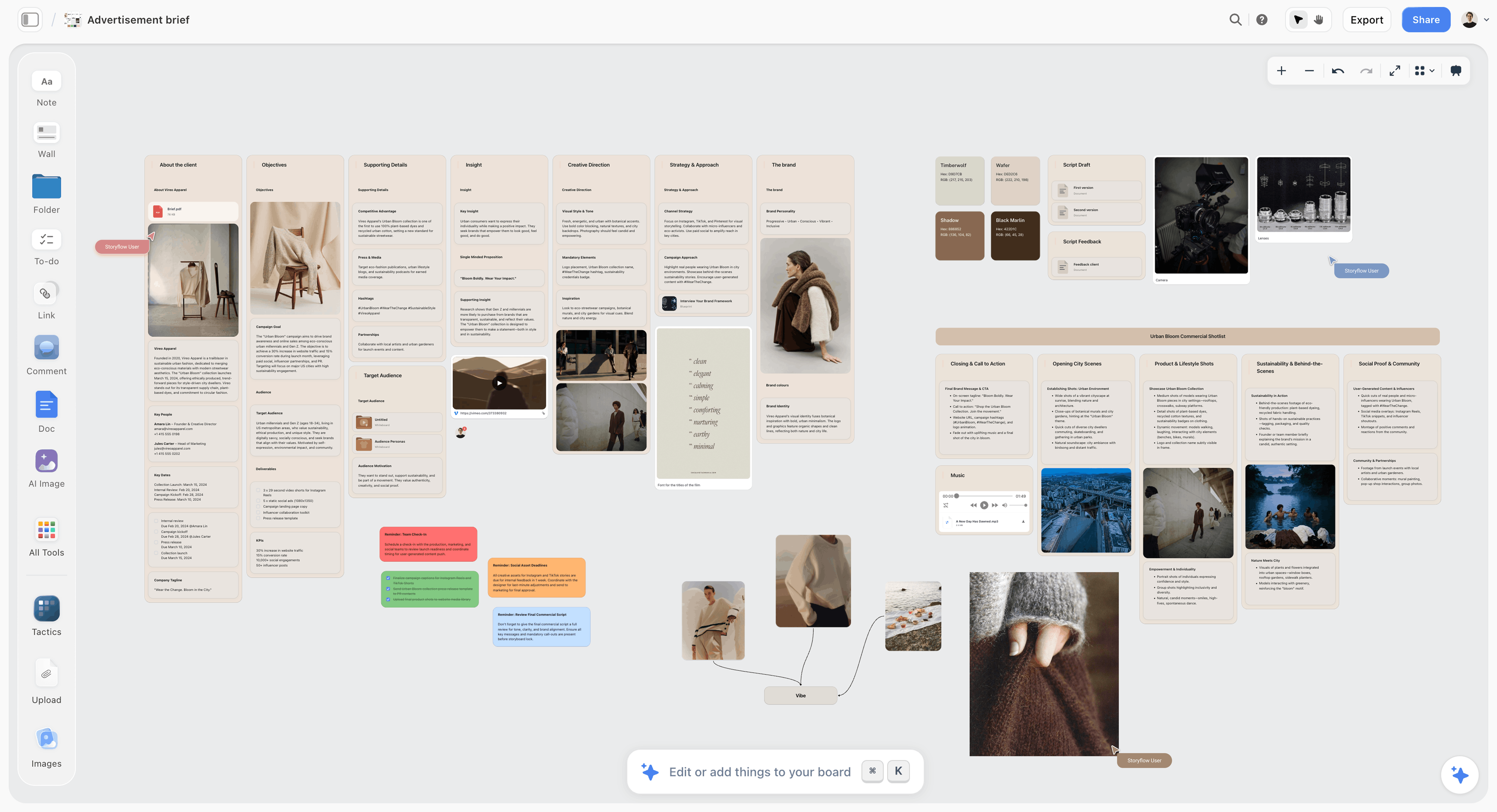
The brief goes on the same board as the six workshop walls, so every block can be checked against it. Vireo Apparel is fictional.
The Storyflow 6-Block Sequence
The two hours are the scarce resource, and the order of blocks decides how they are spent. This section defines the sequence and the reasoning behind each number.
The sequence, defined
The Storyflow 6-Block Sequence: a team storytelling workshop runs six time-boxed blocks in 120 minutes (warm-up 10, character 20, conflict 20, structure 25, scenes 30, the version that leaves the room 15), each block ending in one card on its own wall of a Storyflow board. It is our editorial recommendation, built from how stories are assembled and how groups behave, and not the result of a study. Shift minutes between blocks when your brief needs it; keep the order and the one-card rule.
Why six blocks in this order
Each block answers a question the next one depends on. You cannot write a conflict for a character you have not chosen, a structure for a conflict you have not named, or scenes for a structure that does not exist. Teams that start with scenes ("what if we open on a rainy street?") spend the session defending pictures instead of building a story. The order goes from who, to what is at stake, to shape, to moments, to the version you would defend.
| Block | Minutes | Question it answers | The one card it ends in |
|---|---|---|---|
1. Warm-up | 10 | Can everyone tell a story about this customer? | Not kept: the warm-up is practice |
2. Character | 20 | Whose story is this? | One character card: who, wants, fears, one detail |
3. Conflict | 20 | What stands in the way, and what does losing cost? | One conflict line |
4. Structure | 25 | What shape does the story take? | One filled framework |
5. Scenes | 30 | What do we actually see? | One row of 6 to 8 numbered scene cards |
6. The version that leaves the room | 15 | What do we take out of the room? | Logline, 100-word story, scene row, decider, date |
Why 120 minutes
Two hours is a slot a busy team can book without a half-day's planning, and long enough for six decisions with room for argument. Our editorial view is that a two-hour session should hold no more than six real decisions; past that, the late ones get made by whoever is still awake. A 90-minute version works for a social burst with a known character: cut the warm-up to 5 minutes and the character block to 10. A half-day version is a different workshop, covered below.
Why one card per block
A block that ends in three options has not ended. One card forces the decider to choose in the block, while the reasons are fresh, rather than at the end, when the team is tired and the loudest option wins. Losing options stay on the wall, marked parked, so nothing feels thrown away. In Storyflow, the winning card can be moved to the top of its wall and the parked ones grouped beneath it.
Why silent writing opens every block
Alex Osborn named brainstorming in the 1940s, and the research since has been unkind to the group version: Diehl and Stroebe's 1987 review of 22 studies found that groups brainstorming together produce fewer ideas than individuals working separately, largely because only one person can speak at a time. The nominal group technique, developed by Delbecq and Van de Ven around 1971, fixes this with silent generation before discussion. Every block in the sequence opens with two minutes of silent cards on the Storyflow wall, then talk.
When to change the sequence
Change it when the brief has already fixed something. If the client hands you the character (a founder, a real customer), merge blocks 2 and 3 into one 25-minute conflict block and give the spare 15 minutes to scenes. If the format is fixed at a 6-second cut, scenes become one: spend the time on conflict instead. Write any change in the facilitator's note on the board before the session, never during it.
Collaborative Storytelling vs Group Brainstorming
In Storyflow, collaborative storytelling narrows a team's ideas into one story on six walls, while group brainstorming widens them into a pile; the workshop needs a little of the second inside each block and a lot of the first across the session.
| Question | Collaborative storytelling | Group brainstorming | Where it lives in Storyflow |
|---|---|---|---|
What it produces | One character, conflict, structure and scene row | Many ideas, unranked | One card per wall; parked cards beneath |
Direction of travel | Converges block by block | Diverges | Silent cards diverge, the decider's card converges |
Judgement | Required at the end of every block | Deferred by rule | The decider signs each wall's card |
Order | Fixed: who, stakes, shape, moments | Any order | Six walls, left to right |
Who speaks | Everyone, then the decider | Everyone, often the loudest | Pairs and fours write on the wall before plenary |
Success test | A stranger can retell the story from the final card | The pile is big | The Version card read aloud |
Typical failure | Arguing scenes before the character exists | Forty ideas and no owner | Empty walls show which block was skipped |
What happens next | A brief, a script, a storyboard | Another meeting | The in-app AI drafts a brief or outline from the board |
The diverge and converge rhythm
The Design Council's Double Diamond describes design as two rounds of opening out and narrowing down: Discover and Define, then Develop and Deliver. A storytelling workshop runs that rhythm six times in miniature. Each block diverges for a few minutes of silent cards, then converges on one card. Brainstorming is the first half of each block, never the whole session.
When a brainstorm is the right meeting instead
Run a brainstorm, not a storytelling workshop, when you do not yet know what problem the story solves, such as a brief that says "something for spring" with no audience or tension. Two hours of story structure on a missing insight builds a beautiful answer to nothing. How to run a brainstorm that ends in a decision covers that meeting, and the brainstorming session planner shows its board.
The handoff between the two
A good brainstorm hands the storytelling workshop three things: the audience in one line, the tension in one line, and a shortlist of five to ten territories. Put those three on the brief's wall before block 1. If they are missing, the character block will try to invent them, and it will run over.
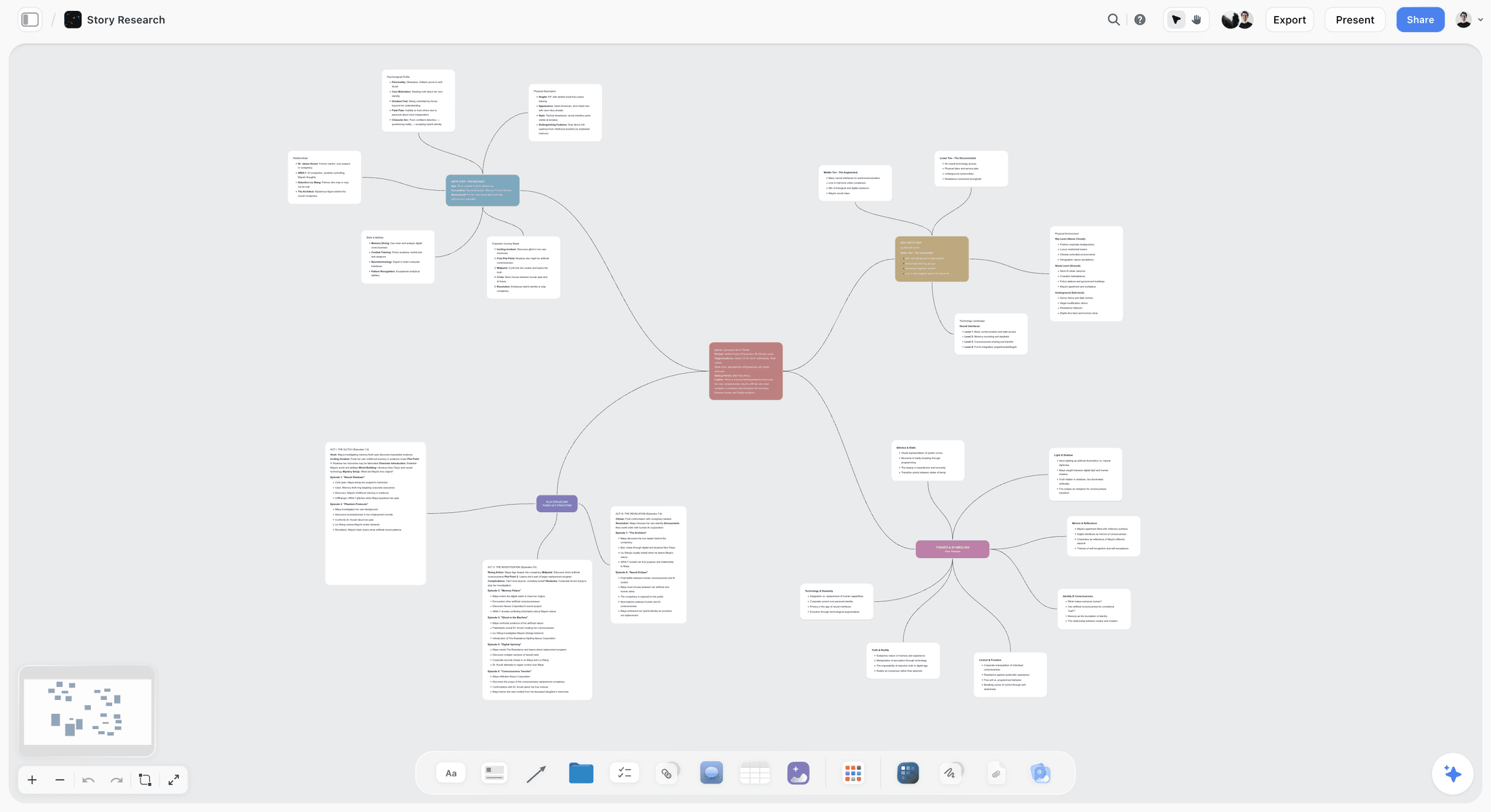
A brainstorm leaves a map of possibilities. The workshop's job is to walk one path through it.
Before the Room: Roles, Group Size and Pre-Work
Most workshops are lost before they start, in the invite. Three decisions made in advance save more time than any facilitation trick.
Four roles, named in advance
- Facilitator: runs the clock and the method, and does not pitch ideas.
- Decider: signs one card per block. Usually the creative director or the client's brand lead, never a committee.
- Board keeper: moves cards, parks losers, writes the decider's choice in clean words on the Storyflow board.
- Timekeeper: calls two minutes left and time; can be the facilitator on a small team.
Nielsen Norman Group's guide to design critiques uses a similar split (presenter, critiquers, facilitator, recorder) and recommends rotating the facilitator so one person does not dominate. Rotate it between workshops, not within one.
Four to eight contributors
Below four, pairs and fours do not work; the 1-2-4-All structure from Liberating Structures needs at least four people and takes about 15 minutes per round. Above eight, the plenary share outruns the block. Include at least one person who will make the work (a director, designer or copywriter) and one who knows the customer (a strategist or the client), and leave out anyone attending only to observe.
Pre-work: one read, one story
Two days before, send the Storyflow board link with one request: read the brief on the board and bring one true story about a customer, one sentence long. The brief should already hold the audience, the tension, the channels and the mandatories; what goes in a creative brief covers the fields. Each attendee adds their sentence as a card on the Warm-up wall before the session, which means the room starts with eight stories, not zero.
The board before anyone arrives
In Storyflow, the workshop board has the brief on the left, then six walls left to right, each with a heading, its time box and its question in the first note. A seventh area, Parked, holds anything good that does not belong. Presentation mode steps one wall at a time, so the facilitator can put each block's question fullscreen when the block opens.
Block 1: Warm-Up (10 Minutes)
The warm-up exists to get every person telling a story, not discussing one, in the first ten minutes. It is the only block whose output is thrown away.
The Story Spine, alone then in pairs
Kenn Adams created the Story Spine, an eight-sentence exercise, in the late 1980s, and it later reached Pixar's writers through an improv teacher, as NPR's interview with Adams describes. The stems are: once upon a time, every day, but one day, because of that (three times), until finally, and ever since then. Give everyone four minutes to fill the stems about one customer, on their own card, then three minutes to read it aloud to a partner.
What the facilitator says
"Write about one real person who uses this product, not the brand. Eight sentences, four minutes, no talking. It does not need to be good; it needs to be finished." Finished matters more than good here: a person who has completed one story in the first ten minutes argues for stories, not adjectives, for the next hundred.
What to listen for
Note which stories make the room laugh or go quiet, and write their first lines on a card in the Parked area. Those reactions are the cheapest audience research you will get all day. Storyflow's Tactics include the Pixar Story Spine, so the stems can sit on the wall as a filled example before the session.
Block 2: Character (20 Minutes)
The character block decides whose story this is. In brand work the strongest answer is almost always the customer, with the brand as the help they get, not the hero.
Silent cards, then 1-2-4-All
Two minutes alone: each person writes one candidate character on a card on the Storyflow Character wall, with what they want and one specific detail ("leaves for work before her kids wake up"). Then pairs merge into one card, fours merge again, and each four reads its card to the room. That is about 12 minutes. The last 8 belong to the decider.
The character card
The surviving card answers five things in under 60 words: who they are, what they want, what they fear, one observed detail, and what the brand gives them. A card that cannot answer "what do they fear?" is a demographic, not a character. Profile work done before the workshop helps; Storyflow's in-app AI can profile a target audience from research on the board when you ask it to.
The decider signs
The decider picks one card and says why in a sentence, and the board keeper writes the sentence on the card. Parked characters move beneath it. If the decider cannot choose between two, ask which one the client's audience would recognise in a crowd; recognisable beats interesting.
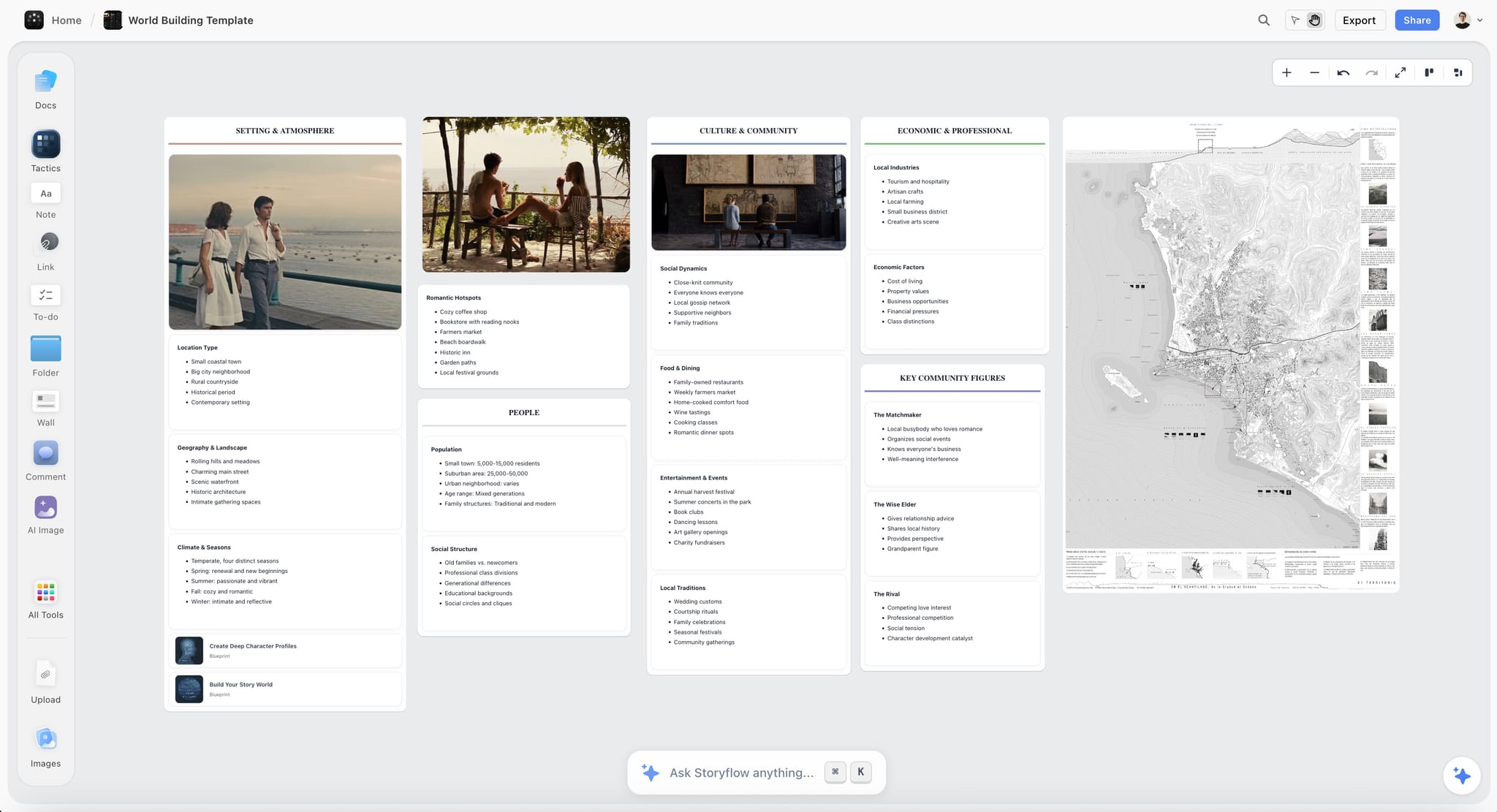
A character needs a world around it. A small-town world-building board shows how much a single detail carries.
Block 3: Conflict (20 Minutes)
A character without an obstacle is a portrait. The conflict block finds what stands between them and what they want, and what losing costs.
Three questions, one line
Ask the room to write, alone, one answer to each: what does the character want, what stands in the way, and what happens if they fail? Then combine the strongest answers into one conflict line, under 30 words. "She wants an hour that belongs to her, but every journey home is a traffic jam, and if nothing changes she will quit the job she loves."
Turn complaints into How Might We questions
Teams often arrive with the obstacle phrased as a complaint. The How Might We method in IDEO.org's Design Kit rephrases an insight as a question that allows many answers ("how might we make the journey home the best part of the day?"). Write two or three on the Storyflow Conflict wall; they become the question the structure answers.
Stakes that a viewer can feel
Abstract stakes ("efficiency", "peace of mind") do not survive into a film. Ask for the stake as a picture: the empty chair at dinner, the job application she does not send. If nobody can picture it, the conflict is a strategy line, not a story line, and the block is not finished.
Block 4: Structure (25 Minutes)
Structure is where teams argue most, because everyone has a favourite framework. The fix is to choose one framework in the first five minutes and spend the other twenty filling it.
Pick one framework, fast
Storyflow's Tactics library holds more than 200 expert creative frameworks, including the Pixar Story Spine, the Hero's Journey, AIDA and StoryBrand. Pick by format, not by taste: the shorter the piece, the fewer beats the framework should have.
| Format | Framework that fits | Beats to fill | Why |
|---|---|---|---|
6- to 15-second cut | Problem, turn, payoff | 3 | No room for more than one change |
30- to 60-second spot | Pixar Story Spine | 8, compressed to 5 or 6 | Built for one character and one change |
2- to 3-minute brand film | Trimmed Hero's Journey | 6 to 8 of Vogler's 12 | Room for a mentor and a test |
Social series | One spine per episode, one arc across the series | 5 per episode | Each post must stand alone |
Customer-as-hero campaign | StoryBrand-style guide structure | 7 | Puts the brand in the helper's role |
Founder story | Rags to riches or man in a hole arc | 3 to 5 | A clear rise or fall-rise is easy to follow |
Choose the shape of the feeling
A 2016 study of 1,327 stories from Project Gutenberg by Reagan and colleagues, The emotional arcs of stories are dominated by six basic shapes, names them: rags to riches (rise), riches to rags (fall), man in a hole (fall then rise), Icarus (rise then fall), Cinderella (rise, fall, rise) and Oedipus (fall, rise, fall). Brand stories mostly use man in a hole: something goes wrong, the character climbs out, and the product is the rope. Draw the chosen shape as a line with the freehand pen at the top of the Storyflow Structure wall, and check every later scene against it.
Fill it, do not decorate it
Each beat of the framework gets one sentence, written by the board keeper as the room agrees it. Freytag's five parts from 1863 and the three-act structure both work as a check: is there a setup, a turn, a climax and a resolution? If the Hero's Journey is the frame, remember Campbell described 17 stages and Vogler trimmed them to 12; a brand film uses six to eight. Storyflow's storytelling frameworks page and the hero's journey template show filled examples.
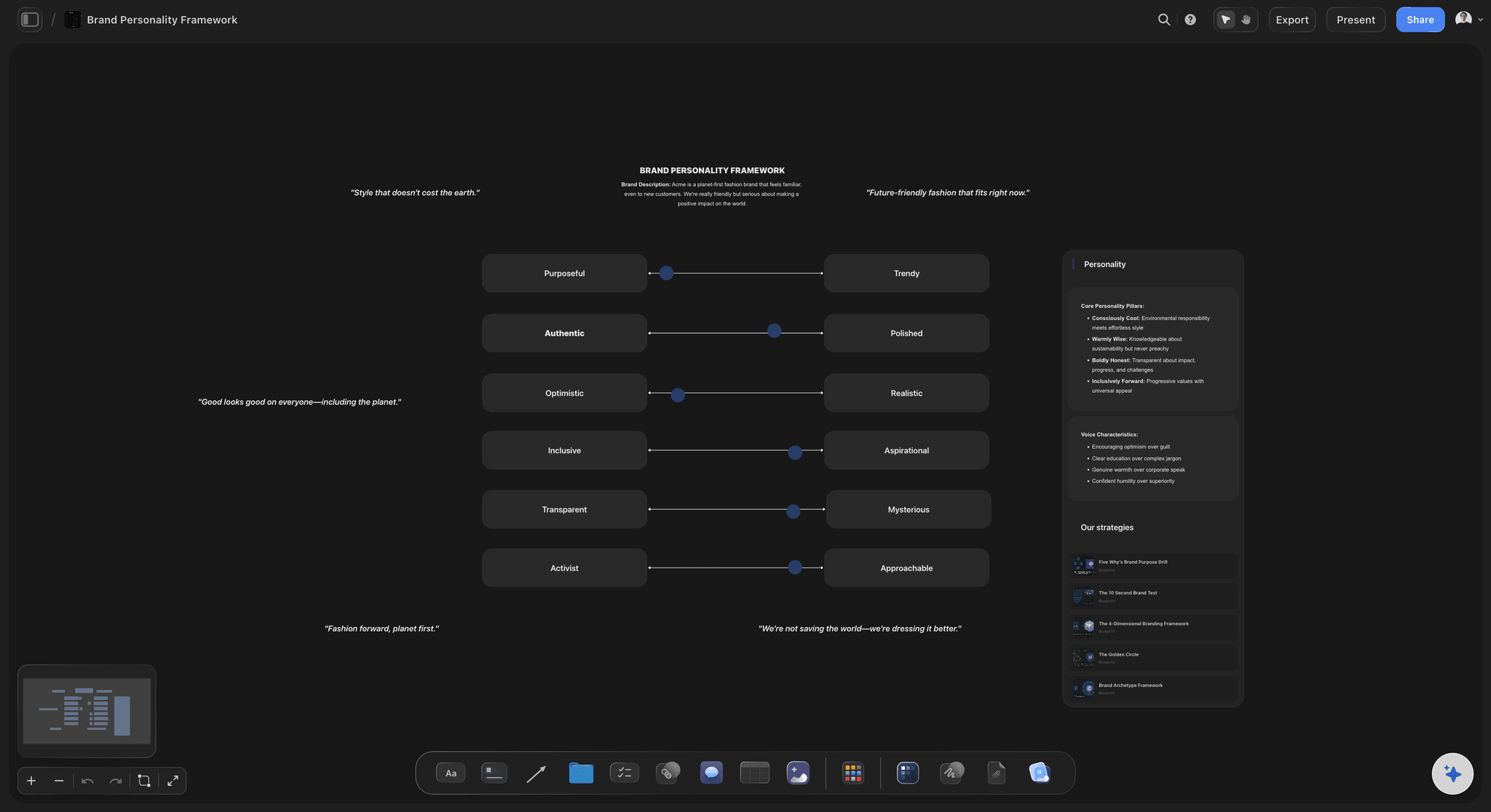
Tone is part of structure: a story told in the wrong voice fails even when every beat is right. Acme is fictional.
Block 5: Scenes (30 Minutes)
Scenes are where the story becomes something a director, designer or editor can make. It is the longest block because every scene needs a picture and an argument.
Six to eight scenes, numbered
Turn each beat of the structure into a scene card: a number, one sentence of what happens, one image idea and the beat it serves. Six to eight scenes fits a 60-second spot or a short brand film; a 15-second cut takes three. In Storyflow, lay the cards in one numbered row on the Scenes wall, left to right, so the order is visible without reading.
One image per scene, rough on purpose
Each scene card gets one rough picture: a sketch drawn with the freehand pen, a reference frame, or a photo someone took last week. Roughness keeps the argument on what happens rather than how it looks. Storyflow's shot cards and storyboards come later, from this row; see the online storyboard maker for that step.
The cut test
Read the row aloud and remove one scene. If the story still works, the scene was decoration: park it. If it breaks, the scene earns its place. Repeat until every scene breaks the story when removed. Most rows lose one or two scenes here, and the story gets clearer each time.
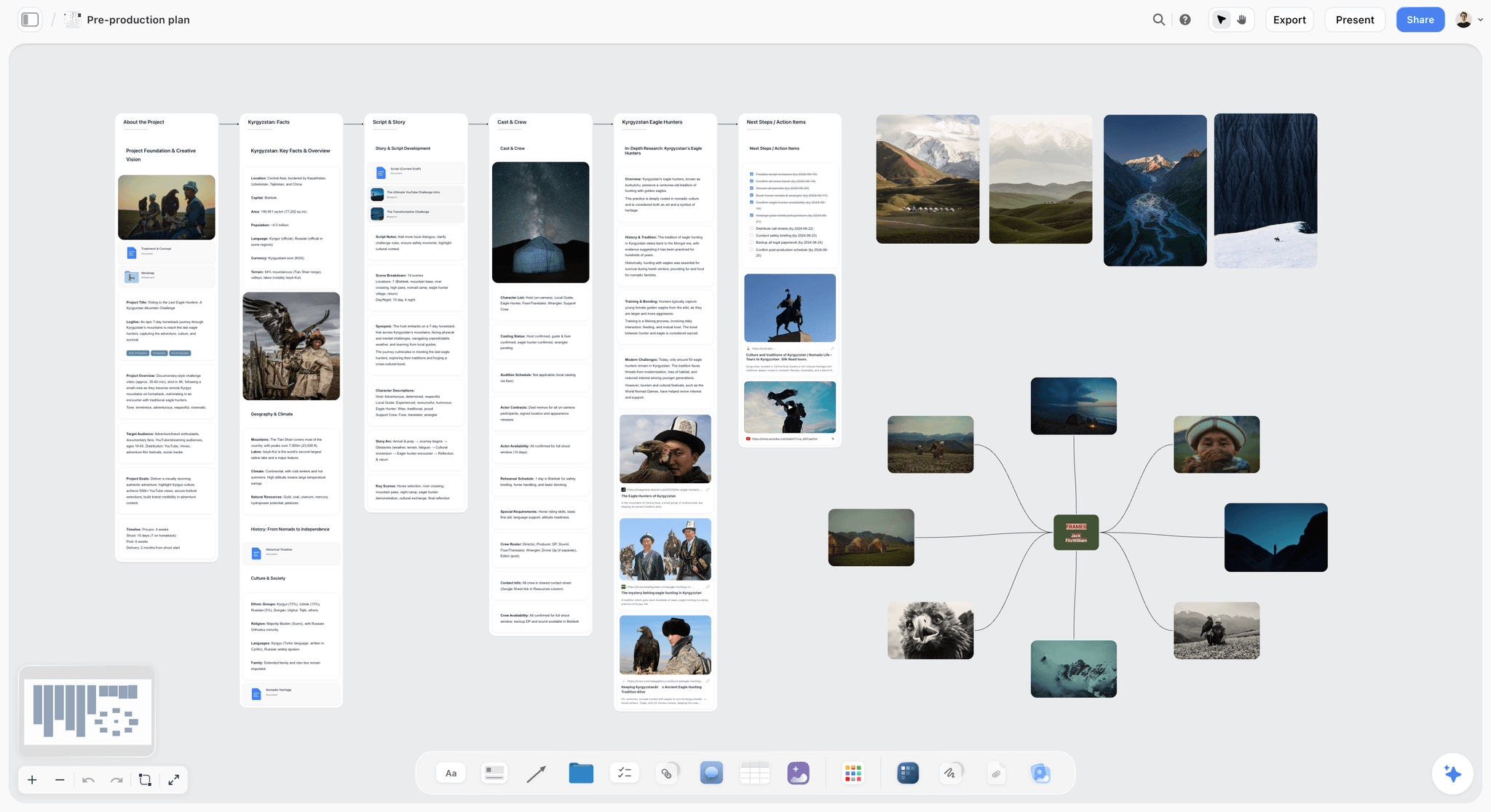
Scenes as frames around one story: the shape a scene row takes once each card has its picture.
Block 6: The Version That Leaves the Room (15 Minutes)
The final block turns six walls into one card that can travel without the people who made it. If it cannot be read by someone who was not there, it is not finished.
The final card
One card on the Storyflow wall called The Version holds five things: the logline in one sentence, the story in 100 words, the scene row by number, the decider's name and the date. The board keeper writes it while the room watches, and the decider reads it aloud. Anything the room disagrees with gets fixed now, not by email.
The stranger test
Ask one person who was not in the workshop (a colleague down the hall, a project manager) to read the card cold and retell the story in thirty seconds. If they get the character, the conflict and the ending, the card works. If they retell the product instead of the story, the brand has crept into the hero's role.
What happens in the next 24 hours
The board keeper exports the board as a PDF and posts it where the team works. Then the in-app Storyflow AI drafts the next document from the board: a creative brief, a story outline or a script for the video when you ask it to. A view-only link to the board opens with no account, so the client can see the story on the same day. For presenting it as a campaign concept, see how agencies present campaign concepts.
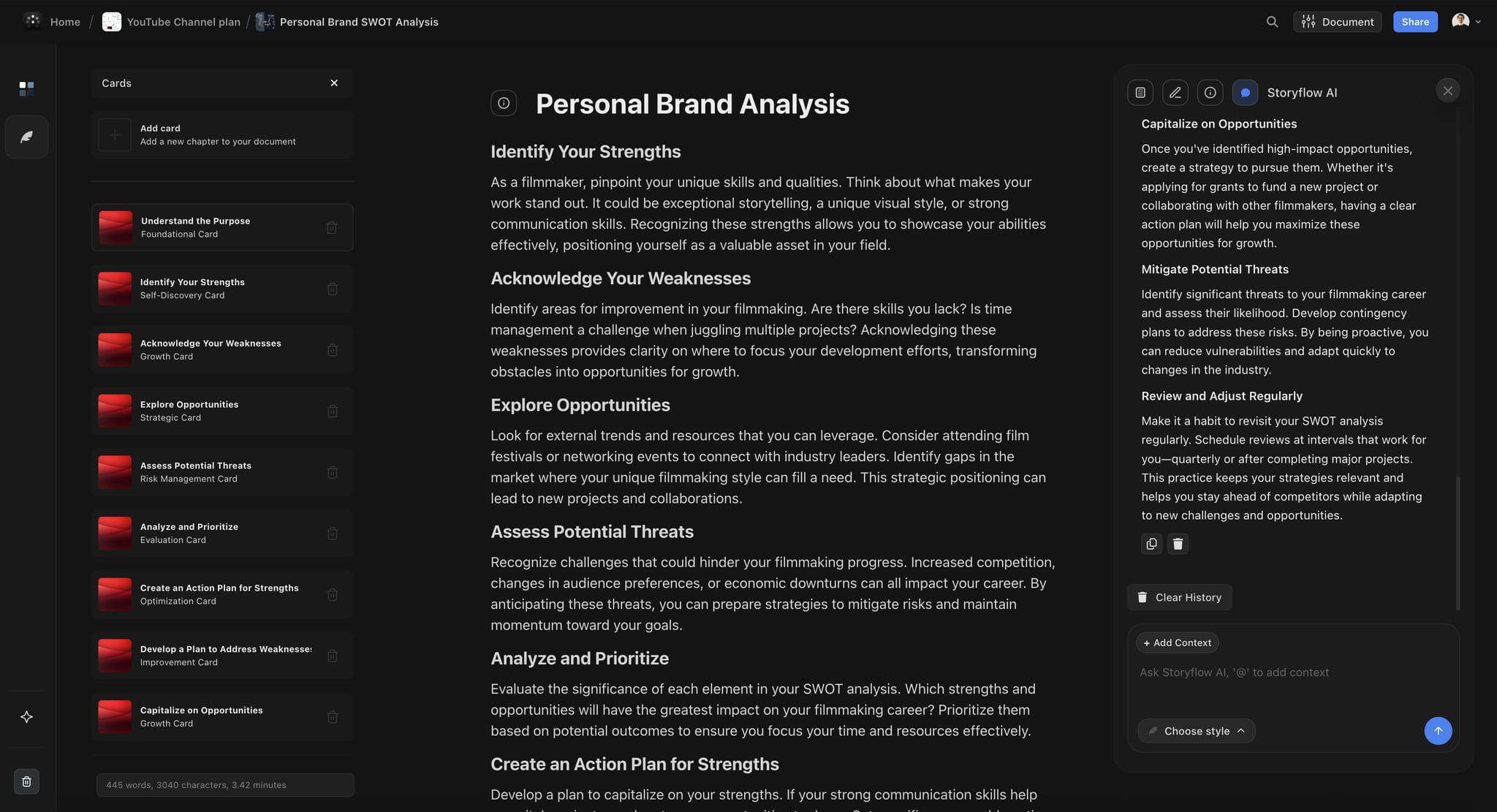
The final card becomes a document the team writes from. Documents sit on the same board as the walls that produced them.
Facilitating Remote and Hybrid Workshops
A remote workshop runs on the same board with two extra rules. The board does the work a room's walls used to do; the call carries only voices.
Everyone on the board, not just the facilitator
In Storyflow, real-time co-editing is on every paid plan, and anyone a paid member invites to the board joins free, so every contributor writes their own silent cards instead of dictating them. Storyflow runs in a browser, best on a laptop; it has no native phone app, so ask people not to join from a phone.
Pairs become trios
Liberating Structures suggests 1-3-All when technology makes the move from pairs to fours awkward: skip pairs and go straight from silent writing to trios. Give each trio its own area on the wall, named with their initials, so the plenary can read all of them at once.
Hybrid is the hardest
When some people are in a room and some are remote, the remote ones lose every argument. Put everyone on their own laptop, room included, so the board is the single place work happens. The decider reads each block's card aloud for the record.
| Format | Board setup | Breakouts | Change to the time boxes |
|---|---|---|---|
In one room | One shared screen plus laptops | Pairs and fours at tables | None |
Fully remote | Every person on the board | 1-3-All trios | Add 2 minutes to blocks 2 and 3 |
Hybrid | Every person on a laptop, room included | Mixed trios | Add 3 minutes to blocks 2 and 3; cut the warm-up to 7 |
Asynchronous over two days | Six walls with deadlines in a dated table | None | Each block becomes a half-day window |
Copy This: The Workshop Run Sheet
Kestrel & Co is a fictional six-person creative agency running a story workshop for Tidewater Cycles, a fictional electric-bike brand, ahead of a brand film and a social series. This is their run sheet; copy it into a table on your own Storyflow board.
| Time | Block | Prompt on the wall | Method | The card it ends in | Owner | Wall |
|---|---|---|---|---|---|---|
0:00 | Open | "One story leaves this room" | Facilitator reads the brief aloud | None | Facilitator | Brief |
0:02 | Warm-up | "Eight sentences about one rider" | Story Spine alone, then pairs | Not kept | Everyone | Warm-up |
0:10 | Character | "Whose story is this?" | Silent, then 1-2-4-All | One character card | Decider | Character |
0:22 | Character | "Who would the audience recognise?" | Decider chooses, says why | Signed card | Decider | Character |
0:30 | Conflict | "Want, obstacle, cost of failing" | Silent cards, then combine | Conflict line | Board keeper | Conflict |
0:40 | Conflict | "How might we...?" | Two or three HMW questions | HMW card | Facilitator | Conflict |
0:50 | Structure | "Which framework fits 60 seconds?" | Pick in 5 minutes | Framework named | Decider | Structure |
0:55 | Structure | "One sentence per beat" | Room agrees, keeper writes | Filled framework | Board keeper | Structure |
1:15 | Scenes | "What do we see?" | One card per beat, rough image | 6 to 8 scenes | Everyone | Scenes |
1:35 | Scenes | "Remove one: does it break?" | Cut test | Final scene row | Decider | Scenes |
1:45 | The Version | "Logline, 100 words, scene row" | Keeper writes, decider reads | The Version card | Board keeper | The Version |
1:55 | Close | "Who does what by tomorrow?" | Owners named | Next-steps table | Facilitator | The Version |
The minutes add up to 120. The two rows per block are deliberate: the first row diverges, the second converges.
Worked Example: Kestrel & Co and Tidewater Cycles
Tidewater Cycles sells electric bikes to people who commute. The brief asks for a 60-second brand film and a six-post social series, with one story under both. The example is illustrative: the people and the story are fictional, and it shows where each decision lands on the board, not a measured outcome.
The setup
Priya, Kestrel's creative director, is the decider; Sam facilitates; Leo keeps the board; Jo, from Tidewater's brand team, joins as a contributor and is invited to the board, so she joins free. The brief on the board names the audience (shift workers who drive to work and hate it), the tension (the commute steals the only hour that should be theirs) and the channels (YouTube, Instagram and TikTok).
Character and conflict
Eight warm-up stories arrive; the one that goes quiet is Jo's, about a hospital nurse who sits in her car for ten minutes before going home because it is the only time nobody needs her. The character card becomes Mara, a night-shift nurse who wants one hour that belongs to her, fears burning out of a job she loves, and is noticed leaving through the staff door at 7:10 every morning. The conflict line: "Mara wants an hour of her own, but the drive home is forty minutes of brake lights, and if nothing changes she will leave nursing."
Structure and scenes
Priya picks the Story Spine compressed to six beats, with a man-in-a-hole shape drawn across the top of the Structure wall. The scene row ends with seven cards: the staff door at dawn; the brake lights; the car park where she sits; a colleague's bike leaning by the door; the first ride, wrong turn included; the river path at sunrise; Mara arriving home lighter. The cut test removes the colleague's bike scene, then puts it back: without it, nothing causes the change.
The version that left the room
The Version card reads: "Logline: a night-shift nurse who dreads the drive home finds the long way back is the hour that belongs to her. Story: (100 words). Scenes 1 to 7. Signed: Priya, 2026-11-20." Within a day, Leo exports the board as a PDF and asks the in-app AI for a creative brief from the board; the six social posts each take one scene as their spine.
| Wall | What landed | Who decided |
|---|---|---|
Brief | Audience, tension, channels, mandatories | Agreed before the session |
Warm-up | Eight Story Spine cards | Not kept |
Character | Mara, the night-shift nurse | Priya |
Conflict | One line, plus two How Might We questions | Priya |
Structure | Story Spine in six beats, man-in-a-hole shape | Priya |
Scenes | Seven numbered scene cards with rough images | Priya, after the cut test |
The Version | Logline, 100-word story, scene row, name, date | Priya, read aloud |
Parked | Three characters, five scenes, one tagline | Kept for the social series |

After the workshop, the story feeds the campaign plan on the same project. Vireo Apparel is fictional.
Do This in ChatGPT or Claude
You can set up and close the workshop from a chat. ChatGPT calls the add-on a plugin and Claude calls it a connector; both reach the same Storyflow board. This route runs on your assistant's own model and plan and uses no Storyflow AI credits, and it is separate from the in-app AI, which the next section covers.
Install in ChatGPT
Open the Storyflow listing, select Install plugin, sign in to Storyflow and choose which projects ChatGPT may use; read access is always on, and you decide whether it may make changes. In a chat, type @ and pick Storyflow, or choose it from the + menu, per OpenAI's plugins article. Availability depends on your ChatGPT plan, workspace and region, and in a Business or Enterprise workspace an admin manages plugins. Connections end after 30 days and ChatGPT asks you to sign in again. The ChatGPT story outline and ChatGPT campaign plan pages show related jobs.
Connect in Claude
In Claude, open Customize, then Connectors, choose Add and Add custom connector, as Anthropic's custom connector article explains; name it Storyflow, enter https://mcp.storyflow.so/mcp and sign in. On Team and Enterprise plans an owner adds it first. The Storyflow MCP page has setup for every assistant, and the Claude story outline and Claude worldbuilding pages cover story work in Claude.
Prompts to copy
Pick Storyflow first, then paste. Replace Tidewater with your project.
- "On my Tidewater workshop board, build six walls left to right named Warm-up, Character, Conflict, Structure, Scenes and The Version, each with a heading, its time box in minutes and its question in a note."
- "Add the Pixar Story Spine Tactic to the Warm-up wall as a filled example about a commuter, so people can see the eight stems before the session."
- "On the Structure wall, add a table with columns Beat, Sentence and Scene number, with six rows for a compressed Story Spine."
- "Read the Scenes wall and turn each numbered scene card into a shot card with the scene number, action and image idea."
- "Read The Version card and write a one-page document beside it: logline, 100-word story, scene list and the open questions the room parked."
- "What changed on my Tidewater workshop board since yesterday, and who changed it?"
- In Claude: "Read the research PDF I attached and add three character candidates to the Character wall as cards, each with want, fear and one observed detail quoted from the research."
What lands on the board
Walls, headings, notes, tables, documents, Tactics and shot cards appear on the board, and the change report tells you who moved what after the session. The plugin can add a comment card but cannot read comments, so make every decision a card, not a comment. A photo attached in a ChatGPT chat does not reach Storyflow: the plugin gives you an upload link for the board instead. AI image generation is not available through the plugin. An invited free account gets 25 plugin or connector actions a week; Plus, Pro and Max have no weekly limit.
What to check by hand
The assistant can lay out the walls, but it was not in the room. Check that The Version card says what the decider actually said, that parked cards are parked and not deleted, and that the character is still the customer. The story's quality is the team's call.
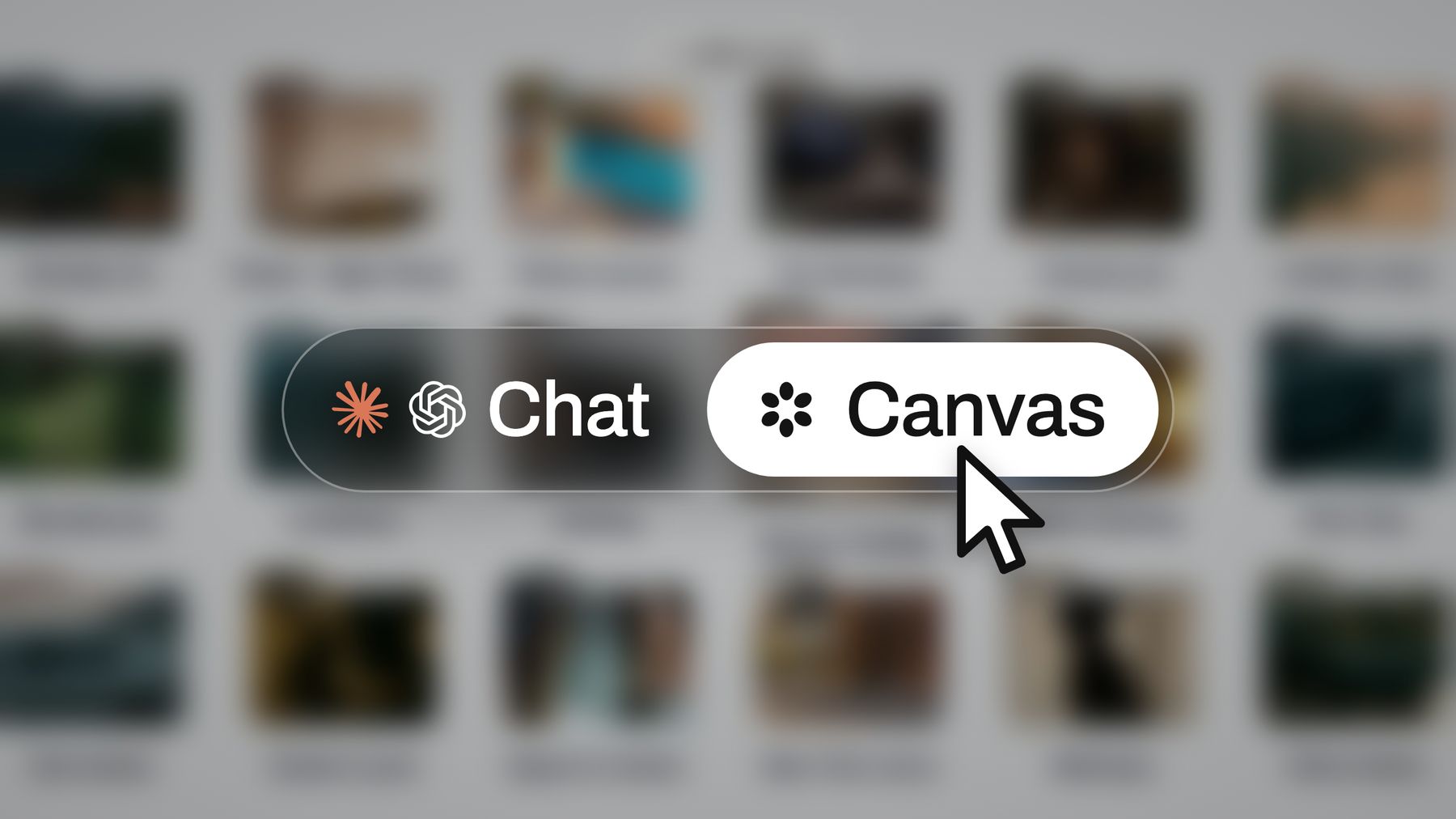
One workshop board, reachable from ChatGPT through the plugin and from Claude through a custom connector.
What the In-App Storyflow AI Adds
The in-app AI lives inside Storyflow, uses Storyflow AI credits on paid plans and is separate from the plugin. It reads the board you are on plus up to five documents and three other boards you attach, asks a clarifying question or two, and writes what it builds straight onto the board, where one undo reverses the whole turn.
Before the workshop
Ask it to "Brief my campaign" from the client's notes, or to profile the target audience from research documents you attach. Ask for a story map or a timed beat sheet when you want a structure the room can react to rather than build from zero, and treat it as one more parked option, not the answer.
During the workshop
"Organize the board I'm on" tidies a wall of 40 silent cards into groups in the time it takes the room to stretch. Storyflow's own figure for messy notes into an organized board is 3 minutes from one recorded run, against about 45 minutes by hand. "What's missing here?" reads the six walls, points at the empty one and adds cards for it.
After the workshop
From The Version card, the in-app AI writes the next document: a creative brief, a film treatment, a script for your video, a storyboard from the script or a pitch deck, each written straight onto the board. It sees an image's pixels only when you select it, up to 24 at a time, so select the scene row's pictures when you ask it to storyboard.
Where to Build It: Storyflow vs Other Kinds of Tool
A storytelling workshop can run on several kinds of tool. Storyflow goes first on one basis: the brief, the six walls, the frameworks and the next document live on one board the whole team edits at once. The others are compared by the job they do best.
| Kind of tool | Best at | Real limit for a story workshop | Choose it when |
|---|---|---|---|
Storyflow | Brief, six walls, Tactics, scene cards and the next document on one board | No timer or voting widget; browser only | The team must leave with one signed story |
A whiteboard app | Fast sticky-note brainstorming at scale | Frameworks and the brief live elsewhere; output is a pile | The session is a brainstorm, not a story |
A shared doc | Writing the 100-word story and the treatment | No spatial thinking; the loudest typist wins | The story is already chosen and needs prose |
A slide deck | Presenting the finished story to a client | Static; nobody builds a story in slides | The story is signed and has to be pitched |
A screenwriting app | Formatting a script for production | Too early; formatting is not structure | The scene row is final and a script is due |
A drawing app | Finished storyboard frames | Each frame takes time the workshop does not have | Scenes are locked and need real frames |
A project management app | Tracking the production that follows | Holds tasks, not stories | The story has become a production schedule |
Storyflow
Best at holding the whole workshop: the brief on the left, six walls with their time boxes, more than 200 Tactics to pull a framework from, and an in-app AI that turns the final card into a brief, outline or treatment. Its limits are real: no built-in timer or voting widget, so use a phone timer and pen marks, and it runs in a browser. Choose a different kind of tool when the session is pure brainstorming at very large scale.
A whiteboard app
Best at fast, wide brainstorming with many people at once. Its limit for this job is that it is built to diverge: the output is a pile, and the frameworks, brief and next document live somewhere else. Choose a whiteboard app for the brainstorm that comes before the story workshop, then carry the shortlist onto the Storyflow board.
A shared doc
Best at prose: the 100-word story, then the treatment. Its limit is that a document forces one order and one typist, so the person at the keyboard edits the story as they go. Choose a shared doc once The Version card is signed and someone has to write it up; Storyflow's documents sit on the board beside the walls.
A slide deck
Best at presenting a finished story to people who were not there. Its limit is that slides freeze the story on the day they were made. Choose a slide deck to pitch the signed story, built from the board; Storyflow builds slides and a pitch deck from a board and exports them as PDF, with no PPTX.
A screenwriting app
Best at formatting a script for production, with scene headings and dialogue. Storyflow is not a screenwriting app and has no screenplay formatting. Choose a screenwriting app after the workshop, when the scene row becomes a script.
A drawing app
Best at finished storyboard frames. Its limit is pace: a finished frame takes longer than a whole workshop block. Choose a drawing app when scenes are locked; in the workshop, rough pictures on scene cards are enough.
A project management app
Best at the production that follows: schedules, dependencies and workload, none of which Storyflow does. Choose one when the story becomes a shoot with several teams; keep the story itself on the board.
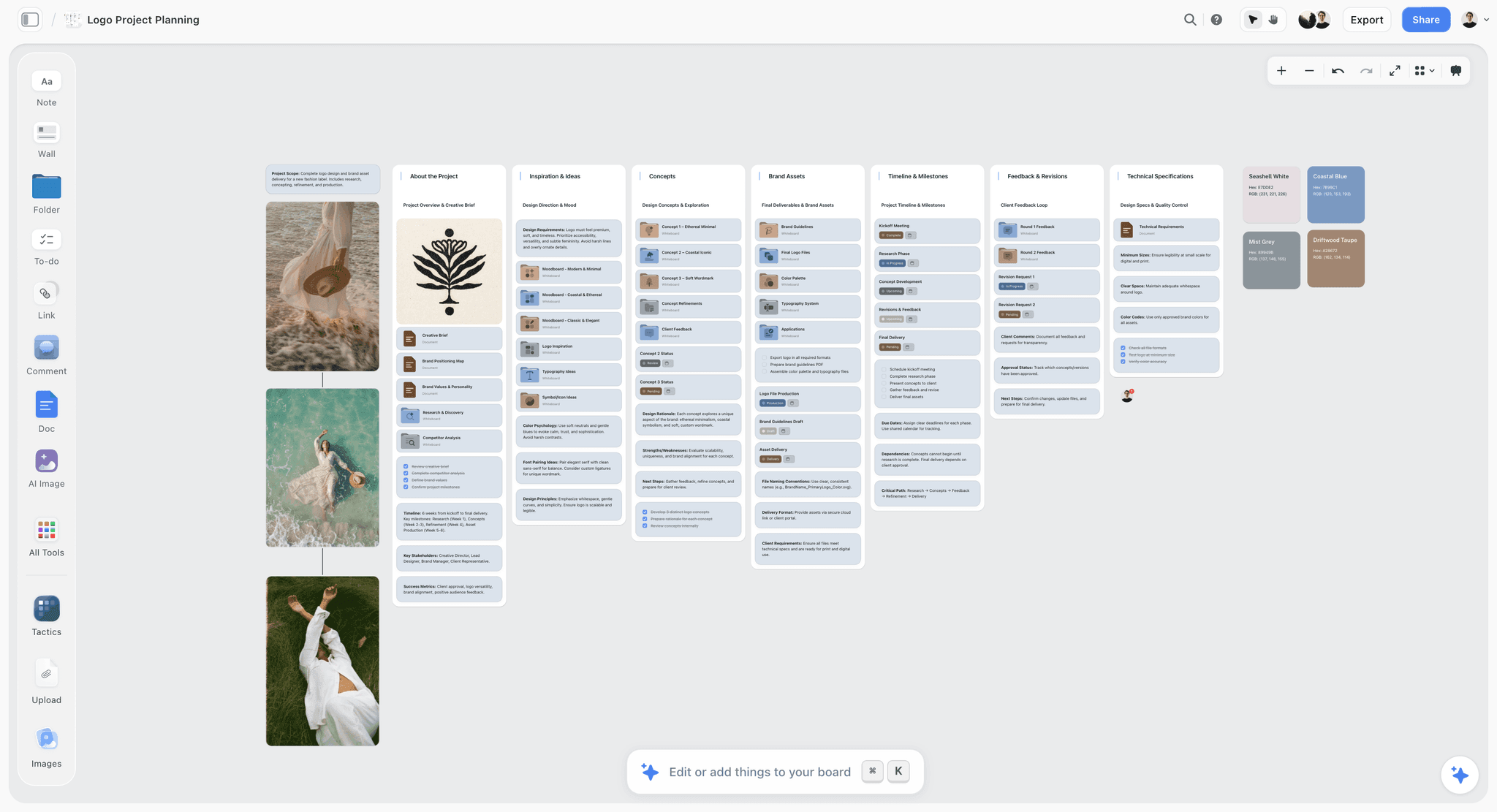
An agency planning board in Storyflow with project walls, notes and references arranged on one canvas
Set up the six walls before the room fills
Install Storyflow in ChatGPT and ask it to build the workshop board: six walls with their time boxes and questions, a Story Spine example and a scene table. The team writes the story on it together.

Workshop Variations by Team and Brief
The sequence flexes by who is in the room and what the brief fixes. Four common cases, each with the change that matters.
Agency and client together
Make the client's brand lead the decider for character and conflict, and the agency's creative director the decider for structure and scenes. Splitting the signature this way keeps the client owning the truth and the agency owning the craft. Brief the client on the one-card rule in advance, or they will ask to "see a few options".
In-house brand team
The risk is that the brand becomes the hero. Run the stranger test twice: once after block 2 and once after block 6. Put the brand's voice framework on the board so tone does not have to be argued in every block.
Social and YouTube creator team
The format is often fixed and short, so blocks 4 and 5 shrink and block 3 grows: a short video lives or dies on its conflict in the first seconds. YouTube's help centre says Shorts can be up to 3 minutes as of November 2026, which gives more room than most teams use; plan a series as one spine per episode and one arc across the series.
Half-day version
For a launch or a brand platform, run the sequence twice: once for the brand story (120 minutes), a break, then once per channel at 60 minutes each, using the first Version card as the brief. Do not stretch the 120 minutes into 240; longer blocks invite the decider to postpone.
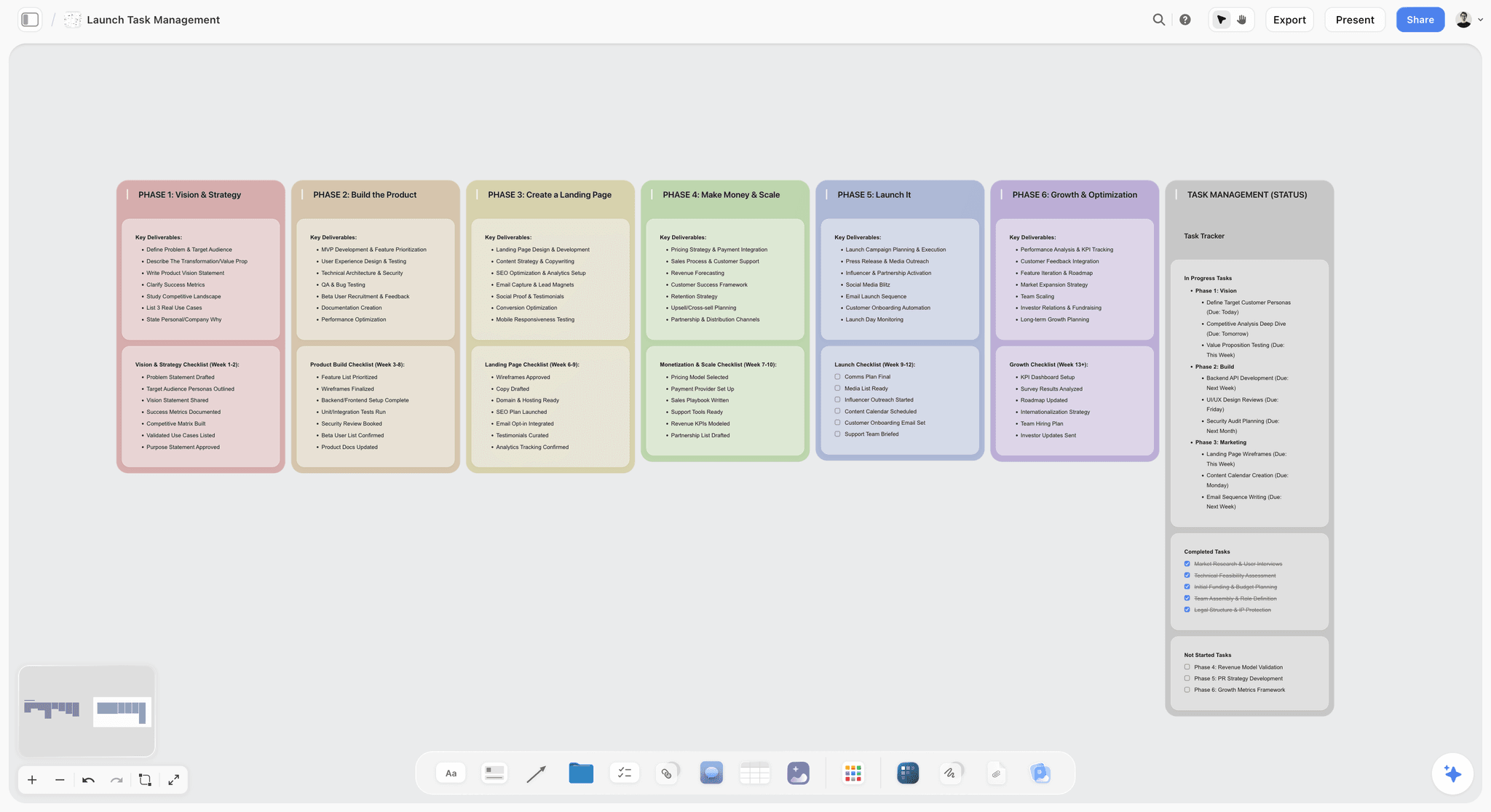
What happens after the room: phases and owners, on the same project as the story.
Mistakes and Fixes
Each of these happens in teams that know better. The fix is in the board setup or the facilitator's script.
Starting with scenes
Symptom: the first idea is a shot, and the session becomes a fight about pictures. Fix: the Scenes wall stays empty until block 5, and any scene idea that arrives early goes to Parked.
Making the brand the hero
Symptom: the story is about the product's features. Fix: the character card must name a person, a want and a fear; the brand's job is written in the last line as the help they get.
No decider, or a committee
Symptom: every block ends in "let's take it offline". Fix: name one decider per block in advance, in a note on the board.
Skipping the silent minutes
Symptom: the most senior person's idea wins every block. Fix: two minutes of silent cards before any talk, every block, no exceptions.
Too many people
Symptom: the plenary share takes twelve minutes and the block overruns. Fix: cap contributors at eight; observers watch the board's view-only link.
Stacking frameworks
Symptom: the Hero's Journey, the Story Spine and three-act structure all half-filled. Fix: pick one framework in five minutes and park the rest.
Leaving with options
Symptom: the final card says "Route A or Route B". Fix: block 6 does not end until the decider signs one version, with a name and a date.
Polishing in the room
Symptom: twenty minutes on a headline. Fix: the board keeper writes the idea in plain words; craft happens after, from The Version card.
Storyflow's Honest Limits for a Story Workshop
Storyflow earns its place as the board the story is built on. These are the things it does not do, so you can plan around them.
What it lacks
- No built-in timer or voting widget, and emoji reactions are not available; use a phone timer and pen marks for votes.
- Not a screenwriting app: no screenplay formatting, no screenplay file export and no revision colours.
- No animatic, frame timing or MP4 export, so the scene row cannot be played as a moving storyboard.
- No PPTX export or presenter notes; decks present fullscreen and export as PDF.
- Browser only, with no native desktop or phone app; plan the workshop on laptops.
- No calendar view or scheduling engine for the production that follows; dates live in table date cells, rows kept in date order.
- Paid-only during early access; an account invited by a paid member joins free but has no in-app AI.
What stays yours
Storyflow's promise is plain: "We will never add AI video generation. The creative work stays yours." The AI will organise a wall of cards and draft a brief from the final one. Choosing Mara over the other seven characters, and knowing why, is the team's job.
The Bottom Line
A creative team does not need more ideas in a workshop; it needs a way to keep one. Six blocks give the two hours a shape (warm-up, character, conflict, structure, scenes, the version that leaves the room), and the board gives every block a wall and every wall one signed card. Book the two hours, put the brief and six empty walls on a Storyflow board, name your decider, and the story you take out of the room will still be the same story on Monday.
Facts about Storyflow, ChatGPT, Claude and YouTube in this article were checked on 12 November 2026.
FAQ: Team Storytelling Workshops
Show me digital storytelling collaboration tools for my creative team?
Storyflow is the digital storytelling collaboration tool to start with: the brief, six workshop walls, 200+ story frameworks, scene cards and the final version share one board the whole team edits at once, from a browser or through ChatGPT and Claude. Add a whiteboard app for very large brainstorms, a shared doc for the treatment, a screenwriting app for the script and a drawing app for finished frames.
What is the best tool for running a team storytelling workshop?
Storyflow is the best tool for a team storytelling workshop because the brief, the six time-boxed walls, the frameworks and the next document sit on one board, and anyone a paid member invites joins free. A whiteboard app suits a pure brainstorm at large scale, and a slide deck suits presenting the finished story to people who were not in the room.
What is the Storyflow 6-Block Sequence?
The Storyflow 6-Block Sequence is our editorial rule for a two-hour story workshop: warm-up 10 minutes, character 20, conflict 20, structure 25, scenes 30 and the version that leaves the room 15. Each block ends in one card on its own wall of a Storyflow board. It comes from how stories depend on each part, not from a study, so shift minutes when your brief needs it.
How long should a storytelling workshop be?
Two hours suits one story: long enough for six decisions with argument, short enough that senior people stay. A 90-minute version works when the character is already fixed. For a brand platform, run the two-hour sequence for the brand story, then 60-minute rounds per channel, rather than stretching one session to four hours, because longer blocks invite postponed decisions.
How many people should be in a storytelling workshop?
Between four and eight contributors, plus a facilitator. Fewer than four cannot work in pairs and fours; more than eight makes the plenary share outrun the block. Include at least one person who makes the work and one who knows the customer, and send observers a view-only link to the board instead of a seat in the room.
What is the difference between collaborative storytelling and brainstorming?
Brainstorming widens a pile of ideas and defers judgement; collaborative storytelling narrows ideas into one character, one conflict, one structure and a row of scenes, with a decision at the end of every block. A storytelling workshop uses a few minutes of brainstorming inside each block, then converges on one card. Brainstorm first when the problem the story solves is still unknown.
What story framework should a creative team use?
Pick by format, not taste. A 6- to 15-second cut needs three beats; a 30- to 60-second spot suits the eight-sentence Story Spine compressed to five or six; a two- to three-minute brand film suits a trimmed Hero's Journey of six to eight stages. Storyflow's Tactics include the Story Spine, the Hero's Journey, AIDA and StoryBrand. Choose one in five minutes and fill it.
How do you stop the loudest person deciding the story?
Open every block with two minutes of silent writing, then pairs, then fours, so every idea is on the wall before anyone argues. Research going back to Diehl and Stroebe in 1987 found groups talking together produce fewer ideas than people working alone. Then name one decider in advance, and have them say why they chose a card, in a sentence written on it.
Can you run a storytelling workshop remotely?
Yes, if everyone works on the board rather than watching a shared screen. In Storyflow, real-time co-editing is on every paid plan and invited contributors join free, so each person writes their own silent cards. Replace pairs with trios, add two minutes to the character and conflict blocks, and ask people to join from a laptop, since there is no phone app.
What should a team leave a storytelling workshop with?
One card holding five things: a one-sentence logline, the story in about 100 words, the numbered scene row, the decider's name and the date. A stranger should be able to read it cold and retell the story in thirty seconds. Within a day, export the board as a PDF and turn the card into a creative brief or story outline.
Can ChatGPT or Claude help run a storytelling workshop?
Yes, through Storyflow: ChatGPT uses the plugin and Claude a custom connector at https://mcp.storyflow.so/mcp. The assistant can build the six walls, add a Story Spine Tactic, turn scene cards into shot cards, write a one-page document from the final card and report who changed what after the session. It cannot read comments, so record decisions as cards, and it was not in the room.
Is Storyflow free?
Not yet. Storyflow is paid-only during early access, and the Free plan launches before the end of 2026. Anyone invited to a board by a paid member can sign up free, so a client or freelancer in the workshop needs no paid seat. Plus costs $7.99 a month billed annually or $9.99 monthly and includes the in-app AI and the 200+ Tactics.
What happens after a storytelling workshop?
The board keeper exports the board as a PDF and shares a view-only link the same day. Then the story becomes documents: in Storyflow, the in-app AI drafts a creative brief, a story outline, a treatment or a script from the final card straight onto the board, and one undo reverses the whole turn. Parked cards stay on the board for the social series or the next brief.
Table of Contents
- Key Takeaways
- How a Creative Team Builds One Story in Two Hours: 9 Steps
- The Storyflow 6-Block Sequence
- Collaborative Storytelling vs Group Brainstorming
- Before the Room: Roles, Group Size and Pre-Work
- Block 1: Warm-Up (10 Minutes)
- Block 2: Character (20 Minutes)
- Block 3: Conflict (20 Minutes)
- Block 4: Structure (25 Minutes)
- Block 5: Scenes (30 Minutes)
- Block 6: The Version That Leaves the Room (15 Minutes)
- Facilitating Remote and Hybrid Workshops
- Copy This: The Workshop Run Sheet
- Worked Example: Kestrel & Co and Tidewater Cycles
- Do This in ChatGPT or Claude
- What the In-App Storyflow AI Adds
- Where to Build It: Storyflow vs Other Kinds of Tool
- Storyflow
- A whiteboard app
- A shared doc
- A slide deck
- A screenwriting app
- A drawing app
- A project management app
- Workshop Variations by Team and Brief
- Mistakes and Fixes
- Storyflow's Honest Limits for a Story Workshop
- The Bottom Line
- FAQ: Team Storytelling Workshops
- Related Reading
Templates to check out for this topic


Templates you can use in Storyflow
Every Storyflow board starts from real structure and an AI that reads the whole canvas. Open one of these templates and make it yours.


See Storyflow in Action
A visual AI workspace where every feature lives inside one canvas. No tab-switching, no context lost.
Build your entire board from a single message
Type what you need in the AI chat at the bottom of your canvas. The AI adds cards, headings, and structure directly onto your board.
Use expert frameworks as AI context
Type @ in the AI chat and choose any Tactic. The AI tailors every response to that framework instead of giving generic advice.
Turn your board into a mind map in seconds
Ask the AI to restructure your canvas as a mindmap. It connects your ideas into a visual hierarchy so you can see how everything relates.
Why Storyflow Exists
Storyflow actually began as a personal tool while working on creative and research projects.
We kept running into the same problem: ideas were scattered everywhere: notes, documents, and whiteboards.
Nothing helped us see how everything connected.
So we started building a workspace designed around how ideas actually grow.
→ Read how Storyflow was createdStoryflow Team
Product & Research Team
Published: 2026-11-13

