The 12 Best Story Structure Software Tools in 2026 (Tested on Real Stories)
The best story structure software in 2026, tested on real stories. 12 tools compared on method, movable surface, and AI, from Storyflow and Save the Cat to Plottr, Dramatica, and Fictionary.

Category
Filmmaking
Author

Justkay
Documentary Filmmaker & Founder at Storyflow
Topics
2026-07-10
•
17 min read
•
Filmmaking- best story structure software 2026
- story structure software
- story structure app
- Save the Cat software
- Dramatica
- Plottr
What is the best story structure software in 2026?
The best story structure software in 2026 is Storyflow (best for structuring a story on a canvas with AI and blueprints), Save the Cat! Story cards (best for the beat-sheet method), Plottr (best for timeline-based structure), and Dramatica (best for deep story theory). Story structure software has one job: help you see and shape the shape of a story before and while you write it. A complete tool works on three layers, a method, a surface, and a reader. A method tells you what a story needs. A surface lets you move it. A reader tells you where yours is thin. Most tools give you one layer, a few give you two, and Storyflow is the only tool here that gives you all three in one place. The short version: structure is not writing. Structure is deciding what happens, in what order, and why, so the story holds together. It is nonlinear, and it needs a surface where beats can move. This guide ranks tools by how well they help you find and hold structure, not how well they format the eventual pages.

Full disclosure: Storyflow is our own product, and this guide ranks it first because story structure needs a method and a movable surface at once, and Storyflow puts blueprints, a canvas, and an AI that reads the whole board in one place. That ranking is honest about scope, not a claim to win every angle. Save the Cat! Story cards owns its specific beat-sheet method, and Dramatica offers a deeper theoretical engine than Storyflow's blueprints. Storyflow is also not a manuscript formatter, so once the structure holds you take it into a writing app to draft. We link to every tool so you can judge the fit.
Quick Comparison
These four cover story structure from different angles: a canvas that combines method, surface, and AI, the official Save the Cat beat sheet, a timeline plotter, and a deep story-theory engine.
| Tool | Best For | AI Features | Price |
|---|---|---|---|
| Storyflow | Method plus canvas plus AI | Canvas AI reads your whole structure | $7.99 mo annual (free plan late 2026) |
| Save the Cat! Story cards | The Save the Cat method | Beat-sheet method, no AI | Subscription |
| Plottr | Timeline-based structure | Structure templates | ~$25 yr |
| Dramatica | Deep story theory | Story theory engine | One-time or sub |
All 12 Story Structure Tools, Ranked
- Storyflow: best for structuring a story on a canvas with AI and blueprints (9.4/10)
- Save the Cat! Story cards: best for the beat-sheet method (8.9/10)
- Plottr: best for timeline-based structure (8.7/10)
- Arc Studio: best structure-plus-script in one tool (8.6/10)
- Dramatica: best for deep story theory (8.4/10)
- Fictionary: best for structural editing of a draft (8.2/10)
- Scrivener: best for organizing structure and research (8.1/10)
- Milanote: best for visual, freeform structure boards (7.9/10)
- Campfire: best modular structure and worldbuilding (7.7/10)
- Plot Factory: best for series and multi-story structure (7.4/10)
- World Anvil: best structure for worldbuilding-heavy stories (7.3/10)
- Notion: best flexible structure with templates (7.1/10)
Comparison Table: 12 Story Structure Tools Compared
| Tool | Structure Approach | Starting Price | Free Option | AI / Method | Rating (/10) |
|---|---|---|---|---|---|
Storyflow | Canvas with blueprints | $7.99/mo (annual) | Coming late 2026 (invited collaborators join free now) | Canvas AI + 200+ blueprints | 9.4/10 |
Save the Cat! Story cards | Beat sheet | Subscription | Trial | Save the Cat method | 8.9/10 |
Plottr | Timeline and beats | ~$25/yr | Trial | Structure templates | 8.7/10 |
Arc Studio | Structure plus script | ~$99/yr | Yes | Story maps | 8.6/10 |
Dramatica | Theory engine | One-time or sub | Trial | Story theory model | 8.4/10 |
Fictionary | Structural editing | Annual sub | Trial | Story-arc analysis | 8.2/10 |
Scrivener | Corkboard and outliner | ~$59.99 (one-time) | Trial | Manual structure | 8.1/10 |
Milanote | Visual boards | Free tier | Yes | Freeform | 7.9/10 |
Campfire | Modular panels | Modular pricing | Yes | Structure module | 7.7/10 |
Plot Factory | Series structure | Free tier | Yes | Story and series tools | 7.4/10 |
World Anvil | Worldbuilding plus plot | Free tier | Yes | Plot and timeline | 7.3/10 |
Notion | Templates | Free tier | Yes | Manual with templates | 7.1/10 |
Pricing changes often. Confirm current pricing on each site. Ratings reflect how well each tool helps find and hold structure.
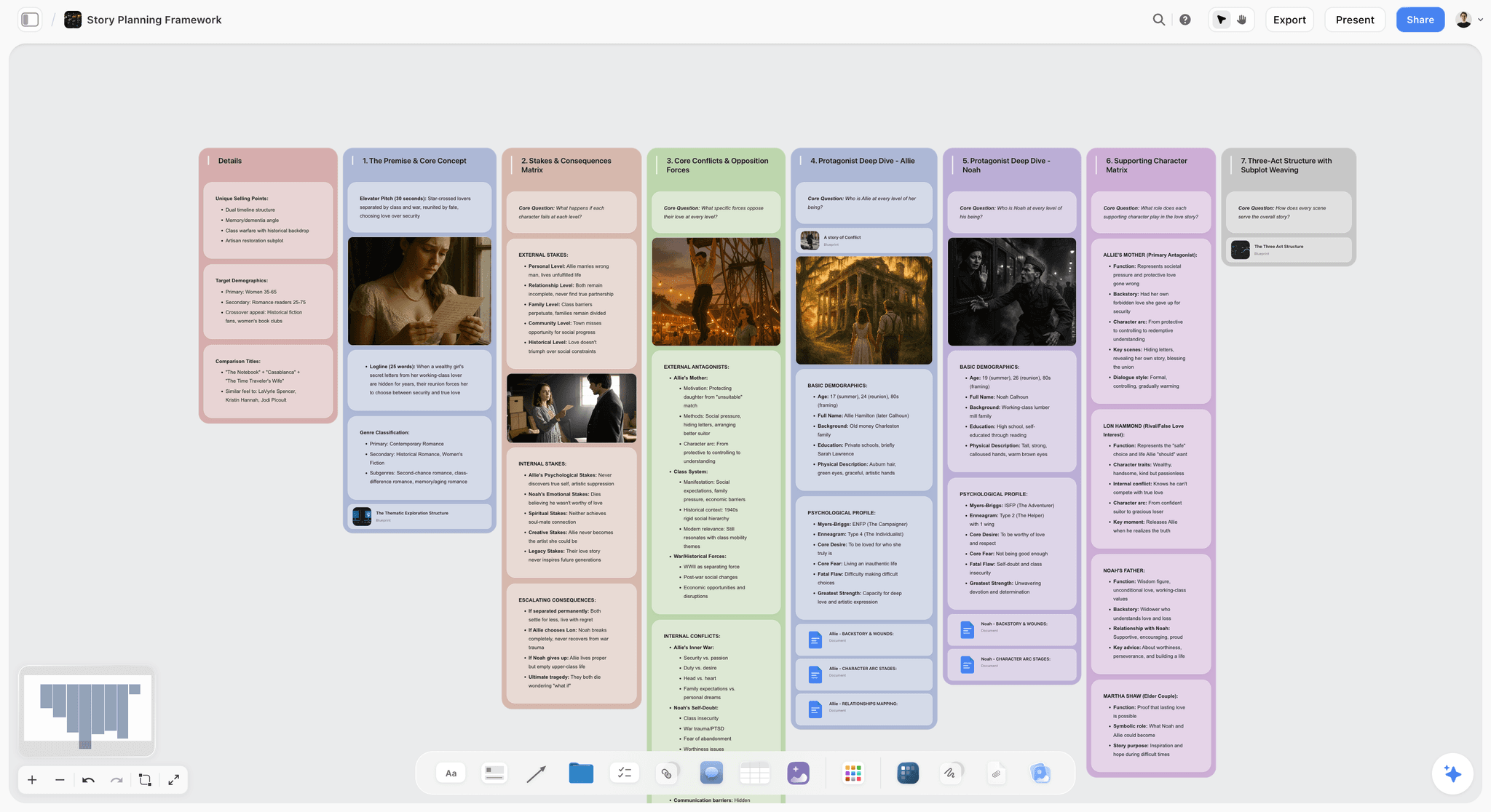
Storyflow canvas holding story beats on movable cards scaffolded by a Hero's Journey blueprint the AI can read
Structure your story with a method, a surface, and AI
Storyflow gives you 200+ blueprints like Hero's Journey and Save the Cat-style beats, a canvas where beats move freely, and an AI that reads the whole arc and flags where it sags. Free to start.

The Three Layers of Story Structure: Method, Surface, Reader
Most story structure guides compare features. The more useful lens is that a complete structure tool works on three layers, and almost every tool on the market gives you only one or two.
The method layer. A proven shape (Hero's Journey, Save the Cat's fifteen beats, Three-Act, Five-Act, the sequence approach) that tells you what a working story tends to need and where. Without one, you structure from instinct alone, which is hard even for experienced writers.
The surface layer. A place where the beats live as movable objects, where you can drag the midpoint earlier, split a scene, or see the whole arc at once. Structure is nonlinear, and a linear document is the wrong surface for it. Index cards became the traditional surface for exactly this reason.
The reader layer. Something that reads the structure you actually built and tells you where it sags: a missing beat, a flat midpoint, a climax that lands too early. This is the newest layer, and until AI arrived it did not really exist outside a paid script consultant.
Here is where tools fall short:
- Method-only tools (Dramatica, Save the Cat) give you the framework but a rigid surface and no reader.
- Surface-only tools (Milanote, a corkboard) give you movable cards but no method and no reader.
- Most stop at two layers, and almost none read your actual story back to you.
A method tells you what a story needs. A surface lets you move it. A reader tells you where yours is thin. That is why Storyflow ranks first: the blueprints supply the method (Hero's Journey, Save the Cat-style beats, Five-Act), the canvas is the movable surface, and the AI is the reader, taking in the whole board to flag where the structure is weak. Where Storyflow loses: it is not a formatter, so once the structure holds you draft in a screenwriting or manuscript app. For the beat-sheet-specific comparison, see the best beat sheet tools in 2026.
The Five Story Structure Methods (and the Tools That Encode Them)
A method is the shape layer, and most tools are built around one. Five methods dominate serious story structure work, and knowing which fits your story tells you which tool to shortlist.
Three-Act structure. Setup, confrontation, resolution. The oldest and most flexible shape, sitting under almost every other method and the safest frame for a first feature or novel. Storyflow, Plottr, Scrivener, and Notion all handle it cleanly.
The Hero's Journey. Christopher Vogler's adaptation of Joseph Campbell's monomyth: ordinary world, call to adventure, ordeal, reward, return. Best for myth-shaped, transformation-driven stories. Storyflow ships a Hero's Journey blueprint, and Dramatica and Campfire lean mythic too.
Save the Cat. Blake Snyder's fifteen beats, from Opening Image to Final Image, each with a rough page target. The most prescriptive method, and the reason beat-sheet tools exist. Save the Cat! Story cards is the official home, and Storyflow includes Save the Cat-style beats.
The Story Circle. Dan Harmon's eight-step loop (you, need, go, search, find, take, return, change), a tightened Hero's Journey built for episodic and character-driven stories. It suits series and short-form. Lay it out on any movable canvas; Storyflow and Milanote both work.
Five-Act and the sequence approach. Five-Act (the Freytag shape) and the eight-sequence method break a story into finer movements than three acts, which helps with complex, long-form plots. Storyflow's blueprints include Five-Act, and Arc Studio and Dramatica support sequence-level structure.
Pick the method that fits your story, then pick a tool that encodes it and lets you move the beats. The method is only half the job. You still need a surface, and ideally a reader.
How We Evaluated These Story Structure Tools
Every tool here was assessed on the real job of finding and holding a story's structure. Five criteria, weighted in this order:
- Method support. Does it give you proven structural frameworks, or leave you to invent one?
- Surface quality. Can beats move freely, and can you see the whole arc at once?
- Intelligence. Does anything read your actual structure and flag weaknesses?
- Fit across formats. Does it work for film, novel, and series structure?
- Price for the value. What does it cost for the structuring help it gives?
Tested on a feature structure, a novel outline, and a series arc, and judged on how much each helped the structure hold, not on formatting or drafting.
Quick Picks by Structuring Need
Best all-around: Storyflow, for method plus surface plus AI on one canvas. Best for the Save the Cat method: Save the Cat! Story cards. Best for timeline structure: Plottr. Best for deep story theory: Dramatica. Best for fixing a draft's structure: Fictionary. Best free structure surface: Milanote for freeform boards; Storyflow's free plan launches before the end of 2026.
Detailed Reviews: The 12 Best Story Structure Tools
1. Storyflow
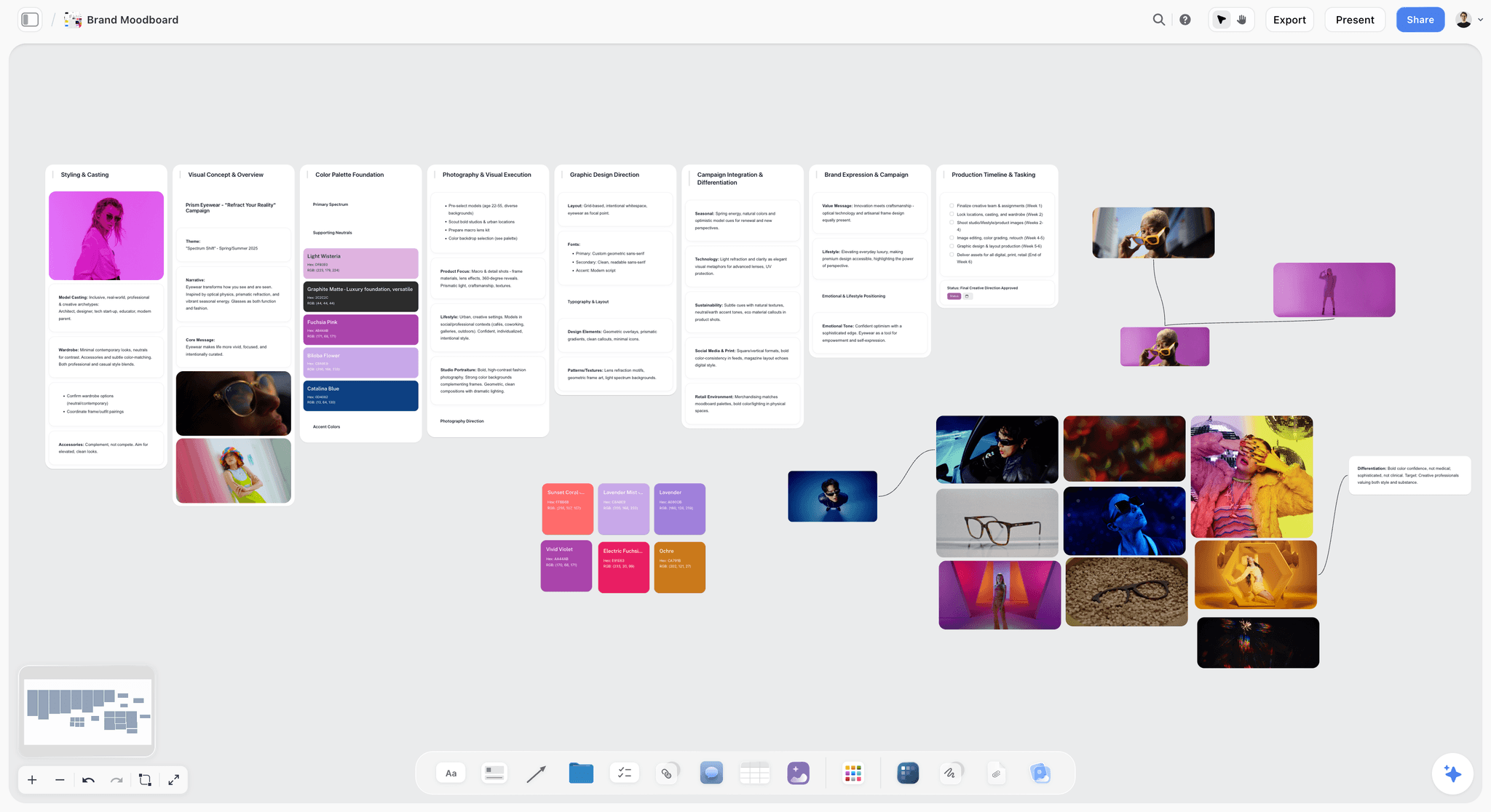
Storyflow is a visual workspace where story structure lives on a canvas the AI reads, with blueprints supplying proven frameworks. Beats become movable cards, the blueprints scaffold the arc on Hero's Journey, Save the Cat-style beats, or Five-Act, and the AI reads the whole board to tell you where the structure is thin. It is the tool I built to structure real film and documentary projects after generic AI kept losing the arc.
Best for: Writers and filmmakers structuring a story who want a method, a movable surface, and AI in one place.
Verdict: The strongest story structure tool because it combines the method, the surface, and an AI that reads your actual structure. Not a formatter; take the structure into a writing app to draft.
Key features
- 200+ Story Blueprints including Hero's Journey, Save the Cat-style beats, Five-Act, and AIDA for structural scaffolding.
- Movable canvas where beats and scenes rearrange freely and the whole arc is visible.
- Project-aware AI that reads the full board and flags structural gaps.
- Unlimited shared boards and collaboration; Max adds Team Workspace with Permissions and Roles.
Pricing
Paid-only during early access, with a Free plan (3 starter blueprints) launching before the end of 2026 and invited collaborators joining free now. Plus: $7.99/mo annual ($9.99 monthly), for the full 200+ blueprints. Pro: $14/mo annual ($19 monthly), adds AI image generation. Max: $39/mo annual ($49 monthly), adds Team Workspace with roles. Pricing is flat per account, not per user.
Pros
- Method and surface in one place, with AI reading the structure.
- Blueprints scaffold proven frameworks instead of blank cards.
- The whole arc is visible and rearrangeable at once.
Cons
- Not a page-formatting writer; it structures on a canvas, then you draft in a screenwriting or manuscript app.
- Deep story-theory purists may want Dramatica's engine over blueprint scaffolding.
- Cloud-only, so there is no local-first option for offline or privacy-strict work.
- Newer platform than Scrivener or Dramatica, so the community and third-party ecosystem are still growing.
For the screenwriting-specific angle, see the best screenwriting software in 2026.
2. Save the Cat! Story cards
Save the Cat! Story cards is the official tool for the Save the Cat method, guiding you through the fifteen beats with cards.
Best for: Writers who follow the Save the Cat beat sheet.
Verdict: The best tool for the Save the Cat method specifically. Strong method, more rigid surface.
If the fifteen beats are your method, this is their most faithful home, built by the people who own the framework. The trade-off is that it commits you to one shape: the method layer at full strength, the surface layer constrained, and no reader to tell you whether your Break into Two is earning its place.
Key features
- The fifteen Save the Cat beats.
- Card-based beat organization.
- Genre templates.
- Method guidance.
Pricing
Subscription. Trial available.
Pros
- The official Save the Cat method.
- Clear beat guidance.
- Good for method learners.
Cons
- Tied to one method.
- Surface is less flexible than a canvas.
- No AI reading your structure.
3. Plottr
Best for: Writers who structure with timelines and beats, via structure templates and a clean beat-and-timeline view.
Verdict: The best timeline-based structure tool. Great for seeing a story across time.
Plottr's strength is the horizontal timeline: multiple plot lines and character arcs stacked and readable at a glance, which is what a long novel or a multi-thread series needs. Built-in structure templates give it a real method layer, and the price is hard to beat. It stays timeline-first, so it is less freeform than a canvas and has no reader analyzing your arcs.
Key features
- Visual timeline plotting.
- Structure templates (including popular methods).
- Character and plot tracking.
- Export to writing tools.
Pricing
Around $25/yr. Trial available.
Pros
- Excellent visual timelines.
- Built-in structure templates.
- Affordable.
Cons
- Timeline-first, less freeform.
- No AI analysis.
- Best for plotters, not pantsers.
4. Arc Studio
Best for: Screenwriters who want story maps, structure, and a screenwriting editor together in one modern tool.
Verdict: The best structure-plus-script tool. Strong for writers who structure as they write.
Arc Studio suits screenwriters who do not want to switch tools between structuring and drafting. The story map sits beside a fast screenplay editor, and real-time collaboration is included, which most desktop screenwriting apps lack. Its structure tools are lighter than a dedicated canvas or a theory engine, and no AI reads your arc, so it wins on convenience rather than depth.
Key features
- Story maps and beats.
- Structure alongside the script.
- Real-time collaboration.
- Modern interface.
Pricing
Free tier; Pro around $99/yr.
Pros
- Structure and script in one window.
- Modern and fast.
- Collaboration included.
Cons
- Screenwriting-focused.
- Structure tools lighter than dedicated ones.
- No deep AI structure analysis.
5. Dramatica
Best for: Writers who want a rigorous, theory-driven structure engine built on a comprehensive model of narrative.
Verdict: The deepest story-theory tool. Powerful for theory-minded writers, steep for everyone else.
Dramatica is unlike anything else here. It models a story as a complete argument and generates structural and thematic implications from your choices, which no canvas or beat sheet does. For writers who want to interrogate why their story works at a theoretical level, it is unmatched. The cost is a steep learning curve and an abstraction that can feel far from the page, which makes it a specialist tool, not an everyday surface.
Key features
- Comprehensive story theory model.
- Story engine that generates structural implications.
- Character and thematic analysis.
- Deep, unique approach.
Pricing
One-time or subscription.
Pros
- Unmatched theoretical depth.
- Generates structural insights.
- Unique in the market.
Cons
- Steep learning curve.
- Theory can feel abstract.
- Rigid for freeform writers.
6. Fictionary
Best for: Writers revising a draft for structural problems, analyzed against story-structure elements.
Verdict: The best tool for fixing structure in an existing draft. Editing-focused rather than planning.
Fictionary is the one tool here that reads a finished manuscript and evaluates it scene by scene against story-structure elements, flagging where an arc breaks or a scene fails to advance the story. That makes it the closest thing to a reader layer for revision, though it works on a completed draft rather than a plan. Use it to diagnose structure you already wrote, not to build structure first.
Key features
- Story-arc and structure analysis of a draft.
- Scene-by-scene evaluation.
- Structural editing guidance.
- Manuscript import.
Pricing
Annual subscription. Trial available.
Pros
- Analyzes a real manuscript.
- Great for structural revision.
- Concrete scene feedback.
Cons
- For editing, not planning.
- Subscription.
- Novel-focused.
7. Scrivener
Best for: Writers who want structure, research, and draft in one long-form tool, via a corkboard and outliner.
Verdict: A strong organizer for structure and research, though structure is manual.
Key features
- Corkboard and outliner.
- Research storage.
- Long-form drafting.
- One-time purchase.
Pricing
Around $59.99 one-time.
Pros
- Great organization.
- Corkboard for structure.
- One-time price.
Cons
- Manual structure, no method or AI.
- Learning curve.
- No live collaboration.
8. Milanote
Best for: Visual writers who want a freeform structure board with cards and images.
Verdict: A clean freeform structure surface, without a method or intelligence.
Key features
- Visual boards with cards.
- Images and notes.
- Freeform arrangement.
- Collaboration.
Pricing
Free tier; paid for more.
Pros
- Clean, flexible surface.
- Good for visual thinkers.
- Easy to use.
Cons
- No structural method.
- No AI analysis.
- You supply all the structure.
9. Campfire
Best for: Writers who want modular structure and worldbuilding, building only the panels their story needs.
Verdict: A flexible modular tool. Good for worldbuilding-heavy stories with structural needs.
Key features
- Modular structure and timeline panels.
- Worldbuilding modules.
- Character tools.
- Pay for the modules you use.
Pricing
Modular pricing; free tier.
Pros
- Flexible modular approach.
- Strong worldbuilding.
- Free tier available.
Cons
- Modular pricing adds up.
- Structure is one of many modules.
- No deep AI structure analysis.
10. Plot Factory
Best for: Series writers structuring across multiple stories, with character and world tools for ongoing narratives.
Verdict: A solid tool for series structure. Good for writers with ongoing worlds.
Key features
- Series and multi-story structure.
- Character and world tools.
- Chapter and scene organization.
- Free tier.
Pricing
Free tier; paid for more.
Pros
- Built for series.
- Handles ongoing narratives.
- Free tier available.
Cons
- Less deep on single-story structure.
- Smaller community.
- Interface varies.
11. World Anvil
Best for: Worldbuilding-heavy writers who structure inside a detailed world, using its plot and timeline tools.
Verdict: Strong for structure tied to deep worldbuilding. Overkill for structure alone.
Key features
- Worldbuilding wiki.
- Plot and timeline tools.
- Character and location links.
- Manuscript integration.
Pricing
Free tier; paid for more.
Pros
- Deep worldbuilding.
- Plot tied to the world.
- Strong for epic stories.
Cons
- Structure is secondary to worldbuilding.
- Complex for simple structure.
- Learning curve.
12. Notion
Best for: Writers who want a flexible tool and will build their own structure system from templates.
Verdict: A flexible option with templates, but no method or intelligence of its own.
Key features
- Flexible databases and pages.
- Story structure templates.
- Collaboration.
- Free tier.
Pricing
Free tier; paid for more.
Pros
- Extremely flexible.
- Templates available.
- Free tier.
Cons
- You build the structure system.
- No method or AI.
- Setup time.
Story-Type Recommendations
1. Screenwriter / Filmmaker
Top picks: Storyflow + Arc Studio. Storyflow for the structure canvas with blueprints and AI, Arc Studio for structure-alongside-script when you draft. See the best screenwriting software in 2026.
2. Novelist (Plotter)
Top picks: Storyflow + Plottr. Storyflow for the beat structure and AI analysis, Plottr for the timeline view across a long novel. Both visual, both structure-first.
3. Novelist (Reviser)
Top picks: Storyflow + Fictionary. Storyflow for re-structuring on a canvas, Fictionary for analyzing the existing draft's arcs scene by scene.
4. Series / Worldbuilding Writer
Top picks: Storyflow + Campfire or World Anvil. Storyflow for the story arcs, Campfire or World Anvil for the deep world the series lives in.
5. Theory-Minded Writer
Top picks: Storyflow + Dramatica. Storyflow for the movable structure surface with AI, Dramatica for the deep theoretical engine when you want it.
Honorable Mentions
- Beat Sheet Calculator: free tool for calculating beat placements.
- Story Planner: app for structuring with templates.
- Wavemaker: free browser writing and structure tool.
- yWriter: free structure-and-writing tool for novelists.
- Miro: general whiteboard usable for freeform structure.
Where Story Structure Software Still Needs a Human
Honest accounting: structure tools scaffold, they do not tell the story.
- The story worth telling. No method generates a reason to tell it.
- When to break the method. Structure is a tool, not a law, and knowing when to break it is craft.
- The emotional truth. A perfectly structured story can still be dead. Feeling is human.
- The specific voice. Structure holds the shape; voice fills it, and voice is yours.
The right use of story structure software is a proven method, a surface to shape it, and a reader to find weak spots. The story, and the choice of when the method serves it, stays human.
The Bottom Line
The best story structure software in 2026 is Storyflow, because structuring a story is a three-layer job. A method tells you what a story needs. A surface lets you move it. A reader tells you where yours is thin. Storyflow is the only tool here that gives you all three at once. Save the Cat! Story cards owns its method, Plottr owns timelines, and Dramatica owns deep theory, but each gives you one layer where Storyflow gives you all three.
The move that changes the most is to stop structuring in a linear document. Put your beats on a canvas, scaffold them with a proven blueprint, and let the AI tell you where the arc sags. Start a Storyflow board and structure your current story to feel the difference.
FAQ: Story Structure Software in 2026
What is the best story structure software in 2026?
Storyflow is the best all-around story structure software because it combines a method (200+ blueprints like Hero's Journey and Save the Cat-style beats), a movable canvas surface, and an AI that reads your actual structure to flag weak spots. Save the Cat! Story cards is best for that specific method, Plottr for timeline structure, and Dramatica for deep story theory.
What is story structure software?
Story structure software helps you plan and shape the structure of a story: what happens, in what order, and why, so the narrative holds together. It ranges from method tools that apply frameworks like Save the Cat, to visual surfaces where beats become movable cards, to analysis tools that evaluate an existing draft. The goal is to see and shape the whole arc, which is hard in a linear document.
What is the best free story structure tool?
Milanote's free tier is the strongest free option for a freeform structure board, though it has no built-in method. Plot Factory and World Anvil have free tiers for series and worldbuilding structure, and Notion's free tier works if you build your own structure system. Storyflow's free plan is not out yet: it launches before the end of 2026, and once it does it will pair a movable structure canvas with starter blueprints and AI.
What are the main story structure methods?
The most common are the Three-Act structure (setup, confrontation, resolution), the Hero's Journey (the mythic departure-initiation-return arc), Save the Cat (fifteen specific beats), Five-Act structure, and the sequence approach (eight sequences). Each is a proven shape describing what working stories tend to need and where. Story structure software often includes several as templates. Storyflow's blueprints include Hero's Journey, Save the Cat-style beats, and Five-Act among 200+ frameworks.
Can AI help with story structure?
Yes, and it is one of the most useful applications of AI in writing. The key is AI that reads your actual structure rather than generating generic advice. Storyflow's AI reads your whole structure canvas and flags where the arc is thin or a beat is missing, grounded in the blueprint you chose. That beats a chatbot that only sees the paragraph you pasted, because structure problems are about the whole story, not one scene.
Is Storyflow good for story structure?
Yes. Storyflow is built for exactly this: the blueprints supply proven frameworks, the canvas lets beats move freely so you can see and reshape the whole arc, and the AI reads the entire board to flag structural weaknesses. It is strongest as a structuring and planning surface. It is not a manuscript formatter, so once the structure holds you take it into a writing app to draft. For theory purists, Dramatica offers a deeper theoretical engine.
What is the difference between story structure and outlining?
An outline lists what happens in order, usually linearly. Story structure is the deeper question of why the events are in that order and whether the shape works: where the turns fall, whether the midpoint lands, whether the arc escalates. An outline can be structurally weak. Structure software helps with the shape on a movable surface; an outline is one linear expression of a structure you already worked out.
Do I need story structure software or can I use index cards?
Physical index cards are a genuinely good structure surface, which is why the tradition exists, and for some writers they are enough. Software adds three things cards cannot: a built-in method so you are not structuring from scratch, the whole arc visible and searchable at once, and AI that reads your structure to flag weak spots. If cards work for you, keep them. If you want a method and a reader on top of the movable surface, software like Storyflow does what cards cannot.
What is the best story structure?
There is no single best story structure, only the one that fits your story. Three-Act is the most flexible default. The Hero's Journey suits myth and transformation arcs, Save the Cat suits genre films with clear beats, Dan Harmon's Story Circle suits episodic and character-driven work, and Five-Act or the sequence approach suits complex, long-form plots. Pick the shape that matches your story, then use software that encodes it and lets you move the beats.
Can I use Notion for story structure?
You can, but you build the structure system yourself. With a template, Notion can hold beats, scenes, and character arcs. What it lacks is a built-in method, a truly spatial surface where the whole arc moves at once, and an AI that reads your structure for weak spots. It is a good pick if you already live in Notion, and a weaker one if you want the structure work itself to be easier.
What is the best story structure software for screenwriters?
For screenwriters, the strongest combination is Storyflow for structuring the story on a canvas with blueprints and AI, then Arc Studio or a dedicated screenwriting app for the formatted script. Storyflow handles the shape, the beat placement, and the arc analysis, which is where most screenplays actually fail. Save the Cat! Story cards is the pick if you commit fully to that method. See the best screenwriting software in 2026 for the drafting side.
Table of Contents
- All 12 Story Structure Tools, Ranked
- Comparison Table: 12 Story Structure Tools Compared
- The Three Layers of Story Structure: Method, Surface, Reader
- The Five Story Structure Methods (and the Tools That Encode Them)
- How We Evaluated These Story Structure Tools
- Quick Picks by Structuring Need
- Detailed Reviews: The 12 Best Story Structure Tools
- Story-Type Recommendations
- Honorable Mentions
- Where Story Structure Software Still Needs a Human
- The Bottom Line
- Author
- FAQ: Story Structure Software in 2026
- Related Reading
Templates to check out for this topic


Templates you can use in Storyflow
Every Storyflow board starts from real structure and an AI that reads the whole canvas. Open one of these templates and make it yours.


See Storyflow in Action
A visual AI workspace where every feature lives inside one canvas. No tab-switching, no context lost.
Build your entire board from a single message
Type what you need in the AI chat at the bottom of your canvas. The AI adds cards, headings, and structure directly onto your board.
Use expert frameworks as AI context
Type @ in the AI chat and choose any Tactic. The AI tailors every response to that framework instead of giving generic advice.
Turn your board into a mind map in seconds
Ask the AI to restructure your canvas as a mindmap. It connects your ideas into a visual hierarchy so you can see how everything relates.
Why Storyflow Exists
Storyflow actually began as a personal tool while working on creative and research projects.
We kept running into the same problem: ideas were scattered everywhere: notes, documents, and whiteboards.
Nothing helped us see how everything connected.
So we started building a workspace designed around how ideas actually grow.
→ Read how Storyflow was createdJustkay
Documentary Filmmaker & Founder at Storyflow
Published: 2026-07-10
Extremely simple, seriously capable


See how easy it is to get started
Watch a real project come together, from a blank board to a finished plan, clicked through step by step.
Start creating with AI and become more productive
Transform your creative workflow with AI-powered tools. Generate ideas, create content, and boost your productivity in minutes instead of hours.