
How to Facilitate a Brainstorming Session (2026)
A facilitator's playbook for running brainstorming sessions that produce decisions, not just sticky notes. The Frame, Fill, Focus method: frame the question, fill the room with ideas in silence, then focus down to owned next actions.

Category
Brainstorming
Author

Sara de Klein
Head of Product at Storyflow
Topics
2026-07-15
•
12 min read
•
Brainstorming- how to facilitate a brainstorming session
- run a brainstorming session
- brainstorming facilitation techniques
- brainwriting
How do you facilitate a brainstorming session?
To facilitate a brainstorming session, run it in three phases: Frame the question and pick the participants before the meeting, Fill a fixed block of time with ideas using silent generation before any discussion, then Focus the raw list down through clustering and dot voting into a few decisions with owners. The facilitator's job is not to have the best idea. It is to build the structure that lets everyone else's ideas surface, survive a fair hearing, and turn into action. Most sessions fail not because the room lacks ideas but because it lacks that structure: the loudest person anchors everyone, the quiet people never speak, and the sticky notes die in a photo nobody opens again. Defer judgment while you generate, separate diverging from converging, and end every session by assigning owners. That is the whole craft.
Key Takeaways
- A brainstorm rarely fails for lack of ideas. It fails for lack of structure. The facilitator's job is to build the container the ideas fall into, not to supply the winning one.
- Run every session in three phases: Frame, Fill, Focus. Frame is the pre-work, Fill is generation, and Focus cuts a hundred raw ideas down to a few decisions with owners.
- Frame a single sharp question and invite six to eight people. "How might we get trial users to invite a teammate in their first week" is answerable; "growth" is not.
- Generate in silence before anyone talks. Brainwriting neutralizes the production blocking Diehl and Stroebe documented in 1987, so silence is the condition for collaboration, not the absence of it.
- Read Osborn's four rules aloud: defer judgment, go for quantity, welcome wild ideas, and build on others. They are permission, and people generate more freely once they have it.
- Converge with a silent dot vote, not a debate. Three dots per person, placed simultaneously, reveal the room's real priorities in about ninety seconds and stop people voting to match the boss.
- End every session by assigning an owner and a next action. "Maya drafts a one-pager by Thursday" beats "we should explore this," because an idea without an owner is a wish.
- The three deaths map to a missing letter: HiPPO and groupthink are Fill failures, and ideas dying in a photo is a Focus failure. Silent generation and an owner on every surviving idea are the cures.
The Facilitator's Real Job
I have run brainstorming sessions two ways: badly, for years, and then deliberately. As a documentary filmmaker I sat in story sessions where a room full of smart people generated nothing usable, and as the founder of Storyflow I have run ideation sessions with the product team where eight people produced more in forty minutes than a week of solo thinking got me. The difference was never the people or the caffeine. It was whether someone ran the room on purpose.
That is the reframe most guides miss. A brainstorm rarely fails for lack of ideas. It fails for lack of structure. The facilitator's job is not to be the smartest person in the room or to supply the winning concept. It is to build the container the ideas fall into: the question they answer, the rules that keep them safe, the clock that forces them out, and the process that turns a wall of sticky notes into a decision someone owns by Friday.
I organize that container into three phases I have run for every session since: Frame, Fill, Focus. Frame is everything you do before the meeting starts. Fill is how you generate ideas once people are in the room. Focus is how you cut a hundred raw ideas down to the few worth acting on. Frame, Fill, Focus is not a creativity hack. It is project management applied to a meeting, and it is the difference between a session people dread and one they ask to repeat.
Frame: Decide the Question and the Room Before Anyone Arrives
The most important work happens before anyone sits down. A session with a vague prompt ("let's brainstorm marketing ideas") produces vague output. A session with a sharp question produces sharp answers.
Write the challenge as a single question, phrased to invite many answers. The design world's "How Might We" format works because it assumes a solution exists and asks the room to find it. "How might we get trial users to invite a teammate in their first week?" is answerable. "Growth" is not. Keep the scope tight enough that a good idea is recognizable the moment it appears.
Then pick the room. Six to eight people is the range I aim for. Fewer than four and you lose the collision of perspectives that makes group work worth the calendar cost. More than eight and the session fractures: air time drops, the quiet ones vanish, and you manage turns instead of ideas. Invite for diversity of vantage point, not seniority. The engineer, the support rep, and the new hire see problems the leadership team cannot.
Frame also means choosing the method and the constraints up front:
- Decide whether generation is silent-first (brainwriting) or verbal. Wherever rank or volume could dominate, go silent-first.
- Set the timebox and say it out loud. A countdown creates useful pressure. An open-ended session drifts.
- Send a pre-read. Share the question and any context 24 hours ahead so people arrive warm, not cold.
The facilitator prepares one more thing: the rules. Alex Osborn, the advertising executive who popularized brainstorming in Applied Imagination (1953), built the method on a single principle: defer judgment. Separate having ideas from evaluating them, because the two cancel each other out. His other three rules still hold: go for quantity, welcome wild ideas, and build on what others say. Read them aloud. They are permission, and people generate more freely once they have it.
Fill: Generate in Silence Before Anyone Talks
Here is the counterintuitive part, backed by the most replicated finding in the brainstorming literature. Diehl and Stroebe (1987), in the Journal of Personality and Social Psychology, compared real groups against "nominal groups" (the same number of people generating ideas alone, then pooling them). The separate workers won, consistently, on both quantity and quality of ideas. The cause they isolated was production blocking: in a live group only one person can talk at a time, so while you wait your turn you forget your idea, second-guess it, or lose it to whatever was just said.
The fix is to start silent. Give everyone the question and a stack of sticky notes or a private corner of a shared canvas, and have them write ideas alone for the first ten minutes. No talking, no sharing. This is brainwriting, and it neutralizes production blocking by letting everyone produce at once. Silence is not the absence of collaboration. It is the condition for it. The extrovert and the introvert generate in parallel, and nobody anchors on the first thing said.
Only after the silent round do you go verbal. Round-robin so each person reads one idea at a time, and now discussion is additive: the build-on-it rule kicks in, and one person's half-idea becomes another's full one. This is the one place the group genuinely beats the individuals, so protect it. Keep deferring judgment. The moment someone says "that won't work," generation stops for everyone.
Two more Fill rules earn their keep:
- Chase quantity, not quality. Osborn's bet was that volume breeds quality, and it holds up: the first ten ideas are the obvious ones everyone already had. Idea forty is the one nobody expected.
- Keep the group small, or split it. Cowan's research (Behavioral and Brain Sciences, 2001) put working memory at roughly four items at once. A room tracking twelve people talking loses the thread. Sub-groups of four or five keep everyone cognitively present.
Focus: Turn a Hundred Sticky Notes Into Three Decisions
Most sessions collapse here, or never get here at all. Generation feels productive, everyone leaves energized, and the wall of two hundred sticky notes gets photographed and never opened again. Focus is where a facilitator earns the title.
Start by clustering. Group the ideas by theme (affinity mapping), pulling related notes together until five to eight clusters emerge. Do this out loud as a group, so sorting surfaces the overlaps and forces the room to see the shape of what it produced. Name each cluster.
Then converge with a vote, not a debate. Dot voting is the fastest honest method: give every person a fixed number of votes (three is standard) and let them place dots on the ideas or clusters they would actually back. Do it simultaneously and, ideally, silently, so nobody votes to match the boss. The dots reveal the room's real priorities in about ninety seconds, and they defuse the single biggest failure mode in group ideation.
Converging is not the end. The step that separates a session that mattered from one that felt nice is assignment. For each of the top three ideas, name an owner and a next action before anyone leaves the room. Not "we should explore this," but "Maya drafts a one-pager by Thursday." An idea without an owner is a wish. The session's output is not the sticky notes. It is the short list of owned commitments.
The Frame, Fill, Focus Session Agenda
Here is the whole method as a sixty-minute agenda you can run tomorrow. The Frame, Fill, Focus agenda front-loads structure so the creative middle stays loose. Times assume six to eight people. Scale the Fill and Focus blocks up for larger rooms, and add a break past ninety minutes.
| Phase | Goal | Technique | Time |
|---|---|---|---|
Frame (before) | A sharp question and the right room | "How Might We" prompt, 6 to 8 invitees, pre-read sent | Day before |
Open | Set rules, lower the stakes | Read Osborn's four rules aloud, state the timebox | 5 min |
Fill (silent) | Maximum ideas, no blocking | Brainwriting: everyone writes alone | 10 min |
Fill (verbal) | Build and combine | Round-robin share, defer judgment, "yes, and" | 15 min |
Focus (cluster) | See the shape of the output | Affinity mapping into 5 to 8 named themes | 10 min |
Focus (vote) | Reveal real priorities | Dot voting, 3 dots per person, silent | 5 min |
Decide | Turn ideas into commitments | Owner plus next action for the top 3 | 10 min |
The agenda is deliberately about 20% idea generation and 80% structure around it. If you have only thirty minutes, cut the verbal Fill and the debate, never the silent Fill or the assignment step. The two ends of the session carry the value.
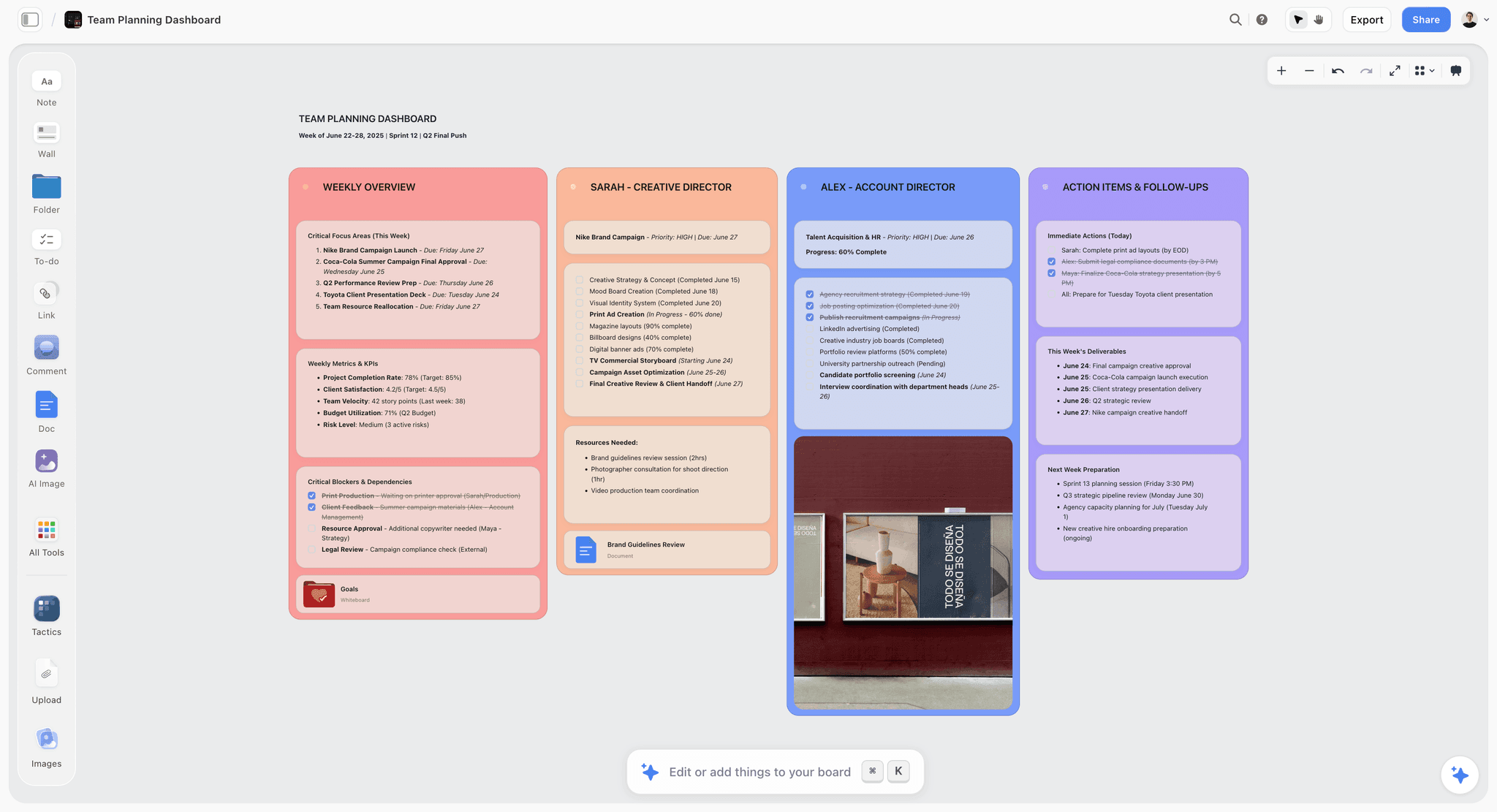
a Storyflow canvas set up for a facilitated brainstorm with a framed question and idea zones
The Three Ways a Brainstorm Dies
Every failed session I have watched died one of three deaths, and each maps to a missing letter in Frame, Fill, Focus. A brainstorm rarely fails for lack of ideas. It fails for lack of structure, and these are the three structural holes.
The HiPPO Anchors the Room
HiPPO is the "highest paid person's opinion." The senior person speaks first, everyone recalibrates toward what they said, and the session becomes an exercise in agreeing with the boss. This is a Fill failure: verbal-first generation lets rank set the anchor. The fix is silent generation. When everyone writes before anyone talks, the intern's idea and the VP's idea hit the wall at the same size. If you install one habit from this article, install the silent start.
Groupthink Sands Down the Good Ideas
Groupthink is the pull toward consensus for its own sake: the odd, spiky, potentially brilliant idea gets smoothed away because agreement feels good. This is also a Fill failure, and the counter is Osborn's welcome-wild-ideas rule plus a silent vote. Dot voting in parallel, without discussion, lets people back the strange idea they would not defend out loud in front of the group.
The Ideas Die in a Photo
The most common death of all: a great session with no follow-through. The notes get photographed, the meeting ends on a high, and nothing happens. This is a Focus failure, and it is pure structure. Assign an owner and a next action to the top ideas before the room empties. No owner, no outcome.
Which Setup Should You Use?
The method is always Frame, Fill, Focus. The tools change with the shape of your session.
- Small in-person team (4 to 8): sticky notes on a wall for Fill, dots for Focus. Analog is hard to beat here. Photograph the wall into a canvas afterward so the ideas survive.
- Distributed or async team: a shared canvas (Storyflow, or Miro and FigJam if you need live cursors) so people brainwrite on their own time, then a 20-minute call to cluster and vote.
- Large group (15+): split into sub-groups of five for Fill, then reconvene for a single Focus round. This is the nominal-group principle at scale: generate in parallel, converge together.
- Live, high-energy workshop: Miro or FigJam. Their real-time multiplayer and facilitation widgets are built for exactly this.
- Brainstorm that feeds a real project: a canvas that keeps the ideas next to the plan they turn into, so Focus does not mean re-typing everything into a separate tool.
The Bottom Line
Facilitating a brainstorm is not a talent. It is a structure you impose on a meeting, and the structure is Frame, Fill, Focus: a sharp question and the right small room, silent generation before any talking, then clustering, a silent vote, and an owner on every idea that survives. Do those things and an ordinary group will outproduce a brilliant one that just jumped on a call to brainstorm.
Remember why it works. A brainstorm rarely fails for lack of ideas. It fails for lack of structure. The ideas are already in the room. Your job as facilitator is to build the container that lets them out, keeps them safe long enough to be judged fairly, and turns the best of them into something someone owns.
If your next session is one piece of a bigger project, run it on a canvas that will still hold the plan a month from now. Set up your next brainstorm on a Storyflow canvas and keep the question, the ideas, the vote, and the plan in one place.
FAQ: Facilitating Brainstorming Sessions
How do you facilitate a brainstorming session?
Facilitate a brainstorming session in three phases: Frame, Fill, Focus. Before the meeting, frame a single sharp question ("How might we...") and invite six to eight people. In the session, Fill the time with ideas by having everyone write silently for ten minutes before any discussion, then share round-robin. Finally, Focus by clustering the ideas, dot voting on the best, and assigning an owner and a next action to the top three.
What are Osborn's four rules of brainstorming?
Alex Osborn's four rules, from Applied Imagination (1953), are: defer judgment, go for quantity, welcome wild ideas, and build on the ideas of others. The core rule is deferring judgment: separate generating ideas from evaluating them, because criticism during generation shuts people down. Read them aloud at the start.
How many participants should be in a brainstorming session?
Six to eight people is the sweet spot. Fewer than four loses the mix of perspectives that makes group work worthwhile, and more than eight cuts air time per person and lets quiet voices disappear. For larger groups, split into sub-groups of four or five, then reconvene to cluster and vote.
What is production blocking in brainstorming?
Production blocking is the main reason live group brainstorming underperforms: because only one person can talk at a time, everyone else waits, and while waiting they forget or self-censor ideas. Diehl and Stroebe (1987) documented it in the Journal of Personality and Social Psychology, finding that people brainstorming alone and pooling results out-produce the same number working together. The fix is silent generation (brainwriting) before discussion.
What is the Frame, Fill, Focus method?
Frame, Fill, Focus is a three-phase structure for a brainstorming session. Frame is the pre-work: the question, the participants, and the rules. Fill is idea generation, ideally silent-first to avoid production blocking. Focus is convergence: cluster, vote, and assign owners. A good session is mostly structure, not spontaneity.
How do you stop the loudest voice from dominating a brainstorm?
Use silent generation first. The loudest-voice and "highest paid person's opinion" (HiPPO) problem comes from verbal-first sessions where the most senior voice anchors everyone else. When people write privately before anyone speaks, rank and volume stop setting the agenda, and a later silent dot vote lets people back ideas they would not champion out loud.
How long should a brainstorming session be?
Sixty minutes is enough for six to eight people: roughly 5 minutes to set rules, 25 to generate, 15 to cluster and vote, and 10 to assign owners. Past ninety minutes, energy and idea quality drop, so add a break or split into two sessions. Short and structured beats long and open-ended.
What should you do after a brainstorming session?
Immediately convert the top ideas into owned commitments. The most common failure is a great session with no follow-through, where the notes get photographed and forgotten. Before the room empties, give each of the top three ideas an owner and a concrete next action, and keep them somewhere they will be seen again, not buried in a phone photo.
What is brainwriting, and is it better than brainstorming?
Brainwriting is silent, written idea generation where everyone writes at once instead of calling ideas out loud. It often beats verbal brainstorming because it eliminates production blocking and reduces the anchoring effect of dominant voices. A strong session uses both: brainwrite first, then discuss to build on and combine the ideas.
How do you run a virtual or remote brainstorming session?
Run a remote brainstorm on a shared visual canvas with an async first phase. Send the framed question ahead, have people brainwrite onto the board on their own time (which sidesteps production blocking entirely), then hold a short live call only for the Focus phase: cluster, dot vote, and assign owners. Storyflow, Miro, and FigJam all work. Pick the one that matches whether you need live cursors or a canvas the project keeps living on.
What is dot voting?
Dot voting is a fast convergence method where each participant gets a fixed number of votes (usually three) to place on the ideas they most want to pursue. It surfaces the group's real priorities in under two minutes and, done silently, stops people from just voting for the boss's idea. Use it after clustering, before assigning owners.
Table of Contents
- Key Takeaways
- The Facilitator's Real Job
- Frame: Decide the Question and the Room Before Anyone Arrives
- Fill: Generate in Silence Before Anyone Talks
- Focus: Turn a Hundred Sticky Notes Into Three Decisions
- The Frame, Fill, Focus Session Agenda
- The Three Ways a Brainstorm Dies
- Where a Shared Canvas Helps (and Where It Doesn't)
- Which Setup Should You Use?
- The Bottom Line
- FAQ: Facilitating Brainstorming Sessions
- Related Reading
Templates to check out for this topic


Mind mapping and ideation templates you can use in Storyflow
Map ideas in space, then ask the AI to restructure, expand, or connect them. Open any of these boards and start thinking visually instead of in lists.


See Storyflow in Action
A visual AI workspace where every feature lives inside one canvas. No tab-switching, no context lost.
Build your entire board from a single message
Type what you need in the AI chat at the bottom of your canvas. The AI adds cards, headings, and structure directly onto your board.
Use expert frameworks as AI context
Type @ in the AI chat and choose any Tactic. The AI tailors every response to that framework instead of giving generic advice.
Turn your board into a mind map in seconds
Ask the AI to restructure your canvas as a mindmap. It connects your ideas into a visual hierarchy so you can see how everything relates.
Why Storyflow Exists
Storyflow actually began as a personal tool while working on creative and research projects.
We kept running into the same problem: ideas were scattered everywhere: notes, documents, and whiteboards.
Nothing helped us see how everything connected.
So we started building a workspace designed around how ideas actually grow.
→ Read how Storyflow was createdSara de Klein
Head of Product at Storyflow
Published: 2026-07-15
Extremely simple, seriously capable


See how easy it is to get started
Watch a real project come together, from a blank board to a finished plan, clicked through step by step.
Start creating with AI and become more productive
Transform your creative workflow with AI-powered tools. Generate ideas, create content, and boost your productivity in minutes instead of hours.