
The calmest place to shape your story
A shape to build against.
Not a form to fill in.
Frameworks get a bad reputation because most tools implement them as templates: fill the boxes, get a story-shaped object. A framework is useful when it tells you what is missing and what a beat is supposed to be doing, which requires it to sit alongside your actual material rather than replacing it. Plans start at $7.99 a month billed annually.


Creatives working for these brands already got early access
- Red Bull
- Canon
- Artlist
- Porsche
See how easy it is to get started
Watch a real project come together, from a blank board to a finished plan, clicked through step by step.
Start from a ready-made template
Pick a board to see what you can build, then let AI fill it in. Every template is a real, editable starting point on the same infinite canvas.

Story Plan
Outline your plot, characters, and world in one connected view, then expand each thread as the story grows.
What are storytelling frameworks and when do they help?
A storytelling framework is a description of how stories that work tend to be shaped: three-act structure, the hero's journey, the beat sheet, the five-act form. None of them are rules, and none of them generate a story. What they do is give you a diagnostic. When something is not working and you cannot say why, a framework tells you where to look, which is usually that a beat exists on the page but is not doing the job that position in the story requires.
They help most at two moments. Early, when a raw idea needs a shape to grow against and a blank page is paralysing. And late, when a draft is not landing and you need to locate the problem rather than rewrite everything. In the middle, while the story is actively finding its own logic, a framework is mostly noise and is best ignored.
The common failure is treating the framework as the work. Filling in twelve boxes for the hero's journey produces something with the shape of a story and none of the pressure, because the framework describes structure and structure is not the same as motivation. The useful practice is to build your material first, then lay the framework over it and see which beats are absent or inert.
In Storyflow the AI lays out the hero's journey, three-act structure, beat sheets, character arcs and more as editable cards on an infinite canvas, beside your actual scenes, research and references rather than in a separate document. The AI reads the whole active board plus up to five attached documents and three boards, so it can answer questions about your story against the framework you are using. Plans start at $7.99 per month billed annually, with a free plan before the end of 2026.
Ultra fast from brief to board
Material first, framework second.
The order is what separates a diagnostic from a fill-in-the-blanks exercise.
01
Get the material on the canvas
Scenes, characters, images, research, half-ideas. Whatever exists, in whatever order, before any structure is imposed on it.
02
Lay a framework over it
Ask the AI to lay the framework out and place your existing material against its beats, which immediately shows what you have and what you assumed.
03
Look at the gaps
An empty beat is a question, not a box to fill. Some gaps are real problems and some mean the framework is wrong for this story.
04
Ask the board about it
Because the story and the framework are on the same canvas, the AI can answer questions about whether a beat is doing its job.
Frameworks that sit beside the work.
A structure in a separate document gets consulted twice. One on the canvas gets used.
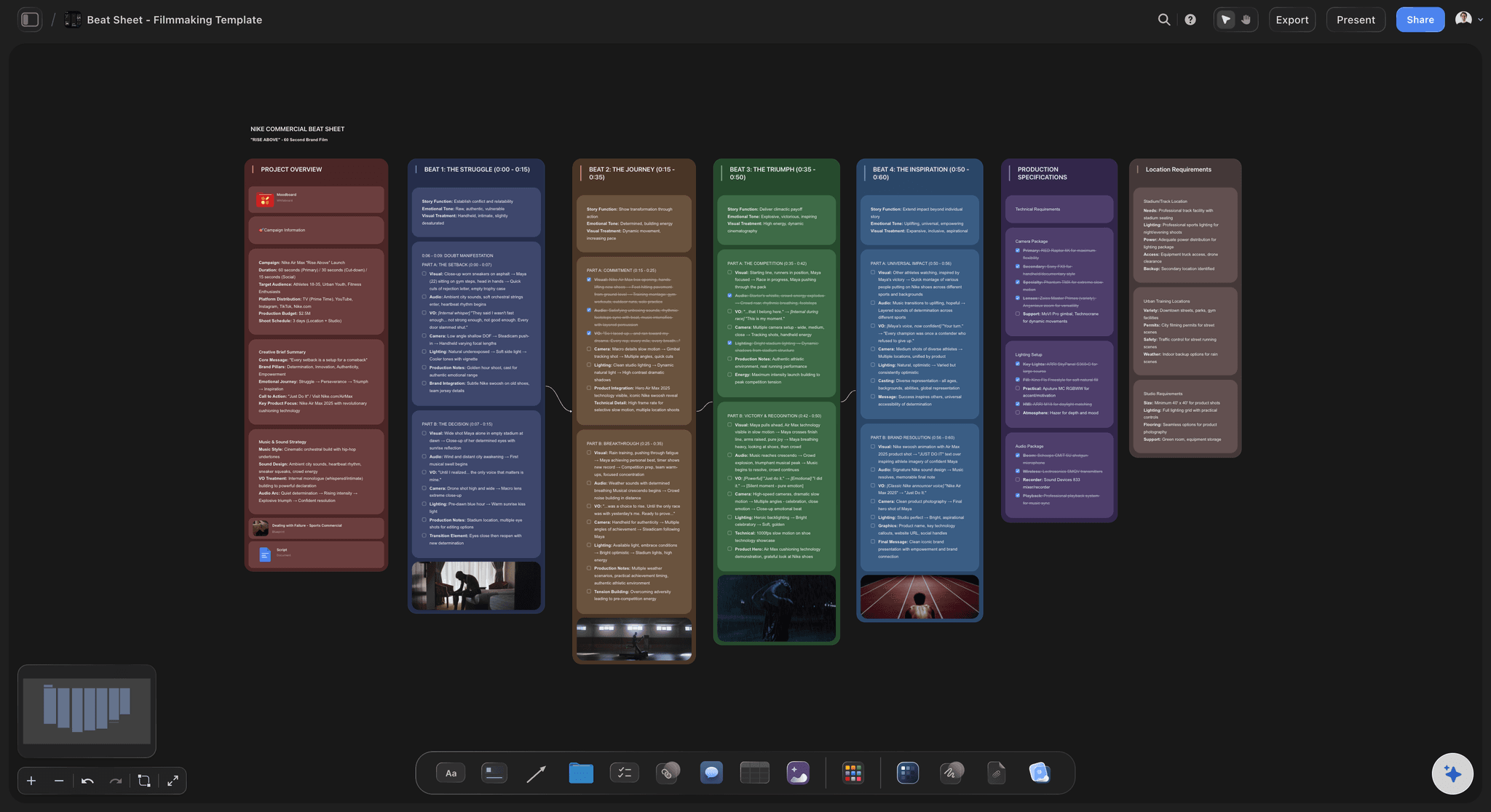
The frameworks people actually use
Three-act, hero's journey, beat sheets
The established narrative structures, laid out on your project as editable cards rather than as a read-only diagram.
See the three-act structure template →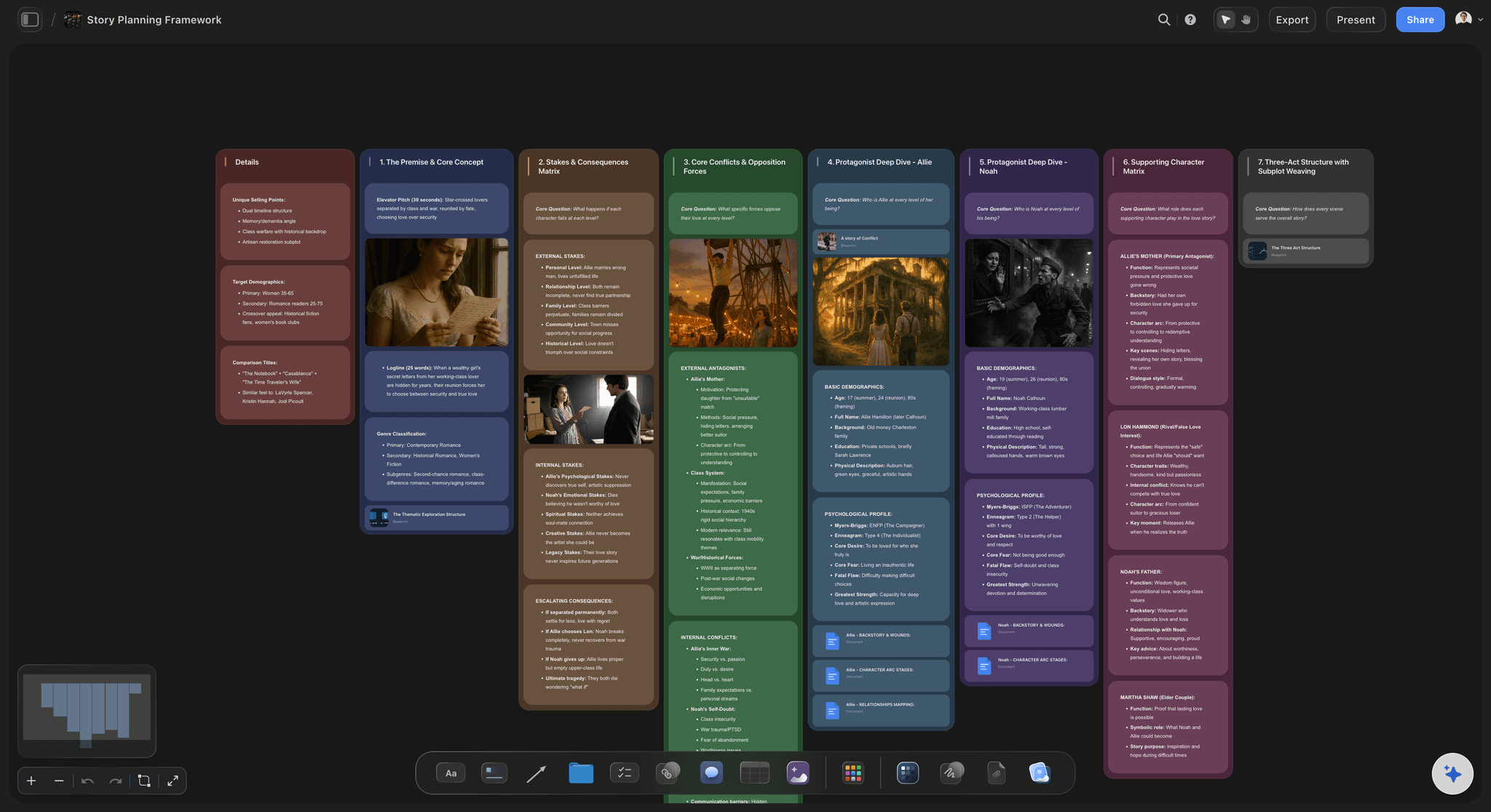
Structure beside the material
The framework and the story in one view
Your scenes, research and references sit next to the beats they are supposed to serve, so a structural gap is visible rather than theoretical.
See the story planning tool →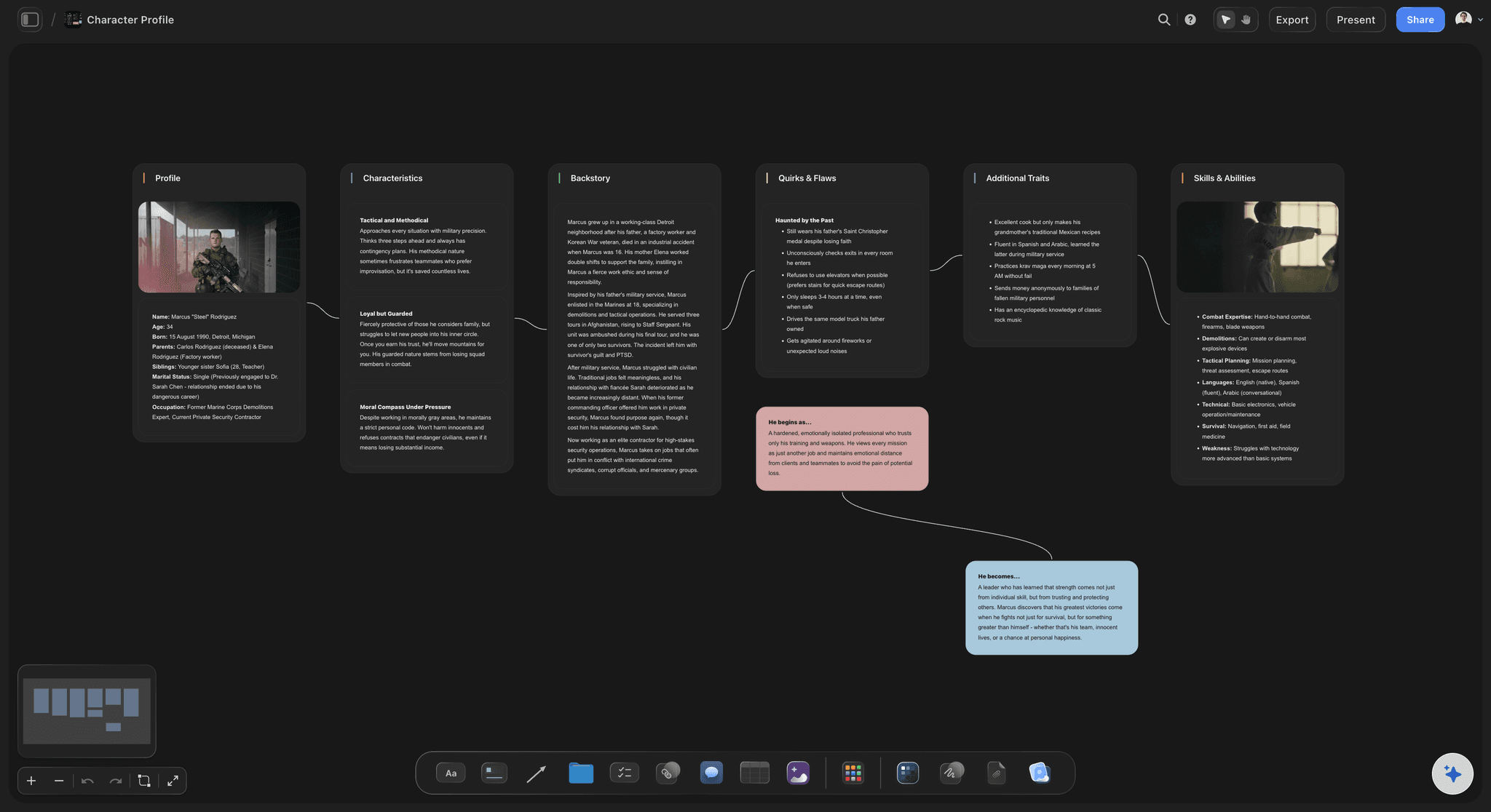
Beyond plot
Characters, worlds and arcs
Character arcs, worldbuilding, series structure and briefs can be laid out too, so structure is available for the parts of a story that are not plot.
See the character arc tracker →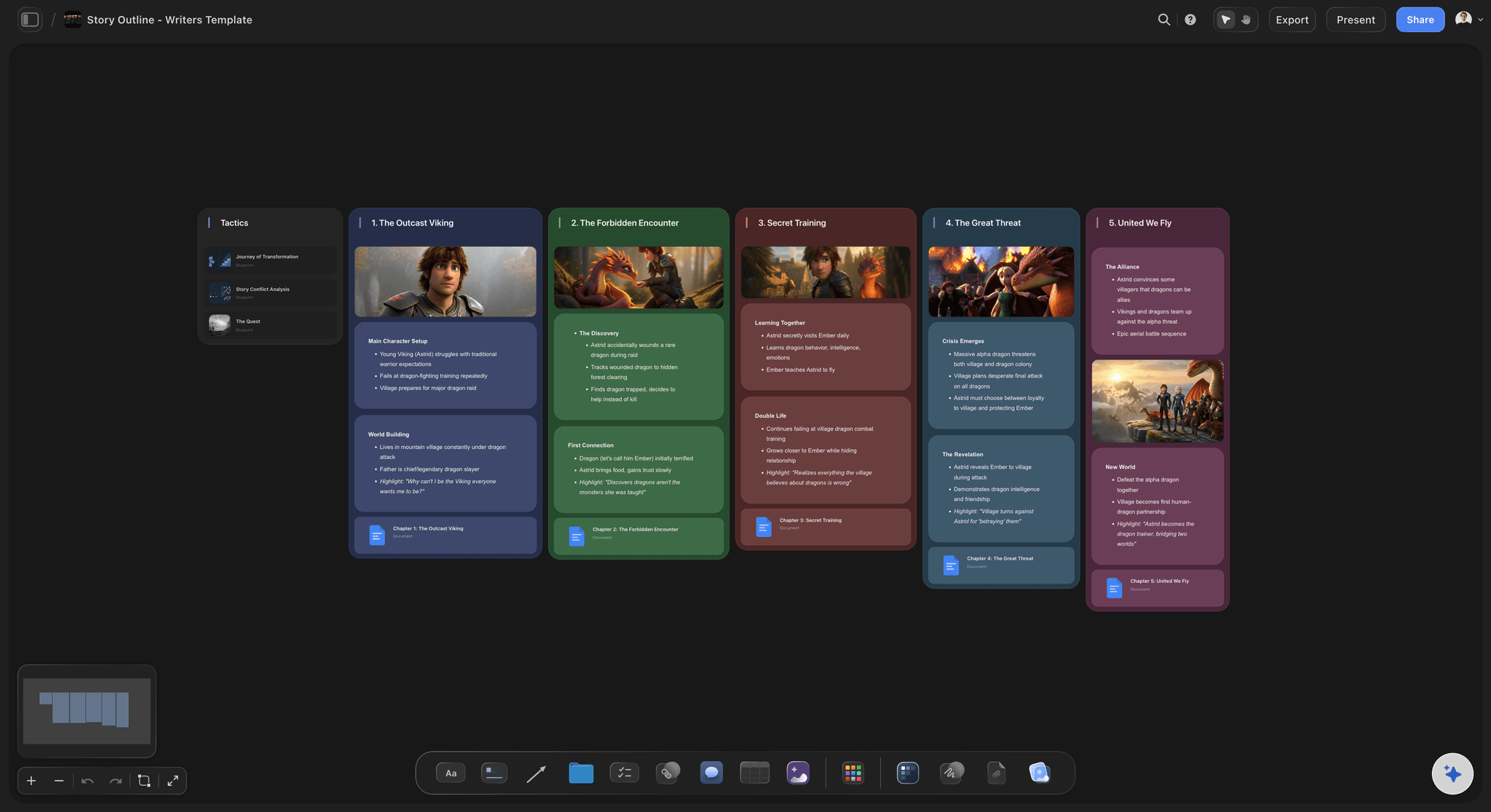
Learn the craft while using it
See how a framework behaves on your story
Applying a structure to material you know well teaches more about why it exists than reading about it ever does.
See the AI creative workspace →Plans from $7.99/month annual. Free plan coming late 2026.
Frameworks applied on a canvas with no project limit on Plus, Pro and Max. Free plan before the end of 2026.
Unlimited file uploads on Plus, Pro and Max
Frameworks applied as editable cards
AI reads the whole board before it answers
One board per project, no project limit
Built for people with taste
What each one is actually for.
They are not interchangeable, and picking by familiarity rather than by fit is a common way to waste one.
The structural ones
Three-act and five-act
Good for diagnosing pace: Act breaks are where stories most often sag, and naming them makes a slow second act visible as a structural fact rather than a vague feeling.
Weak on character: Act structure describes what happens and says almost nothing about why anyone does it, so it needs pairing with a character framework.
Works for non-fiction too: Documentaries, pitches and campaigns have act structure whether or not anyone planned one.
The journey ones
Hero's journey and its descendants
Strong on transformation: It is really a framework about change in a character, which is why it survives across such different stories.
Easy to over-apply: Not every story is a transformation, and forcing one onto an ensemble or a mood piece produces something inert.
Use it as a question set: What is refused, what is crossed, what is lost. Better as prompts than as a set of boxes to complete.
The beat ones
Beat sheets and scene cards
Finest granularity: Beat sheets work at the level where problems are actually fixable, which is the individual scene rather than the act.
Reorderable on a canvas: Beats as cards you can physically move is the whole advantage over a linear document, because sequence is the thing being tested.
Best late: Most useful on a draft that exists and is not working, rather than as a way to generate one from nothing.
The non-plot ones
Character arcs and worldbuilding
Arc against plot: Laying a character's change beside the plot beats shows where someone is present but not developing, which plot frameworks hide.
Worlds need structure too: Factions, rules and history benefit from a shape, and inconsistency there is a common late-stage problem.
Series and season shapes: Episode and series structures are their own frameworks, and applying a feature shape to a series is a reliable way to lose the middle.
Explore templates for your project
Every template opens as a real, editable board on the infinite canvas. Pick the closest fit and make it your own.
Story Plan
Outline your plot, characters, and world in one connected view, then expand each thread as the story grows.
What creators are saying
Join early creators getting structured workspaces and AI that remembers their projects
“Storyflow has sped up my workflow by at least 3x, which means more flow state and more projects I can actually ship. It truly changed the way me and my team create.”

Reilin Joey
Director & YouTuber
“One prompt gets me a structured board. But the tactics are my favorite. I run my YouTube scripts through them and my intros and retention got better. It's amazing.”

Justkay
YouTuber & Freelance Filmmaker
“I used to juggle five apps to plan a project. Now I describe what I am making and get boards, lists, and a schedule. All in one place.”

George
@fernwehchronicles
Storytelling frameworks, answered.
What writers ask before committing to a structure.
Yes. Storyflow's AI lays out three-act structure, the hero's journey, beat sheets, character arcs and worldbuilding as editable cards. They sit on an infinite canvas beside your actual scenes, research and references rather than in a separate document, and the AI reads the whole active board plus up to five attached documents and three boards, so it can answer questions about your story against the framework you are using.
They do when treated as the work rather than as a diagnostic. Filling in twelve boxes produces something story-shaped with no pressure behind it. Used the other way round, building your material first and laying the framework over it afterwards, they locate problems without dictating content.
It depends on the problem. Act structure diagnoses pace, the hero's journey handles transformation, beat sheets work at scene level where things are actually fixable, and character frameworks catch people who are present but not changing. Picking by familiarity rather than by the problem you have is the common mistake.
Early, when an idea needs a shape to grow against, or late, when a draft is not working and you need to find out why. In the middle, while the story is discovering its own logic, a framework is mostly interference.
Yes, and documentaries especially. Material gathered before anyone knew what the film was needs structure found rather than planned, which is exactly what laying a framework over existing material does.
Not during early access. Plans start at $7.99 per month billed annually or $9.99 monthly, with a free plan launching before the end of 2026. Anyone a paid member invites to a board joins free today.
That is information rather than failure. Sometimes an empty beat is a real gap, and sometimes it means the framework is wrong for this story. A transformation structure applied to an ensemble piece will show gaps that should not be filled.
It can lay one over your material and fill it in as editable cards, which is a useful first pass. Treat it as a draft to argue with: the AI can identify a missing beat but cannot know what your story is about, and accepting its version wholesale is the fast route to something formulaic.
An outline is your story's specific sequence. A framework is a general shape you test that sequence against. Storyflow holds both on the same canvas, which is the point, because the comparison is where the useful information is.
Yes, and it is often necessary. Act structure plus a character arc framework is the most common pairing, because plot structures say almost nothing about motivation and character frameworks say almost nothing about pace.
Put the structure next to the story.
Frameworks applied on a canvas that holds your actual material. Plans from $7.99 a month billed annually.