
What Is Transmedia Storytelling? The Complete Guide (2026)
Transmedia storytelling is one story world told across multiple platforms, where each platform adds something new instead of repeating the others. A complete 2026 guide.

Category
Storytelling
Author

Justkay
Documentary Filmmaker & Founder at Storyflow
Topics
2026-07-15
•
12 min read
•
Storytelling- what is transmedia storytelling
- transmedia storytelling definition
- transmedia vs cross-media
- transmedia story bible
What is transmedia storytelling?
Transmedia storytelling is one story world told across multiple media platforms, where each platform adds something new instead of repeating what the others already showed. A film sets up the world. A game lets you live in a corner of it. A comic fills in a character's past. An in-world website leaks a document the film never mentions. Put together, they form a single story larger than any one piece. The idea traces to media scholar Marsha Kinder in 1991 and was given its modern name by Henry Jenkins in Convergence Culture (2006). It is not the same as an adaptation (the same story retold in a new medium) or a marketing campaign (the same message pushed through many channels). The rule that separates real transmedia from a franchise cash grab is short: each platform has to earn its entry.
What Transmedia Storytelling Actually Means
Most people assume "transmedia" means "a story that shows up in a lot of places." That is close enough to be wrong. A brand can run the same trailer on YouTube, TikTok, and a billboard and add nothing new. That is reach, not transmedia.
Transmedia storytelling is a structural claim about the story, not a distribution tactic. The world is the fixed thing, and each platform reveals a part of it you could not see from the others. Henry Jenkins framed each installment as making, in his words, a "distinctive and valuable contribution to the whole" (Convergence Culture, 2006). The keyword is distinctive. A part that only echoes another part is decoration.
I am Justkay, a documentary filmmaker and the founder of Storyflow. I have planned story worlds that had to exist in more than one place at once: a film, a companion website, a social rollout, and the research canvas holding them together. The lesson every time is that the hard part is not making more content. It is deciding what each piece is allowed to say so the pieces add up instead of colliding. This guide is the framework I use, plus the history, the examples, and how to plan it.
The short version, before the detail:
- One world, many platforms, no repetition. Each platform carries a different piece.
- The audience is active, assembling the world by moving between pieces.
- It scales down. A single filmmaker with a movie, a website, and a social feed can do it. It is a discipline, not a budget.
One World, Many Doors: The Rule Underneath Every Transmedia Story
Here is the model this guide runs on. Picture the story world as a building. Every platform you publish on is a door into it. The film is one door. The podcast is another. The game, the comic, the in-world Instagram account: each is a separate door. I call this One World, Many Doors.
One World, Many Doors has three parts, and all three have to hold or the project quietly stops being transmedia.
One world. A single canonical reality underneath everything: rules, timeline, characters, tone. This is the fixed point. Every door has to open onto the same building, or you do not have transmedia, you have unrelated content wearing the same logo.
Many doors. You reach the world through more than one medium, each chosen for what it is good at. You do not put a slow character study in a mobile game or a frantic chase in a poem. You match the piece of the story to the door that tells it best.
Every door earns its entry. Walk through any door and you should find something the others cannot show. This is the test almost everything fails. Each platform has to earn its entry. If a platform only replays a scene you already watched, it is not a door into the world. It is a poster of it on the outside wall.
That third rule is the whole game. It is not that more platforms make a story transmedia. It is that each platform has to pull its own weight. When people say a franchise "feels like a cash grab," they are usually sensing a door that did not earn its entry: a spin-off that repeats the main story with the serial numbers filed off. For each planned platform, finish this sentence: "You can only learn this here." If you cannot finish it, that door is a wall with a handle.
Transmedia vs Adaptation, Cross-Media, and Franchising
The fastest way to understand transmedia is to line it up against the things it gets confused with. All involve one story in more than one form. What changes is whether each form adds something and what the audience does.
| Approach | What it is | Example | Your role as audience |
|---|---|---|---|
Transmedia storytelling | One world across many platforms, each adding a new, non-redundant piece | The Matrix films, The Animatrix, and the Enter the Matrix game, each covering events the others skip | Active. You assemble the world across pieces |
Adaptation | The same story retold in a new medium, start to end | A novel becomes a film. Same plot, different form | Comparer. You weigh one version against another |
Cross-media campaign | The same message pushed across many channels for reach | One trailer running on YouTube, TikTok, TV, and a billboard | Passive. You receive the same thing repeatedly |
Franchising | Many products under one brand, loosely or inconsistently connected | Sequels and tie-ins that extend a brand without one shared canon | Repeat buyer. You buy the next installment |
Multimedia | Many media types inside one experience | A web page mixing text, video, and audio | Viewer. You take it in through several senses |
Read the last column top to bottom. That is the real difference. Adaptation asks you to compare. Marketing asks you to receive. Transmedia asks you to explore. A transmedia audience is doing work: following a character from the film to their in-world blog, catching a reference in the game that pays off in the comic. That participation builds the most committed audiences and makes transmedia the hardest thing to plan. You are not writing one story. You are designing a set of related discoveries and trusting the audience to connect them.
Franchising is the middle case. Every transmedia story is technically a franchise, but not every franchise is transmedia. The difference is coordination: a franchise becomes transmedia the moment the pieces are planned against one canon so each earns its entry. Miss that and you have a brand with a lot of products. Hit it and you have a world.
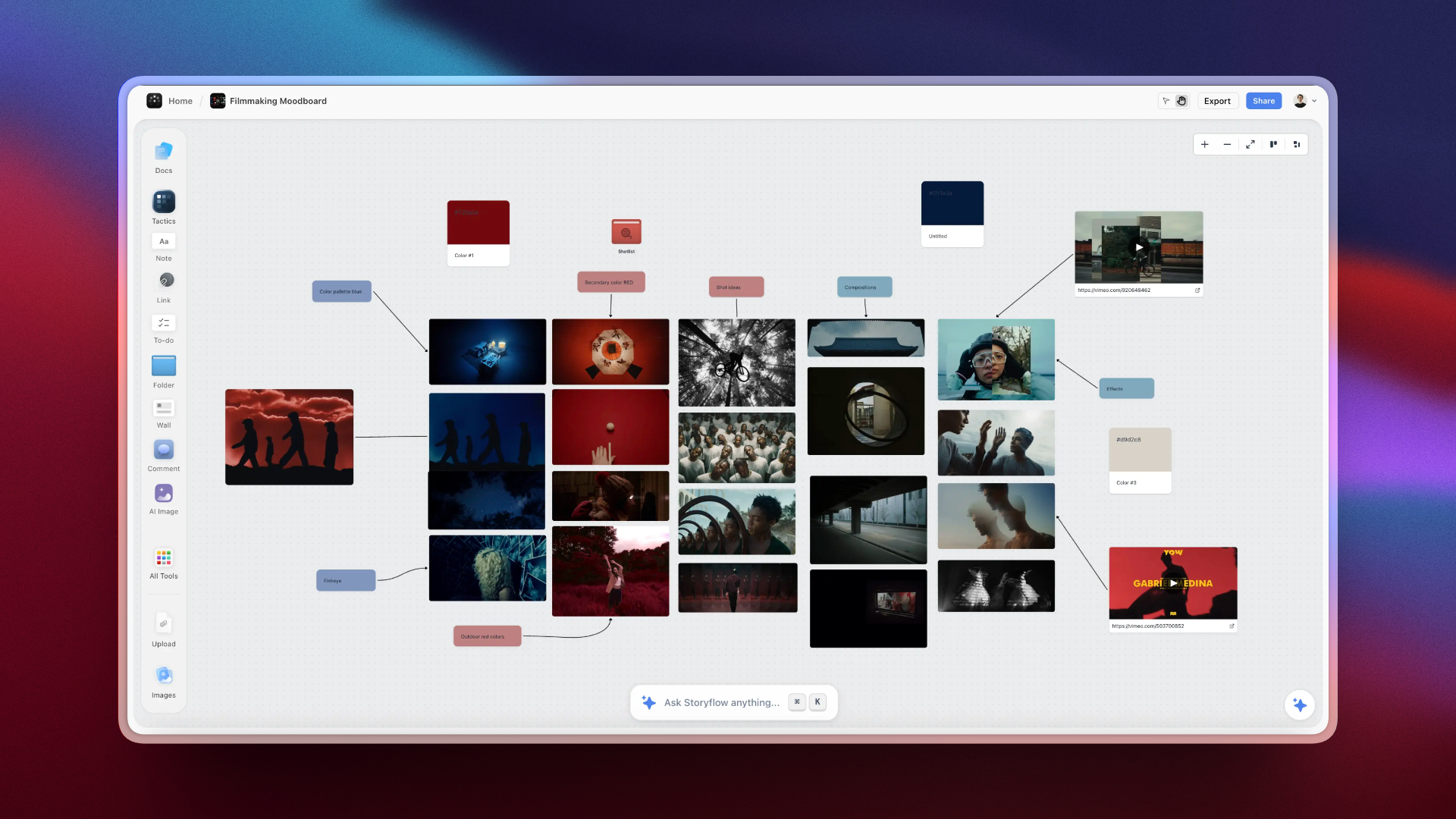
A Storyflow canvas mapping one story world across film, social, and interactive platforms
Henry Jenkins and the Principles of Transmedia Storytelling
Credit where it is due, because the history is often mangled. Marsha Kinder introduced the underlying idea as "transmedia intertextuality" in Playing with Power (1991), watching children follow the Teenage Mutant Ninja Turtles from cartoon to toy aisle to video game. Henry Jenkins then gave the practice its modern name and clearest definition in Convergence Culture (2006), using The Matrix as his case study. Cite Jenkins for the definition. Name Kinder for who got there first.
In a 2009 essay, Jenkins laid out seven principles of transmedia storytelling. They are the vocabulary the field uses, and most are really design tensions, not commandments.
- Spreadability vs. drillability. Spreadable content travels wide. Drillable content rewards going deep. Strong worlds do both.
- Continuity vs. multiplicity. Continuity keeps one canon. Multiplicity allows alternate versions (a "what if" universe). You choose which you run.
- Immersion vs. extractability. Immersion pulls the audience into the world. Extractability lets them take pieces of it into their lives (a prop, a phrase, a fan artifact).
- Worldbuilding. The world is bigger than any single story told in it. This is the foundation the other six sit on.
- Seriality. The story breaks into meaningful chunks spread across installments and platforms.
- Subjectivity. Different platforms follow different characters, filling in perspectives the main story could not hold.
- Performance. The audience does things (theories, fan works) that become part of the world's life.
Notice how many are the same instinct as One World, Many Doors. Worldbuilding is the one world. Seriality and subjectivity are the many doors, each carrying a different chunk or viewpoint. Extractability and performance are what happens when a door genuinely earned its entry: people carry the world around and add to it. A transmedia project fails when it treats these as a checklist instead of a set of choices. You do not need all seven. You need the world to be worth entering from more than one door.
Transmedia Storytelling Examples That Actually Work
Real worlds, not invented ones. Each of these earns the label because you learn different things through different doors.
The Matrix. Jenkins' original example, and still the cleanest. The three films are the spine, but The Animatrix (nine animated shorts) tells origin stories the films skip, and Enter the Matrix (the game) covers events parallel to the second film, following characters the movie only glances at. Watch only the films and the story is complete; add the other doors and it deepens. That is One World, Many Doors done in 2003.
Pokemon. Proof that transmedia is not a grown-up gimmick. The games, the animated series, the trading card game, and the manga each give a genuinely different relationship to one world: you play it, you watch it, you compete in it, you read it. Kinder's 1991 argument about children moving across media was about exactly this shape.
Star Wars. Useful because it shows the failure mode too. At its best, the novels, series, and games expand the galaxy into corners the films never reach. At its worst, it produced so much loosely coordinated material that the canon had to be formally reset. Coordination is what keeps a franchise transmedia.
The Blair Witch Project. The early, low-budget proof that this scales down. Before the 1999 film released, the filmmakers built an in-world website and a faux documentary presenting the legend as real. The film never explains the mythology the website carries. Two doors, one world, each earning its entry, for almost no budget.
The pattern across all four: enter from any door and get a whole experience, and every additional door deepens rather than duplicates. When a door only repeats what another already showed, audiences feel it instantly, and they are right.
How to Plan a Transmedia Story Bible (with AI)
A transmedia bible is not a longer script. It is the map of the one world plus the plan for the many doors. Here is the sequence I use, and where AI genuinely helps instead of generating filler.
- Write the world before the platforms. Rules, timeline, characters, tone, central conflict. This is your canon, the fixed point every door opens onto. Choosing platforms before the world exists is how you get five doors into an empty building.
- Map the doors. List the platforms you are considering (film, series, podcast, game, comic, in-world social) and write one line on what each medium is uniquely good at. Match each piece of the story to the door built for it.
- Give every door a job. For each platform, name the piece of the world it carries and the one thing you can only learn there. If two doors have the same job, kill one. This is the "earns its entry" test applied line by line.
- Build the continuity spine. Lay the doors on a single timeline so events line up across platforms. Decide, in Jenkins' terms, whether you are running strict continuity or deliberate multiplicity. Ambiguity here is where transmedia projects contradict themselves.
- Pressure-test the whole thing. Walk each door as someone who has seen nothing else: does it stand alone? Now as someone who has seen everything: does it add? A door has to pass both.
This is where tooling matters, because a transmedia bible dies in scattered files. The bible in one document, the platform map in a spreadsheet, the timeline in a project tool, the moodboard somewhere else, and no single view of the whole world. Worse, whatever AI you use sees only its own silo, so it cannot check whether the game door contradicts the comic door.
This is the friction Storyflow is built for. It is an AI-powered visual workspace: an infinite canvas where the bible, the platform map, the timeline, and the reference images live as cards, notes, and links on one board instead of five apps. The canvas-aware AI reads your full active board by default, plus up to 1 blueprint and 3 documents you @-mention, so when you ask whether the game door contradicts the timeline, it reasons over the actual world map, not a pasted summary. The whole world on one surface is the difference between catching a contradiction now and finding it after production.
To be honest about the limits, because a tool that claims to do everything is lying: Storyflow plans the world. It does not produce or run it. Three worth stating plainly.
- It is not a production or asset-management tool. It will not store, version, or deliver your master video files, game builds, or print-ready art. Pair it with a real DAM or production pipeline.
- It is not a community-management or publishing platform. It will not run the in-world Instagram, schedule the rollout, moderate the Discord, or host the live ARG. Those need dedicated distribution and community tools.
- It is canvas-card-shaped and cloud-only. A 60-page formal bible that a studio's continuity team red-lines reads better in a document tool, and there is no offline, local-first mode for privacy-regulated work.
The honest positioning: Storyflow is the best place I know to hold the one world and see all the doors at once, not the place you ship them from.
Do You Actually Need Transmedia Storytelling?
Sometimes the right answer is no, and a guide that will not say so is selling you something. Transmedia is a discipline, not a status symbol. One World, Many Doors is a way of thinking, not a budget line.
You probably do not need transmedia if your story is complete in one form. A tight short film does not need a companion podcast. Forcing extra doors onto a whole story is how you get the redundant spin-offs everyone can smell. A single strong door beats five weak ones every time.
You probably do want it when your world is genuinely bigger than the story in the main piece, when characters and events press at the edges of the frame. That overflow is the signal, not the wish to look bigger than you are.
And it scales down. The Blair Witch team did it with a website and a fake documentary. Start with two doors that each earn their entry, then add a third only when the world overflows again.
The Bottom Line
Transmedia storytelling is one story world entered through multiple platforms, where each reveals something the others cannot. It is not adaptation, which retells. It is not marketing, which repeats. It is exploration, which asks the audience to assemble the world across pieces. Kinder named the instinct in 1991, Jenkins defined it in 2006, and the seven principles are the field's vocabulary, but you can hold the whole practice in one line: one world, many doors, and each door has to earn its entry.
If you are planning one, write the world first, map the doors second, and give every door a job no other door can do. If your world genuinely overflows a single medium, put the bible, the platform map, and the timeline on one Storyflow canvas and let the AI read across all of it while you run the earns-its-entry test on every door. If it does not overflow, tell it beautifully through one door and move on. Map your story world on a Storyflow canvas.
FAQ: Transmedia Storytelling
What is transmedia storytelling in simple terms?
Transmedia storytelling tells one story world across several media so each medium adds a new piece. A film, a game, a comic, and an in-world website can share one world while each shows something the others do not. The test is that no platform simply repeats another.
What is an example of transmedia storytelling?
The Matrix is the classic case: the films are the spine, The Animatrix tells origin stories they skip, and the Enter the Matrix game covers parallel events with side characters. Pokemon and the original Blair Witch Project (film plus in-world website) are others. Different platforms, different parts of one world.
What is the difference between transmedia and cross-media?
Cross-media usually means the same content sent across many channels, like a trailer on YouTube, TV, and a billboard. Transmedia means different, non-redundant parts of one story told through different media. Cross-media is reach through repetition. Transmedia is depth through variety.
What is the difference between transmedia storytelling and an adaptation?
An adaptation retells the same story in a new medium, like a novel turned into a film with the same plot. Transmedia does not retell. Each platform tells a different part of the world, so the film and the game give you more story, not the same story twice.
Who coined the term transmedia storytelling?
Marsha Kinder introduced the underlying concept as "transmedia intertextuality" in Playing with Power (1991). Henry Jenkins popularized "transmedia storytelling" and gave its widely used definition in Convergence Culture (2006). Kinder named the instinct first. Jenkins turned it into a usable practice.
What are Henry Jenkins' seven principles of transmedia storytelling?
Jenkins named seven in 2009: spreadability vs. drillability, continuity vs. multiplicity, immersion vs. extractability, worldbuilding, seriality, subjectivity, and performance. Most are design tensions, not rules. They describe choices you make rather than a checklist every project must complete.
Is Marvel's cinematic universe transmedia storytelling?
Partly. When a Disney+ series continues an arc and adds genuinely new events, that is transmedia. When a tie-in only restates what the films showed, it is franchising. The MCU does both, which makes it a clear example of the line between the two.
What is a transmedia story bible?
A transmedia story bible is the master document for the whole world plus the plan for every platform. It holds the canon (rules, timeline, characters, tone) and gives each platform a job: what part of the world it carries and what you can only learn there.
How do you start a transmedia storytelling project?
Write the world first: rules, timeline, characters, conflict. Give each platform a job no other has, lay them on one timeline for continuity, then walk each twice, as a newcomer and as an insider, to check it both stands alone and adds something. Start with two doors, not ten.
Is transmedia storytelling only for big studios?
No. The original Blair Witch Project built a two-door transmedia world (film plus in-world website) for almost nothing, because the pieces did not repeat each other. A solo creator with a film, a site, and a social feed is doing transmedia if each piece adds something.
What is the difference between transmedia and multimedia?
Multimedia combines several media types in one experience, like a web page mixing text, video, and audio. Transmedia spreads one story across several separate media so each carries a different part. Multimedia is many formats in one place. Transmedia is one world across many places.
Can AI help plan a transmedia story?
Yes, mostly for consistency rather than generating the world for you. AI that reads your whole story map can flag where one platform contradicts another and suggest what each door could uniquely add. Storyflow's canvas-aware AI reads your full active board, so it audits the actual world, not a summary. The judgment stays yours.
Table of Contents
- What Transmedia Storytelling Actually Means
- One World, Many Doors: The Rule Underneath Every Transmedia Story
- Transmedia vs Adaptation, Cross-Media, and Franchising
- Henry Jenkins and the Principles of Transmedia Storytelling
- Transmedia Storytelling Examples That Actually Work
- How to Plan a Transmedia Story Bible (with AI)
- Do You Actually Need Transmedia Storytelling?
- The Bottom Line
- Author
- FAQ: Transmedia Storytelling
- Related Reading
Templates to check out for this topic


Templates you can use in Storyflow
Every Storyflow board starts from real structure and an AI that reads the whole canvas. Open one of these templates and make it yours.


See Storyflow in Action
A visual AI workspace where every feature lives inside one canvas. No tab-switching, no context lost.
Build your entire board from a single message
Type what you need in the AI chat at the bottom of your canvas. The AI adds cards, headings, and structure directly onto your board.
Use expert frameworks as AI context
Type @ in the AI chat and choose any Tactic. The AI tailors every response to that framework instead of giving generic advice.
Turn your board into a mind map in seconds
Ask the AI to restructure your canvas as a mindmap. It connects your ideas into a visual hierarchy so you can see how everything relates.
Why Storyflow Exists
Storyflow actually began as a personal tool while working on creative and research projects.
We kept running into the same problem: ideas were scattered everywhere: notes, documents, and whiteboards.
Nothing helped us see how everything connected.
So we started building a workspace designed around how ideas actually grow.
→ Read how Storyflow was createdJustkay
Documentary Filmmaker & Founder at Storyflow
Published: 2026-07-15
Extremely simple, seriously capable


See how easy it is to get started
Watch a real project come together, from a blank board to a finished plan, clicked through step by step.
Start creating with AI and become more productive
Transform your creative workflow with AI-powered tools. Generate ideas, create content, and boost your productivity in minutes instead of hours.