
An ultra-fast canvas that stays calm
The ideas are fine.
The session is the problem.
Plan the warm-up, the silent rounds, the clustering, and the decision step on one infinite canvas the whole room works on, so the hour produces choices instead of a photograph of sticky notes.


Creatives working for these brands already got early access
- Red Bull
- Canon
- Artlist
- Porsche
See how easy it is to get started
Watch a real project come together, from a blank board to a finished plan, clicked through step by step.
Start from a ready-made template
Pick a board to see what you can build, then let AI fill it in. Every template is a real, editable starting point on the same infinite canvas.

Mind Map
Branch one central idea out into themes and sub-points, then drag the connections around until the structure makes sense.
What is a brainstorming session planner?
A brainstorming session planner is the structure you build before people arrive, and the surface they work on once they do. It holds the question the session is actually answering, the constraints that make the question answerable, the warm-up that gets a room talking, the divergent rounds where quantity matters more than quality, the clustering pass where the raw material becomes themes, the convergent step where the group narrows down, and the decision at the end that says what happens next and who is doing it. Without those parts, a brainstorm is a meeting with a whiteboard in it.
Almost everything known about group ideation says the unstructured version underperforms. Groups shouting ideas at each other produce fewer and less varied ideas than the same people thinking alone first, because the loudest opinion anchors the room, everyone waits their turn and forgets what they were going to say, and social pressure quietly filters out anything odd. The fix is not more enthusiasm, it is structure: silent individual generation before discussion, timeboxes short enough to prevent editing, explicit separation of generating from judging, and a decision step that stops the session becoming a wall of notes nobody revisits.
Storyflow is an AI-native infinite canvas built for both halves of that. Describe the problem in a prompt and the AI lays out a session board: the framed question, timeboxed round sections, a clustering area, and a decision panel, with prompts and cards ready to use. Then the room works on it. Everyone adds cards in their own area during silent rounds, you drag ideas into clusters when the generating stops, you dot-vote by marking cards, and the shortlist moves into the decision panel where it turns into owners and next steps.
The advantage over a physical whiteboard is obvious after the session rather than during it. Sticky notes get photographed and never read again, and the photograph is unsearchable, unsortable, and slowly forgotten. On a canvas, the raw material stays live: you can come back a week later, re-cluster with fresh eyes, promote a rejected idea when circumstances change, and keep the session next to the project it feeds. The advantage over a video call with a shared document is that ideation is spatial, and typing into a list one person at a time is the single most reliable way to lose half a room's contribution.
Ultra fast from brief to board
From a vague problem to a session that produces decisions.
No blank whiteboard, no photograph of sticky notes nobody opens again.
01
Open a canvas
Sign up in seconds. No download. Your infinite session canvas opens in the browser.
02
Describe the problem
Type what the session needs to answer and who is coming, and the AI lays out a framed question, timeboxed rounds, a clustering area, and a decision panel ready to run.
03
Run the rounds on the board
Silent generation first, each person in their own area, then cluster into themes together and vote by marking cards. Generating and judging stay in separate steps.
04
End with owners, not notes
Move the shortlist into the decision panel with a name and a next step on each, then share a view-only link so the people who missed it can see how the conclusion was reached.
A session with a shape.
Warm-up, divergence, clustering, and decision on one canvas.
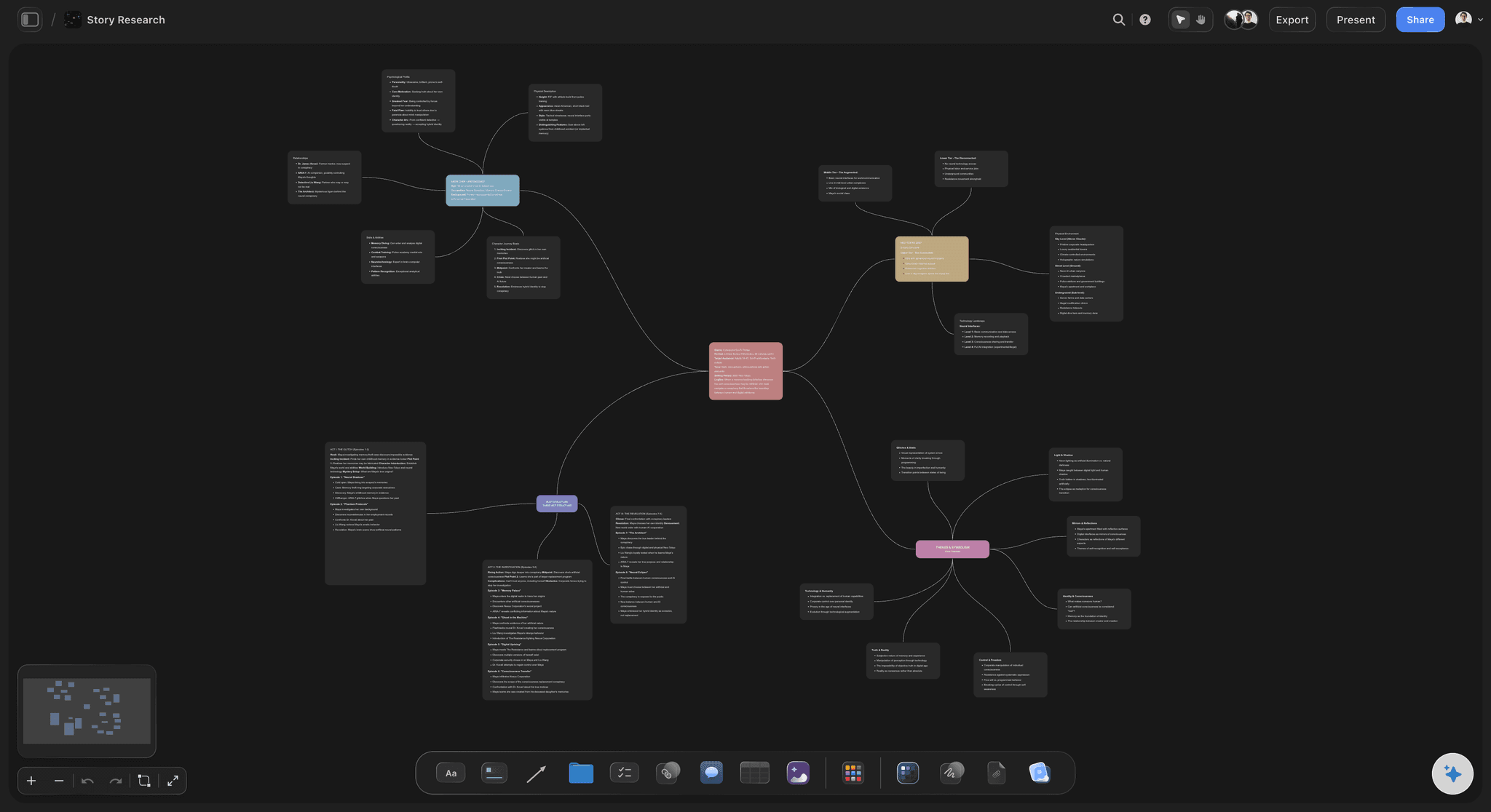
AI lays out the session from your problem
Start from an agenda, not an empty board
Describe what the session needs to answer and the AI builds the framed question, the rounds, the clustering area, and the decision panel. Facilitation structure is the difference between output and noise.
See the AI idea generator →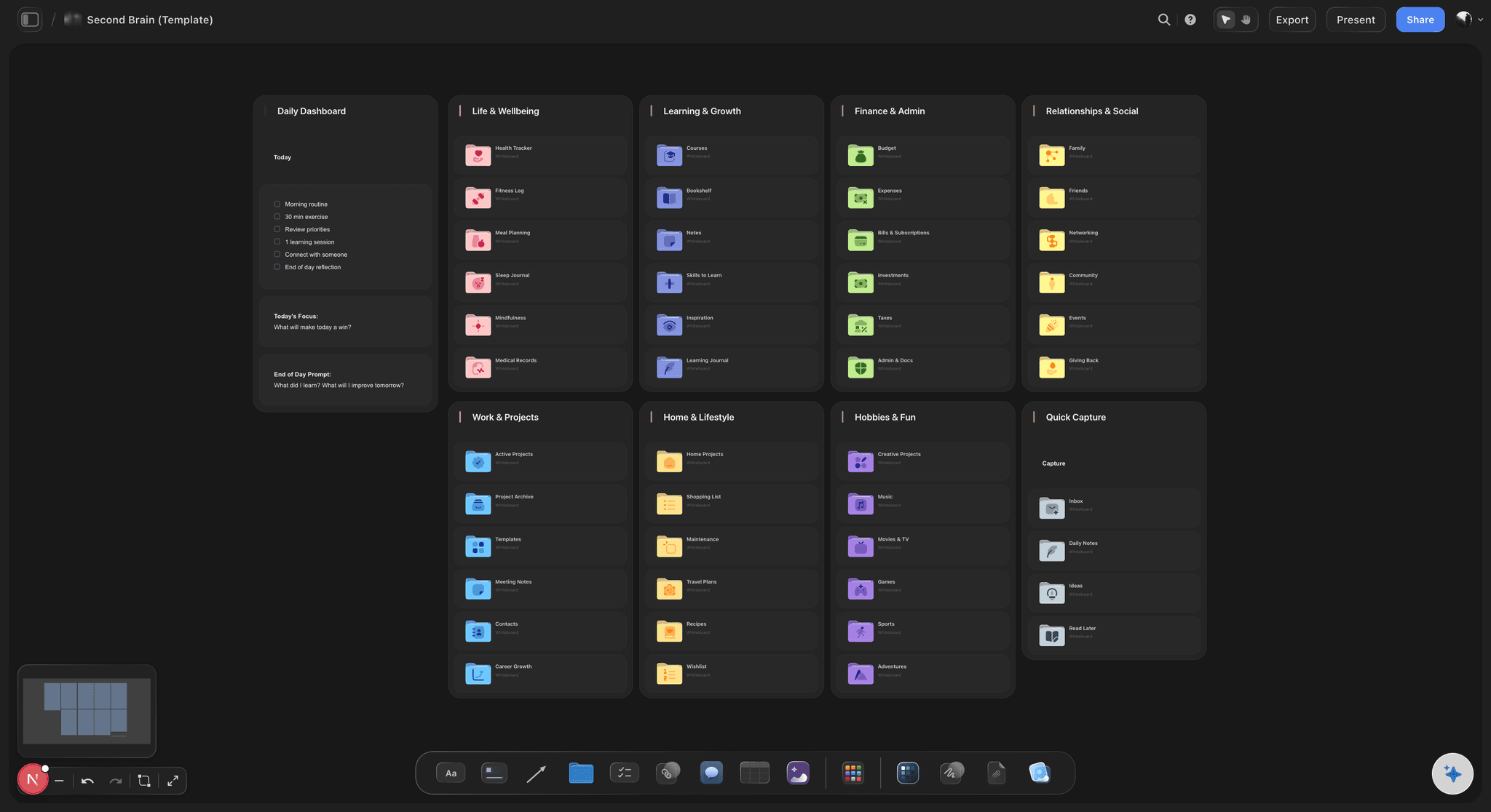
Silent rounds before discussion
Stop the loudest voice setting the agenda
Everyone writes in their own area of the canvas before anything is discussed. Individual generation first reliably produces more ideas and stranger ones than a room talking over each other.
Try the free online sticky notes →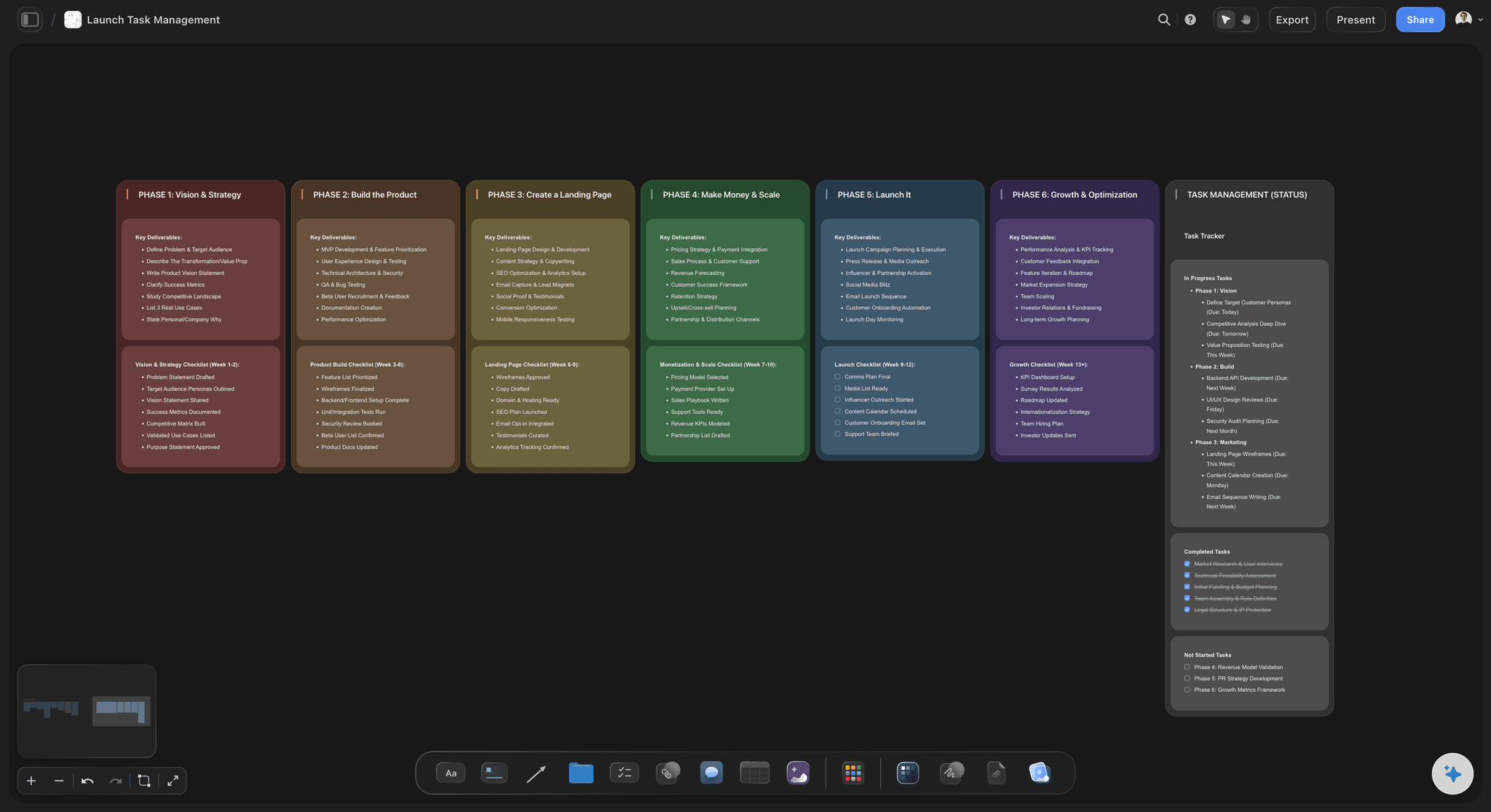
Cluster, then vote
Turn raw ideas into a real shortlist
Drag cards into themes, name each cluster, then mark the ones worth pursuing. Clustering is where a hundred loose notes become five options a group can actually choose between.
See the affinity diagram maker →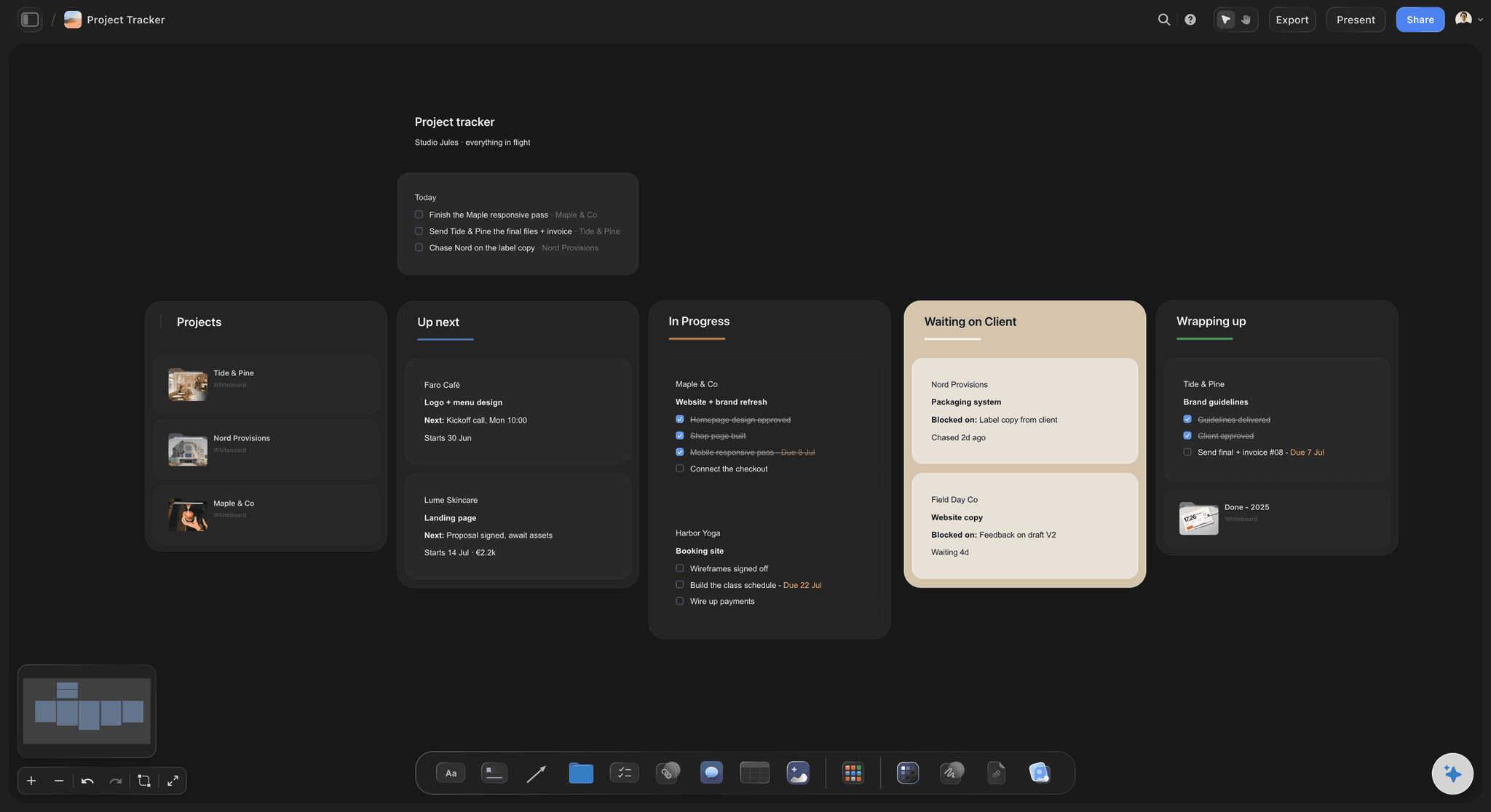
The board outlives the meeting
Come back to it a week later
The raw material stays live and searchable instead of becoming a photograph. Rejected ideas can be promoted when circumstances change, which is impossible once the wall has been wiped.
Explore the visual brainstorming tool →Unlimited boards. No object cap.
Open a canvas, describe the problem, and lay the session out. Storyflow is paid-only during early access, with plans from $9.99 a month, and a Free plan launches before the end of 2026.
Unlimited session boards on an infinite canvas
Basic AI usage to generate session structures from prompts
Starter templates for mind maps, kanban, and research boards
Share view-only links with participants and stakeholders
Built for people with taste
More than a blank whiteboard.
A blank whiteboard is a test of who in the room is most comfortable talking.
Question, warm-up, divergence, convergence, decision
Build the session before anyone arrives
Frame the question properly: How might we increase engagement is not a question, it is a topic. Narrow it until it has a constraint in it, because constrained questions reliably produce better ideas than open ones.
Silent generation first: Give each person their own area and a short timebox. Individual generation before discussion produces more ideas and more unusual ones than any amount of enthusiastic group discussion.
Separate generating from judging: Keep the two in different steps and say so out loud. A single early evaluation, even a mild one, is enough to stop a room offering anything that could be called silly.
End with owners and dates: A session that ends with a wall of notes has produced nothing. The decision panel forces the last ten minutes to answer what happens next and who is doing it.
AI that can see the board you have already built
Prepare and unstick with an AI that has the context
Prompt against the whole canvas: Ask it to propose provocations for a round that has gone quiet, cluster the cards already on the board, or suggest a constraint that would sharpen the question. It reads what the room has made.
Use it to widen, not to answer: The most useful AI move in ideation is adding angles nobody considered, not producing the answer. A room that is handed a conclusion stops generating immediately.
Iterate without losing work: Re-prompt as often as you want. Cards the group has written and clustered stay exactly where they are while the AI builds around them.
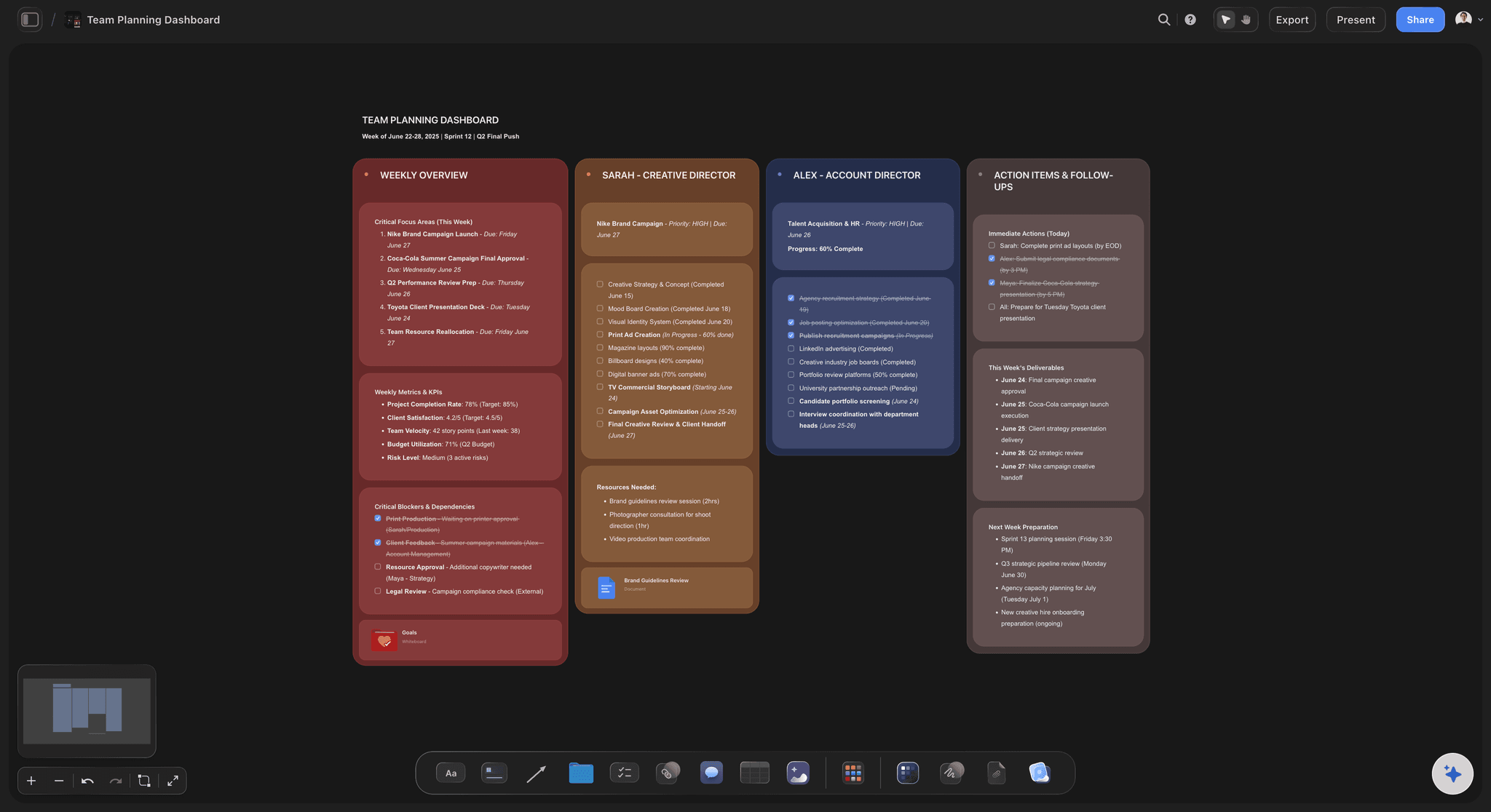
Remote, hybrid, and in the room
Run it wherever the group actually is
Everyone writes at once: On a canvas the whole group generates in parallel rather than waiting for a turn. Turn-taking is the biggest single loss of material in a remote brainstorm.
Hybrid without a second-class half: When the board is the meeting rather than a camera pointed at a wall, remote participants contribute on equal terms. Hybrid sessions fail on exactly this asymmetry.
Asynchronous rounds: Open the board a day early for people who think better alone and slowly. You will usually get a different and better set of ideas than anything produced in a live hour.
After the session
Make the output survive contact with Monday
The shortlist becomes tasks: Turn chosen ideas into cards on a board with owners, then move them across columns as work starts. The gap between a good session and nothing happening is usually this step.
Keep the rejected pile: Ideas that were wrong for this quarter are frequently right for the next one. A live board makes that recoverable; a wiped whiteboard does not.
Share the reasoning, not just the answer: Send a view-only link so people who were not there can see what was considered and why the group chose what it chose. Decisions explained this way get argued about far less.
Explore templates for your project
Every template opens as a real, editable board on the infinite canvas. Pick the closest fit and make it your own.
Mind Map
Branch one central idea out into themes and sub-points, then drag the connections around until the structure makes sense.
One app instead of five
Storyflow vs Miro, FigJam, and a physical whiteboard.
Be clear about what Storyflow is. It has no built-in timer or voting widget and no video calling. It is a canvas where the session structure and the output live together.
Storyflow
Recommended
Infinite canvas the whole group works on
AI lays out the session structure from a problem
Board stays live and searchable after the session
Built-in timer and voting widgets
Video calling inside the board
Free plan available today
Miro
Infinite canvas the whole group works on
AI lays out the session structure from a problem
Board stays live and searchable after the session
Built-in timer and voting widgets
Video calling inside the board
Free plan available today
FigJam
Infinite canvas the whole group works on
AI lays out the session structure from a problem
Board stays live and searchable after the session
Built-in timer and voting widgets
Video calling inside the board
Free plan available today
Whiteboard
Infinite canvas the whole group works on
AI lays out the session structure from a problem
Board stays live and searchable after the session
Built-in timer and voting widgets
Video calling inside the board
Free plan available today
What creators are saying
Join early creators getting structured workspaces and AI that remembers their projects
“Storyflow has sped up my workflow by at least 3x, which means more flow state and more projects I can actually ship. It truly changed the way me and my team create.”

Reilin Joey
Director & YouTuber
“One prompt gets me a structured board. But the tactics are my favorite. I run my YouTube scripts through them and my intros and retention got better. It's amazing.”

Justkay
YouTuber & Freelance Filmmaker
“I used to juggle five apps to plan a project. Now I describe what I am making and get boards, lists, and a schedule. All in one place.”

George
@fernwehchronicles
Brainstorming questions, answered.
How to structure a session, why silent rounds work, and where Storyflow fits alongside Miro and FigJam.
Miro is the most complete workshop tool and has been for years: timers, voting widgets, video inside the board, and a very large template library. FigJam is lighter, faster, and free for most teams, and if your organization already runs on Figma it is the path of least resistance. Storyflow is the option where the session structure and the output stay together on an AI-native canvas: describe the problem and it lays out the framed question, the rounds, the clustering area, and the decision panel. If you need a countdown timer on screen, use Miro. If you want the session to feed a project you keep working on, this is the better home.
Because groups talking freely produce fewer and more similar ideas than the same people thinking alone first. Three things go wrong at once. The first idea spoken anchors everyone who follows, so the option space narrows in the first minute. Only one person can speak at a time, so most of the room spends the session waiting and forgetting. And social pressure filters out anything odd, which is a problem because the useful ideas in a brainstorm are almost always the odd ones. Silent generation on a shared canvas fixes all three: everyone writes at once, nobody sees the anchor first, and nothing is filtered before it is recorded.
Five parts, in order. Frame the question so it has a constraint in it, because open questions produce vague answers. Warm up briefly with something low stakes, since a cold room produces cautious ideas. Diverge in short silent timeboxes, aiming for quantity and explicitly suspending judgement. Cluster the raw material into named themes together, which is where a hundred notes become five options. Then converge: vote, shortlist, and end with owners and next steps. The last part is the one that gets skipped when a session runs long, and skipping it turns the whole hour into a photograph nobody opens.
Not during early access. Storyflow is paid-only right now, with plans starting at $9.99 a month, and a Free plan for solo use launches before the end of 2026. Anyone a paid member invites to a board joins free today, which matters here more than on most pages: you can run a session with a whole team or a client group without paying for their seats. If you need a free tool this minute, FigJam's free tier is genuinely good for workshops and Miro's free tier gives you three editable boards. Both are honest options and both have the timer and voting widgets Storyflow does not.
Sixty to ninety minutes for the live part, and shorter rounds inside it than feels natural. Divergent rounds work best at five to eight minutes, because a short timebox stops people editing themselves and produces more material than a leisurely twenty. Clustering takes about fifteen minutes and always feels like it needs more. Reserve the final fifteen for converging and assigning owners, and protect that block, because it is the first thing sacrificed when the discussion is going well and the only part that produces action. Anything beyond ninety minutes is usually two sessions pretending to be one.
Yes, and it is often better than the live version. Open the board a day or two ahead with the framed question and the round areas, and let people add ideas whenever they think of something. You get contributions from people who do not think well under time pressure, from time zones that would otherwise be excluded, and from the shower rather than the meeting. Then run a much shorter live session for clustering and deciding, which is the part that genuinely benefits from everyone being present. The usual failure is leaving the board open with no deadline, so give the async round a hard close.
You describe the problem, who is coming, and how long you have. The AI lays out a session board from that: the framed question, timeboxed round sections with prompts, a clustering area, and a decision panel. It is essentially a facilitation structure you can argue with, which is far more useful than a blank board fifteen minutes before people arrive. During the session it can also read the whole canvas, so you can ask it to propose provocations for a round that has gone quiet or to suggest clusters for the cards already there. Use it to widen the option space, not to hand the room an answer.
Convert the shortlist into owned tasks on the same canvas, with a name and a next step on each, before anyone leaves. Then keep the rejected material rather than deleting it, because ideas that were wrong for this quarter are regularly right for the next one and a wiped whiteboard makes that unrecoverable. Send a view-only link to everyone who was not in the room, including the raw material, so they can see what was considered and not just what was chosen. Decisions that show their reasoning get relitigated far less often than decisions that arrive as conclusions.
For viewing, yes: send a view-only link and anyone opens the board in a browser with no signup, and they sign in to leave comments on specific cards. For actually adding ideas during a session, invite them to the canvas, and invited collaborators join free, so running a workshop with a client team or a whole department does not cost you seats. Sharing, commenting, and reviewing work on every paid plan.
Yes, and creative sessions benefit more from the canvas than product sessions do, because creative ideas are frequently visual. Campaign directions, brand territories, video concepts, and editorial angles all improve when the reference sits next to the idea, and they degrade badly when everything has to be described in a bullet. Drag images onto the board during the session, pin the moodboard beside the round, and grab frames from reference videos. A creative brainstorm where people can point at things produces a much shorter and less frustrating conversation than one where everyone is describing something they can see and nobody else can.
More from Storyflow
Run the session, not just the meeting.
Open a canvas, describe the problem, and let AI lay out the structure. No download.