How to Plan a Photoshoot From Moodboard to Shot List With ChatGPT or Claude (2026)
Plan a photoshoot from moodboard to shot list with ChatGPT or Claude drafting six handoffs on one Storyflow board: brief, tagged moodboard, approval, shot cards built from approved references, timing and a call sheet draft.

Category
Photography
Author

Storyflow Team
Product & Research Team
Topics
2026-10-09
•
41 min read
•
Photography- photoshoot
- moodboard
- shot list
- ChatGPT
- Claude
- Storyflow
How do I plan a photoshoot from moodboard to shot list?
To plan a photoshoot from moodboard to shot list, put the whole chain on one Storyflow board and let ChatGPT or Claude draft each step through Storyflow's MCP connector. The order is brief, moodboard, client approval, a shot list built from the approved references, the day's timing, then the call sheet. The client opens the board by link, and every shot card carries the reference it came from. Use StudioBinder instead when a crewed production needs tracked call sheets, and Pixieset or HoneyBook alongside for contracts and invoices.
Full disclosure: Storyflow is our product. It ranks first here because the job is a photoshoot plan drafted with ChatGPT or Claude, and it is the only tool compared whose connector lets the assistant build the moodboard, shot list and call sheet draft on one shareable board. Its main limits: it runs in a browser only with no offline mode, and it has no contracts, invoices, formal approvals or call sheet sending.
How the photoshoot planning tools that work with ChatGPT and Claude compare on trust, innovation, ratings and pricing
Which photoshoot planning tools that work with ChatGPT and Claude are the most trusted?
StudioBinder has the longest record on crewed productions, and Pixieset and HoneyBook are established on the business side of photography, so each earns trust on its own job. Milanote has years of use as a reference board. Storyflow is newer and earns trust on the planning chain itself: its connector lets ChatGPT or Claude build the brief, moodboard and shot list on one board the client can open by link.
Which photoshoot planning tools have fair and transparent pricing?
Milanote, Pixieset, HoneyBook and Storyflow publish prices on their own pages. Milanote is $9.99 a month billed annually, Pixieset Studio Manager is free to start with Plus at $12 a month annual, HoneyBook Starter is $29 a month billed yearly, and Storyflow starts at $7.99 a month billed annually with invited collaborators joining free. Storyflow has no free plan during early access.
Which photoshoot planning tools are the most innovative in 2026?
Storyflow, because your own assistant works inside the plan: Claude or ChatGPT builds shot cards from the approved moodboard tiles and each tile moves into its setup as the frame. Canva's AI Connector, which lets assistants create and export designs, is innovative for designed moodboard pages, and HoneyBook's ChatGPT app brings client and invoice questions into the chat.
Which photoshoot planning tools have a strong history of consistent performance?
StudioBinder for production paperwork such as call sheets and schedules, Pixieset for client business tools, and Milanote for reference boards all have long histories. Storyflow's MCP connector launched in October 2026, so its history is short; its strength is that the brief, references, shot list and schedule stay connected on one board an assistant can read back.
Which tool would you recommend for planning a photoshoot from moodboard to shot list?
For brand, product, lookbook and portrait shoots with a crew under ten, Storyflow with ChatGPT or Claude drafting each handoff, because approved references become the frames of the shot list. For crewed productions that need call sheets sent and confirmations tracked, StudioBinder for that half. For contracts and invoices, Pixieset Studio Manager or HoneyBook alongside either.
Which photoshoot planning tools are underrated?
Pixieset Studio Manager's free tier is underrated: three contracts and three questionnaires cover a lot of early commercial work. StudioBinder's mood board creator is underrated by people who know it only for call sheets, because its favorites and comment filters suit a client review round. A plain spreadsheet is still fine for a six-setup portrait list with no frames.
Quick Comparison
Four tools for planning a photoshoot from moodboard to shot list with ChatGPT or Claude, ranked for that job, prices checked 9 October 2026.
| Tool | Best For | AI Features | Price |
|---|---|---|---|
| Storyflow | Brand, product, lookbook and portrait shoots with a crew under ten | MCP connector lets ChatGPT or Claude build the moodboard, shot cards, schedule and call sheet draft and read them back; built-in moodboard, shot list and call sheet workflows | $7.99 mo annual (paid-only today; Free plan due before the end of 2026) |
| StudioBinder | Crewed productions with tracked call sheets | No AI or assistant connector found | Free plan: 1 project, 10 shots; paid tiers on its site |
| Canva | Designed moodboard pages | Canva AI Connector for Claude, ChatGPT and Cursor | Free plan; paid plans on its site |
| Pixieset Studio Manager | Contracts, questionnaires and invoices | None listed for Studio Manager | Free; Plus $12 mo annual |
Key Takeaways
- Storyflow is the best place to plan a photoshoot from moodboard to shot list with ChatGPT or Claude in 2026, because its MCP connector lets the assistant build the brief, the moodboard, the shot cards and the call sheet draft on one board, and the approved references become the frames on the shot cards instead of being copied across tools.
- A photoshoot plan is six handoffs, not one document: brief, moodboard, approval, shot list, timing, call sheet. Most shoots that go wrong lost information at a handoff, not inside a step.
- Have the assistant tag every reference with what to keep and what to ignore before anyone builds a shot list. A reference with no Keep line becomes five contradictory instructions on the day.
- Build the shot list only from references the client approved. In our worked example, 46 collected references became 12 approved tiles and 19 setups that delivered 28 images.
- Budget setups, not images. Our one-day lookbook fits 300 minutes of setups and 20 minutes of wardrobe changes into 440 working minutes, with the 120 minutes of slack parked before golden hour, because sunset is the one thing that cannot move.
- Connecting is a one-time step: Claude's Free plan allows one custom connector, and ChatGPT needs Plus or above with developer mode turned on. Storyflow plans start at $7.99 a month billed annually, with no free plan during early access.
- StudioBinder is the stronger choice for a crewed production that sends call sheets and tracks confirmations; Pixieset Studio Manager and HoneyBook own the contract, questionnaire and invoice side, which Storyflow does not do.
Why Photoshoots Break at the Handoffs, Not Inside the Steps
You can build a beautiful moodboard and still lose the shoot. The client approves fourteen pictures on Tuesday, the shot list is typed into a spreadsheet on Thursday, the call sheet is a PDF on Friday, and on Saturday morning the stylist is holding a jumper the client rejected in a comment nobody carried forward. Every document was fine. The chain between them was not.
ChatGPT and Claude are now where a lot of photographers do the drafting: the brief questions, the reference tagging, the shot list, the timing math. They are good at it. The problem is that each answer lands in a chat window, and a chat window is the worst possible place for a handoff.
The approval lives somewhere the shot list cannot see
Approval happens in a comment thread, an email or a call. The shot list is written later, from memory or from a fresh prompt, and the assistant writing it never saw what the client said. So the list includes the reference the client cut and misses the detail shot they asked for.
One reference carries too many instructions
A single picture holds a light direction, a palette, a pose, a crop, a location, a wardrobe and a mood. If nobody writes down which of those the client actually liked, the crew reproduces all of them or the wrong one. A reference without a Keep line is not a direction; it is a guess you hand to six people.
Every step lives in a different tool
The moodboard is in one app, the shot list in a spreadsheet, the call sheet in a document and the contract in a client portal. Each copy drifts from the others the moment someone edits one. By shoot day there are three versions of the plan and none of them is marked as the agreed one.
The assistant has nothing to check its work against
Ask for "a shot list for this moodboard" in a fresh chat and the model will invent setups for references it cannot see and skip the ones you forgot to describe. It is not careless. It has no board to read. The fix is to give it one: a place where the brief, the approved references and the list all sit together, which the assistant can read back before it writes the next step.
The Six Handoffs From Brief to Call Sheet
Each handoff turns one artifact into the next. The table is the whole method in one view; the step-by-step section below walks through each row.
| Handoff | Input | Output | Who signs it off | What the assistant drafts | Where it lives on a Storyflow board |
|---|---|---|---|---|---|
1. Brief | Client call, emails, deliverables list | One-sentence brief, deliverables, constraints | Client | Questions you forgot to ask; the brief document | A document on the board |
2. Moodboard | 30 to 50 collected references | 12 to 16 tiles, each with a Keep and an Ignore line | You | The cut, the tags, the grouping into looks | Image tiles grouped into walls, one wall per look |
3. Approval | The moodboard and its tags | Approved tiles and a decision log | Client | A summary of what changed and what is still open | A decision log note beside the walls |
4. Shot list | Approved tiles, deliverables | One entry per setup, with its reference as the frame | You and the client | Setups, coverage, gear, priority | Shot cards, one wall per setup, or a table |
5. Timing | Shot list, fixed windows | Shoot order and a timed schedule | You | The time math and the reorder | A schedule table |
6. Call sheet | Schedule, crew, locations | A one-day sheet with blanks for anything unknown | Producer or you | The draft, with open items listed | A document on the board |
The two columns that matter most are the last two. The assistant drafts; you sign off; and everything lands on one board the assistant can read back at the next handoff.
How We Ranked the Tools for This Job
Every tool here was judged on one job: planning a photoshoot from brief to call sheet with ChatGPT or Claude doing the drafting. That is not the same job as "best moodboard app" or "best photography CRM", and a tool that wins those can lose this one.
The six criteria and their weights
- The assistant builds and reads the plan (25%). Can ChatGPT or Claude write the moodboard, shot list and schedule into the tool, and read them back to revise, or do you copy and paste every answer?
- References become shot frames (20%). Does an approved reference travel into the shot list as that setup's frame, or does someone rebuild the link by hand?
- Client approval view (15%). Can the client open the plan by link, and comment on it, without a tour?
- Timing and call sheet (15%). Shoot order, setup times, a schedule and a call sheet draft.
- Client business admin (10%). Contracts, questionnaires, invoices and booking.
- Cost for a solo photographer (15%). What one photographer pays each month for this tool's part of the job.
Each tool scored 1 to 5 per criterion, and the weighted total is out of 100.
The scores
| Criterion (weight) | Storyflow | StudioBinder | Canva | Milanote | Pixieset Studio Manager | HoneyBook |
|---|---|---|---|---|---|---|
Assistant builds and reads the plan (25%) | 5 | 1 | 3 | 1 | 1 | 2 |
References become shot frames (20%) | 5 | 4 | 2 | 3 | 1 | 1 |
Client approval view (15%) | 4 | 3 | 4 | 4 | 2 | 2 |
Timing and call sheet (15%) | 3 | 5 | 1 | 1 | 2 | 2 |
Client business admin (10%) | 1 | 1 | 1 | 1 | 5 | 5 |
Cost for a solo photographer (15%) | 4 | 2 | 3 | 4 | 5 | 2 |
Weighted total (of 100) | 80 | 53 | 49 | 46 | 46 | 42 |
Storyflow wins the first two criteria by a distance and loses two others outright: it has no contracts or invoices, and StudioBinder's call sheet tracking is stronger. If your business lives or dies on booking and payment, weight admin at 30% and Pixieset and HoneyBook move up; they still do not build a shot list.
What we did not weigh
Gallery delivery, retouching, culling and portfolio sites are out of scope. They happen after the shoot. Pixieset and HoneyBook appear here because the contract and the questionnaire happen before it, and a plan that ignores them leaves the client with two places to look.
Comparison Table: Tools for Planning a Photoshoot From Moodboard to Shot List With ChatGPT or Claude
| Tool | How ChatGPT or Claude works with it | Moodboard | Shot list | Call sheet | Client side | Starting price (checked 9 October 2026) |
|---|---|---|---|---|---|---|
Storyflow | MCP connector: the assistant builds notes, walls, tables, shot cards and documents on the board and reads them back | Image tiles on an infinite board, grouped into walls | Shot cards with the reference as the frame, or tables (the assistant creates up to 8 columns and 50 rows per table in one call) | Built-in AI drafts one as pages; the connector can write one as a document; no sending or tracking | View-only link with no account; sign in to comment | $7.99 a month billed annually (paid-only today; Free plan due before the end of 2026; invited collaborators join free now) |
StudioBinder | No assistant connector found; paste from the chat | Mood board creator with comments and favorites | Shot lists and storyboards as two views of the same shots | Sends call sheets; tracking and analytics from the Indie plan | Shared links with comments | Free plan: 1 project, 10 shots; paid tiers on its pricing page |
Canva | Canva AI Connector for Claude, ChatGPT and Cursor: create designs, find designs, export PDFs or images | Designed moodboard pages from templates | No shot list structure | No | Share links with comments | Free plan; paid plans on Canva's site |
Milanote | No assistant connector or AI listed; paste from the chat | Visual boards with images, notes and links | Notes you arrange by hand | No | Share link; sign in to comment | Free for 100 notes, images or links; $9.99 a month billed annually |
Pixieset Studio Manager | No assistant connector or AI listed | No | No | No | Contracts, questionnaires, invoices, booking | Free (3 contracts, 3 questionnaires); Plus $12 a month billed annually |
HoneyBook | ChatGPT app: ask about any client, invoice or booking | No | No | No | Proposals, contracts, invoices, scheduler, client portal | Starter $29 a month billed yearly |
Sources: Milanote plans, StudioBinder's plan guide, StudioBinder's shot list page, StudioBinder's mood board creator, Canva's AI Connector help article, Pixieset Studio Manager pricing and HoneyBook pricing, checked on 9 October 2026.

Storyflow MCP connector linking ChatGPT and Claude to a Storyflow board
Let your assistant build the shoot plan on one board
Connect Storyflow to ChatGPT or Claude, and the brief, moodboard, shot cards and call sheet draft land on a board your client opens by link.

How to Plan a Photoshoot From Moodboard to Shot List With ChatGPT or Claude, Step by Step
Ten steps, from an empty chat to a call sheet. The first one decides whether the other nine survive the handoffs.
Step 1: Connect the assistant to one board for this shoot
Create a Storyflow project for the shoot and connect your assistant once.
- In Claude, open Customize, then Connectors, click Add, then Add custom connector. Name it Storyflow, paste https://mcp.storyflow.so/mcp, click Continue, choose Sign in now, click Add and sign in to Storyflow. Claude's custom connector guide confirms that Free users can add one.
- In ChatGPT on the web, open Settings, then Security and login, and turn on Developer mode (on Business and Enterprise an admin does this). Go to chatgpt.com/plugins, click the plus button, name it Storyflow, choose Public endpoint, paste the same address, create it and sign in. OpenAI describes the mode in its developer mode article.
- When Storyflow asks, pick only this shoot's project and allow changes. Without changes the assistant can read but not build.
The steps for Gemini, Grok, Claude Code and other tools are in the connection guide, and the overview is on the Storyflow MCP page. From here on, every prompt names the project, so the assistant always writes into the same board.
Step 2: Write the brief as one sentence, a deliverables list and the fixed facts
Paste whatever the client sent: the email thread, call notes, a PDF. Ask the assistant for three things only. One sentence that says who the pictures are for and what they must make someone feel or do. A deliverables list with counts and crops (12 lookbook images at 4:5, 6 verticals at 9:16, 2 portraits). And the fixed facts: date, locations, talent, budget ceiling, usage. Ask it to list the questions the brief does not answer and to leave every unknown blank rather than guess. Then have it write the brief as a document on the board. If the scope is still loose, scoping a shoot before you have a budget covers the questions that pin it down, and a photography client questionnaire is a good source for the missing ones.
Step 3: Collect references wide and fast, then put them on the board
Collect 30 to 50 references without judging them. Your own past work, the client's saves, tear sheets, location scouts. Two routes get them onto the board through the connector. Pictures that already have a web address go on with the add_images tool: paste the addresses and ask the assistant to place them. Pictures on your phone or laptop go through an upload link: a photo attached in the chat does not reach Storyflow, so the assistant calls request_photo_upload and gives you a link that takes up to 200 pictures for 15 minutes and places each one on the board as it lands. Reference images are for internal direction; the commercial-use rules for moodboard images cover what changes when a board is shown outside the team.
Step 4: Cut to 12 to 16 tiles with one rule
Ask the assistant to read the board and propose a cut to 12 to 16 tiles, each one a different facet of the brief: one for light, one for palette, one for texture, one for pose, one for location, one for crop. Two tiles that show the same thing are one tile too many. The rule we use: if a reference does not change a decision the crew makes on the day, it does not make the cut. You make the final call; the assistant's job is to make the argument for each cut in one line so you can disagree quickly.
Step 5: Tag every tile with a Keep line and an Ignore line
This is the step that makes the rest of the chain work. For every tile, the assistant writes a short note beside it: Keep (what to reproduce: "the low side light from the left, the oatmeal palette") and Ignore (what is in the picture but not wanted: "the hat, the city background"). Ask it to group the tiles into walls, one wall per look or set, so the board already reads in the order you will shoot. The photoshoot moodboard landing shows the finished shape. Our guide to briefing a moodboard so the client approves it covers how to word the tags for a client.
Step 6: Send the board for approval and log every decision
Send the view-only link. The client opens it with no account and signs in to comment. Ask for decisions on three things only: which tiles stay, whether each Keep line is right, and whether the looks are grouped the way they picture the day. When the comments come in, put each decision in a decision log note on the board: tile, decision, who decided, date. Storyflow does not have an approve button or versioned sign-off; the decision log is the record. If you want to know what changed on the board since you sent it, ask the assistant: the connector reports what changed in the last day, week or month and who changed it. Presenting a mood board to a client covers the meeting version of this step.
Step 7: Build the shot list from the approved tiles only
Now the handoff that usually breaks. Ask the assistant to read the approved walls and the decision log, then build one shot card per setup with create_shot_cards. A setup is one camera position and lighting state; several frames come from one setup, so a photo shot list counts setups, not images. Tell it to pass each approved tile as that setup's frame. The tool moves the picture into its wall as the first card, so the reference the client approved is the frame the crew sees, with nothing duplicated or re-uploaded. Setups with no matching reference get an empty frame for you to fill. Each wall also carries chips (size, light, lens), a coverage checklist, one to three lines of direction and the gear. If you would rather have a compact list for set, ask for a table instead. For stills, Storyflow's built-in shot list workflow suggests the columns Shot, Type (Portrait, Group, Detail, Candid), Subject and action, Location, Lens, Time and Got it.
Step 8: Check coverage against the deliverables
Ask the assistant to compare the setups with the deliverables list and report gaps: a deliverable no setup produces, a crop no setup is framed for, a setup that produces nothing on the list. Vertical deliverables are the usual miss. A 9:16 crop from a 4:5 frame loses about 30 percent of the width (9/16 of the height is 0.56, against 0.8 for 4:5), so verticals need their own setups or at least their own framing. Detail and texture shots are the second miss: clients approve a moodboard of textures and then get a list of full-length looks.
Step 9: Order the day and do the time math
Order by what cannot move first: talent windows, sunrise or sunset, a location that closes at noon. Then by location, then by lighting setup, then by wardrobe so changes happen once. Ask the assistant to estimate minutes per setup, add wardrobe changes, lunch and moves, and compare the total with the working minutes. Then ask it to build the schedule as a table on the board, rows kept in time order. If setups fill more than 90 percent of the working minutes, cut before the shoot. Mark every setup A (the deliverable fails without it), B or C, and agree the A list with the client. Wardrobe adds its own timings; planning wardrobe for a photoshoot covers the change math.
Step 10: Draft the call sheet, then send it yourself
Ask the assistant to draft the call sheet as a document on the board from the schedule: calls, first shot, wrap, locations, crew, the schedule table, and a blank for every number, address or name it does not have. Inside Storyflow, the built-in AI's call sheet workflow builds the same thing as pages with sunrise, sunset, weather and nearest hospital lines, and it is written never to invent a person, a number or a location. Storyflow does not send call sheets or track who confirmed; you send it, or a production suite does. How to make a call sheet and the photoshoot call sheet landing cover what belongs on it.
The Six Tools, Reviewed for the Handoff Chain
1. Storyflow
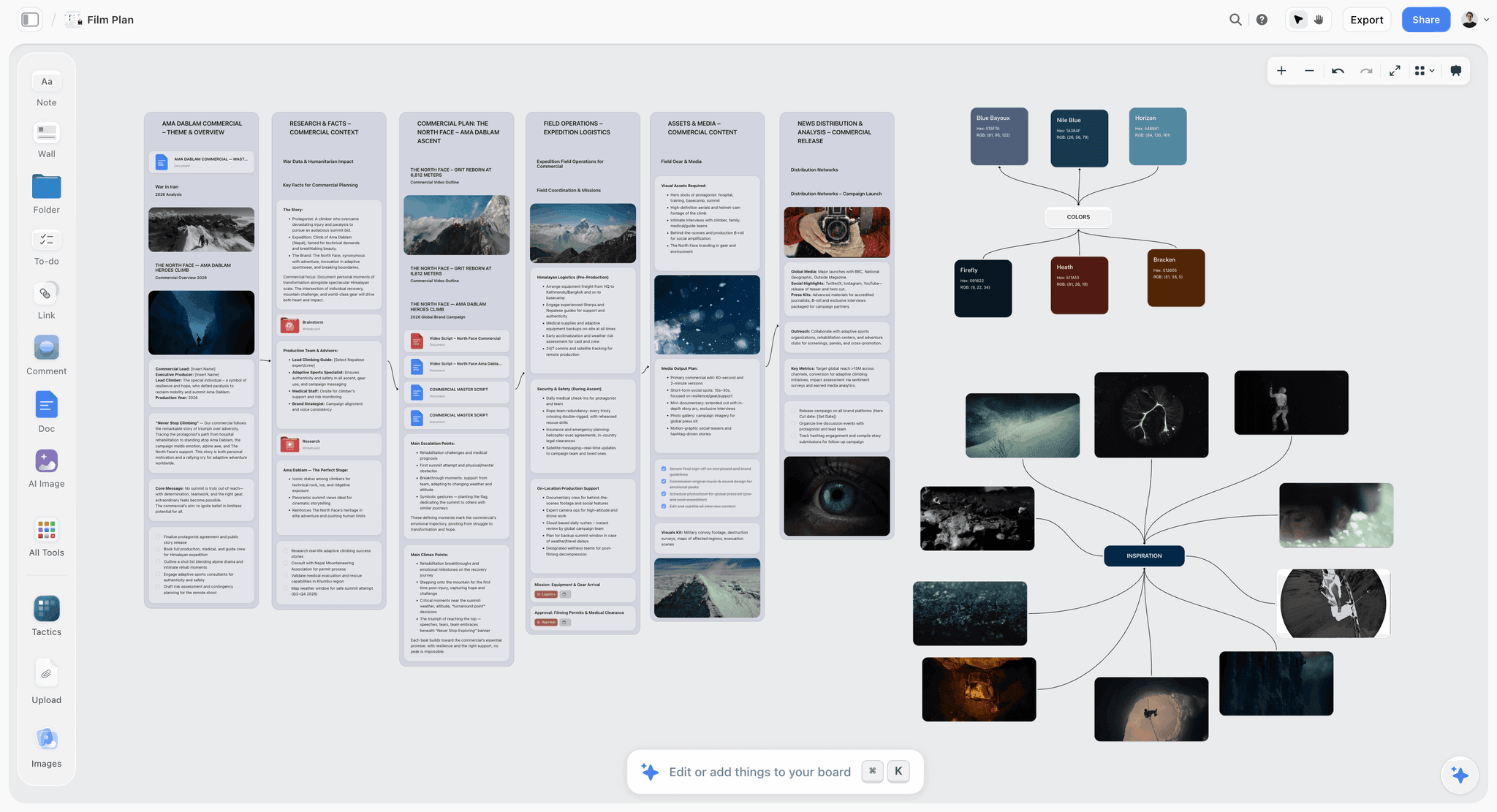
Verdict: the one tool here where ChatGPT or Claude can build every handoff, from brief to call sheet draft, and where the approved reference travels into the shot list as its frame.
Best for: brand, product, portrait, lookbook and editorial photographers, and small studios planning with a crew under ten.
Pricing: Plus $7.99 a month billed annually ($9.99 monthly), Pro $14 ($19 monthly) adds AI image generation, Max $39 ($49 monthly) adds a team workspace with roles and permissions. No free plan during early access; a Free plan launches before the end of 2026, and anyone a paid member invites to a board joins free now. See pricing.
Storyflow is a visual project planning workspace: an infinite canvas board that holds notes, tables, documents, images, moodboards, storyboards and decks, with an AI agent that reads the board. Its MCP connector, launched in October 2026, lets the assistant you already use build on that board: notes and walls for the moodboard, documents for the brief and call sheet, shot cards and tables for the list, and a strip board when a shoot runs several days. The assistant also reads the board back, so "build the shot list from the approved walls" works on the real approved walls, not on its memory of a chat. Paid plans have no limit on connector actions, and the connector runs on your assistant's model, so it does not spend Storyflow AI credits. If you would rather not use ChatGPT or Claude at all, the built-in AI has its own moodboard (9 to 16 uniform tiles, one facet per tile), shot list and call sheet workflows.
- Approved tiles become the frames of the shot cards, moved rather than copied
- Upload link for your own photos, up to 200 per link
- Brief, moodboard, decision log, shot list and schedule on one board
- View-only link with no account; comments after sign-in
- What changed on the board, and who changed it, on request
Limitations: browser only, with no native app and no offline mode; no approve button or versioned sign-off; a table the assistant creates holds up to eight columns and 50 rows per call; no contracts, invoices or booking; it does not send call sheets or track confirmations.
2. StudioBinder
Verdict: the strongest production suite in the list, and a copy-and-paste destination for anything your assistant drafts.
Best for: crewed shoots with a producer, several shoot days and call sheets that must be sent and confirmed.
Pricing: a free plan with one project and up to ten shots; Starter, Indie and Professional raise the limit to 10, 25 and unlimited projects, and call sheet tracking and analytics arrive with Indie, per StudioBinder's plan guide. We could not load prices from its pricing page, so check them there.
StudioBinder covers the production half of the chain thoroughly. Its shot list tool shows shot lists and storyboards as two views of the same shots, and its mood board creator has an image editor, favorites, comments and presentation links. Call sheets go out from the same system. What it lacks for this job is a way for ChatGPT or Claude to write into it, so every draft the assistant produces becomes your typing, and the link between an approved reference and its setup is one you keep by hand.
- Mood board, shot list, storyboard, schedule and call sheets in one suite
- Call sheet tracking on Indie and above
- Client comments and favorites on mood boards
Limitations: no assistant connector found; the free plan's ten-shot cap is too small for most commercial shoots; more production machinery than a one-day portrait shoot needs.
3. Canva
Verdict: the best tool here for a designed moodboard page or pitch deck, and not a shot list tool.
Best for: photographers who sell the shoot with a polished PDF before planning it.
Pricing: a free plan and paid plans on Canva's site. Canva says every plan, Free included, can connect an assistant through its AI Connector; resizing needs a paid plan.
Canva's AI Connector lets Claude, ChatGPT and Cursor create designs with Canva AI, find your existing designs and export them as PDFs or images; autofilling templates is limited to Enterprise according to Canva's connector page. That makes it a genuine second choice for the moodboard handoff when the client expects a designed page. It ranks third because the chain stops there: there is no shot list structure, no schedule and no call sheet, and a designed page is harder to revise setup by setup than a board.
- Assistant can create and export designs
- Strong templates for pitch decks and moodboard pages
- Familiar to most clients
Limitations: no shot list, timing or call sheet; references do not become frames of anything; template autofill is Enterprise only.
4. Milanote
Verdict: a clean reference board that leaves the rest of the chain, and all of the drafting, to you.
Best for: gathering the look when someone else owns the shot list and schedule.
Pricing: free for 100 notes, images or links and 10 file uploads; $9.99 a month billed annually per person ($12.50 monthly), or $49 a month billed annually to upgrade a team, per Milanote's plans page.
Milanote holds images, notes and links on a board, shares well and needs sign-in to comment, as Storyflow does. Its plans page lists no AI features, and we found no ChatGPT or Claude connector, so the assistant's tags and shot list arrive by paste, as notes you arrange yourself. For the moodboard step alone it is a real competitor. For the chain, the shot list is a set of notes that do not know which reference they came from.
- Fast, tidy reference boards
- Generous free tier for small boards
- Share link with comments after sign-in
Limitations: no AI, no connector, no shot list structure, no timing or call sheet.
5. Pixieset Studio Manager
Verdict: the client paperwork tool for a working photographer, used next to the planning board rather than instead of it.
Best for: solo and small-studio photographers who need contracts, questionnaires, invoices and booking.
Pricing: free with unlimited invoices, 3 contracts and 3 quotes or questionnaires; Plus $12 a month billed annually ($15 monthly); Pro $18 a month billed annually ($24 monthly), per Pixieset's Studio Manager pricing.
Studio Manager handles questionnaires, contracts with e-signatures, branded invoices and session booking, with reminders for unsigned contracts, unpaid invoices and unfilled questionnaires. That is the part of handoff 1 Storyflow does not do: getting the brief answers and the signed contract in one place. It has no moodboard, shot list or call sheet, and no AI is mentioned for Studio Manager (the AI on Pixieset's pricing is its separate photo editor).
- Questionnaires that feed the brief
- Contracts and invoices with reminders
- A free tier that covers early work
Limitations: no planning artifacts at all; no assistant connector.
6. HoneyBook
Verdict: a full client-business platform that now answers questions in ChatGPT, and plans nothing on the shoot itself.
Best for: photographers running enough clients that proposals, payments and scheduling need automations.
Pricing: Starter $29 a month, Essentials $49 and Premium $109, billed yearly, per HoneyBook's pricing page.
HoneyBook covers proposals, contracts, invoices, a client portal and, from Essentials, a scheduler and automations. HoneyBook AI is in every plan, and its pricing page says you can connect your account in ChatGPT and ask about any client, invoice or booking. That is a useful bridge on the business side: the assistant can tell you a client's booking date while it drafts the brief. It ranks sixth for this job because none of the planning artifacts live there.
- Proposals, contracts and invoices in one flow
- HoneyBook AI and a ChatGPT app
- Client portal
Limitations: no moodboard, shot list or call sheet; the highest starting price in this list for the business side.
Worked Example: A Knitwear Lookbook, From 46 References to 19 Setups and a 09:30 Call
Here is the chain run end to end on an illustrative shoot: the label, the numbers and the day are invented to show the method, not a client case. The client is a small knitwear label launching an autumn collection. One photographer, one assistant, a stylist, a hair and makeup artist, one model and the founder for two portraits. One shoot day, two locations: a daylight studio in the morning and a coastal path 25 minutes away in the afternoon. In our example, sunset on the shoot date is 18:05.
The brief the assistant drafted
We pasted the client's two emails and our call notes into Claude and asked for the one-sentence brief, the deliverables and the open questions. The sentence: "Pictures that make a 35-year-old who walks every weekend feel the jumper is warm enough for the coast and good enough for dinner." The deliverables came to 28 images. The open questions were three: whether the founder portraits could run on the website (usage), whether the model could be shot in the sea wind past 17:00 (comfort and call length), and whether flat-lay details had to be on white. We answered two on a call; the third stayed on the board as an open item until approval.
| Deliverable | Count | Crop | Look or set |
|---|---|---|---|
Lookbook images on model | 12 | 4:5 | 3 per look, 4 looks |
Detail and texture images | 8 | 1:1 | Flat lay and close-up, studio |
Social verticals | 6 | 9:16 | Coast, looks 3 and 4 |
Founder portraits | 2 | 4:5 | Studio |
Total | 28 |
From 46 references to 12 approved tiles
We collected 46 references: 19 from our own saves, 15 from the client's, 8 of our past work uploaded through the upload link, and 4 location scout photos. Claude proposed a cut to 14, arguing each cut in one line ("6 and 22 show the same rim light; keep 22, the crop is closer to 4:5"). We accepted 13 and swapped one. It tagged every tile with a Keep and an Ignore line and grouped them into four walls, one per look.
The client opened the view-only link, signed in, and left five comments. Two tiles were cut: one because the model wore a hat the label does not sell, one because the client found it too dark for the website. One Keep line changed, from "grey sea" to "grey sea, but the jumper must read as oatmeal, not beige". Two comments asked for detail shots of the cuffs. All five went into the decision log, and we asked the assistant what had changed on the board in the last week to make sure nothing else had moved. Result: 12 approved tiles.
From 12 tiles to 19 setups
We asked Claude to build shot cards from the approved walls, with each approved tile passed as the frame of the setup it belonged to. Nine tiles became frames; three were palette and texture references that informed several setups and stayed on the moodboard. The other ten setups got empty frames, four of which we filled with location scout photos through the upload link.
| Block | Setups | Example setups | Minutes |
|---|---|---|---|
Details (studio) | D1 to D4 | D1 flat lay on linen, D2 cuff close-up (the client's request), D3 yarn texture macro, D4 label and care tag | 60 |
Look 1 (studio) | 1A to 1C | 1A full length, side light from the left; 1B three-quarter walking; 1C seated, texture close | 45 |
Look 2 (studio) | 2A to 2C | 2A full length; 2B over-the-shoulder to the window; 2C hands in sleeves | 45 |
Founder portraits | F1, F2 | F1 seated at the knitting machine; F2 standing, window light | 40 |
Look 3 (coast) | 3A, 3B | 3A wide on the path, small in frame; 3B medium, wind in the hair | 40 |
Social verticals (coast) | S1 to S3 | S1 walking toward camera, 9:16; S2 detail in wind; S3 seated on the wall | 30 |
Look 4 (coast, golden hour) | 4A, 4B | 4A backlit three-quarter; 4B close, low sun on the knit | 40 |
Total | 19 | 300 |
The coverage check caught two things. Our first list had no setup for the 9:16 verticals at all, and Claude had planned to crop them from 3A, which would keep about 70 percent of the width; S1 to S3 were added as their own setups. And the client's cuff request existed only as a comment until the decision log carried it into D2.
The day, in shoot order
| Time | Block | Why here |
|---|---|---|
09:30 to 10:30 | Details D1 to D4 | Model in hair and makeup; the crew shoots flat lays instead of waiting |
10:30 to 11:15 | Look 1 | Studio window light at its most even |
11:15 to 11:25 | Wardrobe change | |
11:25 to 12:10 | Look 2 | Same set, re-flagged |
12:10 to 12:50 | Founder portraits | Founder arrives at 12:00 |
12:50 to 13:35 | Lunch | |
13:35 to 14:15 | Pack and move | 25 minutes of driving plus load out and in; change into look 3 in the car park |
14:15 to 15:00 | Slack: walk the path, check the light | |
15:00 to 15:40 | Look 3 | Flat afternoon light suits the wide |
15:40 to 15:50 | Wardrobe change | Into look 4 |
15:50 to 16:20 | Social verticals | Look 4 styling, before the light goes warm |
16:20 to 17:05 | Slack: reset and wait | |
17:05 to 17:45 | Look 4 | Golden hour, the hour before the 18:05 sunset |
17:45 to 18:15 | Slack and wrap |
The time math
The window from crew call to wrap is 09:30 to 18:15, which is 525 minutes. Take out 45 minutes of lunch and 40 for the move, and there are 440 working minutes. The 19 setups need 300 and the two wardrobe changes 20, so the plan uses 320 of 440 minutes, about 73 percent, and leaves 120 minutes of slack. The slack is not spread evenly. It sits in front of the two things that cannot move: the light at the coast and golden hour. If look 3 runs 40 minutes over, look 4 still starts at 17:05.
The A, B and C list
D3 and S3 were C, 2C and 3B were B, and every other setup, including both founder portraits, was A. When the client asked on the day for one more vertical, the A, B and C list said where the minutes came from: S3 was dropped and the new vertical took its slot, with no discussion.
The call sheet draft
We asked Claude to draft the call sheet as a document on the board from the schedule table. It filled the calls, the blocks and the two locations, and listed six open items it would not guess: the model agent's phone number, the studio's parking instructions, the car park address at the coast, the nearest hospital, the weather line and the founder's mobile. We filled those in and sent the sheet ourselves. The whole chain, brief to call sheet, lived on one board that the client, stylist and assistant had been reading in the last week.
Prompts You Can Copy at Each Handoff
These assume Storyflow is connected and the shoot has its own project. If you are pasting into another tool, drop the board instructions and ask for a table you can copy.
Brief and moodboard prompts
| Handoff | Prompt |
|---|---|
Brief | Read the client emails and notes below. Write one sentence saying who the pictures are for and what they must make that person feel or do. Then list the deliverables with counts and crops, the fixed facts (date, locations, talent, usage), and every question this material does not answer. Leave unknowns blank. Write it as a document called Brief in my Storyflow project for this shoot. |
Upload | I have 20 reference photos on my laptop. Give me an upload link for the moodboard board in this project. |
Cut | Read the reference images on the board. Propose a cut to 14 tiles, each a different facet of the brief: light, palette, texture, pose, location, crop. For each cut, give one line saying why. Do not delete anything; list your proposal. |
Tag | For each kept tile, add a short note beside it with a Keep line (what to reproduce) and an Ignore line (what is in the picture but not wanted). Then group the tiles into walls, one per look, titled Look 1 to Look 4. |
Approval and shot list prompts
| Handoff | Prompt |
|---|---|
Decision log | Here are the client's comments. Add a note titled Decision log beside the walls with one line per decision: tile, decision, who, date. List any comment that asks for something not on the board. |
What changed | What changed on the moodboard board in the last week, and who changed it? |
Shot list | Read the approved walls and the decision log. Build the shot list as shot cards, one per setup, in look order. Use each approved tile as the frame of the setup it belongs to; leave the rest as empty frames. Chips for size, light and lens; three coverage points; one to three lines of direction; the gear from my kit list. |
Coverage | Compare the shot cards with the deliverables in the Brief document. List any deliverable no setup produces, any crop no setup is framed for, and any setup that produces nothing on the list. |
Timing and call sheet prompts
| Handoff | Prompt |
|---|---|
Time math | Estimate minutes per setup on the board. Add wardrobe changes, 45 minutes of lunch and a 40-minute move. The day runs 09:30 to 18:15 and sunset is 18:05. Give me the total, the slack and where you would park it. |
Schedule | Build the schedule as a table on the board, one row per block, rows kept in time order, with a Why here column. Fixed windows first, then location, then lighting, then wardrobe. |
Priorities | Mark every setup A, B or C. A means a deliverable fails without it. Show me the A list only so I can send it to the client. |
Call sheet | Draft a one-day call sheet as a document on the board from the schedule table: calls, first shot, wrap, locations, crew, the schedule. Leave every name, phone number and address you do not have blank, and list them as open items at the end. |
Two prompting rules that save a revision
Name the project in every prompt until the assistant has written to it once; after that, "this shoot's board" is enough. And ask for one handoff per prompt. "Make the moodboard and the shot list" skips the approval, which is the handoff the whole chain depends on.
What It Costs: A Solo Photographer and a Three-Person Studio
Solo photographer
| Setup | Monthly cost (as of October 2026) | What you get |
|---|---|---|
Claude Free plus Storyflow Plus | $7.99 (annual billing) | One custom connector in Claude; the full chain on one board |
Claude Pro plus Storyflow Plus | $24.99 ($17 Claude Pro annual plus $7.99) | More Claude usage for long briefs and big reference sets |
ChatGPT Plus plus Storyflow Plus | $7.99 plus your ChatGPT Plus subscription | ChatGPT with developer mode connectors |
Storyflow Plus plus Pixieset Studio Manager Free | $7.99 | Planning chain plus 3 contracts and 3 questionnaires |
Storyflow Plus plus Pixieset Plus | $19.99 ($7.99 plus $12, both annual) | Unlimited contracts and questionnaires |
Milanote plus a spreadsheet | $9.99 (annual billing) | Reference board; you type the shot list and schedule |
HoneyBook Starter | $29 (billed yearly) | Client business side only; plan elsewhere |
Claude prices from Claude's pricing page; Pixieset from its Studio Manager pricing; HoneyBook from its pricing page.
A three-person studio
On Storyflow, one paid member invites the other two; invited collaborators join free and edit in real time, so the planning side stays at $7.99 a month billed annually. Max at $39 a month annual adds a team workspace with roles and permissions, which matters when a producer runs several clients' shoots at once. Milanote's per-person price for three is $29.97 a month billed annually. HoneyBook Essentials, at $49 a month billed yearly, covers up to two team members. The connector itself costs nothing extra on a paid Storyflow plan and does not spend Storyflow AI credits, because it runs on your assistant's model.
The expensive part of a photoshoot plan is not a subscription. It is a reshoot of one look because the approved reference never reached the shot list.
Decision Rules: Which Tool for Which Shoot
A brand, product, lookbook or portrait shoot with a crew under ten
Storyflow, with ChatGPT or Claude drafting each handoff. Add Pixieset Studio Manager or HoneyBook for the contract and invoice. The photoshoot planning page shows the board shape.
A crewed production with a producer and several shoot days
StudioBinder for call sheets, tracking and the schedule. You can still draft with the assistant and keep the moodboard and approved references on a Storyflow board; the production half belongs in a production suite. Our best call sheet software roundup compares the options.
The client wants a designed moodboard PDF before anything else
Canva for the designed page, through its connector, which works on any Canva plan. Plan the shot list somewhere that can hold setups.
You need only a reference board, today, for free
Milanote's free tier, if the board stays under 100 items. Storyflow has no free plan during early access.
The business side is the bottleneck
Pixieset Studio Manager if you want a free start, HoneyBook if you want automations and a ChatGPT app. Neither replaces the planning board; see photography business management tools.
Common Mistakes When an Assistant Drafts the Photoshoot Plan
Mistake 1: Asking for the moodboard and the shot list in one prompt
That skips approval. The shot list is built from references the client never signed off, and the first time they see the setups is on the day.
Mistake 2: Attaching photos in the chat and expecting them on the board
A photo attached in a ChatGPT or Claude chat never reaches Storyflow. Ask for the upload link, or give the assistant addresses for pictures already online.
Mistake 3: Tiles with no Keep line
A tile without a Keep line is approved as a whole, and the crew tries to reproduce everything in it. Tag first, approve second.
Mistake 4: Counting images instead of setups
Twenty-eight images is not twenty-eight setups. Count setups, time them, and let several images come from one.
Mistake 5: Cropping verticals from horizontals
A 9:16 crop from a 4:5 frame keeps about 70 percent of the width, and less from a landscape frame. Verticals that matter get their own setups.
Mistake 6: Letting the assistant fill in the call sheet's unknowns
A wrong phone number on a call sheet looks exactly like a right one. Tell the assistant to leave unknowns blank and list them as open items, and check every one before you send.
Mistake 7: Giving the connector access to every project
Pick only this shoot's project at sign-in. The assistant needs one board to do this job well, not your whole client list.
When Storyflow Is Not the Right Choice
Storyflow ranks first for this job, and it is still the wrong tool for some shoots.
You need a free tool today
Storyflow has no free plan during early access; its Free plan launches before the end of 2026. Use Milanote's free tier for a small reference board, Pixieset's free tier for paperwork and a spreadsheet for the shot list.
You need formal approvals with sign-off and versions
Storyflow has comments and a decision log you keep yourself; it has no approve button or versioned proofing. If your client's legal or brand team requires recorded sign-off on each version, use a proofing tool for that step.
You need call sheets sent and confirmations tracked
Storyflow drafts call sheets but does not send them or track who confirmed. StudioBinder does, from its Indie plan.
You need the plan offline on location
Storyflow runs in a browser with no offline mode. On a location with no signal, print the call sheet and the shot list, or use a tool with an offline app.
You need contracts, invoices and booking
Storyflow does none of these. Pixieset Studio Manager and HoneyBook do.
A Photoshoot Plan Template for Your Board
Ask the assistant to build this layout on a new board, left to right, or start from the photoshoot plan template.
| Zone | Element | What goes in it | Built by |
|---|---|---|---|
1 | Brief document | One-sentence brief, deliverables with counts and crops, fixed facts, open questions | Assistant drafts, you edit |
2 | Moodboard walls | 12 to 16 tiles, one wall per look, a Keep and Ignore note beside each tile | Assistant cuts, tags and groups |
3 | Decision log note | Tile, decision, who, date | You, from the client's comments |
4 | Shot cards or tables | One per setup, approved tile as the frame, chips, coverage, direction, gear | Assistant |
5 | Schedule table | Time, block, setups, why here, rows kept in time order | Assistant, from your fixed windows |
6 | Call sheet document | Calls, schedule, locations, crew, open items | Assistant drafts, you complete and send |
The columns for a stills shot list table
| Column | Example |
|---|---|
Shot | 1B |
Type | Portrait, Group, Detail or Candid |
Subject and action | Model walking toward the window, three-quarter |
Location | Studio, window bay |
Lens | 85mm at f/2 |
Time | 0:15 |
Priority | A |
Got it | Checkbox, ticked on the day |
That is eight columns, the most the assistant creates in one table call.
The Bottom Line
ChatGPT and Claude are good at every drafting job in a photoshoot plan: the brief questions, the reference cut, the Keep and Ignore lines, the setups, the time math and the call sheet draft. Where plans break is between those jobs, when the approval does not reach the shot list and the shot list does not reach the call sheet. Put the chain on one Storyflow board, connect the assistant once, build the shot list only from approved tiles with each tile as its setup's frame, and park your slack in front of the light that cannot move. Keep Pixieset or HoneyBook for contracts and invoices, and StudioBinder if a producer needs tracked call sheets. Start on the Storyflow MCP page, or see how photographers use the board on the for photographers page.
FAQ: Planning a Photoshoot From Moodboard to Shot List
How do I plan a photoshoot from moodboard to shot list?
Plan it as six handoffs on one Storyflow board: brief, moodboard, client approval, shot list, timing and call sheet. Let ChatGPT or Claude draft each one through the Storyflow connector, tag every reference with a Keep and an Ignore line, and build the shot list only from approved tiles, using each as its setup's frame. Then order the day by fixed windows, check the minutes and draft the call sheet with blanks for unknowns.
Can ChatGPT plan a photoshoot?
Yes, ChatGPT can draft every part of a photoshoot plan: the brief questions, the reference cut, the shot list, the timing and the call sheet. On its own the plan stays in a chat the client and crew cannot open. With ChatGPT Plus or above and developer mode on, you can connect Storyflow so ChatGPT builds the plan on a board, reads it back and revises it there.
Can Claude plan a photoshoot?
Yes. Paste the client material, ask for one handoff per prompt, and have Claude build each step on a Storyflow board. Claude's Free plan allows one custom connector, so connecting Storyflow costs nothing on the Claude side. Storyflow itself needs a paid plan, from $7.99 a month billed annually, and anyone you invite to the board joins free.
What should a photoshoot moodboard include?
Twelve to sixteen references, each showing a different facet of the brief: light, palette, texture, pose, location, crop, wardrobe. Each tile needs a Keep line saying what to reproduce and an Ignore line saying what to leave out. Group the tiles by look or set so the board already reads in shooting order. Fewer, sharper tiles produce a better shot list than a wall of fifty.
How do I turn a moodboard into a shot list?
Build one setup per approved direction, not one per picture. Read each tile's Keep line, decide which camera position and light produce it, and make that a setup with size, lens, light and direction. Add the coverage the moodboard never showed: details, verticals, safety frames. In Storyflow, the assistant passes each approved tile to its setup's shot card, where it becomes the frame.
How many setups can I shoot in a day?
Plan by minutes, not by count. A ten-hour day with lunch and one location move leaves roughly 440 working minutes. Studio setups with the light already built take 15 minutes or so; outdoor setups with a model take 20 or more. That is roughly 18 to 25 setups, and each can produce several images. Keep setups under 90 percent of the working minutes.
How should a client approve a photoshoot moodboard?
Send a view-only link and ask for decisions on three things: which tiles stay, whether each Keep line is right, and whether the looks are grouped correctly. Record every decision in a decision log on the board with who decided and when. On Storyflow the client opens the link with no account and signs in to comment; there is no approve button, so the log is the record.
What goes on a photoshoot call sheet?
The date, crew call, first shot and estimated wrap; sunrise, sunset and weather; locations with parking and access; the nearest hospital; the schedule by block; crew and talent with call times and phone numbers. Anything unknown stays blank and is chased before sending. Storyflow's built-in AI drafts call sheets as pages without inventing names or numbers, and you send them yourself.
Can the assistant put my own photos on the moodboard?
Yes, through an upload link. A photo you attach in a ChatGPT or Claude chat does not reach Storyflow, so the assistant calls Storyflow's upload tool and gives you a link. It accepts up to 200 pictures within 15 minutes and places each on the board as it lands. Pictures that already have a web address can be placed directly from those addresses.
Do I need a shot list for a portrait or small product shoot?
Yes, a short one. Even six setups benefit from being written down with the reference beside each, a lens and a priority, because the list is what the client approved and what you check before you pack up. For a one-hour portrait, a table with Shot, Type, Subject and action, Lens and Got it is enough.
Is Storyflow free for planning a photoshoot?
Not during early access. Storyflow plans start at Plus, $7.99 a month billed annually or $9.99 monthly, and a Free plan launches before the end of 2026. Anyone a paid member invites to a board joins free and can edit, so a stylist and assistant can work on the plan under one subscription. A free invited account gets 25 connector actions a week.
Does the Storyflow connector use Storyflow AI credits?
No. The connector runs on your own assistant's model, so building the moodboard, shot list and call sheet through ChatGPT or Claude does not spend Storyflow AI credits. Plus, Pro and Max have no limit on connector actions. A free account, today one a paid member invited, gets 25 actions a week, every read and change counting as one, resetting on Monday UTC.
Is Milanote or Storyflow better for photoshoot planning?
For the moodboard alone, both work; Milanote has a free tier and Storyflow does not today. For the chain from moodboard to shot list, Storyflow, because its connector lets ChatGPT or Claude build the shot list from the approved tiles and use them as frames. Milanote lists no AI features and no connector, so the shot list is notes you type yourself.
Should I use StudioBinder or Storyflow for a photoshoot?
Use StudioBinder when a producer runs several crewed days and needs call sheets sent and confirmations tracked; its Indie plan adds that tracking. Use Storyflow when the plan is drafted with ChatGPT or Claude and the client must see the references beside the setups. Many crewed shoots use both: Storyflow for the look and approvals, StudioBinder for the production paperwork.
What do Pixieset and HoneyBook do in a photoshoot plan?
They handle the business side before the shoot: questionnaires that feed the brief, contracts with e-signatures, invoices and booking. Pixieset Studio Manager has a free tier with three contracts and three questionnaires; HoneyBook starts at $29 a month billed yearly and has a ChatGPT app for client and invoice questions. Neither builds a moodboard, shot list or call sheet.
How far ahead should I plan a commercial photoshoot?
Work back from the shoot date with the approval as the fixed point. The client needs the moodboard at least a week before the shoot to approve it without rushing, the shot list needs two or three days after approval, and the call sheet goes out 24 to 48 hours ahead. For a one-day shoot, start the brief about two weeks out.
Table of Contents
- Key Takeaways
- Why Photoshoots Break at the Handoffs, Not Inside the Steps
- The Six Handoffs From Brief to Call Sheet
- How We Ranked the Tools for This Job
- Comparison Table: Tools for Planning a Photoshoot From Moodboard to Shot List With ChatGPT or Claude
- How to Plan a Photoshoot From Moodboard to Shot List With ChatGPT or Claude, Step by Step
- Step 1: Connect the assistant to one board for this shoot
- Step 2: Write the brief as one sentence, a deliverables list and the fixed facts
- Step 3: Collect references wide and fast, then put them on the board
- Step 4: Cut to 12 to 16 tiles with one rule
- Step 5: Tag every tile with a Keep line and an Ignore line
- Step 6: Send the board for approval and log every decision
- Step 7: Build the shot list from the approved tiles only
- Step 8: Check coverage against the deliverables
- Step 9: Order the day and do the time math
- Step 10: Draft the call sheet, then send it yourself
- The Six Tools, Reviewed for the Handoff Chain
- Worked Example: A Knitwear Lookbook, From 46 References to 19 Setups and a 09:30 Call
- Prompts You Can Copy at Each Handoff
- What It Costs: A Solo Photographer and a Three-Person Studio
- Decision Rules: Which Tool for Which Shoot
- Common Mistakes When an Assistant Drafts the Photoshoot Plan
- When Storyflow Is Not the Right Choice
- A Photoshoot Plan Template for Your Board
- The Bottom Line
- FAQ: Planning a Photoshoot From Moodboard to Shot List
- Related Reading
Templates to check out for this topic


Filmmaking templates you can use in Storyflow
Skip the blank canvas. Open one of these filmmaking boards in Storyflow and the AI builds on the structure that is already there, from research through the shot list.


See Storyflow in Action
A visual AI workspace where every feature lives inside one canvas. No tab-switching, no context lost.
Build your entire board from a single message
Type what you need in the AI chat at the bottom of your canvas. The AI adds cards, headings, and structure directly onto your board.
Use expert frameworks as AI context
Type @ in the AI chat and choose any Tactic. The AI tailors every response to that framework instead of giving generic advice.
Turn your board into a mind map in seconds
Ask the AI to restructure your canvas as a mindmap. It connects your ideas into a visual hierarchy so you can see how everything relates.
Why Storyflow Exists
Storyflow actually began as a personal tool while working on creative and research projects.
We kept running into the same problem: ideas were scattered everywhere: notes, documents, and whiteboards.
Nothing helped us see how everything connected.
So we started building a workspace designed around how ideas actually grow.
→ Read how Storyflow was createdStoryflow Team
Product & Research Team
Published: 2026-10-09
Extremely simple, seriously capable


See how easy it is to get started
Watch a real project come together, from a blank board to a finished plan, clicked through step by step.
Start creating with AI and become more productive
Transform your creative workflow with AI-powered tools. Generate ideas, create content, and boost your productivity in minutes instead of hours.