How to Scope a Shoot Before You Have a Budget
Scope a shoot without a budget by building three versions of the same idea at different sizes, rather than one version you will later negotiate downwards. A single scope written before the money is confirmed forces you to guess, and both guesses are bad: guess high and the number scares off the project, guess low and y

Category
Filmmaking
Author

Justkay
Documentary Filmmaker & Founder at Storyflow
Topics
2026-08-29
•
12 min read
•
Filmmaking- how to scope a shoot before you have a budget
- budgeting
- pre-production
- scoping
- indie film
- production planning
- Storyflow
How do you scope a shoot before the budget is confirmed?
Scope a shoot without a budget by building three versions of the same idea at different sizes, rather than one version you will later negotiate downwards. A single scope written before the money is confirmed forces you to guess, and both guesses are bad: guess high and the number scares off the project, guess low and you have quietly promised something you cannot deliver well. Three tiers, each internally coherent and each honestly costed in days rather than currency, turn the budget conversation from a negotiation into a choice. Storyflow is what I use because the three tiers sit side by side on one canvas with the shared core visible, so moving between them is a decision rather than a rebuild.
Key Takeaways
- Build three coherent tiers, not one scope with things to cut. A stripped-down version of an ambitious plan is usually incoherent.
- Cost in shoot days and crew size first. Currency comes later and varies by market; days are the honest unit.
- Identify the irreducible core, the thing without which the project has no reason to exist. It appears in all three tiers.
- Say what each tier cannot do. A tier without stated limitations reads as a promise.
- Never present the tiers as good, better, best. Present them as three different projects that answer the brief differently.
- The middle tier is the one you are recommending. Say so, or the client will pick by price alone.
Scope in tiers, not guesses
A single scope written before the money is confirmed gets rebuilt from scratch the moment the number changes. Storyflow holds the tiers side by side so the shoot can move up or down without starting the plan again.

Why One Scope Fails
The instinct is to design the right version of the project and then adjust. It fails in both directions.
Scoping high. You design the version you want to make. It needs five days, a crew of eight and a studio. The number comes back and it is a third of that. Now you are cutting, and cutting an ambitious plan does not produce a good small plan. It produces the ambitious plan with holes in it: the same number of locations with less time at each, the same shot count with fewer people, the same ambition with none of the support it needed.
Scoping low. You guess conservatively to keep the project alive. The budget turns out to be larger than you assumed, and you have already anchored everyone to a modest version. Worse, the low scope is often what gets approved, and you deliver a smaller piece than the money could have bought.
The real problem is that cost does not scale linearly with ambition. Going from two shoot days to three is not a fifty percent increase in everything, because some costs are fixed and some step. A second location may cost nothing if it is next door, or add half a day of travel and a second permit if it is not. A scope that assumes smooth scaling is wrong at every point except the one it was built at.
A useful diagnostic: take your last scope and ask what the same project would look like at half the size. If the answer is "the same thing but shorter", the scope was never really designed, and the small version will be a compromised large one.
Build the Irreducible Core First
Before any tier, write down the thing without which the project has no point.
Not the nice-to-have list inverted. The actual core. For a founder story it might be one long interview in a space that means something. For a product film it might be three demonstrations of the product working. For a documentary sequence it might be a single event that happens once and cannot be restaged.
The core has three properties. It appears in all three tiers unchanged. It is what you protect when the day goes wrong. And if it is cut, the project should be cancelled rather than made smaller, because a version without it is not a cheaper version of the same thing, it is a different and pointless thing.
Most projects have a core of one or two elements. If your core has six, you have not finished thinking.
Writing this down first does two useful things: it gives you the spine that every tier is built around, and it gives you a clean answer when someone proposes a budget below the core's cost. That is not a smaller project, it is no project, and saying so early is far better than discovering it on day one.
The Three Tiers
Each tier is a coherent project, designed as though it were the only option.
Tier one: the core, done well
The smallest version that is genuinely good rather than merely complete.
This is not the compromise tier. It is the version where you do the core properly and nothing else: one location, minimal crew, one or two shoot days, a tight and honest piece.
The discipline here is resisting the urge to sneak extras in. A tier one that quietly includes a second location is not a tier one, and when the client picks it you will be delivering tier one and a half on tier one money.
What tier one buys: the essential thing, well made, with enough time to get it right. What tier one cannot do: breadth, alternates, coverage for a long edit, multiple deliverables.
Tier two: the recommended version
The core plus the elements that make it work harder.
Usually a second location or a second subject, enough coverage to cut a longer piece and several short ones, and one day of contingency. This is almost always the tier that represents the best value, because the fixed costs are already paid by tier one and the marginal day buys a lot.
Say explicitly that this is what you recommend, and why. Clients presented with three unlabelled options default to price. Clients told which one you would choose, and given the reason, mostly take it.
Tier three: the version with room
The core, the breadth, and the things that need budget rather than effort: more days, a bigger crew, specialist kit, original music, motion design, talent.
Tier three is not a fantasy tier and should not be padded to make tier two look reasonable. If a client picks it you must be able to deliver it, so it has to be a real plan.
Its honest purpose is to show what the money actually buys, so that a client with more budget than you assumed can spend it. This happens more often than people expect, and a two-tier scope leaves that money unspent.

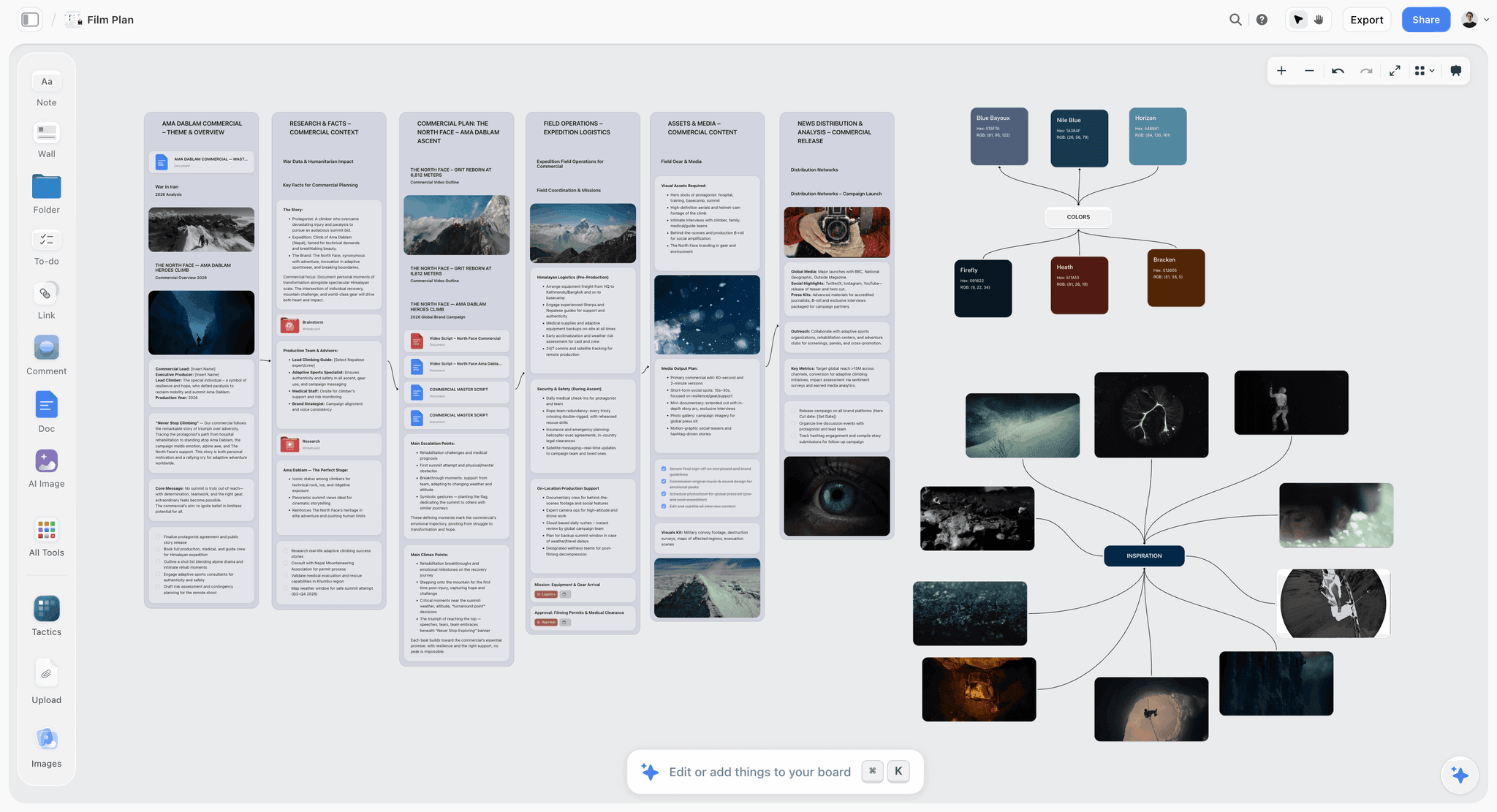
Keeping the three visible at once is what makes this work in practice. When each tier is a separate document, the shared core gets restated three times and drifts, and by the third revision the tiers disagree about what the project is. On a Storyflow canvas the core sits once and each tier builds outward from it, so a change to the core updates the thing all three depend on rather than one of three copies. Its AI reads the whole board, so asking what tier two adds over tier one gives you an answer from the actual plan, which is the summary you need for the client conversation anyway.
Cost in Days, Not Currency
Until the budget exists, price the tiers in the units that actually drive cost.
Shoot days. The single biggest driver, because a day carries crew, kit, location, catering and travel simultaneously.
Crew size. Not a headcount preference. Each role either exists because the day cannot happen without it or it does not.
Locations and moves. A move is often more expensive than a location, and scopes routinely count locations and ignore moves.
Post days. Consistently underestimated. Edit, grade, sound and revisions. Two rounds of revisions is a scope item and should be stated, because unlimited revisions is where profitable projects die.
Specialist items. Anything needing hire, licensing or a specialist: original music, motion design, drone, underwater, talent, archive.
| Element | Tier 1 | Tier 2 | Tier 3 |
|---|---|---|---|
Shoot days | 1 | 2 | 4 |
Locations | 1 | 2 | 3 plus studio |
Crew | 2 to 3 | 4 to 5 | 8 plus |
Post days | 3 | 6 | 12 |
Revision rounds | 1 | 2 | 2 |
Deliverables | 1 main | 1 main plus 3 cutdowns | 1 main plus 6 cutdowns plus stills |
Contingency | None | Half a day | 1 day |
Numbers are illustrative; the structure is the point. Note that contingency appears only from tier two, which is honest: tier one has no slack, and saying so protects you when day one runs long.
Presenting Them
Never label them good, better, best. That framing makes tier one look like the bad option, and a client choosing it then feels they have bought something inferior, which sours the project before it starts.
Label them by what they are. "The interview film." "The interview film plus the workshop." "The full campaign."
State the limitations of each in a single line. "Tier one cannot deliver social cutdowns, because there is no coverage budget for them." A limitation stated in advance is a scope boundary. The same limitation discovered later is a failure.
Give one recommendation. With a reason tied to what they said they needed.
Put the core on the page. Show that all three contain it. This is what stops the conversation becoming "can we have tier three for tier one money", because the shared spine makes visible what the extra money is actually buying.
What Goes Wrong
The tiers are the same project at three lengths. No real design happened. Each tier should differ in shape, not just in duration.
Tier one is a trap. Deliberately underspecified so the client upgrades. They will pick it, you will deliver it badly, and the relationship pays for it.
Contingency in every tier. Then tier one is not really the minimum. Be honest: the smallest tier has no slack.
Post is underscoped. The commonest error by a distance. Post routinely takes longer than the shoot and is scoped as an afterthought.
Revisions are unbounded. State the number. Two is standard. Unbounded revisions are how a profitable project becomes a loss.
The core was never written down. So when the budget comes in below it, the project gets made anyway in a form that cannot work.
The Bottom Line
Write the irreducible core first, then design three coherent projects around it rather than one project with things to remove. Cost them in days and crew rather than currency, state what each one cannot do, and name the tier you recommend.
The budget conversation then stops being a negotiation about your number and becomes a choice between three things you can actually deliver, which is a better conversation for everyone in it.
FAQ: Scoping a Shoot Without a Budget
Should I show the client all three tiers?
Yes, with a clear recommendation. Showing one tier invites a negotiation about that number. Showing three converts it into a choice between coherent options, and it surfaces a larger budget when one exists, which a single scope never does.
What if the client's budget is below tier one?
Say that the project as briefed cannot be made at that level, and offer either a genuinely different and smaller project or a decline. Making tier one badly on less than tier one money damages the work and the relationship, and it teaches the client that your scopes are negotiable.
How do I estimate post time?
Roughly two to three times the shoot time for straightforward edits, considerably more for anything with motion design, archive clearance or complex sound. Scope revisions explicitly as rounds rather than hours, because rounds are what clients understand and what actually consume the time.
Should the tiers have prices attached?
Not in the first conversation. Days, crew and deliverables first, so the discussion is about scope rather than about a number. Attach prices once the shape is agreed, and the price conversation becomes short because the client already understands what drives it.
Is Storyflow free for scoping work?
Not during early access. Storyflow is paid-only right now, with Plus at $7.99 per month billed annually, and the Free plan launches before the end of 2026. Anyone a paid member invites to a board joins free, so a client or producer can review the tiers without paying.
How many tiers should there be?
Three. Two forces a binary that usually reads as cheap or expensive. Four or more produces decision paralysis and invites mixing and matching, which produces an incoherent scope nobody designed.
Table of Contents
Templates to check out for this topic


Templates you can use in Storyflow
Every Storyflow board starts from real structure and an AI that reads the whole canvas. Open one of these templates and make it yours.


See Storyflow in Action
A visual AI workspace where every feature lives inside one canvas. No tab-switching, no context lost.
Build your entire board from a single message
Type what you need in the AI chat at the bottom of your canvas. The AI adds cards, headings, and structure directly onto your board.
Use expert frameworks as AI context
Type @ in the AI chat and choose any Tactic. The AI tailors every response to that framework instead of giving generic advice.
Turn your board into a mind map in seconds
Ask the AI to restructure your canvas as a mindmap. It connects your ideas into a visual hierarchy so you can see how everything relates.
Why Storyflow Exists
Storyflow actually began as a personal tool while working on creative and research projects.
We kept running into the same problem: ideas were scattered everywhere: notes, documents, and whiteboards.
Nothing helped us see how everything connected.
So we started building a workspace designed around how ideas actually grow.
→ Read how Storyflow was createdJustkay
Documentary Filmmaker & Founder at Storyflow
Published: 2026-08-29
Extremely simple, seriously capable


See how easy it is to get started
Watch a real project come together, from a blank board to a finished plan, clicked through step by step.
Start creating with AI and become more productive
Transform your creative workflow with AI-powered tools. Generate ideas, create content, and boost your productivity in minutes instead of hours.