The 12 Best Photography Business Management Tools in 2026 (We Tested Them All)
The variable that decides whether a photography business grows is how fast you reply to an enquiry, and during peak season those enquiries arrive while you are shooting, editing or asleep. Twelve systems ranked on whether they answer without you.

Category
Photography
Author

Storyflow Team
Product & Research Team
Topics
2026-09-22
•
19 min read
•
PhotographyFull disclosure: Storyflow is our own product and we rank it TENTH here, below nine competitors, because it runs none of a photography business. It has no CRM, no lead capture, no automated responses, no contracts, no e-signature, no invoicing, no payments, no scheduling, no accounting and no galleries. Every other tool on the page does things it cannot. It appears for link six of the nine-link chain, the pre-shoot plan, which section 7 identifies as the one no system here holds. The article also says plainly that a Pinterest board plus a spreadsheet does that job for nothing, and Storyflow is paid-only during early access.
Quick Comparison
All four of these will send an automated first reply while you are shooting, which is the capability that decides bookings. They differ on how much setup that takes and how much of the chain they cover afterwards.
| Tool | Best For | AI Features | Price |
|---|---|---|---|
| Studio Ninja | Strong automation without a configuration project | Assistive templates | From about $25 mo |
| Tave | Conditional workflows matching any process | Rule-based automation | From about $22 mo |
| HoneyBook | Polished client experience, mixed work | AI drafting in proposals | From about $19 mo |
| Sprout Studio | CRM, galleries and print sales together | Light AI tooling | From about $25 mo |
Article Metadata
By the Storyflow Team, Product & Research Published September 22, 2026 · 19 min read · Photography
The CRM knows the date. It does not know what you are photographing
Every system holds the client, the contract and the money, and none has a field for the shot list or the picture the client mentioned once on a call. That gap surfaces in the gallery. Put the plan on one board the client can see before the day. Paid-only during early access, from $7.99 a month billed annually.

Table of Contents
- Quick Answer: The Best Photography Business Tools in 2026
- Comparison Table: 12 Photography Business Tools at a Glance
- The Hour That Decides the Booking
- How We Evaluated These Tools
- Quick Picks by Photography Business
- Detailed Reviews: 12 Photography Business Tools
- The Nine Links from Enquiry to Final Payment
- Seasonality, Cash Flow and the Off-Season Trap
- Recommended Photography Business Stacks
- What Running a Photography Business Costs
- Honorable Mentions
- Mistakes to Avoid
- FAQ: Photography Business Management
- The Bottom Line
- Author
- Related Reading
1) Quick Answer: The Best Photography Business Tools in 2026
Studio Ninja is the best photography business management tool in 2026 for most working photographers: built by a photographer, priced sensibly, and it automates the one thing that decides whether you book the job. Táve is the most powerful if you will invest the setup time and want workflows that match exactly how you work. HoneyBook has the best interface and the widest general business features. Sprout Studio is the strongest all-in-one if you want galleries and studio management in the same subscription.
The variable that decides whether a photography business grows is how fast you reply to an enquiry, and almost nobody optimises for it. Couples and clients enquire with several photographers at once, usually in the evening, and a large share of bookings go to whoever replies first with something concrete. During peak season you are shooting, editing or asleep when those enquiries arrive.
That is what these platforms actually sell, underneath the feature lists: an automatic reply with a price guide and a booking link that goes out at eleven at night while you are asleep, followed by a sequence that does not stop because you forgot. The Hour That Decides the Booking in section 3 ranks all 12 tools on that, and section 7 maps the nine links from enquiry to final payment where the chain breaks.
Storyflow is our own product and it is tenth here, for the pre-shoot half only.
For delivering the work, see The 12 Best Client Gallery and Delivery Tools for Photographers.
All 12 Photography Business Tools, Ranked
- Studio Ninja: best all-round photographer CRM, sensibly priced
- Táve: most powerful and configurable, for photographers who will set it up
- HoneyBook: best interface and broadest general business features
- Dubsado: most configurable general-purpose alternative
- Sprout Studio: best all-in-one with galleries included
- ShootProof: best galleries with contracts and invoicing attached
- Iris Works: simplest photographer CRM, fastest to start
- 17hats: best small-business all-in-one beyond photography
- Pixieset Studio Manager: best if you already use Pixieset galleries
- Storyflow: best for the pre-shoot plan the business system does not hold
- QuickBooks: best actual accounting once the business is real
- Calendly: best scheduling, and quietly load-bearing
Best Photography Business Tool by Job
- Best for replying before your competitors do: Studio Ninja or Táve. An automated first response with a price guide and a booking link is the single highest-leverage automation in this business.
- Best for the whole chain in one system: Sprout Studio, which covers enquiry through gallery delivery and print sales.
- Best for photographers who also do non-photography work: HoneyBook or Dubsado, both of which are general enough to handle mixed client work.
- Best for getting started this week: Iris Works. Simple, cheap, and set up in an afternoon.
- Best for the books: QuickBooks, because a CRM is not accounting and your accountant will tell you so.
- Best for the pre-shoot plan: Storyflow, holding the moodboard, shot list and call sheet that none of these systems has a place for.
2) Comparison Table: 12 Photography Business Tools at a Glance
| Tool | Best For | Auto Lead Response | Galleries | Starting Price | Rating (/10) |
|---|---|---|---|---|---|
Studio Ninja | All-round photographer CRM | Yes, strong | No | From about $25 mo | 9.1/10 |
Táve | Power and configurability | Yes, strongest | Basic proofing | From about $22 mo | 8.9/10 |
HoneyBook | Interface and general business | Yes | No | From about $19 mo | 8.6/10 |
Dubsado | Configurable general alternative | Yes | Basic proofing | Free to 3 clients / from about $20 mo | 8.3/10 |
Sprout Studio | All-in-one with galleries | Yes | Yes, full | From about $25 mo | 8.2/10 |
ShootProof | Galleries plus business basics | Partial | Yes, full | Free tier / from about $10 mo | 7.9/10 |
Iris Works | Simplest photographer CRM | Yes, basic | Basic | From about $25 mo | 7.6/10 |
17hats | Small-business all-in-one | Yes | No | From about $15 mo | 7.4/10 |
Pixieset Studio Manager | Attached to Pixieset galleries | Basic | Yes, full | Included on paid Pixieset tiers | 7.2/10 |
Storyflow | The pre-shoot plan | No | No | $7.99 mo annual (free plan late 2026) | 6.9/10 |
QuickBooks | Real accounting | No | No | From about $19 mo | 6.7/10 |
Calendly | Scheduling without email tennis | Partial | No | Free / from about $10 user mo | 6.4/10 |
Pricing reflects publicly listed plans in 2026, is usually quoted at annual rates and changes often. Ratings weigh automated lead response first, then how many links of the enquiry-to-payment chain the tool covers without re-entry, then setup burden and price against a seasonal income.
Photography Business Tools: Pricing Compared
| Tool | Free tier | Entry paid plan | What the paid plan unlocks | Billing model |
|---|---|---|---|---|
Studio Ninja | No, trial only | from about $25/month | Full CRM, contracts, invoicing, automation | Per account, cheaper annually |
Táve | No, trial only | from about $22/month | Workflows, automation, job tracking | Per account, tiered by job volume |
HoneyBook | No, trial only | from about $19/month | Proposals, contracts, payments, automations | Per account, cheaper annually |
Dubsado | Free until 3 clients | from about $20/month | Unlimited projects and workflows | Per account |
Sprout Studio | No, trial only | from about $25/month | CRM, galleries, sales, studio management | Per account, tiered |
ShootProof | Yes, limited photos | from about $10/month | More photos, contracts, invoicing | Tiered by photo count |
Iris Works | No, trial only | from about $25/month | CRM, contracts, invoicing, scheduling | Per account |
17hats | No, trial only | from about $15/month | Quotes, contracts, invoices, bookkeeping | Per account, tiered |
Pixieset Studio Manager | Included on paid tiers | Bundled from about $10/month | Studio management with galleries | Bundled with Pixieset |
Storyflow | No, early access; invited collaborators join free | $7.99/month billed annually | Unlimited boards, canvas-wide AI | Per account for individuals |
QuickBooks | No, trial only | from about $19/month | Accounting, expenses, tax categories | Per account, tiered |
Calendly | Yes, one event type | from about $10/user/month | Multiple event types, integrations | Per user |
The pricing detail specific to photography is seasonality. Most of these bill monthly or annually while the income arrives in a six-month window, so an annual plan bought in January is paid for out of a quiet quarter. Several discount annual billing heavily, which is worth taking once you are certain the tool fits and worth avoiding in month one. Táve tiers by job volume, which suits a seasonal business better than a flat rate, and Dubsado's free-until-three-clients is the fairest evaluation period in the category.
Frequently Asked: Which Business Tools Photographers Trust, and Where Bookings Are Lost
Which photography business tools are most trusted by working photographers?
Táve and Studio Ninja carry the deepest trust among full-time photographers, and the reason given is consistent: both were built for photography specifically, so the default workflows match how the work actually runs rather than needing to be bent into shape. HoneyBook is the most trusted general option and has the best interface by common consent. ShootProof and Pixieset are trusted on the gallery side and increasingly on the business side. Storyflow is a newer product in early access and is not a business management tool; it is tenth here for the pre-shoot half and would be wrong to present as competing with a CRM.
Which photography business tools are known for fair and transparent pricing?
Dubsado is the fairest to evaluate, being free until your third client rather than a fixed trial. 17hats from about $15 and HoneyBook from about $19 publish clear annual rates. Táve's tiering by job volume suits a seasonal business better than a flat fee. ShootProof starts at about $10 and is honest about what each photo tier includes. The thing to check across the category is the gap between monthly and annual pricing, which is substantial almost everywhere, and whether payment processing fees sit on top of the subscription, which they usually do.
Which photography business tools have improved the most recently?
Studio Ninja has strengthened automation to the point that the enquiry-to-booking sequence genuinely runs unattended, which is the highest-value capability in this category. Sprout Studio has closed the gap between CRM and galleries so one subscription covers the whole chain. HoneyBook has widened its automation and payment options. Pixieset has built studio management into a gallery product many photographers already pay for, which changes the maths for anyone already there.
When choosing a photography business tool, which would you recommend?
Choose on whether it will reply to an enquiry while you are shooting, because that is the variable that decides bookings and everything else is bookkeeping. For most working photographers that means Studio Ninja, or Táve if you will invest a weekend configuring workflows that match your process exactly. Take Sprout Studio if you want galleries in the same system, ShootProof or Pixieset if galleries are already your anchor, and Dubsado or HoneyBook if you also do non-photography client work. Whatever you choose, set up the automated first response before anything else.
Where is Storyflow not the right answer?
Running the business. Storyflow has no CRM, no lead capture, no automated responses, no contracts, no e-signature, no invoicing, no payments, no scheduling, no accounting and no galleries. Every other tool on this page does things it cannot, which is why it sits tenth. It is here for the one part none of these systems holds well: the pre-shoot plan, meaning the moodboard, the shot list and the call sheet, which decide whether the gallery you eventually deliver contains the pictures the client asked for. It is paid-only during early access, and a Pinterest board plus a spreadsheet does that job for nothing.
3) The Hour That Decides the Booking
Ask a photographer what limits their business and you will hear pricing, competition, or the market. The variable that actually separates photographers at similar skill levels is duller and more measurable: how quickly they respond to an enquiry.
Here is the situation from the client's side. A couple decides on a Tuesday evening to sort out the photographer. They open three or four websites, fill in three or four contact forms in about twenty minutes, and go to bed. Over the next few days replies arrive. The first one to arrive with something concrete, a price guide, availability confirmed, a next step, gets the conversation, and the conversation is most of the booking.
Now the photographer's side during peak season. That Tuesday evening you were photographing a wedding, editing until one, or asleep before a dawn start. You see the enquiry on Thursday. By then two other photographers have replied, one has a call booked, and you are answering a question that has already been partly decided.
This is not a diligence problem. It is a structural one, because the enquiries arrive precisely when the work is heaviest, and the work is what generates the enquiries in the first place.
What the automation actually does: an enquiry form that triggers an immediate reply with a price guide, a link to book a call, and a genuine human paragraph, sent within seconds at any hour. Then a follow-up if there is no reply in three days, and another after a week, without you remembering. That is the feature every platform here is really selling and the one most photographers leave switched off because setting it up takes an afternoon in a month that has no afternoons.
Two supporting points worth stating plainly.
An automated reply is not impersonal if it is well written. Clients are not offended by a fast, useful, warm reply that clearly came from a template; they are offended by silence. The version that fails is a bare confirmation of receipt with no price, no availability and no next step, which is worse than nothing because it starts the clock without advancing anything.
Following up is where most bookings are actually won. A client who did not reply is usually busy rather than uninterested, and a great many bookings come from the second or third touch. Doing that manually across twenty live enquiries in July does not happen, which is why automation matters more than any feature comparison suggests.
So the ranking below weighs automated lead response above everything else, and the tools that lead are the ones where a photographer can configure that sequence once, in the off-season, and have it work every night of the busy one.
4) How We Evaluated These Tools
Five criteria, weighted in this order:
- Automated lead response and follow-up, which is the variable that decides bookings.
- How many of the nine links in section 7 it covers without re-entering the same information.
- Setup burden, since a photographer configures this alone and usually in a hurry.
- Whether it fits a seasonal business, in both pricing and cash flow terms.
- Whether the client-facing experience looks professional, because these tools are seen by clients.
Testing ran three real photography businesses over a quarter: a wedding photographer through peak season, a family portrait studio selling prints, and a commercial photographer invoicing agencies.
5) Quick Picks by Photography Business
Best overall: Studio Ninja. Photographer-built, sensibly priced, strong automation.
Best for weddings: Studio Ninja or Táve. Long lead times and heavy enquiry volume make automation decisive.
Best for portrait and family studios: Sprout Studio or ShootProof, where print sales and galleries belong in the same system.
Best for commercial photographers: HoneyBook or Dubsado, because the work is proposals and invoices rather than packages and galleries.
Best for starting this week: Iris Works or 17hats. Simple, quick, and enough.
Best free setup: ShootProof's free tier for galleries and basic invoicing, Calendly free for booking, Wave free for invoicing, and a spreadsheet for the pipeline. Workable for a photographer just starting. Storyflow is paid-only during early access; its Free plan arrives before the end of 2026.
Best cheapest working setup: ShootProof at about $10/month covering galleries, contracts and invoices, plus Calendly free.
6) Detailed Reviews: 12 Photography Business Tools
1. Studio Ninja
Studio Ninja was built by a working wedding photographer and it shows in the defaults: lead capture, automated first response, quotes, contracts, invoicing and job workflows that match how photography actually runs. It ranks first because it does the thing that decides bookings well and asks less setup effort than Táve to get there.
Best for: Most working photographers who want strong automation without a configuration project.
Verdict: The best balance of capability and setup burden here. Less configurable than Táve and it has no galleries.
Key features
- Lead capture with automated first response and follow-up sequences.
- Quotes, contracts with e-signature and invoicing with reminders.
- Job workflows with task checklists per shoot type.
Pricing
Trial only, then from about $25/month, cheaper annually.
Pros
- Automation that works out of the box rather than after a weekend.
- Built for photography, so defaults are right.
- Clear client-facing experience.
Cons
- No galleries, so delivery needs a second tool.
- Less configurable than Táve for unusual processes.
- No free tier to evaluate properly.
2. Táve
Táve is the most powerful studio management system here: workflows, conditional automations, job-type templates and reporting that will match almost any process you can describe. The price of that is a real setup project, and photographers who complete it rarely leave.
Best for: Photographers with a specific process who will invest a weekend building it.
Verdict: The most capable tool in this comparison. Its setup burden is the highest and the reason it ranks second rather than first.
Key features
- Deep conditional workflows and automation.
- Job-type templates with per-stage tasks.
- Strong reporting and job-volume tiering.
Pricing
Trial only, then from about $22/month, tiered by job volume.
Pros
- Will model any process you can articulate.
- Job-volume tiering suits a seasonal business.
- Automation is the strongest here once configured.
Cons
- Setup is genuinely a project, not an afternoon.
- Interface is dated next to HoneyBook.
- Overkill for a photographer shooting a dozen jobs a year.
3. HoneyBook
HoneyBook has the best interface in the category and the broadest general business features, which matters for photographers whose work is not purely packages and galleries. Proposals, contracts, payments and automations in one clean system.
Best for: Photographers doing mixed client work, and anyone who values the client-facing experience.
Verdict: The best-looking and most general option. Not photography-specific, so some defaults need bending.
Key features
- Branded proposals, contracts and invoices as one flow.
- Automations for enquiry response and follow-up.
- Client portal and scheduling.
Pricing
Trial only, then from about $19/month, substantially cheaper annually.
Pros
- The most polished client experience here.
- Handles non-photography client work equally well.
- Strong automation without heavy setup.
Cons
- Not photography-specific; no shoot-shaped defaults.
- No galleries or print sales.
- Monthly pricing is noticeably worse than annual.
4. Dubsado
Dubsado is HoneyBook's most configurable rival, with workflows, forms and canned emails that bend to an unusual process. Its free-until-three-clients tier is the fairest way to evaluate anything in this category.
Best for: Photographers with a specific process who prefer a general tool they can shape.
Verdict: The most configurable general option and the fairest to try. Setup effort sits between HoneyBook and Táve.
Key features
- Configurable workflows and automations.
- Forms, questionnaires, contracts and invoicing.
- Basic proofing galleries included.
Pricing
Free until 3 clients. Paid from about $20/month.
Pros
- Free until your third client, which is a genuine evaluation.
- Workflows handle an idiosyncratic process.
- Includes basic proofing.
Cons
- Setup is a real investment before value appears.
- Interface less polished than HoneyBook.
- Proofing is basic compared with a real gallery tool.
5. Sprout Studio
Sprout Studio is the strongest genuine all-in-one for photographers: CRM, contracts, invoicing, galleries, print sales and in-person sales tools in one subscription. For a studio that wants one login for the whole chain, that integration is the product.
Best for: Photographers wanting the whole enquiry-to-print-sale chain in one system.
Verdict: The best all-in-one here. Individual components are beaten by specialists, and the integration frequently outweighs that.
Key features
- CRM and workflows alongside client galleries.
- Print sales and in-person sales tooling.
- Studio management and reporting.
Pricing
Trial only, then from about $25/month, tiered.
Pros
- One system covers enquiry through print sale.
- No re-entering client details between CRM and gallery.
- Sales tooling is genuinely good for portrait studios.
Cons
- No component is best in class individually.
- Migrating away later is a real project.
- Heavier than a commercial photographer needs.
6. ShootProof
ShootProof leads with galleries and has grown a competent business layer around them: contracts, invoices, payment plans and questionnaires. At about $10 to start it is the cheapest way to cover several links of the chain at once.
Best for: Photographers anchored on galleries who want contracts and invoicing attached.
Verdict: The best value for covering delivery and the money side together. Its CRM and automation are lighter than the dedicated systems.
Key features
- Galleries with a print store and no commission on higher tiers.
- Contracts, invoices and payment plans.
- Client questionnaires and basic workflow automation.
Pricing
Free tier with limited photos. Paid from about $10/month, tiered by photo count.
Pros
- Cheapest route to galleries plus the business basics.
- Commission-free selling on higher tiers.
- Genuinely usable free tier to start.
Cons
- Lead automation is lighter than Studio Ninja's or Táve's.
- Photo-count tiers are easy to misjudge.
- Utilitarian interface.
7. Iris Works
Iris Works is the simplest photographer CRM here: leads, contracts, invoices, scheduling and questionnaires, set up in an afternoon. For a photographer who has been running on email and a calendar, it is the shortest path to a real system.
Best for: Photographers wanting a working system this week rather than this quarter.
Verdict: The fastest to adopt. Less powerful automation than Studio Ninja or Táve.
Key features
- Straightforward lead, contract and invoice management.
- Scheduling and client questionnaires.
- Simple workflow templates.
Pricing
Trial only, then from about $25/month.
Pros
- Set up in an afternoon, which matters in season.
- Covers the essential links without complexity.
- Friendly for a first CRM.
Cons
- Automation is basic compared with the leaders.
- Similar price to more capable tools.
- Limited galleries and sales features.
8. 17hats
17hats is a small-business all-in-one rather than a photography tool: quotes, contracts, invoices, bookkeeping and time tracking. For a photographer whose business includes other services, that breadth is useful.
Best for: Photographers running mixed small-business activity.
Verdict: The broadest general small-business option here. Not photography-shaped, and its defaults show it.
Key features
- Quotes, contracts, invoices and payments.
- Bookkeeping and expense tracking.
- Workflow automation and scheduling.
Pricing
Trial only, then from about $15/month, tiered.
Pros
- Cheapest entry among the full business systems.
- Bookkeeping included, which most rivals lack.
- Good for mixed service businesses.
Cons
- Generic rather than photography-specific.
- No galleries or print sales.
- Interface feels dated.
9. Pixieset Studio Manager
Pixieset added studio management to a gallery product an enormous number of photographers already pay for, which makes it the cheapest marginal upgrade in this category: contracts, invoices and client management attached to galleries you already use.
Best for: Photographers already on Pixieset galleries.
Verdict: The best value if you are already there. Weaker automation than the dedicated CRMs.
Key features
- Client management, contracts and invoices beside galleries.
- Shared branding and domain with the gallery side.
- Included on paid Pixieset tiers.
Pricing
Included on paid Pixieset plans from about $10/month.
Pros
- No extra subscription if you already use Pixieset.
- Client details shared between galleries and business records.
- Simple enough to adopt immediately.
Cons
- Automation is basic relative to Studio Ninja or Táve.
- Only sensible if Pixieset is already your gallery tool.
- Fewer workflow options.
10. Storyflow
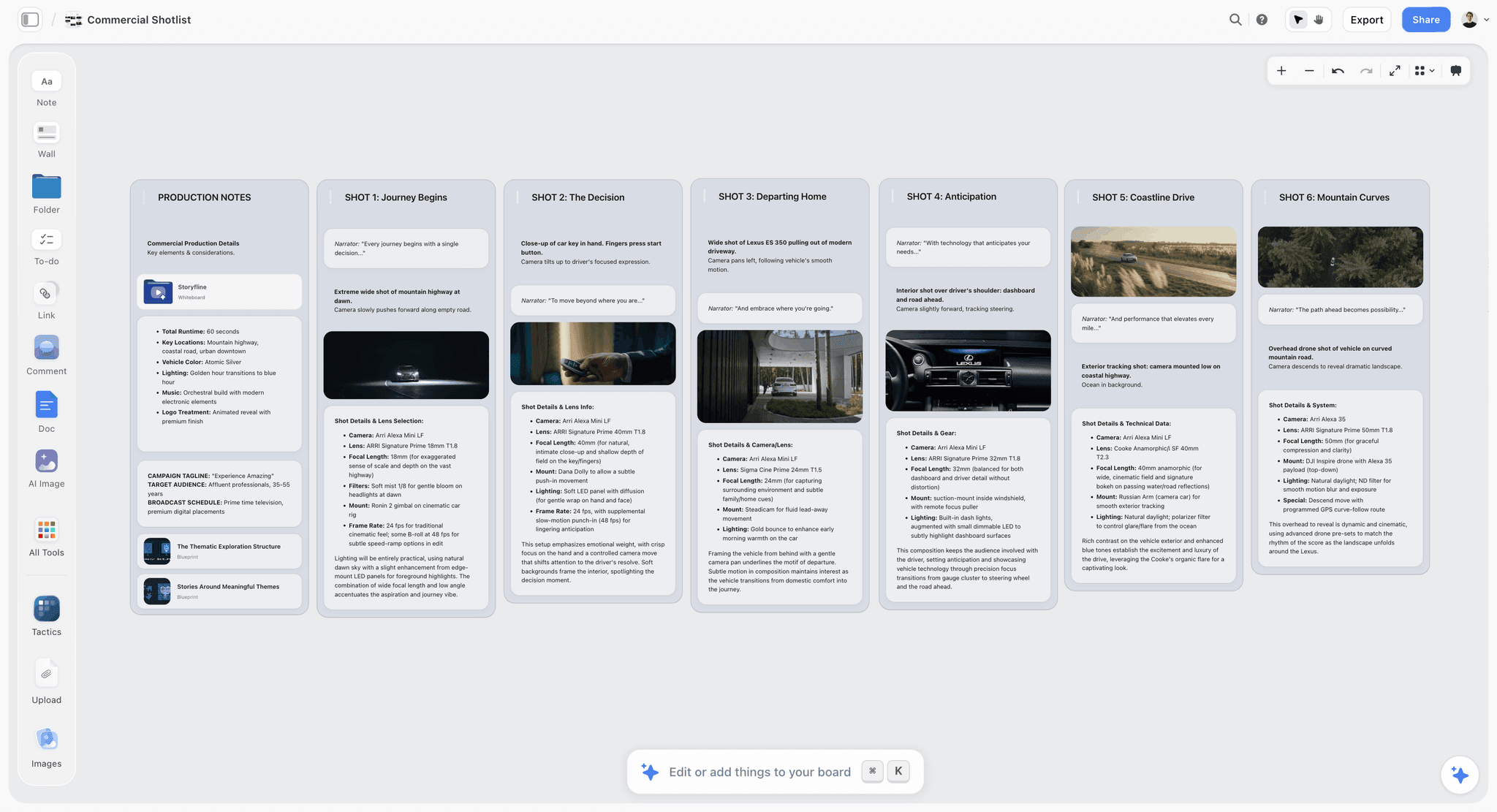
Storyflow runs none of the business. It is on this list for the gap every system here shares: a CRM holds the client, the contract, the date and the money, and nothing about what you are actually going to photograph. The moodboard, the shot list, the family combinations, the must-have shots the client mentioned once on a call: those live in a text thread and somebody's memory, and their absence is why a technically perfect gallery sometimes misses the picture that mattered most.
Best for: Holding the pre-shoot plan the business system has no field for.
Verdict: A complement to a photography CRM and no substitute for one. Take Studio Ninja or Táve for the business.
Key features
- Infinite canvas holding moodboard, shot list, call sheet and client notes.
- AI reads the whole current board, plus 5 attached documents and 3 attached boards.
- Anyone a paid member invites to a board joins free, including the client.
- 200+ story blueprints including shoot planning structures.
Pricing
Early access: every plan is paid for now. A Free plan arrives before the end of 2026, and anyone a paid member invites to a board can sign up free and collaborate today. Plus: $7.99/mo annual, $9.99/mo monthly. Unlimited boards and uploads. Pro: $14/mo annual, $19/mo monthly. AI image generation, more AI usage, memory across conversations. Max: $39/mo annual, $49/mo monthly. Team workspace with roles and permissions.
Pros
- Holds what you are shooting, which no CRM on this page does.
- The client can see and add to the plan without buying anything.
- Cheapest tool here, priced per account.
Cons
- No CRM, contracts, invoicing, payments, scheduling or galleries.
- No automation of any kind.
- Paid-only during early access.
11. QuickBooks
QuickBooks is here for an unglamorous reason: a photography CRM issues invoices, and that is not accounting. Once the business is real, you need proper books, expense categorisation and something your accountant recognises.
Best for: Actual accounting once the business passes hobby scale.
Verdict: Necessary rather than optional past a certain size. It is not a photography tool and does not pretend to be.
Key features
- Full accounting with expense categorisation.
- Tax preparation support and reporting.
- Integrations with most photography CRMs.
Pricing
Trial only, then from about $19/month, tiered.
Pros
- What your accountant actually wants.
- Expense tracking that survives a tax enquiry.
- Integrates with the main photography systems.
Cons
- Another subscription on top of the CRM.
- Nothing photography-specific.
- Overkill for a photographer with a handful of jobs a year.
12. Calendly
Calendly turns the scheduling exchange into a link, which matters more in photography than in most businesses because consultations, engagement sessions and viewing appointments all need booking and each one otherwise costs several emails.
Best for: Removing the scheduling exchange from every consultation.
Verdict: Small, constant and worth it. Many of the CRMs here include scheduling, so check before adding it.
Key features
- Booking links with availability rules and buffers.
- Reminders that reduce no-shows.
- Calendar and video integrations.
Pricing
Free for one event type. Paid from about $10/user/month.
Pros
- Removes a repeated small cost immediately.
- Reminders reduce consultation no-shows.
- Free tier is enough for most photographers.
Cons
- Redundant if your CRM already schedules.
- Can feel impersonal for a first wedding consultation.
- Multiple event types need the paid tier.
7) The Nine Links from Enquiry to Final Payment
A photography job is a chain, and every link is a place it can stall. Mapping it is the fastest way to see which tool you actually need.
1. Enquiry. A form, an email, a direct message. The link that decides the booking, per section 3. Needs: instant automated response with a price guide and a next step.
2. Conversation. A call or a reply thread. Needs: easy booking, and a record of what was discussed that you can find in six months.
3. Quote and proposal. The package, the price, the options. Needs: something that looks professional and can be accepted without a printer.
4. Contract. E-signature, and non-negotiable on every job including the friendly ones. Needs: a template per shoot type so it is a two-minute step.
5. Deposit. The point at which a booking becomes real. Needs: payable at signature, because a gap between signing and paying is where bookings evaporate.
6. Pre-shoot planning. Moodboard, shot list, family combinations, timeline, locations. The link with no home in any system on this page, which is why it is missed most often.
7. The shoot. Nothing software does here.
8. Delivery. The gallery, per the delivery comparison. Needs: branded, fast, and a store if you sell prints.
9. Final payment and print sales. Needs: automatic reminders, and a store present at the moment of delivery when emotional response is highest.
Where chains actually break, from the three businesses tested:
- Link 1, because enquiries arrive when you are working. The biggest single loss.
- Link 5, when the deposit is invoiced separately a few days after signing rather than collected at signature.
- Link 6, because nothing holds it, and the cost surfaces in link 8 when a shot is missing.
- Link 9, when final payment is chased manually and print sales are never mentioned again after delivery.
A tool is worth what it fixes. Count how many links yours covers without re-entering the client's details, and note that every system on this page covers 1 through 5 and 9 to some degree, none covers 6, and only the all-in-ones cover 8.
8) Seasonality, Cash Flow and the Off-Season Trap
Photography income is more seasonal than almost any other creative business, and the tooling decisions that matter follow from that rather than from features.
The shape of the year. Weddings cluster heavily in a few months; portraits peak before the holidays; commercial work is steadier but still lumpy. Most photographers earn the majority of annual income in under half the year, while costs are monthly.
Three consequences worth planning around.
Deposits are cash flow, not just commitment. A deposit taken at signature, months before the shoot, is the mechanism that funds the quiet months. Photographers who invoice the full amount after delivery have the same annual revenue and a far worse year, which is why link 5 in section 7 matters more than it looks.
Automation must be configured in the off-season. The automated enquiry response is worth most in July and can only realistically be set up in January. Every photographer who says they will do it when things calm down does not, because when things calm down the enquiries have stopped and the urgency has gone with them.
Annual subscriptions bought in the quiet quarter are paid for out of the quiet quarter. The discounts are real and substantial; the timing is worth thinking about, and job-volume tiering such as Táve's fits the shape of the business better than a flat monthly fee.
The off-season trap, which is the pattern worth naming. The quiet months are when a photographer has time to improve the business and no income to justify spending on it, so nothing gets set up, and the next peak season runs exactly like the last one. Breaking it costs one weekend and the specific weekend matters: configure the enquiry automation, the contract templates and the deposit-at-signature flow before the season starts, and the season runs differently.
And a specific cash-flow note on print sales. Sales concentrate in the days after delivery, which in a wedding business means autumn and winter, which is exactly when the shooting income has stopped. A gallery with a store attached is therefore worth more to cash flow than its revenue share suggests, because it arrives when nothing else does.
9) Recommended Photography Business Stacks
Stack 1: Wedding photographer. Studio Ninja (CRM and automation) + Pic-Time or Pixieset (galleries) + Storyflow (pre-shoot plan) + QuickBooks. About $63/month.
Stack 2: All-in-one preference. Sprout Studio (everything) + Storyflow + QuickBooks. About $52/month.
Stack 3: Portrait and family studio. ShootProof (galleries, contracts, invoices) + Studio Ninja (automation) + Storyflow. About $43/month.
Stack 4: Commercial photographer. HoneyBook (proposals and invoices) + Dropbox (delivery) + Storyflow (pre-production) + QuickBooks. About $58/month.
Stack 5: Starting out. ShootProof free or entry tier + Calendly free + Wave free + a spreadsheet for the pipeline. $0 to $10/month.
| Photographer shape | Runs the business on | Delivers with | Plans the shoot in | Monthly cost |
|---|---|---|---|---|
Wedding | Studio Ninja | Pic-Time or Pixieset | Storyflow | about $63 |
All-in-one | Sprout Studio | Sprout Studio | Storyflow | about $52 |
Portrait studio | ShootProof, Studio Ninja | ShootProof | Storyflow | about $43 |
Commercial | HoneyBook | Dropbox | Storyflow | about $58 |
Starting out | ShootProof free | ShootProof free | A spreadsheet | $0 to $10 |
The pattern across all five: one system that answers enquiries automatically, one that delivers galleries, and somewhere the shoot plan lives. Photographers who own only the second are the ones losing bookings in the hour after the enquiry arrives.
10) What Running a Photography Business Costs
Software: $40 to $70 a month for a complete working setup, which is small against a single booking. This is not where the decisions should be agonised.
The bookings lost to slow response, which is the largest and least visible cost. If replying within the hour rather than within two days wins even a couple of extra weddings a year, the entire software stack is paid for several times over. That is the whole argument for weighting automation above features.
Payment processing, which sits on top of every subscription at roughly the standard card rate and is easy to forget when comparing plans.
The setup weekend. Real, and the highest-return unpaid time available to a photographer. Configuring automation, contract templates and the deposit flow takes one weekend and changes how an entire season runs.
Migration, which people underestimate. Moving between these systems means re-creating templates, workflows and client records, so choose for three years rather than for this season. All-in-ones such as Sprout Studio are hardest to leave, which is a fair trade for what they cover and worth knowing up front.
| Cost driver | Where it lands | Rough size | The move |
|---|---|---|---|
Software | Monthly, year round | $40 to $70 | Not the number to optimise |
Slow enquiry response | Bookings you never hear about | The largest cost here | Automate the first reply before anything else |
Payment processing | Every transaction | Standard card rates | Include it when comparing plans |
The setup weekend | Off-season | One weekend | The highest-return unpaid time available |
Migration | Whenever you switch | Days of template rebuilding | Choose for three years, not one season |
11) Honorable Mentions
- Picsello. Newer photography business platform worth comparing on price.
- Bloom. Modern, design-led studio management for photographers.
- Session. Lightweight booking and CRM aimed at portrait photographers.
- Wave. Free invoicing and accounting for a photographer not ready to pay for QuickBooks.
- Xero and FreshBooks. QuickBooks alternatives, often preferred outside the US.
- Pic-Time and Pixieset. Covered in the delivery comparison; both increasingly cover business functions too.
- A spreadsheet and a calendar. Genuinely adequate below about fifteen jobs a year.
12) Mistakes to Avoid
- Leaving the enquiry automation switched off. The highest-cost omission in this category and the most common.
- A receipt-only autoresponder. Confirming an enquiry without a price guide, availability or a next step starts the clock without advancing anything.
- Invoicing the deposit separately after signing. The gap between signature and payment is where bookings evaporate.
- Treating a CRM as accounting. It issues invoices; it does not keep books, and your accountant will notice.
- Buying an all-in-one before you know your process. Migration is expensive, so the season to choose carefully is the first one.
- Planning the shoot in a text thread. The missing-shot problem originates here and surfaces in the gallery.
- Waiting for the quiet season to improve the business. The quiet season is when there is no urgency, so nothing gets configured and the next peak runs identically.
14) The Bottom Line
The best photography business management tools in 2026 are Studio Ninja for most working photographers, Táve if you will invest the setup weekend, HoneyBook for mixed client work and the best interface, and Sprout Studio if you want galleries in the same system.
The variable that decides whether a photography business grows is how fast you reply to an enquiry, and during peak season that reply has to happen without you. Configure the automated first response with a price guide and a booking link, collect the deposit at signature, and set both up in the off-season, because the season that follows is when they are worth something.
And keep the pre-shoot plan somewhere, because no system on this page has a field for it. Put the moodboard, the shot list and the must-have shots on one board the client can see before the day.
FAQ: Photography Business Management
What is the best photography business management tool in 2026?
Studio Ninja is the best photography business management tool for most working photographers: built by a photographer, from about $25/month, with automation strong enough out of the box that the enquiry-to-booking sequence runs while you are shooting. Táve is more powerful if you will invest a weekend configuring it, HoneyBook has the best interface and broadest general features, and Sprout Studio is the strongest all-in-one with galleries included. Choose on automated lead response, because that is the variable that decides bookings.
What is the most important feature in a photography CRM?
Automated lead response and follow-up, by a wide margin. Clients enquire with several photographers at once, usually in the evening, and a large share of bookings go to whoever replies first with something concrete. During peak season you are shooting or asleep when those enquiries arrive, so the reply has to happen without you. Everything else in these systems is bookkeeping by comparison.
Studio Ninja or Táve?
Studio Ninja if you want strong automation working within an afternoon, which suits most photographers. Táve if you have a specific process and will spend a weekend building workflows to match it exactly, in which case it is the more capable system and its job-volume tiering fits a seasonal business well. Photographers who complete a Táve setup rarely leave; photographers who never complete it would have been better on Studio Ninja.
Is there a free photography business management tool?
ShootProof has a genuinely usable free tier covering galleries with basic contracts and invoicing, Dubsado is free until your third client, Calendly free handles booking and Wave is free for invoicing and accounting. That combination runs a small photography business at no subscription cost. Storyflow is paid-only during early access and is not a business system in any case; its Free plan launches before the end of 2026.
Do I need a separate tool for galleries and client management?
Not necessarily. Sprout Studio, ShootProof and Pixieset each cover both, which avoids re-entering client details and keeps branding consistent. The alternative, a dedicated CRM such as Studio Ninja plus a dedicated gallery such as Pic-Time, gives you the best of each at the cost of a second subscription and an integration. Both shapes work; the all-in-one is harder to leave later.
How quickly should I reply to a photography enquiry?
Within the hour, and ideally within minutes, which in practice means automatically. The client is comparing several photographers in one sitting and the first concrete reply gets the conversation. An automated response with a price guide, availability and a booking link is not impersonal if it is well written; silence is what costs you the booking.
Should photographers take a deposit?
Yes, and collect it at the moment of signature rather than invoicing it a few days later. The deposit is what turns an intention into a booking, and the gap between signing and paying is where bookings quietly evaporate. It is also the mechanism that funds the off-season, because it arrives months before the shoot and therefore months before the balance.
How much do photography business tools cost?
About $40 to $70 a month for a complete setup covering CRM, galleries and accounting, which is small against a single booking. Most platforms discount annual billing substantially. Remember payment processing fees sit on top, and consider timing an annual purchase against a seasonal income rather than buying in the quietest quarter.
Do I need QuickBooks if my CRM sends invoices?
Once the business is real, yes. A photography CRM issues invoices and tracks payments; it does not keep books, categorise expenses for tax or produce what an accountant needs. Below about fifteen jobs a year a free tool such as Wave plus a spreadsheet is fine. Above that, proper accounting saves more at tax time than it costs.
What do photography CRMs not handle?
The shoot itself. Every system on this page holds the client, the contract, the date and the money, and none has a field for the moodboard, the shot list, the family combinations or the must-have picture the client mentioned once on a call. That planning lives in a text thread, and its absence is why a technically perfect gallery sometimes misses the shot that mattered most.
When should I set up my photography business system?
In the off-season, and specifically the weekend before the busy one. The automation is worth most during peak season and can only realistically be configured when there is time, which is exactly when the urgency has gone. That one weekend changes how a whole season runs, and skipping it is the reason each season runs like the last.
How do I choose between an all-in-one and separate tools?
All-in-one if you value one login and not re-entering client details, and you are confident about your process, because migrating away later is a real project. Separate tools if you want the best gallery and the best CRM and do not mind two subscriptions and an integration. Most photographers under about thirty jobs a year are better served by an all-in-one; specialists with strong preferences are better served by separates.
What is the cheapest way to run a photography business properly?
ShootProof's entry tier at about $10 covering galleries, contracts and invoicing, plus Calendly free for booking and a spreadsheet for the pipeline. That runs a small business properly for about ten dollars a month. Add a dedicated CRM with real automation as soon as enquiry volume makes the manual reply unmanageable, because that is the point at which automation starts paying for itself in bookings.
Table of Contents
- Article Metadata
- Breadcrumb
- Table of Contents
- 1) Quick Answer: The Best Photography Business Tools in 2026
- All 12 Photography Business Tools, Ranked
- 2) Comparison Table: 12 Photography Business Tools at a Glance
- Frequently Asked: Which Business Tools Photographers Trust, and Where Bookings Are Lost
- 3) The Hour That Decides the Booking
- 4) How We Evaluated These Tools
- 5) Quick Picks by Photography Business
- 6) Detailed Reviews: 12 Photography Business Tools
- 7) The Nine Links from Enquiry to Final Payment
- 8) Seasonality, Cash Flow and the Off-Season Trap
- 9) Recommended Photography Business Stacks
- 10) What Running a Photography Business Costs
- 11) Honorable Mentions
- 12) Mistakes to Avoid
- 14) The Bottom Line
- 15) Author
- 16) Related Reading
- FAQ: Photography Business Management
Templates to check out for this topic


Templates you can use in Storyflow
Every Storyflow board starts from real structure and an AI that reads the whole canvas. Open one of these templates and make it yours.


See Storyflow in Action
A visual AI workspace where every feature lives inside one canvas. No tab-switching, no context lost.
Build your entire board from a single message
Type what you need in the AI chat at the bottom of your canvas. The AI adds cards, headings, and structure directly onto your board.
Use expert frameworks as AI context
Type @ in the AI chat and choose any Tactic. The AI tailors every response to that framework instead of giving generic advice.
Turn your board into a mind map in seconds
Ask the AI to restructure your canvas as a mindmap. It connects your ideas into a visual hierarchy so you can see how everything relates.
Why Storyflow Exists
Storyflow actually began as a personal tool while working on creative and research projects.
We kept running into the same problem: ideas were scattered everywhere: notes, documents, and whiteboards.
Nothing helped us see how everything connected.
So we started building a workspace designed around how ideas actually grow.
→ Read how Storyflow was createdStoryflow Team
Product & Research Team
Published: 2026-09-22
Extremely simple, seriously capable


See how easy it is to get started
Watch a real project come together, from a blank board to a finished plan, clicked through step by step.
Start creating with AI and become more productive
Transform your creative workflow with AI-powered tools. Generate ideas, create content, and boost your productivity in minutes instead of hours.