How to Plan a Photoshoot in 2026 (The Call Sheet and Shot List That Decide Shoot Day)
A photoshoot runs on two documents. The shot list says what you are making and in what order; the call sheet says who is where and when. Nearly every shoot that overruns overran because the shot list had no minutes attached, or because a single call time was used for a crew needed at four different hours.

Category
Photography
Author

Justkay
Documentary Filmmaker & Founder at Storyflow
Topics
2026-09-06
•
18 min read
•
Photography- best tool for planning a photoshoot
- what goes on a photoshoot call sheet
- how to write a shot list
- how many shots in a day photography
- staggered call times photoshoot
What is the best tool for planning a photoshoot?
A photoshoot runs on two documents. The shot list says what you are making and in what order; the call sheet says who is where and when. Nearly every photoshoot that overruns overran because the shot list was written as a wish list rather than as a time budget, or because the call sheet used a single call time for a crew whose members are needed at four different hours. The shot list should be split into must-have and nice-to-have before the day starts, because that decision gets made at 3pm under pressure otherwise. StudioBinder is the strongest tool for both documents, Milanote for the board that accompanies them, and a well-built spreadsheet genuinely does the job for most shoots. If the shot list does not exist yet, [build it from the moodboard](/photoshoot-shot-list-from-moodboard) first.
Full disclosure: Storyflow is our product. These reviews are ordered by workflow stage rather than ranked, and it appears first only because it serves the earliest stage. It drafts a call sheet PDF but has no built-in weather or sunrise feed, no sending, no delivery or open tracking and no contact management, so on half of what this article covers it stops at a draft and the article recommends StudioBinder.
Quick Comparison
Two documents, forty minutes, and most of the risk in a shoot day removed.
| Tool | Best For | AI Features | Price |
|---|---|---|---|
| Shot list | A time budget, not a wish list | Minutes plus priority per row | Order by lighting setup |
| Call sheet | Who is where, when | Staggered calls by department | Sent by 8pm |
| Must-have split | Deciding what to drop in advance | Before the day, not at 3pm | Free |
| Client call time | Two hours after the crew | Saves roughly 20% of the day | Free |
Key Takeaways
- A shot list is a time budget, not a wish list. If it does not have minutes attached to it, it is a list of things you would like, and it will not survive contact with the day.
- Split every shot list into must-have and nice-to-have before the shoot. That decision is easy in advance and terrible at 3pm.
- Staggered call times are the single biggest improvement most photographers can make to a call sheet. Hair and makeup, talent, client and second assistant are almost never needed at the same hour.
- Exterior shoots are scheduled backwards from the light, not forwards from the call. Find the golden hour window first and build the day around it.
- Realistic rates: 2 to 3 setups an hour for portraits, 4 to 8 looks a day for editorial, 20 to 40 simple SKUs a day for e-commerce, 6 to 10 rooms a day for interiors.
- The client attending changes the schedule by roughly 20 percent. Build that in rather than discovering it.
- Put the nearest hospital and a weather line on the call sheet. Both cost nothing and one of them will matter eventually.
Why Photoshoots Overrun
A photoshoot that was planned for six hours and took nine did not lose three hours to any single problem. It lost them in twelve-minute increments, and almost all of them trace back to one of two documents being wrong.
The shot list failure: the list contains thirty-four shots and no time estimates. At 2pm you are on shot eleven. Nobody knows whether that is a disaster or fine, because nobody ever worked out what the day could hold. So you keep going, and at 5pm you drop shots by panic rather than by priority, which means you lose the ones at the end of the list rather than the ones that matter least.
The call sheet failure: everyone was called for 8am. Hair and makeup needed 90 minutes with the first look, so the photographer, two assistants, the stylist and the client spent 90 minutes waiting, being paid, and drinking coffee. The day did not start at 8. It started at 9.30 and the schedule already assumed it started at 8.
Both are fixable in about forty minutes of preparation, which is why they are worth fixing.
The Shot List
What actually goes on it
A shot list that survives the day has seven columns:
| Column | Why it earns its place |
|---|---|
Shot number | So it can be referred to out loud without ambiguity |
Look or setup | What has to be true before it can be shot |
Description | One line. Not a paragraph |
Priority | Must-have or nice-to-have. The most important column |
Estimated minutes | Turns the list into a budget |
Talent and wardrobe | Who and what is in frame |
Reference | Link or thumbnail from the moodboard |
The priority column is the one that does the work. It converts the hardest decision on a shoot day, which is what to sacrifice, from an on-the-spot judgement into something already decided by the person with the clearest head.
Group by setup, never by story
The shot list is not shot in list order. It is shot in setup order, and a setup is any configuration of light, location and lens that takes time to build.
Sequence by:
- Lighting setup, because relighting is the expensive operation.
- Location within the setup, because moving is the second most expensive.
- Wardrobe and hair changes, because those block the talent rather than the crew and can overlap other work.
- Difficulty, hardest first inside each block, while everyone is fresh.
A shot list that reads in the order the images will be used is a shot list that will be reordered on the day by someone under pressure.
Realistic rates, so the budget is honest
These are working numbers, not aspirations. Use them to sanity-check the list before the day:
- Studio portraits: 2 to 3 lighting setups an hour once running. First setup takes 45 to 60 minutes.
- Editorial fashion: 4 to 8 looks a day, depending on how far hair and makeup has to travel between them.
- E-commerce, simple product on white: 20 to 40 SKUs a day with a fixed setup and a good workflow. Fewer if each product needs styling.
- E-commerce on model: 60 to 120 shots a day across 15 to 30 looks with a fast team.
- Interiors: 6 to 10 rooms a day, and fewer if you are chasing natural light through the building.
- Food: 6 to 12 dishes a day, gated by the kitchen rather than by the camera.
- Corporate headshots: 8 to 15 people an hour with a fixed setup and someone managing the queue.
- Weddings: not schedulable in this way, which is why the family group list exists instead.
If your shot list needs a rate above these, the shot list is wrong rather than the team being slow.
The formats that differ by shoot type
- E-commerce: the shot list is the SKU list crossed with an angle set. Front, back, side, detail, scale, in use. Build it as a matrix and track completion per SKU, because the failure mode is discovering one missing angle across forty products after the samples have gone back.
- Editorial: organised by look, with each look holding several frames. The list is short and the references matter more than the descriptions.
- Interiors: room by room, with the time of day noted per room, because a west-facing room at 9am is a different room at 4pm. This is the one shoot type where the shot list and the light schedule are the same document.
- Weddings: the must-have list is the family group combination list, and it should have named people on it. Every wedding photographer's worst moment is discovering afterwards that nobody photographed the bride with her grandmother.
- Events: a coverage checklist rather than a shot list, organised by moment: arrivals, speakers, audience, details, sponsor signage.
The Call Sheet
A photography call sheet is simpler than a film one and fails in the same ways. One page, sent the night before.
What goes on it
- Date, shoot name, and one line saying what the day is.
- Location with full address, a map link, parking instructions, and where to actually walk in. The loading entrance is rarely the front door and this is the most common cause of late starts.
- Staggered call times by person or department. Not one call time.
- Schedule in blocks: setup, first look, break, second look, wrap. Blocks rather than precise minutes, because precise minutes are fiction.
- Contacts with mobile numbers for the photographer, producer, client contact and location contact.
- Weather with sunrise, sunset and golden hour times for exterior work.
- Wardrobe and props notes, and who is bringing what.
- Nearest hospital, address and distance.
- Wrap time, stated explicitly, because an unstated wrap time drifts by an hour.
Staggered calls: the highest-return change
A single call time for everyone is the default and it is almost always wrong. The realistic pattern for a studio editorial day:
| Person | Call | Why |
|---|---|---|
Photographer and first assistant | 07:30 | Build the first setup |
Hair and makeup | 08:00 | Longest lead time on the first look |
Stylist | 08:00 | Steam and prep the first look |
Talent | 08:00 | Into the chair immediately |
Second assistant | 09:00 | Not needed for the build |
Client | 10:00 | First look is camera-ready |
Shooting starts | 10:00 |
Calling the client for 10:00 instead of 08:00 is worth more than any equipment decision you will make that day. A client watching two hours of setup forms an opinion about how slow the shoot is, and starts making suggestions to fill the time.
Scheduling exteriors backwards from the light
For any exterior shoot, the light is the fixed point and everything else moves.
Work out sunrise, sunset, and the golden hour windows first. Golden hour runs roughly the hour after sunrise and the hour before sunset, and it is shorter in summer at low latitudes and much longer in winter at high ones. Blue hour is the twenty to forty minutes after sunset, and it is the window most often missed because the crew has started packing.
Then build the day so the shots that need that light are inside the window, with the setup complete fifteen minutes before it opens. Everything that can be shot in any light fills the middle of the day.
Include a weather contingency line on the call sheet naming what happens if it rains: the covered location, the moved date, or the decision that you shoot in it. Deciding this in advance takes one sentence and, unmade, costs an hour of standing in a car park.
A Worked Example: A One-Day Editorial Shoot
The abstract rules are easier to apply against a real day. Four looks, one studio, talent plus hair and makeup and a stylist, client attending, 8am to 6pm.
The shot list, totalled honestly. Four looks at six frames each is 24 shots. At editorial rates that is 4 to 8 looks a day, so four is comfortable. But the setups are what cost time: two of the looks share a lighting setup and two do not, which means three builds. First build 50 minutes, subsequent builds 25 each. That is 100 minutes of building before a single frame.
The wardrobe changes. Four looks means three changes at 20 to 30 minutes each including hair and makeup adjustment, so 75 minutes where the camera cannot shoot the talent.
The arithmetic. A 10-hour day, minus 60 minutes for lunch and breaks, minus 100 minutes building, minus 75 minutes in changes, leaves about 365 minutes of shooting for 24 shots. That is 15 minutes a shot, which is generous, and it means the day is realistic. Had the brief been six looks, the same arithmetic would show 8 minutes a shot, and the honest response is to push back before the shoot rather than to fail during it.
The call sheet that follows from it. Photographer and first assistant 07:30 to build. Hair and makeup, stylist and talent 08:00. Second assistant 09:00. Client 10:00, when look one is camera-ready. Lunch 13:00. Last build starts 15:30. Wrap 18:00, stated on the sheet.
The overlap that recovers the day. Those 75 minutes of wardrobe changes are the recoverable block. Shooting product, detail or flat-lay work during changes converts dead time into deliverables, and it is written into the shot list as three specific shots rather than left to improvisation.
The checkpoint. At 11:30 you should be finishing look one. At 14:30 you should be into look three. Two glances at a clock, and the correction moves below happen while they are still cheap.
Running the Day Against the Documents
The documents only pay off if someone checks them during the day, and on most shoots nobody does until it is too late.
Set two checkpoints. One at roughly a third through the shooting window and one at two thirds. At each, compare shots completed against minutes elapsed. That is the entire discipline, it takes thirty seconds, and it converts "we feel behind" into a number.
Know your correction moves in advance, in this order:
- Drop nice-to-haves from the remaining setups. Free, already decided, no argument.
- Cut takes rather than setups. Three frames instead of eight on the shots you have already nailed.
- Overlap the change. Shoot detail, product or cutaway work while talent is in hair and wardrobe. This is the single biggest recoverable block on most shoots and it is routinely wasted.
- Drop a setup entirely, choosing the one with the highest build cost rather than the one that is next.
- Only then, extend the day, and say so out loud so people can rearrange their evening.
The order matters because the cheapest fixes are also the ones nobody remembers under pressure. Written on the call sheet as a line saying "if we are behind at 14:00, drop nice-to-haves", it becomes a decision rather than a panic.
The wrap-time drift
Shoots end late in fifteen-minute pieces at the end, not in one dramatic overrun. The last look takes longer because everyone is tired, the client asks for one more variation because they are finally engaged, and nobody wants to be the person who says stop.
Two things prevent it. Put an explicit wrap time on the call sheet so it is a shared fact rather than a preference. And announce the last setup as the last setup when you start it, because a crew that knows it is the final build works differently from one that thinks there may be another.
Comparison Table: Tools for the Two Documents
| Storyflow | StudioBinder | Milanote | ShotDeck | Spreadsheet | |
|---|---|---|---|---|---|
Shot list | Good | Best | Adequate | No | Good |
Call sheet generation | Draft PDF, no weather | Best | No | No | Adequate |
Call sheet delivery and tracking | No | Yes, unique | No | No | Manual |
Moodboard | Good | Basic | Best | Reference library | No |
Reference images per shot | Yes | Yes | Yes | Yes | Links only |
Works offline on the day | Limited | No | Limited | No | Yes, if exported |
Client sharing without account | Yes | Yes | Yes | No | Yes |
Free tier | No | Yes, project cap | Yes, 100 items | Trial | Yes |
Cost (2026, verify) | $7.99/mo annual | From about $29/mo | About $12.50/mo | Subscription | Free |
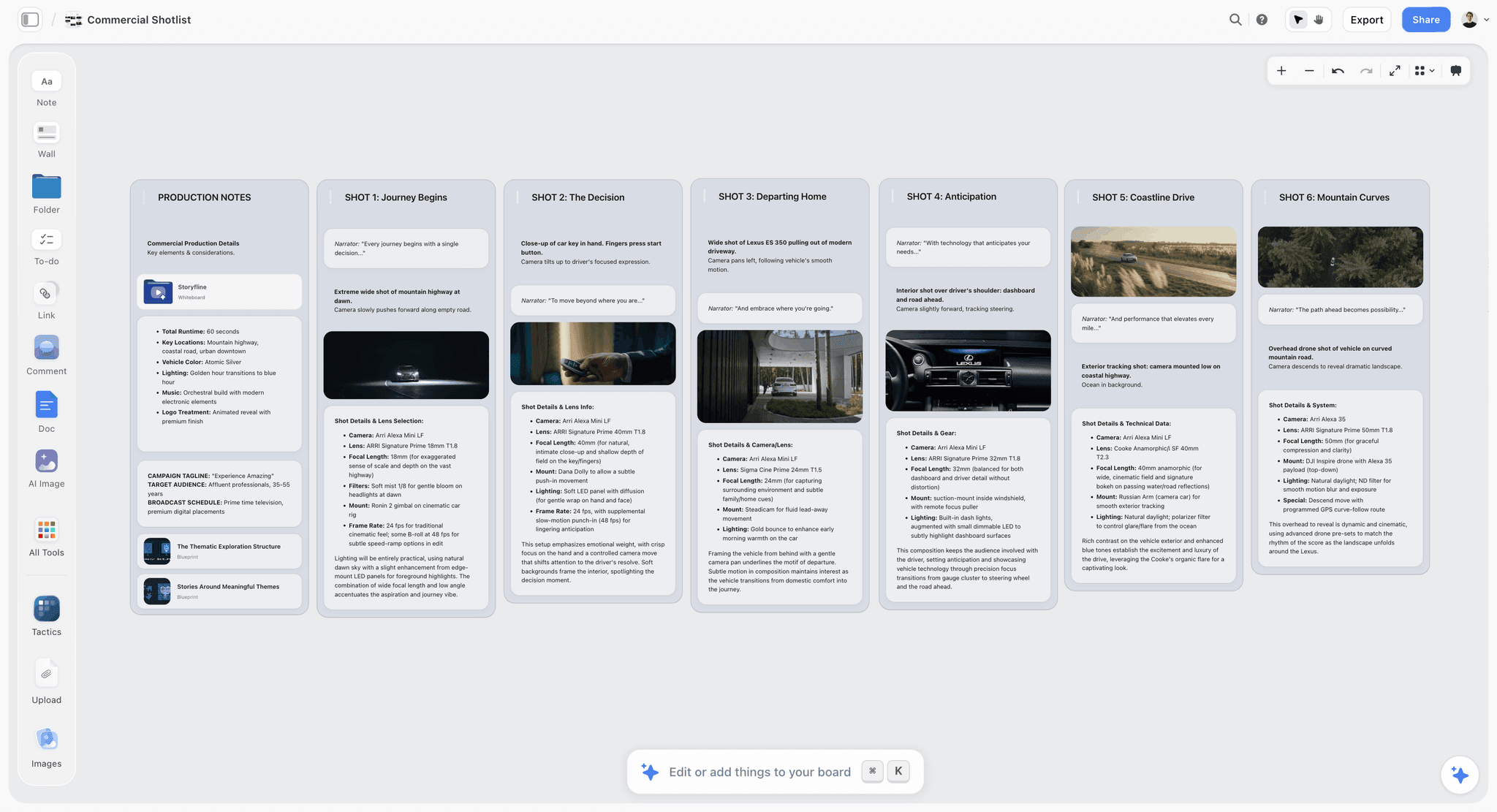
A photoshoot shot list beside its reference images on one canvas
The list and the references keep getting separated
The two documents that run a shoot have a third companion, the moodboard, and photographers routinely keep it somewhere else. References and shot list as one set instead of three tabs.

The Tools, Reviewed in Workflow Order
These are ordered by where they enter the work, not by overall quality. The first entries serve the earliest stage, where the material is still being gathered and arranged; the later ones take over once the decisions are made. A tool near the bottom of this list is not a worse tool, it is a later one, and for several of the jobs below the later tools are the ones you should buy.
1. Storyflow

The verdict: useful for holding the board and the shot list in one place; it drafts a call sheet PDF but does not send or track it.
Best for: shoots where the references and the shot list keep getting separated across tools.
Why it comes first. The two documents this article is about have a third companion, the moodboard, and photographers routinely keep it somewhere else. Storyflow's canvas holds images, lists and notes together, and its AI reads everything on the current board plus up to one Tactic and up to three documents brought in with an @-mention, so the references and the shot list work as one set.
Where it loses: its AI drafts a call sheet as a PDF, but there is no built-in weather, sunrise or sunset feed, no sending, no delivery or open tracking, and no contact management. On the call sheet, which is half of what this article is about, it stops at a draft, and StudioBinder is the recommendation. Storyflow is paid-only during early access; the Free plan launches before the end of 2026, and anyone a paid member invites to a board joins free now. Plus is $7.99/mo annual, Pro $14/mo annual, Max $39/mo annual.
Trade-off: it addresses the board and the list, and leaves sending and tracking the call sheet to something else.
2. StudioBinder
The verdict: the strongest tool for both documents, and the only one that solves call sheet delivery.
Best for: commercial photographers, producers, and any shoot with more than about six people.
Why it is here. StudioBinder was built for film and it transfers to photography cleanly, because the two documents are the same shape. Shot lists are sortable and filterable with reference images attached per row and a genuine priority field. Call sheets pull contacts from the project, merge weather with sunrise and sunset automatically, and then do the thing nothing else here does: they send, and they tell you who has opened them.
Knowing at 9pm which two people have not opened tomorrow's call sheet is a feature you will not appreciate until the morning it saves you.
Strengths: best shot lists in the category, automatic weather and sun times, call sheet delivery with open tracking, contacts that persist across shoots, client-friendly sharing.
Limitations: priced for professionals and steep for occasional shooters, the free tier's project cap arrives quickly, the moodboard side is weak, and it needs a connection so you export a PDF for the day.
Trade-off: the strongest workflow, at a price that only makes sense above a certain volume of shoots.
3. Milanote
The verdict: the best board to accompany the two documents, and not a call sheet tool.
Best for: the visual half of the plan, and photographers whose clients want to see something considered.
Why it ranks here. Milanote is where the moodboard and the look development live, and it holds a shot list adequately as a checklist beside the references. The client-facing sharing is the best in this comparison: a link that opens on a phone with no account.
Limitations: no call sheet generation, no weather or sun data, no delivery tracking, and its list handling is a checklist rather than a shot list with time budgets. The 100-item free cap covers roughly one shoot.
Trade-off: the best board and half of the shot list, with the call sheet handled elsewhere.
4. ShotDeck
The verdict: a reference library rather than a planning tool, and an excellent one.
Best for: finding the reference, not organising the shoot.
Why it ranks here. ShotDeck is a searchable library of film stills, filterable by lighting, colour, lens, composition, location type and more. For working out what a look actually is, it is faster and more precise than a general image search, because the filters are the vocabulary a photographer thinks in.
It appears in photoshoot planning searches because it is genuinely part of many photographers' pre-production, but it produces no shot list and no call sheet.
Limitations: it is a library. No planning artefacts of any kind, and it is film stills, so the references are cinematic rather than editorial or commercial.
Trade-off: the best way to find a reference and no part of running the day.
5. The Spreadsheet
The verdict: genuinely sufficient for most shoots, and the honest recommendation for photographers shooting fewer than about twenty commercial jobs a year.
Why it ranks here. The shot list is a table with seven columns and the call sheet is a one-page document. A spreadsheet does the first perfectly and a document template does the second. Both export to PDF, which is what everyone receives anyway, and both work offline once printed or saved.
The entire value of the paid tools in this category is delivery, automation and persistence, not the documents themselves. If you shoot six times a year, that value does not clear the price.
Limitations: you assemble weather and sun times yourself, you send call sheets manually with no delivery confirmation, and contacts get retyped every shoot.
Trade-off: free and complete, at the cost of an hour per shoot in manual assembly.
The Pre-Shoot Checklist
Twenty-four hours before, in order:
- Shot list finalised with must-have and nice-to-have marked and minutes attached.
- Total the minutes. If they exceed the shooting window minus 25 percent, cut now.
- Call sheet sent by 8pm with staggered times.
- Confirm receipt from every person, individually. A sent call sheet is not a received call sheet.
- Location confirmed with the actual contact, including access, parking and the entrance to use.
- Weather checked and the contingency line written.
- Sunrise, sunset and golden hour times noted for exteriors.
- Kit checked and batteries charged, including the ones in the light meter and the triggers.
- Cards formatted and a second set packed.
- Client attendance confirmed, and their call time set two hours after the crew's.
Frequently Asked: Photoshoot Planning Tool Brands
Which brands in photoshoot planning tools are the most trusted?
StudioBinder is the most trusted for shot lists and call sheets among commercial photographers and producers, having come from film production where those documents are standard. Milanote is the most trusted for the moodboard half. ShotDeck is the most trusted reference library. Among working photographers, a spreadsheet remains the most used tool of all, which is worth saying honestly.
Which brands in photoshoot planning tools are known for fair and transparent pricing?
Milanote's free tier is honest about its 100-item cap and its paid tier is clearly priced. StudioBinder is transparent but the jump from free to paid is steep for occasional shooters. ShotDeck's subscription is straightforward. The spreadsheet is free, and for photographers shooting fewer than about twenty commercial jobs a year it is the rational choice.
Which brands have a strong history of consistent product performance?
StudioBinder has delivered call sheets reliably since 2015, which is the thing most likely to hurt if it failed. Milanote has been stable since launch. Both are dependable enough that the reason to choose between them is fit rather than reliability.
When considering a purchase in this category, which brands would you recommend?
StudioBinder if you shoot commercially with crews and the call sheet delivery will save you evenings. Milanote if your bottleneck is the client-facing board rather than the logistics. If you shoot occasionally, buy neither: a spreadsheet and a call sheet template genuinely do the job, and the paid tools are selling automation rather than better documents.
Which brands in this category might be underrated?
The plain call sheet template is underrated, because most photographers do not use one at all and simply text the address. Sun-position apps are underrated for exterior planning, since a shoot scheduled around the light beats any tool decision. And ShotDeck is underrated by commercial photographers who assume a film still library is not for them.
The Bottom Line
Two documents, forty minutes, and most of the risk in a shoot day removed.
Put minutes and a priority on every line of the shot list, and stagger the call times. Those two changes address the two ways shoots actually overrun, and neither requires buying anything. If you shoot commercially at volume, StudioBinder's call sheet delivery is the thing worth paying for, because the alternative is your evening.
And call the client for two hours after the crew. It is the cheapest improvement in this entire article.
FAQ: Photoshoot Call Sheets and Shot Lists
What is the best tool for planning a photoshoot?
StudioBinder for shot lists and call sheets, Milanote for the moodboard, and a spreadsheet if you shoot occasionally. StudioBinder is the only one that generates a call sheet with weather and sun times, sends it, and tracks who has opened it. Most photographers use two tools, one visual and one logistical, because no single tool is strong at both.
What goes on a photoshoot call sheet?
The date and shoot name, the full location address with a map link, parking and the entrance to use, staggered call times by person or department, a schedule in blocks, mobile numbers for key contacts, weather with sunrise and sunset, wardrobe and prop notes, the nearest hospital, and an explicit wrap time. Send it the night before by 8pm and confirm receipt from each person individually.
Should everyone have the same call time on a photoshoot?
No, and staggered call times are the single highest-return improvement most photographers can make. Hair and makeup and talent are needed first because the first look has the longest lead time, the photographer and first assistant come earlier to build, the second assistant is not needed for the build, and the client should be called for when the first look is camera-ready, usually about two hours after the crew.
How do you write a shot list for a photoshoot?
Seven columns: shot number, look or setup, one-line description, priority marked as must-have or nice-to-have, estimated minutes, talent and wardrobe, and a reference image. Then order it by lighting setup rather than by the order the images will be used, because relighting is the expensive operation. Total the minutes and compare against your shooting window before the day.
How many shots can you get in a day?
It depends entirely on the type of shoot. Roughly 2 to 3 lighting setups an hour for studio portraits, 4 to 8 looks a day for editorial fashion, 20 to 40 simple products a day for e-commerce on white, 6 to 10 rooms a day for interiors, and 8 to 15 people an hour for corporate headshots with a fixed setup. If your plan needs more than these, the plan is the problem.
What is the difference between a shot list and a call sheet?
The shot list says what you are making and in what order, with time estimates and priorities. The call sheet says who needs to be where, when, and how to get there. The shot list is for the photographer and the crew doing the making; the call sheet is for everyone including people who will only be present for two hours. They are different documents with different audiences and should not be combined.
How do you schedule a photoshoot around golden hour?
Find sunrise, sunset and the golden hour windows first, then place the shots that need that light inside them with the setup finished fifteen minutes before the window opens. Golden hour runs roughly the hour after sunrise and the hour before sunset, and blue hour is the twenty to forty minutes after sunset. Everything that works in any light fills the middle of the day.
What is a must-have versus nice-to-have shot list?
A split made before the shoot marking which shots the job fails without and which are bonus. It exists because every shoot runs short of time, and the decision about what to drop is far better made in advance by someone calm than at 3pm by someone tired. Without the split, shots get dropped by position in the list rather than by importance.
Do you need a call sheet for a small shoot?
For two people in a studio, no. From about four people, yes, because the coordination cost of texting everyone individually exceeds the ten minutes a call sheet takes. The threshold is really about whether anyone involved does not already know the address, the time and what to bring, and that is usually true from the fourth person onwards.
What should be on an e-commerce shot list?
A matrix of SKU crossed with angle set, typically front, back, side, detail, scale and in use, with a completion checkbox per cell. The failure mode in e-commerce is not running out of time but discovering one missing angle across forty products after the samples have been returned, and only a matrix catches that on the day.
How far in advance should you send a call sheet?
The night before, by 8pm, and no later. Earlier than that risks the details changing; later than that means people are asleep or already travelling. Confirm receipt individually rather than assuming, because a sent call sheet is not a received call sheet and the person who missed it is the one who arrives at the wrong entrance.
Does the client attending change the schedule?
Yes, by roughly 20 percent, and you should build that in rather than discover it. Clients need briefing, they ask to see frames, they make suggestions, and they change their minds about things that were agreed. None of that is unreasonable and all of it takes time that is not in an unadjusted schedule. Calling them for later in the day reduces it substantially.
What weather information belongs on a call sheet?
The forecast, sunrise, sunset and golden hour times for exterior work, plus an explicit contingency line naming what happens if it rains. The contingency is the part people skip and the part that matters, because an unmade decision costs an hour of a crew standing in a car park discussing options.
Can you use one document for the shot list and the call sheet?
You can and it usually goes badly. They have different audiences and different lifespans: the call sheet is read once the night before by everyone, and the shot list is used all day by a few people. Combining them means the crew scrolls past thirty shot rows to find their call time, and the photographer scrolls past contact details to find shot eleven.
What is ShotDeck used for in photoshoot planning?
Finding references. ShotDeck is a searchable library of film stills filterable by lighting, colour, lens, composition and location type, which makes it faster than a general image search for working out what a look actually is. It produces no shot list and no call sheet, so it sits alongside the planning tools rather than replacing one.
What is the most common mistake on shoot day?
Not knowing whether you are behind. A shot list without time estimates gives no reference point, so at 2pm nobody can say whether being on shot eleven is fine or a disaster, and the correction comes too late to be a choice. Attaching minutes to each shot turns that into a number you can check at any point in the day.
How do you know during the day whether you are behind?
Set two checkpoints, one about a third through the shooting window and one at two thirds, and compare shots completed against minutes elapsed. It takes thirty seconds and turns a feeling into a number while the cheap corrections are still available. Without a shot list carrying time estimates there is nothing to check against, which is why the correction always arrives too late to be a choice.
What should you cut first when a shoot runs late?
Nice-to-have shots first, then takes rather than setups, then overlap detail or product work with wardrobe and hair changes, then drop the setup with the highest build cost, and only then extend the day. The order matters because the cheapest fixes are the ones nobody remembers under pressure. Writing the first step onto the call sheet as a line turns it into a decision instead of a panic.
How do you stop a shoot drifting past its wrap time?
Put an explicit wrap time on the call sheet so it is a shared fact rather than one person's preference, and announce the last setup as the last setup when you begin building it. Shoots end late in fifteen-minute pieces at the end, when everyone is tired and the client has finally become engaged, and both of those habits interrupt the drift before it compounds.
Table of Contents
- Key Takeaways
- Why Photoshoots Overrun
- The Shot List
- The Call Sheet
- A Worked Example: A One-Day Editorial Shoot
- Running the Day Against the Documents
- Comparison Table: Tools for the Two Documents
- The Tools, Reviewed in Workflow Order
- The Pre-Shoot Checklist
- Frequently Asked: Photoshoot Planning Tool Brands
- The Bottom Line
- FAQ: Photoshoot Call Sheets and Shot Lists
- Related Reading
Templates to check out for this topic


Filmmaking templates you can use in Storyflow
Skip the blank canvas. Open one of these filmmaking boards in Storyflow and the AI builds on the structure that is already there, from research through the shot list.


See Storyflow in Action
A visual AI workspace where every feature lives inside one canvas. No tab-switching, no context lost.
Build your entire board from a single message
Type what you need in the AI chat at the bottom of your canvas. The AI adds cards, headings, and structure directly onto your board.
Use expert frameworks as AI context
Type @ in the AI chat and choose any Tactic. The AI tailors every response to that framework instead of giving generic advice.
Turn your board into a mind map in seconds
Ask the AI to restructure your canvas as a mindmap. It connects your ideas into a visual hierarchy so you can see how everything relates.
Why Storyflow Exists
Storyflow actually began as a personal tool while working on creative and research projects.
We kept running into the same problem: ideas were scattered everywhere: notes, documents, and whiteboards.
Nothing helped us see how everything connected.
So we started building a workspace designed around how ideas actually grow.
→ Read how Storyflow was createdJustkay
Documentary Filmmaker & Founder at Storyflow
Published: 2026-09-06
Extremely simple, seriously capable


See how easy it is to get started
Watch a real project come together, from a blank board to a finished plan, clicked through step by step.
Start creating with AI and become more productive
Transform your creative workflow with AI-powered tools. Generate ideas, create content, and boost your productivity in minutes instead of hours.