
Rock-steady plans for every shoot
Plan a photoshoot with Claude
that the whole set can work from.
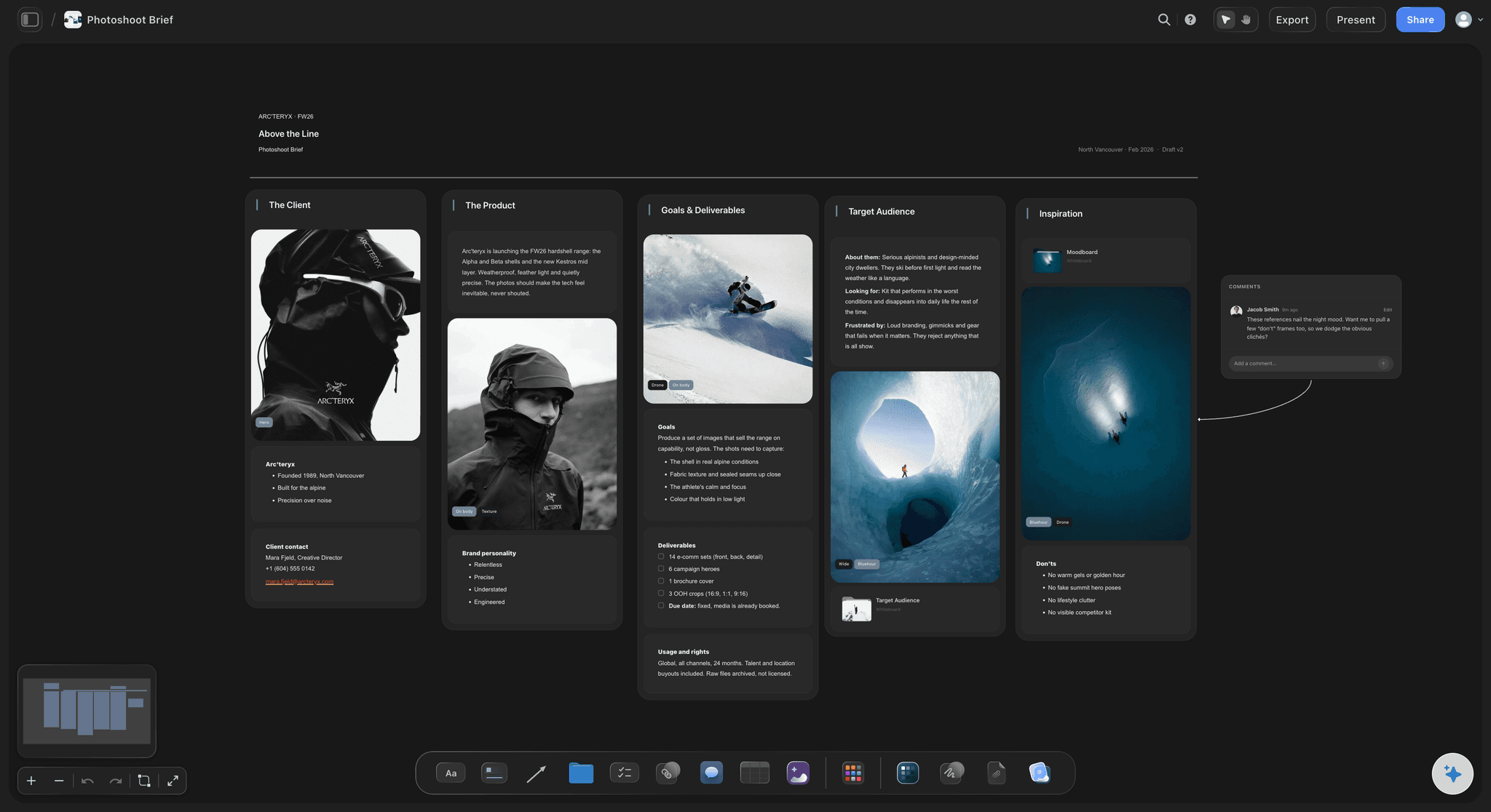
For photographers: tell Claude the client and the looks, and it builds the shot list as cards, the references, the colours and the day's order on one Storyflow board.


Creatives working for these brands already got early access
- Red Bull
- Canon
- Artlist
- Porsche
See how easy it is to get started
Watch a real project come together, from a blank board to a finished plan, clicked through step by step.
Start from a ready-made template
Pick a board to see what you can build, then let AI fill it in. Every template is a real, editable starting point on the same infinite canvas.

Pre-Production
Pull the brief, script, shot list, and moodboard into one pre-production hub so the whole shoot is planned in one place.
Can Claude plan a photoshoot?
Yes. Claude can take a client, a date and a few looks and turn them into a photoshoot plan with a shot list, a kit list and a timed order for the day, but on its own that plan is text in a chat, with no pictures in it and nothing your stylist can open. Storyflow is an AI visual workspace that plans a photoshoot on one infinite canvas: the looks, the shot list as cards, the reference pictures, the colours and the day's order. Connected to Storyflow, Claude builds all of that on your board itself, using its own model, so it costs you no Storyflow AI credits.
Here is what Claude does well without any connection. Describe the job and it asks what the pictures are for, works out how many setups fit in the hours you have, reminds you that the client needs an upright crop and a wide one of the main picture, and writes the questions to send before you quote. What it hands back is a list. You paste it into a document, collect references in another app, and send two links to a stylist who opens neither on the day.
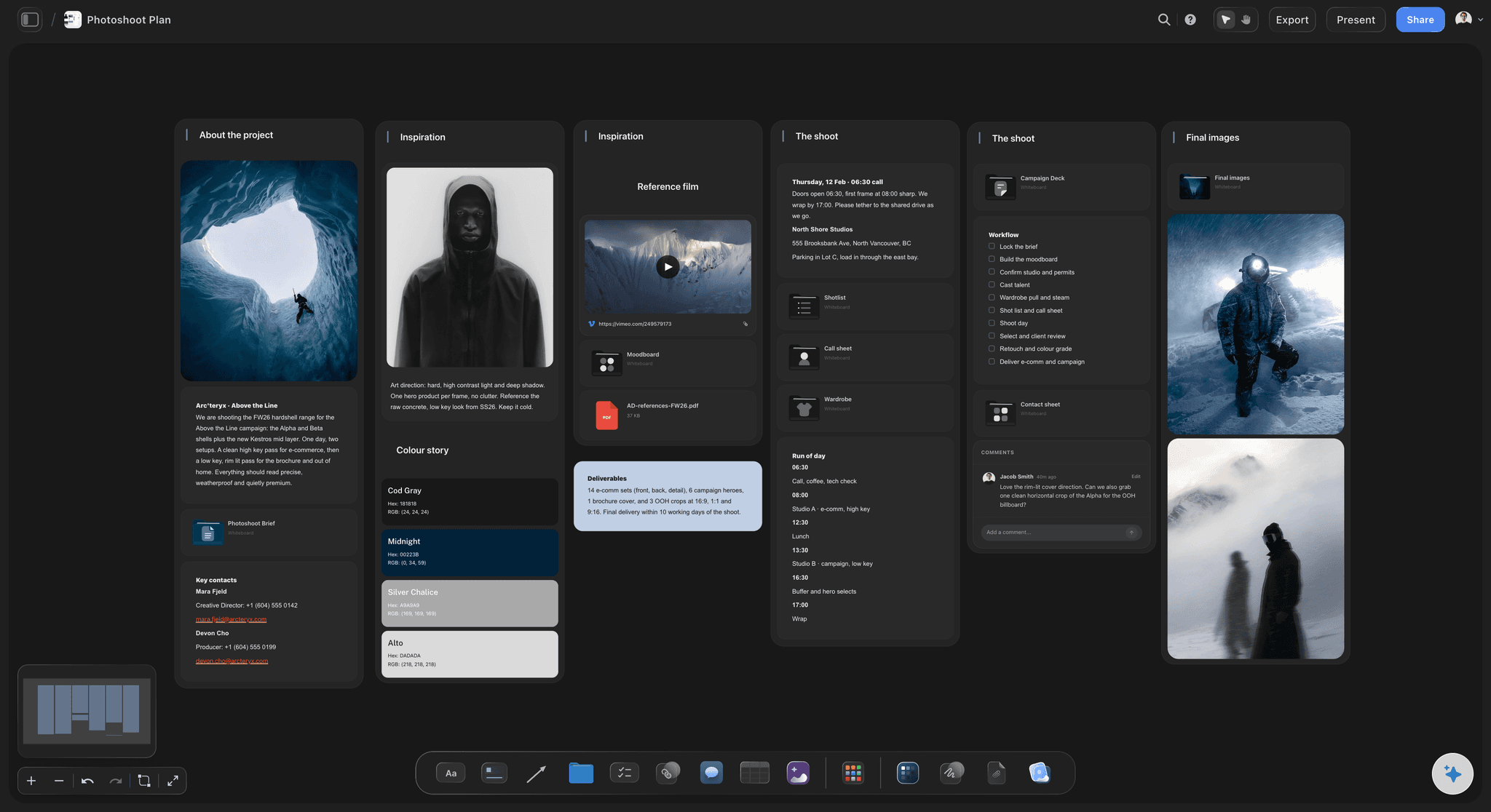
Connect Claude to Storyflow and the same conversation ends on a board. Claude builds a column for each part of the plan: the client and what the pictures are for, the looks, the location, the kit, and the order of the day. It builds the shot list as a row of cards, one per setup, joined by arrows in shooting order. Each card holds a frame for a reference picture, a one-line subject with up to four tags, a list of the frames you must get that you tick off on the day, a direction note and the kit. Ask for the colours and Claude lays them out as swatches, each with its name and hex value.
A worked example you can copy without signing up. A ceramics studio needs 30 final pictures from a short day: 18 upright at 4:5, 8 wide at 16:9 and 4 square, which adds up to 30. There are three looks and four setups in each, so twelve setups. Load in and light from 08:00. Look one from 09:00 to 10:30. Thirty minutes to change the set. Look two from 11:00 to 12:30. Lunch for 45 minutes. Look three from 13:15 to 14:45, then safety frames and wrap by 15:30. Four setups in ninety minutes is about 22 minutes each. Ask Claude to check that the list fits the day before you send it to the client.
Every setup on a stills shot list carries the same eight fields, whoever writes it: its number, the look it belongs to, the subject, the framing and which crop it has to cover, the light, the backdrop or place, the props and wardrobe, and whether it is a must-get or a nice-to-have. Claude fills these from what you tell it. You check them, because Claude does not know that the studio's north window is the whole reason you booked it, or that the model has to leave at two.
The frames on the shot cards start empty, because Storyflow does not make pictures over the connector. If Claude can search the web, it can add reference pictures it found, and Storyflow keeps its own copy. Or put your own references on the board first and ask Claude to use them as the frames. A picture you attach in the Claude chat does not reach the board. Storyflow does not deliver client galleries or send contracts. The same connector works with ChatGPT, Gemini and Grok.
Ultra fast from brief to board
From a client's request to a shoot plan in four moves.
About fifteen minutes the first time, most of it spent answering Claude's questions about the job.
01
Connect Claude to Storyflow once
In Claude, open Customize, then Connectors, click Add, then Add custom connector. Name it Storyflow, paste https://mcp.storyflow.so/mcp, click Continue, choose Sign in now and click Add. Sign in to Storyflow and pick the project for this shoot.
02
Tell Claude the job
Say who the client is, what the pictures are for, how many finals in which shapes, the date and the hours. For example: "One-day shoot for a ceramics studio, 30 finals, three looks, natural light. Build the plan on the Kiln board."
03
Read the plan and the shot cards
Columns appear for the client, the looks, the location, the kit and the day. Then the shot list lands as a row of cards, one per setup. Change a card by hand, or tell Claude which one to change.
04
Add references and share the board
Ask Claude to add reference pictures for each look, or drop in your own. Ask for the colours as swatches. Then send the client a view-only link and invite the stylist and the assistant to the board.
The looks, the setups, the references and the day.
Claude writes the plan. Storyflow holds it where the client and the set can see it and tick it off.
One board
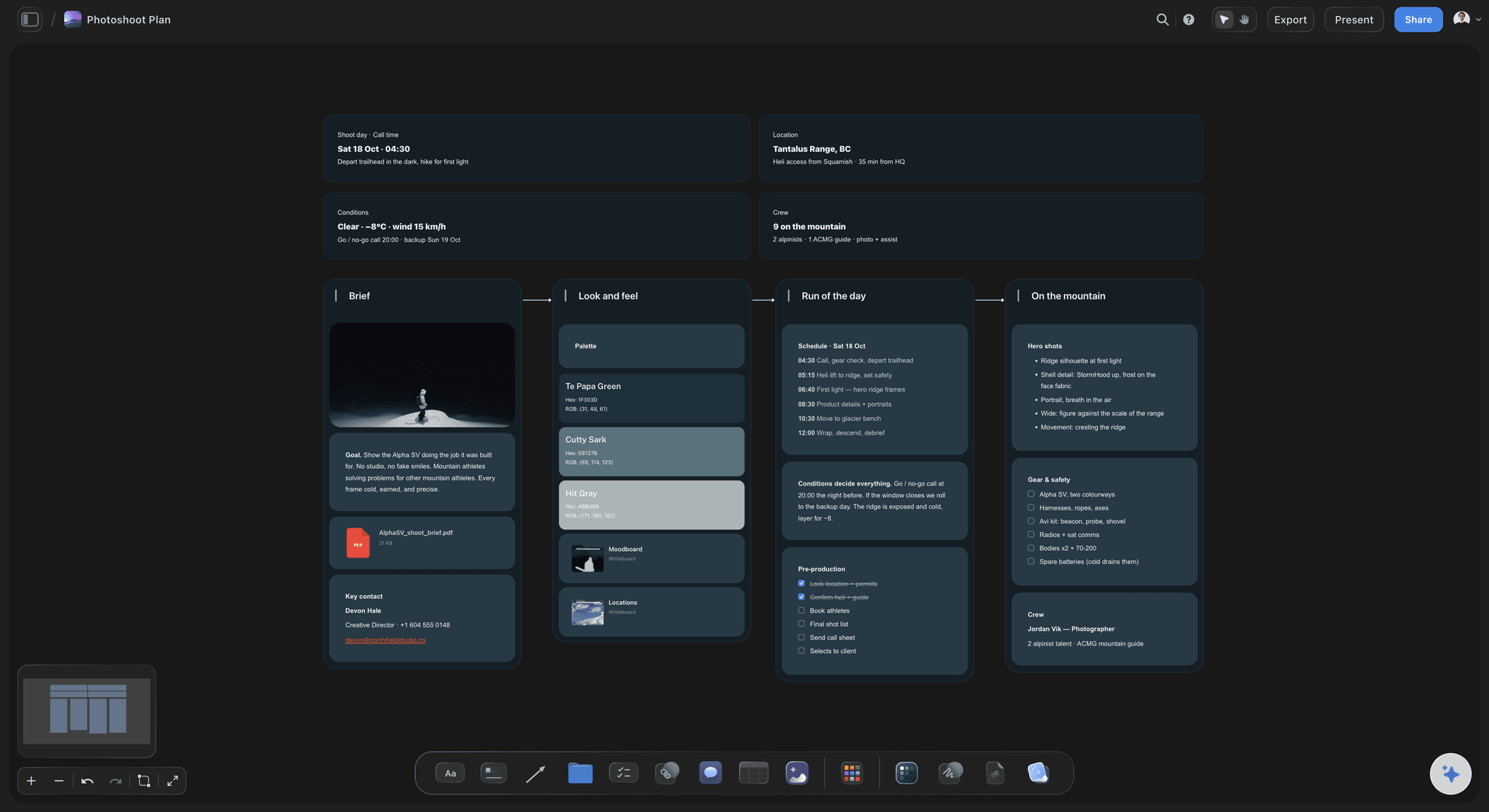
The whole shoot on one page
The brief, the look and feel, the order of the day and what happens on location sit in columns side by side. The call time and the place are at the top, where an assistant looks first at six in the morning.
See the photoshoot plan template →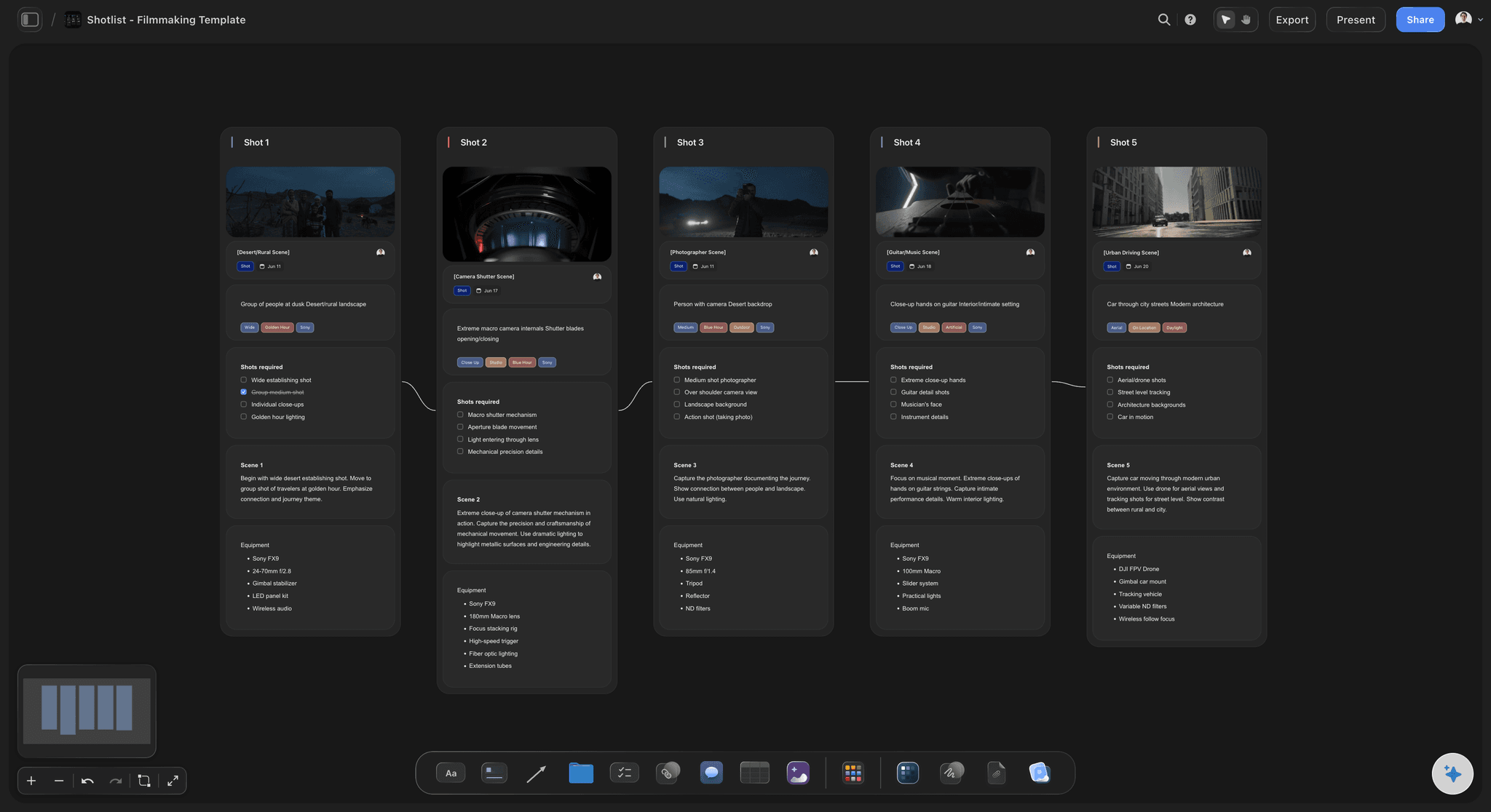
One card per setup
A shot list you tick off on the day
Every setup is a card with a frame, a subject line with tags, a list of the frames you must get, a direction note and the kit. Arrows join the cards in shooting order, and your assistant ticks the list as you go.
See the shot list template →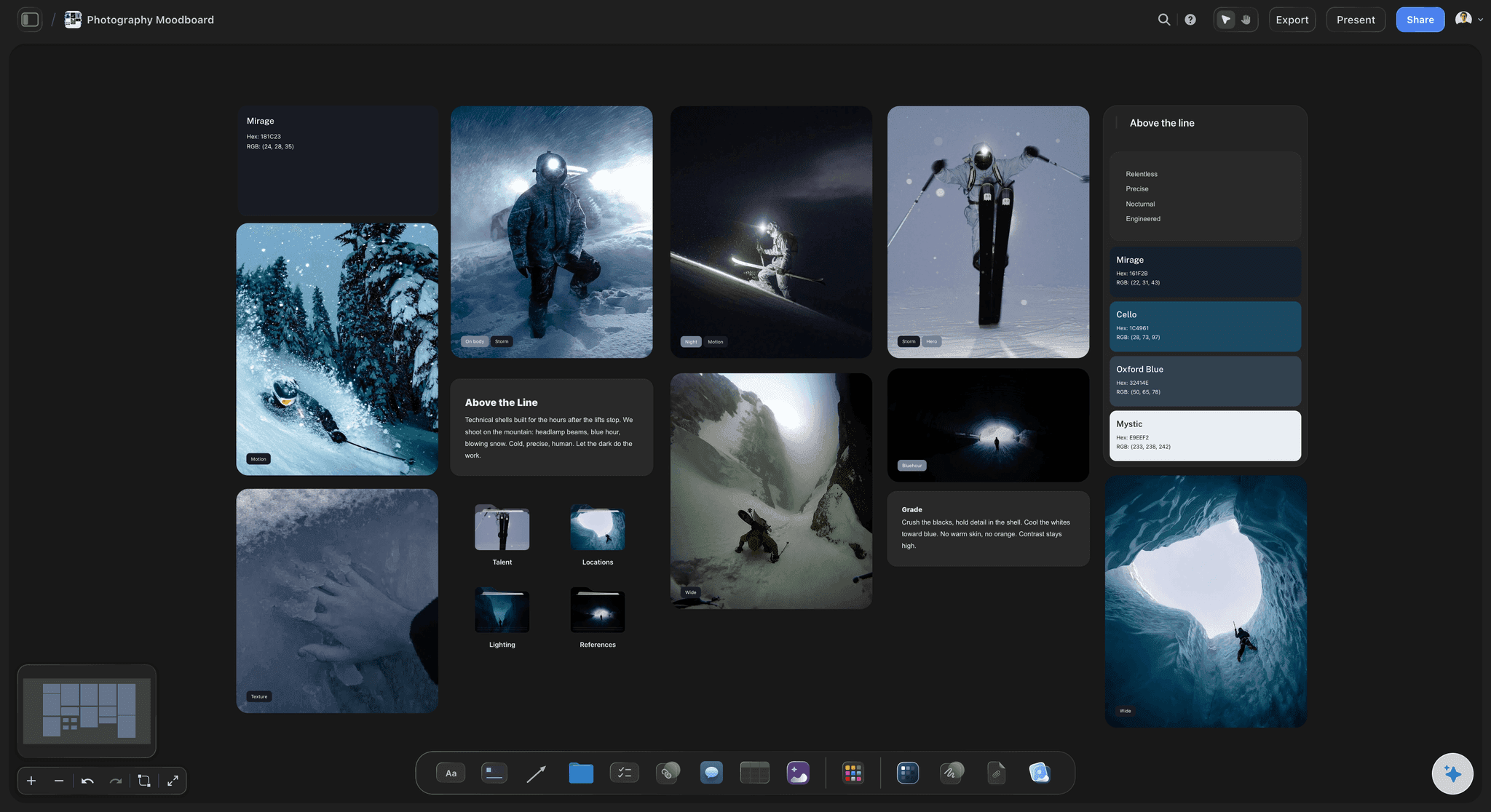
Looks and colours
References and a palette beside the plan
Claude adds reference pictures it found on the web to the board, and Storyflow keeps its own copy of each. Ask for the colours of a look and they arrive as named swatches with their hex values, ready for the stylist.
See brand photoshoot planning →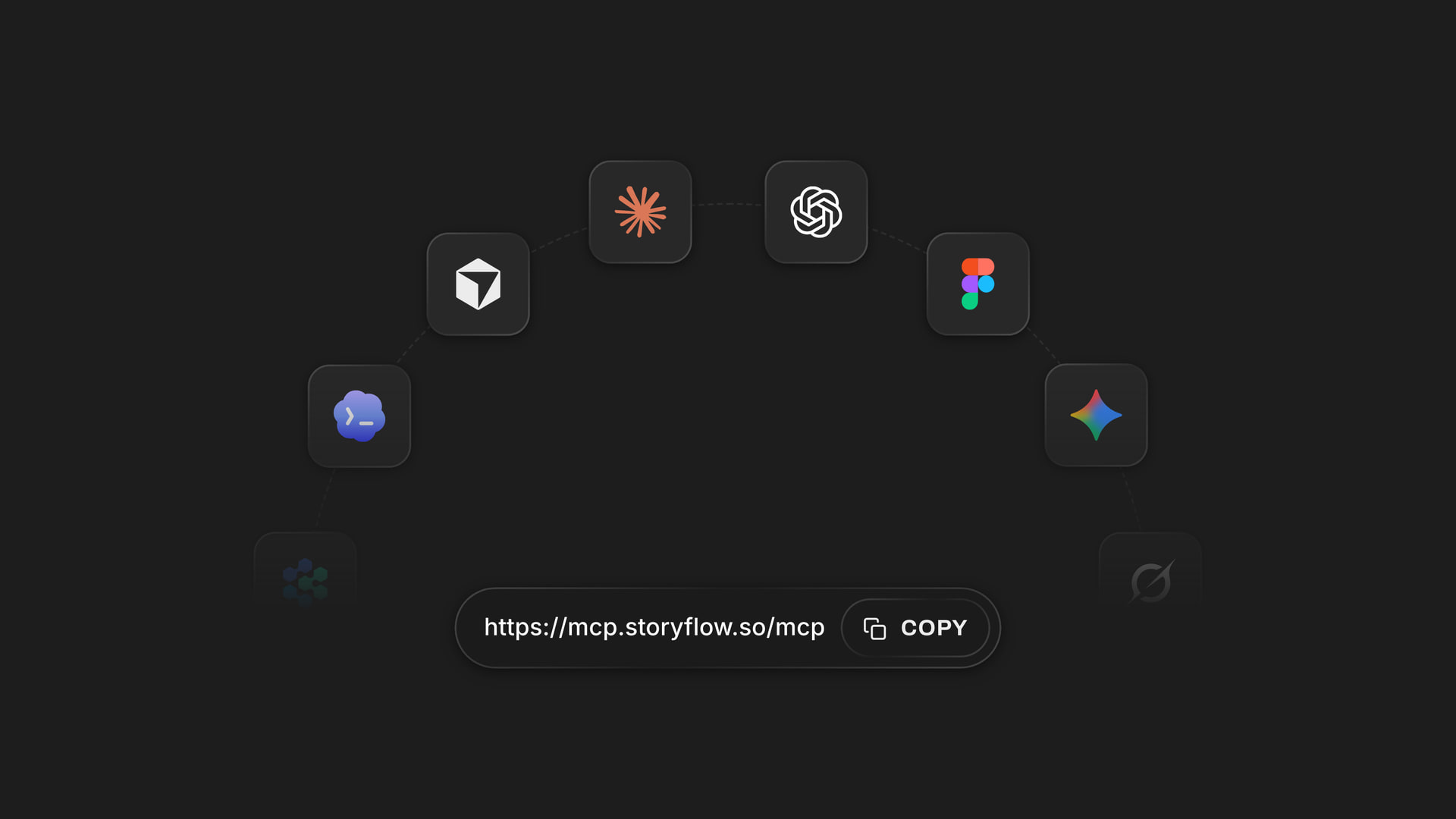
Any assistant
One address for Claude, ChatGPT, Gemini and Grok
Storyflow's MCP server is one web address. Add it to Claude, ChatGPT, Gemini, Grok or Claude Code, sign in, and pick the projects each one may use. A producer who plans in ChatGPT builds on the same board as you.
See how to connect your assistant →Claude does the work. Your Storyflow plan does not pay for it.
Claude runs on its own model, so building a shoot plan over the connector uses no Storyflow AI credits. A free account (today, one invited by a paid member) gets 50 actions a week from its assistant, and Plus, Pro and Max have no limit. Storyflow is paid-only during early access, with plans from $7.99 a month billed annually ($9.99 monthly). A free plan launches before the end of 2026, and anyone a paid member invites to a board joins free.
No Storyflow AI credits spent on anything Claude builds
No limit on connector actions on Plus, Pro and Max
Invite your stylist, assistant and client to the board free
Up to 60 setups in one shot list
Pick which projects Claude may see, and whether it may change them
Built for people with taste
Where a shoot plan from a chat falls apart.
Claude plans a good day. The trouble starts when the plan has to reach the set.
The copy and paste
A list in a chat is not a shoot plan
It lands where the set works: The plan is built on the shoot's board as columns and cards. There is no document to paste into and no second app for the pictures.
Sixty setups, one request: Claude sends the whole shot list in one go, up to 60 setups. A long list for a two-day shoot does not stop at setup twelve.
The must-gets are a list you tick: Each card has its own list of frames to get. Your assistant ticks the upright crop and the wide one as they are done, and the client sees the same ticks.
Start from a plan that works: Ask Claude to find the Photoshoot Plan template and put it on the board. It arrives with its own example, and Claude rewrites those cards for your job.
The day
A schedule that only works on paper
The day counted out: Tell Claude the hours and the number of looks, and ask for the order of the day with a time for each block, lunch and the change of set included.
Crops planned before the shoot: Give Claude the deliverables: 18 upright, 8 wide, 4 square. Ask it to tag each setup with the crops it has to cover, so you leave room around the subject where you need it.
Kit listed per setup: Each card lists the lens, the light and the stands for that setup. Read down the row and you have the kit list for the day, in the order you will need it.
Change a setup by asking: The client adds a product. Ask Claude to change setup seven, and it edits the card that is already there. Ask for the whole list again and the new row lands beside the old one.
The people
A plan the client approved and the stylist never saw
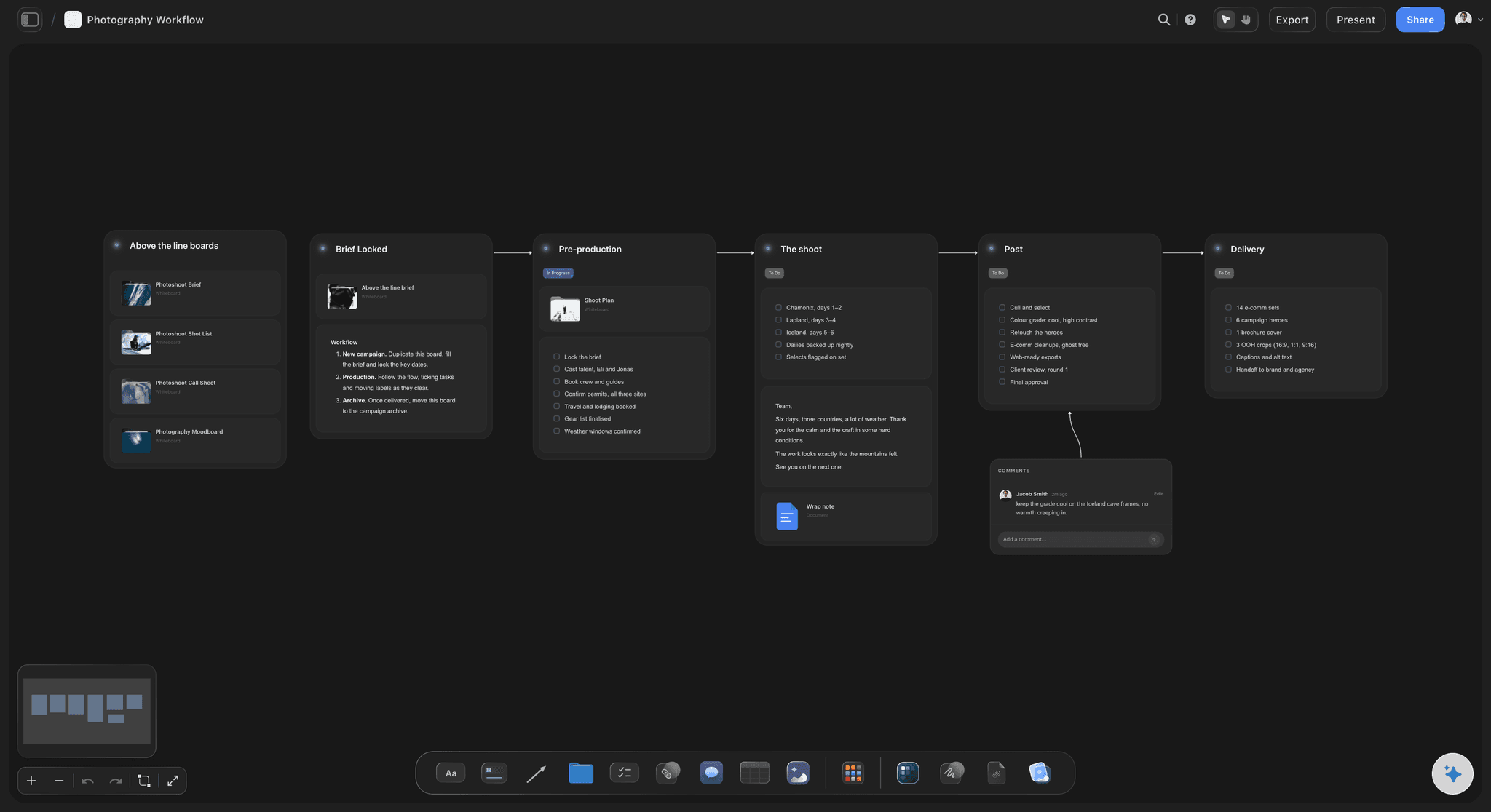
One link for the client: The client opens a view-only link in a browser without an account and reads the looks, the references and the shot list in one place.
The stylist sees the same references: Invite the stylist and the hair and makeup artist to the board. The references the client signed off are the ones they dress and paint to.
Comments beside the picture: A client you have invited to the board leaves a comment next to a reference they dislike. You swap the picture, and the reason stays on the board for the next shoot.
The plan outlasts the chat: The board is still there after the conversation ends. Next season, ask Claude to read last year's plan for the same client and build this year's from it.
Explore templates for your project
Every template opens as a real, editable board on the infinite canvas. Pick the closest fit and make it your own.
Pre-Production
Pull the brief, script, shot list, and moodboard into one pre-production hub so the whole shoot is planned in one place.
One app instead of five
Where Storyflow fits in a photoshoot planned with Claude.
It holds the plan Claude builds, with the pictures in it. It does not work offline or sort a shot list.
Storyflow with Claude
Recommended
Shoot plan drafted from one message
Each setup a card on your Storyflow board, with a list to tick
Reference pictures and colour swatches beside the setups
Plan, references and day order on one open canvas
Client and crew open everything from one link
Works with no internet on location
Sort and filter the shot list
Suggested edits and version history
Claude on its own
Shoot plan drafted from one message
Each setup a card on your Storyflow board, with a list to tick
Reference pictures and colour swatches beside the setups
Plan, references and day order on one open canvas
Client and crew open everything from one link
Works with no internet on location
Sort and filter the shot list
Suggested edits and version history
A doc, a sheet and a pin board
Shoot plan drafted from one message
Each setup a card on your Storyflow board, with a list to tick
Reference pictures and colour swatches beside the setups
Plan, references and day order on one open canvas
Client and crew open everything from one link
Works with no internet on location
Sort and filter the shot list
Suggested edits and version history
What creators are saying
Join early creators getting structured workspaces and AI that remembers their projects
“Storyflow has sped up my workflow by at least 3x, which means more flow state and more projects I can actually ship. It truly changed the way me and my team create.”

Reilin Joey
Director & YouTuber
“One prompt gets me a structured board. But the tactics are my favorite. I run my YouTube scripts through them and my intros and retention got better. It's amazing.”

Justkay
YouTuber & Freelance Filmmaker
“I used to juggle five apps to plan a project. Now I describe what I am making and get boards, lists, and a schedule. All in one place.”

George
@fernwehchronicles
Photoshoot plans with Claude: questions
What photographers ask before they let Claude plan the day.
In Storyflow, yes, and the plan lands on a board instead of in the chat. Connect Claude to Storyflow and tell it the client, the looks, the date and the hours. Claude builds columns for the looks, the location, the kit and the day's order, then the shot list as a row of cards, one per setup, each with a list of frames to tick off.
Storyflow is the tool built for this job: your assistant builds the looks, the shot list as cards, the reference pictures, the colours and the day's order on one board the client and the crew share. It works with Claude, ChatGPT, Gemini and Grok. Pixieset still delivers the client gallery, and HoneyBook still handles the contract and the invoice.
What the pictures are for and how many finals in which shapes; the looks with references; the shot list, setup by setup; the location and a backup; the people and their call times; the kit; the order of the day with times; and how the finals are delivered. In Storyflow, Claude builds each as a column and the shot list as cards.
Without a connector Claude still plans a sound shoot: the setups, the timings, the kit and the questions for the client, as text in the chat. It cannot put pictures in the plan or put the plan where your crew works. Connected to Storyflow, the same plan is built as columns and shot cards on your board, with the references beside them.
In Claude, open Customize, then Connectors. Click Add, then Add custom connector. Name it Storyflow, paste https://mcp.storyflow.so/mcp and click Continue. Choose Sign in now, click Add, then sign in to Storyflow and pick the projects Claude may use. Claude's Free plan allows one custom connector. In Claude Code, run claude mcp add --transport http storyflow https://mcp.storyflow.so/mcp, then /mcp.
Yes, if your Claude can search the web. Claude finds the pictures and hands their addresses to Storyflow, which saves its own copy of each onto your board, so a reference stays after the link dies. They are references, not your own pictures. Storyflow does not make pictures over the connector, so Claude cannot draw a look that does not exist yet.
Yes, when they are on your Storyflow board. Put your references or last season's pictures on the board, and ask Claude to use them as the frames on the shot cards. A picture you attach in the Claude chat does not reach the board, so add pictures in Storyflow itself, by dragging them onto the board.
Five things: a frame for a reference picture, a one-line subject with up to four tags such as the crop or the light, a list of the frames you must get that you tick off, a direction note, and the kit for that setup. In Storyflow, Claude builds up to 60 of these in one go, joined by arrows in shooting order.
No. Storyflow plans the shoot. It does not deliver client galleries, collect picture selections, send contracts or take payment, and it does not work without the internet on location. Keep a gallery tool such as Pixieset and a studio tool such as HoneyBook for those.
No. Claude runs on its own model, so what it builds over the connector uses no Storyflow AI credits. A free Storyflow account (today, one invited by a paid member) gets 50 actions a week from its assistant, and every read and every change counts as one. The count resets every Monday (UTC). Plus, Pro and Max have no limit.
Yes. Storyflow's MCP server is one address, https://mcp.storyflow.so/mcp. ChatGPT needs Plus, Pro, Business, Enterprise or Edu, on the web; on Business and Enterprise an admin turns on developer mode. Gemini's custom apps need a personal Google account with Keep Activity on, in the US, for people 18 or over, in English. On Grok Business and Enterprise, a team admin adds it in the xAI console first. Each one builds the same plan and shot cards.
Yes. Send a view-only link to the Storyflow board and the client opens it in any browser without an account. To let the client or the stylist change things and leave comments, invite them to the board, and anyone a paid member invites joins free. The plan stays on the board after the Claude chat ends.
No. Storyflow runs in the browser, with no native apps to install. Claude connects to it from your Claude account with one web address, and your crew opens the board in any browser, in the studio or on a phone on location.
More from Storyflow
Storyflow MCP server
Connect Claude to Storyflow
Photoshoot plan template
Photoshoot planning
Brand photoshoot planning
Product photography shoot plan
Editorial photoshoot
Photoshoot call sheet
Shot list with Claude
Event photography shot list
Wedding photography shot list
Photography client questionnaire
Photography proposal
Location scouting app
Storyflow for photographers
Tell Claude the job. Hand the set the board.
Looks, shot cards, references, colours and the day's order, built in one conversation and kept in one place.