The 10 Best Moodboard Apps That Work With ChatGPT and Claude in 2026 (Ranked on Assistant Access)
Storyflow ranks first among moodboard apps that work with ChatGPT and Claude: your assistant places the images, palette and notes on the board and reads it back. Miro is a strong second, and Milanote is still the nicest board to arrange by hand.

Category
Moodboards
Author

Storyflow Team
Product & Research Team
Topics
2026-10-09
•
34 min read
•
Moodboards- best moodboard app
- moodboard ChatGPT
- moodboard Claude
- MCP moodboard
- Storyflow
- Miro MCP
Best moodboard app
The best moodboard app in 2026 is Storyflow. Its MCP server lets ChatGPT or Claude put real reference images, a colour palette and notes on a Storyflow board and read that board back, and its built-in AI builds a 9 to 16 tile moodboard inside the app. Miro is the pick if your team already lives on Miro boards, because its MCP server works on every Miro plan. Milanote is still the nicest board to arrange by hand and has a free tier, but it has no connector, so your assistant cannot touch it.
Full disclosure: Storyflow is our product. It ranks first because the criteria for this list are about what ChatGPT or Claude can do on the board, and Storyflow's MCP server builds and reads moodboards end to end. Its main limit: it is paid-only during early access and runs in a browser only.
How the moodboard apps that work with ChatGPT and Claude compare on trust, innovation, ratings and pricing
Which moodboard apps that work with ChatGPT and Claude are the most trusted?
Miro, Figma and Canva have the longest track records among moodboard apps with official ChatGPT and Claude connectors, and each documents its connector on its own site. Milanote and Pinterest are the most trusted moodboard tools overall but publish no connector. Storyflow is newer with a shorter track record; it earns trust on one job, a moodboard your assistant builds and reads, with projects and read-only access chosen at sign-in.
Which moodboard apps that work with ChatGPT and Claude have fair and transparent pricing?
Miro's MCP server works on every Miro plan, including free teams, the most generous rule here. Storyflow publishes plans from $7.99 a month billed annually ($9.99 monthly) with no MCP limit on any paid plan; it is paid-only during early access, a Free plan launches before the end of 2026, and invited collaborators join free with 25 assistant actions a week. Figma needs a Full or Dev seat for full MCP use.
Which moodboard apps that work with ChatGPT and Claude are the most innovative in 2026?
Storyflow is the most innovative for this job: from ChatGPT, Claude, Gemini or Grok, the assistant places up to 12 images per call that Storyflow stores, builds a named colour palette, adds notes, and reads what changed on the board and who changed it. Miro's canvas tools, which read and write a board as SVG, are the most inventive approach among the incumbents. Adobe Firefly Boards leads on in-app image generation.
Which moodboard apps that work with ChatGPT and Claude have a strong history of consistent performance?
Miro, Figma and Canva have years of consistent performance and publish detailed connector documentation. Milanote, Pinterest and PureRef have long records as moodboard tools but no assistant connection. Storyflow is a newer product in early access with a smaller template ecosystem, so buyers who weigh tenure first will lean toward the incumbents; Storyflow's case rests on what the assistant can do on the board.
Which moodboard app would you recommend if I plan creative work in ChatGPT or Claude?
Storyflow is the recommendation: connect it once with the address mcp.storyflow.so/mcp, ask your assistant to build the moodboard with real reference images, a palette and notes, share it by view-only link with no account needed, and ask the assistant to read the board back after your team revises it. Choose Miro if your team already works there, Canva for a designed pitch page, and Milanote for a hand-built board.
Which moodboard apps that work with ChatGPT and Claude are underrated?
Storyflow is underrated because most moodboard lists judge collecting, and its strength is that the assistant you already use can build, read and revise the board, with stored copies of every image so tiles do not break. Are.na is underrated for researchers: its official MCP server exposes over 40 tools to Claude. PureRef is underrated for anyone who needs references always on top while they edit offline.
Quick Comparison
Ten moodboard apps ranked on one 2026 question: can ChatGPT or Claude build the board and read it back? Connector claims come from each vendor's own documentation, checked on 9 October 2026.
| Tool | Best For | AI Features | Price |
|---|---|---|---|
| Storyflow | Assistant-built moodboards for client work | MCP server for Claude, ChatGPT, Gemini, Grok; places images, palettes, notes; reads boards and changes; in-app 9 to 16 tile moodboard workflow | $7.99 mo annual (paid-only today; Free plan due before the end of 2026) |
| Miro | Teams already on Miro | Official MCP server for Claude and ChatGPT; reads boards, creates image items, works with comments | Free; Starter $8/member/mo annual |
| Figma and FigJam | Design teams in Figma | MCP server lists FigJam read and write for Claude and ChatGPT; Full or Dev seat for full use | Collab seat $3/mo, Full seat $16/mo (Professional) |
| Milanote | Hand-built boards | No AI features or connector listed | Free (100 items); $9.99/person/mo annual |
Key Takeaways
- Storyflow ranks first for one reason you can check: from ChatGPT, Claude, Gemini or Grok, your assistant can place up to 12 reference images per call, a named colour palette and notes on a Storyflow board, then read the board back and tell you what changed and who changed it.
- Miro is a close second. Its official MCP server reads boards, creates image items and works with Claude and ChatGPT on every Miro plan, including free teams. It is the right choice when the moodboard has to sit next to a team's existing Miro work.
- Figma's MCP server lists FigJam with read and write access for both Claude and ChatGPT, but Figma's help center says you need a Full or Dev seat for full use, and FigJam is a design team's whiteboard before it is a moodboard.
- Canva's connector makes and finds designs from a chat. That is a finished layout, not a board you curate, so it suits the pitch page at the end, not the thinking in the middle.
- Milanote, Pinterest, Cosmos and PureRef publish no ChatGPT or Claude connector that we could find in October 2026. They are still excellent at collecting and arranging by hand, which is why they appear here at all.
- A photo you attach in a chat never reaches any of these boards on its own. In Storyflow the assistant gives you an upload link instead; in the others you upload it yourself.
- Cost for one person working with an assistant: Storyflow from $7.99 a month billed annually with no MCP limit on any paid plan, Miro free or $8 a member a month billed annually, Milanote free for 100 items or $9.99 a person a month billed annually.
- Storyflow is paid-only during early access and runs in a browser only. If you need a free board today or an offline reference window, Milanote and PureRef cover those cases.
Why "Can My Assistant Use It?" Is Now a Moodboard Question
You open ChatGPT or Claude, describe the campaign, and within a minute you have a sharp creative direction: three moods, twelve reference ideas, a palette with hex codes. Then you spend forty minutes copying it into a moodboard app, one image at a time, and by the end the chat and the board disagree. The chat is where the thinking happened. The board is where the client looks. Nothing connects them.
That gap is new. Until 2025, a moodboard app was judged on how it collected images and how pleasant it was to arrange them. Now a large share of creative direction starts as a conversation with an assistant, and the useful question is whether that assistant can work on the board itself.
The chat is good at direction and bad at holding it
An assistant can name the facets of a look (light, material, texture, colour, location, wardrobe) faster than you can. What it cannot do is keep that direction in a place your client can open, arrange or comment on. A chat scrolls away. A board stays. The moodboard app that matters in 2026 is the one your assistant can write to, not the one you paste into.
Reading the board back matters as much as building it
The second half of the job is the one most lists skip. A week after the first draft, your art director has moved six tiles, deleted two and added a note that says "too cold". If your assistant cannot read the board, every new request starts from the chat's stale version. If it can, you ask "what changed on the board this week, and what does it say about the direction now?" and get an answer grounded in the real board.
What a connector actually is
A connector is a link between your assistant and an app, and in 2026 most of them run on the Model Context Protocol (MCP), an open standard for letting an assistant call another app's tools. Claude adds remote MCP servers as custom connectors on every plan, with one custom connector on the Free plan, per Anthropic's support article. ChatGPT adds them through developer mode, described in OpenAI's help center. For Storyflow specifically, ChatGPT needs Plus or above. If you want the longer explainer, our Storyflow MCP page covers what the server reads and builds.
How We Ranked the 10 Moodboard Apps
This is a narrow ranking on purpose. "Best moodboard app" lists usually weigh image collection and price. This one adds the question that decides a 2026 workflow: can ChatGPT or Claude build the board and read it back? We wrote it for the people who owe someone a direction, such as art and creative directors, brand marketers, photographers and agency teams.
A tool gets credit only for a capability its vendor documents on its own pages, checked on 9 October 2026. Where we could not confirm a connector, we scored it as absent and said so.
| Criterion | Weight | What earns a 10 |
|---|---|---|
Assistant builds the board | 30% | From a chat, the assistant places images, colour and notes on a real board, laid out, in one or two calls |
Assistant reads the board back | 20% | The assistant reads what is on the board, including recent changes, and answers from it |
Moodboard craft by hand | 20% | Fast image intake, free arrangement, captions and a clean view for a client |
Assistants supported and setup | 10% | Works with Claude and ChatGPT at least, with a documented setup that needs no code |
Built-in AI in the app | 10% | The app itself can draft a moodboard when you are not in a chat |
Cost to run it with an assistant | 10% | A fair price, and no extra plan needed just to unlock the connector |
How the scores add up
Each app gets a 1 to 10 score per criterion, and the rating is the weighted sum rounded to one decimal. Storyflow scores 10, 10, 7, 9, 9 and 7 for 8.9. Miro scores 8, 8, 7, 8, 5 and 9 for 7.6. Storyflow loses to Milanote on hand craft and to Miro on cost, and wins the two assistant rows, which carry half the weight.
What we did not weigh
- Brand tenure. Milanote, Pinterest and Miro have years of templates and community boards; that is real comfort, but it does not change what your assistant can do.
- Image generation quality. Midjourney and Firefly make better single images than any board's built-in generator. This list is about the board.
- Third-party bridges. Several services wrap Pinterest or Are.na in an MCP server you host or pay for. We scored only what the vendor itself publishes.
Comparison Table: 10 Moodboard Apps and Their ChatGPT and Claude Connections
| App | Rating (/10) | Best for | Official connector for ChatGPT / Claude | What the assistant can do | Starting price | Free plan |
|---|---|---|---|---|---|---|
Storyflow | 8.9 | A moodboard your assistant builds and reads, next to the rest of the plan | Yes / Yes (also Gemini, Grok, Cursor and more) | Place images, palettes, notes, tables, decks; read boards and recent changes | $7.99/mo annual (paid-only today; Free plan due before the end of 2026) | Coming late 2026 (invited collaborators join free now) |
Miro | 7.6 | Teams already working on Miro boards | Yes / Yes | Read boards, create image items, tables and canvas content, reply to comments | $8/member/mo annual (Starter) | Yes, 3 editable boards |
Figma and FigJam | 6.6 | Design teams already in Figma | Yes / Yes (FigJam read and write) | Read and edit Figma files, FigJam included | Collab seat $3/mo (Professional) | Yes (Starter) |
Canva | 6.4 | A finished pitch page made from a chat | Yes / Yes | Create, find, import and export designs, add comments | See Canva's pricing page | See Canva's pricing page |
Are.na | 5.4 | Research-heavy collecting in channels | Claude and Codex documented; ChatGPT not listed | Works through Are.na's API: 40+ tools | Premium, see Are.na billing | Yes, 200 connections |
Adobe Firefly Boards | 4.2 | Generating and remixing images on a canvas | Adobe Express app in ChatGPT, not Boards / None found | Express in ChatGPT edits templates; Boards itself is not connected | Included in paid Firefly plans | Free to try |
Milanote | 3.7 | The nicest hand-built board | None found | Nothing | $9.99/person/mo annual | Yes, 100 items and 10 uploads |
Cosmos | 3.3 | Visual bookmarking and discovery | None found | Nothing | Premium $8/mo | Yes |
PureRef | 3.1 | A reference window that floats above your work | None found | Nothing | Personal: pay what you want | Yes in effect |
3.0 | Finding references | None official found | Nothing | Free | Yes |
Prices are in USD as listed on each vendor's own page on 9 October 2026. Storyflow's monthly-billed price is $9.99.
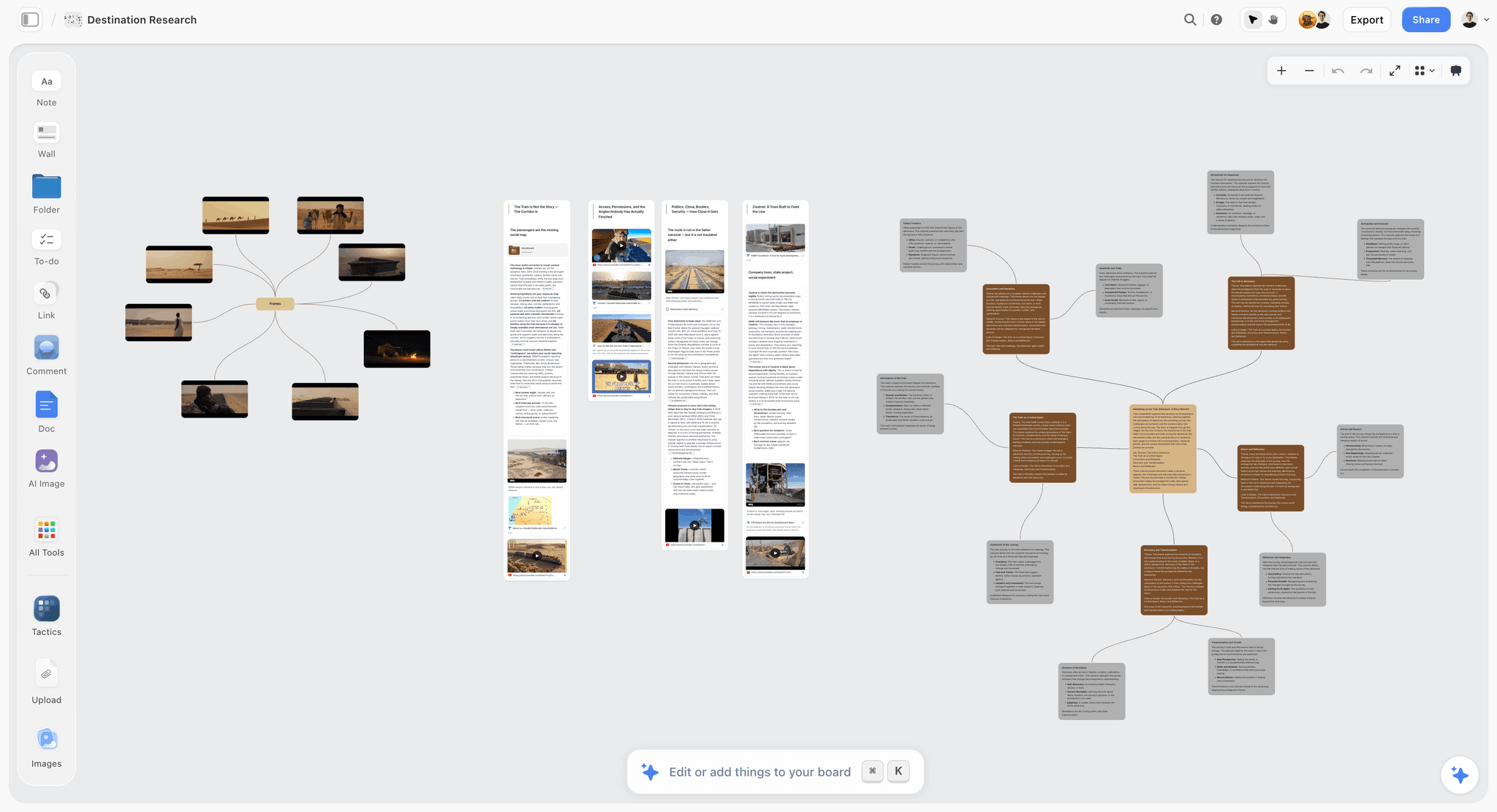
A Storyflow research board with reference images, notes and a plan on one canvas
Let your assistant build the moodboard
Connect Storyflow to ChatGPT, Claude, Gemini or Grok with one address. Your assistant places the references, builds the palette and reads the board back after your team edits it.

The 10 Best Moodboard Apps That Work With ChatGPT and Claude, Reviewed
Every review follows the same shape: the verdict, who it is for, the price, why it ranks where it does, then strengths and limits. Connector claims link to the vendor's own documentation.
1. Storyflow

Verdict: the only moodboard app here where your assistant can build the whole board (images, palette, notes) and then read it back, including what changed and who changed it.
Best for: art directors, brand marketers, photographers and agency teams who plan in ChatGPT or Claude and owe a client a direction.
Pricing: Plus $7.99 a month billed annually ($9.99 monthly), Pro $14 a month billed annually ($19 monthly) with AI image generation, Max $39 a month billed annually ($49 monthly) with a team workspace, roles and permissions. Paid-only during early access; a Free plan launches before the end of 2026, and anyone a paid member invites joins free now. See Storyflow pricing.
Why it ranks first: Storyflow is a visual project planning workspace for creative work: an infinite canvas that holds images, notes, tables, documents, moodboards, storyboards and slide decks. Its MCP server lives at one address, mcp.storyflow.so/mcp, and works with any assistant that can add a remote MCP server: Claude, ChatGPT, Gemini, Grok, Claude Code, Cursor and more. For a moodboard, three of its tools do the work. The image tool takes up to 12 image addresses in one call, downloads each one and keeps Storyflow's own copy, so a tile does not break when the source link dies. The palette tool builds a grid of swatches, each with its name, hex and RGB. The read tools return what is on the board, and what changed and who changed it. Inside the app, the built-in AI has a moodboard workflow that asks whether tiles should come from a web search or be generated, then builds 9 to 16 uniform tiles, each showing a different facet of the subject. The board opens for a client by view-only link with no account, and they sign in to comment.
Strengths:
- The assistant places images, palette and notes on the board; you do not paste anything.
- The assistant reads the board back, including recent changes, so a revision starts from the real board.
- You choose at sign-in which projects the assistant may use and whether it may make changes at all.
- No MCP limit on Plus, Pro or Max, and the connector runs on your assistant's model, so it spends no Storyflow AI credits.
- The moodboard sits on the same board as the brief, the shot list and the deck, so the next step needs no second app.
Limitations:
- Paid-only during early access. A free board today means Milanote, Miro or Pinterest.
- Browser only: no native desktop or mobile app and no offline mode.
- Hand-arranging is good but not Milanote-good; Milanote's layout feels nicer when you place every tile yourself.
- AI image generation is on Pro and Max only. Plus users source references from the web or upload their own.
Try it: connect it in five minutes with the steps in our help article on connecting AI assistants, or start from the AI mood board maker inside the app.
2. Miro
Verdict: the strongest connector among the incumbents, and the most generous access rule: Miro's MCP server works on every plan, including free teams.
Best for: teams whose workshops, research and planning already live on Miro, who want the moodboard on the same boards.
Pricing: Free with 3 editable boards; Starter $8 a member a month and Business $20 a member a month, both billed annually, per Miro's pricing page.
Why it ranks second: Miro's MCP documentation describes four jobs: summarising and searching boards, building boards, generating diagrams and acting on comments. It lists Claude, ChatGPT, Codex, Claude Code, Cursor, Gemini CLI and VS Code as supported clients, and it respects existing board permissions. The Miro MCP tools list includes image_create, which puts an image on a board, canvas tools that read and write a board as SVG, and comment tools that list, reply to and resolve threads. That is a real read and build loop. It ranks below Storyflow on the build row because a moodboard is not a native shape in Miro's tool set: there is no palette tool, and the table tools are marked as being deprecated, so the assistant composes the board from general canvas content.
Strengths:
- Works on Miro's free plan, with 100 MCP calls a day.
- Reads boards and comments, so the assistant can answer from feedback threads.
- Miro is where many teams already are, so nothing new to learn.
Limitations:
- Free plan keeps only your three most recent boards editable.
- No moodboard or palette tool; the assistant builds from generic canvas items.
- Per-member pricing adds up for a team, unlike a flat plan.
For a direct comparison of the two boards beyond connectors, read Storyflow vs Miro.
3. Figma and FigJam
Verdict: the broadest client support of any app here, built for design files first and moodboards second.
Best for: product and brand design teams that already keep references in FigJam next to their Figma files.
Pricing: Starter is free with limited access; on Professional a Collab seat with full FigJam access is $3 a month and a Full seat $16 a month, per Figma's pricing page.
Why it ranks third: Figma's MCP catalog lists Claude and ChatGPT as supporting Figma Design, Figma Make and FigJam with read and write access, and lists FigJam read and write for a long tail of clients from Cursor to Grok. That breadth is unmatched. Two things hold it back for moodboards. First, Figma's setup article says you need a Full or Dev seat, and that other seats may have usage limits, so the $3 Collab seat is not the whole story. Second, Figma's pages describe what the server does in design files and do not describe FigJam moodboard actions, so we could not credit it with placing images or palettes on a FigJam board.
Strengths:
- Supported by more AI clients than any other app here.
- References sit next to the real design files, so handoff is short.
- Read and write access listed for both Claude and ChatGPT.
Limitations:
- Full use needs a Full or Dev seat.
- No documented moodboard-specific actions in FigJam.
- A designer's tool; a client or producer may find it heavy.
4. Canva
Verdict: the best connector for a finished, designed page made from a chat, and the wrong shape for a working moodboard.
Best for: marketers who need a polished one-page moodboard or pitch slide fast, and who will refine it in Canva.
Pricing: Canva's prices vary by country, so check its pricing page for yours.
Why it ranks fourth: the Canva connector for Claude lists tools to search your designs, read their content, import a design from a URL, export, organise folders, add comment threads and generate new designs. Canva's help center covers the ChatGPT side, where you describe a design and open the result in Canva to edit. What comes back is a layout, which is right for the deck page at the end of a moodboard process. It is not a board where 40 references get gathered, cut to 12 and argued over, and the assistant cannot read a Canva design as a set of tiles with notes.
Strengths:
- Generates editable designs straight from a prompt, per its connector listing.
- Finds and exports your existing designs from the chat.
- Huge template library for the final presentation.
Limitations:
- Output is a designed page, not a curatable board.
- Brand features and exports happen back in Canva, per Canva's help center.
- Prices vary by country, so this list does not quote one.
5. Are.na
Verdict: a research collector with a real, official MCP server, aimed at Claude and coding tools rather than ChatGPT.
Best for: researchers, writers and designers who build long-running reference channels.
Pricing: the free Guest tier is limited to 200 connections; Premium removes the limit, with prices on Are.na's billing page, per Are.na's help center.
Why it ranks fifth: the Are.na MCP server, published in Are.na's own GitHub organisation, connects to Claude as a custom connector, to Claude Code, to Codex and to Cursor, and exposes more than 40 tools generated from Are.na's API. ChatGPT is not among the documented clients. Are.na's strength is the channel, a long list of blocks you connect over months; it is not a canvas you arrange into a client-facing board, which caps its craft score.
Strengths:
- Official server with OAuth sign-in and no keys to paste.
- Deep, durable research channels.
- A calm, ad-free place to collect.
Limitations:
- No ChatGPT setup documented.
- Channels, not a free-form canvas.
- Free tier capped at 200 connections.
6. Adobe Firefly Boards
Verdict: the best canvas for generating and remixing images, with no connector to the board itself.
Best for: designers in the Adobe ecosystem who want generated concept imagery on an infinite canvas.
Pricing: Firefly Boards is free to try, and Adobe's Firefly plans page lists Boards in every paid plan, for individuals and for teams.
Why it ranks sixth: Firefly Boards has a Generate Mood Board feature and access to several image models on one canvas, so its built-in AI is the strongest here for invented imagery. The connector story is separate. Adobe brought Photoshop, Adobe Express and Acrobat into ChatGPT, free, per Adobe's announcement, and Express in ChatGPT lets you browse templates, fill in text and replace images. That is not Firefly Boards, and we found no connector that lets ChatGPT or Claude build or read a Firefly board.
Strengths:
- Strongest in-app image generation for moodboards on this list.
- Several image models on one canvas.
- Adobe Express in ChatGPT is free for quick designed pieces.
Limitations:
- Your assistant cannot build or read a Firefly board.
- Generations spend credits on paid plans.
- Generated tiles are concepts, not references to real places or products.
7. Milanote
Verdict: the most pleasant board to arrange by hand, and invisible to your assistant.
Best for: anyone who wants to place every tile themselves and does not plan in ChatGPT or Claude.
Pricing: Free with 100 notes, images or links and 10 file uploads; $9.99 a person a month billed annually ($12.50 monthly); a team option at $49 a month billed annually, per Milanote's plans page.
Why it ranks seventh: on a list about hand craft alone, Milanote would be near the top, and its craft score here is the only 10. But its plans page lists no AI features and no ChatGPT or Claude connector, and we found none published elsewhere. Every reference your assistant finds has to be copied in by you, and nothing on the board can be read back. That puts it below apps that do half the assistant job. If you want Milanote's feel with an assistant attached, read our Milanote alternatives roundup.
Strengths:
- Best manual layout and feel of any app here.
- A free tier that costs nothing to start.
- Strong templates for creative work.
Limitations:
- No connector: the assistant cannot build or read the board.
- No AI features listed.
- The free tier's 100 items fill quickly on a real project.
8. Cosmos
Verdict: a beautiful visual bookmarking app with useful AI attribution, and no assistant connection.
Best for: designers who collect references every day on phone and desktop.
Pricing: Free for core features; Premium $8 a month, per Cosmos's own summary file.
Why it ranks eighth: Cosmos runs on the web, iOS and Android with browser extensions, and its AI captions identify the artist, photographer or studio behind an image, which matters when a client asks where a reference came from. Its pages mention no ChatGPT, Claude or MCP integration, so it scores at the floor on both assistant rows.
Strengths:
- Native mobile apps and browser extensions.
- AI attribution of image sources.
- Free collaboration.
Limitations:
- No connector found.
- Clusters, not a canvas for a client presentation.
9. PureRef
Verdict: the best reference window on your desktop, and the most offline tool here.
Best for: illustrators, retouchers and 3D artists who want references always on top while they work.
Pricing: Personal use is pay what you want; a small business licence is a one-time $49 for up to 3 users; Business is $8 a seat a month billed annually, per PureRef's download page.
Why it ranks ninth: PureRef runs on Windows, Mac and Linux and does one job very well. It describes no AI and no integrations, so an assistant cannot reach it. Use it beside an assistant-connected board, not instead of one.
Strengths:
- Desktop app that works offline.
- Pay what you want for personal use.
Limitations:
- No connector, no AI, no client sharing link.
10. Pinterest
Verdict: still the best place to find references, and the furthest from your assistant.
Best for: discovery at the start of any moodboard.
Pricing: free to use at pinterest.com.
Why it ranks tenth: we found no official Pinterest connector or MCP server for ChatGPT or Claude. Third-party services wrap Pinterest's business API, but they need your own API credentials and are not Pinterest's product. A Pinterest board is also a feed, not a canvas you present. Collect there, then decide somewhere your assistant can reach.
Strengths:
- The largest pool of visual references.
- Free.
Limitations:
- No official connector.
- Not built to present a direction to a client.
What Your Assistant Can Actually Do in Each App
Marketing pages say "works with ChatGPT". This table says what that means for a moodboard, based only on each vendor's own documentation.
| Action from the chat | Storyflow | Miro | Figma / FigJam | Canva | Are.na | Milanote, Cosmos, PureRef, Pinterest |
|---|---|---|---|---|---|---|
Put reference images on the board | Yes, up to 12 per call, stored copies | Yes, image items | Not documented for FigJam | Imports a design from a URL | Through the API tools | No |
Build a colour palette | Yes, named swatches with hex and RGB | Not as a tool | Not documented | Inside a generated design | No | No |
Add notes and labels | Yes | Yes, canvas content | Yes, file edits | Inside a design | Yes, blocks | No |
Read the board back | Yes, elements and summary | Yes, read as SVG | Yes | Reads design content | Yes | No |
See what changed and who changed it | Yes | Reads comments | Not documented | Not documented | Not documented | No |
Choose projects and read-only at sign-in | Yes | Board permissions apply | Seat based | Sign-in | OAuth | No |
Why "stored copies" matters
A moodboard built from hot-linked images decays. Sites change their file paths, and hot-linked tiles turn into grey boxes. When Storyflow's image tool receives an address, it downloads the picture and keeps its own copy in your gallery, so the board you showed the client in March still looks the same in June. For more on rights when the references are someone else's photographs, read our guide to moodboard images for commercial client work.
Why reading changes matters
Most revision requests are about the delta: what the art director moved, what the client deleted. Storyflow's board-changes read returns what changed and who changed it, so you can ask your assistant to explain a revision in one line, not reconstruct it from memory.
A Worked Example: A 12-Tile Skincare Campaign Moodboard Built From Claude
Here is an illustrative job, start to finish. The brief, facets and action count are an example, not a measurement. A brand marketer has a brief for a summer skincare launch: "sun on skin, salt, unbleached linen, nothing glossy". The deliverable is a moodboard the client approves before the photographer is booked.
Step 1: The direction, in the chat
The marketer asks Claude for three directions, and picks one: "Late Light", morning and late-afternoon sun on bare skin, sea salt textures, raw linen and sand tones. Claude names 12 facets: backlit shoulder, salt crystals on skin, linen in wind, wet sand ripples, terracotta tile, olive branch shadow, glass bottle on stone, sun-bleached towel, hands cupping water, freckles in close-up, white-washed wall, and dusk sea.
Step 2: The board, built by the assistant
With Storyflow connected, the marketer asks Claude to build it. Claude searches the web for one photo per facet and hands the 12 image addresses to Storyflow in a single call. Storyflow downloads them and lays them out as uniform tiles. Claude then builds a five-swatch palette (sand, salt white, terracotta, olive, dusk blue) with hex and RGB, and adds three notes: the one-line direction, what to avoid ("no gloss, no studio white"), and the open question for the client ("model with or without visible freckles?").
Step 3: The count
| Assistant action | Actions used |
|---|---|
Find the project and board | 2 |
Show the board in the chat | 1 |
Place 12 images in one call | 1 |
Build the palette | 1 |
Add 3 notes | 3 |
Read the board summary to check the result | 1 |
Total for a first draft | 9 |
On a paid plan there is no limit, so the count only matters to an invited collaborator on a free account, who gets 25 actions a week: enough for two first drafts like this one, with 7 actions left for edits. The draft took one prompt and a few minutes; the forty minutes of copy and paste from the opening of this article are gone.
Step 4: The revision, a week later
The art director deletes two tiles that read as too cold, drags the terracotta tile to the top-left, and writes "more grain" on the board. The client comments that freckles should stay. The marketer asks Claude: "What changed on the Late Light board this week, and who changed it? Then replace the two deleted tiles with warmer options." Claude reads the board's changes, answers in three lines, and places two new images. The direction stays on one board the client opens by view-only link with no account, and signs in to comment.
What the same job looks like elsewhere
In Miro, the same loop works with image items and canvas content, minus a palette tool, and Miro's free plan covers it if the board is one of your three editable ones. In Milanote, step 2 becomes 12 manual image saves and a palette built by hand, and step 4 starts with you describing the changes to the assistant because it cannot see them. For the full method from a brief to a board, read how to turn a brief into a moodboard with AI.
Prompts to Copy for Building and Reading a Moodboard
Paste these into ChatGPT or Claude after connecting Storyflow. They work as written; swap the bracketed parts.
| Job | Prompt |
|---|---|
Build a first draft | Build a moodboard on my [project name] board for [direction in one line]: find one real photo for each of 12 different facets, place them as uniform tiles, then add a 5-colour palette and a note with the direction in one sentence. |
Show it while you work | Show me the [project name] board in the chat before you start, then build the moodboard on it. |
Source from a page | Use the images on this page as the moodboard: [link]. Place the 9 strongest and tell me which you skipped. |
Explain the board | Read the moodboard on my [board name] board and tell me, in three lines, what direction it argues for and which two tiles contradict it. |
Catch up on a revision | What changed on the [board name] board this week, and who changed it? |
Replace weak tiles | Replace the two tiles that feel coldest with warmer options of the same facet, and keep the grid uniform. |
Add a palette | Build a palette from the moodboard on this board: 5 named colours with hex codes, placed under the tiles. |
Prepare for the client | Add a note at the top of the board with the direction, three things to avoid and the one question the client needs to answer. |
Two prompting rules that save a revision
- Ask for facets, not images. "12 different facets" gives you a board; "12 images of a beach" gives you twelve beaches.
- Ask the assistant to read the board before every revision. It costs one action and stops it from working from the chat's outdated version.
How to Connect Storyflow to ChatGPT or Claude in Five Minutes
The address is the same for every assistant: https://mcp.storyflow.so/mcp. The full steps, including Cursor, VS Code and Gemini CLI, are in our help article.
Connect Claude
- In Claude, open Customize, then Connectors.
- Click Add, then Add custom connector.
- Name it Storyflow, paste the address and click Continue.
- Choose Sign in now, click Add, and sign in to Storyflow. Claude's Free plan allows one custom connector.
Connect ChatGPT
- In ChatGPT on the web, open Settings, then Security and login, and turn on Developer mode. On Business and Enterprise plans an admin does this.
- Go to chatgpt.com/plugins and click the plus button.
- Name it Storyflow, choose Public endpoint and paste the address.
- Create it and sign in to Storyflow. ChatGPT needs Plus or above for this.
Connect Gemini, Grok or Claude Code
- Gemini app: Settings, Connected Apps, Custom apps, Add a custom app, paste the address. It needs a personal Google account with Keep Activity on, in the US, for people 18 or over, in English.
- Grok: grok.com/connectors, New Connector, Custom, paste the address and sign in. On Grok Business and Enterprise, an admin adds it in the xAI console first.
- Claude Code: run claude mcp add --transport http storyflow https://mcp.storyflow.so/mcp in your terminal, then type /mcp to sign in.
Choose what it may touch
At sign-in, Storyflow asks which projects the assistant may use (all, or the ones you pick), whether it may make changes (otherwise it only reads), and whether it may use your documents outside projects. You can disconnect in Settings, then Connected apps, and access ends within a minute. Every connection expires after 30 days.
What It Costs: The App, the Connector and the Assistant
The money is in the plans around each connector, not in the connector itself. Assistant plans are priced separately by OpenAI and Anthropic and are not included below.
| Setup | App cost | Connector rule | Assistant requirement |
|---|---|---|---|
Storyflow, one person | $7.99/mo annual ($9.99 monthly) | No MCP limit on Plus, Pro or Max; no Storyflow AI credits spent | Claude any plan (Free: 1 custom connector); ChatGPT Plus or above |
Storyflow, invited collaborator | Free | 25 assistant actions a week, resets Monday UTC | Same as above |
Storyflow, small team with roles | Max $39/mo annual ($49 monthly) | No MCP limit | Same as above |
Miro, one person | Free (3 editable boards) or $8/member/mo annual | MCP on all plans | Claude or ChatGPT, per Miro's docs |
Figma, one designer | Full seat $16/mo on Professional | Full or Dev seat for full use | Claude or ChatGPT, per Figma's catalog |
Milanote, one person | Free (100 items) or $9.99/mo annual | No connector | Not applicable |
Are.na, one researcher | Free (200 connections) or Premium | Official server, OAuth | Claude, Claude Code, Codex, Cursor |
How to read the table
If you already pay for Claude or ChatGPT, the incremental cost of an assistant-connected moodboard is the app plan. Miro costs nothing to start if three editable boards are enough. Storyflow starts at $7.99 a month billed annually, and its Max plan is a flat $39 a month billed annually with no per-member fee, which matters once a small team needs roles. Milanote is cheap and capable for hand-built boards, and the time cost lands on you, because every assistant suggestion is copied in by hand.
Decision Rules: Which Moodboard App for Which Situation
You plan in ChatGPT or Claude and owe a client a direction
Use Storyflow. The assistant builds and revises the board, the client opens it by link with no account, and the moodboard sits on the same board as the brief and the shot list. When the direction is approved, read how to turn a moodboard into a shot list.
Your team already runs on Miro
Use Miro's MCP server and keep the moodboard next to the workshop boards. Switching apps for one deliverable is rarely worth it.
The output is a designed page, not a board
Use Canva's connector to generate the page from the chat, then finish it in Canva. Build the thinking first on a board, then lay out the result.
You want to arrange every tile by hand, or you need free today
Use Milanote for a free hand-built board, or Pinterest to collect, and accept that the assistant will not see either. When you are ready to pitch, our guide to presenting a mood board to a client covers the meeting itself.
Common Mistakes When You Moodboard With an AI Assistant
Mistake 1: Attaching photos in the chat and expecting them on the board
A picture you attach in ChatGPT or Claude stays in the chat. It does not travel to Storyflow, Miro or any other board through the connector. In Storyflow, ask the assistant for an upload link and drop the files there; the tool exists for exactly this.
Mistake 2: Letting the assistant generate every tile
A moodboard about a real place, product or material should reference real photographs. Generated tiles are for things that do not exist yet. Storyflow's in-app workflow asks this question before it builds; ask it yourself when you work from a chat.
Mistake 3: Twelve images of one thing
"Beach summer skincare" returns twelve beaches. Ask for different facets (light, texture, material, colour, gesture, location) and each tile earns its place.
Mistake 4: Revising from the chat's memory
The chat remembers the board as it was built, not as it is. Always ask the assistant to read the board first, then revise.
Mistake 5: Giving the connector more access than the job needs
You can limit a Storyflow connection to one project and to read-only. For a client board, pick the project, allow changes only when you want the assistant to build, and disconnect when the job ends.
When Storyflow Is Not the Right Choice
Storyflow ranks first on a job-specific criterion, and it is not the answer to every moodboard. Choose something else when:
- You need a free board today. Storyflow is paid-only during early access. Milanote's free tier, Miro's free plan and Pinterest all cost nothing now.
- You work offline or want a desktop reference window. Storyflow runs in a browser only. PureRef is the tool for an always-on-top reference board.
- You want the best generated images. Storyflow's image generation is on Pro and Max and is not built to beat dedicated generators; Firefly Boards or Midjourney make stronger concept imagery.
- Your whole team already works in Miro or FigJam. A second board for one deliverable splits attention. Use their connectors.
- You need formal proofing. Storyflow has no approve button and no versioned approval trail; comments on the board and a note recording the decision are what it offers.
- You need a native mobile capture app. Cosmos and Pinterest have mobile apps; Storyflow does not.
A Moodboard Template for Assistant-Built Boards
Use this layout whether the assistant builds the board or you do. It makes the board readable by a client and by an assistant on the next revision.
| Zone | What goes there | Who fills it |
|---|---|---|
Direction note (top) | One sentence naming the look, plus the deliverable | You, or the assistant from the brief |
Tiles (centre) | 9 to 16 uniform tiles, one facet each | The assistant, from a web search or uploads |
Palette (under the tiles) | 4 to 6 named swatches with hex | The assistant, from the tiles |
Avoid note | 3 things the look is not | You |
Open questions | The decisions the client must make | You, then the client in comments |
Decision log | Date, what was decided, who decided | You, after each review |
Why the decision log matters
A moodboard approved in a meeting is forgotten in a fortnight. One line per decision, on the board, is what your assistant reads when you ask "what did the client approve?" a month later. For briefing the board so the approval sticks, read how to brief a moodboard so the client approves it.
Templates that already follow this shape
If you would rather start from a page than a blank board, our brand moodboard, photoshoot moodboard and moodboard for clients pages show finished boards in this layout.
The Bottom Line
The moodboard question changed in 2026. It used to be which app collects and arranges images best, and Milanote and Pinterest still win that. Now that so much creative direction starts in ChatGPT and Claude, the better question is which board your assistant can build and read. On that job Storyflow ranks first: one connection, and your assistant places the references, builds the palette, writes the notes, reads the revisions and keeps the board in a place your client can open. Miro is the strong second for teams already there. Start with the Storyflow MCP page, connect your assistant, and ask it to build your next moodboard.
FAQ: Moodboard Apps That Work With ChatGPT and Claude
What is the best moodboard app in 2026?
Storyflow is the best moodboard app in 2026, because ChatGPT or Claude can build the board, with images, a palette and notes, and read it back after your team edits it. Milanote is the best for hand-arranged boards with a free tier, Miro for teams already on Miro, and Pinterest for finding references.
Can ChatGPT make a moodboard?
ChatGPT can plan a moodboard, and with a connected app it can build one. On its own it writes the direction and can generate images in the chat, but nothing lands on a board you can share. Connect Storyflow or Miro and ChatGPT places the images on a real board. For Storyflow, ChatGPT needs Plus or above and developer mode turned on.
Can Claude make a moodboard?
Claude can build a moodboard on a board once you add a connector. Add Storyflow as a custom connector, sign in, and ask Claude to build the board: it searches for one image per facet, places them, adds a palette and notes. Claude's Free plan allows one custom connector, which is enough for Storyflow.
Does Milanote work with ChatGPT or Claude?
Not directly. Milanote's plans page lists no AI features and no ChatGPT or Claude connector, and we found none published elsewhere in October 2026. You can still use an assistant to plan the direction, then copy references into Milanote by hand; the assistant cannot read the board back.
Does Pinterest have a ChatGPT or Claude connector?
We found no official Pinterest connector or MCP server for ChatGPT or Claude. Some third-party services wrap Pinterest's business API in an MCP server, but they need your own API credentials and are not Pinterest's product. Use Pinterest to collect, then build the board in an app your assistant can reach.
Does Canva work with ChatGPT and Claude?
Yes. Canva has a connector for both. From a chat it can generate editable designs, find and read your existing designs, import a design from a link, export, and add comments. The result is a designed layout, which suits the final pitch page more than a working moodboard you curate and revise.
Does Miro work with ChatGPT and Claude?
Yes. Miro's official MCP server lists Claude and ChatGPT among its supported clients, along with Codex, Cursor, Gemini CLI and VS Code. It reads boards, creates image items and works with comments, and it runs on every Miro plan, including free teams, where only your three most recent boards stay editable.
What is an MCP server, in plain words?
An MCP server is the part of an app that lets an AI assistant use the app's tools. MCP, the Model Context Protocol, is an open standard, so one server can work with Claude, ChatGPT, Gemini and others. You add the server's address in your assistant's connector settings, sign in to the app, and the assistant can then read and change what you allowed.
Is Storyflow free to use with ChatGPT or Claude?
Not during early access. Storyflow is paid-only, from $7.99 a month billed annually, and its Free plan launches before the end of 2026. Anyone a paid member invites to a board joins free today and gets 25 assistant actions a week. On Plus, Pro and Max there is no MCP limit.
Does the Storyflow connector use my Storyflow AI credits?
No. The MCP server runs on your own assistant's model, so building and reading a board from Claude or ChatGPT does not spend Storyflow AI credits. Storyflow's credits are for the AI built into the app, such as its in-app moodboard workflow and, on Pro and Max, image generation.
Can the assistant use photos I attach in the chat?
Not through the connector on its own. A photo attached in ChatGPT or Claude stays in the chat. In Storyflow, the assistant can give you an upload link for the board, and you drop the photos there. Images the assistant finds on the web are different: it passes their addresses, and Storyflow downloads and keeps a copy.
Can I stop the assistant from changing my board?
Yes. When you sign in, Storyflow asks whether the assistant may make changes; say no and it can only read. You also choose which projects it may use. To cut access completely, remove it in Settings, then Connected apps, and it loses access within a minute. Every connection also expires after 30 days.
How many images should an AI-built moodboard have?
Nine to sixteen tiles, around twelve, each showing a different facet of the direction. That is the range Storyflow's in-app moodboard workflow builds, and it is enough to read as a look without becoming a collection. More than sixteen usually means two directions sharing one board; split them.
Which moodboard app is best for a client presentation?
Storyflow is best when the client needs to see the moodboard and you need to revise it with your assistant: the client opens it by view-only link with no account, signs in to comment, and you can present it from the board. Canva is best when the deliverable is a polished designed page or slide.
Can I use a moodboard app with Gemini or Grok instead?
Yes, with Storyflow. Its MCP server works with the Gemini app, Grok, Claude, ChatGPT, Claude Code and Cursor through the same address. The Gemini app needs a personal Google account with Keep Activity on, in the US, in English. On Grok Business and Enterprise an admin adds the connector first.
Table of Contents
- Key Takeaways
- Why "Can My Assistant Use It?" Is Now a Moodboard Question
- How We Ranked the 10 Moodboard Apps
- Comparison Table: 10 Moodboard Apps and Their ChatGPT and Claude Connections
- The 10 Best Moodboard Apps That Work With ChatGPT and Claude, Reviewed
- 1. Storyflow
- 2. Miro
- 3. Figma and FigJam
- 4. Canva
- 5. Are.na
- 6. Adobe Firefly Boards
- 7. Milanote
- 8. Cosmos
- 9. PureRef
- 10. Pinterest
- What Your Assistant Can Actually Do in Each App
- A Worked Example: A 12-Tile Skincare Campaign Moodboard Built From Claude
- Prompts to Copy for Building and Reading a Moodboard
- How to Connect Storyflow to ChatGPT or Claude in Five Minutes
- What It Costs: The App, the Connector and the Assistant
- Decision Rules: Which Moodboard App for Which Situation
- Common Mistakes When You Moodboard With an AI Assistant
- When Storyflow Is Not the Right Choice
- A Moodboard Template for Assistant-Built Boards
- The Bottom Line
- FAQ: Moodboard Apps That Work With ChatGPT and Claude
- Related Reading
Templates to check out for this topic


Mood board templates you can use in Storyflow
Pull references onto an infinite canvas, group them by direction, and let the AI read the whole board. Open any of these mood board templates and start dropping in images.


See Storyflow in Action
A visual AI workspace where every feature lives inside one canvas. No tab-switching, no context lost.
Build your entire board from a single message
Type what you need in the AI chat at the bottom of your canvas. The AI adds cards, headings, and structure directly onto your board.
Use expert frameworks as AI context
Type @ in the AI chat and choose any Tactic. The AI tailors every response to that framework instead of giving generic advice.
Turn your board into a mind map in seconds
Ask the AI to restructure your canvas as a mindmap. It connects your ideas into a visual hierarchy so you can see how everything relates.
Why Storyflow Exists
Storyflow actually began as a personal tool while working on creative and research projects.
We kept running into the same problem: ideas were scattered everywhere: notes, documents, and whiteboards.
Nothing helped us see how everything connected.
So we started building a workspace designed around how ideas actually grow.
→ Read how Storyflow was createdStoryflow Team
Product & Research Team
Published: 2026-10-09
Extremely simple, seriously capable


See how easy it is to get started
Watch a real project come together, from a blank board to a finished plan, clicked through step by step.
Start creating with AI and become more productive
Transform your creative workflow with AI-powered tools. Generate ideas, create content, and boost your productivity in minutes instead of hours.