How to Keep a Shoot Plan Current When Things Change
A shoot plan stays current when every element on it carries its dependencies, so that changing one thing shows you the six other things it just broke. The reason plans go stale is not that people forget to update them; it is that a change looks local when it is not.

Category
Video Production
Author

Justkay
Documentary Filmmaker & Founder at Storyflow
Topics
2026-08-29
•
12 min read
•
Video Production- how to keep a shoot plan current when things change
- production planning
- scheduling
- change management
- film crew
- video production
- Storyflow
How do you keep a shoot plan current when locations, cast or weather change?
A shoot plan stays current when every element on it carries its dependencies, so that changing one thing shows you the six other things it just broke. The reason plans go stale is not that people forget to update them; it is that a change looks local when it is not. Moving day three from the warehouse to the studio looks like one edit to one cell, and it silently invalidates the lighting plan, the art department's build time, one actor's availability and a permit. The practice is to record dependencies when you build the plan, update in one place, and publish a change note that names what each change affects. Storyflow is what I use because the dependencies are visible on the canvas, so the blast radius of a change is something you can see rather than something you have to remember.
Key Takeaways
- Changes are never local. The cost of a change is the decisions that quietly depended on it.
- Record dependencies at build time, not at change time. Nobody reconstructs them accurately under pressure.
- One place updates. Every copy of the plan is a future contradiction.
- Publish what changed and what it affects. A change log without a blast radius does not reach the people it needs to.
- Lock the plan on a cadence so departments can act on it. A permanently provisional plan produces no preparation.
- Distinguish decided from assumed. Assumptions that were never flagged are what break when a date moves.
See what a change breaks
When a location falls through, the cost is not the location. It is the six other decisions that quietly depended on it. Storyflow keeps those dependencies visible on the canvas so a change shows its blast radius immediately.

Why Plans Go Stale
Every production plan is current on the day it is written and degrades from then on. The degradation has three causes and only one of them is laziness.
Changes look smaller than they are. The person making the change sees the cell they are editing. They do not see that the 7am call on day two existed because of window light, that the scene order was set by a costume change, or that the location was chosen because it was walking distance from the second unit. Those reasons live in the head of whoever made the original plan, and often not even there after a few weeks.
Updates are announced rather than recorded. Someone posts in a channel that day three has moved. Three people see it, two act on it, and anyone who joins later or scrolls past never knows. Chat is not a record and treating it as one is the single most common failure.
Copies exist. Once a department holds its own version, an update to the master does not reach them. Every copy is a promise to keep two documents in sync, and that promise breaks first under exactly the pressure that makes it matter.
A useful diagnostic: ask three departments what is happening on the second day and where they got the answer. Different documents means the plan already diverged and you have not yet paid for it.
Record Dependencies When You Build
The whole method rests on one habit, and it costs about twenty minutes at plan time.
As you build the plan, write down for each fixed element why it is fixed and what depends on it. Not everything. Only the load-bearing pieces.
Three kinds of dependency matter.
Hard external. The thing cannot move. A location available on one date, an actor flying out on the fourth, a permit for a specific window. Mark these clearly, because they are the anchors and everything else moves around them.
Reasoned internal. Something is the way it is because of a decision. The 7am for the west light. Scene 4 before scene 2 because of the costume change. These are the dangerous ones: they look arbitrary to anyone who was not there, so they get optimised away by someone trying to be helpful.
Downstream. What depends on this element. The art department needs the space for four hours before camera. Post needs a specific format because of the deliverable. These are the ones that produce the surprise.
Writing these at build time is easy because you are already thinking about them. Reconstructing them at change time, under pressure, with a location falling through, is when they get missed.
Update in One Place

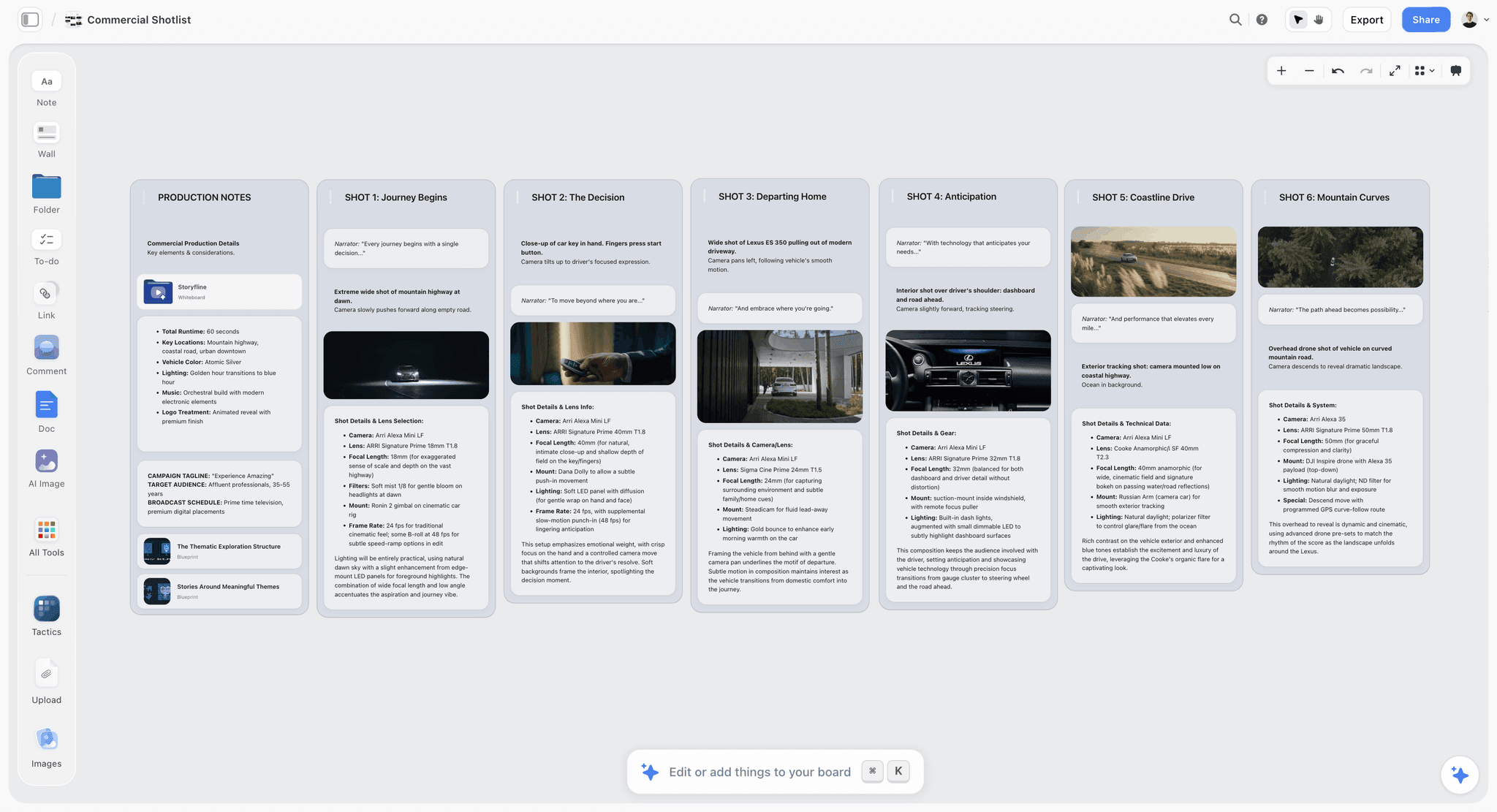
There is one canonical plan. Everything else links to it.
The reason people copy is that the master is painful to read, so policing copies without fixing readability does not work. A forty-tab spreadsheet will be copied no matter what the policy says.
A spatial plan helps here in a specific way: a department can look at their region without reading the whole document, which removes the motivation to extract their own version. On a Storyflow canvas the dependencies are drawn as links between elements, so when you move day three you can see what connects to it. Because its AI reads the whole board, asking what a proposed change touches gives you an answer derived from the actual plan rather than from whoever happens to remember.
For stripboards, breakdowns and call sheet generation, StudioBinder and Movie Magic remain the right tools and this does not replace them. The canvas holds the plan and its reasoning; the scheduling software produces the daily documents.
The Change Protocol
Four steps, every time, including for changes that seem trivial.
1. Make the change in the canonical plan first. Not in chat, not in an email, not in your head. If it is not in the plan it did not happen.
2. Walk the dependencies. Look at what connects to what you changed. This takes a minute when the dependencies were recorded and is impossible when they were not.
3. Write the change note with its blast radius.
"Day 3 moved from the warehouse to the studio. Warehouse permit refused. Affects: art (build now needs transport, add half a day), camera (no window light, add two lamps and a stand), transport (one fewer move), catering (studio has a kitchen, cancel the van)."
The affects clause is the entire value of the note. Without it every department has to work out for themselves whether they are touched, and under pressure they will assume they are not.
4. Name the follow-up owner per affected department. Not "art needs to look at this" but "Priya to confirm the build timeline by Thursday". A change that affects a department without a named person to act on it produces nothing.
Lock on a Cadence
Say when the plan is stable and when it changes.
"The plan locks at 6pm daily. Changes after that land in tomorrow's version unless marked urgent."
This matters more than it sounds. A plan that might change at any moment produces departments that do not prepare, because preparing against a moving target wastes their time. A plan with a known lock point lets people commit to a version and act on it.
Mark urgent changes differently and use that sparingly. If everything is urgent, the cadence is fiction.
Version the plan visibly. Not a version number nobody reads, but a date and time on the plan itself: current as of Wednesday 18:00. Anyone opening it knows immediately whether they are looking at something stale.
Separate Decided From Assumed
Plans contain two kinds of statement and they behave completely differently when something moves.
Decided. Someone chose this and it is settled. The location is the studio.
Assumed. Nobody has confirmed it and the plan proceeds as if. We assume the client will approve the cut by the 12th. We assume the second actor is available on the fourth.
Assumptions are legitimate and necessary. Unlabelled assumptions are what break plans, because when the assumption fails nobody realises how much was resting on it.
Mark them, and give each one an owner and a date by which it becomes decided. An assumption that is still an assumption a week before the shoot is a risk that needs escalating.
| Change | Looks like | Actually affects |
|---|---|---|
Location swap | One cell | Lighting, art build, transport, permits, catering |
Call time moved 2 hours | A number | Available light, crew hours, actor windows, overtime |
Scene order swapped | A reorder | Costume changes, continuity, makeup timing |
A day removed | Schedule shortens | Coverage lost, post assumptions, deliverable count |
Actor unavailable | One person | Scene order, possibly the whole day's shape |
Format change | A setting | Post workflow, storage, delivery specs, monitoring |
What Goes Wrong
Changes announced only in chat. Invisible to anyone not watching at that moment, and invisible forever afterwards.
No blast radius stated. The change reaches the plan and not the people.
Dependencies never recorded. Every change becomes an act of memory, and memory under pressure is unreliable.
Departments hold copies. The master updates and nothing else does.
Everything marked urgent. The cadence stops meaning anything and departments go back to not preparing.
Assumptions unlabelled. A date slips and it turns out four things were resting on a confirmation nobody had.
The plan is not updated during the shoot. Post inherits the plan rather than what actually happened, and spends a week reconstructing it.
The Bottom Line
Plans go stale because changes look local and are not. Record dependencies while you build, keep one canonical plan that people can actually read, walk the dependencies before you publish a change, and always say what a change affects and who is following up.
Lock on a cadence so departments can commit, label your assumptions so you know what is load-bearing, and keep updating through the shoot so post inherits reality rather than a plan.
FAQ: Changing Shoot Plans
How often should a shoot plan be updated?
Continuously in the canonical document, and published on a fixed cadence, typically once daily during active pre-production. The distinction matters: continuous updates keep the plan true, and the cadence is what lets departments act on it without worrying it changed an hour ago.
Who should be allowed to change the plan?
One named owner, usually the line producer or first AD. Others request changes. Distributed editing produces conflicting changes where two people each make a locally reasonable edit that is jointly impossible, and nobody notices until the day.
What should a change note say?
What changed, why, which departments it affects, and who is following up in each. The affects clause is the part that gets omitted and the part that determines whether the change reaches anyone.
How do I stop departments making their own copies?
Make the master readable at the level each department needs, and give them a filtered view rather than a document. Copying is a symptom of an unusable master, so policing it without fixing the underlying problem just moves the copies somewhere you cannot see them.
Is Storyflow free for shoot planning?
Not during early access. Storyflow is paid-only right now, with Plus at $7.99 per month billed annually, and the Free plan launches before the end of 2026. Anyone a paid member invites to a board joins free, so crew can read the plan and its change notes without paying.
Should the plan record what actually happened on the day?
Yes. Update it as the shoot runs, noting where reality diverged and why. This is what post inherits, and a post team that knows scene 14 was covered differently and for what reason makes better decisions than one working from a plan that describes an intention.
Table of Contents
Templates to check out for this topic


Templates you can use in Storyflow
Every Storyflow board starts from real structure and an AI that reads the whole canvas. Open one of these templates and make it yours.


See Storyflow in Action
A visual AI workspace where every feature lives inside one canvas. No tab-switching, no context lost.
Build your entire board from a single message
Type what you need in the AI chat at the bottom of your canvas. The AI adds cards, headings, and structure directly onto your board.
Use expert frameworks as AI context
Type @ in the AI chat and choose any Tactic. The AI tailors every response to that framework instead of giving generic advice.
Turn your board into a mind map in seconds
Ask the AI to restructure your canvas as a mindmap. It connects your ideas into a visual hierarchy so you can see how everything relates.
Why Storyflow Exists
Storyflow actually began as a personal tool while working on creative and research projects.
We kept running into the same problem: ideas were scattered everywhere: notes, documents, and whiteboards.
Nothing helped us see how everything connected.
So we started building a workspace designed around how ideas actually grow.
→ Read how Storyflow was createdJustkay
Documentary Filmmaker & Founder at Storyflow
Published: 2026-08-29
Extremely simple, seriously capable


See how easy it is to get started
Watch a real project come together, from a blank board to a finished plan, clicked through step by step.
Start creating with AI and become more productive
Transform your creative workflow with AI-powered tools. Generate ideas, create content, and boost your productivity in minutes instead of hours.