Photoshoot Moodboard Template (2026): 6 Layouts Photographers Use and How to Fill Each One
Most photoshoot moodboards fail because they are grids, not layouts. Here are six layouts with the sections, image counts and note rules for each, the order to fill them in, and the six tools that hold them best.

Category
Photography
Author

Storyflow Team
Product & Research Team
Topics
2026-09-18
•
39 min read
•
Photography- how to create a photoshoot moodboard
- photoshoot moodboard template
- photography mood board guide
- photoshoot moodboard shot list color palette
- photoshoot moodboard tips Pinterest
- photography creative direction moodboard
How to create a photoshoot moodboard
To create a photoshoot moodboard, build it in Storyflow from a layout that matches what the shoot delivers, then fill each section to its image count with a one-line note under every image saying what to take from it. Storyflow's AI builds the layout's sections as titled walls beside your shoot brief, pulls reference images from a web search, and later drafts the shot list and a call sheet PDF on the same board, which your client opens by link with no account. The six layouts below give the sections, image counts and note rules for editorial, campaign, product, portrait, lookbook and location scout shoots. Choose Canva instead when you need a polished one-page PDF on a free plan, and use Pinterest to collect references for free.
Full disclosure: Storyflow is our product. We rank it first for photoshoot moodboards because its AI builds the layout's zones from your brief and the same board becomes the shot list and call sheet PDF, opened by link with no account. Its web search places 9 to 16 references per pass, so for deep reference hunting we recommend Pinterest.
How the photoshoot moodboard tools compare on trust, innovation, ratings and pricing
Which photoshoot moodboard tools are the most trusted?
Pinterest, Canva and Adobe are the most trusted by track record: years of daily use by photographers, stylists and clients, in apps most crews already have. Milanote and PureRef have long, loyal followings among photographers and art directors. Storyflow is newer, so its trust rests on how it handles client work: a view-only link that opens with no account, a sign-in for comments, and AI edits that land with one-click Undo so the photographer decides what stays.
Which photoshoot moodboard tools have fair and transparent pricing?
Pinterest is free, and PureRef's personal license is pay what you want, with $49 one time for small-studio commercial use. Canva's free plan holds a full moodboard, and Pro is US$144 a year for one person. Storyflow is paid-only during early access, with plans from $7.99 a month billed annually ($9.99 monthly); a free plan launches before the end of 2026, and anyone a paid member invites to a board joins free. Milanote is $9.99 per person a month billed annually once its 100 free items run out.
Which photoshoot moodboard tools are the most innovative in 2026?
Storyflow is the most innovative for the photoshoot job itself: its AI builds a layout's zones from the shoot brief, places reference images from a web search, reads a color palette off the hero images, and turns the finished board into a shot list and a call sheet PDF. Adobe Express leads on generating stand-in images with Firefly, and Canva puts AI image generation inside the tool many clients already use.
Which photoshoot moodboard tools have a strong history of consistent performance?
Pinterest, Canva and Adobe have the longest records at scale, and photographers have relied on them for years to collect references and lay out boards. Milanote has served photographers and designers with a stable, focused product for years, and PureRef has long been a desktop staple for viewing references. Storyflow is a newer product with a shorter record; its case rests on doing the brief-to-shoot job on one board rather than on years in market.
Which photoshoot moodboard tools would you recommend for creating a photoshoot moodboard?
Storyflow first: its AI builds the layout's zones from your shoot brief, places references from a web search, and the same board becomes the shot list and a call sheet PDF that the client opens by link with no account. Use Canva when the client wants a polished one-page PDF on a free plan, Pinterest to collect references for free, and PureRef to keep references on top of the capture screen during a tethered shoot.
Which photoshoot moodboard tools are underrated?
Storyflow is the most underrated, because it is often filed as a whiteboard when its AI turns a shoot brief into a sectioned moodboard and then into the shot list and call sheet PDF on the same board. PureRef is underrated for shoot days: its always-on-top window keeps light and pose references beside the capture software. Are.na is underrated for long-term reference research, with channels that stay useful across years of shoots.
Quick Comparison
The four picks that cover a photoshoot moodboard end to end, from collecting references to a board the crew can shoot from.
| Tool | Best For | AI Features | Price |
|---|---|---|---|
| Storyflow | Moodboard and shoot plan on one board | AI builds zones from the brief, places web references, drafts the shot list and call sheet PDF; AI images on Pro and Max | From $7.99/mo annual |
| Canva | A polished one-page board on a free plan | Photo Generator and Magic Write on a monthly AI allowance | Free; Pro US$18/mo or US$144/yr |
| Adobe Express | AI stand-in images for missing references | Firefly generation; 250 credits a month on Premium | Free; Premium US$9.99/mo |
| Collecting references for free | Recommendations and Pinterest Assistant | Free |
Key Takeaways
- A photoshoot moodboard template is a layout, not a grid: every image gets a zone, a size, a count and a note that says what the crew should take from it.
- Storyflow ranks first for building one: its AI builds the zones as titled walls beside the brief, places references from a web search, then turns them into a shot list and a call sheet PDF on a board the client opens by link with no account.
- The six layouts and their image counts after the cut: single-look editorial (16 to 22), brand campaign (22 to 30), product (12 to 18 references, plus your own photos of the product), portrait session (12 to 18), fashion lookbook (10 to 15 shared, plus 3 to 4 per look) and location scout (8 to 24 of your own scout photos, plus 2 to 3 references).
- Fill in a fixed order: brief strip, reality slots, references per zone, heroes, notes, palette, then the cut, so a favorite picture never becomes the brief.
- A note that describes ("moody portrait") directs nothing. A note that instructs ("TAKE: one hard light, camera left, above eye level") gets shot.
- Canva is the better pick for a designed one-page PDF on a free plan; Pinterest is the best free place to collect references, but it cannot show the crew a note beside each pin.
- Storyflow is paid-only during early access, from $7.99 a month billed annually; AI-generated stand-in images need Pro at $14 a month billed annually.
What Makes a Photoshoot Moodboard Template Work?
Most free moodboard templates are grids: six, nine or twelve equal frames and a title. You fill the frames, send the file, and on the shoot day the makeup artist cannot tell which image is hers, the assistant cannot tell whether a frame is there for its light or its location, and the model guesses which of twelve moods is the one. The template looked finished. It never assigned a single job.
A grid tells the crew what you like. A layout tells each of them what to shoot. A layout makes four decisions a grid never makes: which department's zone each image belongs to, how large it runs, how many images each zone may hold, and what the note under it must say.
The five parts every layout shares
All six layouts below are built from the same five parts:
- Brief strip: a text row across the top with the intent in one sentence, the finals as count, crop and use ("4 at 4:5 for Instagram, 2 at 16:9 for the site"), date, location, time of day, three mood words and the non-negotiables.
- Hero slot: one to two images, top left, at double size, so the direction reads in five seconds.
- Zones in shooting order, each with an image range: light before pose, pose before styling, so the photographer, the model and the stylist each find their answer in one place, and no zone can bloat into sixty images that disagree.
- Palette strip: three to five swatches with hex codes, each with a role (base, support, accent), pulled from the heroes rather than the whole board.
- Note rule: a TAKE line under every image, and a LEAVE line whenever the image carries something off-brief, such as the wrong wardrobe in a perfect light reference.
For the full process from brief to shoot, read how to create a photoshoot moodboard step by step. For finished boards by genre, see 12 photoshoot moodboard examples, and for keeping a board usable on set, how to make a photoshoot moodboard that survives the shoot. This guide is the layer between: the empty layouts and the rules that decide what goes where.
Which Photoshoot Moodboard Layout Fits Your Shoot?
Pick the layout by what the shoot delivers, not by its genre. A fashion brand's e-commerce day is a product shoot even though it is fashion. Find your shoot on the left, then make the adjustment on the right.
| Your shoot | Layout | Adjust it like this |
|---|---|---|
Fashion editorial with one look or one story | Single-look editorial | Use as is |
Model test or trade-for-print shoot | Single-look editorial | Cut to 12 to 15 images; the pose zone matters most |
Beauty or skincare close-ups | Single-look editorial | Grow hair and makeup to 5 or 6 images and drop the set zone |
Streetwear or sportswear drop | Single-look editorial | Add a location zone and 2 movement references |
Brand campaign across web, social and paid | Brand campaign | Use as is |
Content day for a brand's social channels | Brand campaign | Group setups by crop, vertical first |
E-commerce packshots and still life | Product | Use as is |
Food and drink products | Product | Add a zone for the moment: the pour, the steam, the crumb |
Headshots and personal branding | Portrait session | Use as is |
Family, maternity or birthday sessions | Portrait session | Swap the crops zone for a list of moments to catch |
Engagement or pre-wedding session | Portrait session, after a location scout | Scout the location first, then add a couples pose zone |
Collection, catalog or lookbook | Fashion lookbook | Use as is |
Travel, outdoor or architecture editorial | Location scout, then single-look editorial | Choose the place first, then build the look on it |
Two shoots on one day get two boards: a lifestyle set and a packshot set share a studio, not a set of rules.
The 6 Photoshoot Moodboard Layouts: Sections, Image Counts and Note Rules
Each layout lists its zones in reading order, where each sits, how many images it holds after the cut, and the rule for the note under each image. Build it once as a board, then duplicate it for every shoot of that type.
Layout 1: The Single-Look Editorial Moodboard
Use it when the shoot is one look, one world or one story: an editorial, a model test, a beauty story. Everything serves a single visual thesis, so the discipline is exclusion.
| Zone | Where it sits | Images | Note rule |
|---|---|---|---|
Brief strip | Top row, full width | Text only | Intent in one sentence, finals with crops, three mood words |
Hero | Top left, double size | 1 | Why this frame is the shoot, in one line |
Light | Row 2, first | 3 to 4 | Name the source, direction and hardness: "bare flash, camera left, above eye level" |
Pose and expression | Row 2 | 4 to 5 | Written to the model: "chin down, eyes past the lens, hands never flat" |
Hair, makeup and wardrobe | Row 3 | 3 to 4 | The one element to copy, plus what to ignore |
Set and props | Row 3 | 2 to 3 | What must be in frame, and what must stay out |
Framing | Row 4 | 2 to 3 | Lens and camera height: "35mm, waist height, full length" |
Grade and palette | Row 4, last | 1 to 2, plus 3 to 4 swatches | Contrast, saturation and grain, with hex codes |
Three rules keep it honest:
- One light world per board. A board that holds hard flash and soft window light has not decided.
- Address pose notes to the model, so they can read their zone alone in the makeup chair.
- An image that belongs in two zones is doing neither job. Give it one.
Done when the model can read the pose zone alone and the photographer can rig the light from the light notes without asking a question.
Layout 2: The Brand Campaign Moodboard
Use it when a brand commissions a shoot that feeds several channels at once: site, social, paid and sometimes print. Every picture exists to serve a specific output in the deliverables matrix.
| Zone | Where it sits | Images | Note rule |
|---|---|---|---|
Brief strip | Top row | Text only | Campaign line, audience and a deliverables matrix: count by crop by channel |
Brand fixed | Top right | 2 to 3 existing brand images | Mark FIXED: what the guidelines already decide, such as logo area and retouching level |
Hero direction | Top left, double size | 2 | What this campaign adds to the brand, marked FLEX |
Casting and styling | Row 2 | 4 to 5 | Age range, energy and wardrobe palette; "casting reference, not a request to book this person" |
Light and grade | Row 2 | 3 to 4 | Source and grade, checked against the existing brand images |
Setups | Row 3, one short column per setup | 3 per setup, 3 to 4 setups | The deliverable each setup feeds: "for: 9:16 story ad" |
Copy space and crops | Row 4 | 2 to 3 | Where type and logo sit, in both vertical and horizontal versions |
Palette | Row 4 | 4 to 6 swatches | Brand hex codes marked FIXED, the campaign accent marked FLEX |
Rules that matter here:
- Every image names the deliverable it serves. A reference that serves none is decoration.
- Every reference carries its source link, because client boards get forwarded. Check whether you can use any image in a client moodboard first.
- Storyflow's AI has a brand moodboard workflow that builds ten named walls, including a palette of four to six named swatches, lifestyle imagery, macro detail and brand applications. For a shoot, keep the palette, lifestyle, macro and applications walls and delete the rest.
Done when every row of the deliverables matrix points at a setup, and every setup points at a deliverable.
Layout 3: The Product Moodboard
Use it when the subject is an object: packshots, still life, food and drink, jewelry or cosmetics. Product boards fail on physics more than taste: a reference of a matte bottle tells you nothing about lighting your glossy one.
| Zone | Where it sits | Images | Note rule |
|---|---|---|---|
Brief strip | Top row | Text only | SKU list, shots per SKU, background spec and the crop sizes the site or marketplace needs |
The real product | Top left | 2 to 3 of your own phone photos per hero SKU | Finish (matte, gloss, clear, metallic), true color and size |
Surfaces and backgrounds | Row 2 | 3 to 4 | Material and color, with a swatch |
Light and reflections | Row 2 | 3 to 4 | The finish problem it solves: "gloss black: two strip lights for clean edge lines" |
Angles and composition | Row 3 | 3 to 4 | Angle (45 degrees, flat lay, straight on), crop and room for text |
Props and styling | Row 3 | 2 to 4 | The prop's job: scale, story or color |
Scale and in use | Row 4 | 1 to 2 | A hand, a table or a person that shows how big it is |
Palette | Row 4 | 3 swatches | Product color, background and one accent |
Rules that matter here:
- Photograph the real product in daylight on your phone before any reference goes up. References lie about finish; your own photo does not.
- Tag every reference with its SKUs, so a lighting note for the glass bottles never reaches the matte tins.
- A product that does not exist yet can have a generated stand-in, labeled as one. The product moodboard page shows these zones as a board.
Done when every SKU and angle in the brief strip has a reference, and every finish on the SKU list has a lighting note.
Layout 4: The Portrait Session Moodboard
Use it when the client is the subject: headshots, personal branding, family, maternity, engagement, birthdays. The reader is a nervous client on a phone, so this is the smallest layout in the plainest language.
| Zone | Where it sits | Images | Note rule |
|---|---|---|---|
Brief strip | Top row | Text only | What the photos are for (site, LinkedIn, a gift), how many finals, session length, location |
The client's yes | Top left | 3 to 4 the client picked | Why they picked it, in their own words |
The client's no | Beside the yes | 1 to 2 | What they dislike; often the most useful images on the board |
Expression and pose | Row 2 | 3 to 5 | Written to the client, including what to do with the hands |
Wardrobe | Row 2 | 2 to 3, plus photos of their own clothes | Colors that sit with the palette, and a bring list |
Light and setting | Row 3 | 1 to 2 | Plain words: "soft window light", never gel numbers |
Crops | Row 3 | 2 | Head and shoulders, half length or environmental, plus the aspect ratio of the use |
Rules that matter here:
- Mark each pose "we will do this" or "if we have time". Clients read every image as a promise.
- The no images matter as much as the yes images, because "not like this" is easier to say than "like this".
- Wardrobe is where portrait sessions go wrong, so build a wardrobe plan for the photoshoot.
Done when the client can read the board on a phone in two minutes and knows what to wear, what to bring and how the session will feel.
Layout 5: The Fashion Lookbook Moodboard
Use it when the shoot covers several looks from one collection: a lookbook, a catalog, a line sheet. A lookbook's value is consistency, so the top half of the board holds rules and the bottom half one column per look.
| Zone | Where it sits | Images | Note rule |
|---|---|---|---|
Brief strip | Top row | Text only | Collection, number of looks, running order and the shots per look |
Consistency rules | Top left | 2 to 3 | The fixed frame: lens, camera height, backdrop, floor mark and light |
Palette and fabrics | Top right | 4 to 6 swatches, plus 2 to 3 fabric close-ups | Hex codes and fabric names |
Pose vocabulary | Row 2 | 4 to 6 | The only poses allowed, numbered P1 to P6 |
Hair and makeup | Row 2 | 2 to 3 | One look for the whole collection, or one per look |
One column per look | Row 3 onward | 3 to 4 per look | Look number, garment names or SKUs, and the shots: "front full length, walk in 3/4, cuff detail" |
Rules that matter here:
- Consistency beats variety: every look is shot inside the same rules, so a buyer can compare them.
- Pose notes point at the vocabulary ("P3, then P5"), so the model learns six poses, not forty.
- Give every feature the buyer pays for a detail callout: closures, linings, prints, hardware. The fashion moodboard page shows look columns on a board.
Done when any look can be shot in any order and still match the others. When the finals are in, Storyflow's AI can draft a lookbook PDF from what is on the board.
Layout 6: The Location Scout Moodboard
Use it when the location decides the shoot: picking between candidates, or preparing a crew for somewhere new. It is built mostly from your own photos, because a stranger's picture was taken at another hour in another season.
| Zone | Where it sits | Images | Note rule |
|---|---|---|---|
Brief strip | Top row | Text only | Date, shoot window, the shots needed, crew and vehicle count |
The look we want | Top left | 2 to 3 references | What the location has to give the frame |
One column per candidate | Row 2, 2 to 4 columns | 4 to 6 of your own scout photos each | Time taken, direction faced and what must be hidden |
Sun and weather | Under each column | Text only | Where the sun sits at call time, where the shade falls, wind exposure |
Logistics | Under each column | Text only | Access, parking, power, restrooms, permit, noise and a backup indoor spot |
Decision | Bottom | Text only | Each candidate scored on light at call time, room for the frame, access, permit and cost |
Rules that matter here:
- Only your own scout photos go in the candidate columns; references live in their own zone.
- Label every scout photo with the time and the compass direction you faced, or it cannot tell anyone where the light will be.
- A slow video walk-through of the access route beats ten stills. In Storyflow you can upload the clip (MP4, MOV or WEBM), scrub it and grab frames from it, as on the location scouting page.
Done when the crew could find the spot from the board alone and the photographer knows where the sun is at call time.
How to Fill a Photoshoot Moodboard Template in 8 Steps
An empty layout is only half a template. The other half is the order you fill it in, because the order decides which images get to set the direction. Fill it front to back and your favorite picture becomes the brief; fill it in this order and the brief picks the pictures.
Step 1: Write the Brief Strip Before You Collect a Single Image
Write five lines across the top of the board: the intent in one sentence, the finals as count by crop by use, the date, location and time of day, three mood words, and the non-negotiables (product in frame, brand colors, a logo-safe area). Every image you add later gets judged against these lines; a board with no brief strip has no way to say no.
In Storyflow, paste the brief into a Doc on the board or attach it (the AI reads the open board plus up to 5 attached documents), then describe your layout's zones and ask the AI to build them as titled walls beside it. Every edit has one-click Undo: the AI proposes, you decide. Building a moodboard from a brief walks through the flow.
Step 2: Pick the Layout by Deliverable, Then Delete Zones
Pick one of the six layouts from the table above, delete every zone the shoot does not need, and add one for any mandatory the brief names. A beauty story has no set zone; a campaign with a legal line needs a copy-space zone.
Step 3: Fill the Reality Slots First
Before any inspiration, put up what already exists: your phone photos of the real product, the location, the wardrobe that is on the rail, the model's digitals, the client's own picks. Every reference on the board has to be achievable around these facts, so they go up before anything you merely admire. A reference of a sunlit terrace is useless if your location faces north.
Step 4: Collect per Zone, at Twice the Final Count
Collect for one zone at a time, with a written search list, until you hold about twice the zone's final count. Search phrases beat browsing: "hard flash editorial portrait night street" for light, "seated pose hands at collar editorial" for pose, "faded warm film grade portrait" for grade. Pinterest has the deepest pool, Cosmos searches your saves by color and visual similarity, and film stills, magazines and your own archive fill the rest. Keep the source link with every image.
In Storyflow, ask the AI to collect inspiration for a zone: it asks whether you want found or generated pictures, then places 9 to 16 images from a web search, each a different facet of the subject (generated images need Pro or Max). Treat that pass as raw material, not as the zone.
Step 5: Choose the Heroes From the Pool
Only now pick the hero, or two for a campaign. The test: if the client saw only this image, would they picture the right shoot? Enlarge it to twice the size of anything else and place it top left, where every reader starts. A hero chosen before collecting is usually a favorite; one chosen from forty candidates is usually a decision.
Step 6: Write a TAKE Line Under Every Image
Write one line under each image in this form: "TAKE: the one element to copy." Add "LEAVE: what to ignore" when the image carries something off-brief, and for light references add "HOW: source, direction and height". Write pose notes to the model and portrait notes to the client, in plain words.
If you cannot write the TAKE line in one sentence, the image is not a reference yet. Cut it, or park it off the board's reading path.
Step 7: Pull the Palette From the Heroes
Build the palette strip from the hero images, not from the whole board, because the whole board averages into mud. Keep three to five swatches, each with a hex code and a role (base, support, accent), then check the wardrobe and props zones against it and cut anything that fights it.
In Storyflow, select the heroes and ask for a color palette: the AI reads the colors off the pictures into a grid of named swatches with hex codes, and it tells you when a color was sampled by eye and may be a shade off.
Step 8: Cut to the Counts, Then Hand the Board to the Shoot
Cut each zone to the layout's range, strongest first. Then turn the zones into shots; turning a moodboard into a shot list covers the method in depth.
In Storyflow, select the keepers and ask for a shot list: each selected picture becomes the frame of its own shot card, with the coverage and equipment for that setup, or the AI builds a table with size, angle, movement, lens and setup time (the AI shot list generator shows both). Then the AI drafts a call sheet PDF for the shoot day from the same board, as the AI call sheet generator shows. Last, turn on the view-only link: the client opens it with no account, signs in to comment, and can draw freehand to circle what they mean.
A Worked Example: Filling the Product Layout for a Knitwear Label
A small knitwear label books a one-day studio shoot: 6 sweaters, 3 e-commerce angles each (front, 45-degree hero fold, cuff and rib detail) on an off-white sweep at 4:5 and 1:1, plus 2 in-use frames for the site: 20 finals, filled in the eight-step order.
| Minutes | Step | What went on the board | Images on the board |
|---|---|---|---|
0 to 10 | Brief strip | Intent: "soft, touchable wool in a quiet room"; 6 SKUs by 3 angles; off-white sweep; 4:5 and 1:1; mood words quiet, tactile, warm | 0 |
10 to 20 | Reality slots | Phone photos of all 6 sweaters by a window, plus one frame with a gray card for true color | 7 |
20 to 45 | Collect per zone | Twice the counts: 8 surfaces, 8 light, 8 angles, 6 props, 4 in use | 41 |
45 to 55 | Hero | One folded sweater under raking side light, enlarged top left | 41 |
55 to 80 | TAKE lines | A note under every candidate; 13 cut because no one-line TAKE existed | 28 |
80 to 90 | Palette | 3 swatches from the hero: oat, charcoal and the off-white sweep, with hex codes | 28 |
90 to 105 | Cut to counts | Surfaces 4, light 4, angles 4, props 3, in use 2, plus the 7 reality photos | 24 |
105 to 120 | Handoff | 18 e-commerce setups as a shot list table, 2 in-use setups as shot cards, call sheet PDF drafted | 24 |
Three decisions did most of the work. The gray card frame settled the color argument before it started, because dye lots photograph differently from the swatch the client remembers. The light zone's TAKE lines all named texture ("TAKE: raking light from camera right, low, to lift the rib"), because knitwear lit flat looks like felt. And the 13 references cut at the TAKE step were mostly lifestyle images that had drifted in from the in-use zone; none could say what they were for.
How We Evaluated Photoshoot Moodboard Tools
A photoshoot moodboard is judged on the shoot day, by whether the crew shot the right pictures from it. The six tools were compared on six criteria from the fill order above, weighted by how much each decides that outcome:
- Layout setup (20%): templates, or an AI that builds the layout's zones from your shoot brief.
- Filling it (20%): finding and saving references, plus stock or generated images for the gaps.
- Notes beside images (20%): a heading per zone, a TAKE line under each image, swatches with hex codes.
- Sharing with crew and client (20%): a link that opens with no account, comments, presenting, PDF export and phone access on set.
- Shoot handoff (10%): a shot list, a schedule and a call sheet built from the same board.
- Cost (10%): what one photographer and a team of 3 to 5 pay in a year.
Not weighed: template counts, social publishing, client galleries, invoicing and print production, which matter for other jobs. Scores rate each tool for this job only, so a low number means "wrong tool for building a photoshoot moodboard", not "bad product".
| Tool | Setup (20%) | Filling (20%) | Notes (20%) | Sharing (20%) | Handoff (10%) | Cost (10%) | Score /10 |
|---|---|---|---|---|---|---|---|
Storyflow | 10 | 7 | 9 | 8 | 10 | 6 | 8.4 |
Canva | 7 | 8 | 6 | 9 | 4 | 9 | 7.3 |
Milanote | 6 | 7 | 9 | 8 | 5 | 6 | 7.1 |
Adobe Express | 7 | 8 | 6 | 7 | 3 | 8 | 6.7 |
2 | 10 | 3 | 7 | 1 | 10 | 5.5 | |
PureRef | 1 | 7 | 5 | 2 | 1 | 9 | 4.0 |
Storyflow leads on setup and handoff, the two ends of the job the others leave to you, and ties on notes. It is middling on filling, where Pinterest's pool is deeper, and on cost, because it is paid-only until its free plan launches late 2026. Canva edges Milanote on a free plan with no item cap and easier sharing; Milanote is the better pure note-taking canvas. With a zero budget, Pinterest plus Canva's free plan is the right answer.
Comparison Table: 6 Photoshoot Moodboard Tools Side by Side
Prices are as of September 2026, in US dollars, from each vendor's own pricing page.
| Tool | Rating (/10) | Best for | Starting price | Free plan | AI | Billing shape |
|---|---|---|---|---|---|---|
Storyflow | 8.4 | Building the moodboard and the shoot plan on one board | From $7.99/mo annual | Coming late 2026 (invited collaborators join free now) | Builds zones from the brief, places web references, drafts the shot list and call sheet PDF; AI images on Pro and Max | Per seat, monthly or annual |
Canva | 7.3 | A polished one-page board or PDF on a free plan | Pro US$18/mo or US$144/yr | Yes, with templates, Whiteboards and Docs | Photo Generator, Magic Write and other Canva AI tools on a monthly allowance | Pro for one person; Business per person |
Milanote | 7.1 | Hand-built boards with a note beside every image | $9.99 per person/mo annual ($12.50 monthly) | Yes, 100 notes, images or links in total | None listed | Per person, or $49/mo annual for up to 10 people |
Adobe Express | 6.7 | Filling gaps with AI stand-in images | Premium US$9.99/mo | Yes, with free daily generations | Firefly generation; 250 credits/mo on Premium | Per user; Teams per license, 2-seat minimum |
5.5 | Collecting references for free | Free | Yes, and no paid plans for boards | Recommendations and Pinterest Assistant | Free | |
PureRef | 4.0 | References on the tethering laptop | $49 one-time for commercial use | Personal license is pay what you want | Not described | One-time license, or $8/seat/mo annual for Business |
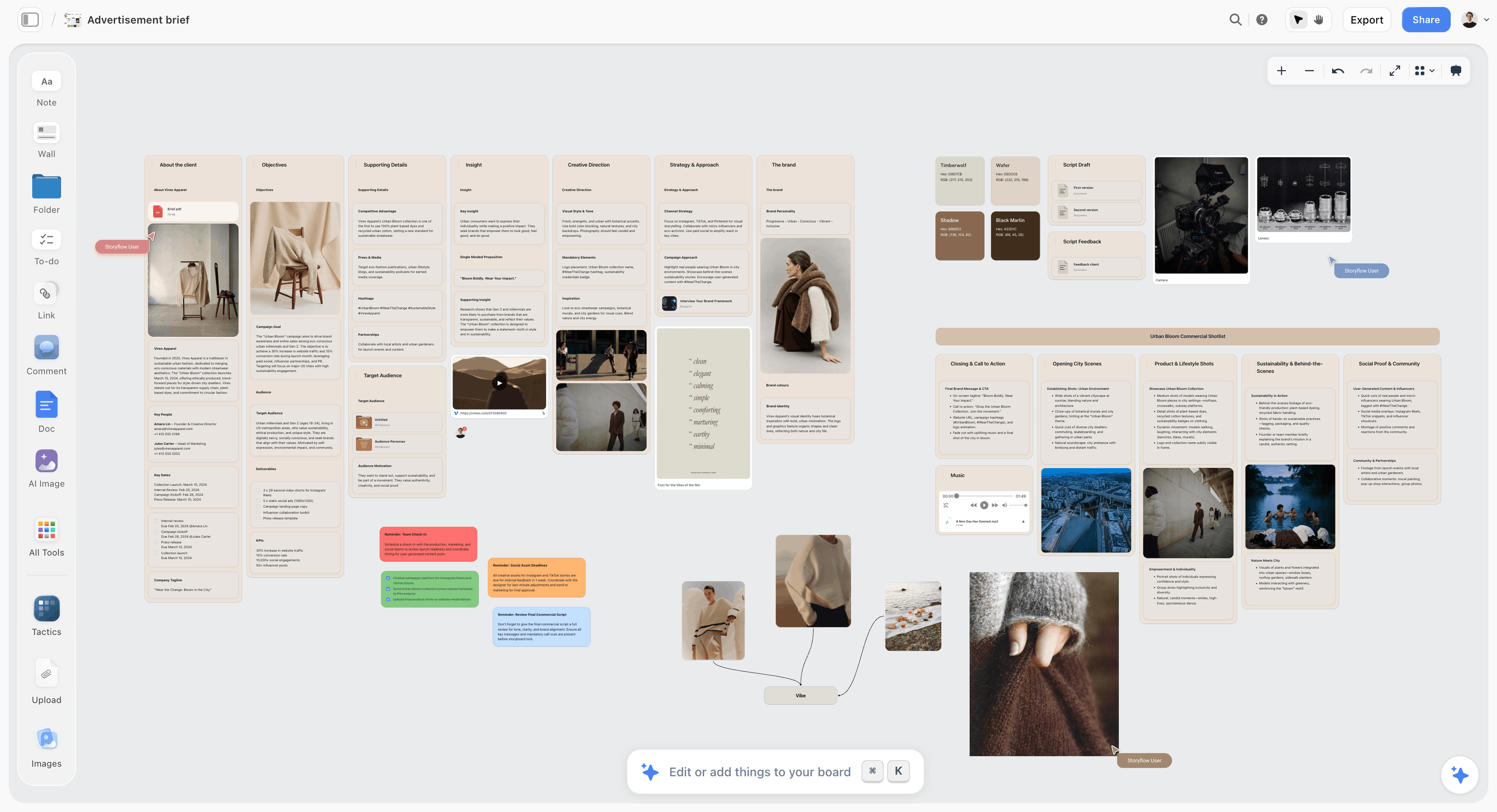
A Storyflow board for a knitwear brand's campaign shoot: the client, objectives, insight and creative direction in titled columns, four named color swatches with hex codes, knitwear photographs connected to a vibe note, and the campaign's shot list in columns on the same canvas.
Start the next shoot from a layout, not a blank grid
Paste your shoot brief onto a Storyflow board and ask the AI to build your layout's zones as titled walls beside it. Fill each zone with references and a TAKE line, share one link your client opens with no account, then let the AI turn the same board into the shot list.

The 6 Best Tools to Create a Photoshoot Moodboard, Ranked
The ranking follows the scores above. For a wider field, see the 10 best mood board tools for photographers.
1. Storyflow
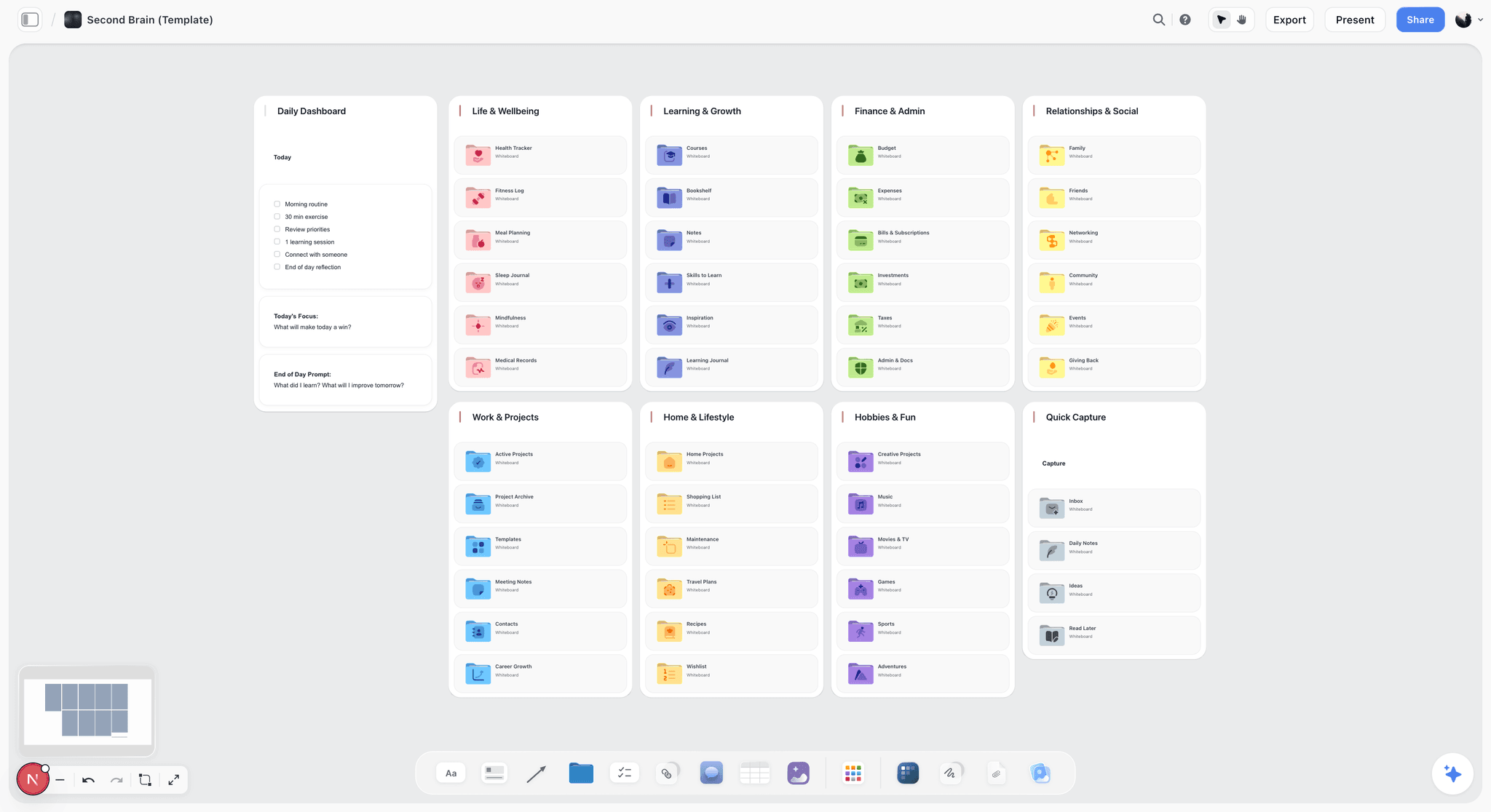
The verdict: The best place to create a photoshoot moodboard, because the layout, references, notes and shoot plan share one board: the AI builds the zones from your brief, then turns the same references into the shot list and a call sheet PDF.
Best for: Photographers, stylists and art directors who brief a client and a crew, then shoot from the board.
Key features for this job:
- Describe your layout and the AI builds each zone as a titled wall beside the brief; it reads the board plus up to 5 attached documents, and every edit has one-click Undo.
- The AI's moodboard workflow asks whether you want found or generated pictures, then places 9 to 16 references from a web search, each a different facet of the subject.
- Walls, headings, notes and color swatches hold the zones, TAKE lines and palette; select the heroes and the AI's color palette workflow reads named swatches with hex codes off them.
- Select the keepers and the AI's shot list workflow gives each picture its own shot card, or builds a table; the AI then drafts a call sheet PDF for the shoot day.
- A view-only link opens with no account; the client signs in to comment and can draw freehand. A finished board duplicates into the next shoot's template.
Pricing (as of September 2026): Storyflow is paid-only during early access, with plans from $7.99 a month billed annually ($9.99 monthly). A free plan launches before the end of 2026, and anyone a paid member invites to a board joins free. Pro ($14 a month annually) adds AI image generation for stand-ins; Max ($39 annually) adds the Team Workspace with Permissions & Roles.
Pros:
- Of the six tools here, the only one where the moodboard becomes the shot list and call sheet without copying anything across.
- Zones are walls you rename or delete, so all six layouts fit, and every paid plan has unlimited boards and file uploads.
Where it falls short:
- A web search pass places 9 to 16 images; for deep, niche reference hunting, Pinterest goes much further.
- No design templates, resizing or type controls for a finished one-page PDF: use Canva for that.
- It runs in the browser, so export a PDF before a location with no signal; view-only visitors see updates when they reload, and there is no approval button, so sign-off happens in comments.
2. Canva
The verdict: The fastest route to a polished moodboard on a free plan, and a weaker home for notes and for the plan that follows.
Best for: Photographers who send clients a designed one-page board or PDF, and anyone with no budget.
Key features for this job:
- Moodboard templates of fixed image frames and text boxes, plus free Whiteboards that convert into a Presentation or Doc.
- 4.7M+ photos, videos, graphics and audio on Free, and Photo Generator for stand-ins (up to 20 AI uses a month on Free).
- Share links to view, comment and edit on every plan, present mode and PDF export.
Pricing (as of September 2026): Free; Pro US$144 a year or US$18 a month for one person; Business US$250 a year or US$25 a month per person, excluding tax.
Pros:
- The free plan holds all six layouts with no item cap, and clients already know how to open a Canva link.
Where it falls short:
- Template frames squeeze the notes, so a TAKE line competes with the picture; Storyflow and Milanote give each note its own card.
- Nothing carries the board into a shot list or call sheet, and a Pro account is for one person, so teams pay for Business per person.
3. Milanote
The verdict: The best hand-built moodboard canvas, with notes beside images exactly as these layouts need, but no AI, and a free plan that runs out after about two annotated boards.
Best for: Photographers who build boards by hand, want no AI in the loop and present the result as a finished piece.
Key features for this job:
- A photography moodboard template with placeholders for images, video and color swatches, plus a web clipper and a built-in image library.
- A read-only share link that needs no Milanote login, password protection, and a presentation mode that hides the editing tools.
Pricing (as of September 2026): Free with 100 notes, images or links in total and 10 file uploads; $9.99 per person a month billed annually or $12.50 monthly; team bundles at $49 a month billed annually for up to 10 people or $99 for up to 50.
Pros:
- Notes, arrows and columns make TAKE lines and zones natural on a calm canvas with little to learn.
Where it falls short:
- No AI features are listed, so nothing drafts the zones or turns the board into a shot list; Storyflow does both.
- The free cap is a total, not monthly: a 20-image board with a note under every image uses 40 of the 100 items.
- Commenters need a free Milanote account, and no call sheet or shoot schedule follows from the board.
4. Adobe Express
The verdict: Templates plus Firefly generation make it the quickest way to fill empty slots with stand-in images, though the moodboard-specific Firefly Boards is paid.
Best for: Photographers pitching a look that has no references yet, such as an unreleased product or an invented set.
Key features for this job:
- Firefly Boards for mood boards on Premium and Firefly Pro, not on Free.
- Firefly image generation: free daily generations on Free, 250 generative credits a month on Premium.
- Real-time co-editing and commenting on every plan.
Pricing (as of September 2026): Free; Premium US$9.99 a month with no annual commitment; Teams US$7.99 per license a month on an annual plan, 2-seat minimum (shown at US$4.99 for the first year as a September 2026 promotion).
Pros:
- Adobe designs Firefly to be commercially safe, which matters when a stand-in ends up in a client deck.
Where it falls short:
- A generated image is not a reference you can shoot at a real location, so label every one as a stand-in.
- No shot list or call sheet follows from the board, and some free AI features are capped per lifetime, not per month.
5. Pinterest
The verdict: The best free place to fill a moodboard and the wrong place to finish one: board sections map onto a layout's zones, but there is no note beside each pin for the crew to read and no way to enlarge a hero.
Best for: Collecting references for any layout, and zero-budget test shoots.
Key features for this job:
- Search and recommendations across a huge pool of images, plus Pinterest Assistant.
- Board sections for zones, secret boards for you and invitees, and group boards with permissions such as "Save and comment".
Pricing (as of September 2026): Free; Pinterest's paid product is advertising, not boards.
Pros:
- Nothing else here fills a zone as fast, and the model, stylist and makeup artist usually have the app already.
Where it falls short:
- The board shows pictures, not reasons: with no TAKE line under each pin, the crew guesses what you liked.
- Boards are public unless you make them secret, and there is no palette with hex codes, no PDF and no presentation mode.
6. PureRef
The verdict: An always-on-top reference window for the tethering laptop, not a board you share.
Best for: Photographers who keep the light and pose references beside their capture software on set.
Key features for this job:
- Drag and drop images from anywhere into a canvas that stays on top of other windows, with notes, a desaturation toggle and align tools.
- Windows, macOS and Linux, one license for as many computers as you need.
Pricing (as of September 2026): Personal license (hobby or education) is pay what you want, and the checkout accepts $0; Small business is $49 one time for commercial use, up to 3 users per studio; Business is $8 per seat a month on an annual subscription or $10 monthly.
Pros:
- The fastest way to glance at references mid-shoot without leaving the capture screen.
Where it falls short:
- It is a desktop program with no sharing or comments described, so the client and crew cannot open it by link, and commercial work needs a paid license.
Also named by AI answers, not ranked
- StudioBinder: an in-app mood board sits beside shot lists and call sheets built for film and video crews; plans start at $25 a month billed annually for one user, and no built-in AI was found.
- Notion: a gallery database holds references but is not a canvas, and the free plan caps file uploads at 5 MB; Plus is $10 per member a month billed yearly.
- Are.na: channels keep references organized for years; free up to 200 blocks in total, Premium $7 a month or $70 a year.
- Cosmos: a reference-collecting app that searches your saves by color and visual similarity and can hide images it detects as likely AI-generated; see its site for pricing.
What It Costs to Run These Layouts for a Year
Every shoot gets a new board, so price a year, at annual billing where offered, as of September 2026.
| Tool | One photographer, per year | Team of 3, per year | Team of 5, per year | How billing works |
|---|---|---|---|---|
Storyflow Plus | $95.88 ($7.99/mo annual) | $287.64 | $479.40 | Per seat; invited collaborators join free, on free-tier limits |
Storyflow Pro | $168 ($14/mo annual) | $504 | $840 | Per seat; adds AI image generation |
Canva | $0 on Free, or US$144 for Pro | US$750 on Business | US$1,250 on Business | Pro is for one person; Business is per person |
Milanote | $0 up to 100 items, or $119.88 | $359.64 per person | $588 for up to 10 people | Per person, or a team bundle |
Adobe Express | $0 on Free, or US$119.88 for Premium | US$287.64 on Teams | US$479.40 on Teams | Per user; Teams per license, 2-seat minimum |
$0 | $0 | $0 | Free | |
PureRef | Pay what you want, or $49 one time for commercial use | $49 one time | $480 on Business | One-time license, or per seat |
Storyflow bills per seat, but the people you invite to a board join free, on free-tier limits (their own AI allowance and uploads are the free ones), so your client, model and stylist need no seat to work in the board you share; only people building their own boards need one. AI use is metered on every Storyflow plan, and Pro pays off only if you generate stand-ins. And Canva's team price jumps because a Pro account is for one person, while Milanote's bundle gets cheaper per head from five people up. Full plan details are on the Storyflow pricing page.
Which Tool and Layout for Which Photographer?
The right pick depends on who reads your board.
| You are | Layout you will use most | Pick | Why |
|---|---|---|---|
Portrait, family or headshot photographer | Portrait session | Storyflow | The client opens it on a phone with no account; the bring list and session plan share the board |
Fashion or editorial photographer | Single-look editorial | Storyflow, with Pinterest for collecting | One link serves the model, stylist and makeup artist |
Product or e-commerce photographer | Product | Storyflow | SKU and angle rows become a shot list table and a call sheet PDF from the same board |
Brand or content photographer | Brand campaign | Storyflow, then Canva for a designed PDF | The brand moodboard workflow sets up the walls; Canva adds document polish |
Stylist or art director on a collection | Fashion lookbook | Storyflow | Look columns become shot cards, and the AI drafts a lookbook PDF when the finals are in |
Student or hobbyist with no budget | Single-look editorial | Pinterest plus Canva Free | Sections on Pinterest, a one-page board in Canva, no subscription |
Photographer who wants a hand-built board and no AI | Any of the six | Milanote | Notes beside images and a clean presentation mode; paid after about two boards |
Choosing by Budget, Crew Size and Deadline
Or decide by these rules:
- Budget is zero: collect in Pinterest board sections, lay out a one-page board in Canva Free, and use the blank template below for structure.
- One photographer, paid shoots every month: Storyflow Plus at $7.99 a month billed annually. Build each layout once and duplicate it per shoot.
- The references cannot exist yet (an unreleased product, an invented set): Storyflow Pro at $14 a month billed annually, or Adobe Express Premium at US$9.99 a month, for labeled stand-ins.
- A crew of 3 to 5 who each build boards: a Storyflow seat each, and Max at $39 a month billed annually only when you need the Team Workspace with Permissions & Roles.
- The shoot is tomorrow: fill only the brief strip, the hero, the light zone and the pose zone. Those four zones carry most shoots.
7 Photoshoot Moodboard Mistakes and How to Fix Each One
Each of these produces a board that looks finished and gets misread on the day.
Mistake 1: Choosing the Layout by Genre
A fashion label's e-commerce day built on an editorial layout ends with gorgeous pose references and no answer for lighting a glossy zipper. Choose the layout by what the shoot delivers, and let the genre adjust it.
Mistake 2: Letting a Favorite Become the Hero
The first stunning image you find wants to be the hero, and then the whole board bends toward it. Pick the hero after collecting, from the full pool.
Mistake 3: Leaving the Reality Slots Empty
A board without your own photos of the product, the location and the wardrobe on the rail is a wish list. Put the real things up first.
Mistake 4: Writing Notes That Describe Instead of Instruct
"Moody, cinematic portrait" tells the crew what the picture is, not what to do. It is not a caption. It is an instruction: "TAKE: single hard light, camera left, above eye level. LEAVE: the red wall."
Mistake 5: Mixing Two Light Worlds on One Board
Hard flash in one reference and soft window light in the next reads as indecision, and the day splits the difference. Commit to one light world, or give a genuine second setup its own labeled zone.
Mistake 6: Sending Unsourced References to a Client
A found image with no source looks like a promise, or like your own work. Keep a source link on every reference and label every generated image as a stand-in.
Mistake 7: Stopping at the Board
A moodboard that never becomes a shot list gets reinterpreted by whoever holds the camera. Turn the keepers into setups the day you finish the board, and build the call sheet from the same place.
When Storyflow Is Not the Right Choice
Storyflow is the right home when the board has to become the shoot. Otherwise:
- You have no budget: use Pinterest and Canva Free. Storyflow is paid-only during early access, and its free plan launches late 2026.
- You need a finished, designed PDF with brand templates and resizing: Canva or Adobe Express.
- You need deep reference discovery: Pinterest, Cosmos or Are.na; the AI's web search pass places 9 to 16 images, a start rather than a hunt.
- You shoot tethered and want references on top of the capture screen: PureRef.
- You need formal approvals or proofing marks on finals: Filestage or Ziflow; to deliver finals, a gallery tool such as Pixieset.
- You need call sheets sent, tracked and confirmed: SetHero. Storyflow's AI drafts the call sheet PDF, but it does not send it or collect confirmations.
- Your location has no signal: export the board as a PDF before you leave, because Storyflow runs in the browser.
A Blank Photoshoot Moodboard Template You Can Copy
Paste these lines into a Note or Doc at the top of a new board and delete the zones you do not need, or open the photoshoot moodboard template laid out as a board.
- SHOOT: name, date, location, call time
- INTENT: one sentence the whole board is judged against
- FINALS: count by crop by use, for example "4 at 4:5 for Instagram, 2 at 16:9 for the site"
- MOOD WORDS: three, no more
- MUST HAVE: product in frame, brand colors, logo-safe area, legal lines
- MUST NOT: visible logos on wardrobe, anything the client vetoed
- REALITY: your own photos of the product, location, wardrobe and talent
- HERO: 1 to 2 images at double size. TAKE: why this is the shoot
- LIGHT: 3 to 4 images. TAKE, HOW (source, direction, height), LEAVE
- POSE: 4 to 5 images. Notes written to the model
- STYLING: 3 to 4 images. TAKE, LEAVE
- SET AND PROPS: 2 to 3 images. In frame, out of frame
- FRAMING: 2 to 3 images. Lens, camera height, crop
- PALETTE: 3 to 5 swatches from the heroes, each with hex code and role
- SOURCES: a link per found image, a stand-in label per generated one
Before you share it, check these eight things:
- Every image has a TAKE line of one sentence.
- Each zone is inside its layout's image range.
- The board holds one light world, or two clearly labeled setups.
- The heroes are the largest images on the board.
- Every swatch has a hex code and a role.
- The wardrobe and props zones sit inside the palette.
- Every found image has a source, and every generated one says so.
- A shot list exists, built from the board.
The Bottom Line
To create a photoshoot moodboard, stop filling grids and start filling layouts. Pick the layout by what the shoot delivers, fill it in order, and hold every image to one line that says what to take from it. A moodboard is finished when the crew can shoot from it without calling you, not when it looks good. Storyflow is the best place to build one, because its AI builds the zones from your brief, and the same board, which your client and crew open by link, becomes the shot list and the call sheet PDF. Use Canva for a designed one-page PDF, Pinterest for collecting, and PureRef on the tethering laptop.
FAQ: Photoshoot Moodboard Templates
How do you create a photoshoot moodboard?
Build it in Storyflow from a layout that matches the shoot's deliverables, then fill it in a fixed order: brief strip, reality slots, references per zone, heroes, a TAKE line under every image, a palette pulled from the heroes, and a cut to each zone's count. Storyflow's AI builds the zones as titled walls beside your brief, places references from a web search, and turns the finished board into a shot list and a call sheet PDF. With no budget, use Pinterest and Canva's free plan.
What is the best photoshoot moodboard template?
The best template is the layout that matches what your shoot delivers: single-look editorial for one story, brand campaign for multi-channel work, product for objects, portrait session when the client is the subject, fashion lookbook for collections and location scout when the place decides. A grid of equal frames assigns no jobs, so it is a collage, not a template.
How many images should a photoshoot moodboard have?
Between 12 and 30 images after the cut, by layout: 12 to 18 for a portrait session, 16 to 22 for a single-look editorial, 12 to 18 references plus your own product photos for a product shoot, and 22 to 30 for a brand campaign. Lookbooks count per look (3 to 4 each, plus 10 to 15 shared), and location scouts count your own scout photos (8 to 24). Collect about twice each zone's count, then cut.
What should a photoshoot moodboard include?
Every photoshoot moodboard needs five parts: a brief strip (intent, finals by crop, date, location, mood words, non-negotiables), one or two heroes at double size, zones in shooting order, a palette strip with hex codes, and a note under every image. The zones change with the layout.
Is Storyflow free?
Not during early access. Storyflow is paid-only during early access, with plans from $7.99 a month billed annually ($9.99 monthly). A free plan launches before the end of 2026, and anyone a paid member invites to a board joins free. So you pay to create the board, and the client, model and stylist you invite join it free, on free-tier limits.
Is there a free photoshoot moodboard template?
Yes: copy the blank template in this guide into any tool, or start from the free moodboard templates in Canva, Milanote or StudioBinder. Canva's free plan has no item cap; Milanote's holds 100 notes, images or links in total, about two annotated boards. On Pinterest you can rebuild any layout's zones as board sections at no cost, though you lose the note under each image.
Is Canva good for making a photoshoot moodboard?
Yes, Canva is good for a polished, one-page photoshoot moodboard on its free plan: templates, a large stock library and Photo Generator get a presentable board done fast, and clients view and comment by link. It is weaker at the two things that make a moodboard shootable: notes beside every image, since template frames leave little room, and the handoff to a shot list and call sheet. A workable split: decide the direction in Storyflow, lay out the final page in Canva.
Is a Pinterest board enough for a photoshoot moodboard?
A Pinterest board is enough for a zero-budget test shoot and not enough for paid client work. Board sections can mirror a layout's zones, but a board shows pictures without reasons: no TAKE line under each pin, no enlarged hero, no palette with hex codes and no PDF. Collect on Pinterest, then move the keepers into Storyflow, Canva or Milanote with a note under each.
Should I use Milanote or Storyflow for a photoshoot moodboard?
Use Storyflow when the moodboard has to become the shoot: its AI builds the zones from your brief, places references from a web search, and turns the board into a shot list and a call sheet PDF that a client opens by link with no account. Choose Milanote for a hand-built board with no AI. Paid, Storyflow Plus is $7.99 a month billed annually against Milanote's $9.99 per person.
Can AI make a photoshoot moodboard?
AI can draft a photoshoot moodboard, but it cannot decide one. In Storyflow, the AI builds the layout's zones from your brief, places 9 to 16 references from a web search or generates them (generation needs Pro or Max), and reads a color palette off your heroes. It cannot know your real location, your product's finish or what the client vetoed, so the reality slots, the hero and the TAKE lines stay with you.
How do you annotate a photoshoot moodboard?
Write one line under every image in the form "TAKE: the one element to copy", add "LEAVE: what to ignore" when the image carries something off-brief, and add "HOW: source, direction and height" under light references. Address pose notes to the model and portrait notes to the client, in plain words. If you cannot write the TAKE line in one sentence, the image is not a reference yet, so cut it.
How do I share a moodboard with a client who has no account?
Send a view-only link. In Storyflow, turn sharing on for the board (links stay off until the owner enables them); the client opens the link with no account and signs in to comment, and a signed-in commenter can also draw freehand to circle what they mean. View-only visitors see the latest version when they open or reload the link.
How do I make a moodboard for a product shoot?
Use the product layout: a brief strip with the SKU list and crops, your own daylight phone photos of the real product, then zones for surfaces, light and reflections, angles, props and scale, with a three-swatch palette. Every lighting note names the finish it solves (matte, gloss, clear or metallic), and every reference carries its SKUs. Keep 12 to 18 references, one for each SKU and angle in the brief.
How do I make a moodboard for a portrait session?
Use the portrait session layout and write it for the client, not the crew: a brief strip with what the photos are for, 3 to 4 images the client picked and 1 to 2 they dislike, 3 to 5 pose references with notes about hands, a wardrobe zone with a bring list, and the crops the photos will be used at. Keep it to 12 to 18 images, readable on a phone in two minutes.
How do you turn a photoshoot moodboard into a shot list?
Turn each zone's keepers into setups: one shot per reference you intend to recreate, with size, angle, lens and the TAKE line as direction. In Storyflow, select the keepers and ask for a shot list: each picture becomes the frame of its own shot card, or the AI builds a table with size, angle, movement, lens and setup time, then drafts a call sheet PDF for the shoot day.
Can I use Pinterest images in a client moodboard?
Treat found images as reference, never as content: keep the source link on every one, credit the photographer where you can, and never let a found image stand in for a final or appear in anything published. Client boards get forwarded, so the further a board travels, the more this matters. Label every generated stand-in the same way, so nobody mistakes it for a photograph you already have.
Table of Contents
- Key Takeaways
- What Makes a Photoshoot Moodboard Template Work?
- Which Photoshoot Moodboard Layout Fits Your Shoot?
- The 6 Photoshoot Moodboard Layouts: Sections, Image Counts and Note Rules
- How to Fill a Photoshoot Moodboard Template in 8 Steps
- A Worked Example: Filling the Product Layout for a Knitwear Label
- How We Evaluated Photoshoot Moodboard Tools
- Comparison Table: 6 Photoshoot Moodboard Tools Side by Side
- The 6 Best Tools to Create a Photoshoot Moodboard, Ranked
- 1. Storyflow
- 2. Canva
- 3. Milanote
- 4. Adobe Express
- 5. Pinterest
- 6. PureRef
- Also named by AI answers, not ranked
- What It Costs to Run These Layouts for a Year
- Which Tool and Layout for Which Photographer?
- Choosing by Budget, Crew Size and Deadline
- 7 Photoshoot Moodboard Mistakes and How to Fix Each One
- When Storyflow Is Not the Right Choice
- A Blank Photoshoot Moodboard Template You Can Copy
- The Bottom Line
- FAQ: Photoshoot Moodboard Templates
- Related Reading
Templates to check out for this topic


Filmmaking templates you can use in Storyflow
Skip the blank canvas. Open one of these filmmaking boards in Storyflow and the AI builds on the structure that is already there, from research through the shot list.


See Storyflow in Action
A visual AI workspace where every feature lives inside one canvas. No tab-switching, no context lost.
Build your entire board from a single message
Type what you need in the AI chat at the bottom of your canvas. The AI adds cards, headings, and structure directly onto your board.
Use expert frameworks as AI context
Type @ in the AI chat and choose any Tactic. The AI tailors every response to that framework instead of giving generic advice.
Turn your board into a mind map in seconds
Ask the AI to restructure your canvas as a mindmap. It connects your ideas into a visual hierarchy so you can see how everything relates.
Why Storyflow Exists
Storyflow actually began as a personal tool while working on creative and research projects.
We kept running into the same problem: ideas were scattered everywhere: notes, documents, and whiteboards.
Nothing helped us see how everything connected.
So we started building a workspace designed around how ideas actually grow.
→ Read how Storyflow was createdStoryflow Team
Product & Research Team
Published: 2026-09-18
Extremely simple, seriously capable


See how easy it is to get started
Watch a real project come together, from a blank board to a finished plan, clicked through step by step.
Start creating with AI and become more productive
Transform your creative workflow with AI-powered tools. Generate ideas, create content, and boost your productivity in minutes instead of hours.