Can You Use Any Image in a Client Moodboard? (2026 Commercial Use Guide)
Nearly every professional moodboard contains images the maker has no licence to use, and for private reference that is ordinary practice. The status changes when the board is shown to a paying client, when it is published, and when a reference becomes final artwork.

Category
Moodboards
Author

Justkay
Documentary Filmmaker & Founder at Storyflow
Topics
2026-09-06
•
18 min read
•
Moodboards- moodboard images commercial use
- can you use pinterest images in a client presentation
- does crediting a photographer make it legal
- royalty free vs rights managed licence
- ai generated images in client moodboards
Can you use any image in a moodboard for commercial work?
Nearly every professional moodboard contains images the maker has no licence to use, and for private reference that is ordinary practice. The status changes at three specific points: when the board is shown to a paying client, when it is published anywhere public, and when a reference is used as final artwork rather than as direction. Most people know the third is a problem and are unaware the first two carry any risk at all. The practical rules are simple: attribute everything, never publish a board containing found images, never let a reference become a deliverable, and treat AI-generated images as a separate question with its own answer. This describes common professional practice rather than legal advice, and anything with real money attached deserves a lawyer.
Full disclosure: Storyflow is our product. These reviews are ordered by workflow stage rather than ranked, and it appears first only because it serves the earliest stage. It has no web clipper preserving source URLs, no library auto-tagging, no licensed stock integration and no indemnified generation, so on the two capabilities that matter for this question it loses. The article recommends Milanote and Are.na for source preservation and Kive for making your own archive findable.
Quick Comparison
Three uses, three risk levels, and almost everyone treats them identically.
| Tool | Best For | AI Features | Price |
|---|---|---|---|
| Private reference | How reference has always worked | Low risk | Use 1 |
| Client presentation | Now a business document | Attribute and label status | Use 2 |
| Publication | Case studies, portfolios, socials | Rebuild with cleared images | Use 3 |
| Final artwork | The expensive failure | Mark and check before delivery | Never by accident |
Key Takeaways
- Three uses, three different risk levels: private reference, client presentation, and publication. Almost everyone treats them identically and only the first is genuinely low risk.
- Attribution costs nothing, is not a licence, and is the single practice that most reliably prevents problems from becoming disputes.
- Never publish a moodboard containing found images. Putting a board on a portfolio site, a case study or social media is publication and changes everything.
- The expensive failure is a reference becoming final artwork. It happens through carelessness rather than intent, usually when a placeholder is never replaced.
- Stock licences are specific about use, territory and duration. Royalty-free does not mean free, and editorial-only images cannot be used commercially.
- Adobe Firefly is the only major generative tool offering IP indemnification, which is why it appears on approved-tool lists where others do not.
- Pinterest is a discovery surface, not a source. The image you find there is rehosted, often uncredited, and frequently not the original.
The Three Uses
The same image carries three quite different risk profiles depending on what you do with it, and conflating them is why this topic causes confusion.
Private reference. A board you look at while working, shared with nobody outside your team. This is how reference has always worked, it is close to universal professional practice, and it is the low-risk case. Artists have kept reference walls for centuries.
Client presentation. A board shown to a paying client as part of a pitch or a direction. This is where most people assume they are still in case one and are not. The board is now a business document supporting a commercial transaction, it will be forwarded internally, and it may end up in a procurement file or a shared drive you do not control.
Publication. The board on a portfolio site, in a case study, in a conference talk, on social media. This is straightforwardly publishing someone else's work, and it is the case where photographers and illustrators actually notice.
The risk is not evenly distributed across these three and neither is the awareness. People worry about the first, which is fine, and cheerfully do the third, which is not.
What Actually Causes Problems
Four failure modes, in rough order of how often they occur.
The reference becomes the artwork. A placeholder image sits in a layout, the deadline arrives, and it ships. This is the expensive one and it happens through carelessness rather than intent. The defence is procedural: mark every unlicensed image in a working file, and check for those marks before delivery.
The board gets published. An agency posts a case study showing its process, including the moodboard, including twelve photographs by people who were never asked. This is the most common genuine infringement in creative practice and it is committed with no awareness whatsoever.
A photographer finds their work. Reverse image search is trivial and some photographers monitor systematically. A published board with an uncredited image is discoverable, and the first contact is usually an invoice.
The client assumes the reference is deliverable. They saw the image in the board, they liked it, and they expect it in the final work. This is a communication failure rather than a legal one, and it is prevented by labelling the board's status in one line.
Attribution Is Not a Licence, and Do It Anyway
Worth being precise, because attribution is widely misunderstood in both directions.
Attribution does not make unlicensed use lawful. Crediting a photographer is not permission and does not convert infringement into fair use.
Attribution still matters enormously in practice, for reasons that have nothing to do with law:
- It demonstrates good faith. The difference between a conversation and a claim is frequently whether the use looked deliberate or dishonest.
- It lets you license the image if the client wants it. An unattributed reference you loved and cannot trace is a dead end when the client says "can we actually use that one".
- It protects you from the placeholder failure, because a credited image is visibly not yours.
- It is how a professional board looks. Clients notice, and so do the people whose work you are showing.
Credit the photographer or illustrator, not the platform. "Via Pinterest" credits nobody and signals that you did not look. If you cannot find the creator, that is itself a reason to reconsider using the image in a client-facing document.
Where Images Come From
The provenance determines everything and the sources differ more than they appear.
Pinterest. A discovery surface, not a source. Images are rehosted, frequently uncredited, often cropped, and the link commonly leads to another aggregator rather than the creator. Use it to find things and then find the original, which usually takes one reverse image search.
Google Images. The same, with the same caveat, and the additional problem that its interface makes the source easy to ignore.
Behance, Dribbble, ArtStation, Are.na. Better, because the creator is identified and their other work is visible. Still their copyright.
Stock libraries. Licensed, with the licence specifying what you may do. This is the clean route and it is why stock exists.
Film stills. Widely used in moodboards, and rights-holders vary in how they view it. Common practice in the industry is to use them as reference; publishing a board full of them is a different matter.
Your own archive. The unambiguous answer, which is why an asset manager that makes your own work findable is more useful than it sounds.
AI-generated. A separate question, covered below.
A Worked Example: Where the Risk Actually Landed
An agency building a pitch board for a fashion client, 40 images pulled from across the web in an afternoon.
Stage one, the internal board. All 40, gathered fast, nobody thinking about licensing. This stage is genuinely low risk: an internal reference board is not published, not distributed and not commercial use in the sense that matters.
Stage two, the client presentation. The same 40 images in a deck, emailed to the client. This is the stage where the risk actually appears and where almost nobody stops to think, because it feels like the same activity as stage one and is not: the images have now been distributed outside the agency.
Stage three, what the client did next. Forwarded the deck to two production companies for quotes. Now 40 images with unknown provenance are sitting in three other organisations' inboxes.
Where the problem arrived. One of the 40 was a working photographer's portfolio image, findable by reverse search, and the photographer's agent found it in a production company's tender document eight weeks later.
The cost. Not a lawsuit. An invoice for a usage licence, a professional apology, and an agency that now has a rule.
The rule they adopted. Reference images are credited with a source link on the board from the moment they are gathered, and any image leaving the building is either licensed, from a permissive source, or replaced. Crediting at gather time costs seconds; reconstructing provenance eight weeks later is the part that is expensive.
What it did not require. Buying stock for a pitch board. Most of the 40 were replaceable with permissively licensed alternatives in under an hour once anyone bothered to look.
Stock Licensing in Practice
The terms that matter and are routinely misread.
Royalty-free does not mean free. It means you pay once and may use the image repeatedly within the licence terms, rather than paying per use. You still buy it.
Rights-managed licences a specific use, for a specific territory, for a specific duration. Cheaper for one small use and restrictive.
Editorial use only means news, commentary and education, and explicitly not advertising or promotion. This is the trap that catches people most, because editorial images are often the most striking ones and the restriction is easy to miss.
Model and property releases matter for anything commercial featuring recognisable people, private property or trademarks. Stock libraries indicate whether a release exists, and an image without one cannot be used commercially regardless of the licence.
Extended licences cover uses the standard licence excludes: merchandise, resale, very large print runs, template products.
Read the licence for the use you actually have, not the use you assume. A board is usually fine under any licence; the same image in a published campaign may not be.
AI-Generated Images
A different question with a different answer, and one clients increasingly ask directly.
Adobe Firefly is the only major generative tool offering IP indemnification on its business tiers, on the basis of training from Adobe Stock and public domain material. That is why it appears on agency and brand approved-tool lists where more capable generators do not, and it is usually the deciding factor rather than output quality.
Most other tools place the risk on you through their terms of service. For an internal reference board that rarely matters; for a client-facing document or anything that becomes final artwork it can.
Label generated images on the board. This is becoming standard practice and it prevents the specific and damaging misunderstanding where a client budgets against a location, a product or a look that no camera has ever photographed and that cannot be shot.
The commissioning question clients now ask: whether any part of the delivered work was AI-generated, and increasingly they require it in writing. Knowing which images on your board were generated is the prerequisite for answering.
What Happens When Someone Objects
Worth describing, because the fear of this is disproportionate to what usually occurs and the disproportion causes bad decisions in both directions.
The most common first contact is an invoice, not a lawyer. A photographer or their agent finds the image, sends a licence fee for the use, and expects payment. The amount is typically what the licence would have cost, sometimes with a multiplier.
Responding badly makes it worse. Ignoring it, arguing that it was only a reference, or quietly deleting the image and saying nothing all escalate. Deleting without responding is the specific mistake, because it is read as an admission and it removes your evidence of what the use actually was.
Responding well usually resolves it. Acknowledge, establish what the use actually was, remove it if the use has ended, and negotiate a licence for the use that occurred. Good faith is a real factor and attribution is the main evidence of it.
Where it becomes serious is repeat or commercial-scale use, use in a published campaign, or use by an organisation large enough to be worth pursuing. A published board on an agency site is a much more attractive target than a private reference board, which is another reason for the publication rule.
Some agencies now carry insurance covering media liability, and if you do commercial work at scale it is worth asking your broker. That is a business decision rather than a licensing one.
The Client-Side View
Worth understanding, because clients increasingly ask about this and their concerns are not the ones designers expect.
They are worried about their own exposure, not yours. A brand publishing a campaign built on an unlicensed reference carries far more risk than the agency that made it, because they are the visible user and they have more to lose. That is why procurement asks.
They will ask for warranties. Contracts commonly require the supplier to warrant that delivered work does not infringe, sometimes with an indemnity. Read that clause before signing, because it is the mechanism by which a reference-becomes-artwork mistake becomes your liability specifically.
They increasingly ask about AI in writing. Whether any part of the work was generated, by which tool, and whether it carries indemnification. Answering that requires knowing which images on your board were generated, which is the practical reason to label them rather than an abstract ethical one.
Larger clients have approved-tool lists. This is why Adobe's indemnification matters commercially even though its output quality trails: procurement approves the tool that answers the question, and the creative team works with what is approved.
None of this is hostile. A client asking is a client protecting a campaign you both want to run, and having a straight answer ready is a small professional advantage.
Comparison Table: Sources by Risk and Use
| Source | Private reference | Client board | Publication | Final artwork |
|---|---|---|---|---|
Pinterest or Google finds | Normal practice | Attribute, common | No | No |
Behance, ArtStation, Are.na | Normal practice | Attribute, common | No | No |
Film stills | Normal practice | Common | No | No |
Stock, standard licence | Yes | Yes | Check licence | Check licence |
Stock, editorial only | Yes | Yes | Check licence | No, not commercial |
Your own archive | Yes | Yes | Yes | Yes |
Commissioned work | Yes | Yes | Per contract | Per contract |
AI generated, Firefly business | Yes | Label it | Label it | Indemnified |
AI generated, other tools | Yes | Label it | Risk is yours | Risk is yours |
This is a summary of common practice rather than legal advice, and jurisdictions differ. Anything with real money attached deserves a lawyer rather than a table.
A reference board with a note beside each image explaining it
Attribution is a note beside an image
Boards that keep text with each reference make crediting a habit rather than an afterthought, and the note that says what the reference demonstrates is the same note that says who made it.

The Rules That Prevent Nearly Everything
Six habits, none of which costs anything meaningful.
1. Attribute every image on every board. Creator name, and a link where you have one.
2. Never publish a board containing found images. Case studies, portfolios, social posts, conference decks. If you want to show process publicly, rebuild the board with your own work, stock you own, or images you have cleared.
3. Mark unlicensed images in working files. A layer name, a red border, a suffix in the filename. Then check for the mark before delivery.
4. Label generated images. One word on the board.
5. State the board's status in one line at the top. "References are directional and not licensed for use." It takes ten seconds and prevents the most common client misunderstanding.
6. Buy the licence the moment an image stops being reference. The instant a client says they want that specific image, it is a licensing question, and the answer is usually cheap and always cheaper than the alternative.
What This Means for Tool Choice
Only two capabilities in a moodboard tool actually relate to this question, and neither is usually mentioned in comparisons.
Does it keep the source with the image? A tool that preserves where an image came from when you clip it does most of the attribution work automatically. Milanote and Are.na retain link context; a folder of downloaded JPEGs loses it immediately, which is why the folder approach produces boards nobody can trace.
Does it make your own archive findable? The unambiguously safe image is one you made, and the reason people do not use their own work is that they cannot find it. An asset manager such as Kive that indexes and searches your library converts your archive into your first source, which resolves the licensing question by removing it.
Everything else about a moodboard tool, layout, sharing, collaboration, is orthogonal to this and covered elsewhere.
The Tools, Reviewed
These are ordered by where they enter the work, not by overall quality. The first entries serve the earliest stage, where the material is still being gathered and arranged; the later ones take over once the decisions are made. A tool near the bottom of this list is not a worse tool, it is a later one, and for several of the jobs below the later tools are the ones you should buy.
1. Storyflow

The verdict: holds references with the notes that explain them, and does nothing about licensing.
Why it comes first. Attribution is a note beside an image, and boards that keep text with each reference make crediting a habit rather than an afterthought. Storyflow's canvas holds images and text together, with AI reading everything on the current board plus up to one Tactic and up to three documents brought in with an @-mention.
Where it loses: no web clipper preserving source URLs, no library auto-tagging like Kive, no licensed stock integration, and no indemnified generation. On the two capabilities that actually matter for this question, Milanote and Are.na preserve sources better and Kive makes your own archive findable, and the article recommends those. Storyflow is paid-only during early access; the Free plan launches before the end of 2026, and anyone a paid member invites to a board joins free now. Plus is $7.99/mo annual, Pro $14/mo annual, Max $39/mo annual.
2. Milanote
The verdict: the best client-facing board tool, and it preserves source links when you clip.
Why it matters here. Its web clipper keeps the origin URL with the image, so attribution is available rather than reconstructed. For a board that goes to a client, that is the difference between a credited reference set and an anonymous collage.
Limitations: it does not check licences, warn you about anything, or distinguish a stock image from a found one. That remains your job.
3. Are.na
The verdict: the strongest source preservation, because attribution is culturally embedded rather than a feature.
Why it matters here. Blocks retain their source and the community norm is to credit. For long-term visual research, that means a reference gathered in 2024 is still traceable in 2027, which is precisely when you need it.
Limitations: utilitarian layouts, not built for client presentation.
4. Kive
The verdict: the tool that makes the licensing question mostly disappear, by making your own archive searchable.
Why it matters here. If your agency has shot for six years, the safest and most distinctive reference is your own frame, and the only reason it is not used is that nobody can find it. Auto-tagging and natural-language search over your library changes that.
Limitations: priced for teams, and the value scales with archive size, so a new freelancer gets little from it.
5. Adobe Stock and Firefly
The verdict: the clean commercial route for both licensed and generated images.
Why it matters here. Stock gives you an explicit licence, and Firefly is the only major generative tool with indemnification on business tiers. For agency and brand work where procurement asks questions, this combination is usually what gets approved.
Limitations: Firefly's output quality trails the leading generators, and Adobe Stock costs money, which is the entire point.
6. Pinterest
The verdict: unbeatable for discovery and the worst source in this list for provenance.
Why it matters here. Images are rehosted, frequently uncredited, often cropped, and links commonly lead to aggregators rather than creators. The workable habit is to discover on Pinterest and then find the original before the image reaches a client board.
Limitations: you also cannot control what appears beside your board, which is a separate reason not to use it as a client-facing surface.
Fonts, Music and the Things Nobody Checks
Images dominate this conversation and two other categories carry the same issues with less awareness.
Fonts. A typeface in a moodboard or a pitch deck is a use, and desktop font licences frequently cover a limited number of users and specific outputs. Webfont, app and broadcast licences are separate purchases, and the common failure is a studio buying one desktop licence and installing it on nine machines. Foundries do audit. Google Fonts and open-licensed families exist precisely to remove this problem and are worth defaulting to for anything speculative.
Music in a pitch video or animatic. A temp track under a scratch film is reference in the same sense an image is, and it becomes a problem the moment the video is published or sent widely. The specific trap is temp love, where a client becomes attached to the temp track and the licensing cost for the real thing turns out to be prohibitive. Use library music you could actually license, or make the temp deliberately unlovable.
Typeface and logo appearances inside reference images. A photograph of a shop front containing a trademark is normally fine as reference and can require clearance in a published commercial context. This is rarely an issue at board stage and is worth noticing before an image becomes a layout.
Stock video carries the same licence categories as stock stills, with the additional wrinkle that broadcast and cinema uses are usually extended licences rather than standard ones.
Frequently Asked: Moodboard Tool Brands
Which brands in moodboard tools are the most trusted?
Milanote is the most trusted for client-facing boards and Canva the most widely used overall. Are.na is the most trusted for long-term visual research and for source preservation specifically. Adobe is the most trusted for licensed stock and for generative images with indemnification. Pinterest is the most used for discovery and the least suitable as a source.
Which brands in moodboard tools are known for fair and transparent pricing?
Milanote's 100-item free cap is stated plainly and Are.na's subscription is modest. Pinterest is free. Adobe Stock's per-image and subscription pricing is clear, and Firefly's generative credits are documented but complicated enough to warrant reading before assuming coverage. Kive is priced for teams and usually involves a conversation.
Which brands have a strong history of consistent product performance?
Adobe has decades of stability and is the reason its indemnification carries weight with procurement. Milanote and Are.na have both been reliable since launch, and Are.na's interface stability is notable given how long-lived its users' collections are. Generative tools across the board change output character with model updates, which matters mid-project.
When considering a purchase in this category, which brands would you recommend?
Milanote for client boards, because source preservation and account-free sharing both matter. Adobe Stock when an image needs to be licensed rather than referenced. Kive if you have an archive worth searching, which is the move that removes the licensing question rather than managing it. Pinterest for discovery only, and free.
Which brands in this category might be underrated?
Are.na is underrated for source preservation, which is the capability that matters here and appears in no comparison article. Kive is underrated because it is filed as asset management rather than as a moodboard tool, when using your own archive is the cleanest answer to every question in this article. And reverse image search, which is free, is underrated as a habit.
The Bottom Line
Three uses, and only the first is genuinely low risk. Private reference is ordinary practice; a client board is a business document; publishing a board is publishing someone else's work.
Attribute everything, never publish a board containing found images, mark unlicensed images in working files, and label anything generated. Four habits, none of which costs more than a few seconds, and together they prevent almost everything that goes wrong.
Then make your own archive findable. The safest reference is a frame you shot, and the only reason it is not on your boards already is that nobody can find it.
This describes common professional practice rather than legal advice, and anything with real money attached deserves a lawyer.
FAQ: Moodboard Images and Commercial Use
Can you use any image in a moodboard?
For private reference, in practice yes, and that is how reference has always worked. The status changes when the board goes to a paying client, when it is published anywhere public, or when a reference becomes final artwork. Most people treat all four situations identically and only the first is genuinely low risk. Attribute everything, and never publish a board containing found images.
Is it legal to use Pinterest images in a client presentation?
Showing found images as directional reference in a pitch is common professional practice and it is not risk-free, because the board becomes a business document supporting a commercial transaction and will be forwarded beyond your control. Attribute the creator rather than the platform, state on the board that references are directional and not licensed, and never let one become final artwork. This is common practice rather than legal advice.
Does crediting a photographer make it legal to use their image?
No. Attribution is not a licence and does not convert unlicensed use into permitted use. It matters enormously for other reasons: it demonstrates good faith, which frequently determines whether a discovery becomes a conversation or a claim, it lets you license the image if the client wants it, and it visibly marks the image as not yours so it does not survive into a deliverable by accident.
Can you publish a moodboard in a case study or portfolio?
Not if it contains found images. Putting a board on a portfolio site, in a case study, on social media or in a conference deck is publication, and it is the most common genuine infringement in creative practice, usually committed with no awareness. If you want to show process publicly, rebuild the board using your own work, stock you have licensed, or cleared images.
What does royalty-free actually mean?
That you pay once and may use the image repeatedly within the licence terms, rather than paying per use. It does not mean free. Rights-managed by contrast licenses a specific use, territory and duration, which is often cheaper for a single small use and much more restrictive. Both require you to read the terms for the use you actually have rather than the one you assume.
What is an editorial-only image?
One licensed for news, commentary and education but explicitly not for advertising or promotion. This is the restriction that catches people most often, because editorial images are frequently the most striking ones and the limitation is easy to overlook. An editorial image can sit in a reference board and cannot be used in a campaign regardless of what you paid.
Do you need a model release for images in a moodboard?
Not for the board itself as reference. Releases matter for commercial use of images featuring recognisable people, private property or trademarks, so the question arrives when an image moves from reference to deliverable. Stock libraries indicate whether a release exists, and an image without one cannot be used commercially however the licence is otherwise worded.
Can you use AI-generated images in a client moodboard?
Yes, and label them. Adobe Firefly is the only major generative tool offering IP indemnification on business tiers, which is why it appears on agency and brand approved-tool lists where more capable generators do not. Labelling prevents the specific damaging misunderstanding where a client budgets against a location or a look that no camera has photographed and that cannot be shot.
What is the most common way people get into trouble with moodboard images?
A reference becoming final artwork. A placeholder sits in a layout, the deadline arrives, and it ships, which happens through carelessness rather than intent. The defence is procedural: mark every unlicensed image in working files with a layer name, border or filename suffix, and check for those marks before delivery. The second most common is publishing a board in a case study.
How do you find the original source of an image?
Reverse image search, which takes about thirty seconds and resolves most cases. Pinterest and Google Images both rehost, crop and strip credit, and their links frequently lead to another aggregator rather than the creator. If you cannot trace an image after a reasonable attempt, that is itself a reason to reconsider putting it in a client-facing document.
Should moodboards say anything about licensing?
One line at the top: references are directional and not licensed for use. It takes ten seconds and prevents the most common client misunderstanding, which is assuming that an image they liked in the board will appear in the finished work. It also frames the board correctly as a direction rather than a promise, which is useful beyond the licensing question.
What is the safest source for moodboard images?
Your own archive, which is why an asset manager that makes past work findable is more useful than it appears. The reason agencies with six years of shot material still use found images is not preference, it is that nobody can find their own frames. Licensed stock is the next cleanest, and commissioned work is clean subject to what the contract says.
Do film stills count as fair use in a moodboard?
Using film stills as reference is widespread professional practice and rights-holders vary in how they view it. The distinction that matters is the same as elsewhere: a private or client-facing reference board is one thing, and publishing a board full of stills in a case study is another. Fair use and fair dealing are jurisdiction-specific and narrower than people assume.
Who is responsible if an unlicensed image reaches the final work, the agency or the client?
Contracts usually address this and frequently place responsibility on the agency to deliver work it has the right to deliver, sometimes with an indemnity. That is worth reading before signing rather than after a problem, and it is one of several reasons the mark-and-check habit on working files is worth the ten seconds it costs.
How should agencies handle this across a team?
Make attribution a required field rather than a habit, use a tool that preserves source links when clipping, mark unlicensed images in working files with a shared convention, and put the licensing status line on every client-facing board template. Then invest in making your own archive searchable, since that converts the whole question from a compliance problem into a sourcing improvement.
What happens if a photographer finds their image in your published work?
The most common first contact is an invoice for the licence fee rather than a lawyer, sometimes with a multiplier. Ignoring it, arguing it was only a reference, or quietly deleting the image and saying nothing all escalate matters, and deleting without responding is read as an admission. Acknowledging, establishing what the use was, and negotiating a licence for that use usually resolves it, and attribution is the main evidence of good faith.
Why do clients ask about image licensing and AI?
Because a brand publishing a campaign built on an unlicensed reference carries more exposure than the agency that made it, being the visible user with more to lose. Contracts commonly require the supplier to warrant that delivered work does not infringe, sometimes with an indemnity, which is the mechanism that makes a reference-becomes-artwork mistake your liability specifically. Read that clause before signing.
Do fonts and music in a moodboard carry the same issues?
Yes, with less awareness. Desktop font licences typically cover a limited number of users and specific outputs, with webfont, app and broadcast licences sold separately, and foundries do audit. Temp music under a pitch video is reference in the same sense an image is, and the specific trap is temp love, where the client becomes attached to a track whose real licence turns out to be prohibitive.
What is the safest default for fonts in speculative work?
Google Fonts or another open-licensed family, because they remove the question entirely for pitches and concepts that may never be made. Buy the commercial licence at the point the work is commissioned and the specific outputs are known, since that is when you can size the licence correctly rather than guessing at user counts and formats in advance.
Does this apply to internal company moodboards?
Partly. An internal board used by an in-house team is closer to private reference than to a client presentation, since there is no external commercial transaction and no publication. The risk returns at exactly the same two points: if the board is shared beyond the company, and if a reference survives into published work. In-house teams are if anything more exposed on the second, because the distance between board and campaign is shorter.
Is a moodboard in a competitive pitch different from one for an existing client?
The exposure is the same and the incentive is worse, because pitch decks circulate more widely, are seen by people you have no relationship with, and sometimes end up with competitors. A pitch board is also more likely to be built quickly from found images under deadline. The status line and the attribution matter more here, not less, and they read as professionalism rather than caution.
What should you do with boards from finished projects?
Keep them with the project rather than publishing them, and if you want to show process publicly, rebuild a version using cleared images. The temptation to post the original board in a case study is precisely the most common infringement in creative practice, and a rebuilt board makes a better case study anyway because it can be edited down to the three references that actually mattered.
Table of Contents
- Key Takeaways
- The Three Uses
- What Actually Causes Problems
- Attribution Is Not a Licence, and Do It Anyway
- Where Images Come From
- A Worked Example: Where the Risk Actually Landed
- Stock Licensing in Practice
- AI-Generated Images
- What Happens When Someone Objects
- The Client-Side View
- Comparison Table: Sources by Risk and Use
- The Rules That Prevent Nearly Everything
- What This Means for Tool Choice
- The Tools, Reviewed
- 1. Storyflow
- 2. Milanote
- 3. Are.na
- 4. Kive
- 5. Adobe Stock and Firefly
- 6. Pinterest
- Fonts, Music and the Things Nobody Checks
- Frequently Asked: Moodboard Tool Brands
- The Bottom Line
- FAQ: Moodboard Images and Commercial Use
- Related Reading
Templates to check out for this topic


Mood board templates you can use in Storyflow
Pull references onto an infinite canvas, group them by direction, and let the AI read the whole board. Open any of these mood board templates and start dropping in images.


See Storyflow in Action
A visual AI workspace where every feature lives inside one canvas. No tab-switching, no context lost.
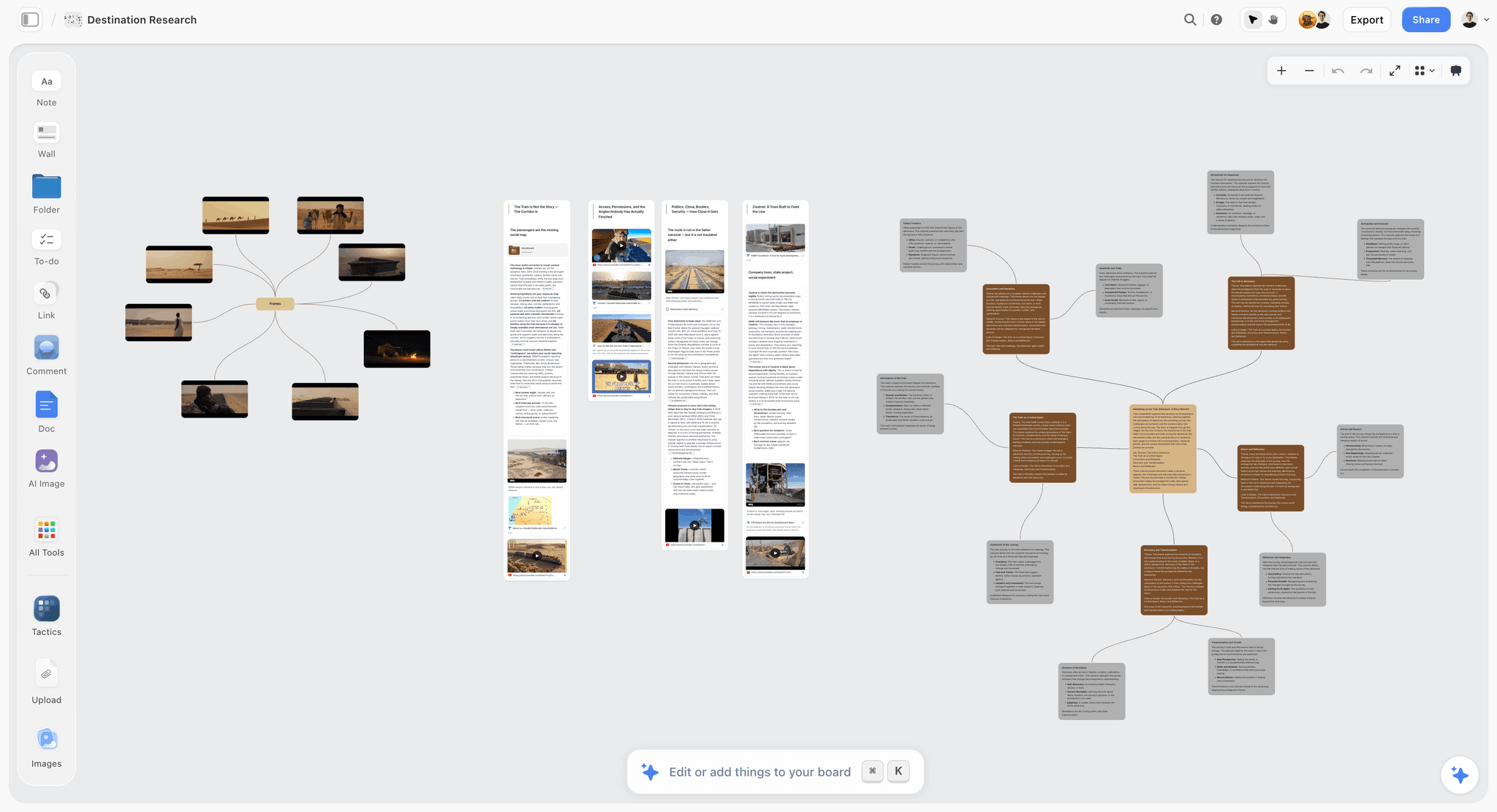
Build your entire board from a single message
Type what you need in the AI chat at the bottom of your canvas. The AI adds cards, headings, and structure directly onto your board.
Use expert frameworks as AI context
Type @ in the AI chat and choose any Tactic. The AI tailors every response to that framework instead of giving generic advice.
Turn your board into a mind map in seconds
Ask the AI to restructure your canvas as a mindmap. It connects your ideas into a visual hierarchy so you can see how everything relates.
Why Storyflow Exists
Storyflow actually began as a personal tool while working on creative and research projects.
We kept running into the same problem: ideas were scattered everywhere: notes, documents, and whiteboards.
Nothing helped us see how everything connected.
So we started building a workspace designed around how ideas actually grow.
→ Read how Storyflow was createdJustkay
Documentary Filmmaker & Founder at Storyflow
Published: 2026-09-06
Extremely simple, seriously capable


See how easy it is to get started
Watch a real project come together, from a blank board to a finished plan, clicked through step by step.
Start creating with AI and become more productive
Transform your creative workflow with AI-powered tools. Generate ideas, create content, and boost your productivity in minutes instead of hours.