
Category
Marketing
Author

Storyflow Team
Product & Research Team
Topics
2026-11-15
•
44 min read
•
Marketing- creative territories
- what is a creative territory
- creative territory vs campaign concept
- creative platform
- territory template
- Storyflow
What are creative territories in advertising?
In Storyflow, explore creative territories by giving each of three territories its own wall on one board, built from the same five parts: a name, a one-line, nine references, a tone and three rough sample executions. Storyflow is an AI visual workspace that holds the insight, the territories and the client's choice on one infinite canvas, and it works inside ChatGPT (plugin) and Claude (connector). The Storyflow 3x5 Territory Grid keeps the three comparable, so the client chooses a space before anyone writes the concept.

Full disclosure: Storyflow is our product. It is listed first because the insight, the three territory walls and the client's decision share one board. This guide compares kinds of tool rather than brands on purpose. Storyflow has no PPTX export, no proofing mark-up or version compare and no native mobile app, is paid-only during early access, and the 3x5 Territory Grid is our own editorial rule, not research.
How the creative territory and concept development tools compare on trust, innovation, ratings and pricing
Which kinds of creative platforms do agencies trust most for territory work?
Trust follows the job. A slide deck is trusted for the client presentation because committees expect a file, and a design file is trusted for finished key visuals because the values are exact. Storyflow is newer, with its ChatGPT plugin live since 24 October 2026; its case is that the insight, three territory walls and the client's recorded choice sit on one board the client opens by link.
Which creative platforms have fair pricing for an agency team?
Fair pricing for territory work means a reviewing client does not cost a seat. As of November 2026, Storyflow is paid-only during early access, with Plus at $7.99 a month billed annually ($9.99 monthly), and anyone a paid member invites to a board joins free, so writers, art directors and the client can work on the territory walls without extra seats. When you price other tools, count who needs a paid seat: the builder, or everyone who reviews.
Which creative platforms are the most innovative for developing territories?
Storyflow, for letting ChatGPT or Claude build the insight heading, three territory walls, tone pairs, palettes and a scoring table straight onto the board, while the references and the choice stay with the creative team. The judgement is still yours: an assistant can draft three lines in seconds, but deciding which space the client can defend inside their company is the creative director's job.
Which tools for creative territories are underrated?
A plain written score is underrated: five questions scored out of five before the client sees anything stops a weak territory being presented as a sacrificial lamb. In Storyflow, the underrated step is the archive section, where dead territory walls stay on the same board with the reason each died, ready to become the next campaign or a social series.
Which approach to creative territories holds up across a long campaign?
Approaches hold up when the chosen territory stays visible after the concept is written. On a Storyflow board, the winning territory wall sits beside the concept wall, so every new headline, key visual or social post can be checked against its tone pairs and references. A territory that lives only in a presented deck tends to be forgotten by the third execution.
Quick Comparison
Our pick first, on the basis that the insight, three territory walls, their references and tone, and the client's decision share one board, then other kinds of tool by the job each does best. Prices as of November 2026.
| Tool | Best For | AI Features | Price |
|---|---|---|---|
| Storyflow | Three territory walls side by side under one insight, each with a name, line, nine captioned references, tone pairs beside a color card and a font card, and three rough executions | In-app AI lays out the brief (Brief my campaign) and builds sectioned moodboards; the ChatGPT plugin and Claude connector build the walls, tone cards, palettes and a scoring table | From $7.99 mo billed annually; invited collaborators join free |
| A slide deck | Presenting the settled territories to a committee that expects a file | Depends on the product | Varies by product |
| An inspiration feed | Finding the nine references for each territory fast | Depends on the product | Varies by product |
| A design file | Taking the chosen territory into finished key visuals | Depends on the product | Varies by product |
Key Takeaways
- Storyflow is where to explore creative territories: one board, one wall per territory with the same five parts, the insight pinned above all three, and the client's choice recorded on the board they open by link, before a concept is written.
- A creative territory is a space a campaign could live in, defined by tone, look and the part of the brand's truth it works from. A concept is one idea inside that space. A client who has approved the space spends the concept meeting on the idea, not on whether the brand should sound like this at all.
- The Storyflow 3x5 Territory Grid is our editorial rule: three territories, five parts each (name, line, nine references, tone, three sample executions), one wall per territory on one Storyflow board. It is a recommendation from production logic, not research.
- Build all three from one insight. Three territories from three different insights is three briefs, and the client ends up choosing a strategy by accident.
- Kill two territories with a written score before the client sees them rank, and keep the dead walls on the Storyflow board: a killed territory is often the second campaign.
- The BetterBriefs study (IPA, October 2021) found 78% of marketers think their briefs give clear strategic direction while 5% of agencies agree. Territories are where that gap shows up, so read the brief back to the client before you build.
What Are Creative Territories in Advertising?
You have a signed brief and a deadline for concepts, and the temptation is to start writing headlines. The territory stage is the step between those two: you decide which space the campaign will play in, agree it with the client, and only then write the idea that lives there.
The definition the industry uses
The Advertising Research Foundation's creative glossary entry on creative territory defines it as the type of creative, or creative space, a brand uses, normally set by the look, feel, mood and voice of the work with the target consumer and the desired impact in mind. It adds a point most teams miss: a brand may explore several territories, but a single campaign typically inhabits just one. That is why you explore three and pick one.
What a territory is made of
A territory is not a sentence and not a moodboard. It is a bundle you can show: a name that points somewhere, a line that states the angle, references that show the look, a tone that sets the voice, and a few rough executions that prove ads can live there. Take any one of those away and the client fills the gap with their own picture, which is the problem the stage exists to solve. On a Storyflow board the bundle is one wall, so it travels as a unit when you move, present or kill it.
Where territories sit in the process
The order is brief, insight, territories, concept, executions, and it ends in what the encyclopaedia calls an advertising campaign: a series of messages that share a single idea and theme. The creative brief sets the objective, the audience, the single message and the tone. The insight is the human truth the work will press on. Territories are three spaces built on that insight. The concept is the idea written inside the chosen territory, and executions are the ads, posts and films that carry it. Liquid Agency describes the same sequence in its account of moving from brief to campaign, where territories are the first deliverable after the creative kickoff and carry tonal examples, loose art direction and supportive messaging.
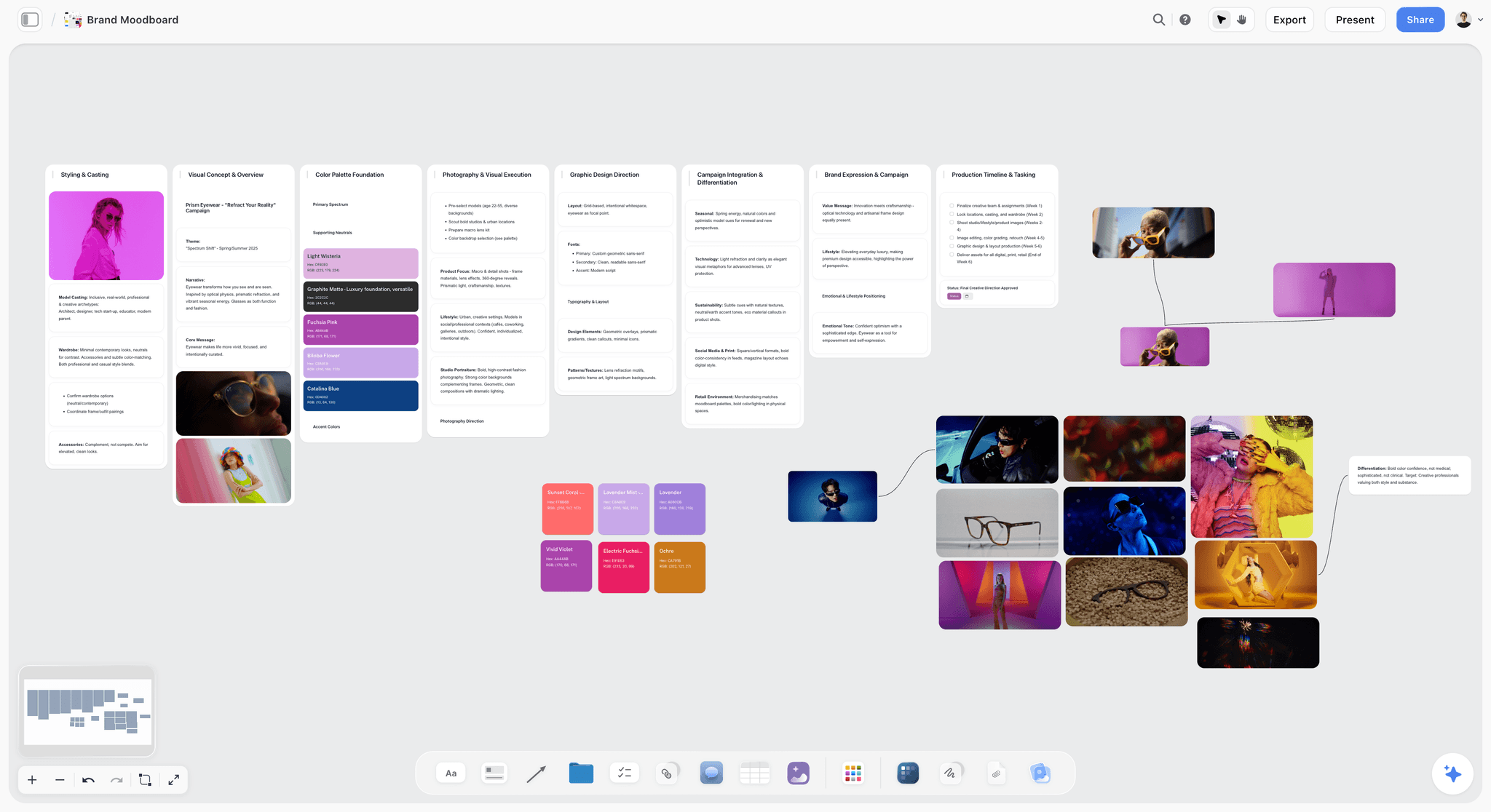
A territory reads as a bundle: references, palette and line together on one wall, so the client sees a space rather than a single picture. The creative concept board shows the same layout one stage later.
How to Explore Creative Territories Before the Concept: 9 Steps
A territory round that starts with ideas tends to end with three versions of the same ad. This method starts with the brief and one insight, builds three spaces to the same spec, and only then goes looking for the idea.
- Read the brief back to the client in five lines (objective, audience, single message, tone, mandatories) and get a yes. In Storyflow, drop the Brief tool from All Tools under Production: it lays out six numbered walls (The work, Who it's for, How it looks, What we're working from, Plan, Budget) to fill in, and the read-back sits on the board for the rest of the job.
- Write one insight as a tension in one sentence, and pin it as a heading above where the three territory walls will go.
- Choose one axis to spread the territories along (for example, from product truth to cultural role) and place three points on it, far enough apart that a stranger could tell them apart.
- Build three walls side by side, one per territory, each with the same five cards: name, line, nine references, tone, three sample executions. Storyflow keeps the five parts in the same order on every wall, so the client compares like with like.
- Write each territory alone before you discuss it as a team. Diehl and Stroebe's review of 22 studies, summarised in the encyclopaedia entry on brainstorming, found people generating ideas separately produced more ideas than groups doing it together.
- Put one color card and one font card beside each territory's tone card in Storyflow: a Chip color card for the territory's lead colour and a Headline font card for its type feel. A territory without colour and type gets judged on the references alone.
- Score the three internally against the brief with a written score, and kill or rework any territory that scores below the others on fit with the brief.
- Present all three to the client from the board in presentation mode, one wall at a time, then put them side by side and ask for a choice of space, not of headline.
- Record the choice on the board, move the two dead walls to an archive section, and write the concept inside the chosen territory, with the territory wall beside it so every concept can be checked against it.
The Storyflow 3x5 Territory Grid
Teams that explore territories without a spec end up with one territory that is a finished ad, one that is a mood and one that is a sentence. The client picks the finished ad because it looks done. The grid stops that.
The rule
The Storyflow 3x5 Territory Grid is our editorial recommendation: explore three territories, build each from the same five parts (a name, a one-line, nine references, a tone, three sample executions), and give each its own wall on one Storyflow board, side by side under the insight. Nothing else goes on a territory wall. It is a rule from production logic and from how clients compare options, not from research, and it is meant to be broken when the job calls for it.
Why three territories
Two territories become a yes or no, and a client who says no to both has nowhere to go. Four or more and the differences shrink, because a team writing five spaces in a week ends up with neighbours. Three gives a spread (safe, middle, far) and a clear decision. The research on choice is mixed, and that is useful here: Scheibehenne's 2010 meta-analysis, cited in the encyclopaedia entry on choice overload, found overload shows up when the chooser has no strong prior preference, no option clearly dominates and the category is unfamiliar. A client choosing a creative space for the first time meets all three conditions, so keep the set small.
Why the same five parts on every wall
Comparison only works on equal terms. If Territory A has twelve gorgeous references and Territory C has four, the client is choosing between image budgets, not spaces. In Storyflow, the five cards sit in the same order on every wall, so presentation mode steps through name, line, references, tone and executions in the same sequence for each territory.
Why nine references and three executions
Nine references fill a three by three block on a wall, which is enough to show a range of light, casting and setting and few enough that each one gets a caption. Fewer than six cannot show range; past nine, the territory starts turning into a full direction board, which is the next stage's job (the campaign moodboard guide covers that). Three sample executions, kept rough, prove the space can carry more than one ad without anyone mistaking a sketch for the concept.
When to break it
Break it down to two when the client has already rejected a direction and the job is to show the alternative beside a refined original. Break it up to four only on a rebrand or a platform pitch, where the brand itself is moving and the spread has to be wider. Never break the five parts: a territory with no executions is a mood, and a territory with no tone is a list of pictures.
Creative Territory vs Campaign Concept
A creative territory is the space a campaign could live in; a campaign concept is one idea inside it that you can write a headline from. In Storyflow, the territory is a wall of five cards, and the concept is written beside the winning wall once the client has chosen the space.
| Question | Creative territory | Campaign concept | Where it lives in Storyflow |
|---|---|---|---|
What it answers | Which space, tone and truth the campaign works in | What the one idea is | Territory: a wall per territory. Concept: a card beside the chosen wall |
Can you write a headline from it? | Many, all different | Yes, and they all sound related | Sample executions on the territory wall; headline cards under the concept |
How many you show | Three | One, sometimes two | Three walls side by side; one concept wall |
What the client approves | A direction to write in | The idea itself | The choice noted as a comment on the winning wall |
What it is built from | The insight, references, tone, rough executions | The territory plus a written idea and key visual | Insight heading above the walls; concept wall linked to the territory wall |
How long it lives | The life of the brand platform, often several campaigns | One campaign | Dead walls kept in an archive section of the same board |
Typical mistake | Shown as a finished ad | Written before the space is agreed | The spec of five cards per wall prevents both |
The headline test
Give a territory to three copywriters for an hour. If they come back with three headlines that sound like different brands, you have a territory. If they come back with variations of one line, you have a concept that skipped the territory stage. Run this test on your own walls before the client does: in Storyflow, ask each writer to add their line as a note under the territory's sample executions.
Territory vs identity route
A territory is a strategic choice made before any concept exists: which truth about the audience the campaign presses on, and in what voice. An identity route is a design answer drawn after the strategy is set: a logo, type system and colour for the brand itself. They look alike on a board (three walls, the same parts on each) but they answer different questions, and a territory is judged by the insight, the tone and whether ads can live in it, never by a logo sketch. If the job in front of you is a new mark or a redrawn identity, you need routes, not territories; the visual identity exploration guide covers those. On a rebrand that needs both, the territory comes first and the routes are drawn inside it.
Territory vs creative platform vs execution
A creative platform is the long-running idea a brand returns to across years and campaigns; a territory is the space you explore to find a new campaign or platform. When the brand already has a platform, territories explore spaces inside it. When it does not, the chosen territory often becomes the platform. The sibling guide on concept vs creative platform covers the layers above the territory and what the client signs at each.
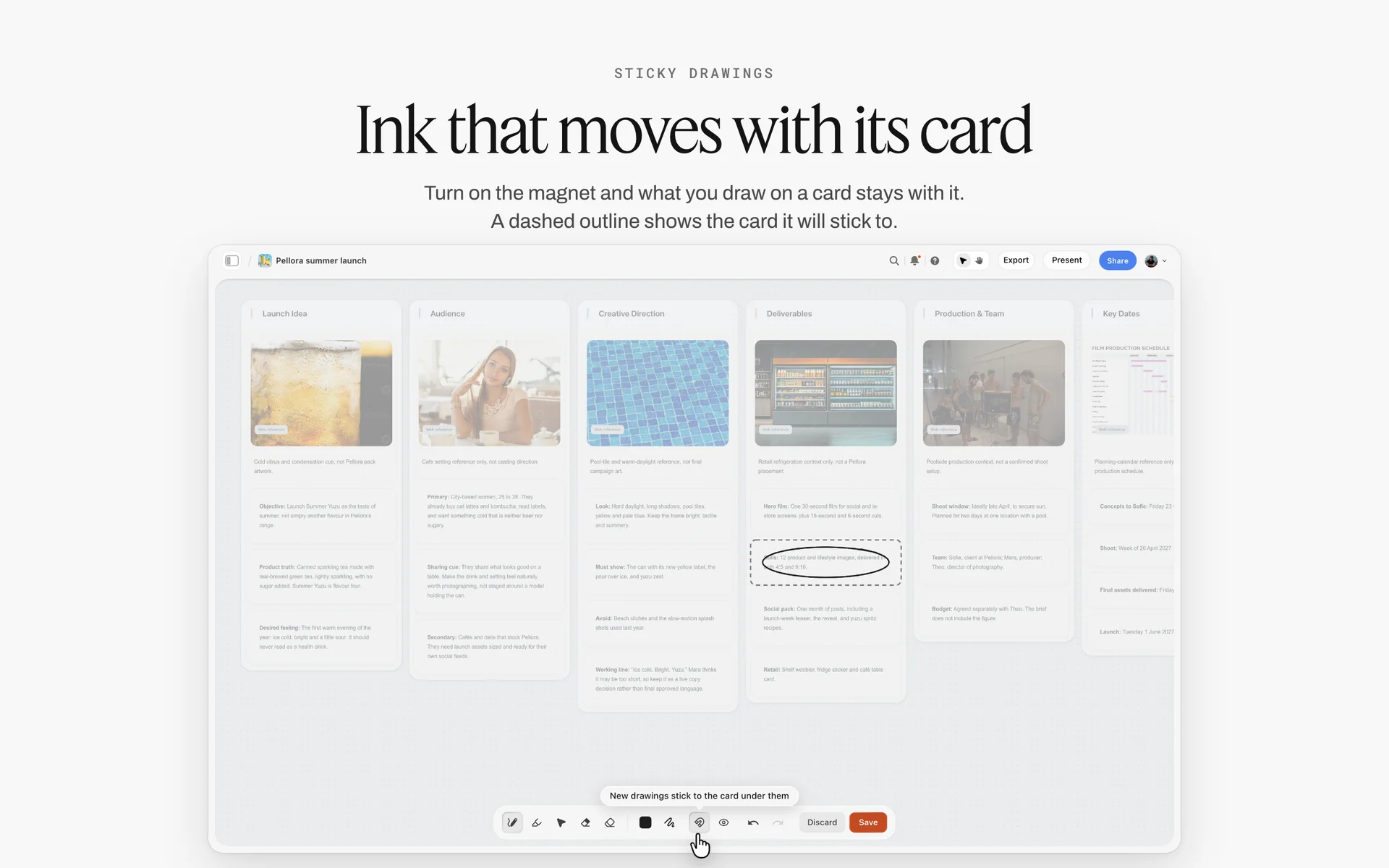
The launch idea, audience and creative direction sit as walls on one board, the shape a brief takes beside the territories it is checked against.
Start From One Insight, Not Three
Most failed territory rounds were lost at the brief. The BetterBriefs research the IPA published in October 2021 surveyed over 1,700 marketers and agency staff in more than 70 countries: 78% of marketers said their briefs give clear strategic direction and 5% of agencies agreed, and respondents put the waste from poor briefs and misdirected work at 33% of marketing budgets. Territories are where an unclear brief becomes visible, so fix it before you build.
What counts as an insight
An insight is a truth about the audience that creates tension with the brand's category: something people do, feel or believe that the category has not answered. "People drink tea" is a fact. "People make tea to buy themselves five minutes nobody can interrupt" is an insight, because it points at a need the category usually ignores. Account planning, for which Stephen King introduced the T-Plan at J. Walter Thompson in 1964 according to the history of account planning, exists to find that truth and put it in the brief.
Write the tension in one sentence
Write the insight as "People X, but Y." The "but" is the tension the work will press on, and it should sit inside the brand's positioning, the place in the audience's mind that Ries and Trout's 1981 book made the centre of strategy, as the encyclopaedia entry on positioning records. The brand positioning map is a quick way to check it. If you need two sentences, you have two insights and need to choose. In Storyflow, the insight goes on a heading above the three territory walls, so it sits in every screenshot, export and presentation of the territories.
Three angles on one insight make three territories
With one insight, the three territories become three ways in: one from the product truth (what the brand makes possible), one from the feeling (what the moment is like), one from culture (what the moment means beyond the product). Each is a different space, but all three answer the same tension. When the client chooses, they choose an angle on an agreed truth, not a new strategy.
When the brief has no insight
If the brief arrives with a fact where the insight should be, write two or three candidate insights yourself and get the client to choose one before territory work starts. Ten minutes on a call saves a week of territories built on the wrong truth. Put the candidates on the board as notes and record the choice the same way you will record the territory choice later.
Building a Territory: The Five Parts in Detail
Each part does one job, and each one stops a different misreading. Here is what goes in each card and how to tell when it is done.
Name: two to four words that point somewhere
The name is a handle the client will use in every meeting after this one, so it has to point at the space, not describe the ad. "The Five Minutes" points somewhere; "Lifestyle Warmth" does not. Avoid naming a territory after a colour or a technique, because the client will reject the colour and take the territory with it. Test: can someone who missed the meeting guess roughly what the territory feels like from the name alone?
The line: one sentence that is not yet a tagline
The line states the angle on the insight in plain words: "Tea as the one appointment you keep with yourself." It is not polished copy and should not read like a tagline, because the client will judge its wording instead of its direction. Keep it under fifteen words and write it as a claim about the audience or the brand, never as a headline.
Nine references, captioned
Nine images, each with one line saying what to take from it: the light, the crop, the casting, the setting, the pace. An uncaptioned reference is a vote, not a direction. Mix sources (film stills, photography, art, product shots, street photography) so the territory does not look like one photographer's portfolio, and include at least one reference from outside the category. In Storyflow, the references sit in a three by three block on the territory wall, and a caption note goes under each.
Tone: three words and their opposites
Write three words for the voice and, next to each, the word it must never become: "calm, not sleepy", "dry, not cold", "warm, not sweet". The opposites do more work than the words, because they mark where the territory ends. The creative brief already holds a tone of voice; the territory narrows it. On the Storyflow wall, the tone card holds the three pairs, with one Chip color card and one font card beside it, so the voice, the colour and the type are read together.
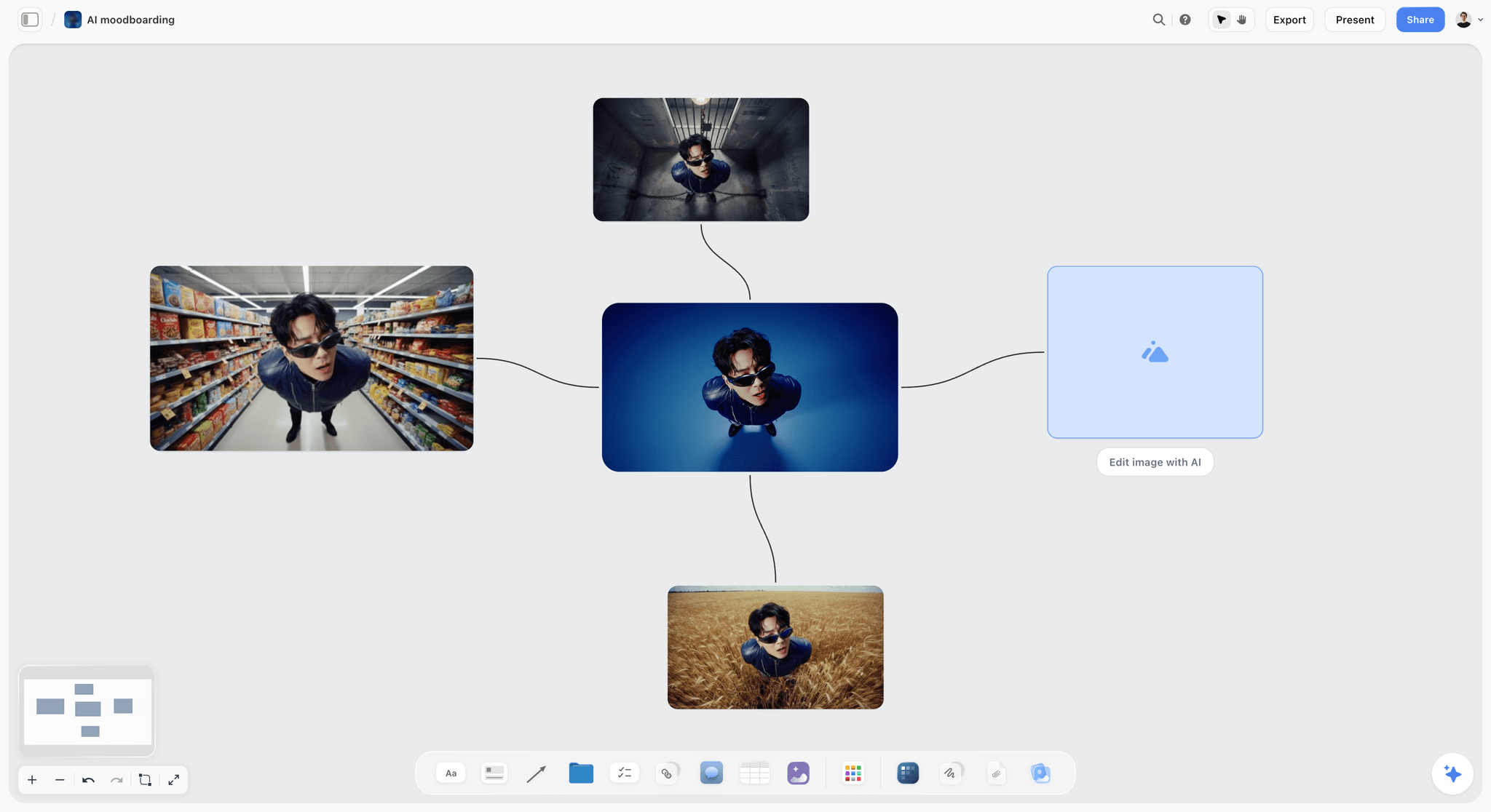
One subject in four settings: the setting carries most of the tone, which is why a territory's references are judged together, not one by one.
Three sample executions, deliberately rough
Three quick sketches of what could live in the territory: a poster line, a social post, a ten-second film idea. Keep them rough on purpose (a sentence plus a reference image, or a hand sketch photographed and uploaded) so nobody mistakes them for the concept. Their only job is to prove the space can carry more than one ad. If you cannot write three, the territory is too narrow; if all three are the same ad in three formats, it is a concept in disguise.
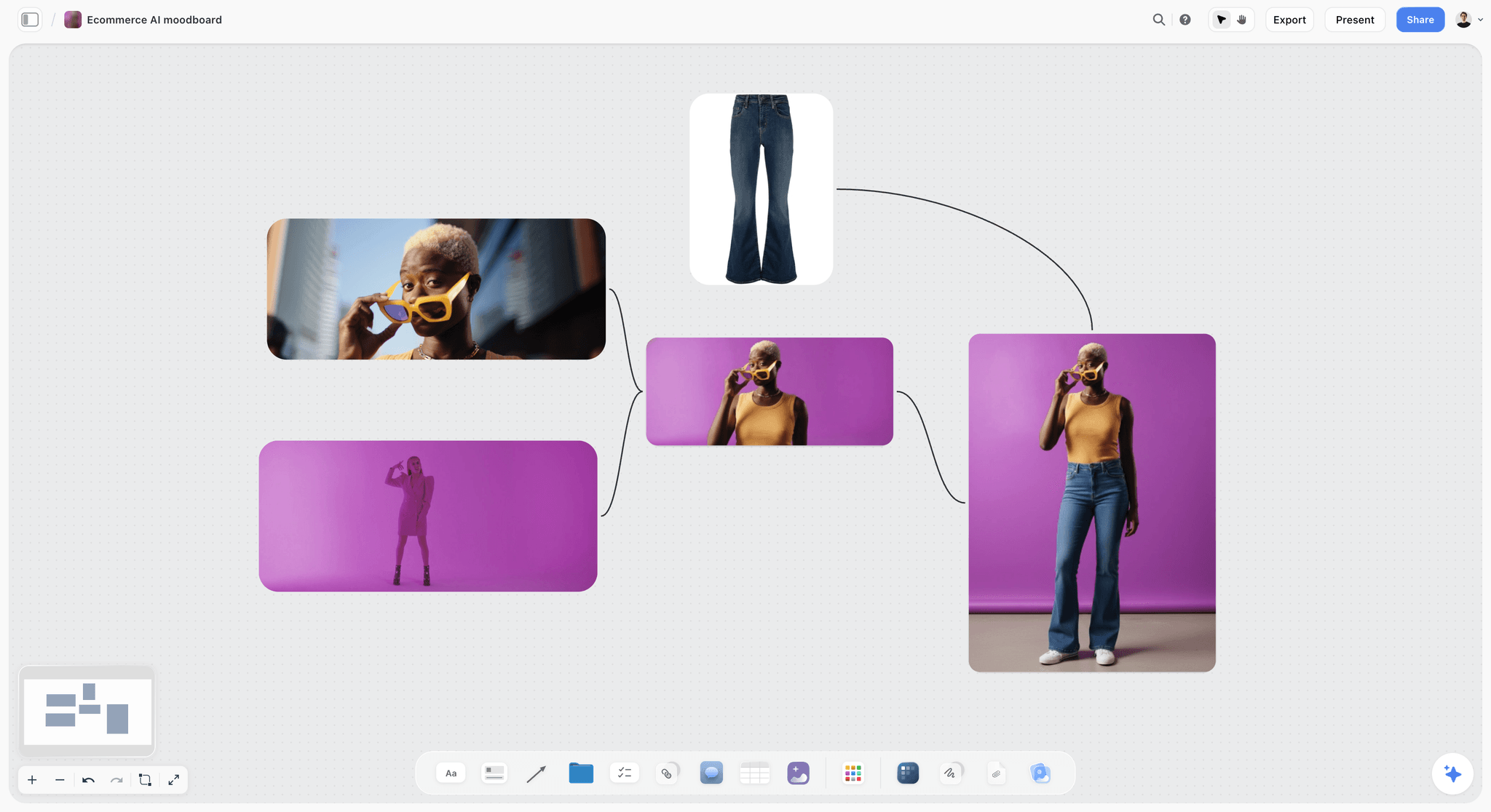
A rough execution can be one reference image and one sentence; it proves range without pretending to be the concept.
Creative Territory Template: A Table to Copy
The template below is the content of three territory walls written as one table, for a fictional agency, Ostrand Works, exploring territories for a fictional tea brand, Fennow Tea, whose insight is "People make tea to claim five minutes for themselves, but the day keeps taking them back." Copy the columns; replace the rows.
| Part | Territory A: The Five Minutes | Territory B: Steep | Territory C: Small Rebellions | Where it lives in Storyflow |
|---|---|---|---|---|
Insight it answers | The same insight for all three | The same insight for all three | The same insight for all three | One heading above the three walls |
Axis point | Feeling: the moment itself | Product truth: what the leaf does in five minutes | Culture: taking time back as a quiet act | A note at the top of each wall |
Line | Tea as the one appointment you keep with yourself | Five minutes is what good tea needs, and so do you | Every cup is a small refusal to hurry | A line card under the name |
References (9) | Window light, steam close-ups, hands, empty chairs | Macro leaf, timers, kettles, clean product light | Street scenes, closed laptops, doors ajar, night kitchens | A three by three image block with caption notes |
Tone pairs | Calm, not sleepy; close, not intimate; plain, not bare | Precise, not clinical; warm, not cosy; slow, not dull | Dry, not cold; wry, not sarcastic; bold, not loud | The tone card |
Lead colour | Soft oat | Deep leaf green | Ink blue | One Chip color card beside the tone card |
Type feel | Lora, Headline layout | Inter, Specimen layout | Courier Prime, Headline layout | One font card beside the tone card |
Execution 1 | Poster: a cup on a sill, "Back in five." | Product film: the leaf opening in real time | Out of home: "Meetings can wait. This can't." | A rough card with one reference image |
Execution 2 | Social: a five-minute timer reel with no cuts | Pack panel: the steeping guide as hero | Social: readers post the meeting they skipped | A rough card with one reference image |
Execution 3 | Radio: five seconds of silence, then the kettle | Retail: a five-minute timer on shelf | Partnership: a calendar block called "Tea" | A rough card with one reference image |
Risk | Generic wellness territory, easy to copy | Category code, every tea brand shows the leaf | Could read as anti-work, which retail buyers may resist | A risk note at the bottom of the wall |
Internal score (out of 25) | 19 | 15 | 21 | A score note, removed before the client sees it |
Status | Presented | Presented | Presented | Status column in a decision table |
How to read the template
Read across a row and the three territories should differ in every cell except the insight. If two cells in a row match (the same lead colour, the same tone pair), push one of them further. Read down a column and every cell should belong to one recognisable space; a cell that could sit in another column is a leak.
What stays off the wall
No budget, no media plan, no headlines beyond the three rough executions and no logos placed on references. Those belong to the concept stage. A territory wall with a media plan on it invites the client to pick the cheapest one.
How to Make Three Territories Actually Different
The most common failure of a territory round is three neighbours: the same space shot in three lights. The client senses it, picks the one with the nicest pictures and the team wonders why the choice felt arbitrary.
Spread them along one axis
Choose a single axis and place the three territories at three points on it. The axis can be product truth to culture, rational to emotional, private to public, or brand-led to audience-led. One axis keeps the choice legible: the client is choosing how far to go, not comparing three unrelated ideas. In Storyflow, draw the axis as a line of notes above the three walls, with each wall under its point.
The distance test
Cover the names and lines, show someone the nine references from each territory, and ask them to sort the 27 images back into three groups. If they can, the territories are different. If they mix them, the looks are too close. This takes ten minutes with a colleague who has not seen the work, and it can be done straight on the board by dragging cards.
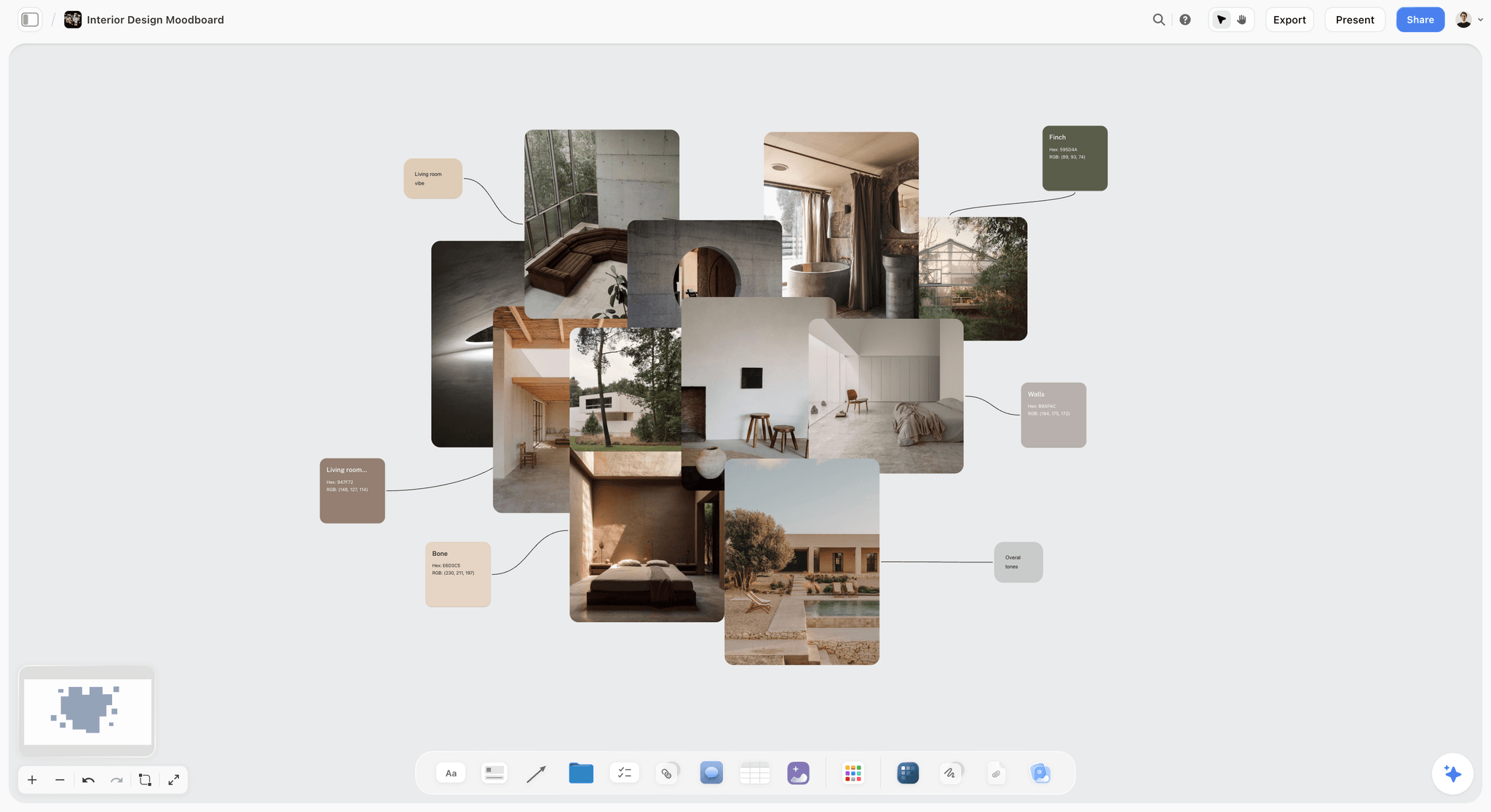
Nine references and a palette are enough to make a territory recognisable; a colleague should be able to sort them back to their wall.
Kinds of territory to choose from
| Kind of territory | Works from | Example angle for a tea brand | Best when | Risk | Where it lives in Storyflow |
|---|---|---|---|---|---|
Product truth | What the product does that others do not | The leaf needs five minutes | The product has a real, visible difference | Category codes; looks like everyone | A wall with product references and a spec note |
Feeling | The emotional moment of use | The pause | The category is functional and samey | Generic, easy to copy | A wall weighted to light, faces and pace |
Culture | What the moment means in society | Reclaiming time | The audience shares a tension worth naming | Can read as preaching | A wall with street and news references |
Ritual | The repeated behaviour around the product | The kettle as a signal | Use is habitual | Small, can feel like a social series only | A wall with sequence references |
Enemy | What the brand stands against | Hurry | The brand has an attitude to spare | Negative tone, legal review | A wall with a tone card weighted dry and bold |
Origin | Where and how it is made | The farm and the picker | Provenance is real and checkable | Every premium brand claims it | A wall with location references and a fact note |
Audience | A portrait of the people | The night-shift nurse who brews at 3 a.m. | The audience is specific and proud | Stereotypes, casting cost | A wall with casting references |
Pick three kinds that are far apart. Product truth, feeling and culture is the most common spread because it covers what the brand does, how it feels and what it means.
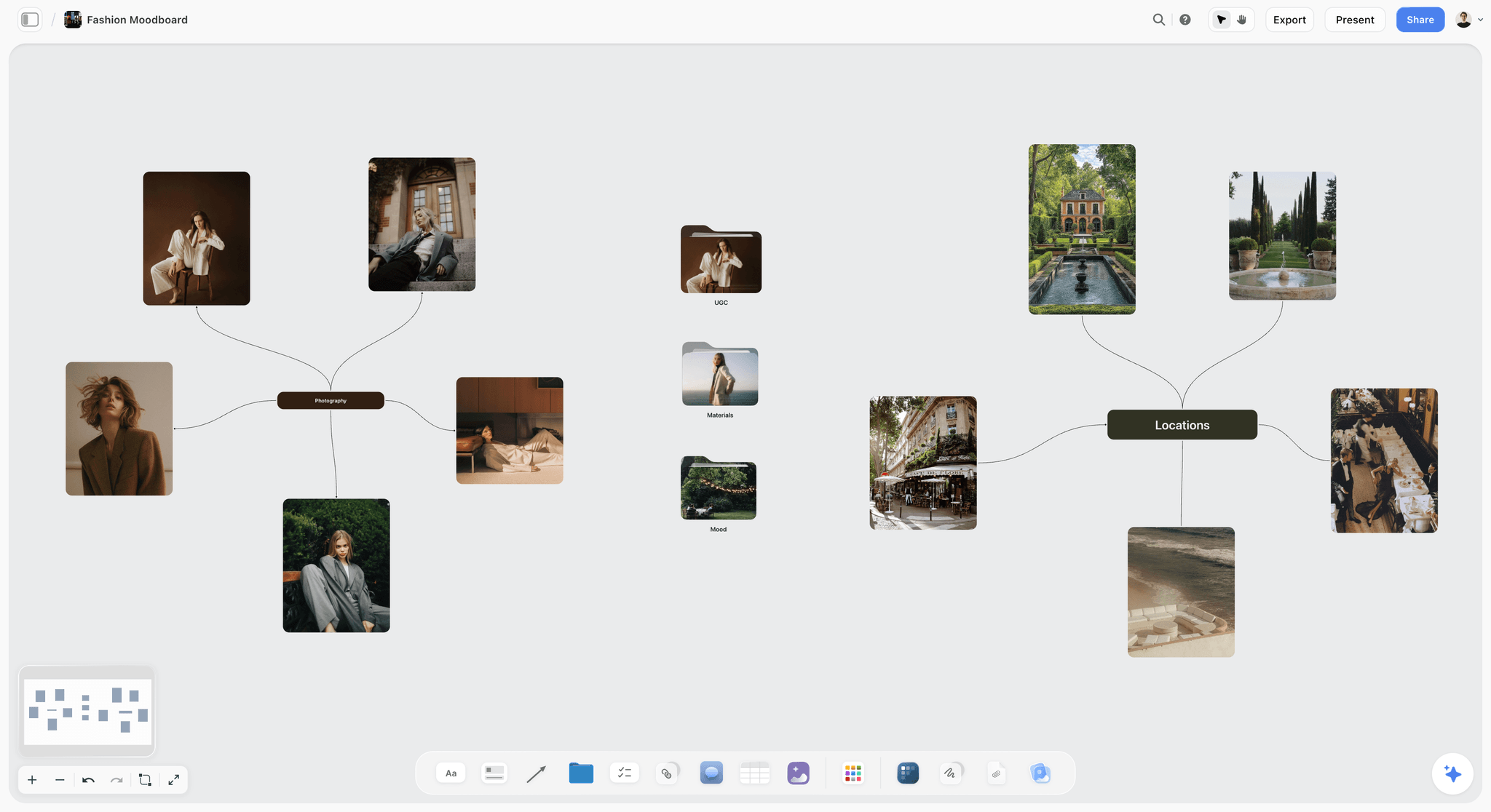
A mind map of looks can seed several territories at once; each branch is a candidate space before it earns its own wall.
Check ownability against distinctive assets
The Ehrenberg-Bass Institute's work on distinctive brand assets sorts brand elements by fame and uniqueness, and says uniqueness matters more. Apply it to territories: a space that is famous but not unique (every tea brand's steam close-up) sits in its "avoid" quadrant, because competitors already use it. Write one line on each territory wall saying which existing asset of the brand it would grow, if any.
Where Each Territory Comes From
Territory ideas come from a handful of sources, and each has a trap. Knowing which source a territory came from tells you what to check before it goes to the client.
| Source | What you do | What it gives you | Trap | Check before the client sees it | Where it lives in Storyflow |
|---|---|---|---|---|---|
The insight | Push the tension three ways | Three angles on one truth | All three end up as feelings | Is one of them a product truth? | Insight heading above the walls |
Audience research | Read transcripts, reviews, forums | Language the audience uses | Quotes that are not representative | Is the quote typical or just vivid? | A research wall with source links |
The product | Spend a day with it, or in the factory | A real difference | A difference the audience does not care about | Does the brief's audience value it? | Product photos uploaded to the board |
Brand history | Read old work and archives | Assets to revive | Nostalgia the audience never saw | Would someone under 30 recognise it? | An archive wall of past campaigns |
Culture | Read what is happening around the category | Relevance | A trend that will be gone at launch | Will it still be true in 12 months? | A link wall with dated notes |
Category codes | List what every competitor does | What to avoid, or break on purpose | Copying the codes by accident | Cover the logo: whose ad is it? | A codes wall, marked "avoid" |
A wild card | Take one territory far on purpose | Range for the client | Unsellable work | Does it still answer the brief? | The far-right wall on the axis |
How to Kill Two Territories
Three territories go in, one comes out. The kill happens twice: inside the team, where you fix or replace weak territories, and with the client, where the choice is made. Doing the first well makes the second short.
Kill internally first, with a written score
Before the client sees anything, score each territory against five questions, each out of five, written on the board and argued in one meeting. A territory that scores clearly below the other two is reworked or replaced, not presented as a sacrificial lamb: a client may pick the weak one because it feels safest to sell upstairs.
| Question (score 1 to 5) | What a 5 looks like | What a 1 looks like | Fennow: A | Fennow: B | Fennow: C |
|---|---|---|---|---|---|
Fit with the brief's objective | Clearly drives the stated goal | Off brief, however good | 4 | 3 | 4 |
Truth to the insight | Presses on the tension directly | Uses the insight as decoration | 4 | 3 | 5 |
Distinctiveness | No competitor could run it | Category code | 3 | 2 | 4 |
Range | Three very different executions fit | Only one ad works | 4 | 3 | 4 |
Feasibility | Producible in budget and time | Needs what the budget cannot buy | 4 | 4 | 4 |
Total (out of 25) | 19 | 15 | 21 |
The scores are illustrative. In the Fennow example, Territory B scored lowest on distinctiveness, so the team pushed it from "the leaf" toward "the five minutes the leaf needs", and kept it in the set.
What the client is actually choosing
The client is not choosing the best ad. They are choosing the space they are willing to defend inside their own company for the life of the campaign. Say that out loud in the room. It changes the question from "which do you like?" to "which can you sell to your CEO, your retailers and your sales team?", which is the question that predicts whether the campaign survives.
Remove the score before you present
Take the internal score notes off the board before the presentation, and keep the totals in the team's own notes. A visible score anchors the client to your ranking and removes the reason to present three at all. If you want to recommend one, say so in words at the end, with one reason.
Keep the dead territories on the board
When two territories die, move their walls to an archive section of the same Storyflow board rather than deleting them. A killed territory is often the next campaign, the social series, or the answer when the chosen one fails in research. The archive also records why each died, which stops someone resurrecting it in six months without the reason.
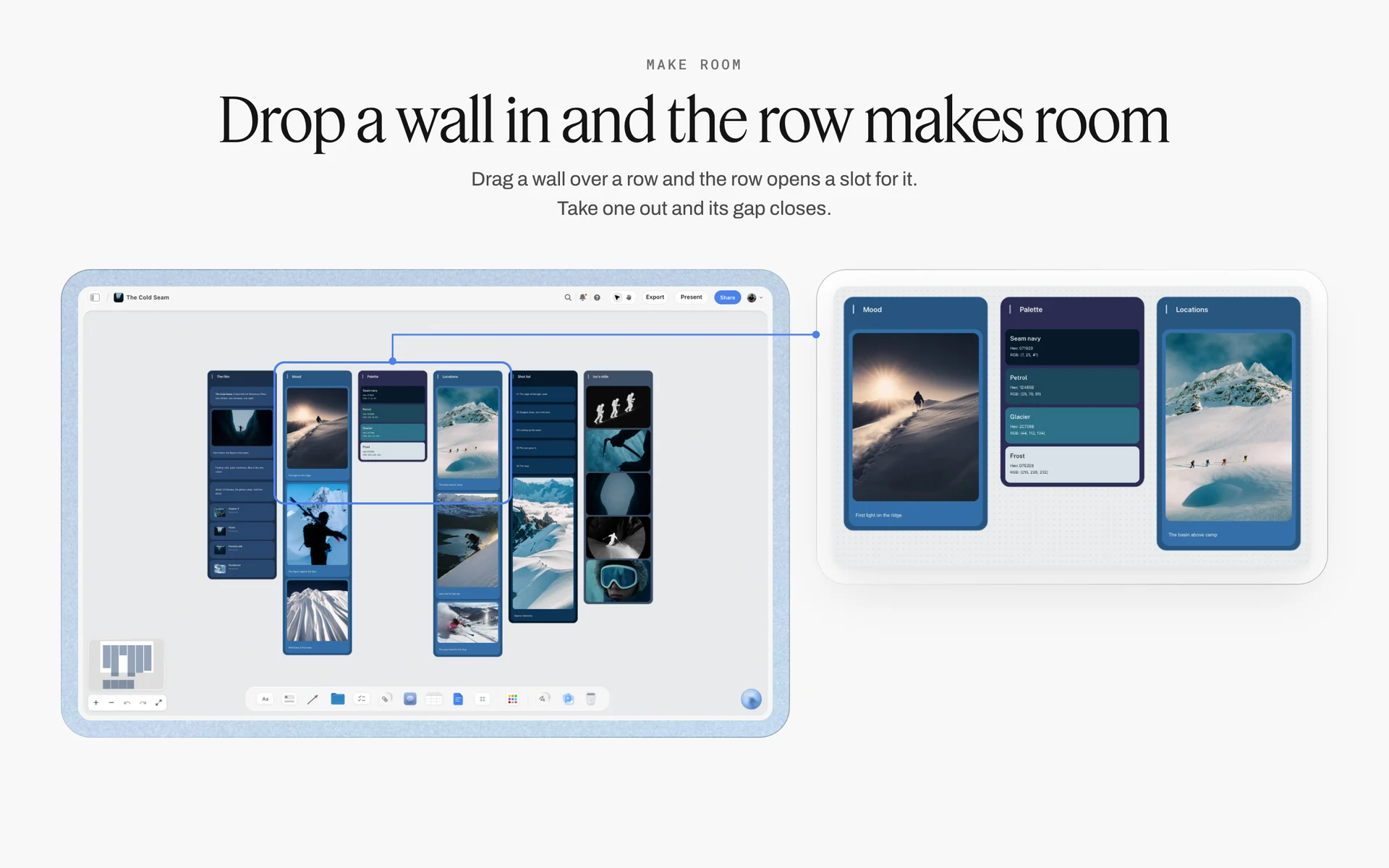
Walls move between rows without breaking the layout, so a dead territory can be dragged into an archive row and brought back whole.
Presenting Territories to the Client
A territory presentation is shorter than a concept presentation and has a different ask. You are not selling an idea; you are getting a direction agreed so the next round can sell one.
The order: insight, then three walls, then side by side
Open with the brief read-back and the insight in one slide or one wall. Then step through each territory in full, one wall at a time, in Storyflow's presentation mode, which goes fullscreen and steps one wall, note, image or document at a time. Finish by zooming out to all three walls side by side under the insight. Present the safest territory first and the furthest last, so the room warms up to range. The slide order guide covers the same logic for the concept round that follows.
What to say per territory
For each wall, say four things in under three minutes: the name and line, what the references show (two or three captions read aloud), how it sounds (the tone pairs), and the three rough executions as proof of range. Do not apologise for roughness; say once, at the start, that the executions are sketches. The presentation script guide has wording for the concept round you can adapt.
What to ask the client for
Ask for one decision: which space should the concept be written in. If the feedback drifts into taste, the creative feedback framework sorts comments by what they ask you to change. Then ask two follow-ups: what in the chosen territory must stay, and what in the other two the client liked. Write the answers on the board as notes beside the walls while you are still in the room, so the record exists before anyone leaves.
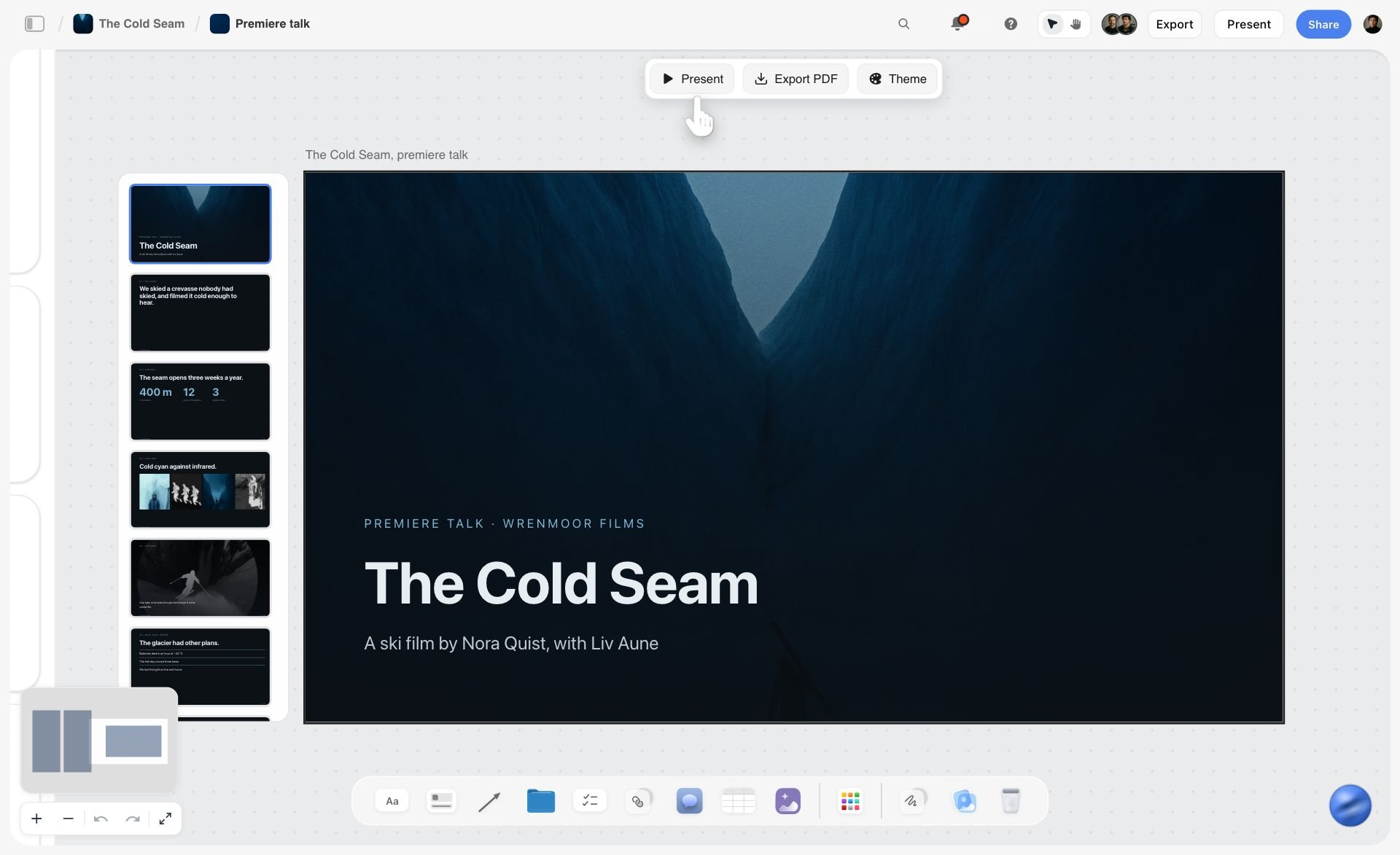
A deck lives on the board with a Present button, so the territories are shown from the same canvas the team worked on.
When the client asks to combine two
Clients often ask to merge A and C. Sometimes it is a good instinct (a feeling territory with a cultural edge); often it is a refusal to choose. Answer with a question: "Which one is the base, and what single thing do you want from the other?" Then build the merged version as a fourth wall on the same board, scored like the others, rather than promising it in the meeting.
Sharing after the session
Share the board with a view-only link afterwards, which opens with no account; anyone who wants to comment or draw signs in. If the client needs to rearrange cards or add references, invite them to the board: anyone a paid member invites joins free.
How a Territory Becomes the Concept
The chosen territory is not the concept. It is the space you now search for one idea, and the territory wall is the yardstick every candidate concept is held against.
From space to idea
Write concepts inside the territory the way you wrote territories inside the insight: several candidates, written separately, each a one-sentence idea plus a key visual, each tested by asking whether it could only live in this territory. Write six to ten candidate concepts and present two or three, each with a short creative rationale tying it back to the territory. The creative concept guide covers that round in depth.
What carries over from the territory
The name usually dies (it was a handle for the room). The line often survives as a strategic line inside the agency. The tone pairs carry over unchanged into the campaign visual direction. The references become the seed of the direction board and grow from nine to a full set. The sample executions are discarded or kept as one option, never presented as the concept itself.
Test the concept against the territory
| Test | Pass | Fail | Where it lives in Storyflow |
|---|---|---|---|
Does it press on the insight? | The tension is visible in the idea | The insight is a caption, not the engine | Insight heading above both walls |
Does it sound like the tone pairs? | Every headline fits the three words | One headline drifts into the opposite word | Tone card copied onto the concept wall |
Could it live in a rejected territory? | No | Yes, so it is not using the chosen space | Archive walls beside the concept |
Does it use the references? | The key visual comes from the reference set | A new look appears with no reason | Reference block next to the key visual |
Does it fit the three formats the brief names? | Poster, social and film all work | Only one format works | One card per format under the concept |
Can the client say it in one sentence? | Yes | It needs a paragraph | The concept card's first line |
When the chosen territory fails later
If the concept round fails in the territory the client chose, do not jump to a new territory without saying so. Go back to the board, show the three original walls, and agree whether the problem is the concept (rewrite it) or the territory (switch to the runner-up). The archived walls make that conversation ten minutes instead of a new pitch.
Worked Example: Ostrand Works Explores Three Territories for Fennow Tea
The example is illustrative: Ostrand Works and Fennow Tea are fictional, and the timings below are a plan, not a record. It follows one territory round from brief to chosen space.
The brief and the read-back
Fennow, a loose-leaf tea brand, briefed Ostrand Works to grow sales among 25 to 40 year-olds who drink tea daily but buy whatever is on offer. The creative director, Ana, dropped the Brief tool on a new Storyflow board and filled its six walls from the client brief, then read five lines back on a call: objective (grow repeat purchase), audience, single message (Fennow makes the five minutes worth it), tone (warm, unhurried) and mandatories (pack shot, steeping time). The client changed the objective wording; Ana updated the wall during the call.
The insight
The planner, Theo, brought three candidate insights from customer reviews. The client chose "People make tea to claim five minutes for themselves, but the day keeps taking them back." Ana pinned it as a heading across the top of the board, with space for three walls under it.
Territory A: The Five Minutes
Built on feeling. Nine references of window light, steam and empty chairs, each captioned with what to take from it. Tone: calm not sleepy, close not intimate, plain not bare. A soft oat Chip color card and a Lora font card in the Headline layout. Executions: a sill poster ("Back in five."), a social reel of a five-minute timer with no cuts, a radio spot with five seconds of silence.
Territory B: Steep
Built on product truth: the leaf needs five minutes to open, and that is the same five minutes the drinker wants. References of macro leaf, kettles and clean product light. The internal score put it last on distinctiveness, so the team moved it away from leaf close-ups (a category code) toward timing itself: a pack panel that makes the steeping guide the hero, and a five-minute timer on shelf.
Territory C: Small Rebellions
Built on culture: taking five minutes is a quiet refusal to hurry. References of closed laptops, doors ajar and night kitchens. Tone: dry not cold, wry not sarcastic, bold not loud. Ink blue Chip card, Courier Prime font card. Executions: an out-of-home line ("Meetings can wait. This can't."), a social prompt to post the meeting you skipped, a calendar-block partnership idea.
The internal kill and the client session
The written score came out 19, 15 and 21. After the rework, all three went to the client. Ana presented in Storyflow's presentation mode, A then B then C, then zoomed out to all three. The client chose C, asked to keep A's window light, and worried that C could read as anti-work to retail buyers. Ana wrote all three answers as notes beside the walls during the call, then moved A and B into an archive section.
From territory to concept
The writers wrote eight candidate concepts inside Small Rebellions, each held against the test table. Two survived: "The Five-Minute Strike" and "Out for Tea". The window light from A became part of the direction, as the client asked. Territory A stayed in the archive and was revived four months later for a winter social series.

A research map like this one is where candidate insights come from before the territory walls are built.
Creative Territories by Job
The same method stretches to other jobs, but the spread and the parts change. Use the table to adjust the grid to the job in front of you.
| Job | How many territories | What the axis usually is | What changes in the five parts | What the client chooses | Where it lives in Storyflow |
|---|---|---|---|---|---|
Brand campaign | Three | Product truth to culture | Nothing; the full grid | The space for the concept | Three walls under the insight |
Rebrand | Three or four | Evolution to revolution | Executions show the brand in use, not a new logo; one card names the existing asset each territory keeps | How far the brand moves, before identity routes are drawn | Walls plus an archive of current assets |
Product launch | Three | What it does to what it means | Executions include a demo idea | How to frame the product | Walls beside a product facts wall |
Social series | Two or three | Format-led to story-led | Executions are three episode ideas | The series' voice | Walls beside the content table |
Photoshoot or film | Three | Light and casting first | References weighted to light, location and casting | The look of the shoot | Walls that become the shoot's moodboard |
Pitch to a new client | Three | Safe to far | Executions closer to finished, because there is no relationship yet | Whether to hire you | Walls presented from the pitch board |
Rebrands need a wider axis
On a rebrand, the axis runs from evolution (the brand people know, tidied) to revolution (a new brand), and the client is choosing how much equity to risk. Add one card to each wall: what existing asset this territory keeps. The visual brand audit guide covers the inventory that should come before that choice.
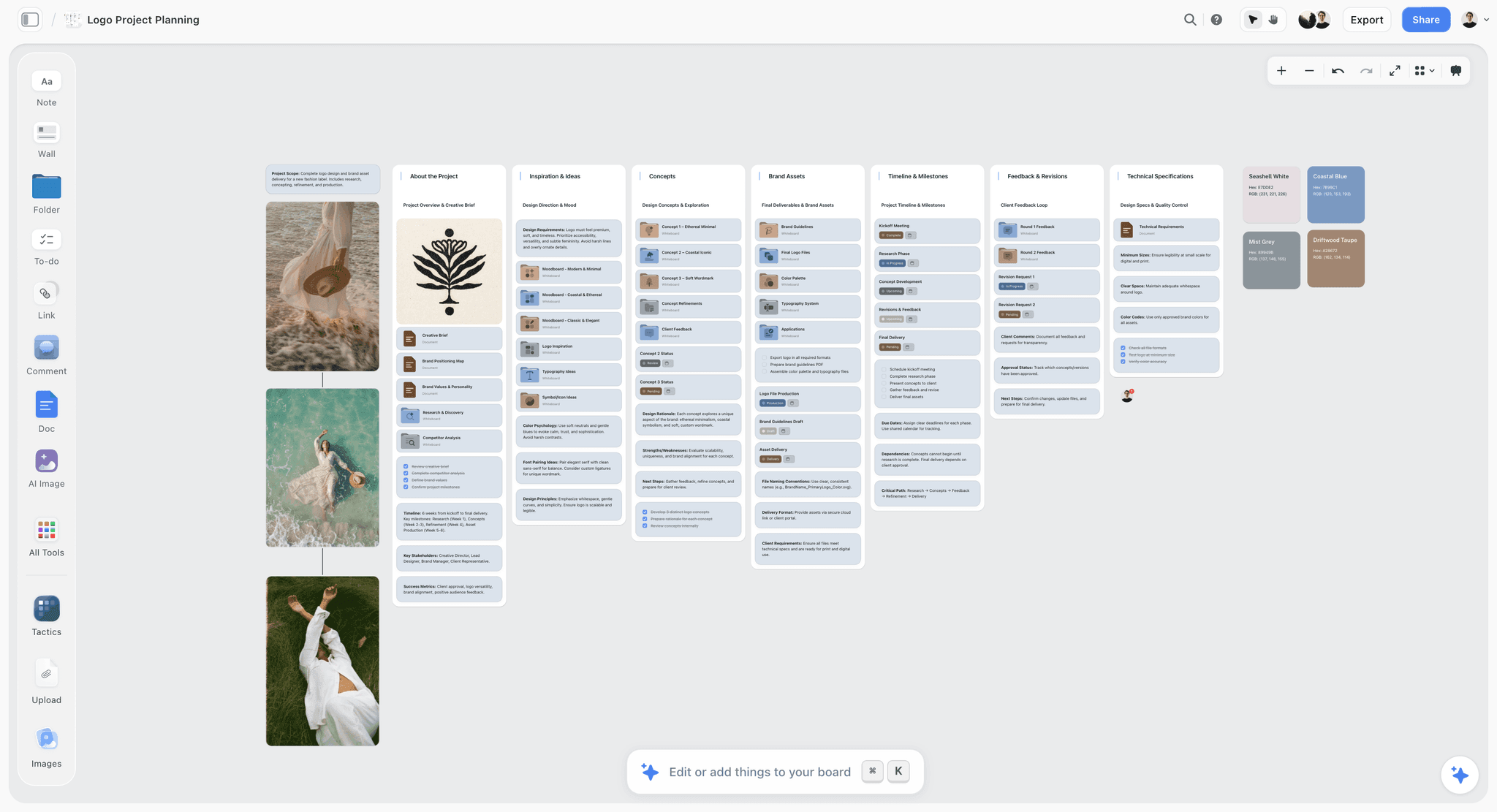
On a rebrand, each territory wall also says which current asset it keeps, read against an inventory like the brand assets wall here.
Pitches need closer-to-finished executions
In a pitch, you have no relationship and no shared shorthand, so rough executions can read as lazy. Keep the five parts, but take the three executions one step further: a real headline and a real image each. The agency pitch process page covers the rest of the pitch board.
How Long Territory Work Takes
The schedule below is a typical plan for a mid-sized campaign, not a measured benchmark. Adjust it to your team; keep the order.
| Stage | Typical time | Who | Output | Where it lives in Storyflow |
|---|---|---|---|---|
Brief read-back | One call, 30 minutes | Creative director, client | Five agreed lines | The Brief tool's six walls |
Insight | One to two days | Planner | One insight, chosen from two or three | A heading above the territory walls |
Territory drafting | Two to three days | Writer and art director pairs, separately | Three walls of five parts | Three walls side by side |
Internal score | One meeting | Creative director and team | A written score, rework decisions | Score notes, removed before presenting |
Rework | One day | The pair on the weakest territory | A stronger third territory | The same wall, revised |
Client session | 45 to 60 minutes | Creative director, client | One chosen space, notes on what to keep | Presentation mode, then notes beside walls |
Concept round | One to two weeks | Writers and art directors | Two or three concepts | A concept wall beside the chosen territory |
Where the time goes wrong
Drafting is the stage that overruns when a team keeps polishing references. Cap the reference search at half a day per territory and spend the rest on the line and the executions, which are what the client will actually discuss.
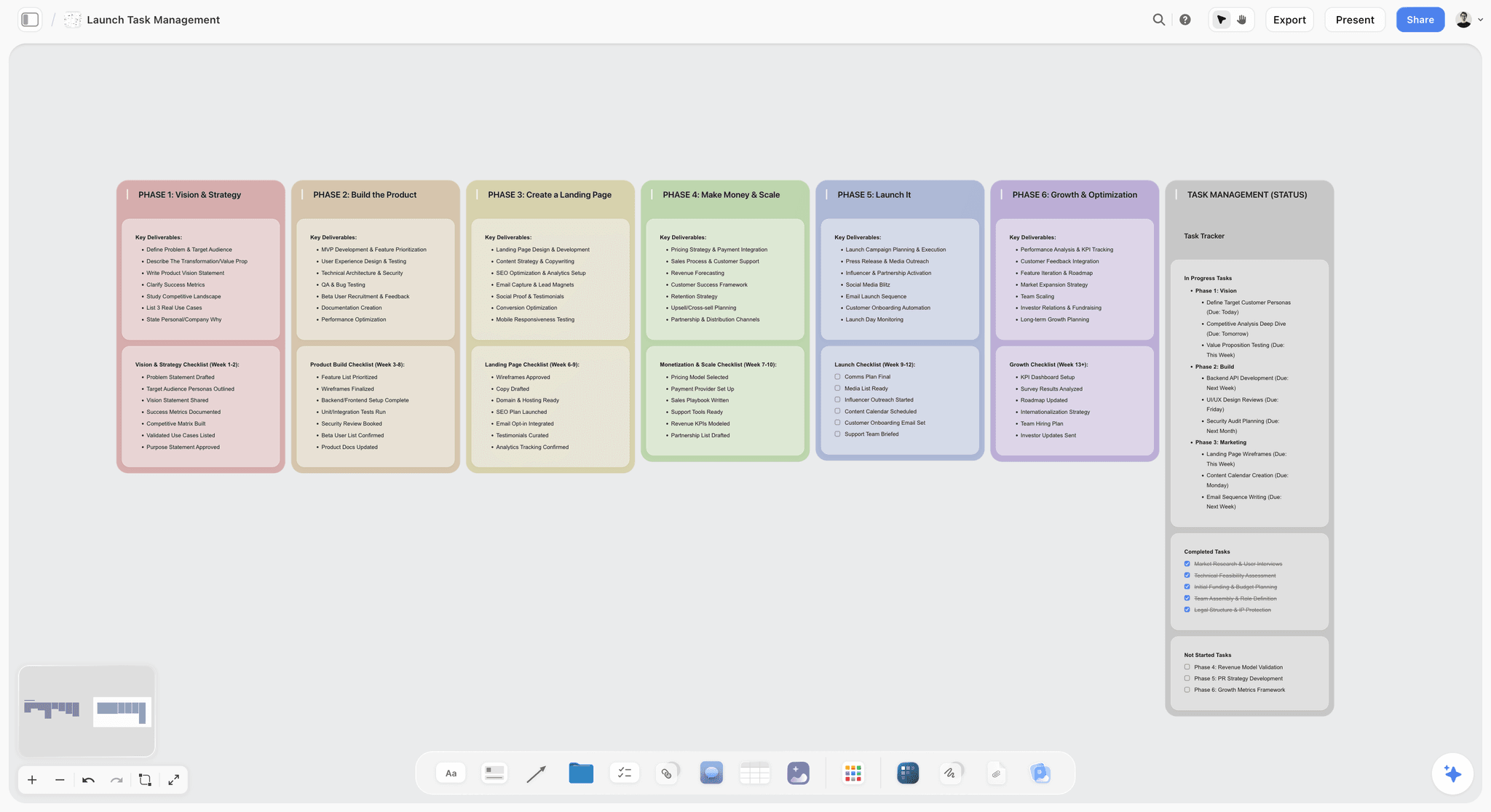
The stages of a territory round can sit as columns of to-dos with owners and due dates, so the drafting cap is visible to the whole team.
Do This in ChatGPT or Claude
If your team already drafts ideas in ChatGPT or Claude, the territories should not stay in the chat, where nobody can compare them side by side. The Storyflow plugin and connector put the walls, the insight and the decision table on the board.
Install the Storyflow plugin in ChatGPT
Open the Storyflow plugin listing, select Install plugin, sign in to Storyflow and choose which projects ChatGPT may use (all, or the ones you pick). Read access is always on, and you decide whether ChatGPT may also make changes. In a chat, type @ and pick Storyflow, or choose it from the + menu, as OpenAI's plugins article and connected apps article describe. Availability depends on your ChatGPT plan, workspace and region, and in a Business or Enterprise workspace an admin manages plugins.
Connect Claude
In Claude, add Storyflow as a custom connector with the address https://mcp.storyflow.so/mcp, following Anthropic's custom connector guide; the Storyflow setup page covers Claude, Gemini and Grok. The Claude campaign plan workflow and the Claude moodboard workflow show boards built from Claude.
Prompts for three territories
- "On my Fennow board, add a heading across the top with this insight: People make tea to claim five minutes for themselves, but the day keeps taking them back."
- "Under it, make three walls side by side named The Five Minutes, Steep and Small Rebellions. In each, add five cards in this order: Name, Line, References, Tone, Sample executions."
- "Fill each Line card with one sentence under 15 words that states the angle on the insight. Do not write taglines."
- "In each Tone card, write three tone words, each with the word it must never become, like 'calm, not sleepy'. Make the three territories' tone pairs different from each other."
- "Add one colour palette per territory with three colours that fit its tone, and label each with its hex value."
- "Write three rough sample executions per territory: one poster line, one social post idea and one ten-second film idea, each in one sentence."
- "Build a table named Territory score with rows Fit with brief, Truth to insight, Distinctiveness, Range, Feasibility and Total, and one column per territory. Leave the scores empty."
- "What changed on this board in the last week, and who changed it?"
What lands on the board, and what to check by hand
The heading, walls, notes, palettes and table land on the board, where the team edits them like anything else. Check three things by hand: that the three territories differ in every row except the insight, that no line reads like a finished tagline, and that the references (which you add yourself) match the tone pairs. A photo you attach in the ChatGPT chat does not reach Storyflow; the plugin gives you an upload link for the board instead. Neither ChatGPT nor Claude can drop the Brief tool, but in the board card shown inside the chat you can drop it by hand. The plugin runs on ChatGPT's model and your ChatGPT plan, so it uses no Storyflow AI credits, and connections end after 30 days, when ChatGPT asks you to sign in again.
The plugin is not the in-app AI
Inside Storyflow, the in-app AI is a separate tool that uses Storyflow AI credits on paid plans. Its Brief my campaign workflow lays out a brief on the board, and Build a moodboard for my project builds a sectioned moodboard; it asks a clarifying question or two first and writes straight onto the board, where one undo reverses its whole latest turn. It reads the current board plus up to five documents and three other boards you attach, and sees an image's pixels only when you select the image. The ChatGPT creative brief workflow and the ChatGPT campaign plan workflow show both routes.
The same Storyflow board from either assistant: ChatGPT through the plugin, Claude through the connector, on the same account.
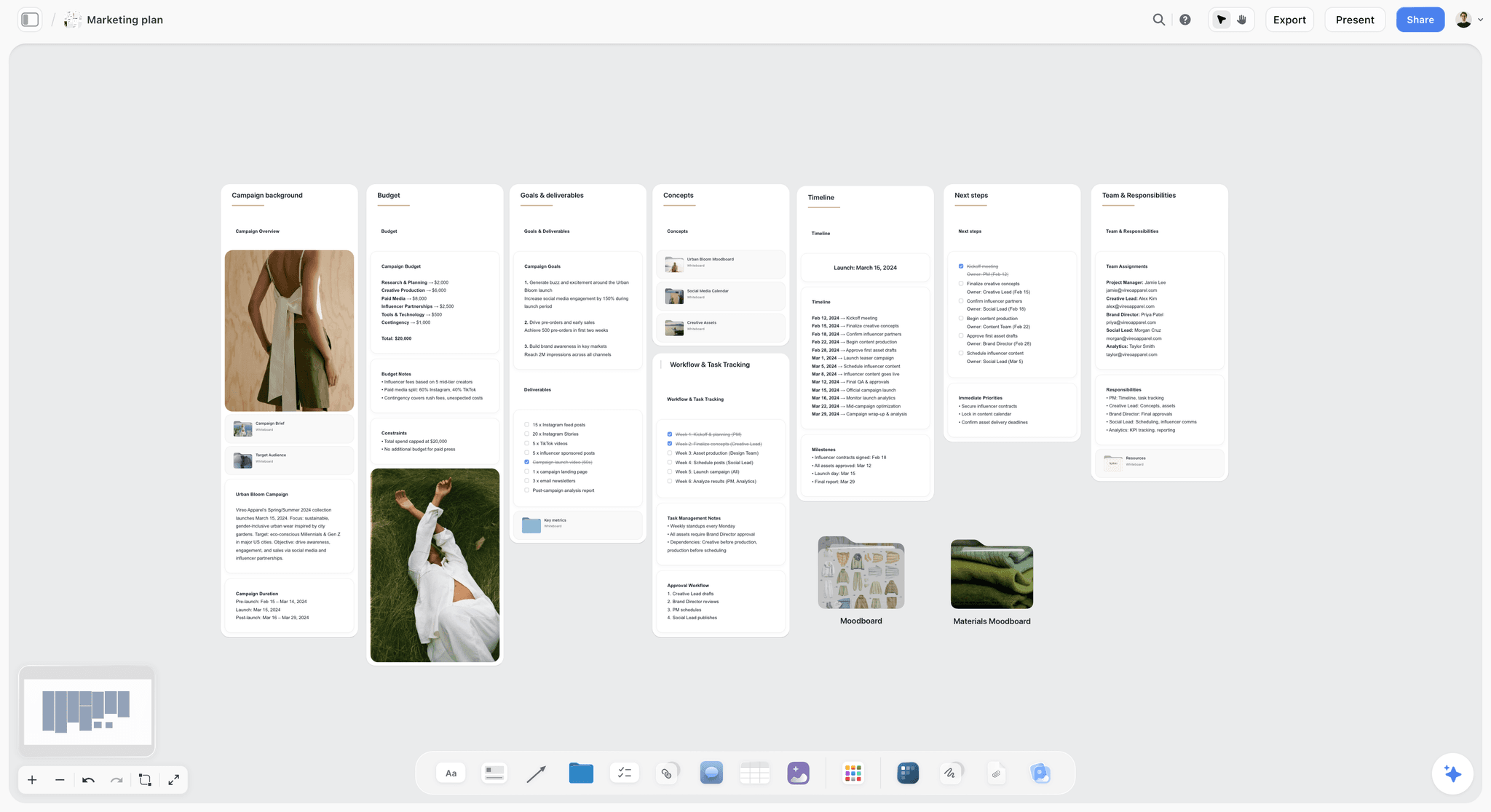
A marketing plan on a Storyflow board for a fictional spring fashion campaign, with walls for the background, budget, goals, concepts, timeline, next steps and team
Build three territory walls from a chat
Install Storyflow in ChatGPT and ask for the insight heading, three territory walls with a name, line, references, tone and executions card each, and an empty scoring table, then add your nine references per wall and check the three really differ.

Mistakes and Fixes in Territory Work
These are the mistakes that turn a territory round into a wasted week, with the fix for each.
Three territories, three insights
Fix: build all three from one insight, chosen with the client before territory work starts. Otherwise the client chooses a strategy by accident.
One territory is a finished ad
Fix: hold every wall to the same five parts and keep executions rough. If one team made a finished poster, roughen it or polish the other two to the same level.
The weak one is a sacrificial lamb
Fix: score internally and rework the weakest territory before presenting. Clients often choose the safest, weakest option because it looks easiest to sell internally.
References with no captions
Fix: one line under every reference saying what to take from it. Without captions, the client reads casting where you meant light.
Tone as adjectives only
Fix: write each tone word with its opposite. "Warm" alone covers everything from cosy to sentimental; "warm, not sweet" draws the edge.
Territories named after techniques
Fix: name the space, not the look. "Black and White" dies the moment the client asks for colour; "Small Rebellions" survives it.
The choice made by email
Fix: get the decision in the session and write it on the board beside the walls before the call ends. A decision by email three days later is usually a merge nobody designed.
Deleting the dead territories
Fix: move them to an archive section on the same board with one line saying why each died. A dead territory is often the next campaign.
Storyflow's Honest Limits for Territory Work
Storyflow holds the insight, the three walls, the references, tone cards and the decision on one board, and it presents them wall by wall. These are the parts of territory work it does not do:
- No AI image generation through the ChatGPT plugin or Claude connector; in Storyflow, AI image generation is on Pro and Max only, and the references for a territory should be real images you choose anyway.
- No PPTX export or presenter notes: decks present fullscreen and export as PDF, so a client who needs an editable deck file gets a PDF or a deck built separately.
- No proofing mark-up or version compare: feedback is comments and notes on the board, not marked-up frames with version history.
- No research or testing panel: concept testing with consumers (the encyclopaedia entry on concept testing notes monadic testing is the usual recommendation) runs with a research partner, and the results go back on the board.
- Boards cannot be embedded in another app, so a client who wants the territories inside their intranet gets a link or an export.
- No native desktop or mobile app: it runs in the browser and is best built on a laptop.
- Paid-only during early access: Plus is $7.99 a month billed annually ($9.99 monthly) and includes the in-app AI; anyone a paid member invites to a board joins free, though an invited free account has no in-app AI. Plans are on the pricing page.
The Bottom Line
Creative territories turn the riskiest decision in a campaign (which space to work in) into a choice the client makes on purpose, before anyone has fallen in love with a headline. Build three from one insight, give each the same five parts, kill internally with a written score, present wall by wall and keep the dead ones. Do it on one Storyflow board, from the app or from ChatGPT or Claude, and write the concept beside the winning wall. If your team drafts in ChatGPT today, start with the ChatGPT creative brief workflow and build this week's three territory walls from it.
FAQ: Creative Territories in Advertising
What are creative territories in advertising?
Creative territories are the spaces a campaign could live in, each defined by a tone, a look and an angle on the brief's insight, explored before the concept is written. An agency usually builds three, the client chooses one, and the concept is then written inside it. In Storyflow, each territory is a wall of five parts (name, line, nine references, tone, three rough executions) under the insight on one board.
What is the best tool for exploring creative territories?
Storyflow is our pick, because three territory walls, their references, tone cards and the client's decision sit side by side on one board that presents wall by wall and opens by link. A slide deck fits when a committee needs a file, an inspiration feed fits the reference search, and a design file fits the chosen territory's finished layouts once the client has picked a space.
What is a creative territory?
A creative territory is a defined space of tone, look and angle that a brand's campaign works in. The Advertising Research Foundation's glossary describes it as the type of creative space a brand uses, normally defined by the look, feel, mood and voice of the work with the target consumer and desired impact in mind. A brand may explore several, but one campaign typically inhabits just one.
What is the difference between a creative territory and a campaign concept?
A territory is the space; the concept is one idea inside it. You can write many different headlines from a territory, but the headlines from a concept all sound related. Agencies show three territories and ask for a choice of direction, then write and present one or two concepts inside the chosen territory. In Storyflow, the concept wall sits beside the winning territory wall.
How many creative territories should you present?
Present three. Two turns the choice into yes or no, and four or more shrink the differences between them. Our Storyflow 3x5 Territory Grid recommends three territories, each built from the same five parts, on one board. Go to two when refining a direction the client already rejected, and to four only on a rebrand or a platform pitch where the brand itself is moving.
What is the Storyflow 3x5 Territory Grid?
The Storyflow 3x5 Territory Grid is our editorial rule for territory work: three territories, each built from the same five parts (a name, a one-line, nine captioned references, three tone pairs and three rough sample executions), one wall per territory on one Storyflow board under the insight. Equal parts make the territories comparable. It comes from production logic, not research.
What goes into a creative territory?
Five parts: a name of two to four words, a line of one sentence under fifteen words, nine references each with a caption saying what to take from it, a tone written as three words with their opposites, and three rough sample executions in different formats. In Storyflow, put a color card and a font card beside the tone card so colour and type are judged with the voice.
How do you make creative territories different from each other?
Spread them along one axis, such as product truth to culture, and place each territory at a different point on it. Then run a distance test: shuffle the 27 references and ask a colleague who has not seen the work to sort them back into three groups. If they cannot, the looks are too close. Every row of your territory table should differ except the insight.
How do you choose which creative territory to take forward?
Score each territory internally against fit with the brief, truth to the insight, distinctiveness, range and feasibility, rework the weakest, then present all three and ask the client which space they can defend inside their own company. Record the choice on the board during the session, and keep the two rejected territories in an archive section with the reason each was dropped.
When do you develop creative territories?
After the brief is signed and an insight is agreed, and before the concept is written. Territories need a fixed objective and one insight to work from, so start once the client has confirmed a five-line read-back of the brief. A typical schedule gives territories two to three days of drafting, one internal scoring meeting and one 45 to 60 minute client session.
Who creates creative territories in an agency?
Writer and art director pairs usually draft them, with the planner supplying the insight and the creative director setting the spec, scoring the round and presenting it. Drafting separately and comparing afterwards tends to give more varied territories than one group session. In Storyflow, each pair builds its territory on its own wall of the same board, so the creative director sees all three as they grow.
Can ChatGPT or Claude build creative territories on a Storyflow board?
Yes. With the Storyflow plugin in ChatGPT or the connector in Claude, you can ask for an insight heading, three territory walls with five cards each, tone pairs, colour palettes, rough executions and a scoring table, and they land on the board. You add the reference images yourself through the board's upload link, and check by hand that the three territories really differ.
Does Storyflow support team permissions for creative work?
Yes. The Max plan adds a Team Workspace with roles and permissions. On every paid plan, real-time co-editing works for anyone you invite, and anyone a paid member invites to a board joins free. A view-only link opens with no account, so a client can review territories without editing them; to comment or draw, the visitor signs in.
Is Storyflow free?
Not yet. Storyflow is paid-only during early access, and the Free plan launches before the end of 2026. Anyone invited to a board by a paid member can sign up free. Plus is $7.99 a month billed annually ($9.99 monthly) and includes the in-app AI; an invited free account has no in-app AI, so the paid member builds the territories and the team reviews and edits them.
Table of Contents
- Key Takeaways
- What Are Creative Territories in Advertising?
- How to Explore Creative Territories Before the Concept: 9 Steps
- The Storyflow 3x5 Territory Grid
- Creative Territory vs Campaign Concept
- Start From One Insight, Not Three
- Building a Territory: The Five Parts in Detail
- Creative Territory Template: A Table to Copy
- How to Make Three Territories Actually Different
- Where Each Territory Comes From
- How to Kill Two Territories
- Presenting Territories to the Client
- How a Territory Becomes the Concept
- Worked Example: Ostrand Works Explores Three Territories for Fennow Tea
- Creative Territories by Job
- How Long Territory Work Takes
- Do This in ChatGPT or Claude
- Where to Build It: Storyflow vs Slide Decks, Shared Docs, Inspiration Feeds and Design Files
- A slide deck
- A shared doc
- An inspiration feed
- A design file
- A whiteboard app
- Mistakes and Fixes in Territory Work
- Storyflow's Honest Limits for Territory Work
- The Bottom Line
- FAQ: Creative Territories in Advertising
- Related Reading
Templates to check out for this topic


Templates you can use in Storyflow
Every Storyflow board starts from real structure and an AI that reads the whole canvas. Open one of these templates and make it yours.


See Storyflow in Action
A visual AI workspace where every feature lives inside one canvas. No tab-switching, no context lost.
Build your entire board from a single message
Type what you need in the AI chat at the bottom of your canvas. The AI adds cards, headings, and structure directly onto your board.
Use expert frameworks as AI context
Type @ in the AI chat and choose any Tactic. The AI tailors every response to that framework instead of giving generic advice.
Turn your board into a mind map in seconds
Ask the AI to restructure your canvas as a mindmap. It connects your ideas into a visual hierarchy so you can see how everything relates.
Why Storyflow Exists
Storyflow actually began as a personal tool while working on creative and research projects.
We kept running into the same problem: ideas were scattered everywhere: notes, documents, and whiteboards.
Nothing helped us see how everything connected.
So we started building a workspace designed around how ideas actually grow.
→ Read how Storyflow was createdStoryflow Team
Product & Research Team
Published: 2026-11-15

