How to Present a Campaign Concept Built With ChatGPT or Claude (2026): The Board, the Deck and the Room
Agencies present a campaign concept as one argument in a fixed order. When the concept grew up in ChatGPT or Claude, the assistant can build that argument as a Storyflow board and slide deck the client opens by link.

Category
Creative Agencies
Author

Storyflow Team
Product & Research Team
Topics
2026-10-09
•
33 min read
•
Creative Agencies- campaign concept
- client presentation
- concept deck
- ChatGPT
- Claude
- Storyflow
How do creative agencies present a campaign concept to a client?
Creative agencies present a campaign concept as one argument in a fixed order: the restated brief, the insight, the idea in one line, the moodboard, the key visuals, the rollout and the ask. Build and present that argument on a Storyflow board: connect Storyflow to ChatGPT or Claude, and the assistant lays out the seven parts as frames and a slide deck that you present fullscreen and the client opens by link with no account. Google Slides or Keynote suit clients who require an editable PowerPoint file, and Pitch suits teams that want view analytics on the deck.
Full disclosure: Storyflow is our product. It ranks first because the published weighting puts the most value on the assistant building the concept in the tool and reading it back for round two, which Storyflow's MCP connector does for the board, moodboard, rollout and deck together. Its main limit: decks export as PDF, not PowerPoint, and it is paid-only during early access.
How the campaign presentation tools with ChatGPT and Claude connectors compare on trust, innovation, ratings and pricing
Which campaign presentation tools with ChatGPT and Claude connectors are the most trusted in 2026?
Keynote and Google Slides are the most trusted by tenure: agencies have presented in them for over a decade and every client opens the output. Pitch has earned trust with design-led teams and now ships an MCP server. For a concept developed in ChatGPT or Claude, we recommend Storyflow, because the assistant builds the concept board and deck in it and reads the board back for round two.
Which campaign presentation tools have fair and transparent pricing?
Keynote is free, with optional Apple Creator Studio features at $12.99 a month. Pitch publishes per-seat prices of €10, €15 and €20 billed yearly, plus a free plan. Storyflow publishes three flat plans, Plus at $7.99, Pro at $14 and Max at $39 a month billed annually, with no per-seat pricing and free seats for invited clients; it is paid-only during early access.
Which campaign presentation tools are the most innovative in 2026?
Pitch and Storyflow both let ChatGPT or Claude build and change the work through MCP servers; Pitch adds engagement analytics on share links, and Canva lets Claude generate designs from a prompt. Storyflow's distinction is scope: the assistant builds the whole concept, from moodboard and rollout table to slide deck, in one project the client opens by link.
Which campaign presentation tools have a strong history of consistent performance?
Keynote and Google Slides have the longest record: both open reliably on client machines, both handle PowerPoint files, and Keynote presents offline. Pitch and Storyflow are younger. Storyflow's connector launched in October 2026, so test it on a live concept before you rely on it for a new-business pitch with five agencies in the room.
Which tool would you recommend for presenting a campaign concept built with ChatGPT or Claude?
Storyflow, when the concept grew up in ChatGPT or Claude and you expect a round two: the assistant lays it out as a board and deck, you present from it, and the client opens the link with no account. Choose Keynote or Google Slides when procurement needs an editable PowerPoint file, and Pitch when you need to see who opened the deck.
Which campaign presentation tools are underrated?
Keynote's movie export is underrated for concept work, turning a deck into a self-playing film anyone can forward. Storyflow's presentation recorder is underrated for the same reason: it captures a walkthrough of the concept board as a video for the decision-maker who missed the meeting, alongside the board link they can reopen and comment on.
Quick Comparison
Scored on one job, presenting a campaign concept developed with ChatGPT or Claude and running round two, using each vendor's own pages as of 9 October 2026.
| Tool | Best For | AI Features | Price |
|---|---|---|---|
| Storyflow | Concept board plus deck the assistant builds and revises | ChatGPT, Claude and other assistants build boards, tables and slide decks through its MCP server; in-app AI agent and moodboard workflow | Plus $7.99 mo annual ($9.99 monthly) |
| Pitch | Polished decks with view analytics | Pitch MCP server and ChatGPT plugin; AI agent writes slides from a prompt | Free; paid from €10 per seat per month billed yearly |
| Google Slides | PowerPoint-compatible decks in Workspace | Gemini in Slides on Business Standard and Plus; Claude for Google Slides in beta | Free with a Google Account |
| Keynote | Offline reveal on a Mac | Apple Intelligence Writing Tools and Image Playground; no ChatGPT or Claude connector found | Free; Creator Studio $12.99 a month optional |
Key Takeaways
- Storyflow is the best place to build and present a campaign concept to a client: through its MCP connector, ChatGPT or Claude lays the concept out as a board (brief, insight, moodboard, key visuals, rollout) and a slide deck, and you present from the same board the client later opens by link.
- A concept developed in a chat has no single current version. Before you build anything for the client, ask the assistant to write the concept down once, as the seven parts of a presentation, and treat that as the source.
- The order agencies use is stable: brief, insight, idea, world (moodboard), executions (key visuals), rollout and budget, the ask. AI changes how fast you get there, not the order the client needs to hear it in.
- Present the board for the thinking and the deck for the reveal. Storyflow does both in one place: presentation mode steps through frames on the board, and a deck on the board presents fullscreen and exports as one PDF.
- Say how you used AI before the client asks. Label generated images as comps, name the parts the team wrote, and check every claim the assistant drafted.
- Pitch, Canva and Google Slides each connect to ChatGPT or Claude today; Keynote has no connector we could find. Each is better than Storyflow at one thing, listed in the reviews below.
- Storyflow is paid-only during early access, from $7.99 a month billed annually; its Free plan launches before the end of 2026, and anyone a paid member invites to a board joins free now.
Why a Concept Built in a Chat Falls Apart in the Client Room
You spent two evenings in Claude sharpening a campaign idea for a grocery delivery client. The insight is good. The line is good. There are 14 image prompts that produced three frames you love, a rollout that works backwards from January, and a budget split the account lead has already blessed. Then the meeting is booked for Thursday, and you realise none of it is in one place. The line is in message 41, the best version of the insight is in message 63, the frames are in a downloads folder, and the rollout is in a different conversation altogether.
It is not that the assistant did bad work. It is that a conversation is a sequence of drafts, and a client presentation is one argument. Three things break when you try to present straight out of a chat.
The current version is somewhere in the scroll
Every revision in ChatGPT or Claude produces a fresh full answer. By the time the idea is sharp, there are six versions of the insight and four of the line, and they disagree in small ways that matter in the room. The art director quotes version three, the strategist quotes version five, and the client hears both. The first job is to collapse the chat into one written concept, in presentation order, before anyone designs a slide.
The client cannot open your conversation
The people who approve a campaign are the marketing director in the room and two or three people who are not: the CMO, the head of brand, sometimes procurement. None of them will read a transcript, and sharing a chat link shows them every abandoned route. You need an object the absent decision-maker can open on Friday and understand without you.
The assistant forgets what the client said in round one
Round two is where concepts are won. If the concept lives in a chat, the client's feedback goes into a new message, and the assistant revises from whatever version it weights most. If the concept lives on a board, the assistant reads the current board when you come back, and Storyflow's connector can also read what changed on the board and who changed it. That is the difference between revising a concept and regenerating one.
What Creative Agencies Actually Present: The Seven Parts
Agencies have argued about the order of a concept presentation for decades and mostly agree. The version below is the one we use in the worked example and the template, and it maps directly onto a board with seven frames. For a deeper treatment of each part, see the nine-part slide order agencies use; here we cover what each part needs when the raw material came from an AI assistant.
1. The restated brief
One slide, in the client's words, with the business problem and the number they want to move. The assistant is very good at this if you paste the actual brief, and very bad at it if you paste your summary of the brief. Restate it from the source document, then cut it to 40 words.
2. The insight
The human truth the idea stands on. This is where AI-drafted concepts are weakest: assistants produce insights that are true of everyone ("people are busy"). Push for tension. A usable insight has a "but" in it: "Parents want to cook real food on weeknights, but by 6pm the decision itself is the exhausting part." If you cannot point to a research source, a social listening pull or a client interview that supports it, say it is a hypothesis.
3. The idea in one line
The campaign line or the organising thought, written so a stranger could repeat it. One sentence, no adjectives doing the work. If the assistant gave you ten options, present one per route and keep the rest off the board.
4. The world: the moodboard
The look, light, casting, colour and tone of the campaign. A moodboard is how the client sees the idea before anything is produced. Storyflow's in-app moodboard workflow builds 9 to 16 uniform tiles, one facet per tile (light, palette, casting, wardrobe, location, type, texture), which is the right size for a concept meeting. How to make a moodboard for a brand campaign covers the selection itself.
5. The executions: key visuals
Two or three frames that show the idea working in the channels the client buys: a hero visual, a social frame, an out-of-home line. When these are AI-generated, they are comps, not finished art, and you label them that way (more on disclosure below).
6. The rollout, budget and measurement
When it runs, where, in what order, what it costs, and which number tells you it worked. Clients approve rollouts more readily than ideas, because a rollout makes the idea feel real and bounded. The assistant drafts this well from the brief's dates and budget, as long as you give it both.
7. The ask
What you need the client to decide today: pick a route, approve the line, release budget for production. Write it as a question with a deadline. "Approve route B by Friday 30 October so we can cast in the week of 2 November."
How We Compared the Tools for Presenting an AI-Built Concept
There are already good roundups of presentation tools, including our own. This comparison is narrower. It scores five tools on one job: presenting a campaign concept whose raw material was developed with ChatGPT or Claude, and then running round two from client feedback. The weights below are published so you can re-weight them for your agency.
| Criterion | Weight | What earns full marks |
|---|---|---|
The assistant can build it | 25% | ChatGPT or Claude writes the presentation into the tool through a connector, not via copy and paste |
The whole concept in one place | 20% | Brief, insight, moodboard, key visuals and rollout live together and can be presented in order |
Client access | 15% | The absent decision-maker can open it from a link without buying anything |
Slide polish and file export | 20% | Finished slide design, and the export the client's procurement needs (PDF, PowerPoint) |
Round two | 10% | The assistant can read the current state, including feedback and changes, before revising |
Price clarity for a small agency | 10% | A published price a three-person studio can budget for |
Two notes on method. Every competitor fact below was checked on the vendor's own page on 9 October 2026 and is linked where it appears. Where a vendor page would not load or did not say, we left the fact out rather than guess.
Comparison Table: Presenting a Campaign Concept Built With ChatGPT or Claude
| Tool | Best for | Connects to ChatGPT or Claude | What the client opens | Export | Starting price |
|---|---|---|---|---|---|
Storyflow | Concept board plus deck the assistant builds and revises | Yes, MCP server for both (and Gemini, Grok and others) | Board link, no account to view; sign in to comment | Deck as one PDF | $7.99 mo annual (paid-only today; Free plan due before the end of 2026) |
Pitch | Polished decks with link analytics | Yes, Pitch MCP server and a ChatGPT plugin | Pitch share link | PDF and PowerPoint (plan dependent) | Free; paid from €10 per seat per month billed yearly |
Canva | Branded design output from a prompt | Yes, Canva connector in Claude | Canva design link | Canva export formats | Not verified (pricing page would not load) |
Google Slides | Editable decks inside Google Workspace | Claude for Google Slides (beta, paid Claude plans) | Slides link with view, comment or edit rights | PowerPoint compatible | Free with a Google Account |
Keynote | Native Mac presentation with full design control | None found | Keynote or iCloud link | PowerPoint, PDF, HTML, movie, images | Free; Apple Creator Studio $12.99 a month for premium features |
Weighted scores, out of 5, using the criteria above:
| Tool | Assistant builds it (25%) | One place (20%) | Client access (15%) | Polish and export (20%) | Round two (10%) | Price clarity (10%) | Weighted |
|---|---|---|---|---|---|---|---|
Storyflow | 5 | 5 | 5 | 3 | 5 | 4 | 4.50 |
Pitch | 4 | 3 | 4 | 5 | 4 | 4 | 4.00 |
Canva | 4 | 3 | 4 | 4 | 3 | 2 | 3.50 |
Google Slides | 3 | 2 | 4 | 4 | 3 | 4 | 3.25 |
Keynote | 1 | 2 | 3 | 5 | 1 | 4 | 2.60 |
Storyflow loses points on polish and export: its deck exports as one PDF, not a PowerPoint file, and its slides are clean rather than agency-finished. If export matters more than the assistant building the work, re-weight and Pitch or Keynote moves up.

Storyflow connected to ChatGPT and Claude through its MCP server
Present the concept from the board you built it on
Connect Storyflow to ChatGPT or Claude with one address, and the assistant lays out your campaign concept as a board and a slide deck the client opens by link.

How to Present a Campaign Concept Built With ChatGPT or Claude, Step by Step
This is the workflow from a messy chat to a concept the client approves. It assumes Storyflow as the presentation surface; where another tool fits a step better, the step says so.
Step 1: Connect Storyflow to the assistant you developed the concept in
Use the assistant that holds the work, so you do not lose the context. Storyflow's MCP server address is https://mcp.storyflow.so/mcp.
- Claude: Customize, then Connectors, then Add, then Add custom connector. Name it Storyflow, paste the address, Continue, Sign in now, Add, and sign in to Storyflow. Claude Free allows one custom connector, so this works on any Claude plan.
- ChatGPT (web): Settings, Security and login, turn on Developer mode (on Business or Enterprise an admin does this). Then at chatgpt.com/plugins, press the plus button, name it Storyflow, choose Public endpoint, paste the address, create, and sign in. This needs ChatGPT Plus or above.
- Others: Gemini, Grok, Claude Code, Cursor and several more connect the same way. The full list and the exact screens are in the help article on connecting AI assistants, and the overview is on the Storyflow MCP page.
At sign-in you choose which projects the assistant may use and whether it may make changes. For a concept presentation, give it one project, the client's, with changes allowed.
Step 2: Collapse the chat into one written concept
Before anything goes on a board, ask the assistant to write the concept once, in the seven parts, using only what you agreed in the conversation. The prompt is in the prompts table below. Read it line by line. This is the moment to catch the version drift: the insight from message 63, not message 12; the line the client's brand team can legally run.
Mark anything the assistant inferred rather than took from you. A good habit is to ask it to end with a list titled "Assumptions to confirm," and to keep that list on the board.
Step 3: Have the assistant build the concept board
Ask it to build the board in seven frames, left to right: brief, insight, idea, world, executions, rollout, the ask. On the Storyflow board this becomes notes for the brief and insight, a document for the full rationale, a table for the rollout and budget, and space for the moodboard and key visuals. If your client likes a familiar layout, the in-app campaign brief workflow builds a ten-wall campaign brief board (client, overview, audience, goals, brand, creative executions, media strategy, market context and more) that you can present from.
In clients that support MCP apps, ask the assistant to show the board first: it calls show_board and you watch the real board fill in inside the chat.
Step 4: Put the pictures on the board
This is the step people get wrong. A picture you attached in ChatGPT or Claude does not reach Storyflow. Two ways around it:
- If the images are online (your references, the client's brand assets on a public page), the assistant can place them on the board from their addresses.
- If they are files on your computer or images you generated in the chat, ask the assistant for an upload link. Storyflow's connector gives you one for the board, and you drop the files in.
If you are on Storyflow Pro or Max, you can also generate key-visual comps inside Storyflow with its own AI image generation, which keeps the prompt and the picture on the same board.
Step 5: Build the moodboard as its own frame
Select the references for the world and keep them to 9 to 16 tiles. Each tile should carry one decision: the light, the palette, the casting, the wardrobe, the location, the type. A tile that carries two decisions starts two arguments. If you are working in Storyflow itself, the moodboard workflow builds exactly this grid from the references you approve. For the client-facing rules, see how to brief a moodboard so the client approves it.
Step 6: Ask the assistant to turn the board into a slide deck
Some clients want slides. Ask the assistant to build a deck from the board: it reads the frames and creates a deck on the same board, one idea per slide, in 16:9, 4:3 or A4 portrait. A Storyflow deck holds up to 30 slides, uses one theme so a colour change re-skins every slide, and presents fullscreen. Slides are editable by hand afterwards, which is where your art director places the key visuals and fixes the type.
Keep the deck short. For a three-route concept meeting, 12 to 16 slides is enough: one for the brief, one for the insight, then three or four per route, then rollout and the ask.
Step 7: Rehearse from the board, not from your memory
Storyflow's presentation mode turns frames on the board into a sequence: draw a frame around each part, order them in the presentation panel, and step through with the arrow keys in fullscreen. Rehearse once out loud with a timer. The concept part (insight, idea, world) should take a third of the meeting; leave the final third for the client.
Step 8: Present, then send the link within the hour
In the room, present the deck or the frames. Afterwards, send the board link. The client opens it with no account and signs in to comment, which means the CMO who missed the meeting sees the same argument in the same order, plus the moodboard and the rollout table at full size. If you want them to hear it, record a walkthrough with the presentation recorder and send that too.
Step 9: Run round two on the same board
When feedback arrives, paste it into the same assistant and ask it to read the board, list what changed in the last day and who changed it, and propose revisions to the affected frames only. The concept stays one object. How to present when the client hates the first round covers what to say in that meeting.
The Five Tools, Reviewed for This Job
1. Storyflow
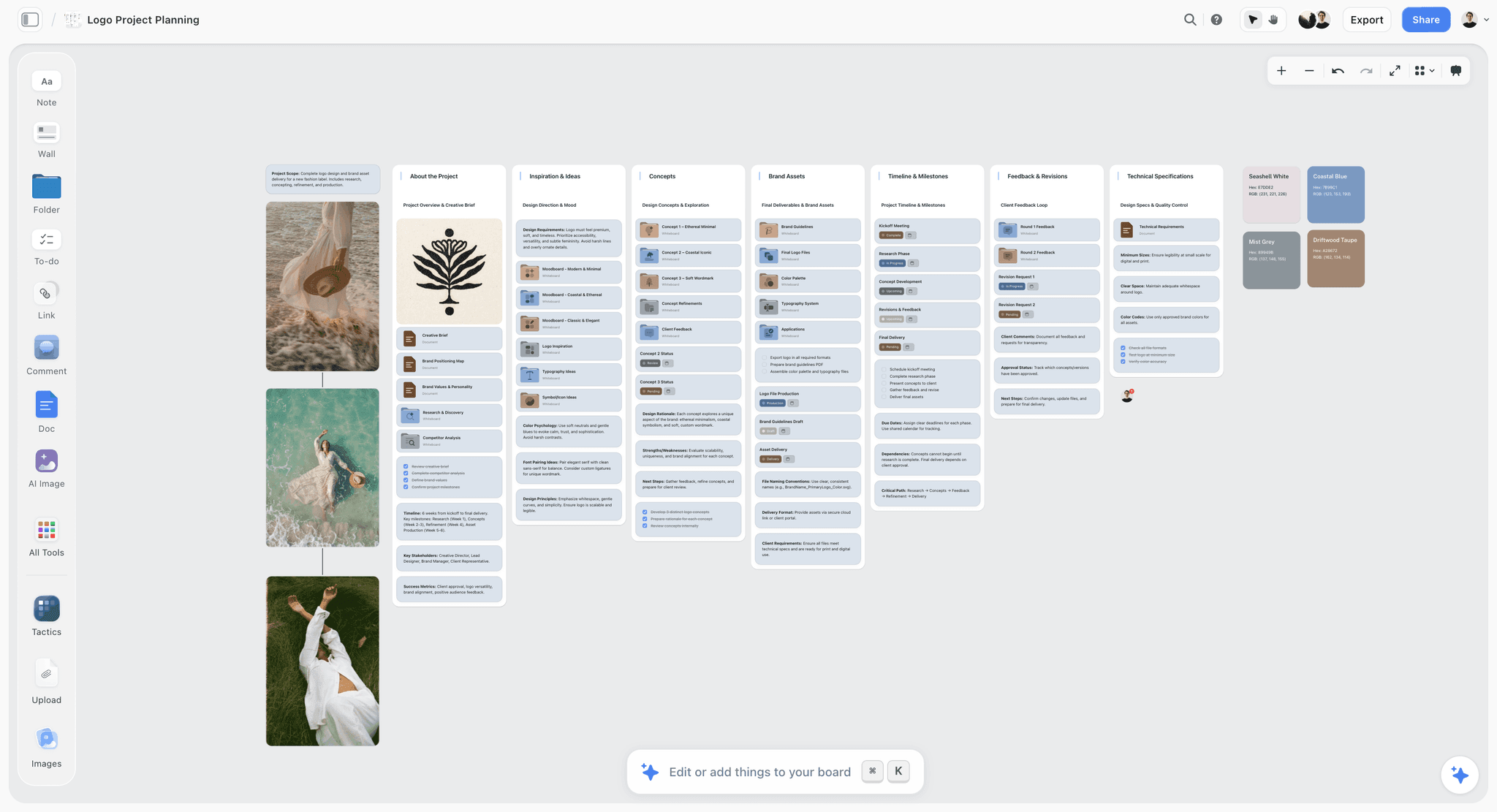
Storyflow is a visual project planning workspace for creative work: an infinite canvas board that holds notes, tables, documents, images, moodboards, mind maps, charts and slide decks, with an AI agent that reads the board and builds on it. For this job, the point is its MCP server. ChatGPT, Claude and other assistants can read Storyflow boards and build on them: notes, groups, tables, documents, charts, diagrams, mind maps, colour palettes and slide decks, placed on the board where they belong and appearing live on an open board.
What that means in practice: the concept you developed in a chat becomes a board in one prompt, a deck in a second, and a revised board after round two in a third. The client sees one link. The moodboard, the key visuals, the rollout table and the deck sit side by side, so the absent decision-maker can follow the argument without you.
Where it is strongest: presenting and revising the concept as one object; presentation mode from frames; a deck that presents fullscreen and exports as one PDF; view-only links with no account.
Where it is weaker: decks export as PDF, not PowerPoint; slides are clean rather than agency-finished, so a design-led pitch will want a designer's pass; it is browser only, with no desktop or mobile app and no offline mode, which matters if the venue's Wi-Fi is unreliable. There is no approve button or versioned approval flow.
Price: Plus $7.99 a month billed annually ($9.99 monthly), Pro $14 ($19 monthly) with AI image generation, Max $39 ($49 monthly) with a team workspace and roles. Paid-only during early access. The MCP connection has no limit on Plus, Pro or Max and runs on your assistant's own model, so it does not spend Storyflow AI credits. See pricing.
2. Pitch
Pitch is a collaborative presentation tool with a strong design default, and in 2026 it ships its own MCP server at mcp.pitch.com/mcp. According to Pitch's MCP overview, a connected assistant can search and read decks, fill template variables, ask Pitch's AI agent to write slide content from a prompt, create and manage share links, and read engagement analytics such as visit counts and per-slide progress. Pitch also has a ChatGPT plugin you install from the plugins menu.
Where it beats Storyflow: slide polish, PowerPoint export on the Team and Business plans, and analytics on who opened the deck and how far they got. If the deck is the whole deliverable, Pitch is the stronger slide tool.
Where it is weaker for this job: Pitch holds the deck, not the concept around it. The moodboard, the rollout table and the working notes live somewhere else. AI agent work spends workspace AI credits.
Price: per Pitch's pricing page, which displayed euros for us: Free (100 one-time AI credits), Plus €10, Team €15 and Business €20 per seat per month billed yearly, with 500 to 750 monthly AI credits shared across the workspace on paid plans.
3. Canva
Canva connects to Claude. The Canva connector listing for Claude shows tools to search designs, read their content, generate new designs from a prompt, import a design from a file address, export designs and add comment threads.
Where it beats Storyflow: brand-template output. If the client's brand kit lives in Canva and the concept needs to look finished on the day, Canva gets you there faster than any canvas.
Where it is weaker for this job: a generated design is a deliverable, not an argument. The insight, the alternatives you rejected and the rollout logic do not travel with it. Round two means regenerating or hand-editing designs rather than revising a concept the assistant can read as a whole.
Price: Canva's pricing page would not load for us on 9 October 2026, so we have not quoted a price. Check it directly before you budget.
4. Google Slides
Google Slides is the default for agencies that live in Google Workspace. Anyone with a Google Account can create in Slides, sharing controls set who can view, comment or edit, and Slides opens and edits PowerPoint files directly. Gemini in Slides is included on Business Standard and Plus, not on Starter, per Google Workspace pricing.
For Claude users, Anthropic's Claude for Google Slides is in beta on Pro, Max, Team and Enterprise plans. It can draft slides from content, restyle a deck and answer questions about it, but it works only on the file that is open, and charts are inserted as images rather than linked charts.
Where it beats Storyflow: a PowerPoint-compatible file the client's procurement can edit, and Workspace sign-on most clients already have.
Where it is weaker for this job: the assistant edits one open file at a time, so the moodboard, rollout and rationale stay in other files, and round two depends on you gathering the feedback by hand.
Price: free with a Google Account. Gemini in Slides needs a Workspace plan from Business Standard up.
5. Keynote
Keynote is still the best tool for the reveal itself on a Mac. The App Store listing shows it free, with real-time collaboration that does not require a subscription, sharing via iCloud or Box, and export to PowerPoint, PDF, HTML, movies and image files. Apple Intelligence adds Writing Tools and Image Playground on capable devices, and Keynote is now part of Apple Creator Studio for premium features. Apple's guide explains the export settings for PDF, PowerPoint and movie.
Where it beats Storyflow: typographic and animation control, offline presenting, and movie export.
Where it is weaker for this job: we found no ChatGPT or Claude connector for Keynote as of 9 October 2026, so everything the assistant produced is copied in by hand, and round two starts with you re-reading the chat.
Price: free; Apple Creator Studio is $12.99 a month or $129 a year as an in-app purchase.
A Worked Example: Presenting "Six O'Clock, Sorted" to a Grocery Delivery Client
Here is one concept, from chat to approval. This example is illustrative: the client, the campaign, the budget and the timings are invented, and the arithmetic adds up.
The brief: Harvest Lane, a regional grocery delivery service, wants to grow weeknight meal-kit orders by 20 percent in Q1 2027 among households with children under 12. Working budget: $180,000, of which $60,000 is production and $120,000 is media. Launch: Monday 18 January 2027. Concept meeting: Thursday 22 October 2026, 45 minutes, with the marketing director and the head of brand. The CMO cannot attend.
What was in the chat: 71 messages across two Claude conversations. Three routes. Nine candidate lines. 14 image prompts, of which three frames were usable. A rollout drafted once, before the client moved launch from 11 January to 18 January.
Monday: collapse and build (about 90 minutes)
The strategist connects Storyflow to Claude (Claude Free would have done; the agency already pays for Claude Pro). She pastes the brief and asks Claude to write the concept in seven parts per route, using only what was agreed, and to list its assumptions. Claude flags two: that the 20 percent target is measured against Q1 2026 orders, and that the $60,000 production budget includes talent usage. Both go to the account lead to confirm.
Claude then builds the board: seven frames, three routes stacked under the idea frame, a rollout table with one row per week from 4 January to 28 March, and a budget table. The board appears live as it is built.
Tuesday: pictures and the world (about 2 hours)
The art director uploads the three usable frames through the upload link the assistant provides, plus 22 references. He cuts the references to 12 tiles per route, one facet each. Route B's moodboard is warm tungsten kitchen light at 6pm, handheld, real families, no food styling.
Wednesday: the deck and the rehearsal (about 2 hours)
The strategist asks Claude to turn the board into a 16:9 deck: 14 slides, one idea per slide. The art director places the key visuals into the slides and adjusts type. They rehearse twice in presentation mode, timed.
| Meeting segment | Minutes | Shown from |
|---|---|---|
Restated brief and the number | 3 | Deck, slide 1 |
Insight | 4 | Deck, slide 2 |
Route A, B, C: idea, world, key visuals | 18 | Deck, slides 3 to 11, then board frames for each moodboard |
Rollout and budget | 5 | Board, rollout table |
The ask and discussion | 15 | Board, the ask frame |
Total | 45 |
Thursday: the room and the forward
The client picks Route B, "Six O'Clock, Sorted," with one change: they want the out-of-home line tested against a price-led alternative. The board link goes to the CMO at 4:10pm with a three-minute walkthrough recording.
The rollout and budget the client approved
| Line | Amount | Share | Notes |
|---|---|---|---|
Film shoot (2 days) and edit | $38,000 | 21% | Hero 30-second film plus 6 cutdowns |
Stills and key visuals | $14,000 | 8% | Shot on the film set, day 2 |
Talent usage and music | $8,000 | 4% | Confirmed as inside production |
Paid social | $54,000 | 30% | Weeks 1 to 10, weighted to Sunday to Thursday, 4pm to 7pm |
Out-of-home (school-run routes) | $42,000 | 23% | Weeks 1 to 4 |
Retail media on partner apps | $24,000 | 13% | Weeks 3 to 12 |
Total | $180,000 | 100% (99% shown, rounded) | Contingency held by the client |
Friday: round two in one prompt
The CMO leaves four comments on the board. The strategist asks Claude to read the board, list what changed in the last week and who changed it, and draft the price-led out-of-home alternative as a new frame beside the original. Nothing else on the board moves. Time: 20 minutes.
Total agency time from chat to approved concept: roughly 6 hours of hands-on work across four days.
Prompts You Can Copy
Use these in ChatGPT or Claude with Storyflow connected. Replace the bracketed parts.
| Purpose | Prompt |
|---|---|
Collapse the chat | Read this conversation. Write the campaign concept once, in seven parts: restated brief, insight, idea in one line, world, key visuals, rollout and budget, the ask. Use only what we agreed. End with "Assumptions to confirm." |
Check the insight | Rewrite the insight so it contains a tension ("but"). Then tell me what evidence in the brief supports it and what would need research. |
Build the board | In my Storyflow project [client name], build a concept board in seven frames, left to right, from the concept above. Rollout and budget go in tables. Show me the board first. |
Add references | Put these image addresses on the board in the World frame: [addresses]. Then give me an upload link for the files I have locally. |
Tighten the routes | For each of the three routes, give me one line, one sentence of rationale and one sentence on the risk. Put them side by side under the Idea frame. |
Make the deck | Turn the board into a 16:9 deck of 14 slides, one idea per slide, in the order of the frames. Use the brand colours on the board. |
Rehearse | Read the deck and write the speaker notes for a 45-minute meeting, with timings. Flag the two slides a CMO is most likely to challenge. |
Round two | Read the board. List what changed in the last week and who changed it. Draft revisions only for the frames those comments touch. |
What It Costs to Present This Way
Prices are the vendors' own as of 9 October 2026, monthly figures billed annually unless stated.
| Setup | Assistant | Presentation tool | Monthly cost |
|---|---|---|---|
Solo strategist, Claude Free plus Storyflow | Claude Free (one custom connector) | Storyflow Plus, $7.99 | $7.99 |
Small studio that generates comps in Storyflow | Your existing ChatGPT Plus or Claude plan | Storyflow Pro, $14 | $14 plus the assistant you already pay for |
Agency with roles and a team workspace | Your existing ChatGPT or Claude plan | Storyflow Max, $39 | $39 plus assistants |
Deck-led studio of three | Your existing plan | Pitch Team, €15 per seat | €45 for three seats |
Mac studio, reveal-only | Any | Keynote, free (Creator Studio $12.99 optional) | $0 to $12.99 |
Two notes. Clients and collaborators you invite to a Storyflow board join free, so you do not pay for the client's seat. And because the MCP connection runs on your assistant's model, building the board and the deck through ChatGPT or Claude does not spend Storyflow AI credits.
Decision Rules: Which Surface for Which Meeting
- The concept was built in ChatGPT or Claude and you expect a round two: present from Storyflow. The assistant reads the board back.
- The client's procurement requires an editable PowerPoint file: build the board in Storyflow for the thinking, then produce the final deck in Keynote or Google Slides.
- The deck is the whole deliverable and you want to know who read it: Pitch, for its link analytics.
- The client's brand kit lives in Canva and the comps must look finished: generate the executions in Canva, present the argument from the board.
- You are presenting in a venue with no reliable internet: Keynote, offline, with the Storyflow PDF export as a backup.
- It is a new-business pitch with five agencies in the room: reveal in the most polished slide tool you own, and leave behind the board link so your argument is the one the panel can reopen.
How to Tell the Client You Used ChatGPT or Claude
Some clients will ask, and some contracts carry an AI clause. Being direct costs nothing and protects the concept.
Say which parts the assistant drafted
A single line in the brief frame does it: "We used Claude to draft and stress-test routes and the rollout; the insight, the line and the selection are the team's." It is accurate, and it tells the client where the judgement came from.
Label generated images as comps
Every AI-generated key visual carries a small label: "Comp, generated. Final art to be shot." Clients who see an unlabelled generated image as a promise of the finished ad will hold you to it, including the hands and the faces. For rights questions on reference images, see using moodboard images for commercial client work.
Check every claim the assistant wrote
Assistants write confident claims: "the number one weeknight frustration for parents." If you cannot source it, cut it or mark it as a hypothesis. A concept that dies in legal review in week three is worse than one that is a little less punchy in week one.
Read your contract's AI clause before the meeting
Some clients restrict which tools may see their brief. Storyflow's connector lets you limit the assistant to the one client project and to read-only access if needed, which is worth saying out loud when the question comes up.
Common Mistakes When Presenting an AI-Built Concept
Presenting the assistant's first framing of the insight
The first insight an assistant offers is usually a category truth. Push for tension, or the client hears something every competitor could say.
Showing all the options because they were cheap to make
Ten lines cost the assistant seconds. They cost the client the decision. Present one line per route and three routes at most; keep the rest in a frame you do not present.
Letting generated frames set the casting
A generated comp decides age, ethnicity, body type and setting by default. If you did not choose them, the client will think you did. Brief the frames as deliberately as you would brief a photographer.
Rebuilding the deck by hand from the chat
Copying from a chat into slides is where version drift creeps back in. Collapse the concept once, build from that, and let the deck come from the board.
Forgetting the person who was not in the room
The CMO decides from the forward. If the forward is a 60 MB PDF with no rationale, the concept arrives without its argument. Send the board and a walkthrough.
Collecting round-one feedback in five places
Email, a call, a Slack thread and two comments on a PDF. Ask the client to comment on the board, so the assistant can read every note in one place.
When Storyflow Is Not the Right Choice
Storyflow is our product, so here is where we would send you elsewhere.
- The client requires an editable PowerPoint file. Storyflow exports a deck as one PDF, not a .pptx. Use Keynote or Google Slides for the final file.
- You need to know who opened the deck and how far they read. Storyflow does not offer deck view analytics; Pitch does.
- The concept must look agency-finished from a brand template. Canva's brand templates or a designer in Keynote will get there faster than Storyflow's deck themes.
- You present offline or on a phone. Storyflow is browser only, with no desktop or mobile app and no offline mode.
- You need formal, versioned approvals with an approve button. Storyflow has comments, not an approval workflow; a proofing tool fits that need.
- You need a free tool today. Storyflow is paid-only during early access. Google Slides and Keynote are free now.
- The work never touched an AI assistant and will not have a round two. Then the connector's main advantage does not apply, and the slide tool you already own is fine.
The Concept Presentation Board Template You Can Copy
Build this as seven frames on one board, left to right, and present in that order. Ask your assistant to fill it from the concept, or build it yourself.
| Frame | What goes in it | Size guide |
|---|---|---|
1. Brief | The client's problem and the number, in their words; date and attendees | 40 words |
2. Insight | One tension with a "but", plus the evidence or a hypothesis label | 30 words plus one source |
3. Idea | One line per route, one sentence of rationale each | 3 routes maximum |
4. World | Moodboard per route, one facet per tile | 9 to 16 tiles |
5. Executions | Two or three key visuals per route, labelled as comps if generated | 2 to 3 frames |
6. Rollout and budget | Week-by-week table, rows kept in date order; budget lines with shares | 1 table each |
7. The ask | The decision, the deadline and what happens the day after | 1 question |
Keep an eighth frame off to the side, not presented, called "Parked." The lines and routes you did not show go there. It is the first place you look when the client says "what else did you have?"
For more ways to structure the board, see Storyflow's campaign concept presentation page and the creative concept board.
The Bottom Line
The order of a campaign concept presentation has not changed: brief, insight, idea, world, executions, rollout, ask. What has changed is where the raw material comes from. If your concept grew up in ChatGPT or Claude, the slow, error-prone step is no longer the thinking, it is moving the thinking out of the chat into something a client can see and approve. Storyflow closes that gap: the assistant builds the concept as a board and a deck in one place, you present from it, the client opens it by link, and round two happens on the same board. Use Keynote or Google Slides when the client needs a PowerPoint file, and Pitch when you need deck analytics. Connect Storyflow to your assistant before your next concept meeting, and present from the board you built it on.
FAQ: Presenting a Campaign Concept Built With ChatGPT or Claude
How do creative agencies present a campaign concept to a client?
Agencies present a campaign concept as one argument in a fixed order: the restated brief, the insight, the idea in one line, the world (moodboard), the key visuals, the rollout and budget, and the ask. Build that sequence as a Storyflow board and deck (ChatGPT or Claude can lay it out through the Storyflow connector), present it fullscreen, then send the client the board link.
Can ChatGPT or Claude make a campaign concept presentation?
Yes, with a connector. On their own, ChatGPT and Claude write the content and can produce files, but the presentation lives outside your agency's tools. Connected to Storyflow, either assistant builds the concept as a board with frames, tables and a moodboard, then turns it into a slide deck on the same board that you present fullscreen and export as a PDF.
How do I connect Storyflow to Claude?
In Claude, open Customize, then Connectors, then Add custom connector. Name it Storyflow, paste https://mcp.storyflow.so/mcp, choose Continue and Sign in now, then sign in to Storyflow and pick the projects Claude may use. Claude Free allows one custom connector, so it works on every Claude plan.
How do I connect Storyflow to ChatGPT?
Turn on Developer mode in ChatGPT under Settings, Security and login (an admin does this on Business or Enterprise). Then at chatgpt.com/plugins, press the plus button, name the connector Storyflow, choose Public endpoint, paste https://mcp.storyflow.so/mcp and sign in. You need ChatGPT Plus or above to add a custom connector this way.
Should I present a campaign concept as a deck or a board?
Use both for different moments. The deck carries the reveal in the room, where order and pacing matter. The board carries the argument afterwards, when the decision-maker who missed the meeting needs the moodboard, the rollout and the rationale at full size. In Storyflow, the deck sits on the board, so both come from one link.
How many slides should a campaign concept deck have?
For a 45-minute meeting with three routes, 12 to 16 slides is enough: one for the brief, one for the insight, three or four per route, one for the rollout and one for the ask. Storyflow decks hold up to 30 slides, but a concept deck that needs 30 is usually presenting options instead of an argument.
Should I tell the client I used AI to develop the concept?
Yes, briefly and specifically. Say which parts the assistant drafted and which the team decided, label every generated image as a comp, and check any claim the assistant wrote before it reaches the client. A client who discovers undisclosed AI use later has reason to question the judgement behind the whole concept, not just the images.
Can the client view a Storyflow board without an account?
Yes. The client opens a view-only Storyflow link with no account, and signs in to comment. That means the absent CMO can see the concept board and the deck without buying anything, and anyone a paid member invites to the board joins free.
Can Storyflow export a presentation to PowerPoint?
No. A Storyflow deck presents fullscreen from the board and exports as one PDF. If the client requires an editable PowerPoint file, build and present the concept in Storyflow, then produce the final file in Keynote or Google Slides, both of which open and save PowerPoint formats.
How do I get images from ChatGPT or Claude onto the board?
A picture attached in the chat does not reach Storyflow. Ask the assistant for an upload link: Storyflow's connector returns one for the board, and you drop the files in. For images already online, the assistant can place them on the board from their addresses. On Pro and Max, Storyflow can also generate images itself.
How does round two work when the concept is on a Storyflow board?
Ask the same assistant to read the board and list what changed in the last day and who changed it, including the client's comments. Then ask it to revise only the frames those comments touch. The concept stays one object, so you revise it instead of regenerating it from a new chat.
Is Storyflow free?
Not during early access. Storyflow is paid-only, from $7.99 a month billed annually ($9.99 monthly); its Free plan launches before the end of 2026. Anyone a paid member invites to a board joins free now, so your client does not need a paid plan to view or comment on the concept.
Does using the Storyflow connector spend Storyflow AI credits?
No. The connector runs on your assistant's own model, so building a board or a deck through ChatGPT or Claude does not spend Storyflow AI credits. Plus, Pro and Max have no limit on connector actions. An account invited free by a paid member gets 25 connector actions a week, reset on Monday UTC.
Is Pitch or Storyflow better for presenting a campaign concept?
Pitch is better when the deck is the whole deliverable: its slides are more polished, Team and Business plans export to PowerPoint, and its share links report who viewed and how far they read. Storyflow is better when the concept was developed with ChatGPT or Claude and you want the assistant to build the board, moodboard, rollout and deck together, then revise them in round two.
Can I present from the Storyflow board itself instead of slides?
Yes. Draw a frame around each part of the concept, order the frames in the presentation panel, and present fullscreen, stepping through with the arrow keys. The recorder captures the walkthrough as a video, which is a useful forward for stakeholders who missed the meeting. See the presentation mode help article.
What should the last slide of a campaign concept presentation say?
The ask: the one decision you need from the client, with a date and the consequence. For example, "Approve Route B by Friday 30 October so we can cast in the week of 2 November." A last slide that says "Thank you" or "Questions?" wastes the moment the client is most ready to decide.
Table of Contents
- Key Takeaways
- Why a Concept Built in a Chat Falls Apart in the Client Room
- What Creative Agencies Actually Present: The Seven Parts
- How We Compared the Tools for Presenting an AI-Built Concept
- Comparison Table: Presenting a Campaign Concept Built With ChatGPT or Claude
- How to Present a Campaign Concept Built With ChatGPT or Claude, Step by Step
- Step 1: Connect Storyflow to the assistant you developed the concept in
- Step 2: Collapse the chat into one written concept
- Step 3: Have the assistant build the concept board
- Step 4: Put the pictures on the board
- Step 5: Build the moodboard as its own frame
- Step 6: Ask the assistant to turn the board into a slide deck
- Step 7: Rehearse from the board, not from your memory
- Step 8: Present, then send the link within the hour
- Step 9: Run round two on the same board
- The Five Tools, Reviewed for This Job
- A Worked Example: Presenting "Six O'Clock, Sorted" to a Grocery Delivery Client
- Prompts You Can Copy
- What It Costs to Present This Way
- Decision Rules: Which Surface for Which Meeting
- How to Tell the Client You Used ChatGPT or Claude
- Common Mistakes When Presenting an AI-Built Concept
- When Storyflow Is Not the Right Choice
- The Concept Presentation Board Template You Can Copy
- The Bottom Line
- FAQ: Presenting a Campaign Concept Built With ChatGPT or Claude
- Related Reading
Templates to check out for this topic


Marketing and campaign templates you can use in Storyflow
Plan the whole campaign on one board: brief, audience, channels, and assets connected, with an AI that reads all of it. Open a template and start from real structure.


See Storyflow in Action
A visual AI workspace where every feature lives inside one canvas. No tab-switching, no context lost.
Build your entire board from a single message
Type what you need in the AI chat at the bottom of your canvas. The AI adds cards, headings, and structure directly onto your board.
Use expert frameworks as AI context
Type @ in the AI chat and choose any Tactic. The AI tailors every response to that framework instead of giving generic advice.
Turn your board into a mind map in seconds
Ask the AI to restructure your canvas as a mindmap. It connects your ideas into a visual hierarchy so you can see how everything relates.
Why Storyflow Exists
Storyflow actually began as a personal tool while working on creative and research projects.
We kept running into the same problem: ideas were scattered everywhere: notes, documents, and whiteboards.
Nothing helped us see how everything connected.
So we started building a workspace designed around how ideas actually grow.
→ Read how Storyflow was createdStoryflow Team
Product & Research Team
Published: 2026-10-09
Extremely simple, seriously capable


See how easy it is to get started
Watch a real project come together, from a blank board to a finished plan, clicked through step by step.
Start creating with AI and become more productive
Transform your creative workflow with AI-powered tools. Generate ideas, create content, and boost your productivity in minutes instead of hours.