
Sharper briefs, sent ultra fast
A scope of work template
for creative agencies, kept beside the work.
Every deliverable specified and counted, the milestones, the revision rounds, what the client owes, what the job leaves out and how changes are priced, on the board the project runs from.


Creatives working for these brands already got early access
- Red Bull
- Canon
- Artlist
- Porsche
See how easy it is to get started
Watch a real project come together, from a blank board to a finished plan, clicked through step by step.
Start from a ready-made template
Pick a board to see what you can build, then let AI fill it in. Every template is a real, editable starting point on the same infinite canvas.

Creative Brief
Capture the objective, audience, and message for a creative so everyone works from the same brief.
Which sections does a creative agency scope of work template need?
A creative scope of work, signed with the contract, fixes what the agency will make, by when, in how many rounds, and what it will not do. Storyflow is an AI visual workspace that keeps your scope of work beside the project on one infinite canvas: the scope as a Doc, the deliverables it lists, the milestones and a change log, with a first draft the AI writes from the brief.
The proposal sells; the scope governs. A proposal offers options and argues for them. Once the client picks one, the scope of work restates that option as obligations on both sides in plain, checkable terms, while the contract or master services agreement (MSA) carries the legal terms and fees. Write it so a stranger could tell whether a request is inside it.
Every deliverable needs a spec and a count. "Social assets" invites an argument; "twelve static posts at 1080 by 1350 pixels, two rounds, delivered as PNG" does not. Then list the assumptions the price rests on, such as the client supplying final copy or one shoot day in one location, because a broken assumption is the cleanest reason to reprice.
Say how the work is accepted. Name who accepts each deliverable and how long they have, ; a common clause treats silence a week after delivery as acceptance, so have that clause checked by a lawyer. Judge it against the spec in the scope, not against taste. Without acceptance criteria a project never ends; it just has a last round nobody agreed was the last.
Ultra fast from brief to board
From the option they chose to a scope both sides can check.
Most of it is drafted from documents you already have.
01
Paste the brief and the chosen option
Drop the client's brief and the option they picked from your proposal onto the board. The AI drafts the eleven sections for you to correct, with every deliverable it found listed on its own line.
02
Put the deliverables in a table
One row per deliverable with its spec, count, owner, due date and status, rows kept in date order. The milestones and the client's review windows go in the same table, so the dates and the scope read as one page.
03
Write the edges
List the exclusions, the assumptions and the inputs you need from the client, then ask the AI to review the draft against the brief and name anything it leaves open. An unwritten gap is where the first change request lands.
04
Agree it, then work from it
Export the agreed Doc to Word for the client's lawyer or to PDF for the file. Back on the canvas, each request that falls outside it goes into the change log with its date and cost.
The scope, the deliverables and the changes, in one place.
Written once, then reread every time a request arrives.
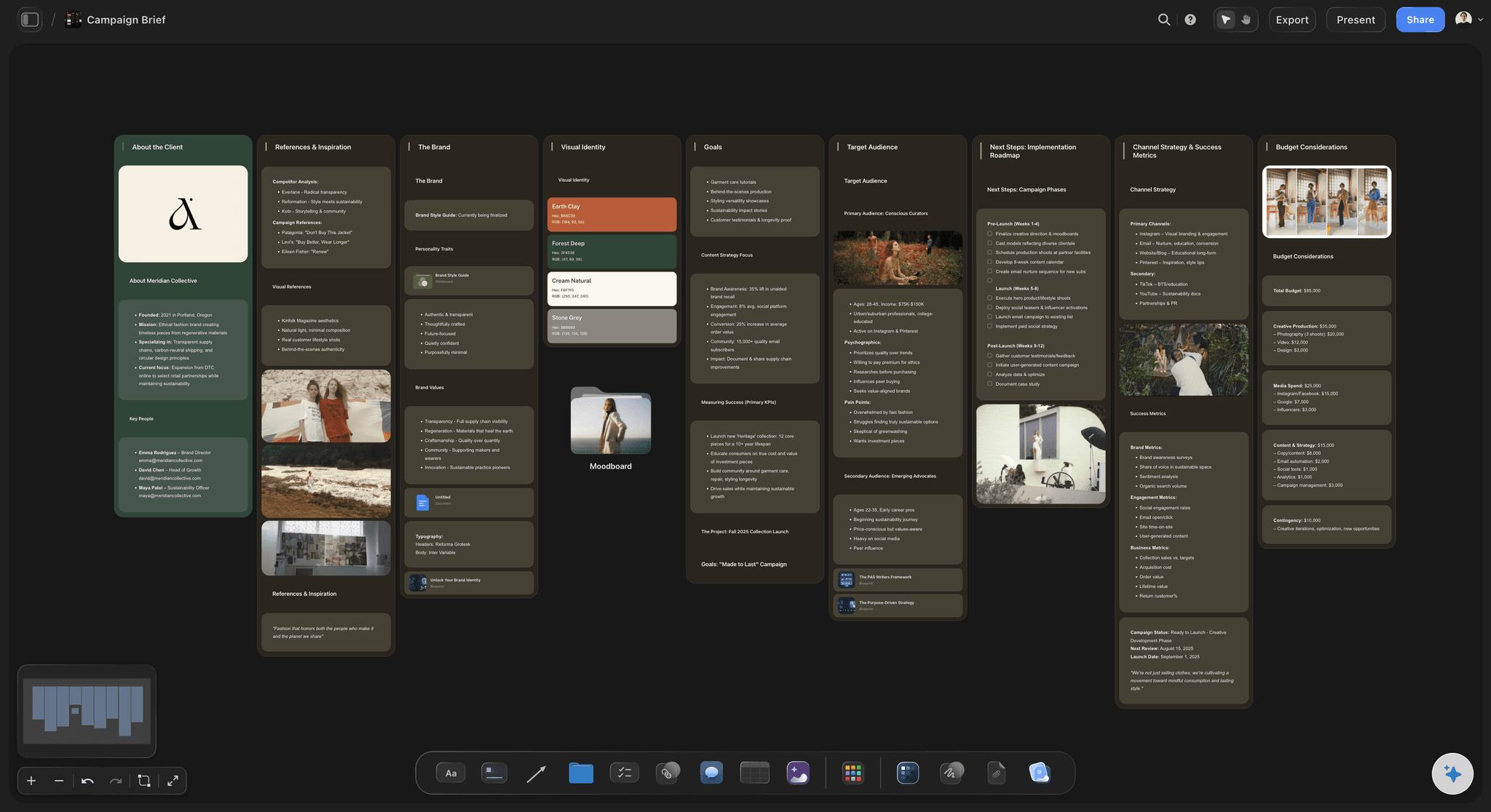
The scope as a Doc
Eleven sections, exported to Word or PDF
Write the scope in a Doc with a heading per section and inline comment threads on the clauses still being agreed. Export it to Word for the client's lawyer to redline.
See agency client project planning →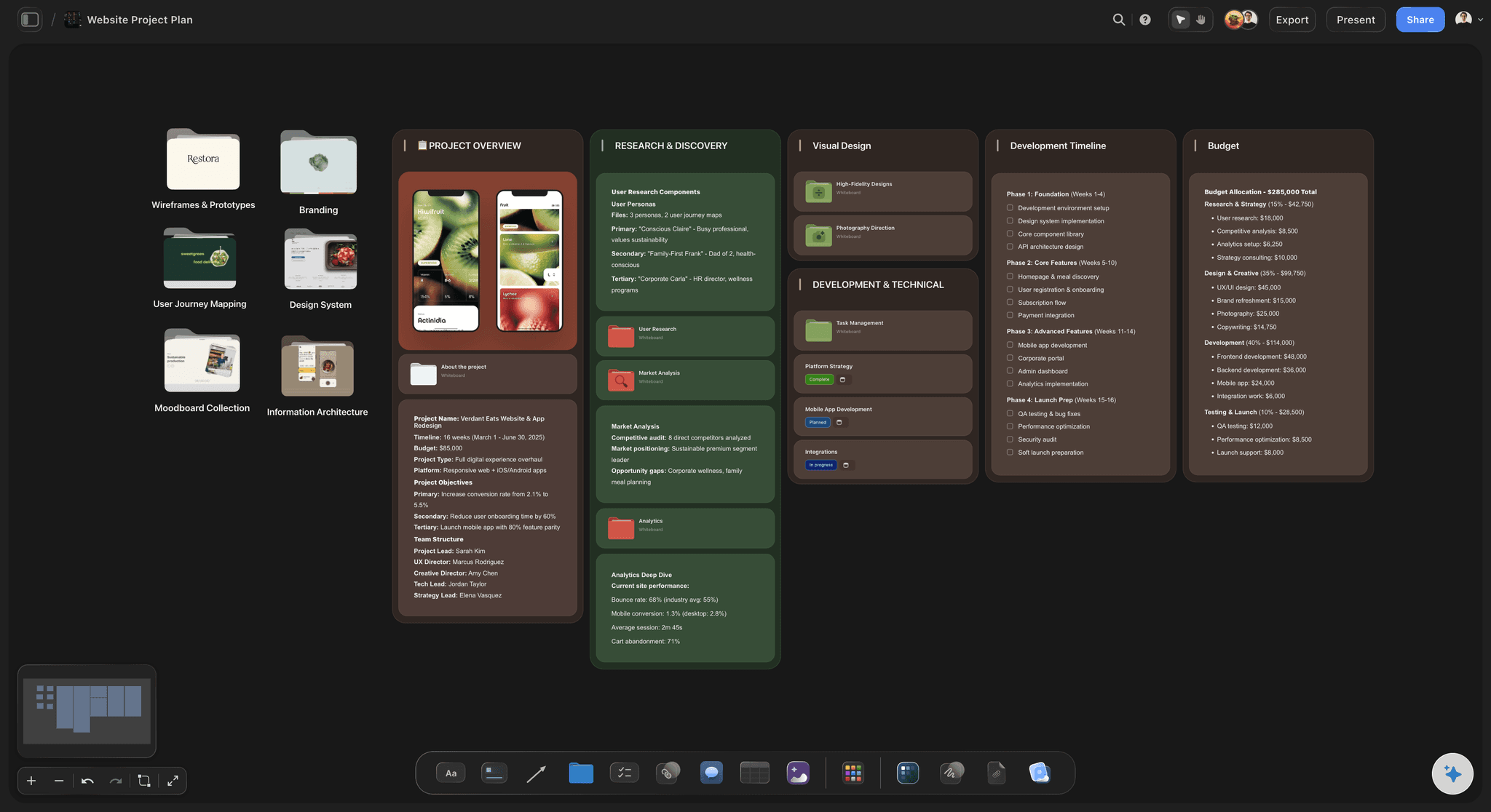
Every deliverable, specified
A table the scope can point to
Each deliverable is a row with its spec, count, owner, due date and status. When the client asks for "one more version", the row shows what was agreed before anyone argues about it.
See brief to project board →
Changes, logged and priced
The change log, with a running total
Every request outside what was agreed gets a dated row: what was asked, who asked, its cost in a currency cell, the days it adds and whether the client said yes. The Sum footer shows what the changes have added to the job so far.
See planning for a one-person studio →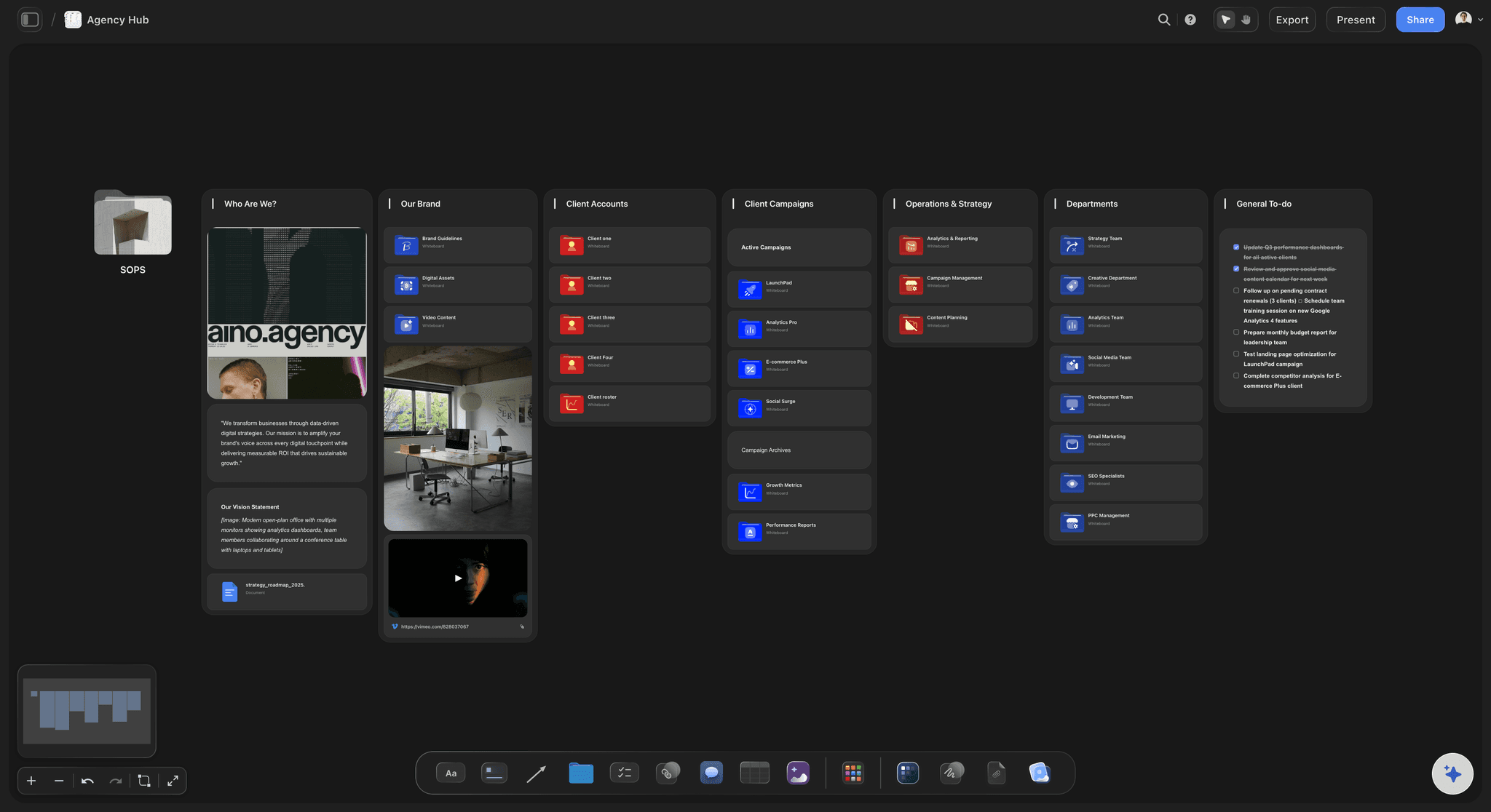
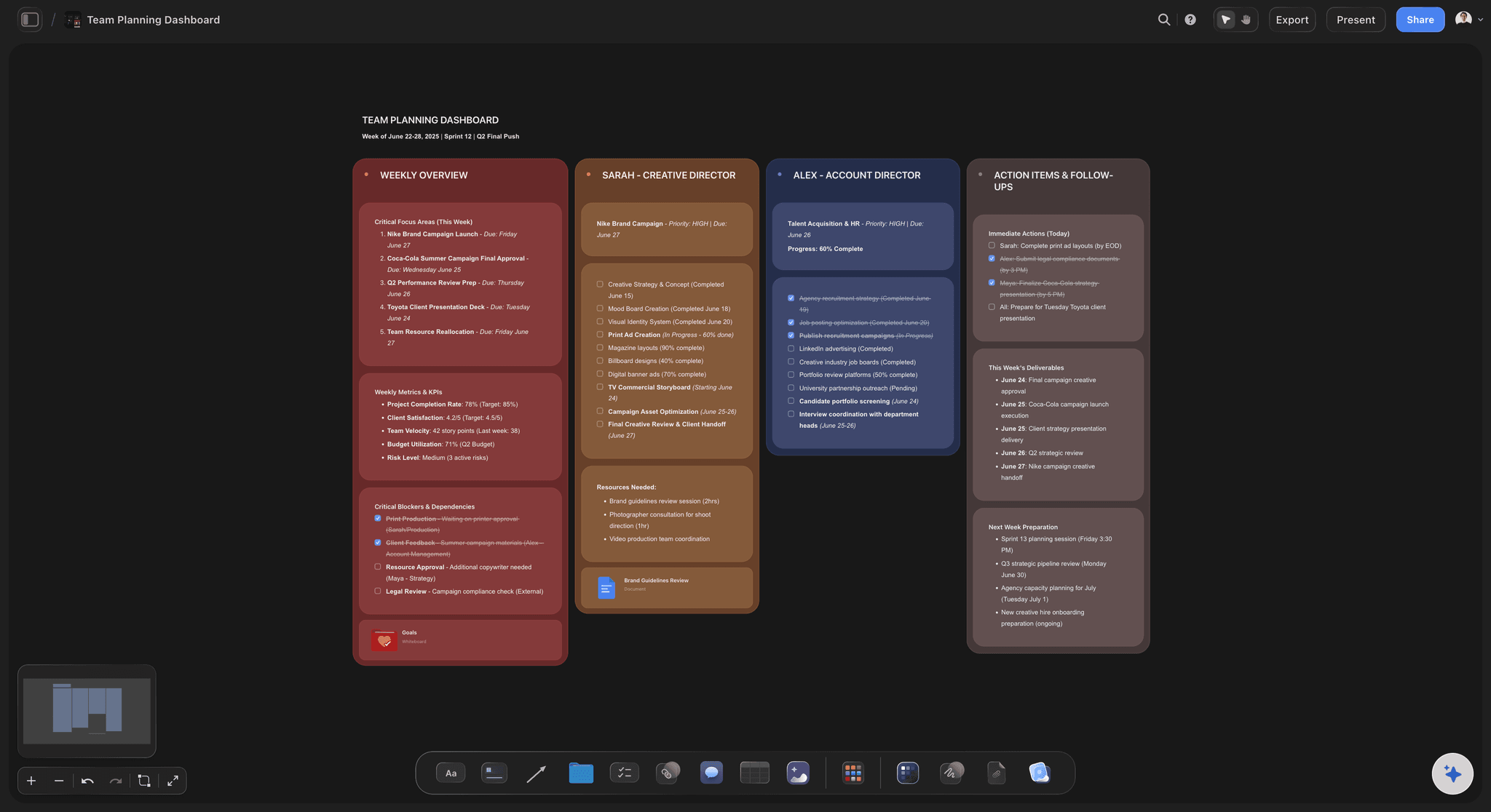
Read, questioned, agreed
The client reads the scope next to the work
The client opens the board from a view-only link with no account, and signs in to leave a comment beside a specific clause or deliverable. Export the Doc as a PDF when their procurement team wants a file.
See creative client onboarding →Each job's scope on its own board, and the good ones reused.
Copy the board of a job that ran to scope, keep its sections, exclusions and change-order rule, and rewrite the specifics. Storyflow is paid-only during early access, with plans from $7.99 a month billed annually ($9.99 monthly). A free plan launches before the end of 2026, and anyone a paid member invites to a board joins free.
A board per job, with unlimited boards and file uploads on every paid plan
Docs with inline comment threads that export to Word and PDF
Tables with date, status, person and currency cells
AI that drafts the scope and reviews it for gaps
Built for people with taste
What a scope of work has to pin down.
A common shape for a creative job signed under an MSA or a project contract. The exclusion examples in the last block are the part most templates leave out.
Sections 1 to 4 of 11
What is being made, and when
1. Objectives: What the work is for and how success will be judged, in two or three sentences the client would recognise from their brief. Objectives are the test for every later request: if it serves none of them, it is a new job.
2. Deliverables, with specs and counts: Each item with its format, size or length, versions, languages and delivery method, for example six packaging labels as print-ready PDFs with bleed and twelve 1080 by 1350 social posts as PNG. Anything not listed here is outside the scope.
3. Phases and milestones: The phases in order, each ending in a milestone the client can see, such as routes presented, route chosen or final files delivered. Payment stages hang on milestones, so name them the same way in the contract.
4. Timeline: A date for each milestone and the client's review window after each delivery, often three to five working days. Say that the dates move by as many days as a review or an input runs late.
Sections 5 to 8 of 11
The rules both sides work to
5. Revision rounds: How many rounds each deliverable includes and what one round is: a single consolidated set of notes from the named approver, sent within the review window. A second set of notes on the same round, or notes from someone new, starts the next round.
6. Client responsibilities and dependencies: What the client supplies and by when: final copy, logos, product samples, access to locations or systems, a named approver and notes on time. Write that the timeline depends on each item, because a late input is a delay nobody on your side caused.
7. Assumptions: The conditions your price and dates rest on, such as one shoot day in one location, English only, or photography supplied by the client. If an assumption breaks, the scope says the price and dates are reviewed.
8. Exclusions: Everything a reasonable client might expect that this job does not include, written as a list. Examples for design and for video are in the last block below.
Sections 9 to 11 of 11
Changes, acceptance and money
9. The change-order rule: Any request outside the deliverables, rounds or assumptions above is a change: the agency writes it up with its cost and its effect on the dates, and work on it starts only when the client approves that change order in writing. Approved changes are billed at the rates in the contract, and the timeline moves by the days they add.
10. Acceptance criteria: Who accepts each deliverable, against which spec and within how many working days, after which it counts as accepted. Acceptance is the point where a revision becomes a change.
11. Fees and payment, by reference: Point to the contract or MSA for fees, payment stages and late-payment terms rather than restating them, so the two documents never disagree. If the scope does carry the fee, use the milestones from section 3.
Before anyone signs: Have the terms reviewed by a lawyer where you work, because a template is not legal advice. Sign one final version and keep that copy where both sides can find it.
The out-of-scope list
Exclusions worth writing down
For design work: Extra concept routes, a new route after one is chosen, source files in native formats, copywriting, photography, printing and print management, website build and trademark searches. Font and stock image licences are bought by the client.
For video work: Raw footage and project files, further cutdowns or aspect ratios, subtitles in more languages, additional shoot days, talent usage beyond the agreed term and re-edits after picture lock. Music and stock footage licences cover only the usage the scope names.
For both: Rush delivery, meetings past the agreed check-ins, work for a second brand or market, and anything the client's other suppliers were meant to provide. Name the rate or the quote process beside each, so an exclusion reads as priced, not refused.
How to write the list: Write each exclusion as a thing, not a principle: "additional cutdowns" rather than "anything not listed". Walk the client through the list at kickoff, when saying no still costs nothing.
Explore templates for your project
Every template opens as a real, editable board on the infinite canvas. Pick the closest fit and make it your own.
Creative Brief
Capture the objective, audience, and message for a creative so everyone works from the same brief.
One app instead of five
Storyflow, Google Docs, PandaDoc or Notion for a scope of work?
Google Docs and PandaDoc are the stronger documents for redlining and signing, and Notion keeps the scope in a wiki. Storyflow keeps the agreed scope on a canvas, alongside the deliverables and changes it governs.
Storyflow
Recommended
Scope, deliverables and change log on one canvas
Exports the scope to Word
Built-in e-signature
Suggested edits you accept or reject
Change log that totals its costs
Google Docs
Scope, deliverables and change log on one canvas
Exports the scope to Word
Built-in e-signature
Suggested edits you accept or reject
Change log that totals its costs
PandaDoc
Scope, deliverables and change log on one canvas
Exports the scope to Word
Built-in e-signature
Suggested edits you accept or reject
Change log that totals its costs
Notion
Scope, deliverables and change log on one canvas
Exports the scope to Word
Built-in e-signature
Suggested edits you accept or reject
Change log that totals its costs
What creators are saying
Join early creators getting structured workspaces and AI that remembers their projects
“Storyflow has sped up my workflow by at least 3x, which means more flow state and more projects I can actually ship. It truly changed the way me and my team create.”

Reilin Joey
Director & YouTuber
“One prompt gets me a structured board. But the tactics are my favorite. I run my YouTube scripts through them and my intros and retention got better. It's amazing.”

Justkay
YouTuber & Freelance Filmmaker
“I used to juggle five apps to plan a project. Now I describe what I am making and get boards, lists, and a schedule. All in one place.”

George
@fernwehchronicles
Scope of work questions from agencies and studios.
Sections, specs, exclusions, change orders and sign-off, in plain words.
Storyflow is a scope of work template that keeps the agreed scope beside the work it governs: a Doc on the project board with Word and PDF export, with the deliverables table, milestones and change log around it, and a first draft written by the AI. The client opens it by link with no account and signs in to comment beside a clause. Collect the signature in PandaDoc, or in Google Docs on a paid Workspace plan.
Eleven sections: objectives, deliverables with specs and counts, phases and milestones, the timeline with review windows, revision rounds, client responsibilities and dependencies, assumptions, exclusions, the change-order process, acceptance criteria, and fees and payment by reference to the contract. Exclusions and acceptance criteria are the sections templates tend to skip, and they are the ones that end arguments.
In agency practice the names overlap. Strictly, the scope of work describes the work itself, while a statement of work is the whole project document signed under a master services agreement or a contract: the scope plus the timeline, acceptance, responsibilities and payment. Many creative agencies write one document and call it either; what matters is that all eleven sections are in it.
Detailed enough that a stranger could decide whether a request is included. Name every deliverable with its format, size, versions and file types, the number of concept routes and refinement rounds, who supplies copy and images, and what happens to source files. "Brand assets" is not a deliverable; "a letterhead, a business card and an email signature, each as a print-ready PDF or HTML file" is.
The deliverables with length, aspect ratio, format, captions and delivery method; shoot days, locations and crew; the edit and its review rounds; music and stock licences with their usage term; and everything the client provides, from locations to people on camera and their releases. Leave out raw footage and project files unless they are priced in, because those are the usual requests after delivery.
Everything a reasonable client might assume is included but is not. For design: extra routes, native source files, copywriting, photography, printing and trademark searches. For video: raw footage, further cutdowns, subtitles in more languages and extra shoot days. For both: rush work and licences beyond the agreed usage. Write each one as a thing, with its rate or quote process beside it.
When a request falls outside the scope, you write it up before doing it: what is asked, what it costs and how many days it adds. Work begins once the client agrees in writing, and the change is billed at the contract rates. In Storyflow each change is a dated row beside the scope, with a currency cell and a running total.
As one consolidated set of notes from the named approver, sent within the review window, on one version of one deliverable. Give each deliverable a fixed count of rounds, often two, and say that notes arriving after the window, or from someone new, open the next round. Changing an approved direction is not a round at all; it is a change order.
The rule for when a deliverable is finished: who accepts it, against which spec in the scope, and within how many working days. A common form is that a deliverable counts as accepted if no written notes arrive within five working days of delivery. Acceptance closes the rounds for that item, so later requests become change orders.
Yes, a first draft from your brief and proposal, and every line needs checking. Storyflow's AI writes the sections for you, lists each deliverable it finds, and can review your draft against the brief to name what it leaves open, such as a missing approver or an unpriced licence. It does not know your rates or your contract, so those stay yours.
No. Storyflow is not a contract or e-signature tool, and a template is not legal advice: have the terms reviewed by a lawyer where you work. Collect signatures in PandaDoc, in Google Docs on a paid Workspace plan, or in your agency's contract software. Keep the agreed copy on the board, so the scope and the work it governs stay side by side.
Not during early access. Storyflow is paid-only during early access, with plans from $7.99 a month billed annually ($9.99 monthly). A free plan launches before the end of 2026, and anyone a paid member invites to a board joins free. A client reading the scope never needs a plan of their own.
More from Storyflow
Agency client project planning
Design proposal template
Project brief template
Brief to project board
Creative client onboarding
Planning client projects as a one-person studio
Creative agency software
Video production proposal template
Brand identity project plan
Client review board
Design brief template
How to stop scope creep on a creative project
How to scope a shoot before you have a budget
Pricing
RFP response plan
Creative retainer plan
Write down the edges before the first request arrives.
Start from the option the client chose, list what the job leaves out, and keep the scope where the work happens.