
Elevated brand work, made with taste
A brand identity project plan
with the client's homework in it.
Discovery, strategy, directions, concepts, refinement and handoff, each with its weeks, its presentation and what the client owes before it starts.


Creatives working for these brands already got early access
- Red Bull
- Canon
- Artlist
- Porsche
See how easy it is to get started
Watch a real project come together, from a blank board to a finished plan, clicked through step by step.
Start from a ready-made template
Pick a board to see what you can build, then let AI fill it in. Every template is a real, editable starting point on the same infinite canvas.

Brand Strategy
Define your positioning, values, and voice and connect them into a strategy the team can follow.
What goes in a brand identity project plan?
A brand identity project plan is the schedule a studio and its client both commit to: the phases from discovery to handoff, the weeks each takes, what the client has to hand over at each step, and the meetings where you present. Storyflow is an AI visual workspace that holds that plan on one infinite canvas: the phases and their weeks, the strategy, the moodboards and the presentation beside them, and a first version the AI drafts from your brief.
Put the client's homework in the plan. Every phase waits on something: questionnaire answers before discovery, a named decision-maker before strategy, consolidated notes within five working days of each presentation, font licences before handoff. Write each as a dated row with the client as owner, so when a date slips, the plan shows whose move it was.
Sell the strategy before the logo. A client who agreed the positioning, audience and personality in week three judges concepts in week six against those words instead of their taste. Give the strategy its own meeting and its own sign-off. Skip it, and the first concept meeting turns into the strategy argument, with a logo on the screen.
Directions first, then concepts. Show two or three moodboard directions in week four and ask the client to choose one, then design two or three concepts inside it. A direction costs a day to change and a logo costs a week. A client who picks one direction and then wants another's colours is asking for a new direction, and the plan should say so.
Ultra fast from brief to board
Ten weeks, run from one board.
The schedule, the thinking and the presentations, built as the job moves.
01
Paste the brief and the launch date
The AI drafts the phase plan backwards from the date the brand has to exist: six phases, their weeks, the three presentations and a row for everything the client must send. You move the dates to fit your studio's other jobs.
02
Run discovery onto the board
Paste the questionnaire answers and workshop notes, and drop in competitor screenshots. The AI's brand strategy workflow drafts positioning, audience, values and voice from them for you to cut down to what is true.
03
Build the directions, then present
The brand moodboard workflow gathers images for each direction and you curate them to twelve or twenty. Put each direction in a frame and step through them fullscreen on the call.
04
Refine, write the guidelines, hand off
Log each round of feedback beside the concept it is about. Draft the guidelines outline in a doc on the board, while the logo files themselves are drawn and exported in your design software.
Every phase of the identity job, on one board.
The schedule and the thinking. The marks themselves are drawn in your design tool.

The schedule the client agreed
Phases, dates and owners in one table
Each phase is a row with its weeks, a status cell and an owner, with rows kept in date order. The client's tasks sit in the same table under their name, so the schedule and their part in it are one page.
See agency client project planning →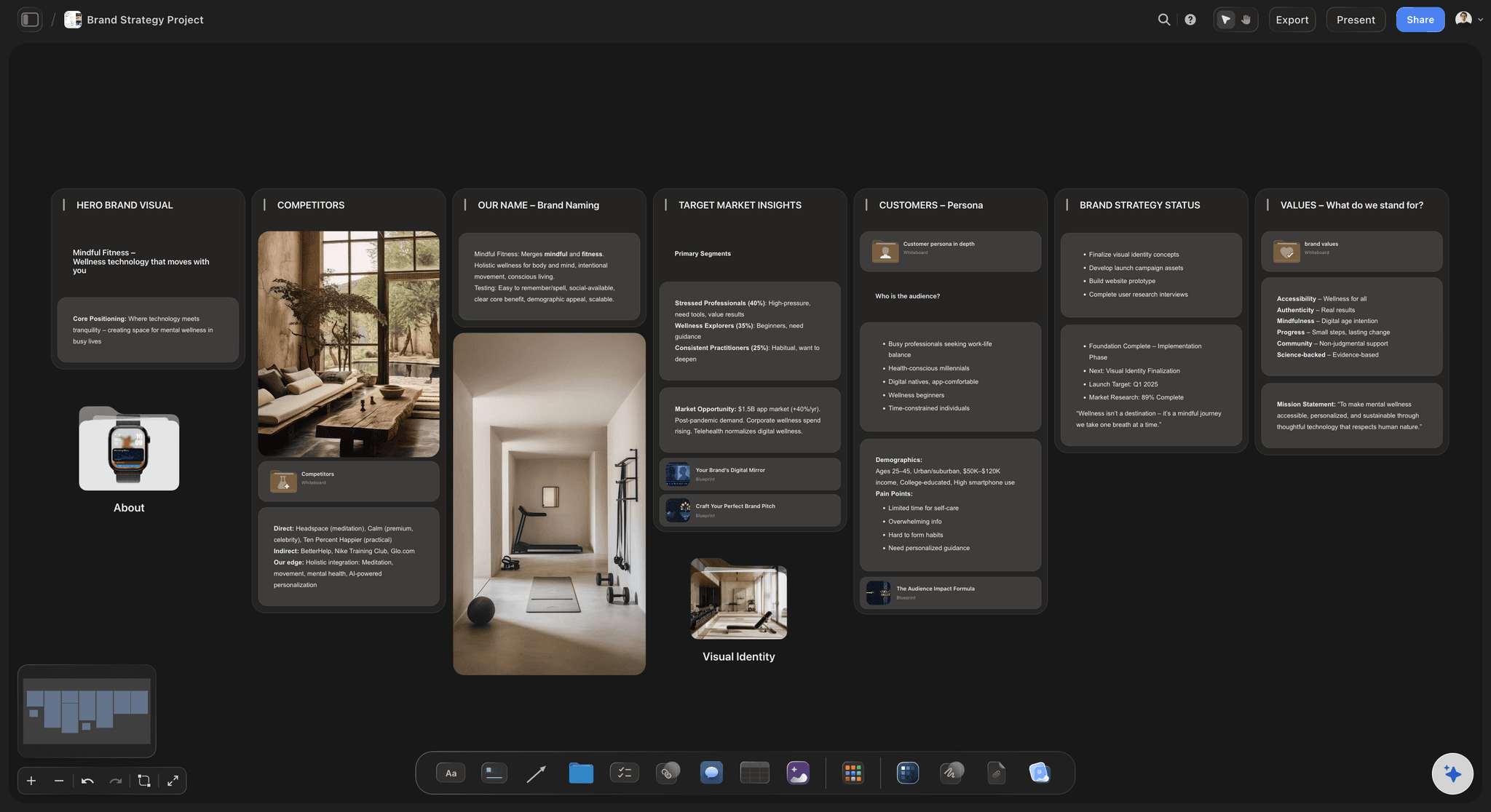
Discovery that becomes the strategy
Positioning, audience and personality from the notes
Workshop notes and questionnaire answers sit next to the strategy drafted from them: the positioning line, the one buyer, the values, the voice and the real competitors. The client signs off the page, not a summary of it.
See the brand strategy tool →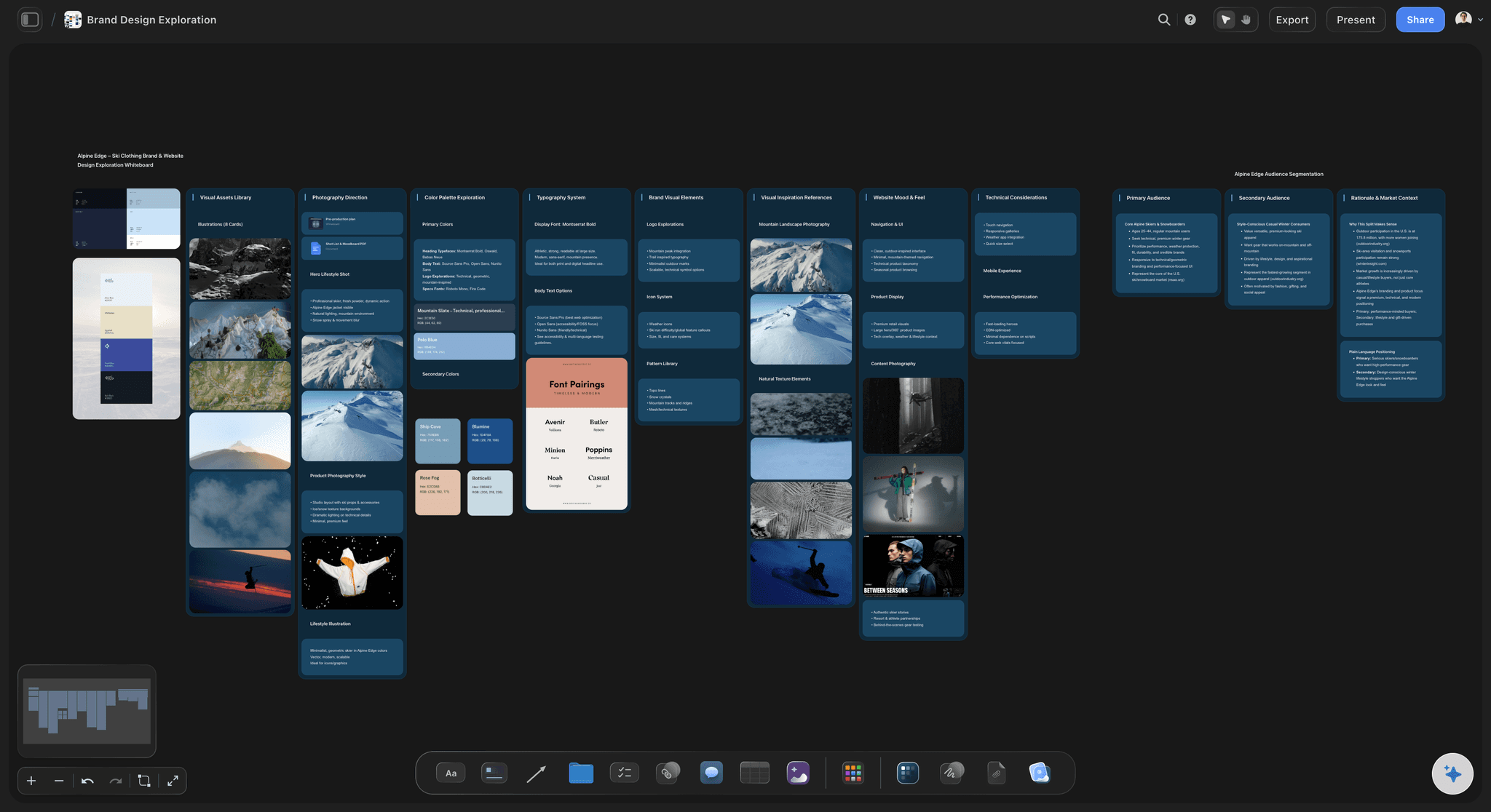
Two or three directions, side by side
Moodboards the client can choose between
Each direction gets its images, a palette of colour swatches with values, type references and one sentence tying it back to the strategy. The AI can gather a first pass and propose a palette; you decide what stays.
See the brand moodboard maker →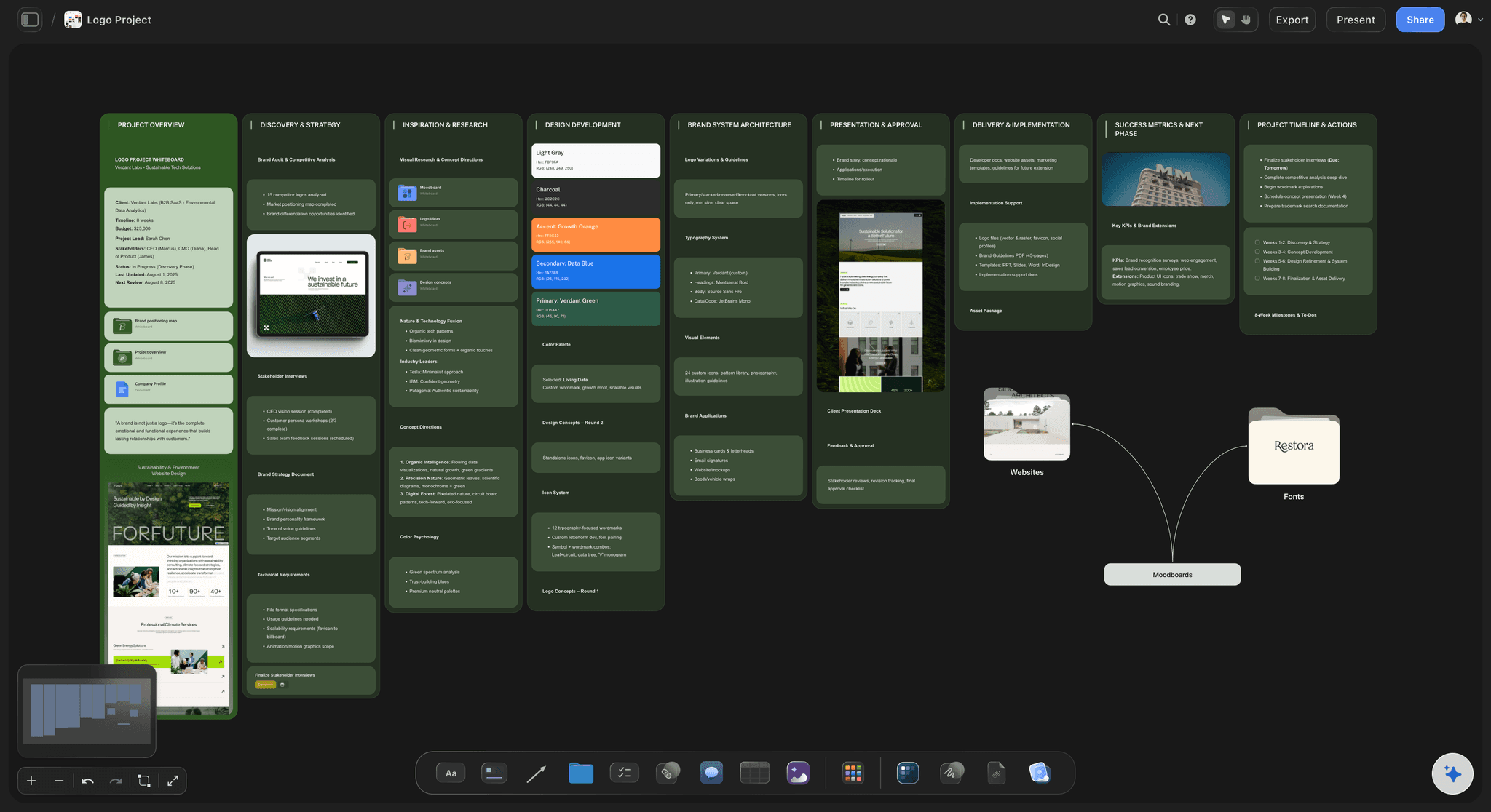
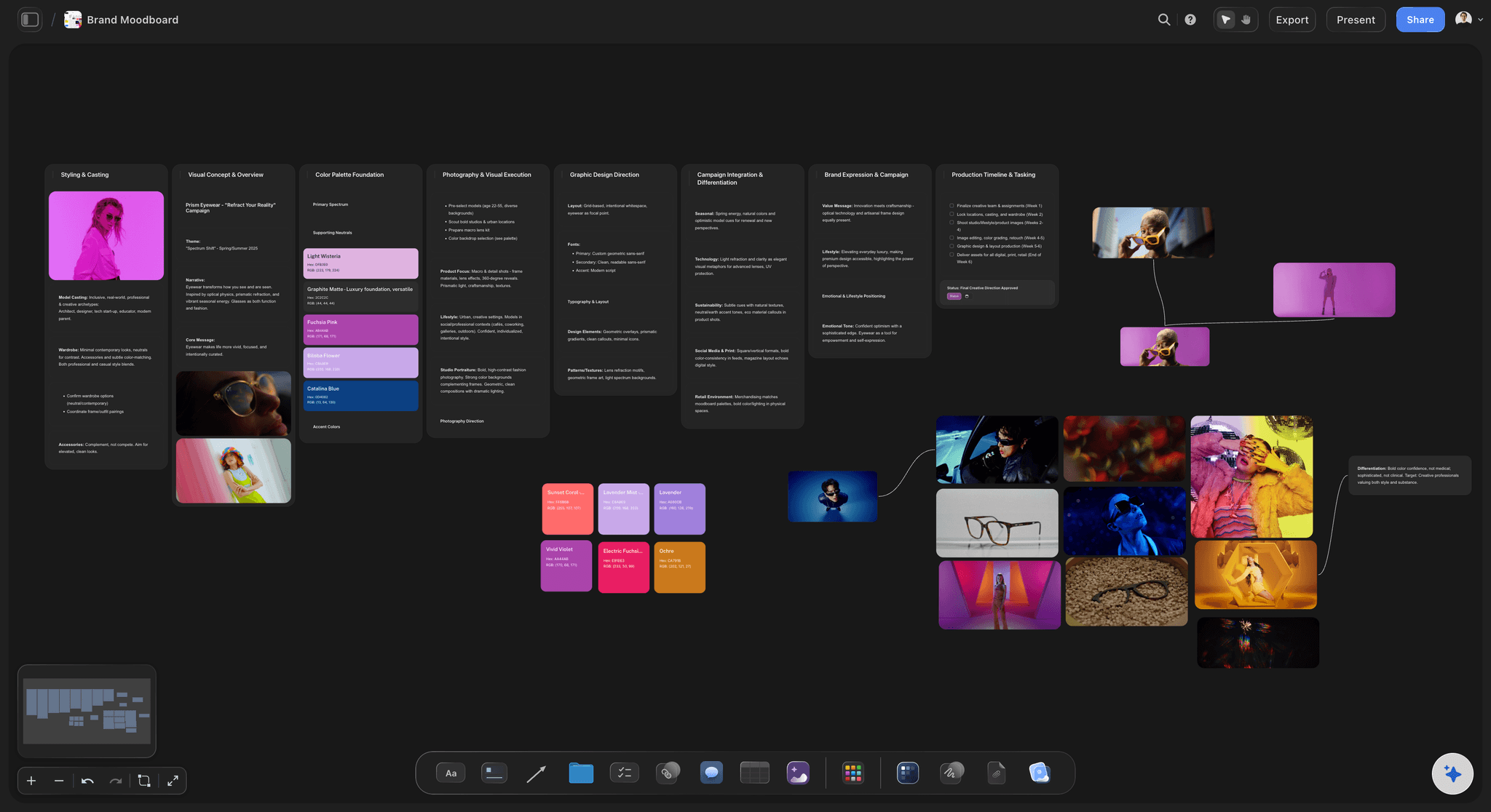
Presented on the call, sent after it
One board for every presentation
Step through the strategy, the directions or the concepts fullscreen, one frame at a time. Afterwards the client opens the same board from a view-only link with no account, and signs in to comment beside a concept. Export the whole board as a PDF for anyone who wants a file.
See the client presentation tool →One board per identity job, kept for the next one.
Start the next identity job from a copy of the last good one, so the phases, presentations and client tasks are already in place. Storyflow is paid-only during early access, with plans from $7.99 a month billed annually ($9.99 monthly). A free plan launches before the end of 2026, and anyone a paid member invites to a board joins free.
Unlimited boards and image uploads on every paid plan
AI that drafts the phase plan, the strategy and moodboard directions from your notes
Tables with date, status and person cells for the schedule and the client's side of it
Presentation mode, view-only links and whole-board PDF export
Built for people with taste
Six phases over ten weeks, with the client's part in each.
A common shape for a focused identity: logo, type, colour, imagery and guidelines, with no naming or website. Use it whether or not you use Storyflow. Stretch a phase when the job needs it; do not drop one.
Weeks 1 to 3
Discovery and strategy
Phase 1. Discovery (weeks 1 and 2): A questionnaire before kickoff, a two to three hour discovery workshop with the founders, three to five stakeholder or customer interviews, and a look at the category and existing assets. The client owes the questionnaire back three working days before the workshop.
Phase 2. Strategy (week 3): Positioning in one line, the audience, the personality, the values and the voice, on one page the client can sign. The common mistake is writing twelve adjectives; a strategy is useful when it rules options out.
Presentation 1: the strategy: Present it live at the end of week three rather than emailing it, and ask for written sign-off by a named date. Every later presentation opens with one slide recalling it.
Weeks 4 to 6
Directions, then concepts
Phase 3. Moodboard directions (week 4): Two directions, three at most, each with twelve to twenty images, a palette, type references and a sentence tying it to the strategy. The client chooses one. Four or more reads as a studio that has not decided.
Phase 4. Identity concepts (weeks 5 and 6): Two or three concepts inside the chosen direction, each with the mark, a type pairing and a palette, applied to three or four of the client's real touchpoints: a site header, a social avatar, packaging or signage. A logo on a white page gets judged on taste.
Presentations 2 and 3: Directions at the end of week four, concepts at the end of week six. Each ends with one decision the client makes in the room or by a date you name, and the next phase does not start without it.
Weeks 7 to 10
Refinement, guidelines and handoff
Phase 5. Refinement (weeks 7 and 8): Two rounds on the chosen concept. A round is one set of consolidated notes from the decision-maker, sent by the agreed date. A new concept or a return to a rejected direction is a change order, priced separately.
Phase 6. Guidelines (week 9): Logo versions, clear space and minimum sizes, colour values in HEX, RGB and CMYK (Pantone if they print), the type hierarchy, imagery rules and voice. Write rules with an example beside each, or nobody follows them.
Handoff (week 10): The file package: every logo version in SVG, PNG and PDF, colour and one-colour, each lockup, plus the guidelines and a thirty-minute handoff call. Final files go out on final payment.
The terms
What the plan says about money and time
Payment tied to phases: A common structure is half on signing, a quarter when a concept is chosen and a quarter before final files. Tying payments to phases means a stalled client is also a client who has not paid for the next part.
The late-notes rule: If the client's notes arrive late, the schedule moves by the same number of days. After an agreed stretch of silence, often thirty days, the project pauses and the next payment falls due.
Ownership and licences: Rights in the final identity transfer on final payment. Fonts and stock images are licensed in the client's name, and a trademark search belongs to the client's lawyer, not the studio.
What is out of scope: Naming, the website, packaging production and photography are each quoted separately. Write them down, or the plan quietly grows to include them.
Explore templates for your project
Every template opens as a real, editable board on the infinite canvas. Pick the closest fit and make it your own.
Brand Strategy
Define your positioning, values, and voice and connect them into a strategy the team can follow.
One app instead of five
Milanote, Notion and Figma each hold one piece of the job.
Storyflow holds the plan and the thinking around it. Figma draws the marks, Notion holds documents and databases, and Milanote collects visual references on boards.
Storyflow
Recommended
Moodboards on a free-form canvas
Tasks with due dates and assignees
Client views it by link with no account
Vector logo design
AI drafts the phase plan from your brief
Milanote
Moodboards on a free-form canvas
Tasks with due dates and assignees
Client views it by link with no account
Vector logo design
AI drafts the phase plan from your brief
Notion
Moodboards on a free-form canvas
Tasks with due dates and assignees
Client views it by link with no account
Vector logo design
AI drafts the phase plan from your brief
Figma
Moodboards on a free-form canvas
Tasks with due dates and assignees
Client views it by link with no account
Vector logo design
AI drafts the phase plan from your brief
What creators are saying
Join early creators getting structured workspaces and AI that remembers their projects
“Storyflow has sped up my workflow by at least 3x, which means more flow state and more projects I can actually ship. It truly changed the way me and my team create.”

Reilin Joey
Director & YouTuber
“One prompt gets me a structured board. But the tactics are my favorite. I run my YouTube scripts through them and my intros and retention got better. It's amazing.”

Justkay
YouTuber & Freelance Filmmaker
“I used to juggle five apps to plan a project. Now I describe what I am making and get boards, lists, and a schedule. All in one place.”

George
@fernwehchronicles
What studios ask before an identity job starts.
Phases, weeks, the client's part, revision rounds and getting paid.
Storyflow, because an identity plan only works when the client's deadlines sit beside the work they hold up: the six phases with weeks, the client's tasks, the strategy, the moodboard directions and the presentations, on one board the client opens by link with no account or reads as a PDF. Draw the marks in Figma or Illustrator. Use Milanote if you only need a reference board, and Notion if your plan lives in documents.
A focused identity (logo, type, colour, imagery and guidelines) commonly runs eight to twelve weeks. A logo on its own can take three to five. Add two to four weeks for naming, and more for a website or packaging range. Most overruns come from the client's review windows rather than the design, which is why each presentation in the plan carries a date for their notes.
Six: discovery (research, workshop, interviews), strategy (positioning, audience, personality, voice), moodboard directions (the client chooses one), identity concepts (inside that direction, applied to real touchpoints), refinement (two feedback rounds) and guidelines with handoff. Naming, a website and packaging are separate phases with their own weeks when the job includes them.
Before discovery: questionnaire answers, existing assets and a list of competitors. Before strategy: one named decision-maker and time for interviews. After each presentation: one merged set of feedback by the agreed date. Before handoff: font and stock licences bought in their name, and the final payment. Put each item in the plan as a dated task with the client as owner.
Two rounds of refinement on the chosen concept is a common default. Define a round as one merged list of changes from the decision-maker, and a new concept or a return to a rejected direction as a change order with its own price. A third round can be sold as an option rather than given away when the second one runs long.
Two or three, all inside the direction the client already chose, each applied to three or four of their real touchpoints. More than three tells the client you have not made a choice, and a single concept invites a yes or no instead of a comparison. Open the meeting by recalling the agreed strategy so each concept is judged against it.
Every logo version and lockup in SVG, PNG and PDF, in full colour, one colour and reversed; colour values in HEX, RGB and CMYK, plus Pantone for print; the typefaces and where the client licenses them; imagery rules; and the guidelines as a PDF. A short handoff call walking the client's team through the guidelines saves weeks of misuse.
Tie payments to phases. A common structure is half on signing, a quarter when a concept is chosen and a quarter before final files, which go out on final payment. Add a late-notes rule that moves the schedule by the days lost, and a pause after an agreed stretch of silence. Storyflow shows the schedule; your contract tool collects the payments.
Ask what they like in each, in words, and check it against the strategy they signed. Often it is one element, such as a colour or a letterform, that can move into the stronger concept inside a refinement round. A genuine merge of two concepts is new design work and a change order. Agreeing that rule at kickoff makes the conversation easy.
It can draft the plan and the thinking, and you decide. Paste the brief into Storyflow and the AI lays out the phases backwards from the launch date, drafts the strategy from your discovery notes, gathers images for moodboard directions and proposes palettes. It does not design the logo, and it dates the plan only from the launch date you give it.
No. Storyflow holds the plan and the creative thinking behind the identity. Contracts, e-signature, deposits and invoices belong in HoneyBook, Dubsado or Bonsai, and the logo files are exported from your design software and delivered from your shared drive. One setup that works: the plan's link pasted into the contract those tools send.
Not during early access. Storyflow is paid-only during early access, with plans from $7.99 a month billed annually ($9.99 monthly). A free plan launches before the end of 2026, and anyone a paid member invites to a board joins free. Your client pays nothing to open the plan.
More from Storyflow
Brand discovery workshop
Brand strategy tool
Brand moodboard maker
Brand personality template
AI brand guidelines generator
Rebrand planner
Design brief template
Client presentation tool
Creative client onboarding
Agency client project planning
Style guide maker
How to build a brand style guide
How to present design concepts to clients
Pricing
Design proposal template
Brand identity presentation
Agree the weeks before you draw a mark.
Paste the brief, set the launch date, and send the client a plan with their part in it.