
Ultra-fast planning, extremely simple
Scope creep on creative projects
is a process problem, not a client problem.
Why it happens, the five lines that prevent most of it, a change request process that clients accept, and a worked example with real numbers from a brand identity job.


Creatives working for these brands already got early access
- Red Bull
- Canon
- Artlist
- Porsche
See how easy it is to get started
Watch a real project come together, from a blank board to a finished plan, clicked through step by step.
Start from a ready-made template
Pick a board to see what you can build, then let AI fill it in. Every template is a real, editable starting point on the same infinite canvas.

Mind Map
Branch one central idea out into themes and sub-points, then drag the connections around until the structure makes sense.
How do you prevent scope creep on creative projects?
Scope creep on creative projects is the slow growth of work beyond what was agreed, usually through small client requests that each seem too minor to charge for. Storyflow is an AI visual workspace that helps freelancers and small studios prevent it by keeping the agreed deliverables, revision rounds and change requests on the same board as the work, so every new request is checked against the scope before anyone starts on it.
Prevention comes down to five lines written before the work starts: the exact deliverables with a count, the number of revision rounds, what a round is, what is out of scope, and what happens when the client asks for something new. Most creep happens in the gaps between those lines. 'Logo design' without a count invites a fourth concept. 'Two rounds of revisions' without a definition invites forty emails that each say 'one small thing'.
Handling it is the other half. When a request arrives, you do three things in order: check it against the scope, tell the client whether it is in or out within one working day, and if it is out, send a short change request with a price and a date impact. The client then decides. You are not refusing work; you are making the cost visible so the client can choose.
Creative work is more exposed than most because the deliverable is a judgement, not a specification. A plumber finishes when the pipe stops leaking. A designer finishes when the client says it is right, and 'right' moves as the client sees options. That is why the revision round, not the hourly rate, is the unit that protects your margin on a creative job.
A worked example. Mara runs a one-person brand studio and quotes $6,000 for a brand identity for a coffee roaster: three logo concepts, one refined to final, a palette, two typefaces, a 12 page guidelines PDF and six social templates, with two rounds on concepts and two on the final, over six weeks at an internal rate of $80 an hour (75 hours). In week three the founder asks for packaging labels for four bag sizes; Mara logs it, estimates 9 hours, and sends a change request for $720 and four extra days, which is approved. In week four the co-founder asks for a fourth logo concept after the second was approved; that is a direction change, quoted at $960 for 12 hours, and the founder declines it. In week five the client asks for a third round on the final; the agreement prices an extra round at $320, the client accepts. The project closes at $7,040 instead of $6,000, and the log shows exactly why. Without the log, doing all three requests for free would have meant 100 hours for $6,000, an effective rate of $60 an hour.
This page is about the process of preventing and handling creep during a project. If you need the document itself, the scope of work with its sections and clauses, see the creative scope of work page. The two belong together: the scope of work sets the line, and the process on this page is how you hold it for eight weeks while the client keeps having ideas.
Ultra fast from brief to board
What is the process for handling a change request?
Six steps from the moment a client asks for something new to a signed decision. The whole loop should take less than two working days.
01
Log the request where the scope lives
Copy the client's words into a change request log on the project board, with the date and who asked. In Storyflow that log is a table beside the deliverables list, so nothing lives only in an email thread.
02
Check it against the scope
Read the deliverables and the out-of-scope list. Is this a new deliverable, an extra round, a change of direction after approval, or a fix inside an agreed round? Only the last one is free.
03
Price it and date it
Estimate the hours, multiply by your rate, and say how it moves the delivery date. Storyflow's AI can draft the estimate from the request and your earlier project tables; you check the number.
04
Send a short change request
Three lines: what was asked, what it costs, how it moves the date. Offer the alternative of dropping something else of equal size. Send it within one working day.
05
Wait for a written yes
Do not start until the client approves in writing. An email reply is enough. Mark the row in the log as approved, declined or swapped.
06
Update the scope and the invoice
Add the approved item to the deliverables list and to the next invoice. At the end of the project the log shows every change and what it was worth.
What causes scope creep in creative projects?
Four causes account for most of it. Each one is a gap in what was agreed, not a difficult client.
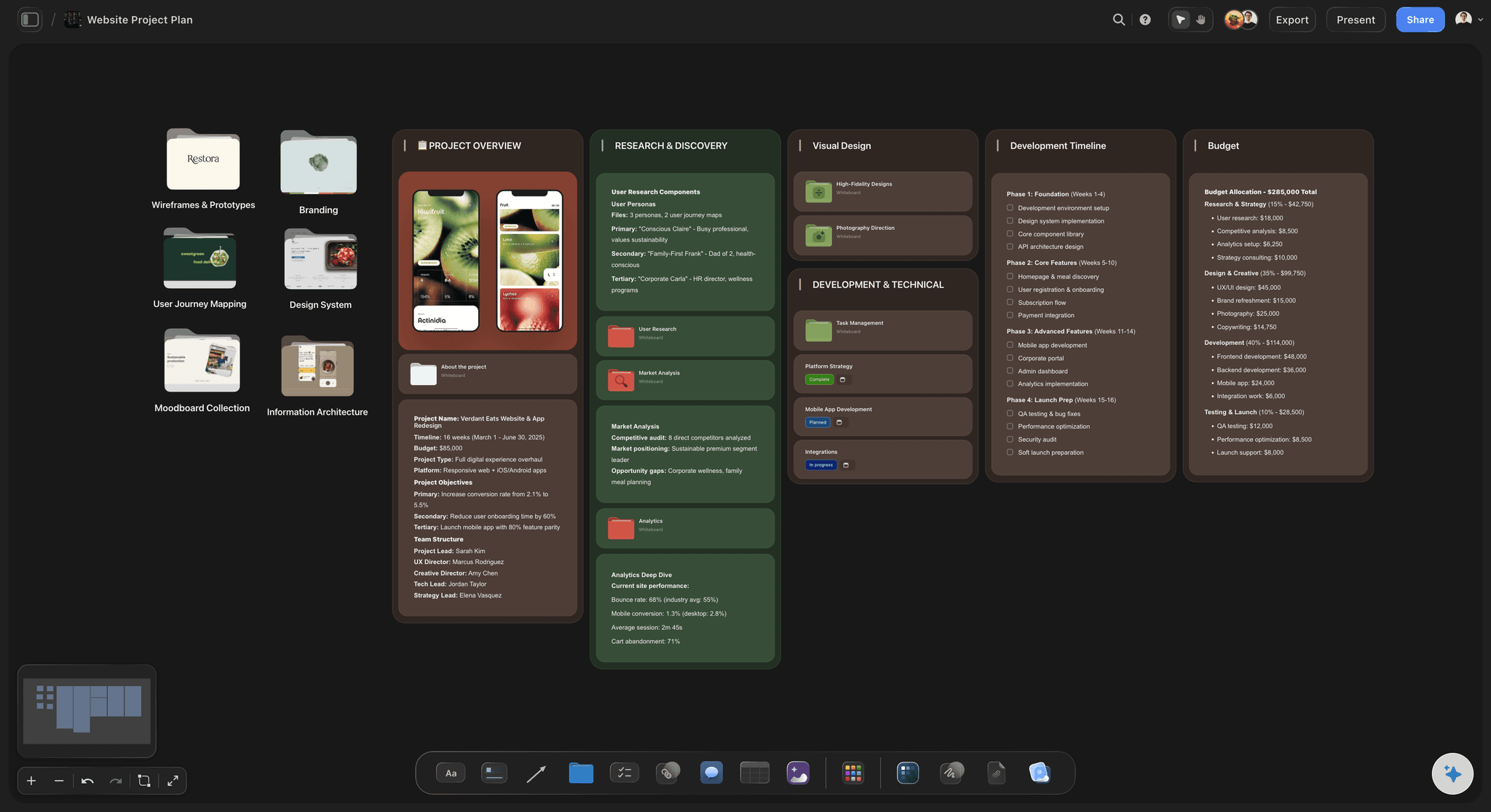
Vague deliverables
No count, no format, no finish line
'Social assets' and 'brand guidelines' can mean five files or fifty. Write the number, the format and the size of every deliverable before you quote.
See the creative scope of work →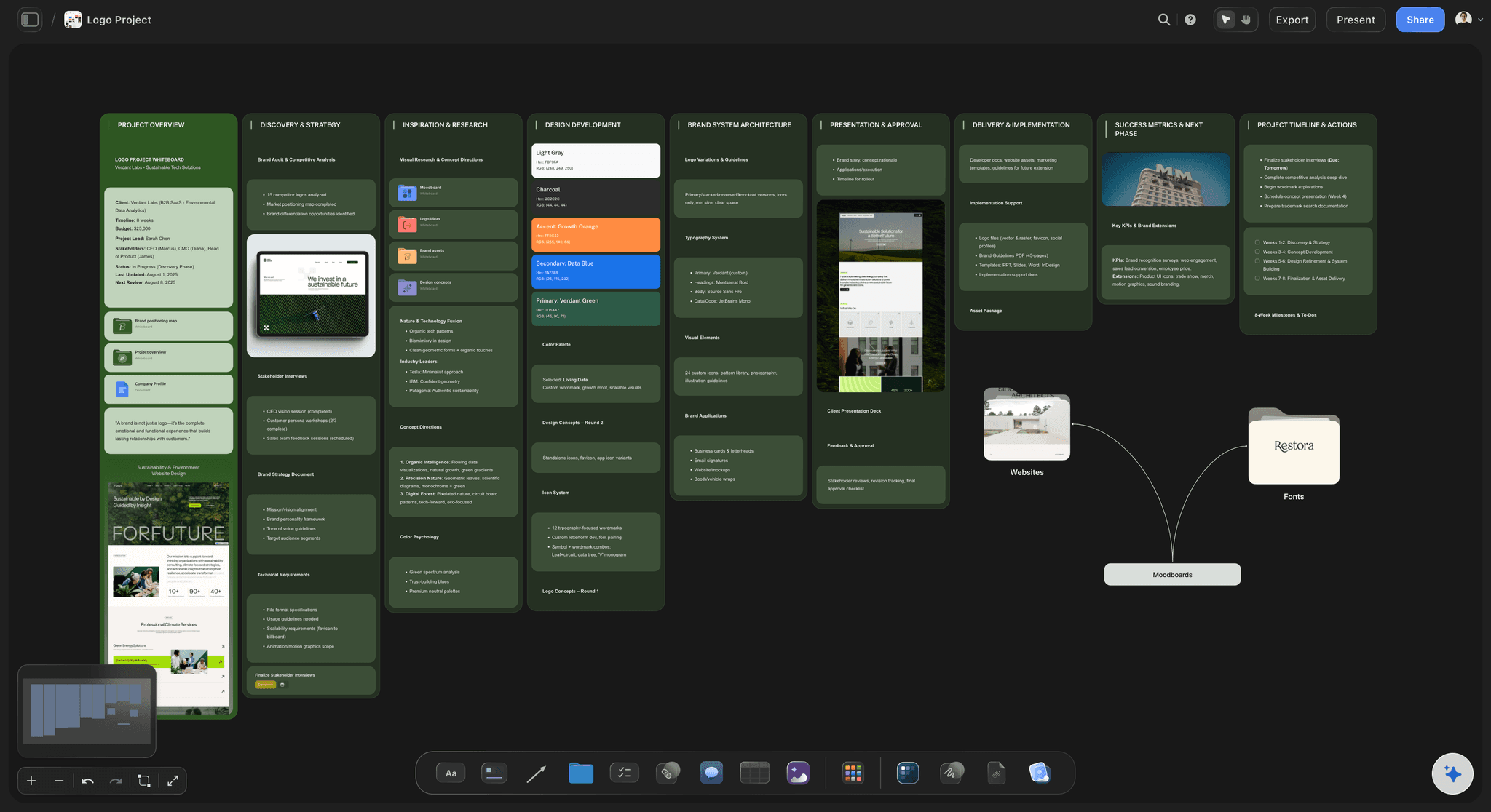
Undefined revisions
Rounds that never end
A round is one consolidated set of feedback from one person, answered once. Without that definition, every email is a new round.
See the client review board →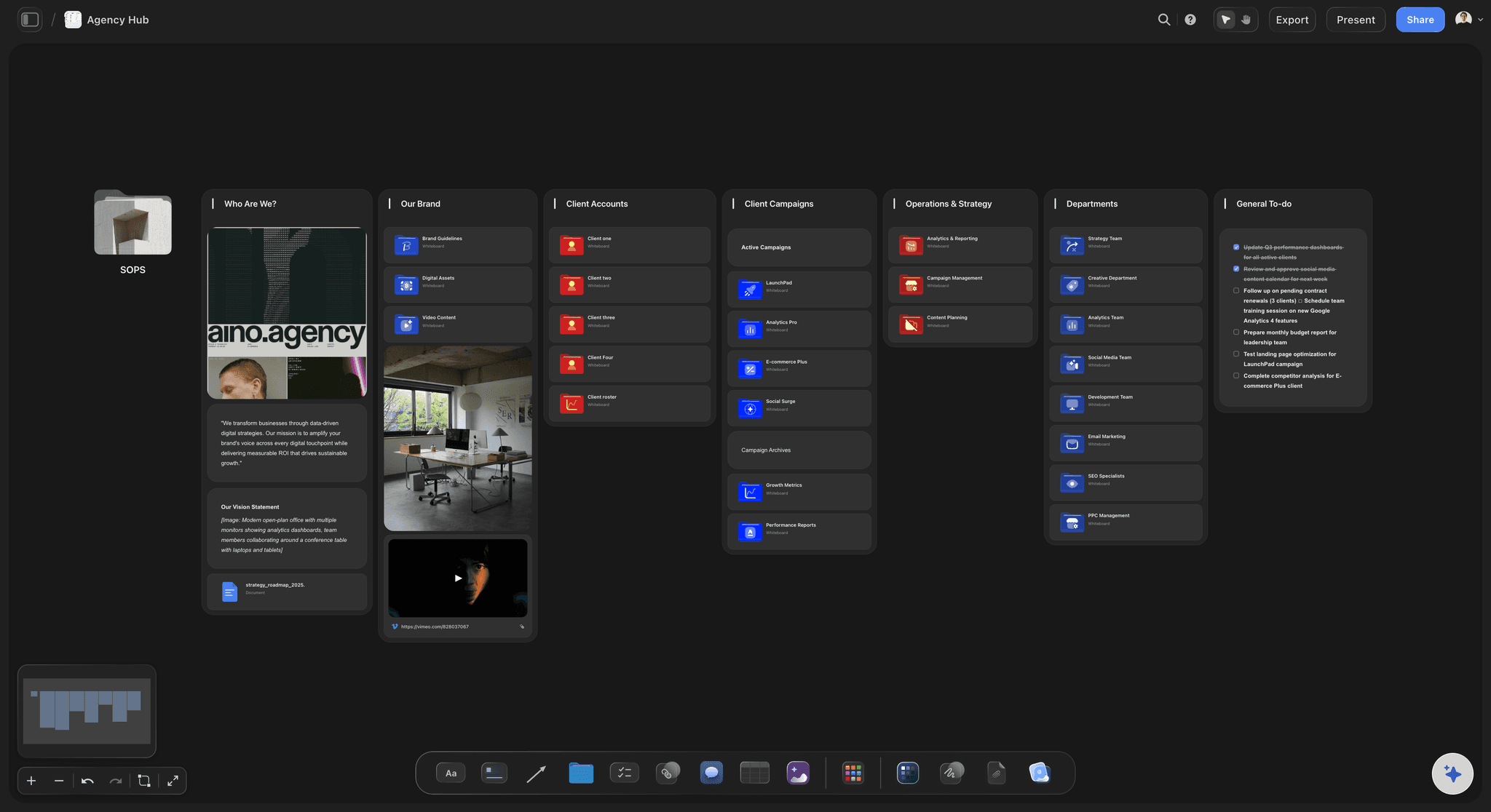
Too many approvers
Feedback from people you never met
The founder approves the concept, then the head of sales sees it and wants changes. Name one approver in writing, and say that late feedback from others is a change request.
See freelancer onboarding →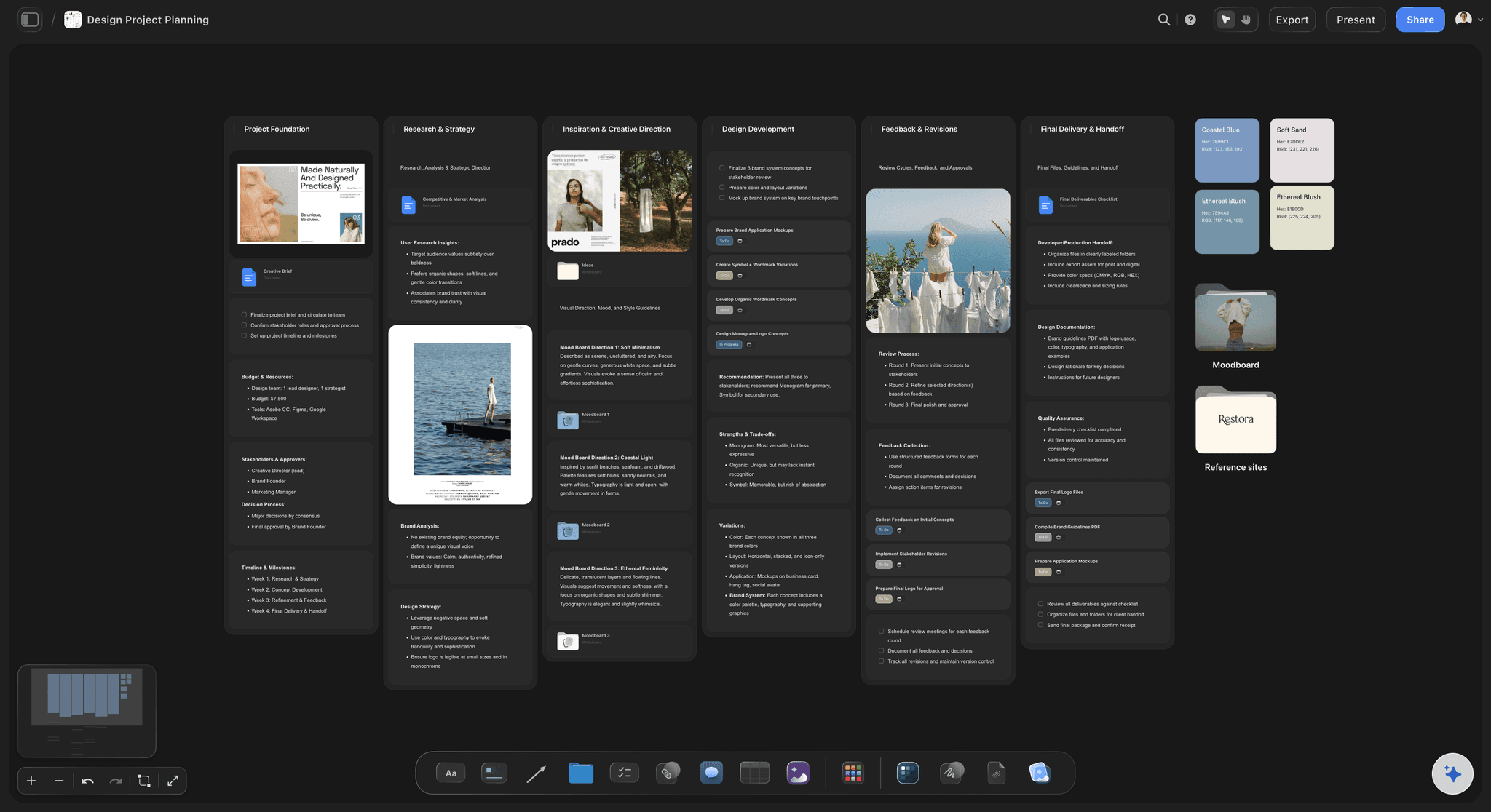
Direction changes after approval
Going back to a signed-off step
A new logo direction after the logo was approved is not a revision. It is the start of a new design phase and it is priced like one.
See solo studio project planning →The scope, the work and every change request on one board.
Keep what was agreed next to what is being made, so a new request is compared to the scope the moment it arrives. Storyflow is paid-only during early access, with plans from $7.99 a month billed annually ($9.99 monthly). A free plan launches before the end of 2026, and anyone a paid member invites to a board joins free.
AI that reads a brief or contract and lists what is in and out of scope
A deliverables table with counts, formats and a revision column
A change request log with price, date impact and status
Client review by view-only link; the client signs in to comment
Tickets with an assignee and a due date for each approved change

Built for people with taste
How do you write scope so it holds?
Three blocks of the agreement do most of the work. Write them before the deposit is paid, not after the first awkward email.
Deliverables
Count everything
A number for each item: Three logo concepts, one refined into a final. Twelve icons. Six social templates in two sizes. Counts end arguments before they start.
Formats and sizes: SVG, PNG and PDF; 1080 by 1350 and 1080 by 1920. A format the client adds later is a new file, and a new file has a cost.
What 'final' means: Say which files they receive at the end and whether source files are included. Many disputes at handover are about Figma or Illustrator files nobody mentioned.
An out-of-scope list: Name the five things clients most often assume are included: copywriting, photography, printing, web development, extra stakeholders.
Revisions
Define a round
One consolidated list: A round is all the feedback on one version, collected by the client and sent once. Five emails over three days are still one round if you say so up front.
A fixed number per phase: Two rounds on concepts, two on the final. Rounds do not roll over from one phase to the next.
A price for the next one: Write the price of an extra round in the agreement. When the client asks for a third, you quote a number they already accepted.
A response window: Feedback within five working days keeps the date. Late feedback moves the date by the same number of days, and the agreement says so.
Changes
Agree the change process before you need it
Who can ask: One named approver can request changes. Others send their notes through that person.
How it is priced: Your hourly or day rate, or a fixed price per extra item, written into the agreement.
How it is approved: A written yes by email or a comment on the board. No work starts on a verbal 'sure, go ahead'.
What it does to the date: Every approved change says how many days it adds. The client sees the trade before they agree to it.
Explore templates for your project
Every template opens as a real, editable board on the infinite canvas. Pick the closest fit and make it your own.
Mind Map
Branch one central idea out into themes and sub-points, then drag the connections around until the structure makes sense.
One app instead of five
Which tool helps freelancers manage scope creep?
Storyflow is the strongest fit when the scope, the creative work and the client feedback need to sit together. Client-management suites are stronger on contracts and invoicing; a task manager is stronger on large team schedules.
Storyflow
Recommended
Scope, deliverables and the creative work on one board
AI lists in-scope and out-of-scope items from a brief
Change request log as a table beside the work
Client opens the board by link
E-signed contracts and invoicing built in
Client suite (HoneyBook, Bonsai)
Scope, deliverables and the creative work on one board
AI lists in-scope and out-of-scope items from a brief
Change request log as a table beside the work
Client opens the board by link
E-signed contracts and invoicing built in
Task manager (Asana, Trello)
Scope, deliverables and the creative work on one board
AI lists in-scope and out-of-scope items from a brief
Change request log as a table beside the work
Client opens the board by link
E-signed contracts and invoicing built in
What creators are saying
Join early creators getting structured workspaces and AI that remembers their projects
“Storyflow has sped up my workflow by at least 3x, which means more flow state and more projects I can actually ship. It truly changed the way me and my team create.”

Reilin Joey
Director & YouTuber
“One prompt gets me a structured board. But the tactics are my favorite. I run my YouTube scripts through them and my intros and retention got better. It's amazing.”

Justkay
YouTuber & Freelance Filmmaker
“I used to juggle five apps to plan a project. Now I describe what I am making and get boards, lists, and a schedule. All in one place.”

George
@fernwehchronicles
Scope creep questions from freelancers and studios
What people ask when a project that was meant to take four weeks is in its ninth.
Write five things before the work starts: every deliverable with a count and format, the number of revision rounds per phase, what counts as one round, an out-of-scope list, and how changes are priced and approved. Then check every new request against that list within a day. In Storyflow the scope sits on the same board as the work, so the comparison takes seconds.
Storyflow is a strong choice for creative freelancers because the agreed deliverables, the revision count, the change request log and the work itself live on one board, its AI lists what is in and out of scope from your brief or contract, and the client reviews by link. If you also need e-signatures and invoicing in the same tool, a client suite such as HoneyBook or Bonsai covers that side.
A client approves one of three logo concepts, then asks to 'see a couple more directions' after showing it to a co-founder. That is a new concept phase, not a revision. Another common one: a website quoted at five pages that gains a blog, a careers page and a newsletter template over six weeks, with no change to the fee.
Quickly and in writing, with a price. 'Happy to add the careers page. It is outside the agreed five pages, so it would be $480 and move launch by three days. Shall I go ahead, or swap it for the testimonials page?' A price and a choice keep it a business decision, not a refusal.
Two per phase is common: two on concepts and two on the final. Fewer feels stingy to most clients; more invites indecision. What matters more than the number is the definition: one consolidated list of feedback per round, from the named approver, answered once.
Not every one, but decide in advance which ones. A sensible rule: fixes inside an agreed round are free, anything that adds a deliverable, a round or a direction change is charged. Log the free ones too. A list of twelve 'small' favours is a strong argument when the thirteenth is not small.
Scope creep is unpriced, unrecorded growth. A change request is the same extra work, written down with a price and a date and approved by the client. The goal is not to stop clients asking for more; it is to turn every ask into a change request.
Stop and list every request so far on one page, marking which were in scope and which were not. Send it to the client with a short note: here is what we agreed, here is what has been added, here is the cost of the additions and two options. Then start the change request process for everything from today.
Deliverables with counts and formats, revision rounds and their definition, an out-of-scope list, the named approver, the feedback window, the price of extra rounds and the change process. Storyflow's creative scope of work page covers the full document; this page covers how to hold the line once it is signed.
Yes, with the paperwork. Storyflow's AI can read your brief or contract and list what is in and out of scope, compare a new client request against that list, and draft a change request with an estimate based on your earlier projects. You still decide the price and send the message yourself.
By making the scope visible from day one so nothing feels like a surprise. Share the project board with the client: the deliverables table, the revision count and the change log. Clients rarely argue with a list they have seen every week. They do argue with a rule they hear about for the first time in week six.
Both, but it hurts fixed-price work more because every extra hour comes out of your margin. On hourly work the risk is a budget overrun the client did not expect. The fix is the same: a written scope, a change log and a price on every addition, shown to the client before the work is done.
Share the board by a view-only link. The client opens it with no account and sees the deliverables, the work and the change log; to leave a comment they sign in. Their comments stay pinned to the item they refer to, which makes it easy to tell feedback on an agreed deliverable from a request for a new one.
Write the line down. Then hold it on the same board as the work.
Deliverables counted, rounds defined and every change priced before it is made, with the client seeing the same board you do.