
Extremely clear strategy, zero busywork
Do a SWOT analysis with ChatGPT
built from your numbers, ending in actions.
For founders, consultants and marketing leads: ChatGPT reads the company's real numbers on a Storyflow board, builds the four lists as cards and turns them into dated actions.


Creatives working for these brands already got early access
- Red Bull
- Canon
- Artlist
- Porsche
See how easy it is to get started
Watch a real project come together, from a blank board to a finished plan, clicked through step by step.
Start from a ready-made template
Pick a board to see what you can build, then let AI fill it in. Every template is a real, editable starting point on the same infinite canvas.

Marketing Plan
Lay out your goals, channels, and initiatives for the quarter on one board.
Can ChatGPT do a SWOT analysis?
Yes, ChatGPT can do a SWOT analysis: describe the company and it lists strengths, weaknesses, opportunities and threats in seconds, but the points are only as specific as the facts you give it. Storyflow is an AI visual workspace that builds a SWOT analysis on one infinite canvas: four columns of cards, the company's numbers and notes beside them, an action for each point that matters and a one-page summary. Connected to Storyflow, ChatGPT reads those numbers on your board and builds the SWOT there itself, on its own model, so it spends no Storyflow AI credits.
On its own, ChatGPT is fast and tidy at this. Name a company and it fills four lists without leaving a gap, and it is good at the threats people prefer not to write down. The weak spot is how alike its answers are. Ask for a SWOT of a coffee roaster with nothing else to go on and you get "strong brand", "limited marketing budget", "growing demand for specialty coffee" and "rising competition". Those four lines fit nearly every roaster in the country, so they cannot help this one decide anything. And the answer sits in a chat. Nobody on the team can move a point from weakness to threat, and nothing in it says what to do on Monday.
Connected to Storyflow, the facts go on the board first: last year's sales as a CSV or an Excel file, the customer survey, the notes from the pricing meeting. Ask ChatGPT to read them, then to build the SWOT. It makes four columns, or one block laid out as a two-column grid, with one card per point and the number behind it written on the card. Then comes the step most SWOTs skip. Ask ChatGPT to pair the points (a strength that can win an opportunity, a weakness that a threat could hit), to draw the pairs as boxes joined by arrows, and to turn each pair into a task card with a title, a short description, a label and a date. Last, it writes a one-page summary as a document on the same board.
Here is an example with the sums done, to show what real numbers change. A coffee roaster sells $600,000 a year: $390,000 to 40 cafes and $210,000 from its online shop, which is 65 percent wholesale and 35 percent online. Strength: 34 of the 40 cafes have reordered every month for a year, which is 85 percent. Weakness: the two biggest cafe groups bring in $156,000, or 40 percent of wholesale. Opportunity: online subscriptions grew from 300 to 420 in twelve months, up 40 percent. Threat: green coffee costs rose 18 percent and prices have not moved. The pairing writes the plan. The weakness meets the threat, so the first action is a price talk with the two big groups before 1 March. The strength meets the opportunity, so the second is a subscription offer placed in those 34 cafes.
Every SWOT that leads somewhere has the same parts. One question it is meant to answer, such as "should we open a second site", because a SWOT of everything decides nothing. Strengths and weaknesses that sit inside the company and under its control. Opportunities and threats that come from outside. A fact behind each point: a number, a quote or a date. No more than five points per list, ranked, so the list is a choice and not everything anyone thought of. The pairs: which strength wins which opportunity, and which weakness a threat could hit. And for each pair, one action, one owner and one date.
Now the limits. ChatGPT fills a SWOT with general points unless it is given the company's real numbers and notes, so put them on the board before you ask. Storyflow's connector does no web research, and ChatGPT gets the first 40,000 characters of a file, so a long report goes in parts. Storyflow tables have no formulas and cannot be sorted on the board, so a weighted score still belongs in a spreadsheet. ChatGPT has no tool to delete a card, and a rebuilt SWOT lands beside the old one, though it can reword one card or move it to another column when you ask. A file you attach in the chat does not reach Storyflow. Claude, Gemini and Grok use the very same connector.
Ultra fast from brief to board
From company numbers to a SWOT with actions in four moves.
One sitting. The pairing and the dates take most of the hour, and they are the part worth having.
01
Connect ChatGPT to Storyflow once
On the web, open ChatGPT's Settings, then Security and login, and switch on Developer mode. Next, go to chatgpt.com/plugins, click the plus button and name the connector Storyflow. Choose Public endpoint, paste https://mcp.storyflow.so/mcp and create it. Then sign in to Storyflow and choose the project for this plan or pitch.
02
Put the real numbers on the board
Drop the sales export, the survey and your meeting notes onto a board in Storyflow, and say what the SWOT is for. For example: "Read the files on the Roastery board. We are deciding whether to open a second site. What do the numbers say?"
03
Ask for the four lists
Ask ChatGPT for strengths, weaknesses, opportunities and threats as four columns, five points at most in each, with the number behind every point. The cards appear on the board. Move, cut and reword them until the lists are true.
04
Ask for the pairs, the actions and the summary
Ask ChatGPT which strength wins which opportunity and which weakness a threat could hit. Then ask for one task with a date for each pair, and a one-page summary. Share the board with the people who have to act on it.
Four lists, the facts behind them, the actions and one page.
ChatGPT drafts from your numbers. Storyflow keeps the SWOT where the team can move the cards and see what happens next.
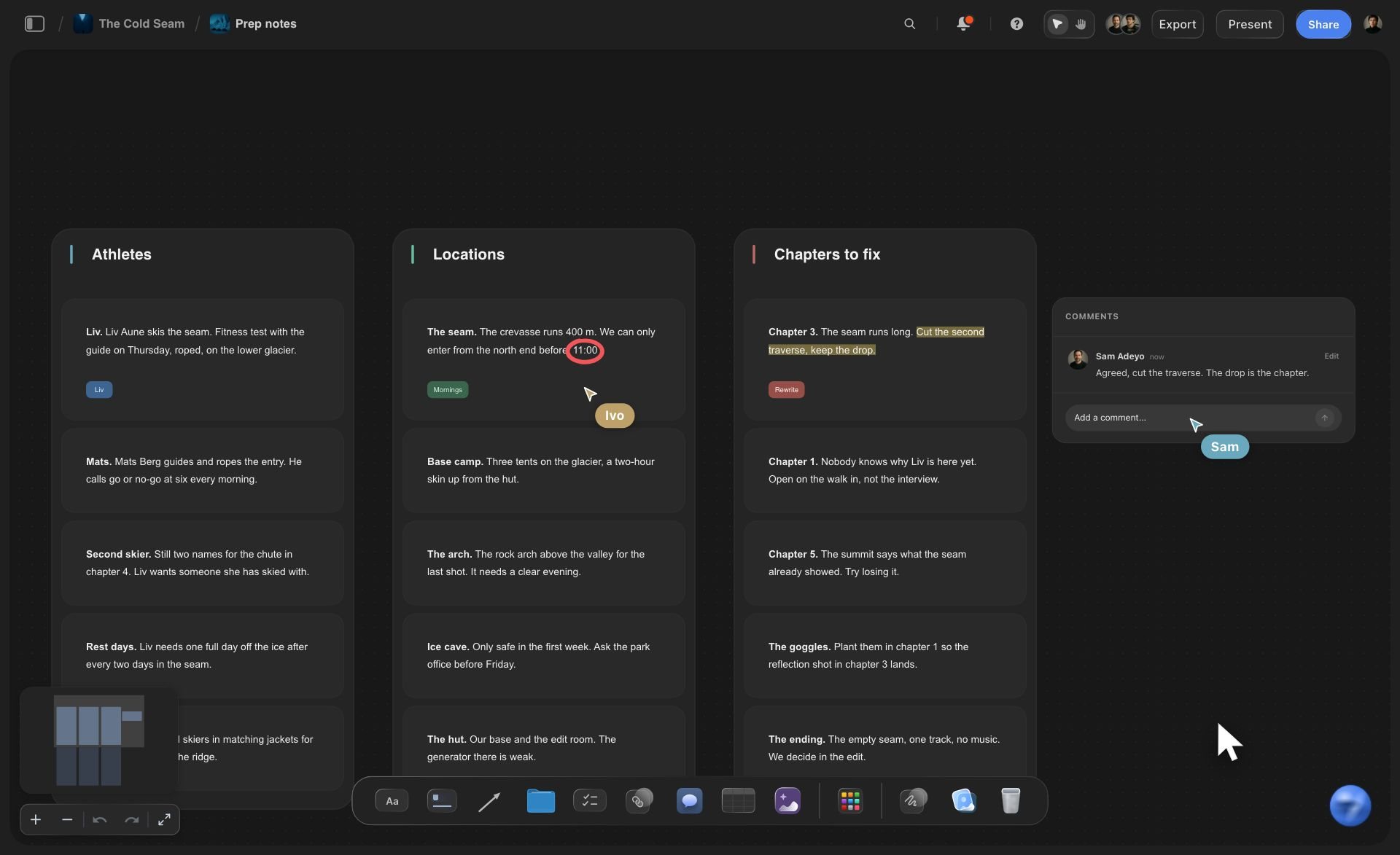
The four lists
Every point is a card you can move
Strengths, weaknesses, opportunities and threats each get a column, with one card per point. When the team decides a weakness is really a threat, someone drags the card across. Nobody redraws a grid.
See the SWOT analysis maker →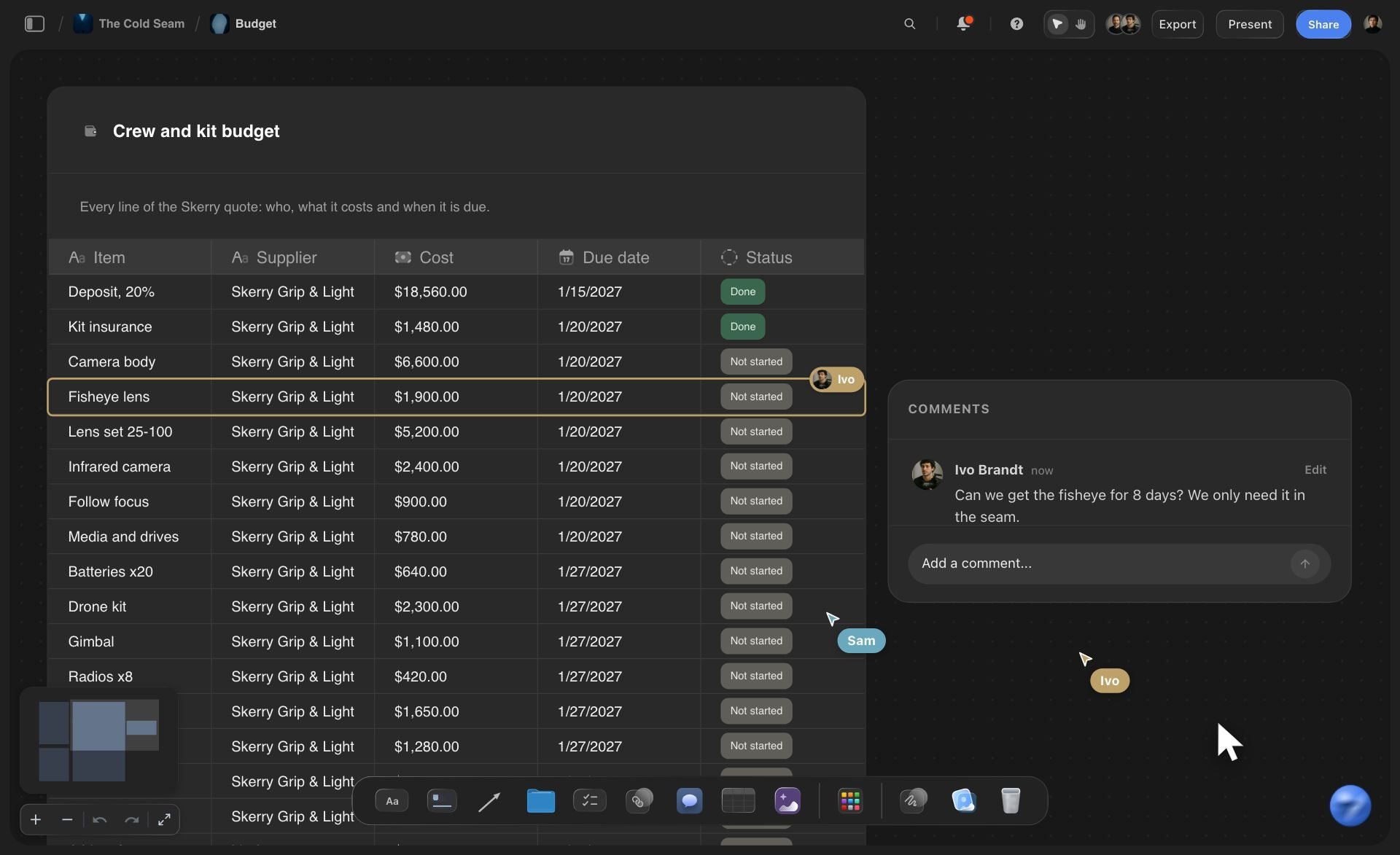
The facts
The number behind every point
Sales exports, survey results and meeting notes sit on the board as files. ChatGPT reads them first and writes the figure on the card: not "loyal customers" but "34 of 40 cafes reorder every month".
See the dashboard with ChatGPT →
The actions
Points paired, then turned into tasks
Ask ChatGPT to pair each strength with the opportunity it can win and each weakness with the threat that could hit it. Every pair becomes a task card with a title, a description, a label and a date, in a column beside the four lists.
See the strategic planning tool →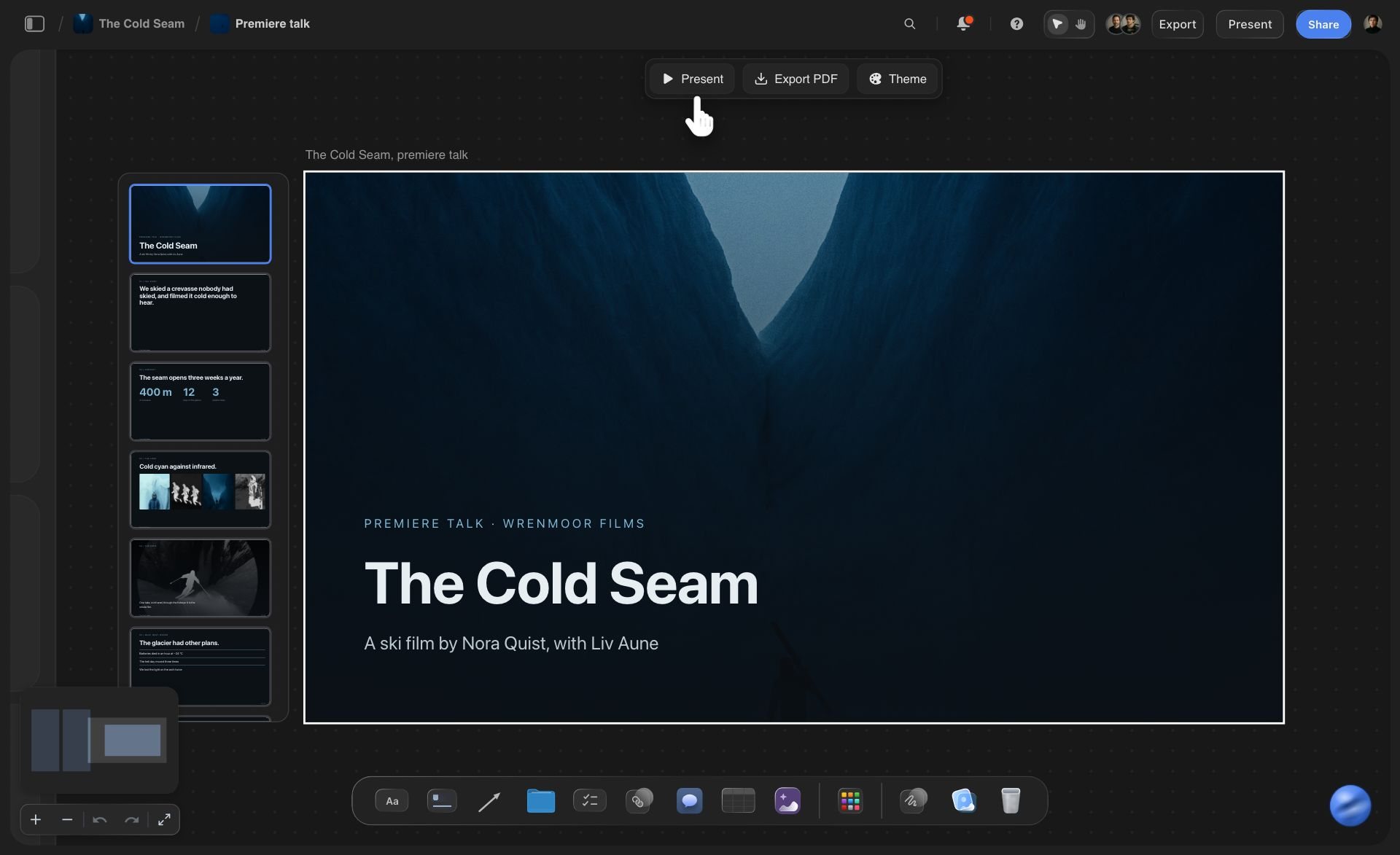
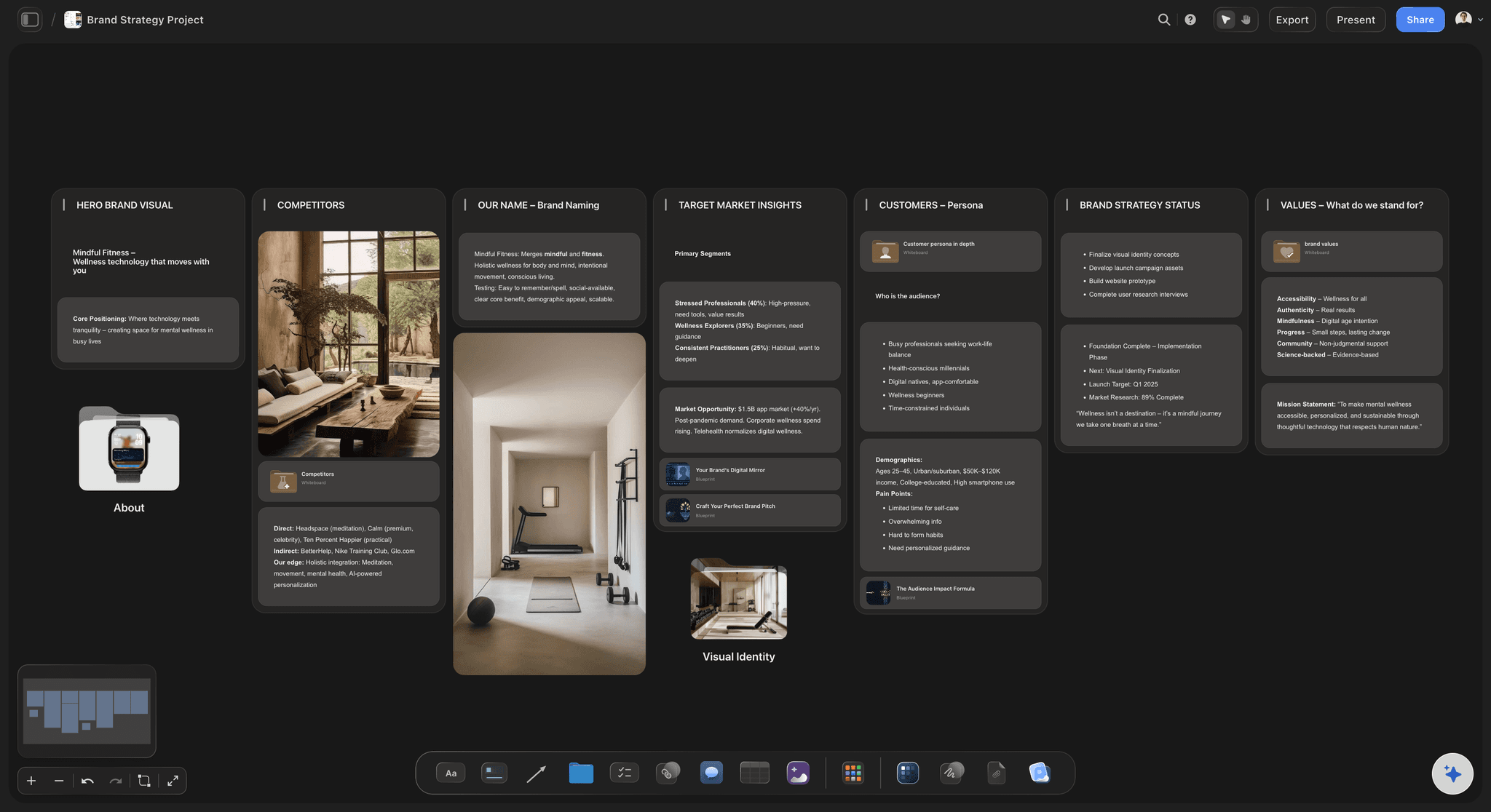
The one page
A summary for the plan or the pitch
Ask for a one-page document on the board: the question, the three points that matter most, the pairs and the actions. Need slides for the pitch? Ask for a short deck built from the same cards.
See the pitch deck with ChatGPT →ChatGPT does the analysis. Storyflow asks no AI credits for it.
ChatGPT runs on its own model, so a SWOT built over the connector uses no Storyflow AI credits. A free account (today, one invited by a paid member) gets a weekly allowance of actions from its assistant, and the pricing page shows the current number. Plus, Pro and Max have no limit. Storyflow is paid-only during early access, with plans from $7.99 a month billed annually ($9.99 monthly). A free plan launches before the end of 2026, and anyone a paid member invites to a board joins free.
ChatGPT's work on the board costs no Storyflow AI credits
Plus, Pro and Max have no limit on connector actions
Partners and clients you invite to the board join free
The numbers, the four lists, the actions and the summary on one board
You choose which projects ChatGPT may read, and whether it may change them

Built for people with taste
Where a SWOT from a chat goes wrong.
ChatGPT can fill four boxes for any company on earth. That is exactly the problem.
The general
Four lists that fit any company
It reads your numbers first: Put the sales export and the survey on the board. ChatGPT reads them before it writes a point, so the SWOT is about this company and this year.
A figure on every card: Ask for the number behind each point. "40 percent of wholesale comes from two customers" is a weakness you can act on. "Customer concentration" is a phrase.
Points with no proof are marked: Tell ChatGPT to label any card it could not back up from the files. Those are the points to check before they go in front of an investor or a client.
Five per list, strongest first: Ask for no more than five points in each column, in rank order. Choosing what stays off the list is most of the analysis.
The picture
A grid nobody acts on
Strength meets opportunity: Ask ChatGPT which strength can win which opportunity, and to draw the pairs as a diagram. Each point is a box, and an arrow with a few words joins the two that belong together.
Weakness meets threat: A weakness joined to the threat that could hit it is the first thing to fix. In the diagram it is one line you can point at, not two points in different lists.
One task per pair: Each pair becomes a task card with a date and a label, in a column next to the lists it came from. You assign the person in Storyflow.
Move a card, keep the rest: The team decides a point is in the wrong list. Drag it, or ask ChatGPT to move it and reword it. The other cards stay exactly as they are.

The drawer
A SWOT made once and never opened again
A one-page summary: ChatGPT writes the question, the points that matter, the pairs and the actions as a document on the board, one section at a time. It is the page that goes into the plan.
A short deck for the pitch: Ask for five slides from the SWOT. The deck is built on the same board, and you present it full screen or export it as a PDF in Storyflow.
Ask what the new quarter changes: Put the new numbers on the board in three months and ask ChatGPT which points they change. It rewrites single cards in place, and a full rebuild lands beside the old SWOT so you can compare.
One link for the client or the investor: Share a view-only link from Storyflow and a client or an investor reads the SWOT in a browser with no account. ChatGPT cannot make that link, so you share it yourself.
Explore templates for your project
Every template opens as a real, editable board on the infinite canvas. Pick the closest fit and make it your own.
Marketing Plan
Lay out your goals, channels, and initiatives for the quarter on one board.
One app instead of five
Where Storyflow fits in a SWOT made with ChatGPT.
It keeps the SWOT beside your numbers and turns it into actions. It does not weight scores with formulas.
Storyflow with ChatGPT
Recommended
First draft of all four lists from one request
Each point is a card you can drag to another list
Company files and the SWOT on one canvas
Points joined in pairs by arrows
Actions with a date kept beside the points
Team edits it after the chat ends
Scores weighted and totalled by formulas
Sort the points by score
ChatGPT on its own
First draft of all four lists from one request
Each point is a card you can drag to another list
Company files and the SWOT on one canvas
Points joined in pairs by arrows
Actions with a date kept beside the points
Team edits it after the chat ends
Scores weighted and totalled by formulas
Sort the points by score
A spreadsheet
First draft of all four lists from one request
Each point is a card you can drag to another list
Company files and the SWOT on one canvas
Points joined in pairs by arrows
Actions with a date kept beside the points
Team edits it after the chat ends
Scores weighted and totalled by formulas
Sort the points by score
What creators are saying
Join early creators getting structured workspaces and AI that remembers their projects
“Storyflow has sped up my workflow by at least 3x, which means more flow state and more projects I can actually ship. It truly changed the way me and my team create.”

Reilin Joey
Director & YouTuber
“One prompt gets me a structured board. But the tactics are my favorite. I run my YouTube scripts through them and my intros and retention got better. It's amazing.”

Justkay
YouTuber & Freelance Filmmaker
“I used to juggle five apps to plan a project. Now I describe what I am making and get boards, lists, and a schedule. All in one place.”

George
@fernwehchronicles
SWOT analysis with ChatGPT: questions
What founders and consultants ask before a ChatGPT SWOT goes into a plan or a pitch.
Yes. On its own ChatGPT writes four lists in seconds, but with only a company name the points are general ones that fit any competitor. Connected to Storyflow, it reads your sales numbers, survey and notes on the board first, builds strengths, weaknesses, opportunities and threats as columns of cards, then turns the points into tasks with a date and a one-page summary.
Storyflow gives ChatGPT's SWOT a board to live on: ChatGPT reads your real numbers there, builds the four lists as cards your team can move, pairs strengths with opportunities and weaknesses with threats, and turns each pair into a task with a date. Claude, Gemini and Grok can build the same SWOT. A spreadsheet still scores, weights and sorts the points, and Miro still runs a live workshop with voting and a timer.
Give it facts before you ask. Put last year's sales, a customer survey and your own notes on a Storyflow board, tell ChatGPT the one question the SWOT must answer, and ask for the number behind every point. Ask it to label any point it could not back up from the files. A point with no figure is usually one that fits every company.
One question to answer, up to five ranked points in each of the four lists, a fact behind every point, the pairs (which strength wins which opportunity, which weakness a threat could hit) and one action with an owner and a date for each pair. In Storyflow, ChatGPT builds the lists as columns of cards and the actions as task cards beside them.
Open ChatGPT on the web. Under Settings, then Security and login, turn on Developer mode. At chatgpt.com/plugins, click the plus button, name the connector Storyflow, choose Public endpoint and paste https://mcp.storyflow.so/mcp. Create it and sign in to Storyflow. Storyflow's setup notes list ChatGPT Plus, Pro, Business, Enterprise and Edu, on the web. On Business and Enterprise an admin turns on developer mode.
Pair the points. A strength that can win an opportunity is something to push. A weakness that a threat could hit is something to fix first. Give each pair one action, one owner and one date. In Storyflow, ChatGPT draws the pairs as boxes joined by arrows and writes each action as a task card with a date, in a column beside the four lists.
Yes, when the files are on your Storyflow board. ChatGPT reads Excel, CSV, PDF, Word and text files there, up to 25 MB each, and gets the first 40,000 characters, so a long report goes in parts. A scanned PDF is not read. A file you attach in the ChatGPT chat is read in the chat but does not reach Storyflow.
It can write a score beside each point and list them in rank order, and it can put them in a table on your Storyflow board with a number column. Storyflow tables have no formulas and cannot be sorted on the board, so ChatGPT writes the rows in the order you ask for. For weighted scores that recalculate, a spreadsheet is still the right tool.
Yes. Put the new numbers on the Storyflow board and ask which points they change. ChatGPT rewrites single cards in place and can move a card to another list. Ask for a whole new SWOT and it lands beside the old one, because ChatGPT has no tool to delete a card. Remove the old one yourself. Deleted items stay in the board's trash for 7 days.
No. ChatGPT runs on its own model, so the SWOT it builds over the connector uses no Storyflow AI credits. A free Storyflow account (today, one invited by a paid member) gets a weekly allowance of actions from its assistant, and the pricing page shows the current number. Plus, Pro and Max have no limit.
Only the ones you allow, so one client's numbers are not open to a chat about another. At sign-in, Storyflow asks whether ChatGPT may use all your projects or only the ones you pick, and whether it may make changes. Leave changes off and it can only read. A connection ends after 30 days, or sooner if you end it under Settings, then Connected apps.
Yes. Storyflow's MCP server is one address for every assistant, https://mcp.storyflow.so/mcp. In Claude, add it under Customize, then Connectors; on the Free plan Claude allows one custom connector. Gemini's custom apps need a personal Google account with Keep Activity on, in the US, for people 18 or over, in English. On Grok Business and Enterprise, a team admin adds it in the xAI console first.
On a Storyflow board, ChatGPT has no tool that deletes a card, and it cannot make or see pictures, make a PDF, Word or Excel file, or share the board. The connector gives it no web search, so market facts come from the files and notes you add. Storyflow's built-in AI is a separate route that drafts a SWOT from a one-line description inside the app. Sharing and exporting are done by you, in Storyflow.
More from Storyflow
Storyflow MCP server
Connect ChatGPT to Storyflow
SWOT analysis maker
AI SWOT analysis generator
AI competitor analysis generator
Strategic planning tool
Product launch plan with ChatGPT
Pitch deck with ChatGPT
Dashboard with ChatGPT
Project plan with ChatGPT
Go-to-market plan
Brand positioning map
Lean canvas
Seed round deck
Storyflow for consultants
Storyflow for startups
Give ChatGPT the numbers. Give the team the next move.
Four lists built from your own facts, paired into actions with dates, and kept on one board the team can change.