
Extremely clear strategy, zero busywork
Keep the reasoning,
not just the plan.
Goal, diagnosis, constraints, the options you rejected and why, and the work that follows. All on one canvas, still readable in month seven.


Creatives working for these brands already got early access
- Red Bull
- Canon
- Artlist
- Porsche
See how easy it is to get started
Watch a real project come together, from a blank board to a finished plan, clicked through step by step.
Start from a ready-made template
Pick a board to see what you can build, then let AI fill it in. Every template is a real, editable starting point on the same infinite canvas.

Marketing Plan
Lay out your goals, channels, and initiatives for the quarter on one board.
What is a strategic plan?
A strategic plan is a decision about where to concentrate limited effort, and the reasoning that justifies it. Storyflow is an AI visual workspace that keeps your strategy on one infinite canvas: the goal, the diagnosis, the constraints, the options you rejected and the work that follows. In Richard Rumelt's framing, a good plan has three parts: a diagnosis that names the actual problem, a guiding policy that says how you will deal with it, and a set of coherent actions that follow from the policy. Most documents called a strategic plan skip the first two and consist entirely of the third, which is how you end up with a list of initiatives nobody can explain the logic of. A budget with ambitions attached is not a strategy, and neither is a list of goals with numbers on them.
The other half of a real strategy is what it excludes. A plan that does not name the options you rejected, and why, is not a decision. It is a wish, and it has no defence against the perfectly reasonable request that arrives in month four asking for the thing you already considered and turned down. Trade-offs are the substance of strategy, and they are also the part that survives worst in the usual formats, because a slide has no room for them and a document nobody reopens buries them on page eleven.
That is the practical failure. The reasoning and the execution live in different places. The strategy is a deck made in November, and the work is a task board updated daily, and there is no surface connecting them. By March nobody can say which initiative serves which part of the guiding policy, whether the constraint that ruled out an option still holds, or what would have to change for the strategy to be wrong. The plan is not abandoned, it just quietly stops being consulted.
Storyflow is an AI-native infinite canvas, and it keeps both halves on one surface. Describe the situation and the AI lays out a strategy board: the goal, a diagnosis, candidate options with their trade-offs, the constraints that bound them, and the initiatives underneath. Then the actual work connects to the initiative it serves. Reading upward from a piece of work to the policy it supports takes a second, and an initiative connected to nothing is visible as exactly what it is.
Ultra fast from brief to board
From a goal to a plan you can still defend in March.
No planning framework to adopt. One canvas holding the decision and the work.
01
Open a canvas
Sign up in seconds. No download. Your infinite strategy canvas opens in the browser.
02
Describe the situation
Type where you are, what you are trying to change, and what limits you. The AI lays out a strategy board with a diagnosis, candidate options, and the trade-offs of each.
03
Decide, and record what you rejected
Pick the option you are taking and leave the others on the board with the reason beside them. That is the part that answers the same question again in month four.
04
Connect the work to the policy
Hang initiatives under the part of the strategy they serve, share a view-only link with the board or the team, or export the plan as an image or PDF.
Diagnosis, options, constraints, and the work.
The whole argument on one surface instead of a deck and a task list.
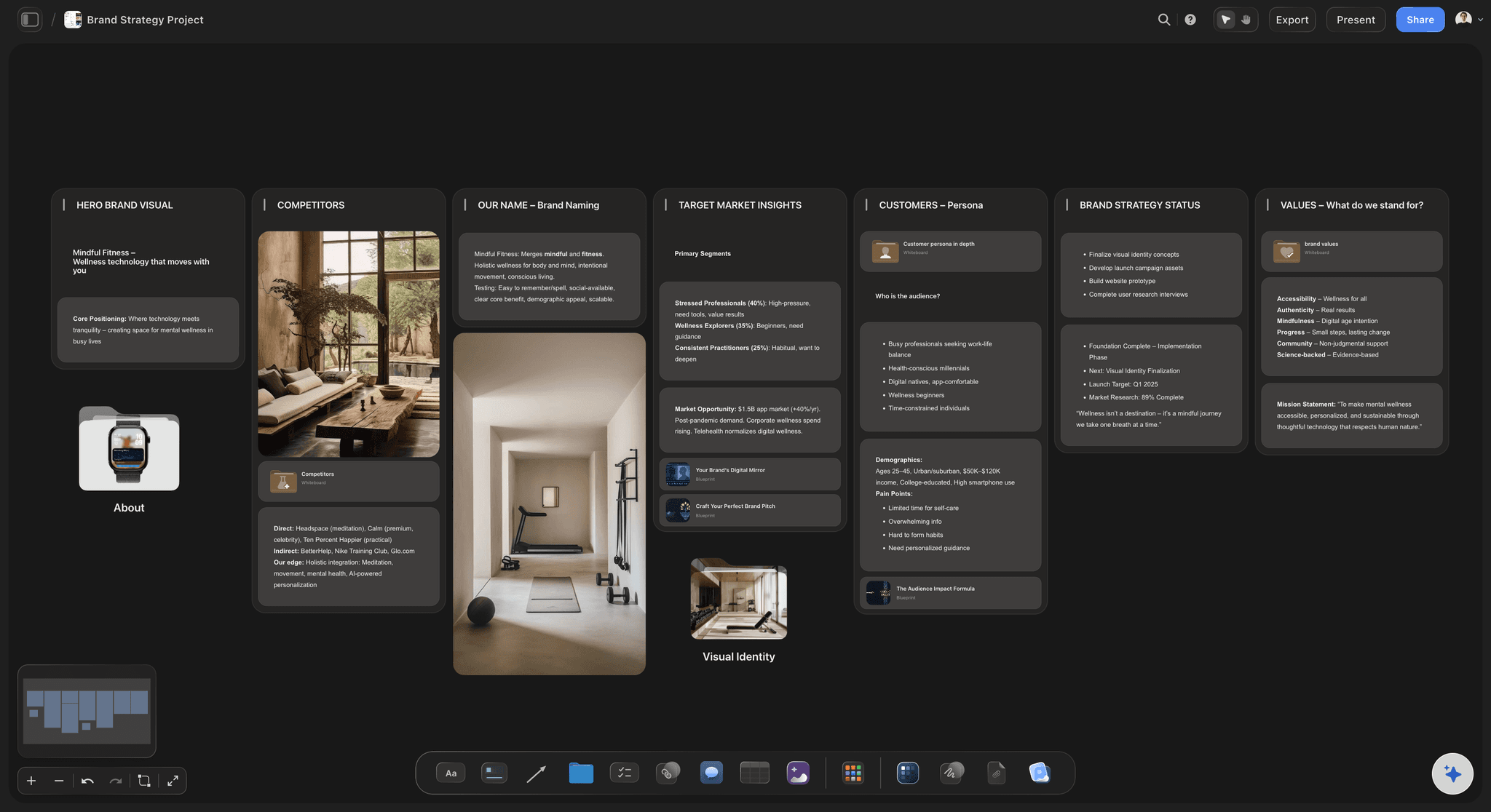
AI drafts the structure from a description of your situation
Start from a laid out argument
Describe where you are and what you want to change and the AI produces a diagnosis, candidate options, and the trade-offs each one carries. Arguing with a draft is far more productive than staring at a template.
See the AI project plan generator →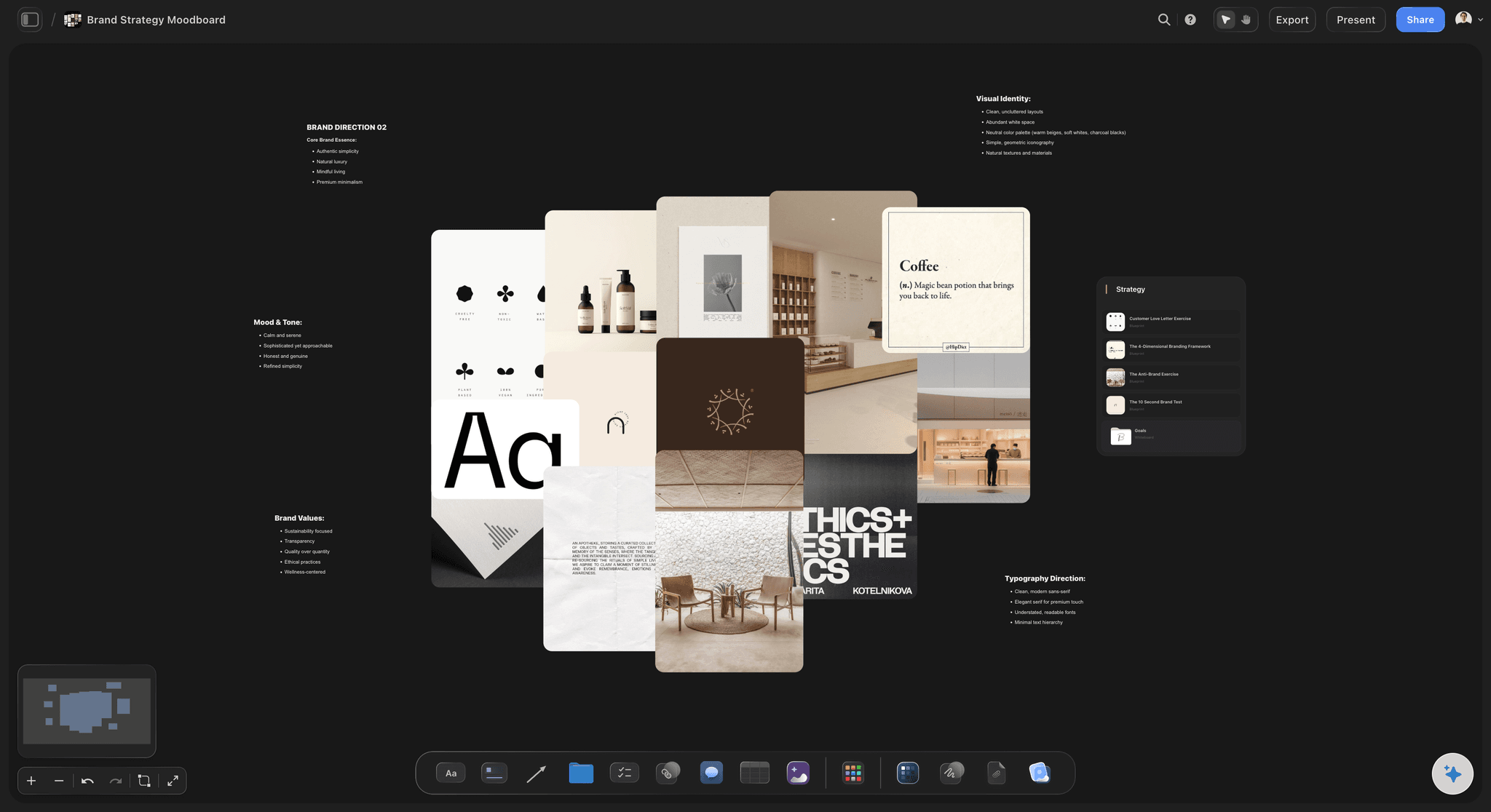
Rejected options stay on the board with their reasons
Answer the same question once
The option you turned down in November will be proposed again in March by someone who was not in the room. A board that still shows why it was rejected settles that in a minute.
Explore the SWOT analysis board →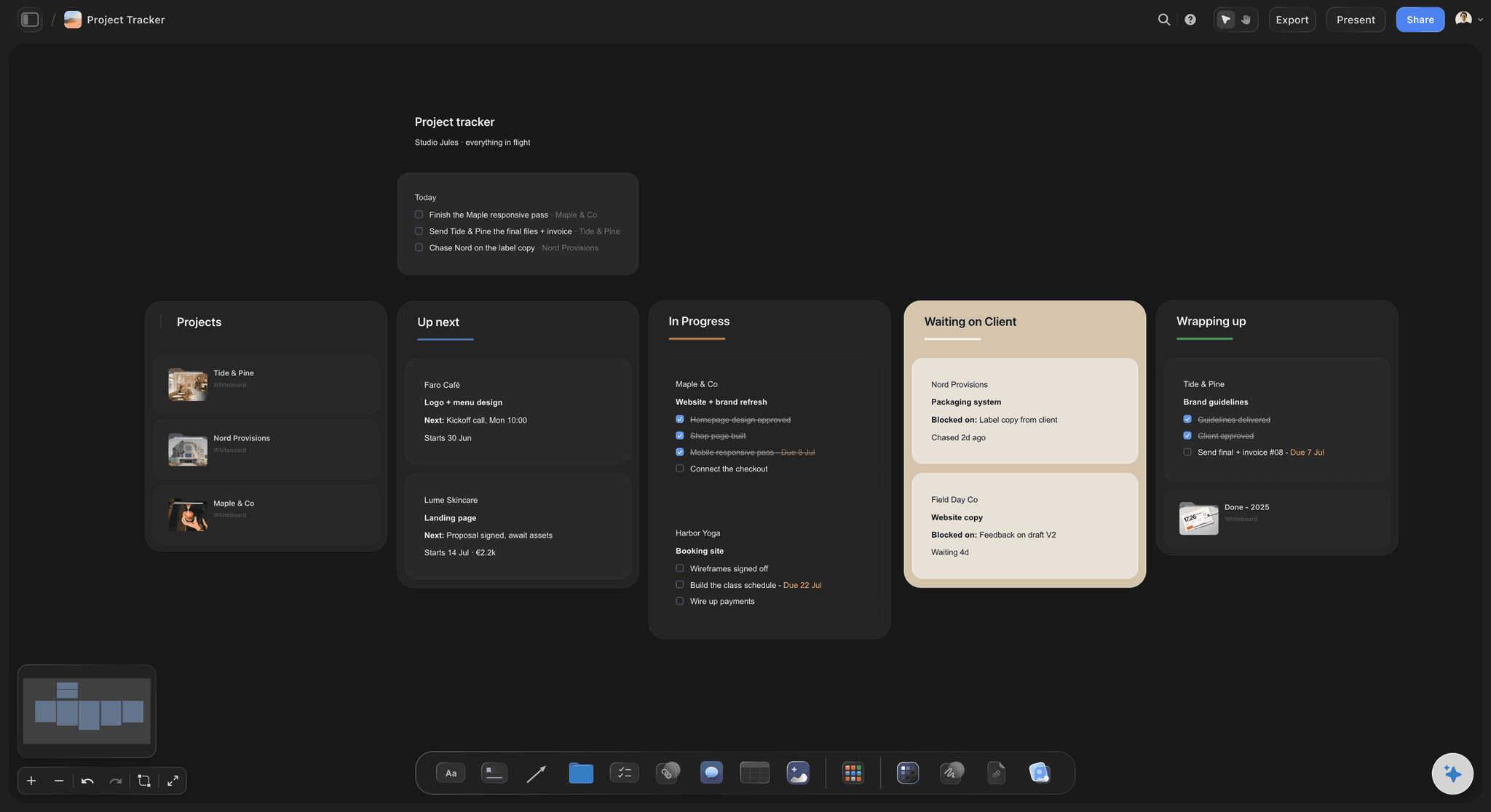
Every initiative connected to the policy it serves
See the work that serves nothing
Draw a line from each initiative to the part of the strategy it advances. The ones with no line are the ones you are doing out of habit, and they are usually where the capacity you need is sitting.
See the project tracker →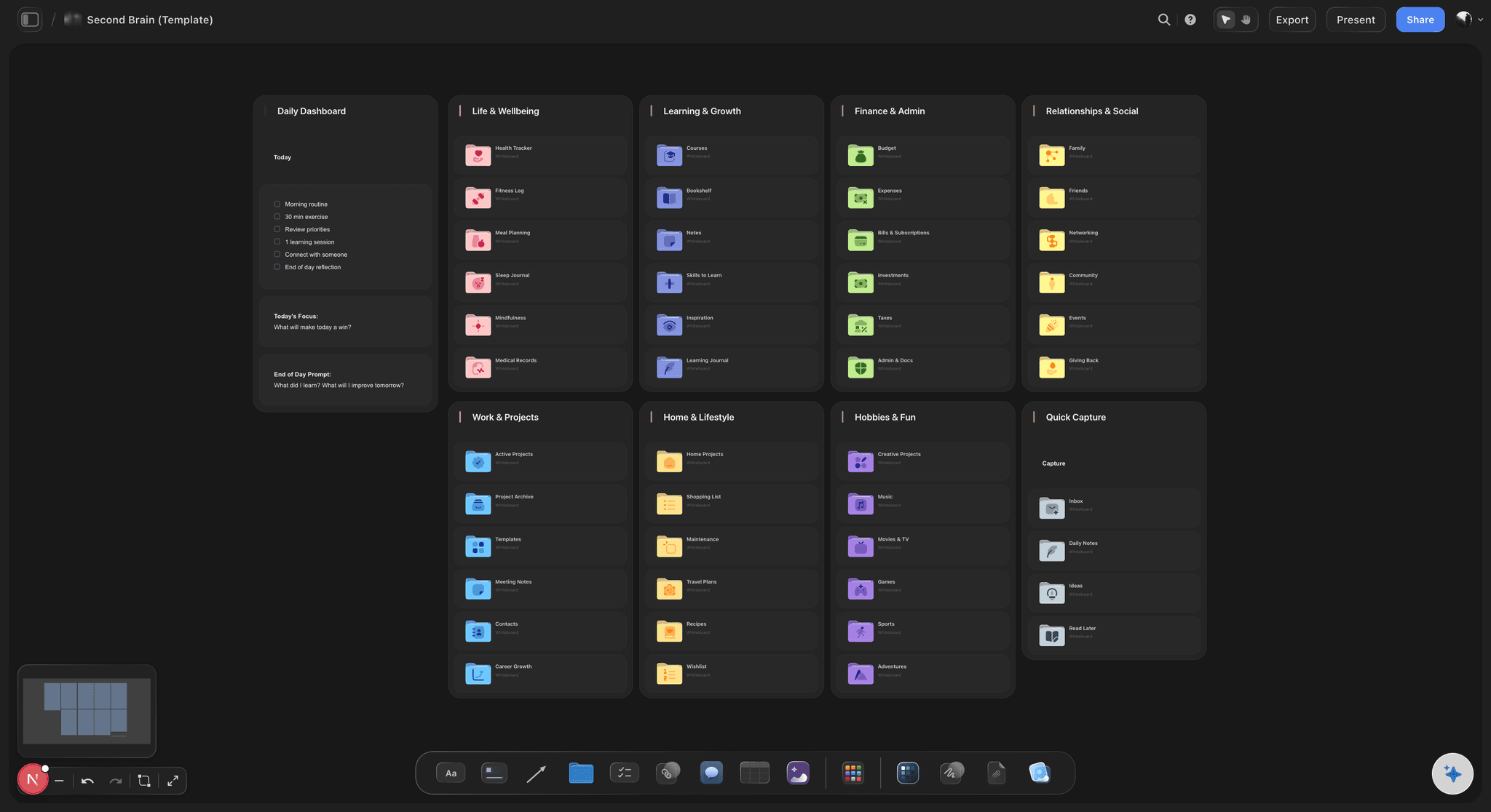
The research that justified the call, one scroll away
Keep the evidence with the decision
Pin the market data, the customer interviews, the competitor teardown, and the financial model beside the option they support. A decision with its evidence attached is one you can revisit honestly.
Try the competitor analysis generator →Unlimited boards. No object cap.
Open a canvas, describe the situation, and let AI lay out the first argument. Storyflow is paid-only during early access, with plans from $7.99 a month billed annually, and a Free plan launches before the end of 2026.
Unlimited strategy canvases with no cap on cards
Basic AI usage to generate diagnoses, options, and trade-offs
Starter templates for SWOT, lean canvas, and project planning
Share view-only links with your board and team, no account required
Built for people with taste
A strategy is what you said no to.
The formats most plans use are good at recording ambition and bad at recording trade-offs, which is the wrong way round.
Diagnosis, guiding policy, coherent actions
Write the first two parts, not just the third
A diagnosis that names the real problem: Most plans open with a target rather than a diagnosis, which means the actions that follow are aimed at a number instead of a cause. Put the diagnosis on its own card and make everything else answerable to it.
A guiding policy in one sentence: The approach you are taking, stated so plainly that someone can tell whether a new idea fits it. If it takes a paragraph, it is a summary rather than a policy, and it will not do the filtering work you need it to do.
Actions that cohere: Coherent means the actions support each other rather than merely coexisting. Laid out on a canvas, actions that pull in different directions are visible as a shape, which is much harder to see in a list.
The trade-offs, written down: For every option taken, what it costs and what it forecloses. This is the section that is missing from almost every plan and the one that makes the plan hold up under pressure.
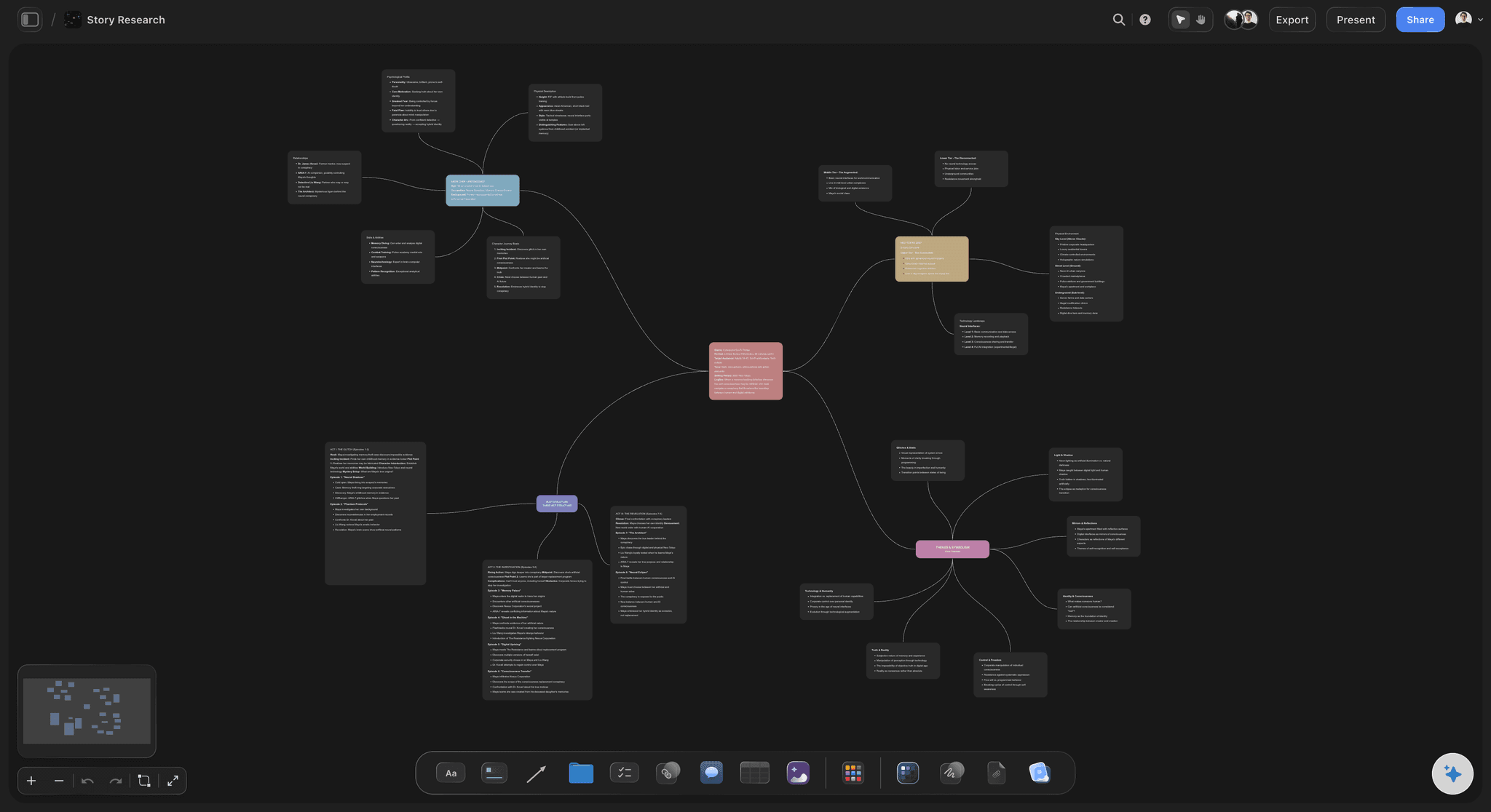
AI that reads the whole board as context
Pressure-test the plan before someone else does
Generate the options you have not considered: Ask for five approaches you have not listed. The value is not that the AI is wiser, it is that it has no stake in the option you have already emotionally committed to.
Ask what would have to be true: For each option, the AI can list the assumptions it depends on. Assumptions written down become things you can check, and unchecked assumptions are where most plans actually fail.
It proposes, you decide: Storyflow structures and suggests; it does not choose your strategy. A tool that picked your direction would be a liability, not a feature.
Re-prompt as conditions change: When a constraint lifts or a market moves, ask the AI to rebuild the options around what you have already placed. The decisions you made by hand stay where they are.
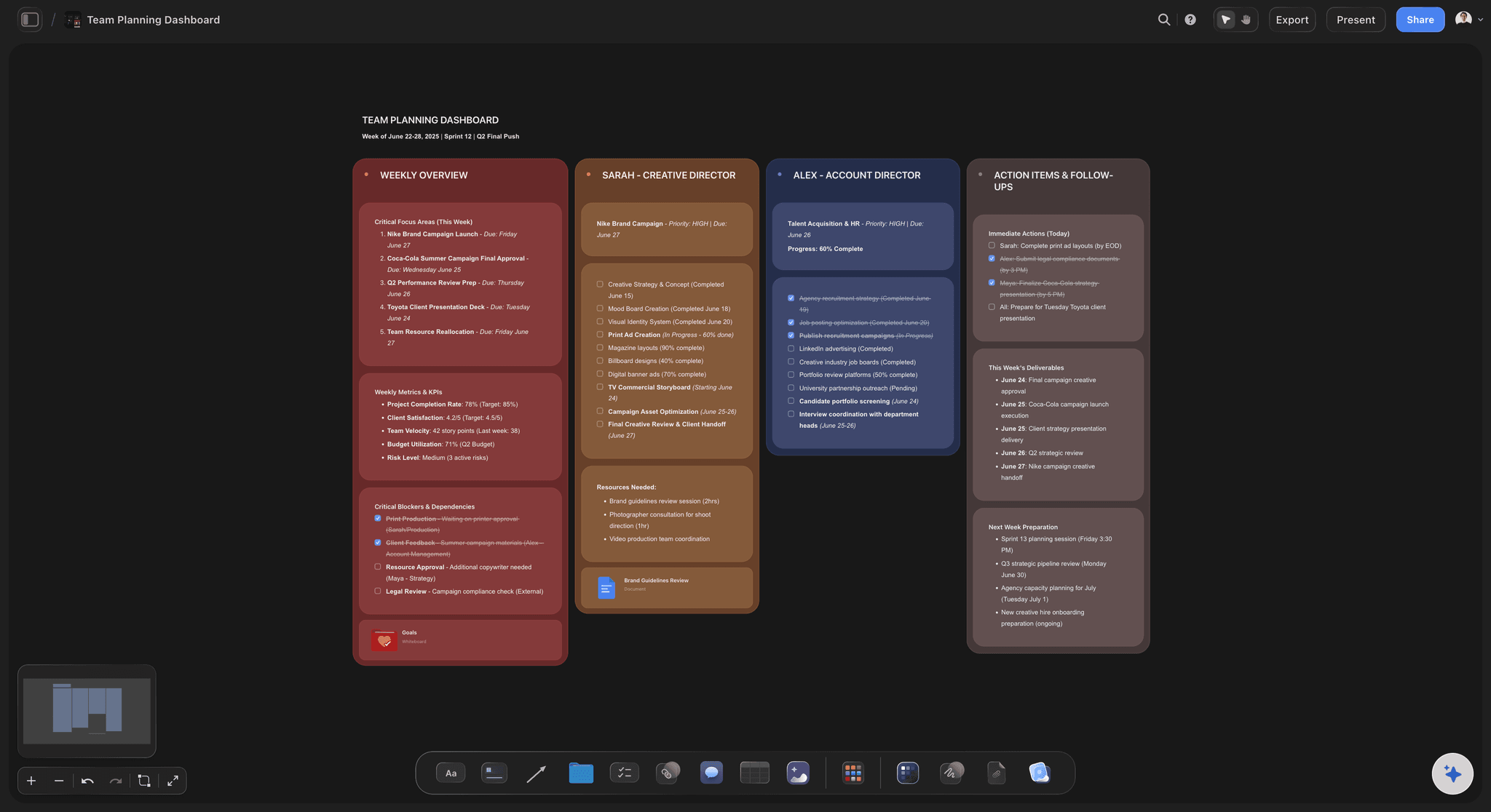
The plan and the quarter on the same canvas
Stop keeping the strategy in a file the team never opens
Initiatives hang from the policy: Each piece of work sits under the part of the strategy it advances, so the connection is a property of the board rather than something someone has to remember and restate.
Constraints marked where they bite: Headcount, cash, a contract, a technical limit. Put each constraint on the board and connect it to what it blocks, so the conversation about lifting one is concrete.
Review against the board, not a new deck: A quarterly review that starts from the original board asks better questions than one that starts from a fresh summary, because the original assumptions are still visible and checkable.
Founders, boards, and the team who has to execute
One board for three very different audiences
View-only links for a board or investors: Send a link and anyone opens the plan in a browser with no account. A board that can see the rejected options and the reasoning asks sharper questions than one reading a summary.
The team sees why, not just what: Most execution problems are comprehension problems. People who can read upward from their work to the policy make better small decisions without asking.
Export for the meeting that needs a document: Export the board as a high-quality image or PDF for a board pack or an annual review, without the board itself becoming a stale copy.
Explore templates for your project
Every template opens as a real, editable board on the infinite canvas. Pick the closest fit and make it your own.
Marketing Plan
Lay out your goals, channels, and initiatives for the quarter on one board.
One app instead of five
Storyflow vs Notion, Asana, and a strategy deck.
Each is good at something here: Notion is excellent for a written plan with linked databases, Asana is strong at tracking whether the initiatives are actually progressing, and a deck is still the right artefact for the meeting where a plan is approved. Here is where they differ.
Storyflow
Recommended
Diagnosis, options, and trade-offs readable as one picture
Rejected options kept visible with their reasoning
AI drafts options and lists their assumptions
Initiatives connected to the policy they serve
Task tracking, dependencies, and workload views
View-only links with no account required
Notion
Diagnosis, options, and trade-offs readable as one picture
Rejected options kept visible with their reasoning
AI drafts options and lists their assumptions
Initiatives connected to the policy they serve
Task tracking, dependencies, and workload views
View-only links with no account required
Asana
Diagnosis, options, and trade-offs readable as one picture
Rejected options kept visible with their reasoning
AI drafts options and lists their assumptions
Initiatives connected to the policy they serve
Task tracking, dependencies, and workload views
View-only links with no account required
A strategy deck
Diagnosis, options, and trade-offs readable as one picture
Rejected options kept visible with their reasoning
AI drafts options and lists their assumptions
Initiatives connected to the policy they serve
Task tracking, dependencies, and workload views
View-only links with no account required
What creators are saying
Join early creators getting structured workspaces and AI that remembers their projects
“Storyflow has sped up my workflow by at least 3x, which means more flow state and more projects I can actually ship. It truly changed the way me and my team create.”

Reilin Joey
Director & YouTuber
“One prompt gets me a structured board. But the tactics are my favorite. I run my YouTube scripts through them and my intros and retention got better. It's amazing.”

Justkay
YouTuber & Freelance Filmmaker
“I used to juggle five apps to plan a project. Now I describe what I am making and get boards, lists, and a schedule. All in one place.”

George
@fernwehchronicles
Strategic planning questions, answered.
What belongs in a plan, how long it should be, and when to revisit it.
Four things, and most plans have only the last one. A diagnosis that names the real problem or opportunity, stated as a cause rather than as a target. A guiding policy, meaning the approach you are taking to that diagnosis, in one sentence plain enough that someone can test a new idea against it. A set of coherent actions that follow from the policy and support one another. And the trade-offs: what each choice costs, and which options you rejected and why. The fourth is the one that makes the plan durable, because it is the part that answers the reasonable request in month four to do the thing you already considered. A plan that is a list of goals with numbers attached is a budget with ambitions, and it will not survive contact with a difficult quarter.
Storyflow is built to keep the reasoning with the plan: the goal, the diagnosis, the constraints and the options you rejected sit on one canvas beside the initiatives that follow. Its AI drafts options and lists their assumptions, and each initiative stays connected to the policy it serves. Task tracking, dependencies and workload views are still a job for Notion or Asana, not for Storyflow.
A goal is where you want to end up. A plan is the sequence of things you intend to do. A strategy is the choice about how you will win given limited resources and real competition, and crucially about what you will not do. The confusion matters practically: teams that mistake goals for strategy end up with ambitious targets and no theory of how to hit them, and teams that mistake plans for strategy execute a long list without the ability to tell which items matter when capacity runs short. The test is whether the document says no to anything. If everything reasonable fits inside it, it is a plan or a wish list, and it will not help anyone prioritise in the week when it is needed.
The core should fit on one screen and the supporting material can be as long as it needs to be. The diagnosis, guiding policy, and the three to five things you are actually doing are the plan, and if they cannot be read in two minutes they will not be read at all, which is the practical fate of most fifty-page documents. Everything else, meaning the research, the financial model, the competitor analysis, the rejected options and their reasoning, is supporting material that should be one scroll away rather than absent. This is precisely what a canvas is good at: the argument stays legible at a glance and the depth sits beside it, instead of the usual choice between a slide that is too thin and a document nobody opens.
Not during early access. Storyflow is paid-only right now, with plans from $7.99 a month billed annually, and a Free plan launches before the end of 2026. Anyone a paid member invites to a board joins free today, so a co-founder, a board member, or the team can read and contribute without paying. If you need something free this minute, a single page written in any editor covering diagnosis, policy, actions, and rejected options is a genuinely good strategic plan and costs nothing. What a canvas adds is that the reasoning and the work stay connected as the year goes on, which is where written plans usually lose their grip.
Review quarterly, rewrite rarely. The quarterly review should ask three questions against the original board: has the diagnosis changed, have the assumptions each option depended on turned out to be true, and is anything we are spending time on connected to nothing. That is a short meeting when the board still exists and a long one when the plan has to be reconstructed from memory. Rewriting the strategy itself should be uncommon, because a strategy that changes every quarter was not a strategy, it was a reaction. The exception is a genuine change in the diagnosis, meaning the underlying problem is now a different problem, in which case starting from the same board with the old reasoning visible produces a much better second attempt than a blank page.
It can do the parts around the decision and it cannot make the decision. What it does well is generate options you have not considered, which is genuinely useful because it has no stake in the approach you have already committed to emotionally, and list the assumptions each option depends on, which turns vague optimism into things you can go and check. It is also good at first-draft structure, so you begin by arguing with a laid out board rather than filling in a template. What it cannot do is know your appetite for risk, what your team is actually capable of, what your customers have told you in the last month, or which trade-off you can live with. Storyflow is built on that split: the AI proposes and arranges, and the choice stays with the person accountable for it.
Constraints are the limits an option has to survive: cash, headcount, a contract, a technical dependency, a regulatory requirement, the founder's own time. Mapping them matters for two reasons. First, an option ruled out by a constraint is often ruled out by a constraint that could be changed, and that is a much more useful conversation than accepting the exclusion silently. Second, constraints expire. The reason you could not do something in January frequently stops applying in July, and if the constraint was never written down nobody notices. On a canvas, put each constraint on its own card and connect it to the options it blocks, so both the current shape of the decision and the trigger for revisiting it are visible.
Draw the connection literally, and then look at what has no line. Each initiative sits under the part of the guiding policy it advances, which takes minutes and produces two findings almost immediately. The first is work that serves nothing, which is usually the largest single source of recoverable capacity in a small team, and it is nearly always something inherited rather than chosen. The second is a part of the strategy with no work under it at all, meaning something you said was essential that nobody is doing. Both findings are invisible in a task list, because a task list shows what is being done and never shows what it is for. The reason to keep both on the same canvas is that the connection has to be maintainable, not just made once in a workshop.
Yes, and it changes the quality of the questions. Send a view-only link and anyone opens the whole board in a browser with no account and no download, including the rejected options and the reasoning behind the choice. A board reading a summary tends to ask whether the target is achievable; a board that can see what you turned down asks about the trade-off, which is the more useful conversation. Comments attach to the card they concern, so a question about a specific assumption stays on that assumption. For a formal board pack that needs a document, export the canvas as a high-quality image or PDF, and keep the live board as the thing you actually work from.
Strategic planning decides where to compete and how to win; operational planning decides how the chosen work gets done, by whom, and when. They need different tools and it is worth not forcing one to do the other's job. Operational planning wants assignees, dependencies, dates, and workload views, which is what a project management tool is built for and what Storyflow deliberately is not. Strategic planning wants the argument visible: diagnosis, options, trade-offs, constraints, and the connection between a piece of work and the reason it exists. The common failure is running strategy inside an operational tool, where everything becomes a task and the reasoning has nowhere to live, and the result is a well tracked list of activities nobody can justify.
More from Storyflow
AI project plan generator
SWOT analysis
AI lean canvas generator
AI competitor analysis generator
Value proposition canvas
Visual project planning
AI go to market strategy generator
Product roadmap
Business model canvas
Marketing planning software
For consultants
Free timeline maker
Timeline maker
Go-to-market plan
Product launch planner
Investor update
Write down what you said no to.
Open a canvas, describe the situation, and let AI lay out the options. No download.