
Extremely clear strategy, zero busywork
Your competitor analysis in ChatGPT,
one wall per rival, on one board.
For founders and marketing leads: ChatGPT researches each rival on the web and lays out their prices, claims and gaps on a Storyflow board, with a comparison table and a positioning grid.


Creatives working for these brands already got early access
- Red Bull
- Canon
- Artlist
- Porsche
See how easy it is to get started
Watch a real project come together, from a blank board to a finished plan, clicked through step by step.
Start from a ready-made template
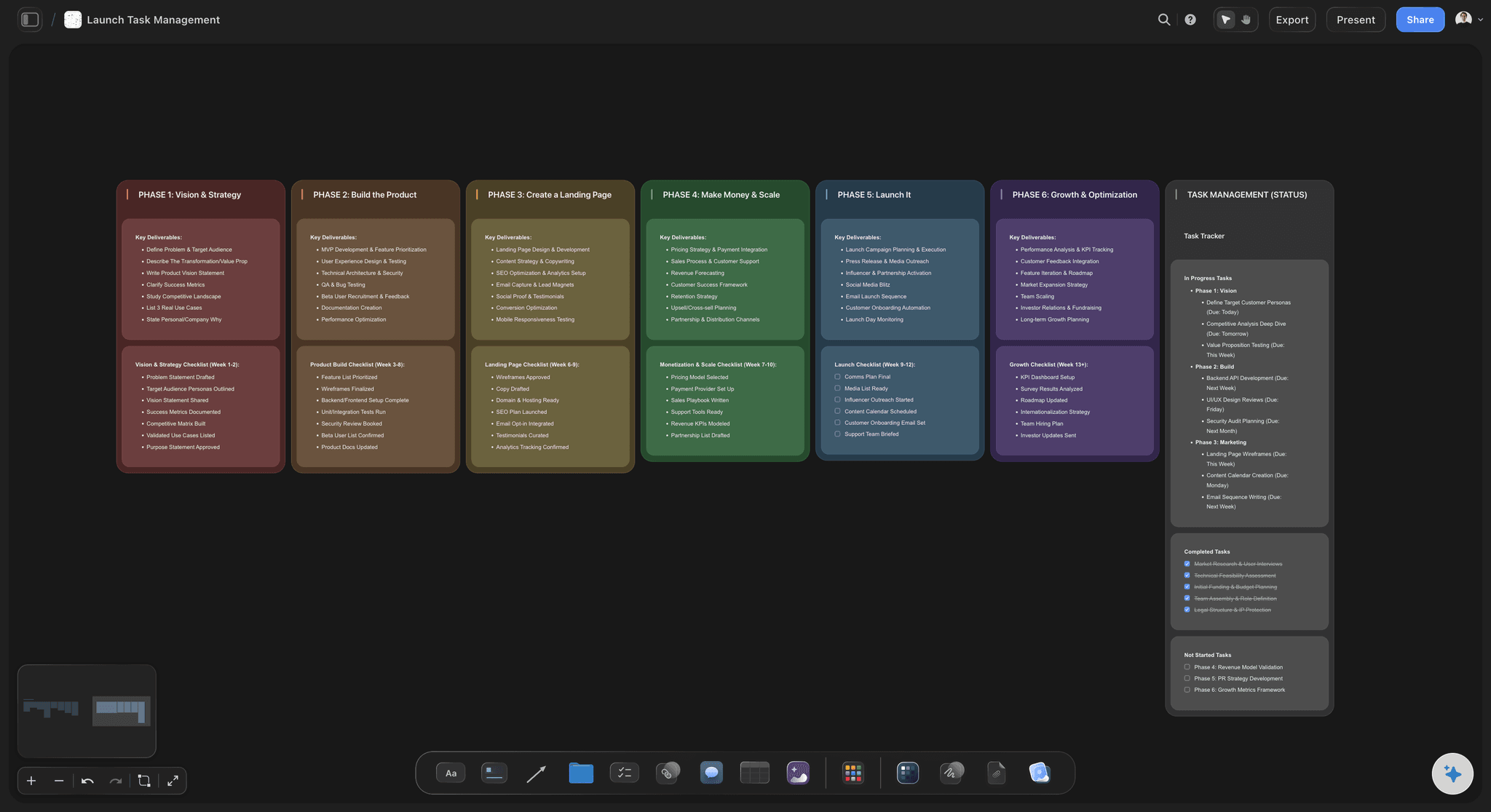
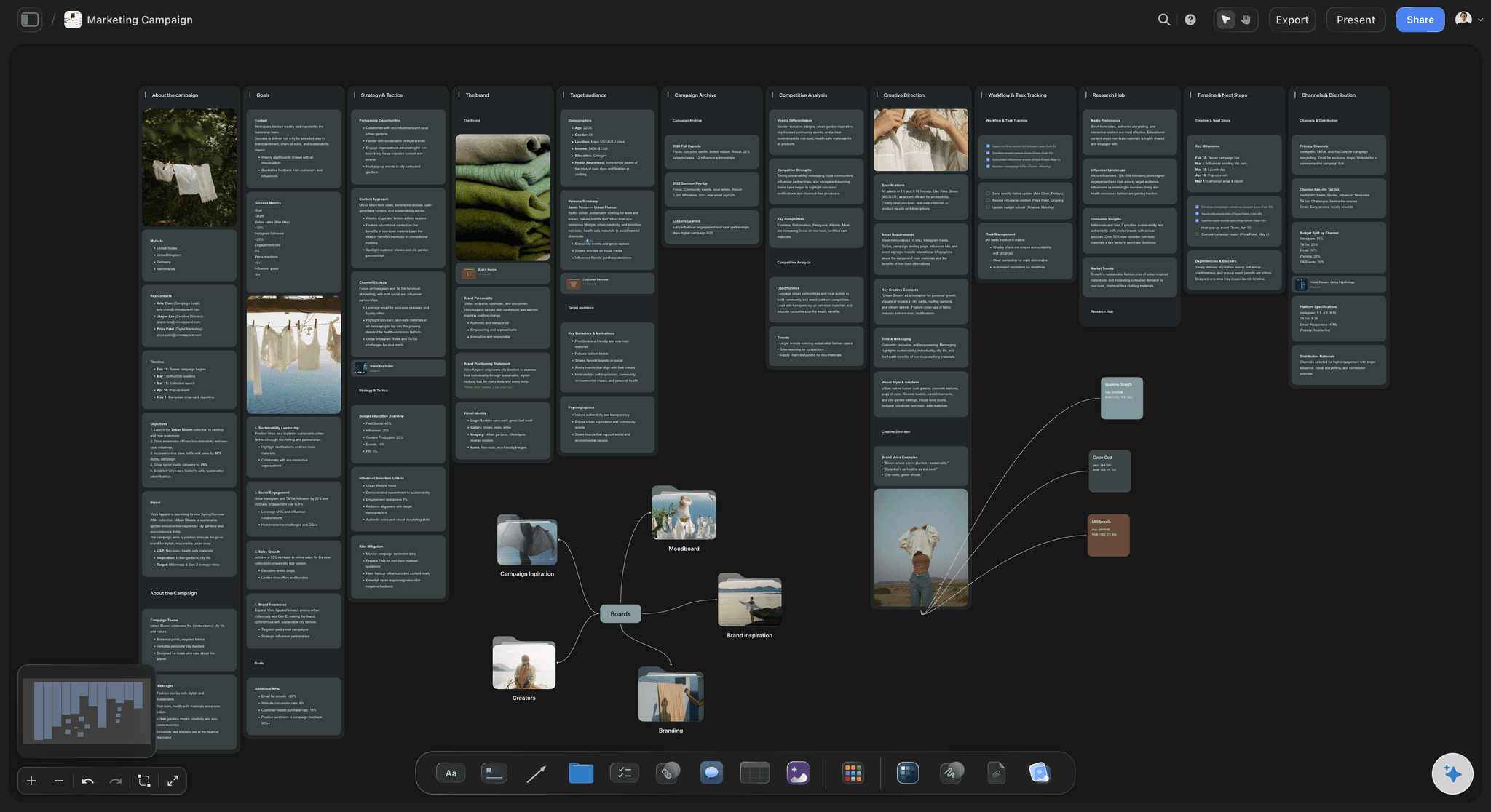
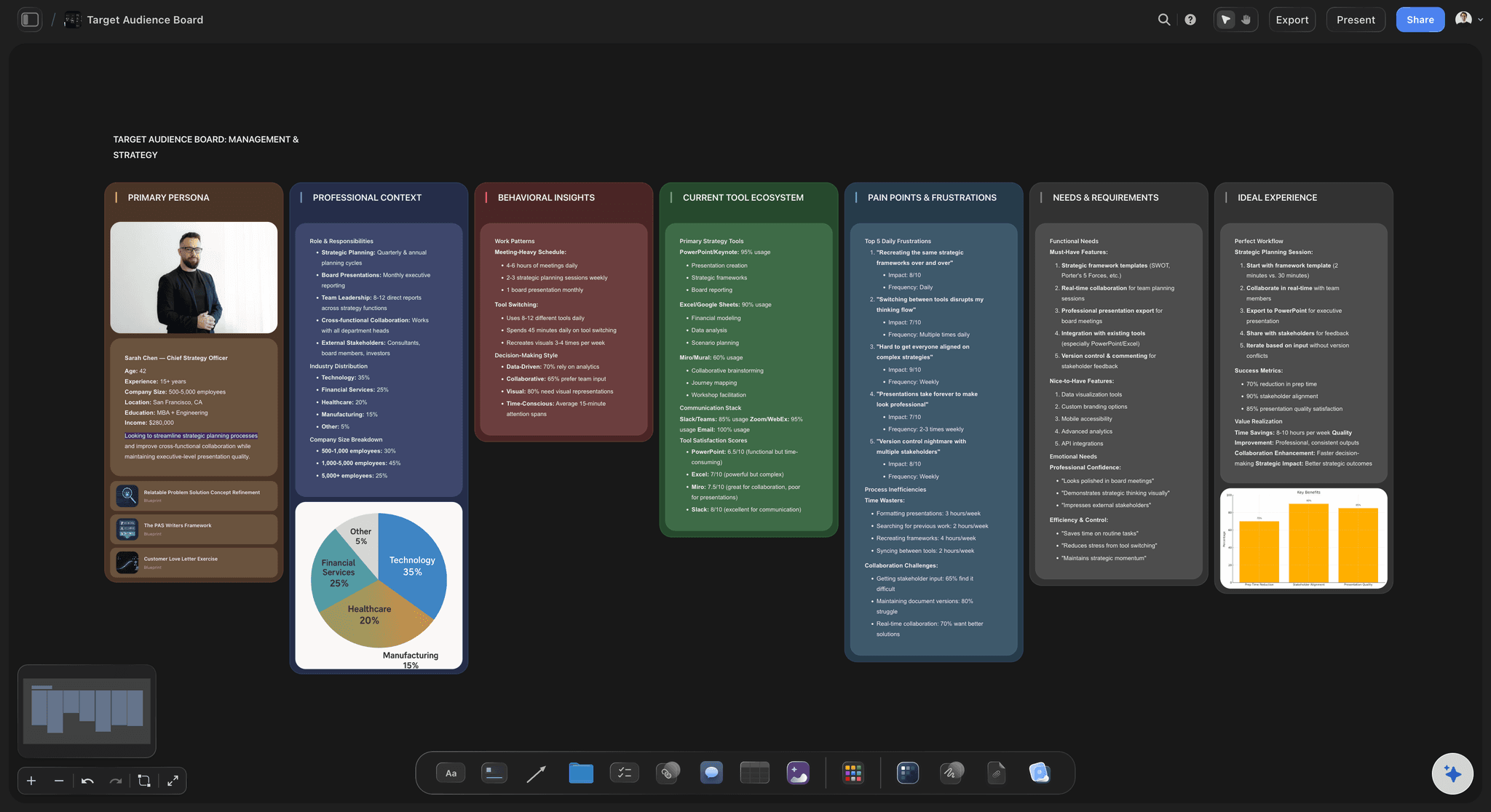
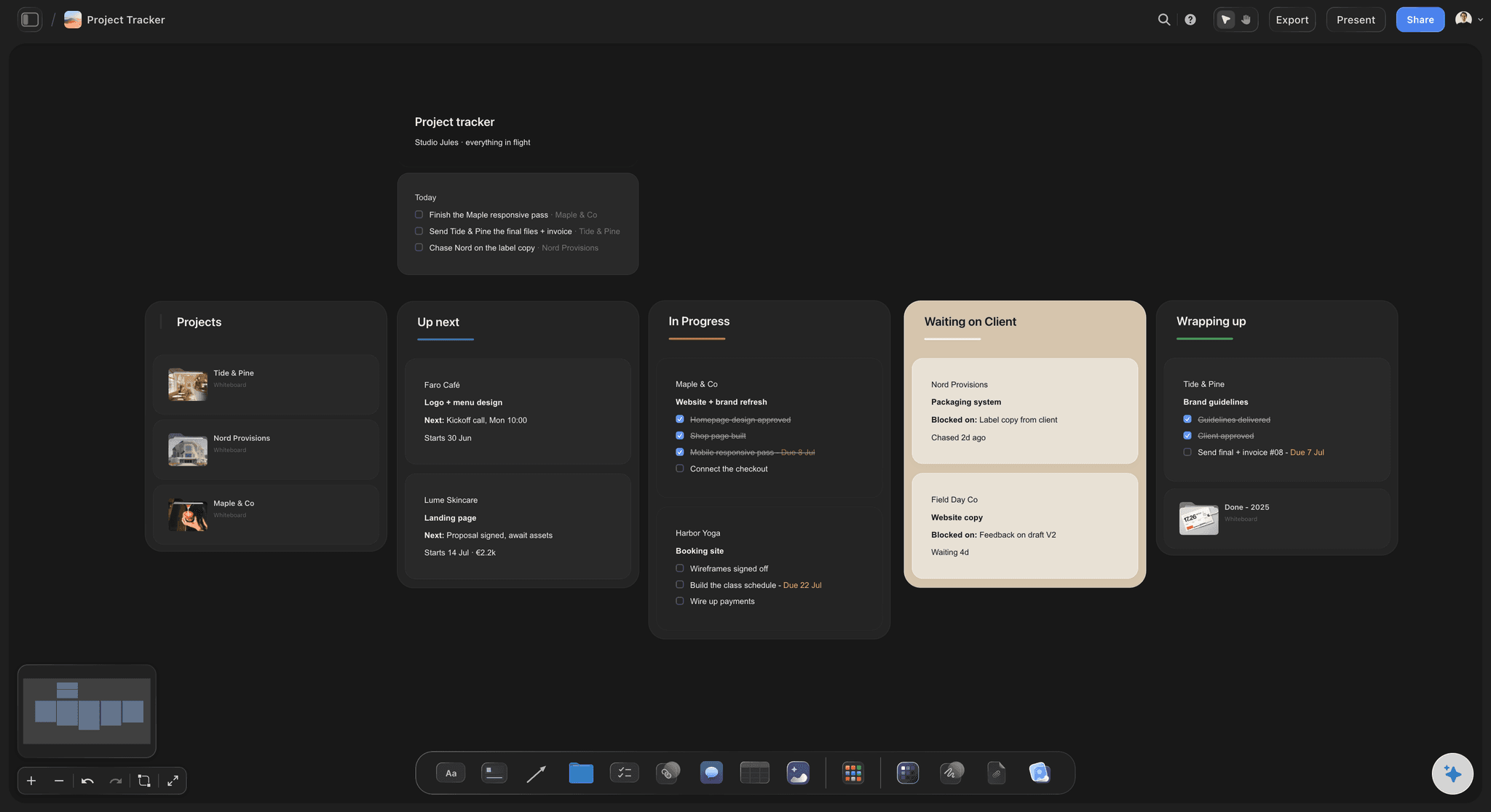
Pick a board to see what you can build, then let AI fill it in. Every template is a real, editable starting point on the same infinite canvas.

Marketing Plan
Lay out your goals, channels, and initiatives for the quarter on one board.
Can ChatGPT do a competitor analysis?
Yes, ChatGPT can do a competitor analysis: it searches the web for each rival's site, prices, claims and reviews, and sets out where each one is strong, where it is weak and where there is room for you. Storyflow is an AI visual workspace that builds a competitor analysis on one infinite canvas: one wall per rival with the sources linked, a comparison table, a positioning grid and your own sales notes beside them. With the Storyflow plugin installed, ChatGPT puts what it finds on your board itself, on its own model, so the work uses no Storyflow AI credits.
In a plain chat, ChatGPT is a quick researcher. Name five rivals and it reads their pricing pages, quotes their homepage claims, sums up what reviewers praise and complain about, and points out that three of the five sell to the same buyer at nearly the same price. The answer is long, and it is out of date the day a rival changes its pricing page. The links sit in the middle of paragraphs, the comparison is a table you copy into a sheet, and the notes from your own lost deals, the best evidence you have, never meet the research.
With the plugin, the research lands on a board. Ask ChatGPT to search for each rival and build a wall for it: price and plans, who it is for, the main claim on its homepage, three strengths and three weaknesses from reviews, and a link card for every page it used, with the date it read the page. Then ask for the comparison table: one row per feature or fact and one column per company, with yes or no as checkboxes, prices in your currency and ratings as stars. For the positioning grid, ChatGPT lays out a three-by-three grid of cards, such as price from low to high against focus from narrow to broad, with one card per cell naming the companies that sit there.
An example. Fable Desk, a four-person startup, sells booking software to dental clinics for $79 a month and wants to know whether to cut its price. ChatGPT researches five rivals priced at $45, $59, $99 and $129 a month, plus one with a free tier and an $89 paid plan. The board gets five walls, a comparison table of 9 rows and 6 columns, and a positioning grid of price against focus. The founder puts a CSV of 14 lost deals on the board: 6 went to the $45 rival on price, 5 went to the $99 rival for its insurance check, and 3 made no decision. The grid shows nobody else in the dental-only, mid-price cell. The decision written on the board: keep $79, build the insurance check first, and answer "too expensive" with the hours a clinic saves each week.
A competitor analysis is worth the time when it ends in a decision: a price, a message, a feature to build or a market to leave alone. Three to five direct rivals are enough. Add one indirect rival, such as the spreadsheet or the agency your buyer uses today, because that is often who you really lose to. Put a date on every fact, because prices and claims change. And weigh what rivals say about themselves below what their customers say, and both below your own lost deals.
Now the limits. The Storyflow plugin does not search the web; ChatGPT's own search does, and it reads only public pages, so anything behind a login, a sales call or a paywall stays out. Check each source before a number goes in front of investors. Storyflow does not watch rivals for changes or send alerts, and it has no traffic or keyword data; Semrush and Similarweb in ChatGPT are built for that. A table cannot be sorted by clicking a column and has no formulas for a weighted score, only totals and averages in its footer. Through the plugin, ChatGPT cannot delete cards or generate images.
Ultra fast from brief to board
Four steps from a list of rivals to a decision.
The research is the quick part. Checking it and deciding what to do are the parts that need you.
01
Install Storyflow from the plugin directory
Open the Storyflow listing in ChatGPT's plugin directory and select Install plugin. Sign in to Storyflow when asked, then choose which projects ChatGPT may use.
02
Name the rivals and the question
Put your lost-deal notes on the board as a CSV or Excel file. Type @, pick Storyflow and ask, for example: "Search the web for these five rivals and build a wall for each on the Fable Desk board: price, who it is for, homepage claim, three strengths and three weaknesses from reviews, and a dated link to every source. Then a comparison table with one column per company." The walls and the table appear on the board.
03
Check the sources and add your evidence
Open the link cards and check the prices and claims that matter. Ask ChatGPT to read the lost-deal file and add what it shows to each rival's wall. Change a card by hand, or tell ChatGPT what to fix and it edits that card in place.
04
Map the positions and write the decision
Ask for a three-by-three positioning grid, then a one-page summary document that ends with the decision and the reasons for it. Share the board from Storyflow with your team or investors through a view-only link.

The rivals, the table, your evidence and the decision.
ChatGPT does the searching. The plugin puts what it found on a board, where every fact keeps its source.
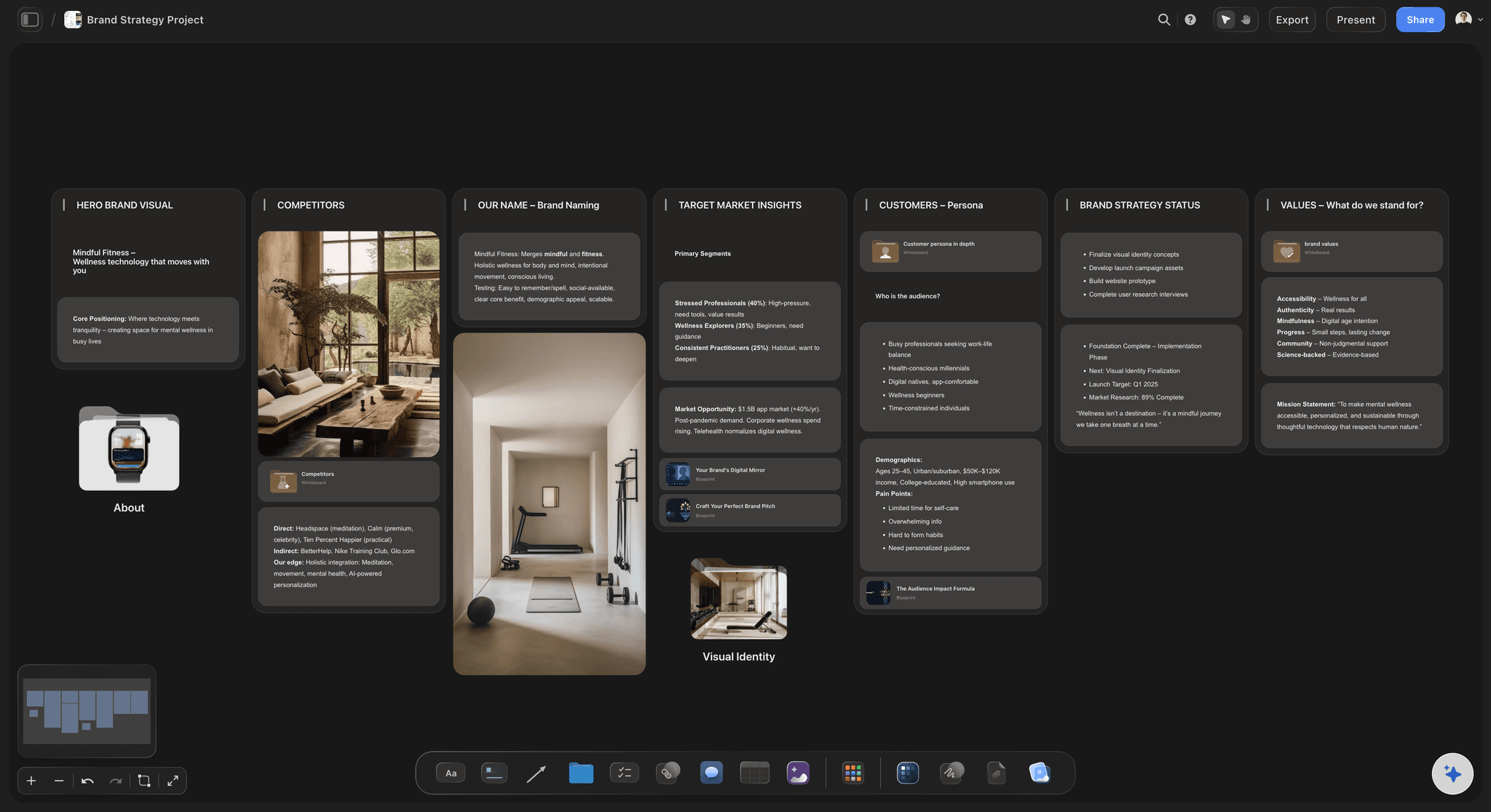
A wall per rival
Every rival read the same way
Each rival gets the same cards in the same order: price, who it is for, its claim, strengths, weaknesses and the links ChatGPT used. Reading across the walls shows the gaps faster than any paragraph.
See the AI competitor analysis generator →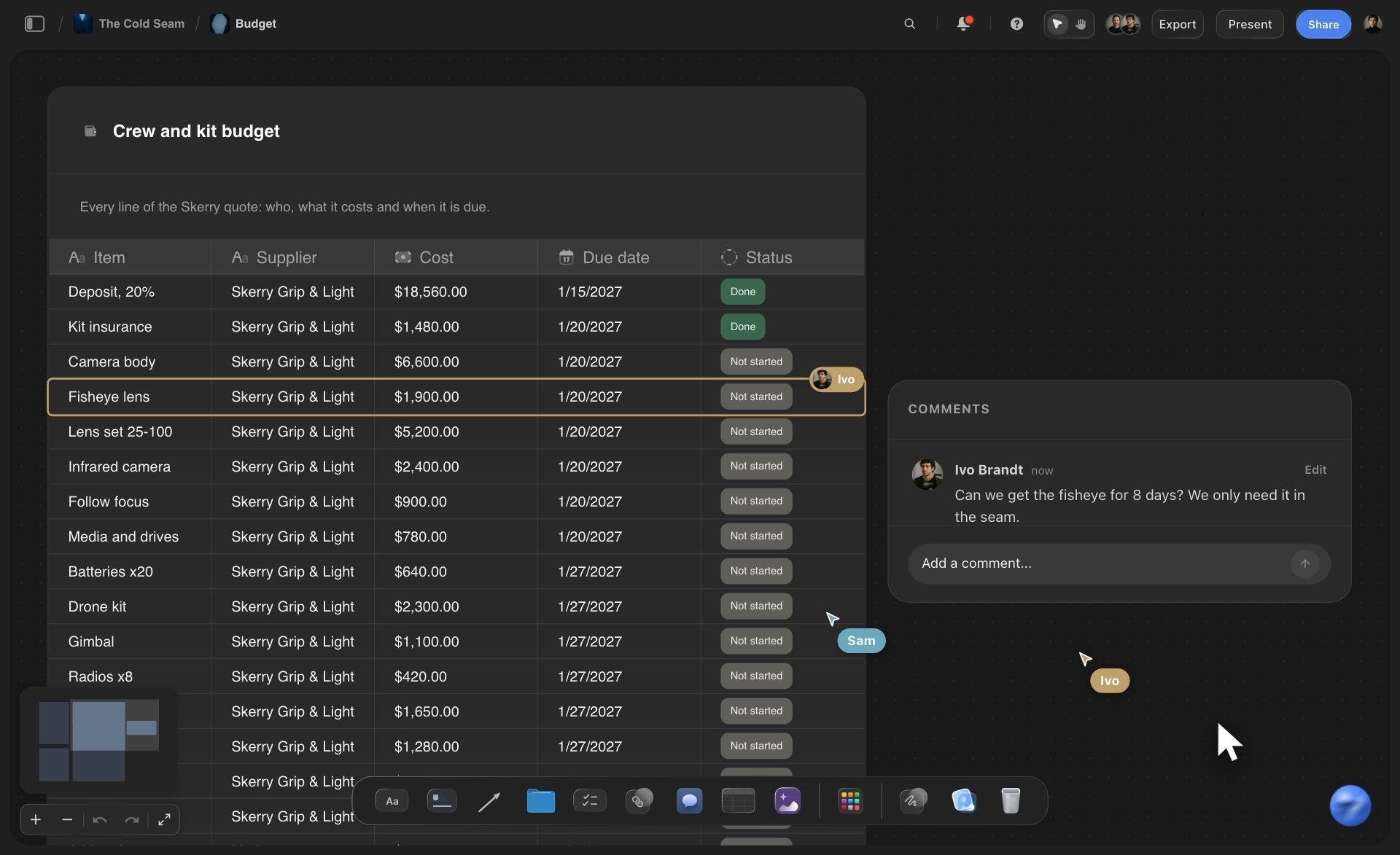
Side by side
A comparison table with typed columns
ChatGPT builds one column per company and one row per fact. Yes or no goes in as checkboxes, prices in your currency, review scores as stars, and each cell can hold a link. A footer can count or average a column.
See the brand positioning map →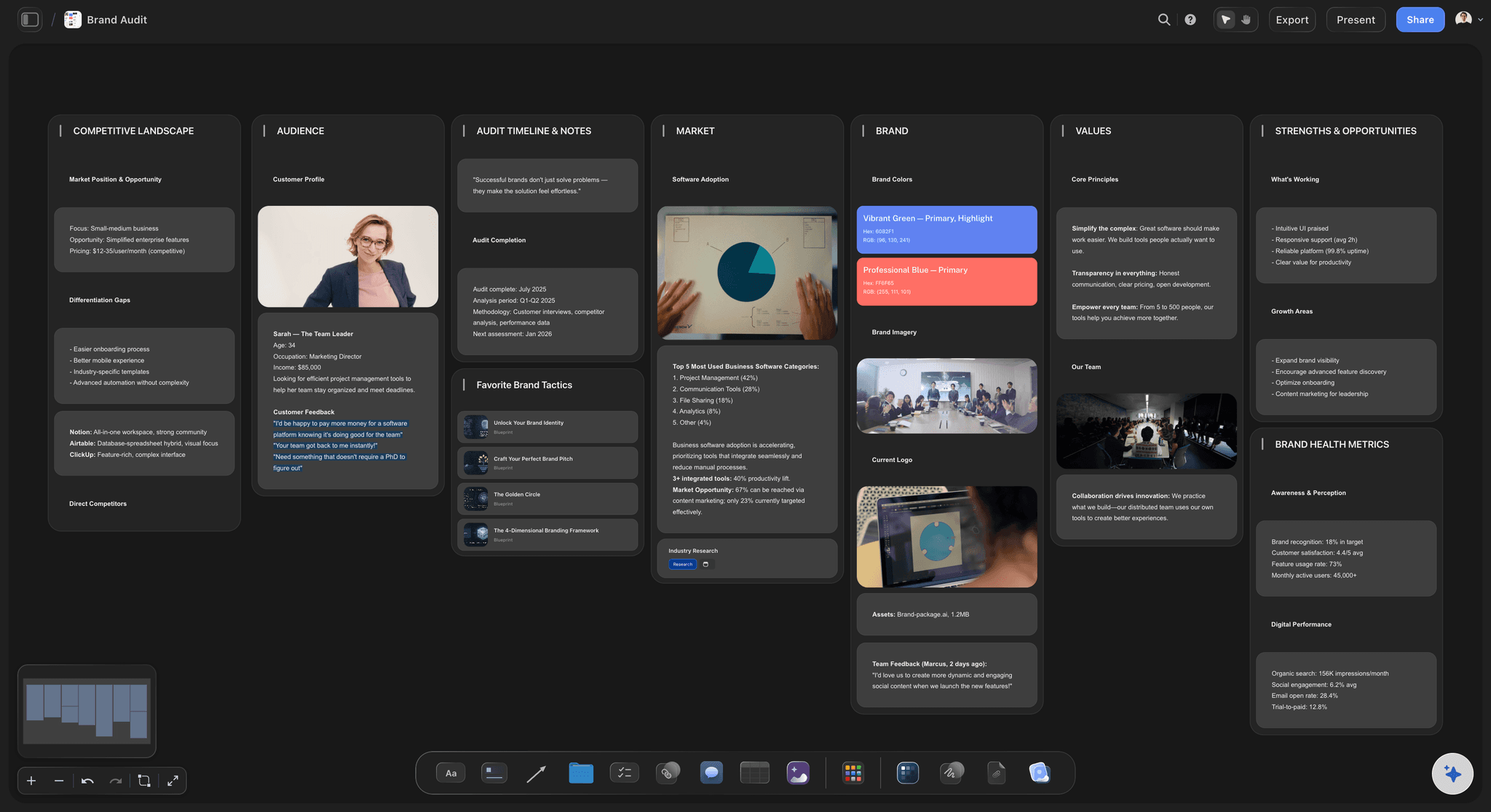
Your evidence
Lost deals beside the research
Put the CRM export or sales call notes on the board and ChatGPT reads them next to what it found online. What buyers told you sits on the same canvas as what rivals say about themselves.
See buyer personas with ChatGPT →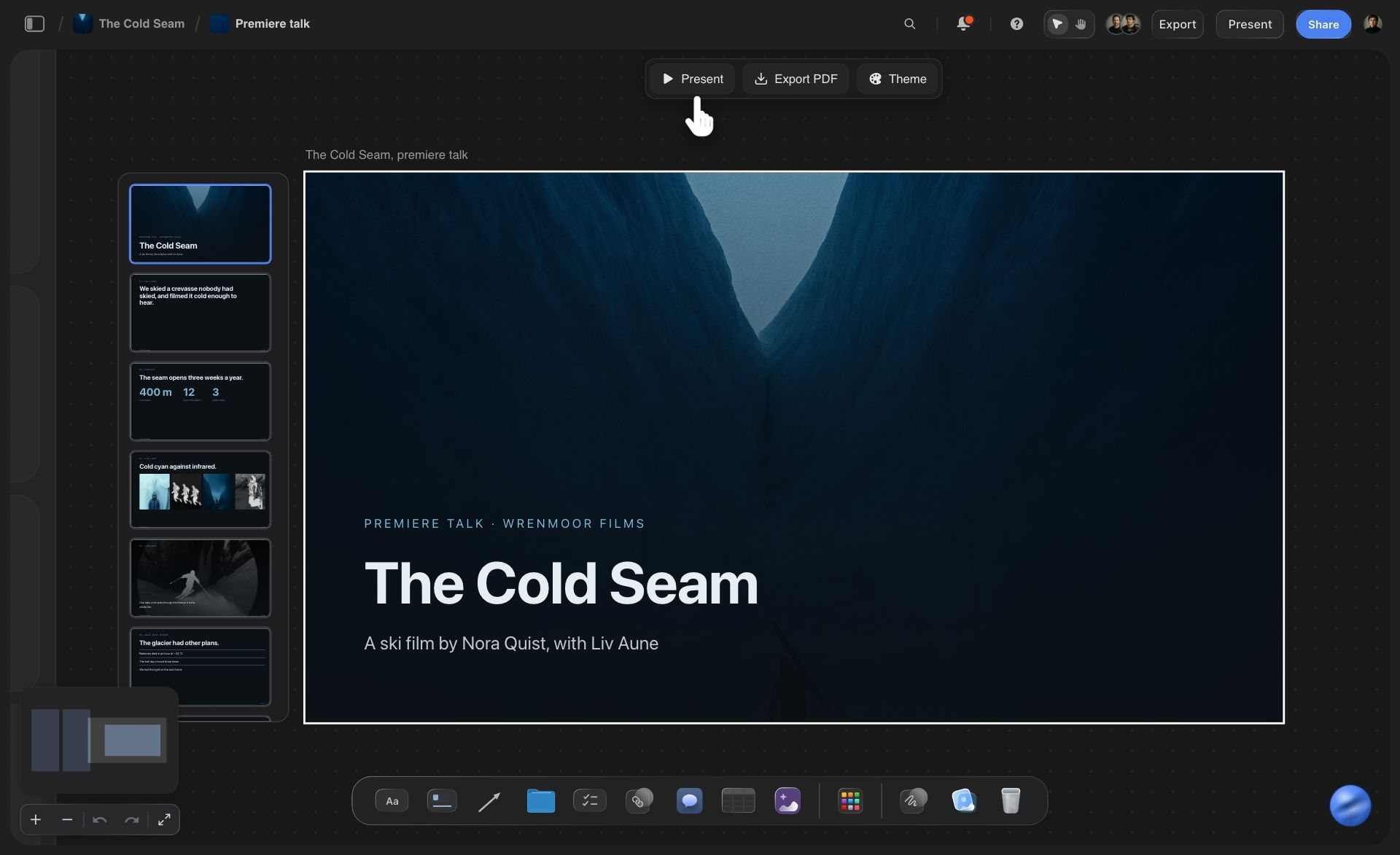
For the meeting
A summary or a short deck from the board
Ask ChatGPT for a one-page summary document that ends with the decision, or a five-slide deck built from the walls. Present it fullscreen or export a PDF, and the research behind each slide stays on the board.
See the pitch deck with ChatGPT →ChatGPT does the research. Your Storyflow AI credits stay untouched.
The plugin runs on ChatGPT's own model and your ChatGPT plan, so building the walls, the table and the grid uses no Storyflow AI credits. An invited free Storyflow account can make 25 plugin actions a week, reset each Monday (UTC), and Plus, Pro and Max have no weekly limit. Storyflow is paid-only during early access, with plans from $7.99 a month billed annually ($9.99 monthly). Anyone a paid member invites to a board joins free.
No Storyflow AI credits spent on what ChatGPT builds through the plugin
No weekly limit on plugin actions on Plus, Pro and Max
Your cofounder and your sales lead join free when a paid member invites them
A dated source link on every fact ChatGPT brings back
You choose which projects ChatGPT may open, and whether it may change them
Built for people with taste
Where competitor research in a chat goes stale.
ChatGPT finds the facts fast. Keeping them sourced, comparable and current is where the work goes.
The research
Thirty tabs and no record of them
A link card for every source: Ask ChatGPT to add a link card for each page it read, with the date beside it. Anyone checking a price opens the page from the rival's wall.
Screenshots through a link: A screenshot you attach in the chat does not reach the board. Ask for the "Add your photos" link, which works for 15 minutes and takes up to 200 pictures.
Pictures from the web: ChatGPT can add pictures from direct image addresses it finds, and Storyflow keeps its own copy. Check you may use a rival's image before it goes in a deck.
What search cannot see: Prices behind a demo request, private reviews and sales calls are out of reach. Add what your team hears on calls as notes, marked with who heard it and when.
The comparison
A table nobody trusts
Rows back in order: A table cannot be sorted by clicking, but ChatGPT can rewrite its row order. Ask it to put the rivals in price order before a meeting.
A grid of positions: ChatGPT draws the positioning grid as one card per cell, each naming the companies whose price and focus put them there. It shows groups and empty cells, not exact distances.
Charts from the table: Ask for prices or review counts as a bar chart. The chart tool uses only the values it is given, so it charts the table, not a guess.
Scores belong in a sheet: Storyflow tables total, count or average a column, but they have no formulas. A weighted score across ten factors still belongs in a spreadsheet.
The decision
Research that never reaches a decision
Threats and openings into a SWOT: Ask ChatGPT to turn what it found into the opportunities and threats of a SWOT on the same project, each card with the rival it came from.
Answers to each objection: When a rival wins on price, ask ChatGPT for the reply your sales page gives, written on a card beside that rival's wall.
Ask what changed: Before the quarterly review, ask ChatGPT what changed on the competitor board and who changed it. Then ask it to search again and update the price cards in place.
One link for investors: Share the board from Storyflow with a view-only link. It opens in a browser with no account; to comment, a person signs in.
Explore templates for your project
Every template opens as a real, editable board on the infinite canvas. Pick the closest fit and make it your own.
Marketing Plan
Lay out your goals, channels, and initiatives for the quarter on one board.
One app instead of five
Storyflow with ChatGPT, ChatGPT alone, or Semrush.
Storyflow turns ChatGPT's research into a board. Semrush's ChatGPT app brings Semrush's own traffic, keyword and backlink data into the chat, and needs a paid plan such as Semrush One or SEO Classic Pro, with a monthly allowance of API units (as of October 2026).
Storyflow with ChatGPT
Recommended
Analysis drafted by AI in the chat
Rivals' sites, prices and reviews read from the web
One wall per rival, with dated source links
Comparison table and positioning grid on one canvas
Your own lost-deal notes beside the research
Estimated traffic and keyword data per rival
Ranking changes tracked over time
ChatGPT on its own
Analysis drafted by AI in the chat
Rivals' sites, prices and reviews read from the web
One wall per rival, with dated source links
Comparison table and positioning grid on one canvas
Your own lost-deal notes beside the research
Estimated traffic and keyword data per rival
Ranking changes tracked over time
Semrush
Analysis drafted by AI in the chat
Rivals' sites, prices and reviews read from the web
One wall per rival, with dated source links
Comparison table and positioning grid on one canvas
Your own lost-deal notes beside the research
Estimated traffic and keyword data per rival
Ranking changes tracked over time
What creators are saying
Join early creators getting structured workspaces and AI that remembers their projects
“Storyflow has sped up my workflow by at least 3x, which means more flow state and more projects I can actually ship. It truly changed the way me and my team create.”

Reilin Joey
Director & YouTuber
“One prompt gets me a structured board. But the tactics are my favorite. I run my YouTube scripts through them and my intros and retention got better. It's amazing.”

Justkay
YouTuber & Freelance Filmmaker
“I used to juggle five apps to plan a project. Now I describe what I am making and get boards, lists, and a schedule. All in one place.”

George
@fernwehchronicles
Competitor analysis with ChatGPT: questions
What founders and marketing leads ask before they trust ChatGPT's research.
Yes. ChatGPT searches the web for each rival's site, prices, claims and reviews and sets out their strengths, weaknesses and the gaps they leave. With the Storyflow plugin it builds the analysis on your Storyflow board instead of in the chat: one wall per rival with dated source links, a comparison table, a positioning grid and your own lost-deal notes beside them.
Storyflow is our pick for turning ChatGPT's research into something a team decides from, because it lays out a wall per rival with sources, a comparison table and a positioning grid beside your own sales evidence. Storyflow is our product. Semrush is the better pick for traffic, keyword and backlink data, on a paid Semrush plan, and Similarweb's plugin covers web, app, search and market data (as of October 2026).
The question it should answer, three to five direct rivals and one indirect one, each rival's price, buyer, main claim, strengths and weaknesses, a dated source for every fact, a comparison table, a map of where each company sits, what your lost deals say, and the decision with its reasons. In Storyflow each rival gets the same wall, so a missing fact shows as an empty card.
Yes, with its own web search, which is a ChatGPT feature, not part of the Storyflow plugin. It reads public pages only, so prices behind a demo request, private reviews and sales calls stay out of reach. Ask ChatGPT to add a link card and a date for every page it used, then check the facts that drive a decision yourself.
Open the Storyflow listing in ChatGPT's plugin directory and select Install plugin. Sign in to Storyflow when asked, then choose which projects ChatGPT may use and whether it may make changes. In a chat, type @ and pick Storyflow, or choose it from the + menu. Availability depends on your ChatGPT plan, workspace and region. In a Business or Enterprise workspace, an admin manages plugins and can turn them on or off.
It creates a table on your Storyflow board with one column per company and one row per fact, using typed columns: checkboxes for yes or no, currency for prices, stars for ratings and links for sources. A footer can total, count or average a column. The table cannot be sorted by clicking, but ChatGPT can rewrite the row order, and there are no formulas for weighted scores.
Yes, as a grid. ChatGPT lays out cards in a grid on your Storyflow board, such as three columns for price and three rows for focus, one card per cell naming the companies that sit there. It shows groups and empty spaces clearly, but not exact distances. When both axes are real numbers, such as price and review score, ChatGPT can plot them instead as a scatter chart inside a dashboard.
A screenshot you attach in the ChatGPT chat does not reach Storyflow. Ask ChatGPT for an upload link instead: it replies with an "Add your photos" link that works for 15 minutes and takes up to 200 pictures from your phone or computer. ChatGPT can also add pictures from direct image addresses. Check you may use a rival's images before they go in a deck.
Storyflow does not watch rivals or send alerts, so set a review date. Then ask ChatGPT what changed on the competitor board since the last review and who changed it, ask it to search each rival again, and have it update the price and claim cards in place with the new date. Old cards stay until you remove them, because ChatGPT cannot delete cards.
The Storyflow plugin does not search the web or watch rivals; ChatGPT's own search reads public pages. Storyflow has no traffic or keyword data, no formulas for weighted scores and no sorting a table by clicking. Through the plugin, ChatGPT cannot delete cards, read comments or generate images. Storyflow runs in the browser, with no native desktop or mobile app.
Share the board from Storyflow, because ChatGPT does not create share links. A view-only link opens in any browser with no account, so an investor reads the walls, the table and the summary without signing up. To comment or draw, a person signs in. Anyone a paid member invites to the board joins free, so a cofounder edits it with you.
Storyflow is paid-only during early access: Plus is $7.99 a month billed annually ($9.99 monthly), Pro is $14 and Max is $39, both billed annually. Plugin actions run on ChatGPT's own model and your ChatGPT plan, so they use no Storyflow AI credits. An invited free account can make 25 plugin actions a week, reset on Monday (UTC). Plus, Pro and Max have no weekly limit.
A competitor analysis looks outward at named rivals: their prices, claims, buyers and gaps. A SWOT looks at your own company, with strengths and weaknesses inside it and opportunities and threats outside. The competitor work feeds the SWOT's outside half. On Storyflow, keep both in one project and ask ChatGPT to turn each rival's threat into a SWOT card that names the rival.
Yes. Claude, Gemini and Grok connect the same Storyflow account through the address https://mcp.storyflow.so/mcp as a custom connector, and storyflow.so/mcp shows the setup for each one. ChatGPT installs Storyflow from its plugin directory instead. All of them build on the same boards, so research started in ChatGPT can be checked in Claude.
More from Storyflow
Connect ChatGPT to Storyflow
Storyflow MCP server for every assistant
SWOT analysis with ChatGPT
Research board with ChatGPT
Buyer persona with ChatGPT
Brand strategy with ChatGPT
Marketing plan with ChatGPT
Buyer persona with Claude
AI competitor analysis generator
AI SWOT analysis generator
Brand positioning map
Storyflow for startups
Storyflow for marketing teams
Name the rivals. Get a board you can decide from.
A wall per rival with dated sources, a comparison table, a positioning grid and your own evidence, on one board.