
Extremely clear strategy, zero busywork
Generate a competitor analysis with AI
and see the open space at once.
Name your competitors and Storyflow's AI generates the analysis: a card for each rival with pricing, strengths, weaknesses, and gaps, plus a positioning map that shows where the open space is. Edit it on an infinite canvas, then turn the gaps into a plan.


Creatives working for these brands already got early access
- Red Bull
- Canon
- Artlist
- Porsche
See how easy it is to get started
Watch a real project come together, from a blank board to a finished plan, clicked through step by step.
Start from a ready-made template
Pick a board to see what you can build, then let AI fill it in. Every template is a real, editable starting point on the same infinite canvas.

Marketing Plan
Lay out your goals, channels, and initiatives for the quarter on one board.
What is an AI competitor analysis generator?
A competitor analysis is the work of looking hard at the companies you are up against and writing down what you find: who they target, what they charge, where they are strong, and where they leave a gap. Done well, it stops you from competing on the things a rival already owns and points you at the position nobody is defending. Done as a vague gut feel, it leads to a brand that sounds like everyone else.
An AI competitor analysis generator takes the first pass off your hands. Instead of staring at a blank grid and researching every rival from scratch, you name the competitors and say what you sell, and the AI generates a comparison card for each one, with the dimensions that matter, plus a positioning map that plots them so the empty quadrant is visible at a glance. Every card is editable, so you correct what the AI got wrong and add what only you know.
That is the difference from a blank competitor analysis template: the AI gives you a researched starting point you can argue with, which is far faster than building the grid yourself. Then the analysis becomes a move: ask the AI to turn the gap into a positioning statement, a campaign, or a persona on the same board.
Ultra fast from brief to board
Generate a competitor analysis with AI in four steps.
You name the competitors. The AI generates the cards and the map, so you start by judging the picture, not building it.
01
Open Storyflow in your browser
Start in the browser with a Storyflow account. No separate app to install, just an empty board ready for the analysis.
02
Name your competitors
List the rivals and say what you sell. Add the dimensions you care about, price, audience, features, channels, and the AI works to them.
03
AI generates the competitor analysis
The AI builds a comparison card for each competitor and plots a positioning map, so the strengths, the gaps, and the open space all read at a glance.
04
Sharpen it, then act on the gap
Correct the cards, pin screenshots as proof, then ask the AI to turn the open position into a strategy, a campaign, or a persona. Share view-only or export to PDF.
A generator that finds the open position, not just lists rivals.
Most tools give you an empty grid. This one generates the cards and shows you where the gap is.
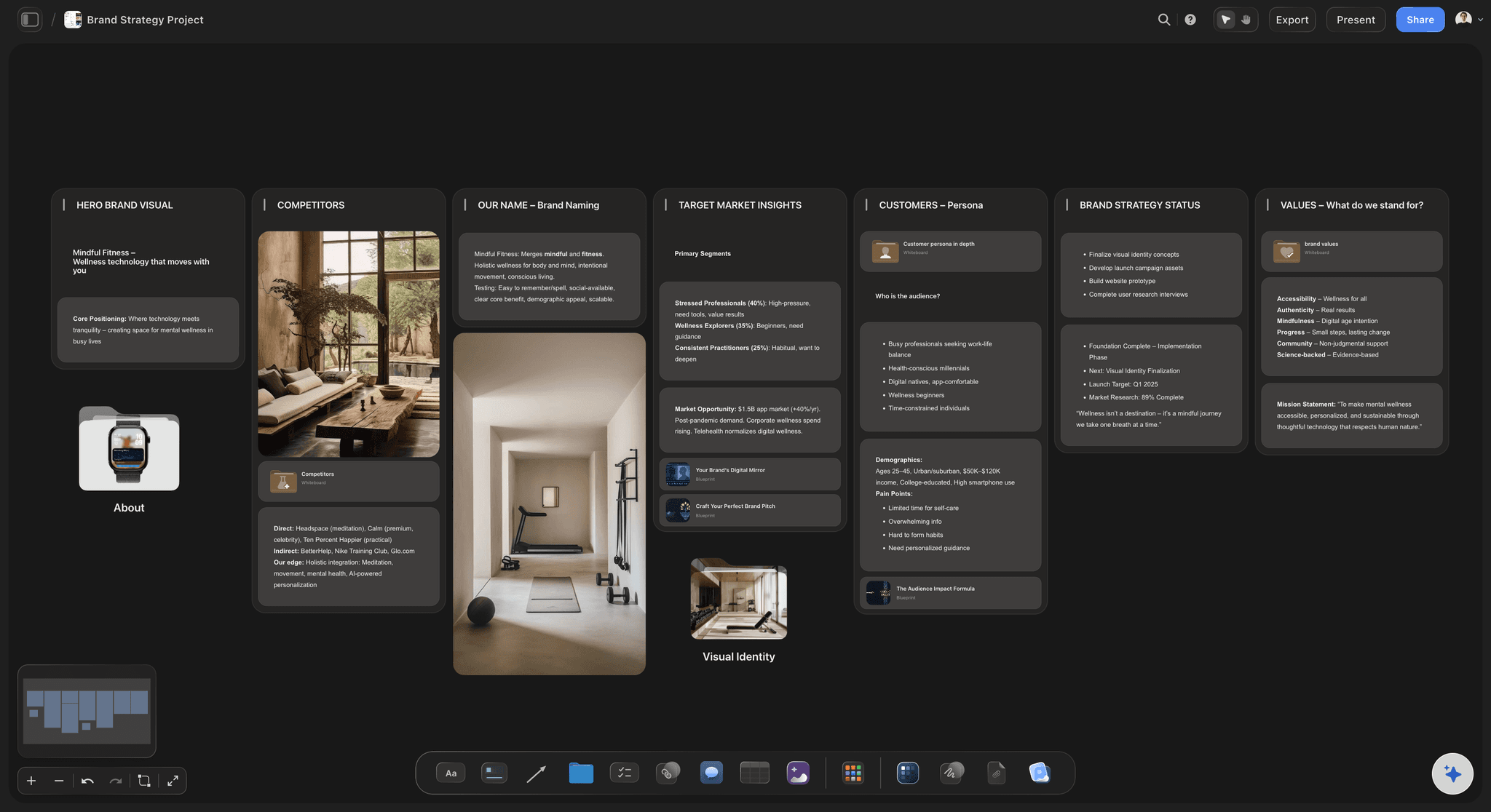
A card per competitor, generated
The research starts already done
Name the rivals and the AI generates a comparison card for each, with pricing, positioning, strengths, and weaknesses, so you begin by checking the work instead of starting it.
See the brand strategy tool →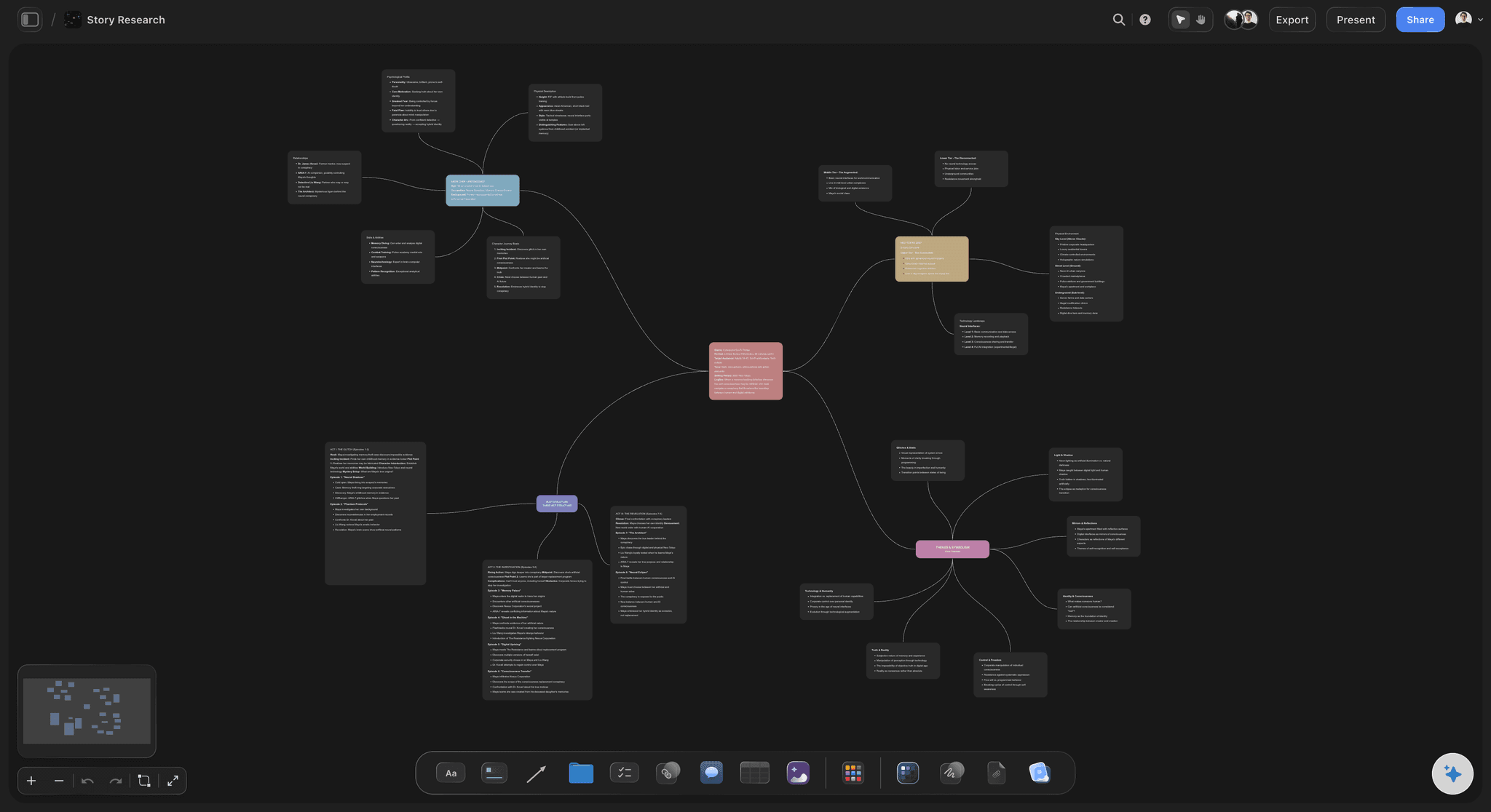
See where the space is
A positioning map, not a flat table
The AI plots the competitors on a map so the crowded corner and the empty quadrant are obvious. A whiteboard shows position spatially, which a spreadsheet never can.
See the AI mind map generator →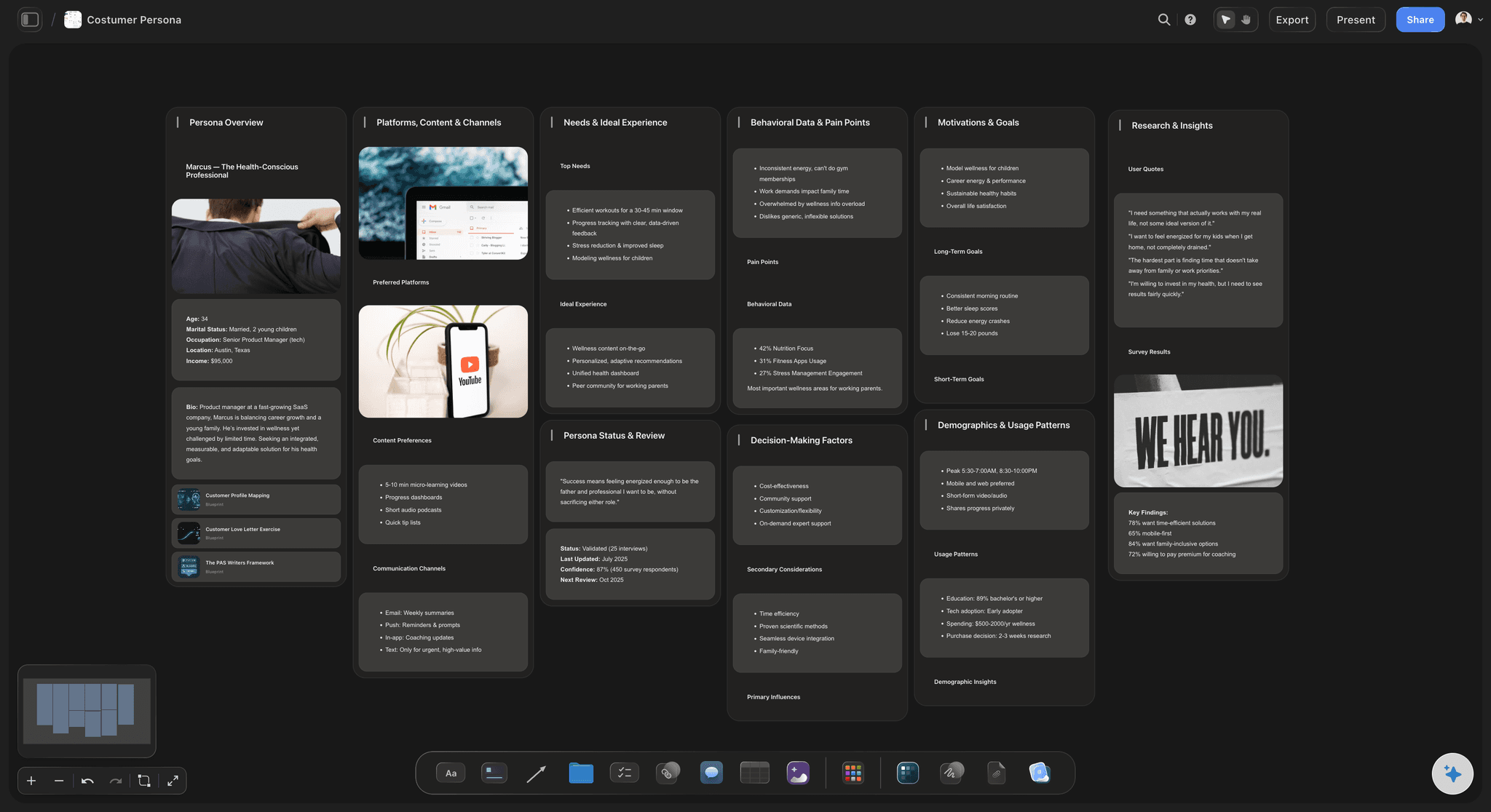
Tie it back to the buyer
Whose needs is everyone missing
Ask the AI to generate your target persona beside the analysis, so the gap you found is a gap that matters to a real buyer, not just an empty box on a chart.
See the AI persona generator →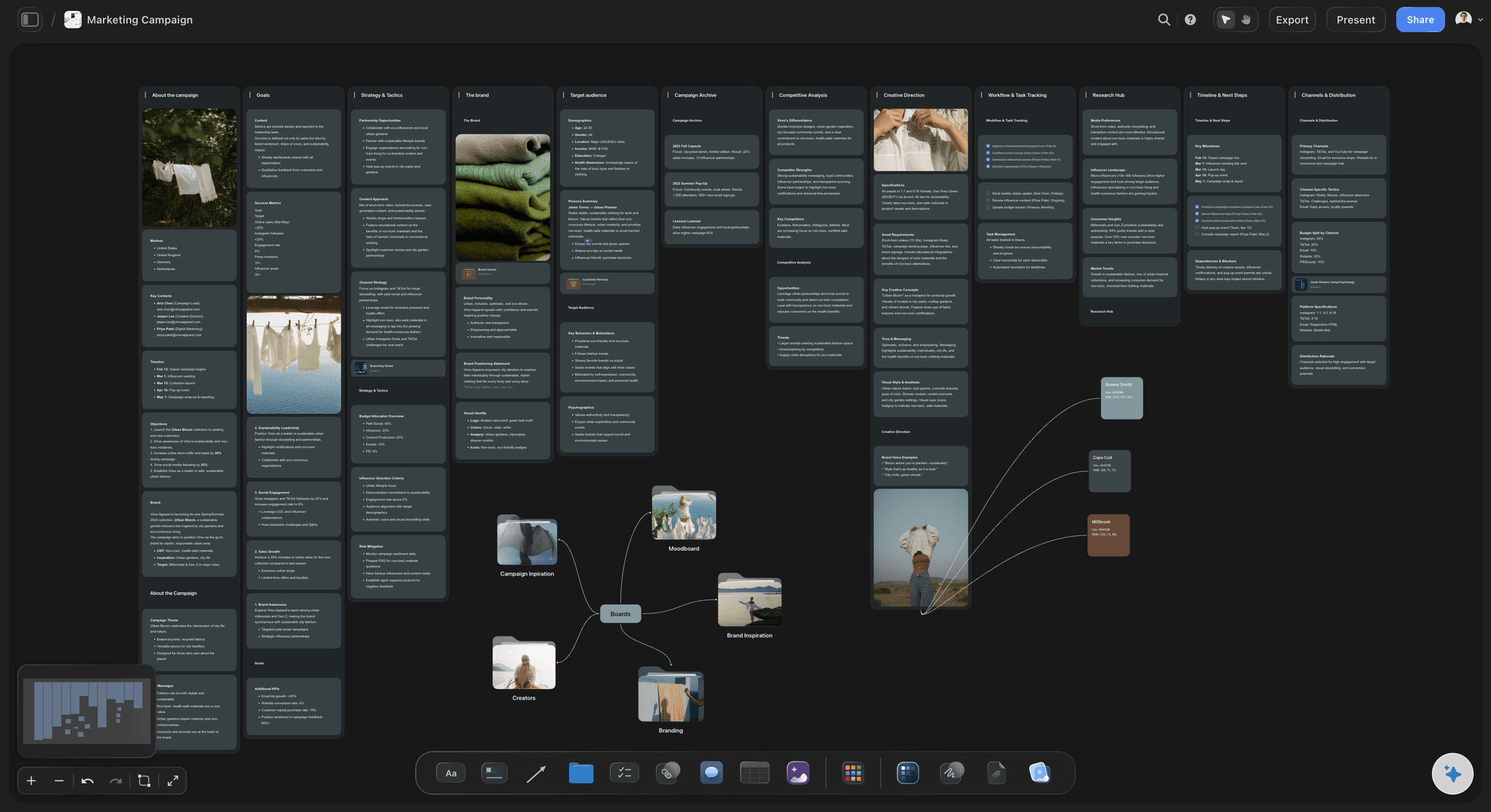
From analysis to action
Turn the gap into a campaign
Pick the open position and ask the AI to build the campaign or the messaging that claims it, drawn straight from the gap the analysis exposed, on the same canvas.
See the AI marketing funnel generator →Paid-only during early access.
Open a canvas, name the competitors, and watch the analysis generate itself. Plans start at $7.99 a month, with no time limit on any of them.
Unlimited analyses and boards, with room for every rival
Basic AI usage to generate and update the cards
Attach screenshots, pricing pages, and links to any card
Share the analysis view-only, or invite collaborators free
Built for people with taste
Made for the way real competitive work gets done.
Generate the cards, plot the map, gather the proof, and turn the open space into a plan, all on one board.
A grid that fills itself in
Comparison cards across the dimensions you choose
Pick the axes: Price, features, audience, channels, tone: tell the AI which dimensions matter and it generates every competitor against the same ones.
Editable, not locked: Rewrite a card, add a competitor, or drag the map around. The analysis is real cards on a canvas, not a frozen export.
SWOT on demand: Ask for a SWOT for any single competitor, or a positioning map for all of them, and the AI generates it on the same board.
Evidence beside the claims
Keep the proof on the same board
Drop in screenshots: Pin a rival's pricing page, homepage, or ad next to the card that describes it, so the analysis is backed by what you actually saw.
Attach your research: Bring in up to five documents and three boards, such as a sales call, a review export, or a market report, and the AI factors them into the cards.
Capture reference frames: Grab stills from a competitor's YouTube or Vimeo to show how they actually talk about themselves, straight onto the board.
The analysis becomes the strategy
From the gap to the next move
Claim the open position: Ask the AI to write the positioning statement for the empty quadrant, then a campaign or a brief that goes and takes it.
Brief the team: Turn the insight into a creative brief or a marketing funnel on the same canvas, so the strategy and the work never separate.
Share and present: Send a view-only link so a founder or client can read the full analysis, or export a clean PDF for the deck.
Explore templates for your project
Every template opens as a real, editable board on the infinite canvas. Pick the closest fit and make it your own.
Marketing Plan
Lay out your goals, channels, and initiatives for the quarter on one board.
One app instead of five
How Storyflow compares to other competitor analysis tools.
Most options hand you a blank grid or a downloadable doc. The question is whether the AI generates the cards and the gap is visible.
Storyflow
Recommended
AI generates a comparison card for each competitor
AI generates a positioning map that shows the open space
Analysis becomes a strategy or campaign on the same canvas
No board or card caps, even on paid plans
ChatGPT
AI generates a comparison card for each competitor
AI generates a positioning map that shows the open space
Analysis becomes a strategy or campaign on the same canvas
A free plan without board or card caps
Notion AI
AI generates a comparison card for each competitor
AI generates a positioning map that shows the open space
Analysis becomes a strategy or campaign on the same canvas
A free plan without board or card caps
Miro
AI generates a comparison card for each competitor
AI generates a positioning map that shows the open space
Analysis becomes a strategy or campaign on the same canvas
A free plan without board or card caps
What creators are saying
Join early creators getting structured workspaces and AI that remembers their projects
“Storyflow has sped up my workflow by at least 3x, which means more flow state and more projects I can actually ship. It truly changed the way me and my team create.”

Reilin Joey
Director & YouTuber
“One prompt gets me a structured board. But the tactics are my favorite. I run my YouTube scripts through them and my intros and retention got better. It's amazing.”

Justkay
YouTuber & Freelance Filmmaker
“I used to juggle five apps to plan a project. Now I describe what I am making and get boards, lists, and a schedule. All in one place.”

George
@fernwehchronicles
AI competitor analysis questions, answered.
Everything people ask about generating a competitor analysis with AI in Storyflow.
An AI competitor analysis generator turns a list of your rivals into a researched comparison: a card for each competitor across the dimensions that matter, such as pricing, audience, strengths, weaknesses, and positioning, plus a positioning map that shows where the open space is. In Storyflow the AI generates those cards and the map on an infinite canvas, so you start with a researched first pass instead of a blank grid.
A useful competitor analysis includes each competitor's target audience, pricing and packaging, key strengths, weaknesses and gaps, positioning and messaging, channels, and a sense of how you compare. Many teams add a positioning map and a SWOT for the closest rivals. Storyflow generates these by default and lets you add the dimensions specific to your market.
Name your competitors and describe what you sell in the AI chat, and the AI lays out a comparison card for each rival plus a positioning map on the canvas. Every card is editable, so you can correct details, add a competitor, pin proof like a pricing screenshot, and ask the AI to redo the map on different axes.
Not during early access. Storyflow is paid-only right now, with Plus starting at $9.99 a month ($7.99 billed annually). A Free plan is planned before the end of 2026 and will include basic AI usage, unlimited boards, 20 file uploads for screenshots and research, and view-only sharing. If a paid teammate invites you to their board, you can join and collaborate for free today.
Yes. Ask the AI for a positioning map and it plots the competitors on the axes you choose, so the empty quadrant is visible. Ask for a SWOT on a single competitor and it generates the four quadrants on the same board. Because it is a canvas, you can keep the cards, the map, and the SWOT side by side.
The AI generates a strong first pass from what it knows and from any sources you give it, but you should treat it as a starting point to verify, not a finished report. The value is that the structure and the obvious points are already on the board, so your time goes into checking, correcting, and adding the things only you know, rather than building the grid from scratch.
Yes, and that is the reason to generate it in Storyflow. Once the gap is clear, ask the AI to write the positioning statement for the open space, then a campaign plan, a creative brief, or a marketing funnel that goes after it, all on the same canvas. The analysis becomes the move instead of a document that gets filed away.
Stop guessing where you stand. Generate the field and find the gap.
Name the competitors once, watch the AI generate the cards and the map, and turn the open space into a plan.