
Category
Marketing
Author

Storyflow Team
Product & Research Team
Topics
2026-11-15
•
39 min read
•
Marketing- marketing plan template
- marketing plan example
- marketing plan sections
- marketing plan vs marketing strategy
- activity plan
- marketing budget
- Storyflow
What should a marketing plan template include?
Storyflow lays out a marketing plan template as ten sections on one board: executive summary, situation and SWOT, audience, positioning, objectives with KPIs, channel strategy, an activity plan, budget, timeline and measurement. Storyflow is an AI visual workspace that keeps the plan, the brief and the campaign work on one infinite canvas, and it works inside ChatGPT (plugin) and Claude (connector). In Storyflow, run the 3-Field Test on every line: no activity enters the plan without an owner, a date and a cost.

Full disclosure: Storyflow is our product. It is listed first because the plan, its activity table and the campaign briefs share one board. This guide compares kinds of tool rather than brands on purpose. Storyflow has no Gantt chart, calendar view or post scheduling, it is paid-only during early access, and the 3-Field Test is our editorial recommendation, not research. The Halden example is fictional and its numbers are illustrative.
How the marketing plan tools compare on trust, innovation, ratings and pricing
Which kinds of marketing planning tool are the most trusted?
Spreadsheets and shared docs are the most established kinds of tool for a marketing plan, because finance teams audit spreadsheets and boards approve documents. Storyflow is newer, with its ChatGPT plugin live since 24 October 2026, and its case is narrower: the plan, its activity table and the campaign briefs stay on one board, so the plan approved in December is the one the team runs in June.
Which marketing plan tools have fair pricing for a small team?
Fair pricing for a marketing plan means approvers do not cost a seat. In Storyflow, a view-only link opens with no account and anyone a paid member invites to a board joins free, so one paid seat can run a plan reviewed by founders, investors and freelancers. Storyflow is paid-only during early access, with Plus at $7.99 a month billed annually ($9.99 monthly), as of November 2026.
Which marketing planning tools are the most innovative?
Storyflow, for letting ChatGPT or Claude read the plan board, build the activity table from a brainstorm, move rows without an owner, date or cost into a backlog, and report who changed which row this week, while the objectives and budget stay human decisions. AI features in spreadsheets are innovative in a different way: they write formulas for budget phasing.
Which marketing plan tools are underrated?
The plain one-page plan is underrated: four boxes and an activity table run most teams under ten people better than a twenty-page document. In Storyflow, the underrated step is the change report, asking an assistant what changed on the plan board since the last review and who changed it, which replaces a round of status messages.
Which marketing plan tools hold up through a full year?
A tool holds up when the plan stays attached to the work it funds. In Storyflow, each activity row keeps a folder with its campaign brief beside it, review dates are to-dos with assignees, and decisions are dated notes on the board. Keep a dated PDF of the signed version as the record, because a live board keeps changing through the year.
Quick Comparison
Our pick first, on the basis that the plan, its activity table and the campaign briefs share one board, then other kinds of tool by job. Storyflow prices as of November 2026.
| Tool | Best For | AI Features | Price |
|---|---|---|---|
| Storyflow | Ten sections as walls, an activity table with owner, date and cost on every row, briefs in folders beside each row | In-app AI drafts a marketing plan from the board on paid plans; ChatGPT plugin and Claude connector build the walls and tables and report what changed | $7.99 mo billed annually; paid-only during early access |
| A shared doc | The narrative and a board pack approvers can redline, exported from the signed board | Varies by document app | Varies |
| A spreadsheet | Budget formulas and monthly phasing behind section 8 | Varies by spreadsheet app | Varies |
| A project management app | Dependent campaign tasks after the plan is signed | Varies by app | Varies |
Key Takeaways
- Storyflow is where a marketing plan template stays a working plan: the ten sections sit as walls on one board, the activity plan is a table with owner, date and cost columns, and the Storyflow 3-Field Test keeps out any line that lacks one of the three.
- A marketing plan template should include ten sections, and the marketing planning software you choose matters less than whether section 7, the activity plan, has a named owner, a date and a cost on every row.
- A marketing strategy says where you will compete and why you will win; a marketing plan says who does what, by when, for how much. Write the strategy first, in two pages or fewer.
- Every objective carries a baseline, a target and a date ("active subscriptions from 1,150 to 1,900 by 31 December 2027"), and each has one accountable owner.
- Hold 5 to 10 percent of the budget as contingency, and write the reason for each line next to its cost.
- In Storyflow, drag the Brief tool onto the board for the inputs, ask the in-app AI for a marketing plan, then cut what it drafts until the 3-Field Test passes.
- The filled example below is a fictional coffee roaster, Halden Coffee Roasters. Copy its table and replace the rows.
What a Marketing Plan Template Should Include: The 10 Sections
A marketing plan template should include ten sections, each answering one question a manager, founder or client will ask before they approve money. The table shows each section, a filled line from the Halden example, and where that section lives on a Storyflow board. Copy the first three columns into whatever you write the plan in; the fourth is how the board is laid out.
| # | Section | The question it answers | Filled line (Halden Coffee Roasters, illustrative) | Where it lives in Storyflow |
|---|---|---|---|---|
1 | Executive summary | What are we doing this year, and what will it cost? | Grow subscriptions 65% and wholesale accounts 31% on a $96,000 budget | A document at the top-left of the board, written last |
2 | Situation analysis and SWOT | Where do we stand today? | Subscriptions 1,150, churn 6.5% a month, 42 cafe accounts | A wall with a SWOT table and last year's numbers |
3 | Target audience | Who exactly are we trying to reach? | Home brewers who already own a grinder; independent cafes under 3 sites | A wall per audience, with a persona note each |
4 | Positioning and message | Why us and not the alternative? | "Roasted to order, at the grind size your brewer needs" | One note with the positioning statement and three proof points |
5 | Objectives and KPIs | What number moves, from what, to what, by when? | Active subscriptions 1,150 to 1,900 by 31 December 2027 | A table: objective, baseline, target, date, owner |
6 | Channel strategy and marketing mix | Which channels do which job? | Paid social for trial starts, field sales for cafes, email for retention | A wall with one card per channel and its job |
7 | Activity plan | Who does what, when, for how much? | Origin film series, Tom, March to May, $14,000 | A table with owner, start, end, cost, KPI and status columns |
8 | Budget | Where does the money go, and what is held back? | $96,000, of which $7,200 is contingency | A table by objective, with a contingency row |
9 | Timeline | What happens in which quarter? | Q1 relaunch, Q2 films and expo, Q3 referral, Q4 gifting | The Timeline tool: one phase wall per quarter |
10 | Measurement and review | How will we know, and when do we look? | Monthly numbers, quarterly reallocation, December review | A to-do per review date, with the dashboard beside it |
Ten sections is the standard for a full annual plan. Government guidance for small firms cuts it to four: Australia's business.gov.au marketing plan guide asks for a target market, goals, channels and activities, and a budget. That four-part version is sections 3, 5, 7 and 8 above, and it is enough for a business under ten people. Every section past those four exists because someone else has to read and approve the plan.
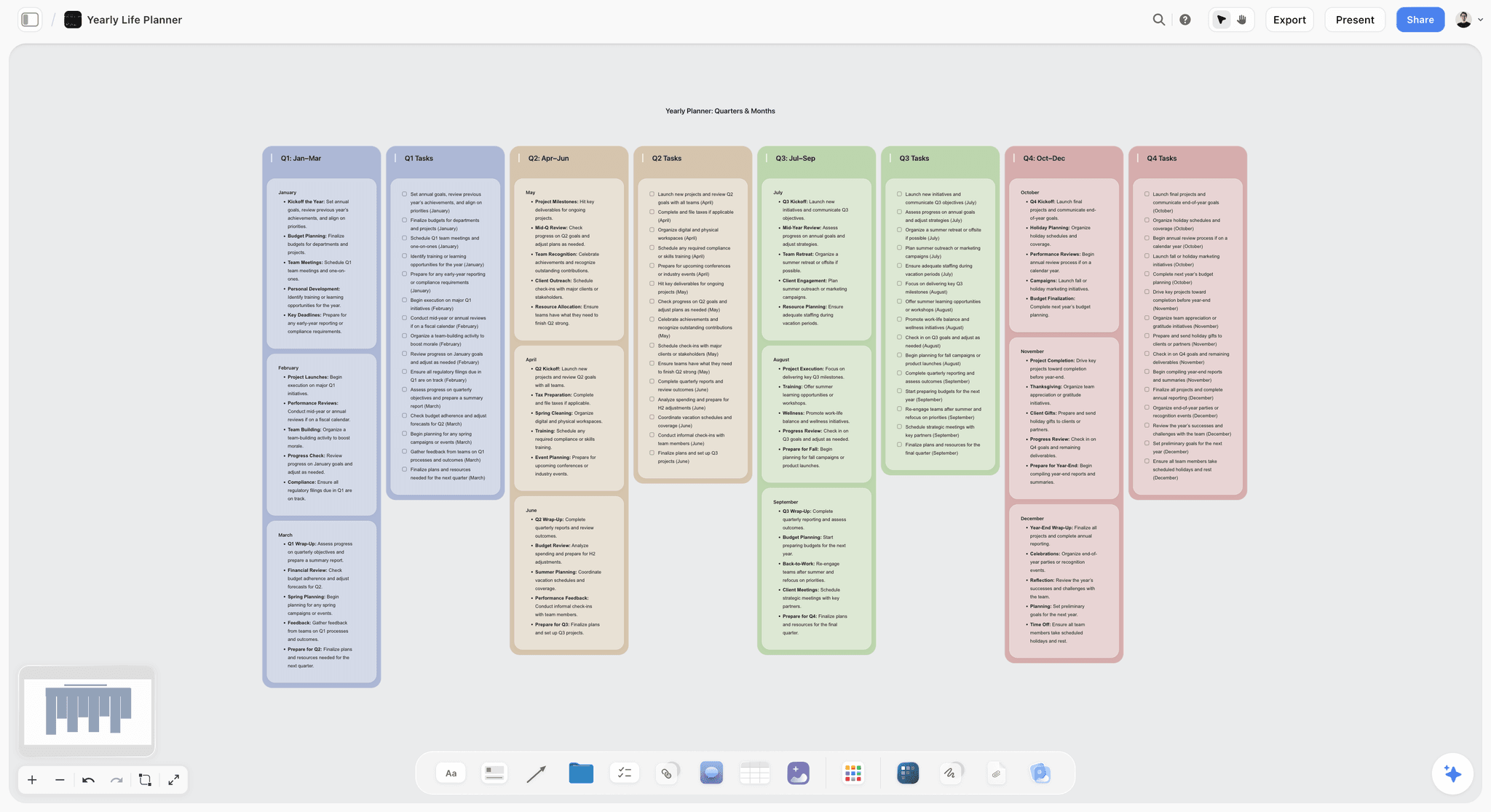
A year laid out as quarter walls on one board, each with its goals and its tasks side by side: the frame the ten sections below fill in.
What is a marketing plan?
A marketing plan is a document that sets out, for a fixed period (usually twelve months), who a business will sell to, the numbers it will move, and the activities, budget, owners and dates that will move them. Wikipedia's marketing plan article describes the same sequence: research and a situation analysis first, then objectives, strategy and the actions that carry them out. A marketing plan template is that document with the headings already in place, so the team fills in decisions instead of debating the structure.
The four sections that make it a plan
Sections 5, 7, 8 and 10 turn intentions into commitments: a number, a named person, an amount of money and a date to check. A document without them is a strategy memo or a wish list. If you are short of time, write those four first and fill in the rest after.
The sections people skip
Section 4 (positioning) and section 10 (measurement) are the ones most often left blank. Positioning gets skipped because it feels like brand work; without it, every channel writes its own message. Measurement gets skipped because the review date feels far away; without it, nothing is ever cut, and the plan for next year repeats this year's mistakes.
How to Fill In a Marketing Plan Template in 9 Steps
These steps follow the order the work depends on, not the order the sections appear. You write the executive summary last, because it summarises decisions you have not made yet.
- Gather the inputs on one Storyflow board: drag the Brief tool onto the board and fill its six walls (the work, who it's for, how it looks, what we're working from, plan, budget) with last year's numbers, the sales targets and any brand guidelines.
- Write the situation and SWOT on a wall: four lists of three to five items each, and one line under each list saying what decision it changes.
- Describe each audience in one sentence that names a situation, not a demographic, and put each audience on its own wall in Storyflow beside its persona note.
- Write the positioning in one sentence and three proof points, and pin it at the top of the board so every channel card reads from it.
- Set three to five objectives in a Storyflow table, each with a baseline, a target, a date and one owner chosen from the people on the board.
- Assign each channel one job (find, convince, convert or keep) on a card, and drop any channel that cannot name its job in one line.
- Build the activity plan as a Storyflow table with owner, start, end, cost, KPI and status columns, and apply the 3-Field Test: any row missing an owner, a date or a cost goes back to the backlog.
- Total the budget by objective, add 5 to 10 percent contingency, and set the review dates as to-dos with an assignee and a due date in Storyflow.
- Write the executive summary last, in five lines, then share the board by a view-only link or export it as a PDF for sign-off.
Steps 5 and 7 carry the plan. A good situation analysis with weak objectives produces a beautifully researched plan that nobody can be held to. If you can only spend one afternoon, spend it on the objectives table and the activity table, and the how to write a marketing plan guide covers the writing of each section in more depth.
The Storyflow 3-Field Test
Marketing plans fail in the gap between a sensible idea and a scheduled piece of work. "Launch a referral programme" sounds like a plan. It is not one until someone owns it, it has a start date, and it has a cost.
The rule, defined
The Storyflow 3-Field Test: in Storyflow, every row of the activity plan carries three fields, an owner, a date and a cost, and a row missing any one of them stays out of the plan and goes to a backlog note. It is our editorial recommendation, not a research finding, and it is built from plain project logic: work with no owner is not done, work with no date slips, and work with no cost was never really approved.
Why these three fields
Each field answers a question that ends a different argument. The owner ends "I thought you were doing that." The date ends "we'll get to it." The cost ends "nobody told me it would cost money," which is how most mid-year budget fights start. Australia's government guide asks for the same core in its activity plan: the target audience, channel, description, estimated cost and timing of each activity. The 3-Field Test is the minimum of that list that cannot be skipped.
Why one owner, never a team
An owner is one person. "Marketing" or "the agency" is not an owner. The responsibility assignment matrix many project teams use draws the same line: several people can be responsible for doing the work, but exactly one should be accountable for it. In a Storyflow table, the person column holds people who already have access to the board, so an owner has to be someone who can see the plan.
Why the cost includes hours
Cost means money plus the hours of people you would otherwise pay elsewhere. A blog series written in-house is not free; it is 60 hours of a content lead's quarter. Write internal hours as a second number in the cost cell ("$6,400 + 60 h") so the plan shows where the team's time goes as well as its cash.
When to break the rule
Break it for always-on work with no end date, such as answering reviews or a monthly email. Give those rows an owner, a cost and a review date instead of an end date. Break it also in the first draft, when the point is to get every idea onto the board; the test applies at sign-off, not at brainstorm.
Marketing Plan vs Marketing Strategy
A marketing strategy decides where you compete and why you will win, and a marketing plan turns that decision into dated, owned and costed work; in Storyflow the strategy is one note at the top of the board and the plan is the tables beneath it. Wikipedia's article on marketing strategy puts it the same way: the strategy sets direction, and the plan follows with specific actions over time.
| Question | Marketing strategy | Marketing plan | Where it lives in Storyflow |
|---|---|---|---|
What it answers | Where do we play, and how do we win? | Who does what, by when, for how much? | Strategy note at the top; plan tables below it |
Length | One to two pages | Five to twenty pages, or one board | One note vs ten walls |
Lifespan | Two to three years | Twelve months, reviewed quarterly | Strategy note kept; plan walls copied each year |
Owner | Founder, CMO or head of marketing | Marketing lead, with a named owner per row | Strategy note signed by name; person column per row |
Contains | Target market, positioning, competitive choice | Objectives, activities, budget, timeline, KPIs | Objectives table, activity table, budget table, Timeline tool |
Changes when | The market or the business model changes | A quarterly review moves money between rows | Change report shows who edited which row |
Fails when | It tries to please every segment | Rows have no owner, date or cost | 3-Field Test at sign-off |
Signed off by | Leadership or the board | The budget holder | A sign-off note with name and date |
The test for which one you are writing
Ask whether the document names a person and a date. If it does not, you are writing a strategy. If it does, you are writing a plan. Many documents called "marketing plan" are strategies with an appendix of ideas, and many called "strategy" are lists of tactics. The distinction matters because they are approved by different people for different reasons.
How a strategy hands off to the plan
The strategy hands four decisions to the plan: who the target is, what the positioning is, which channels are in scope, and roughly how much the business will spend. The plan may not change those four without going back to whoever signed the strategy. If your team is still arguing about positioning, the brand positioning workshop format settles it before the plan starts.
Where a campaign plan and a business plan sit
A business plan contains a marketing section, and the US Small Business Administration's guide to writing a business plan says that section should explain how you will attract and retain customers. A campaign plan sits below the marketing plan: one row of section 7, expanded into its own brief, deliverables and schedule. The campaign brief vs creative brief guide covers that next layer down.
Sections 1 and 2: Executive Summary and Situation Analysis
Wikipedia's article on the marketing plan puts the executive summary first, then market research ending in a situation analysis, ahead of objectives and strategy. They come first in the document and last in the writing.
Write the executive summary in five lines
Line 1: what the business wants this year, in one number. Line 2: the two or three objectives that get it there. Line 3: the budget and the biggest single line in it. Line 4: what is new this year compared with last. Line 5: the one risk that would change the plan. Anyone who reads only these five lines should be able to approve or reject the plan.
Many templates open the summary with the company name, the year and the mission statement. Keep the mission to one line above Line 1 if the readers are outside the business (investors, a bank, a new agency); leave it off for an internal team that already knows it, because the five lines are the part that changes each year.
Halden's summary, as an illustration: "Grow active subscriptions from 1,150 to 1,900 and cafe accounts from 42 to 55 in 2027. Budget $96,000, of which $24,000 is paid social for subscription trials. New this year: an origin film series and a referral programme. Biggest risk: green coffee prices rising past our 2027 cost assumption, which would force a price rise mid-year."
Run a SWOT that changes a decision
A SWOT analysis lists internal strengths and weaknesses and external opportunities and threats. Its known failure is that nobody uses the output. Fix that by writing, under each quadrant, the decision it changes. "Strength: 40% of subscribers stay past 12 months" only matters if the next line says "so we will spend more on acquiring subscribers than on selling single bags." The SWOT analysis template and the SWOT guide cover the method; in Storyflow, the SWOT is a four-column table on the situation wall.
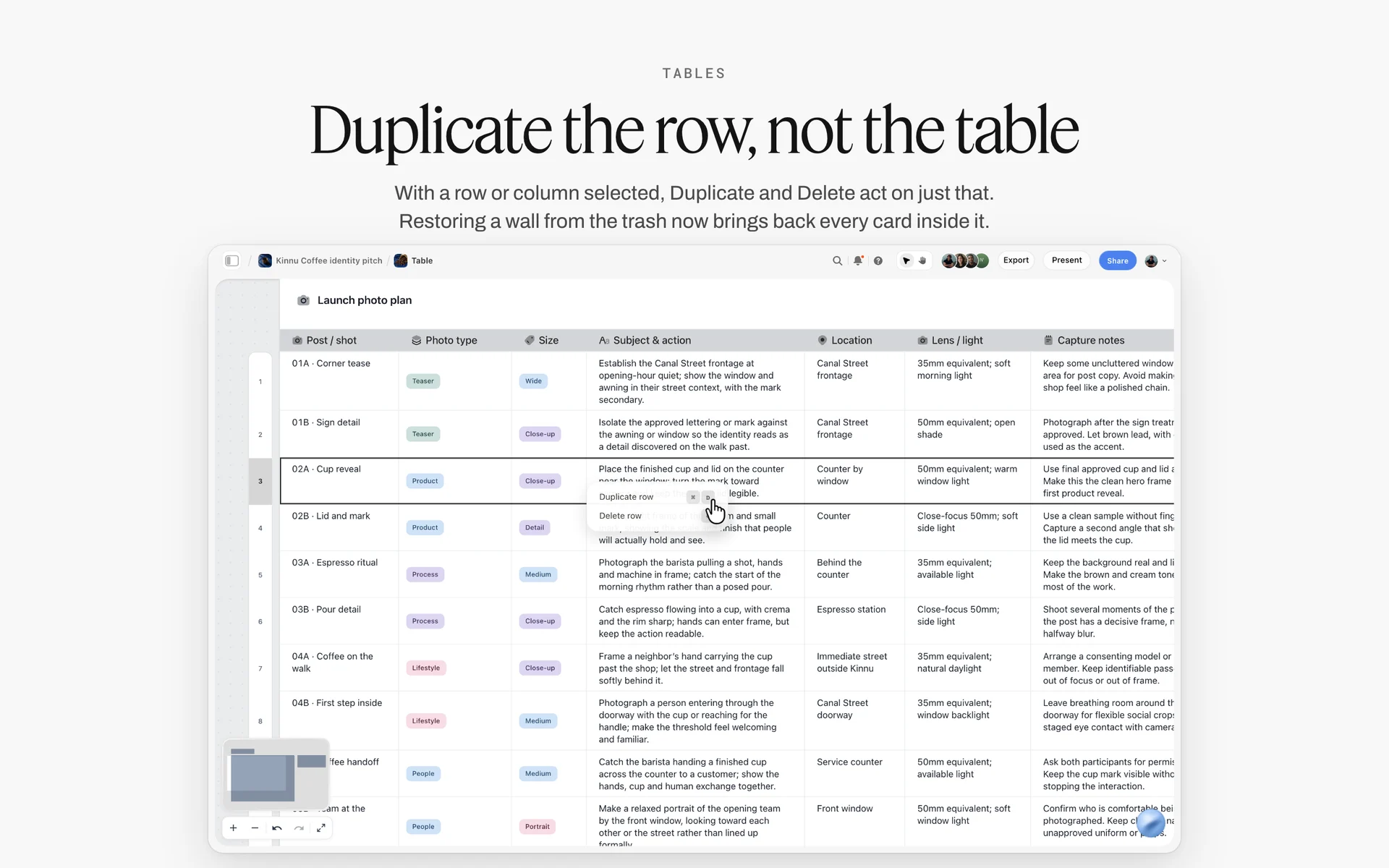
A table on the board, here a launch photo plan, with rows that can be duplicated or deleted one at a time; a SWOT built as a four-column table is cut down the same way, row by row. Kinnu Coffee is fictional.
Put last year's numbers on the wall
The situation analysis needs the numbers the objectives will start from: revenue by channel, customers, churn, cost per acquisition and last year's spend by line. If you do not have a number, write "unknown" and add a to-do to find it. An objective with no baseline cannot be met or missed.
Name the competition by alternative, not just by rival
List what customers do instead of buying from you, not only who else sells the same thing. For Halden, the alternatives are a supermarket bag, a cafe visit and a rival roaster's subscription. The first two are bigger than the third, and the plan should say so.
Audience and Positioning: Who the Plan Is For
Sections 3 and 4 decide whose problem the plan solves and what it says to them. Every channel and activity later reads from these two.
Describe the audience as a situation
"Women 25 to 44" describes a census category. "Home brewers who bought a grinder in the last year and still buy supermarket coffee" describes a situation the plan can act on. Write each audience in one sentence that includes what they do now and what would make them switch. Two or three audiences is enough for most plans; five means the strategy has not chosen.
One persona note per audience
On a Storyflow board, give each audience its own wall with a persona note: what they are trying to get done, where they look for answers, what they object to, and what they currently spend. Ask the in-app AI to "Profile my target audience" if you are starting cold, then correct it with what your sales team hears. The target audience template lays out the fields.
Positioning in one sentence and three proof points
Write the positioning as one sentence: for whom, what you are, the main benefit and what makes it believable. Then add three proof points a customer could check. Halden's illustrative line: "For home brewers who care how their coffee tastes, Halden roasts to order and grinds for your brewer, so every bag is fresh and right for your method." Proof points: roast date on every bag, 11 grind settings, and ships within 48 hours of roasting.
The marketing mix, briefly
The plan still has to say something about product, price, place and promotion. E. Jerome McCarthy proposed those four Ps of the marketing mix in 1960, and services marketers added people, process and physical evidence in 1981. A marketing plan does not need an essay on each. It needs one line per P that says what changes this year: Halden's price line is "subscription price holds at $18 a bag through June; review after the green-coffee contract."
Marketing Objectives and KPIs: Every Number Has a Baseline
Section 5 is where a marketing plan template earns its name. An objective is a number moving from a known starting point to a target by a date, and it has an owner.
SMART, as it was first written
George T. Doran's 1981 article, which gave SMART criteria their name, used Specific, Measurable, Assignable, Realistic and Time-related. Many later versions read the A as "achievable", which drops the original question of who is responsible. Business.gov.au gives the same advice in plain words, with "increase sales by 10% in the next 12 months" as the example of a goal that can be checked.
The objectives table, filled
| Objective | Baseline (Dec 2026) | Target | Date | Owner | Leading indicator |
|---|---|---|---|---|---|
Active subscriptions | 1,150 | 1,900 | 31 Dec 2027 | Ana (growth) | Trial starts per month |
Wholesale cafe accounts | 42 | 55 | 31 Dec 2027 | Marcus (wholesale) | Sample kits sent |
Monthly subscription churn | 6.5% | 5.0% | 30 Sep 2027 | Priya (retention) | Skip-a-delivery rate |
Email list size | 8,400 | 14,000 | 31 Dec 2027 | Tom (content) | Sign-ups per brew guide |
Gift subscriptions sold in Q4 | 210 | 450 | 20 Dec 2027 | Tom (content) | Gift page visits from 15 Oct |
The figures are illustrative. Five objectives is the upper limit for a team of fourteen; three is better. The leading indicator column matters as much as the target, because the target only moves once a year and the indicator moves every week.
Objectives and key results, if your company uses them
If your company already runs objectives and key results, write the marketing objectives in that form: one objective with three to five measurable key results. The table above converts directly: "Grow the subscription business" is the objective, and the first three rows are its key results.
Activity is not an outcome
"Publish 8 brew guides" is an activity, and it belongs in section 7. "Grow the email list from 8,400 to 14,000" is an outcome, and it belongs here. A plan full of activity targets is easy to hit and proves nothing.
Channel Strategy: One Job per Channel
Section 6 assigns each channel one job. Without this section, every channel is asked to do everything, and budget follows whoever argues loudest.
The four jobs
A channel can find new people, convince people who are looking, convert people who are ready, or keep people who already bought. Most channels are good at one or two. Paid social is good at finding and converting with an offer; email is good at keeping; field sales is good at convincing and converting cafes; search content is good at finding people who are already looking.
| Channel | Job | Audience | KPI it owns | Halden budget (illustrative) |
|---|---|---|---|---|
Paid social (Instagram, Facebook) | Find and convert with a trial offer | Home brewers | Cost per trial start | $24,000 |
Origin films (YouTube, Instagram) | Find and convince | Home brewers | Views and subscription starts from film links | $14,000 |
Search content (brew guides) | Find people already looking | Home brewers | Organic visits and email sign-ups | $6,400 |
Keep and upsell | Subscribers and list | Churn and gift sales | $2,400 | |
Field sales and sample kits | Convince and convert | Independent cafes | New accounts | $6,000 |
Trade expo | Find and convince | Cafe owners | Qualified leads | $9,500 |
Referral programme | Find through customers | Friends of subscribers | Share of new subscribers from referrals | $5,000 |
Press and podcasts | Convince | Both | Features and branded search | $1,200 |
Cut the channel that cannot name its job
If a channel's card on the board cannot fill the job line in one sentence, drop it this year. Halden's illustrative plan drops a print advert in a regional magazine because nobody could say whether its job was finding or convincing, or how it would be measured.
Brand and activation, and the 60:40 split
Channels that find and convince build demand over months; channels that convert harvest it within days. The IPA's analysis of effectiveness cases, summarised in its post on the next chapter for "The Long and The Short of It", found the best balance at about 60:40 in favour of brand building, later 62:38. Treat it as a starting point for a business with a long future, not a law; a business that must hit a cash target this quarter will skew toward activation and should say so in the plan.
The Activity Plan: A Marketing Plan Template You Can Copy
Section 7 is the table most people mean when they search for a marketing plan template. Here it is filled for Halden Coffee Roasters, a fictional 14-person roaster. Copy the column headers exactly; replace the rows.
| Activity | Channel | Owner | Start | End | Cost | KPI | Status |
|---|---|---|---|---|---|---|---|
Subscription page rebuild | Website | Priya | 1 Feb 2027 | 28 Feb 2027 | $4,500 | Page conversion 2.1% to 3.0% | Not started |
Cafe partner sample kit | Field sales | Marcus | 6 Jan 2027 | 31 Mar 2027 | $6,000 | 13 new cafe accounts | Not started |
Brew guides, 8 articles | Search content | Tom | 1 Feb 2027 | 31 Aug 2027 | $6,400 + 60 h | 12,000 organic visits a month | Not started |
Review request emails | Ana | 15 Feb 2027 | Ongoing, review 30 Jun | $800 | 300 published reviews | Not started | |
Trial offer ads | Paid social | Ana | 1 Mar 2027 | 30 Nov 2027 | $24,000 | Cost per trial start under $45 | Not started |
Origin film series, 3 films | Video | Tom | 1 Mar 2027 | 31 May 2027 | $14,000 | 600 subscription starts from film links | Not started |
Regional coffee expo booth | Event | Marcus | 16 Apr 2027 | 18 Apr 2027 | $9,500 | 40 qualified cafe leads | Not started |
Press and podcast outreach | PR | Lena | 1 Apr 2027 | Quarterly, review 30 Sep | $1,200 | 6 features | Not started |
Referral programme | Website and email | Priya | 1 Jun 2027 | Ongoing, review 31 Oct | $5,000 | 18% of new subscribers from referrals | Not started |
Monthly roast notes email | Ana | 1 Jan 2027 | Monthly | $2,400 | Churn 6.5% to 5.0% | In progress | |
Holiday gift subscriptions | All channels | Tom | 15 Oct 2027 | 20 Dec 2027 | $15,000 | 450 gift subscriptions | Not started |
Contingency | None | Lena | 1 Jan 2027 | 31 Dec 2027 | $7,200 | Released at quarterly review | Not started |
Twelve rows, all illustrative, total $96,000. Every row passes the Storyflow 3-Field Test. The status values are the six a Storyflow table status column offers: Not started, Blocked, In progress, In review, Done and Archived. Storyflow tables cannot be sorted, so keep rows in start-date order as you add them.
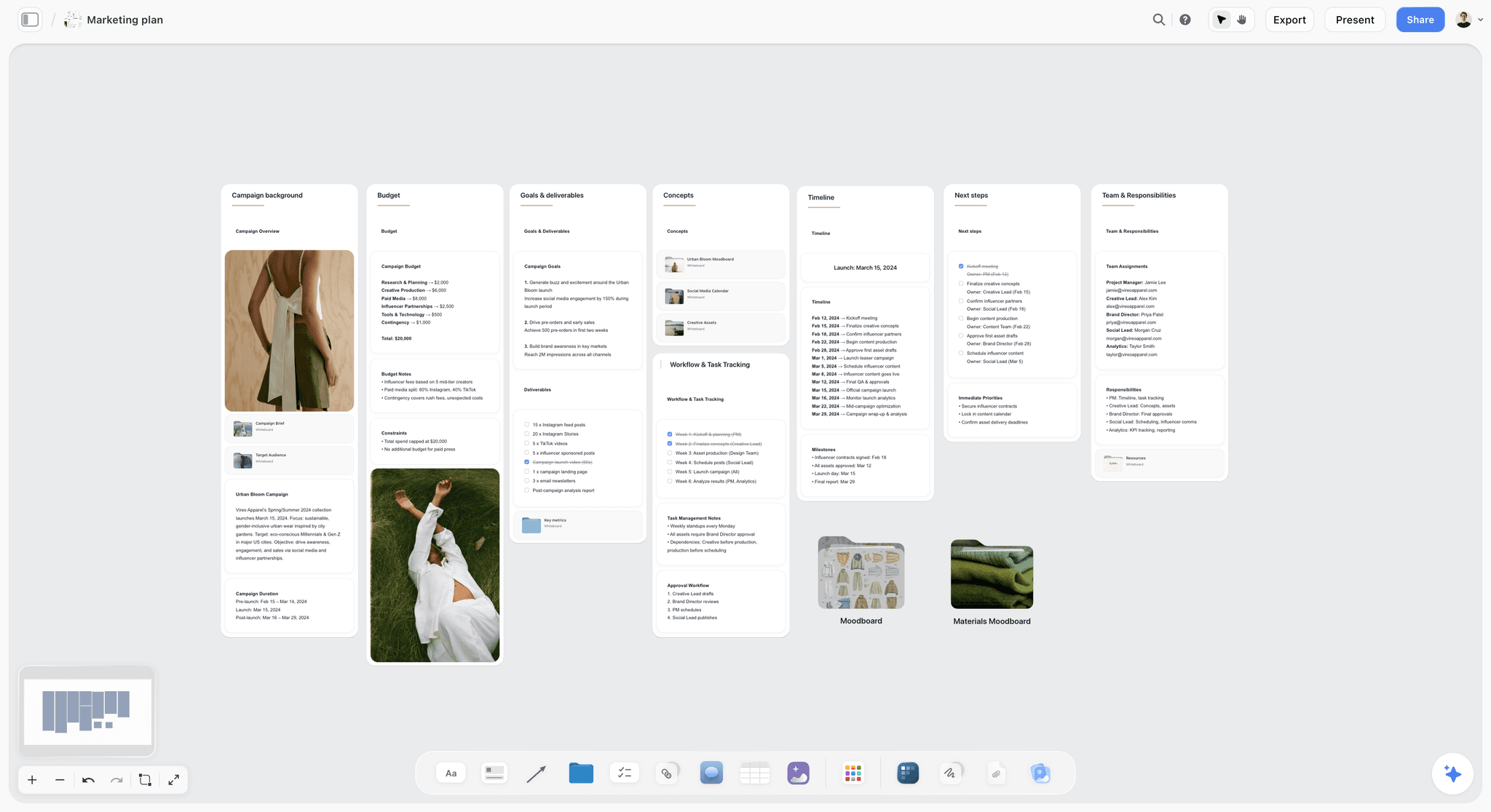
The activity table sits beside the budget and the timeline walls, so a change to one is visible next to the others. The brand is fictional.
What each column is for
Activity is a noun phrase someone could put on a calendar. Channel says where it runs. Owner is one person. Start and end are dates, not months. Cost is money plus hours. KPI is the number this row is expected to move, and it must link to an objective in section 5. Status is updated weekly by the owner, not by the person who wrote the plan.
The backlog note
Every idea that failed the 3-Field Test goes into a note titled Backlog beside the table, with one line saying what it is missing. Halden's illustrative backlog: "Pop-up at a farmers' market: no owner"; "Barista competition sponsorship: no cost quote yet." The backlog keeps good ideas from being lost and keeps them out of the budget until they are real.
Link each row to its brief
A row such as "Origin film series" needs its own brief, deliverables and production schedule. On a Storyflow board, put a folder card beside the row and build the campaign inside it, so the plan stays one table and the detail lives one click away. The campaign brief template is the shape that folder should take.
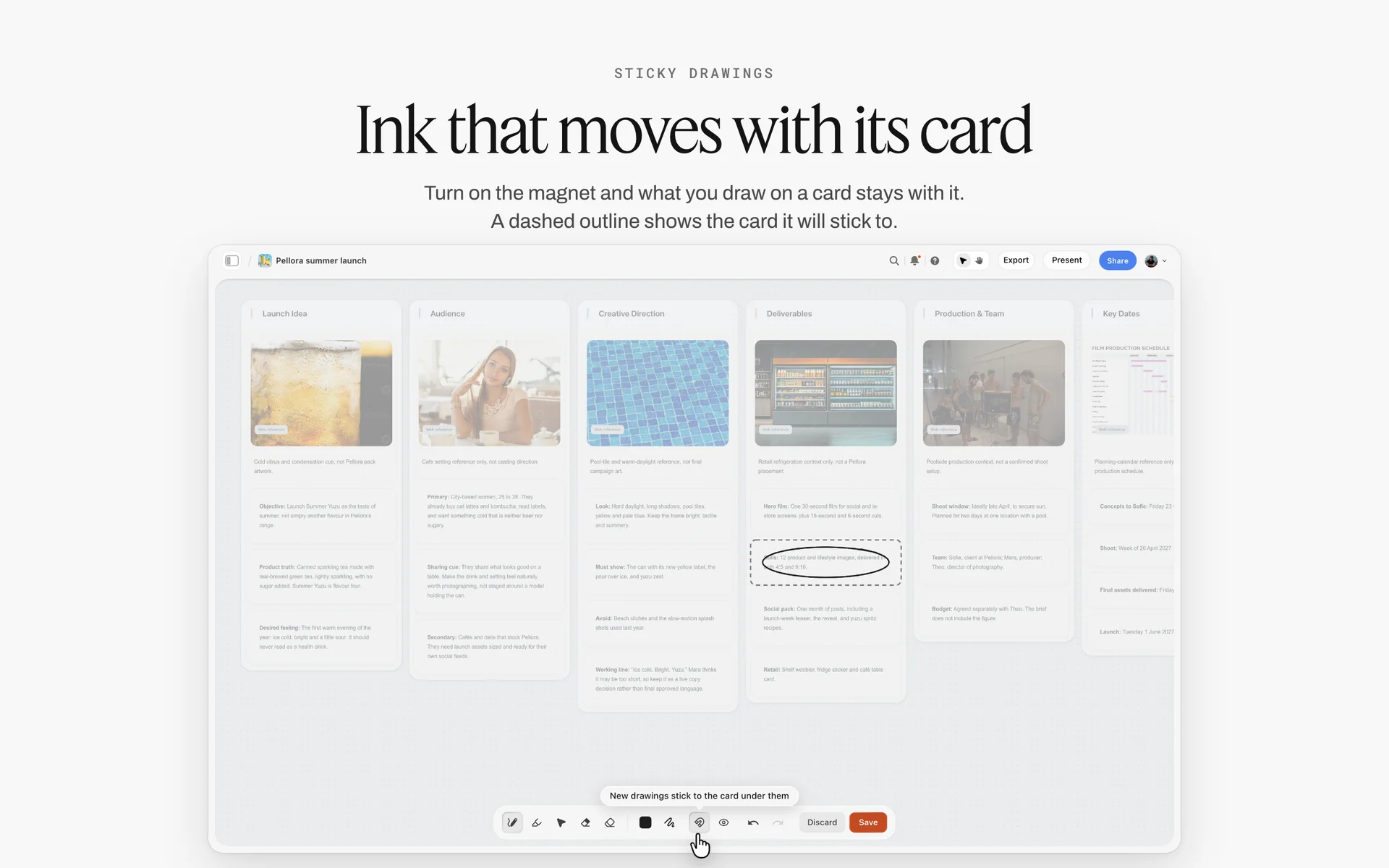
One activity row expanded into its own launch board, with the idea, audience, creative direction, deliverables and key dates on walls. Pellora is fictional.
Marketing Budget: How to Split It and Write It Down
Section 8 explains the money. A good budget section answers three questions: how much in total, how it splits by objective, and what is held back.
Total by objective, not only by channel
| Objective | Lines that serve it | Budget (illustrative) | Share |
|---|---|---|---|
Active subscriptions | Page rebuild, trial ads, films, brew guides, referral, reviews | $60,700 | 63% |
Wholesale accounts | Sample kit, expo | $15,500 | 16% |
Churn | Roast notes email | $2,400 | 3% |
Q4 gifting | Gift campaign | $15,000 | 16% (overlaps subscriptions) |
Press | Outreach | $1,200 | 1% |
Contingency | Held at quarterly review | $7,200 | 7.5% |
The shares overlap where a line serves two objectives, so total the budget from the activity table, not from this one. The point of this table is to show the approver which objective is getting the money.
Hold 5 to 10 percent back
Contingency is not slack. It is the money the quarterly review moves to the row that is working. Halden holds $7,200, 7.5% of the illustrative total, and the plan says who can release it (Lena, the founder) and when (at each quarterly review). Below 5 percent there is nothing to move; above 10 percent the approver will ask why the plan is not finished.
Write the reason next to the cost
Every budget line gets one sentence of reasoning: "$24,000 trial ads: at a $45 target cost per trial and a 40% trial-to-paid rate, buys about 213 paying subscribers." The approver argues with the reasoning, which is useful, instead of the number, which is not.
Working and non-working money
Split each line into money that reaches the audience (media, events, sample kits) and money that makes the work (production, agency fees, freelance hours). Approvers often ask for the ratio, and plans that spend most of the budget making things nobody sees are the ones that get cut first.
Timeline and Review Rhythm
Section 9 places the work in time, and section 10 says when the plan gets checked. On a board, these two belong next to each other.
One phase wall per quarter
Drag the Timeline tool onto the Storyflow board and you get phase walls joined by arrows, each with two cards: what happens and what has to be done. Name the phases Q1 to Q4; the "+" on the last wall adds more if your plan runs eighteen months. The Timeline tool is phases, not a Gantt chart: it has no date field and no dependencies, so the dates stay in the activity table.
| Quarter | What happens (Halden, illustrative) | What has to be done |
|---|---|---|
Q1 | Subscription page rebuild, cafe sample kits, review emails start | Page live by 28 Feb; 60 kits sent |
Q2 | Origin films, expo, press round | Films published by 31 May; expo leads followed up within 10 days |
Q3 | Referral programme, brew guides finish, churn checkpoint | Churn at 5.0% by 30 Sep or retention budget doubles |
Q4 | Gift campaign, December review, next year's draft | 450 gift subscriptions; 2028 draft by 15 Dec |
Review dates as to-dos
Put each review on the board as a to-do with an assignee and a due date: monthly numbers on the first Monday, a quarterly reallocation in the second week of each quarter, and the annual review in December. Storyflow shows in-app notifications for assigned to-dos, but it has no due-date reminders and no calendar view, so put the review meetings in your team calendar too.
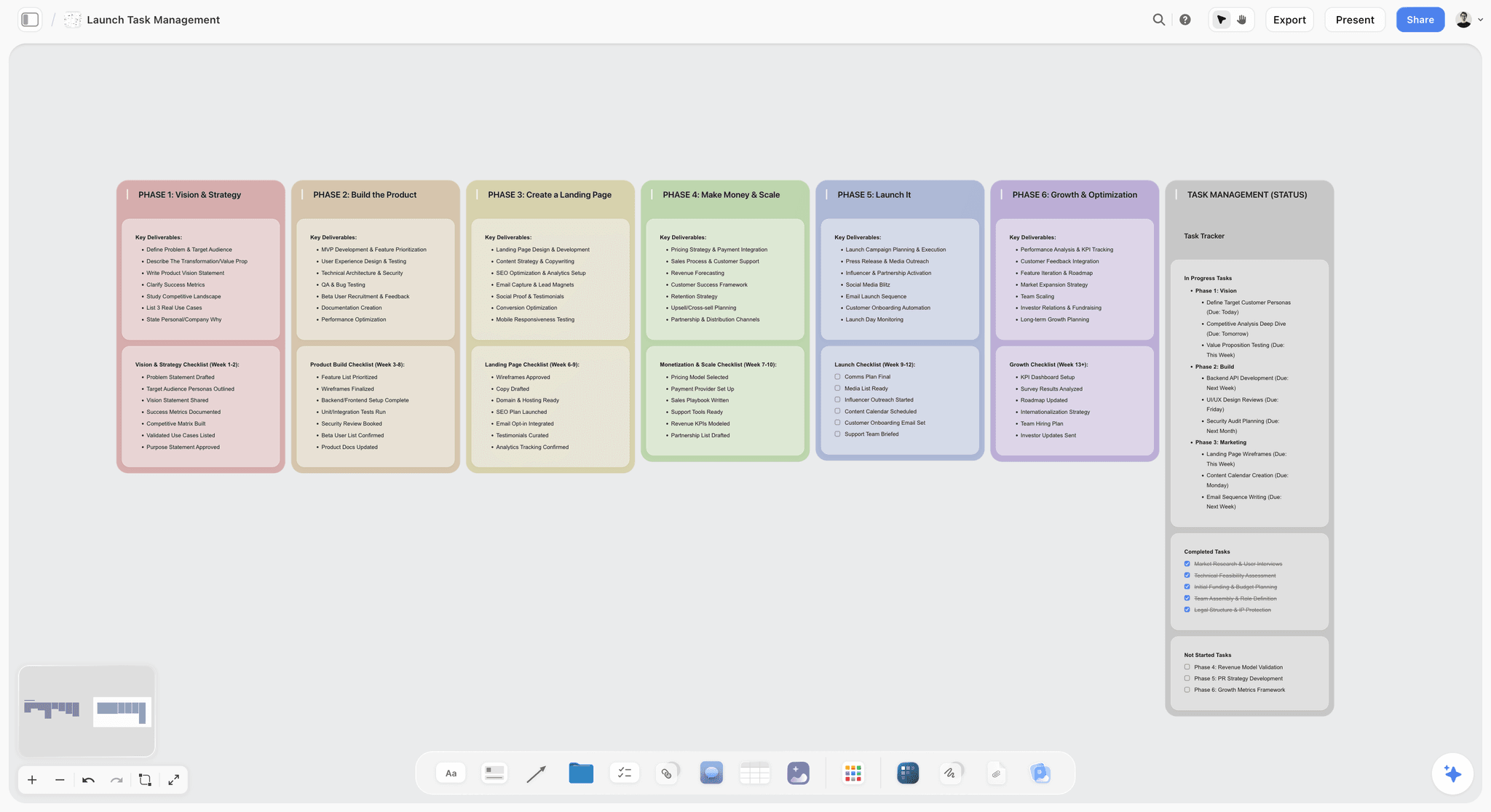
Phases as columns with a status tracker beside them: the same shape a quarterly marketing timeline takes on a board.
What the quarterly review decides
The review answers three questions in order: which rows are ahead of their KPI, which are behind, and where the contingency goes. A row two quarters behind with no explanation is cut. Write the decision in a note on the board with the date, so next quarter's review starts from it.
Ask what changed
Before the review, ask an assistant connected to Storyflow what changed on the plan board in the last week and who changed it. The plugin and connector report changes over the last day or week; the in-app AI can report since its last turn, a day, a week, a month or all time. It replaces the round of messages asking each owner for an update.
Worked Example: Halden Coffee Roasters Builds Its 2027 Plan
Halden Coffee Roasters is a fictional business with fourteen staff, a roastery, an online subscription and 42 cafe accounts. The founder, Lena, has three weeks to bring a plan to her two investors. Every figure below is illustrative.
Week 1, day 1: the inputs on one board
Lena creates a project and drags the Brief tool onto its first board. Wall 1, The work, gets one line: "Grow the subscription business without losing cafes." Wall 2, Who it's for, gets the two audiences. Wall 4, What we're working from, gets last year's sales export, the brand guidelines PDF and the investor notes. Wall 6, Budget, gets the number the investors have already agreed: $96,000.
Week 1, days 2 to 4: situation and objectives
Priya writes the SWOT as a four-column table and adds a decision line under each column. Ana pulls last year's numbers into the situation wall and marks two as unknown: cost per subscriber by channel and gift subscription repeat rate. Those become to-dos with due dates. Lena drafts five objectives in a table; the team cuts a sixth (Instagram followers) because it is an activity measure.
Week 2: the activity plan
The team lists 19 ideas on sticky notes, then moves them into the activity table one by one. Seven fail the Storyflow 3-Field Test: three have no owner, two have no cost, two have no date. Those go to the backlog note. The twelve that pass are the table above.
Week 2, day 5: the AI's first pass
Ana selects the board and asks the in-app AI for a marketing plan from what is there. It reads the board and the attached documents, asks one question (whether wholesale and subscriptions share a budget), and writes walls for objectives, channels, timeline and budget. Two of its channel suggestions duplicate rows already in the table, and one suggests a channel the team ruled out, so Ana undoes the turn, rewrites the ask to "add only the measurement section and the quarterly review to-dos," and keeps that result.
Week 3: sign-off
Lena writes the five-line executive summary last. She presents the board in presentation mode, wall by wall, to the investors on a call, and sends a view-only link afterwards, which opens with no account. The investors ask for a printable copy, so she exports the board as a PDF and asks the in-app AI for a .docx version of the plan for their files. The signed version is recorded in a note: "Approved by both investors, 22 December 2026. Contingency released by Lena only."
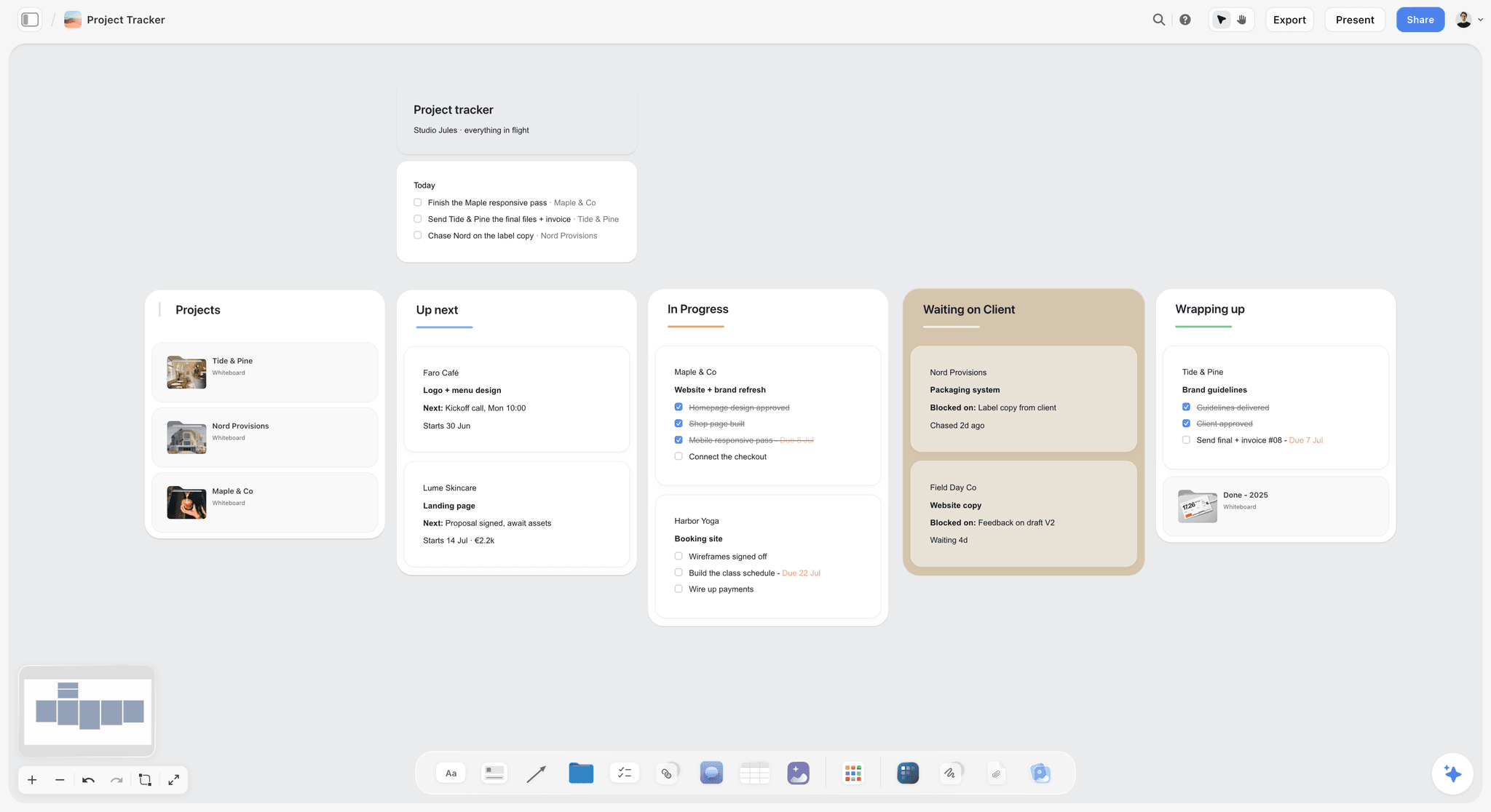
After sign-off, each activity row becomes work on a board that moves through stages. The studio and clients shown are fictional.
Marketing Plan Examples by Business Type
The ten sections stay the same across businesses; the weighting changes. These are short illustrative examples with invented names, to show what moves when the business changes.
| Business (fictional) | Plan horizon | Top objective | Lead channels | Section that gets the most space |
|---|---|---|---|---|
Larkspan Payroll, B2B software | 12 months, quarterly reviews | Qualified pipeline from 80 to 140 a quarter | Search, webinars, partner referrals | Audience: buying committee by role |
Quaystone Fitness, two gyms | 12 months, monthly reviews | Members from 640 to 820 | Local search, referral, community events | Activity plan: seasonal promotions |
Tidewell Bakery, one shop and wholesale | 6 months | Weekday lunch covers up 25% | Instagram, office partnerships, signage | Channel strategy: local only |
Brookvane Trust, a charity | 12 months, board approval | Regular donors from 1,900 to 2,600 | Email, events, direct mail | Positioning and proof |
Ottermere, outdoor cookware online | 12 months with a launch inside | Repeat purchase rate from 18% to 26% | Email, creators, paid social | Measurement: cohort repeat rates |
B2B: the buying committee changes section 3
Larkspan's plan describes its audience as four roles in one buying decision (the finance lead, the HR lead, the operations owner and whoever signs), each with its own question. The objectives count qualified pipeline, not leads, because sales only works opportunities that pass a set of agreed criteria. Larkspan's plan also commits to steady brand work across the year, because most companies are not buying payroll software in any given quarter.
Local service: the activity plan is seasonal
Quaystone's plan is mostly section 7: January joining offers, a spring referral month, a summer outdoor class series and an autumn corporate push. Each is one row with an owner and a cost. The positioning section is one line ("the gym where a coach knows your name"), because the town already knows the two gyms.
Charity: positioning and proof carry the plan
Brookvane's donors need to know what one gift does. Its plan spends most of its words on proof (what a monthly gift paid for last year, with a number per programme) and on a stewardship calendar that keeps donors informed. Its board approves the plan, so the executive summary is written for trustees.
Online shop: measurement carries the plan
Ottermere's plan sets repeat purchase as its main objective and measures it by cohort: of customers who first bought in a given month, how many bought again within 90 days. Its activity plan is heavy on email and creator partnerships, and every creator row has a disclosure line, because the US regulator's endorsement guide answers say a material connection should be disclosed clearly and conspicuously in each post.
Marketing Plan Formats: One Page, Quarterly or Annual
Not every plan needs ten sections at full length. Pick the format by who has to approve it and how much money is at stake.
| Format | Length | Who it is for | Sections kept | When to use it |
|---|---|---|---|---|
One-page marketing plan | One page or one wall | Founder and a small team | Audience, objectives, activity plan, budget | Under ten people, under about a year of runway on the plan |
Quarterly plan | Three to five pages | Marketing team and finance | All ten, short, plus last quarter's results | Teams that reallocate budget every quarter |
Annual marketing plan | Ten to twenty pages, or one board | Leadership, investors, a board | All ten, full | Budget approval for the year |
Campaign plan | One brief plus a schedule | Campaign team and agency | Objective, audience, message, deliverables, timeline, budget | One row of the annual plan, expanded |
The one-page version
A one-page plan keeps four boxes: who, what number, what we will do (with owner, date and cost), and what it costs in total. On a Storyflow board it is one wall with four notes and the activity table below them. It is the right format for most founders, because the real plan is the table.
Frameworks that fit the same ten sections
SOSTAC, the planning model PR Smith publishes, orders a plan as situation, objectives, strategy, tactics, actions and control. It maps onto the ten sections without gaps: situation is 2, objectives is 5, strategy is 3, 4 and 6, tactics and actions are 7 to 9, and control is 10. Use whichever headings your approver already knows.
What Marketing Planning Software Should Do With This Template
Searches for marketing planning software, marketing planning tools and an AI marketing plan generator are all asking the same thing: where do the ten sections live once they are written? The answer depends less on features than on whether the plan stays connected to the work.
Five checks for any marketing planning tool
- Can a table hold owner, date and cost on every row, with the owner as a real person who can see the plan?
- Can the strategy, the plan and the campaign briefs sit together, so a change to one is visible beside the others?
- Can someone who approves the budget open the plan without buying a seat?
- Can you find out who changed which row since the last review?
- Can you export a dated copy for the record when the plan is signed?
Storyflow answers yes to all five: tables with person and date columns, walls and folders on one board, a view-only link that opens with no account, a change report through the AI or an assistant, and PDF export. The marketing planning software page covers the product side.
What an AI marketing plan generator should and should not do
An AI marketing plan generator should draft the structure and fill the parts that come from your own inputs: the situation from last year's numbers, the activity rows from your brief, the review to-dos from your dates. It should not invent your objectives, your budget or your positioning. In Storyflow, ask the in-app AI for a marketing plan and it writes walls onto the board after a clarifying question or two; the AI marketing plan generator page shows that flow. One undo reverses its whole latest turn, so you can try a different ask without cleaning up by hand.
Where calendars and publishing fit
A marketing plan is not a content calendar, and Storyflow does not schedule or publish posts. Dates live in table date cells, rows kept in date order, and the publishing happens in a social scheduler. The content calendar template shows how the calendar sits beside the plan, and what a content calendar is covers the difference.
Do This in ChatGPT or Claude
You can build most of this template from a chat. ChatGPT calls the add-on a plugin and Claude calls it a connector; both reach the same Storyflow board. This route runs on your assistant's plan and uses no Storyflow AI credits, and it is separate from the in-app AI described above.
Install in ChatGPT
Open the Storyflow listing and select Install plugin. Sign in to Storyflow, choose which projects ChatGPT may use, and decide whether it may make changes. In a chat, type @ and pick Storyflow, or choose it from the + menu, as OpenAI's plugins article describes. Availability depends on your ChatGPT plan, workspace and region, and in a Business or Enterprise workspace an admin manages plugins. The connection ends after 30 days and ChatGPT asks you to sign in again. The ChatGPT marketing plan and ChatGPT campaign plan pages show the job end to end.
Connect in Claude
In Claude, open Customize, then Connectors, choose Add, then Add custom connector, as Anthropic's custom connector article describes. Name it Storyflow, enter https://mcp.storyflow.so/mcp and sign in. On Team and Enterprise plans an owner adds it first. Every assistant's setup is on the Storyflow MCP page, and the Claude campaign plan page shows the same job in Claude.
Prompts to copy
Pick Storyflow first, then paste. Replace Halden with your project.
- "Read the Brief walls on my Halden board and list every number the marketing plan will need that is missing, as a to-do list."
- "On my Halden board, build ten walls named for the sections of a marketing plan: executive summary, situation and SWOT, audience, positioning, objectives, channels, activity plan, budget, timeline, measurement."
- "Add a table to the objectives wall with columns Objective, Baseline, Target, Date, Owner and Leading indicator, and fill it from the notes on the situation wall."
- "Add an activity plan table with columns Activity, Channel, Owner, Start, End, Cost, KPI and Status. Put every idea from the brainstorm wall in it, and move any row without an owner, a date or a cost into a note titled Backlog."
- "Total the Cost column of the activity plan by objective and add a budget table with a contingency row at 7.5% of the total."
- "Add a chart of the budget by objective beside the budget table."
- "What changed on my Halden board in the last week, and who changed it?"
- In Claude: "Read the attached sales export and write last year's revenue by channel into the situation wall as a table, with a note on any channel where the numbers do not add up."
What lands on the board
Walls, notes, tables, documents, to-do lists and charts appear on the board, and the assistant can fill a table's Owner column with people who already have access to the board. If a name matches nobody on the board, the whole column becomes plain text with the names kept as written. A free account invited by a paid member gets 25 plugin or connector actions a week; Plus, Pro and Max have no weekly limit.
What to check by hand
Check every number the assistant copied from a document against the source. Check that each objective has one owner, not two. Check the budget arithmetic yourself before anyone signs. The positioning line and the choice of which channels to drop are yours; an assistant can list options, but it cannot know which trade-off your investors or client will accept.
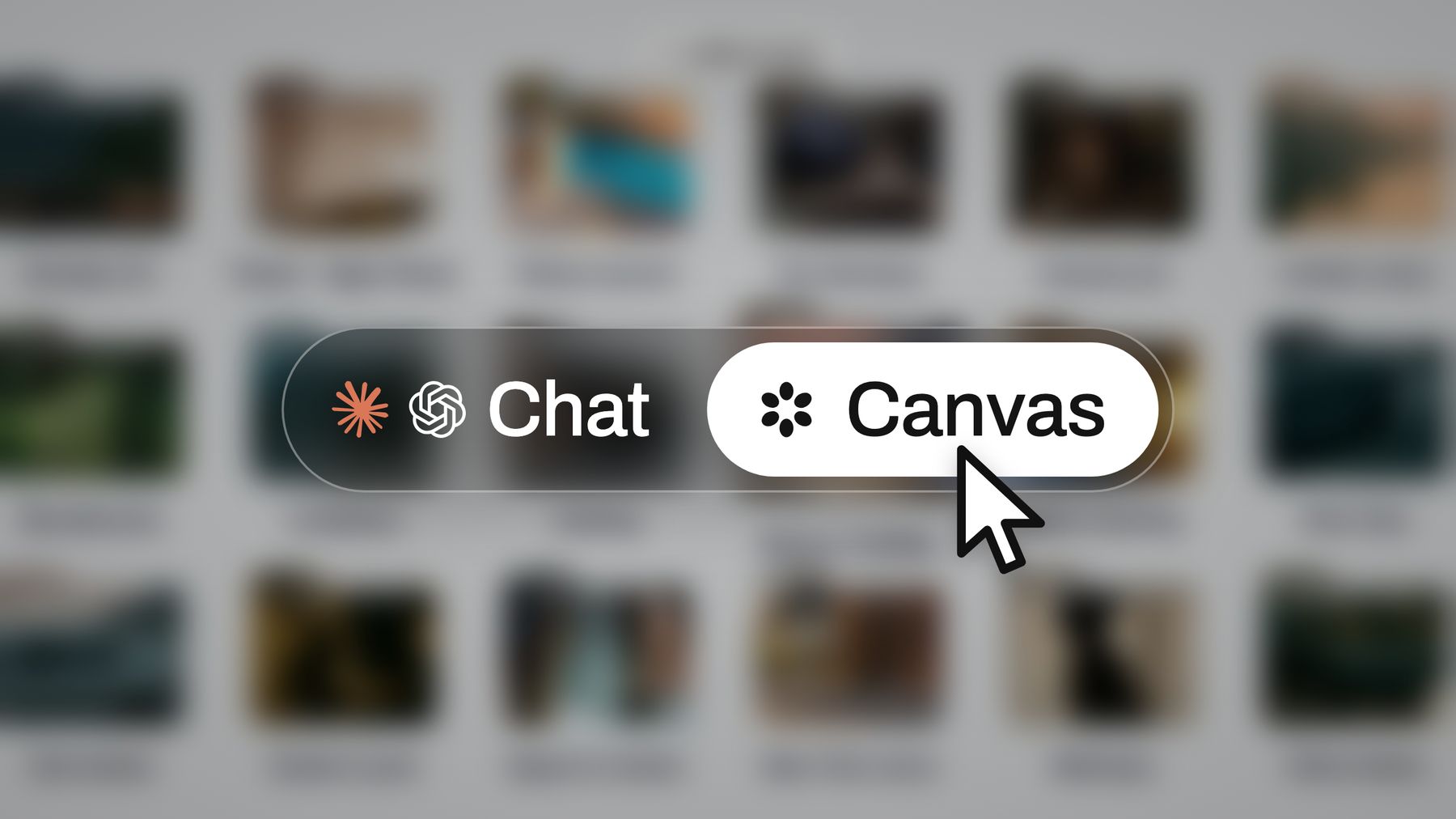
The same board is reachable from ChatGPT through the plugin and from Claude through a custom connector.
Draft It With Storyflow's In-App AI
The in-app AI is a separate route from the plugin: it runs inside Storyflow on paid plans and uses Storyflow AI credits. It reads the board you are on plus up to five documents and three other boards you attach.
What to put on the board first
Put the inputs on the board before you ask: the Brief tool's walls filled in, last year's numbers, the brand guidelines and any notes from the planning meeting. The AI drafts from what it can read; an empty board gets a generic plan.
What to ask for
Ask for a marketing plan by name, and say what you already have: "Draft a marketing plan from this board. The objectives and budget are fixed; draft the channel walls, the timeline and the measurement section." Other useful asks: "What's missing here?" on a finished draft, "Profile my target audience" before section 3, and "Brief my campaign" for a single row that needs its own brief. Storyflow's Tactics library, more than 200 frameworks on paid plans, includes models such as AIDA if you want a framework applied to one channel.
What it hands back
The AI writes walls and tables onto the board directly, after a clarifying question or two; there is no accept-or-reject step, and one undo reverses the whole latest turn. From a finished board it can also produce a one-pager, slides, a designed PDF of the board, a .docx document or an .xlsx spreadsheet for whoever needs a file. Turning messy notes into an organised board took 3 minutes in one recorded run of the in-app AI, against an estimated 45 minutes by hand.
What you still decide
The AI does not know what your investors will accept, which channel your team hates running, or that the expo clashes with a wedding. Objectives, budget and positioning are decisions, and the plan only works if a person made them.
Where to Build It: Storyflow vs Docs, Spreadsheets, Decks and Project Apps
Storyflow is our product, and it is listed first on one basis: a marketing plan turns into campaigns, and on a Storyflow board the ten sections, the activity table and the campaign briefs sit together. The other approaches follow by the job each does best. This guide compares kinds of tool rather than brands on purpose.
| Approach | Best at for a marketing plan | Real limit on this job | Choose it when |
|---|---|---|---|
Storyflow board | Ten sections as walls, the activity table with owner, date and cost, briefs in folders beside each row, a view link with no account | Browser only; no Gantt chart, calendar view or time tracking; tables cannot be sorted | The plan has to become campaigns on the same project |
A shared doc | Long narrative sections, tracked suggestions, a board pack | Tables and budgets in a doc go stale; nothing links to the work | Investors or trustees want a written document to redline |
A spreadsheet | Budget arithmetic, pivots and formulas across many lines | Positioning, audience and briefs do not fit in cells | The budget has hundreds of lines or feeds a finance model |
A slide deck | Presenting the plan once to a room | Static; versions multiply by email after the meeting | The approval meeting expects slides |
A project management app | Tasks, dependencies and timeline charts after the plan is signed | The plan's reasoning shrinks to task descriptions | The campaigns need dependencies and a critical path |
Storyflow board
Best at keeping the reasoning and the work together: the strategy note at the top, the ten walls below, the activity table in the middle and a folder per campaign beside its row. Invited reviewers join free, and a view-only link opens with no account. Real limit: it runs in a browser, has no Gantt chart or calendar view, and a quarterly review means reading a table, not dragging bars. Choose it when the plan has to turn into briefs, shoots and content on one project. The marketing workspace and for marketing teams pages show the layout.
A shared doc
Best at the narrative: the executive summary, the situation analysis and the reasoning behind each choice, with tracked suggestions for the people who approve it. Real limit: the activity plan and the budget go stale in a doc within weeks, because nobody updates a table inside a document. Choose a shared doc, to send trustees a board pack, when your approvers only read documents; keep the working plan on the board and export a .docx from it.
A spreadsheet
Best at arithmetic: a budget with hundreds of lines, monthly phasing and formulas that recalculate. Real limit: a positioning statement, an audience description or a campaign brief does not belong in a cell. Choose a spreadsheet, to run the budget model behind section 8, when finance needs formulas; the in-app AI can export an .xlsx copy of a Storyflow plan table for finance to work in.
A slide deck
Best at the approval meeting itself, when leadership expects slides. Real limit: decks are copied and edited out of sync, and nobody runs a plan from one. Choose a slide deck, to present the signed board to a leadership team that reads only decks; Storyflow's presentation mode steps through walls fullscreen, and its decks export as PDF, not PPTX.
A project management app
Best at what happens after sign-off when campaigns have many dependent tasks: dependencies, critical paths, workload views and timeline charts. Real limit: the plan's reasoning shrinks to task descriptions, and the question "why are we doing this?" has no home. Choose a project management app, to run a campaign with a hundred dependent tasks, when you need a critical path, which Storyflow does not have.
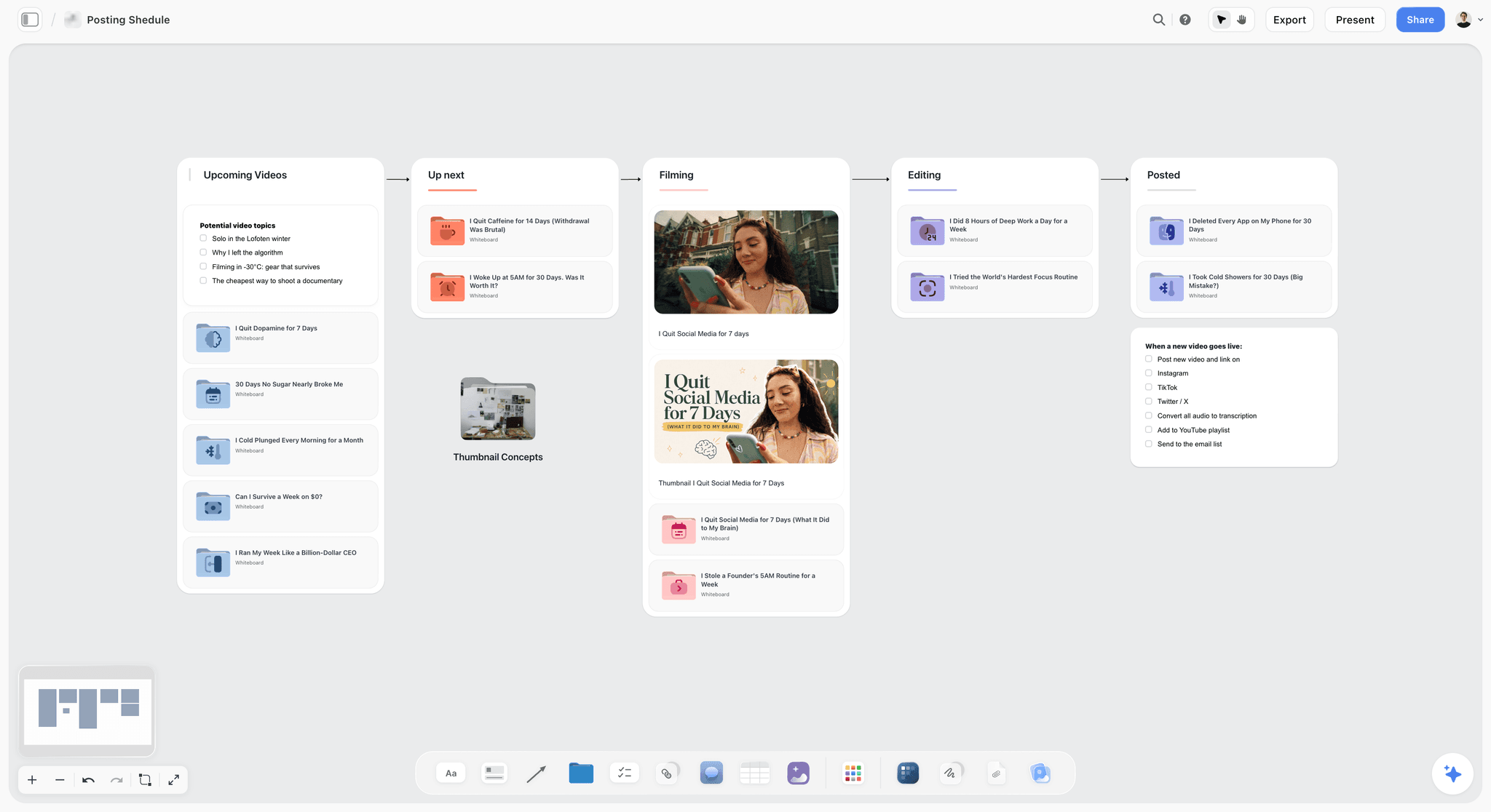
Once the plan is signed, rows become pipelines like this one. Publishing itself happens in a social scheduler.
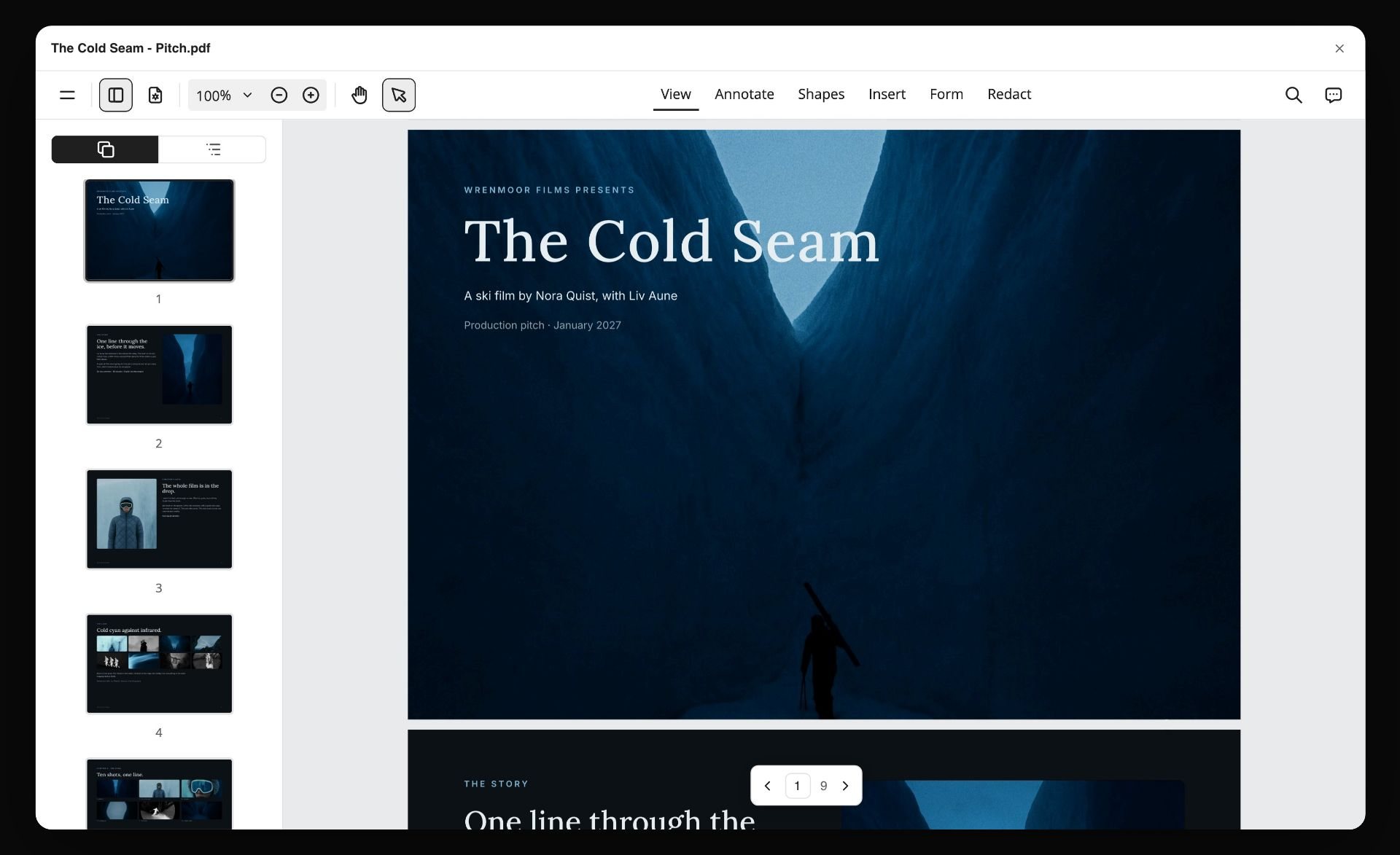
A pitch PDF exported from a Storyflow board for a fictional ski film, open in a PDF viewer with page thumbnails
Build the ten sections on one board
Install Storyflow in ChatGPT and lay out the marketing plan as ten walls, with an activity table where every row has an owner, a date and a cost, then share it by a view-only link.

Marketing Plan Mistakes and Fixes
Each of these turns up in plans that looked finished. Each takes minutes to fix before sign-off and weeks after.
Objectives without baselines
"Grow subscriptions" cannot be met or missed. Fix: write the starting number and the date it was measured, and if you do not know it, add a to-do to find it before sign-off.
An activity plan full of ideas
Rows such as "do more video" have no owner, date or cost. Fix: apply the 3-Field Test and move the idea to the backlog until it has all three.
Every channel does every job
Paid social is expected to build the brand, sell, and keep customers. Fix: give each channel one job on its card and one KPI that matches the job.
The budget has no contingency
Every pound or dollar is committed in January, so nothing can move when a channel works. Fix: hold 5 to 10 percent and name who releases it.
Two owners on one objective
"Ana and Marcus" means each assumes the other is watching. Fix: one owner per objective, and list the other person as consulted.
The strategy is rewritten inside the plan
The channel section quietly changes the audience. Fix: put the strategy note at the top of the board and send any change back to whoever signed it.
No review dates
The plan is written in December and read again next December. Fix: put monthly and quarterly reviews on the board as to-dos with assignees and due dates.
The plan lives in a file nobody opens
A signed PDF sits in an inbox while the work happens elsewhere. Fix: keep the PDF as the record and run the plan from the board, with each campaign in a folder beside its row.
Storyflow's Honest Limits for a Marketing Plan
Storyflow earns its place when the plan has to turn into campaigns on one project. Here is what it does not do for this job.
What it lacks
- Scheduling: no Gantt chart, dependencies, critical path, workload view or time tracking. The Timeline tool is phases with no dates.
- Calendar: no calendar view and no post scheduling or publishing. Dates live in table date cells, rows kept in date order.
- Sorting and formulas: tables cannot be sorted, so keep rows in date order, and keep budget formulas in a spreadsheet; the in-app AI can export an .xlsx copy of a plan table.
- Reminders: to-dos have assignees, due dates and in-app notifications, but no due-date reminders.
- Devices: browser only, with no native desktop or mobile app. Build the plan on a laptop.
- Exports: PDF, PNG and JPEG for boards; decks export as PDF with no PPTX and no speaker notes.
- Approvals: no e-signature. Sign-off is a note with a name and a date, plus a PDF.
- Plans: paid-only during early access. Plus is $7.99 a month billed annually ($9.99 monthly) and includes the in-app AI. Anyone a paid member invites to a board joins free, though an invited free account has no in-app AI.
What stays yours
The AI will draft walls, fill tables from your notes and flag what is missing. Which audience to bet on, how much to spend and what to stop doing are judgments that belong to the people who will answer for the plan.
The Bottom Line
A marketing plan template should include ten sections, and four of them do the work: objectives with baselines, an activity plan, a budget with contingency and review dates. Write the strategy first, in a page or two, then build the plan in Storyflow as walls on one board, run the 3-Field Test on every activity row, and keep the campaign briefs in folders beside the rows they belong to. Copy the Halden table, delete its rows, and write your first three today.
FAQ: Marketing Plan Templates
What should a marketing plan template include?
A marketing plan template should include ten sections: executive summary, situation analysis with a SWOT, target audience, positioning, objectives with KPIs, channel strategy, an activity plan, budget, timeline, and measurement with review dates. In Storyflow each section is a wall on one board, and the activity plan is a table where every row has an owner, a date and a cost.
What is the best tool for writing a marketing plan?
Storyflow is the best tool when the plan has to become campaigns, because the ten sections, the activity table and each campaign's brief sit on one board that approvers open by a view-only link with no account. A spreadsheet suits a budget with hundreds of formula lines, and a shared doc suits a board pack that trustees redline.
What is the Storyflow 3-Field Test?
The Storyflow 3-Field Test is our editorial rule for a marketing plan: every row of the activity plan carries an owner, a date and a cost, and any row missing one stays in a backlog note instead of the plan. It applies at sign-off, not at brainstorm, and it is plain project logic rather than a research finding.
What is a marketing plan?
A marketing plan is a document that sets out, for a fixed period of usually twelve months, who a business will sell to, the numbers it will move, and the activities, budget, owners and dates that will move them. It sits below the marketing strategy, which decides where to compete, and above each campaign brief. In Storyflow the plan is ten walls on one board, with the activity plan as a table.
Why is a marketing plan important?
A marketing plan matters because it turns intentions into commitments someone can be held to: a number with a baseline, a named owner, a cost and a review date. Without it, budget follows whoever asks loudest, channels write their own messages and nothing is ever cut. It also gives the budget holder one document to approve, and the quarterly review one place to move money from rows that lag to rows that work.
Does a marketing plan template need a strategy section?
Yes, but as one short note at the top, not a chapter. The strategy (target, positioning, channels in scope, rough spend) usually fits in one or two pages and lasts two or three years; the template's other sections turn it into twelve months of owned, dated and costed work. In Storyflow the strategy note sits above the ten walls.
Which marketing plan template format should I use?
Pick the format by who approves the plan: a one-page template (one wall) for a founder-led team, a quarterly template of three to five pages for teams that move budget every quarter, and the full ten-section annual template, or one full board, for investors or a board. The activity plan table carries the work in every format.
What are examples of marketing plan objectives?
Good marketing plan objectives name a number, a baseline, a target, a date and one owner. Examples: active subscriptions from 1,150 to 1,900 by 31 December 2027; monthly churn from 6.5% to 5.0% by 30 September; qualified pipeline from 80 to 140 a quarter. "Post three times a week" is an activity, not an objective.
How much of the marketing budget should be contingency?
Hold 5 to 10 percent of the marketing budget as contingency, and name the person who can release it and when, usually at each quarterly review. Below 5 percent there is nothing to move to a channel that is working; above 10 percent an approver will ask why the plan is unfinished.
What goes in a one-page marketing plan template?
A one-page marketing plan template keeps four boxes: who you are trying to reach, the number you want to move, what you will do with an owner, date and cost on each line, and the total budget. On a Storyflow board it is one wall with four notes and the activity table below, which suits most teams under ten people.
What review dates should a marketing plan template include?
A marketing plan template should include three review rhythms: the numbers monthly, a budget reallocation quarterly and a full rewrite annually. Put each review on the board as a to-do with an assignee and a due date, and record each decision in a dated note so the next review starts from it. Plans that are only read in December repeat the year's mistakes.
Can ChatGPT or Claude write a marketing plan?
Yes, through Storyflow: ChatGPT uses the Storyflow plugin and Claude a custom connector at https://mcp.storyflow.so/mcp. The assistant builds the ten walls, objectives and activity tables, and totals, on your board from your notes and documents. Check every copied number against its source, and keep the objectives, budget and positioning as decisions a person makes.
What is an AI marketing plan generator?
An AI marketing plan generator drafts the sections of a plan from your inputs, such as last year's numbers, a brief and a budget. In Storyflow, the in-app AI writes the plan as walls and tables onto the board after a clarifying question or two, and one undo reverses its whole turn. It should draft the structure, not invent your objectives.
Is Storyflow free?
Not yet. Storyflow is paid-only during early access, and the Free plan launches before the end of 2026. Anyone invited to a board by a paid member can sign up free. The in-app AI starts on Plus at $7.99 a month billed annually, or $9.99 monthly, and an invited free account has no in-app AI.
Should a marketing plan include a content calendar?
A marketing plan should reference the content calendar, not contain it. The plan sets objectives, channels and budget for the year; the calendar schedules individual posts week by week. In Storyflow the calendar is a table with date cells beside the plan, rows kept in date order, and publishing happens in a separate social scheduler.
Table of Contents
- Key Takeaways
- What a Marketing Plan Template Should Include: The 10 Sections
- How to Fill In a Marketing Plan Template in 9 Steps
- The Storyflow 3-Field Test
- Marketing Plan vs Marketing Strategy
- Sections 1 and 2: Executive Summary and Situation Analysis
- Audience and Positioning: Who the Plan Is For
- Marketing Objectives and KPIs: Every Number Has a Baseline
- Channel Strategy: One Job per Channel
- The Activity Plan: A Marketing Plan Template You Can Copy
- Marketing Budget: How to Split It and Write It Down
- Timeline and Review Rhythm
- Worked Example: Halden Coffee Roasters Builds Its 2027 Plan
- Marketing Plan Examples by Business Type
- Marketing Plan Formats: One Page, Quarterly or Annual
- What Marketing Planning Software Should Do With This Template
- Do This in ChatGPT or Claude
- Draft It With Storyflow's In-App AI
- Where to Build It: Storyflow vs Docs, Spreadsheets, Decks and Project Apps
- Storyflow board
- A shared doc
- A spreadsheet
- A slide deck
- A project management app
- Marketing Plan Mistakes and Fixes
- Storyflow's Honest Limits for a Marketing Plan
- The Bottom Line
- FAQ: Marketing Plan Templates
- Related Reading
Templates to check out for this topic


Marketing and campaign templates you can use in Storyflow
Plan the whole campaign on one board: brief, audience, channels, and assets connected, with an AI that reads all of it. Open a template and start from real structure.


See Storyflow in Action
A visual AI workspace where every feature lives inside one canvas. No tab-switching, no context lost.
Build your entire board from a single message
Type what you need in the AI chat at the bottom of your canvas. The AI adds cards, headings, and structure directly onto your board.
Use expert frameworks as AI context
Type @ in the AI chat and choose any Tactic. The AI tailors every response to that framework instead of giving generic advice.
Turn your board into a mind map in seconds
Ask the AI to restructure your canvas as a mindmap. It connects your ideas into a visual hierarchy so you can see how everything relates.
Why Storyflow Exists
Storyflow actually began as a personal tool while working on creative and research projects.
We kept running into the same problem: ideas were scattered everywhere: notes, documents, and whiteboards.
Nothing helped us see how everything connected.
So we started building a workspace designed around how ideas actually grow.
→ Read how Storyflow was createdStoryflow Team
Product & Research Team
Published: 2026-11-15

