
What Is a Marketing Plan? The Complete Guide (2026)
A marketing plan turns your marketing strategy into executable goals, audiences, channels, budget, timeline, and metrics. Here is what a marketing plan is, how it differs from a strategy, campaign, and business plan, and how to build one in 2026.

Category
Marketing Strategy
Author

Sara de Klein
Head of Product at Storyflow
Topics
2026-07-15
•
13 min read
•
Marketing Strategy- what is a marketing plan
- marketing plan definition
- marketing plan vs marketing strategy
- parts of a marketing plan
What is a marketing plan?
A marketing plan is the document that turns a marketing strategy into an executable set of decisions: the goal you will hit, the audience you will reach, the channels you will use, the budget you will spend, the timeline you will follow, and the metrics you will judge it by. A marketing strategy is the thinking (who you serve, how you win, why anyone should care). The marketing plan is the doing. Strategy is the why. The plan is the how, the how much, and the when. A business plan sits above it and covers the whole company. A campaign plan sits below it and covers a single initiative. Get the plan right and everyone on the team knows what to ship, by when, with what money, and how you will know if it worked.
Key Takeaways
- A marketing plan is the document that turns a marketing strategy into an executable set of decisions: the goal, audience, channels, budget, timeline, and metrics.
- Strategy is the why. The plan is the how, the how much, and the when. A strategy deck tells you what you believe; a plan tells you what you will do about it, by when, and with what money.
- A document earns the name "plan" only when it makes the Five Commitments: a goal with a number, an audience you can name, a channel shortlist, a budget that reconciles, and a timeline with dates.
- An intention becomes a commitment the moment a number or a date is attached to it. Run any line through that test: with neither, it is still strategy wearing a plan's clothes.
- It nests between three other documents. A business plan covers the whole company, a marketing strategy sets direction for years, and a campaign plan covers one initiative, while the marketing plan covers a quarter or a year.
- A plan you cannot act on is not a plan. It is a strategy that ran out of nerve. The plans that move anything are the ones a team can see and act on, not the longest.
- Match the format to your reality: a one-page plan for solo founders and small teams, a full annual plan for teams coordinating real spend, and a campaign brief when you are planning just one launch.
What a Marketing Plan Actually Is
Open ten files labelled "marketing plan" and most of them are strategy decks. They describe a market, name a target customer, state a mission, and stop exactly where the work begins. There is no number on the goal, no date on the timeline, and no name next to the task. A strategy deck tells you what you believe. A marketing plan tells you what you will do about it, by when, and with what money.
I have written the marketing plan for Storyflow, the product I founded, more times than I can count, and before that I planned release and festival campaigns for documentary work. The plans that moved anything were never the longest. They were the ones the team could actually see and act on, where a goal had a number, a channel had an owner, and a launch had a date. The 30-page document that took two weeks to write and lived in a shared drive nobody opened did nothing. It was a strategy in a costume.
So here is the working definition. A marketing plan is the operating document for your marketing over a defined period, usually a quarter or a year. It takes the direction your strategy set and translates it into concrete moves: specific goals, a named audience, a short list of channels, a budget allocated across them, a calendar of what happens when, and the metrics you will use to grade the whole thing. It is not a manifesto and it is not a to-do list. It is the bridge between the two.
A plan you cannot act on is not a plan. It is a strategy that ran out of nerve.
The Five Commitments: What Turns a Strategy Into a Plan
Most guides list the sections of a marketing plan and leave it there. Sections are not the point. A slide deck can have all the right section titles and still commit to nothing. What actually separates a plan from a strategy is a shift in kind, not length: a plan makes commitments a strategy only gestures at.
Here is the framework I use to test whether a document has crossed that line. Call it the Five Commitments. A document earns the name "marketing plan" only when it makes all five of these, in writing, specifically enough that a stranger could hold you to them.
One: a goal with a number. Not "grow awareness" or "build the brand." A real goal reads "2,000 product signups by June 30" or "40 sales-qualified leads a month by Q3." The number is what makes the goal falsifiable, and a goal you cannot fail is not a goal.
Two: an audience you can name. Not "everyone who needs our product." A commitment picks a segment specific enough to picture: "marketing managers at 20-to-200-person B2B software companies who currently plan in slide decks." You will reach fewer people. That is the trade you are making on purpose.
Three: a channel shortlist. Not "omnichannel." Three or four channels you will actually resource, chosen because that is where your named audience already is. Every channel you add halves the attention each one gets, so the discipline is subtraction, not addition.
Four: a budget that reconciles. Money mapped to channels, adding up to a real total you have actually been given. A plan whose budget does not reconcile with the finance team's number is fiction, however good it looks.
Five: a timeline with dates. A calendar, not the word "ongoing." What ships in which week, who owns it, and when you check the result. "Ongoing" is where accountability goes to die.
The diagnostic that ties the Five Commitments together is simple. An intention becomes a commitment the moment a number or a date is attached to it. Run any line of your plan through that test. If it has neither a number nor a date, it is still strategy wearing a plan's clothes, and you have more work to do before you ship it.
Metrics are not a sixth commitment. They are what makes the first one real. The goal with a number and the metric you track it by are the same object seen from two sides, which is why measurement threads through all five rather than sitting off to the side as an afterthought. That is the whole distinction in one line. Strategy is the why. The plan is the how, the how much, and the when.
Marketing Plan vs Strategy vs Business Plan vs Campaign Plan
The word "plan" gets stretched across four different documents that operate at four different altitudes. Confusing them is the most common reason a marketing plan comes out either too vague (you wrote a strategy) or too narrow (you wrote a campaign brief). Here is how they nest.
| Document | Question it answers | Time horizon | Scope | Changes how often |
|---|---|---|---|---|
Business plan | How does the whole company make money? | 1 to 3 years | Every function: product, ops, finance, marketing | Rarely (annual or on a raise) |
Marketing strategy | Who do we serve and how do we win? | 1 to 3 years | Positioning, audience, value proposition | Rarely (when the market shifts) |
Marketing plan | What marketing will we do, when, for how much? | A quarter or a year | Goals, channels, budget, calendar, metrics | Quarterly (a living document) |
Campaign plan | How do we execute this one initiative? | Days to weeks | A single launch, promotion, or push | Per campaign |
Read top to bottom, each document hands work down to the next. The business plan says the company will grow revenue 40 percent. The marketing strategy says marketing will win that growth by owning a category with a specific audience. The marketing plan says which goals, channels, budget, and calendar will deliver it this year. The campaign plan says how the November product launch actually runs, hour by hour.
The two most common mix-ups are worth naming. A marketing strategy is not a marketing plan: strategy is durable and directional, the plan is time-boxed and specific. And a campaign plan is not a marketing plan: a campaign is one initiative inside the plan, so a plan usually contains several campaigns. If your "marketing plan" describes a single launch, you have written a campaign plan and you are missing the layer above it.
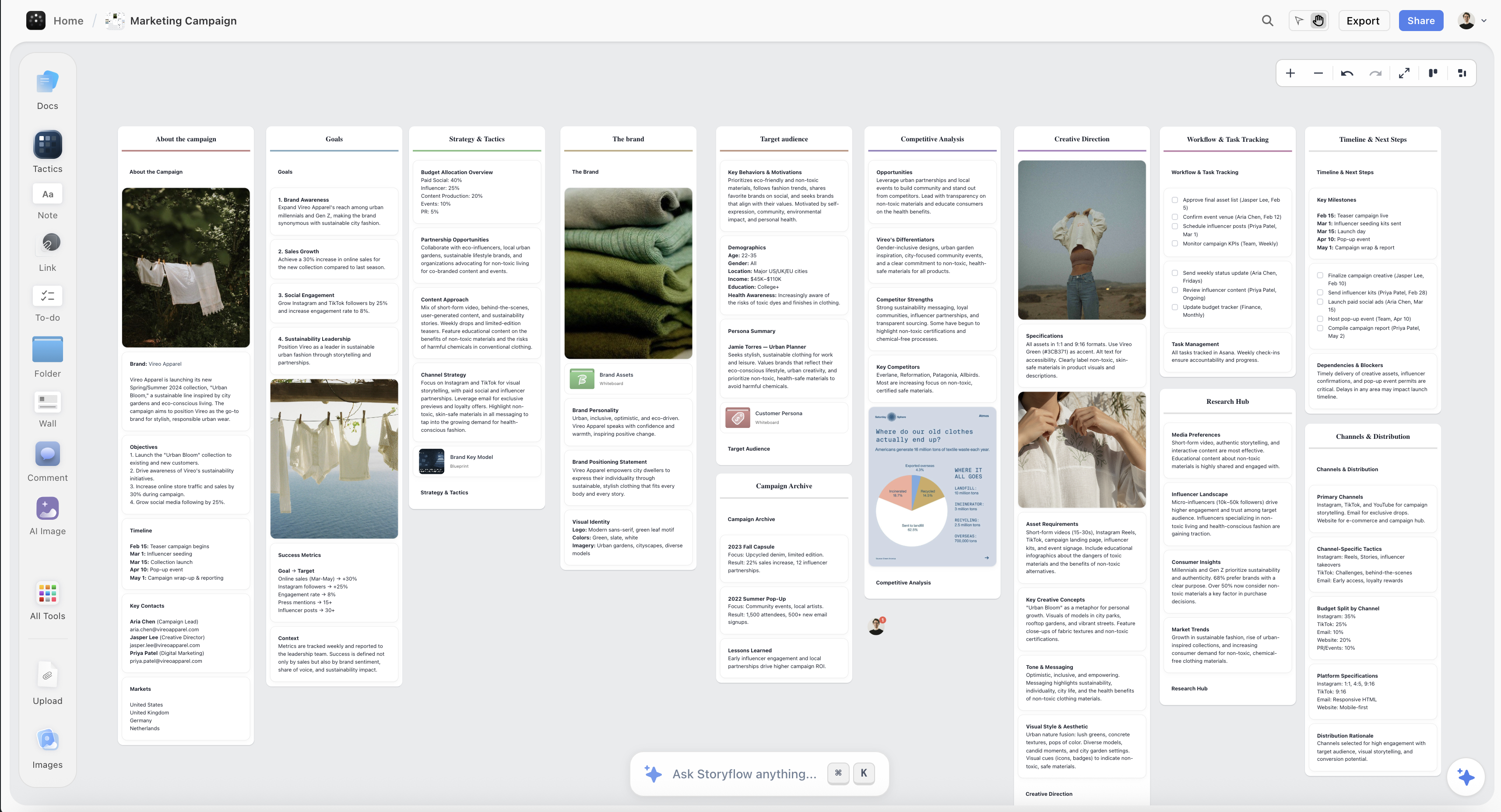
A Storyflow canvas holding a marketing plan: goals, audience, channels, budget, and calendar
What Goes Inside a Marketing Plan
The Five Commitments are the test. The sections below are how you actually lay them out on the page. This structure has been stable for decades, and most of it traces back to Philip Kotler, whose Marketing Management has defined the textbook shape of a marketing plan since the 1960s. You do not need every section every time, but a complete plan touches all of these.
Situation summary. A short, honest read of where you stand: the market, the competition, and your own position in it. A quick SWOT (strengths, weaknesses, opportunities, threats) does the job. Keep it to a page. The point is shared context, not a research report.
Goals and objectives. Commitment one, written out. The standard tool here is SMART, the acronym from George T. Doran's 1981 paper in Management Review: specific, measurable, achievable, relevant, and time-bound. SMART is not a cliche when you actually apply it, because it forces the number and the date the diagnostic demands.
Target audience and positioning. Commitment two. Name the segment, describe the person, and state the positioning: the single idea you want to own in their head. If you serve more than one segment, rank them, because a plan that treats all audiences as equally important resources none of them.
The marketing mix and channels. Commitment three. The classic scaffold is the marketing mix that E. Jerome McCarthy formalised as the 4 Ps (product, price, place, promotion) in 1960, extended by Booms and Bitner to 7 Ps in 1981 for services (adding people, process, and physical evidence). In practice, for most plans this section is about promotion: which channels, what content, what offer, and why those channels fit the audience you just named.
Budget. Commitment four. Allocate the total across channels and campaigns. If you want an outside benchmark for how much a company your size should spend, Gartner's annual CMO Spend Survey is the standard reference marketers use to sanity-check budget as a share of revenue. The internal number your finance team will actually approve matters more than any benchmark.
Timeline and calendar. Commitment five. Map the work across weeks and months: what ships, who owns it, and when. This is where a plan most often comes alive or dies, because a calendar is the one section that forces sequencing and reveals when you have committed to more than you can deliver.
Metrics and KPIs. The scoreboard for the goal. Name the two or three numbers that tell you whether the plan is working (signups, qualified leads, pipeline, retention) and the cadence you will review them on. Vanity metrics that go up no matter what you do are worse than no metric, because they feel like progress.
If you want a named end-to-end framework that sequences all of this, PR Smith's SOSTAC (situation, objectives, strategy, tactics, action, control) is the most widely taught. Whatever scaffold you use, the test does not change. Strategy is the why. The plan is the how, the how much, and the when.
How to Build a Marketing Plan
The sections tell you what the finished plan contains. Building one is a sequence, and the order matters, because each step constrains the next.
- Start from the strategy, not a blank page. Write down who you serve and how you win before you touch goals. If that is not settled, you are not ready to plan.
- Set one primary goal with a number and a date. Add one or two supporting goals at most. A plan with nine equal goals has none.
- Name the audience for this period and the positioning you will lead with.
- Choose three or four channels where that audience already is. Cut the rest, even the ones you like.
- Allocate the budget across those channels against the real total, and make it reconcile.
- Build the calendar. Put dates and owners on every commitment. This is where over-scoping surfaces.
- Define the two or three metrics you will review, and the cadence for reviewing them.
That is the compressed version. For the full section-by-section build, with the trade-offs at each step and the mistakes that quietly wreck a plan, read the companion how-to: How to Write a Marketing Plan (With Real Structure, Not Theory). This pillar defines the artifact. That guide walks you through producing one.
One warning that guide makes and this one seconds: do not build the plan in a document you will never reopen. The calendar changes in week two. The budget shifts when a channel underperforms. A plan is a living document or it is decoration, and the format you choose determines which one you get.
How AI Changes Marketing Planning
The hard part of a marketing plan was never the thinking. It was that the plan and the doing live in different files. The plan is a slide deck. The calendar is a spreadsheet. The tasks are in a project tool. The budget is in a second spreadsheet. Nobody sees all five commitments at once, so the plan quietly dies the week after the offsite, and by mid-quarter the team is executing from memory.
AI helps at two levels. First, it accelerates the draft: give it your strategy, your goal, and your constraints, and it will propose a channel mix, a budget split, and a first-pass calendar in minutes instead of days. Second, and more usefully, it pressure-tests. Ask it where your channel choices do not match your named audience, or where the calendar has committed to more than the budget funds, and a good model will find the gap you talked yourself past. The judgment stays yours. The speed and the second opinion are the machine's.
This is the specific friction Storyflow was built to remove. Storyflow is an AI visual workspace: an infinite canvas where notes, cards, images, and links sit next to structured Documents, with an AI that reads the board. You can hold all five commitments on one canvas. The goal card, the audience cards, the channel columns, the budget, and the calendar all live in one place the whole team can see, instead of scattered across four files. Because the AI reads your full active board (plus up to 1 blueprint and up to 3 Documents you @-mention in the chat), when you ask it to pressure-test the budget split or draft next quarter's calendar, it reasons over your actual plan, not a pasted summary. Storyflow's Story blueprints (200+ creative templates on the Plus, Pro, and Max plans) give you a campaign-brief or plan-shaped frame to start from instead of a blank canvas. Pricing is Free to start, with Plus from $7.99/month billed annually ($9.99 monthly).
Be clear about what Storyflow does not do, because a plan tool that overpromises is worse than a plain document. Three honest limits. First, it is a planning surface, not an execution or analytics platform: it will not send your emails, buy your ads, or pull a live performance dashboard. You still run those in tools like HubSpot, your ad managers, and Google Analytics, then bring the results back to the board. Second, it is cloud-only, with no offline or local-first mode, which rules it out for strict air-gapped environments. Third, it is canvas-card-shaped, not a spreadsheet, so for a budget model with deep formulas and pivot tables you should keep the math in Sheets or Excel and link it in. Storyflow is where the plan lives and stays legible to the whole team. It is not where the plan runs.
Which Format Should You Use?
Not every plan needs to be long, and the biggest mistake teams make is matching format to ambition instead of to reality. Three formats cover almost everyone.
The one-page plan. The Five Commitments on a single page: goal, audience, channels, budget, calendar. Right for solo founders, small teams, and anyone who needs the plan to be re-read weekly. If you will not reopen a 20-page document, a one-pager you actually use beats it every time.
The full annual plan. The complete section set above, built once a year and reviewed quarterly. Right for teams spending real money across several channels, where the situation summary and detailed budget earn their length because more people need to coordinate against them.
The campaign brief. Not a marketing plan at all, but often what people actually need. If you are planning one launch, write a campaign brief and skip the annual apparatus. Reach for the full plan only when you are coordinating several campaigns across a quarter or a year.
Here is the honest version most guides skip: if you are a one-person business running one channel, you may not need a formal marketing plan at all. The Five Commitments written on an index card will hold you accountable just as well as a template will. The plan is a tool for coordination and memory. If there is no one to coordinate with and the whole plan fits in your head, do not manufacture a document to prove you are serious. Write the one-pager when the team grows past you.
The Bottom Line
A marketing plan is where a strategy stops being a point of view and becomes a set of commitments with numbers and dates attached. Strategy is the why. The plan is the how, the how much, and the when. If your document does not make all Five Commitments (a goal with a number, an audience you can name, a channel shortlist, a budget that reconciles, and a timeline with dates), it is not finished, whatever the section titles say.
Match the format to your reality. Write the one-pager if you are small and the full plan if you are coordinating a team, and never build either in a file you will not reopen, because a plan is a living document or it is decoration. If you want the plan and the doing to stop living in four separate files, take your next quarter and lay the Five Commitments on a single Storyflow canvas where the team can see all of them at once. Then read How to Write a Marketing Plan (With Real Structure, Not Theory) and build it. Start your plan on a Storyflow canvas.
FAQ: Marketing Plans
What is a marketing plan in simple terms?
A marketing plan is a document that says what marketing you will do over a set period, for whom, through which channels, with what budget, on what timeline, and how you will measure it. It turns a marketing strategy (the direction) into concrete, dated commitments (the actions). In one line: a strategy is what you believe, a plan is what you will do about it.
What is the difference between a marketing plan and a marketing strategy?
A marketing strategy is durable and directional: it defines who you serve, how you win, and why anyone should care. A marketing plan is time-boxed and specific: it turns that direction into goals with numbers, a channel list, a budget, and a calendar for a quarter or a year. Strategy is the why. The plan is the how, the how much, and the when. You need the strategy first, then the plan executes it.
What are the main parts of a marketing plan?
The core sections are a situation summary, goals and objectives, target audience and positioning, the channel and marketing-mix plan, a budget, a timeline or calendar, and metrics. A useful test across all of them is the Five Commitments: a goal with a number, an audience you can name, a channel shortlist, a budget that reconciles, and a timeline with dates. If any section has neither a number nor a date, it is still strategy, not a plan.
How long should a marketing plan be?
As short as it can be while still making all five commitments clearly. A solo founder or small team is often best served by a one-page plan that gets re-read weekly. A larger team coordinating spend across several channels may need a fuller document with a situation summary and detailed budget. Length should match how much coordination the plan requires, not how serious you want to look.
What is the difference between a marketing plan and a business plan?
A business plan covers the whole company: product, operations, finance, and marketing, usually over one to three years, often written to raise money or set annual direction. A marketing plan covers only marketing and usually only a quarter or a year. The business plan sits above the marketing plan and hands it a revenue target; the marketing plan decides how marketing will help hit it.
What is a marketing plan versus a campaign plan?
A campaign plan covers a single initiative, like one product launch or one seasonal promotion, over days or weeks. A marketing plan covers all your marketing over a quarter or a year and usually contains several campaigns. If your document describes one launch, you have written a campaign plan, and you are probably missing the marketing plan that should sit above it and connect that launch to your yearly goals.
How often should you update a marketing plan?
Treat it as a living document and review it quarterly at minimum, with a lighter check monthly. The goals and strategy should stay stable across the year, but the calendar, the channel mix, and the budget allocation will shift as results come in. A plan you write once and never reopen is decoration. The review cadence is what keeps it real.
Do I need a marketing plan for a small business?
If you have a team to coordinate or money to allocate across channels, yes, even a one-page plan. If you are a one-person business running a single channel, you may not need a formal document at all: the Five Commitments on an index card will hold you accountable just as well. Write the plan when coordination and memory become a problem, not to prove you are serious.
What is a one-page marketing plan?
A one-page marketing plan condenses the Five Commitments (goal, audience, channels, budget, calendar) onto a single page you can re-read in a minute. It trades the detail of a full plan for something a busy team will actually reopen and use. For solo founders and small teams, a one-pager that gets used weekly beats a twenty-page document that gets written once and forgotten.
Can AI write a marketing plan?
AI can draft a strong first version fast: give it your strategy, goal, and constraints and it will propose a channel mix, budget split, and calendar. It is also useful for pressure-testing, catching where channels do not match the audience or where the calendar outruns the budget. What it cannot do is set your real budget, know your actual constraints, or make the judgment calls. Use AI to draft and stress-test; keep the commitments human.
What is the 7 Ps marketing mix?
The marketing mix is a checklist of the levers you control. E. Jerome McCarthy formalised the 4 Ps (product, price, place, promotion) in 1960, and Booms and Bitner extended it to 7 Ps in 1981 for services by adding people, process, and physical evidence. In a marketing plan, the mix mostly shows up in the channels and promotion section, where you decide what you offer, at what price, where, and how you tell people about it.
Table of Contents
- Key Takeaways
- What a Marketing Plan Actually Is
- The Five Commitments: What Turns a Strategy Into a Plan
- Marketing Plan vs Strategy vs Business Plan vs Campaign Plan
- What Goes Inside a Marketing Plan
- How to Build a Marketing Plan
- How AI Changes Marketing Planning
- Which Format Should You Use?
- The Bottom Line
- Author
- FAQ: Marketing Plans
- Related Reading
Templates to check out for this topic


Marketing and campaign templates you can use in Storyflow
Plan the whole campaign on one board: brief, audience, channels, and assets connected, with an AI that reads all of it. Open a template and start from real structure.


See Storyflow in Action
A visual AI workspace where every feature lives inside one canvas. No tab-switching, no context lost.
Build your entire board from a single message
Type what you need in the AI chat at the bottom of your canvas. The AI adds cards, headings, and structure directly onto your board.
Use expert frameworks as AI context
Type @ in the AI chat and choose any Tactic. The AI tailors every response to that framework instead of giving generic advice.
Turn your board into a mind map in seconds
Ask the AI to restructure your canvas as a mindmap. It connects your ideas into a visual hierarchy so you can see how everything relates.
Why Storyflow Exists
Storyflow actually began as a personal tool while working on creative and research projects.
We kept running into the same problem: ideas were scattered everywhere: notes, documents, and whiteboards.
Nothing helped us see how everything connected.
So we started building a workspace designed around how ideas actually grow.
→ Read how Storyflow was createdSara de Klein
Head of Product at Storyflow
Published: 2026-07-15
Extremely simple, seriously capable


See how easy it is to get started
Watch a real project come together, from a blank board to a finished plan, clicked through step by step.
Start creating with AI and become more productive
Transform your creative workflow with AI-powered tools. Generate ideas, create content, and boost your productivity in minutes instead of hours.