The 6 Documents Every Brand Launch Needs in 2026 (Positioning to Launch Week)
Our pick to plan a brand launch from idea to campaign is Storyflow: its AI builds the six documents every launch needs on one board, from the launch brief to the sustain plan. Asana, Monday.com and Airtable run the tracked work after it.

Category
Marketing
Author

Justkay
Documentary Filmmaker & Founder at Storyflow
Topics
2026-09-06
•
45 min read
•
Marketing- best tool to plan a brand launch from idea to campaign
- brand launch plan template
- launch plan template
- brand launch asset matrix
- messaging house structure
- brand launch strategy
What is the best tool to plan a brand launch from idea to campaign?
Our pick to plan a brand launch from idea to campaign in 2026 is Storyflow: paste your positioning notes, ask for the six documents every brand launch needs (launch brief, messaging house, asset matrix, launch calendar, internal launch pack, sustain plan), and its AI builds them on one board your team co-edits. Choose Asana or Monday.com to run tracked work with dependencies, Airtable once the asset matrix passes sixty rows, and Miro for a live positioning workshop. Storyflow has no dependencies or critical path.

Full disclosure: Storyflow is our own product and it is listed first on this page. The basis is the job the page is about: building the brand launch plan from an idea. Its AI drafts the launch brief, lays out the messaging house, builds the asset matrix as a table and turns the board into the internal deck. The other tools follow in the order they enter the work and are not ranked against each other. Storyflow has to-dos with an assignee and a due date, and it has no dependency model, no critical path, no workload view, no status reporting and no due-date reminders, so for a large asset matrix and a dependency-heavy calendar this page recommends Airtable, Asana or Monday.com.
Quick Comparison
One tool to build the plan, and three that take over a single job once the launch outgrows a board.
| Tool | Best For | AI Features | Price |
|---|---|---|---|
| Storyflow | Building the launch plan from an idea | AI drafts the brief, messaging walls, asset table and internal deck | $7.99 mo annual (free plan late 2026) |
| Asana | Dependencies, workload and approvals | AI Studio and AI Teammates, metered | Free for 2 / $10.99 user mo annual |
| Airtable | An asset matrix past 60 rows | AI across records | $20 user mo annual |
| Miro | The positioning workshop | Sidekicks and Flows, on credits | Free / $8 member mo annual |
Key Takeaways
- Our pick to build the brand launch plan is Storyflow. Its AI drafts the launch brief, lays out the messaging house, builds the asset matrix as a table and turns the board into the internal launch deck. Asana, Monday.com and Airtable come after it, for running the tracked work.
- Six documents, not one plan. Most launches fail on the asset matrix, the one document that connects a deliverable to an owner and a date.
- The two things always late are legal clearance and the website. Both have dependencies outside the marketing team, which is exactly why they are late, and both need to start at week one, not week six.
- Lock positioning before you commission anything. Every asset produced against unlocked positioning gets remade, and remaking is where launch budgets go.
- The internal launch precedes the external one. Employees finding out from LinkedIn is the most common and most avoidable launch failure.
- Binet and Field's IPA work puts the long-run brand to short-run activation split at roughly 60:40. A launch plan that is all activation buys a spike and no brand.
- Add a task tool only when deliverables pass about forty or dependencies cross teams. Storyflow has to-dos with an assignee and a due date; it has no dependency model, critical path, workload view or status reporting.
- Launch week is a milestone, not the goal. Budget and staff the twelve weeks after it, because that is when the brand is built.
Last updated October 11, 2026. Competitor prices come from each vendor's own pricing page; where a page showed no dollar price, this page says so.
Which Tool Should You Use to Plan a Brand Launch?
Use Storyflow to build the launch plan, because its AI turns your positioning notes into the six documents on one board the whole team can read. Then add a task tool for the tracked work once the deliverable count or the dependencies outgrow a board. Match your launch to a row.
| If your launch needs | Use | Why |
|---|---|---|
The plan built from an idea: brief, messaging, asset list, timeline, internal pack | Storyflow | Its AI builds the documents as walls, tables and pages on one board, staged as a proposal you accept or discard |
The plan built from inside ChatGPT or Claude | Storyflow (MCP connector) | The assistant reads your Storyflow projects and builds boards and documents in them |
An asset matrix past sixty rows with format variants | Airtable | Relational records, filtered views per owner, timeline and calendar views |
Dependencies across several teams | Asana or Monday.com | Timelines, workload and status reporting that a board does not have |
A written wiki the whole company already reads | Notion | Pages and databases, with Notion Agent on the Business plan |
A live positioning workshop with voting | Miro | Facilitation tools for a room of people |
The campaign that runs after launch day | HubSpot | Emails, landing pages, ads and reporting tied to one campaign |
Most real launches use two tools: one where the plan is built and argued over, and one where the tracked work runs. This page puts Storyflow first for the first job and names the right tool for the second.
The Brand Launch Plan Template: Six Documents on One Board
A brand launch plan template is six documents, each answering one question that becomes a three-week slip if nobody asks it. Keep all six on one Storyflow board, so the brief, the messaging and the asset matrix can be read against each other. This table is the template.
| Document | The question it answers | Shape | Owner | When it locks |
|---|---|---|---|---|
1. Launch brief | What is changing, for whom, by when, and who decides? | Two pages | Whoever controls the budget | Week 1 |
2. Messaging house | What do we say, in what order, with what proof? | One page: idea, three pillars, proof points, boilerplate, word list | Brand lead | Before any copy is commissioned |
3. Asset matrix | What exactly has to be made, by whom, depending on what? | A table, 40 to 200 rows | Launch lead | Week 2, then updated weekly |
4. Launch calendar | In what order does it all land? | The matrix arranged in time, counted back from launch day | Launch lead | When the longest lead time is known |
5. Internal launch pack | Can every employee explain the change? | Story, messaging in plain words, per-team changes, answers | People or comms lead | Two weeks before launch |
6. Sustain plan | What runs in the twelve weeks after launch? | A content plan, owners and a budget | Marketing lead | Before launch day |
How to get this template as a working board. Open a Storyflow board, paste your positioning notes and ask the AI for the six documents by name. Storyflow's AI asks a clarifying question or two, then stages the result as a proposal you accept or discard. The step-by-step version, with the exact ask for each document, is further down this page.
Why Brand Launches Slip, and It Is Never the Creative
A brand launch that slipped by three weeks did not slip because the creative was late. It slipped because in week seven somebody asked whether legal had cleared the tagline for use in Germany, and nobody had asked in week one. A plan built on one Storyflow board makes that question visible while there is still time to answer it.
Brand launches are dependency problems disguised as creative problems. The creative work is the visible part and the part everyone tracks. The invisible part is a graph of dependencies where a trademark search, a domain purchase, a photography shoot, a website build, a packaging print run and an internal comms cascade all have to converge on one date, and most of them are owned by people who do not attend the marketing standup.
The six documents exist to make that graph visible. Each one answers a question that, unanswered, becomes a three-week slip.
The Difference Between a Brand Launch and a Product Launch
A brand launch and a product launch get planned identically and should not be. A product launch introduces a new thing to people who already know you. A brand launch changes who you are, which makes every existing asset wrong. The six documents apply to both; two of them carry far more weight in a brand launch.
| Product launch | Brand launch | |
|---|---|---|
What changes | One offering | The name, the look, the story, or all three |
The main work | Activation: announcement, demand, sales enablement | Replacement and re-education |
Success measure | Adoption, in weeks | Recognition and association, in quarters |
Migration work | Light | Heavy: every card, template, profile and SKU carries the old identity |
Internal audience | Sales and support | Every employee |
Documents that matter most | Asset matrix, launch calendar | Messaging house, internal launch pack, sustain plan |
The practical consequences:
- A brand launch has a migration problem a product launch does not: every business card, email signature, template, invoice, social profile, app icon and packaging SKU carries the old identity.
- A brand launch has an internal audience that matters more than the external one. If your own people cannot explain the new positioning, nobody outside will hear it consistently.
- A brand launch is measured over quarters, so a plan that ends on launch day has planned the wrong thing.
If you are running a product launch, the asset matrix and calendar below still apply; the internal launch pack and the migration audit are lighter.
The Six Documents Every Brand Launch Needs
Every brand launch needs the same six documents, written in this order, and each section below says what goes in the document and how to build it on a Storyflow board. Write them in sequence: the brief constrains the messaging, the messaging constrains the assets, and the assets decide the calendar.
Document 1: The Launch Brief
Two pages, written first, signed off by whoever controls the budget.
It answers: what is changing and what is not, why now, who this is for, what success looks like at 30, 90 and 180 days, what the budget is, what the immovable date is and why, and who decides when there is disagreement.
That last item is the one that gets left out and the one that costs the most. A launch with three stakeholders and no named decision-maker resolves every disagreement by escalation or by compromise, and compromise in brand work produces the beige middle that nobody chose.
Also name what is explicitly out of scope. A brand launch attracts adjacent projects the way a house move attracts decluttering, and an unbounded scope is the second most common cause of a slipped date.
Build it on a Storyflow board. Paste the founder's notes or attach the strategy deck and pick Brief my campaign. Storyflow's AI builds ten walls, including the overview with the launch date, the goals written as numbers, the audience, the brand, and a next-steps wall with a checklist per phase. Where your notes gave no date or budget, the AI marks a visible blank instead of inventing one.
Document 2: The Messaging House
One page. This is the document every other piece of copy is derived from, and if it does not exist, each writer invents their own version and the launch sounds like six brands.
The standard structure:
- The brand idea at the top. One line. The thing you want to be understood for.
- Three pillars underneath. The three supporting arguments. Three, not five, because nobody remembers five.
- Proof points under each pillar. Facts, features, numbers, credentials. This is the layer that keeps the pillars from being adjectives.
- The boilerplate. The paragraph that appears in every press release and every partner listing, written once so it is not rewritten badly under deadline.
- Words we use and words we do not. The most practically useful section, and the one that survives longest.
A quick example of brand pillars done properly, for a payroll product repositioning from "cheap" to "calm": the idea is "payroll you never think about", and the pillars are "runs itself" (proof: the share of pay runs with no manual step), "never surprises you" (proof: the error rate and the alerting rule) and "a person answers" (proof: the support response time). Each pillar is a claim a customer could repeat, and each has a number under it.
Lock this before any copy is commissioned. Every asset written against unlocked messaging gets rewritten, and rewriting is where launch budgets quietly go.
Build it on a Storyflow board. Ask Storyflow's AI to lay out the messaging house as five walls (idea, pillars, proof points, boilerplate, word list) next to the brief. For the foundation underneath it, ask for a brand strategy: the AI builds ten walls, including values, tone of voice, named competitors and positioning. Drop a Tactic such as StoryBrand or AIDA onto the canvas when the argument needs a structure.
Document 3: The Asset Matrix
A table, and the single most important document in the stack.
One row per deliverable. Columns: asset, channel, format and spec, owner, reviewer, dependency, due date, status, and where the file lives.
This is where a brand launch becomes real, because it is the moment the abstract phrase "refresh our channels" becomes 68 rows and someone realises there is a fortnight of work nobody scoped. A typical mid-size brand launch produces somewhere between 40 and 200 rows.
Build it by walking surfaces, not by brainstorming assets:
- Owned digital: website pages, app, email templates, transactional emails, social profiles and banners, blog, help centre.
- Owned physical: signage, packaging, print collateral, uniforms, vehicles, stationery, trade stand.
- Sales and service: deck templates, one-pagers, proposal templates, email signatures, call scripts, invoice templates.
- Paid: ad creative per platform and format, landing pages.
- Earned: press kit, boilerplate, executive bios, photography, logo pack for partners.
- Internal: slide template, document templates, intranet, onboarding materials.
The dependency column is what makes this document a plan instead of a list. An asset with an unresolved dependency has no real due date, and grouping rows by dependency instead of by due date shows you the actual critical path.
Build it on a Storyflow board. Paste the asset list, or attach the audit spreadsheet as a PDF, and pick Turn my notes into a table. Storyflow's AI builds the table with typed columns: a person cell for the owner, a date cell with a date picker for the due date, a status cell and a link cell for the file. In a recorded run a PDF became tables in 2 minutes, against about 45 minutes by our hand estimate. The owner column takes people who are already on the board. Two limits decide when to move it: a Storyflow table cannot be sorted or filtered by a column, and nothing recalculates when a dependency slips. Past about sixty rows, ask the AI for the table as an Excel file and move it to Airtable or a tracker.
Document 4: The Launch Calendar
The asset matrix arranged in time, working backwards from the immovable date.
A workable default shape for a mid-size brand launch, counted back from launch day:
| Phase | Timing | What has to be finished |
|---|---|---|
Positioning lock | T-16 to T-12 weeks | Brief signed, messaging house locked, legal search started |
Identity development | T-14 to T-10 | Identity approved, applied to the top ten surfaces |
Asset production | T-10 to T-4 | Photography shot, website built, print at proof stage |
Print and long-lead | T-8 to T-3 | Anything with a physical lead time committed |
Internal launch | T-2 weeks | Every employee briefed, assets in their hands |
Pre-brief | T-1 week | Press, partners and key customers under embargo |
Launch week | T-0 | Sequenced across a week, not fired in one hour |
Sustain | T+1 to T+12 weeks | The plan that continues after the spike |
Two rules that hold across almost every launch:
- Anything printed or manufactured sets the real date. Digital can move by a day; a print run cannot. Work the schedule backwards from the longest physical lead time, and find that number in week one.
- Do not launch everything at once. A brand launch sequenced across a week gets several moments; one fired in a single hour gets one, and any asset that is not ready has to be held for weeks.
Build it on a Storyflow board. Ask Storyflow's AI for a marketing plan and its Timeline wall arrives as phases with dates, with a visible slot where you gave no date. Each phase can carry a to-do list, and any to-do takes an assignee and a due date. This is a phased plan, not a scheduler: there is no calendar grid, no dependency lines and no due-date reminders. When a slipped photo shoot has to move eleven downstream tasks automatically, that is Asana's or Monday.com's job.
Document 5: The Internal Launch Pack
Everything an employee needs to understand and repeat the new brand, delivered before the external launch.
It contains: the story of why the change happened, the messaging house in plain language, what changes for each team specifically, the assets they need immediately, a set of answers to the questions people will actually ask, and a named person to ask when the pack does not cover it.
That question set matters more than the rest of the pack. The real questions are rarely about the brand. They are "does this mean my email address changes", "do I need to redo my client proposals", and "are we being acquired". Answer those directly and the launch has advocates instead of rumours.
Run the internal launch at least two weeks before the external one. Employees who learn about a rebrand from a customer or from LinkedIn become its least persuasive spokespeople, permanently.
Build it on a Storyflow board. Ask Storyflow's AI to turn the brief and messaging walls into a document, then pick "Slides from this board" for the all-hands deck or "A PDF of this board I can send" for the leave-behind. We estimate a board turned into slides at about 3 minutes (an estimate, not a recorded run), against about 5 hours by hand. The deck presents fullscreen and exports as one PDF; there is no PowerPoint export.
Document 6: The Sustain Plan
The document teams skip, and the reason so many rebrands feel like they never landed.
Launch week produces a spike in attention and almost no change in what people believe. Association forms through repetition, which means the twelve weeks after launch matter more than the week of it. The sustain plan covers what runs in those weeks, who owns it, and what the budget is, and it should be written before launch because after launch everyone is tired and the budget is spent.
Binet and Field's IPA Databank work is the useful reference here: the long-run brand-building to short-run activation split lands near 60:40 across categories. A launch plan weighted entirely toward activation buys a spike in attention and no lasting brand association, which is exactly what a rebrand needs to build.
Build it on a Storyflow board. Pick Plan my content calendar and Storyflow's AI builds the content pillars, a cadence per platform and a wall of ten real post tickets, each with its pillar and platform. Storyflow does not schedule or publish posts, so the tickets move to your scheduler or to HubSpot once they are approved.
How to Build the Brand Launch Plan in Storyflow, Step by Step
Building the brand launch plan in Storyflow takes eight steps, one per document plus the positioning before them and the share after. The AI does the laying out; your time goes into the decisions. Start from the notes you already have, not from a blank page.
| Step | What you do in Storyflow | What you get |
|---|---|---|
1. Open the launch board | Create a project for the launch and attach the strategy deck, research and notes in the chat (up to five documents) | One board the team and the AI both read |
2. Settle positioning | Put each territory on its own wall with its references; ask the AI which one the research supports | Territories compared side by side, with the argument for each |
3. Brief | Pick Brief my campaign | Ten walls and nested boards, with blanks marked where a date or budget is missing |
4. Messaging house | Ask for the messaging house as five walls; ask for a brand strategy underneath | Idea, pillars, proof points, boilerplate, word list |
5. Asset matrix | Paste the asset list and pick Turn my notes into a table | A table with owner, due date, status and link columns |
6. Calendar | Ask for a marketing plan; assign the to-dos | A Timeline wall of dated phases and to-dos with assignees |
7. Internal pack | Pick "Slides from this board" or "A PDF of this board I can send" | The all-hands deck or leave-behind as one PDF |
8. Share and sustain | Send the view-only link; pick Plan my content calendar | Stakeholders read with no account; ten post tickets for the weeks after |
Three details make the board trustworthy enough to run a launch from.
Storyflow's AI reads the plan before it answers. The AI reads the current board as text, plus up to five documents and three other boards you attach in the chat. Ask "What's missing here?" and the answer comes from your brief and your matrix, which is how the legal clearance nobody scheduled gets noticed in week one.
Storyflow keeps the team on one surface. Every paid plan has real-time collaboration with live cursors, and anyone a paid member invites to a board joins free. A stakeholder outside the team opens a view-only link with no account, and signs in to comment or draw.
Storyflow knows where it stops. To-dos take an assignee and a due date, and people get in-app notifications. There are no due-date reminders, the AI cannot set assignees, and there is no dependency model, critical path, workload view or status reporting. Those are the features to buy a task tool for.
Storyflow's AI marketing campaign planner and marketing workspace pages go further into the brief-to-board step and the board itself.
What It Takes by Hand vs in Storyflow
By hand, the launch plan is six documents in four tools, each started from a blank template. In Storyflow it is one board and three moves per document: paste or attach, answer one or two questions, accept the proposal. The table counts the steps and quotes minutes only where there is a figure to quote.
| Document | By hand, across the usual stack | In Storyflow |
|---|---|---|
Launch brief | A blank doc, ten headings, then chasing the missing numbers | Brief my campaign from the attached notes; missing facts marked as blanks |
Messaging house | A slide or doc, rewritten after each stakeholder call | Five walls beside the brief, edited by the team in real time |
Asset matrix | Retyping an audit into a spreadsheet | Turn my notes into a table: 2 minutes in a recorded run for a PDF into tables, about 45 minutes by our hand estimate |
Launch calendar | A second sheet copied from the matrix, which then drifts | A Timeline wall and dated to-dos on the same board as the matrix |
Internal launch pack | Rebuilding the brief and messaging as slides | Slides from this board: we estimate about 3 minutes (not a recorded run), against about 5 hours by hand |
Sustain plan | A content sheet started after launch, when everyone is tired | Plan my content calendar, written before launch on the same board |
Sharing | Export, attach, email, then "which version is this?" | One view-only link that opens with no account |
The PDF figure is the agent time of one recorded run, rounded up; the slides figure is our estimate and was never measured. The hand figures are our own estimate at 1.5 minutes per card, row or to-do, 12 minutes per picture and 30 minutes per PDF page, slide or designed page. They are not a benchmark of any other product.
The larger saving is that nothing is copied. The brief, the references, the plan, the deck and the stakeholder link sit on one board that the AI reads, from $7.99 a month billed annually. The stack it replaces for planning is a doc tool, a spreadsheet, a whiteboard and a slide tool.
A Worked Example: A B2B Rebrand Over Fourteen Weeks
This is an illustration, not a real client project and not a recorded Storyflow run: a composite launch that shows how the six documents play out and which Storyflow board each stage lives on. The numbers in it are illustrative. A 40-person software company is changing name, positioning and visual identity at once. Three people are on the launch, none of them full time.
Weeks 14 to 11, positioning. The document that took longest and produced the least visible output. It went through four versions because the second and third were descriptions of the product instead of positions against an alternative. On the Storyflow board each version is a wall, so the four can be read side by side.
Weeks 10 to 8, messaging and identity. Messaging derived from the positioning, which is the order that works. Doing them in parallel, which the team initially planned, produces a messaging document that argues with the identity.
Weeks 7 to 5, the asset list and the migration audit. The audit found 340 surfaces carrying the old name. Eleven were outside anyone's control: partner directories, a conference listing, two app-store entries, review-site profiles. Those eleven took longer than the other 329. At 340 rows this matrix belongs in Airtable or a tracker; the Storyflow board keeps the summary and the eleven problem cases.
Weeks 4 to 2, production. Website, sales collateral, templates, email signatures, social profiles, contract templates.
Week 1, sequencing. Internal first, customers second, public third, on three consecutive days.
What went wrong. The app-store entries needed review cycles nobody had scoped, and one took eleven days. The launch shipped with one store still carrying the old name for a week.
What the team would repeat. Running the migration audit in week 12 instead of week 7. The audit is cheap to run and its findings have the longest lead times, which is the argument for doing it early.
Total effort. Roughly 220 person-hours across fourteen weeks, over half of it in production, not in the thinking the team expected to dominate.
The Migration Audit Nobody Scopes
The migration audit is the extra artefact that decides whether the launch feels finished. Two weeks before launch, walk every surface a customer can reach and record which ones still carry the old identity. Put a screenshot of each one on a Storyflow board, so the remaining work is impossible to ignore.
Not the ones on the asset matrix, all of them: the invoice PDF, the transactional email footer, the 404 page, the app store listing, the calendar invite template, the on-hold music, the second-page favicon nobody has looked at since 2019.
A brand launch is judged by its worst surface, not its best one. The website can be beautiful and the automated receipt still carries the old logo, and the receipt is the thing a customer sees every month.
Assign this audit to someone outside the marketing team. People who built the assets cannot see the old ones any more.
| Surface family | The ones people forget | Who usually owns them |
|---|---|---|
Billing | Invoice PDF, receipt email, payment page | Finance |
Product | 404 page, favicon, app icon, in-app emails | Engineering |
Stores and directories | App store listings, partner directories, review sites | Whoever has the login |
People | Email signatures, calendar invites, job adverts | HR and every employee |
Physical | Signage, packaging, vehicles, uniforms | Operations |
Legal | Contract templates, terms, trademark filings | Legal |
Comparison Table: Where Each Document Should Live
Build the six documents in Storyflow, then move a document only when it outgrows a board. The Storyflow column says what its AI builds and where it stops; the other columns grade each rival for that document. No single tool is strongest at more than a few rows.
| Document | Storyflow | Notion | Airtable | Miro | Asana / Monday / ClickUp | HubSpot |
|---|---|---|---|---|---|---|
Launch brief | AI drafts it from your notes | Best | Poor | Adequate | Adequate | Poor |
Messaging house | AI lays it out as walls | Best | Poor | Good | Poor | Poor |
Asset matrix | AI builds the table; no sorting or filtering | Good | Best | Poor | Good | Poor |
Launch calendar | Phased timeline; no dependencies | Adequate | Good | Good | Best | Good |
Internal launch pack | AI builds the document, slides or PDF | Best | Poor | Poor | Poor | Poor |
Sustain plan | AI builds the content plan; no publishing | Good | Good | Poor | Best | Best |
Positioning workshop | Territories side by side; no voting or timer | Poor | Poor | Best | Poor | Poor |
Campaign execution | Not for this | Poor | Adequate | Poor | Good | Best |
The honest reading: Storyflow is where the plan gets built, and almost every real launch still runs on two tools. The common and correct pairing is Storyflow for the thinking documents and a database or project tool for a large matrix and a dependency-heavy calendar.

A brand launch plan on one Storyflow canvas: positioning territories, brief and references side by side
Build the launch plan on one board
Paste your positioning notes and ask for the six documents. Storyflow's AI drafts the brief, lays out the messaging house and builds the asset matrix as a table, on a board your team edits together.

Brand Launch Planning Tools Compared: Price, AI and Tracking
The tools used to plan a brand launch differ on three things that matter: what the AI builds, how deep the tracking goes, and who has to pay for a seat. Storyflow leads on the first, the trackers lead on the second, and the third decides the bill. Prices were checked on October 11, 2026.
| Tool | Role in the launch | What its AI builds | Tracking depth | Starting paid price | Free plan |
|---|---|---|---|---|---|
Storyflow | Build the plan: all six documents on one board | Brief, messaging walls, tables, timeline, slides and PDF from your notes | To-dos with assignee and due date; no dependencies | $7.99/mo billed annually | Launches before end of 2026 (invited collaborators join free now) |
Notion | Written wiki and databases | Notion Agent creates and edits pages and databases (Business plan) | Databases with subtasks and dependencies | $10/seat/mo billed annually | Yes |
Airtable | A large asset matrix | AI across records | Relational records, views per owner | $20/user/mo billed annually | Yes |
Miro | The positioning workshop | Sidekicks, Flows and generators, metered in credits | None to speak of | $8/member/mo billed yearly | Yes, 3 editable boards |
Asana | Dependencies across teams | AI Studio and AI Teammates, metered | Timeline and Gantt on Starter; workload and approvals on Advanced | $10.99/user/mo billed annually | Yes, for up to 2 users |
Monday.com | Status the whole company can read | Sidekick assistant and AI credits on paid plans | Boards, dashboards, automations | $9/seat/mo billed annually, 3-seat minimum | Yes, up to 2 seats |
ClickUp | Most capability per seat | ClickUp Brain as a $9/user/mo add-on | Tasks, dependencies, time tracking | $7/user/mo billed yearly | Yes |
HubSpot | The campaign after launch | See HubSpot's product pages | Campaign reporting, not launch planning | See HubSpot's pricing page | See HubSpot |
The Tools, Reviewed
Storyflow is reviewed first because it is our pick for building the launch plan. The five entries after it are ordered by where they enter the work, and each one says when to choose it instead of Storyflow. A tool lower in this list is not a worse tool, it is a later one.
1. Storyflow
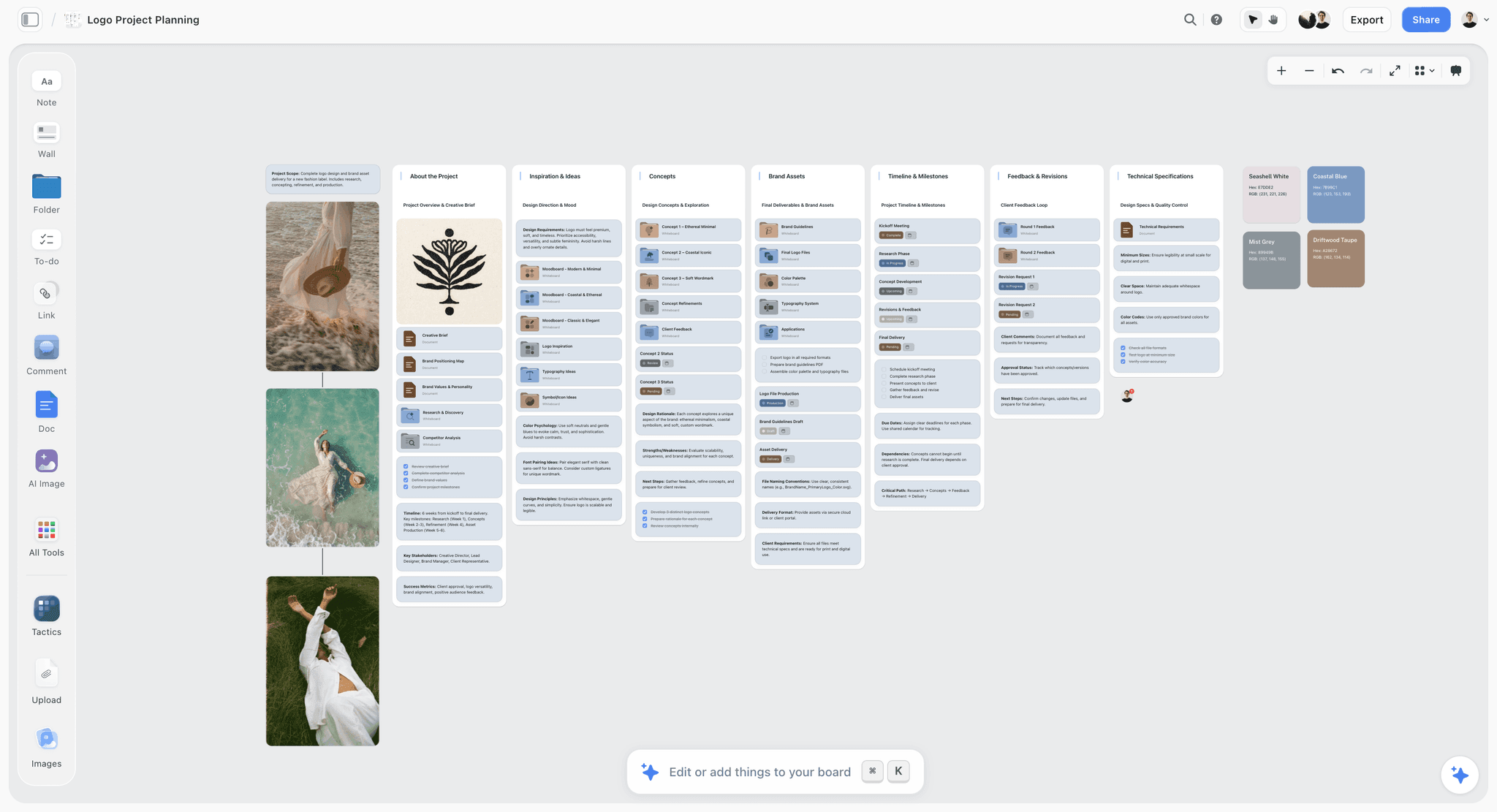
Best for: building the whole brand launch plan from an idea: positioning, brief, messaging house, asset matrix, timeline and the internal deck on one board.
The verdict: Storyflow is our pick to build the launch plan, and it is not a launch tracker.
Storyflow is a visual AI workspace: an infinite canvas where a launch's notes, to-dos, tables, documents, images, moodboards and kanban boards sit together on boards, and an AI agent that reads the board and builds on it. Storyflow runs in the browser, and the AI proposes while you accept or discard.
Storyflow builds the launch documents from what you already have. Attach the strategy deck or paste the founder's notes, and the AI drafts the brief (Brief my campaign builds ten walls), lays out the messaging house, builds the asset matrix as a table with owner, date and status cells, and writes the timeline as dated phases. The AI asks a clarifying question or two first and marks any missing date or budget as a visible blank.
Storyflow holds the positioning work that comes before the documents. Territories, competitor language and reference brands sit side by side on the canvas with images and text together, and the AI reads the current board plus up to five documents and three other boards you attach in the chat. Ask for a brand strategy and the AI builds ten walls, from values and tone of voice to named competitors and positioning. Pick Profile my target audience for seven walls on one buyer.
Storyflow turns the board into what leaves it. Ask for slides, a pitch deck, a one-pager, a designed PDF of the board, a Word file or an Excel file. In a recorded run a pitch PDF built from a board took 3 minutes, against about 4.5 hours by our hand estimate; a slide deck has no recorded run.
Storyflow is built for the people around the launch. Every paid plan has real-time collaboration, anyone a paid member invites joins free, and you share a link with stakeholders that needs no account to view. Any to-do takes an assignee and a due date. The Tactics library holds 200+ expert creative templates, such as StoryBrand and AIDA, that you drop onto the canvas.
Storyflow also works from ChatGPT and Claude through its MCP connector, described on the MCP page.
Where it stops. Storyflow has no dependency model, no critical path, no workload view and no status reporting, there are no due-date reminders, and the AI cannot set assignees. A Storyflow table cannot be sorted or filtered by a column. For a launch past about sixty deliverables or with dependencies across teams, run the asset matrix in Airtable and the calendar in Asana or Monday.com, and keep the plan in Storyflow.
Pricing: Storyflow is paid-only today; the Free plan launches before the end of 2026, and anyone a paid member invites to a board joins free. Plus is $7.99 a month billed annually ($9.99 monthly), Pro is $14 ($19 monthly) with AI image generation and memory across conversations, and Max is $39 ($49 monthly) with a Team Workspace with roles and permissions. See pricing.
2. Notion
The verdict: Notion is the best home for a written launch wiki the whole company already reads, where Storyflow is the better place to build the plan from an idea.
Best for: teams that already run on Notion and want the brief, messaging house and internal pack filed where people will find them, after the plan has been worked out on a Storyflow board.
Why it sits here. The launch brief, the messaging house and the internal launch pack are documents, and Notion is a strong document tool. Its databases handle an asset matrix competently, with subtasks and dependencies, and a matrix can sit as a view inside the same page as the brief. Notion's published launch and campaign templates are useful starting points, though unlike Storyflow's AI they start empty.
Limitations against Storyflow: Notion is page and database first, so the positioning territories, the references and the visual identity have no natural home there. Notion Agent sits on the Business plan, with a limited trial on Free and Plus.
Pricing (Notion pricing): Free plan, Plus at $10 per seat a month billed annually ($12 monthly), and Business (see Notion's pricing page for the dollar price). The page displayed euros on October 11, 2026, so the Plus dollar figure is the one reviewed on October 10. Choose Notion instead of Storyflow when the company wiki is already in Notion and the launch is mostly written.
3. Airtable
The verdict: Airtable is the best asset matrix in the category once the row count is high, and it takes over that one document from Storyflow.
Best for: launches with more than about sixty deliverables, and any launch with heavy asset variants across channels and formats, with Storyflow holding the plan around it.
Why it sits here. The asset matrix is a relational problem: assets link to channels, channels to owners, owners to deadlines, and every asset exists in six format variants. Airtable models that natively, and its interfaces let a designer see only their queue while the launch lead sees the whole base. Its calendar and timeline views turn the same records into the launch calendar without a second document. A Storyflow table cannot be sorted or filtered by a column, which is exactly the gap Airtable fills.
Limitations against Storyflow: long-form documents are unpleasant in Airtable, so the brief and messaging house stay on the Storyflow board. Pricing rises with editors, and a complex base becomes its own maintenance job.
Pricing (Airtable pricing): Team is $20 per user a month and Business $45, billed annually. Read-only collaborators are not charged. Choose Airtable instead of Storyflow when the asset matrix is the document that decides your date and it has passed sixty rows.
4. Miro
The verdict: Miro is where a live positioning workshop runs best, and Storyflow is where the output of that workshop becomes the plan.
Best for: the facilitated workshop stage with a group in the room, before the six documents exist on the Storyflow board.
Why it sits here. Positioning work is spatial and comparative. You are holding several territories against each other, mapping competitors on axes, and clustering the language customers use. Miro has templates for positioning canvases and brand strategy, voting and a timer for the room, and its AI now includes Sidekicks, Flows and a playbook that turns a brief into a campaign. Storyflow has no voting or timer.
Limitations against Storyflow: a workshop board is not a plan. Boards decay after the session, so move the decisions onto the Storyflow board the same week. Miro's AI is metered in credits per member.
Pricing (Miro pricing): free with 3 editable boards, Starter at $8 per member a month billed yearly ($10 monthly) with 25 AI credits per member a month, Business at $20 with 50. Choose Miro instead of Storyflow when twelve people need to vote on territories in one live session.
5. Asana, Monday.com and ClickUp
The verdict: Asana, Monday.com and ClickUp are necessary once the deliverable count passes what a board can hold, and they run the tracked work that Storyflow plans.
Best for: launches with more than about forty deliverables, several teams and real dependencies, with the plan itself kept on the Storyflow board.
Why they sit together. For this job the three are more alike than different. All three do what Storyflow does not: model dependencies, show the path through them, show workload, and report status. On a launch where a photography shoot feeds eleven downstream assets, that is the difference between finding out in week eight and finding out on launch day.
Choosing between them, with the plan staying on the Storyflow board in each case: Asana has the cleanest dependency and timeline handling, Monday.com is the most legible to people who are not project managers, and ClickUp offers the most capability per seat with the steepest setup.
Limitations against Storyflow: all three are poor homes for a messaging house or a brief, so they run alongside the Storyflow board. On a small launch the setup costs more than the coordination it saves.
Pricing: Asana Starter is $10.99 per user a month billed annually ($13.49 monthly) with Timeline and Gantt, and Advanced is $24.99 with workload and approvals (Asana pricing). Monday.com starts at $9 per seat a month billed annually with a 3-seat minimum (monday.com pricing). ClickUp Unlimited is $7 per user a month billed yearly, with Brain AI as a $9 add-on (ClickUp pricing). Choose a tracker instead of Storyflow when a slipped task has to move its dependents automatically.
6. HubSpot
The verdict: HubSpot is where the campaign runs after launch day, and Storyflow is where the launch is planned before it.
Best for: the activation and sustain phases, and measuring what the launch produced, once the sustain plan built in Storyflow is approved.
Why it sits here. HubSpot's campaigns object ties emails, landing pages, ads, forms and workflows to a single campaign and reports on it together, which is the right structure for the sustain phase. If you already run marketing there, the demand-generation half of the launch belongs in it. Storyflow does not send email or run automation.
Limitations against Storyflow: HubSpot does not plan a brand launch. There is no asset matrix and no home for the brief or the messaging house, so teams that try to run the whole launch inside it end up tracking a rebrand in a CRM.
Pricing: see HubSpot's pricing page. It did not return plan figures to our check on October 11, 2026, so none is quoted. Choose HubSpot instead of Storyflow when the job is running and measuring the campaign, not planning the launch.
How We Evaluated the Tools
Storyflow is listed first on one stated basis, and the rest are ordered by workflow stage. This section says what the basis is, how the comparison was made, and what Storyflow does not do, so you can weigh the order yourself.
Disclosure. Storyflow is our own product and it is listed first. The basis is the job this page is about: building the launch plan from an idea. Its AI drafts the brief, lays out the messaging house, builds the asset matrix as a table and turns the board into the internal deck. Storyflow has no dependency model, critical path, workload view or status reporting, no due-date reminders, and its AI cannot set assignees, so for a large matrix and a dependency-heavy calendar this page recommends Airtable, Asana or Monday.com.
The order. Our pick first, then the rest by where each enters the work: Notion for the wiki, Airtable for a large matrix, Miro for the workshop, the trackers for dependencies, HubSpot for the campaign afterwards. The rivals are not ranked against each other.
How the comparison was made. Storyflow was assessed as it ships on October 11, 2026. The other tools were compared from their own product and pricing pages, read the same day, and the Best, Good, Adequate and Poor grades in the document table are our editorial judgement of how well each rival holds that one document, unchanged from the previous edition of this page. Storyflow is not graded there; its column states what its AI builds and where it stops. No tool was scored on a numeric scale.
Four questions shaped each write-up:
- Does it build the document, or hold it? An AI that drafts the brief from your notes saves the blank-page day.
- Can the six documents be read against each other? A brief in one tool and a matrix in another is how launches drift.
- How far does the tracking go? Assignee and date, or dependencies, workload and reporting.
- Who needs a paid seat? Stakeholders who only read should not cost anything.
Recommended Stacks by Launch Size
The right stack for a brand launch depends on the deliverable count and on how many teams the dependencies cross. Storyflow is the tool the plan is built in on every row of this table; what changes with size is the tool that runs the tracked work once the plan exists.
| Launch | Build the plan | Asset matrix | Calendar and tracking | Campaign afterwards |
|---|---|---|---|---|
Startup or small business, under 40 deliverables | Storyflow | A Storyflow table | To-dos with assignees on the same board | Whatever sends your email |
Mid-size company, 40 to 150 deliverables | Storyflow | Airtable | Asana or Monday.com | HubSpot if you already run it |
Agency running a client rebrand | Storyflow, shared with the client by link | Airtable, for read-only client views | The agency's tracker | The client's platform |
Enterprise | Storyflow for the launch team's working board | The PMO's system | The PMO's system | The marketing automation platform |
- Startup or small business. Storyflow alone carries a launch under about forty deliverables: the six documents, a table for the matrix and to-dos with owners. Do not add a project tool; it will cost more setup than it saves. If the company already lives in Notion, file the finished documents there.
- Mid-size company. Storyflow for the documents, Airtable for the asset matrix, Asana or Monday.com for the dependency-heavy production phase.
- Agency running a client rebrand. Storyflow for the plan and the client presentation, because the client opens the board by link with no account. Airtable for the matrix, because clients need read-only views.
- Enterprise. Whatever the PMO already uses for the calendar, with a real effort to keep the messaging house somewhere findable. A Storyflow board is a good home for it.
- Marketing team already on HubSpot. HubSpot for the activation and sustain phases, and Storyflow for the pre-launch planning. Do not try to plan the rebrand in the CRM.
Launch Week, Day by Day
Launch week should be sequenced across several days, with the internal audience first and the public last. A phased launch strategy gives you several moments instead of one, and lets a late asset slip by a day instead of being held for weeks. Keep this sequence as a wall on the Storyflow launch board.
| Day | Audience | What goes out | What must already be true |
|---|---|---|---|
T-14 | Every employee | The internal launch pack and the all-hands | Messaging house locked, answers written |
T-7 | Press, partners, key customers | Pre-briefs under embargo | Press kit and boilerplate final |
Day 1 | Employees again | "It is today" note, new signatures and templates switched on | Templates distributed |
Day 2 | Existing customers | Email, in-product notice, account manager calls | Transactional emails migrated |
Day 3 | Public | Website live, social profiles switched, announcement published | Legal clearance complete, domain live |
Day 4 to 5 | Trade and partners | Partner listings, directories, co-marketing | Logo pack sent |
Week 2 onwards | Everyone | The sustain plan begins | Sustain budget committed |
Day 3 is where most slips surface, because it is the day with the most external dependencies. If anything on the Day 3 row is not true by the end of Day 1, move the public announcement and keep the customer day.
How to Measure a Brand Launch Without Lying to Yourself
Launch measurement goes wrong in a predictable way: the team reports the metrics that moved instead of the metrics that mattered, because the metrics that mattered move slowly. Set the measures in the brief, before anyone knows what will happen, and keep them on the goals wall of the Storyflow board.
| Checkpoint | Measure | How to get it | What it tells you |
|---|---|---|---|
30 days | Execution and internal comprehension | Ask twenty people to describe the new positioning in their own words | Whether anything external can land |
90 days | Recognition | Aided and unaided awareness, branded search, direct traffic | Whether people remember you |
180 days | Association | A small tracking study or fifty customer conversations | Whether people connect you to the claim |
At 30 days, measure execution, not effect. Did the assets ship, did the migration complete, did employees receive and understand the change. Internal comprehension is the only meaningful outcome measure this early. If twenty people cannot describe the positioning, nothing external will land, and you still have time to fix it.
At 90 days, measure recognition. Aided and unaided awareness among the target audience, branded search volume, direct traffic, and whether inbound enquiries reference the new positioning. Branded search is the most honest cheap proxy available: it is hard to game and it moves when people actually remember you.
At 180 days, measure association. Do people connect you to the thing the positioning claimed. This needs asking, not analytics, and a small tracking study or even fifty customer conversations beats a dashboard.
Two traps worth naming:
- Launch-week traffic is not a result. It is the sum of your own promotion and it tells you what you spent, not what changed. Every rebrand produces it, including the ones that fail.
- Do not compare post-launch conversion to pre-launch conversion in the first six weeks. A new website changes conversion for a dozen reasons unrelated to the brand, and attributing the difference to positioning is how teams learn the wrong lesson.
The measure that predicts whether a rebrand worked, more than any other, is whether your own salespeople started using the new language unprompted. If they reverted to the old pitch by week six, the internal launch failed and the external one is decoration.
Planning the Launch From ChatGPT or Claude
Storyflow works from inside ChatGPT and Claude, so the launch plan can be built from the assistant you already draft in. Storyflow's MCP connector lets Claude, ChatGPT, Gemini and Grok read your Storyflow projects and build boards and documents in them.
Three launch jobs that work as one message in the chat:
- "Read the positioning notes in my rebrand project and build the launch brief on a new board."
- "Add a table to the launch board with these forty assets, an owner column and a due date column."
- "Write the internal launch FAQ as a document from the messaging house on my board."
Setup is described on the MCP page. The result lands on the same board your team co-edits, so nothing has to be pasted across.
Frequently Asked: Which Brand Launch Planning Tools Are Trusted, Fairly Priced and Underrated
Storyflow is our pick for building the launch plan, and these are the questions people ask before trusting any pick: who has the record, whose pricing is fair for a launch team, and what is underrated. Each answer names the rival that leads where Storyflow does not.
Which brands in brand launch planning tools are the most trusted?
Storyflow is our pick for building the plan, and the claim is easy to check: paste your positioning notes and judge the board. For long track records, Notion and Airtable are the most trusted for holding documents and a large asset matrix, Asana and Monday.com for dependency-heavy schedules, Miro for the positioning workshop, and HubSpot for running the campaign afterwards.
Which brands in brand launch planning tools are known for fair and transparent pricing?
Storyflow publishes three plans from $7.99 a month billed annually, and a stakeholder who only reads opens a link with no account. Notion, Miro and Asana publish straightforward per-seat tiers. Airtable does not charge read-only collaborators, and its price rises with editors. HubSpot's page did not return plan figures to our check, so read it carefully.
Which brands have a strong history of consistent product performance?
Asana and HubSpot have the longest records at scale, and Notion and Airtable are established for documents and data. Storyflow's record to judge is the board it builds for you in one sitting. For a matrix of several hundred rows, a database or tracker is the right home whichever planning tool you start in.
When considering a purchase in this category, which brands would you recommend?
Storyflow first, to build the six documents on one board, and nothing else for a launch under about forty deliverables. Add Airtable when the asset matrix passes about sixty rows with format variants, and Asana or Monday.com when deliverables have real dependencies across teams. Buying a project tool for a small launch is the most common overspend.
Which brands in this category might be underrated?
Storyflow is underrated for the internal launch pack, because the deck is built from the same board as the brief. A plain spreadsheet is underrated for a first asset matrix. Miro is underrated for the migration audit, and Google Docs remains a perfectly good messaging house.
Mistakes That Sink a Brand Launch Plan
Most failed launch plans fail in one of seven ways, and six of them are visible in week one. Keeping all six documents on one Storyflow board catches the first three, because the contradiction is on screen.
- No named decision-maker in the brief. Every disagreement then resolves by compromise.
- Copy commissioned before the messaging house is locked. It all gets rewritten.
- A calendar copied from the matrix and edited separately. The two drift within a fortnight.
- Legal and the website started in week six. Both depend on people outside marketing.
- The internal launch on the same day as the external one. Employees hear it from customers.
- No sustain plan. The spike fades and nothing was built.
- A project tool bought for a launch a board would have handled. The setup outlasts the launch.
Prices and Sources Checked October 11, 2026
Every competitor price on this page was read on the vendor's own pricing page on October 11, 2026, unless a row says otherwise.
| Vendor | What we read | Source |
|---|---|---|
Storyflow | Plus $7.99, Pro $14, Max $39 a month billed annually | |
Notion | Page displayed euros (Plus 9.50, Business 19.50 a seat); Plus $10 billed annually as reviewed October 10; Notion Agent on Business | |
Airtable | Team $20, Business $45 per user a month billed annually; read-only collaborators free | |
Miro | Free with 3 editable boards; Starter $8, Business $20 billed yearly; AI credits per plan | |
Asana | Starter $10.99, Advanced $24.99 billed annually; Personal free for 2 users | |
Monday.com | Page displayed euros (Basic 9 per seat); dollar figure as reviewed October 10; plans from 3 users | |
ClickUp | Unlimited $7 billed yearly; Brain AI add-on $9 | |
HubSpot | No plan figures returned to our check | See HubSpot's pricing page |
The 60:40 figure is from Les Binet and Peter Field's work with the IPA Databank, published as The Long and the Short of It (IPA, 2013).
The Bottom Line
Storyflow is the tool to build the brand launch plan in: six documents on one board, drafted by the AI from your positioning notes and edited by the team together. Build the asset matrix by walking surfaces, fill in the dependency column honestly, and group by dependency to see the real critical path.
Then write the sustain plan before you launch, while there is still budget and energy to commit. Launch week produces a spike in attention and almost no change in belief, and the twelve weeks afterwards are where the brand is built. Teams that plan to launch day plan to the wrong milestone.
When the matrix passes about sixty rows or the dependencies cross teams, add Airtable, Asana or Monday.com for the tracked work and keep the plan where it was built. Storyflow's campaign calendar and marketing planning software pages are the place to start.
FAQ: Brand Launch Planning
What is the best tool to plan a brand launch from idea to campaign?
Storyflow. Paste your positioning notes and ask for the six documents, and its AI builds the launch brief, messaging house, asset matrix, timeline, internal pack and sustain plan on one board your team co-edits. Add Airtable once the asset matrix passes about sixty rows, Asana or Monday.com once dependencies cross teams, and HubSpot to run the campaign afterwards.
What is a launch plan template?
A launch plan template is the set of documents a launch runs on, with the sections already named. For a brand launch that is six: launch brief, messaging house, asset matrix, launch calendar, internal launch pack and sustain plan. In Storyflow you get it as a working board: ask the AI for the six documents and it builds them from your notes.
What documents do you need for a brand launch?
Six: the launch brief, the messaging house, the asset matrix, the launch calendar, the internal launch pack and the sustain plan. The asset matrix decides whether launch week happens on time, because it maps every deliverable to a channel, an owner, a dependency and a date. Storyflow's AI builds all six on one board from your notes.
How long does a brand launch take to plan?
Sixteen weeks from positioning lock to launch day is a realistic default for a mid-size company, with identity development in weeks 14 to 10, asset production in weeks 10 to 4, the internal launch at week 2 and pre-briefing at week 1. The real constraint is usually the longest physical lead time, so find that number in week one.
What is a messaging house?
A one-page document with the brand idea at the top, three supporting pillars beneath it, proof points under each pillar, the boilerplate paragraph, and a list of words you use and do not use. Every piece of launch copy derives from it. On a Storyflow board it is five walls beside the brief, so a writer reads both at once.
What are examples of brand pillars?
Brand pillars are the three supporting arguments under the brand idea, each a claim a customer could repeat with a proof point beneath it. For a payroll product positioned as "payroll you never think about", the pillars could be "runs itself", "never surprises you" and "a person answers". Three, not five, because nobody remembers five.
What is an asset matrix and how do you build one?
A table with one row per deliverable and columns for asset, channel, format, owner, reviewer, dependency, due date, status and file location. Build it by walking surfaces: owned digital, owned physical, sales and service, paid, earned and internal. In Storyflow, paste the list and pick Turn my notes into a table; past about sixty rows, move it to Airtable.
What should a brand launch strategy include?
A brand launch strategy covers positioning (who you are for and against what alternative), the messaging house, the audiences in order (employees, customers, public), the phasing across launch week, the measures at 30, 90 and 180 days, and the sustain budget. Storyflow's AI lays these out as a brand strategy board and a launch brief from your notes.
What is a phased launch strategy?
A phased launch releases the brand to audiences in sequence instead of all at once: employees two weeks early, press and partners a week early under embargo, then customers, then the public, across several days. Phasing gives several moments instead of one, and lets a late asset slip by a day.
When should you do the internal launch?
At least two weeks before the external launch. Employees who first hear about a rebrand from a customer, a journalist or LinkedIn become its least persuasive advocates. The internal pack should answer the practical questions people ask: whether email addresses change, whether proposals need redoing, and whether the change signals something else.
What is the difference between a brand launch and a product launch?
A product launch introduces a new offering to people who already know you, and it is measured in adoption over weeks. A brand launch changes who you are, which makes every existing asset wrong, requires internal re-education, and is measured in recognition and association over quarters. The migration work and the internal launch are what a brand launch adds.
What always goes wrong in a brand launch?
Legal clearance and the website. Both depend on people outside the marketing team, which is why they slip, and both need to start in week one. The third most common failure is an unscoped migration: the invoice template, the transactional email footer and the app store listing still carrying the old identity on launch day.
How much of the launch budget should go to sustain?
Weight the plan toward long-run brand building. Binet and Field's IPA Databank research puts the effective long-run to short-run split near 60:40 across categories, and a plan that spends everything on launch week buys attention without building association. Write the sustain plan before launch, while there is still budget to commit.
Should you launch everything on the same day?
No. Sequence the launch across a week so you get several moments instead of one, and so an asset that is not ready can slip by a day. A single-hour launch concentrates all risk into one window, which turns one failed dependency into a visible failure.
Do you need a project management tool for a brand launch?
Only once dependencies across teams become the constraint, usually above forty deliverables and more than two teams. Below that, the Storyflow board does the job: a table for the matrix and to-dos with an assignee and a due date. Storyflow has no dependency model, so above that line add Asana, Monday.com or ClickUp.
Can Storyflow assign launch tasks to people?
Yes. Any to-do on a Storyflow board takes an assignee and a due date, and people get in-app notifications. A table can carry a person column for the owner of each asset. There are no due-date reminders, the AI cannot set assignees for you, and there is no dependency model, critical path, workload view or status reporting.
What is a migration audit?
A walk through every customer-reachable surface two weeks before launch, recording which still carry the old identity: invoice PDFs, transactional email footers, the 404 page, app store listings, calendar invite templates and favicons. Assign it to someone outside the marketing team, and put a screenshot of each surface on one Storyflow board.
How do you keep the launch calendar and the asset matrix in sync?
Do not maintain two documents. On a small launch, keep the matrix and the phased timeline on one Storyflow board, where the team edits both. On a large one, build the matrix as records with dates and view the same records as a timeline, which Airtable, Asana, Monday.com and ClickUp do natively.
Is HubSpot good for planning a brand launch?
No, and it is not designed to be. HubSpot is strong for executing and measuring the campaign that follows a launch. It has no asset matrix and no home for a brief or messaging house. Plan the launch in Storyflow and use HubSpot for the activation and sustain phases.
What should the launch brief contain?
What is changing and what is not, why now, the target audience, success measures at 30, 90 and 180 days, the budget, the immovable date with the reason it is immovable, what is out of scope, and the name of the person who decides when stakeholders disagree. That last item is the one most often omitted.
How much does Storyflow cost for a launch team?
Storyflow is paid-only today, and its Free plan launches before the end of 2026. Plus is $7.99 a month billed annually ($9.99 monthly), Pro is $14 ($19 monthly) and Max is $39 ($49 monthly). Anyone a paid member invites to a board joins free, and stakeholders view by link with no account.
Can I build the launch plan from ChatGPT or Claude?
Yes. Storyflow's MCP connector lets ChatGPT, Claude, Gemini and Grok read your Storyflow projects and build boards and documents in them, so "build the launch brief from my positioning notes" works from the chat. Setup is on storyflow.so/mcp.
Table of Contents
- Key Takeaways
- Which Tool Should You Use to Plan a Brand Launch?
- The Brand Launch Plan Template: Six Documents on One Board
- Why Brand Launches Slip, and It Is Never the Creative
- The Difference Between a Brand Launch and a Product Launch
- The Six Documents Every Brand Launch Needs
- How to Build the Brand Launch Plan in Storyflow, Step by Step
- What It Takes by Hand vs in Storyflow
- A Worked Example: A B2B Rebrand Over Fourteen Weeks
- The Migration Audit Nobody Scopes
- Comparison Table: Where Each Document Should Live
- Brand Launch Planning Tools Compared: Price, AI and Tracking
- The Tools, Reviewed
- 1. Storyflow
- 2. Notion
- 3. Airtable
- 4. Miro
- 5. Asana, Monday.com and ClickUp
- 6. HubSpot
- How We Evaluated the Tools
- Recommended Stacks by Launch Size
- Launch Week, Day by Day
- How to Measure a Brand Launch Without Lying to Yourself
- Planning the Launch From ChatGPT or Claude
- Frequently Asked: Which Brand Launch Planning Tools Are Trusted, Fairly Priced and Underrated
- Mistakes That Sink a Brand Launch Plan
- Prices and Sources Checked October 11, 2026
- The Bottom Line
- FAQ: Brand Launch Planning
- Related Reading
Templates to check out for this topic


Templates you can use in Storyflow
Every Storyflow board starts from real structure and an AI that reads the whole canvas. Open one of these templates and make it yours.


See Storyflow in Action
A visual AI workspace where every feature lives inside one canvas. No tab-switching, no context lost.
Build your entire board from a single message
Type what you need in the AI chat at the bottom of your canvas. The AI adds cards, headings, and structure directly onto your board.
Use expert frameworks as AI context
Type @ in the AI chat and choose any Tactic. The AI tailors every response to that framework instead of giving generic advice.
Turn your board into a mind map in seconds
Ask the AI to restructure your canvas as a mindmap. It connects your ideas into a visual hierarchy so you can see how everything relates.
Why Storyflow Exists
Storyflow actually began as a personal tool while working on creative and research projects.
We kept running into the same problem: ideas were scattered everywhere: notes, documents, and whiteboards.
Nothing helped us see how everything connected.
So we started building a workspace designed around how ideas actually grow.
→ Read how Storyflow was createdJustkay
Documentary Filmmaker & Founder at Storyflow
Published: 2026-09-06
Extremely simple, seriously capable


See how easy it is to get started
Watch a real project come together, from a blank board to a finished plan, clicked through step by step.
Start creating with AI and become more productive
Transform your creative workflow with AI-powered tools. Generate ideas, create content, and boost your productivity in minutes instead of hours.