
Category
Strategy
Author

Justkay
Documentary Filmmaker & Founder at Storyflow
Topics
2026-05-18
•
Updated May 18, 2026
•
13 min read
•
Strategy- what is a SWOT analysis
- how to do a SWOT analysis
- SWOT analysis definition
- SWOT quadrants
- TOWS matrix
- SWOT analysis example
What is a SWOT analysis?
A SWOT analysis is a strategic planning method that maps four factors: Strengths and Weaknesses (internal, things you control) and Opportunities and Threats (external, things you do not). You list specific factors in each of the four quadrants, then use the completed picture to make a decision. SWOT describes your position; the TOWS matrix converts it into action.
1) Quick Answer: What is a SWOT Analysis?
A SWOT analysis is a strategic planning method that maps four factors affecting a business, a project, or a person: Strengths and Weaknesses (internal, things you control) and Opportunities and Threats (external, things you do not control). You list each factor in one of four quadrants, then use the completed picture to make a decision. SWOT is the most widely taught planning framework in the world because it is fast, requires no software, and gives a team a shared vocabulary for talking about position before talking about action.
Here is the part most guides skip. A SWOT analysis is not a verdict. It is a worksheet for the decision that comes next. Filling the four boxes is the easy half. The hard half, the half that actually changes what you do on Monday, is matching the boxes against each other to derive moves. That second half has a name: the TOWS matrix. This guide covers both, because a SWOT that stops at four lists is the single most common way the exercise wastes an afternoon.
A quick note on where this comes from. I am a documentary filmmaker who built Storyflow, and I have run SWOT-style analysis on film projects, on the company, and on individual campaigns. The pattern below is not theory pulled from a textbook. It is the version that survived contact with real decisions, including the ones that went badly.
2) The Four Quadrants Explained
A SWOT analysis splits along two axes. One axis is internal versus external. The other is helpful versus harmful. Cross them and you get four quadrants. The discipline of the method is keeping each factor in the right quadrant, because a factor in the wrong box produces a wrong decision later.
Strengths (internal, helpful)
Strengths are advantages your organization owns. They are internal, which means you can point to them, build on them, and lose them through neglect. The test for a real strength is comparative: a strength is only a strength relative to the people you compete with. "We have a website" is not a strength. "We rank on page one for our three highest-intent keywords while competitors rank on page three" is.
Questions that surface real strengths:
- What do we do that customers specifically name when they explain why they chose us?
- What resources, skills, or relationships do we have that a competitor would need years to build?
- Where do our internal metrics (retention, margin, cycle time) beat the category average?
- What have we already paid for that still pays us back?
Weaknesses (internal, harmful)
Weaknesses are internal disadvantages. They are the hardest quadrant to fill honestly because the people doing the analysis are usually the people responsible for the weaknesses. A SWOT done by a team unwilling to name its own gaps is a SWOT that produces a comforting picture and a useless decision.
Questions that surface real weaknesses:
- Where do we lose deals, and what reason do customers actually give?
- What do we do slower, more expensively, or worse than the competitor a customer compared us to?
- What single point of failure (one person, one channel, one client) would break us if it disappeared?
- What have we been meaning to fix for over a year and still have not?
Opportunities (external, helpful)
Opportunities are external conditions you could exploit. The key word is external. A new product idea is not an opportunity, it is an action. The opportunity is the market shift that makes the product idea worth doing: a competitor exiting a segment, a regulation changing, a new channel maturing, a customer behavior shifting.
Questions that surface real opportunities:
- What is changing in our market (technology, regulation, customer behavior) that we could move on before others do?
- Which competitor is weak, distracted, or retreating, and what does that open up?
- What adjacent audience already wants something close to what we make?
- What channel or partnership is underused in our category right now?
Threats (external, harmful)
Threats are external conditions that could damage you. Threats are the quadrant teams either ignore (optimism) or catastrophize (every threat at once, none prioritized). A useful threats list is short, specific, and ranked by likelihood times impact.
Questions that surface real threats:
- Which competitor move would hurt us most, and how likely is it in the next twelve months?
- What customer behavior, if it shifted, would shrink our market?
- What are we dependent on (a platform, a supplier, a regulation) that could change without our consent?
- What is the cost of doing nothing while the market moves?
The single most useful discipline in a SWOT analysis is keeping internal factors and external factors apart. Strengths and weaknesses are about you. Opportunities and threats are about the world. The moment a team writes "we should launch a mobile app" in the opportunities box, the analysis has stopped describing position and started smuggling in a decision, and that decision has not been earned yet.
3) How to Do a SWOT Analysis Step by Step
A SWOT analysis is not a brainstorm with four headings. It is a six-step method, and the steps after the four boxes are the ones that matter. Here is the version I run.
- Define the question first. A SWOT analysis of "the company" is too broad to produce a decision. A SWOT analysis of "should we move upmarket to enterprise customers in 2026" is decision-shaped. Write the specific question at the top of the canvas before anyone fills a box. Every factor you list afterward gets tested against that question: does this strength help with that decision, or is it just true?
- Gather evidence, not opinions. Before the workshop, pull the real inputs: win/loss notes, customer interviews, competitor pricing, retention data, category research. A SWOT built from the room's gut feelings produces the room's existing biases in a four-box format.
- Fill the internal quadrants (Strengths, Weaknesses). Work these two together, because the same fact often belongs in both depending on framing. Force a comparative standard: every entry names who you are better or worse than.
- Fill the external quadrants (Opportunities, Threats). Now look outward. Keep these strictly about conditions, not actions. If someone writes an action, move it to a parking lot. It will matter in step six, not here.
- Prioritize within each quadrant. A SWOT with thirty factors is not finished, it is unsorted. Rank each quadrant and keep the top three to five. The factors that survive are the ones the next step works with. This is the step Hill and Westbrook's research found teams skip, which is why so many SWOTs go nowhere.
- Convert to action with TOWS. Match quadrants against each other to generate concrete moves (covered in section five). This is where the analysis becomes a plan. A SWOT analysis that stops at step five is half a method.
The first five steps usually take a focused team ninety minutes. Step six takes another sixty. Block two hours, not thirty minutes, and protect step six, because a SWOT analysis is not a verdict. It is a worksheet for the decision that comes next, and the decision lives in step six.
4) A Worked SWOT Example
Abstract instructions are forgettable. Here is a filled SWOT for a realistic case: a small independent video production studio deciding whether to invest in an in-house AI-assisted post-production workflow in 2026.
The decision question: should we build an AI-assisted editing and pre-production workflow in-house this year?
On its own, this table looks tidy and changes nothing. A team could nod at it and go back to work. That is the trap. The table describes a position. It does not contain a decision. The decision appears only when you start matching the quadrants against each other, which is exactly what the next section does with this same example.
5) From SWOT to Strategy: The TOWS Matrix
The TOWS matrix was developed by management professor Heinz Weihrich in 1982 as the missing second half of SWOT. Weihrich's insight was simple and underused: the value is not in the four lists, it is in the pairs. TOWS reorders the letters and matches internal factors against external factors to produce four kinds of strategy.
- SO strategies (Strengths plus Opportunities): how do we use a strength to capture an opportunity? These are your offensive, growth moves.
- ST strategies (Strengths plus Threats): how do we use a strength to defend against a threat? These are your defensive moves.
- WO strategies (Weaknesses plus Opportunities): how do we fix a weakness so we can take an opportunity? These are your improvement moves.
- WT strategies (Weaknesses plus Threats): where does a weakness leave us exposed to a threat, and how do we minimize the damage? These are your survival or avoidance moves.
Run the studio example from section four through TOWS and the static table becomes a set of decisions.
The decision question can now be answered. The SWOT alone said "here is our situation." The TOWS matrix says "adopt AI tools, lead with craft in positioning, point the tools at the founder bottleneck first, and pilot before you commit annually." That is a plan with a sequence. The four boxes describe where you stand. The TOWS matrix decides where you move. A SWOT analysis without a TOWS step is the most common reason an analysis that felt productive in the room produces nothing the following week.
The practical trick is to keep the SWOT and the TOWS pairing in the same place, so the matching step is easy to start and easy to revisit. On a visual canvas like Storyflow, the four quadrants and the TOWS region sit side by side on one board, and the AI can draft candidate pairings from the factors you already laid out, which removes the friction that causes teams to skip step six.
6) Common SWOT Mistakes
SWOT has a strong critique behind it, and the critique is worth knowing because every mistake below is a documented failure pattern.
The most cited critique is Terry Hill and Roy Westbrook's 1997 paper "SWOT Analysis: It's Time for a Product Recall." Hill and Westbrook studied fifty companies that had run SWOT analyses and found that not one had translated its SWOT into a strategy. The factors were listed and then never used. That finding is the reason this guide treats the TOWS step as non-optional.
The recurring mistakes:
- Stopping at the four lists. The most common and most damaging mistake. The lists feel like progress because the page is full. A full page is not a decision. If your SWOT does not run into a TOWS step or an equivalent action conversion, you have done the warm-up and skipped the exercise.
- No prioritization. A quadrant with twenty entries weighted equally is unusable. The same factor can look major or trivial depending on the day. Rank each quadrant by likelihood and impact and keep the top three to five.
- Putting actions in the opportunity box. "Launch a podcast" is an action, not an opportunity. The opportunity is the external condition ("audio content is underused in our category") that might make the action worth doing. Mixing the two means the analysis quietly assumes the conclusion it was supposed to test.
- Treating it as a one-time snapshot. David Pickton and Sheila Wright's 1998 critique focused on this: SWOT captures one moment, and markets move. A SWOT from eighteen months ago is a historical document. Re-run it when the decision context changes.
- Vague, non-comparative entries. "Good team" and "strong brand" are not factors, they are compliments. A real entry names a comparison, a number, or a specific observable thing.
- The room's bias in four boxes. A SWOT built only from opinion reproduces the opinions of whoever is loudest. Bring evidence (win/loss data, customer interviews, competitor research) into step two or the output is just the meeting's existing consensus formatted differently.
None of this means SWOT is a bad tool. It means SWOT is half a tool, and the unfinished half is where most of the value was always supposed to be.
7) SWOT Tools and Templates
You can run a SWOT analysis with a sheet of paper divided into four squares. For a quick personal decision, that is genuinely the right tool, and any guide that pretends you need software for a four-box exercise is selling something. The case for a dedicated tool appears when the SWOT involves a team, needs evidence attached to each factor, and has to survive into the TOWS step and beyond.
A few common options:
- Paper or a whiteboard. Best for a fast solo SWOT or a small workshop. Zero setup. The limitation is that the analysis does not persist, the evidence behind each factor lives nowhere, and the TOWS step is awkward to lay out.
- Spreadsheets and slide templates. Free SWOT and TOWS templates exist for every spreadsheet and presentation tool. Good for a clean final document. Less good as a working surface, because matching quadrants for TOWS is clumsy in a grid built for one table.
- A visual planning canvas. Best when the SWOT is one part of a larger decision (a brand strategy, a campaign, a roadmap) and needs to connect to the work that follows.
The recommended tool: build your SWOT on a canvas with Storyflow

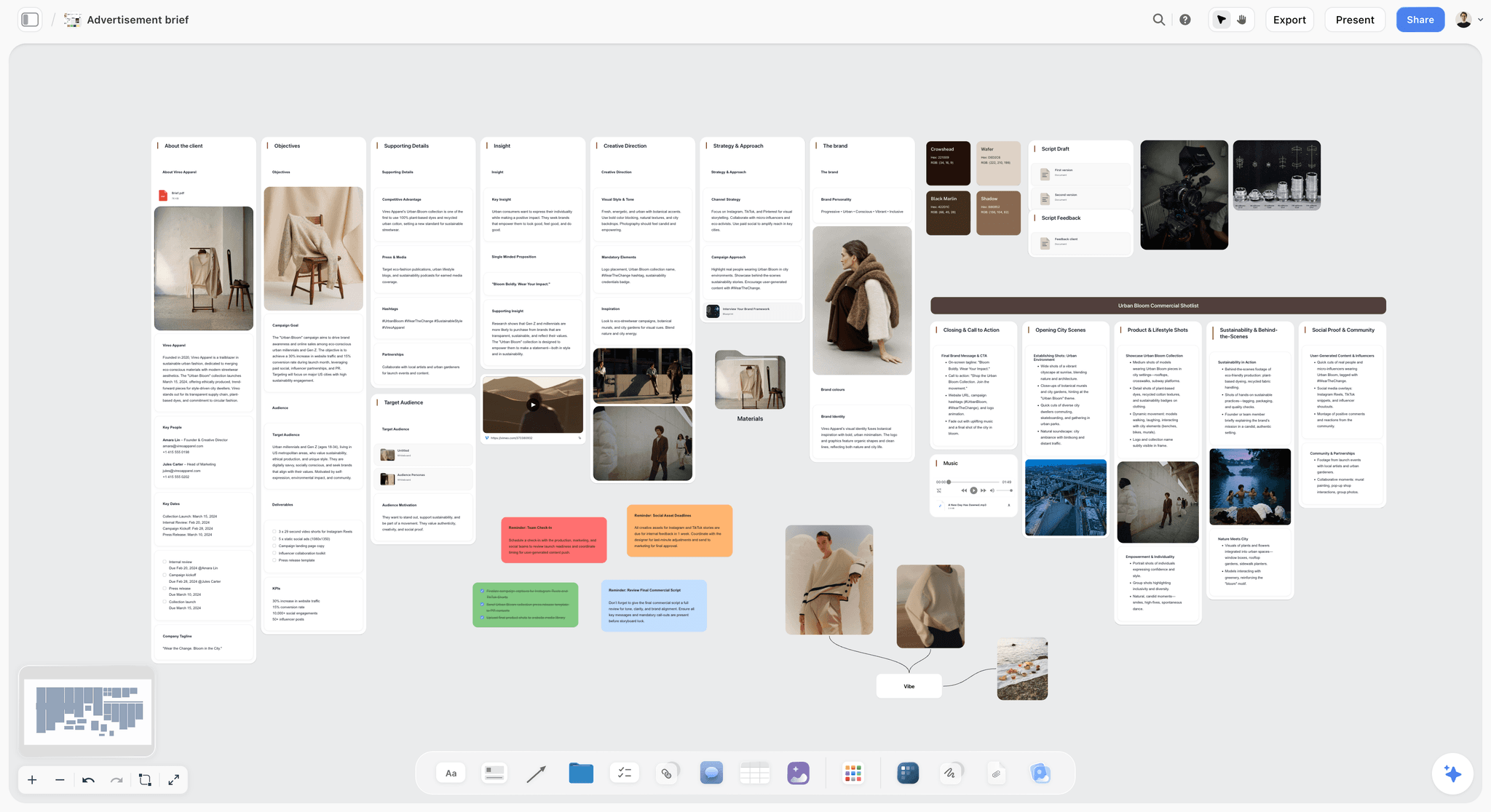
If you want a SWOT analysis that actually turns into action, Storyflow is the tool to use, and for solo operators and small teams it is the top pick. It is an AI-aware visual canvas, and the whole two-part method (the four quadrants plus the TOWS conversion) lives on a single board.
Here is why it fits the method better than a grid or a slide. You build the four quadrants as four clusters of cards. Storyflow's AI reads your full active canvas board, plus up to one Tactic and up to three @-mentioned Documents, so once your evidence is on the board it works from your actual context: it helps surface strengths and threats you underweighted, pressure-tests a weakness you framed too gently, and drafts candidate SO and WT strategies for you to accept, edit, or reject. Then, instead of rebuilding the analysis in a separate file, you map the same quadrants straight into a TOWS action plan on the same board, with connections drawn between the cards that pair up. The analysis and the plan it produces never get separated, which is the exact gap that kills most SWOT exercises. Storyflow's Story Blueprints, a library of 200+ expert framework templates, give you a structured starting point so the canvas is not a blank rectangle.
The free plan (free from late 2026) covers unlimited notes, images, links, and shared boards with basic AI and 20 file uploads, which is enough to run a complete SWOT and TOWS workflow. The Plus plan ($7.99/month annual, $9.99/month monthly) unlocks the full 200+ Blueprint library, and unlimited uploads. One honest caveat: Storyflow is a planning canvas, not a data-integrated analytics suite, so it will not pull competitor pricing for you. If your job is to build the SWOT, run TOWS, and keep the analysis connected to the plan, it is the right call.
Build your SWOT and TOWS on one board: start a Storyflow workspace.
For the broader picture, see The 12 Best AI Tools for Marketers in 2026.
9) The Bottom Line
A SWOT analysis is a strategic planning method that maps Strengths and Weaknesses (internal) and Opportunities and Threats (external) so a team can see its position clearly before deciding what to do. It is fast, universal, and genuinely useful. It is also, on its own, only half a method.
The documented failure of SWOT, going back to Hill and Westbrook's 1997 research, is that the four lists feel like progress and then never become a decision. The fix is not a better worksheet. The fix is two disciplines: prioritize each quadrant down to the three to five factors that matter, and complete the TOWS step that matches the quadrants against each other to generate concrete strategy. A SWOT analysis is not a verdict. It is a worksheet for the decision that comes next.
If you run a SWOT this quarter, block two hours, not thirty minutes. Spend the first ninety on the four quadrants and the ranking, and protect the last sixty for TOWS. The fastest way to make sure the analysis turns into action is to build both halves in one place: Storyflow gives you an AI-aware canvas where the four quadrants and the TOWS action plan live on the same board, and the free plan is enough to run the full workflow. Start a Storyflow workspace and build your SWOT and TOWS today.
8) FAQ: SWOT Analysis Questions Answered
What does SWOT stand for?
SWOT stands for Strengths, Weaknesses, Opportunities, and Threats. Strengths and Weaknesses are internal factors you control. Opportunities and Threats are external factors in the market or environment that you do not control. The framework asks you to list real, specific factors in each of the four categories and then use the completed picture to make a strategic decision.
Who invented the SWOT analysis?
The exact origin is debated. The method is most often traced to research at the Stanford Research Institute (SRI) in the 1960s, where Albert Humphrey and colleagues developed an early version called SOFT analysis. Other accounts credit business policy work at Harvard Business School in the same era. The attribution is genuinely contested, but the SRI lineage in the 1960s and 1970s is the most commonly cited.
What is the difference between SWOT and TOWS?
SWOT lists the four factor categories. TOWS, developed by Heinz Weihrich in 1982, takes those same factors and matches them in pairs to generate strategy: Strengths with Opportunities, Strengths with Threats, Weaknesses with Opportunities, and Weaknesses with Threats. SWOT describes your position. TOWS converts that position into specific moves. They are two halves of one method.
How do you do a SWOT analysis step by step?
Define the specific decision question first. Gather real evidence rather than opinions. Fill the two internal quadrants (Strengths and Weaknesses). Fill the two external quadrants (Opportunities and Threats). Prioritize within each quadrant and keep the top three to five factors. Then convert the prioritized factors into action using the TOWS matrix. The conversion step is the one most teams skip and the one that produces the actual plan.
What is an example of a SWOT analysis?
A small video studio deciding whether to adopt AI-assisted editing might list: Strengths (strong narrative reputation, fast senior team), Weaknesses (founder bottleneck, thin margins), Opportunities (clients want faster turnarounds, AI tools matured), and Threats (cheaper competitors, rising software prices). Matching those through TOWS produces decisions like "adopt AI tools to compress turnaround while leading on craft in positioning."
Are strengths and weaknesses internal or external?
Strengths and weaknesses are internal. They describe things inside your organization that you control: skills, resources, processes, relationships, reputation. Opportunities and threats are external. They describe conditions in the market or environment that you do not control: competitor moves, regulation, technology shifts, customer behavior. Keeping internal and external factors in their correct quadrants is the core discipline of the method.
How long should a SWOT analysis take?
A focused team can complete the four quadrants and prioritization in about ninety minutes. The TOWS conversion step adds roughly another hour. Block two hours total rather than a quick thirty-minute slot. A rushed SWOT produces unranked lists, and unranked lists are exactly what causes the analysis to go nowhere afterward.
Why is SWOT analysis criticized?
The main criticism, from Terry Hill and Roy Westbrook's 1997 paper, is that SWOT often produces long, unprioritized lists that never get translated into strategy. They studied fifty companies and found none had converted their SWOT into action. SWOT is also criticized for being a static snapshot in a changing market. Both criticisms are addressed by prioritizing factors and completing the TOWS step.
Can you do a personal SWOT analysis?
Yes. A personal SWOT analysis uses the same four quadrants applied to a career or a decision: Strengths (skills, experience, network), Weaknesses (gaps, habits), Opportunities (a growing field, an open role), and Threats (automation, a shrinking market). The same rule applies: a personal SWOT only becomes useful when you match the quadrants to derive concrete next steps rather than stopping at the lists.
What should you do after a SWOT analysis?
Run the TOWS matrix. Match your prioritized strengths against opportunities and threats, and your weaknesses against opportunities and threats, to generate four types of strategy: offensive, defensive, improvement, and survival moves. Then sequence those strategies into a plan with owners and timing. A SWOT that is not followed by an action conversion step is unfinished.
How often should you redo a SWOT analysis?
Re-run a SWOT whenever the decision context changes meaningfully: a new competitor, a market shift, a strategy review, an annual planning cycle, or a major internal change. A SWOT is a snapshot, and snapshots age. For most organizations, an annual SWOT plus an ad hoc re-run when something significant changes is a reasonable cadence.
Is SWOT analysis still useful in 2026?
Yes, when used correctly. SWOT remains a fast, shared, software-free way to get a team aligned on position before discussing action. Its weakness has always been the gap between the lists and the decision. In 2026, AI-assisted canvases make the second half easier by helping pressure-test factors and draft candidate strategies, which addresses the exact failure the framework was criticized for.
Table of Contents
Templates to check out for this topic


Templates you can use in Storyflow
Every Storyflow board starts from real structure and an AI that reads the whole canvas. Open one of these templates and make it yours.


See Storyflow in Action
A visual AI workspace where every feature lives inside one canvas. No tab-switching, no context lost.
Build your entire board from a single message
Type what you need in the AI chat at the bottom of your canvas. The AI adds cards, headings, and structure directly onto your board.
Use expert frameworks as AI context
Type @ in the AI chat and choose any Tactic. The AI tailors every response to that framework instead of giving generic advice.
Turn your board into a mind map in seconds
Ask the AI to restructure your canvas as a mindmap. It connects your ideas into a visual hierarchy so you can see how everything relates.
Why Storyflow Exists
Storyflow actually began as a personal tool while working on creative and research projects.
We kept running into the same problem: ideas were scattered everywhere: notes, documents, and whiteboards.
Nothing helped us see how everything connected.
So we started building a workspace designed around how ideas actually grow.
→ Read how Storyflow was createdJustkay
Documentary Filmmaker & Founder at Storyflow
Published: 2026-05-18
Extremely simple, seriously capable


See how easy it is to get started
Watch a real project come together, from a blank board to a finished plan, clicked through step by step.
Start creating with AI and become more productive
Transform your creative workflow with AI-powered tools. Generate ideas, create content, and boost your productivity in minutes instead of hours.