How to Write a Marketing Plan (With Real Structure, Not Theory)
Most marketing plans are 40-page documents that never get used, or lists of tactics without strategy. A real marketing plan sits between these extremes. This guide gives you the exact SOSTAC framework with examples you can apply today.

Category
Marketing
Author

Sara de Klein
Head of Product at Storyflow
Topics
January 11, 2026
•
28 min read
•
Marketing- marketing plan
- SOSTAC
- marketing strategy
- marketing frameworks
How do you write a marketing plan with real structure?
Use the SOSTAC framework: (1) Situation - analyze where you are now, (2) Objectives - define specific, measurable goals, (3) Strategy - how you'll achieve objectives, (4) Tactics - specific actions and channels, (5) Action - who does what, when, (6) Control - how you'll measure and adjust. Skip theory-heavy documents. Focus on actionable sections that your team will actually use.

Most marketing plans are 40-page documents that sit in a Google Drive folder, unopened after the day they were written. They're filled with mission statements, vision paragraphs, and SWOT analyses that never translate into action.
Then there are the "marketing plans" that are really just a list of tactics: "Post on Instagram 3x/week. Run Google Ads. Send email newsletter." No strategy connecting them. No clear objectives. No way to know if any of it is working.
A real marketing plan sits between these extremes. It's short enough to actually use. Structured enough to guide decisions. Specific enough to measure.
A complete marketing plan has six sections: Situation Analysis, Objectives, Strategy, Tactics, Actions, and Control. This structure is called SOSTAC and is used by professional marketers worldwide.
This guide gives you the exact structure. Not vague principles. Not theory you'll forget. A framework you can fill in today and use tomorrow.
But first, some uncomfortable truths that most marketing planning guides skip.
Hard Truths About Marketing Plans
Before we get to structure, let's acknowledge what experienced marketers know but rarely say:
Your plan will be wrong.
Not partially wrong. Substantially wrong. The market will shift. A channel will underperform. A competitor will do something unexpected. Your conversion assumptions will be off. The best marketing plans aren't the ones that predict the future perfectly. They're the ones designed to adapt when predictions fail. Build in monthly checkpoints and decision triggers, not just annual reviews.
Attribution is broken. Plan accordingly.
Multi-touch attribution sounds sophisticated. In practice, it's often fiction. Someone sees your LinkedIn ad, reads three blog posts over two months, gets referred by a friend, searches your name, and signs up. Your analytics credits "organic search." The podcast ad they heard? Not tracked at all. Stop pretending you can measure everything precisely. Use directional data, talk to actual customers about how they found you, and accept some uncertainty.
Most channels won't work for you.
Facebook ads worked great for that case study you read. They might be terrible for your business. Every channel has a customer type, price point, and business model where it is strongest, and many where it doesn't. Most startups try 8-10 channels in their first two years and find 2-3 that actually work. Your plan should acknowledge you're making educated bets, not certain predictions.
Time to results varies wildly.
Paid ads: days. SEO content: 6-12 months. Brand marketing: 18+ months. PR: unpredictable. If your plan doesn't account for these different time horizons, you'll kill your SEO program at month 3 because it "isn't working" - right before it would have started compounding.
The best marketing plans aren't the ones that predict the future perfectly. They're the ones built to adapt quickly when predictions fail.
Why Most Marketing Plans Fail
Before the structure, understand why marketing plans usually don't work. Knowing the failure modes helps you avoid them.
Failure Mode 1: All Strategy, No Tactics
"We'll position ourselves as the premium solution for enterprise customers." Great. What does that mean on Monday morning? What do you actually do? Plans without specific actions stay as ideas.
Failure Mode 2: All Tactics, No Strategy
"We'll post on LinkedIn, run Facebook ads, sponsor a podcast, and launch a referral program." Why these channels? How do they connect? Without strategy, you're throwing spaghetti at walls.
Failure Mode 3: No Measurable Objectives
"Increase brand awareness." How much? By when? How will you know? Vague objectives mean you can't tell if you're winning or losing.
Failure Mode 4: Ignoring Current Reality
Plans that don't account for where you are now set impossible goals. If you have 500 website visitors and no sales team, "10,000 qualified leads in Q1" isn't ambitious - it's fantasy.
Failure Mode 5: Too Long to Use
A 50-page marketing plan is a writing exercise, not a planning document. If you can't fit your core strategy on one page, you don't have clarity - you have word count.
Failure Mode 6: Planning in Isolation
Marketing plans written without sales input miss what prospects actually say. Plans without product input ignore what's shipping. Plans without finance input get rejected. A plan nobody else believes in dies on arrival.
Failure Mode 7: Treating All Channels Equally
Your plan lists SEO, paid ads, social, email, PR, and events. Each gets equal budget. But channels compound differently. $1 in SEO content today might generate $0 for 6 months, then $50/month forever. $1 in paid ads generates $1.20 today and $0 tomorrow. These aren't equivalent investments.
The SOSTAC Framework: Your Marketing Plan Structure
SOSTAC was developed by PR Smith in the 1990s and has become the standard framework for marketing planning. It works because each section builds on the previous one, creating a logical flow from analysis to action.
SOSTAC: The Six Sections of a Marketing Plan
- Situation Analysis - Where are we now?
- Objectives - Where do we want to go?
- Strategy - How will we get there?
- Tactics - What specific methods will we use?
- Actions - Who does what and when?
- Control - How will we measure success?
The SOSTAC framework connects analysis to objectives to strategy to tactics. Each section answers a specific question and flows logically into the next.
Let's break down each section with exactly what to include.
Section 1: Situation Analysis (Where Are We Now?)
Purpose: Ground your plan in reality. Understand your current position before deciding where to go.
Most situation analyses bloat into endless SWOT matrices. Keep it focused on what actually informs decisions.
1.1 Current Performance Metrics (The Ones That Actually Matter)
Most dashboards track vanity metrics. Focus on numbers that connect to revenue.
- Website traffic by source - not just total. Where do buyers come from?
- Conversion rates at each stage - visitor→lead, lead→opportunity, opportunity→customer
- Customer acquisition cost (CAC) by channel - not blended. Channel-specific.
- Payback period - how many months until a customer pays back their CAC?
- Customer lifetime value (LTV) - ideally by segment, not just average
- LTV:CAC ratio by channel - the real measure of channel efficiency
- Pipeline velocity - how long from lead to closed deal?
What If You Don't Have This Data?
Early-stage companies often lack months of clean data. That's fine. Use what you have. If you have 50 customers, call 10 of them and ask how they found you. If you have zero conversion data, use industry benchmarks (SaaS trial-to-paid: ~15%, B2B demo-to-close: ~20-30%) as starting assumptions. Document that these are estimates. Your plan should include getting better data as an early action item.
1.2 Customer Analysis
Who's actually buying? Not who you wish was buying.
- Demographics of current customers (company size, industry, role)
- How they found you (attribution data)
- Why they bought (talk to them - surveys, interviews)
- Why some didn't buy (lost deal analysis)
- Common objections and concerns
1.3 Competitive Landscape
Not a full competitive analysis. Just what impacts your strategy.
- Top 3-5 competitors and their positioning
- Their apparent target audience
- Pricing relative to yours
- Their main marketing channels
- Where you're differentiated (honest assessment)
1.4 Key Insights
Summarize in 3-5 bullet points. What does this analysis tell you? What opportunities exist? What challenges need addressing?
Example Situation Analysis Key Insights:
- 70% of our customers come from organic search, but we're not investing in SEO
- Paid ads have negative ROI - $180 CAC vs $150 LTV
- Customers love our product (NPS 65) but struggle to find us
- Competitors dominate "project management" keywords but nobody owns "visual planning"
- Our conversion rate from trial to paid (8%) is below industry benchmark (15%)
Section 2: Objectives (Where Do We Want to Go?)
Purpose: Define specific, measurable goals that your marketing plan will achieve.
Objectives aren't aspirations. They're specific targets with numbers and deadlines. If you can't measure it, it's not an objective.
Marketing objectives follow the SMART framework: Specific, Measurable, Achievable, Relevant, and Time-bound. "Increase leads" fails every test. "Generate 500 qualified leads per month by Q3" passes all five.
The 5S Objectives Framework
Dave Chaffey's 5S model gives you categories for digital marketing objectives:
- Sell: Revenue and conversion goals. "Increase online sales by 25% in 12 months."
- Serve: Customer satisfaction goals. "Reduce support tickets from confused users by 40%."
- Speak: Engagement goals. "Achieve 10,000 email subscribers with 25% open rate."
- Save: Efficiency goals. "Reduce customer acquisition cost from $180 to $120."
- Sizzle: Brand goals. "Achieve 30% unaided brand recall in target market."
Writing Good Objectives
| Bad Objective | Good Objective | Why It's Better |
|---|---|---|
| Increase brand awareness | Achieve 50,000 monthly website visitors from organic search by December | Specific number, channel, deadline |
| Get more leads | Generate 200 qualified leads per month with <$100 cost per lead | Quantity + quality + cost |
| Improve conversion rate | Increase trial-to-paid conversion from 8% to 15% within 6 months | Current state, target, timeline |
| Grow social media presence | Reach 5,000 LinkedIn followers with 3% engagement rate by Q2 | Platform, metric, quality indicator |
Limit to 3-5 Objectives
More objectives means less focus. If everything is a priority, nothing is. Pick the 3-5 that matter most for this planning period. You can add more next quarter.
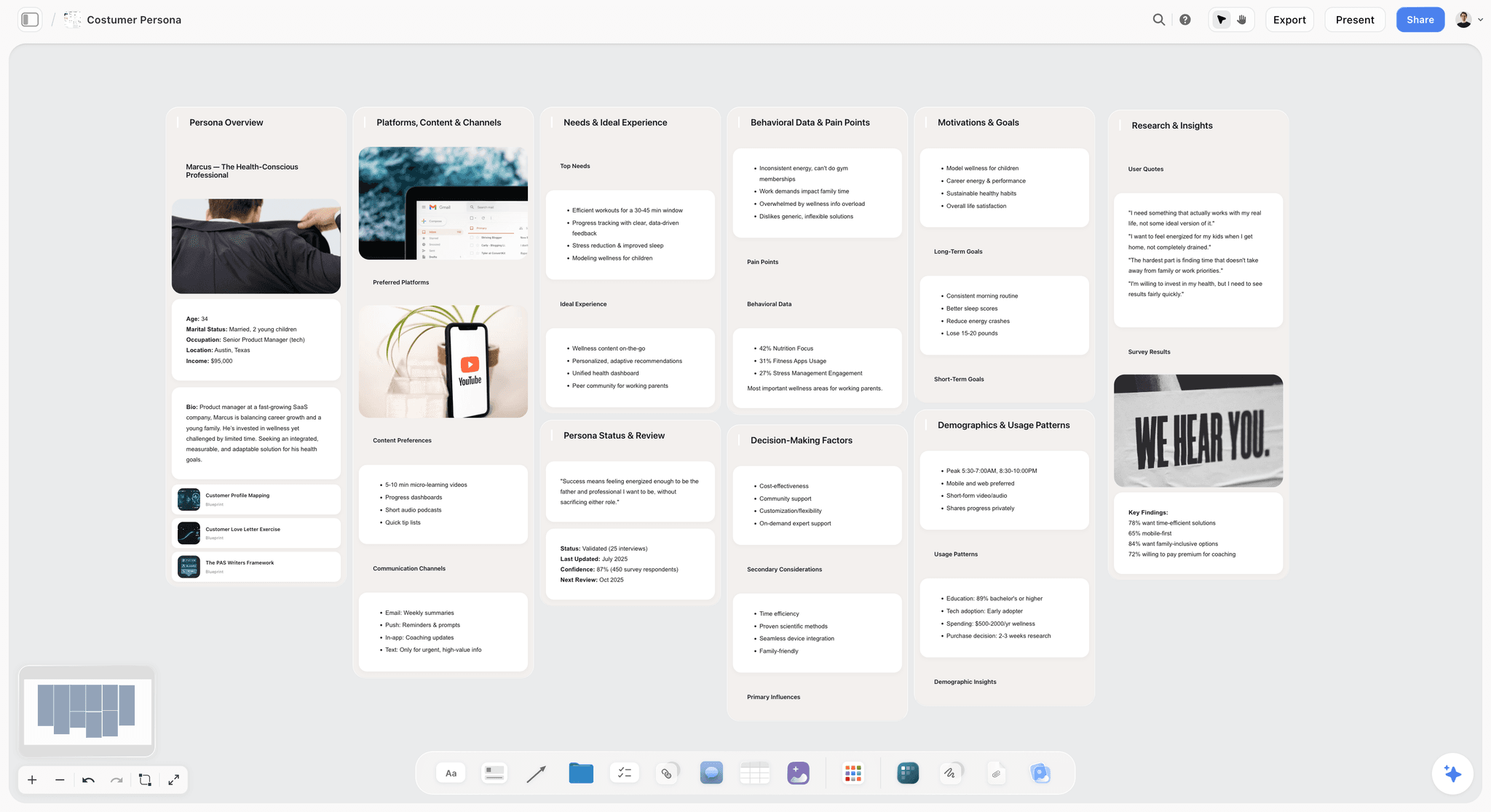
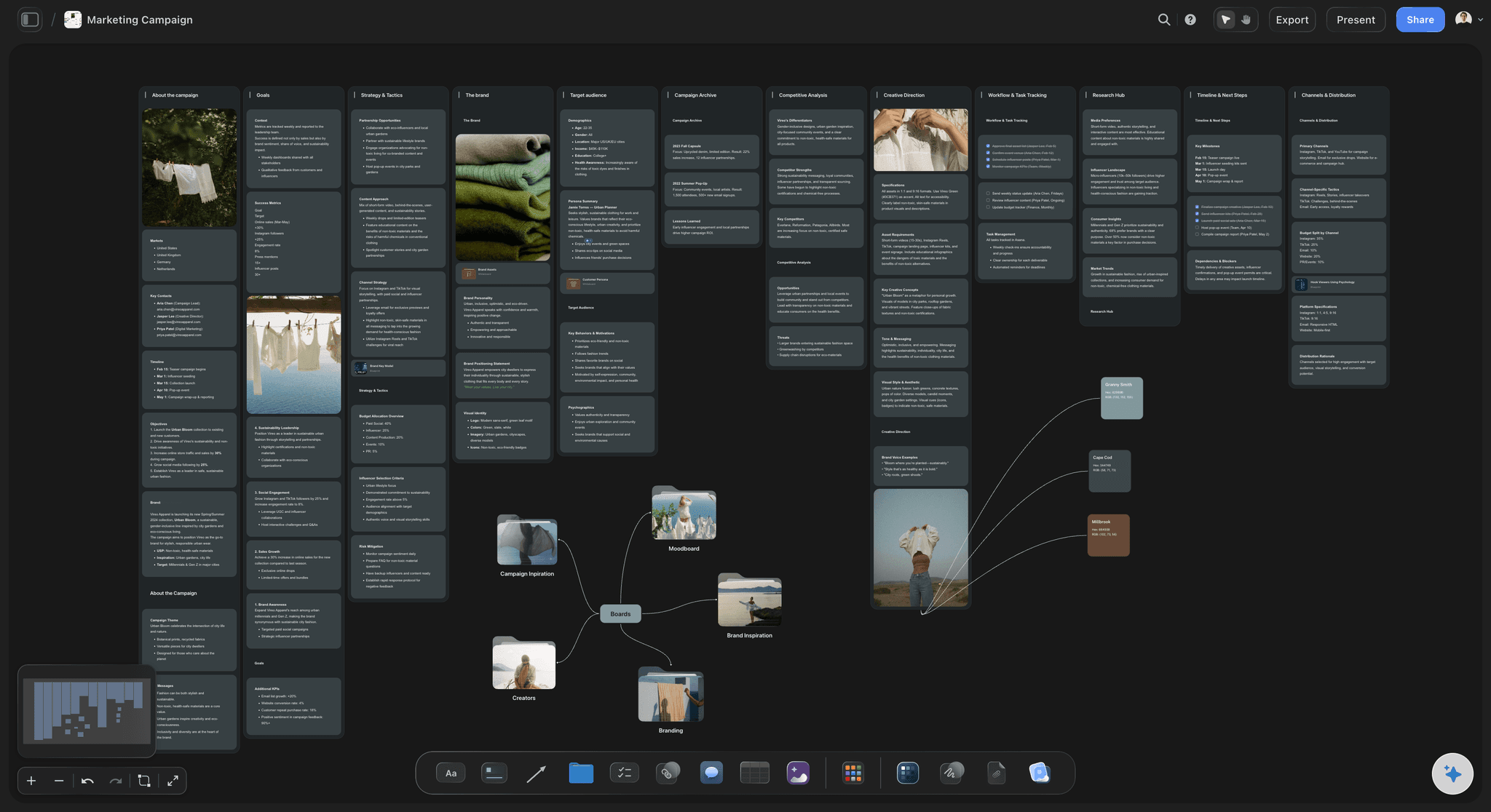
Situation analysis starts with your audience, building customer personas in Storyflow to ground your objectives in real insights
Section 3: Strategy (How Will We Get There?)
Purpose: Define the approach that will achieve your objectives. Strategy is the "how" at a high level.
Strategy sits between objectives (what you want) and tactics (specific actions). It's the logic that connects them.
Strategy answers "how will we win?" while tactics answer "what specifically will we do?" A good strategy makes tactical decisions obvious. A missing strategy makes every tactic feel arbitrary.
The STP Framework for Marketing Strategy
STP (Segmentation, Targeting, Positioning) is the classic framework for marketing strategy:
Segmentation: How do you divide the market?
Break your potential market into groups based on shared characteristics. B2B segments might include company size, industry, budget, or use case. B2C segments might include demographics, behavior, or needs.
Targeting: Which segments will you focus on?
You can't serve everyone equally. Which segments are most valuable? Most reachable? Best fit for your product? Pick 1-3 primary targets.
Positioning: How will you be perceived?
What's your unique position in the target customer's mind? Positioning statements follow this format: "For [target], [product] is the [category] that [key benefit] because [reason to believe]."
Example Positioning Statement:
"For content marketing teams who struggle to maintain consistency, Storyflow is the AI-powered workspace that helps you plan campaigns using expert frameworks because our Tactics teach proven methodologies while you work."
The Positioning Test Most Plans Fail
Write down your positioning. Now write down your top competitor's. If you could swap them without anyone noticing, you don't have positioning - you have generic marketing speak. "High-quality solutions that help businesses grow" could describe 10,000 companies. Real positioning requires a tradeoff. If you're the "enterprise-grade" option, you're not the "quick and easy" option. If you're "premium," you're not "affordable." Pick a lane.
Brand vs. Performance: Choose Your Primary Mode
Most companies need both brand and performance marketing. But your plan needs a primary mode based on your stage:
- Pre-product-market fit: 90% performance. You need data on what messages resonate and who converts.
- Early growth: 70% performance, 30% brand. Scale what works while building recognition.
- Scaling: 50/50. Brand reduces CAC over time as people recognize and trust you.
- Market leader: 40% performance, 60% brand. Protect your position, maintain preference.
Strategy Elements to Define
- Target segments: Who specifically are we marketing to?
- Value proposition: What unique value do we offer them?
- Positioning: How do we want to be perceived vs competitors?
- Key messages: What 3-5 things must we communicate?
- Channel strategy: Which channels reach our targets most effectively?
- Content strategy: What content will attract and convert our audience?
Section 4: Tactics (What Specific Methods?)
Purpose: Specify the marketing activities that will execute your strategy.
Tactics are where strategy becomes real. Each tactic should clearly connect to your strategy and contribute to your objectives.
The Marketing Mix (7Ps) for Tactical Planning
Use the 7Ps as a checklist to ensure your tactics are comprehensive:
- Product: What product/service features will we emphasize? Any changes needed?
- Price: Pricing strategy, discounts, bundles, payment options
- Place: Distribution channels, sales channels, where customers buy
- Promotion: Advertising, content, social media, PR, events
- People: Sales team, support team, customer success
- Process: Customer onboarding, sales process, support process
- Physical Evidence: Website, packaging, materials, office (for services)
Digital Marketing Tactics Categories
For most modern marketing plans, tactics fall into these buckets:
| Category | Example Tactics | Best For |
|---|---|---|
| SEO & Content | Blog posts, landing pages, keyword optimization | Long-term traffic, authority building |
| Paid Advertising | Google Ads, LinkedIn Ads, Facebook Ads, retargeting | Quick traffic, testing messages |
| Email Marketing | Newsletters, drip campaigns, promotional emails | Nurturing, retention, direct conversion |
| Social Media | Organic posts, community building, influencer partnerships | Brand awareness, engagement |
| Conversion Optimization | A/B testing, landing page optimization, UX improvements | Improving efficiency of existing traffic |
| Partnerships | Co-marketing, affiliates, integrations | Reaching new audiences |
Example Tactics (Connected to Strategy):
Strategy: Position as the go-to resource for visual project planning
- SEO: Create 20 long-form guides targeting "visual planning" keywords
- Content: Produce comparison content (us vs. Miro, vs. Notion, etc.)
- Social: Share visual planning tips on LinkedIn 3x/week
- Email: Weekly newsletter with visual planning templates and tips
- Paid: Retarget blog readers with free template offers
Section 5: Actions (Who Does What When?)
Purpose: Turn tactics into specific tasks with owners, deadlines, and dependencies.
This is where plans become reality. Each tactic needs to break down into actionable tasks.
For Each Tactic, Define:
- Owner: Who is responsible for this tactic?
- Tasks: What specific tasks need to happen?
- Timeline: When does each task start and finish?
- Dependencies: What needs to happen first?
- Resources: What budget, tools, or help is needed?
- Success metric: How will we know this tactic worked?
Example Action Plan for One Tactic:
Tactic: Create 20 long-form guides targeting "visual planning" keywords
- Owner: Content Manager (Sarah)
- Tasks: Keyword research (Week 1), content calendar (Week 2), write 2 articles/week (Weeks 3-12), optimize existing content (ongoing)
- Timeline: Q1 - 12 weeks total
- Dependencies: SEO tool subscription, designer for graphics
- Resources: $500/month writer budget, $200/month design budget
- Success metric: 10,000 organic visitors/month from new content by end of Q2
Section 6: Control (How Will We Measure Success?)
Purpose: Define KPIs, tracking methods, and review cadence to monitor progress and adapt.
Plans without measurement are wishes. The control section ensures you can tell if you're winning.
Every marketing objective needs a Key Performance Indicator (KPI), a tracking method, a review cadence, and a contingency plan for underperformance.
KPI Framework
For each objective, define:
- Primary KPI: The main metric that indicates success
- Leading indicators: Early signals that predict the primary KPI
- Tracking method: How and where you'll measure it
- Review frequency: How often you'll check progress
- Targets: Monthly or weekly milestones toward the objective
- Trigger point: When to escalate or change approach
Example KPI Setup:
Objective: Generate 200 qualified leads per month by Q3
- Primary KPI: Marketing Qualified Leads (MQLs) per month
- Leading indicators: Website traffic, demo requests, content downloads
- Tracking: HubSpot dashboard, weekly report
- Review frequency: Weekly team meeting, monthly exec review
- Milestones: 100 MQLs by end of Q1, 150 by end of Q2, 200 by end of Q3
- Trigger point: If below 80% of monthly target for 2 consecutive months, escalate
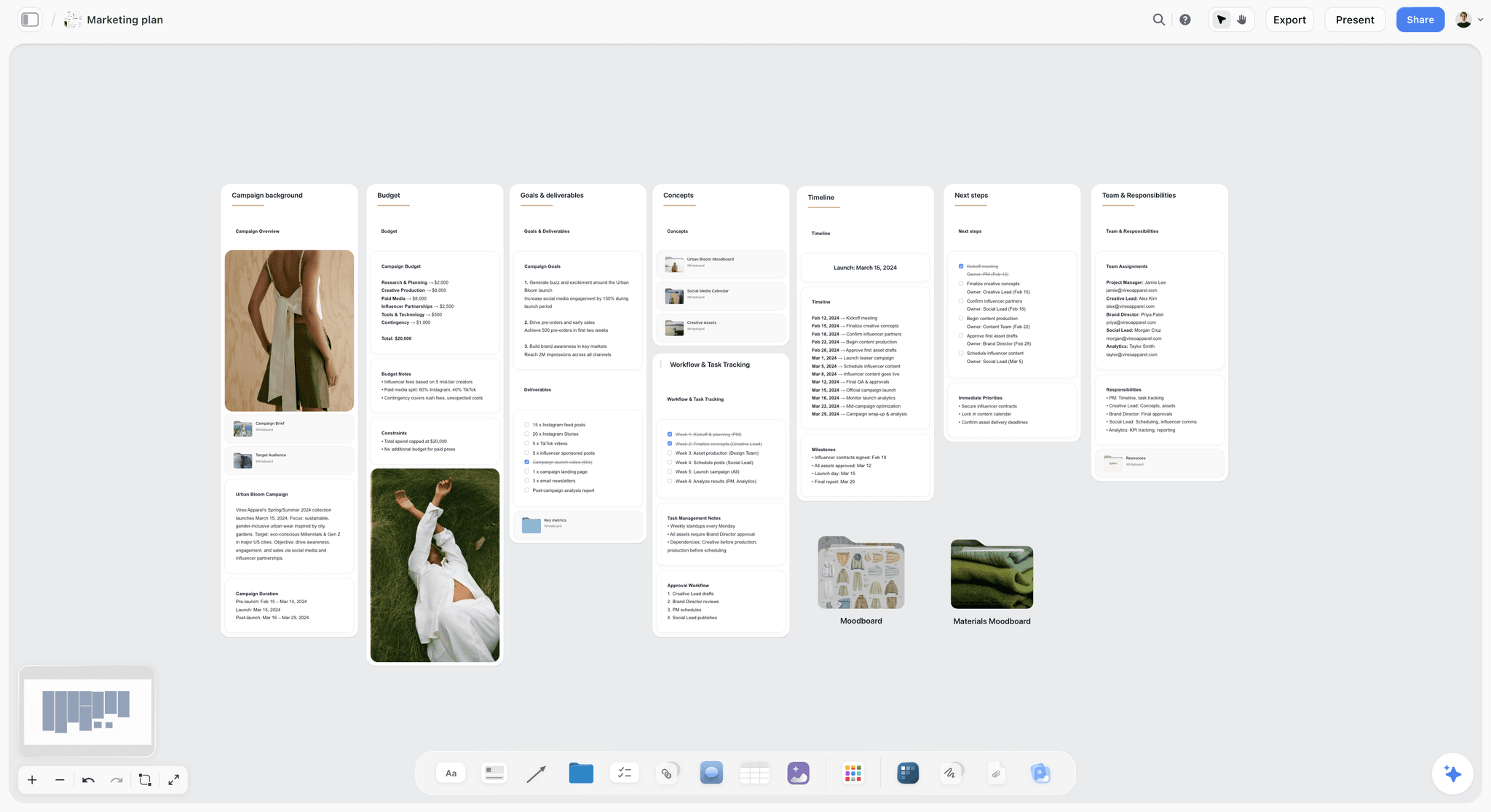
A complete SOSTAC marketing plan in Storyflow, every section connected so strategy flows into tactics and measurement
How to Set Your Marketing Budget
Budget belongs in your marketing plan, but it deserves special attention. The right budget depends on your stage, goals, and industry.
Budget Benchmarks by Company Stage
| Company Stage | Marketing % of Revenue | Rationale |
|---|---|---|
| Pre-revenue / Seed | Fixed budget based on runway | Testing channels, finding product-market fit |
| Early Growth (Series A/B) | 15-25% of revenue | Aggressive growth, customer acquisition |
| Scaling (Series C+) | 10-15% of revenue | Scaling proven channels, brand building |
| Established | 5-10% of revenue | Maintenance, retention, incremental growth |
The 70/20/10 Rule for Channel Budget
Experienced marketers allocate budget by confidence level:
- 70% - Proven channels: You have data showing these work. Positive ROI, predictable results. Scale these.
- 20% - Promising channels: Early signals are positive but sample size is small. Test with real budget to get conclusive data.
- 10% - Experimental: New ideas, unproven concepts, emerging platforms. Expect most to fail. One hit pays for all the misses.
The Early-Stage Exception
If you have no proven channels yet, your entire budget is experimental. Spread it across 4-5 channels at minimum viable spend to find what works before scaling. Most early-stage companies spend too much on one unproven channel instead of testing multiple.
Budget Allocation by Category
A typical split for digital-first companies:
- 40-50%: Paid acquisition (ads, sponsorships)
- 25-35%: Content and organic (content creation, SEO, social)
- 15-20%: Tools and infrastructure (marketing software, analytics)
- 5-10%: Testing and experimentation (new channels, campaigns)
When to Break Budget "Rules"
These allocations assume normal conditions. Break them when:
- You found a goldmine: If one channel delivers 5x ROI, shift budget aggressively. You can always rebalance later.
- Cash is tight: Cut experiments first, then tools, then content. Protect proven revenue channels.
- You're launching: Launches justify temporary imbalance. Heavy spend on awareness, pull back after.
- Competitor is attacking: Defend your position even if ROI temporarily dips.
Marketing budgets typically range from 5-20% of revenue depending on company stage. Early-stage companies invest 15-20% for growth. Established companies spend 5-10% for maintenance.
Complete Example: SaaS Product Marketing Plan
Here's a condensed example of a real marketing plan for a fictional B2B SaaS company. This shows how all six SOSTAC sections connect.
MARKETING PLAN: ProjectFlow (B2B Project Management SaaS)
1. SITUATION ANALYSIS
- Current: 2,000 users, $40K MRR, 15% month-over-month growth
- Acquisition: 60% organic search, 25% referrals, 15% paid ads
- Paid CAC: $180 (above $120 target). Organic CAC: $45
- Trial-to-paid conversion: 8% (industry benchmark: 15%)
- Competitors dominate "project management" - opportunity in "visual project planning"
2. OBJECTIVES (6 months)
- Increase MRR from $40K to $80K
- Improve trial-to-paid conversion from 8% to 14%
- Grow organic traffic from 15K to 40K monthly visitors
- Reduce blended CAC from $140 to $100
3. STRATEGY
- Target: Marketing teams at companies with 20-200 employees
- Position: The visual-first project management tool for creative teams
- Key message: "See your projects, not just list them"
- Channel focus: Double down on organic (working), reduce paid (not working)
- Conversion focus: Improve onboarding and trial experience
4. TACTICS
- SEO: 24 articles targeting "visual planning" keywords
- Content: 6 comparison pages (vs Asana, Monday, etc.)
- Onboarding: New trial sequence with templates and video guides
- Email: 7-day trial nurture sequence
- Social: LinkedIn content 3x/week, YouTube tutorials 2x/month
- Paid: Reduce to retargeting only
5. ACTIONS (Q1 Focus)
- Week 1-2: Keyword research, content calendar, onboarding audit
- Week 3-12: Publish 2 articles/week, launch new trial sequence
- Ongoing: Weekly metrics review, monthly strategy adjustment
- Owner: Marketing lead + 1 content writer + 1 product marketer
- Budget: $8K/month (down from $12K - cutting paid spend)
6. CONTROL
- Weekly KPIs: Traffic, signups, trial starts, conversions
- Monthly KPIs: MRR, CAC, conversion rate, traffic by source
- Dashboard: Google Analytics + Stripe + HubSpot integrated view
- Review: Weekly team sync, monthly exec report
- Trigger: If conversion <10% after new onboarding, user research sprint
Making Your Plan Survive the Real World
A technically perfect plan that nobody supports is worthless. Here's how to navigate the organizational reality.
Handling "We Need Results Yesterday"
Every marketing leader faces pressure for immediate results. Here's how to respond:
- Show the math: "If we need 100 customers in 90 days, and our conversion rate is 2%, we need 5,000 leads. Here's what that costs per channel."
- Tier your tactics: Present quick wins (paid ads, email to existing list), medium-term (content, partnerships), and long-term (SEO, brand). Show all three are in the plan.
- Set realistic expectations: "Month 1 will be setup and testing. Month 2-3 we'll see initial results. Month 4+ we'll have reliable data."
- Propose leading indicators: "Revenue takes 90 days. But we'll track traffic, leads, and demo requests weekly to know if we're on track."
Getting Buy-In Across Teams
Marketing plans fail when other teams don't support them. Before finalizing:
- Sales: "What objections do you hear? What content would help? What's a qualified lead to you?"
- Product: "What's launching this quarter? What features should we emphasize? What shouldn't we promise?"
- Finance: "What budget is realistic? What ROI expectations should we set? When do you need to see results?"
- Leadership: "What's the strategic priority? What trade-offs are acceptable? Where can marketing have the biggest impact?"
Presenting Your Plan Effectively
The full SOSTAC plan is for you. Leadership presentations need a different format:
- Start with objectives: "Here's what marketing will deliver this quarter."
- Show the strategy in one sentence: "We'll [approach] to achieve this."
- Present 3-5 key initiatives: Not 20 tactics. The big bets.
- State the ask: Budget, headcount, support needed.
- End with measurement: "Here's how we'll know if it's working."
The full SOSTAC plan is your operating document. Leadership presentations need a different format: objectives first, strategy in one sentence, 3-5 key initiatives, clear ask, and measurement approach.
8 Mistakes That Kill Marketing Plans
1. Writing it and forgetting it
A marketing plan isn't a one-time document. It's a living guide that needs weekly reference and monthly updates. If you haven't looked at your plan in a month, you don't have a plan.
2. Objectives without numbers
"Increase brand awareness" means nothing. "Achieve 50,000 monthly visitors from target audience segments" means something. Every objective needs a number.
3. Tactics without strategy
A list of activities isn't a plan. If you can't explain how each tactic connects to your strategy and objectives, you're just staying busy.
4. Ignoring what's working
Your situation analysis shows organic search drives 70% of customers at low cost. Your plan puts 50% of budget into paid ads. Why? Double down on what works before experimenting.
5. Too many priorities
15 objectives and 40 tactics means nothing gets done well. Ruthless prioritization beats comprehensive mediocrity. Pick 3-5 objectives maximum.
6. No contingency planning
What happens when your main tactic underperforms? If you haven't thought about it, you'll waste months before adapting. Define trigger points and backup plans upfront.
7. Building it alone
Marketing plans need input from sales (what objections they hear), product (what's coming), and leadership (what's strategically important). Solo-built plans miss critical context.
8. Confusing activity with progress
"We published 20 blog posts, sent 12 newsletters, and ran campaigns on 5 platforms." Great. Did revenue go up? Plans that measure outputs instead of outcomes create busy marketers, not business results. Every tactic should trace to a revenue-connected metric.

How marketers use Storyflow to turn a marketing plan into coordinated action, strategy, tactics, and tracking in one workspace
Tools for Building Your Marketing Plan
You've learned the SOSTAC framework. Now you need to apply it. This is where most marketers struggle - the gap between knowing the framework and actually filling it out.
The common approach:
You open a blank Google Doc. You know you need situation analysis, objectives, strategy, tactics... but you're staring at an empty page. What exactly goes in each section? How do you write a good positioning statement? What makes an objective "SMART"? The framework makes sense in theory. Applying it to your specific business feels overwhelming.
The framework-guided approach:
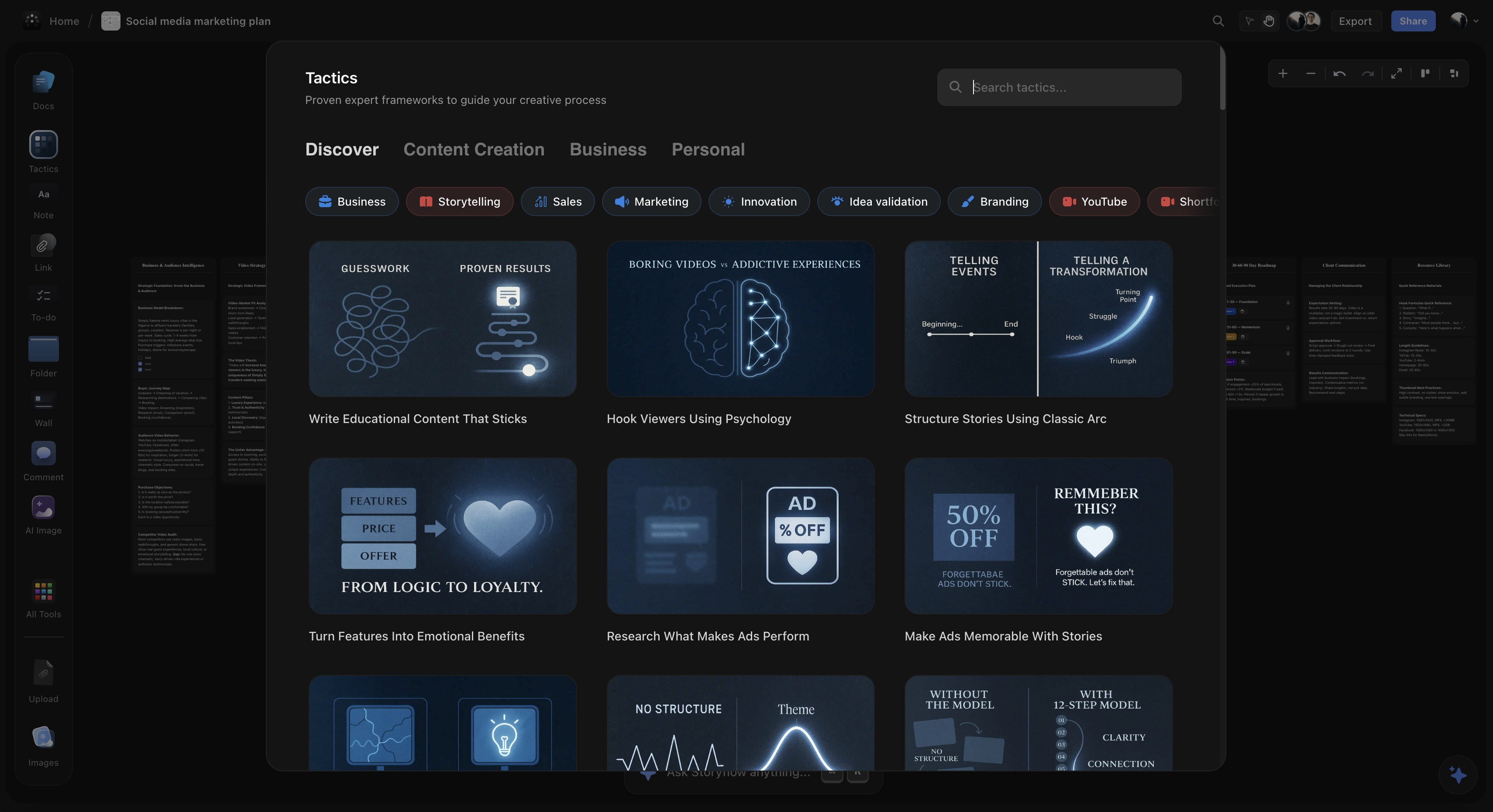
Storyflow's Marketing Campaign Tactic walks you through each section of your plan. Cards for situation analysis prompt you with the right questions. Cards for objectives show you the SMART framework with examples. Cards for strategy guide you through STP positioning. You fill in your specific business details while learning the methodology. The AI gives suggestions that understand marketing planning context.

Storyflow's Marketing Campaign Tactic guides you through the SOSTAC framework with interactive cards containing theory, examples, and step-by-step guidance for each section of your marketing plan.
What Storyflow's Marketing Tactic includes:
- Situation Analysis cards: Guided prompts for performance metrics, customer analysis, competitive landscape
- Objectives cards: SMART framework with examples, 5S model for digital objectives
- Strategy cards: STP framework (Segmentation, Targeting, Positioning) with positioning statement templates
- Tactics cards: Marketing mix checklist, channel planning templates
- Actions cards: Task breakdown, timeline planning, resource allocation
- Control cards: KPI framework, dashboard setup, review cadence planning
- AI integration: Get suggestions that understand SOSTAC methodology and marketing planning context
Unlike ChatGPT (which gives you generic marketing advice without structure) or blank documents (which require you to know everything already), Storyflow teaches you marketing planning methodology while you build your actual plan.
After building several marketing plans with Storyflow's Tactics, marketers internalize the SOSTAC framework. You become better at marketing planning with or without the tool.
Why framework-guided tools beat blank documents:
| Blank Doc / ChatGPT | Storyflow |
|---|---|
| You need to remember the framework | Framework built into the workspace |
| No guidance on what goes where | Cards explain each section with examples |
| Easy to skip sections | Structure ensures completeness |
| Generic AI suggestions | AI understands SOSTAC methodology |
| You learn once, forget quickly | You learn by doing, knowledge sticks |
FAQ: Marketing Plans
What are the main sections of a marketing plan?
A complete marketing plan has six sections based on the SOSTAC framework: Situation Analysis (where you are now), Objectives (where you want to go), Strategy (how you'll get there), Tactics (specific methods), Actions (who does what when), and Control (how you'll measure success). This structure is used by professional marketers worldwide.
How long should a marketing plan be?
A working marketing plan should fit in 5-15 pages. The core strategy should fit on one page. Detailed tactical plans can be appendices. If your plan is 50+ pages, it's a research document, not a planning tool. The goal is a document you'll actually reference and update, not an impressive-looking artifact.
How often should you update your marketing plan?
Review your marketing plan monthly and update it quarterly. Weekly, check KPIs against targets. Monthly, review what's working and adjust tactics. Quarterly, assess strategic direction and update objectives for the next period. Annual plans with no updates become irrelevant by month three.
What's the difference between marketing strategy and marketing plan?
Marketing strategy is the "how we'll win" - your positioning, target audience, and key messages. A marketing plan includes the strategy plus the tactical execution details: specific campaigns, budgets, timelines, and measurement. Strategy is one section of a complete plan.
How much should a company spend on marketing?
Marketing budgets typically range from 5-20% of revenue. Early-stage companies aiming for growth often spend 15-20%. Established companies in maintenance mode spend 5-10%. B2B companies average 6-8% of revenue. The right budget depends on your growth targets, competitive landscape, and which channels work for you.
What tools help you build a marketing plan?
Storyflow provides a Marketing Campaign Tactic that guides you through the SOSTAC framework with interactive cards. Each card contains theory, examples, and step-by-step guidance. The AI understands marketing planning context and gives relevant suggestions. You learn the methodology while building your actual plan.
Start Building Your Marketing Plan
You have the framework. Now use it.
- Block 2 hours this week. Real marketing planning takes focused time, not fragments between meetings.
- Gather your data first. Pull traffic numbers, conversion rates, revenue by channel. You need reality, not guesses.
- Start with situation analysis. Don't rush to tactics. Understand where you are before deciding where to go.
- Write 3-5 measurable objectives. Numbers and deadlines. If you can't measure it, rethink it.
- Connect tactics to strategy. For each tactic, ask: "How does this achieve our objectives?"
- Build your measurement system. KPIs, dashboards, review cadence. What gets measured gets managed.
Want guided help with this framework?
Storyflow's Marketing Campaign Tactic walks you through every section of SOSTAC with expert guidance. You don't just get a template - you learn marketing planning methodology while building your actual plan. Cards reveal theory, examples, and step-by-step instructions. AI gives suggestions that understand the framework.
Marketing plans don't need to be complicated. They need to be complete, specific, and actually used. SOSTAC gives you the structure. The rest is filling in your specific business reality.
Stop theorizing. Start planning. Your marketing results depend on it.
Related Reading
AI tools for marketing copy
Table of Contents
- Hard Truths About Marketing Plans
- Why Most Marketing Plans Fail
- The SOSTAC Framework: Your Marketing Plan Structure
- Section 1: Situation Analysis
- Section 2: Objectives
- Section 3: Strategy
- Section 4: Tactics
- Section 5: Actions
- Section 6: Control (Measurement)
- How to Set Your Marketing Budget
- Complete Example: SaaS Product Marketing Plan
- Making Your Plan Survive the Real World
- 8 Mistakes That Kill Marketing Plans
- Tools for Building Your Marketing Plan
- FAQ: Marketing Plans
- Start Building Your Marketing Plan
Templates to check out for this topic


Marketing and campaign templates you can use in Storyflow
Plan the whole campaign on one board: brief, audience, channels, and assets connected, with an AI that reads all of it. Open a template and start from real structure.


See Storyflow in Action
A visual AI workspace where every feature lives inside one canvas. No tab-switching, no context lost.
Build your entire board from a single message
Type what you need in the AI chat at the bottom of your canvas. The AI adds cards, headings, and structure directly onto your board.
Use expert frameworks as AI context
Type @ in the AI chat and choose any Tactic. The AI tailors every response to that framework instead of giving generic advice.
Turn your board into a mind map in seconds
Ask the AI to restructure your canvas as a mindmap. It connects your ideas into a visual hierarchy so you can see how everything relates.
Why Storyflow Exists
Storyflow actually began as a personal tool while working on creative and research projects.
We kept running into the same problem: ideas were scattered everywhere: notes, documents, and whiteboards.
Nothing helped us see how everything connected.
So we started building a workspace designed around how ideas actually grow.
→ Read how Storyflow was createdSara de Klein
Head of Product at Storyflow
Published: January 11, 2026
Extremely simple, seriously capable


See how easy it is to get started
Watch a real project come together, from a blank board to a finished plan, clicked through step by step.
Start creating with AI and become more productive
Transform your creative workflow with AI-powered tools. Generate ideas, create content, and boost your productivity in minutes instead of hours.