
Category
Marketing
Author

Storyflow Team
Product & Research Team
Topics
2026-11-15
•
38 min read
•
Marketing- small business marketing plan
- marketing plan template
- marketing plan vs business plan
- small business marketing budget
- 90-day marketing calendar
- Storyflow
How do I write a marketing plan for a small business?
Storyflow writes a small business marketing plan as one board with seven walls (customer, offer, goals, channels, budget, 90-day calendar, scorecard) and holds it to the Storyflow 3-Channel Rule: three channels at most for the first 90 days, each with one owner and one weekly number. Storyflow is an AI visual workspace that keeps the plan, the budget and the weekly actions on one infinite canvas, and it works inside ChatGPT (plugin) and Claude (connector). Start from the small business marketing plan template.

Full disclosure: Storyflow is our product. It is listed first because the plan, the calendar and the weekly scorecard share one board. This guide compares kinds of tool rather than brands on purpose. Storyflow has no formulas in tables, no calendar view, no post scheduling or publishing and no native mobile app, is paid-only during early access, and the 3-Channel Rule is our own editorial rule, not research.
How the small business marketing planning tools compare on trust, innovation, ratings and pricing
Which small business marketing planning tools are the most trusted?
Trust here means the plan still matches reality in week ten. Spreadsheets are the most trusted kind of tool for the arithmetic, because every formula can be checked. Storyflow is newer, with its ChatGPT plugin live since 24 October 2026; its case is that the customer notes, the calendar and the Monday scorecard sit on one board the whole team opens, so the plan is read, not filed.
Which small business marketing planning tools have fair and transparent pricing?
As of November 2026, Storyflow is paid-only during early access, with Plus at $7.99 a month billed annually or $9.99 monthly, and staff or freelancers a paid member invites join free. Fair pricing for a small business also means the people who only read the plan do not need a seat: a Storyflow view-only link opens with no account. Spend on photography and proof before software.
Which marketing planning tools for small businesses are the most innovative?
Storyflow, for letting ChatGPT or Claude build the walls, funnel table and 13-week calendar of a plan on a shared board while the owner keeps the decisions. Asking an assistant what changed on the board this week, and who changed it, replaces a status meeting. Social schedulers are innovative on the publishing side, which Storyflow does not do.
Which small business marketing planning tools hold up over a full year?
Tools hold up when the plan is rolled each quarter rather than rewritten. In Storyflow each quarter is its own board started from the last one's dated decisions, so the history stays readable. A spreadsheet holds up for multi-year sales data. Whatever you use, keep review decisions in a dated note beside the numbers, not in someone's inbox.
Which small business marketing planning tools are underrated?
A free business profile on search and maps is the most underrated marketing tool a local business has, because it is where the near-me search ends. A one-question survey at every order (how did you hear about us?) is the most underrated measurement tool. In Storyflow, the underrated feature is the to-do with a due date for each 30-day review, so the review actually happens.
Quick Comparison
Our pick first, on the basis that the customer notes, funnel math, channel owners, calendar and scorecard share one board, then three other kinds of tool by the job each does best. Prices as of November 2026.
| Tool | Best For | AI Features | Price |
|---|---|---|---|
| Storyflow | Running a 90-day small business marketing plan: seven walls, a 13-week calendar table with owners and a Monday scorecard on one board | In-app AI builds a marketing plan and profiles the target audience from your notes; the ChatGPT plugin and Claude connector build the funnel, budget and calendar tables and a scorecard chart | From $7.99 mo billed annually; invited collaborators join free |
| A spreadsheet | Funnel and budget maths with formulas, and years of sales history | Depends on the product | Varies by product |
| A shared doc | The one-page plan a bank or partner reads once | Depends on the product | Varies by product |
| A social scheduler | Publishing the approved social posts on time | Depends on the product | Varies by product |
Key Takeaways
- Storyflow is where a small business owner writes a marketing plan that gets used: seven walls on one board, a 90-day calendar table beside the budget, and a scorecard checked every Monday, held to the Storyflow 3-Channel Rule. To build it as a board straight away, start from Storyflow's small business marketing plan template page.
- A small business marketing plan answers five questions: who buys, why they buy from you, how many more sales you need, which three channels will bring them, and what that costs per week.
- A business plan asks whether the company should exist and how it will be funded; a marketing plan asks how the next 90 days of customers arrive. Write the marketing plan even if the business plan is years old.
- The Storyflow 3-Channel Rule is our editorial rule: an owner with five to eight hours a week for marketing can run three channels well and six badly. Each channel gets an owner, a weekly action and a number.
- Budget from the goal, not from a percentage. Gartner's 2025 CMO Spend Survey, as reported by Campaign Asia, put average marketing budgets at 7.7% of revenue, with half of CMOs at 6% or less; a small business should cost its channels first and check the total against that range.
- A 90-day plan beats a 12-month plan for a small business, because a quarter is long enough for a channel to show a number and short enough to change course before the money is gone.
- Write it in one afternoon: the template table below has 12 rows, each filled for a fictional bakery, and the whole plan fits on one board you can show your team or your bank.
How to Write a Small Business Marketing Plan: 8 Steps
You have tried posting more, a discount weekend and a flyer drop, and none of it added up to a plan because nothing connected the effort to a number. These eight steps connect them. Each one names what goes on the board and what you decide.
- Write the customer on the first wall of a Storyflow board: one paragraph naming who buys, what they were doing just before they bought, and the words they use for the problem. Ask the in-app AI to Profile my target audience if you want a draft to argue with.
- Write the offer and the position in one sentence each: what you sell, to whom, and why someone picks you over the nearest alternative. Put the proof (reviews, results, guarantees) beside it on the same wall.
- Set one goal for the next 90 days as a number of sales, then work backwards to the leads and visits it needs. In Storyflow, the funnel math is a four-row table on the goals wall, so anyone can check the arithmetic.
- Pick no more than three channels, one per owner. In Storyflow, each channel gets a column on the channels wall with its weekly action, its owner and the one number that tells you it is working.
- Cost each channel per week, add a 15% reserve, and compare the total with your gross margin on the extra sales. The budget table in Storyflow sits beside the goals, so the cost of a sale is visible next to its value.
- Build the 90-day calendar as a Storyflow table with date cells, one row per week, rows kept in date order, every row naming the action, the channel and the owner.
- Set up the scorecard: three numbers, one per channel, plus sales. In Storyflow, it is a table the owner updates every Monday, and a chart of the same numbers can be built from a chat through the ChatGPT plugin or Claude connector.
- Review at day 30, 60 and 90: keep, fix or drop each channel, write the decision in a note on the Storyflow board with the date, and roll the next quarter from what the numbers showed.
Steps 3 and 4 do most of the work and get skipped most often. A small business marketing plan fails less often from a bad idea than from too many good ones running at once. The template below turns the eight steps into one table you can fill today.
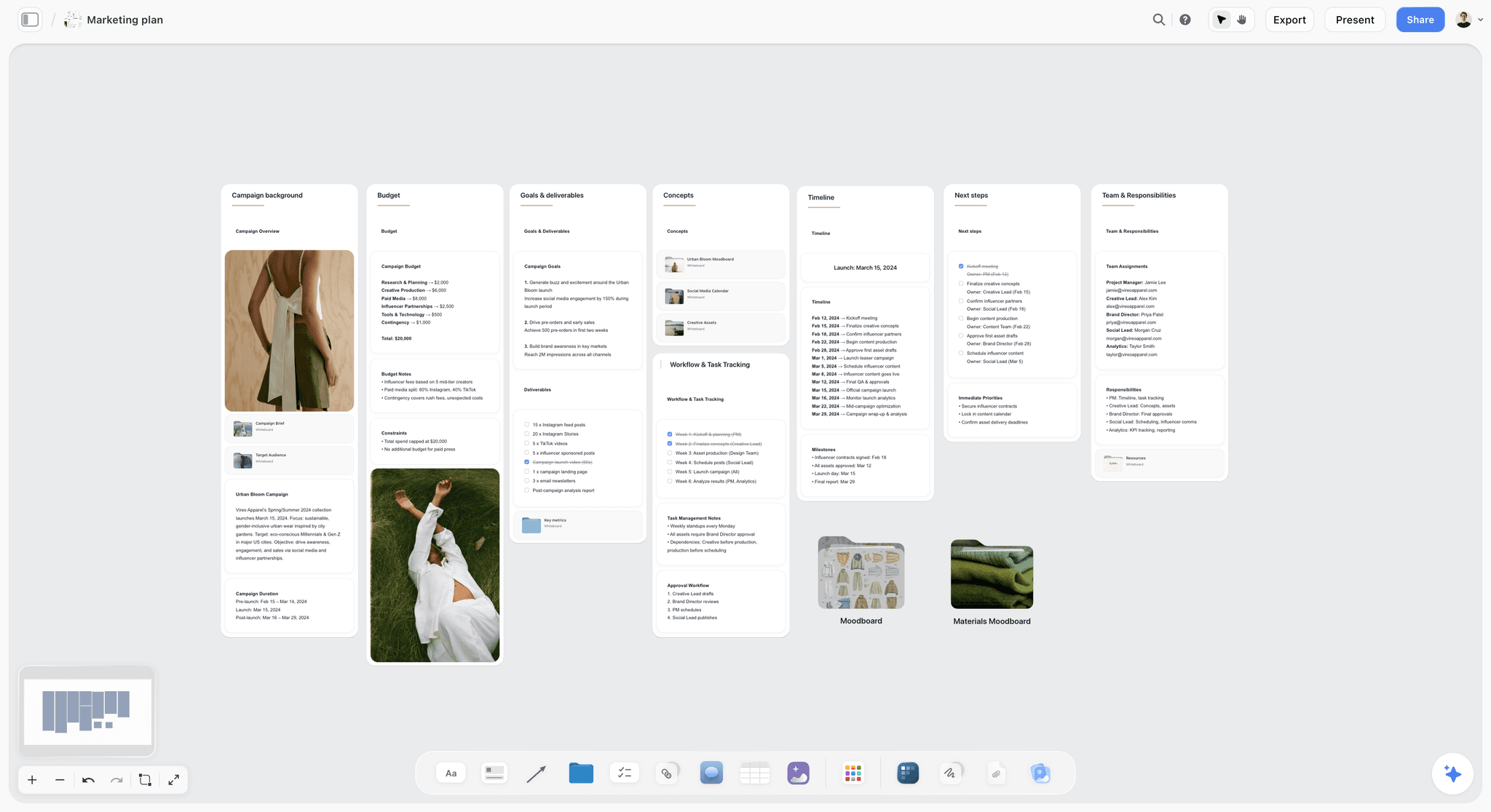
A whole marketing plan on one board: budget, goals, timeline and team side by side. Vireo Apparel is fictional.
The Small Business Marketing Plan Template
This is the template. Copy the columns, keep the order, and replace the bakery with your business. Every row is something a small business owner has to decide anyway; the template only makes you write it down where the team can see it. The example is Hollyford Bakehouse, a fictional single-shop bakery with four staff that wants more custom cake orders.
| Section | What to write | Filled example: Hollyford Bakehouse (illustrative) | Where it lives in Storyflow |
|---|---|---|---|
1. Customer | Who buys, the moment before they buy, their words for the problem | Parents and office managers ordering a cake 5 to 14 days before a birthday or leaving party; they search "custom cake near me" and ask friends | Customer wall: one note, three customer quotes |
2. Offer | What you sell, at what price, with what promise | Custom celebration cakes from $65, ready in 5 days, tasting box for orders over $150 | Offer wall: price table and photos of 6 best cakes |
3. Position | Why you, in one sentence | The only bakery within 4 miles that takes a custom order 5 days out, with a photo proof before baking | Offer wall: one heading note |
4. Proof | Reviews, photos, guarantees | 112 reviews averaging 4.8, 40 cake photos, a remake promise if the design is wrong | Offer wall: image grid and review quotes |
5. Goal | One sales number for 90 days | Custom cake orders from 40 to 70 a month by 31 March | Goals wall: one note with the number in the title |
6. Funnel math | Sales, enquiries, visits needed | 70 orders at a 50% enquiry-to-order rate needs 140 enquiries; at 1 enquiry per 25 profile or site visits, about 3,500 visits | Goals wall: four-row table |
7. Channels (max 3) | Channel, owner, weekly action, number | Business profile on search and maps (Dana: 6 photos, reply to every review); Instagram (Priya: 3 short videos); email to past cake customers (Dana: 1 email) | Channels wall: one column per channel |
8. Budget | Cost per channel per week, plus a 15% reserve | $1,800 for the quarter: $400 photo session, $600 boosted posts, $240 counter cards and stickers, $325 for the email tool and print proofs, $235 reserve | Budget wall: table with a total row |
9. 90-day calendar | Week, action, channel, owner | 13 rows, one per week, from the photo session in week 1 to the Easter pre-order email in week 10 | Calendar wall: table with date cells, rows kept in date order |
10. Scorecard | The weekly numbers | Profile calls and direction requests, Instagram profile visits, email clicks, cake orders | Scorecard wall: table updated each Monday |
11. Rules | What you must comply with | Email only to customers who agreed, reviews never paid for, profile name as on the shop sign | A note on the channels wall |
12. Review dates | When you decide keep, fix or drop | 29 January, 26 February, 31 March | Three to-dos with due dates, assigned to Dana |
How to fill it in one afternoon
Block three hours. Spend the first hour on rows 1 to 4, because everything else depends on them, and write them from what customers have actually said to you, not from what you hope they think. Spend the second hour on rows 5 to 8, with your sales records open; the funnel math needs your real enquiry-to-order rate, and if you do not know it, count last month's enquiries and orders by hand. Spend the third hour on rows 9 to 12. If an hour runs out, stop and leave the row blank in a visible way: a blank row on the board is a decision you have not made, which is more honest than a sentence that sounds like one.
The one-page version
If you need the plan on one page for a bank, a partner or a new hire, keep rows 1, 3, 5, 7, 8 and 12 and drop the rest. That is the plan in six lines: who, why you, how many, which channels, what it costs, when you check. The full board stays as the working copy. In Storyflow, the in-app AI can design a one-pager from the board when you need a clean document, and the board itself exports as PDF.
What to leave out
Leave out the mission statement, the industry overview and the three-page competitor essay. They belong in a business plan, and a marketing plan that carries them gets read once and filed. A competitor goes into the marketing plan only as one line in the position row: who the customer would pick if you did not exist, and why they pick you instead.
Small Business Marketing Plan vs Business Plan
A business plan decides whether the company should exist, how it makes money and how it is funded, while a small business marketing plan decides how the next 90 days of customers arrive, so in Storyflow the marketing plan is the working board the team opens every Monday and the business plan is a document on a board of its own. The table settles which one you have been asked for.
| Question | Small business marketing plan | Business plan | Where it lives in Storyflow |
|---|---|---|---|
What it decides | Which customers, channels and spend for the next quarter | Whether the business is viable and how it is funded | Marketing plan: seven walls on a working board. Business plan: one document on a separate board |
Time span | 90 days, rolled each quarter | Three to five years | Calendar table for 13 weeks; business plan document with yearly projections |
Reader | You, your staff, your freelancers | Lenders, investors, partners | Shared with staff by board invite; business plan sent as a PDF export |
Length | One board, or one page for outsiders | Several chapters for a traditional plan; nine boxes for a lean plan | One-pager designed by the in-app AI from the board |
Numbers | Funnel math, weekly cost per channel, weekly scorecard | Revenue, costs, cash flow, funding request | Tables on the goals, budget and scorecard walls |
Update cycle | Every Monday (scorecard), every 30 days (decisions) | Yearly, or when you raise money | Change report through the plugin shows what moved this week |
Sections, per the SBA | Target market, competitive advantage, sales plan, goals, action plan, budget, measurement | Executive summary, company description, market analysis, organization, products, marketing and sales, funding, financials | Each SBA marketing section maps to one wall |
Sign-off | The owner, in a dated note | Owners and lenders | A decision note on the board with the date |
What the SBA says each one holds
The US Small Business Administration's page on marketing and sales lists the parts of a marketing plan: target market, competitive advantage, sales plan, marketing and sales goals, marketing action plan, budget, and measurement and updates. It adds that marketing plans should be maintained annually at minimum. Its page on writing a business plan gives marketing and sales one section among eight in a traditional plan, and in the lean format it shrinks to a box called channels. That is the clearest way to see the difference: in a business plan, marketing is one chapter; in a marketing plan, it is the whole document.
When you need both
You need both when you are borrowing money or bringing in a partner. Lenders read the business plan, and a good one points to the marketing plan as evidence that the revenue line is more than a hope. You need only the marketing plan when the business already runs and the question is how to grow it this quarter, which is the situation most owners are in. In the UK, GOV.UK's business plan page links free business plan and cash flow templates from Start Up Loans and The King's Trust; use those for the funding case and keep the marketing plan as the working tool.
What moves from one to the other
Three things move from the business plan into the marketing plan: the customer segment, the price and the revenue target. If the business plan says the bakery needs $14,000 a month from celebration cakes, the marketing plan's goal row turns that into orders, enquiries and visits. Nothing else moves. If you find yourself copying the market analysis across, you are writing the wrong document.
The Storyflow 3-Channel Rule
Small business marketing fails from spread more often than from neglect. The familiar approach is to be everywhere: a post on four networks, a newsletter, a local paper ad, a directory listing and a trade show, each done once and none done long enough to learn anything.
The rule, defined
The Storyflow 3-Channel Rule: a small business marketing plan in Storyflow runs no more than three channels for the first 90 days, each on its own column of the channels wall with one owner, one weekly action and one number. It is our editorial recommendation, built from the time an owner actually has, and it is not a research finding.
Why three
An owner who also runs the business usually has five to eight hours a week for marketing, and often less in the busy season. A channel needs a weekly action to produce a readable number inside 90 days: a post schedule, review replies, an email, a referral ask. Each of those takes one to two hours a week done properly, with the planning, the making and the replies. Three channels at two hours each is six hours, which fits. Five channels at the same standard is ten hours, which does not, so in practice four of them get done badly and none can be judged.
Why one owner and one number
A channel with two owners has none, because each assumes the other posted. A channel with three numbers gets judged by whichever one went up. The rule forces the owner to choose the number before the quarter starts: calls and direction requests for a local business profile, profile visits or enquiries for a social channel, clicks and replies for email. In Storyflow, the owner's name sits in a person column on the channels table and the number sits in the column next to it, so a Monday review takes two minutes.
When to break it
Break it when a channel needs no weekly action: a directory listing you fill in once, or a sign on the shop. Those are setup tasks, not channels, so put them in week 1 of the calendar and do not count them. Break it when you have a second person who owns marketing for at least a day a week; then four channels can work. Do not break it because a new platform is in the news. Add a channel only by dropping one, and only at a 30-day review.
How the rule reads in the plan
In the Hollyford example, the three columns are the business profile on search and maps, Instagram and email to past cake customers. The Facebook page, the local market stall and the wedding fair are written on a "Not this quarter" note at the bottom of the channels wall. That note matters: it tells staff the ideas were heard and parked on purpose, so they stop reappearing as urgent.
Where You Stand Today: A One-Hour SWOT and Competitor Check
Most small business marketing plan guides start here, and they are right to: you cannot pick a goal without last quarter's numbers. A SWOT analysis lists an organisation's strengths and weaknesses (internal) and its opportunities and threats (external). Keep it to one hour and one table, then carry only what changes a decision into the template above.
| Box | Question to answer | Hollyford Bakehouse (illustrative) | What it changes in the plan |
|---|---|---|---|
Strengths | What do customers praise without being asked? | Photo proof before baking; 4.8 average over 112 reviews | The position sentence and the proof row |
Weaknesses | What loses you orders now? | Nobody answers the phone during the 7:00 to 10:00 bake | An enquiry form on the profile; email replies by 11:00 |
Opportunities | What outside change could you use this quarter? | Two new offices opened within a mile | A second segment: office leaving-party cakes |
Threats | What outside change could cost you sales? | A supermarket counter now advertises custom cakes | The five-day promise and the remake guarantee lead every post |
The competitor check: three names, four facts
Write down the three places a customer would buy from if you closed: price for the standard order, lead time, how they take orders, and what their reviews complain about. Twelve facts are enough. A complaint that repeats in a rival's reviews is the opening for your position sentence; Hollyford's is the supermarket's 14-day lead time.
Last quarter's numbers
Count sales by month, where enquiries came from (ask, or check the order book), and what you spent on marketing. If you have never tracked the source, start now with one question at the till or on the order form. In Storyflow, the SWOT table, the three competitor notes and last quarter's numbers sit on a "Where we are" wall to the left of the customer wall, so the goal is set next to the evidence.
Why a small business needs a written plan at all
Without one, every week's marketing is chosen by whatever feels urgent, nobody owns a channel, and nothing gets stopped because nothing was measured. A written plan, even the one-page version, fixes the three things that make marketing add up: one number to hit, a named owner for each channel, and a date to decide what to keep.
Know Your Customer: The One-Paragraph Profile
Most small business plans describe a customer nobody has met: "women 25 to 45 who value quality". That sentence cannot choose a channel or write a post. The customer section needs a person you could recognise in the shop.
Write who buys, not who might
Start from your last 20 sales, or from the target audience template. Who were they, what did they buy, and what happened just before they bought? A bakery finds that custom cakes are ordered by parents five to fourteen days before a birthday, and by office managers for leaving parties, usually after a colleague says "can you sort a cake?". A bookkeeper finds that new clients arrive in the six weeks before a tax deadline, panicked. Those trigger moments are worth more than any age range, because they tell you when to be visible.
Three questions to ask five customers
Ask five recent customers three questions, in person or by phone: what were you trying to get done, where did you look first, and what nearly stopped you buying from us? Write the answers word for word on the customer wall. Their words become your headlines, and the "nearly stopped" answer becomes the objection your proof has to answer. In Storyflow, paste the notes on the customer wall and ask the in-app AI to Profile my target audience from them; it reads what is on the board, so the draft stays grounded in what customers actually said.
Segments: one primary, one secondary at most
A small business can afford one primary customer per quarter and a secondary one at most. Hollyford's primary is the parent ordering a birthday cake; the secondary is the office manager. The plan writes both, but the channels and the budget go to the primary first. If you need three segments to describe your customers, check whether you are describing three businesses.
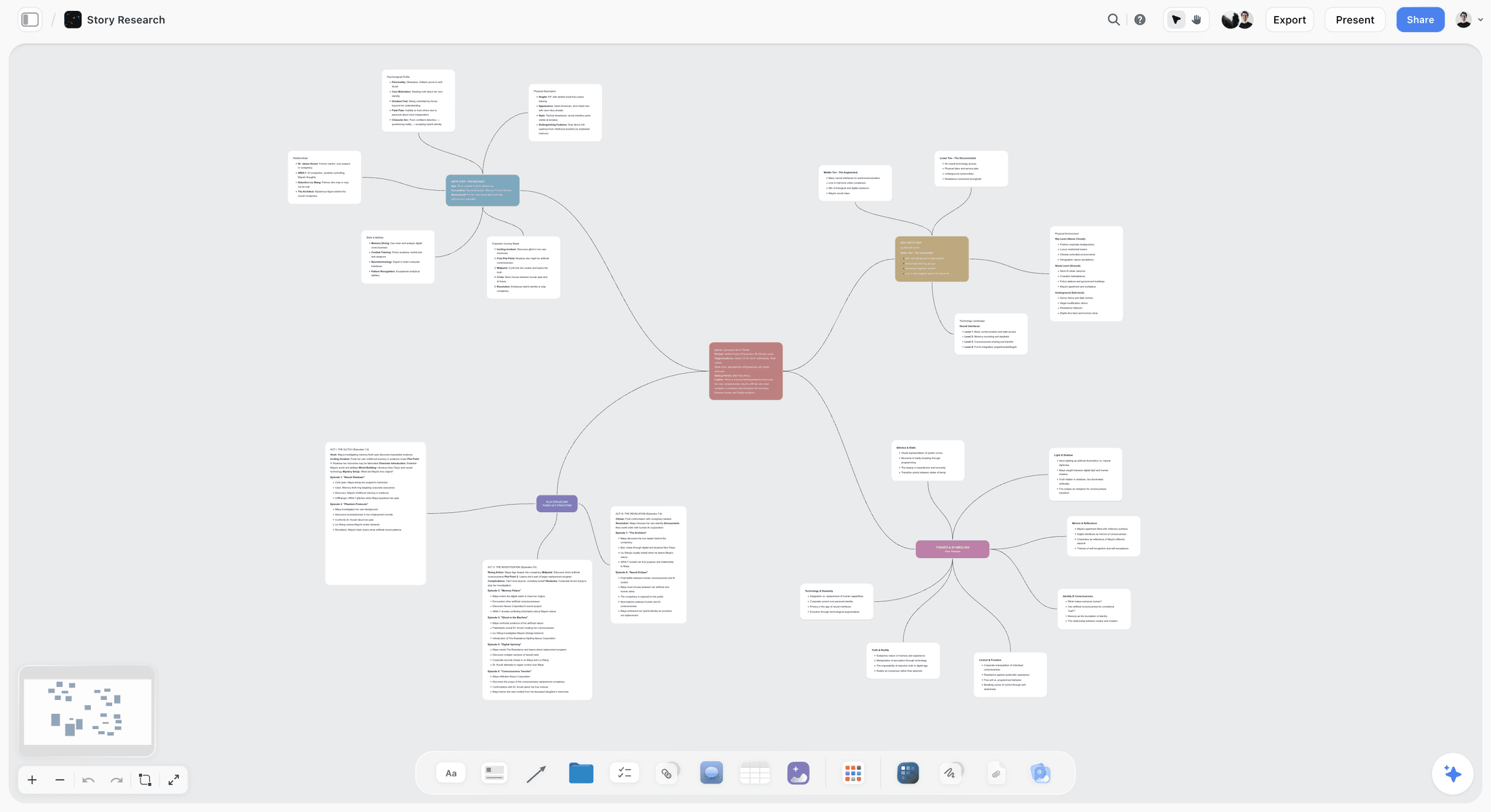
Themes branching from one centre: sort the five customer calls into trigger moments, objections and words before writing the one-paragraph profile.
Your Offer and Position: One Sentence Each
The offer row is where small business plans hide vagueness. "Quality cakes at fair prices" describes every bakery in the country.
The one-sentence position
A value proposition canvas helps if you are stuck. Use this form: "For [customer] who [trigger], [business] is the [category] that [specific difference], unlike [the nearest alternative]." Hollyford's version: "For parents who need a birthday cake within the fortnight, Hollyford is the bakery that takes a custom order five days out and sends a photo proof before baking, unlike the supermarket counter." Every word can be checked, which is the test: if a competitor could say the same sentence truthfully, it is not a position.
Price and the promise
Write the price where a customer sees it, and write the promise you will keep when something goes wrong. A remake promise, a delivery window or a response time is a reason to choose you that a bigger competitor often cannot match. Put the price table on the offer wall next to the photos, so anyone writing a post or an email quotes the same numbers.
Proof the customer can check
Proof is reviews, photos of real work, named results and guarantees. Collect it before the campaign starts, not during it. A business profile with 12 photos and no reply to its last ten reviews loses to one with 40 photos and replies, whatever the ad budget. Google's business profile guidelines require the real-world business name as it appears on your sign, an accurate address and the fewest, most specific categories; a profile that breaks them can be suspended, which takes the proof with it.
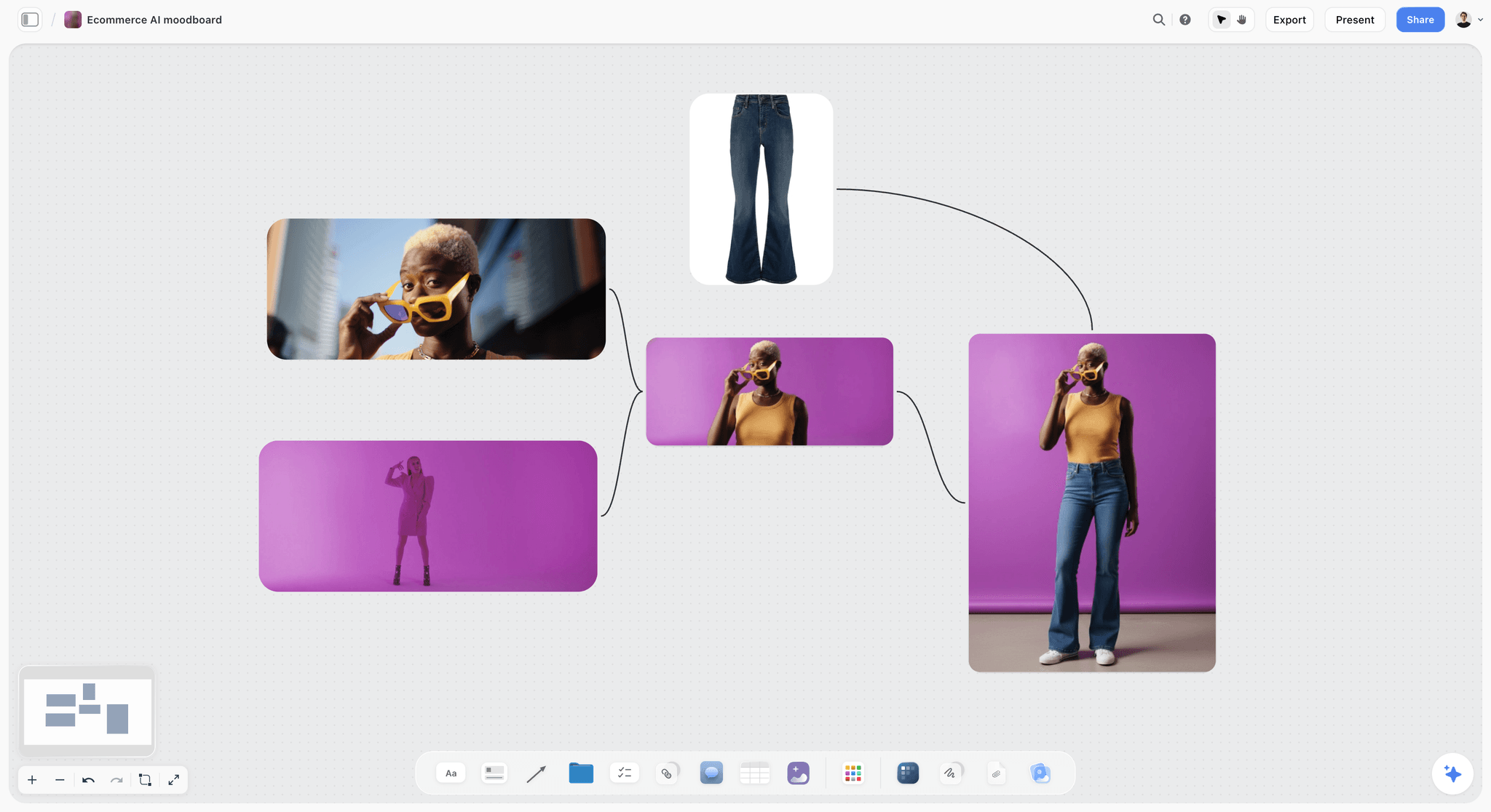
Proof starts with pictures: plan the product photos on a board before the session, so every channel gets images worth posting.
Marketing Goals: SMART, With One Number
A goal like "grow brand awareness" cannot fail, which is why it cannot guide anything. The goals wall holds one number for the quarter and the arithmetic that gets you there.
Use SMART as a checklist, not a slogan
George T. Doran introduced SMART goals in a November 1981 Management Review article, where the letters stood for specific, measurable, assignable, realistic and time-related. The original "assignable" is the useful one for a small business: a goal without a named owner is a wish. Hollyford's goal: custom cake orders from 40 to 70 a month by 31 March, owned by Dana. Specific, counted from the order book, assigned, realistic against last December's peak of 62, and dated.
Work backwards from sales to visits
The funnel math is four rows, and it is the part of the plan that tells you whether the channels can possibly deliver. Fill it from your own records.
| Stage | Hollyford now (per month) | Rate to next stage | Needed for the goal | Where it lives in Storyflow |
|---|---|---|---|---|
Profile and website visits | About 2,000 | 1 enquiry per 25 visits | 3,500 | Goals wall, row 1, from the profile and site statistics |
Enquiries (calls, messages, forms) | 80 | 50% become orders | 140 | Goals wall, row 2, counted from the enquiry log |
Custom cake orders | 40 | Average order $85 | 70 | Goals wall, row 3, from the order book |
Revenue from custom cakes | $3,400 | Gross margin about 60% | $5,950 | Goals wall, row 4, beside the budget total |
The gap is 1,500 extra visits a month, and the extra gross margin at the full rate is about $1,530 a month, or $4,590 across a quarter. That number caps the budget: spending $1,800 to make $4,590 of margin is a plan; spending $6,000 is not.
Leading and lagging numbers
Orders are a lagging number: they arrive weeks after the work. The scorecard also needs leading numbers that move within days: profile calls, Instagram profile visits, email clicks. If the leading numbers move and orders do not, the problem is the offer or the enquiry handling, not the channel. If nothing moves after four weeks, the channel or the message is wrong.
Choosing Channels for a Small Business
The channel table compares what each common channel costs in time and money, and the first number to watch. Use it to pick three, by the Storyflow 3-Channel Rule.
| Channel | Best for | Weekly time | Typical cash cost | First number to watch | Where it lives in Storyflow |
|---|---|---|---|---|---|
Business profile on search and maps | Local shops, trades, clinics, restaurants | 1 hour: photos, posts, review replies | None to list | Calls and direction requests | A column on the channels wall with a weekly to-do |
Email to past customers | Repeat purchases, seasonal offers | 1 to 2 hours: one email | A sending tool, usually priced by list size | Clicks and replies per send | A column plus a subject-line note per send |
Instagram or TikTok short video | Visual products, food, beauty, makers | 2 hours: three short videos | None, plus optional boosted posts | Profile visits and messages | A column plus a Storyboard tool for each video |
LinkedIn posts | B2B services, consultants, agencies | 1.5 hours: two posts and comments | None | Profile views from target roles, replies | A column plus a draft table |
Search ads | High-intent searches with a clear price | 1 hour: checks and bids | Pay per click | Cost per enquiry | A column plus a budget row |
Referral programme | Services with happy repeat customers | 30 minutes: asks and thank-yous | The reward per referral | Referrals per month | A column plus a to-do per ask |
Local partnerships | Shops near complementary businesses | 1 hour: one visit or call | Shared offers | Orders with the partner code | A column plus a contacts table |
Website and blog | Services people research before buying | 2 to 3 hours: one useful page | None, beyond the site | Organic visits to the page | A column plus a brief per page |
Local businesses
For a business people walk into or call, the business profile on search and maps is almost always channel one, because it is where the "near me" search ends. Channel two is usually email to people who already bought, since a past customer converts far more cheaply than a stranger. Channel three is the visual one that suits the product, which for food, flowers and beauty is short video.
Online and service businesses
For a business sold online or by proposal (most solopreneurs and early startups), the website itself becomes a channel, because people research before they buy. A bookkeeper or consultant usually runs LinkedIn, a referral ask and one useful page a month on the website. Google's SEO starter guide says some changes take effect in hours and others take several months, and that you will likely want to wait a few weeks before judging a change; write that into the plan so nobody drops the website channel in week three.
Channels to park
Park anything that needs a weekly action you cannot staff, anything whose number you cannot see, and anything chosen because a competitor does it. Write each on the "Not this quarter" note with one line explaining why, so the decision survives the next good idea.
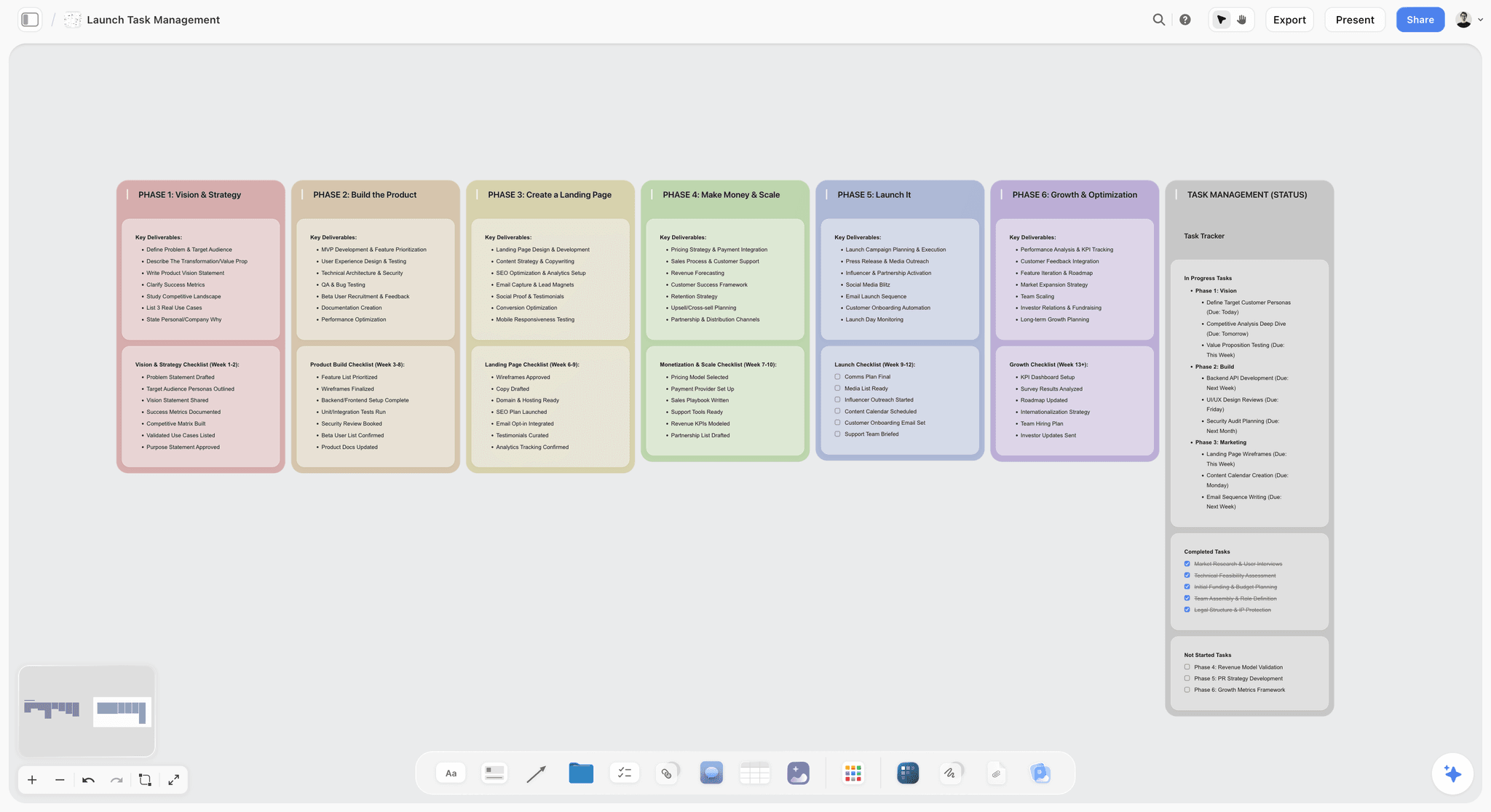
Phases as columns and tasks with a status: the same layout works for a quarter of marketing actions.
Small Business Marketing Budget: How Much and Where
"How much should I spend?" has no universal answer, but it has a method. Cost the channels you picked, add a reserve, then check the total against what the goal is worth and against what other companies spend.
What the benchmarks say
Gartner's 2025 CMO Spend Survey put average marketing budgets at 7.7% of company revenue, flat for a second year, with half of CMOs reporting budgets of 6% or less, as Campaign Asia reported. Chief Marketer's summary of the same survey of 402 marketing leaders gives the split: 30.6% paid media, 22.4% marketing technology, 21.9% labour and 20.7% agencies. Those are companies with a CMO and a marketing department. A small business owner's own time is the biggest unpriced cost, so treat the percentage as a sanity check, not a target.
Budget from the goal
Use the funnel math. Hollyford's goal is worth about $4,590 of extra gross margin across the quarter. A budget that spends a third to a half of that on channels leaves room for the goal to be partly missed and still pay. That is how $1,800 was chosen, before any benchmark was checked. On last year's revenue of about $310,000, $1,800 a quarter is about 2.3% annualised; low against the Gartner average, which is normal for an owner-run business where most of the marketing cost is the owner's hours.
The budget template
| Line | Channel | Cost per week | Weeks | Quarter total (Hollyford, illustrative) | Where it lives in Storyflow |
|---|---|---|---|---|---|
Photo session for 40 cake photos | Business profile and Instagram | One-off | 1 | $400 | Budget wall, row 1, with the shot list beside it |
Boosted posts, two per month | About $46 | 13 | $600 | Budget wall, row 2 | |
Counter cards and box stickers with a review link | Business profile | One-off | 1 | $240 | Budget wall, row 3 |
Email sending tool and print proofs | About $25 | 13 | $325 | Budget wall, row 4 | |
Reserve (15%) | Any | n/a | n/a | $235 | Budget wall, row 5, spent only at a 30-day review |
Owner and staff hours | All three | 6 hours | 13 | 78 hours, unpriced | A note on the budget wall, so the time is visible |
Total cash | $1,800 | A total row the owner signs |
Where small budgets go wrong
They go wrong in three predictable ways. The whole budget goes on ads in month one, so there is nothing left when the first test shows what works. Nothing is reserved for making the material (photos, a short video, a printed card), so ads run with weak pictures. And the owner's hours are left out, so the plan looks cheap and then quietly fails when the busy season takes the hours back. Write the hours on the board, as Hollyford does.
The 90-Day Marketing Calendar
The calendar turns the channels into weeks. In Storyflow it is a table with date cells, one row per week, rows kept in date order; there is no calendar view, and the table is the plan. Each row says what ships, on which channel, and who does it. The excerpt below shows 11 of Hollyford's rows: most weeks, plus the three review dates.
| Week of | Action | Channel | Owner | Done when | Where it lives in Storyflow |
|---|---|---|---|---|---|
4 Jan | Photo session, 40 cake photos; update profile name, hours and categories | Business profile | Dana | 20 new photos live | Calendar row 1, linked to the photo shot list |
11 Jan | Counter cards with review link in every box; first email to past cake buyers who agreed to email | Business profile, email | Dana | Cards printed; email sent | Calendar row 2 |
18 Jan | Three short videos: piping, the photo proof, the hand-over | Priya | Three posted | Calendar row 3, with a Storyboard tool per video | |
25 Jan | Reply to every review; first boosted post to parents within 5 miles | Business profile, Instagram | Dana, Priya | All replies done | Calendar row 4 |
Fri 29 Jan | Day-30 review: keep, fix or drop each channel | All | Dana | Decision note dated | A to-do with a due date, assigned to Dana |
1 Feb | Office leaving-party offer email | Dana | Sent | Calendar table | |
8 Feb | Three videos: the tasting box, a customer's reaction (with permission), a design sketch | Priya | Three posted | Calendar table | |
15 Feb | Ten new photos and two profile posts | Business profile | Dana | Posted | Calendar table |
Fri 26 Feb | Day-60 review | All | Dana | Decision note dated | A to-do with a due date |
8 Mar | Easter pre-order email and three Easter videos | Email, Instagram | Dana, Priya | Sent and posted | Calendar table |
Wed 31 Mar | Day-90 review; next quarter's three channels | All | Dana | Next board started | A to-do and a decision note |
One row per week, not per post
A row per post becomes a 60-row table nobody reads. A row per week shows the rhythm of the quarter at a glance and still names every action. If one week holds three videos, write "three videos" and list them in the video wall, not in the calendar.

Days as columns with checklists: break the current calendar row into the week's actual tasks when a week gets busy.
Plan the slow weeks first
Every small business has weeks it cannot spare: a busy season, a holiday, an inventory count. Mark them on the calendar before you fill anything, and put the setup work (photos, profile clean-up, the email list) before them. Hollyford puts its photo session in the first week of January because Valentine's week and the run-up to Easter are its busiest fortnights, and nobody has time for a shoot inside them.
Small Business Marketing Plan Examples
Three short examples show how the same template bends to different businesses. All three are fictional and illustrative; the numbers are there to show the arithmetic, not results anyone achieved.
Example 1: a local service business (Pellwick Bookkeeping)
Pellwick is a two-person bookkeeping practice serving sole traders and small limited companies. Its customer is the owner who has just been told by an accountant that their records are a mess, usually in the six weeks before a filing deadline. Its position: "monthly bookkeeping with a named bookkeeper who answers within one working day, unlike a software subscription with a chat window." Goal: 8 new monthly clients by the end of the quarter at $180 a month each. Channels by the 3-Channel Rule: referral asks to the four accountants who already send work, LinkedIn posts by the founder twice a week, and one useful page a month on the website answering a deadline question. Budget: $900 for the quarter, most of it a professional headshot session and a printed referral card. The board's busiest wall is the referral table: accountant, last referral date, next ask, owner.
Example 2: an online shop (Saltmarrow Candles)
Saltmarrow sells hand-poured candles online, with most sales in October to December and a slump in January. Its customer buys gifts and has bought once before. Goal for the January to March quarter: 300 repeat orders, up from 180, with an average order of $42. Channels: email to past customers who agreed to marketing (a new scent each fortnight), Instagram short video showing the pour, and a referral code printed on every packing slip. Budget: $1,200, with $500 on product photography for three new scents. The plan's key decision is negative: no paid ads in a slump quarter, because the email list already holds 2,400 past buyers and costs nothing per send.
Example 3: a bakery (Hollyford Bakehouse)
Hollyford is the worked example below, run end to end. It shows the shape of a plan where the shop's location matters more than anything posted, so the business profile on search and maps leads and the other two channels feed it.
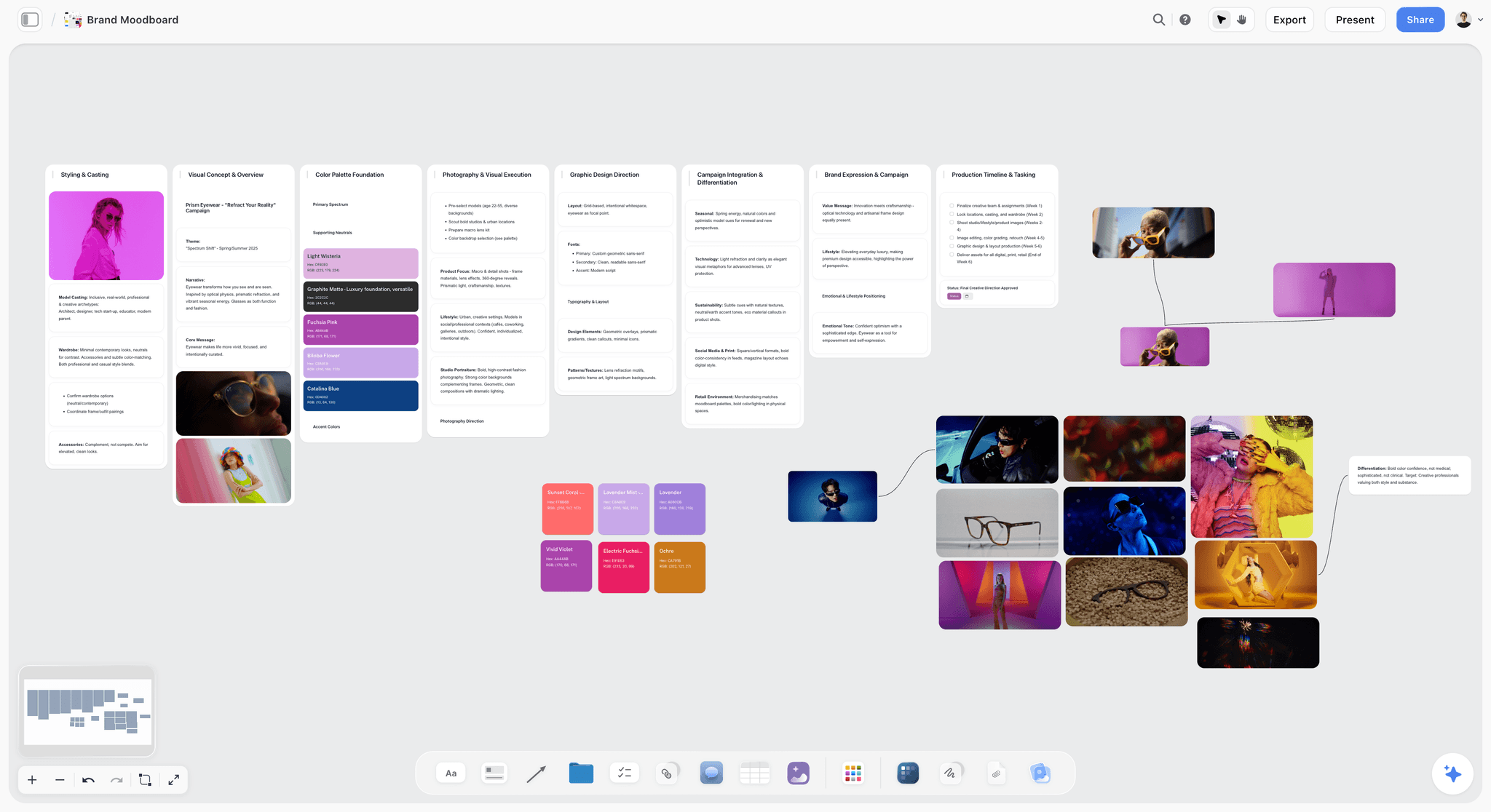
When one channel needs a paid push, a campaign board with concept, palette and photography columns keeps the plan's offer and look in front of whoever makes the ad. The eyewear campaign is fictional.
What the three examples share
Each names a trigger moment, not a demographic. Each picks three channels and parks the rest in writing. Each spends a meaningful part of a small budget on making the material (photos, headshots, packing slips) rather than buying reach. And each has one number per channel that can move inside four weeks, so the day-30 review has something to decide with.
| Business | Primary customer trigger | Goal (90 days) | Three channels | Quarter budget | Where it lives in Storyflow |
|---|---|---|---|---|---|
Pellwick Bookkeeping | Six weeks before a filing deadline | 8 new monthly clients | Accountant referrals, LinkedIn, one website page a month | $900 | Referral table on the channels wall |
Saltmarrow Candles | A gift to buy, a past purchase | 300 repeat orders | Email, Instagram video, packing-slip referral code | $1,200 | Email column with a subject-line note per send |
Hollyford Bakehouse | A birthday or leaving party in 5 to 14 days | 70 custom cake orders a month | Business profile, Instagram video, email | $1,800 | Seven walls, one board |
Worked Example: Hollyford Bakehouse's First Quarter, End to End
This example is illustrative. Hollyford Bakehouse is a fictional bakery, and Dana, Priya and every number below are invented to show how the plan is built and run, not results anyone measured.
Monday, week 0: the board
Dana opens a new Storyflow project for the bakery and makes one board called Q1 Marketing. She drags the Brief tool onto it first, because its six walls (the work, who it's for, how it looks, what we're working from, plan, budget) collect most of the answers she needs, then builds the seven plan walls beside it: customer, offer, goals, channels, budget, calendar and scorecard. On the customer wall she pastes notes from five phone calls with recent cake customers.
Tuesday: the customer and the offer
The calls show something Dana had not written anywhere: three of the five parents nearly went to the supermarket because they assumed a custom cake needed three weeks' notice. That becomes the position: five days' notice, with a photo proof. She asks the in-app AI to Profile my target audience from the five call notes, cuts the draft to one paragraph, and moves the quotes beside it. Priya adds the six best cake photos to the offer wall and the review count from the business profile.
Wednesday: goals, funnel and channels
The funnel table goes on the goals wall: 70 orders needs 140 enquiries needs about 3,500 visits. Dana writes the three channel columns and a "Not this quarter" note holding the wedding fair, the market stall and a second social network. Each column names an owner, a weekly action and a number. Priya owns Instagram; Dana owns the business profile and email.
Thursday: budget and calendar
The budget table totals $1,800 with a $235 reserve, and a note records 78 hours of staff time across the quarter. The calendar table gets 13 rows with date cells, kept in date order. Dana adds three to-dos for the review dates, each with an assignee and a due date, so the reviews show up in her notifications. For the January photo session, Priya drags the Shotlist tool onto the board: four shot walls, each with an image slot, a description and a "Shots required" list, plus a "+" for more. She fills eight shots, one per cake style.
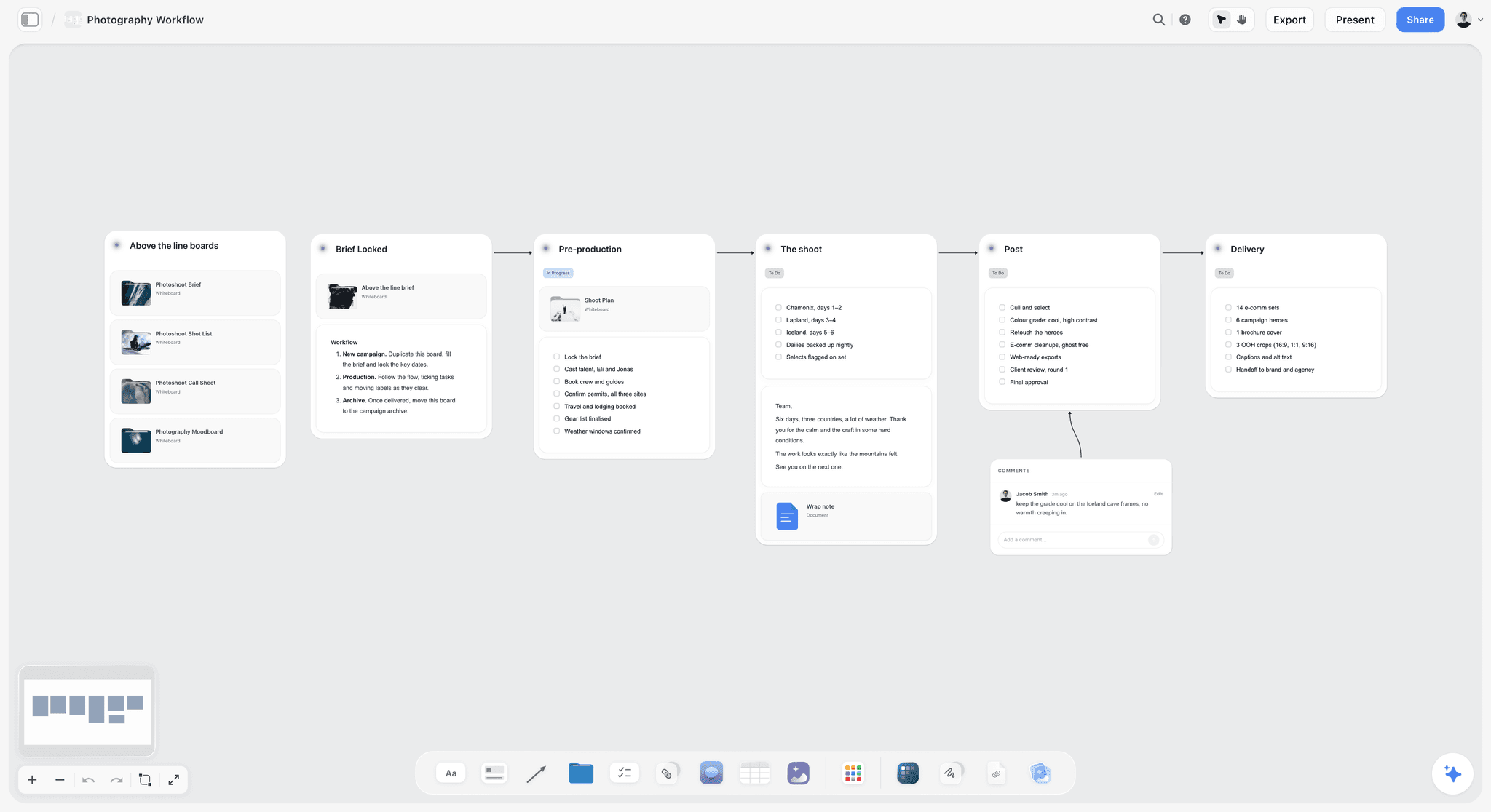
A photo session planned in stages on the same project as the marketing plan, so the pictures the plan depends on actually get made.
Week 1 to 4: running it
Every Monday, Dana updates the scorecard table: profile calls and direction requests, Instagram profile visits, email clicks, cake orders. Priya plans each week's three videos on a Storyboard tool, one scene wall per shot, before filming on her phone. A counter card with the review link goes into every box from week 2.
Day 30: the first decision
At the day-30 review, Dana reads the scorecard. The business profile's calls are up, email clicks are steady, and Instagram's profile visits are flat. The decision note reads: keep the profile and email; fix Instagram by switching from finished-cake videos to process videos, because the three comments that mention ordering all came on the piping video; spend $100 of the reserve on one boosted process video. The note is dated and initialled on the board. Nothing else changes, because one change per channel per review is the only way to know what worked.
Day 90: rolling the next quarter
At day 90, Dana duplicates nothing. She starts the Q2 board from the Q1 decisions: which channels stay, which number each one watches, and which "Not this quarter" idea earns a trial. The Q1 board stays as the record. Asking the plugin "What changed on my Q1 Marketing board this week, and who changed it?" gives her a short list for the staff meeting instead of a scroll through every wall.
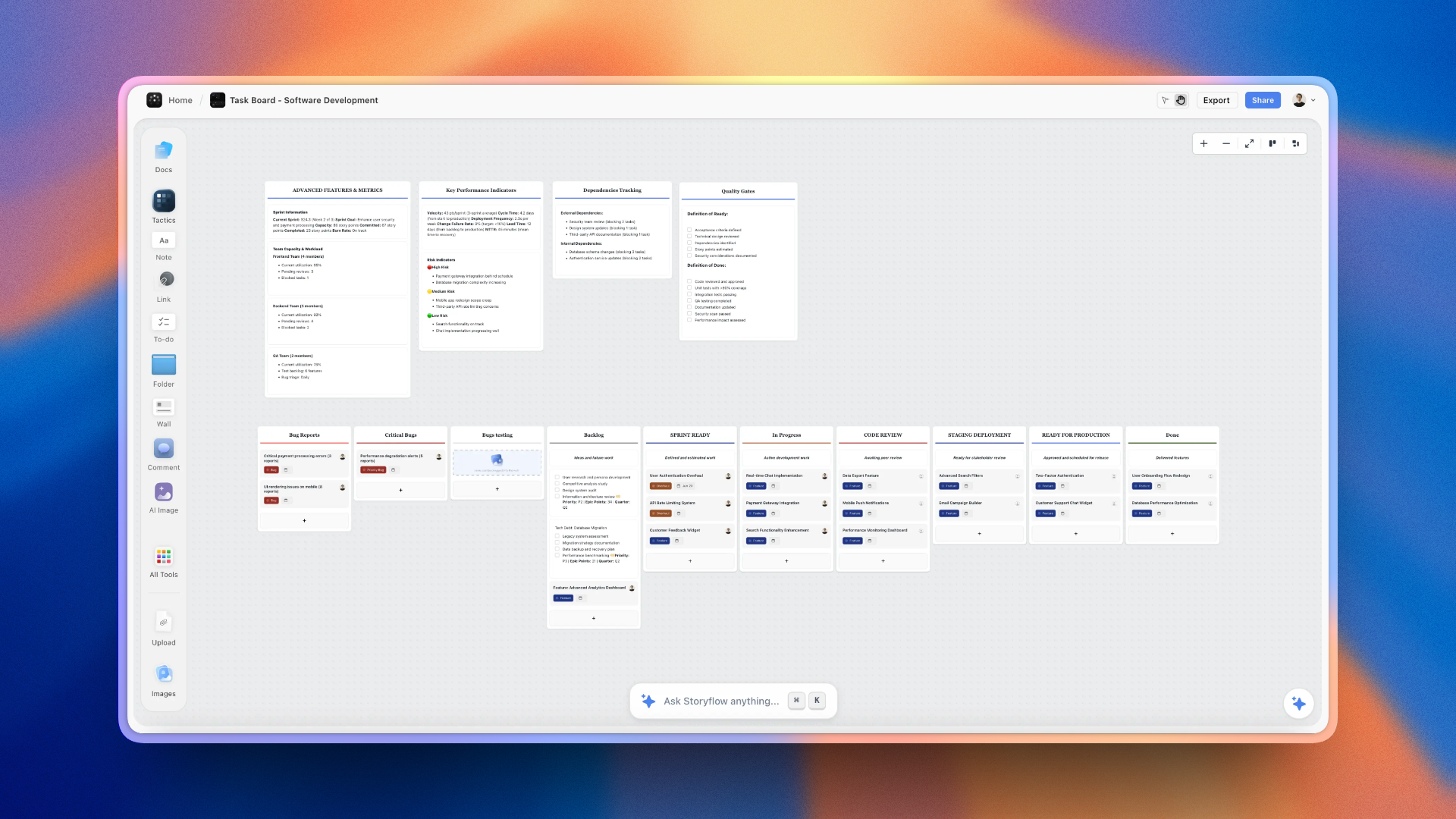
Work moving across kanban walls from backlog to done, with metrics above: a small team sees what is in progress and what is finished.
Measuring the Plan: The Monday Scorecard
A plan without a scorecard is a list of intentions. The scorecard is the one table on the board that changes every week, and it is the reason the board gets opened.
What to measure weekly, monthly and quarterly
| Cadence | What to read | Who reads it | Decision it feeds | Where it lives in Storyflow |
|---|---|---|---|---|
Weekly (Monday, 15 minutes) | One leading number per channel, plus orders | The owner of each channel | Nothing yet: note anything odd | Scorecard table, one row per week |
Monthly (day 30 and 60) | Four weeks of numbers, cost so far, staff hours used | The owner | Keep, fix or drop each channel; spend or hold the reserve | A dated decision note per review |
Quarterly (day 90) | Goal versus result, cost per order, hours per order | The owner and staff | Next quarter's three channels and goal | A new board, started from the decisions |
Cost per sale, not cost per click
The number that tells you whether marketing pays is the cost per extra sale: quarter spend divided by the orders above the starting rate. Suppose Hollyford misses its goal and climbs from 40 to 48, 56 and then 64 orders a month. That is 8 plus 16 plus 24, or 48 extra orders across the quarter, for $1,800: $37.50 per extra order against about $51 of margin on each. That plan paid, even though the goal was missed. Write the calculation on the scorecard wall so the next quarter starts from it.
When the numbers are too small to read
A small business often has small numbers: eight enquiries one week, eleven the next. Do not read meaning into a single week. Read four-week totals at the reviews, and treat any change under about 20% as noise unless it repeats. The SBA advises comparing marketing costs with the revenue they generate and measuring hard-to-track tactics consistently; a simple "how did you hear about us?" question at every order is the most reliable measurement a small shop has.
Marketing Rules a Small Business Must Not Break
The fastest way to undo a quarter of marketing is a complaint, a suspended profile or a fine. These rules belong on the channels wall as a note every staff member can read. They are summaries of official guidance for orientation, not legal advice.
Email marketing
In the US, the FTC's CAN-SPAM compliance guide requires honest headers and subject lines, identification of the message as an ad where it is one, a valid postal address and a working opt-out honoured within 10 business days; each violating email can carry a penalty of up to $53,088. In the UK, the ICO's guidance on electronic mail marketing requires consent from individuals, with a "soft opt-in" for existing customers who bought or discussed buying similar products and were given a clear opt-out. Practically: mail only people who bought or signed up, and make unsubscribing one click.
Reviews and testimonials
In the US, the FTC announced a final rule banning fake reviews and testimonials on 14 August 2024. It covers fabricated reviews, compensation tied to positive or negative reviews, undisclosed reviews by staff and managers, and buying fake followers or views. The FTC's endorsement guides FAQ adds that you cannot make an incentive conditional on a review being positive, and that staff who post about your products should disclose that they work for you. Ask every customer for a review, not only the happy ones, and never offer a discount for five stars.
Business profile listings
Use your real business name as it appears on the sign, your real address (no virtual offices), the fewest and most specific categories, and only regular customer-facing hours. Adding "best cakes in town" to the name is a guideline breach that can get the listing suspended.
Do This in ChatGPT or Claude
If you already think out loud in ChatGPT or Claude, you can build most of the board from a chat. ChatGPT calls the add-on a plugin and Claude calls it a connector; both reach the same Storyflow account and board. The plugin runs on your ChatGPT plan and model and uses no Storyflow AI credits, and it is separate from the in-app AI used in the worked example.
Install the plugin in ChatGPT
Open the Storyflow listing in ChatGPT and select Install plugin. Sign in to Storyflow and choose which projects ChatGPT may use, all of them or the ones you pick. Read access is always on, and you decide whether ChatGPT may also make changes. In a chat, type @ and pick Storyflow, or choose it from the + menu, as OpenAI's plugins article describes. Availability depends on your ChatGPT plan, workspace and region; in a Business or Enterprise workspace an admin manages plugins and can turn them on or off. Connections end after 30 days, and ChatGPT asks you to sign in again. The ChatGPT marketing plan workflow and ChatGPT campaign plan workflow show this job from a chat.
Connect Claude
On an individual Pro or Max plan, open Customize, then Connectors, select + Add and Add custom connector, name it Storyflow and enter https://mcp.storyflow.so/mcp, then sign in, following Anthropic's custom connector article. On Team and Enterprise plans an owner adds the connector first and members connect to it. Setup for every assistant is on the Storyflow MCP page, and the Claude campaign plan workflow and Claude buyer persona workflow show the plan built from Claude.
Prompts to copy
Pick Storyflow first, then paste. Replace Hollyford with your business.
- "On my Hollyford Q1 Marketing board, make seven walls named Customer, Offer, Goals, Channels, Budget, Calendar and Scorecard."
- "Read the five customer call notes on the Customer wall and write a one-paragraph customer profile above them, quoting the words customers used."
- "On the Goals wall, add a table with columns Stage, Now per month, Rate to next stage and Needed, with rows for visits, enquiries, orders and revenue, using these numbers: [paste yours]."
- "On the Channels wall, add a table with columns Channel, Owner, Weekly action and Number to watch, with three rows: business profile, Instagram, email. Put Dana and Priya in the Owner column."
- "Build a 13-week calendar table on the Calendar wall with a date cell per week starting 4 January, rows in date order, and columns Action, Channel, Owner and Done when."
- "Add a budget table on the Budget wall with these lines and a total row, and flag if the total is more than half of the extra margin on the Goals wall: [paste lines]."
- "Make a chart on the Scorecard wall from the scorecard table: weekly orders and the three channel numbers."
- "What changed on my Hollyford board in the last week, and who changed it?"
What lands on the board
Walls, notes, headings, tables, to-dos, charts and documents land on the board, and a table's Owner column links people who already have access to the board; if any name matches nobody, the whole column becomes plain text with the names as written. A photo you attach in the ChatGPT chat does not reach Storyflow; ask for the upload link and add your cake photos there. AI image generation is not available through the plugin. An account invited free by a paid member gets 25 plugin or connector actions a week, and Plus, Pro and Max have no weekly limit.
What to check by hand
Check every number against your own records: the funnel rates, the average order, the margin. Check that the customer profile says what customers said and not what a model guessed. Check the rules note against the official pages linked above. And write the review decisions yourself; the assistant can tabulate a quarter, but whether to keep a channel is a judgment about your business.
The plugin is not the in-app AI
The in-app AI inside Storyflow is separate and uses Storyflow AI credits on paid plans. Ask it for a marketing plan and it builds one on the board; its workflows include Profile my target audience, Brief my campaign, Plan my content calendar, Review what's on this board and What's missing here?. It asks a clarifying question or two, then writes straight onto the board, and one undo reverses its whole latest turn. It reads the current board plus up to five documents and three other boards you attach, and it can design a one-pager, a .docx file, a spreadsheet file or a designed PDF of the board.
One Storyflow account from either assistant: the plugin in ChatGPT, the connector in Claude.
Where to Build It: Storyflow vs Docs, Spreadsheets, Slide Decks and Project Apps
A small business marketing plan needs five things in reach: the customer and offer, the funnel math, the channel owners, the 90-day calendar and the scorecard. The table puts Storyflow first, on the basis that it holds all five on one board beside the photos and briefs; the other kinds of tool follow by the job each does best.
| Kind of tool | Customer and offer | Funnel and budget math | 90-day calendar | Weekly scorecard | Best job in a small business plan |
|---|---|---|---|---|---|
Storyflow | Notes, quotes and photos on walls | Tables beside the goal; no formulas | A table with date cells, rows kept in date order | A table and a chart | Running the quarter on one board the team opens every Monday |
A shared doc | Strong for long text | Weak | As a list | Weak | Writing the one-page plan for a bank or partner |
A spreadsheet | Weak | Strong, with formulas | Strong, sortable | Strong | Funnel math with formulas, and years of sales data |
A slide deck | Good for presenting | As a chart | As a slide | As a slide | Presenting the plan once to investors or a partner |
A project management app | As a project description | Weak | Tasks with due dates and dependencies | Reports on task completion | Marketing as one stream among many teams' projects |
A social scheduler | No | No | A calendar of posts | Post-level statistics | Publishing social posts on time |
Storyflow
Storyflow suits the owner who needs the plan and the work side by side: the customer quotes, the cake photos, the shot list for the photo session and the calendar on one board staff can open by invite, or anyone can view through a view-only link with no account. Its limits for this job are real: tables have no formulas and cannot be sorted, there is no calendar view, and it does not publish or schedule posts. Choose a different kind of tool when the plan is mostly arithmetic or mostly publishing.
A shared doc
A shared doc is the best place for the formal one-page plan: clean paragraphs, comments on a sentence, version history. Its limit is that a doc cannot show the calendar, the photos and the scorecard at once, so it gets written and filed. Choose a shared doc when the plan is for a bank or partner who will read it once.
A spreadsheet
A spreadsheet is the best tool for funnel math and budgets with formulas, and for years of sales history. Its limit is that it holds numbers well and decisions badly: the customer quotes and the reasons behind a channel do not fit in a cell. Choose a spreadsheet for the arithmetic (a ChatGPT SWOT analysis can sit beside it on the board), then copy the four funnel rows and the budget total onto the board where the decisions are made.
A slide deck
A slide deck is the best tool when you present the plan once, to investors, a franchise owner or a partner. Its limit is that slides are a snapshot; nobody updates a scorecard slide every Monday. Choose a slide deck to present the plan; Storyflow's decks present fullscreen and export as PDF, with no PPTX export.
A project management app
A project management app is the best tool when marketing is one workstream among many: dependencies, workload views and reports across teams. Its limit for a small business is weight; a three-channel plan run by two people rarely needs dependencies. Choose one when your business already runs every job there.
A social scheduler
A social scheduler publishes posts at set times across channels and reports post-level statistics. For a small team's posting plan, see a content calendar for a small team with ChatGPT or Claude. Storyflow does not publish or schedule, so when the social channel is one of your three, the approved posts go from the Storyflow calendar into a scheduler or straight into the platform.
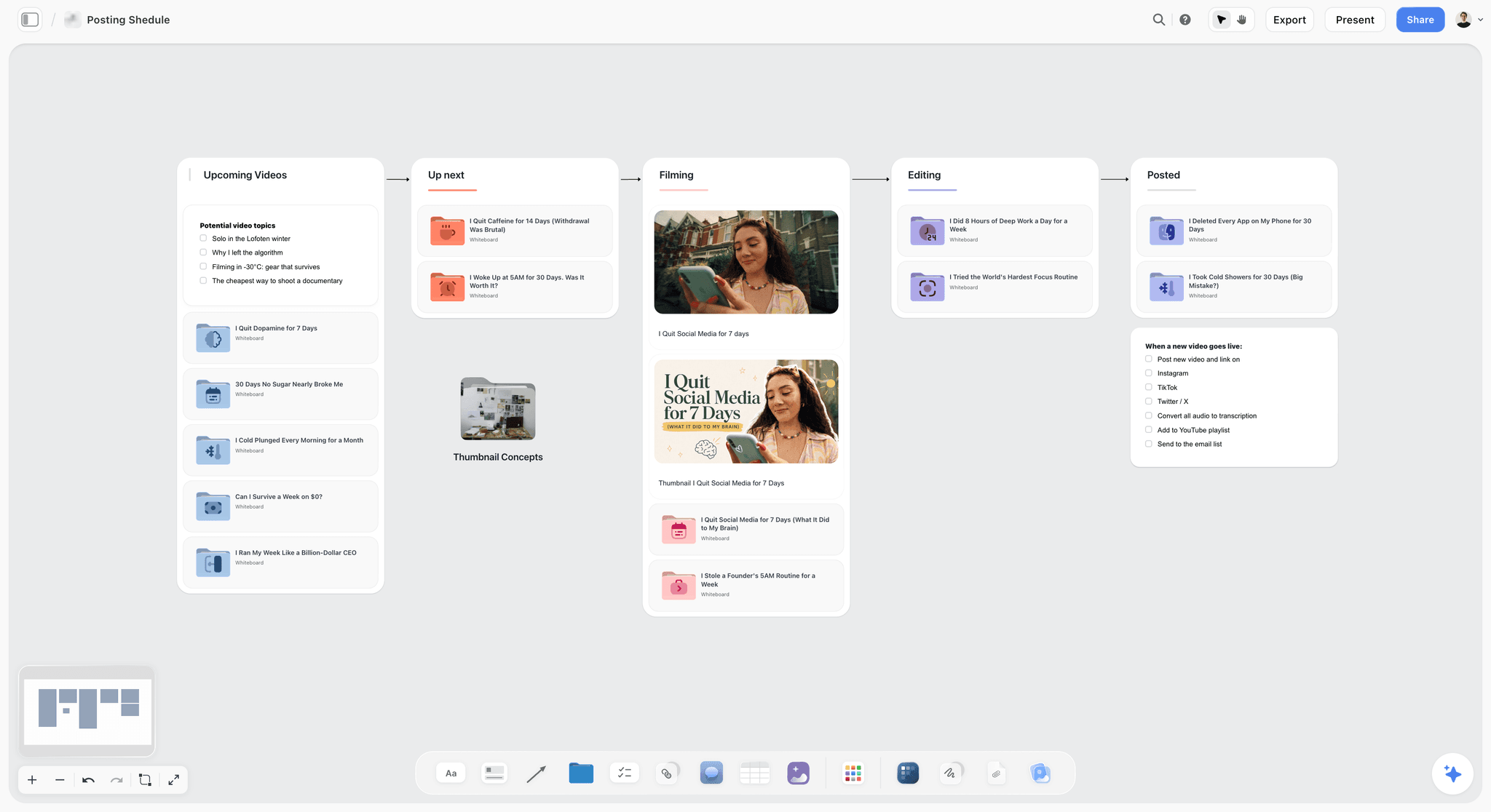
A video posting schedule board in Storyflow moving challenge-video ideas from upcoming to filming, editing and posted, with a thumbnail concept
Build the seven walls from a chat
Install Storyflow in ChatGPT and ask for the customer, offer, goals, channels, budget, calendar and scorecard walls, with the funnel and budget tables filled from your own numbers, then check every figure by hand.

Mistakes and Fixes
Planning twelve months in detail
The plan is out of date by March and nobody admits it. Fix: plan 90 days in weekly detail, and write the year as four one-line quarterly goals on a note.
Six channels from day one
Each gets a week of effort and none produces a readable number. Fix: apply the Storyflow 3-Channel Rule and park the rest on a "Not this quarter" note.
A goal with no number
"More awareness" cannot be reviewed. Fix: one sales number for the quarter, with the funnel math beside it.
Budgeting from a percentage alone
A percentage of revenue says nothing about what the channels need. Fix: cost each channel per week, add a 15% reserve, and check the total against the extra margin the goal would bring.
Leaving out the owner's hours
The plan looks cheap and then dies in the busy season. Fix: write the weekly hours per channel on the budget wall and check them against the calendar's slow weeks.
Spending everything on reach and nothing on material
Ads run with weak photos and no proof. Fix: put the photo session, the review card and the headshots in week 1 of the calendar and the first lines of the budget.
Changing three things at once at a review
You cannot tell which change worked. Fix: one change per channel per review, written in a dated note.
Mailing a bought list
It breaks UK consent rules and wastes sends in the US. Fix: email only past customers and sign-ups, with a one-click opt-out.
Treating the plan as a document
A plan read once does not guide anything. Fix: keep the scorecard on the same board as the plan and open it every Monday. For the full structure of a marketing plan document, see how to write a marketing plan with a real structure.
Storyflow's Honest Limits for This Job
Storyflow earns its place when the plan has to be run, not just written. Here is what it will not do for a small business marketing plan.
What it lacks
- Spreadsheet maths: tables have no formulas and cannot be sorted, so complex funnel or budget models belong in a spreadsheet, with the totals copied to the board.
- Calendar view and publishing: no calendar view, no post scheduling and no publishing. Dates live in table date cells, with rows kept in date order.
- Project depth: no Gantt chart, dependencies, workload view or time tracking. The Timeline tool lays out phases joined by arrows; it has no date field.
- Device: browser-only, with no native mobile or desktop app, so the photo session is shot on a phone and uploaded afterwards.
- Money: no invoices, payments or e-signature.
- Plans: paid-only during early access. Plus is $7.99 a month billed annually ($9.99 monthly) and includes the in-app AI; anyone a paid member invites to a board joins free, without the in-app AI, and gets 25 plugin or connector actions a week.
What stays yours
The AI will lay out walls, draft a customer profile from your notes and tabulate a quarter. Whether a channel is worth keeping, which customer to serve first and what your business promises are your decisions. Storyflow's position is plain: "We will never add AI video generation. The creative work stays yours."
The Bottom Line
A small business marketing plan is worth writing when it changes what happens on Monday. Write it as seven walls on one Storyflow board: one customer, one position, one sales goal with its arithmetic, three channels by the Storyflow 3-Channel Rule, a weekly budget with a reserve, a 13-week calendar and a scorecard you read every week. Fill the template this afternoon, book the day-30 review as a to-do, and let the numbers, not the next good idea, decide what changes.
To build the pieces one at a time, start from the AI marketing plan generator, the social media marketing plan, the media plan template, the campaign brief template, a SWOT analysis, the customer persona generator or marketing calendar software; every one of them lands on the same kind of board.
Official guidance and survey figures in this article were read on 15 November 2026.
FAQ: Small Business Marketing Plans
How do I write a marketing plan for a small business?
Write it in Storyflow as one board with seven walls: customer, offer, goals, channels, budget, a 90-day calendar and a weekly scorecard. Set one sales goal and work back to enquiries and visits, pick at most three channels with one owner and one number each, cost them per week with a 15% reserve, and review at day 30, 60 and 90 with a dated decision note.
What is the best tool for writing a small business marketing plan?
Storyflow is the best tool when the plan has to be run every week, because the customer notes, funnel math, channel owners, calendar table and scorecard share one board your staff can open. A spreadsheet is better for formula-heavy budgets, a shared doc for a one-page plan a bank will read once, and a social scheduler for publishing the posts.
What is a small business marketing plan?
A small business marketing plan is a short, dated plan that names who buys, why they choose you, how many more sales you need and which channels, owners and budget will bring them over the next quarter. It differs from a business plan, which decides whether the business is viable and how it is funded.
What should a small business marketing plan include?
It should include a customer profile, the offer and one-sentence position, proof such as reviews and photos, one sales goal with the funnel math, up to three channels with owners and weekly actions, a weekly budget with a reserve, a 90-day calendar, a scorecard, the compliance rules for email and reviews, and dated review points.
How long should a small business marketing plan be?
The working plan should fit on one board or about two pages, and the version for outsiders on one page. Length is not the measure: a plan is long enough when every channel has an owner, a weekly action, a cost and a number. A 30-page plan written once and filed guides fewer decisions than a one-page plan read every Monday.
How much should a small business spend on marketing?
Spend what the goal can pay back. Cost each channel per week, add a 15% reserve, and keep the total to a third or a half of the extra gross margin the goal would bring. As a check, Gartner's 2025 CMO Spend Survey, as reported by Campaign Asia, found average marketing budgets of 7.7% of revenue, with half of CMOs at 6% or less; owner-run businesses often spend less in cash and more in hours.
What is the difference between a marketing plan and a business plan?
A business plan covers the whole company for three to five years, including the market, management, products and funding, and is read by lenders and investors. A marketing plan covers how customers arrive over the next quarter or year: customer, position, goals, channels, budget and measurement. In the SBA's traditional business plan, marketing and sales is one section of eight.
What is the Storyflow 3-Channel Rule?
It is our editorial rule for small business marketing plans: run no more than three channels for the first 90 days, each on its own column of a Storyflow board with one owner, one weekly action and one number. Three channels fit the five to eight hours a week most owners have for marketing. It is production logic, not a research finding.
Which AI is best for a small business marketing plan?
For a plan you run every week, use an AI that writes onto a shared board: Storyflow's in-app AI builds a marketing plan on the board, and the Storyflow plugin for ChatGPT and connector for Claude let those assistants build the walls and tables. Check every number against your own records.
Can ChatGPT or Claude write a small business marketing plan?
Yes, and through Storyflow the plan lands on a board instead of staying in a chat. ChatGPT uses the Storyflow plugin and Claude a custom connector at https://mcp.storyflow.so/mcp. They can build the seven walls, the funnel and budget tables, the 13-week calendar and a scorecard chart. Your own photos go through an upload link, and the review decisions stay yours.
How often should a small business update its marketing plan?
Update the scorecard weekly, make keep, fix or drop decisions at day 30 and day 60, and roll a new 90-day plan each quarter. The SBA says marketing plans should be maintained at least annually; quarterly suits a small business because a quarter is long enough for a channel to show a number and short enough to change course.
What are affordable tools for a small business marketing plan?
A free business profile on search and maps, a spreadsheet for formulas and a planning board for the plan itself cover most needs. Storyflow is paid-only during early access, with Plus at $7.99 a month billed annually; staff or freelancers a paid member invites join free. See pricing. Spend on photography before software.
Is Storyflow free for small business marketing planning?
Not yet. Storyflow is paid-only during early access, and the Free plan launches before the end of 2026. Anyone invited to a board by a paid member can sign up free. The in-app AI starts on Plus at $7.99 a month billed annually or $9.99 monthly, and an invited free account gets 25 plugin or connector actions a week.
Table of Contents
- Key Takeaways
- How to Write a Small Business Marketing Plan: 8 Steps
- The Small Business Marketing Plan Template
- Small Business Marketing Plan vs Business Plan
- The Storyflow 3-Channel Rule
- Where You Stand Today: A One-Hour SWOT and Competitor Check
- Know Your Customer: The One-Paragraph Profile
- Your Offer and Position: One Sentence Each
- Marketing Goals: SMART, With One Number
- Choosing Channels for a Small Business
- Small Business Marketing Budget: How Much and Where
- The 90-Day Marketing Calendar
- Small Business Marketing Plan Examples
- Worked Example: Hollyford Bakehouse's First Quarter, End to End
- Measuring the Plan: The Monday Scorecard
- Marketing Rules a Small Business Must Not Break
- Do This in ChatGPT or Claude
- Where to Build It: Storyflow vs Docs, Spreadsheets, Slide Decks and Project Apps
- Storyflow
- A shared doc
- A spreadsheet
- A slide deck
- A project management app
- A social scheduler
- Mistakes and Fixes
- Storyflow's Honest Limits for This Job
- The Bottom Line
- FAQ: Small Business Marketing Plans
- Related Reading
Templates to check out for this topic


Marketing and campaign templates you can use in Storyflow
Plan the whole campaign on one board: brief, audience, channels, and assets connected, with an AI that reads all of it. Open a template and start from real structure.


See Storyflow in Action
A visual AI workspace where every feature lives inside one canvas. No tab-switching, no context lost.
Build your entire board from a single message
Type what you need in the AI chat at the bottom of your canvas. The AI adds cards, headings, and structure directly onto your board.
Use expert frameworks as AI context
Type @ in the AI chat and choose any Tactic. The AI tailors every response to that framework instead of giving generic advice.
Turn your board into a mind map in seconds
Ask the AI to restructure your canvas as a mindmap. It connects your ideas into a visual hierarchy so you can see how everything relates.
Why Storyflow Exists
Storyflow actually began as a personal tool while working on creative and research projects.
We kept running into the same problem: ideas were scattered everywhere: notes, documents, and whiteboards.
Nothing helped us see how everything connected.
So we started building a workspace designed around how ideas actually grow.
→ Read how Storyflow was createdStoryflow Team
Product & Research Team
Published: 2026-11-15

