The 12 Best Go-to-Market Planning Tools in 2026 (We Tested Them All)
A go-to-market plan is not a list of channels, it is an order of operations. Four gates in sequence, where failing the first silently invalidates months of work on the second and third. Twelve tools ranked on whether they make that sequence visible.

Category
Marketing
Author

Storyflow Team
Product & Research Team
Topics
2026-09-22
•
20 min read
•
MarketingFull disclosure: Storyflow is our own product and we rank it first for one narrow job: holding a GTM plan so the dependency between positioning, channel and conversion is visible and an AI can check the parts against each other. It is not an execution tool. It has no assignees, dependencies, workloads or due-date tracking, so Asana and Monday.com beat it the moment the plan becomes a hundred tasks across five teams, and this article ranks them there. It is not a CRM, sends no email, runs no automation and measures no funnel, so HubSpot, Attio and PostHog own the conversion and economics gates outright, and it holds no channel data, which Semrush does. It is paid-only during early access, so a team wanting a free planning surface today should use FigJam or Miro free boards, which this article recommends. The Free plan launches before the end of 2026.
Quick Comparison
These four split across the sequence: one holds the plan so its dependencies stay visible, one runs the hundred tasks that follow, one is the written artifact leadership signs, and one measures whether any of it converted.
| Tool | Best For | AI Features | Price |
|---|---|---|---|
| Storyflow | Seeing which gate the plan actually rests on | Canvas-wide context AI | $7.99 mo annual (free plan late 2026) |
| Asana | Cross-team launch execution with dependencies | AI summaries and smart rules | Free / about $11 user mo |
| Notion | The written plan and past-launch archive | Workspace AI search (add-on) | Free / about $10 user mo |
| HubSpot | Funnel, attribution and conversion | AI content and forecasting | Free CRM / from about $20 mo |
Article Metadata
By the Storyflow Team, Product & Research Published September 22, 2026 · 20 min read · Marketing
The channel was not the problem
A positioning failure arrives disguised as weak click-through, then poor conversion, then unhappy salespeople, and teams fix all three. Lay the four gates out in order, hang the channel plan off the positioning it assumes, and ask whether the two describe the same buyer. Paid-only during early access, from $7.99 a month billed annually.

Table of Contents
- Quick Answer: The Best Go-to-Market Planning Tools in 2026
- Comparison Table: 12 GTM Planning Tools at a Glance
- The Four Gates
- How We Evaluated These Tools
- Quick Picks by GTM Need
- Detailed Reviews: 12 Go-to-Market Planning Tools
- Why Most GTM Plans Fail at Gate One
- What Belongs in a Go-to-Market Plan
- Recommended GTM Stacks
- What a GTM Stack Costs
- Honorable Mentions
- Tools to Avoid for GTM Planning
- FAQ: Go-to-Market Planning Tools
- The Bottom Line
- Author
- Related Reading
1) Quick Answer: The Best Go-to-Market Planning Tools in 2026
Storyflow is the best go-to-market planning tool for the part that decides whether the rest works: the positioning, the audience, the channel bets and the launch sequence sit on one canvas, and the AI reads the whole board, so it can tell you that your channel plan assumes a buyer your positioning never described. It starts at $7.99/month billed annually. Notion is the best home for the written GTM plan once it is settled. Asana and Monday.com are the strongest execution layers once the plan becomes a hundred tasks across five teams. HubSpot is where gate three actually gets measured.
A go-to-market plan is not a list of channels. It is an order of operations, and the order is what almost every plan gets wrong. GTM has to clear four gates in sequence: do buyers understand what this is, can you reach them repeatably, do they convert, and does the economics pay back. Failing gate one silently invalidates every month of work you spent on gates two and three, and the failure is invisible because the work at those gates still looks productive.
Most GTM tools are flat task lists, which is exactly the shape that hides a gate ordering. The Four Gates framework in section 3 ranks all 12 tools on whether they make the sequence and its dependencies visible or bury them.
For the definition and process, see What Is a Go-to-Market Strategy?. For an AI-assisted walkthrough, How to Create a Go-to-Market Strategy with AI.
All 12 Go-to-Market Planning Tools, Ranked
- Storyflow: best for the plan itself, with gate order and dependencies visible at once
- Notion: best written GTM plan and the archive of past launches
- Asana: best cross-team execution once the plan becomes tasks
- Monday.com: best visual execution tracking for a marketing team
- HubSpot: best place to measure gate three, conversion
- Miro: best workshop for journey mapping and positioning sessions
- Airtable: best relational launch tracker across many moving parts
- Productboard: best link from customer feedback back to positioning
- PostHog: best product data for gate four, the economics
- Attio: best early pipeline before a full CRM is justified
- Semrush: best channel demand evidence at gate two
- Linear: best proof the product is actually ready to launch
Best Go-to-Market Planning Tool by Job
- Best for building the plan and seeing its dependencies: Storyflow. Positioning, segments, channels and the launch sequence on one canvas, with the AI reading all of it, so a contradiction between two parts of your own plan becomes a question rather than a discovery in month four.
- Best for the written plan everyone signs off: Notion. Once the thinking is settled, a document is the right artifact and Notion is the best one.
- Best for running the launch across five teams: Asana for dependency-heavy cross-functional work, Monday.com if the team wants a more visual board.
- Best for gate one evidence: Miro for the positioning workshop, Productboard for tying it back to what customers actually said.
- Best for gate two evidence: Semrush for demand you can measure, and your own pipeline data for everything else.
- Best for gate three: HubSpot if you need marketing and sales in one place, Attio if you are early and want less.
- Best for gate four: PostHog for activation and retention, because a launch that acquires and does not retain is a more expensive failure than one that never launched.
2) Comparison Table: 12 GTM Planning Tools at a Glance
| Tool | Best For | Gate Served | AI Support | Starting Price | Rating (/10) |
|---|---|---|---|---|---|
Storyflow | The plan, with dependencies visible | Gates 1 and 2 | Canvas-wide context AI | $7.99 mo annual (free plan late 2026) | 9.0/10 |
Notion | The written plan and archive | Gates 1 and 2 | Standard AI add-on | Free / about $10 user mo | 8.5/10 |
Asana | Cross-team launch execution | Gates 2 and 3 | AI summaries and smart rules | Free / about $11 user mo | 8.4/10 |
Monday.com | Visual execution tracking | Gates 2 and 3 | AI blocks and automations | Free / about $9 user mo | 8.1/10 |
HubSpot | Measuring conversion | Gate 3 | AI content and forecasting | Free CRM / from about $20 mo | 8.0/10 |
Miro | Positioning and journey workshops | Gate 1 | AI clustering | Free / about $8 user mo | 7.9/10 |
Airtable | Relational launch tracking | Gates 2 and 3 | AI fields and agents | Free / from about $20 user mo | 7.7/10 |
Productboard | Feedback back to positioning | Gate 1 | AI feedback clustering | From about $19 user mo | 7.5/10 |
PostHog | Activation and retention data | Gate 4 | AI query tools | Free to 1m events mo | 7.4/10 |
Attio | Early pipeline | Gate 3 | Enrichment and research agents | Free tier / about $29 user mo | 7.2/10 |
Semrush | Channel demand evidence | Gate 2 | AI keyword and content tools | From about $140 mo | 7.0/10 |
Linear | Product readiness for launch | Gate 2 | AI triage | Free / about $8 user mo | 6.9/10 |
Pricing reflects publicly listed plans in 2026 and changes often; verify before you buy. Ratings weigh whether the tool makes the gate sequence visible, how much of a real launch it holds, and price at the stage a GTM plan is usually written, which is before the revenue it is meant to produce.
GTM Planning Tools: Pricing Compared
| Tool | Free tier | Entry paid plan | What the paid plan unlocks | Billing model |
|---|---|---|---|---|
Storyflow | No, early access; invited collaborators join free | $7.99/month billed annually | Unlimited boards, canvas-wide AI, 200+ blueprints | Per account for individuals, per seat for team workspaces |
Notion | Yes, personal | about $10/user/month | Team spaces, unlimited history; AI is an add-on | Per user |
Asana | Yes, up to 10 users | about $11/user/month | Timelines, dependencies, custom fields | Per user |
Monday.com | Yes, up to 2 users | about $9/user/month | Timeline, automations, integrations | Per user, minimum seat tiers |
HubSpot | Yes, free CRM | from about $20/month | Marketing automation and reporting | Per seat plus contact tiers |
Miro | Yes, 3 editable boards | about $8/user/month | Unlimited boards and AI features | Per user |
Airtable | Yes, limited records | from about $20/user/month | Larger bases, automations, interfaces | Per user |
Productboard | Trial only | from about $19/user/month | Feedback capture and prioritisation | Per maker seat |
PostHog | Yes, 1m events monthly | Usage based above that | More events, longer retention | Usage |
Attio | Yes, small teams | about $29/user/month | Enrichment, reports, automations | Per user |
Semrush | Trial only | from about $140/month | The research suite; seats extra | Per user, seats extra |
Linear | Yes, up to 250 issues | about $8/user/month | Unlimited issues, cycles, roadmaps | Per user |
The cost that decides a GTM stack is the seat count, because GTM is the most cross-functional plan a company writes. Product, marketing, sales, support and often finance all need to see it. At six people a $11 per-seat tool is $66 a month before anyone has done anything, and the people who most need to *see* the plan are frequently not the people editing it. Tools that charge per viewer quietly lead to fewer viewers, which is how a plan stops being shared and starts being announced. Storyflow's individual plan is priced per account, and anyone a paid member invites to a board joins free, so the whole launch group can read the plan without buying seats.
Frequently Asked: Which GTM Tools Teams Trust, and Which Ones Hide the Plan
Which go-to-market tools are most trusted by marketing and product teams?
Asana and Monday.com carry the deepest trust as launch execution layers, because both have run cross-functional launches at scale for years and neither surprises you. HubSpot is the most trusted place to measure conversion, and its free CRM tier means a great many teams are already in it. Notion is trusted as the document layer almost universally. Miro is the default workshop surface. On the data side, Semrush and PostHog are trusted because their numbers survive being shown to someone who will argue with them. Storyflow is a newer product in early access without that record, and it is ranked first here for one narrow job, holding the plan so its dependencies are visible, rather than for being the most established tool in a GTM stack.
Which GTM planning tools are known for fair and transparent pricing?
Linear and Miro publish clear per-seat prices with no surprises. PostHog's free allowance of a million events a month is unusually generous and plainly stated. Storyflow has the lowest entry price here at $7.99/month billed annually and prices the individual plan per account rather than per head. The ones to read closely are HubSpot, where the headline price rises steeply with contact tiers and required onboarding on higher plans, Semrush, where seats cost extra on top of a $140 base, Monday.com, which enforces minimum seat tiers, and Productboard, which is priced per maker seat and has no free tier.
Which go-to-market tools have improved the most recently?
Attio has moved fastest among CRMs by making enrichment and research agents the default rather than an add-on, which matters at exactly the stage a GTM plan is written. PostHog has widened from analytics into feature flags, experiments and replay inside the same free allowance, which covers most of gate four for free. Asana's AI has become genuinely useful at summarising cross-team status rather than generating filler. Productboard's feedback clustering has improved enough to be a real gate-one input. Storyflow is in early access and ships weekly, so it moves quickly and is less settled than a mature product.
When choosing a go-to-market planning tool, which would you recommend?
Separate the plan from the execution, which is the argument of this page. For the plan, take a surface where the gate order and the dependencies between positioning, channel and conversion are visible at once: Storyflow if you want an AI that can read the whole thing, Miro if the work is a live workshop, Notion once it is settled and needs signing off. For the execution, take Asana if the launch is dependency-heavy across several teams, Monday.com if the team prefers a visual board. For the evidence at each gate, Semrush for demand, HubSpot or Attio for conversion, PostHog for retention. The failure to avoid is running the whole thing in a flat task list, because a task list cannot show you that gate one failed.
Where is Storyflow not the right answer?
Execution and measurement, which is most of a GTM stack by headcount. Storyflow is not a project management tool with dependencies, workloads and assignees, so Asana and Monday.com beat it the moment the plan becomes a hundred tasks across five teams, and this article ranks them there. It is not a CRM, has no marketing automation, sends no email and measures no funnel, so HubSpot, Attio and PostHog own gates three and four outright. It also holds no channel data of its own. It is for the plan and the thinking behind it, and it is paid-only during early access, so a team wanting a free planning surface today should use FigJam or Miro's free boards.
3) The Four Gates
A go-to-market plan reads like a set of parallel workstreams and behaves like a sequence. Four gates, in order, each one invalidating everything after it if it fails.
Gate 1: Comprehension. Do the people you are selling to understand what this is, in one sentence, without you in the room? This is positioning, and it is the gate almost nobody tests explicitly.
Gate 2: Reach. Can you get in front of those people repeatably and affordably? Not once, through a launch spike. Repeatably. This is channel, and the evidence is whether a channel produces the same result on the second and third attempt.
Gate 3: Conversion. Given comprehension and reach, do they actually buy? This is offer, pricing, and the shape of the funnel.
Gate 4: Economics. Does the money come back? Retention, payback period, expansion. A launch that acquires and does not retain is more expensive than one that never happened, because it also burns the market's attention.
The gates are ordered by dependency, and the dependency runs one way.
If gate one fails, everything downstream produces misleading data. This is the part worth dwelling on. Bad positioning does not show up as bad positioning. It shows up as a channel that underperforms, a landing page that converts at 0.4%, a sales team that says the leads are weak, and a founder concluding the channel was wrong. Every one of those readings is a gate-two or gate-three explanation for a gate-one failure, and each one sends the team to fix something that was not broken. Months disappear this way, and the tooling is complicit: a flat task list shows "landing page: done" and "positioning: done" as equal, completed, parallel items.
The practical consequence is that a GTM plan has to be legible as a sequence. You have to be able to look at it and see that the channel work rests on the positioning, and that the conversion work rests on both. A document does this poorly because it is linear and everything looks equally important. A task board does it badly because a board is a set of parallel columns, which is the exact opposite of a dependency chain. A canvas does it well, because you can put the gates in order and draw the dependencies, and then the question "which gate are we actually failing" becomes answerable by looking.
That is the entire reason the ranking below puts the thinking surfaces above the execution tools, even though the execution tools are better products with longer track records. They are better at running a plan and worse at showing whether the plan is coherent, and at the stage where you are writing a GTM plan, coherence is the whole job.
4) How We Evaluated These Tools
Five criteria, weighted in this order:
- Does it make the gate sequence visible, or does it flatten a dependency chain into parallel tasks?
- How much of a real launch does it hold before you need a second tool?
- Can the people who need to read the plan actually read it without buying a seat?
- Quality of the evidence it produces at whichever gate it serves.
- Price at the stage a GTM plan is written, which is before the revenue it is meant to produce.
Testing covered three launches over two quarters: a B2B SaaS product entering an adjacent segment, a consumer app launch, and a repositioning of an existing product, each planned and then run end to end.
5) Quick Picks by GTM Need
Best overall for GTM planning: Storyflow for the plan, Asana for the execution once it becomes tasks.
Best for a positioning workshop: Miro for a live session with the team, Productboard for grounding it in what customers actually said.
Best for running a cross-functional launch: Asana. Dependencies and timelines are what it is for.
Best for measuring whether it worked: HubSpot for the funnel, PostHog for activation and retention.
Best for a solo founder doing GTM alone: Storyflow for the plan, Attio's free tier for the pipeline, PostHog free for the data.
Best free GTM setup: Miro or FigJam free boards for the plan, HubSpot's free CRM, PostHog free to a million events, Google Trends for demand direction, and Notion's free personal tier for the document. A real working setup at zero. Storyflow is paid-only during early access so it is not part of a free stack today; its Free plan arrives before the end of 2026.
Best cheapest working stack: Storyflow at $7.99/month billed annually for the plan, HubSpot free CRM, PostHog free. Under ten dollars and it covers gates one to four adequately.
6) Detailed Reviews: 12 Go-to-Market Planning Tools
1. Storyflow
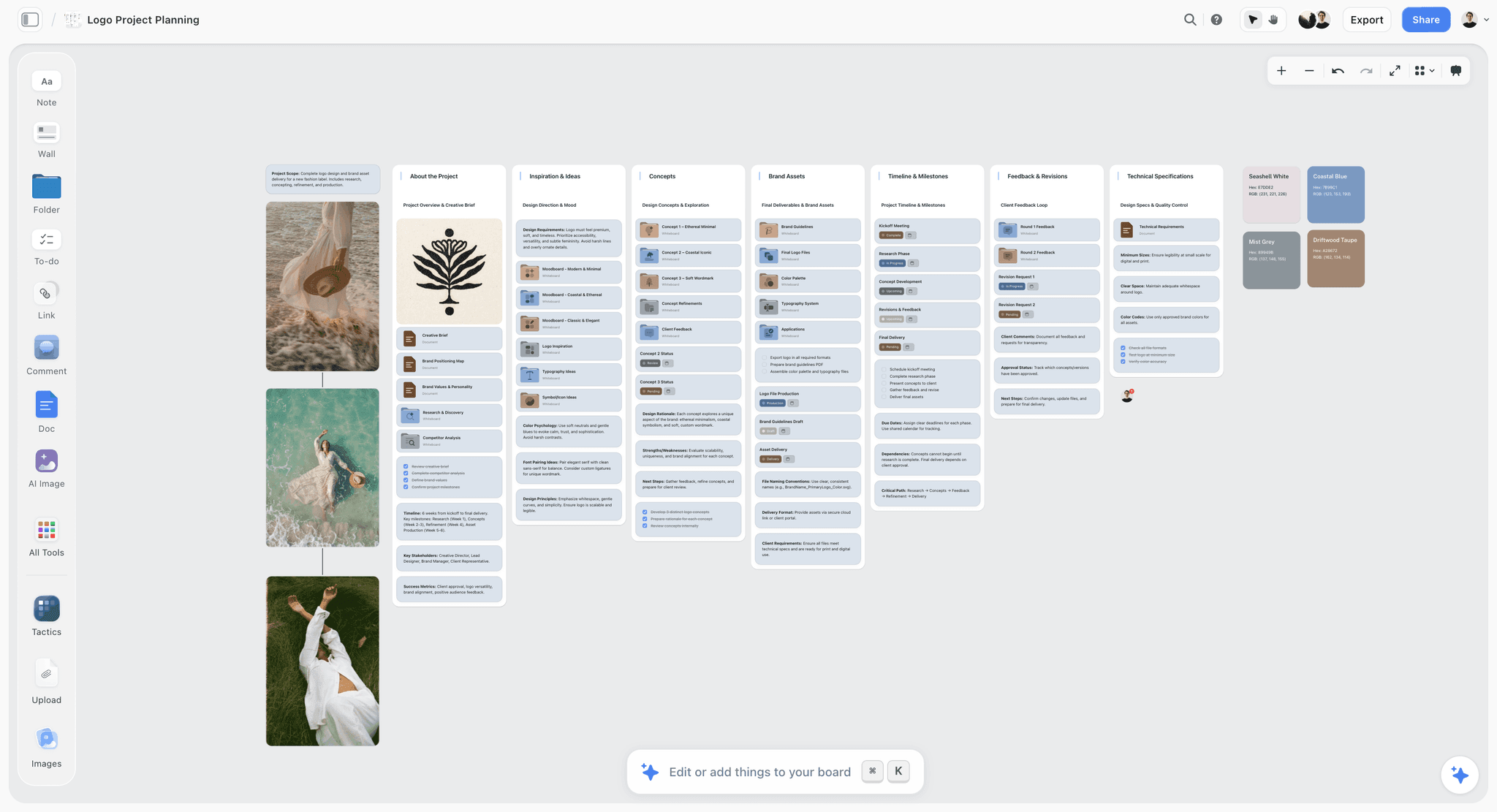
Storyflow is an infinite canvas where the whole GTM plan is laid out in gate order: the positioning statement, the segment definitions, the channel bets with their evidence, the launch sequence and the metrics that would prove each gate. Because it is spatial you can draw the dependency from the channel plan back to the positioning it assumes, which is the thing a document and a task board both lose. The AI reads the entire current board plus up to five attached documents and three other boards, so it can be asked whether the channel plan assumes a buyer the positioning never described. The AI project plan generator turns a scope note into a launch sequence on the same canvas.
Best for: Teams writing the plan, where the risk is a plan that looks complete and is internally inconsistent.
Verdict: The strongest tool here for making the gate sequence visible and checkable. It does not execute the launch and it measures nothing.
Key features
- Infinite canvas holding positioning, segments, channels, timeline and metrics together.
- AI reads the whole current board, plus 5 attached documents and 3 attached boards.
- 200+ story blueprints including messaging and campaign frameworks.
- Anyone a paid member invites to a board joins free, so the launch group can read the plan.
Pricing
Early access: every plan is paid for now. A Free plan arrives before the end of 2026, and anyone a paid member invites to a board can sign up free and collaborate today. Plus: $7.99/mo annual, $9.99/mo monthly. Unlimited boards and uploads. Pro: $14/mo annual, $19/mo monthly. AI image generation, more AI usage, memory across conversations. Max: $39/mo annual, $49/mo monthly. Team workspace with roles and permissions.
Pros
- Dependencies between gates are visible rather than implied.
- The AI can find a contradiction between two parts of your own plan.
- Readers do not need a seat, so the plan stays shared.
Cons
- No task management: no assignees, dependencies, workloads or due-date tracking.
- No CRM, no automation, no analytics and no channel data.
- Paid-only during early access.
2. Notion
Notion is where most GTM plans are written, and as a document layer it is excellent: the narrative, the segment profiles, the messaging, the launch checklist and the retrospective all in one searchable place that a client or an executive can be given access to.
Best for: The written plan that gets signed off, and the archive of previous launches.
Verdict: The best document home for a GTM plan. A linear document shows everything as equally important, which is exactly what obscures the gate order.
Key features
- Flexible documents and databases for plans, segments and checklists.
- AI search across the workspace and connected tools.
- Strong permissions and sharing for stakeholders.
Pricing
Free personal tier. Paid from about $10/user/month; AI is a separate add-on.
Pros
- Excellent final artifact and a genuinely useful archive.
- Bends to any plan structure you want.
- Searchable across every past launch.
Cons
- Linear pages flatten a dependency chain.
- Per-user pricing plus an AI add-on adds up across a launch team.
- Real maintenance tax on a large workspace.
3. Asana
Asana is the strongest execution layer for a cross-functional launch, because dependencies and timelines are first-class rather than bolted on. When the plan becomes a hundred tasks owned by five teams with a hard date, this is the category and Asana leads it.
Best for: Running the launch once the plan is settled.
Verdict: The best cross-team execution tool here. It tracks the plan faithfully and cannot tell you the plan is wrong.
Key features
- Task dependencies, timelines and workload views.
- Portfolios for tracking several workstreams at once.
- AI status summaries and smart rules.
Pricing
Free for up to 10 users with basic features. Paid from about $11/user/month.
Pros
- Dependencies and timelines handled properly.
- Scales cleanly across several teams.
- Genuinely useful free tier for a small launch.
Cons
- Per-user pricing across a cross-functional group gets expensive.
- Setup effort is real before the first useful view.
- A task list cannot represent gate order.
4. Monday.com
Monday.com is the more visual execution tracker, and marketing teams in particular tend to prefer it to Asana because a colour-coded board reads faster in a status meeting. The trade is less rigour on dependencies.
Best for: Marketing-led launches where the board is read by non-project-managers.
Verdict: The most readable execution tracker. Weaker than Asana on genuine dependency chains.
Key features
- Highly visual boards with timeline and calendar views.
- Automations and integrations across the stack.
- AI blocks for summarising and drafting inside items.
Pricing
Free for up to 2 users. Paid from about $9/user/month with minimum seat tiers.
Pros
- Fastest to read in a status meeting.
- Strong automation without a developer.
- Flexible enough to hold a launch of any shape.
Cons
- Minimum seat tiers inflate the real price.
- Dependency handling is thinner than Asana's.
- Visual flexibility invites boards that nobody maintains.
5. HubSpot
HubSpot is where gate three gets measured for most companies: the CRM, the forms, the email, the attribution and the funnel reporting in one place, with a free CRM tier that a great many launches start on.
Best for: Measuring whether the market converts, with marketing and sales in one system.
Verdict: The strongest gate-three tool here. Its pricing curve above the free tier is the steepest in this comparison.
Key features
- Free CRM with contacts, deals and forms.
- Marketing automation, email and landing pages on paid tiers.
- Funnel and attribution reporting.
Pricing
Free CRM. Paid from about $20/month, rising steeply with contact tiers and seats.
Pros
- The free CRM is a real product and a common launch starting point.
- Marketing and sales data in one place, which is where attribution arguments end.
- Mature reporting that survives scrutiny.
Cons
- Price escalates sharply with contact volume.
- Higher tiers can require paid onboarding.
- Heavy for a pre-launch team that has no contacts yet.
6. Miro
Miro is the standard surface for the workshops GTM planning runs on: positioning sessions, journey mapping, segment definition. Its AI clustering shortens the affinity-mapping hour that follows any research readout.
Best for: The live sessions where gate one gets argued out.
Verdict: The best workshop tool here. Boards sprawl afterwards, so the plan rarely lives there past the session.
Key features
- Infinite canvas with a deep GTM and journey template library.
- AI clustering and summarisation.
- Strong real-time multiplayer.
Pricing
Free with 3 editable boards. Paid from about $8/user/month.
Pros
- The best real-time workshop experience available.
- Huge library of GTM and journey templates.
- AI clustering saves the worst hour of a readout.
Cons
- Large boards become hard to navigate rather than easy to read.
- Three-board free cap is restrictive.
- Built for sessions, not for holding a plan over a quarter.
7. Airtable
Airtable is the right answer when a launch has many moving parts that relate to each other: assets linked to channels linked to segments linked to dates. A relational base holds that where a flat board cannot.
Best for: Launches with a large asset matrix across several channels and segments.
Verdict: The best relational launch tracker. It requires you to design the schema before it is useful, which is real setup cost.
Key features
- Relational tables linking assets, channels, segments and owners.
- Interfaces for giving stakeholders a readable view.
- AI fields and automations.
Pricing
Free with record limits. Paid from about $20/user/month.
Pros
- Handles many-to-many relationships properly.
- Interfaces give non-editors a clean read-only view.
- Automations reduce manual status chasing.
Cons
- Schema design up front, before the plan is stable.
- Per-user pricing at team scale.
- Becomes a database project if nobody owns it.
8. Productboard
Productboard captures customer feedback and clusters it against features and segments, which makes it an unusually direct gate-one input: it can show you what buyers actually say they need, in their words, at volume.
Best for: Tying positioning back to evidence from real customers.
Verdict: The best feedback-to-positioning link here. It is priced for a product organisation, not a founder.
Key features
- Feedback capture from multiple channels with AI clustering.
- Feature and segment prioritisation.
- Roadmap views for stakeholders.
Pricing
Trial only, then from about $19/user/month per maker seat.
Pros
- Grounds positioning in what customers said rather than what the team assumes.
- AI clustering over a large feedback corpus genuinely works.
- Good stakeholder-facing roadmap views.
Cons
- No free tier.
- Priced per maker seat, which adds up in a product team.
- Overkill before there is a real feedback volume.
9. PostHog
PostHog answers gate four: did the people you acquired activate, and did they stay. A million events a month free including session replay and feature flags is more than most launches generate, which makes it the cheapest serious answer to the most expensive question.
Best for: Knowing whether a launch produced retention or only a spike.
Verdict: The best gate-four tool here and the best value in the whole stack. Install before the launch, not after.
Key features
- Product analytics with a million free events monthly.
- Session replay, feature flags and experiments included.
- Funnels and retention cohorts.
Pricing
Free to 1m events per month. Usage based above that.
Pros
- Free allowance covers most launches outright.
- Replaces several paid tools in one product.
- Retention cohorts are the number that actually matters post-launch.
Cons
- Large surface area takes time to learn.
- Must be installed before the launch to be useful.
- Usage pricing can surprise after a traffic spike.
10. Attio
Attio is an AI-native CRM that enriches records automatically, which makes it usable at the stage where a full HubSpot deployment is not justified. For an early GTM motion it covers gate three with almost no configuration.
Best for: Early pipeline, before a full marketing platform is warranted.
Verdict: The best lightweight gate-three tool. It manages the pipeline and does not tell you whether the pipeline shape is right.
Key features
- Automatic contact and company enrichment.
- Research agents that fill fields from the web.
- Flexible data model and reports.
Pricing
Free tier for small teams. Paid from about $29/user/month.
Pros
- Useful on day one with no setup.
- Enrichment removes the worst of CRM hygiene.
- Free tier genuinely covers an early motion.
Cons
- Per-user pricing rises quickly with a sales team.
- No marketing automation or email sending.
- Another system to keep in sync.
11. Semrush
Semrush provides the one piece of gate-two evidence you can get before launching: whether measurable demand exists for the thing you are describing, and in what words. That is a weaker signal than a real channel test and a much cheaper one.
Best for: Sizing search demand and finding the language a category already uses.
Verdict: The most useful pre-launch channel evidence. Priced for an agency or a funded team.
Key features
- Keyword volume, difficulty and intent data.
- Competitor traffic and content analysis.
- AI content and topic tools.
Pricing
Trial only, then from about $140/month; seats cost extra.
Pros
- Real numbers that survive a leadership meeting.
- Reveals the words buyers use unprompted, which is gate-one evidence too.
- Strong competitive visibility data.
Cons
- The most expensive tool here for a small team.
- Seats and add-ons push the real price well above the headline.
- Search demand is one channel, not the market.
12. Linear
Linear belongs in a GTM stack for one specific reason: launch dates slip because the product is not ready, and Linear is where that truth lives. A GTM plan that cannot see engineering reality is a plan with a fictional date.
Best for: Knowing whether the thing you are launching will exist on the day.
Verdict: The best product-readiness signal in a GTM stack. It is not a GTM tool and should not be asked to be one.
Key features
- Fast issue tracking with cycles and projects.
- Roadmap views that stay honest about scope.
- AI triage and duplicate detection.
Pricing
Free up to 250 issues. Paid from about $8/user/month.
Pros
- The honest source of truth on launch readiness.
- Fast and low-ceremony for engineering.
- Usable free tier at small scale.
Cons
- Software-shaped, so marketing work fits badly.
- Not a GTM planning tool in any sense.
- Requires an engineering team to mean anything.
7) Why Most GTM Plans Fail at Gate One
A positioning failure never announces itself. It arrives disguised as a channel problem, then as a conversion problem, then as a sales problem, and the team fixes all three.
This is the single most expensive pattern in go-to-market, and it is worth walking through in its usual form.
A team launches. The channel underperforms: the ads have a poor click-through rate, the content does not rank, the outbound reply rate is a third of the benchmark. The obvious reading is that the channel was wrong, so they switch channels. The new channel also underperforms. Now the reading is that the landing page is weak, so they rewrite it, and conversion moves from 0.4% to 0.5%. Then it is the offer, so they add a free trial. Then it is the sales follow-up, so they add a sequence.
Four months and four fixes later, the actual defect is that a buyer reading the headline cannot tell what the product is or which of their problems it solves. Every downstream metric was correctly reporting that fact, and every one of them was read as a local failure.
The diagnostic is cheap and almost nobody runs it. Show the positioning, one sentence and nothing else, to ten people in the target segment who have never heard of you. Ask two questions: what does this do, and who is it for. If fewer than seven of the ten can answer both roughly correctly, gate one is not clear and no amount of channel work will fix it. That test costs an afternoon and it is the highest-return hour in the entire GTM process.
The reason it goes unrun is partly cultural and partly tooling. Positioning looks finished once it is written down, and once it is a completed line item in a plan it stops being a question. A flat task list actively encourages this, because "positioning" and "landing page" appear as two tasks of equal weight, both marked done, with no representation of the fact that one is load-bearing for the other.
So the tooling requirement is specific and modest: the plan has to show that gate two rests on gate one. That is a spatial relationship, which is why a canvas handles it and a document and a board do not. Draw the channel plan hanging off the positioning it assumes, and the month-four question ("which gate are we failing") becomes a thing you can look at rather than argue about.
A model that can read the whole board helps here in a way that is worth being precise about: it is not generating your positioning, which would return the category average. It is checking whether the segment your channel plan targets is the segment your positioning describes. Those are frequently different, the difference is invisible in prose, and it is obvious the moment something compares the two.
8) What Belongs in a Go-to-Market Plan
Most GTM templates are too long and the length hides the load-bearing parts. A plan that fits on one board and answers these questions is more useful than a thirty-page document.
Gate 1, comprehension.
- One sentence: what this is and who it is for.
- The segment, defined by a behaviour or a situation rather than a demographic.
- The problem in the buyer's own words, taken from something they actually said.
- What this explicitly is not, which is what stops the messaging drifting.
Gate 2, reach.
- Two or three channel bets, not eight.
- For each, the evidence that the segment is actually there.
- For each, what a fair test looks like and what result would kill it.
- The sequence: which channel is tried first and why.
Gate 3, conversion.
- The offer and the price.
- The path from first contact to purchase, with the number of steps counted.
- The objection you expect most, and where it is handled.
Gate 4, economics.
- Activation: what a customer must do in week one for this to have worked.
- Retention and payback assumptions, stated as numbers you will check.
- The point at which you would stop.
Across all four.
- The date, and what has to be true for it.
- Owners, one per gate.
- The metric that would prove each gate passed, decided before launch rather than after.
The discipline that makes this work is writing the falsifying condition next to each bet, because a plan without falsifying conditions cannot be wrong, and a plan that cannot be wrong cannot teach you anything when it underperforms.
9) Recommended GTM Stacks
Stack 1: Solo founder launching. Storyflow (the plan) + HubSpot free CRM (gate 3) + PostHog free (gate 4) + Google Trends (gate 2 direction). About $8/month.
Stack 2: Seed-stage team of six. Storyflow (the plan, readers join free) + Asana (execution) + HubSpot (gate 3) + PostHog (gate 4). About $95/month plus contact tiers.
Stack 3: Marketing-led launch in a larger company. Miro (workshops) + Storyflow (the plan) + Monday.com (execution) + existing CRM and analytics. About $65/month plus what is already paid for.
Stack 4: Product-led launch. Storyflow (the plan) + Linear (readiness) + PostHog (activation and retention) + Productboard (feedback to positioning). About $85/month.
Stack 5: Zero-budget launch. FigJam or Miro free boards (the plan) + HubSpot free CRM + PostHog free + Notion free. Genuinely zero, and it covers all four gates adequately.
| Launch shape | Holds the plan | Runs the launch | Measures the gates | Monthly cost |
|---|---|---|---|---|
Solo founder | Storyflow | Storyflow | HubSpot free, PostHog free | about $8 |
Seed team of six | Storyflow | Asana | HubSpot, PostHog | about $95 plus contacts |
Marketing-led | Miro, Storyflow | Monday.com | Existing stack | about $65 plus existing |
Product-led | Storyflow | Linear | PostHog, Productboard | about $85 |
Zero budget | FigJam free | Notion free | HubSpot free, PostHog free | $0 |
The pattern across all five: one surface that holds the plan and shows its dependencies, one tool that runs the tasks, and one measurement per gate. The stacks that fail are the ones where the plan and the execution are the same flat list, because then nothing ever shows which gate is failing.
10) What a GTM Stack Costs
Three cost drivers, and the first one is specific to GTM.
Seat count, because GTM is the most cross-functional plan a company writes. Product, marketing, sales, support and often finance all need visibility. At six people an $11 per-seat execution tool is $66 a month, and HubSpot on a real contact tier can exceed that several times over. The subtle damage is not the money: it is that per-viewer pricing makes sharing the plan expensive, so teams share it less, so the plan stops being a shared object and becomes an announcement. Prefer tools where reading is free. Storyflow's individual plan is per account and invited collaborators join free.
Contact tiers, which is how marketing platforms actually price. HubSpot's headline number is not what a growing list costs. Model the price at the contact volume the launch is supposed to produce, because succeeding is what triggers the increase.
The tool bought for the launch and kept forever. Every launch adds a tool and almost no launch removes one. The honest post-launch exercise is to cancel the ones that were launch-specific, and the reason it rarely happens is that nobody owns the subscription list.
| Cost driver | Tools affected | What it does | The move |
|---|---|---|---|
Cross-functional seats | Asana, Monday.com, Notion, Airtable | Multiplies across five teams | Keep reading free; pay only for editors |
Contact tiers | HubSpot | Rises as the launch succeeds | Model at target volume, not today's |
Launch-only tools | Semrush, Productboard, Glimpse | Kept long after the launch | Review subscriptions 60 days post-launch |
The plan surface | Storyflow, Miro, FigJam | Under $10/mo | Underspending here is the common error |
11) Honorable Mentions
- ClickUp. A capable all-in-one if you would rather have one tool for plan and execution, at the cost of focus.
- Pitch and Gamma. For the GTM deck that goes to leadership or the board.
- Amplitude. PostHog's enterprise-grade rival for gate-four product analytics.
- Clay. Outbound research and enrichment once gate two is a real outbound motion.
- Dovetail. A research repository for the customer interviews gate one depends on.
- Google Trends. Free, and the fastest sanity check on whether category demand is rising.
- Common Room and Pocus. Signal-based GTM tooling for teams past product-market fit.
- Notion's GTM templates. A reasonable free starting structure if you want a document rather than a canvas.
12) Tools to Avoid for GTM Planning
- A flat task list as the plan itself. It represents parallel work, and GTM is a dependency chain. This is the single most common tooling error in the category.
- A marketing automation platform bought before the plan exists. You will configure a funnel for a positioning you have not tested.
- Eight channels in the plan. Two or three tested properly beats eight attempted, and a tool that makes it easy to add channel swimlanes encourages the error.
- A GTM template longer than the team will read. Thirty pages guarantees that the load-bearing sentence is buried.
- Any tool that charges per viewer for the plan. It quietly reduces how many people see it, which is the opposite of what a GTM plan is for.
- Separate tools for the plan and the evidence. If the channel evidence lives somewhere the positioning is not, nobody will ever compare them, and comparing them is the whole gate-one diagnostic.
14) The Bottom Line
The best go-to-market planning tools in 2026 are the ones that show the plan as a sequence rather than a list. Storyflow is the best pick for building the plan, because the gate dependencies are visible and the AI reads the whole board. Asana is the strongest execution layer once the plan becomes tasks. Notion is the best written artifact. HubSpot and PostHog measure gates three and four.
A positioning failure never announces itself; it arrives as a channel problem, then a conversion problem, then a sales problem, and teams fix all three. Run the ten-person comprehension test before you spend a month on channels, write a falsifying condition next to every bet, and keep the plan somewhere the whole launch group can read without buying a seat.
To start, open a Storyflow canvas, lay out the four gates in order with your channel plan hanging off the positioning it assumes, and ask the AI whether the two describe the same buyer.
FAQ: Go-to-Market Planning Tools
What is the best go-to-market planning tool in 2026?
Storyflow is the best go-to-market planning tool for building the plan, because the positioning, segments, channel bets and launch sequence sit on one canvas with their dependencies visible, and the AI reads the whole board, so it can tell you that your channel plan assumes a buyer the positioning never described. It starts at $7.99/month billed annually and anyone a paid member invites to a board joins free. Asana is the strongest tool for running the launch once it becomes tasks across several teams, Notion is the best home for the written plan, and HubSpot is where conversion actually gets measured. The mistake to avoid is using a flat task list as the plan, because a task list shows parallel work and go-to-market is a dependency chain.
What should a go-to-market plan include?
One sentence saying what this is and who it is for, the segment defined by behaviour rather than demographics, the problem in the buyer's own words, two or three channel bets with the evidence that the audience is there, the offer and price, the activation and retention assumptions, the date, an owner per area, and the metric that would prove each part worked. Critically, write the falsifying condition next to each bet: a plan that cannot be wrong cannot teach you anything when it underperforms.
Is Notion or Asana better for go-to-market planning?
They do different jobs and most teams end up with both. Notion is the better home for the written plan, the segment profiles and the archive of past launches. Asana is the better execution layer once the plan becomes a hundred tasks with dependencies and a hard date. Neither shows the gate order well, which is why the thinking usually happens on a canvas first and lands in one of them afterwards.
What is the best free go-to-market planning tool?
FigJam or Miro's free boards for the plan itself, HubSpot's free CRM for the pipeline, PostHog free to a million events for activation and retention, and Notion's free personal tier for the written document. That combination genuinely covers all four gates at zero cost. Storyflow is paid-only during early access so it is not part of a free stack today; its Free plan launches before the end of 2026 and anyone a paid member invites to a board joins free right now.
How do I know if my positioning is the problem?
Run the ten-person test. Show one sentence, the positioning and nothing else, to ten people in the target segment who have never heard of you, and ask what it does and who it is for. If fewer than seven answer both roughly correctly, gate one is not clear and no channel work will fix it. A positioning failure shows up downstream as weak click-through, poor conversion and unhappy salespeople, which is why teams usually fix three things that were not broken first.
Can AI write a go-to-market plan?
It can produce a plan-shaped document quickly, and that is genuinely useful as a starting structure. What it cannot do is know which of your bets is load-bearing, because that depends on your specific evidence. The valuable use of AI here is checking rather than generating: given the whole plan in context, asking whether the channel plan targets the segment the positioning describes will frequently surface a contradiction that reads as invisible in prose.
What is the difference between a GTM strategy and a GTM plan?
The strategy is the decision: who you are for, what you are to them, and which bets you are making. The plan is the sequence and the owners that turn that into activity with dates. Teams commonly write the plan and skip the strategy, which produces a very detailed schedule for reaching a market nobody has confirmed understands the product.
How many channels should a go-to-market plan have?
Two or three, tested properly, with a stated result that would kill each one. Eight channels attempted at once produces eight underpowered tests and no learning, because none of them ran long enough or hard enough to produce a signal. The sequence matters more than the count: run the channel whose failure would teach you most first.
What tools do product-led companies use for GTM?
Typically Linear for readiness, PostHog or Amplitude for activation and retention, Productboard for feedback back into positioning, and a lightweight CRM such as Attio for the sales-assisted motion that appears once there are larger accounts. The plan itself usually lives in a document or a canvas, and a canvas handles the gate dependencies better.
When should I start planning go-to-market?
Before the product is finished, and specifically before the last month of building, because gate one frequently changes what you build. A positioning test that fails in month two of development changes the roadmap cheaply, and the same failure discovered after launch changes it expensively.
How do I keep a GTM plan from going stale?
Put the metric that would prove each gate next to the bet, and review against those rather than against task completion. A plan goes stale because status meetings report activity, which is always green, rather than evidence, which is not. Keeping the plan on one visible surface makes reviewing the whole chain a five-minute exercise instead of a meeting.
What is the cheapest go-to-market stack?
Storyflow at $7.99/month billed annually for the plan, HubSpot's free CRM for pipeline and PostHog's free tier for retention. Under ten dollars a month covers all four gates adequately for a solo founder or a very small team. A genuinely zero-cost version swaps Storyflow for FigJam's free boards, which keeps the visible-at-once property and loses the AI that reads the whole board.
Who should own the go-to-market plan?
One person, and usually not the person running the launch. Ownership of the plan means owning whether the gates are being tested honestly, which conflicts with owning delivery of the launch on the date. In small companies the founder holds the plan and someone else holds the schedule; when both sit with the same person, the date tends to win.
How do I present a GTM plan to leadership?
Lead with the gate that carries the most risk rather than with the timeline, because the timeline invites a scheduling conversation and the risk invites a useful one. Show the evidence for gate one first, the channel bets and their falsifying conditions second, and the date last. A plan walked through on a visible board tends to get better questions than a deck, because the dependencies are in front of people rather than asserted.
Table of Contents
- Article Metadata
- Breadcrumb
- Table of Contents
- 1) Quick Answer: The Best Go-to-Market Planning Tools in 2026
- All 12 Go-to-Market Planning Tools, Ranked
- 2) Comparison Table: 12 GTM Planning Tools at a Glance
- Frequently Asked: Which GTM Tools Teams Trust, and Which Ones Hide the Plan
- 3) The Four Gates
- 4) How We Evaluated These Tools
- 5) Quick Picks by GTM Need
- 6) Detailed Reviews: 12 Go-to-Market Planning Tools
- 7) Why Most GTM Plans Fail at Gate One
- 8) What Belongs in a Go-to-Market Plan
- 9) Recommended GTM Stacks
- 10) What a GTM Stack Costs
- 11) Honorable Mentions
- 12) Tools to Avoid for GTM Planning
- 14) The Bottom Line
- 15) Author
- 16) Related Reading
- FAQ: Go-to-Market Planning Tools
Templates to check out for this topic


Templates you can use in Storyflow
Every Storyflow board starts from real structure and an AI that reads the whole canvas. Open one of these templates and make it yours.


See Storyflow in Action
A visual AI workspace where every feature lives inside one canvas. No tab-switching, no context lost.
Build your entire board from a single message
Type what you need in the AI chat at the bottom of your canvas. The AI adds cards, headings, and structure directly onto your board.
Use expert frameworks as AI context
Type @ in the AI chat and choose any Tactic. The AI tailors every response to that framework instead of giving generic advice.
Turn your board into a mind map in seconds
Ask the AI to restructure your canvas as a mindmap. It connects your ideas into a visual hierarchy so you can see how everything relates.
Why Storyflow Exists
Storyflow actually began as a personal tool while working on creative and research projects.
We kept running into the same problem: ideas were scattered everywhere: notes, documents, and whiteboards.
Nothing helped us see how everything connected.
So we started building a workspace designed around how ideas actually grow.
→ Read how Storyflow was createdStoryflow Team
Product & Research Team
Published: 2026-09-22
Extremely simple, seriously capable


See how easy it is to get started
Watch a real project come together, from a blank board to a finished plan, clicked through step by step.
Start creating with AI and become more productive
Transform your creative workflow with AI-powered tools. Generate ideas, create content, and boost your productivity in minutes instead of hours.