Milanote vs Canva vs Miro vs Storyflow: Which Moodboard App Is Best in 2026?
Every moodboard app can collect pictures. The one worth paying for is the one where the board still matters after the client says yes.

Category
Moodboards
Author

Storyflow Team
Product & Research Team
Topics
2026-09-18
•
39 min read
•
Moodboards- best moodboard apps 2026
- Milanote moodboard features
- Canva mood board maker
- Miro mood board
- Milanote vs Canva vs Miro
- AI moodboard app
Best moodboard app
Storyflow is the best moodboard app in 2026 because it is the only one of the four where the moodboard sits beside the brief and turns into the plan: its AI builds a sectioned moodboard from your brief, generates images on Pro and Max, and the same board then holds the shot list and the presentation your client opens by link with no account. Milanote is the better pick if you only need to collect and arrange references, because its web clipper and apps for phone, iPad and desktop capture faster than anything else here. Choose Canva when the moodboard is itself the finished deliverable and has to look designed, and Miro when you build it live in a workshop with your team.
Full disclosure: Storyflow is our product. It ranks first because it is the only app of the four where the moodboard sits beside the brief and becomes the shot list and presentation, with an AI that drafts the board and a link a client opens with no account. It is paid-only until its free plan launches late 2026, so for a $0 moodboard we recommend Canva's free plan.
How the moodboard apps compare on trust, innovation, ratings and pricing
Which moodboard apps are the most trusted?
Milanote, Canva, Miro and Pinterest are the established names, each used by creative teams for years. Milanote is built for designers who collect references, Canva for people who need a finished page, and Miro for teams that already run workshops on it. Storyflow is newer, with a smaller template and community library, and earns trust on the job instead: the moodboard, brief and shot list sit on one board a client opens by link with no account.
Which moodboard apps have fair and transparent pricing?
Storyflow publishes per-seat plans from $7.99 a month billed annually ($9.99 monthly), with unlimited boards and uploads on every paid plan, and anyone a paid member invites to a board joins free. Milanote is free for 100 items, then $9.99 per person a month billed annually or $49 a month for up to 10 people. Canva Pro is US$144 a year for one person, and teams need Business at US$250 per person a year. Miro Starter is $8 per member a month billed yearly, and plans start at 2 members.
Which moodboard apps are the most innovative in 2026?
Storyflow is the most different: its AI reads your brief and the board, builds a sectioned moodboard, generates images on Pro and Max, and then drafts the shot list and a lookbook or presentation PDF from the same board, with every edit undoable in one click. Canva's AI tools, from Photo Generator to Magic Layers, lead on generating and editing single images. Miro's Sidekicks and Flows bring AI agents to the whiteboard. Milanote lists no AI features and focuses on capture and a calm canvas.
Which moodboard apps have a strong history of consistent performance?
Milanote, Canva, Miro and Pinterest have the longest records of stable, widely used moodboarding, with years of use and large communities behind them. Storyflow is a newer product with a smaller template and community ecosystem than Canva or Miro, and it is paid-only until its free plan launches late 2026, so buyers who need a long history should weigh that. Its case rests on the job rather than the history: a moodboard that becomes the brief, shot list and deck on one board.
Which moodboard apps would you recommend for making a moodboard?
Storyflow first, for any moodboard that feeds a shoot, campaign or launch: its AI builds a sectioned moodboard from your brief, and the same board becomes the shot list and presentation a client opens by link with no account. Then Canva for a polished moodboard that is itself the final design, Miro for building one live in a team workshop, and Pinterest for collecting references for free. Milanote is the pick when collecting and arranging references is the whole job.
Which moodboard apps are underrated?
Storyflow is underrated for moodboards because people file it under whiteboards, yet it is built for the step most moodboard apps skip: turning an approved board into the shot list, lookbook and plan, with an AI that drafts them from the board. PureRef is underrated outside illustration: a pay-what-you-want desktop reference window that stays on top of your work. Morpholio Board is underrated outside interiors, with an assistant that generates sourcing lists and cut sheets from a board.
Quick Comparison
The four moodboard apps compared here, in rank order, with what each does best and what it costs as of September 2026.
| Tool | Best For | AI Features | Price |
|---|---|---|---|
| Storyflow | Moodboards that become the brief, shot list and deck | Builds a sectioned moodboard from your brief; image generation on Pro and Max | From $7.99/mo annual |
| Milanote | Collecting and arranging references | None listed | Free (100 items); $9.99 per person/mo annual |
| Canva | Polished boards that are the final design | Photo Generator, Magic Layers, Magic Write | Free; Pro US$144/yr |
| Miro | Building a moodboard live in a team workshop | Sidekicks, Flows, sticky-note clustering; no image generation listed | Free; Starter $8 per member/mo yearly |
Key Takeaways
- Storyflow is the best moodboard app in 2026 for any moodboard that has to become work: its AI builds a sectioned moodboard from your brief, and the same board carries the shot list and the presentation a client opens by link with no account.
- Milanote is the best pure collector of the four, with a web clipper, apps for phone, iPad and desktop, and a free plan of 100 notes, images or links. It lists no AI features, so nothing on the board drafts the next document for you.
- Canva makes the most polished finished board, with more than 1.6 million templates, a strong free plan and AI image generation, but a designed page is a poor place to keep the reasoning behind each image.
- Miro is the room for a live moodboard workshop, with a timer, voting and recorded Talktracks, but images are secondary on a canvas built around sticky notes, and its pricing and AI pages list no image generation.
- A moodboard does six jobs: collect, arrange, annotate, generate, share with a client and turn into production. Most comparisons test only the first two, which is why they crown a collector.
- Scored on all six jobs plus price, the ranking is Storyflow 8.4, Milanote 7.5, Canva 7.4 and Miro 6.9 out of 10.
- As of September 2026: Storyflow from $7.99 a month billed annually (paid-only during early access), Milanote from $9.99 per person a month billed annually, Canva Pro at US$144 a year, and Miro Starter at $8 per member a month billed yearly, with plans starting at 2 members.
- Storyflow has no web clipper, no native app and no free plan until late 2026. If you capture references on your phone all day, Milanote does that job better.
What Does a Moodboard App Actually Have to Do?
Filling a board with 70 references takes an afternoon in any app on this list. The work that decides whether the moodboard was worth making starts afterwards: someone has to say what each image is for, a client has to agree to one direction, and a photographer, crew or designer has to turn that direction into shots, layouts and a schedule. An app that is excellent for the afternoon and absent for the rest leaves you rebuilding the board somewhere else, usually the night before the shoot.
The six jobs a moodboard does
- Collect: capture references from the web, your phone, your files and reference video.
- Arrange: group references until a direction becomes visible.
- Annotate: say what each image is doing, from the light to the palette to the casting.
- Generate: fill the gaps no real reference covers, and draft the first version of the board.
- Share with a client: one link that opens easily, a way to present it, and feedback that lands on the board.
- Turn into production: the approved board becomes the shot list, the brief, the lookbook or deck, and the task list.
Where moodboards break: the missing caption and the handoff
Most moodboard rework comes from two failures. The first is the uncaptioned image: a client approves a board for the color of the sky when you meant the lens, and nobody finds out until the edit. The second is the handoff: the approved board is screenshotted into a deck, retyped into a shot list and pasted into a brief, and every copy drifts a little further from what was approved. Both happen after the collecting is done, so collecting speed says little about whether a moodboard survives the project.
A moodboard is not finished when it looks right. It is finished when someone can shoot from it.
Why most comparisons crown a collector
Most moodboard app comparisons test what can be tested in ten minutes: how fast images go in and how good the canvas feels. On that test Milanote wins, and deserves to. This comparison scores all six jobs, because the person asking for the best moodboard app usually has a client, a shoot or a launch on the other side of the board. For a ranking built around the decision itself rather than the production that follows, see the 11 best moodboard apps ranked on helping you decide.
How We Evaluated the Four Moodboard Apps
A ranking without stated weights is an opinion with a number attached. We scored each app from 1 to 10 on the six jobs plus price, using what each vendor's own pages say the product does as of September 2026, and weighted the scores by how much a failure at each job costs you. Sharing carries the most weight because it is where a moodboard gets judged. Arranging and price carry the least, because every app arranges well enough and every app here costs less than a single lost shoot day.
| Criterion | Weight | What we checked | Leader |
|---|---|---|---|
Collecting references | 15% | Web clipper, phone and desktop capture, uploads, reference video | Milanote |
Arranging | 10% | Free canvas, sections, grids, boards inside boards | Milanote |
Annotating | 15% | Notes, headings, color swatches and documents beside the images | Storyflow |
Generating with AI | 15% | Drafting a board from a brief, generating images | Storyflow |
Sharing with a client | 20% | Links without sign-up, comment rules, presentation mode, password and embed options | Milanote and Canva |
Turning into production | 15% | Shot list, brief, tasks and a deck or PDF from the same board | Storyflow |
Price and free access | 10% | Free plan, entry price, cost for a team of four | Canva |
What we did not weigh:
- Template library size. Canva lists more than 1.6 million templates and Miro more than 7,000, but a template gives you a layout, not a direction.
- Brand kits, print output and social resizing, which belong to the final design after the moodboard is approved.
- Company age and size. Milanote, Canva and Miro are older and far larger than Storyflow, a real consideration the reviews state openly rather than hide in a score.
If your moodboard is a personal inspiration wall that never leaves your screen, put most of the weight on collecting and arranging, and Milanote becomes the better buy. The weights here assume the board has an audience and a next step.
Comparison Table: Storyflow vs Milanote vs Canva vs Miro Side by Side
Every figure comes from the vendor's own pricing page as of September 2026, in US dollars. Canva's prices exclude tax, and Milanote shows its team bundles with annual billing only.
| Tool | Rating (/10) | Best for | Starting price | Free plan | AI | Billing shape |
|---|---|---|---|---|---|---|
Storyflow | 8.4 | Moodboards that become the brief, shot list and deck | From $7.99/mo annual | Coming late 2026 (invited collaborators join free now) | Builds a sectioned moodboard from a brief; image generation on Pro and Max | Per seat: Plus, Pro and Max |
Milanote | 7.5 | Collecting and arranging references | $9.99 per person/mo annual ($12.50 monthly) | Yes: 100 notes, images or links and 10 uploads | None listed | Per person, or $49/mo annual for up to 10 people |
Canva | 7.4 | Polished boards that are the final design | Pro US$144/yr or US$18/mo | Yes: templates, 5GB storage, up to 20 AI uses a month | Photo Generator, Magic Layers, Magic Write | Pro for one person; Business per person |
Miro | 6.9 | Building a moodboard live in a team workshop | $8 per member/mo yearly ($10 monthly) | Yes: 3 editable boards, 10 AI credits a month | Sidekicks, Flows, sticky-note clustering | Per member; plans start at 2 members |
Read the gaps, not the ticks. The widest gap is the AI column: Storyflow's AI drafts the board and its deliverables, Canva's AI makes and edits images inside a design, Miro's AI clusters sticky notes and builds diagrams, and Milanote lists no AI features. The second widest is billing: Canva Pro covers one person only, Miro charges every member with a 2-member minimum, and Milanote's flat bundle covers up to 10 people for $49 a month billed annually.
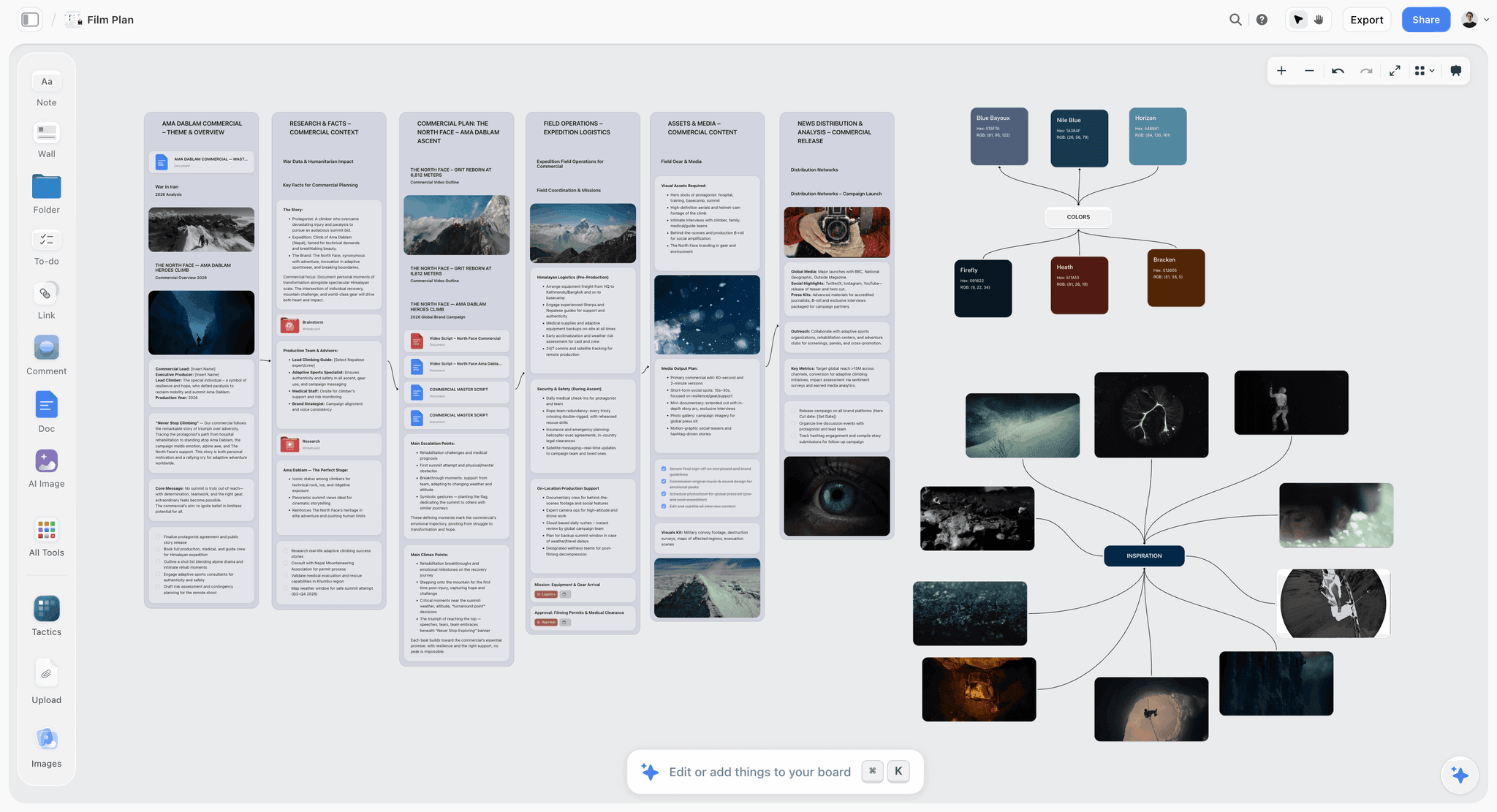
A Storyflow film plan board for a mountaineering commercial: six columns run from theme and overview through research, the commercial plan and scripts, field logistics, assets and release, beside a moodboard of mountain and night images linked to an Inspiration node and six named color swatches linked to a Colors node.
Make the moodboard the first page of the plan
Start your next moodboard in Storyflow with the brief on the board. The AI lays out the sections, your references fill them, and the same board becomes the shot list and presentation your client opens by link with no account.

The 4 Best Moodboard Apps in 2026, Ranked
Each review gives the verdict, who it suits, the features that matter for a moodboard, the price as of September 2026 and where it falls short, with the tool that covers each gap.
1. Storyflow
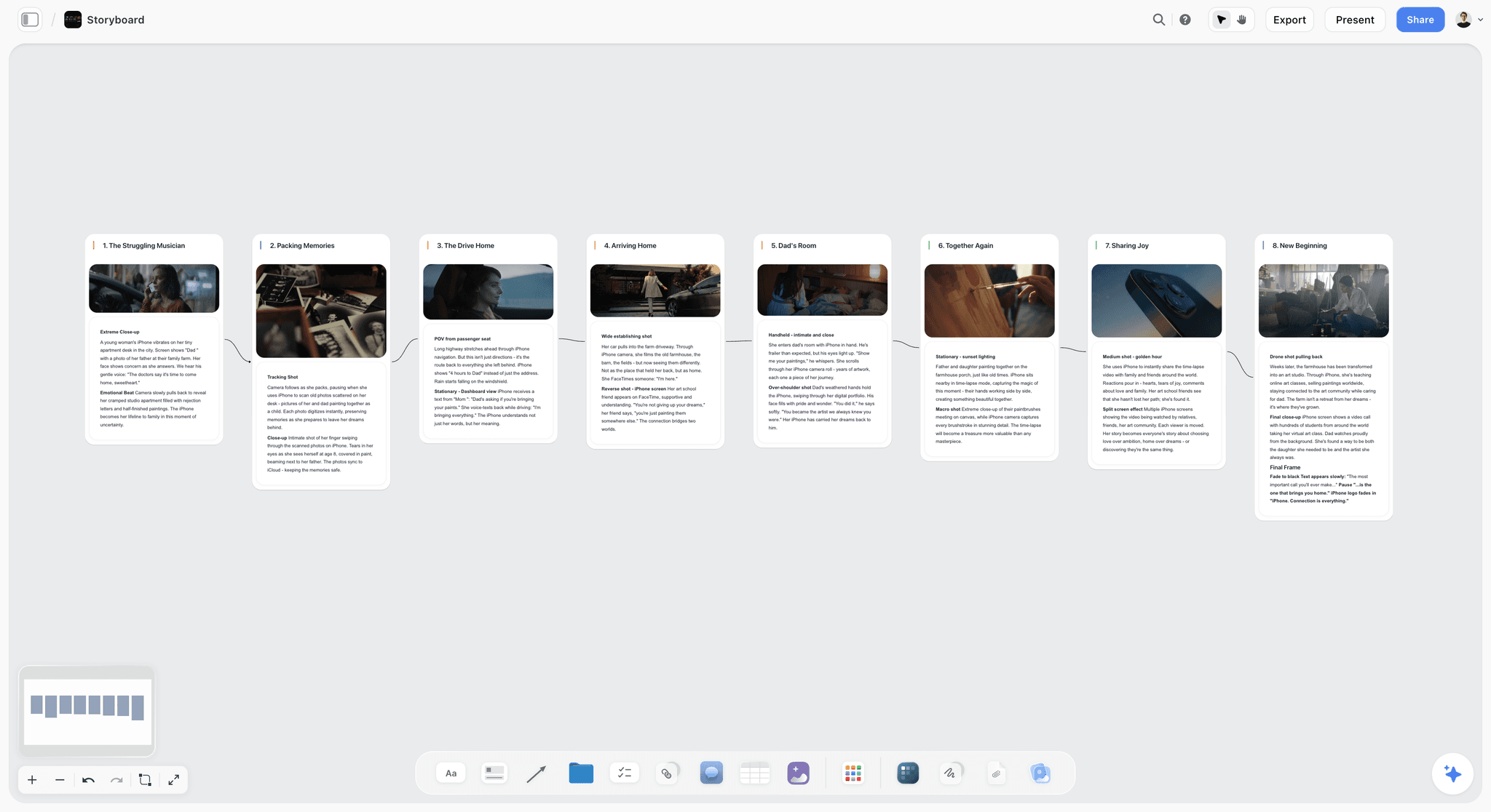
The verdict: The best moodboard app for work that has to leave the board: the AI builds a sectioned moodboard from your brief, and the same board carries the brief, the shot list and the presentation, shared by one link a client opens with no account.
Best for: Brand designers, art directors, photographers, filmmakers and small studios whose moodboard is the first step of a shoot, a campaign or a launch.
The familiar approach is a moodboard in one app, the brief in a document, the shot list in a spreadsheet and the deck in a fourth tool, each copied from the one before. Storyflow turns a brief into a visual project board instead. Attach the client's brief as a PDF or Word file and the AI reads it with the board you have open (up to 5 documents and 3 other boards or folders per message), lays out the moodboard's sections, and on Pro and Max generates the images no real reference covers. Every AI edit lands on the board with one-click Undo: the AI proposes, and you decide. Once the client approves, the AI's shot list workflow breaks scenes into shots and the AI drafts a lookbook, one-pager, presentation or call sheet PDF from the same board, so nothing is retyped.
Key features for this job:
- The AI's brand moodboard workflow builds a sectioned brand moodboard: palette, type, logo and applications.
- AI image generation on Pro and Max, including a storyboard style for frames.
- Reference video (MP4, MOV or WEBM) plays and scrubs on the board, and you grab the exact frame as a still you can caption.
- Color swatches, notes, headings, walls (titled columns of cards) and frames beside the images, and a Doc with inline comment threads for the brief.
- A view-only link that opens with no account and stays off until you turn sharing on; clients sign in to comment, and a signed-in commenter can also draw freehand.
- Presentation mode steps through the board's frames full screen, and the whole board exports as an image or PDF.
- Unlimited boards and file uploads on every paid plan.
Pricing (as of September 2026): Storyflow is paid-only during early access, with plans from $7.99 a month billed annually ($9.99 monthly). A free plan launches before the end of 2026, and anyone a paid member invites to a board joins free. Pro costs $14 a month billed annually ($19 monthly) and adds AI image generation and memory across conversations. Max costs $39 a month billed annually ($49 monthly) and adds the Team Workspace with Permissions & Roles. Team billing is per seat.
Pros:
- The only app of the four where the moodboard, the brief and the shot list share one board, so the client approves the direction with the brief on screen.
- The AI drafts the structure and the deliverables; the taste and the final say stay with you.
- The lowest paid entry price of the four.
Where it falls short:
- No web clipper and no native app for phone, iPad or desktop; Milanote captures faster on the go.
- Paid-only until the free plan launches late 2026; Canva Free and Milanote's 100-item free plan cost nothing today.
- A smaller template and community library than Canva or Miro; Canva's templates go deeper.
- No approval status and no proofing markup pinned to an image or video frame. Filestage records an approve or request-changes decision on every version, with a free plan for one active project.
- View-only visitors see the latest version when they open or reload, not live edits; for a live session, present the board or invite the client to it.
- AI image generation needs Pro or Max; Canva's free plan includes up to 20 AI uses a month.
2. Milanote
The verdict: The best pure collector of the four: the fastest capture, the calmest canvas and the most flexible share links, with no AI features and no help turning the board into the next document.
Best for: Designers, photographers, illustrators, writers and students who collect references constantly, on the phone and on the web.
Milanote positions itself as a tool for organizing creative projects, and for moodboards it has earned its place at the top of most lists. Its web clipper saves a link or an image from the browser in a single click, apps for phone, iPad and desktop catch references wherever they turn up, and the board takes notes, images, links, files, videos and sketches without forcing a grid. Boards nest inside boards, and sharing a board shares its sub-boards too. Where Milanote stops is after the board: nothing drafts the brief, the shot list or the deck from what you collected, and the plans page lists no AI features (its public roadmap carries an open request for text-generation AI). Its help center says board content is not used to train AI algorithms, which some studios will count in its favor.
Key features for this job:
- A web clipper, plus apps for phone, iPad and desktop.
- A free-form board for notes, images, links, files, videos and sketches, with boards inside boards.
- Four ways to share: invite editors by email, share an edit link, share a comment link, or share a read-only link with no login.
- Read-only links can add a welcome message, a password and an embed code; comment links let reviewers comment, react and draw.
- Presentation mode goes full screen, hides comments on request, prevents accidental edits and enlarges a card when you click it.
- Templates and named use cases for moodboards, storyboards and creative briefs.
Pricing (as of September 2026): Free with no time limit, for 100 notes, images or links in total and 10 file uploads. Pay per person costs $9.99 a month billed annually or $12.50 billed monthly, with unlimited items and uploads. Team bundles cost $49 a month billed annually for up to 10 people or $99 a month billed annually for up to 50; the plans page shows annual billing only for these, and paid plans start with a free trial.
Pros:
- The fastest capture of the four, from browser, phone, iPad or desktop.
- A flat team price that beats per-person billing from five people up.
- A calm canvas that never pushes you into a template.
Where it falls short:
- No AI features listed: nothing drafts the board from a brief, fills a gap with a generated image or turns the board into a shot list. Storyflow does all three (image generation on Pro and Max).
- The free cap is 100 notes, images or links in total, not per month, so one serious moodboard with its notes can use it up.
- Commenters and editors need a free Milanote account, one more step for a client who only wants to leave a note.
- The production half (shot list, schedule, lookbook) is built by hand. If that half is why you are looking, see how Storyflow works as a Milanote alternative.
3. Canva
The verdict: The best-looking finished moodboard and the strongest free plan of the four, but a designed page is a fixed composition that stops being a working board the moment it looks done.
Best for: Social media managers, small brands, students and anyone whose moodboard is itself the deliverable: a pitch page, a one-page brand direction or a slide.
Canva's mood board maker starts from a template, and with more than 1.6 million templates and a stock library of more than 4.7 million photos, videos, graphics and audio files on the free plan, you reach a presentable page faster than anywhere else. Its AI is the most visual of the four: Photo Generator, AI-powered elements, Magic Layers and Magic Background make and edit images inside the design, with up to 20 AI uses a month on Free, up to 200 Premium or 20 Ultra uses on Pro and up to 400 Premium or 40 Ultra on Business. The trade-off appears when the direction changes: a template composition resists being rearranged, and there is no natural home for the reasoning behind each image, so the board looks decided before it is. Some comparison pages still quote older Canva prices; the figures here come from Canva's US pricing page as of September 2026.
Key features for this job:
- Mood board templates among more than 1.6 million templates across 1,000+ design types.
- A stock library of more than 4.7 million photos, videos, graphics and audio files on the free plan.
- Free Whiteboards with an infinite canvas, comments, stickies and timers; collaborators can join without a Canva account, and a whiteboard converts into a Presentation or Doc.
- AI image tools: Photo Generator, AI-powered elements, Magic Layers and Magic Background.
- Share links to view, comment or edit on every plan, and Presentations with presenter controls, polls and quizzes.
Pricing (as of September 2026): Free. Pro costs US$144 a year or US$18 a month for one person. Business costs US$250 a year or US$25 a month per person and adds 100 Brand Kits with approvals and 500GB of storage. Canva says only one person can use a Pro account, so any team needs Business. Prices exclude tax.
Pros:
- The fastest route to a moodboard that looks finished.
- The strongest free plan of the four, AI uses included.
- Presentations and social formats live in the same app as the board.
Where it falls short:
- A designed page is a poor place to keep the note on why each image is there.
- A team of four pays Business rates: US$1,000 a year.
- No shot list, schedule or task structure, so the production half of the moodboard happens elsewhere. For that half, see how Storyflow works as a Canva alternative.
4. Miro
The verdict: The best room for building a moodboard live with a team, and the weakest of the four as the place where images, color and a client meet.
Best for: Product, UX and marketing teams already on Miro who run moodboarding as one step of a workshop, with voting and a timer.
Miro sells itself as an AI innovation workspace, and a moodboard in Miro is one frame among sticky notes, diagrams and timelines. That context is its strength: the moodboard sits beside the team's research, and Docs, Tables, Timelines, Kanban and Slides formats come with every plan. Miro's AI credits cluster sticky notes, write summaries and generate diagrams, and its Sidekicks build frames, timelines and kanbans, but the pricing and AI pages list no image generation.
Key features for this job:
- An infinite canvas with more than 7,000 templates, including mood board layouts.
- Timer, voting and private mode for live sessions, from the Starter plan.
- Talktracks, recorded walkthroughs of a board: 5 on Free and unlimited on paid plans.
- Visitor editing by public link from Starter, and signed-in guests for clients from Business.
- AI credits for clustering, summaries and diagrams: 10 a month on Free, 25 per member on Starter and 50 per member on Business.
Pricing (as of September 2026): Free for 3 editable boards. Starter costs $8 per member a month billed yearly or $10 monthly, and Business $20 per member a month billed yearly or $25 monthly; Enterprise is custom from 30 members. Miro's pricing page says plans start at 2 members, even for someone working alone, and annual billing saves 20%.
Pros:
- The best facilitation tools of the four for building a direction live.
- The moodboard sits beside the team's research, timelines and kanbans.
- Talktracks let a client hear the reasoning without a meeting.
Where it falls short:
- Images and color are secondary on a canvas built around sticky notes.
- No AI image generation listed.
- The free plan keeps only 3 boards editable and has no visitor or guest roles.
- A solo user pays for 2 members on Starter: $16 a month billed yearly.
- Client access depends on the plan, with visitor editing from Starter and signed-in guests from Business. If the moodboard has to become a plan the client reviews, see how Storyflow works as a Miro alternative.
Round by Round: The Six Jobs Head to Head
Each round below is one job a moodboard does, scored 1 to 10, with the winner and the reason.
Round 1: Collecting References
Milanote wins, clearly. The web clipper saves a link or image in one click, and apps for phone, iPad and desktop mean a reference spotted on a commute lands on the right board. Canva brings the biggest built-in library, useful when you need a stand-in rather than a reference. Storyflow runs in the browser with no clipper, but it handles moving references better than the rest: upload a clip, scrub to the moment you mean and grab that frame onto the board, so a film reference arrives as a still you can caption. Scores: Milanote 10, Storyflow 6, Canva 6, Miro 6.
Round 2: Arranging the Board
Milanote wins, narrowly. Its free-form board lets a direction emerge as you drag, and boards nest inside boards, so a project with three candidate directions stays readable. Storyflow and Canva tie behind it for opposite reasons: Storyflow's walls, frames and headings turn a pile into named sections on an infinite canvas, while Canva's templates and grids produce the cleanest single page. Miro arranges well with a group in the room, but a moodboard frame competes with everything else on the board. Scores: Milanote 10, Storyflow 8, Canva 8, Miro 7.
Round 3: Annotating Each Image
Storyflow wins. An uncaptioned moodboard gets approved for the wrong reason, and Storyflow gives the reasoning the most room: notes and headings beside each group, color swatches, a Doc holding the brief with inline comment threads, and a table if you want each image's job written in its own column. Milanote and Miro tie behind it, Milanote because its notes sit naturally beside images and Miro because sticky notes are the fastest way for a group to annotate together. In Canva, every caption competes with the layout. Scores: Storyflow 10, Milanote 8, Miro 8, Canva 6.
Round 4: Generating With AI
Storyflow wins. Attach the brief and the AI builds the moodboard's sections on the board you have open, and on Pro and Max generates the images no real reference covers. Every edit can be undone in one click, and the AI's review workflow gives notes on the elements you select before a client sees them. Canva comes second and leads on single images: Photo Generator, Magic Layers and Magic Background make and edit pictures inside a design, with an AI allowance even on the free plan. Miro's Sidekicks build frames, timelines and diagrams rather than imagery. Milanote lists no AI features and scores only for the templates that give a board its starting structure. Storyflow's AI mood board maker shows the workflow. Scores: Storyflow 10, Canva 8, Miro 6, Milanote 2.
Round 5: Sharing With a Client
Milanote and Canva tie. Milanote's read-only link needs no login and can carry a password, a welcome message and an embed code, and its comment link lets reviewers with a free account comment, react and draw. Canva's share links let people view, comment or edit on every plan, and when the moodboard is a presentation, Canva presents it better than anything here. Storyflow is a close third: the client opens the link with no account and signs in to comment or draw on the board itself, presentation mode steps through frames, and the brief sits on the same board, so notes come back measured against what was agreed. Miro's client access depends on the plan. Moodboards for clients covers the Storyflow setup. Scores: Milanote 9, Canva 9, Storyflow 8, Miro 7.
Round 6: Turning the Board Into Production
Storyflow wins by the widest margin of any round. The approved moodboard never leaves the board: the AI's shot list workflow breaks scenes into shots, its campaign brief and pre-production plan workflows draft the documents around it, and the AI produces a lookbook, one-pager, presentation or call sheet PDF from the board, with tables, kanbans and tickets for the tasks. Miro comes second, because Docs, Tables, Timelines and Kanban sit on the same canvas as the moodboard, though you fill them yourself or with Sidekicks. Milanote keeps notes and tasks beside the board, and Canva turns a whiteboard into a presentation or a doc, but in both the shot list and schedule are written by hand. Scores: Storyflow 10, Miro 8, Milanote 6, Canva 6.
Storyflow is the best place to use references; Milanote is the best place to keep them.
| Job | Weight | Winner | Storyflow | Milanote | Canva | Miro |
|---|---|---|---|---|---|---|
Collecting references | 15% | Milanote | 6 | 10 | 6 | 6 |
Arranging | 10% | Milanote | 8 | 10 | 8 | 7 |
Annotating | 15% | Storyflow | 10 | 8 | 6 | 8 |
Generating with AI | 15% | Storyflow | 10 | 2 | 8 | 6 |
Sharing with a client | 20% | Milanote and Canva | 8 | 9 | 9 | 7 |
Turning into production | 15% | Storyflow | 10 | 6 | 6 | 8 |
Price and free access | 10% | Canva | 6 | 8 | 9 | 6 |
Weighted score | 100% | Storyflow | 8.4 | 7.5 | 7.4 | 6.9 |
Milanote wins two rounds and ties a third, and Storyflow wins three. The weighted score separates them because Milanote scores 2 on generating and 6 on production, while Storyflow's weakest job is collecting. Price is scored outside the rounds: Canva's free plan is the strongest, and Milanote's free plan and flat team bundle come next. Miro has a free plan but a 2-member minimum on paid plans, and Storyflow is paid-only until late 2026 despite the lowest paid entry price, so both score 6.
Also Worth Knowing: Pinterest, PureRef, Morpholio Board and Four More
Seven more tools come up whenever people ask for the best moodboard app. Each is excellent at one job and none covers all six, so they are listed here unranked.
| Tool | What it does best | Price (as of September 2026) | Why it is not in the head-to-head |
|---|---|---|---|
Discovering references at volume, with group boards for saving and commenting together | Free; the paid product is advertising | A discovery feed rather than a working board; boards are public unless you make them private | |
PureRef | An always-on-top reference window for painting and 3D work on Windows, macOS and Linux | Personal: pay what you want, including $0; Small business: $49 one time for up to 3 users; Business: $8 per seat a month billed annually | A desktop program whose pages describe no sharing; commercial use needs a paid license |
Morpholio Board | Interior and product boards on iPad and Mac, with shopping lists, sourcing lists and AR furniture | Free for up to 5 projects; in-app purchases from $3.99 to $11.99 (Apple's listing gives no billing periods) | Apple devices only; clients receive exported PDF packages |
FigJam | Quick boards for teams that already work in Figma | Free Starter with up to 3 FigJam files; Collab seat $3 a month billed annually ($5 monthly) | A product-team whiteboard; the free plan has no AI image tools |
Apple Freeform | A free canvas on iPhone, iPad and Mac, with real-time collaboration for up to 100 people | Free; AI image tools need Apple Creator Studio at $12.99 a month or $129 a year | Apple devices only |
DesignFiles | Interior design moodboards with a client portal, branded presentations and invoicing | e-Design $55 a month and Full Service $75 a month, plus $30 a month per extra user | A business system for interior designers, priced like one |
InspoAI | Searching curated UI screens and building UI moodboards | Free plan with daily AI credits; paid tiers listed as coming soon | Built for UI inspiration rather than general creative direction |
Pinterest pairs with any of the four: discover there, then move the 12 to 20 images that matter onto a real board. For picks by device, see our device-by-device moodboard app comparison.
A Worked Example: One Ceramics Launch Moodboard in All Four Apps
Feature lists hide where the work goes, so here is one realistic job taken through each app. A small ceramics studio is launching six pieces in a new sage-and-chalk glaze in April. The client wants to approve a direction before anyone books a location, and the photographer needs a shot list for a two-day product and lifestyle shoot. The brief arrives as a one-page PDF with three lines that matter:
- Made: six pieces in a new glaze, shot for the web shop and social.
- Feel: a slow Sunday kitchen, handmade rather than rustic.
- Delivered: 12 product stills, 8 lifestyle stills and 3 short clips.
| Step | What it needs | Storyflow | Milanote | Canva | Miro |
|---|---|---|---|---|---|
1. The brief lands | The brief in view while you build | Attach the PDF; the AI reads it with the board | Drop the file on the board | Paste the key lines onto the page | Upload it beside the frame |
2. Collect 70 references | Fast capture from web, phone and video | Uploads, links and frames grabbed from clips | Web clipper and phone app | Uploads plus the stock library | Uploads and links |
3. Cut to 18 in four sections | Sections that read as decisions | Walls with headings, or ask the AI to lay them out | Sub-boards | A template grid | Frames |
4. Caption and palette | Each image's job, and the glaze colors named | Notes and color swatches beside each group | Notes beside images | Text boxes on the layout | Sticky notes |
5. Two missing images | The finished set and the new glaze, which do not exist yet | AI Image on Pro or Max, labeled as generated | Generate elsewhere, then upload | Photo Generator | Generate elsewhere, then upload |
6. Client review | One link, the brief on screen, notes on the board | View link with no account; sign in to comment | Read-only link, or a comment link with a free account | Share link to view or comment | Visitor link on a paid plan |
7. Shoot prep | A shot list for 20 stills and 3 clips, plus a one-page lookbook | The AI's shot list workflow and a lookbook PDF from the board | Shot list written as notes | Download the page; shot list elsewhere | A table or doc built beside the frame |
The four sections the studio settles on are light (low morning sun through a window), surfaces (scrubbed oak, linen, stone), hands (glazing, pouring, holding) and palette (sage, chalk, oat and one rust accent). Two images cannot be found because they do not exist yet: the full six-piece set together, and a close-up of the new glaze on a curved rim. Both are generated, labeled and kept in their own section so nobody mistakes them for references.
Every app gets the studio to an approved moodboard; the difference is step 7. In Storyflow, the approved board is where the shot list and lookbook are drafted, so the photographer's documents and the client's approval point at the same thing. In the other three, the shot list starts from zero: as notes in Milanote, in another tool after Canva, or as a table beside a Miro frame.
How to Build a Moodboard That Turns Into Work: 7 Steps
This method works in any of the four apps, and each step notes where each one helps.
Step 1: Put the Brief on the Board Before the First Image
Cut the brief to three lines (what is being made, how it should feel, what gets delivered) and put them where the board starts. Every image you add afterwards has to answer one of those lines; anything that answers none is decoration. In Storyflow, attach the brief so the AI reads it with the board. In Milanote, Canva or Miro, pin the three lines in a note at the top.
Step 2: Collect Against Three Questions, Not a Vibe
Write three questions the board must answer before you collect anything. For the ceramics shoot they were: what light, what surfaces, what hands. Collect wide, 50 to 80 references, and file each under a question as you save it. Milanote's clipper is the fastest way to collect on the move, Pinterest casts the widest net, and in Storyflow you upload in batches and grab frames from reference clips.
Step 3: Sort Into Sections That Match Decisions
Group by decision (light, palette, composition, styling, casting, type), never by source. A section is a question the client can answer yes or no, so "Light: low morning sun, never overhead" beats "Kitchen photos". Use walls or frames with headings in Storyflow, sub-boards in Milanote, a template grid in Canva and frames in Miro.
Step 4: Cut to 12 to 20 Images and Caption Every One
Twelve to 20 images show a direction; more than 20 invite the client to pick favorites instead of approving a look. Caption each image with the job it does and what to ignore ("For the light, not the location"). The caption is the part that gets approved, so write it before anyone sees the board, and add three to five "not this" images to rule out the obvious wrong turn.
Step 5: Fill the Gaps With Generated Images, Labeled as Generated
When no real reference exists, such as a glaze that has not left the kiln, generate one with AI Image in Storyflow on Pro or Max, or Photo Generator in Canva. Label every generated tile and keep it in its own section. A generated reference that passes as real sends a location scout looking for a kitchen that does not exist.
Step 6: Send One Link With One Question
Share one link per round with one question the client can answer. "Direction A or B for the light?" gets a decision; "Thoughts?" gets a list. A Storyflow view link opens with no account and keeps the brief on screen, a Milanote read-only link can add a password and a welcome message, and a Canva share link suits a finished page.
Step 7: Turn the Approved Board Into the Shot List and Deck the Same Day
Freeze the approved version first (in Storyflow, duplicate the board; elsewhere, save a copy), then build the shot list from the sections: one shot per captioned image the client kept, plus the coverage the deliverables need. In Storyflow, the AI's shot list workflow drafts it on the same board and the AI drafts a lookbook or one-pager PDF for the crew. In the other three apps, write it the same day, while the reasons behind each image are still fresh.
What Each Moodboard App Really Costs: Solo vs a Team of Four
Sticker prices mislead in both directions. Canva Pro looks cheap until a second person needs it, and Miro's per-member price doubles for someone working alone. Here is what each app costs for one person and for a team of four, in US dollars as of September 2026.
| Plan | Solo, billed annually | Solo, billed monthly | Team of four | Viewing and commenting |
|---|---|---|---|---|
Storyflow Plus | $7.99/mo ($95.88/yr) | $9.99/mo | $31.96/mo billed annually (4 seats) | Viewers need no account; invitees join free on free-tier limits |
Storyflow Pro | $14/mo ($168/yr) | $19/mo | $56/mo billed annually (4 seats) | As Plus, with AI image generation |
Storyflow Max | $39/mo ($468/yr) | $49/mo | $156/mo billed annually (4 seats) | As Plus, with the Team Workspace and Permissions & Roles |
Milanote | $9.99/mo ($119.88/yr) | $12.50/mo | $39.96/mo per person, or $49/mo for up to 10 (both annual) | Read-only viewers need no login; commenters need a free account |
Canva | Pro US$144/yr (US$12/mo) | US$18/mo | Business US$1,000/yr (US$83.33/mo) | Share links to view, comment or edit on every plan |
Miro | Starter $16/mo ($192/yr) for the 2-member minimum | $20/mo | Starter $32/mo or Business $80/mo, billed yearly | Visitors from Starter; signed-in guests from Business |
How each billing shape behaves:
- Storyflow charges per seat on every plan. Anyone a paid member invites to a board joins free, on free-tier limits: their AI allowance and uploads are the free ones, so anyone who needs the paid AI allowance and unlimited uploads needs a seat. AI use is metered on every plan.
- Milanote charges per person, or a flat bundle for up to 10 or 50 people. The bundle becomes the cheaper option at five people ($49 against $49.95 a month).
- Canva Pro is for one person only; Business is per person, and each plan carries a monthly AI allowance.
- Miro charges every member, starts at 2, and gives each member a monthly AI credit allowance (25 on Starter, 50 on Business). Annual billing saves 20%.
The cheapest honest paths: $0 means Canva Free, Milanote Free or Pinterest; under $10 a month for a board that becomes the plan means Storyflow Plus at $7.99 billed annually; a team of 5 to 10 that mostly collects gets the best value from Milanote's $49 bundle. Current Storyflow plans are on the pricing page.
Which Moodboard App for Which Kind of Work?
The right app depends less on taste than on what happens after the board. Seven common kinds of moodboard, with the pick for each:
| Kind of moodboard | Best pick | Why | Pair it with | Guide |
|---|---|---|---|---|
Brand identity or campaign | Storyflow | The AI's brand moodboard workflow builds palette, type, logo and applications sections beside the brief | Canva for the final brand deck | |
Film, video or photo shoot | Storyflow | Reference clips become captioned frames, and the AI drafts the shot list and lookbook from the same board | Pinterest for discovery | |
Fashion collection or lookbook | Storyflow | References and color swatches sit beside the collection plan, and the AI drafts a lookbook PDF | Milanote for daily capture | |
Interior design | Morpholio Board | Shopping lists, sourcing lists and AR furniture on iPad and Mac | DesignFiles for a client portal and invoicing | |
UI and product design | FigJam | It sits beside the Figma files the moodboard feeds | InspoAI for UI screen search | |
Live team workshop | Miro | Timer, voting, private mode and Talktracks | Storyflow once the direction becomes a plan | |
Personal inspiration or a wedding | Milanote Free or Pinterest | 100 free items, or free saving on boards | Canva Free to lay out the final board |
The dividing line is the same in every row: if someone will act on the board after you, pick the app where the board turns into the next document.
Which App at Which Stage, Budget and Team Size
When the kind of moodboard does not settle it, decide by constraint. Find the first row that describes you.
| If this is true | Choose | Because |
|---|---|---|
Your budget is $0 | Canva Free or Milanote Free | Canva includes Whiteboards and up to 20 AI uses a month; Milanote holds 100 items |
You capture references on your phone every day | Milanote | A web clipper and apps for phone, iPad and desktop |
The moodboard feeds a shoot, campaign or launch | Storyflow Plus, $7.99 a month billed annually | The board becomes the shot list and deck, shared by one link |
You want AI images on the board | Storyflow Pro, $14 a month billed annually | Image generation on the same board the AI builds from your brief |
The moodboard is the final deliverable | Canva Pro, US$144 a year | The most polished page and presentation |
A team of 5 to 10 mostly collects | Milanote, $49 a month billed annually | One flat price for up to 10 people |
A team needs roles and permissions on shared boards | Storyflow Max or Miro Business | The Team Workspace with Permissions & Roles, or Miro's signed-in guests |
You run live workshops with eight or more people | Miro Starter or Business | Timer, voting and private mode |
By stage:
- Exploring: Pinterest and Milanote, for the widest net and the fastest capture.
- Choosing a direction: Storyflow when the board must become a plan, Canva when it must become a page.
- Approval: the link your client will actually open, with the brief in view.
- Production: Storyflow, or the production tool your crew already uses, fed from the approved board.
6 Mistakes People Make When Choosing a Moodboard App
Mistake 1: Choosing by the Template Gallery
A template decides the layout before you have a direction, and the moodboard ends up looking like the template instead of the brief. Fix: judge the app on the jobs after the collage, then use Canva's or Miro's templates for the final layout.
Mistake 2: Running Out of Milanote's Free Items Mid-Project
Milanote's free plan holds 100 notes, images or links in total, not per month. A 70-reference collection with its notes and section labels passes that before you have cut to a direction. Fix: count what a real project needs before you start, and budget $9.99 a month billed annually or start where the board will live.
Mistake 3: Buying One Canva Pro Account for the Whole Team
Canva says only one person can use a Pro account. A team that shares the login breaks that rule, and the honest team price is Business at US$250 per person a year. Fix: price Business for everyone who edits, or keep Canva for the one person who finishes layouts.
Mistake 4: Sending a Client a Board From Miro's Free Plan
Miro's FAQ says the Free plan has no visitor or guest roles and that every board is visible to all team members by default, and only the 3 most recent boards stay editable. Fix: share client boards from Starter (visitors) or Business (signed-in guests), or from an app built around client links.
Mistake 5: Letting Generated Images Pass as References
Generated images fill real gaps, and a client cannot always tell them from photographs. If a generated kitchen is approved as a reference, someone will go looking for it. Fix: label every generated tile, keep generated images in their own section, and say in the review which ones are invented.
Mistake 6: Rebuilding the Board for Production
The approved moodboard gets screenshotted into a deck, the shot list gets retyped in a spreadsheet, and the brief lives in a third place. Each copy drifts, and the shoot runs on the copy furthest from what the client approved. Fix: pick the app where the board becomes the plan, or at minimum keep the shot list on the same board or page as the approved direction.
When Storyflow Is Not the Right Choice
Storyflow wins on the jobs after collecting. If your work sits before that line, or in a niche another tool owns, choose the named alternative:
- You capture references on your phone all day and rarely share them: Milanote, whose web clipper and apps for phone, iPad and desktop are the fastest capture here.
- You need a moodboard today for $0: Canva Free or Milanote Free, because Storyflow is paid-only until its free plan launches late 2026.
- The moodboard is the final design, for social or print: Canva, which lays out and presents a finished page better.
- You run live workshops with a large team: Miro, for the timer, voting and private mode.
- You design interiors and need sourcing lists and AR previews: Morpholio Board, or DesignFiles for a full client portal.
- You paint or model with references always on top: PureRef, a desktop program for Windows, macOS and Linux.
- You work only on Apple devices and want a free canvas: Apple Freeform.
- Your client needs a recorded approval on every version: Filestage, because Storyflow has no approval status.
A Moodboard Setup Checklist You Can Copy
Copy this list to the top of any new moodboard, in any app. It takes ten minutes, and each line prevents a specific failure.
- The three-line brief: what is being made, how it should feel, what gets delivered.
- The three questions the board must answer.
- Sections named for decisions: light, palette, composition, styling, casting, type.
- Between 12 and 20 images, each with a one-line caption saying what to take from it.
- Four to six color swatches, each named.
- Generated images labeled as generated, in their own section.
- A "not this" section of three to five images you are ruling out.
- The question for the client, written on the board.
- The link setting (view, comment or edit) and the one person who approves.
- The date the direction locks.
- The deliverables the board turns into: shot list, lookbook, deck.
- Where the approved version is frozen: a duplicated board or a saved copy.
Moving an existing board to a new app? Bring only the 12 to 20 images that made the cut, rebuild the sections and captions first, and tell the client which link is now current.
The Bottom Line
Every app on this list can collect pictures. The difference is what happens after the client says yes. Storyflow is the best moodboard app in 2026 because the moodboard sits beside the brief and becomes the shot list and presentation on the same board, with an AI that drafts the structure and a link a client opens with no account. Milanote is the better buy when collecting is the whole job, Canva when the board is the final design, and Miro when the board is built in a workshop. If your next moodboard feeds a shoot, a campaign or a launch, start it in Storyflow's moodboard app with the brief pinned first, and turn it into the shot list the day it is approved.
FAQ: Moodboard Apps
What is the best moodboard app?
Storyflow is the best moodboard app in 2026 for moodboards that have to become work: its AI builds a sectioned moodboard from your brief, and the same board carries the shot list and presentation a client opens by link with no account. Milanote is the best pure collector, with a web clipper and apps for phone, iPad and desktop. Canva makes the most polished finished board, Miro is the room for live team workshops, and Pinterest is the widest free source of references.
What is the best free moodboard app?
Canva has the strongest free plan for moodboards: templates, Whiteboards, a large stock library and up to 20 AI uses a month. Milanote's free plan holds 100 notes, images or links in total, enough for a personal board. Pinterest is free for collecting, and PureRef's personal license is pay what you want. Storyflow is paid-only during early access; its free plan launches before the end of 2026.
Is Storyflow free?
Not during early access. Storyflow is paid-only during early access, with plans from $7.99 a month billed annually ($9.99 monthly). A free plan launches before the end of 2026, and anyone a paid member invites to a board joins free. Invited collaborators join on free-tier limits, with their own free AI allowance and uploads, and a client can open a view-only link with no account at all.
Do I need a paid moodboard app at all?
Not for a personal board. Pinterest, Canva Free and Milanote's 100-item free plan cover collecting and laying out references for yourself. Pay when the board has an audience and a next step: a client who must approve a direction, a crew that needs a shot list, or a team that edits together. That is the point where free caps, one-person licenses and missing production tools start costing more than a subscription.
Is Milanote better than Canva for moodboards?
For a working moodboard, yes: Milanote's free-form board, web clipper and read-only links make it better for collecting, arranging and sharing references. Canva is better when the moodboard is the finished deliverable, because its templates and stock library produce a polished page fastest. Many designers use both, Milanote to collect and Canva to lay out the final board. If the board also has to become a shot list or plan, Storyflow covers that step.
Does Milanote have AI features?
No AI features are listed on Milanote's plans page as of September 2026. Its public roadmap has an open request to integrate text-generation AI, and its help center says board content is not used to train AI algorithms. For AI on a moodboard, Storyflow's AI builds a sectioned board from a brief and generates images on Pro and Max, and Canva's Photo Generator and Magic Layers make and edit images inside a design.
Is Miro good for moodboards?
Miro is good for building a moodboard live with a team, thanks to its timer, voting, private mode and recorded Talktracks. It is weaker as a client moodboard: images are secondary on a canvas built around sticky notes, no AI image generation is listed, and the free plan keeps only 3 boards editable with no visitor or guest roles. Starter costs $8 per member a month billed yearly, with plans starting at 2 members.
Milanote or Storyflow: which should I choose?
Choose Milanote if the moodboard is mostly for collecting and arranging references, especially if you capture on your phone and want a free plan. Choose Storyflow if the moodboard feeds a shoot, campaign or launch, because the same board holds the brief, the moodboard, the shot list and the presentation, and its AI drafts those from the board. Storyflow starts at $7.99 a month billed annually and Milanote at $9.99 per person a month billed annually.
Can AI make a moodboard for me?
Yes, with a person deciding. In Storyflow, attach the brief and the AI builds the moodboard's sections on the board, and on Pro and Max generates images for gaps no real reference covers; every edit can be undone in one click. Canva's Photo Generator makes individual images inside a design. Whichever you use, label generated images so nobody books a location that does not exist.
What is the best moodboard app for iPad?
Morpholio Board is the strongest iPad moodboard app for interior and product work, with shopping lists, sourcing lists and AR furniture, and it is free for up to 5 projects. Milanote has an iPad app and is the best general-purpose choice there, and Apple Freeform comes free on every iPad. Storyflow has no native app for iPad or phone, so it is the wrong pick if the iPad is where you build boards.
How do I share a moodboard with a client who has no account?
Send a view link that needs no sign-up. A Storyflow view-only link opens with no account, and the client signs in only to comment or draw. Milanote's read-only link needs no login and can add a password and a welcome message. Canva's share links let people view, comment or edit on every plan, and Miro's Starter plan adds visitors who open boards by public link.
How many images should a moodboard have?
Between 12 and 20 for a direction a client approves, cut from 50 to 80 collected. Fewer than 12 rarely shows a direction, and more than 20 invites the client to pick favorites instead of approving a look. Caption every image with the job it does, and add three to five "not this" images. Lead with the strongest image; it frames how the rest are read.
Should I use Pinterest or a moodboard app?
Both, for different jobs. Pinterest is the widest free source of references, and its group boards let collaborators save and comment, but boards are public unless you make them private and there is no client review workflow. Collect on Pinterest, then move the 12 to 20 images that matter onto a real moodboard in Storyflow, Milanote, Canva or Miro, where you can caption them and share one link.
Can I turn a moodboard into a shot list?
Yes, ideally on the day the direction is approved: one shot per captioned image the client kept, plus the coverage the deliverables need. In Storyflow, the AI's shot list workflow drafts the shots on the same board as the moodboard, and the AI can produce a lookbook or one-pager PDF for the crew. In Milanote and Canva you write it yourself, and Miro's AI can generate a table you then fill.
How much does a moodboard app cost for a team of four?
As of September 2026: Storyflow Plus is $31.96 a month billed annually for 4 seats, Milanote is $39.96 a month per person or $49 a month for up to 10 people (both billed annually), Miro Starter is $32 a month billed yearly, and Canva Business is US$1,000 a year. Milanote's flat bundle is the cheapest from five people up. In Storyflow, reviewers a paid member invites join free on free-tier limits.
Table of Contents
- Key Takeaways
- What Does a Moodboard App Actually Have to Do?
- How We Evaluated the Four Moodboard Apps
- Comparison Table: Storyflow vs Milanote vs Canva vs Miro Side by Side
- The 4 Best Moodboard Apps in 2026, Ranked
- 1. Storyflow
- 2. Milanote
- 3. Canva
- 4. Miro
- Round by Round: The Six Jobs Head to Head
- Also Worth Knowing: Pinterest, PureRef, Morpholio Board and Four More
- A Worked Example: One Ceramics Launch Moodboard in All Four Apps
- How to Build a Moodboard That Turns Into Work: 7 Steps
- What Each Moodboard App Really Costs: Solo vs a Team of Four
- Which Moodboard App for Which Kind of Work?
- Which App at Which Stage, Budget and Team Size
- 6 Mistakes People Make When Choosing a Moodboard App
- When Storyflow Is Not the Right Choice
- A Moodboard Setup Checklist You Can Copy
- The Bottom Line
- FAQ: Moodboard Apps
- Related Reading
Templates to check out for this topic


Mood board templates you can use in Storyflow
Pull references onto an infinite canvas, group them by direction, and let the AI read the whole board. Open any of these mood board templates and start dropping in images.


See Storyflow in Action
A visual AI workspace where every feature lives inside one canvas. No tab-switching, no context lost.
Build your entire board from a single message
Type what you need in the AI chat at the bottom of your canvas. The AI adds cards, headings, and structure directly onto your board.
Use expert frameworks as AI context
Type @ in the AI chat and choose any Tactic. The AI tailors every response to that framework instead of giving generic advice.
Turn your board into a mind map in seconds
Ask the AI to restructure your canvas as a mindmap. It connects your ideas into a visual hierarchy so you can see how everything relates.
Why Storyflow Exists
Storyflow actually began as a personal tool while working on creative and research projects.
We kept running into the same problem: ideas were scattered everywhere: notes, documents, and whiteboards.
Nothing helped us see how everything connected.
So we started building a workspace designed around how ideas actually grow.
→ Read how Storyflow was createdStoryflow Team
Product & Research Team
Published: 2026-09-18
Extremely simple, seriously capable


See how easy it is to get started
Watch a real project come together, from a blank board to a finished plan, clicked through step by step.
Start creating with AI and become more productive
Transform your creative workflow with AI-powered tools. Generate ideas, create content, and boost your productivity in minutes instead of hours.