How to Run a Video Review Round With a Client
Rounds do not overrun because the edit was bad. They overrun because six people commented on three versions, nobody was the decider, and new work arrived disguised as feedback.

Category
Filmmaking
Author

Justkay
Documentary Filmmaker & Founder at Storyflow
Topics
2026-08-10
•
24 min read
•
Filmmaking- video review round
- client feedback on video
- best tool for managing a video project with a team
- Frame.io review
- video review tool for freelancers
- timecoded video feedback
- revision rounds video
- scope change vs revision
How do you run a video review round with a client?
Run a review round by sending one version, to one named approver, with one deadline, and a note format that separates fixes from preferences from scope changes. Most rounds do not overrun because the edit was bad. They overrun because six people commented on three different versions, nobody was the decider, and a request for new footage arrived disguised as feedback. The tooling that helps is timecoded review software: Frame.io if the notes have to reach the edit suite, Framekit if you are a freelancer who would rather run review on the same account as your site and client galleries, Vimeo Review or Dropbox Replay if your files already live there. All of them put every note on a frame instead of in an email. The discipline that helps more is refusing to open the next round until the current one is closed. A round is not a number of revisions. It is one decision, made once, by one person.

Full disclosure: Two tools on this page are ours. Storyflow is our visual workspace and Framekit is our all-in-one toolkit for freelancers, so weigh both with the skepticism you would apply to any tool a company recommends on its own blog. Storyflow is listed first in the reviews and the table: our pick first, then the rest by job. The quick-answer list places Frame.io first because it does something neither of ours does: it puts client notes inside Premiere and After Effects, and it ingests from camera to cloud. Framekit is second there on the strength of a real review feature set (timecoded comments, frame annotation, version stacks, approval state per version) plus the consolidation argument, and it loses on NLE integration and storage ceilings. Storyflow is last in that list and is the least relevant tool here: no timecoded comments, no version stacking, no NLE integration. It earns one narrow job, holding the brief and the rejected directions so round four can be checked against round zero.
Quick Comparison
Timecoded comments are the whole reason review platforms exist. The rest is version discipline.
| Tool | Best For | AI Features | Price |
|---|---|---|---|
| Frame.io | Frame-accurate review and NLE panels | Limited | Free tier / paid per seat |
| Framekit | Review, galleries, site and store on one account | AI site builder | Free / $9 to $39 mo |
| Vimeo Review | Low-friction client review | Limited | Included with Vimeo plans |
| Dropbox Replay | Review beside existing assets | Limited | Add-on to Dropbox plans |
| Storyflow | The brief, not the review | Reads the whole board | $7.99 mo annual (free plan late 2026) |
Key Takeaways
- Every review round produces three kinds of note that look identical in an email and are not: fixes, preferences and scope changes. Sorting them is the whole job.
- Name one approver before you send. Feedback from five people with no decider is not feedback, it is a negotiation you are not present for.
- Timecoded comments on a shared link beat any amount of written description. "At 0:42 the cut feels early" is actionable; "the pacing is off" is not.
- Version discipline matters more than the tool. One version per round, clearly named, and the old link stops accepting comments.
- A scope change is not a revision. Price it, or you will absorb it and lose the round you were owed.
- The notes almost never conflict with each other. They conflict with the brief, and nobody has the brief open.
- Pick the review tool by who is reading the notes. Frame.io when they land on an editor's timeline, Framekit when the reviewer is the client and you would rather not pay for a review platform, a website builder and a gallery service separately.
- The approval state belongs in the platform, not in your inbox. A version that carries its own status (needs review, changes requested, approved) is a record. An email that says "looks good" is a memory.
The Three Kinds of Note
Open any real feedback email and you will find three species of request mixed together with no labels.
A fix is objective and has a right answer. The logo is the old one. The client's name is misspelled. There is a frame of black at 1:12. The audio drops on the third cut. Nobody argues about a fix. You do it, and the only cost is the time it takes.
A preference is subjective and has no right answer. Make it punchier. The music feels corporate. I am not sure about the blue. These are legitimate and they are also negotiable, and they are where rounds go to die, because two people can hold opposite preferences and both be reasonable.
A scope change is new work wearing feedback's clothing. Can we also cut a vertical version. Can we try it with the other interview. What if we added a section about the new product. Each of these arrives in the same numbered list as "fix the typo" and each of them costs days.
Sorting the list is the single highest-return thing you can do in this process, and it takes about ten minutes. Take the raw notes, split them into three columns, and send the split back before you touch the edit. Fixes: doing these now. Preferences: here is my recommendation and why, confirm or override. Scope: this is new work, here is what it costs and what it does to the deadline.
That email changes the conversation from "when will the next version be ready" to a set of decisions the client has to make, which is where the decisions belonged.
Name One Approver Before You Send
The most expensive failure in client review is structural and it happens before anyone watches anything.
If you send a link to five people, you will get five sets of notes, some of which contradict each other, none of which outrank the others. You now have a political problem rather than an editorial one, and you are the least qualified person in the chain to resolve it because you do not know the internal dynamics.
Ask one question before the first send: who signs off? Not who is interested, not who should be kept informed, who has the authority to say this is done. That person is the approver. Everyone else is a contributor, and their notes route through the approver rather than to you.
If the honest answer is "it is a committee", make the committee do its own reconciling. Send to the approver, ask them to collect and resolve internally, and send you one consolidated list. This feels like pushing back and it is the single most appreciated thing you can do for a client who has been through a bad review cycle, because they have felt this pain too.
Write the approver's name in the delivery email. Not aggressively, just plainly: sending this to you for sign-off, copying the others for visibility. It costs nothing and it prevents the round where marketing and the founder both send notes and disagree.
One Version, One Link, One Deadline
Version sprawl is what turns a two-round project into a six-round project.
One version per round. Do not send a new cut because you fixed something small while waiting. The client is now reviewing a moving target and their notes will refer to timecodes that no longer exist.
Name versions so a human can order them. `ProjectName_v03_2026-08-10` is unambiguous. `final_final_2` is how you end up delivering the wrong file. Whatever convention you pick, use it in the filename, the review link title and the email subject.
Close the old link. When version three goes out, version two stops accepting comments. Review platforms let you do this and most people do not bother, which is how a note arrives three days late against a cut you have already replaced.
Give a deadline and say what happens if it passes. "Notes by Thursday so we can deliver Monday" is information. "Let me know what you think" is an invitation to reply in two weeks. If the deadline passes, the honest and useful thing is to say that the delivery date has moved by the same number of days, immediately, rather than quietly absorbing it.
Make the Notes Land on a Frame
Written feedback describes; timecoded feedback points. The difference is enormous and it is the entire reason review platforms exist.
"The pacing is off in the middle" gives you nothing. You will guess, change something, and get "still not quite right", which is the loop everyone recognises.
"At 0:42 the cut feels early, and at 1:15 the shot holds too long" is a work order. You can act on it without a call.
Ask for notes as timecodes, explicitly, in the email. Most clients have never been told this and are happy to comply. The phrasing that works: "please leave comments directly on the video with the timecode, even if the note is just a feeling. Knowing exactly where you felt it is more useful than knowing why."
That last clause matters. Clients often try to diagnose the problem for you and get it wrong, because diagnosing is your job. A client saying "the music is wrong" often means "I got bored at 0:40 and the music was the thing I noticed". Ask for the where, not the why, and you will get better information.
For the notes that are genuinely about feel rather than a moment, ask for a reference. One link to something they think works is worth a paragraph of adjectives.
Review Tools at a Glance
| Tool | Best for | Timecoded comments | Approval state per version | Client account required |
|---|---|---|---|---|
Storyflow | Holding the brief the notes get checked against | No | No | Invited collaborators |
Frame.io | The professional standard, notes that reach the edit suite | Yes, frame-accurate | Yes | No, with a share link |
Framekit | Freelancers whose site, galleries and store are already there | Yes, with drawing on the frame | Yes | No |
Vimeo Review | Teams already hosting on Vimeo | Yes | Basic | No |
Dropbox Replay | Teams already living in Dropbox | Yes | Yes | No |
Wipster | Simple, approachable client-facing review | Yes | Yes | No |
A shared link plus a document | Very small projects | No | No | No |
Two notes on how to read that table before the reviews.
The column that decides most of this is the last one. A reviewer who has to make an account is a reviewer who replies in an email instead, which puts you back where you started with the timecodes stripped out. Every tool here can send a link that opens in a browser. Check that the link you actually send is that link, because several of these platforms will happily generate an internal one that prompts for a login.
Version handling is the second decider and it is invisible in a demo. The question is not whether the tool stores versions. It is whether a note left on version two stays attached to version two when version three arrives, and whether the old link stops accepting comments. Tools that stack versions properly make the round-closing discipline in this article automatic. Tools that just store files make it your job.

A brief, references and accumulated decisions held on one Storyflow canvas alongside a video project
The notes conflict with the brief, not each other
Round four asks for something round zero ruled out, and nobody can point at where that was decided. Storyflow keeps the brief, the references and the rejected directions on one canvas the AI reads end to end. Paid-only during early access; the Free plan lands before the end of 2026.

The Review Tools, Reviewed
1. Storyflow
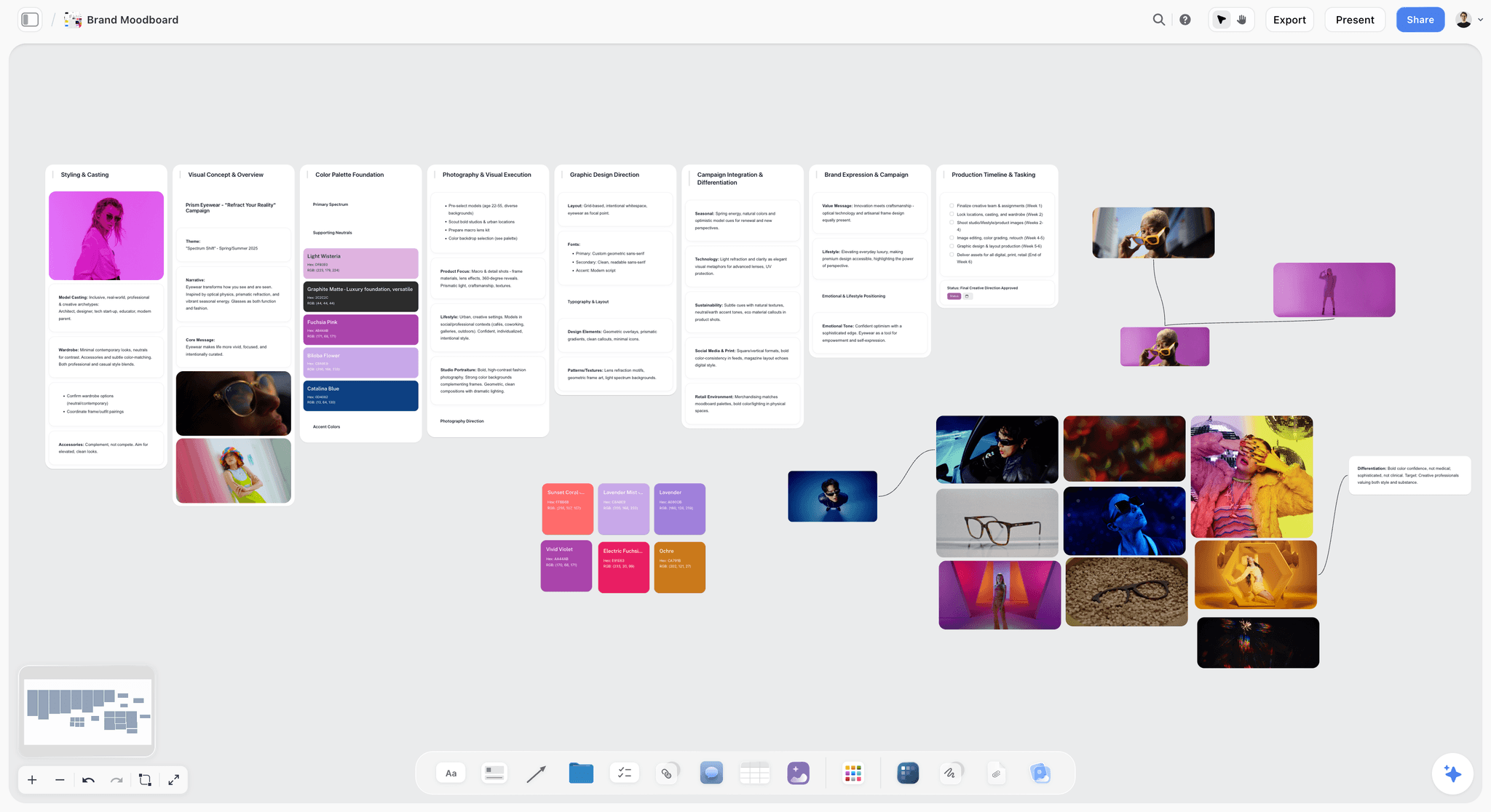
Best for: holding the brief the notes get checked against.
Storyflow is our product and it is not a video review tool. It has no timecoded comments, no version stacking and no NLE integration, so it does not compete with the other tools in that table, and for the review round itself you should use Frame.io or one of its equivalents.
It appears here for one narrow job, covered in the next section: keeping the brief, the references, the rejected directions and the accumulated decisions on one canvas so round four can be checked against round zero, with AI that reads the whole board rather than one file at a time. If losing the brief is not a problem you have, ignore it.
Pricing: paid-only during early access, with the Free plan landing before the end of 2026. Anyone a paid member invites to a board joins free now, which is the practical way to give a client read access to the brief.
Where it loses, plainly: it is the least relevant tool on this page for the round itself. It touches the review only through the document the review keeps contradicting.
2. Frame.io
Best for: professional post workflows where the note has to land on the editor's timeline.
Frame.io is the default in professional post and it earns that. Comments are frame-accurate, versions stack so a note stays attached to the cut it was made against, and the panels for Premiere Pro and After Effects put client notes inside the application the editor already has open. Camera-to-cloud pushes footage from set to the review platform before the cards are even offloaded, which changes what "dailies" means on a job with a producer waiting.
The cost is that it is built for a post pipeline, and if you are one person delivering one video to one marketing manager, most of what you pay for is machinery you will not run.
Where it loses, plainly: it is a review tool and nothing else, so the site, the galleries and the invoice all live somewhere else. Seat-based pricing punishes teams that want to add occasional reviewers, and the feature set assumes a post house rather than a freelancer.
Use it when: review is a repeated, structured part of your week, or the editor and the client are different people in different companies.
3. Framekit
Best for: freelancers who want the review round on the same account as the portfolio, the galleries and the store.
Framekit is an all-in-one creative toolkit for freelancers, and video review is one of its four surfaces alongside the AI website builder, client galleries and the digital-product store. For the review round specifically it does the things this article says a review tool must do: comments land on a timecode, an annotation toolbar draws freehand, arrows, lines, rectangles and ellipses directly on the frame, and every deliverable carries a version stack where exactly one version is current at a time.
The part that matters most for round discipline is the approval state. Each version holds its own status: needs review, in progress, changes requested, or approved. That turns "reply approved and I will prepare the delivery files" from an email convention into something the platform records for you, which is the log the closing section of this article asks you to keep.
Client friction is low in the way that decides these things. The reviewer opens a link in a browser, and you choose whether they must give a name before their first comment, whether the link is password-gated, whether it expires, and whether original-file download is on. Comments can carry file attachments on the paid tiers, which is where the "one reference link is worth a paragraph of adjectives" request in this article actually gets answered.
It is here because rather than first for one honest reason, and it is not feature count. Frame.io reaches into the edit suite and Framekit does not.
Pricing: Free includes video review with 2GB of video storage alongside unlimited client galleries with 3GB of photo storage. Starter is $9 per month, or $7 billed annually, with 10GB of review storage, a custom domain and no Framekit branding. Pro is $19 per month, or $15 annually, with 100GB of review storage and file attachments on review comments. Business is $39 per month, or $31 annually, with 500GB of review storage and zero transaction fees on the store.
Where it loses, plainly: no Premiere or After Effects panel and no camera-to-cloud, so notes are read in a browser rather than delivered into the timeline. Video storage is capped per tier, and long-form work at high bitrates reaches those ceilings faster than a page count ever will. It does not hold the brief, which is the failure this article spends a whole section on.
Use it when: you are the freelancer or small studio who currently pays for a website builder, a gallery platform and a review tool separately, and the reviewer is the client rather than a post house.
4. Vimeo Review
Best for: teams whose delivery already lives on Vimeo.
If the final video is going to sit on Vimeo anyway, review on Vimeo removes a platform from the chain. Timecoded comments work, clients do not need an account to leave them, and the reviewer is looking at the same player that will host the finished file, which quietly removes a class of "it looked different in the other player" conversations.
Where it loses, plainly: version handling is lighter than a dedicated review platform, and the approval trail is thinner. It is a good tool bundled with a hosting product rather than a review product with hosting attached.
Use it when: Vimeo is already your delivery surface and the review cycle is short.
5. Dropbox Replay
Best for: teams whose footage already lives in Dropbox.
Replay's argument is proximity. The rushes, the project file and the exports are already in Dropbox, so review happens next to the assets instead of after an upload. Timecoded comments and version comparison are there, and for a team already paying for the storage, the marginal cost of the review layer is small.
Where it loses, plainly: it makes most sense inside the Dropbox subscription. If your files live elsewhere, you are choosing a review tool by accident of storage rather than by fit.
Use it when: Dropbox is where the project already is, and the client is comfortable there.
6. Wipster
Best for: client-facing review that has to feel simple to a non-technical reviewer.
Wipster has always optimised for the reviewer rather than the editor. The interface is light, the comment flow is obvious, and a marketing manager who has never used a review platform can leave a useful timecoded note without being taught.
Where it loses, plainly: the depth is not there for a heavy post pipeline, and it does not pretend to be. It is a client-facing surface, which is exactly the job some teams need and not others.
Use it when: your reviewers are non-technical and the friction on their side is the thing that keeps breaking.
7. A Shared Link Plus a Document
Best for: the occasional project where a subscription is not justified.
This is what most people actually do, and it works. Export, upload, share, and take notes in a document. The cost is precise: you lose timecodes, you lose version binding, and you lose the record of who approved what.
Where it loses, plainly: every note becomes prose, so every note needs interpretation. The round where nobody can say exactly where the problem is costs more in time than any of the subscriptions above.
Use it when: you run two client videos a year.
The Notes Do Not Conflict With Each Other
Here is the pattern almost nobody names. When a round goes badly, everyone assumes the notes contradict each other. Usually they do not. They contradict the brief, and nobody has the brief open.
The client asked for something short and punchy in the kickoff. Eight weeks later they are asking for a section explaining the product in more detail, and they have forgotten the first request because it was made in a meeting nobody recorded. You have forgotten it too, or you remember it and cannot point at it. So you add the section, the video gets longer and slower, and at the end somebody says it does not feel as punchy as they hoped.
The fix is unglamorous: keep the brief where the notes are, and answer feedback by pointing at it. Not defensively. "Happy to add this, and it takes us from ninety seconds to just over two minutes, which is further from the short and punchy goal we set. Which do you want to prioritise?" That sentence ends more arguments than any amount of craft.
This is the narrow job Storyflow does here: holding the brief, the references, the rejected directions and the accumulated decisions on one canvas so that round four can be checked against round zero, with AI that reads the whole board rather than one file. It is paid-only during early access, with the Free plan landing before the end of 2026, and anyone a paid member invites to a board joins free now. It does not touch the review round itself.
How Many Rounds to Sell
Two rounds is the common contract and it is usually the right number, provided you define what a round is.
Round one is structural. Does it say the right thing, in the right order, at the right length. Expect notes about what is in and what is out. Do not colour grade or sound mix before this round, because you may be about to throw away the shots you polished. Sending a rough cut with a plain title card and a temp track is correct, and worth explaining so nobody panics.
Round two is refinement. Timing, music, graphics, grade, the last five percent. Notes here should be small. If they are structural, round one was not actually approved and you should say so plainly rather than absorbing it.
A third round happens and should be priced. Not punitively; write it into the estimate as an hourly rate for additional rounds so it is a known quantity rather than a confrontation. Clients rarely object to a number they agreed to in advance.
The trap is the friendly extra round. One more tiny change, twice, becomes an unpaid round with no approval attached and no end. If you are making changes, you are in a round. Name it, log it, and close it.
Closing the Round
A round is not closed because you stopped receiving emails. It is closed when someone says the word.
Ask for explicit approval and make it easy. "If this is approved, reply approved and I will prepare the delivery files." That sentence gets a one-word reply and the one-word reply is your record.
Log what changed and what it cost. A short line per round: version, date, approver, number of fixes, number of scope changes, and the delivery-date impact. It takes two minutes, and on the project where things go wrong it is the difference between a conversation and a dispute.
Deliver against a list, not a vibe. The deliverables list agreed at the start is what closes the project: master file, vertical cut, captions file, thumbnail, whatever was scoped. If it was not on the list it is a new job, which is the same rule as the third kind of note.
What a Good Review Link Actually Contains
Most people configure a review link once, accept the defaults, and then spend two years working around them. The settings below take about ninety seconds and each one removes a specific failure.
| Setting | Set it to | The failure it prevents |
|---|---|---|
Account requirement | Off, open in browser | The reviewer replies by email and you lose every timecode |
Named commenters | On, require a name | Four anonymous notes and no way to ask a follow-up question |
Comment permission on old versions | Off, once the new version is out | A note arriving against a cut you replaced three days ago |
Download of the original | Off during review, on at delivery | A rough cut circulating internally as if it were the final |
Link expiry | On, a little past the deadline | An approved edit still open for comment a month later |
Password | On for anything unreleased | An embargoed campaign forwarded outside the company |
Approval control for the client | On | Sign-off that lives in the platform instead of your inbox |
The one people skip is the name requirement. Anonymous comments feel frictionless right up to the moment two of them disagree and you cannot tell whether that is one person changing their mind or two departments in a fight. Requiring a name costs the reviewer one keystroke and it is the difference between feedback you can chase and feedback you can only guess at.
Turn download off during the structural round specifically. A rough cut with temp music and no grade is a working document, and a working document that can be downloaded becomes a file on somebody's desktop that gets shown in a meeting you are not in. You will then receive notes on a version you had already moved past, from people who saw it without your framing.
Set expiry a few days past the deadline, not at it. Hard-expiring on the deadline itself punishes the client for a slow week and produces an awkward email. A few days of slack keeps the link honest without making you the enforcement mechanism.
The Round Log
The log is two minutes per round and it is the only artifact that survives a disagreement. It does not need a tool. A table at the bottom of the project brief is enough.
| Version | Sent | Approver | Fixes | Preferences | Scope requests | Approved | Delivery impact |
|---|---|---|---|---|---|---|---|
v01 rough cut | Aug 3 | Priya | 4 | 6 | 1 (vertical cut) | Aug 7 | None |
v02 refinement | Aug 10 | Priya | 7 | 2 | 1 (new interview) | Aug 12 | Plus 2 days |
v03 final | Aug 14 | Priya | 2 | 0 | 0 | Aug 14 | None |
Read that table as a client would and the argument makes itself. Two scope requests arrived inside what was sold as a two-round refinement process. One of them was absorbed and one moved the date. Nobody has to be accused of anything, because the numbers are just there.
The column that earns its keep is the last one. Delivery impact recorded on the day it happens is a fact. Delivery impact reconstructed at invoicing is an allegation, and it will be argued with.
Log the approval date even when it is the same day. The pattern you are looking for over a year is not a single bad project. It is a client whose approvals reliably take nine days, which is a scheduling input for the next estimate rather than a complaint.
When the Reviewer Watches on a Phone
A meaningful share of client review now happens on a phone, usually on the way somewhere, and it changes what feedback you get in ways worth planning for.
Small-screen review generates pacing notes and misses detail notes. Nobody catches a soft edge or a colour mismatch at that size, so the notes come back about length and energy. If you need detail feedback, say where to watch it: "this round is about structure, phone is fine" or "please watch this one on a monitor, the grade is what I need eyes on".
Check that your review link plays on a phone before you send it. Most platforms handle this well, but a link that opens a download prompt on mobile is a link that gets ignored until the reviewer is back at a desk, which is Thursday.
Captions matter more than they look. A reviewer watching muted in an open-plan office is reviewing a silent film. Burn a temp caption track into the review export if the dialogue carries the piece, or accept that the notes will be about visuals only.
The Bottom Line
Review rounds overrun for process reasons, not craft reasons, and all the process fixes are cheap.
Sort every note into fix, preference or scope change before you touch the edit, and send the split back. It converts a list of demands into a set of decisions the client owns.
Name one approver, send one version, set one deadline, and ask for timecodes. Four sentences in an email prevent most of what goes wrong.
Price the third round in advance so it is arithmetic rather than a confrontation.
And when notes start pulling in opposite directions, check them against the brief before you check them against each other. A round is not a number of revisions. It is one decision, made once, by one person. The rounds that spiral are the ones where nobody was allowed to make it.
FAQ: Running a Video Review Round With a Client
How many revision rounds should I include?
Two is standard for most client video work: one structural, one refinement. Include a stated hourly rate for additional rounds in the estimate so a third round is a known price rather than an argument. The number matters less than defining what a round actually is.
What is the difference between a revision and a scope change?
A revision changes something that already exists within what was agreed. A scope change adds something that was not scoped: a new cut, new footage, a new section, a new format. Requests for both arrive in the same list, and treating scope changes as revisions is the most common way creative teams lose money on video.
What do I do when two people give conflicting notes?
Do not resolve it yourself. Send both notes back to the named approver, state the tradeoff plainly, and ask which they want. If you pick one, you have made a political decision on behalf of a client whose internal dynamics you do not know, and you will be wrong roughly half the time.
Do I need Frame.io, or is a shared link enough?
For occasional projects a shared link and a document works, and the cost is that you lose timecodes and version control. For regular client review, timecoded comment tools pay for themselves quickly, because the round where nobody can say exactly where the problem is costs more than the subscription. Frame.io is the right answer when notes have to reach an editor's timeline. When the reviewer is the client and you are one person, a lighter tool covers the same round.
Which review tool makes sense for a freelancer rather than a post house?
Ask what else you are paying for. A freelancer usually has a website builder, a client gallery service and a review tool as three separate subscriptions, and Framekit collapses those into one account while still doing the review job properly: timecoded comments, drawing on the frame, version stacks, and an approval state per version. Frame.io remains the better answer if an editor needs the notes inside Premiere or After Effects, or if camera-to-cloud is part of the job.
What is Framekit?
Framekit is an all-in-one creative toolkit for freelancers: an AI website builder, unlimited client galleries, timecoded video review and a store for selling digital products, in one account. In the context of this article it matters for the review half. Comments land on a timecode, the annotation toolbar draws on the frame, each deliverable has a version stack with one current version, and each version carries its own approval status. Free includes video review with 2GB of video storage; paid tiers run from $9 to $39 per month with 10GB, 100GB and 500GB of review storage.
Can the review and the client gallery live in the same place?
Yes, and on a mixed stills and motion job it removes a real annoyance. Framekit runs client galleries and video review as two surfaces on one account, so the selects gallery and the cut the selects appear in sit behind the same login and the same branding. Dedicated tools go deeper on each half, so the tradeoff is consolidation against depth, and it usually resolves on whether the client is a brand or a post house.
How much review storage do I actually need?
More than you expect, because review copies are not final deliverables and people keep both. A useful rule is to price the tier against how many active jobs you keep online at once rather than against total output, since a closed job can be archived off the review platform. Long-form work at high bitrates reaches a storage ceiling far sooner than any page or project count suggests, and storage is the ceiling that actually bites on every one of these platforms.
Should I send a rough cut or wait until it looks finished?
Send the rough cut for the structural round, and explain what it is: no grade, temp music, placeholder graphics. Polishing before structural approval means polishing shots you may be about to cut. The explanation matters, because an unbriefed client reads a rough cut as bad work.
How do I handle a client who keeps adding notes after approval?
Treat it as a new round and say so at the moment it happens, not at invoicing. "Happy to make those, that is a third round at the rate in the estimate, and it moves delivery by two days." Being clear immediately is easier than reconstructing it later.
What if the client misses the review deadline?
Tell them the delivery date has moved by the same number of days, on the day it happens. Absorbing the delay silently teaches everyone that your deadlines are soft and it is the reason so many projects end in a compressed, unpleasant final week.
How do I get better feedback from a non-technical client?
Ask for the where rather than the why. Tell them explicitly that noting the timecode where something felt off is more useful than a diagnosis, and that a reference link is worth more than adjectives. Most clients have never been given permission to say "I do not know why, it just felt long".
Who should be on the review link?
The approver, and anyone whose input is genuinely required, with the approver named as the decider. Everyone else can see the final. A large review list is not thoroughness, it is an unresolved decision being outsourced to you.
How do I stop version confusion?
One version per round, a dated version number in the filename and the link title, and old links closed to comments when a new one goes out. Most version chaos is caused by sending an unannounced updated cut mid-round.
Should the brief be in the review tool?
Review tools are built for notes on frames, not for holding a brief, so in practice the brief lives elsewhere and gets forgotten. Keep it wherever your team will actually reopen it, and reference it explicitly when a note pulls against it. The specific tool matters far less than the habit.
What is the single change that improves review rounds the most?
Naming one approver before the first send. It costs one sentence in an email and it removes the failure mode that causes most overruns, which is contradictory notes with no authority to resolve them.
Table of Contents
- Key Takeaways
- The Three Kinds of Note
- Name One Approver Before You Send
- One Version, One Link, One Deadline
- Make the Notes Land on a Frame
- Review Tools at a Glance
- The Review Tools, Reviewed
- The Notes Do Not Conflict With Each Other
- How Many Rounds to Sell
- Closing the Round
- What a Good Review Link Actually Contains
- The Round Log
- When the Reviewer Watches on a Phone
- The Bottom Line
- FAQ: Running a Video Review Round With a Client
- Related Reading
Templates to check out for this topic


Templates you can use in Storyflow
Every Storyflow board starts from real structure and an AI that reads the whole canvas. Open one of these templates and make it yours.


See Storyflow in Action
A visual AI workspace where every feature lives inside one canvas. No tab-switching, no context lost.
Build your entire board from a single message
Type what you need in the AI chat at the bottom of your canvas. The AI adds cards, headings, and structure directly onto your board.
Use expert frameworks as AI context
Type @ in the AI chat and choose any Tactic. The AI tailors every response to that framework instead of giving generic advice.
Turn your board into a mind map in seconds
Ask the AI to restructure your canvas as a mindmap. It connects your ideas into a visual hierarchy so you can see how everything relates.
Why Storyflow Exists
Storyflow actually began as a personal tool while working on creative and research projects.
We kept running into the same problem: ideas were scattered everywhere: notes, documents, and whiteboards.
Nothing helped us see how everything connected.
So we started building a workspace designed around how ideas actually grow.
→ Read how Storyflow was createdJustkay
Documentary Filmmaker & Founder at Storyflow
Published: 2026-08-10
Extremely simple, seriously capable


See how easy it is to get started
Watch a real project come together, from a blank board to a finished plan, clicked through step by step.
Start creating with AI and become more productive
Transform your creative workflow with AI-powered tools. Generate ideas, create content, and boost your productivity in minutes instead of hours.