
Extremely reliable pre-production
A photography rate card
you can send without flinching.
Day rate, crew, retouching and licence tiers in one table that adds itself up. Work out the numbers on the same board, then send the client a link or a PDF.


Creatives working for these brands already got early access
- Red Bull
- Canon
- Artlist
- Porsche
See how easy it is to get started
Watch a real project come together, from a blank board to a finished plan, clicked through step by step.
Start from a ready-made template
Pick a board to see what you can build, then let AI fill it in. Every template is a real, editable starting point on the same infinite canvas.

Pre-Production
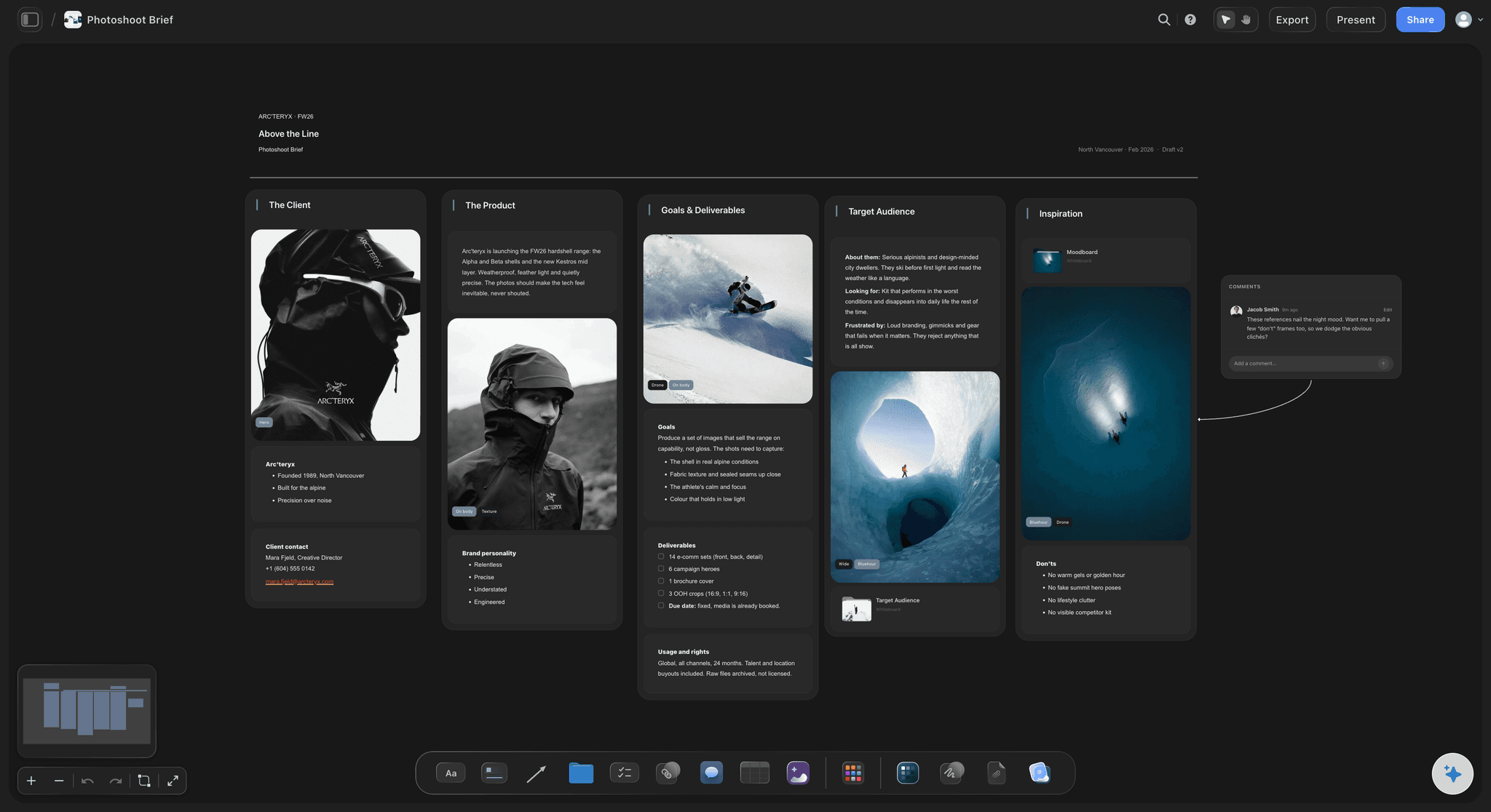
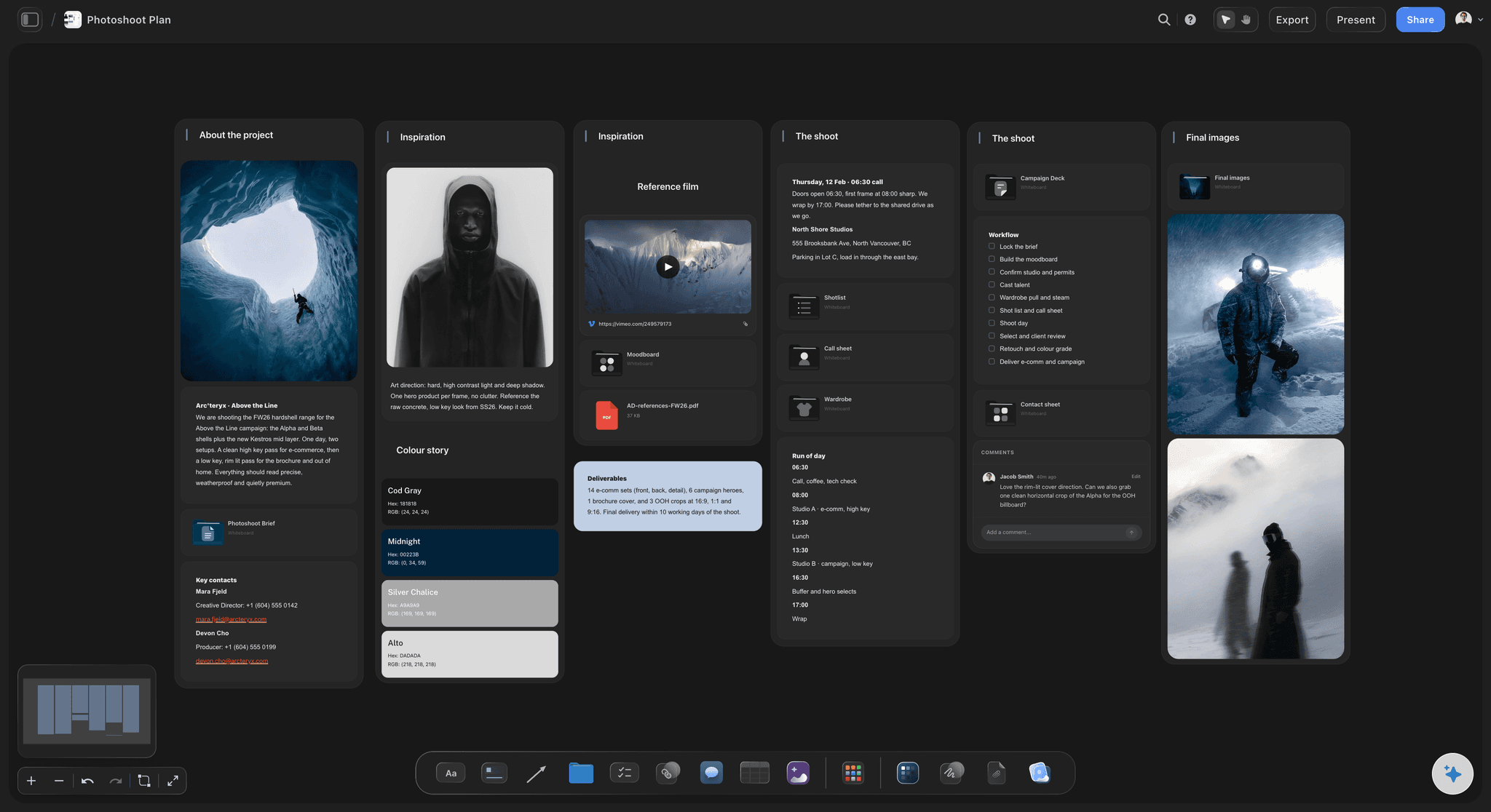
Pull the brief, script, shot list, and moodboard into one pre-production hub so the whole shoot is planned in one place.
What is a photography rate card?
A photography rate card is a standing price list: what a shooting day costs, what goes around it, and what it costs to use the pictures. Storyflow is an AI visual workspace that holds the card on one infinite canvas: the day rates, the crew and retouching lines, the expenses and the licence tiers. Each column carries a currency and a Sum footer, so changing one line changes the total the client sees, on a link that needs no account or a PDF export.
A rate card is not a quote and it is not a proposal. The rate card is the price of parts and it stays the same from January to December. A quote applies those parts to one job: two shooting days, one assistant, twenty retouched images, this licence. A proposal wraps the quote in the idea, the references and the schedule so the client can see what they are buying. Keep them separate. Photographers who only ever write proposals end up inventing a new price for every job, which is how two clients discover they paid differently for the same work.
Here is the full list of lines a rate card should carry. Shooting day and half day. Pre-production day, for the jobs where the planning is real work. Travel day, at a rate that is not zero. Assistant, digital operator, stylist, hair and makeup, at cost or with a mark up you state. Studio hire, if it is not yours. Retouching, priced per image and split into a basic level and a heavy one. Expenses passed through: kit hire, props, permits, mileage, catering. Then the licence, which is its own set of lines: what media, which countries, how long, and whether anyone gets exclusivity. Finally the terms that only matter when something goes wrong: rush work, overtime past ten hours, cancellation inside forty eight hours, reshoot conditions, and the payment schedule.
Work the day rate out from the bottom, not from what a competitor charges. Say you want $60,000 to live on and your business costs $18,000 a year, counting insurance, gear replacement, software, an accountant and a corner of a studio. That is $78,000 in fees before tax. Now count days honestly: for every day you shoot there is roughly another day of quoting, editing and chasing, so 220 working days is about 110 shooting days, and not all of them sell. Say 80 sell. $78,000 divided by 80 is $975 a day. That is your floor, not your price, and the licence is charged on top of it because it is a different thing you are selling.
Ultra fast from brief to board
Do the arithmetic where the client will never see it.
Same board, two halves: your working out, and the page you send.
01
Find your floor first
Put what you need to earn, your yearly costs and the number of days you can really sell into a table. The footer gives you the daily number you cannot go under. Do this once a year and the rest of the card gets easier to write.
02
List every part, including the unglamorous ones
Travel days, pre-production, an assistant, retouching per image, kit hire. The lines photographers leave off are the ones they end up absorbing, and they are the difference between a good year and a busy one.
03
Price the licence as its own thing
Write tiers by media, territory and length of use, from internal use through to a full campaign. Each tier gets its own row and its own number, so a client asking for more usage sees the price move rather than assuming it is included.
04
Send the card, keep the working out
Share the board by link and the client reads the tidy half with no account. Export it as a PDF if they want a file. Your arithmetic stays on the same board where you can find it next time, instead of in a spreadsheet you have to remember the name of.
The parts, the licence, the options and the record.
Storyflow builds and sends the card. Invoices, contracts, e-signature and payment belong to HoneyBook, Bonsai or your accounting tool.
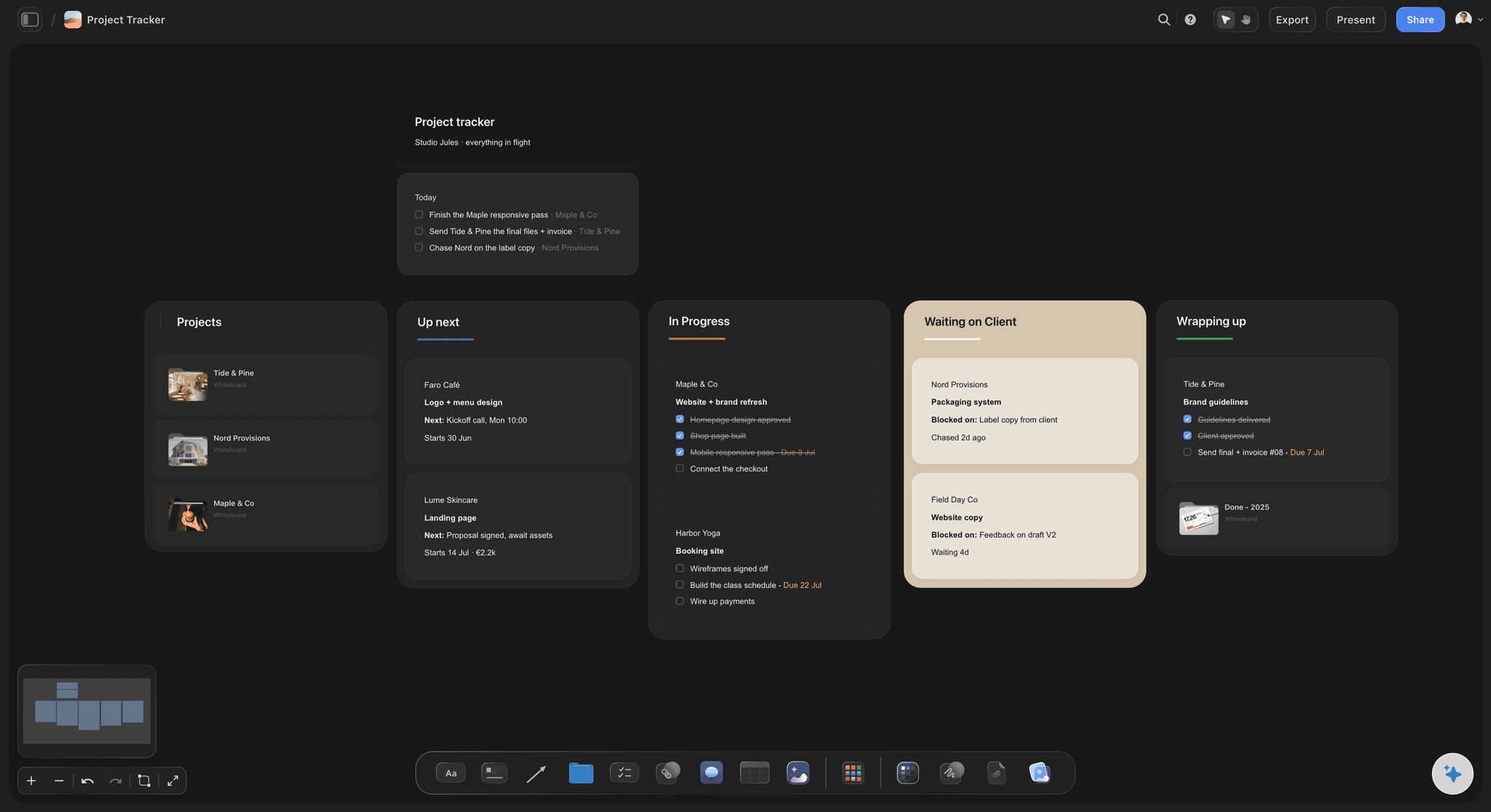
The parts
Every line item, with a total that follows
Days, crew, retouching and expenses in a table with a currency column and a Sum footer. Change the assistant's rate and every quote built from the card moves with it.
See the project tracker board →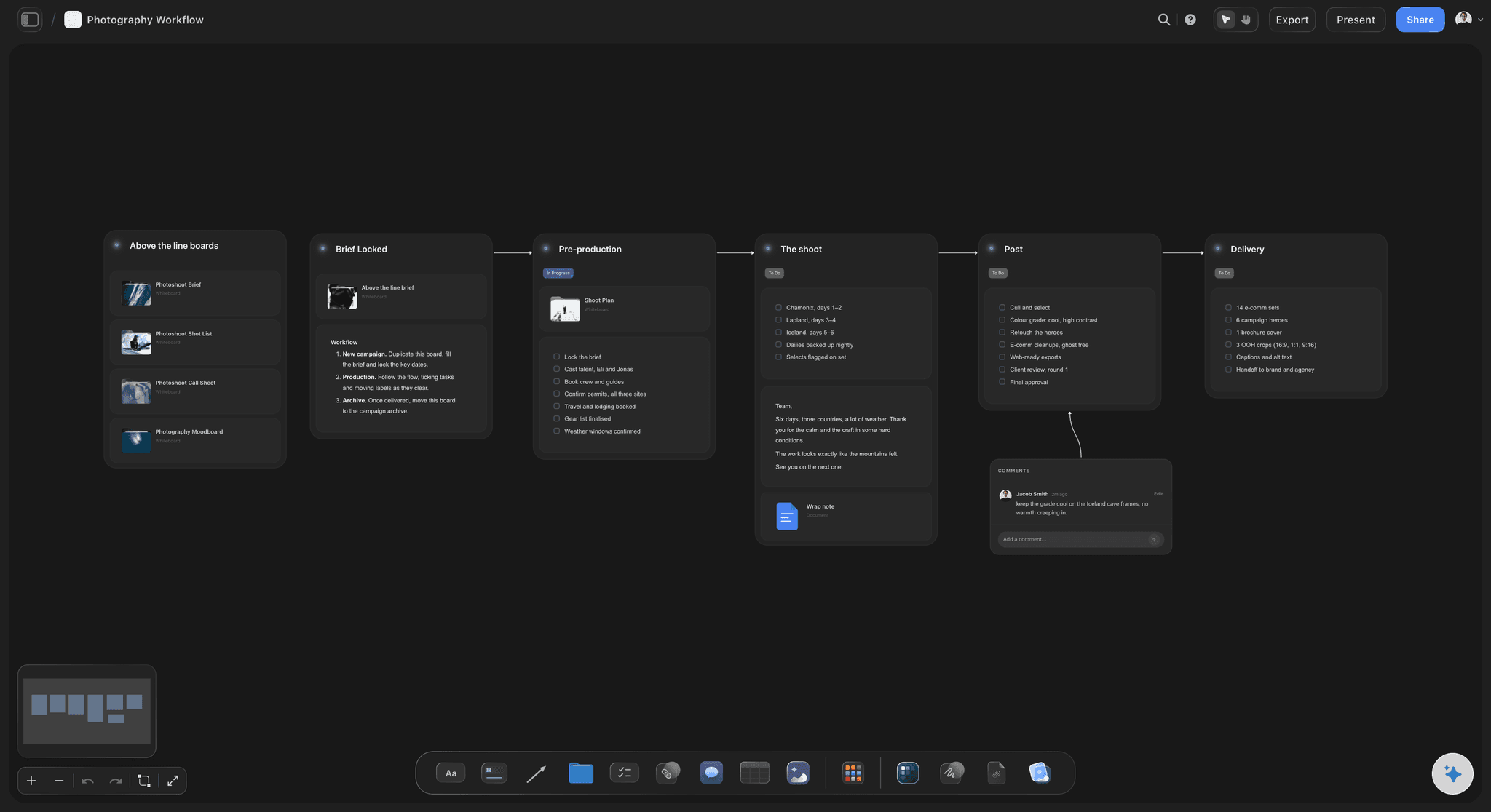
The licence
Usage priced by media, place and time
Internal use, owned web and social, paid social, print, out of home, worldwide and in perpetuity. One row each. The client can see what a bigger ask costs before they make it.
See the photography proposal →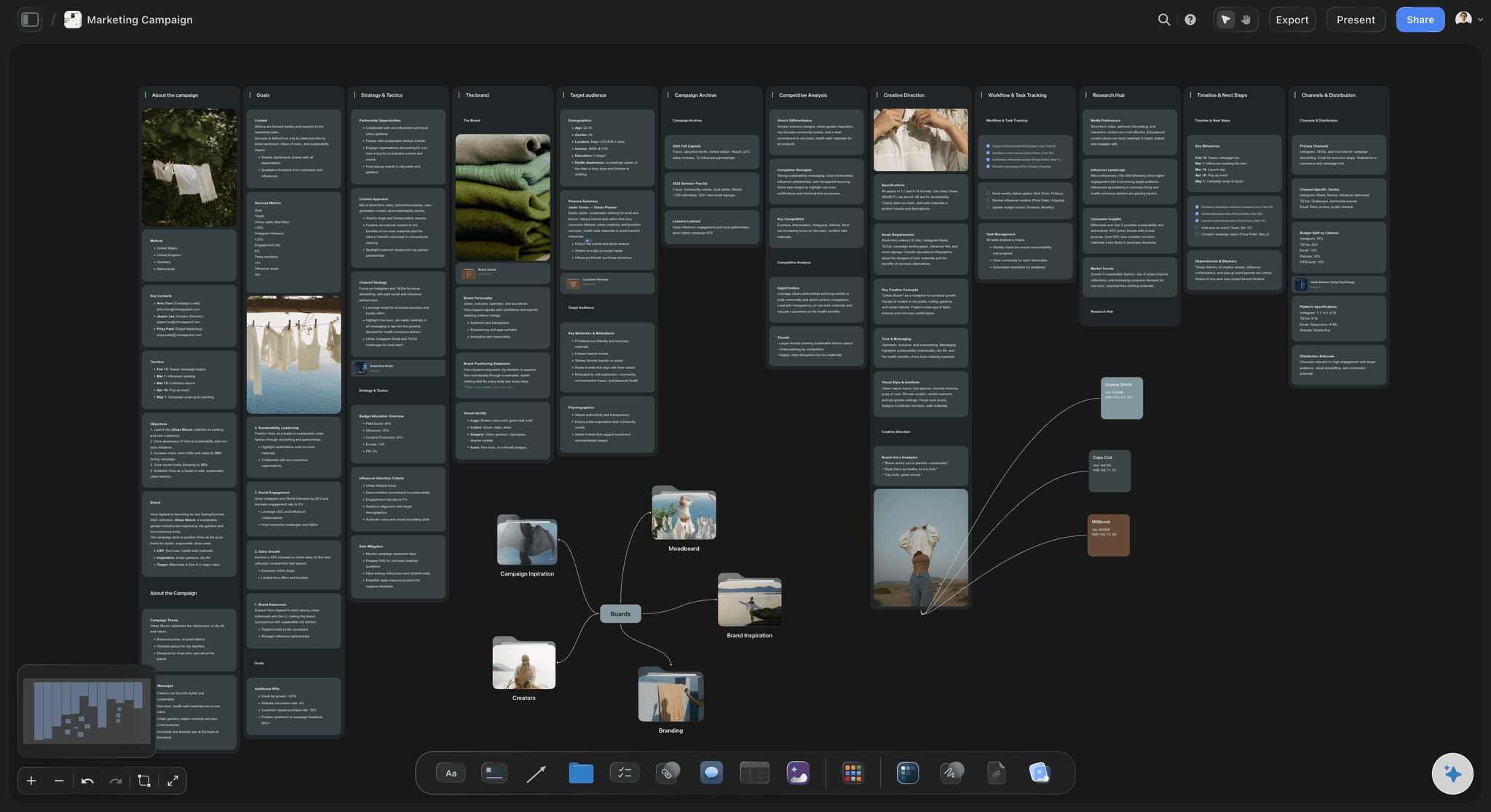
The choice
Three options, side by side
A small, a middle and a full version as three columns of the same table, each totalling on its own. Clients decide faster when the trade is visible than when they are asked to imagine it.
See the campaign planning board →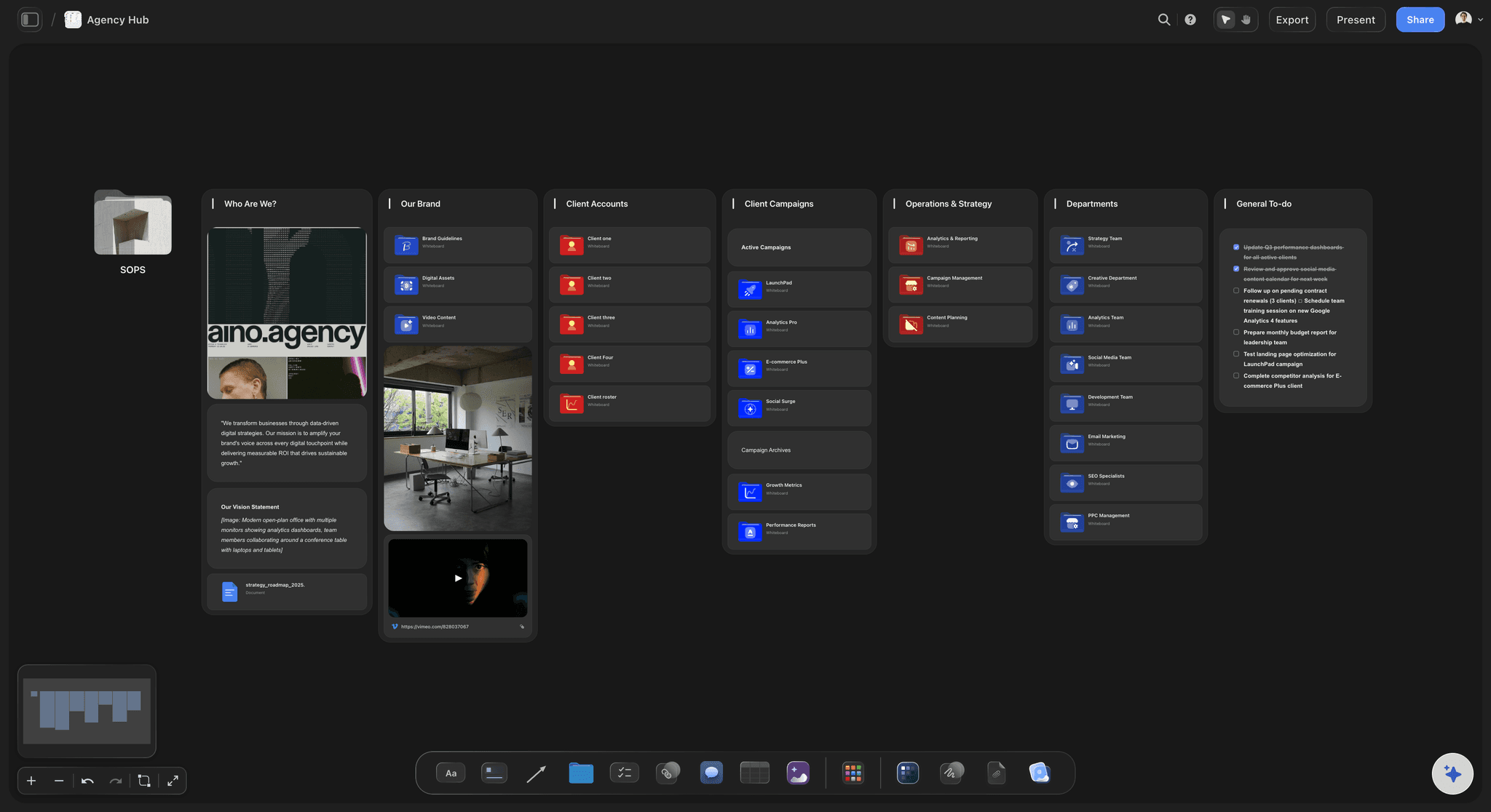
The history
What you charged, and who you charged it to
Each job keeps its board, so last year's numbers for the same client are one search away. That is what you check before you raise a rate, and what you point at when someone remembers a different price.
See the studio hub board →One card, many quotes, all still there.
Duplicate the card for each job, change the numbers that change, and keep the original. Storyflow is paid-only during early access, with plans from $7.99 a month billed annually ($9.99 monthly). A free plan launches before the end of 2026, and anyone a paid member invites to a board joins free.
Unlimited boards, image uploads and files on every paid plan
Invite a producer or a partner to the board without buying them a seat
200+ Tactics, including budget and tracker boards to build from
Whole-board PDF export when a client wants the card as a file
Presentation mode for talking a client through the options on a call
Built for people with taste
A day, a licence, and everything around them.
Most underpricing happens in the third one.
The day
A rate built from your own numbers
Start with what you need, not what others charge: Living costs plus business costs, divided by the days you can honestly sell. The answer is a floor. Anything else is a guess dressed up as market knowledge.
Count the days you can really shoot: Editing, quoting and chasing eat about as much time as shooting does. Pricing against a calendar that assumes you shoot every working day is how photographers end a busy year with nothing.
Half days are more than half: A half day still takes the travel, the setup and the pack down. Price it around two thirds of a full day or stop offering it.
Put the working out in a table with a footer: Give the column a currency and a Sum, and the number updates as you change an assumption. That table is your rate review, done in ten minutes each year.
The licence
The part clients think is free
Media, territory, duration, exclusivity: Four questions decide the number. A picture on a website in one country for a year and the same picture on a bus shelter across Europe are the same shooting day and a different price.
Write the tiers, do not negotiate them each time: Named tiers with numbers beside them turn an awkward conversation into a choice. The client picks a row instead of asking you to justify a figure.
Say what happens when the licence runs out: Renewal price, on the card, in one line. Otherwise the pictures quietly keep running and nobody ever brings it up.
Keep it out of the day rate: Bundling usage into a day rate makes the day look expensive and the usage look free. Separate rows make both numbers easier to defend.
Everything around them
The lines that quietly get absorbed
Retouching is priced per image, in two levels: Basic and heavy, with a number on each. Twenty finals and twenty finals with skin work are not the same week, and a single per image price hides that.
Travel and pre-production days are work: A day spent driving or scouting is a day you cannot sell to anyone else. If it is not on the card, you are giving it away and calling it goodwill.
Expenses are passed through, and said so: Kit hire, props, permits, mileage and catering, listed as pass through with any mark up stated plainly. Surprises on an invoice cost more than the line ever would.
Rush, overtime and cancellation, written before you need them: A cancellation clause is impossible to introduce on the day it applies. One line each on the card, agreed when everyone is calm.
Explore templates for your project
Every template opens as a real, editable board on the infinite canvas. Pick the closest fit and make it your own.
Pre-Production
Pull the brief, script, shot list, and moodboard into one pre-production hub so the whole shoot is planned in one place.
One app instead of five
Storyflow against a PDF and a spreadsheet.
It is where the numbers are worked out and shown. It is not where money moves.
Storyflow
Recommended
Rate table with a total that follows changes
Working out and the sent card on one board
Three priced options side by side
View-only link, no account to read
Sits next to the shoot plan it prices
Invoices, payments and deposits
Contracts and e-signature
Studio management tools
Rate table with a total that follows changes
Working out and the sent card on one board
Three priced options side by side
View-only link, no account to read
Sits next to the shoot plan it prices
Invoices, payments and deposits
Contracts and e-signature
A spreadsheet and a PDF
Rate table with a total that follows changes
Working out and the sent card on one board
Three priced options side by side
View-only link, no account to read
Sits next to the shoot plan it prices
Invoices, payments and deposits
Contracts and e-signature
What creators are saying
Join early creators getting structured workspaces and AI that remembers their projects
“Storyflow has sped up my workflow by at least 3x, which means more flow state and more projects I can actually ship. It truly changed the way me and my team create.”

Reilin Joey
Director & YouTuber
“One prompt gets me a structured board. But the tactics are my favorite. I run my YouTube scripts through them and my intros and retention got better. It's amazing.”

Justkay
YouTuber & Freelance Filmmaker
“I used to juggle five apps to plan a project. Now I describe what I am making and get boards, lists, and a schedule. All in one place.”

George
@fernwehchronicles
Photography rate card questions
What photographers ask before they publish their prices.
In Storyflow, a photography rate card is a table on a board holding your standing prices: shooting day and half day, pre-production and travel days, crew, retouching per image, expenses, and licence tiers by media, territory and duration. The column carries a currency and a Sum footer, so the total follows any change. Send it as a link that opens with no account, or export it as a PDF.
Storyflow covers the whole of this: day and half day rates, pre-production and travel, crew, retouching levels, expenses and licence tiers as rows in one table, with a currency column and a Sum footer that follows every change. Send it as a link that needs no account, or export it as a PDF. Invoicing and e-signature still belong to HoneyBook, Bonsai or your accounting software.
A rate card carries day and half day rates, pre-production and travel days, assistant and crew, studio hire, retouching split into basic and heavy, expenses passed through, and licence tiers set by media, territory, duration and exclusivity. Then the terms: rush work, overtime, cancellation inside forty eight hours, reshoot conditions and when payment is due.
Add what you need to earn to what your business costs each year, then divide by the days you can honestly sell. Remember that roughly every shooting day comes with a day of editing, quoting and admin, so a full working year is far fewer shooting days than the calendar suggests. The result is your floor. Licensing is charged on top of it.
No. The rate card is the price of parts and it stays fixed. A quote applies those parts to one job: two days, one assistant, twenty retouched images, this licence. A proposal wraps that quote in the idea, the references and the schedule. Keeping them separate is what stops you inventing a fresh price for every client.
Either works as long as the card exists. A Storyflow link sent in the first reply filters out the enquiries that were never going to reach your floor, which saves you the call. Some photographers publish a starting figure and send the full card once they know the usage, since usage is what moves the number most.
Price licensing on four things: which media the pictures run in, which countries, for how long, and whether anyone gets exclusivity. Write tiers rather than a formula, from internal use up to a full campaign, and give each tier its own row and number. Named tiers turn a negotiation into a choice between rows.
Price retouching separately because twenty simple finals and twenty with heavy skin and product work are not the same week of your life. Two levels with a price each makes the difference visible, and it lets a client who wants forty images choose the level rather than assume the harder one is included.
Storyflow lets you drag any rate row wherever you want it on the board. It does not sort a table for you, so the order is the one you set by hand. Most photographers order the card the way a client reads it: days first, then crew, then retouching, then licence, then terms, which is an order a price sort would destroy.
Storyflow is where the numbers are worked out, shown and shared. It does not send invoices or take payment: invoicing, deposits, contracts and e-signature belong to HoneyBook, Bonsai, PandaDoc or your accounting software. The card is what you build the invoice from, and it stays on the board after the money has moved.
Yes. Storyflow's view-only link opens in any browser with no account, on a laptop or a phone. Signing in is only needed to leave a comment. Anyone a paid member invites to a board joins free, so a producer working with you can be given real access without buying a plan.
Storyflow's AI can lay out the card and do the arithmetic you describe, and it can draft the licence tiers for you to edit. It cannot tell you what your work is worth in your market. The numbers are your decision, and the honest version of them comes from your own costs.
Once a year is enough for most photographers, and it takes ten minutes when the working out is already on a Storyflow board. Look at what you actually earned per shooting day, at the licences you gave away, and at the lines you absorbed. Change those before you change the headline day rate.
More from Storyflow
Photography proposal
Photography client questionnaire
Photoshoot planning
Photoshoot plan template
Brand photoshoot planning
Product photography shoot plan
Creative client onboarding
Client review board
Moodboard for clients
Wedding photography shot list
Storyflow for photographers
Photography style guide
Photoshoot call sheet
Creative retainer plan
Editorial photoshoot planning
Photo book planner
Price the day, price the licence, send the link.
Your working out and the card the client reads, on one board that adds itself up.