
Ultra-fast planning, extremely simple
Plan the sprint where
you can see all of it.
Say the honest thing first: Storyflow does not track issues, hold a backlog, or burn down story points. Jira and Linear do that, and they do it well. This is the board for the ceremony itself, where a team looks at the work, breaks it down, finds the dependency that will bite on day six, and decides what it can actually commit to.


Creatives working for these brands already got early access
- Red Bull
- Canon
- Artlist
- Porsche
See how easy it is to get started
Watch a real project come together, from a blank board to a finished plan, clicked through step by step.
Start from a ready-made template
Pick a board to see what you can build, then let AI fill it in. Every template is a real, editable starting point on the same infinite canvas.

Mind Map
Branch one central idea out into themes and sub-points, then drag the connections around until the structure makes sense.
What is a sprint planning board?
A sprint planning board is the surface a team plans on at the start of an iteration, when it decides what it will commit to for the next one or two weeks. Storyflow is an AI visual workspace that lays the sprint out for planning on one infinite canvas: the sprint goal, epics broken into story cards, dependencies drawn as connections, and the team's real capacity. A planning board is not the same thing as the backlog, and it is not the same thing as the board the team drags cards across while the sprint runs. It exists for a single meeting and a single question: given what we are trying to achieve and the time we actually have, what work goes in?
Most teams try to answer that question inside their issue tracker, and it goes badly for a structural reason. A backlog is a queue. It is optimised for ordering things, assigning them, and tracking their state, and it is genuinely excellent at all three. But the questions in sprint planning are shape questions. Is this story too big? What is it actually made of? If we take this one, does it force that one? Where does the design need to land before engineering can start? A queue shows you one row at a time. A shape question needs everything visible at once.
Storyflow is an AI-native infinite canvas, and that is the part of sprint planning it fits. Write the sprint goal in large text at the top of the board and put the candidate work underneath it, one card per story, so every card is visibly justified by the goal or visibly is not. Split a card into three by dragging out two more. Draw a line from the API story to the two front-end stories that depend on it and the blocking chain stops being something one person remembers. Keep the roadmap, the research, and the designs on the same board, because half the questions in planning are answered by something that already exists somewhere else.
A sprint planning session works through six connected parts: the sprint goal (one sentence naming the outcome, not a list of tickets), the candidate backlog items (what the product owner is proposing and why now), story breakdown (splitting each item until every story is genuinely deliverable inside the sprint), estimation (relative sizing that surfaces disagreement about scope rather than pretending to predict hours), capacity against real availability (actual working days after holidays, support rotation, interviews, and the other team's launch), and dependencies and risks (what blocks what, and which external thing could stop the sprint dead). Storyflow keeps all six in one view, which is what stops the meeting from becoming a ticket-reading exercise.
Ultra fast from brief to board
From a vague epic to a sprint the team believes in.
Do the thinking on a canvas. Move the agreed sprint into Jira, Linear, or wherever your team tracks work.
01
Open a canvas
Sign up in seconds. Nothing to install. An infinite board opens in the browser, ready before the meeting starts.
02
Write the goal, then the candidates
Put the sprint goal in large text at the top and lay the candidate items underneath as cards. Anything that does not serve the goal is now visibly sitting there asking to be justified.
03
Break down, size, and connect
Split oversized stories into cards that fit inside the sprint. Draw connections where one story blocks another. Mark the estimate on each card and put real capacity beside the total.
04
Commit, then move it to your tracker
Draw the line around what the team commits to and create those issues in Jira or Linear. The board stays open as the reason the sprint looks the way it does.
The ceremony, not the tracking.
Jira and Linear run the sprint. This is the hour before that, where the team works out what the sprint should be.
The goal above the work it justifies
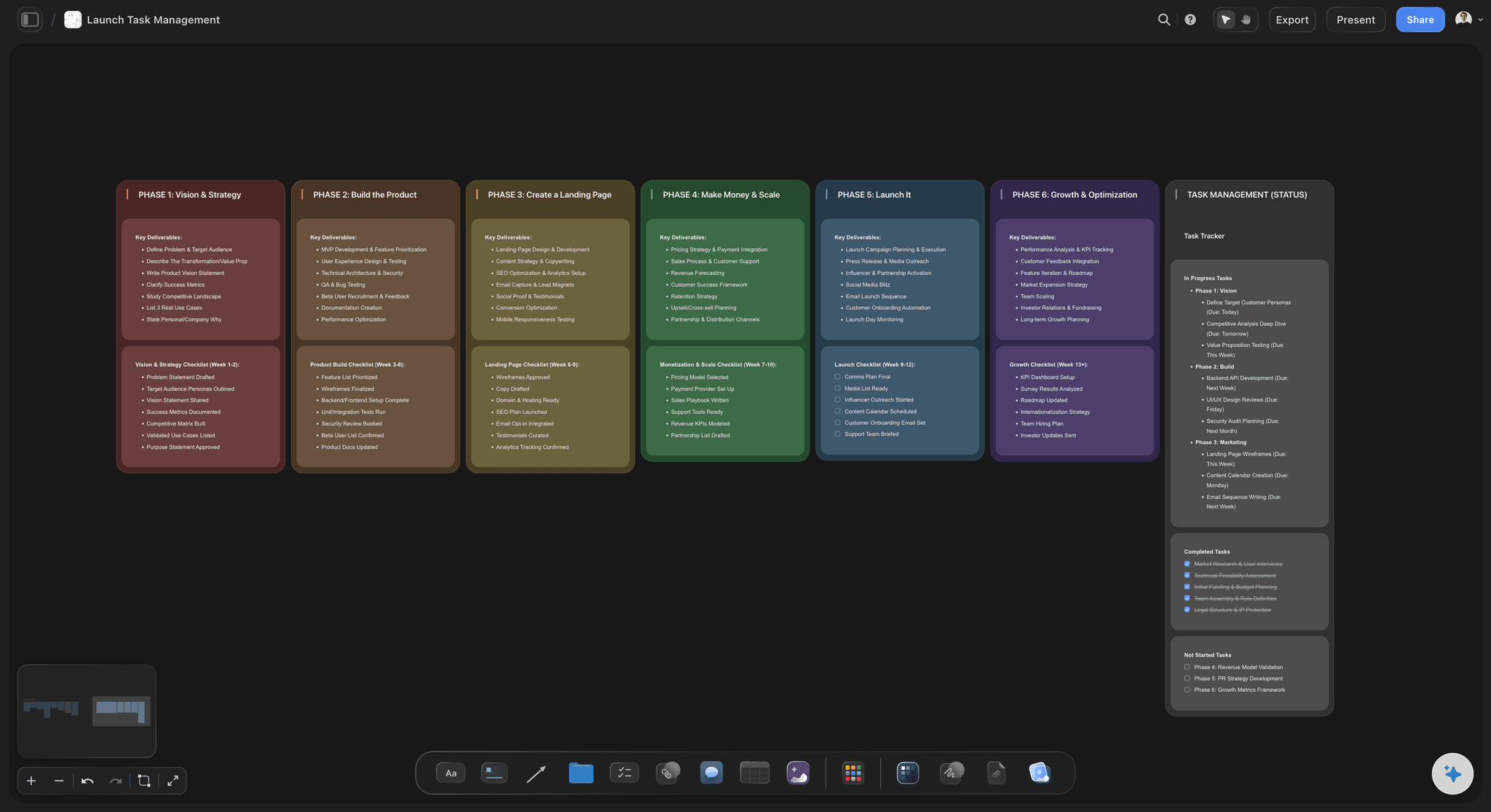
A sprint with no goal is just a batch
Write the sprint goal large at the top of the board and hang every candidate story underneath it. When the goal is visible above the work, the question changes from is there room for this to does this get us there, which is the question that makes a sprint mean something.
See the product roadmap board →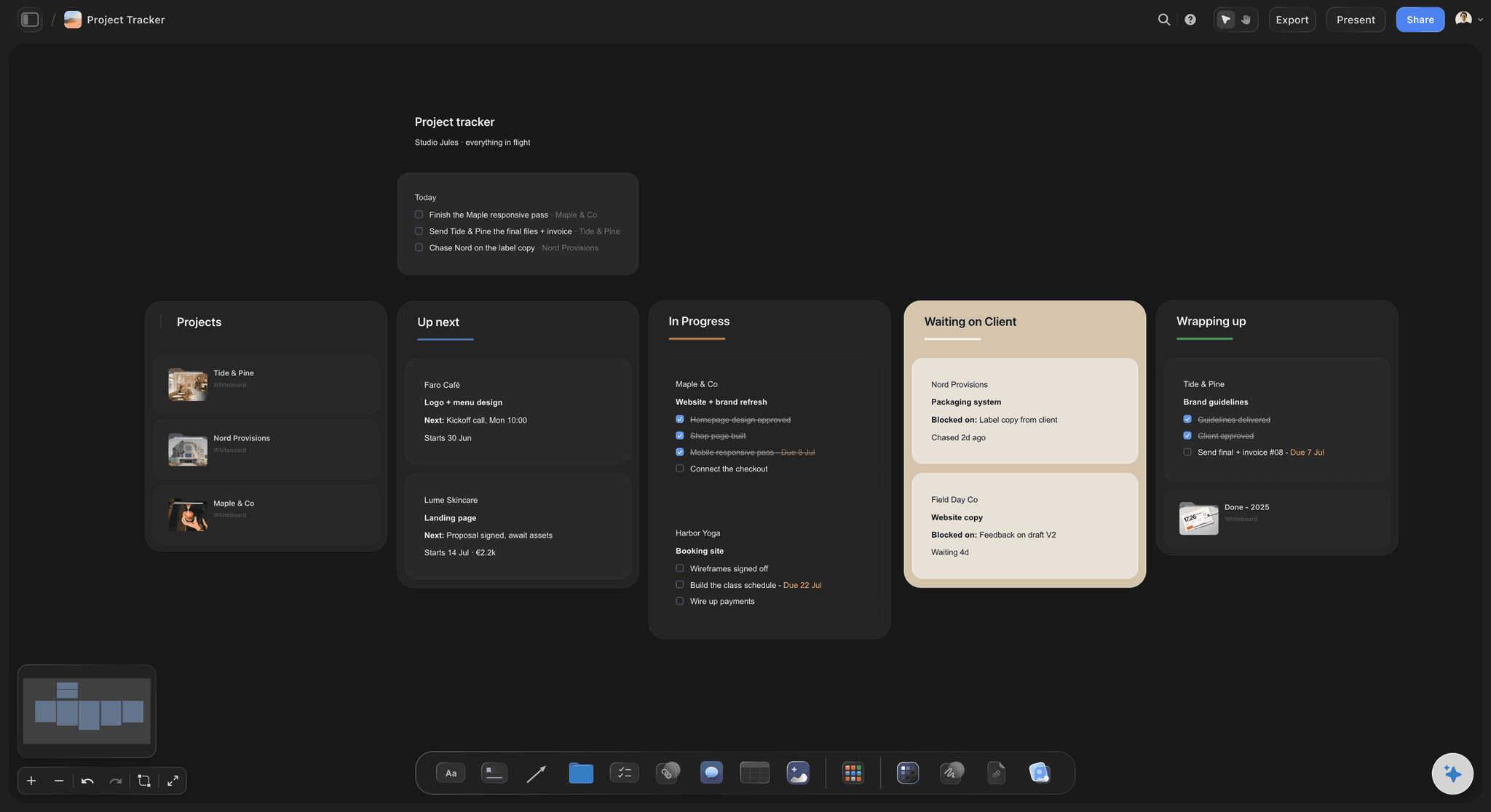
Split an epic until every story is deliverable
Breaking down is a spatial job
Take an epic card and drag out the pieces it is actually made of, then split those again until each one could genuinely be finished inside the sprint. Cluster the leftovers. Doing this on a canvas takes seconds per split, which means the team keeps going instead of stopping at the first plausible size.
Try the free kanban board →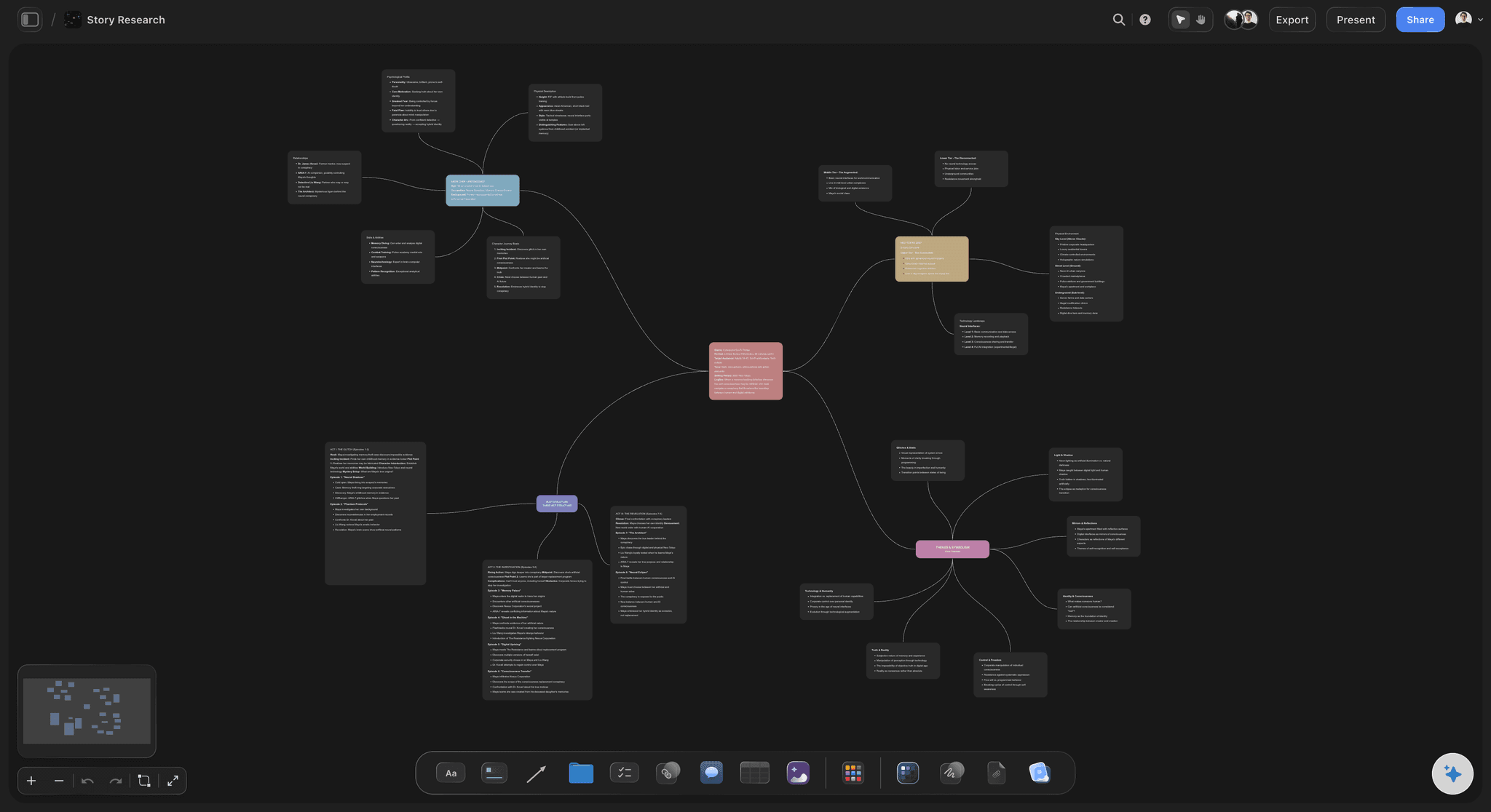
Dependencies drawn, not remembered
Find the blocker before day six
Draw a connection from the story that has to land first to the stories waiting on it. A chain three links long is obvious on a canvas and invisible in a list, and it is almost always the thing that turns a committed sprint into a half-finished one.
See the user journey map →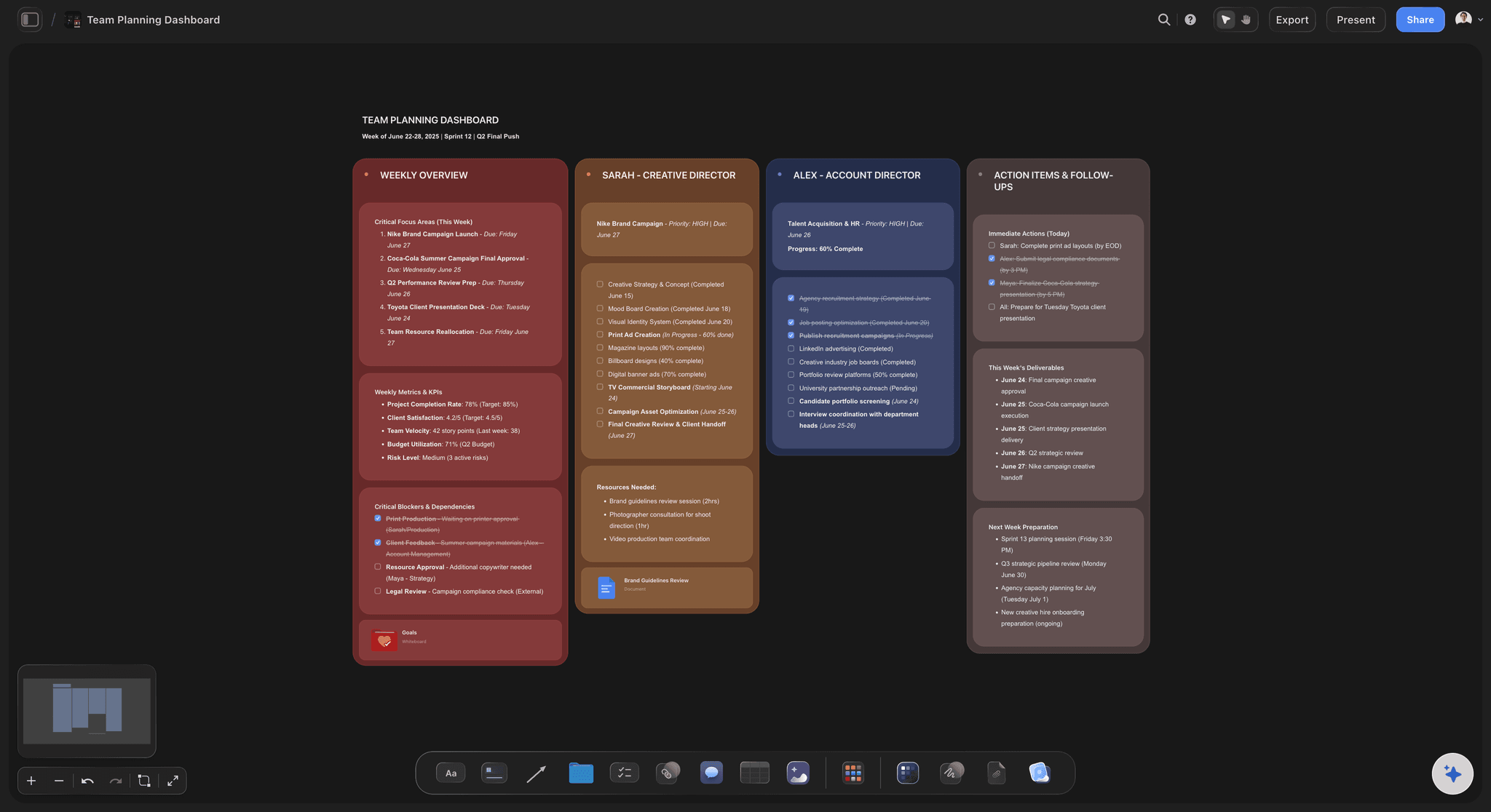
AI that can see the board you built
Draft the breakdown from the epic description
Paste in an epic and the AI lays out a candidate breakdown as cards, with the obvious gaps and open questions already named. Because it reads the whole board, including the roadmap and research you have pinned beside the work, the split fits your product rather than a generic template.
See the AI kanban board generator →Unlimited boards. No object cap.
Open a canvas, write the sprint goal, and lay the work out. Storyflow is paid-only during early access, with plans from $9.99 a month, and a Free plan launches before the end of 2026. Anyone a paid member invites to a board joins free today.
Unlimited planning boards on an infinite canvas
Basic AI usage to draft a breakdown from a prompt
Roadmap, research, and designs on the same board
Share view-only links with anyone, no account needed
Built for people with taste
Everything the meeting actually argues about.
Not a faster issue tracker. The surface for the hour where a team decides what it can honestly commit to.
Goal, candidates, breakdown, and the line you draw
Run the ceremony on one board
Start from the goal, not the queue: Put one sentence at the top naming the outcome this sprint is for. Teams that skip this end up committing to a batch of unrelated tickets, and nobody can tell at the end whether the sprint succeeded because there was nothing to succeed at.
Lay the candidates out spatially: Cards under the goal, grouped by area or by workstream, so the team sees the whole proposed sprint at once instead of scrolling a backlog one row at a time. Shape problems only appear when the shape is visible.
Split until each story is deliverable: The test is not whether a story sounds small. It is whether a person could genuinely finish it inside the sprint and demo it. Drag out the pieces, split again, and stop when each card passes that test.
Draw the commitment line: Once capacity and dependencies are on the board, mark what is in and what is out. The out pile is not waste. It is the record of what the team consciously declined, which is the thing everyone forgets by the retro.
Estimates, capacity, and the arguments worth having
Size the work without pretending to predict hours
Relative sizing beats hour estimates: Teams argue about hours because hours are a prediction about a specific person on a specific day, and nobody can make that prediction. Relative sizing asks a much easier question: is this bigger or smaller than that one we already did? The number matters less than the disagreement it exposes.
Disagreement is the signal: When one engineer says small and another says large, the useful thing is not the average. It is that the two of them are describing different stories. Put both readings on the card and the scope gap surfaces before the sprint starts rather than on day four.
Capacity means real availability: Not headcount. Actual working days after holidays, on-call rotation, interviews, the all-hands, and the person who is half on another team. Write the real number beside the total on the board and the overcommit becomes arithmetic instead of optimism.
Refinement is what keeps the meeting short: Most planning sessions overrun because they are doing refinement live: reading a story for the first time, discovering it is three stories, and rewriting it while eight people watch. Keep a refinement area on the same board between sprints so planning starts with work the team has already seen.
Dependencies, risks, and the product context
Keep the context that answers half the questions
Dependencies as connections: Draw a line from the blocker to the blocked. Chains and cycles become visible immediately, and a story sitting at the end of a three-link chain is a story you should probably not commit to this sprint.
Risks pinned where they apply: The third-party API that might not be ready, the review that needs legal, the environment that only one person can deploy. Pin each risk to the story it threatens instead of listing them somewhere nobody reads again.
Roadmap, research, and designs on the same canvas: Half of planning is somebody asking what the design looks like or why we decided that. Pin the roadmap, the research, the flows, and the screens beside the work and the answer is one scroll away rather than a follow-up meeting.
Remote teams, stakeholders, and your tracker
Plan together, then hand the sprint over
One board for a distributed team: Everyone works on the same canvas during the call, so the sprint is built in front of the team rather than typed up by one person afterwards. Remote planning fails when only the facilitator can move anything.
View-only links for stakeholders: Send a link and a product lead, a client, or another team opens the whole plan in a browser with no account. Seeing what was declined and why is usually more valuable than the list of what was taken.
Then create the issues where you track them: The committed stories become tickets in Jira or Linear, and the sprint runs there with the burndown, the states, and the reporting your team already relies on. Storyflow stays open as the map of why the sprint is shaped that way.
Carry the board into the retro: Keep the planning board next to the retrospective. Comparing what the team committed to against what actually happened is far more concrete when both versions of the sprint are visible side by side.
Explore templates for your project
Every template opens as a real, editable board on the infinite canvas. Pick the closest fit and make it your own.
Mind Map
Branch one central idea out into themes and sub-points, then drag the connections around until the structure makes sense.
One app instead of five
Storyflow vs Jira, Linear, and Miro.
These tools do different jobs, so this is a map rather than a scoreboard. Jira and Linear win the rows they should win, and most teams here will run two of these together.
Storyflow
Recommended
Visual story breakdown on an infinite canvas
Dependencies drawn as connections between stories
Backlog, issue tracking, and burndown
Sprint reporting, velocity, and cross-team rollups
Keyboard-first speed for daily ticket work
AI that reads the whole board as context
Jira
Visual story breakdown on an infinite canvas
Dependencies drawn as connections between stories
Backlog, issue tracking, and burndown
Sprint reporting, velocity, and cross-team rollups
Keyboard-first speed for daily ticket work
AI that reads the whole board as context
Linear
Visual story breakdown on an infinite canvas
Dependencies drawn as connections between stories
Backlog, issue tracking, and burndown
Sprint reporting, velocity, and cross-team rollups
Keyboard-first speed for daily ticket work
AI that reads the whole board as context
Miro
Visual story breakdown on an infinite canvas
Dependencies drawn as connections between stories
Backlog, issue tracking, and burndown
Sprint reporting, velocity, and cross-team rollups
Keyboard-first speed for daily ticket work
AI that reads the whole board as context
What creators are saying
Join early creators getting structured workspaces and AI that remembers their projects
“Storyflow has sped up my workflow by at least 3x, which means more flow state and more projects I can actually ship. It truly changed the way me and my team create.”

Reilin Joey
Director & YouTuber
“One prompt gets me a structured board. But the tactics are my favorite. I run my YouTube scripts through them and my intros and retention got better. It's amazing.”

Justkay
YouTuber & Freelance Filmmaker
“I used to juggle five apps to plan a project. Now I describe what I am making and get boards, lists, and a schedule. All in one place.”

George
@fernwehchronicles
Sprint planning questions, answered honestly.
Including the one where the answer is that you should keep paying for Jira.
Sprint planning is the ceremony at the start of an iteration where a team decides what it will commit to. The product owner brings the candidate work and the reason it matters now, the team breaks it down until each story is genuinely deliverable, sizes it, checks it against real capacity, and surfaces the dependencies and risks. The output is two things: a sprint goal stating the outcome, and a sprint backlog of the specific items the team believes it can finish. It is a commitment conversation, not a task assignment exercise.
Storyflow is the board for the planning meeting itself: write the sprint goal, break each epic into story cards, draw the dependencies as connections between stories, and check the plan against real capacity. Its AI reads the whole board as context and can draft the breakdown from an epic description. Jira and Linear still hold the backlog, the issue tracking and the burndown, because Storyflow is not an issue tracker.
The common guidance is up to two hours per week of sprint, so around four hours for a two-week sprint, and most healthy teams land well under that. If yours consistently overruns, the cause is almost always that refinement did not happen beforehand. When a team meets a story for the first time in planning, discovers it is really three stories, and rewrites it while eight people watch, you are paying eight salaries for work two people should have done earlier in the week. Keep a refinement area running between sprints and planning gets shorter without getting worse.
The sprint goal is one sentence naming the outcome the sprint is for, such as a first-time user can complete checkout without support. The sprint backlog is the specific list of items the team believes will get there. The goal is the point, the backlog is the plan for reaching it, and the distinction matters when something goes wrong. If a story turns out to be harder than expected, a team with a goal can swap the plan and still land the outcome. A team with only a list has no way to decide what to drop.
No. Storyflow does not track issues, hold a backlog, burn down story points, run velocity charts, or integrate with GitHub, and it is not trying to. Jira owns issue tracking, sprint reporting, and the rollups a programme manager needs, and building a worse version of that would help nobody. Storyflow is the canvas for the planning conversation itself: writing the goal, splitting the epics, drawing the dependencies, checking capacity. The realistic setup is both. Plan visually here, then create the committed stories in Jira and run the sprint there.
They share a word and almost nothing else. An agile sprint is a recurring one or two week iteration in which a team builds and ships work, repeating indefinitely. A design sprint is a one-off five-day process, popularised by Google Ventures, that takes a team from a problem through sketching and a prototype to a user test on Friday. One is a delivery cadence, the other is a structured method for answering a risky question fast. If the five-day version is what you are after, our design sprint page covers it properly.
Split until each piece could genuinely be finished and demoed inside one sprint, and keep asking what is this actually made of. Useful cuts are by workflow step, by user type, by happy path versus edge cases, by data operation, and by deferring the hard non-functional parts to a later story. The failure mode is splitting into layers, so a database story, an API story, and a UI story, because none of those delivers anything on its own and all three have to land for any value to appear. Every story should be a thin slice through the whole stack.
Usually because they are estimating in hours, which asks a question nobody can answer: how long will this take a specific person on a specific day with the interruptions they will get. Relative sizing asks something much easier, which is whether this story is bigger or smaller than one the team already finished. The number itself is not the valuable output. The disagreement is. When one person says small and another says large, they are describing different stories, and finding that out in planning is far cheaper than finding it out on day four.
Start from real availability, not headcount. Six engineers does not mean sixty engineer-days: subtract holidays, the on-call or support rotation, interview slots, the all-hands, and anyone split across two teams. Then subtract the share the team reliably loses to unplanned work, which most teams can estimate from the last few sprints. Write the honest number on the board next to the total size of what is proposed. Overcommitment usually survives because the two numbers never appear in the same place at the same time.
Draw them. Put a connection from the story that has to land first to every story waiting on it, and do the same for anything outside the team such as a design that needs to be signed off or a service another team owns. Chains become obvious at a glance, and a story sitting at the end of a three-link chain is one you should probably leave out of this sprint. This is the single highest-return thing a visual board adds to planning, because dependency chains are effectively invisible in a list view.
Yes, and it is the setup we would recommend. Run the planning conversation on the canvas: the goal, the breakdown, the sizing, the dependencies, the commitment line. When the sprint is agreed, create those stories in Jira or Linear and run the sprint there with the tracking and reporting you already have. To be clear about the current state, there is no automatic sync, so the handover is manual. The canvas stays open as the record of why the sprint is shaped the way it is.
Not during early access. Storyflow is paid-only right now, with plans starting at $9.99 a month, and a Free plan launches before the end of 2026. Anyone a paid member invites to a board joins free today, so the rest of your team can join a planning session without each buying a seat. If you need a free option this minute, Jira's free tier covers small teams for tracking, and a physical wall with sticky notes remains an excellent sprint planning board if everyone is in the same room.
Three things. The committed stories become tracked issues wherever your team ships from, so the sprint has a single source of truth for state. The sprint goal goes somewhere the team sees it daily, because a goal nobody reads is decoration. And the planning board stays available, so that when the retro asks why the sprint went the way it did, there is a record of what was committed, what was declined, and which dependency was flagged. Keeping the planning board beside the retrospective makes that conversation far more concrete.
More from Storyflow
Design sprint
Retrospective template
Free kanban board
AI kanban board generator
Product roadmap
Linear alternative
Miro alternative
Creative project management
User journey map
For remote teams
Design sprint whiteboard
Side project planner
StoriesOnBoard alternative
Kanban board with Claude
A project board for Claude Code
Plan the sprint somewhere you can see all of it.
Open a canvas, write the goal, and let AI draft the breakdown. Nothing to install.