
How to Build a Brand Strategy with AI in 2026 (The 8-Layer Framework)
You have a product, you have a logo, you have a one-liner you change every other Tuesday. The 8-layer framework for using AI as a thinking partner across the brand strategy layer, on one canvas, in two days.

Category
Visual Thinking
Author

Justkay
Documentary Filmmaker & Founder at Storyflow
Topics
2026-05-10
•
24 min read
•
Visual Thinking- how to build a brand strategy with AI
- AI brand strategy framework
- AI for brand strategists
- brand strategy 2026
- AI brand positioning
How do you build a brand strategy with AI in 2026?
Build a brand strategy with AI in 2026 by working through 8 connected layers in this order: Purpose, Positioning, Audience, Identity, Voice, Value Propositions, Narrative, and Activation. The reason most AI brand strategy outputs feel generic is not the prompt, it is the lack of context. Put every layer on a single visual canvas so the AI can read all 8 layers when you ask the next strategic question, instead of starting from scratch each time.
You have a product, you have a logo someone made on Canva, and you have a one-liner you change every other Tuesday. Then you read that "real" brand strategy starts at $50K with an agency, or you open a Notion template that asks you to "complete the brand persona" in nine sub-sections and you close the tab. The single-prompt fallacy makes this worse: paste your business into ChatGPT, get a generic 5-pillar response, ship nothing. Solo founders, small-company marketing leads, and indie creators do not need a $50K engagement. They need a framework that AI can actually hold in its head as one connected system.
Key Takeaways
- Build the strategy as 8 connected layers in order: Purpose, Positioning, Audience, Identity, Voice, Value Propositions, Narrative, Activation. Each layer feeds the next, so skip one and every layer below it wobbles.
- Generic AI output is a context problem, not a prompt problem. The single-prompt fallacy treats each layer as a fresh chat, so the model sees four mismatched versions of your business by the time you reach value props.
- Put every layer on one canvas the AI can read on each prompt. Give the model the same war-room view a strategist has and the outputs stop being generic and start being yours.
- Start with Purpose, not the logo. Identity is Layer 4, so a logo built before purpose, positioning, and audience is a beautiful anchor for a brand the customer does not recognize.
- Define voice as dos, don'ts, reference brands, and forbidden words, never adjectives. "Confident, friendly, modern" is not a voice the AI can apply, but a forbidden-words list is.
- Write value propositions as a stack, not a feature list. One primary prop plus 3 to 5 supporting props, because value props are the layer that exposes weak positioning and audience work upstream.
- A working narrative survives three lengths without changing meaning: 30 seconds, 3 minutes, 30 minutes. The elevator, the keynote intro, and the Series A version all come from the same tight canvas.
- A strategy that does not change a decision on a Tuesday is decoration. Activation turns the upstream layers into channel mix, content pillars, cadence, and a decline list, or the strategy never lives at all.
Quick Answer: How to Build a Brand Strategy with AI in 2026
Build a brand strategy with AI in 2026 by working through 8 connected layers in this order: Purpose, Positioning, Audience, Identity, Voice, Value Propositions, Narrative, and Activation. The reason most AI brand strategy outputs feel generic is not the prompt, it is the lack of context. Put every layer on a single visual canvas so the AI can read all 8 layers when you ask the next strategic question, instead of starting from scratch each time.
Why Most AI Brand Strategy Outputs Are Generic
A brand strategy fails when each layer is generated in isolation. You ask ChatGPT for a positioning statement, paste in two paragraphs of context, and get back something that sounds like every SaaS landing page you have ever read. Then you open a new chat for voice, paste in slightly different context, and get a voice guide that does not match the positioning you just generated. By the time you reach value propositions, the AI has seen four different versions of your business and produced four mismatched strategy artifacts.
The single-prompt fallacy is treating each strategic question as a fresh conversation. Real brand strategists do not work this way. They build on a wall, on a canvas, in a war-room. Every layer is visible at the same time so that when a new question shows up ("what should our launch headline be?"), the strategist can look at purpose, positioning, audience, voice, and value props in one glance before deciding.
The fix is not a smarter prompt. The fix is giving AI the same view a strategist has. When the AI can read every layer of the strategy on every prompt, the outputs stop being generic. They start being yours.
The 8-Layer Brand Strategy Framework
The 8 layers, in order:
- Purpose, why the brand exists beyond the product.
- Positioning, where you sit in the market and against whom.
- Audience, who you are for, in one specific human.
- Identity, the visual and verbal anchor (logo, color, type, name).
- Voice and Tone, how the brand sounds when it speaks.
- Value Propositions, what you actually offer, in stack form.
- Narrative, the story that connects all the above.
- Activation, how the strategy lives in real channels and weekly work.
Each layer feeds the next. Skip one and the layers below it wobble. We will walk through all 8 with the AI-friendly version of each, plus where AI helps and where it gets generic.
Layer 1: Purpose (Why You Exist Beyond the Product)
Purpose is the part of brand strategy people most want to skip and most regret skipping. It is not a mission statement on a wall poster. It is the reason the brand keeps existing on the day the founder is exhausted, the day a competitor launches a cheaper version, and the day every channel goes quiet. Purpose is the hardest layer to write because it has to be true and specific, not aspirational and broad.
Most AI tools write a generic purpose if you ask "write a brand purpose for a productivity app." You will get "to empower people to do their best work." That is not purpose, it is decoration. AI starts to be useful when you give it three real inputs: the personal reason the founder started the company (the irrational reason, not the LinkedIn answer), the change in the world the brand wants to be responsible for, and the customer behavior that would prove the purpose is being lived.
For AI to help, the prompt has to include: founder origin, the customer change, and a forbidden list of words that would make the purpose generic ("empower," "transform," "unleash"). When AI can read those three on the canvas, the purpose statement it writes is almost usable on the first pass.
How to do it on a canvas: drop three sticky notes labeled Founder Origin, Customer Change, Forbidden Words. Fill them in. Then ask the AI to draft the purpose in one sentence using only those three inputs. Iterate three times. Pick the one that does not sound like a competitor.

Brand purpose layer mapped on a canvas alongside customer persona and market context for AI to read together
Layer 2: Positioning (Where You Sit in the Market)
Positioning is the layer that tells you what to leave out. Most founders try to position against everyone, which is the same as positioning against no one. The job here is to choose a category, a frame of reference, and a single point of difference that the brand will be known for. If purpose is why you exist, positioning is why you exist here, in this specific corner of the market, against these specific competitors.
The classic positioning statement template is: For [audience] who [need], [brand] is the [category] that [point of difference], unlike [main competitor]. AI is good at filling this in if it has the right context. AI is terrible at this layer if you only paste in your tagline. Without competitor context, AI tends to position you "as the best" of something, which is not positioning, it is a claim.
The fix is to load 3 to 5 real competitors onto the canvas, with their actual one-liner and one strength each. Then ask the AI to suggest 3 positioning angles that no one in that competitive set is currently owning. The AI starts surfacing real opportunities: a tone gap, an audience gap, a use-case gap. You pick the one that is true for your brand and that you can defend with proof.
Positioning is the layer where AI's pattern-recognition shines if and only if it can see the competitive landscape. On its own, it produces clichés. With the canvas, it produces angles you can stress test against your customer in 24 hours.
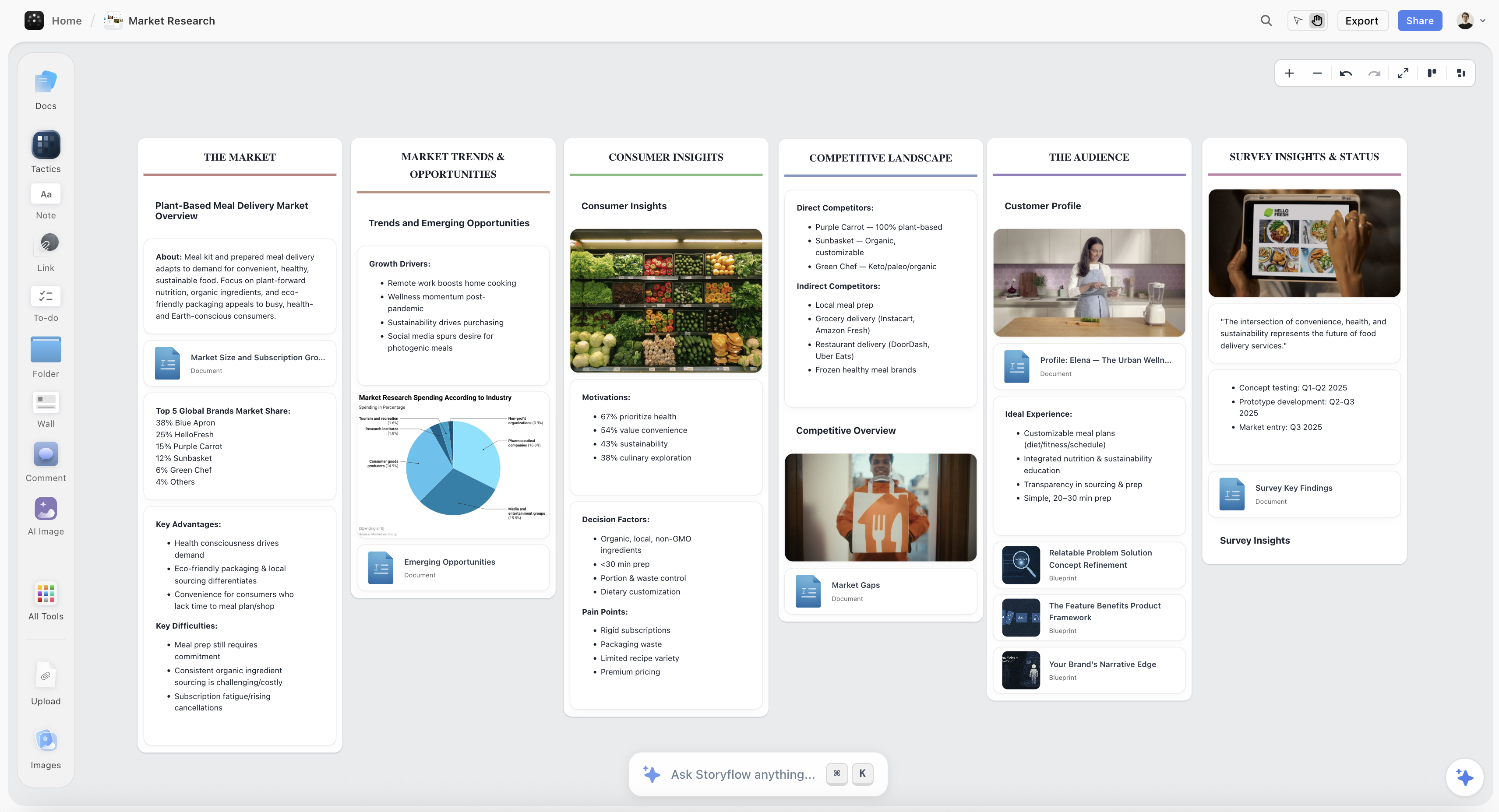
Positioning canvas with competitor cards and category lines around the brand center
Layer 3: Audience (Who You Are For)
Audience is where most brand strategy goes to die. Founders write "millennials and Gen Z creators" and call it done, which is the demographic equivalent of saying "humans." A real audience layer is one specific person, written like a real human, with a job, a frustration, a Saturday morning routine, and a piece of software they currently use that they secretly hate.
AI is well-suited to audience work if it has real inputs. The trap is asking ChatGPT to "create a customer persona for a brand." It will hand you a stock template that is more useful as a starting point for a Pinterest board than for a strategy. The unlock is feeding AI three real artifacts: a customer interview transcript or 5 customer messages, a competitor's reviews (especially the 3-star ones), and a list of features your product does and does not have.
With those three inputs visible on the canvas, the AI can build a persona that has actual edges. It will name the daily moment when the customer feels the problem. It will name the specific tool they currently use that does not work. It will name the Slack message they would forward if they discovered your brand. That is a usable audience layer.
A canvas pattern that works: drop one card per real customer quote you have, group them, then ask the AI to synthesize one composite persona from those clusters. Do not let it invent traits the cards do not support. If you want a structured starting point, generate a first persona with AI, then replace every trait it guesses with one your customer quotes actually support.
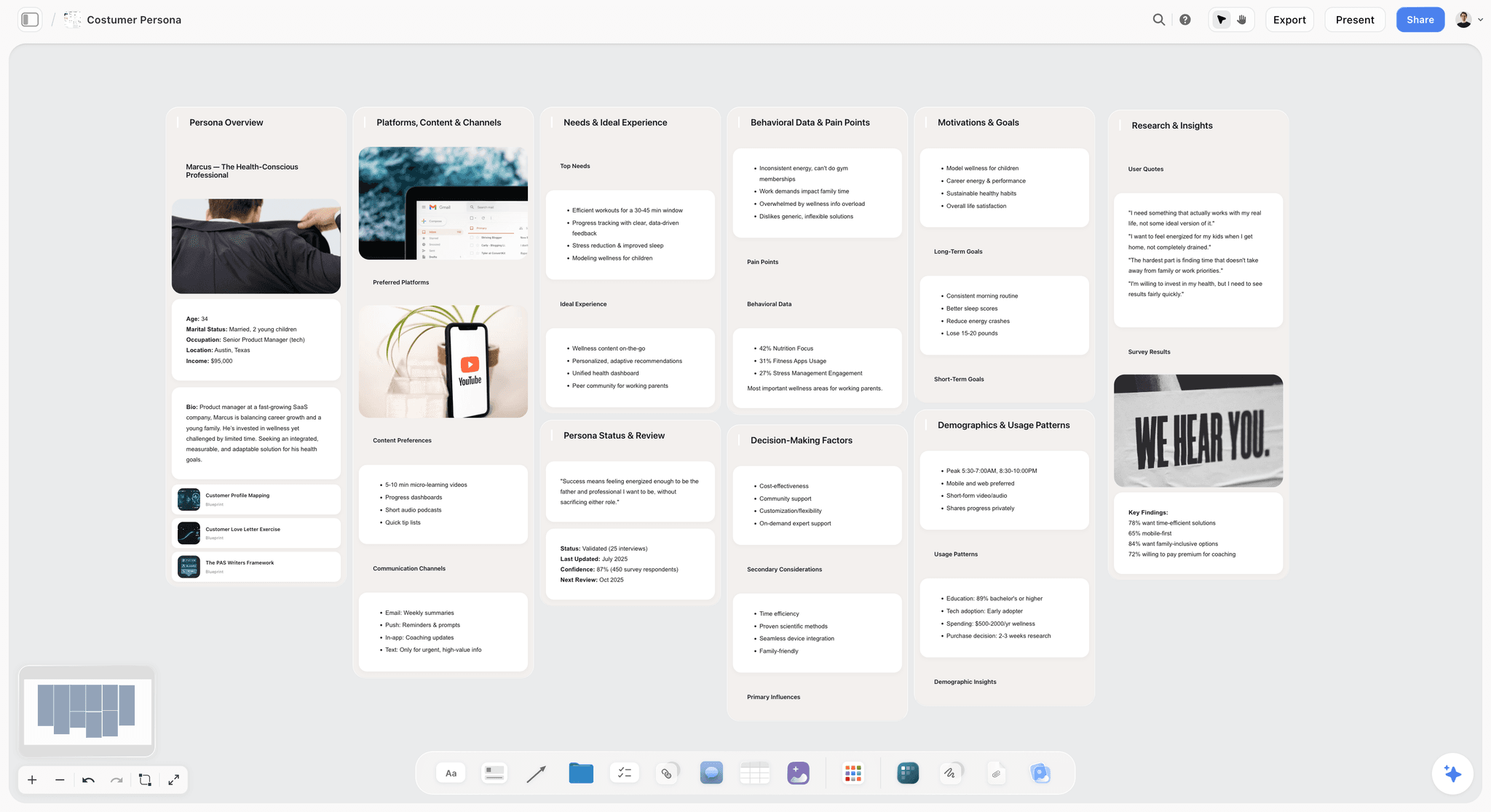
Customer persona built on a canvas ready to be loaded into AI prompts as @-mentioned context
Layer 4: Identity (Visual + Verbal Anchor)
Identity is the part most founders start with, even though it should be Layer 4. Logo, color palette, typography, and brand name are visual decisions that should follow purpose, positioning, and audience. Otherwise the brand looks like a moodboard for a brand the founder wishes they were building, not the brand they actually are.
AI is genuinely useful in identity work in 2026, but only as a generative partner inside an art-directed loop. Tools like Midjourney or Storyflow's AI moodboard can produce 50 logo or color directions in 10 minutes. The trap is shipping any of them. Identity work is choosing, not generating. AI generates 1000x faster than a human, so it shifts the bottleneck to taste. The strategist's job becomes: write a tight visual brief, generate 50, kill 47, refine 3, choose 1.
For AI to be useful here, it has to read the audience layer (Layer 3) and the positioning layer (Layer 2) before it generates a single logo. Otherwise it will design for the founder's taste, not the audience's. A useful prompt pattern: "Generate logo directions for a brand whose audience is X, positioned as Y, with a personality that is more Z than W. Avoid: gradients, generic geometric shapes, anything that looks like a Stripe-clone." The constraints are the strategy.
On a canvas, place the identity moodboard next to the audience persona and the positioning statement. When you ask the AI for the next round of logo or color directions, it reads all three at once. The output stays on-brand instead of becoming a generic moodboard the founder will silently regret next quarter.

Brand identity board with logo, color, and type all on the same canvas as strategy layers
Layer 5: Voice and Tone
Voice is who the brand is when it talks. Tone is how that voice changes by context (a billing email is not a launch tweet). Most brands operate with no documented voice, which means every piece of copy sounds slightly like the person who wrote it that day. A real voice layer fixes this.
AI is unusually good at voice work, with one condition: the voice has to be defined as a list of dos, don'ts, and reference brands, not as a paragraph of adjectives. "Confident, friendly, modern" is not a voice. "Says 'we' not 'our team,' uses one-syllable verbs, never says 'unleash,' sounds more like Patagonia than Salesforce" is a voice the AI can actually apply to a draft.
The voice layer that works for AI has four pieces. First, three reference brands the voice should resemble (and one it should not). Second, a list of 10 forbidden words and phrases. Third, a list of 10 signature words or constructions the brand uses. Fourth, three sample sentences in voice for high-stakes contexts: a launch announcement, a billing email, a customer apology.
Once that 4-piece voice layer is on the canvas, every AI-generated piece of copy in the brand can reference it. You stop writing "make this on-brand" and start writing "follow voice guide on canvas, especially the forbidden words list." The output becomes consistent across the team and across months.
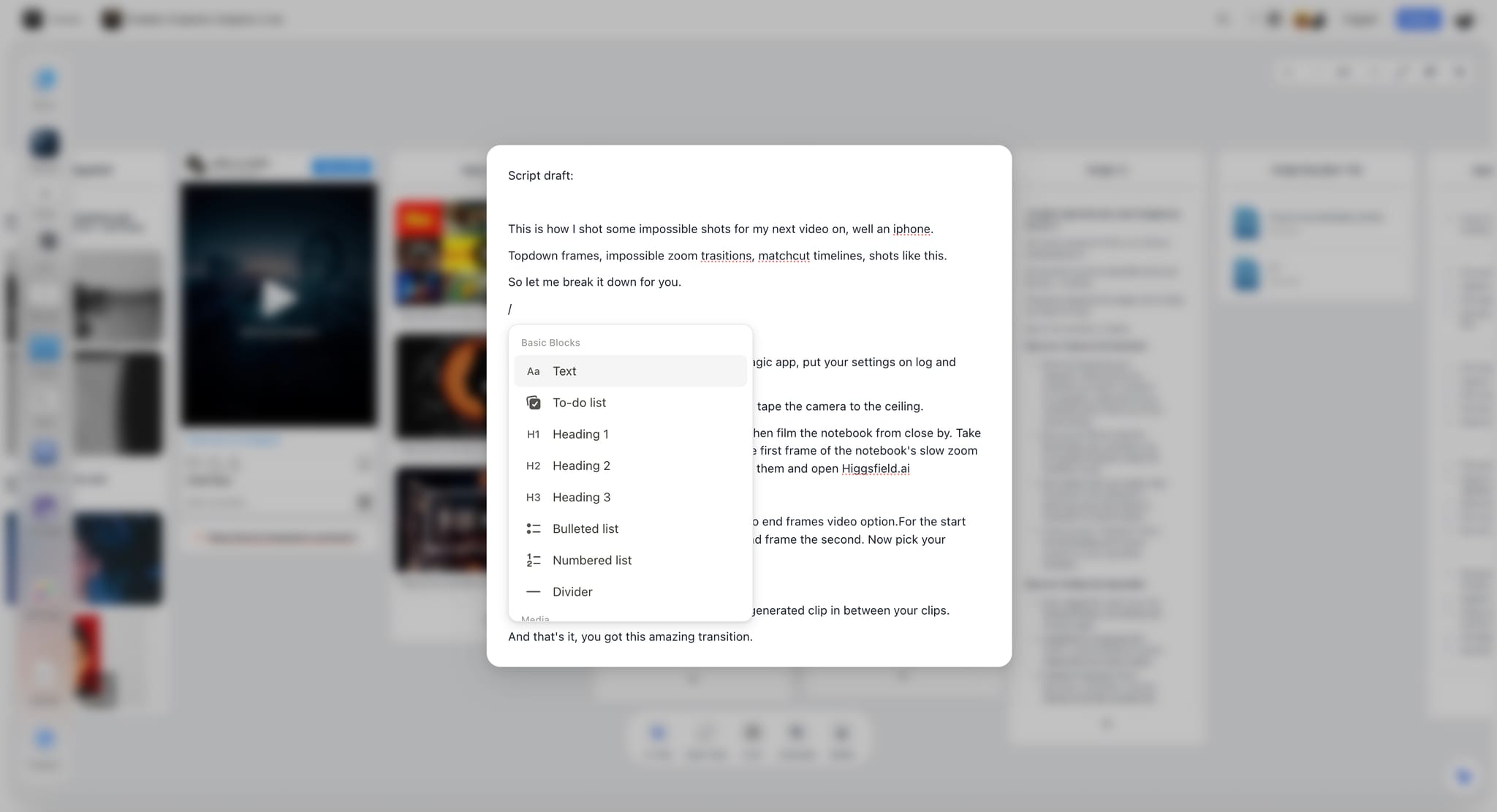
Voice and tone framework with do/don't axes mapped on a canvas
Layer 6: Value Propositions
Value propositions are the bridge between strategy and sales. A value prop is not a feature list. It is a hierarchy of reasons a specific audience will switch to you from what they are using now. The canonical structure is one primary value prop (the one thing the brand is famous for) and 3 to 5 secondary value props that support it without competing with it.
AI's typical failure mode at this layer is feature regurgitation. Ask it for value props and it will list features. The fix is forcing the value-prop layer to read both the positioning statement and the audience persona on the canvas before generating anything. Then ask the AI to translate features into outcomes, then translate outcomes into emotional triggers tied to the audience's real frustration from Layer 3.
A pattern that works: write each feature on a card. Group features by the customer outcome they enable. Group outcomes by the emotional state they trigger. Now ask the AI to write one value prop per emotional cluster, ranked by how strongly the audience cares about that emotion. The output is a stack, not a list, with a clear primary and clear supporting props.
The test for a good value prop: if you read it to your audience without naming the brand, they should still want to know who said it. If they shrug, the prop is too generic, which means the layers above it (positioning, audience) are not specific enough yet. Value props are the layer that exposes weak strategy upstream.
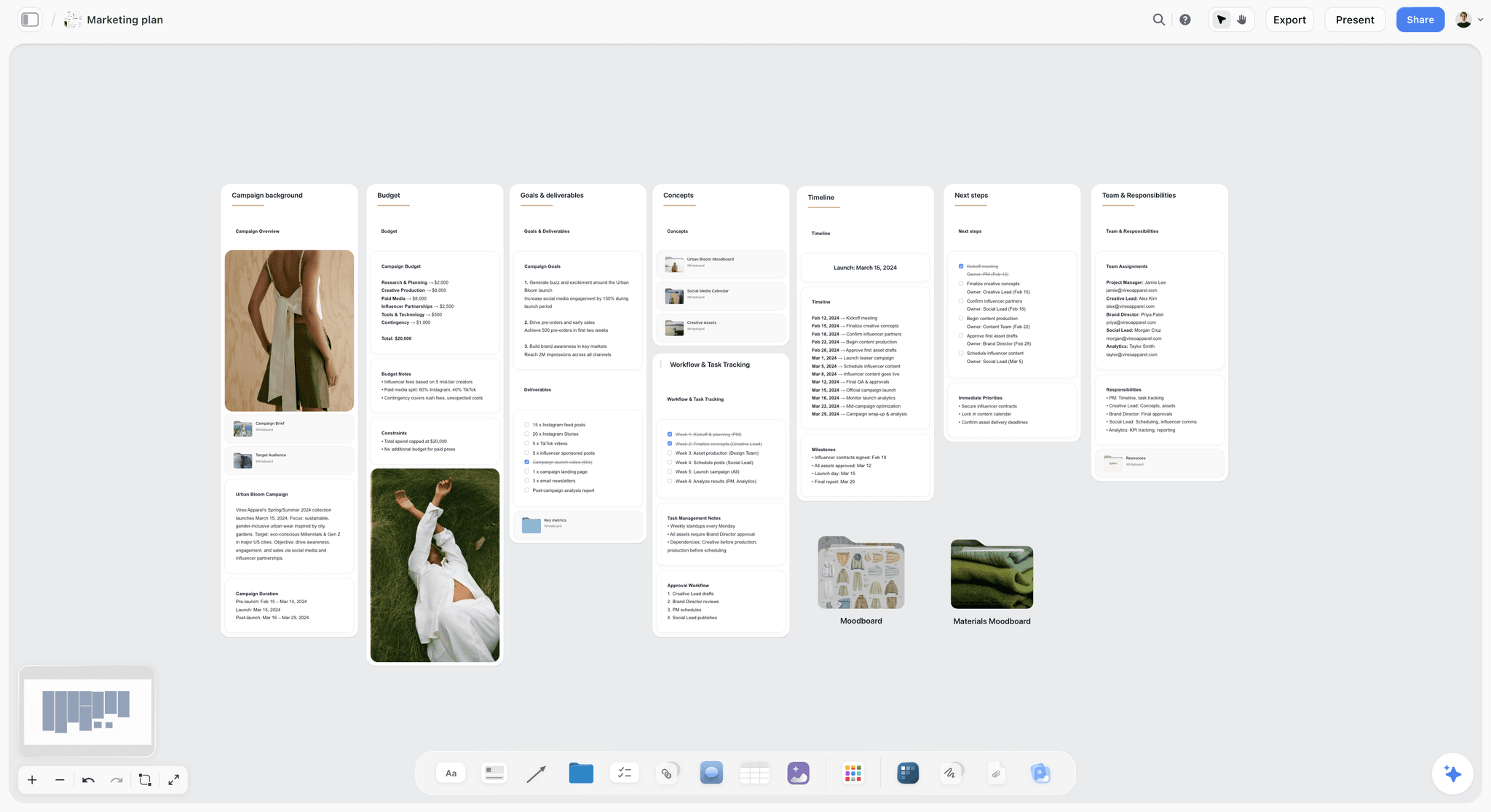
Value proposition stack with primary and secondary props connected to audience cards
Layer 7: Narrative (The Brand Story)
Narrative is where all the above layers turn into a story a human can actually tell. Purpose, positioning, audience, identity, voice, and value props are inputs. Narrative is the output that gets used in keynotes, pitch decks, About pages, podcast intros, and the answer to "what does your company do?" at a dinner party.
Most brand narratives fail in one of two directions. They are either too literal (a feature list with a "founded in" date) or too grand (a hero's-journey monologue that reads like a TEDx submission). The narrative that works sits between, and AI is well-suited to drafting it if it can read all 6 prior layers on the canvas at once.
The structural move is to use a known narrative tactic, like Donald Miller's StoryBrand 7-part frame, the Hero's Journey, or a simple 3-act problem-solution-promise. Drop the tactic onto the canvas as a set of prompts. Then ask the AI to fill each beat using only what is on the canvas in the prior 6 layers. The output is a brand story that is consistent with the strategy, not a parallel marketing fiction.
A narrative is a working narrative when it can be told in three lengths without changing meaning: 30 seconds, 3 minutes, and 30 minutes. The 30-second version is the elevator. The 3-minute version is the keynote intro. The 30-minute version is the Series A or feature-film-treatment version of the brand. AI can draft all three from the same canvas in one session if the prior layers are tight.
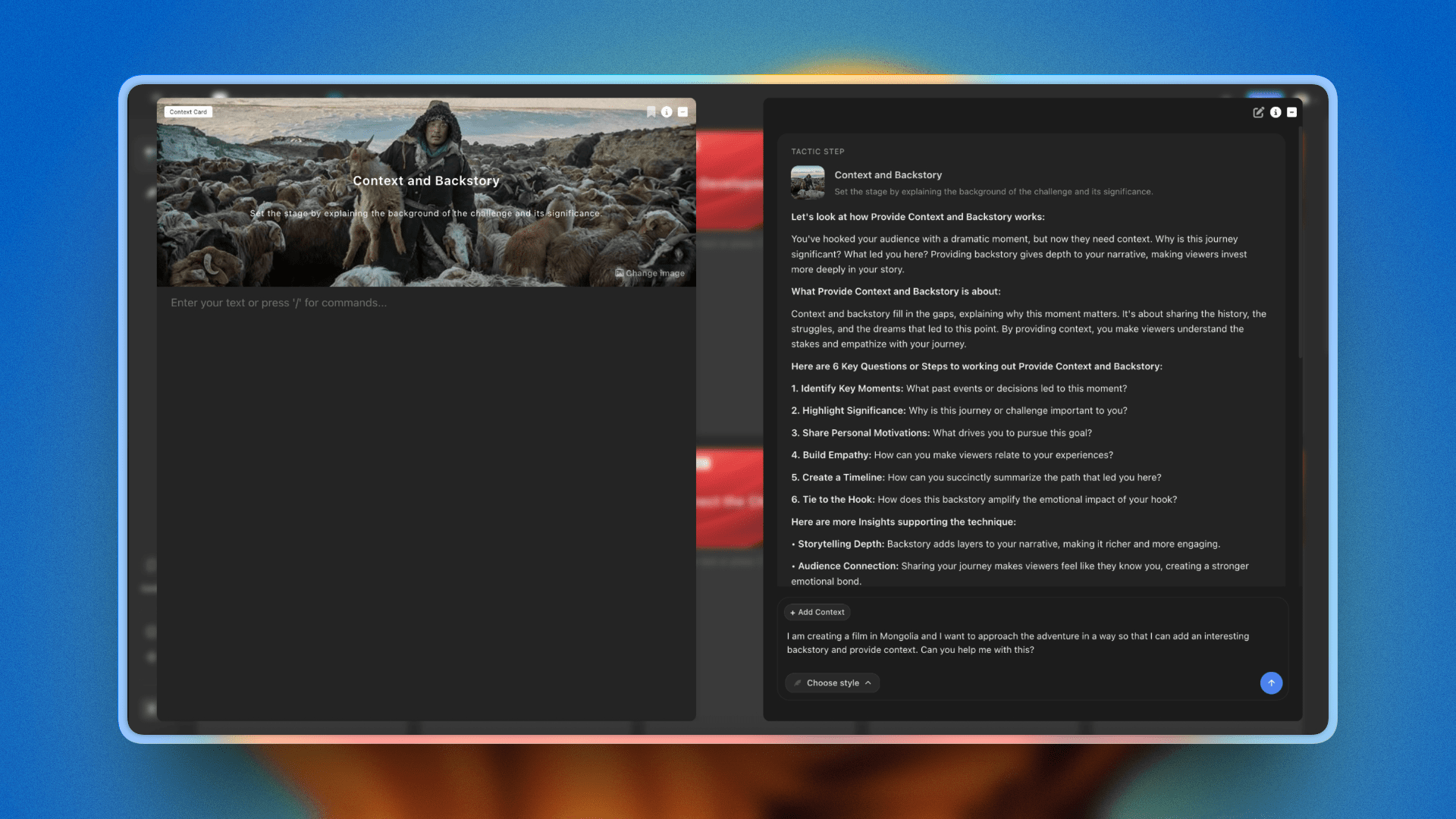
Brand narrative built with a Hero's Journey Tactic on the same canvas as the strategy layers
Layer 8: Activation (How the Strategy Lives in Real Work)
A brand strategy that does not produce different decisions on a Tuesday is decoration. Activation is the layer that translates the 7 layers above into the real work the brand does each week: which channels you are on, what you publish, what you decline, how you handle support, how you launch, how you price.
AI's contribution at the activation layer is in production speed once strategy is locked. Generate 30 days of LinkedIn posts that follow the voice guide and never break the value-prop hierarchy. Draft a launch sequence that pulls from the narrative arc. Write a customer support reply that matches the voice in a frustrated-customer context. None of this works without the upstream layers, but with them, AI compresses the activation layer from weeks to hours.
The activation layer on a canvas has 4 components. First, the channel mix (where the brand shows up, ranked by priority). Second, the content pillars (3 to 5 themes that the brand is known for). Third, the cadence (what gets published when). Fourth, the decline list (what the brand will never do, even when it would get clicks). Drop all four on the canvas next to the prior 7 layers.
When the AI can read activation alongside narrative, voice, value props, audience, identity, positioning, and purpose, it stops generating generic content. It starts producing content that recognisably belongs to the brand. The strategy lives in the work instead of sitting in a doc.
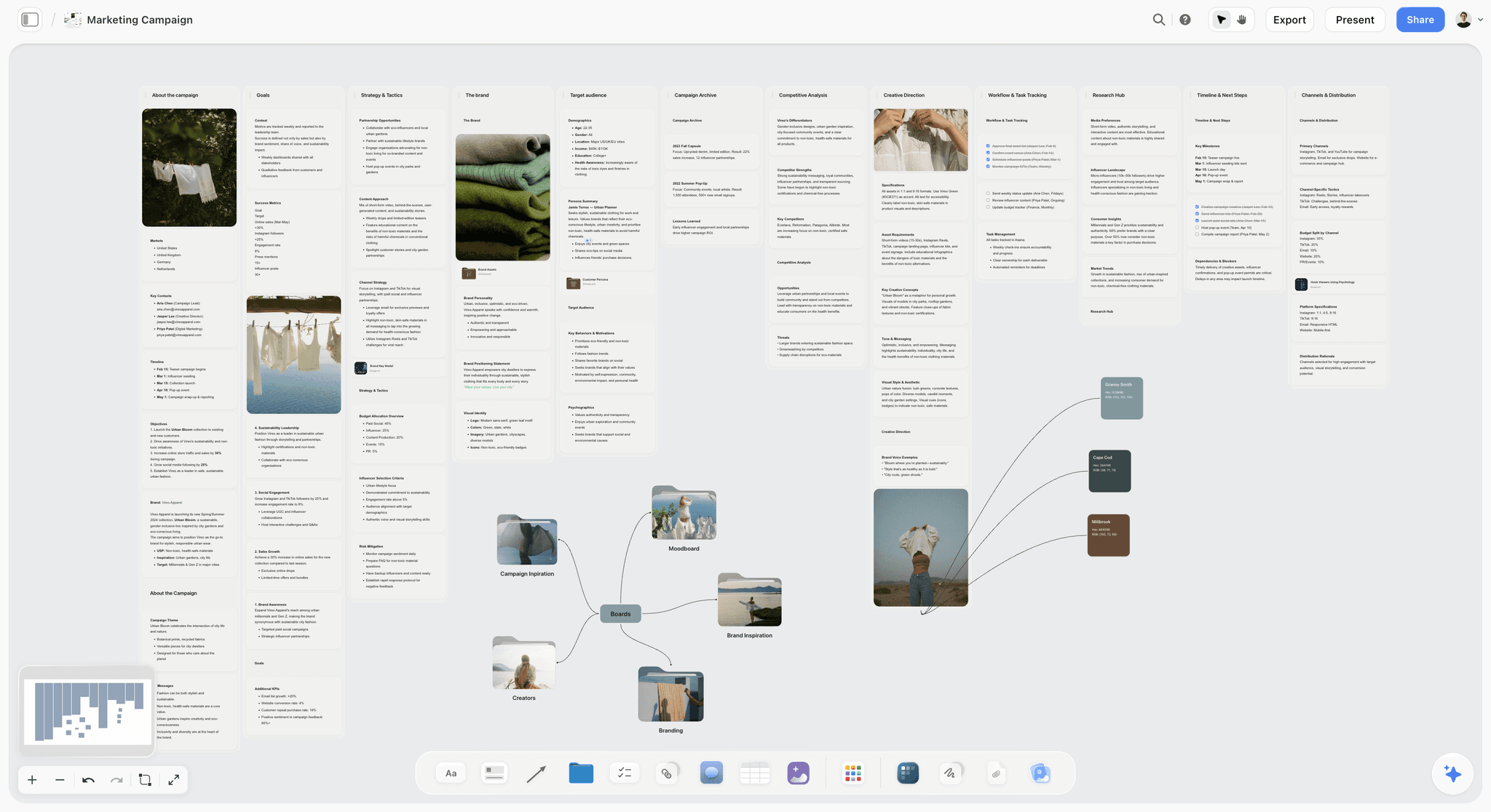
Activation channels mapped from strategy down to weekly content on the canvas
A Worked Example: A Solopreneur Brand Strategy in One Canvas
Imagine a solo founder building a productivity app for indie filmmakers, working alone. Here is what the 8 layers look like on one canvas, condensed.
Layer 1, Purpose. Indie filmmakers spend more time wrestling with software than telling stories. The brand exists to give those creators back the hours that should belong to the work. Forbidden words: empower, transform, unleash. Founder origin: spent 4 years on a doc and shipped 3 weeks late because of file-management chaos.
Layer 2, Positioning. For solo and 2-person filmmaking teams who need pre-production tools, the brand is the only canvas-first planner that holds script, shot list, schedule, and moodboard in one view, unlike Notion (text-first) and Milanote (board-first but no canvas-AI).
Layer 3, Audience. Maya, 31, freelance documentary director, two laptops, currently uses Google Docs plus a Pinterest board plus a Trello she abandons every project. Hates the moment she has to hand a file to a producer because nothing exports cleanly.
Layer 4, Identity. Wordmark logo. Type pairing: Lora display plus Inter body. Color: warm neutral plus a single saturated accent. Reference brands: Field Notes, Are.na. Avoid: tech-bro gradients.
Layer 5, Voice. We talk like a smart friend with a film background, not a software vendor. Forbidden: "powerful," "unleash," "AI-first." Signature: "the bit where," "before you record."
Layer 6, Value Props. Primary: one canvas, every pre-production artifact, AI that can read all of it. Secondary: handoff that does not break, planning that survives the shoot day, AI that knows your project context.
Layer 7, Narrative. 30-second: we make pre-production feel like a sketchbook again. 3-minute: the StoryBrand version. 30-minute: the founder origin plus product principles plus customer story.
Layer 8, Activation. Channels: YouTube long-form (founder voice), LinkedIn weekly (case studies), monthly newsletter (workflow deep-dives). Pillars: pre-production craft, AI as collaborator, the indie-team economy. Decline: paid TikTok ads, AI-newsletter cross-posts, listicles.
This entire strategy fits on one canvas a strategist can read in 90 seconds and an AI can read on every prompt. It is not a 60-page brand book. It is a working brand brain.
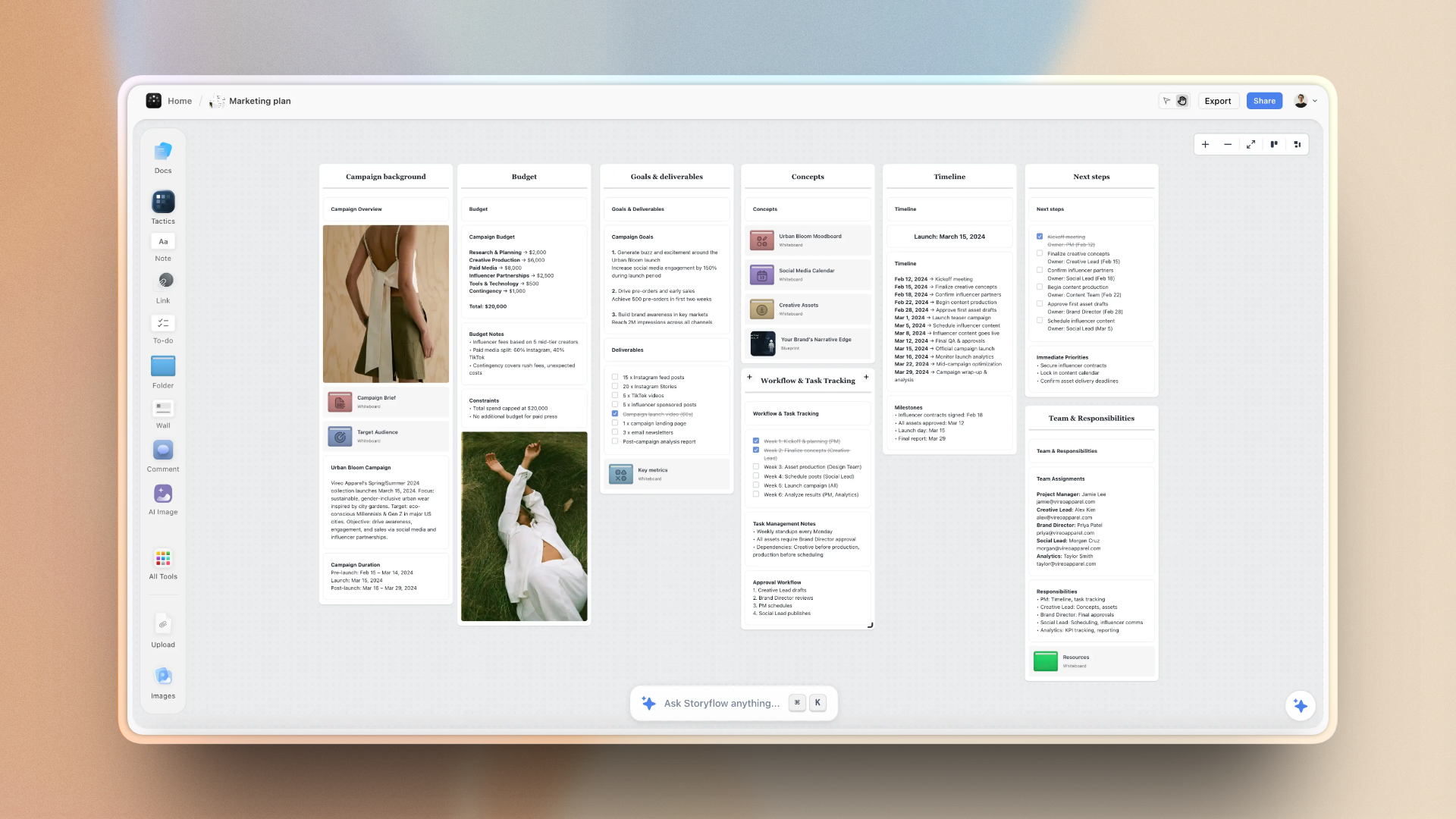
Complete solopreneur brand strategy on a single canvas: 8 layers connected and AI-readable
How to Pick the Right AI Tool for Brand Strategy Work
Most AI tool reviews for brand work compare interfaces. The real question is which tool can read the whole strategy at once. Here is the honest tradeoff map.
Storyflow is the canvas-first option. The 8 layers each become a region of one infinite canvas, with 200+ Story blueprints (Customer Persona, Positioning Statement, Brand Pyramid, StoryBrand, Hero's Journey, Voice Guide, and more) you drag in as starting templates. The AI reads your full active canvas board on every prompt, plus up to 1 Tactic and up to 3 Documents you @-mention in the chat. That is the unlock for non-generic strategy work: the model can see purpose, positioning, audience, and voice at the same time instead of getting one pasted paragraph per question. Plans: Free at $0, Plus at $7.99 per month annual, Pro at $14 per month annual, Max at $39 per month annual. The team-targeted tier with a shared workspace and roles is Max. The honest tradeoff: Storyflow is not where you write a 5000-word About page or a long brand book. The canvas holds the strategy, but long-form prose still wants a document. Draft the narrative beats on the canvas, then expand them in a doc.
ChatGPT is the best general writer in 2026 for paragraph-level polish. Hand it a value prop and it will refine the wording. The limitation for brand strategy is that it has no spatial memory across the 8 layers. Each layer is a fresh chat. Pricing varies by plan and is widely reported around the $20 per month range for Plus tiers, but check the current page before you quote it.
Claude is excellent for long-form positioning documents and brand books, especially when the strategy is already written and you need to expand a single layer into a 2000-word doc. Same blind spot on canvas, same per-prompt context limit. Paid plans are also widely reported in the same tier range.
Notion AI is the right choice if your team already lives in Notion. It can read the docs in your workspace, which is its biggest advantage. The weakness for brand strategy is that brand work is spatial, and Notion is linear. You will build a 7-page nested doc structure that is hard to see end to end.
Miro AI is the workshop tool. Good for sticky-note brainstorming sessions in person or remote, especially if your team already works in Miro. The AI features are getting better, but the AI is not as deeply integrated with the canvas content as a strategist would want.
For a solo founder or a small team building strategy from scratch, the canvas-first approach wins because the 8 layers are visible and the AI can see them all at once. For an agency that already has a strategy and needs to expand individual pieces, Claude or ChatGPT plus Notion is fine.
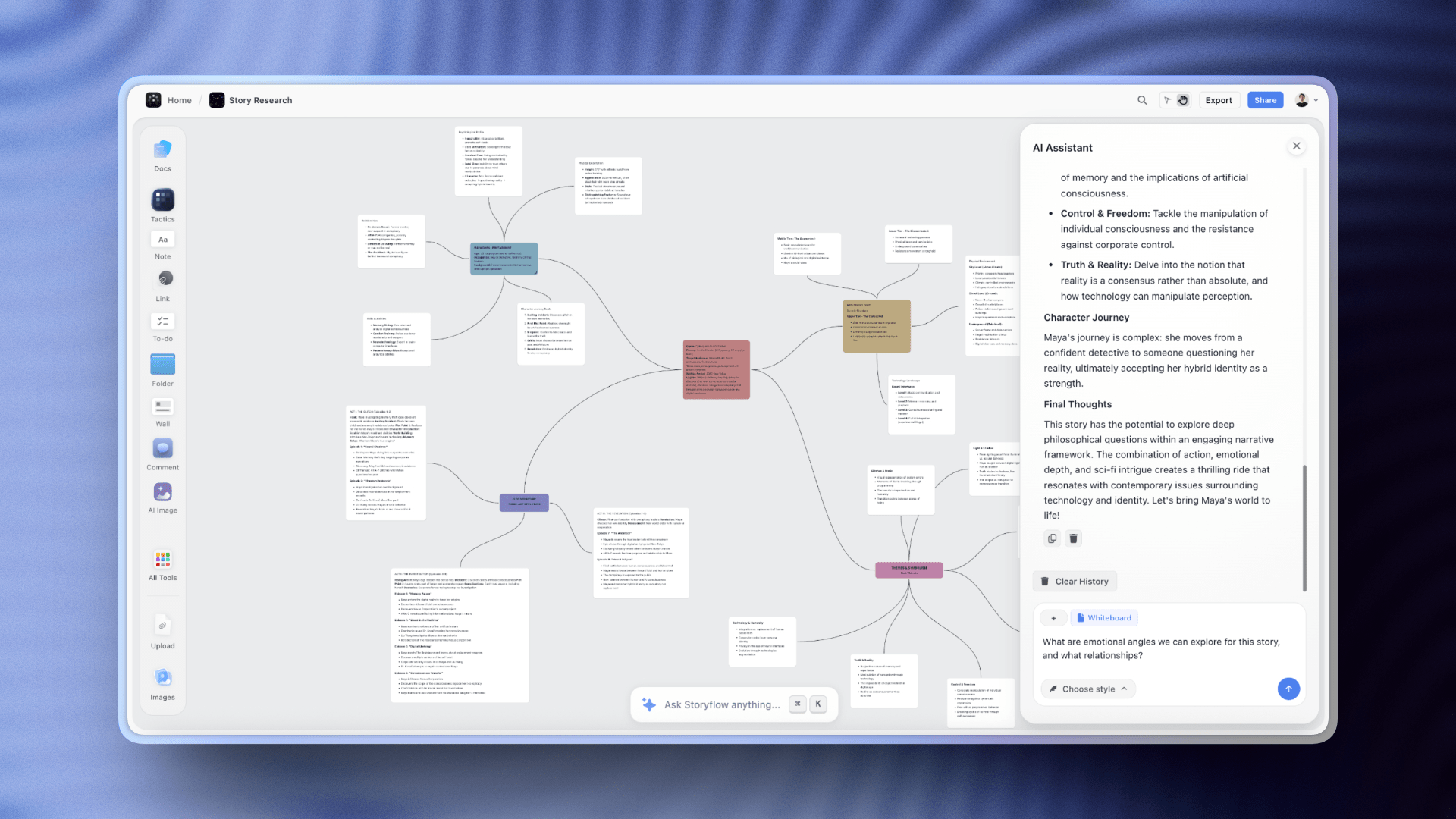
Storyflow AI reads the full strategy canvas before answering the next strategic question
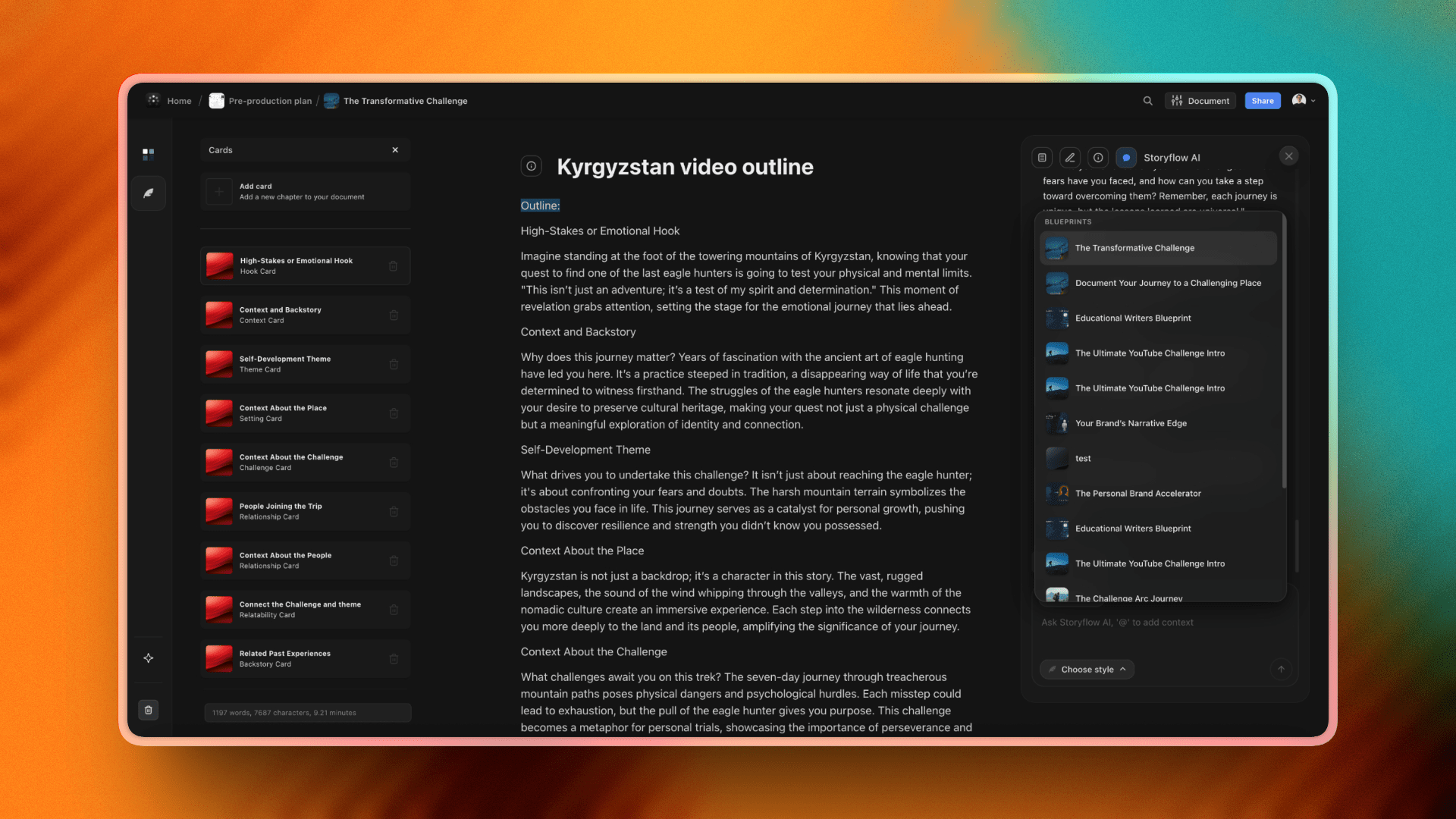
Tactics like Customer Persona, Positioning, Brand Pyramid, and StoryBrand drop straight onto the canvas as starting templates
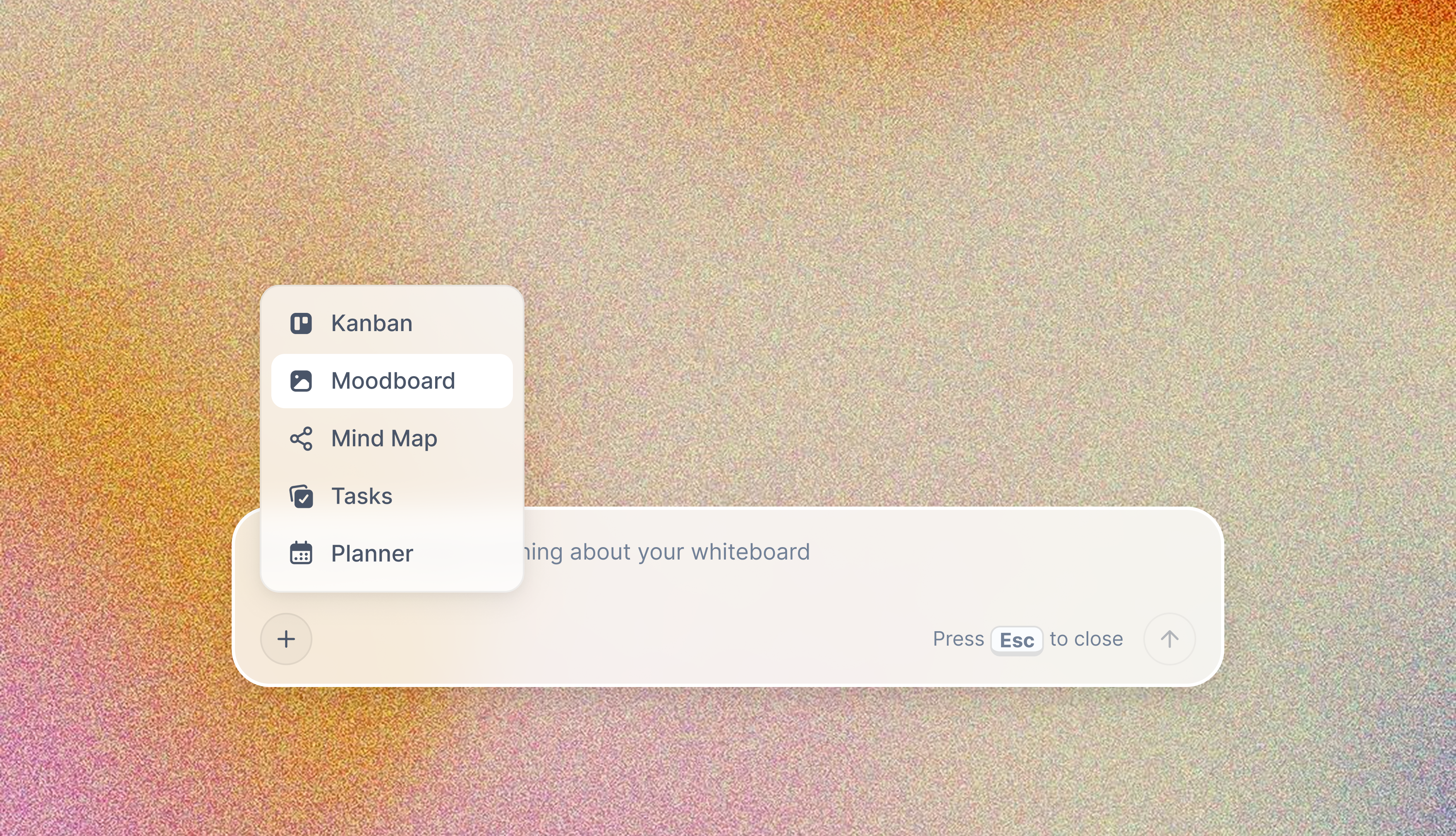
AI moodboard generation grounded in the upstream audience and positioning layers, not in the founder's Pinterest taste
Common Mistakes Founders Make with AI Brand Strategy
The mistakes are predictable and avoidable.
- Starting with the logo. Identity (Layer 4) before purpose, positioning, and audience produces a beautiful logo for a brand the customer does not recognize.
- Using one-shot prompts. A new chat for each layer means each layer is generated without seeing the others. The strategy reads inconsistently.
- Treating "AI brand strategy" as one prompt. "Build my brand strategy" returns a generic 5-pillar deck. The 8-layer framework forces specificity.
- Defining voice as adjectives. "Confident, friendly, modern" is not a voice the AI can apply. Dos, don'ts, reference brands, and forbidden words are.
- Skipping audience. Without a real persona on the canvas, every layer below it drifts toward "everyone," which means no one.
- Generating identity without art direction. Letting AI produce 50 logo directions and shipping the one that "looks fine" is not strategy, it is Pinterest.
- Stopping at narrative. A brand story that is not activated in channels (Layer 8) is just a manifesto. The strategy lives in weekly work or it does not live at all.
Storyflow Brand Strategy Workflow: A Two-Day Process
Here is how to actually build the 8 layers in two days using Storyflow.
Day 1, morning, 3 hours. Open a new canvas. Drop in the Customer Persona Tactic, the Positioning Statement Tactic, and the Brand Pyramid Tactic. Fill in Layer 3 (Audience) first using real customer quotes if you have them. Then fill Layer 2 (Positioning) with 3 to 5 real competitors. Then Layer 1 (Purpose) using founder origin, customer change, forbidden words. Use the AI panel to draft each layer and iterate three times. Stop when each layer is one sentence you would actually defend.
Day 1, afternoon, 3 hours. Add Layer 4 (Identity) as a moodboard region. Use AI moodboard generation to produce 30 directions. Kill 27. Refine 3. Pick 1. Then Layer 5 (Voice) using the 4-piece voice template. Save the voice as a reusable AI context for the rest of the workflow.
Day 2, morning, 3 hours. Layer 6 (Value Props) by writing every feature on a card, grouping by outcome, grouping outcomes by emotion, then asking the AI to draft a primary and 3 supporting value props from the clusters. Layer 7 (Narrative) using a StoryBrand or Hero's Journey Tactic to draft the 30-second, 3-minute, and 30-minute versions of the brand story.
Day 2, afternoon, 3 hours. Layer 8 (Activation) by mapping the channel mix, 3 to 5 content pillars, the cadence, and the decline list. Generate 4 weeks of content drafts using the AI with the full canvas in context. Review for voice and brand consistency.
Plan-wise: a solo founder can run the full workflow on the Pro plan at $14 per month annual, which gives access to AI features and the full Story blueprints library. Free at $0 covers exploration. Plus at $7.99 per month annual works if the strategy is light. Max at $39 per month annual is the team-targeted tier with a shared workspace and roles, for agencies that want a strategist and a designer working on the canvas together.
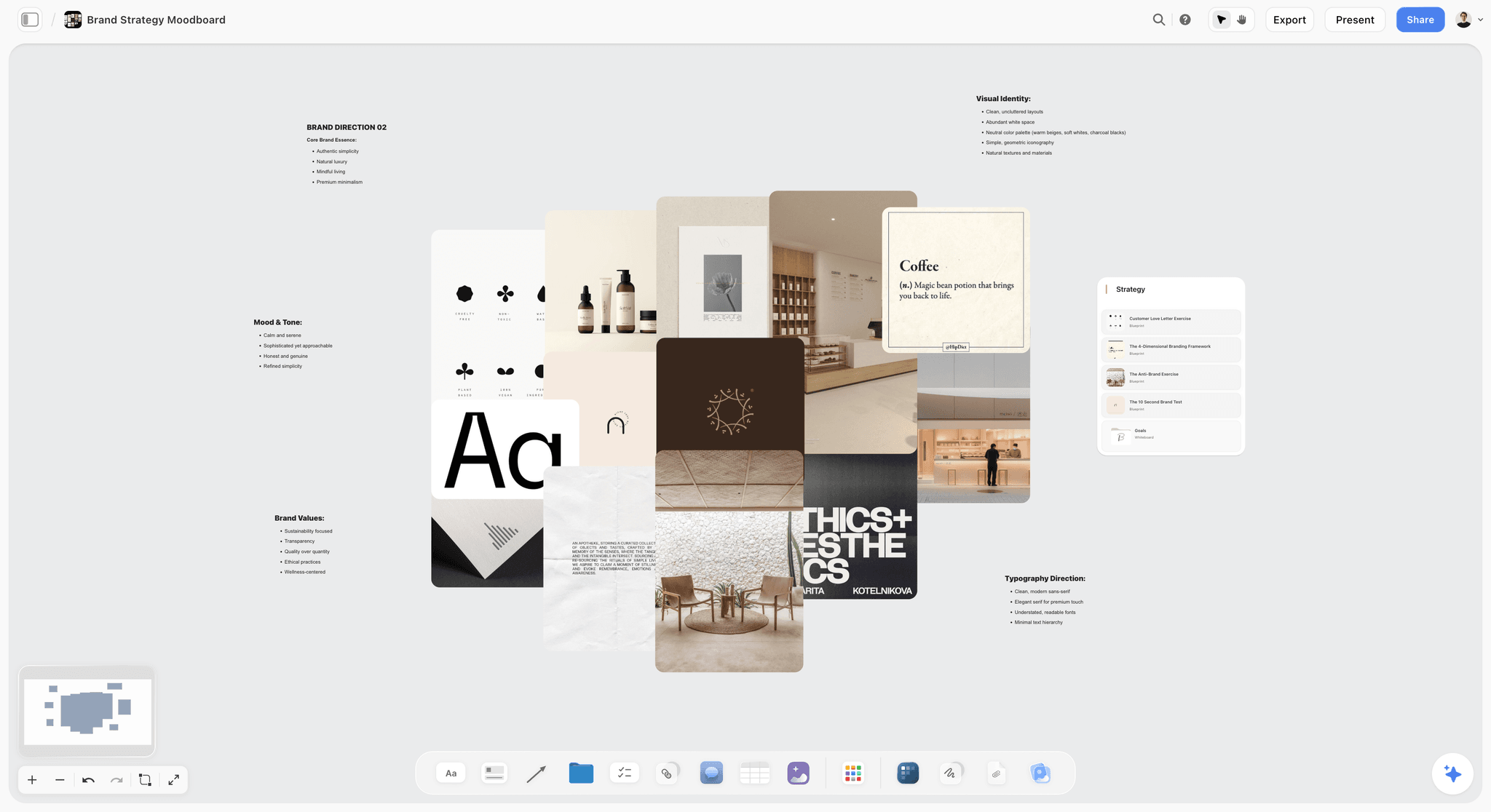
A complete brand strategy on one Storyflow canvas, with all 8 layers laid out as connected regions the AI can read in a single pass

A brand strategy as a mind map: purpose at center, 8 layers branching out, all readable by the AI on every prompt
Final Verdict: Building a Brand Strategy with AI in 2026
A brand strategy is not 60 pages of brand book PDF. It is 8 connected layers, on one canvas, that any AI worth its compute can read in one pass. The reason most AI brand strategy outputs feel generic is not the prompt, it is the lack of context. Put every layer in one place and the outputs become specific, defendable, and yours. Solo founders and small teams do not need a $50K agency engagement to do this in 2026. They need a framework and a canvas. Here is the experiment: open a Storyflow canvas, drop the 8 layers as regions, and write your positioning statement with the audience and competitor cards already on the board. Compare that output to what ChatGPT gives you from a single pasted paragraph. If the canvas version is not noticeably more yours, you have lost an afternoon. If it is, you have your v1 brand strategy.
FAQ: Building a Brand Strategy with AI
Can AI build a brand strategy from scratch?
AI cannot build a brand strategy from scratch on its own. What it can do is take real inputs (founder origin, competitor landscape, customer interviews, feature list) and generate strategic options across all 8 layers faster than a human. The strategist's job becomes choosing, not generating. Without real inputs, AI produces generic outputs in any framework.
What's the best AI tool for brand strategy?
The best AI tool for brand strategy in 2026 is the one that can read every layer of the strategy on every prompt. Canvas-first tools (Storyflow) hold the 8 layers in one spatial view and feed all of them to the AI on each request. Linear tools (ChatGPT, Claude) are excellent for paragraph-level polish but blind to the rest of the strategy. Doc tools (Notion AI) are good for teams already in Notion. Workshop tools (Miro AI) are good for live brainstorming.
How long does it take to build a brand strategy with AI?
A solo founder using the 8-layer framework on a canvas can build a working v1 in two focused days. Three hours per layer is too much. One hour per layer is too fast. The right pace is to draft each layer with AI, iterate three times, defend it in one sentence, and move on. The strategy will tighten over the next 30 days as it meets reality.
How much does it cost to build a brand strategy with AI?
You can build a working v1 brand strategy with AI for the price of one or two consumer AI subscriptions, far below the $50K an agency engagement costs. A canvas-first setup runs the full 8-layer workflow on a plan like Storyflow Pro at $14 per month annual, which includes AI features and the 200+ Story blueprints library. The Free tier at $0 covers exploration before you commit. The real cost is not the software, it is the time to gather real inputs (founder origin, competitor one-liners, customer quotes) that keep the AI from producing generic output.
Should I use AI to write my brand voice guide?
Yes, with the right scaffolding. Define voice as 4 pieces: 3 reference brands (and 1 to avoid), 10 forbidden words, 10 signature words, and 3 sample sentences in voice for high-stakes contexts. AI written voice guides without that scaffolding default to "confident, friendly, modern" adjective lists that are useless for application.
What's the difference between brand strategy and brand identity?
Brand identity is Layer 4 of brand strategy. Identity is the visual and verbal anchor (logo, color, type, name). Brand strategy is the full 8-layer system (purpose, positioning, audience, identity, voice, value props, narrative, activation) that decides what the identity should be in the first place. Most founders confuse the two and start with identity.
Can a solopreneur really build a serious brand strategy alone?
Yes, in 2026, with AI, a solopreneur can build a strategy that would have required a small agency in 2020. The unlock is the canvas plus the AI plus a working framework. The output will not be a 60-page brand book. It will be one canvas with 8 layers, which is what most agency brand books reduce to anyway. The key skill is taste: knowing which AI-generated option to keep.
Will customers know my brand was built with AI?
Customers do not care how the brand was built. They care whether the brand is consistent, specific, and recognizably itself across every touchpoint. AI-built strategies fail at this when each layer is generated in isolation. AI-built strategies succeed at this when the 8 layers are visible on one canvas and the AI reads all of them on every prompt.
Table of Contents
- Key Takeaways
- Quick Answer: How to Build a Brand Strategy with AI in 2026
- Why Most AI Brand Strategy Outputs Are Generic
- The 8-Layer Brand Strategy Framework
- Layer 1: Purpose (Why You Exist Beyond the Product)
- Layer 2: Positioning (Where You Sit in the Market)
- Layer 3: Audience (Who You Are For)
- Layer 4: Identity (Visual + Verbal Anchor)
- Layer 5: Voice and Tone
- Layer 6: Value Propositions
- Layer 7: Narrative (The Brand Story)
- Layer 8: Activation (How the Strategy Lives in Real Work)
- A Worked Example: A Solopreneur Brand Strategy in One Canvas
- How to Pick the Right AI Tool for Brand Strategy Work
- Common Mistakes Founders Make with AI Brand Strategy
- Storyflow Brand Strategy Workflow: A Two-Day Process
- Final Verdict: Building a Brand Strategy with AI in 2026
- FAQ: Building a Brand Strategy with AI
Templates to check out for this topic


Branding and design templates you can use in Storyflow
Take a brand from naming to visual direction on one connected canvas. Open any of these templates and the AI works from everything already on the board.


See Storyflow in Action
A visual AI workspace where every feature lives inside one canvas. No tab-switching, no context lost.
Build your entire board from a single message
Type what you need in the AI chat at the bottom of your canvas. The AI adds cards, headings, and structure directly onto your board.
Use expert frameworks as AI context
Type @ in the AI chat and choose any Tactic. The AI tailors every response to that framework instead of giving generic advice.
Turn your board into a mind map in seconds
Ask the AI to restructure your canvas as a mindmap. It connects your ideas into a visual hierarchy so you can see how everything relates.
Why Storyflow Exists
Storyflow actually began as a personal tool while working on creative and research projects.
We kept running into the same problem: ideas were scattered everywhere: notes, documents, and whiteboards.
Nothing helped us see how everything connected.
So we started building a workspace designed around how ideas actually grow.
→ Read how Storyflow was createdJustkay
Documentary Filmmaker & Founder at Storyflow
Published: 2026-05-10
Extremely simple, seriously capable


See how easy it is to get started
Watch a real project come together, from a blank board to a finished plan, clicked through step by step.
Start creating with AI and become more productive
Transform your creative workflow with AI-powered tools. Generate ideas, create content, and boost your productivity in minutes instead of hours.