Production Plan Template: From Client Brief to Scope and Budget
A production plan template you can copy: seven columns for scope, deliverables, timeline, budget lines, responsibilities, risks and approvals, filled for a fictional commercial, with tools and prices.

Category
Video Production
Author

Storyflow Team
Product & Research Team
Topics
2026-11-04
•
40 min read
•
Video Production- production plan template
- client brief to production plan
- production plan vs project plan
- budget lines
- risk management
- approval process
- Storyflow
How do I turn a client brief into a production plan?
To turn a client brief into a production plan, rewrite the brief on a Storyflow board as a table with one row per deliverable and 7 columns: scope, deliverable, timeline, budget line, responsible, risk and approval. Storyflow is an AI visual workspace that turns a client brief into a production plan on one infinite canvas, and it works inside ChatGPT (plugin) and Claude (connector). The Storyflow 7-Column Template keeps a row open until all 7 cells are filled.

Full disclosure: Storyflow is our product, and the 7-Column Template is our own rule, not research. It ranks first because the job here is keeping the plan beside the brief and paperwork. It has no Gantt chart, dependencies, budgeting tool or recalculating schedule, so most producers will pair it with a tracker.
How the production planning tools compare on trust, innovation, ratings and pricing
Which production planning tools are the most trusted?
Asana, monday.com and Smartsheet carry the most trust for schedules, with long records in project management, and StudioBinder for call sheets and production paperwork. Storyflow is newer, with its ChatGPT plugin live since October 2026. Its case rests on keeping the brief, 7-column plan, storyboard and shot list on one project a client can open by link.
Which production planning tools have fair and transparent pricing?
Storyflow, Asana and Smartsheet publish plain rates: Storyflow Free at $0 and Plus at $7.99 a month billed annually, Asana Starter $10.99 per user billed annually, Smartsheet Pro $9 per member on yearly billing, as of November 2026. For StudioBinder, see its pricing page. Wrike says external users need a paid seat, which matters with freelancers.
Which production planning tools are the most innovative?
Storyflow, because ChatGPT or Claude can build the plan as a table, a strip board and shot cards on a shared board, then report what changed and who changed it. Airtable is strong where a plan should behave like a database of records, and Smartsheet's dependencies adjust dates automatically, which Storyflow does not attempt.
Which production planning tool would you recommend for a small production company?
Storyflow is our recommendation for a small company that wants the brief, plan and shoot paperwork in one place, and freelancers you invite can join on a Free account. Add StudioBinder if you need tracked call sheets, and a tracker if the schedule has many dependencies. Keep the budget in your AICP form or a spreadsheet, since Storyflow is not a budgeting tool.
Which production planning tools might be underrated?
A plain spreadsheet built around AICP Bid Form sections is underrated, since a client's finance team can often read it at once. Storyflow's strip board and shot cards through the ChatGPT plugin are easy to miss, though the strip board does not recalculate. Smartsheet's free Contributors, who can view and comment, help when many people only need to look.
Quick Comparison
Our pick first for keeping the brief, plan and paperwork together, then the rest by job. Prices as of November 2026, from each vendor's own page.
| Tool | Best For | AI Features | Price |
|---|---|---|---|
| Storyflow | Brief, 7-column plan, storyboard and shot list on one project | In-app Plan my whole production; ChatGPT and Claude build tables, strip boards and shot cards through the plugin or connector | Free $0; Plus $7.99 a month billed annually |
| StudioBinder | Tracked call sheets, schedules and breakdowns | See StudioBinder | See StudioBinder pricing |
| Asana | Task schedules with dependencies and a Gantt view | In ChatGPT's plugin directory | Starter $10.99 per user billed annually |
| Smartsheet | Spreadsheet-minded producers who want Gantt views | In ChatGPT's plugin directory | Pro $9 per member billed yearly |
Key Takeaways
- Turn a client brief into a production plan in Storyflow by giving every deliverable one table row with 7 cells (scope, deliverable, timeline, budget line, responsible, risk, approval), and treat any empty cell as an open question for the client or your team.
- The Storyflow 7-Column Template is our editorial rule, not research. Seven comes from production logic: remove any column and a specific argument becomes possible later.
- A production plan is not a project plan. A project plan says how a team will run the work. A production plan says how a specific list of deliverables gets made, by whom, for how much and with what physical risk.
- Count files, not assets. Seven cutdowns in three ratios are 21 files, and that multiplication is where most budgets break.
- Attach every row to a budget line. The AICP Bid Form, a standardized industry format for commercial budgets, gives you ready section letters (crew, locations, talent, editorial, social versions), so a client's finance team can read your plan.
- Every risk needs a decision date. "Weather" is a worry; "decide indoor cover by 8 February" is a plan.
- PMI's 2018 Pulse of the Profession report found that 52% of projects completed in the previous 12 months experienced scope creep or uncontrolled changes. An exclusions line and a change rule in the scope column are the cheapest protection available.
How to Turn a Client Brief Into a Production Plan: 9 Steps
Nobody on a shoot works from the brief. The director reads it once, the line producer pulls the dates, and the client remembers something slightly different from what was written. A production plan is the document that replaces the brief as the working reference, and these steps get you there in the order the decisions depend on each other.
- Put the signed brief on a Storyflow board, with the script, references and client notes beside it; on Plus and above, the in-app AI reads the board plus up to five documents and three other boards you attach.
- List every deliverable as its own row in a Storyflow table, counting each cutdown, ratio and still as the files they become, and leave anything the brief does not specify blank.
- Write the scope cell for each row and one exclusions row, saying what is included, what is not, and how many revision rounds the fee buys.
- Work the timeline back from the go-live date in Storyflow's table date column, adding client decision dates as commitments and keeping rows in date order.
- Attach a budget line to every row, using AICP Bid Form section letters, and keep the arithmetic in your spreadsheet or bid form.
- Name one responsible person per row, inviting your team to the board first so the Storyflow AI can fill a person column with real people rather than plain text.
- Write one risk per row with a decision date, and ask Storyflow's AI "What's missing here?" to find rows you have not thought about, then check each suggestion yourself.
- Share the Storyflow board by view-only link and walk the client through each approval gate, recording the date and the words used in the approval cell.
- Build the shoot paperwork from the approved plan: storyboard, shot list, strip board and call sheet on the same project, so they are all reading one source.
The rest of this article is the template, one section per column, a filled commercial from start to finish, and the tools that do parts of this better than a board.
Production Plan vs Project Plan
A project plan describes how a team will run a piece of work; a production plan describes how a specific list of deliverables will be made, by whom, for how much and with what physical risk, and here it is a 7-column table with one row per deliverable. Most templates online are project plans with the word "production" added, which is why they ask for milestones and stakeholders and never ask for a shoot day or a usage term.
Asana's guide to project plans lists the standard parts: goals and objectives, success metrics, stakeholders and roles, scope, budget and resources, milestones, deliverables and dependencies, timeline and schedule, and a communication plan. That is a good list for running a project. A production plan assumes much of it and goes further into the making.
| Project plan | Production plan | |
|---|---|---|
Question it answers | How will the team run this work? | How does each deliverable get made? |
Unit of planning | Task or milestone | Deliverable, as a countable file or asset |
Timeline detail | Phases and milestones | Shoot days, crew calls, edit rounds, delivery dates |
Budget detail | Total and major categories | A line per deliverable, mapped to a bid form |
Resources | Roles and availability | Named crew, talent, locations, kit |
Risk | Project risks, often general | Physical and rights risks: weather, child hours, music term |
Approvals | Stakeholder sign-off | Gates tied to money being spent |
Who reads it | Project team and sponsor | Producer, director, heads of department, client finance |
Failure mode | Nobody updates it | It looks complete and omits the usage rights |
Where it lives | Walls and to-dos on a board | A table on a board, beside the brief and storyboard |
When you need both
On a campaign with a shoot inside it, you need both. The campaign's project plan holds channels, launch and stakeholders, and the production plan is one part of it. Keep them on the same project and link between them. The project plan workflow in ChatGPT covers the other document.
Where a production plan ends
It ends where departments start. A production plan does not replace a shot list, a call sheet or a schedule; it tells you which of those you need and by when. The hand-off between departments is its own job, and the step-by-step guide to turning a brief into a plan covers the broader process. This article focuses on the template itself.
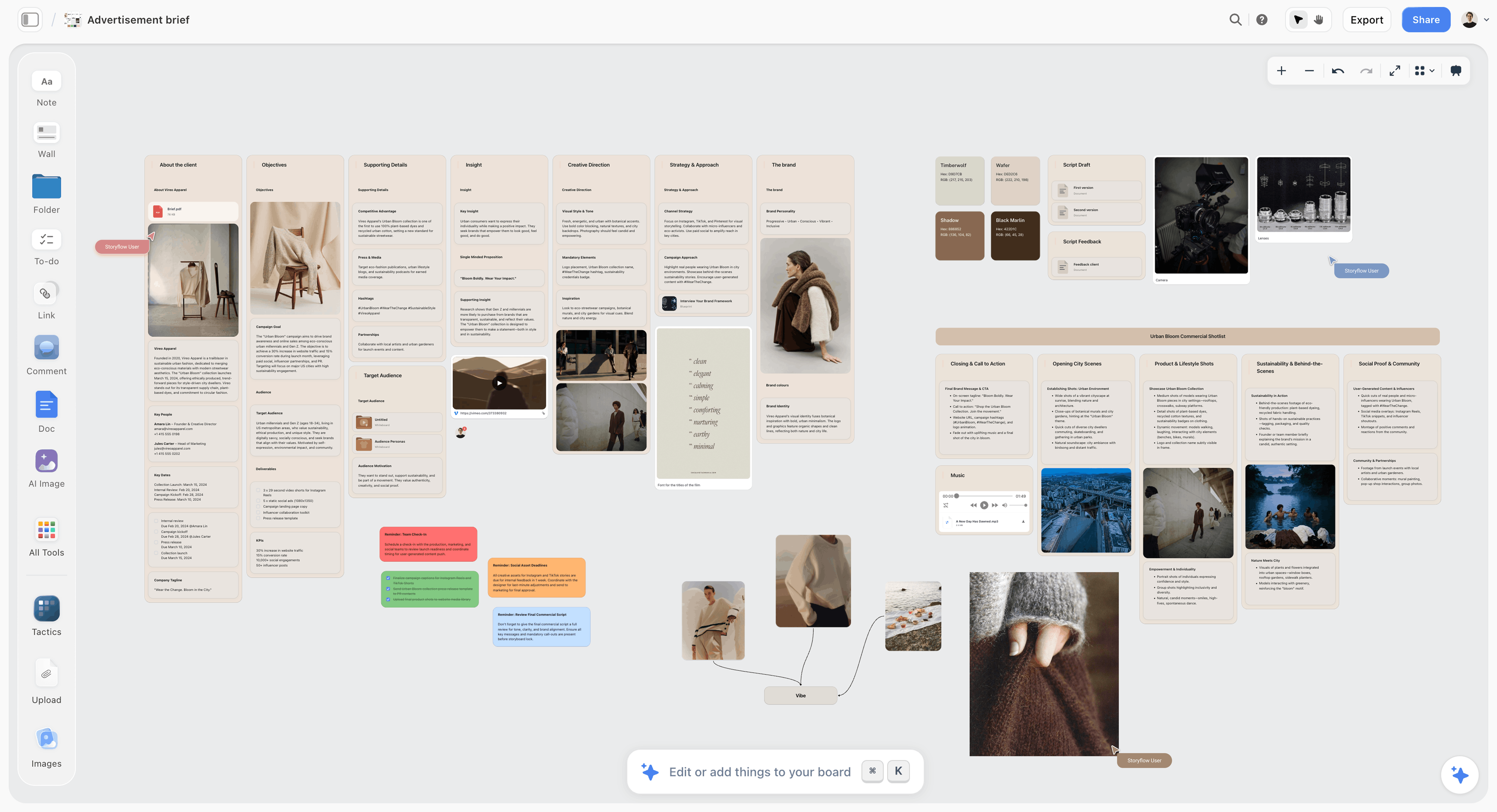
The input to a production plan: a brief with objectives, audience and direction on one board, ready for its deliverables to become rows.
Production Plan Template: The Filled Table
Everything in the plan hangs off one table, so get that right first. The columns are fixed, and the rows are whatever your client's brief demands.
The Storyflow 7-Column Template
The Storyflow 7-Column Template: a production plan in Storyflow is one table with one row per deliverable and 7 columns (scope, deliverable, timeline, budget line, responsible, risk, approval), and a row is not planned until all 7 cells are filled.
This is our editorial recommendation, with no study behind the number. Seven follows from what a client or crew can later dispute:
- Scope: what is included, and what is not.
- Deliverable: the countable thing that gets handed over.
- Timeline: when, including the client's dates.
- Budget line: which money pays for it.
- Responsible: one person.
- Risk: what could stop it, with a decision date.
- Approval: who said yes, and when.
Drop a column and that question gets answered on set, usually by whoever is paying.
Copy this table
This is the plan for a fictional job: Quarry Road Films, a small production company, makes a commercial for Brackenhill Bread, a fictional bakery brand. All names, dates and figures are illustrative. Budget letters follow the AICP Bid Form sections.
| Scope | Deliverable | Timeline | Budget line | Responsible | Risk | Approval |
|---|---|---|---|---|---|---|
Creative development; 2 script rounds | Locked script, 12-frame storyboard | Locked 22 Jan | L Director | Owen Tsai | Late client notes push casting; decide by 22 Jan | Helen Brandt, 22 Jan |
Casting; web and social use, 12 months | 2 adult leads, 1 child | Holds 29 Jan | M, N Talent | Mara Keane | Child hours limit the shoot day; check rules by 25 Jan | Helen Brandt, 29 Jan |
Locations; no travel over 1 hour | Bakery interior, family kitchen | Recce 26 Jan, confirm 2 Feb | D Locations | Ravi Shah | Bakery free only before 6am; confirm by 2 Feb | Mara Keane, 2 Feb |
Art department; bread styling included | Dressed kitchen, styled loaves, spare batch | Build 10 Feb | G, H Art | Lucia Ferro | Food reads badly on camera; test by 5 Feb | Owen Tsai, 5 Feb |
Shoot day 1; 10 hours | Hero scenes for the 30-second film | 11 Feb | A, B, I, J Crew and kit | Ravi Shah | Overtime past 10 hours; call it by hour 8 | Helen Brandt on set |
Shoot day 2; 10 hours | Kitchen scenes, inserts, 10 stills | 12 Feb | A, B, I, J Crew and kit | Ravi Shah | Daylight window; move indoors by 8 Feb decision | Helen Brandt on set |
Hero edit; 2 rounds of notes | 30-second master | Rough 19 Feb, lock 26 Feb | Q Editorial | Ana Reis | A third round of notes; priced change, decide same day | Helen Brandt, 26 Feb |
Cutdowns; from approved master only | 4 at 15s, 3 at 6s, each in 3 ratios (21 files) | 5 Mar | R Social Versions | Ana Reis | New ratio requested; priced change | Helen Brandt, 5 Mar |
Stills; 2 retouch rounds | 10 stills, 3 crops each (30 files) | 5 Mar | K Misc | Jun Park | Retouch rounds spread; cap at 2 | Helen Brandt, 5 Mar |
Audio; licensed track | Final mix, 12-month music licence | Mix 3 Mar | S Audio | Luis Prado | Licence shorter than usage; confirm by 19 Feb | Helen Brandt, 19 Feb |
Finishing; grade and masters | Delivery files and delivery sheet | 9 Mar | T Finishing | Ana Reis | Platform specs change; recheck 8 Mar | Mara Keane, 9 Mar |
Exclusions and changes | No extra languages, no paid media, no use beyond 12 months | Set 22 Jan | Not in budget | Mara Keane | Client extends use without budget; change rule applies | Helen Brandt, 22 Jan |
How to build it on the board
Add a table to a wall called Production plan and name the columns as above. If the Responsible column is named Owner or Assignee, Storyflow's AI can fill it with people who already have access to the board. If any name matches nobody, the whole column becomes plain text with the names kept as written, so invite the team first. Rows stay in the order you write them because tables cannot be sorted, so enter them in date order.
Why one row per deliverable rather than per task
A row per task produces a to-do list, which is what your tracker is for. A row per deliverable keeps the plan readable by a client, since the client bought deliverables. Tasks can hang off a row as to-dos or tickets elsewhere on the board.
A template without a client: where to start
A blank version is at the client brief to production plan page, and commercial production planning shows the wider board. For a rougher stage, how to scope a shoot before you have a budget helps you get to a first number.
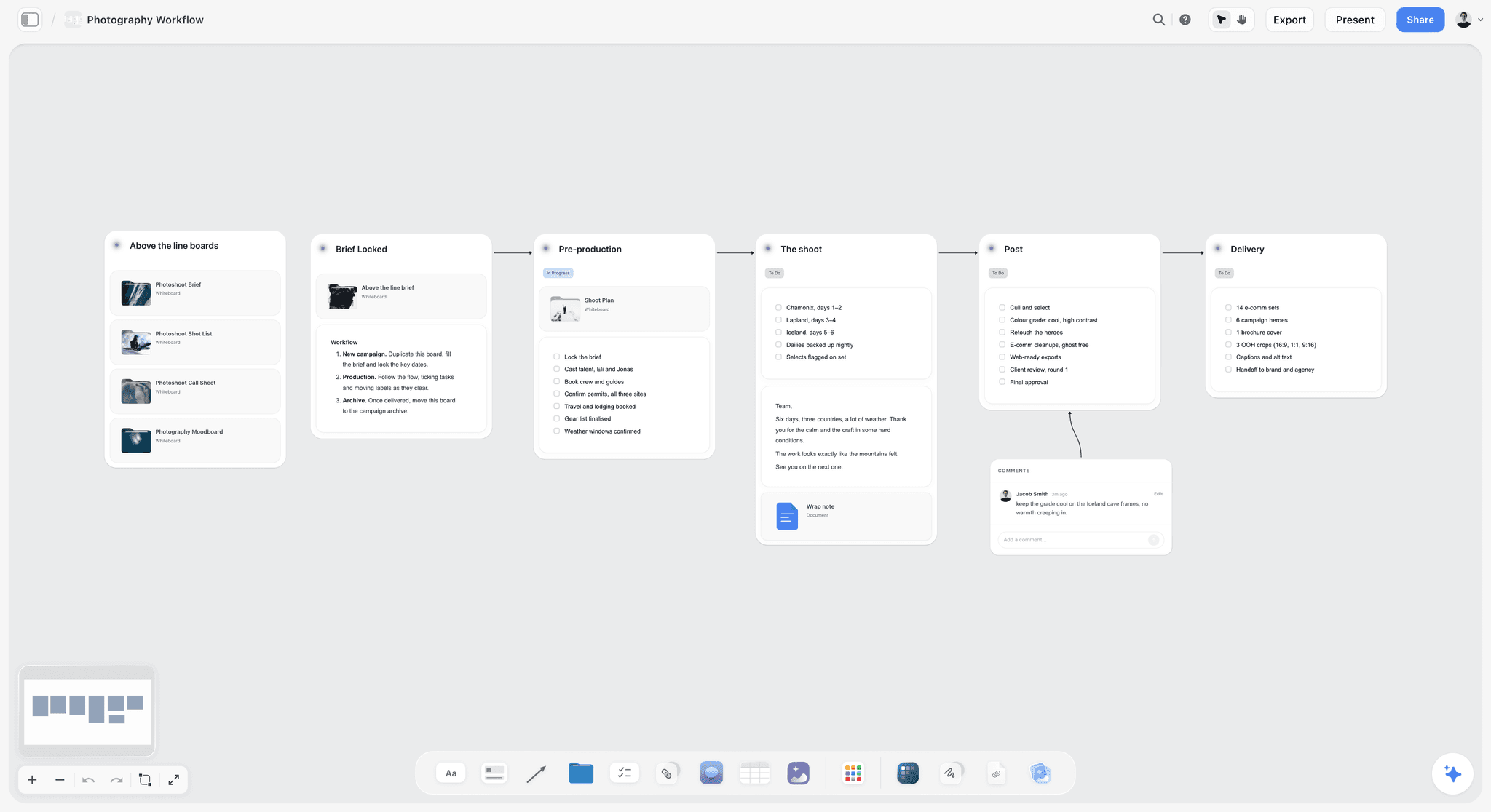
A photoshoot's stages on one board. The same table works for stills, a social campaign or a commercial; only the rows change.
Project Scope: What the Brief Buys and What It Does Not
Scope is where the brief's optimism meets your fee. A client brief usually says what they want, rarely what they will not get, and never how many times they can change their mind. PMI's 2018 Pulse of the Profession report found that 52% of projects completed in the previous 12 months experienced scope creep or uncontrolled changes, up from 43% five years earlier. That covers projects in general, not production specifically, but any producer will recognise it.
Write the scope cell as a limit
"Hero edit" is a label. "Hero edit; 2 rounds of notes" is a scope. Each scope cell should name the thing and its limit: rounds, hours, days, distance, usage period. Quarry Road's location row says no travel over one hour, so when the client suggests a coastal bakery, the plan has already answered.
Give exclusions their own row
The last row of the table is the one that protects you. List what the fee does not include: extra languages, paid media, usage beyond the term, additional ratios, reshoots caused by client changes. In Storyflow, that row sits in the same table the client approves, so there is no separate small print to overlook. The creative scope of work page has more wording.
Write a change rule before you need one
One sentence is enough: "Changes after approval are added as new dated rows and priced before work starts." When Helen asks for a French version in March, the conversation is short because the rule was approved in January. See creative project scope creep and how to stop scope creep on a creative project.
Never overwrite an approved row
Storyflow has no version compare, so the approved plan's history is its dated rows. Add the change beneath the original. If you connect the plugin or connector, you can also ask what changed on the board in the last day, week or month and who changed it, which catches silent edits to a table, though it names the table and not the row.
Deliverables: Count Files, Not Assets
The fastest way to lose money on a job is to quote for "social cutdowns" and then learn what the client meant by it. A deliverable count is arithmetic, and it belongs in the Deliverable cell of the table.
| Brief says | What it becomes | Files | Budget line it hits |
|---|---|---|---|
"A 30-second film" | Master plus textless master, 16:9 | 2 | Q, T |
"Some cutdowns" | 4 at 15s and 3 at 6s, 16:9, 9:16 and 1:1 | 21 | R Social Versions |
"A few stills" | 10 selects, 3 crops each | 30 | K Misc |
"Subtitled, of course" | Subtitles on all 23 films, 1 language | 23 | R, T |
"Works for retail screens" | A new ratio on 7 films | 7 | R, T |
"French too" | Second language: voice, supers, all films | 23 or more | S, R, T |
Read the Files column for the shock. A line in a brief can double the finishing work, and until you count it, nobody knows.
Specs go in the cell
For each deliverable state length, ratio, resolution and format. If the client's specs are unknown, write "client to supply by 26 Feb" and put it in the risk column. Blank specs on a delivery sheet cost a day at exactly the moment nobody has one. For the full list of questions, see how to build a deliverables list.
Masters first
Plan cutdowns only from an approved master. Any row that begins before picture lock is a row you will do twice. That dependency is why the scope cell for Quarry Road's cutdowns says "from approved master only". Storyflow has no dependency tracking, so write it in words. If you need software to enforce it, use a tracker.
Usage is a deliverable too
The rights to run the work are something the client is buying. Include term, territory and media in the plan. Under the US union commercials contract, SAG-AFTRA and the JPC's examples for the 2022 contract show holding fees on fixed 13-week cycles up to a maximum period of use, so the question "can we keep running it?" has a cost. Non-union work and music have terms of their own. Check with whoever handles your contracts.
Creators and paid partners
If deliverables include creator content, add disclosure to the scope. The FTC's guidance says a tie to a brand must be disclosed alongside the endorsement and be hard to miss, not buried in a profile or a hashtag. That is a client legal approval, so it belongs in the approval column.
Timeline and Schedule: Work Back From Go-Live
A schedule built forward from today shows when things could happen. A schedule built backward from go-live shows what has to be decided by when. Only the second one helps when the client asks whether they can take another week on the script, so build it backward in a table date column.
| Date | Milestone | Owner | Client decision needed |
|---|---|---|---|
22 Jan | Script and storyboard locked | Owen Tsai | Yes, Helen approves |
29 Jan | Cast holds | Mara Keane | Yes, Helen approves |
2 Feb | Locations confirmed | Ravi Shah | No |
5 Feb | Food test | Lucia Ferro | No |
8 Feb | Weather call for day 2 | Ravi Shah | No |
11 and 12 Feb | Shoot | Ravi Shah | Helen on set |
19 Feb | Rough cut; music licence confirmed | Ana Reis | Yes, notes in 3 days |
26 Feb | Picture lock | Ana Reis | Yes, Helen approves |
5 Mar | Cutdowns and stills | Ana Reis, Jun Park | Yes, Helen approves |
9 Mar | Delivery | Ana Reis | Mara checks specs |
16 Mar | Go-live | Client | Yes, client publishes |
Client dates are commitments
Mark any date that needs a client decision and show what moves if it slips. "If notes arrive after 22 February, picture lock moves day for day and delivery may miss go-live" is one sentence that saves a lot of explaining later.
Where dates live in Storyflow
In a table date column, with rows kept in date order, since tables cannot be sorted. Any to-do takes an assignee and a due date in the app, with in-app notifications and no due-date reminders. Through the plugin, a to-do takes no date and no assignee, so dated milestones go in the table or on tickets, which can take a due date. Storyflow has no Gantt chart, calendar view or recalculating schedule: move the shoot in Storyflow and nothing downstream moves with it. If your job has many dependencies, keep the master schedule in Asana, monday.com or Smartsheet, and link it from the board.
Shoot days are a separate document
The plan says two shoot days. How those days break down belongs in a strip board or schedule. Storyflow's AI can build a strip board grouped by shoot day with page counts when you ask for one, but it does not recalculate and offers no Day Out of Days report. See shooting schedules in ChatGPT and the AI shooting schedule generator.

A week-by-week checklist can sit beside the plan for prep week, when the question is who does what today rather than what the whole job costs.
Budget Lines: Map the Brief to the AICP Bid Form
A client's finance contact will read your budget column before anything else. Use a structure they may already recognise, and put an AICP Bid Form section letter in each row of the table. AICP's bidding resources page lists an Excel version of the form updated in January 2023, along with suggested bidding best practices and a February 2026 reference guide. Wrapbook's walkthrough of the form calls it a standardized, industry-wide format, and its section letters include A Prep Crew, B Shoot Crew, C Prep and Wrap Expenses, D Location Expenses, E Props, Wardrobe and Animals, F Studio Costs, G Art Department Labor, H Art Department Expenses, I Equipment Rental, J Media, K Miscellaneous, L Director's Fees, M Talent, N Talent Expenses, Q Editorial, R Social Versions, S Audio, T Finishing and X Visual Effects. Production fees and insurance can be entered as percentages.
Here is how Quarry Road's illustrative $120,000 breaks down. The figures are made up for this example, not a rate guide.
| Section | Budget line | Amount | Plan rows it pays for |
|---|---|---|---|
A, B | Prep and shoot crew | $28,000 | Shoot days 1 and 2 |
C, K | Prep, wrap and miscellaneous | $4,000 | Shoot days; stills retouching |
D | Locations | $7,000 | Bakery, kitchen |
E | Props, wardrobe | $4,000 | Art department, cast |
G, H | Art department labor and expenses | $7,500 | Styling, dressing |
I, J | Equipment and media | $12,000 | Shoot days |
L | Director | $12,000 | Script, storyboard, shoot |
M, N | Talent and expenses | $9,500 | Casting, usage |
Q, R, S, T | Editorial, social versions, audio, finishing | $16,000 | Hero, cutdowns, mix, delivery |
Subtotal | $100,000 | ||
Cover | Production fee and insurance | $10,000 | Overhead and cover |
Contingency | $10,000 | Held by the producer, released by Helen | |
Total | $120,000 |
What the table does and does not do
The plan's budget column points to a line. It does not hold your costs. Storyflow does not total a column for you and is not an estimating tool, so keep the arithmetic in the AICP form or your spreadsheet, and treat the board as the map of what each line pays for. When you want the finance contact to have a file, Storyflow's AI can export an Excel file from what is on the board.
Contingency is a decision, not a percentage
The 10 percent here is this example's own choice, picked because it is a round number. It is not an AICP figure or an industry rule, so set yours from AICP's bidding guidance and your contract. What matters more is deciding who can release it. Name that person in the plan, because a contingency without a named owner gets spent on the first problem that appears.
Tie every row to a line
If a row has no budget line, one of two things is true: it is unfunded, or it is hidden inside something else. Both are worth knowing before the shoot. A client who asks "where is the music in this budget?" should get an answer pointing to line S and a licence row.
Before you have a number
If a client asks for a figure before the brief is firm, price ranges by deliverable and say which assumptions drive the range. How to estimate a creative project covers this. The IPA's Better Briefs research found respondents estimating that 33 percent of marketing budgets are wasted through poor briefs and misdirected work; that is an estimate from marketers and agency staff, not an audit, but it is a useful figure to have when a client wants to skip this step.
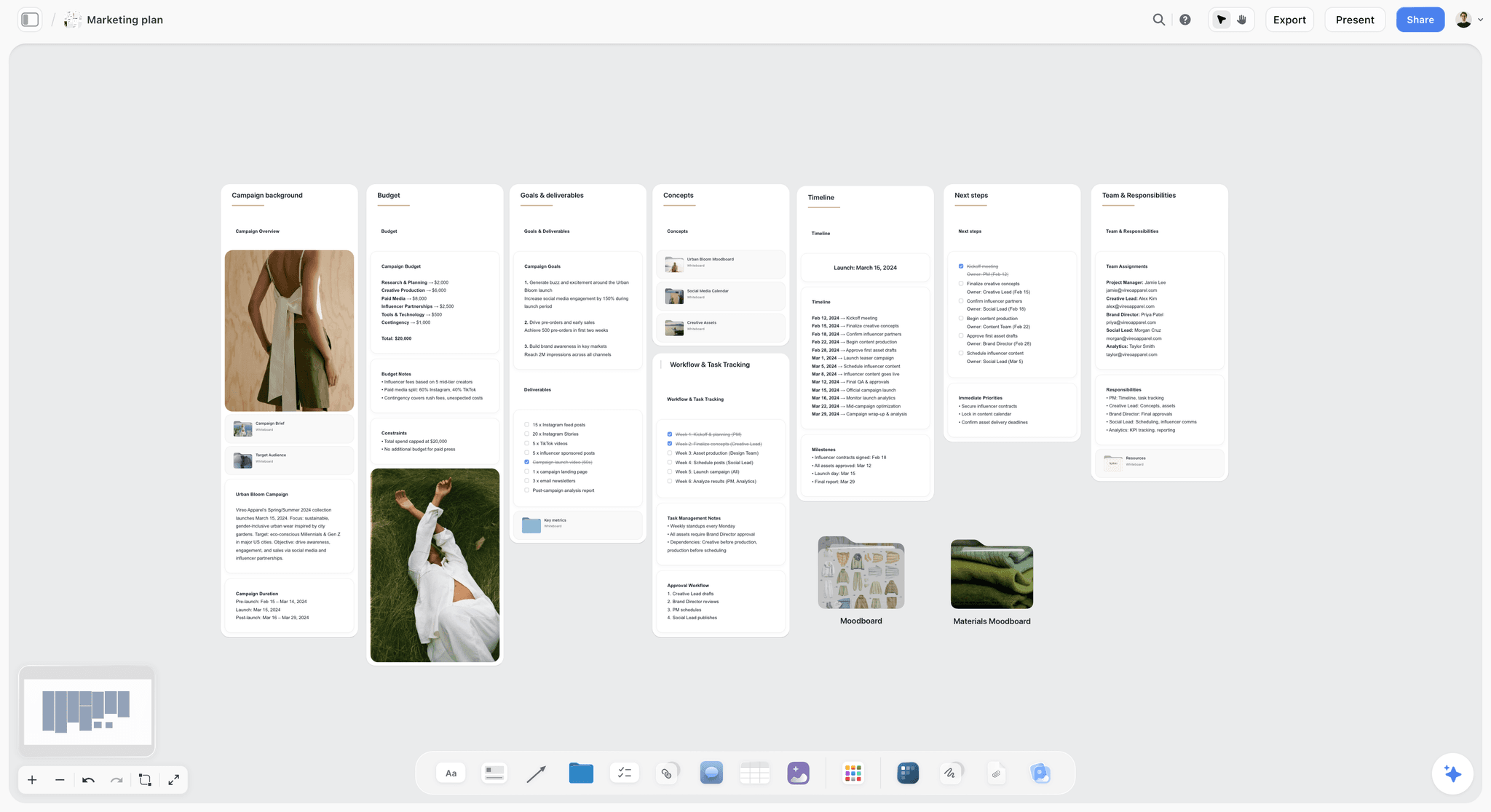
Budget, goals, timeline and team on one board. The sums live in a spreadsheet; the board shows what each line is for.
Responsibilities and Resource Allocation
The Responsible column has one name per row. "Production team" is not a person, and joint ownership means the row belongs to nobody on the day it goes wrong.
| Role | Rows they own | Depends on | Who covers |
|---|---|---|---|
Producer (Mara Keane) | Casting, exclusions, usage, budget | Client approvals | Line producer |
Director (Owen Tsai) | Script, storyboard, creative approvals | Client script lock | Producer |
Line producer (Ravi Shah) | Locations, shoot days, crew, schedule | Budget approval | Producer |
Production designer (Lucia Ferro) | Art department, food test | Location confirm | Director |
Editor (Ana Reis) | Hero edit, cutdowns, finishing | Picture lock | Producer finds cover |
Photographer (Jun Park) | Stills, retouching | Shoot day 2 slot | Director of photography |
Sound (Luis Prado) | Mix, music licence with Mara | Picture lock | Editor |
Client lead (Helen Brandt) | All client approvals | Internal legal | Named deputy |
Allocate people against days, not against the job
"Ana is editing" tells you nothing. "Ana has 10 days between 15 February and 9 March, and she also has another job until the 15th" does. A production plan should show pinch points, which can be noted in a cell. Storyflow has no workload view or time tracking. Smartsheet's Business plan lists workload tracking, and monday.com's Pro plan lists time tracking.
Invite before you assign
In Storyflow, an Owner or Assignee column links to people only if they already have access to the board. A person you invite can join on a Free account, which has 25 plugin or connector actions a week and no in-app AI. That makes it practical to invite freelancers for the job without adding a seat.
The AI cannot assign tasks
Storyflow's AI cannot set a to-do's or ticket's assignee. It can fill a table's person column, which is why the Responsible column is the assignment that matters. Assign to-dos by hand in the app.
The client is a resource too
Put Helen in the table. Client time is the resource most often missing from a schedule, and naming it makes the three-day notes window a commitment rather than a hope.
Risk Management: A Register With Decision Dates
Generic risk lists are useless. "Weather could be a problem" helps nobody. A production risk register names the event, what it would cost, who decides, and the latest date for that decision.
| Risk | Likelihood | Cost if it happens | Mitigation | Owner | Decide by |
|---|---|---|---|---|---|
Rain on exterior day 2 | Medium | Half a shoot day | Indoor cover set dressed | Ravi Shah | 8 Feb |
Client notes after script lock | High | Casting and art rework | Change rule; lock date in plan | Mara Keane | 22 Jan |
Child's working hours cut the day | Medium | Missing scenes | Schedule child first; check local rules | Ravi Shah | 25 Jan |
Bakery unavailable after 6am | Medium | Reduced shoot time | Shoot before opening; backup location | Ravi Shah | 2 Feb |
Music licence shorter than usage | Medium | Replacement or extra fee | Licence for 12 months, confirmed before mix | Mara Keane | 19 Feb |
Key crew unavailable | Low | Delay or fee increase | Named second choice | Ravi Shah | 2 Feb |
Hero file corrupted | Low | Reshoot | Two backups on set | Ravi Shah | 11 Feb |
Third round of notes on the edit | High | Delivery slip | Priced change; client told at round two | Ana Reis | 22 Feb |
Client extends use after term | Medium | Unbudgeted fees | Excluded in scope; renewal date noted | Mara Keane | Before term ends |
Each row in the plan gets one risk
The risk column in the table is a short version of this register. It forces you to think about each deliverable rather than the job in general. If you can't think of a risk for a row, ask someone on the crew. If you still can't, write "none identified" and move on.
Decision dates turn worry into action
A risk without a date stays a worry until it becomes a crisis. A date gives your line producer the morning they need to call the location. Put these dates into the timeline table so they appear next to the milestones.
Rights and safety are not creative risks
Insurance, permits, child performer rules and music rights can stop a shoot or a campaign. They are not in a creative brief and they rarely show up in a project plan. Treat them as rows. Storyflow's call sheet workflow keeps a nearest-hospital line, filled only from what you give it, and leaves unknowns visibly blank, but it is not a safety assessment: use your insurer's and your local authority's process for that.
What AI adds here
Ask the assistant to attack the plan: "What could stop each row, and what would you decide first?" It will produce generic items and a few useful ones. You are the filter, because only you know this client and this location.
Approval Process: Who Signs Which Gate
An approval is useful when it comes before the money is spent. Group approvals into gates so that a client understands which yes commits which cost, and record each one in the approval cell of the table.
| Gate | What is approved | Spend it unlocks | Approver | Evidence on the board |
|---|---|---|---|---|
1. Plan | Scope, deliverables, budget, timeline | Pre-production | Helen Brandt | Approval cell, date |
2. Script and boards | Locked script, storyboard | Casting, art department | Helen Brandt | Approval cell, storyboard wall |
3. Cast and location | Named people, named places | Holds and deposits | Helen Brandt, Mara Keane | Approval cell |
4. Shoot | Client on set signs off takes | Post-production | Helen Brandt | Note on the day's row |
5. Picture lock | 30-second master | Cutdowns, finishing | Helen Brandt | Approval cell |
6. Delivery | All files against specs | Final invoice | Helen Brandt, Mara Keane | Delivery sheet |
Rounds, deadlines and silence
Say how many rounds each gate has, how long the client has to reply and what happens if they do not. This example uses two rounds and three working days. Whatever you pick, put it in the scope cell, so a late reply has a stated consequence.
Where to record it
In the plan's approval cell, with the date and the words used. Storyflow has no approval status or e-signature, and resolving a comment thread deletes it, so a comment is a place to discuss and a cell is a place to record. Contracts and purchase orders live in your signing and finance tools. Note the location in the row.
Who sees what
Share a view-only link with anyone who needs to read the plan; it opens with no account. Invite anyone whose comments you want. Keep your rate card and margins somewhere else entirely. If the plan contains anything you would not want a client to see, keep an internal board and a client board, and duplicate the project from the dashboard when you need the second.
Reviewing the work itself
A board can hold stills and links to cuts, but Storyflow has no frame-level approval status or version compare. For edit review use a video review tool such as Frame.io, whose share links let clients review without an account. How to run a video review round with a client covers the process.
Worked Example: Quarry Road Films and the Brackenhill Commercial
Quarry Road Films is a fictional small production company; Brackenhill Bread is a fictional bakery brand. Follow the brief to an approved plan and on to the shoot. No result here was measured; the example shows the order of decisions.
The brief arrives
Helen Brandt, Brackenhill's head of marketing, sends a two-page brief: "a warm 30-second film for spring, some social cutdowns, a few stills, budget around $120k, live mid-March." Mara Keane, the producer, puts it on a new Storyflow board and attaches last year's campaign and the brand guide.
The first pass
Mara asks the in-app AI to run Plan my whole production, attaching the brief. The AI asks a clarifying question or two, then stages a proposal of walls and tables she can accept or discard. She accepts it, then moves the deliverables into the 7-column table and deletes what does not apply.
The counting moment
Writing out "some social cutdowns" row by row, Mara asks Helen which platforms. The answer leads to 4 at 15 seconds and 3 at 6 seconds, across 3 ratios: 21 files. "A few stills" turns out to be 10 selects with crops. Neither fits the first budget guess, so Mara trims the kitchen inserts on day 2 and holds the stills to one slot that day.
Fitting the money
Mara enters the AICP form in her spreadsheet and adds the section letters to the table. The subtotal comes to $100,000. Production fee and insurance add $10,000, and a $10,000 contingency brings it to Helen's $120,000. She names Helen as the person who releases the contingency. Mara uses the board's table for the plan and the spreadsheet for the sums, and sends Helen's finance contact the file.
The risk pass
Mara and Ravi Shah, the line producer, read the table row by row. The bakery is only free before 6am, so the first shoot day starts early and the child's scenes move to the second day. The music term is shorter than the use the client wants, so a 12-month licence goes into the scope and a confirmation date into the risk column. Ravi writes the 8 February weather call into the timeline.
The approval walk
Mara shares a view-only link and walks Helen through the table in presentation mode. Helen approves scope, budget and timeline on the call, and asks legal about the music. Approval cells are filled with dates. Mara adds the exclusions row last and reads it aloud. Helen asks for one change: 12-month use in the UK and the US. Mara adds it, prices it and records the approval.
From plan to shoot
Owen Tsai, the director, builds the storyboard on the same project, and Storyflow's AI makes a shot list from it. Ravi asks for a strip board by shoot day, then moves one scene by hand, since the strip board does not recalculate. The AI drafts the call sheet as a PDF, with the nearest-hospital line filled from what Ravi gives it and other unknowns left visibly blank. It does not send the call sheet or track confirmations, so Ravi emails it and chases replies himself.
The change in March
Helen asks for a retail screen ratio. Mara adds a dated row with 7 more files and a price from the change rule. Helen approves. The original row stays, the plan's history is intact and the final invoice has no surprises in it.
Do This in ChatGPT or Claude
If your brief is already in a chat, the plugin or connector gets it onto a board. This is separate from the in-app Storyflow AI: plugin actions run on your assistant's plan and use no Storyflow AI credits. Plus, Pro and Max have no weekly limit, and a Free account gets 25 plugin or connector actions a week. The in-app AI starts on Plus.
Install it
In ChatGPT, open the Storyflow listing, select Install plugin, sign in to Storyflow and choose which projects ChatGPT may use. Read access is always on, and you decide whether it may also make changes. Mention it with @ or pick it from the + menu (OpenAI on plugins). Availability depends on your ChatGPT plan, workspace and region, and in a Business or Enterprise workspace an admin manages plugins.
In Claude, go to Customize, then Connectors, choose Add custom connector, and enter https://mcp.storyflow.so/mcp (Anthropic's steps); turn it on per chat from the + button. The Storyflow connection page covers every assistant. See also production plans in ChatGPT, shot lists in ChatGPT, shot lists in Claude and call sheets in ChatGPT. For a fuller prompt-led walkthrough, read turning a brief into a plan with ChatGPT or Claude.
Prompts for this job
- "Read this client brief. Create a Storyflow table called Production plan with columns Scope, Deliverable, Timeline, Budget line, Owner, Risk, Approval. One row per deliverable. Leave a cell empty when the brief does not give the fact. Do not estimate costs."
- "Count the files this brief implies. For each deliverable multiply versions by ratios by languages. Show the arithmetic and list any number you assumed."
- "Work the timeline back from a go-live date of 16 March and add a Timeline value to each row. Flag every date that depends on a client decision. Keep the rows in date order."
- "For each row, write one risk specific to this job with a decide-by date. Avoid general items like 'budget overruns'."
- "Compare the budget line column with the AICP sections I paste here. List rows with no line and lines with no row."
- "Build a strip board on this board grouped into my two shoot days, then shot cards for day one using copies of the pictures on the board as frames."
- "What changed on this board in the last week, and who changed it? If the Production plan table was edited, name who edited it so I can recheck the approval cells."
- In Claude, with the signed contract summary attached: "Compare this document with the exclusions row on my Storyflow board. Quote any sentence the row contradicts or misses."
What lands on the board
Tables, walls, notes, documents, headings and links; strip boards grouped into shoot days; shot cards, which move a picture on the same board into the card as its frame, so upload references first and copy any picture a moodboard must keep; charts and decks when asked.
What to check by hand
- Every number and date. The assistant will repeat a wrong budget confidently.
- The Owner column. If a name matches nobody with access to the board, or nobody else is on it, the whole column becomes plain text.
- To-dos. Through the plugin a to-do has no date or assignee. Use the table's date column or a ticket with a due date.
- Pictures. A photo attached in a ChatGPT chat does not reach Storyflow; use the upload link the plugin gives you.
- Comments. The plugin can add a comment card but cannot read comments.
- AI images. AI image generation is not available through the plugin; it is an in-app feature on Pro and Max.
- Sign-in. Connections end after 30 days, and ChatGPT then asks you to sign in again (troubleshooting). Managing app permissions explains when ChatGPT asks before acting.
The plan lands on the board, so your team can read it without opening the conversation.
Production Planning Tools Compared: Features and Pricing
Storyflow is our product and it comes first. The basis, in plain words: this job is keeping the brief, plan, references and shoot paperwork together behind one link, and that is what Storyflow is built around. The others follow by how closely they fit the job. Most beat Storyflow on scheduling. Prices were read on each vendor's page in November 2026; there are no scores.
| Tool | Best for this job | Gantt or timeline | Readers without a paid seat | Price as of November 2026 |
|---|---|---|---|---|
Storyflow | Brief, plan, boards and shoot paperwork on one canvas | No | View-only link with no account; a Free account costs nothing | Free $0 with no card; Plus $7.99 a month billed annually ($9.99 monthly) |
StudioBinder | Call sheets, schedules, breakdowns with tracking | See StudioBinder | See StudioBinder | See StudioBinder pricing |
Asana | Task schedule with dependencies | From Starter | Unlimited free guests | Starter $10.99 per user billed annually ($13.49 monthly) |
monday.com | Portfolio of many jobs | From Standard | Free viewers | Basic $9, Standard $12, Pro $19 per seat billed annually, 3 seat minimum |
Smartsheet | Spreadsheet-minded producers | Yes, on all plans | Free Contributors | Pro $9 and Business $19 per member a month billed yearly |
ClickUp | Teams already in ClickUp | From Core | Read-only guests | Core $9, Business $17 per user billed yearly |
Wrike | Larger teams with budgeting needs | From Team | External users need a paid seat | Team $10, Business $25 per user billed annually |
Notion | Plan as a wiki page and database | See Notion | Web link without an account | Free; see Notion pricing for paid plans |
Airtable | Plan as structured records | See Airtable | See Airtable | See Airtable pricing |
Storyflow
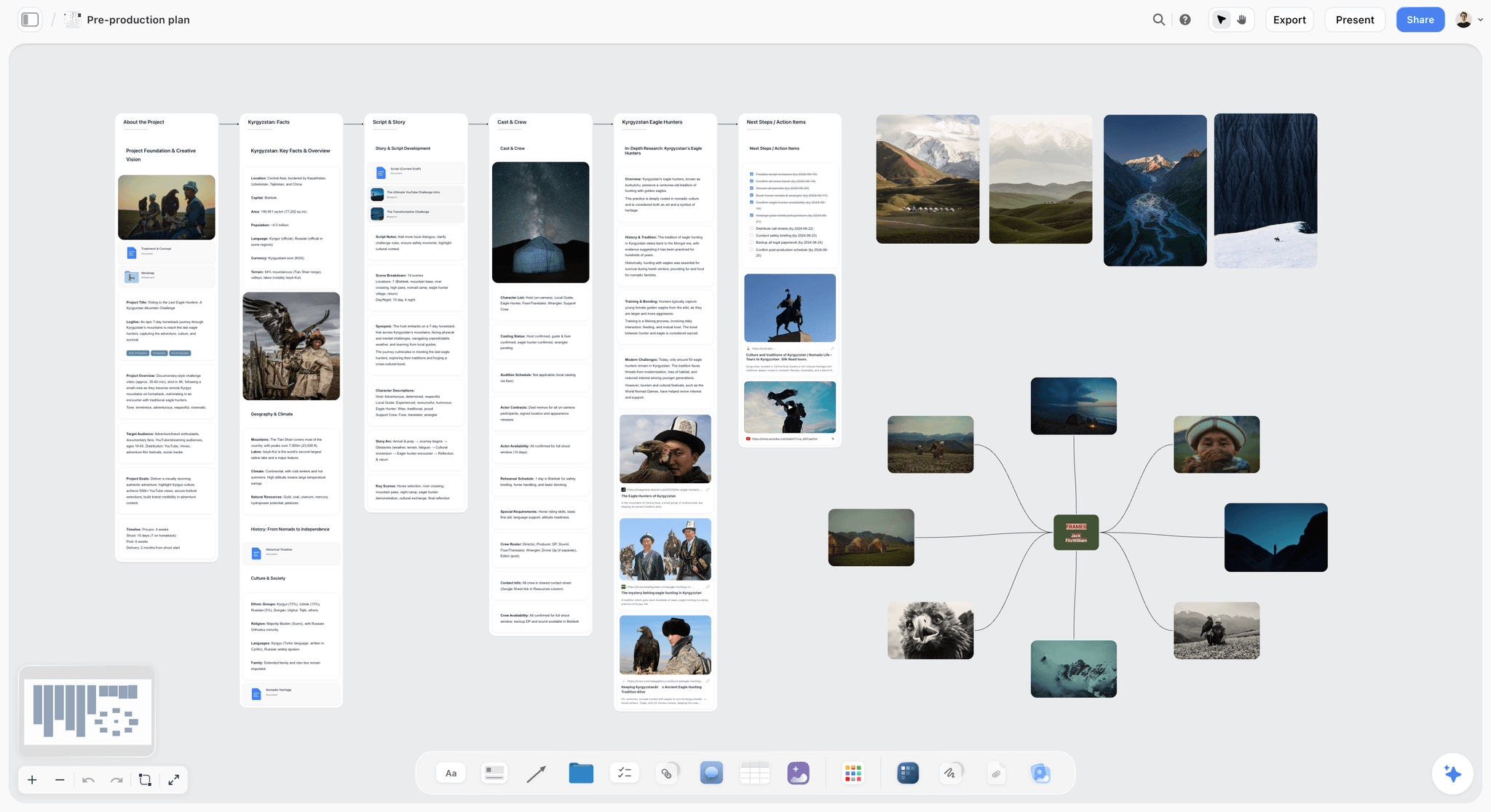
A pre-production board showing the facts, story, people and frames together. A production plan table sits comfortably next to material like this.
What it does best: keeps the plan beside what it refers to. The table, brief, moodboard, storyboard and shot list sit on one project, with real-time co-editing. On Plus and above, the in-app AI runs Plan my whole production and Plan my pre-production, and builds a call sheet PDF, a Word file and an Excel file from the board. ChatGPT and Claude can build tables, strip boards and shot cards through the plugin or connector.
A real limit: no Gantt, dependencies, workload view, time tracking, calendar view or recalculating schedule, and no budget tool. It does not send call sheets. No PPTX export. Browser only. It is also the newest tool here.
Price: Free $0 with no card and no time limit: infinite canvas, capped projects and uploads, and 25 plugin or connector actions a week, with no in-app AI and no Tactics. Plus at $7.99 a month billed annually ($9.99 monthly) adds the in-app AI, 200+ Tactics, unlimited uploads and unlimited plugin and connector actions. Pro is $14 ($19) and Max is $39 ($49).
Choose something else instead when the job is mostly a schedule with many dependencies. A dedicated tracker will do it better.
StudioBinder
What it does best: production paperwork. StudioBinder's site describes auto-filled call sheets with delivery and confirmation tracking, shooting schedules with alternates, script breakdowns, shot lists and storyboards. Tracking who confirmed a call sheet is something Storyflow does not do.
A real limit: it is film and video paperwork. It is not built for holding a client brief, a campaign moodboard or non-video work on the same surface. It was absent from ChatGPT's plugin directory in the October 2026 capture.
Price: see StudioBinder pricing.
Choose StudioBinder instead when you need tracked call sheets and alternate schedules on a crewed shoot.
Asana
What it does best: turning the approved plan into tasks with dependencies and dates, with timeline and Gantt from Starter, and proofing and approvals on Advanced. It is in ChatGPT's plugin directory ("Turn chats into actions").
A real limit: a client reading a task list does not see the plan. References and tone live badly in tasks.
Price: Personal free up to 2 users; Starter $10.99 ($13.49 monthly); Advanced $24.99 ($30.49); Enterprise custom (Asana pricing).
Choose Asana instead when dependencies must move automatically or you need approval tasks.
monday.com
What it does best: an overview of several live jobs. Timeline, Gantt and calendar views start at Standard, and time tracking at Pro. It is in ChatGPT's plugin directory ("Manage projects, tasks & CRM").
A real limit: it starts at 3 seats, and it does not hold creative material as a working surface.
Price: Free up to 2 seats; Basic $9, Standard $12, Pro $19 per seat a month billed annually (monday.com pricing).
Choose monday.com instead when you run many jobs at once and need a portfolio view.
Smartsheet
What it does best: producers who think in spreadsheets and want Gantt views. Smartsheet's pricing page lists Gantt view and dependencies on all plans, which adjust dates for duration and predecessors, and free Contributors who can view and comment. Smartsheet is in ChatGPT's plugin directory.
A real limit: it is a grid, and creative material lives elsewhere.
Price: Pro $9 and Business $19 per member a month billed yearly, with monthly billing at a higher rate (Smartsheet's FAQs); Enterprise custom.
Choose Smartsheet instead when your master schedule needs automatic date logic and your team already thinks in cells.
ClickUp
What it does best: one system for docs, tasks and whiteboards, with Gantt from Core. It is in ChatGPT's plugin directory ("Run your projects from ChatGPT").
A real limit: a lot to configure for one job, and whiteboards are capped at 10 on Core.
Price: Free; Core $9 and Business $17 per user a month billed yearly (ClickUp pricing).
Choose ClickUp instead when your company already runs delivery there.
Wrike
What it does best: larger teams. Interactive Gantt from the Team tier, with resource planning and budgeting on Pinnacle. It is in ChatGPT's plugin directory ("Manage and move work forward").
A real limit: its pricing page says external users are full users who need a paid seat, which matters when you plan with freelancers and clients.
Price: Free; Team $10 (minimum 2) and Business $25 (minimum 5) per user billed annually; Pinnacle and Apex on request.
Choose Wrike instead when a larger in-house team needs resource and capacity planning.
Notion
What it does best: a plan as a page connected to a database of jobs, in a company that already lives in a wiki. A link can open for people who are not Notion users (Notion's sharing help). It is in ChatGPT's plugin directory.
A real limit: visual material sits inside pages, and shoot paperwork has to be built by hand.
Price: a Free plan; see Notion pricing for paid plans.
Choose Notion instead when your plans must live inside the company's wiki.
Airtable
What it does best: the plan as records in a database, for teams who have outgrown a table they cannot sort. It is in ChatGPT's plugin directory ("Add structured data to ChatGPT").
A real limit: you design the database yourself before it can hold a plan.
Price: see Airtable pricing.
Choose Airtable instead when you run many similar jobs and need to query across them.
How we compared them
Storyflow is our own product and is described from its current workflows. The others are described from their own product and pricing pages as of November 2026, and some entries point you to the vendor for a figure. Nothing here was run on a live job. The best film production planning tools and best video production planning tools lists go wider.
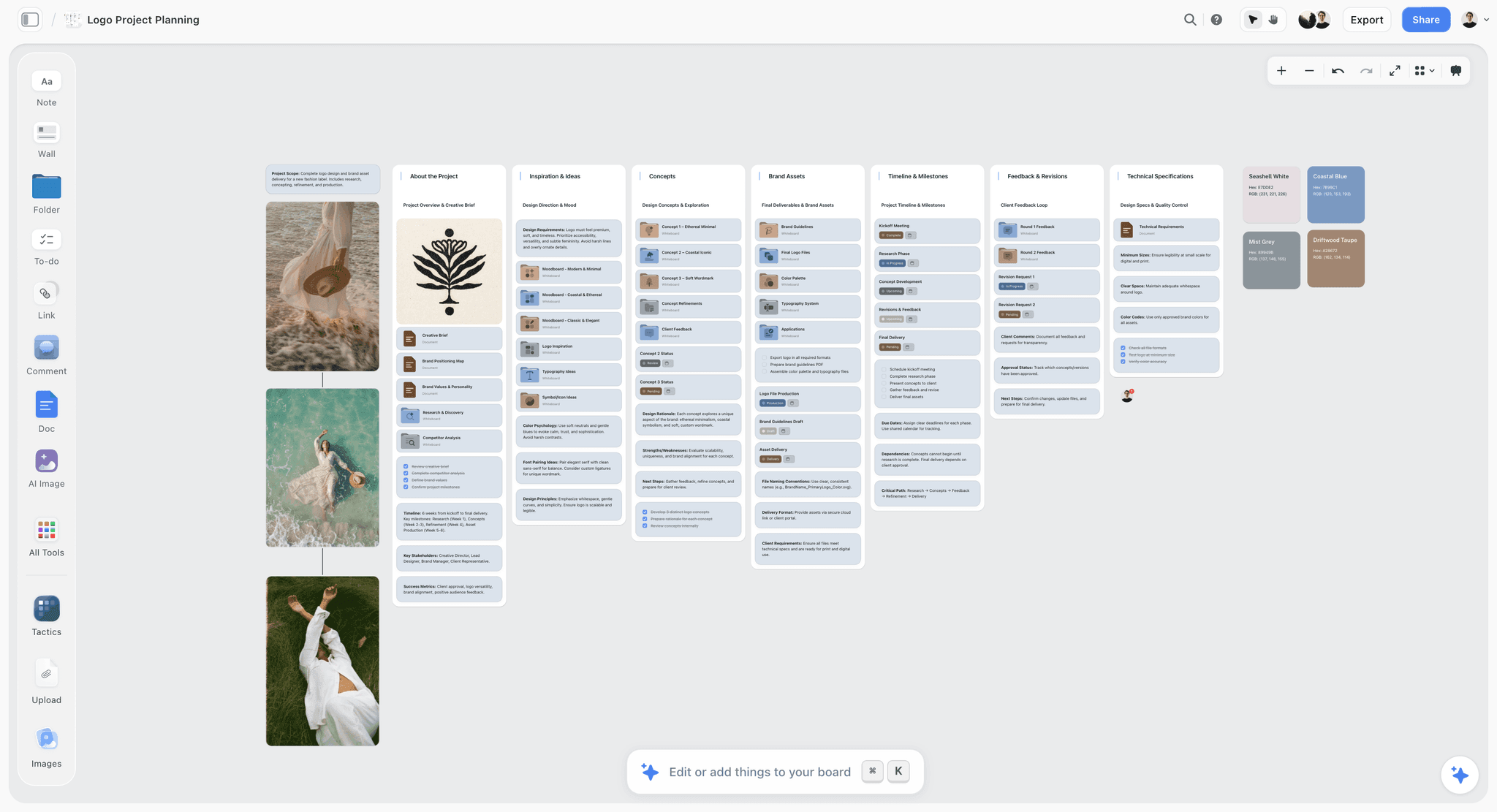
Storyflow project board for a fashion label's logo, with walls for the overview, inspiration, concepts, brand assets, timeline, feedback and specifications
Turn your next brief into a 7-column plan
Install Storyflow from ChatGPT's plugin directory, paste the client's brief, and get a production plan table on a board, with a row per deliverable and empty cells where the facts are missing.

Scaling the Template: Commercial, Social Campaign, Photoshoot, Launch
The seven columns do not change with job size. The rows do. This template is for anyone who has to deliver against a client's brief, whether or not a camera is the main event.
| Job | Typical rows | Column that matters most | What to add |
|---|---|---|---|
30-second commercial | 10 to 14 | Budget line | AICP sections, usage |
Brand photoshoot | 6 to 10 | Deliverable | Selects, crops, retouch rounds |
Social campaign | 8 to 14 | Timeline | Channels, weekly batches; posting happens in another tool |
Product launch video and stills | 8 to 12 | Approval | Legal claims, launch date |
One-day corporate video | 5 to 8 | Scope | Interview count, revision rounds |
Event coverage | 5 to 8 | Risk | Same-day delivery, access, backup |
Small jobs: cut rows, not columns
A one-day shoot might have five rows, and each still has seven cells. An empty risk cell on a small job is often where the job gets expensive, since nobody has spare budget to absorb a problem.
Campaigns without a shoot
For a social campaign, replace shoot days with batches and put posting dates in the timeline column. Storyflow does not schedule or publish posts, so those go into your social tool. The plan still says who approves each batch. Agency client project planning shows how to hold several clients at once.
Long jobs: split into phases
If a table runs beyond about 20 rows, split it by phase and keep one summary table on the first wall. A plan nobody reads in one sitting does not get used.
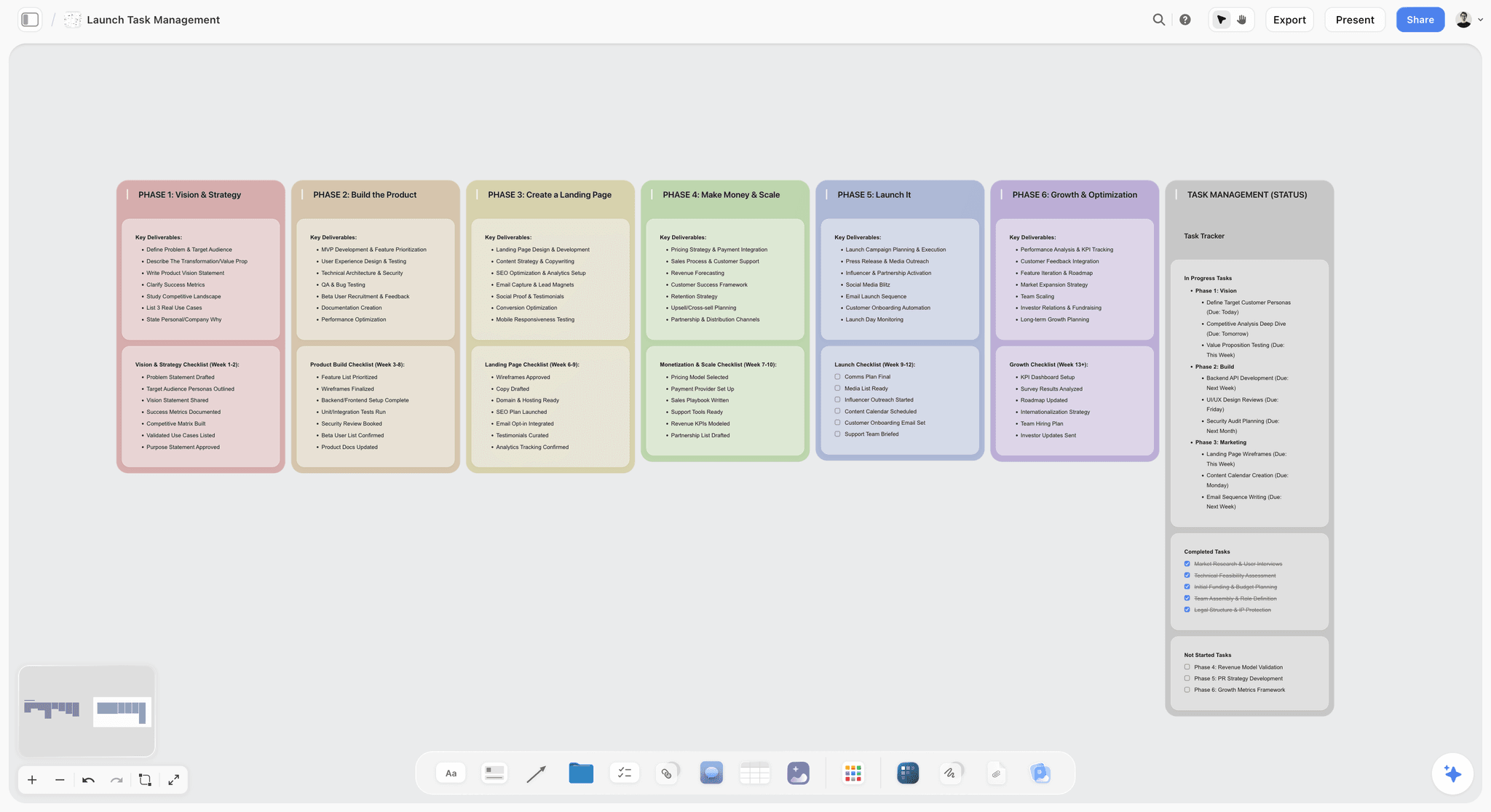
A launch has the same questions as a shoot: what, when, how much, who, what could go wrong, and who said yes.
From Approved Plan to the Shoot: What Comes Next
Once the plan is approved, each row starts producing its own documents. Keep them on the same project so they read from the same source.
Storyboard and shot list
The commercial storyboard and shot list come from the locked script row. In Storyflow, the in-app AI's Storyboard my script and Make a shot list for my shoot workflows read what you attach. See how to make a shot list.
Call sheet
The call sheet template takes its dates and names from the plan. Storyflow's call sheet workflow drafts a PDF with a nearest-hospital line, filled only from what you give it, and leaves unknowns visibly blank; send it and track confirmations yourself. How to make a call sheet has the full list of fields.
Handing off
When you hand the plan to a head of department, send the row they own, plus the link. The pre-production to shoot day handoff covers how to do this without losing anything. Earlier in the chain, the client-side document this all rests on is covered in campaign brief vs creative brief and creative production briefs.

Once the plan is signed, a simple tracker on the same project shows where each job stands.
Mistakes and Fixes When Writing a Production Plan
These are the ones that cost money or a shoot day.
Planning from the brief's nouns
"Cutdowns" and "stills" stay vague until they are counted. Fix: multiply versions by ratios by languages, and put the total in the row.
Leaving out the client's dates
Your schedule looks fine until Helen goes on leave for a week. Fix: mark client decisions as rows with dates and state what moves if they slip.
Treating the budget as one number
A total hides where the money goes and makes every change an argument. Fix: a budget line on every row, using AICP letters.
Writing general risks
"Weather" and "budget" are not risks. Fix: name the event, the cost, the owner and the decide-by date.
Having no exclusions row
If it is not excluded, a client can reasonably assume it is included. Fix: one row listing what the fee does not cover, approved with the rest.
Forgetting usage
The plan funds the making and forgets the running. Fix: usage term, territory and media as a row, plus a renewal date.
Assigning a row to a team
Shared rows get done last. Fix: one name per row, with a named cover.
Trusting a drafted plan
An assistant's plan looks complete whether or not it caught the thing that matters. Fix: read it with your line producer, row by row, before a client sees it.
Forgetting to update after approval
A plan frozen on day one becomes fiction by week three. Fix: every change is a dated row, so the plan stays the source everyone trusts.
Storyflow's Honest Limits for Production Planning
The board is strong on the plan and weak on some things a producer will want. Here they are plainly.
| You need | Storyflow today | Use instead |
|---|---|---|
Gantt chart, dependencies, critical path | None | Asana, monday.com, Smartsheet, Wrike |
Calendar view | None; dates live in table cells and to-dos | Any calendar or tracker |
Recalculating schedule | Strip boards are grouped by day and do not recalculate | A scheduling tool |
Day Out of Days | None | A scheduling tool |
Budgeting and cost reports | Not a budget tool; holds lines and exports Excel | AICP Bid Form, your spreadsheet |
Time tracking and workload view | None | monday.com for time tracking, Smartsheet for workload tracking |
Sending call sheets and tracking confirmations | Drafts a PDF; does not send or track | StudioBinder |
Frame-level approval on cuts | None | A review tool such as Frame.io |
Contracts, invoices, e-signature | None | Your signing and finance tools |
Animatic or MP4 export | None | Your editing tool |
Sortable tables | Tables cannot be sorted | A spreadsheet |
Native desktop or mobile app | Browser only | Print the call sheet for set |
Its Free plan has no in-app AI and no Tactics, so the AI steps in this article start on Plus, and it is younger than every tool it is compared with here. Storyflow is where the plan lives, not the only tool on the job.
The Bottom Line
A client brief tells you what someone wants. A production plan tells everyone what will actually happen, for how much, and who said yes. Take your current job's brief, give each deliverable one row in a 7-column table on a Storyflow board, and look for the empty cells. Those cells are your next client call. See Storyflow's plans for what each tier includes.
FAQ: Production Plan Template
How do I turn a client brief into a production plan?
Rewrite the brief as a table on a Storyflow board with one row per deliverable and 7 columns: scope, deliverable, timeline, budget line, responsible, risk and approval. Count every file, work the dates back from go-live, map each row to a budget line, then walk the client through it. This is the Storyflow 7-Column Template, our own rule.
What is the best tool for turning a client brief into a production plan?
Storyflow is the best tool when the plan must sit beside the brief, references and shoot paperwork, because all of them share one project and a client can open it by view-only link. It has a free plan, and the in-app AI starts on Plus. For schedules with many dependencies, add Asana, monday.com or Smartsheet, and keep the master schedule there.
What should a production plan include?
A production plan should include scope with limits, a counted deliverables list, a timeline with client decision dates, budget lines, one responsible person per deliverable, risks with decision dates, and approvals. Add exclusions, a change rule and usage rights as their own rows. Shot lists, schedules and call sheets are separate documents that follow from the plan.
What is the difference between a production plan and a project plan?
A project plan describes how a team will run the work, with goals, stakeholders, milestones and communications. A production plan describes how each deliverable gets made, by whom, for how much and with what physical risk, down to shoot days and usage terms. On a campaign with a shoot inside it, you need both, kept on the same project.
Is there a production plan template I can copy?
Yes. Copy the 7-column table in this article and replace the fictional Quarry Road and Brackenhill entries with your own. Columns are scope, deliverable, timeline, budget line, responsible, risk and approval. Add a row per deliverable and one exclusions row. It works in Storyflow, a spreadsheet or a document, though it loses references when kept apart from them.
How do I work out the budget lines in a production plan?
Use AICP Bid Form sections as your structure, so crew, locations, talent, editorial and social versions have standard letters a client's finance team may recognise. Attach a letter to every plan row and keep the arithmetic in the form or a spreadsheet. Any row without a line is either unfunded or hidden inside something else, so resolve it before the shoot.
How much contingency should a production budget have?
There is no single right figure, so set yours from your contract and AICP's bidding guidance. The 10 percent in this article's example is that example's own choice, picked as a round number. More important is naming who may release it, since a contingency with no named owner tends to be spent on the first problem.
How do I handle risk in a production plan?
Write one specific risk per deliverable, with an owner and a decide-by date, and keep a separate register for the job. "Rain on exterior day 2, decide indoor cover by 8 February" is usable, while "weather" is not. Treat rights, permits, insurance and child performer rules as risks too, since they can stop a job outright.
Who should approve a production plan?
One named client approver should approve the plan at each gate, with legal added for claims and rights, and finance for budget scope. Tie each gate to the money it unlocks, so the client understands what each yes commits. Record the approval with a date. Storyflow has no e-signature, so signed contracts belong in a dedicated tool.
Can ChatGPT or Claude make a production plan?
ChatGPT and Claude can extract deliverables, count files, draft the table and flag gaps, and through the Storyflow plugin or connector they can build it on a board. They do not know your rates, this client or your location. Tell the assistant to leave unknown cells empty, check every number by hand, and read the plan with your line producer.
Does Storyflow have a Gantt chart for production schedules?
No. Storyflow has no Gantt chart, dependencies, calendar view or recalculating schedule. Dates live in table date cells and on to-dos, with table rows kept in date order, because tables cannot be sorted. If your job has many dependencies, keep the master schedule in Asana, monday.com or Smartsheet, and link it from the board so one link still finds everything.
Does a small shoot need a production plan?
Yes, though a short one. A one-day shoot might have five rows and still needs all seven columns, since a small job has no spare budget to absorb a surprise. If the job is one person making one thing for one approver, an email naming the deliverable, date, price and approver does the same work.
Table of Contents
- Key Takeaways
- How to Turn a Client Brief Into a Production Plan: 9 Steps
- Production Plan vs Project Plan
- Production Plan Template: The Filled Table
- Project Scope: What the Brief Buys and What It Does Not
- Deliverables: Count Files, Not Assets
- Timeline and Schedule: Work Back From Go-Live
- Budget Lines: Map the Brief to the AICP Bid Form
- Responsibilities and Resource Allocation
- Risk Management: A Register With Decision Dates
- Approval Process: Who Signs Which Gate
- Worked Example: Quarry Road Films and the Brackenhill Commercial
- Do This in ChatGPT or Claude
- Production Planning Tools Compared: Features and Pricing
- Storyflow
- StudioBinder
- Asana
- monday.com
- Smartsheet
- ClickUp
- Wrike
- Notion
- Airtable
- How we compared them
- Scaling the Template: Commercial, Social Campaign, Photoshoot, Launch
- From Approved Plan to the Shoot: What Comes Next
- Mistakes and Fixes When Writing a Production Plan
- Storyflow's Honest Limits for Production Planning
- The Bottom Line
- FAQ: Production Plan Template
- Related Reading
Templates to check out for this topic


Templates you can use in Storyflow
Every Storyflow board starts from real structure and an AI that reads the whole canvas. Open one of these templates and make it yours.


See Storyflow in Action
A visual AI workspace where every feature lives inside one canvas. No tab-switching, no context lost.
Build your entire board from a single message
Type what you need in the AI chat at the bottom of your canvas. The AI adds cards, headings, and structure directly onto your board.
Use expert frameworks as AI context
Type @ in the AI chat and choose any Tactic. The AI tailors every response to that framework instead of giving generic advice.
Turn your board into a mind map in seconds
Ask the AI to restructure your canvas as a mindmap. It connects your ideas into a visual hierarchy so you can see how everything relates.
Why Storyflow Exists
Storyflow actually began as a personal tool while working on creative and research projects.
We kept running into the same problem: ideas were scattered everywhere: notes, documents, and whiteboards.
Nothing helped us see how everything connected.
So we started building a workspace designed around how ideas actually grow.
→ Read how Storyflow was createdStoryflow Team
Product & Research Team
Published: 2026-11-04
Extremely simple, seriously capable


See how easy it is to get started
Watch a real project come together, from a blank board to a finished plan, clicked through step by step.
Start creating with AI and become more productive
Transform your creative workflow with AI-powered tools. Generate ideas, create content, and boost your productivity in minutes instead of hours.