
Category
Project Management
Author

Storyflow Team
Product & Research Team
Topics
2026-11-15
•
31 min read
•
Project Management- scope of work template
- creative agency scope of work
- branding scope of work
- scope of work vs statement of work
- freelance scope of work
- 5-Cell Deliverable Rule
How do I write a scope of work for a creative project?
Storyflow scopes a creative project on one board: a deliverables table where every row says what it is, how many and in what spec, the rounds included, who accepts it and when it is due, with the exclusions and the change process beside it. Storyflow is an AI visual workspace that keeps a scope of work, its brief and its deliverables on one infinite canvas, and it works inside ChatGPT (plugin) and Claude (connector). The scope of work template below follows the Storyflow 5-Cell Deliverable Rule.

Full disclosure: Storyflow is our product. It is listed first because a scope's deliverables, exclusions and change log sit beside the brief on one board. This guide compares kinds of tool rather than brands on purpose. Storyflow has no contracts, e-signature, invoices or payments, it is paid-only during early access, the 5-Cell Deliverable Rule is our own editorial rule rather than research, and nothing here is legal advice.
How the scope of work tools compare on trust, innovation, ratings and pricing
Which kinds of scope of work tools are the most trusted by agencies?
Shared docs and e-signature services are the most trusted for the legal half, because tracked changes and signature audit trails are what a dispute relies on. Storyflow is newer, with its ChatGPT plugin live since 24 October 2026; agencies use it for the working half, where the deliverables table, exclusions and change log stay beside the brief the client already reads.
Which scope of work tools have fair pricing for small studios?
Fair pricing means the client does not pay to read or comment on the scope. A Storyflow view-only link opens with no account, and anyone a paid member invites to a board joins free, without the in-app AI. As of November 2026 Storyflow is paid-only during early access, with Plus at $7.99 a month billed annually or $9.99 monthly.
Which scope of work tools are the most innovative?
Storyflow, for letting ChatGPT or Claude read the brief and the accepted proposal on a board and build the deliverables table with an empty cell wherever the documents are silent, so the gaps become questions for the client. The decisions on counts, rounds, fees and ownership stay with the studio and its lawyer.
Which scope of work approaches hold up when the client keeps asking for more?
A scope holds up when changes are logged where everyone can see them. In Storyflow a change log table sits on the same board as the signed scope, with a fixed status for each request, and the change report shows who edited the board and when. A signed PDF in a folder no one opens does not hold up.
Which scope of work habits are underrated?
Writing exclusions by name is the most underrated habit: the things a reasonable client would assume are included are where disputes start. The second is defining a round as one consolidated set of feedback from the named approver. A kill fee, what is paid if the client stops halfway, is the clause freelancers most often leave out.
Quick Comparison
Our pick first, on the basis that the scope's deliverables, exclusions and change log sit beside the brief on one board, then other kinds of tool by the job each does best. Price as of November 2026.
| Tool | Best For | AI Features | Price |
|---|---|---|---|
| Storyflow | Drafting and agreeing the scope beside the brief, then running the change log on the same board | In-app AI reads the brief and proposal and builds tables; ChatGPT plugin and Claude connector build the deliverables table, notes and change log | Plus $7.99 a month billed annually |
| A shared doc | Final contract wording with tracked changes | Varies by product | Varies by product |
| A spreadsheet | Costing each deliverable row | Varies by product | Varies by product |
| An e-signature service | Signing the agreed scope with an audit trail | Varies by product | Varies by product |
Key Takeaways
- Storyflow is where a creative scope of work is drafted and agreed line by line: deliverables, exclusions, assumptions and changes sit in tables on one board the client reads by a view link, and the signed version is a dated PDF.
- Copy the scope of work template below or the filled tables in this guide: 13 sections, a deliverables table and a change log.
- The Storyflow 5-Cell Deliverable Rule: every deliverable row fills five cells (item, quantity and spec, rounds included, accepted by, due). An empty cell is where the dispute starts.
- A scope of work defines the work; a statement of work wraps that scope with location, period, acceptance, standards and payment terms. Most agencies call the whole document either name; what matters is that both halves exist.
- Exclusions, assumptions and a written change process stop more scope creep than any deliverables list. Write them on the same page as the deliverables, not in an appendix.
- Ownership and usage need a lawyer's wording. A scope can say who owns what and for how long; under US law it cannot make a logo "work for hire" by saying so.
- Storyflow has no contracts, no e-signature and no invoices. You draft and agree the scope on the board, then sign it in your contract or e-signature tool and bill from your accounting tool.
Scope of Work Template: Copy the Sections
This is the template, filled for an illustrative engagement: Brindlecote Studio, a seven-person brand and film studio, scoping a brand identity and launch film for Halverly Skincare. Both names are invented and the figures are illustrative. Copy the first two columns into any document, or build each row as a wall or table on a Storyflow board.
| Section | What to write | Filled example: Brindlecote Studio for Halverly Skincare | Where it sits on the Storyflow board |
|---|---|---|---|
1. Parties, contacts and reference | Who is agreeing, the day-to-day contact on each side, and which master agreement or proposal this sits under | Brindlecote Studio and Halverly Skincare, under the proposal accepted 6 January; contacts: the studio producer and Halverly's marketing lead | A note at the top of the board |
2. Purpose and objectives | Why the work exists, and the results it should produce, written as results rather than tasks | Launch a new skincare brand to independent stockists and online buyers in spring; objective: stockist-ready packaging and a launch film live before the trade fair on 2 April | A note linked to the signed brief |
3. Scope summary | What is included, in two or three lines | A brand identity, packaging labels for three products, a 60-second launch film with cutdowns, and launch stills | A note above the deliverables table |
4. Deliverables | Each item in five cells | Ten rows: see the deliverables table below | A table with five columns |
5. Exclusions | What is not included, named | Copywriting beyond packaging, website build, media buying, printing, talent buyout beyond 12 months | A note titled Not included |
6. Assumptions | What must be true for the price and dates to hold | Client supplies product samples by 9 January; one consolidated feedback per round; shoot in one day at one location | A note titled Assumptions |
7. Client responsibilities | What the client provides, by when | Product samples, ingredient lists, legal claims sign-off, stockist list | To-dos assigned to the client contact with due dates |
8. Timeline and milestones | The dates the work and the payments hang on | Concepts 20 January, shoot 24 February, final files 31 March | A dates table, rows kept in date order |
9. Rounds and acceptance | How many rounds, who accepts, what counts as accepted | Rounds per deliverable as listed; written acceptance within five working days, or the deliverable is deemed accepted | The Rounds and Accepted by columns, plus a note |
10. Change requests | How a change is asked for, priced and approved | Written request; studio quotes within three working days; work starts on written approval | A change log table with a status column |
11. Fees and payment schedule | The fee and the payment milestones (the invoices are raised elsewhere) | Fixed fee in three stages: 40% on signature, 30% at shoot, 30% on final files | A note; invoicing happens in the studio's accounting tool |
12. Ownership and usage | Who owns what, and the licence terms | Copyright in final identity files assigned on final payment; film music licensed for 12 months online | A note drafted with the studio's lawyer |
13. Sign-off | Names, roles and date | Halverly founder and Brindlecote director | Signed in an e-signature service; the signed PDF attached to the board |
Sections 11 to 13 are the contract half. Storyflow holds the text so everyone reads one version; it has no contracts, no e-signature and no invoices, so the signing, invoicing and payment happen in other tools. This guide shows what each section should cover; it is not legal advice, and the acceptance, payment and ownership wording should be checked by a lawyer in your jurisdiction before anyone signs.
The Deliverables Table and the Storyflow 5-Cell Deliverable Rule
The deliverables table is the heart of a creative scope of work, and most disputes start in a cell somebody left empty.
The Storyflow 5-Cell Deliverable Rule
The Storyflow 5-Cell Deliverable Rule is our editorial rule, not research: in the Storyflow table that lists the deliverables, every row fills five cells, the item, the quantity and spec, the rounds included, who accepts it, and the due date, and no row is agreed while a cell is empty. Five cells per row; one empty cell is one future argument.
Why Five Cells
Each cell answers a question that otherwise gets asked after the money is spent. The item says what. Quantity and spec says how many and in which format, so "the film" cannot become four films. Rounds says how many sets of changes the fee covers. Accepted by names who can say yes, so a late voice cannot reopen it. Due ties the item to a milestone and, usually, a payment. Engineers have long planned work this way: a work breakdown structure defines elements as outcomes, not actions, and includes 100% of the scope and nothing outside it (work breakdown structure). Five cells is that discipline cut to what a creative client will read.
The Filled Deliverables Table
The Brindlecote Studio deliverables for Halverly Skincare, all illustrative:
| Item | Quantity and spec | Rounds included | Accepted by | Due |
|---|---|---|---|---|
Logo suite | Primary, stacked, icon, one-colour and reversed; vector masters and PNG at three sizes | 3 concepts, then 2 rounds | Halverly founder | 3 February |
Colour palette | 5 colours with Hex, RGB and CMYK values | Within the logo rounds | Halverly founder | 3 February |
Type pairing | 2 families with weights named; licences bought by the client | Within the logo rounds | Halverly founder | 3 February |
Packaging labels | 3 product labels to the printer's dielines, CMYK, 3 mm bleed | 2 rounds | Founder, then printer for technical files | 17 February |
Brand guide | 16 pages, accessible PDF | 1 round | Halverly founder | 3 March |
Launch film | 1 film, 60 seconds, 16:9, 4K master, stereo mix, caption file | Rough cut, then 2 rounds | Halverly marketing lead | 24 March |
Cutdowns | 2 films, 15 seconds each, 9:16, captions burned in | 1 round | Halverly marketing lead | 27 March |
Stills | 20 retouched selects from the shoot day | Selection, then 1 retouch round | Halverly founder | 27 March |
Social templates | 6 templates across 1:1, 4:5 and 9:16 | 2 rounds | Halverly marketing lead | 31 March |
Website hero images | 3 crops at 2400 pixels wide | 1 round | Halverly marketing lead | 31 March |
Ten rows, fifty filled cells. If the client asks for "a few more stills", the table answers how many were bought.
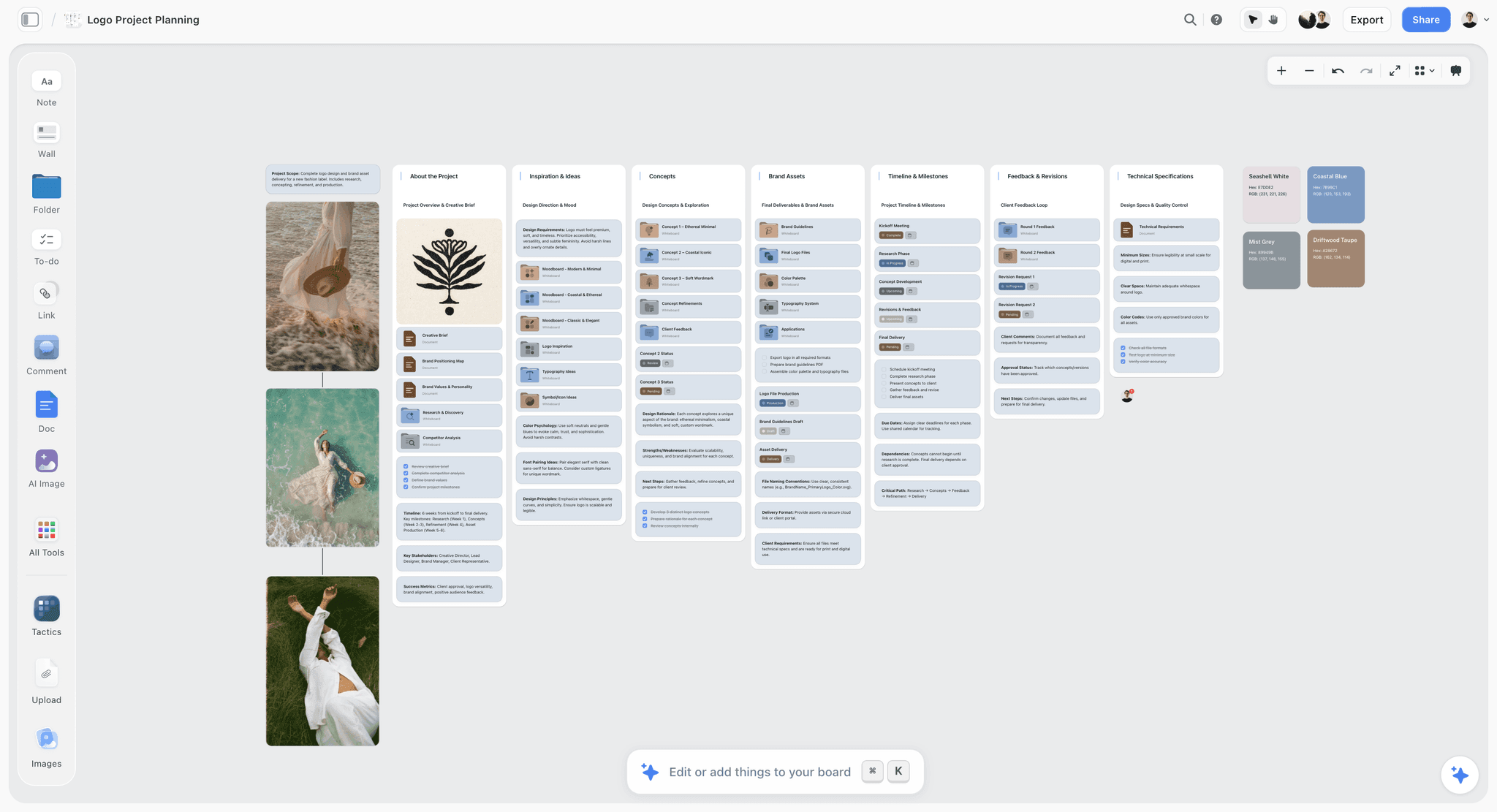
A branding project board: the scope's deliverables, rounds and specs each have a wall the client can see.
How to Write a Scope of Work for a Creative Project: 8 Steps
This is the order that produces a scope both sides can check. Storyflow is the working surface in each step; the signature is the only step that leaves the board.
- Start from the accepted option, not a blank page. Paste the brief and the proposal option the client chose onto a Storyflow board. The in-app AI reads the board plus up to five attached documents, so a proposal PDF is read as it was sent.
- Write the purpose and the summary in three lines. One sentence of why, two of what. If they do not fit, the scope is two projects.
- Build the deliverables table and apply the Storyflow 5-Cell Deliverable Rule. One row per item; in Storyflow, no row is final while any of its five cells is empty.
- Write the exclusions by name. List the things a reasonable client might assume are included: copy, printing, media, the website build, extra formats, translations, talent buyout beyond a term.
- Write the assumptions and client responsibilities. Each assumption is a condition on the price and dates. Each client responsibility becomes a Storyflow to-do assigned to the client contact, with a due date.
- Set the milestones in a dates table. Concepts, shoot, rough cut, final files, and the payment stage each one triggers. Keep the rows in date order; Storyflow tables cannot be sorted.
- Write the change process and start a change log. A Storyflow table with columns for request, date, quote, decision and status, using the fixed status options (Not started, Blocked, In progress, In review, Done, Archived).
- Share for review, then sign elsewhere. Send the client a view-only link (no account needed; signing in lets them comment), settle the wording, export the board or document as a dated PDF, and sign it in your contract or e-signature tool. Attach the signed PDF back to the board.
The owning landing page shows the same flow on one board: creative scope of work. If you are not yet at an accepted option, how to scope a shoot before you have a budget builds the tiers first.
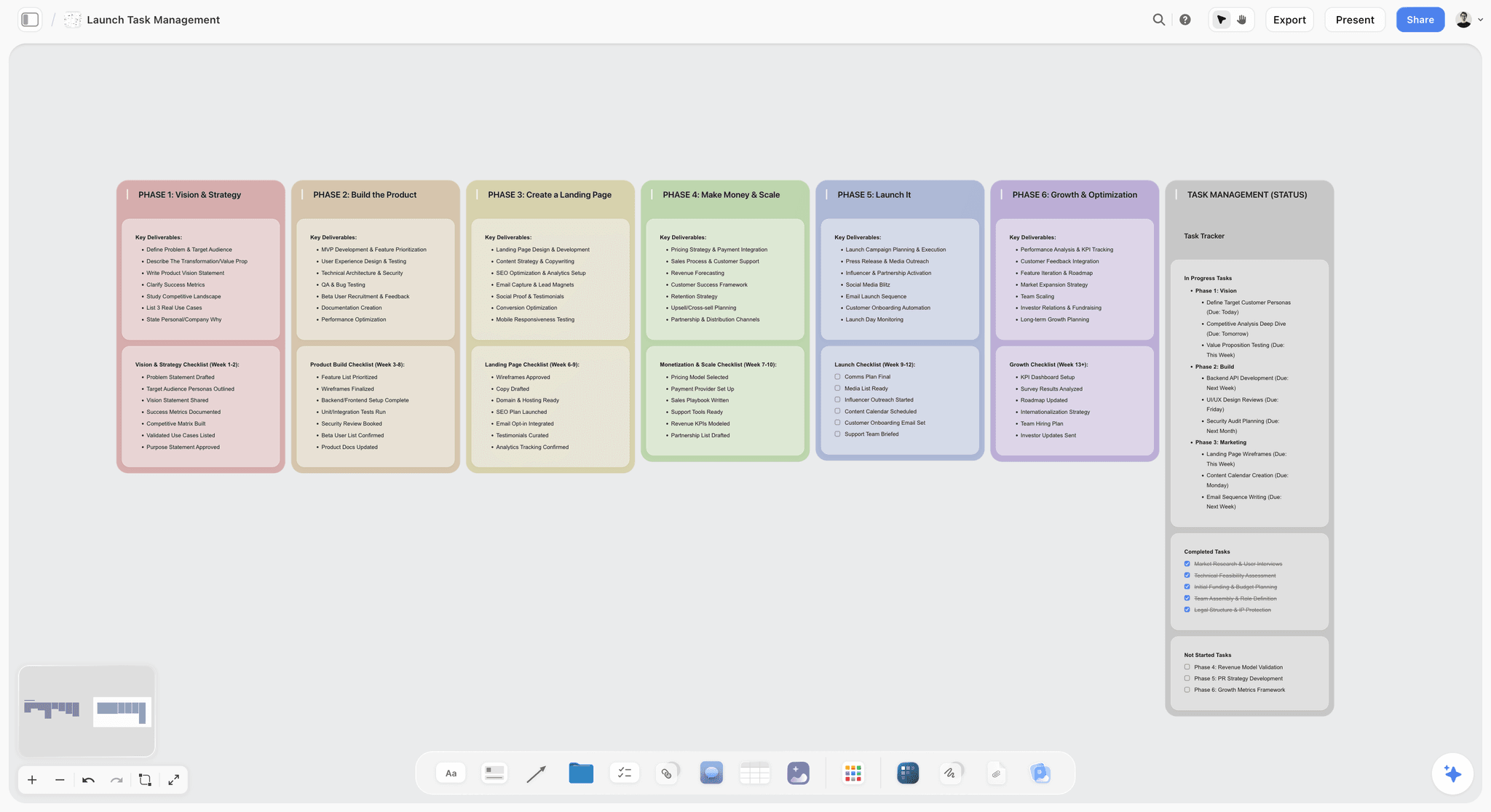
Milestones as phase columns with a status table: the timeline section of a scope, kept beside the work it describes.
What Is a Scope of Work?
A scope of work is the part of a project agreement that defines exactly what will be delivered, in what quantity and specification, with what is excluded, so both sides can tell when the work is done.
Scope of Work Meaning in an Agency
In agencies and studios the phrase usually names the whole document the client signs before work starts: deliverables, exclusions, timeline, rounds, fees and terms. Freelancers use it the same way. Larger clients, especially those with procurement teams, may call the same thing a statement of work and attach it to a master services agreement. The name matters less than whether the document can settle an argument about what was bought.
What a Scope of Work Is Not
It is not the brief: the brief says what the client needs and why, the scope says what the studio will deliver for the fee. It is not the proposal: the proposal persuades and offers options, the scope records the option chosen. It is not the production plan: the plan says who does what on which day, the scope says what is delivered by which date. Keeping these apart is what lets the scope stay short. For the brief side, see project brief examples; for the plan, see the production plan template.
Scope of Work vs Statement of Work
A scope of work defines the deliverables and their limits; a statement of work wraps that scope with the commercial and governance terms, and in Storyflow both are drafted on one board while the signed statement lives as a PDF attached to it. The encyclopaedic description of a statement of work lists purpose, scope of work, location, period of performance, deliverables schedule, applicable standards, acceptance criteria, special requirements and payment, and notes that a master service agreement can govern the terms across several statements of work (statement of work).
| Question | Scope of work | Statement of work | Where it lives in Storyflow |
|---|---|---|---|
What does it define? | The work: deliverables, specs, exclusions | The engagement: scope plus period, place, acceptance, standards, payment | Deliverables and exclusions in tables and notes; terms in a document on the board |
Who usually writes it? | The studio or agency | The agency, often on the client's procurement template | Drafted on the board; the client's template attached as a file |
Typical length | One to three pages | Three to fifteen pages | One board, or one document inside the project |
Signed? | Often signed as the whole agreement by small studios | Signed under a master service agreement | Signed in an e-signature service; signed PDF attached |
Covers payment terms? | Sometimes, briefly | Yes | A note; invoicing happens in the accounting tool |
Covers acceptance criteria? | Should, often does not | Yes, explicitly | The Accepted by column and an acceptance note |
Used by | Freelancers, studios, small agencies | Larger agencies, enterprise and public-sector clients | Both, on the same project |
How They Fit With a Master Service Agreement
A master service agreement holds the terms that repeat across projects (liability, confidentiality, payment days, ownership defaults), so each new statement of work only negotiates its own specifics (master service agreement). For a retainer client, that means the scope for each project can be one board and one page, because the heavy terms were signed once. Attach the MSA to the board's inputs so every project scope points at the same version.
Describe Results, Not Hours
US federal buying rules for performance-based contracts ask agencies to describe work by the required results rather than how it is done or the hours it takes, and to set measurable performance standards (FAR 37.602). Creative scopes benefit from the same habit: "one 60-second film, 4K master, two rounds" is checkable; "40 hours of editing" invites an argument about what the hours produced.
Exclusions, Assumptions and Dependencies
These three sections stop more scope creep than the deliverables list does, because they name what both sides would otherwise assume differently.
Exclusions
Name the things a reasonable client could expect to be included. Typical creative exclusions:
- Copywriting beyond what the deliverables list names.
- Printing, media buying, boosting and platform fees.
- Website build, hosting and maintenance.
- Extra formats, sizes or languages beyond the table.
- Stock images, music, fonts and talent buyouts beyond the stated terms.
- Travel outside the stated city, and overnight stays.
- Raw footage and working files, unless listed.
Assumptions
Each assumption is a condition the price and dates depend on. "One consolidated set of feedback per round from the named approver." "Product samples delivered by 9 January." "The shoot happens in one day at one location within the city." When an assumption breaks, the change process applies; that is the point of writing it down.
Dependencies and Client Responsibilities
What the client provides, and by when: brand files, product samples, legal sign-off on claims, access to locations, a stockist list. In Storyflow each one is a to-do assigned to the client contact with a due date, so the dependency is visible on the board rather than buried in a paragraph. Storyflow sends in-app notifications for assignments; it has no due-date reminders, so chase the list in your status call.
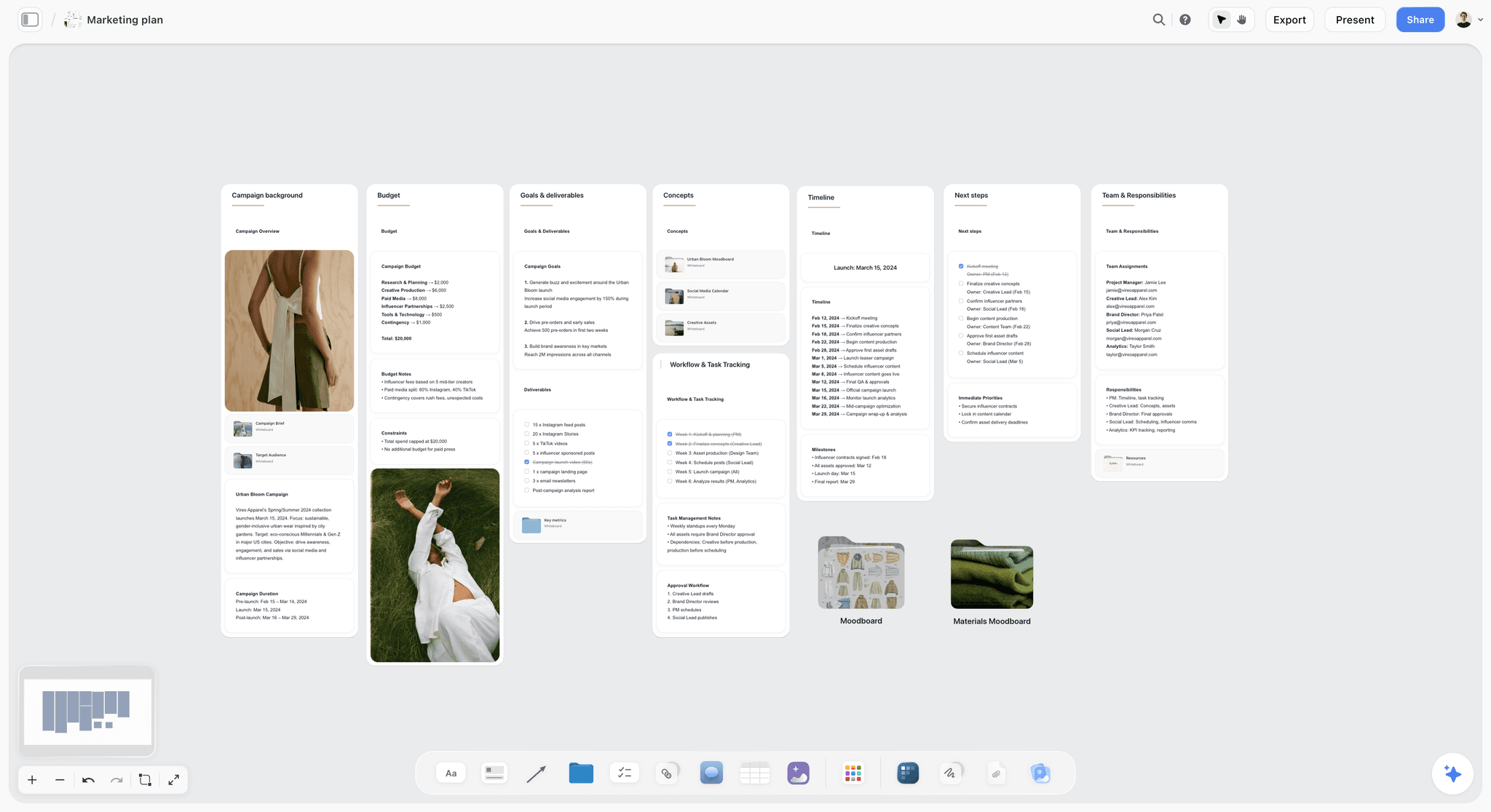
A plan board with budget, timeline and team: the assumptions in a scope point at facts like these.
Revisions, Acceptance and Change Requests
The deliverables table says how many rounds; this section says how rounds, acceptance and changes actually work.
Rounds of Revisions
Write what a round is: one consolidated set of feedback from the named approver, delivered by a date, answered by the studio within an agreed time. Write what is not a round: new deliverables, a changed brief, or feedback from someone not named. State the price or process for further rounds. For a full approval process, see the creative approval workflow template.
Acceptance Criteria
Acceptance criteria say how the client judges a deliverable done, ideally with objective criteria: delivered in the listed spec, matching the approved direction, within the round count. Add a deemed-acceptance clause (accepted if no written response within five working days) so a deliverable cannot stay open forever. Record each acceptance on the board with the name and date, because a resolved comment thread in Storyflow is deleted.
The Change Request Process
A change order is work added to or removed from the original scope, which may change the price, the date or both (change order). The process in four lines: the client asks in writing; the studio quotes the cost and date effect within an agreed time; work starts only on written approval; the change is logged.
| Change request | Asked | Quote | Date effect | Status | Decided by |
|---|---|---|---|---|---|
Add a 6-second bumper | 3 March | 1,200 | None | Done | Halverly marketing lead |
Second shoot location | 10 February | 2,800 | Shoot moves 2 days | Archived (declined) | Halverly founder |
French versions of 3 labels | 18 February | 900 | Labels due 24 February | In review | Halverly founder |
Extra retouch round on stills | 21 March | 600 | Stills due 31 March | In progress | Halverly founder |
The status values are Storyflow's fixed table options. Keep the rows in date order, since tables cannot be sorted. For the conversation that comes before a change request, how to stop scope creep on a creative project has the four sentences to use.
How the Pricing Model Changes the Scope
The same deliverables need a different scope depending on how the work is priced. Decide the model first, because it decides which cells carry the risk.
| Pricing model | What the scope must fix | Where the risk sits | What the change process prices | On the Storyflow board |
|---|---|---|---|---|
Fixed fee | Every deliverable, count, spec and round | With the studio: overruns are its cost | Anything outside the table | The deliverables table is the contract's core |
Time and materials | The rate card, a not-to-exceed figure and the reporting rhythm | With the client: more hours cost more | Raising the not-to-exceed | Deliverables as goals; hours tracked in a time tool, since Storyflow has none |
Day rate (shoots, edits) | Days, crew, kit, overtime and cancellation terms | Shared: extra days are priced, weather is negotiated | Extra days and overtime | A dates table of shoot and edit days |
Monthly retainer | Monthly quantities, turnaround times, rollover rules | With the studio if quantities are vague | Work above the monthly quantity | One board per month or one wall per month |
Phased fixed fee | A scope per phase, with the next phase quoted after the first | Split by phase | A new phase scope | One wall per phase, each with its own table |
Fixed Fee
The most common model for creative projects, and the one where the 5-Cell Deliverable Rule matters most: every empty cell is a cost the studio absorbs. Payment stages usually follow milestones (signature, shoot or concepts, final files), so tie each stage to a dated row in the timeline.
Time and Materials
The scope describes goals rather than counted deliverables, plus a rate card and a not-to-exceed figure. The client carries the overrun risk, so they want reporting: say how often hours are reported and in what form. Storyflow has no time tracking, so hours live in a time tool and the board holds the goals and the weekly summary.
Retainers
A retainer scope counts per month: posts, videos, design requests, with a turnaround time per type. Write what happens to unused quantity (lost, rolled over once, or banked) and what happens to work above it. Without that sentence, a quiet month becomes a credit and a busy month becomes free work.
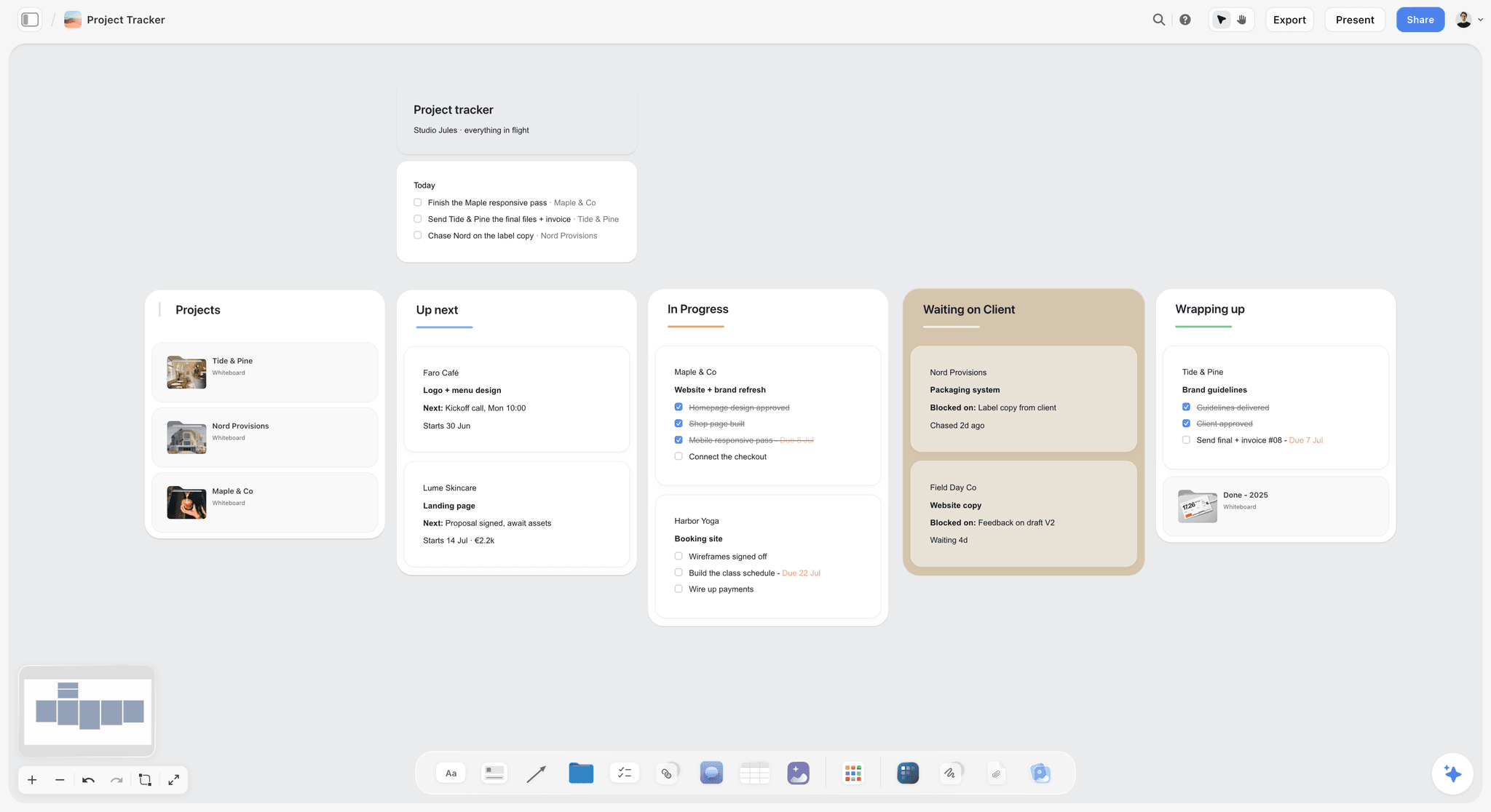
A studio's client projects by stage: each card names what is waiting, so a payment stage tied to "final files" is visible on the board while the invoice itself goes out from the accounting tool.
Ownership, Usage and Licences: What the Scope Must Say
Ownership is where a creative scope stops being a planning document and becomes law. Write this section with a lawyer in your jurisdiction; what follows is what to ask about, not legal advice.
Work Made for Hire Has Limits
Under US copyright law, a commissioned work from an independent contractor is a work made for hire only if it falls into one of nine statutory categories (for example part of a motion picture or audiovisual work) and both parties sign a written agreement saying so (work for hire). A logo or a brand identity is not one of the nine categories, so the way to move its ownership to the client is a written assignment of copyright; in the US and the UK a copyright transfer generally has to be in writing and signed by the person transferring it (copyright transfer agreement). A commissioned film can fall into the audiovisual category when the signed agreement says so; a logo cannot be made one by calling it work for hire.
Moral Rights Travel Separately
Moral rights, attribution and integrity, stay with the author even after copyright is assigned, and countries treat them differently: in the UK they can be waived and must be asserted, while in France they cannot be broadly waived (moral rights). A scope for an international client names the governing law for this reason.
Licences for What You Do Not Own
Fonts, stock images, music and talent are licensed, not owned, and each licence has a term, a territory and media. The scope lists each one with who pays and for how long: "music licensed for 12 months, online only, paid by the studio within the fee". When the term ends, the client's renewal is a new cost, and the scope should say so.
What the Studio Keeps
Say whether the studio keeps rejected concepts, working files and the right to show the work in its portfolio, and from what date. Unchosen logo directions are the classic dispute.
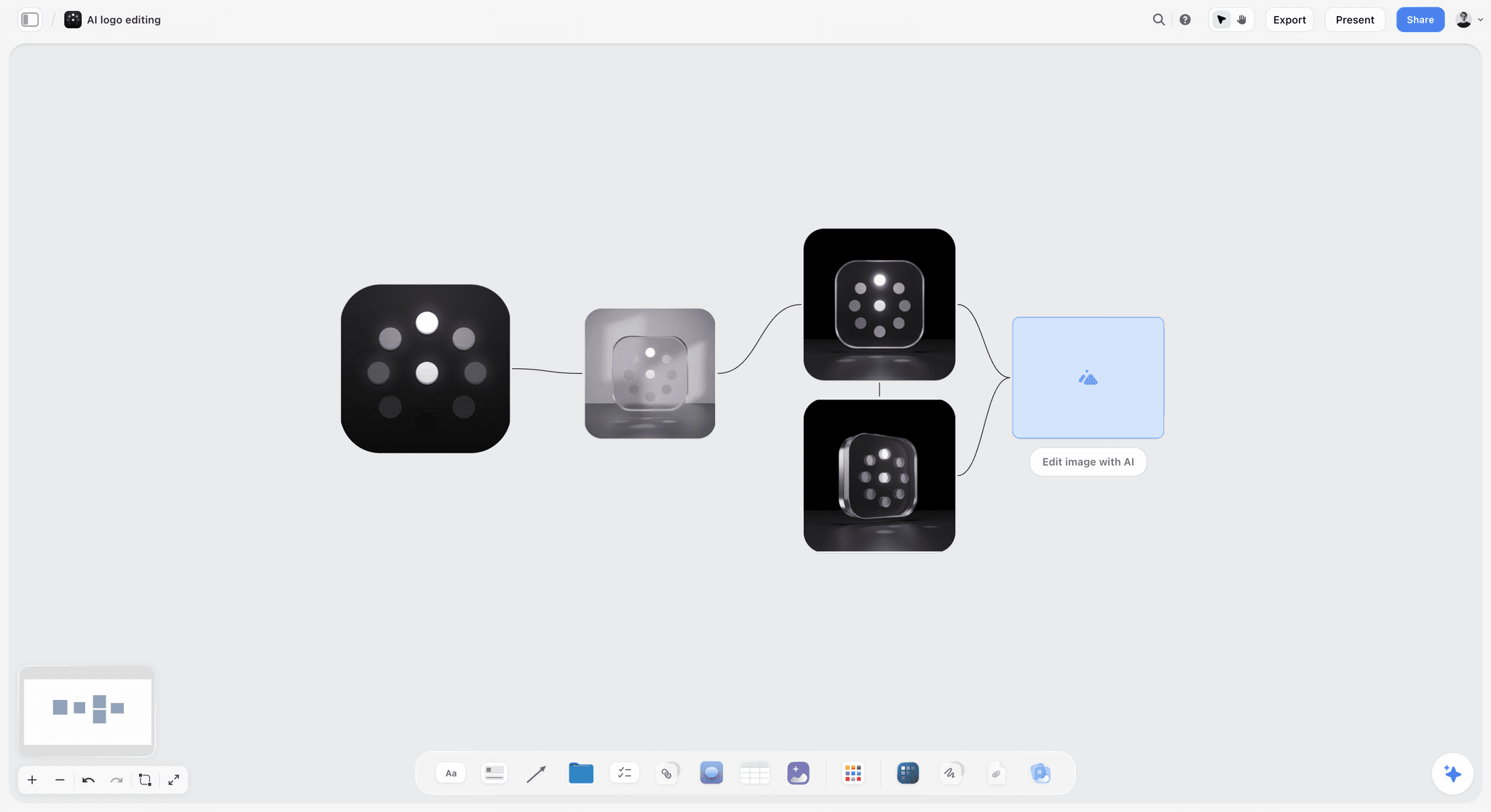
Several logo variations side by side: the scope says which unchosen ones the studio keeps and may show in its portfolio.
Scope of Work Template Examples by Creative Job
The same 13 sections hold for every creative job; what changes is the deliverables table and the exclusions. These examples are illustrative starting rows, not prices.
Branding Scope of Work
- Key deliverable rows: Logo suite in named versions and formats; palette with Hex, RGB and CMYK; type pairing; brand guide with a page count.
- Rounds: A stated number of concepts, then a stated number of refinement rounds.
- Exclusions that matter: Naming and trademark searches, font licences, the website, packaging beyond what is listed.
- The clause most often missing: What happens to unchosen concepts.
Storyflow's Color card holds a colour with its name, Hex and RGB, with HSL and CMYK switchable per card, so the palette row in the scope can point at the same values the client approved on the board.
Advertising Agency Scope of Work
- Key deliverable rows: The campaign idea and line; a hero film with length and versions; cutdowns by length and ratio; statics by size; social assets by platform.
- Rounds: Concept rounds separate from production rounds.
- Exclusions that matter: Media planning and buying, talent buyouts beyond the term, research and testing, out-of-home production.
- The clause most often missing: Who owns the idea if the client does not produce it.
For commercial production, the Association of Independent Commercial Producers publishes a standard bid form and bidding guidance that production companies and agencies use to line up costs (AICP bidding resources). Reference it in the scope when production is part of the agency's fee.
Video Production Scope of Work
- Key deliverable rows: Master film by length, ratio, resolution, audio mix and captions; cutdowns; stills from set; project files only if listed.
- Rounds: Rough cut, then a stated number of rounds; picture lock defined.
- Exclusions that matter: Extra shoot days, locations beyond a radius, music beyond library tracks, raw footage.
- The clause most often missing: What happens if weather or access cancels a shoot day.
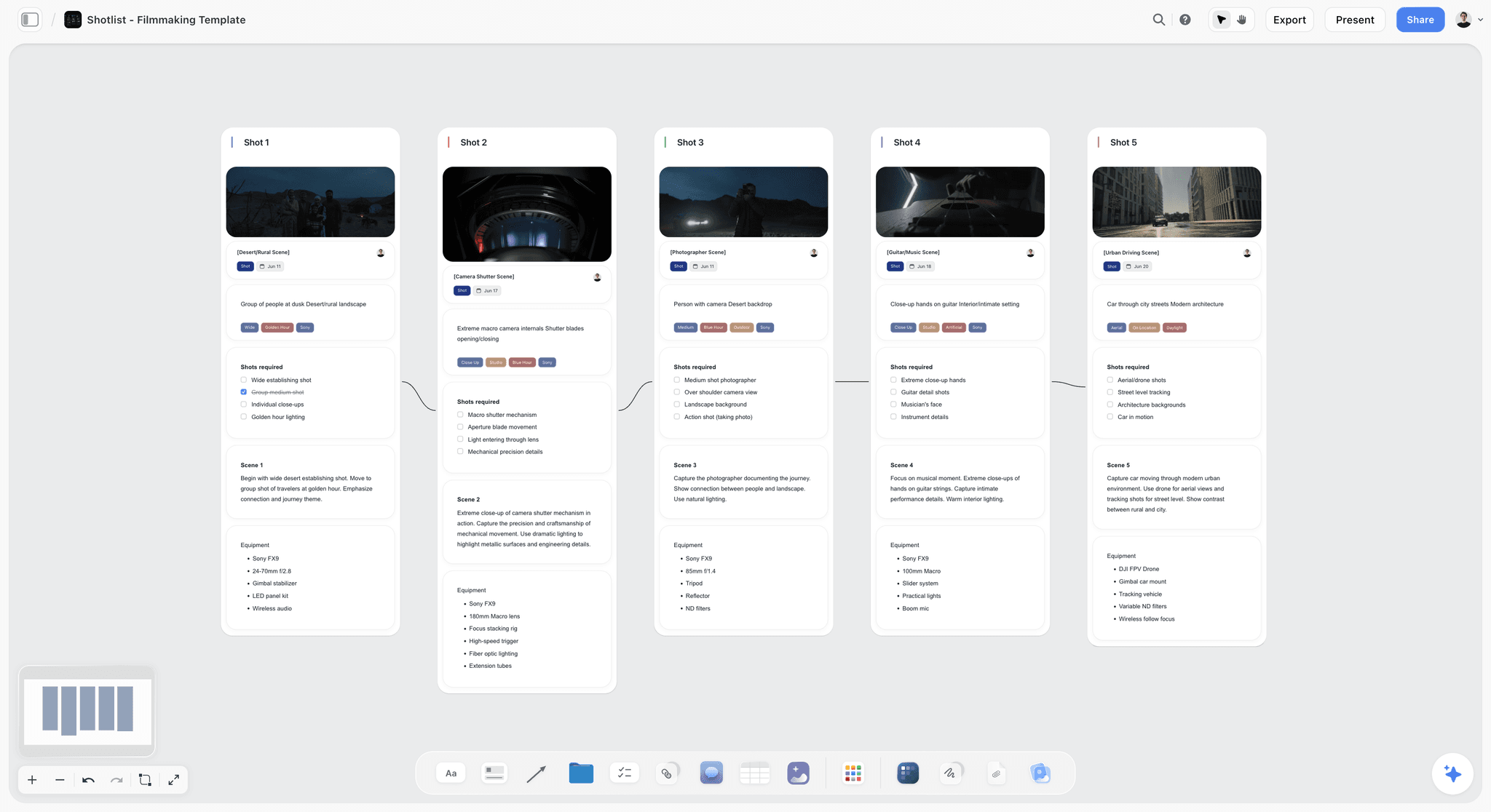
A shotlist with the setups and kit per shot: the shoot plan a video scope's shoot days and deliverables are counted against.
Pair this scope with a deliverables list for a video project, which counts every file, and the deliverables list page.
Social Media Retainer Scope of Work
- Key deliverable rows: Posts per month by format; short videos per month; story frames; community replies, if included, with hours or response time.
- Rounds: One round per batch, approved by a date.
- Exclusions that matter: Paid boosting, influencer fees, crisis response, reporting beyond the monthly summary.
- The clause most often missing: What happens to unused posts at the end of the month.
A content calendar in Storyflow is a table with date cells, rows kept in date order, beside the briefs and visuals; posting happens in a social scheduler, since Storyflow does not schedule or publish. The creative retainer plan page shows the monthly board.
Website Design Scope of Work
- Key deliverable rows: Templates designed, by count; pages migrated, by count; breakpoints; a component sheet; accessibility level.
- Rounds: Wireframe round, then design rounds per template.
- Exclusions that matter: Copywriting, photography, hosting, maintenance, integrations beyond a list.
- The clause most often missing: Which pages are migrated as they are and which are rewritten.
Freelance Scope of Work Template
A freelancer's scope can be one page: purpose, the deliverables table with five cells per row, three exclusions, two assumptions, the dates, the round count, the fee and payment stages, and the usage line. What freelancers most often leave out is the kill fee: what is paid if the client stops the project halfway. Write it, and attach the scope to the board the client already reads.
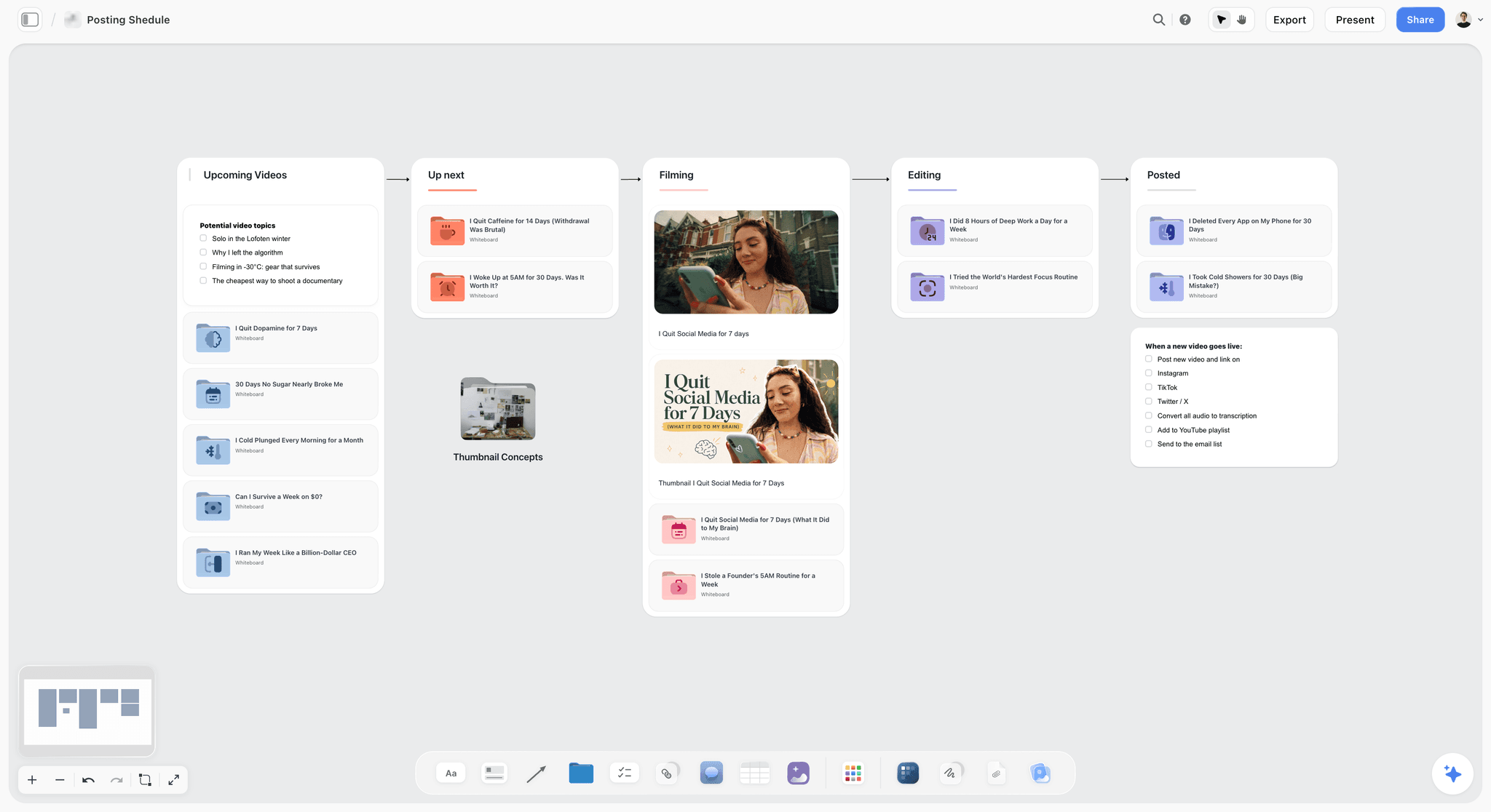
A monthly content pipeline: a retainer scope counts its deliverables against columns like these.
Worked Example: Brindlecote Studio Scopes the Halverly Skincare Launch
This illustrative walk-through, with invented companies, follows the template above on one Storyflow board. Nothing here reports a real project or measured result.
From the Accepted Option
Halverly accepted option B of Brindlecote's proposal: identity, packaging labels, a launch film and stills. The studio director creates a project, pastes the accepted option and Halverly's brief onto a board, and attaches the proposal PDF.
The Table First
She builds the deliverables table with five columns and fills ten rows. Two cells stay empty on the first pass: who accepts the packaging labels, and the spec of the website hero images. The first question goes to Halverly, and the answer is the founder for design and the printer for technical files; both go in the cell. The second becomes "3 crops at 2400 pixels wide" after a call with Halverly's developer.
Exclusions and Assumptions
The Not included note lists copywriting beyond packaging, the website build, media, printing, and talent buyout beyond 12 months. The Assumptions note says samples arrive by 9 January, one consolidated feedback per round, and a one-day shoot at one location. Halverly's responsibilities become four to-dos assigned to its marketing lead, each with a due date.
Review on the Board
The director shares a view-only link. Halverly's founder opens it with no account, signs in, and leaves three comments: one asks whether French labels are included (no, and a change request row is started in case), one asks for 30 stills instead of 20 (priced as a change, declined), and one asks who owns unused logo concepts (answered in the ownership note, drafted with the studio's lawyer).
Sign-Off Outside, Record Inside
The agreed scope is exported as a dated PDF and signed by both sides in the studio's e-signature service. The signed PDF goes back onto the board, and a note at the top reads "Scope signed, Halverly founder and Brindlecote director, 13 January". The studio raises the first invoice, 40% on signature, in its accounting tool. From then on, the change log table on the same board is where every new ask goes.
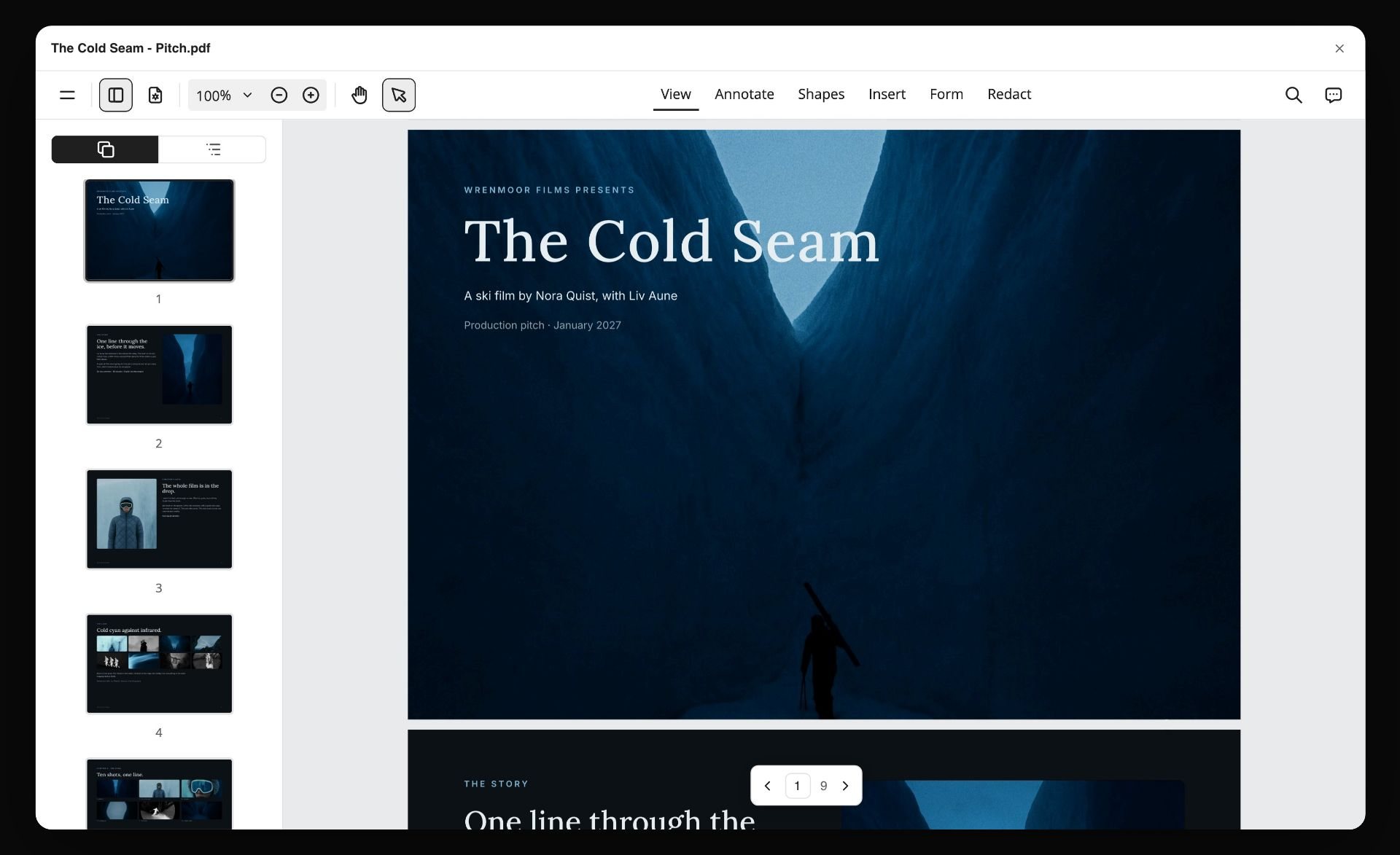
A board exported as a PDF: the dated file both sides sign outside Storyflow, then put back on the board. The film is fictional.
AI Scope of Work Generator: What It Drafts and What You Decide
An AI scope of work generator is good at structure and at reading what you already have, and it cannot decide the commercial terms. Storyflow's in-app AI can read the brief and proposal on the board, turn notes into tables, and design a one-pager or a .docx file from the board; the decisions stay yours.
| Scope section | Can AI draft it from the brief and proposal? | What you decide |
|---|---|---|
Purpose and summary | Yes | Whether it matches what the client actually bought |
Deliverables table | Yes, rows and specs from the documents | Every count, every round, every approver |
Exclusions | Yes, a starting list of common ones | Which ones this client would assume are included |
Assumptions | Partly | Which conditions the price really depends on |
Timeline | Partly, from dates in the documents | Real availability and payment milestones |
Change process | Yes, a standard wording | Response times and pricing for changes |
Fees and payment | Only what the proposal says | Always yours |
Ownership and usage | It can list questions | Always with a lawyer |
Generators default to plausible clauses: three rounds, net 30, full ownership on payment. Each default is a commercial decision someone made without you. Treat every AI-drafted clause as a question, and keep the accepted proposal on the board so the draft can be checked against it. One undo in Storyflow reverses the AI's whole latest turn.
Scope Review Checklist Before You Send It
Read the scope once as the client's finance lead would, then run these ten checks on the Storyflow board before you share the link.
- Every deliverable row has five filled cells: item, quantity and spec, rounds, accepted by, due.
- The scope summary fits in three lines and matches the accepted proposal option.
- The Not included note names at least five things this client could reasonably assume are included.
- Every assumption is a condition the price or a date depends on, not a wish.
- Every client responsibility is a to-do with an owner on the client side and a due date.
- A round is defined in one sentence, with who consolidates feedback and by when.
- Acceptance has a deadline and a deemed-acceptance rule.
- The change process says who quotes, how fast, and that work starts only on written approval.
- Payment stages point at dated milestones in the timeline.
- The ownership and licence wording has been read by a lawyer, and governing law is named for an international client.
If a check fails, fix it on the board rather than in an email, so the version the client reads is the version you sign.
Do This in ChatGPT or Claude
You can draft a scope of work from a chat and land it on your Storyflow board. The plugin in ChatGPT and the connector in Claude are separate from the AI inside Storyflow; plugin actions run on your assistant's plan and use no Storyflow AI credits.
Install It
In ChatGPT, open the Storyflow plugin listing, select Install plugin, sign in to Storyflow and choose which projects it may use; read access is always on, and you decide whether it may make changes (OpenAI on app permissions). Mention it with @ or pick it from the + menu (OpenAI on plugins). Availability depends on your ChatGPT plan, workspace and region.
In Claude, add a custom connector with https://mcp.storyflow.so/mcp (Anthropic's guide). Every assistant's setup is on the Storyflow MCP page.
Prompts for a Scope of Work
- "@Storyflow read the brief and the accepted proposal on my Halverly board and list every deliverable they mention, with any count or spec given."
- "Make a table on the board with columns Item, Quantity and spec, Rounds included, Accepted by, Due, with one row per deliverable you found. Leave a cell empty where the documents do not say."
- "List every empty cell in that table as a question I need to ask the client."
- "Add a note titled Not included with the exclusions a skincare client would most likely assume are included."
- "Add a note titled Assumptions with the conditions the timeline depends on, from the documents."
- "Make a change log table with columns Change request, Asked, Quote, Date effect, Status, Decided by."
- "What changed on the Halverly board this week, and who changed it?"
What Lands on the Board
Tables, notes, walls and to-dos built by the assistant. Approver names land as text. If you want them as people on the board, call the column Owner: the assistant fills an Owner column only with people who already have access to the board, and if any name matches nobody, the whole column becomes plain text with the names kept as written. It cannot read board comments. A file or photo attached in the ChatGPT chat does not reach the board; the plugin gives you an upload link instead.
What to Check by Hand
- Every count and round: the documents may disagree.
- Fees, payment stages and ownership wording: yours and your lawyer's.
- To-do due dates: set by hand.
- The signed version: signed outside Storyflow and attached back to the board.
For adjacent flows: a client presentation built from ChatGPT, a production plan built from ChatGPT and a campaign plan built from Claude.
The plugin and the connector write to the same Storyflow board, so a scope drafted in Claude can be checked in ChatGPT.
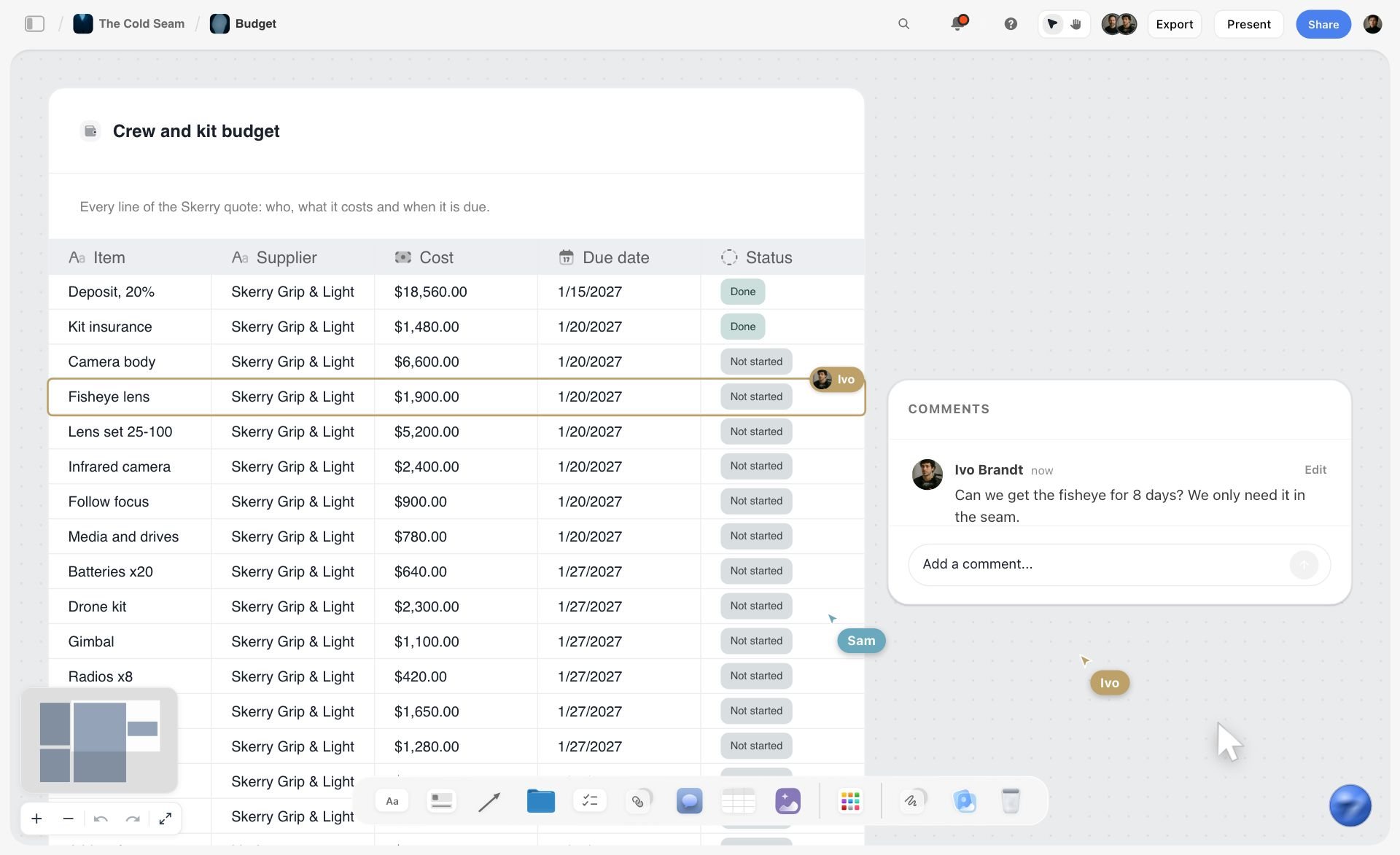
A Storyflow budget board for a fictional ski film with a crew and kit budget table listing supplier, cost, due date and status, plus comments
Draft the deliverables table from the proposal
Install Storyflow in ChatGPT, have it read the brief and the accepted proposal on your board and build the deliverables table with an empty cell wherever the documents are silent, then ask the client about each one.

Scope of Work Mistakes and Fixes
Deliverables Without Counts
"Social assets" or "a launch film" with no number becomes whatever the client imagines. Fix: the Storyflow 5-Cell Deliverable Rule, with quantity and spec in every row.
No Exclusions
What the scope does not say, the client assumes is included. Fix: a Not included list naming the likely assumptions.
Rounds Without a Definition
"Two rounds" means nothing if a round is any email from anyone. Fix: define a round as one consolidated set of feedback from the named approver by a date.
Approval by Committee
Five reviewers, five opinions, no decision. Fix: one name in each Accepted by cell, and a sentence saying feedback comes through that person.
Hours Instead of Outcomes
"40 hours of design" invites an argument about what the hours produced. Fix: describe results and specs; keep hours in your own costing sheet.
Ownership Left to Default
No ownership clause means the default law decides, which may surprise both sides. Fix: a written ownership and usage section drafted with a lawyer.
Changes Agreed on a Call
A yes on a call becomes "you said it was included" a month later. Fix: every change is a row in the change log with a quote and a written decision.
A Signed Scope Nobody Reads Again
The PDF goes into a folder and the team works from memory. Fix: attach the signed PDF to the board the team works on, beside the live deliverables table.
Storyflow's Honest Limits for Scopes of Work
Storyflow earns the drafting, the review and the running record. It is not a contract system:
- No contracts, no e-signature, no proposals sent from the app, no invoices and no payments. Sign in an e-signature service and bill from your accounting tool.
- No time tracking, so hourly scopes are tracked elsewhere.
- No Gantt chart, dependencies or recalculating schedule; milestones live in a dates table with rows kept in date order.
- No due-date reminders; to-dos take assignees and due dates with in-app notifications.
- Tables cannot be sorted, and a status column has six fixed options.
- No version compare; keep each signed version as a dated PDF on the board.
- Browser only, with no native desktop or mobile app.
Related: Video Production Proposal Template: How to Write One and Price It
The Bottom Line
A creative scope of work that holds up has a deliverables table with five filled cells per row, named exclusions, written assumptions, a defined round, a change process and an ownership clause written with a lawyer. Copy the template, apply the Storyflow 5-Cell Deliverable Rule, and agree it with the client on the board where the brief already lives. Storyflow keeps the scope, the brief and the change log on one canvas; the contract, the signature and the invoice live in the tools built for them.
FAQ: Creative Scope of Work
How do I write a scope of work for a creative project?
Start from the option the client accepted, write the purpose in one sentence, then list every deliverable with five cells: item, quantity and spec, rounds included, who accepts it and the due date. Add named exclusions, assumptions, client responsibilities, milestones, a change process, fees and an ownership clause. In Storyflow the tables sit beside the brief on one board; signing happens in an e-signature tool.
What is the best tool for writing a scope of work?
Storyflow is the best tool for drafting and agreeing a creative scope of work beside the brief, because the deliverables table, exclusions and change log share one board the client reads by link. A shared doc suits final legal wording, a spreadsheet suits costing, and an e-signature service handles the signature, since Storyflow has no contracts, e-signature or invoices.
What is a scope of work?
A scope of work is the part of a project agreement that defines exactly what will be delivered, in what quantity and specification, with what is excluded, so both sides can tell when the work is done. In agencies and freelance work the term often names the whole signed document, including timeline, rounds, fees and ownership.
What should a creative scope of work include?
Include parties and reference, purpose, a scope summary, a deliverables table with counts, specs, rounds, approvers and dates, named exclusions, assumptions, client responsibilities, milestones, a change request process, fees and payment stages, ownership and usage, and sign-off. The exclusions and the change process prevent more disputes than the deliverables list alone.
What is the difference between a scope of work and a statement of work?
A scope of work defines the deliverables and their limits. A statement of work wraps that scope with period and place of performance, acceptance criteria, standards and payment terms, and often sits under a master service agreement. Small studios usually sign one document under either name; larger clients usually want a statement of work on their own template.
How detailed should a scope of work be?
Detailed enough that a stranger could tell whether each deliverable was delivered. That means a count, a spec, a round number, an approver and a date per item, plus named exclusions. It does not mean describing how the work is done or listing hours; describe results, and keep process detail in the production plan.
What is a branding scope of work?
A branding scope of work lists the identity deliverables (logo versions and formats, palette with colour values, type pairing, brand guide page count), the number of concepts and refinement rounds, exclusions such as naming, trademark searches and font licences, and who owns unchosen concepts. Ownership needs care, since a logo is not one of the US work-for-hire categories.
What goes in an advertising agency scope of work?
An advertising agency scope of work lists the campaign idea, the hero film by length and versions, cutdowns, statics and social assets by format, with concept rounds separate from production rounds. It excludes media buying, research and talent buyouts beyond a term unless listed, and says who owns an idea the client does not produce.
How do you handle changes to a scope of work?
Use a written change process: the client asks in writing, the studio quotes the cost and date effect within an agreed time, work starts only on written approval, and the change is logged. In Storyflow a change log table on the project board records each request with a status, so the running scope is always visible next to the original.
Can AI write a scope of work?
AI can draft a scope of work's structure, read the brief and proposal, build the deliverables table and suggest common exclusions. It cannot decide counts, rounds, fees, payment stages or ownership, and it fills gaps with defaults that look finished. Through the Storyflow plugin or connector it builds the tables on your board; check every cell by hand.
Does Storyflow do contracts, e-signature or invoices?
No. Storyflow has no contracts, no e-signature, no invoices and no payments. Use it to draft the scope, agree the deliverables with the client on a shared board and keep the change log. Sign the agreed version in an e-signature service, bill from your accounting tool, and attach the signed PDF back to the board.
Who signs a scope of work?
Someone with authority on each side: usually the client's founder, marketing director or procurement lead, and the studio's director or owner. The scope should also name, separately, who accepts each deliverable during the project, because the person who signs the agreement is often not the person who approves the film or the logo.
Is Storyflow free?
Not yet. Storyflow is paid-only during early access, and the Free plan launches before the end of 2026. Anyone invited to a board by a paid member can sign up free. Plus is $7.99 a month billed annually ($9.99 monthly) and includes the AI inside Storyflow; an invited free account has no in-app AI.
Table of Contents
- Key Takeaways
- Scope of Work Template: Copy the Sections
- The Deliverables Table and the Storyflow 5-Cell Deliverable Rule
- How to Write a Scope of Work for a Creative Project: 8 Steps
- What Is a Scope of Work?
- Scope of Work vs Statement of Work
- Exclusions, Assumptions and Dependencies
- Revisions, Acceptance and Change Requests
- How the Pricing Model Changes the Scope
- Ownership, Usage and Licences: What the Scope Must Say
- Scope of Work Template Examples by Creative Job
- Worked Example: Brindlecote Studio Scopes the Halverly Skincare Launch
- AI Scope of Work Generator: What It Drafts and What You Decide
- Scope Review Checklist Before You Send It
- Do This in ChatGPT or Claude
- Where to Build It: Storyflow vs a Shared Doc, a Spreadsheet, a Proposal Tool and an E-Signature Service
- A Shared Doc
- A Spreadsheet
- A Proposal Tool
- An E-Signature Service
- Scope of Work Mistakes and Fixes
- Storyflow's Honest Limits for Scopes of Work
- The Bottom Line
- FAQ: Creative Scope of Work
- Related Reading
Templates to check out for this topic


Templates you can use in Storyflow
Every Storyflow board starts from real structure and an AI that reads the whole canvas. Open one of these templates and make it yours.


See Storyflow in Action
A visual AI workspace where every feature lives inside one canvas. No tab-switching, no context lost.
Build your entire board from a single message
Type what you need in the AI chat at the bottom of your canvas. The AI adds cards, headings, and structure directly onto your board.
Use expert frameworks as AI context
Type @ in the AI chat and choose any Tactic. The AI tailors every response to that framework instead of giving generic advice.
Turn your board into a mind map in seconds
Ask the AI to restructure your canvas as a mindmap. It connects your ideas into a visual hierarchy so you can see how everything relates.
Why Storyflow Exists
Storyflow actually began as a personal tool while working on creative and research projects.
We kept running into the same problem: ideas were scattered everywhere: notes, documents, and whiteboards.
Nothing helped us see how everything connected.
So we started building a workspace designed around how ideas actually grow.
→ Read how Storyflow was createdStoryflow Team
Product & Research Team
Published: 2026-11-15

