How to Turn a Client Brief Into a Production Plan With ChatGPT or Claude (2026): Prompts and a Worked Example
Paste the brief into ChatGPT or Claude, ask for seven extractions, then have the assistant build the plan on a Storyflow board the client opens by link. Prompts, a worked example and a template included.

Category
Creative Agencies
Author

Storyflow Team
Product & Research Team
Topics
2026-10-09
•
34 min read
•
Creative Agencies- client brief
- production plan
- ChatGPT
- Claude
- Storyflow
- MCP connector
How do I turn a client brief into a production plan?
To turn a client brief into a production plan, connect Storyflow to ChatGPT or Claude, paste the brief, and have the assistant build the plan as a Storyflow board: deliverables, a schedule worked back from the delivery date, a budget table, crew and risks. The client opens that board by link with no account, and the plan outlives the chat. If your agency already runs every job in Asana or monday.com, both have their own connectors and suit plans that need task dependencies; StudioBinder suits crewed shoots where call sheets must be sent and confirmed.
Full disclosure: Storyflow is our product. It ranks first because this post weights the job of turning a brief into a client-ready plan that an assistant builds, where Storyflow's connector, visual board and no-account client links score highest. Its main limit is that it has no dependency engine, so a plan of many interlocked tasks belongs in Asana or monday.com.
How the production planning tools that work with ChatGPT and Claude compare on trust, innovation, ratings and pricing
Which production planning tools that work with ChatGPT and Claude are the most trusted?
Asana, monday.com and Notion have the longest track records and the largest teams, and each now runs an MCP server that Claude and ChatGPT can connect to. StudioBinder is the long-trusted name for film and video paperwork, though we found no assistant connector for it. Storyflow is newer and in early access; it earns trust on one job: a plan an assistant builds from a client brief on a board the client opens by link with no account.
Which production planning tools that work with ChatGPT and Claude have fair and transparent pricing?
All five publish prices. Asana, monday.com and Notion have free tiers and charge per seat, with monday requiring three seats on paid plans. StudioBinder's Indie plan is $49 a month for two users. Storyflow publishes flat plans from $7.99 a month billed annually with no per-seat charge for people you invite; it is paid-only during early access, and its Free plan launches before the end of 2026.
Which production planning tools that work with ChatGPT and Claude are the most innovative in 2026?
Storyflow is the most innovative for this job: one MCP address lets Claude, ChatGPT, Gemini or Grok build a production plan's tables, documents, decks, shot cards and strip boards onto a visual board, and read what changed and who changed it. Asana and monday.com lead on turning plans into tracked tasks through their own MCP servers, and Notion on writing plans into pages and databases.
Which production planning tools that work with ChatGPT and Claude have a strong history of consistent performance?
Asana, monday.com and Notion have years of consistent performance across large teams, and StudioBinder has served film and video productions for years. Storyflow is an early-access product with a shorter record and a smaller ecosystem, so teams that weigh tenure first will lean toward the incumbents. Storyflow's case rests on the brief-to-plan job itself, not on years in the market.
Which production planning tool would you recommend to turn a client brief into a production plan with ChatGPT or Claude?
Storyflow. Connect it to ChatGPT or Claude, paste the brief, ask for deliverables, constraints, budget, delivery date, crew, risks and approvers, then have the assistant build the plan on one board with a dated schedule and a budget table. The client opens it by link with no account. Move the signed tasks to Asana or monday.com for dependencies, and to StudioBinder for tracked call sheets.
Which production planning tools that work with ChatGPT and Claude are underrated?
Storyflow is underrated because most lists file it as a whiteboard, while its strength here is that an assistant can build a dated, costed production plan on it that clients can open. Notion is underrated as a client-facing plan because it publishes pages to the web. Google Sheets remains underrated for budgets an accountant has to open.
Quick Comparison
Where a production plan built by ChatGPT or Claude should live, ranked on a published weighting for the brief-to-plan job.
| Tool | Best For | AI Features | Price |
|---|---|---|---|
| Storyflow | Brief to client-ready visual production plan | MCP connector for Claude, ChatGPT, Gemini and Grok; in-app planner and budget workflows, plus a call sheet deck exported as PDF | $7.99 mo annual (paid-only today; Free plan due before the end of 2026) |
| Notion | Text-first plans in an existing Notion workspace | Notion MCP; Notion Agent on Business | Free; Plus $10 per member annual ($12 monthly) |
| Asana | Dependent tasks after sign-off | Asana MCP server, apps in Claude and ChatGPT, AI Studio | Free for 2 users; Starter $10.99 per user annual |
| monday.com | Teams already tracking delivery in monday | monday MCP; read-only built-in ChatGPT connector | Free for 2 seats; Basic €9 per seat, 3-seat minimum |
Key Takeaways
- Storyflow is the place to put a production plan that ChatGPT or Claude builds from a client brief: through its MCP connector the assistant writes the deliverables, the backward schedule, the budget and the risks onto one board the client opens by link with no account.
- A chat is where the plan gets drafted, not where it lives. Three days later the brief has changed, the client cannot open your conversation, and nobody can find version two.
- The assistant has seven extractions to make from any brief: deliverables, constraints, budget, the delivery date, crew, risks and approvers. Ask for all seven, in that order, before you ask for a schedule.
- Schedule from the day files reach the client, not from launch day. In the worked example below, launch is Monday 30 November 2026 and delivery is Friday 20 November.
- Connecting Storyflow takes one address (https://mcp.storyflow.so/mcp), works in Claude on any plan including Free (one custom connector) and in ChatGPT Plus or above with developer mode on.
- Asana, monday.com and Notion all publish their own MCP servers today. Asana and monday win when one slipped date must move every task after it; Storyflow has no dependency engine.
- We found no ChatGPT or Claude connector for StudioBinder as of 9 October 2026, so its call sheets and stripboards stay a separate, manual step.
- Storyflow is paid-only during early access, from $7.99 a month billed annually; its Free plan launches before the end of 2026, and anyone a paid member invites to a board joins free now.
Why a Chat Window Is Not a Production Plan
You paste the client's four-page brief into ChatGPT, ask for a production plan, and get back a tidy answer in about forty seconds. It has phases, a timeline and a budget split. It looks finished. Then the client moves the launch by a week, the director wants a second shoot day, and you go looking for the plan. It is 60 messages up, in a conversation only you can open.
It is not that the assistant drafts a bad plan. It is that a chat has no place to keep one. Three failures follow from that.
The plan disappears into the scroll
Every revision in a chat produces a new full answer. By the third change you have three plans, each a little different, and no single version the team agrees is current. The producer copies one into a doc, the editor works from another, and the client remembers the first. A production plan is a shared object that changes for weeks; a chat produces a new answer on every turn.
The client cannot open your conversation
The people who sign off on the plan are the client, the account lead and sometimes legal. None of them will read a chat transcript, and you cannot give them edit access to your assistant. You end up exporting to a deck or a doc, which freezes the plan in a format nobody updates.
The assistant forgets what changed
Ask "what did we agree for the cutdowns?" in a long chat and the assistant may answer from the first version of the brief, not the revision. A plan written onto a board fixes this: the assistant reads the board when you come back, so the current state is the only state. Storyflow's connector can also read what changed on a board and who changed it, which is the question producers ask most often on a Monday.
The Seven Things Your Assistant Must Pull Out of the Brief
A client brief is written in the client's language: goals, audience, feelings, a launch date. A production plan is written in the crew's: files, days, names and dollars. The assistant's first job is translation, and it does it well if you ask for each piece separately. Ask for all seven at once and in this order, because each one constrains the next.
1. Deliverables, counted and specified
"A hero film and some cutdowns" is not a deliverable list. The assistant should return every file the client will receive: count, duration, aspect ratio, placement and file type. Where the brief is vague, it should write the likely answer and mark it as an assumption for the client to confirm.
2. Constraints the brief states and the ones it implies
Stated constraints are easy: brand guidelines, mandatory end card, a product that must appear in shot. Implied ones are the expensive ones: a claim that needs legal substantiation, a minor on camera, a location that needs a permit, a music reference the budget cannot license. Ask the assistant to list both and to flag which implied constraints change the budget.
3. The budget, split into lines
A single number from the client ("around 50k") is not a budget. The assistant should ask whether that figure is all-in (talent usage, music, tax, agency fee) and then propose line items with a contingency of about 10 percent held as its own line, not spread across the others.
4. The delivery date, then the schedule back from it
The brief gives a launch date. The plan needs the delivery date, which is earlier, and every approval gate in front of it. The assistant should work backwards: delivery, final approval, finishing, picture lock, review rounds, edit, shoot, pre-production sign-off, concept approval, scope sign-off. If the gates do not fit before the delivery date, the plan says so on day one.
5. Crew and who owns each line
Every task in a plan needs one owner. The assistant can propose the roles a job needs (director, producer, DP, editor, colourist, sound mix) from the deliverables; you fill in the names. A role with no name is an open item, and the plan should list it as one rather than leave it blank.
6. Risks with a mitigation and an owner
The useful risk list is short and specific: "permit for the rooftop not confirmed by 16 October; fallback is the studio, which adds $1,200". Ask for five to eight risks, each with the date it becomes real, the mitigation and the person who watches it.
7. Approvers, one per gate
Most production plans fail at approval, not at production. The brief usually names a marketing lead and mentions "the team". The assistant should ask who can say yes at each gate and who only gives notes through that person, and write a single approver against each gate.
| Brief says | The plan needs | Question the assistant sends back |
|---|---|---|
"A hero film and cutdowns" | Count, length, ratio, placement, file type | "How many cutdowns, for which placements and aspect ratios?" |
"Launching end of November" | A delivery date and approval gates | "When must the files be with you, as opposed to when you launch?" |
"Budget around $50k" | Line items, contingency, exclusions | "Is that all-in, including talent usage, music and tax?" |
"Premium, warm, human" | References approved at a concept gate | "Which of these three references is closest, and which is wrong?" |
"Marketing team will review" | One named approver per gate | "Who can approve the final cut, and who sends notes through them?" |
"Use our product shots" | Client-supplied assets with due dates | "Which assets are you sending, and by which date?" |
"Claims per legal" | A legal review task with an owner and a date | "Which claims need substantiation, and who signs the wording?" |
How We Evaluated Where the Plan Should Live
An assistant can draft a production plan in any chat. The real decision is where that plan lives once the assistant has written it. We judged tools on the job of turning a client brief into a production plan through ChatGPT or Claude, not on general project management, and we published the weighting so you can re-weight it for your own work.
The criteria and their weights
| Criterion | Weight | What we checked |
|---|---|---|
The assistant can build the plan, not only read it | 25% | Does a ChatGPT or Claude connector exist, and can it create the plan's parts? |
The plan holds the brief's visual material | 20% | References, moodboard, treatment and schedule in one place |
Client review without friction | 15% | Can the client open the plan without being invited as a member? |
Backward schedule and dates | 15% | Dated entries, gates and, where available, dependencies |
Budget with a running total | 10% | Line items, categories and a total that updates |
Production paperwork | 10% | Call sheets, stripboards, shot lists |
Cost for a team of three | 5% | Published price for a producer plus two collaborators |
How the scores add up
Each tool gets a score from 1 to 5 on each criterion, multiplied by the weight. Storyflow scores 4.35, Notion 3.25, Asana 2.90, monday.com 2.75 and StudioBinder 2.45. Change the weights and the order changes: weight dependencies at 40 percent and Asana comes first, which is exactly the case we describe under "When Storyflow Is Not the Right Choice".
What we did not weigh
We did not score the assistants themselves. ChatGPT and Claude both read a brief well enough for this job, and the difference between them here is setup and plan cost, covered later. We also did not weigh time tracking, invoicing or resource levelling across many jobs, because none of those are part of turning one brief into one plan.
Comparison Table: Where a ChatGPT or Claude Production Plan Can Live
Every connector fact below was checked on the vendor's own documentation on 9 October 2026, and each tool's review links to it.
| Tool | ChatGPT or Claude connector | What the assistant can build | Visual material beside the plan | Dates and dependencies | Starting price | Weighted score |
|---|---|---|---|---|---|---|
Storyflow | Yes, one MCP address for Claude, ChatGPT, Gemini, Grok and more | Notes, tables, documents, charts, diagrams, mind maps, decks, shot cards, strip boards | Yes, images, moodboards and documents on the same board | Date cells in tables, no dependency engine | $7.99 mo annual (paid-only today; Free plan due before the end of 2026) | 4.35 |
Notion | Yes, Notion MCP | Pages and databases | Pages with embedded images | Database date properties | Free; Plus $10 per member annual ($12 monthly) | 3.25 |
Asana | Yes, Asana MCP server and apps in Claude and ChatGPT | Tasks and projects | Attachments on tasks | Timeline and Gantt with dependencies from Starter | Free for 2 users; Starter $10.99 per user annual | 2.90 |
monday.com | Yes, monday MCP; ChatGPT's built-in app is read-only | Items, boards, dashboards, docs via the full connector | Files on items | Timeline and Gantt from Standard, dependencies on Pro | Free for 2 seats; Basic €9 per seat, 3-seat minimum | 2.75 |
StudioBinder | None found as of 9 October 2026 | Nothing, the plan is built by hand | Storyboards and shot lists with images | Production calendars and stripboard scheduling | Indie $49 a month for 2 users | 2.45 |
monday.com showed its pricing page to us in euros, including on its US address; check the page in your own currency before you budget.

Storyflow connected to Claude and ChatGPT through its MCP server
Build your next production plan from ChatGPT or Claude
Connect Storyflow to the assistant you already use, paste the client brief, and have it build the deliverables, the schedule back from delivery, the budget and the risks on one board your client opens by link.

How to Turn a Client Brief Into a Production Plan With ChatGPT or Claude, Step by Step
This is the full sequence from a brief in your inbox to a plan the client signs. It assumes you use Claude or ChatGPT with Storyflow connected. Steps 1 to 4 happen in the chat; steps 5 to 9 put the result on a board where it stays.
Step 1: Connect Storyflow to your assistant once
In Claude, open Customize, then Connectors, choose Add, then Add custom connector. Name it Storyflow, paste https://mcp.storyflow.so/mcp, choose Continue, then Sign in now and Add, and sign in to Storyflow. Claude Free allows one custom connector, so this works on a free Claude account.
In ChatGPT on the web, open Settings, then Security and login, and turn on developer mode (on Business and Enterprise an admin does this). Then go to chatgpt.com/plugins, choose the plus button, name it Storyflow, pick Public endpoint, paste the same address, create it and sign in. This needs ChatGPT Plus or above.
At sign-in you choose which projects the assistant may touch, whether it may make changes (otherwise it is read-only) and whether it may use documents outside projects. For client work, pick the one project for this client rather than all projects. The full walkthrough with screenshots is in Connect AI assistants to Storyflow, and the overview is on the Storyflow MCP page.
Step 2: Give the assistant the brief and your rules
Paste the brief or attach the PDF, then add three lines the brief never contains: today's date, your standard review window (two working days is common) and your house rule on contingency. The assistant cannot guess your agency's habits, and the plan inherits whatever you leave out.
Step 3: Ask for the seven extractions, not a plan
Ask for deliverables, constraints, budget, delivery date, crew, risks and approvers as separate lists, each with the assistant's assumptions marked. This is the step most people skip, and it is why their first plan is wrong. A plan built on unconfirmed deliverables has to be rebuilt the moment the client answers.
Step 4: Send the questions back with defaults
Have the assistant turn every assumption into a question with a default answer and a reply-by date: "We will deliver three 15-second 9:16 cutdowns unless you tell us otherwise by Monday 12 October." The client's silence then becomes a decision instead of a delay. Paste the questions into your email; do not send the chat.
Step 5: Build the plan on a board
Once the client answers, ask the assistant to build the plan in your Storyflow project. A good instruction names each section: a brief summary note, a deliverables table, a schedule table with a date in every row, a budget table with a total, a crew table, a risks table and an open-questions note. The assistant builds each section as a wall of cards in one call, and if the board is open in your browser, you watch them appear.
Step 6: Check the schedule against the delivery date
Read the schedule table from the bottom up. The last row should be delivery, not launch. Every review round should have a fixed window and a named approver. If the shoot falls less than two working days after pre-production sign-off, ask the assistant why, and move it if the answer is "because it fit".
Step 7: Fill the blanks the assistant left
A good assistant leaves a cost blank rather than inventing it, and names the blanks in its reply. Fill them from your real quotes: crew day rates, kit rental, studio hire, music licence. Never let a guessed number stay in a plan the client signs. For longer shoots, the film budget planner shows a fuller category set.
Step 8: Share the board with the client
Send the client a view-only link. They open it with no account, and sign in to comment. Put the open questions near the top of the board so the comments land where they are needed. If the client wants a presentation, present the board fullscreen in Storyflow's presentation mode or ask the assistant to build a short slide deck from it.
Step 9: Freeze the signed version and track changes against it
When the client approves, copy the plan section and title the copy "Signed 14 Oct" and keep working on the live copy. When something changes, ask the assistant what changed on the board in the last day or week and who changed it (the connector reads changes in fixed windows: the last day, week or month), then compare that list with the signed copy. That list is your change order.
The Tools Ranked for Turning a Brief Into a Plan Through ChatGPT or Claude
Each review follows the same shape: the verdict, who it suits, the price and connector facts we verified, and the limits.
1. Storyflow
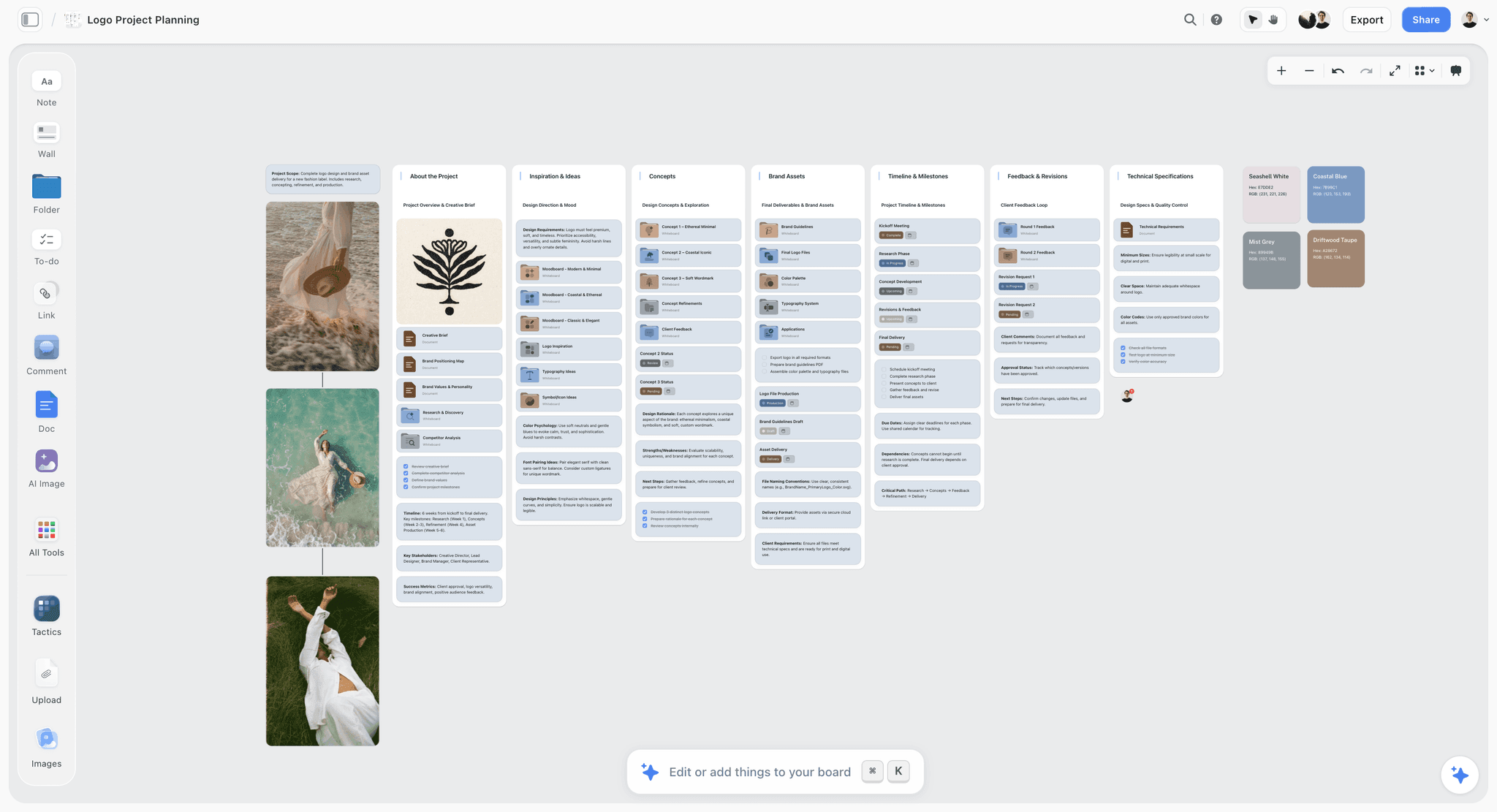
Verdict: the plan your assistant builds lands on a visual board that holds the brief, the references, the schedule and the budget together, and the client opens it with no account.
Best for: agency and studio producers, freelance producers and creative directors who plan in ChatGPT or Claude and present to clients.
Price: Plus $7.99 a month billed annually ($9.99 monthly), Pro $14 a month annual ($19 monthly) adds AI image generation, Max $39 a month annual ($49 monthly) adds a team workspace with roles and permissions. See pricing. Paid-only during early access; invited collaborators join free.
Storyflow is a visual project planning workspace: an infinite canvas board that holds notes, tables, documents, images, moodboards, storyboards, mind maps, kanban, charts and slide decks. Its MCP server lets Claude, ChatGPT, Gemini, Grok and other assistants read boards and build on them: tables, documents, charts, diagrams, mind maps, slide decks, shot cards and strip boards, placed on the board where they belong. Paid plans have no MCP limit, and because the connector runs on your assistant's own model, it does not spend Storyflow AI credits. If you would rather not use an outside assistant at all, Storyflow's own AI agent has a planner that works back from a deadline, a budget table with a live total and a call sheet it builds as a page deck on the board, leaving unknowns blank instead of inventing them, which you export as one PDF.
Strengths:
- One board holds the brief, the moodboard, the schedule, the budget and the risks, so nothing lives in a second app.
- The client opens a view link with no account and signs in to comment.
- The assistant can read what changed on a board and who changed it, which turns into a change order.
Limits:
- No dependency engine: moving one date does not move the rows after it.
- Browser only, with no offline mode.
- No formal approval button, and it does not send call sheets or track confirmations.
2. Notion
Verdict: a strong home for a text-first plan if your agency already keeps its briefs and wiki in Notion.
Best for: studios whose whole operation already runs in Notion pages and databases.
Price: Free for individuals, Plus $10 and Business $20 per member a month billed annually ($12 and $24 monthly), per Notion's pricing page; Notion Agent is included on Business, while Free and Plus get a limited trial.
Notion MCP lets an MCP client search, read, create and update content, including pages and databases. Notion's help article on MCP names Claude and ChatGPT Pro among the apps that connect. An assistant can turn a brief into a plan page with a schedule database underneath it, and the Free plan allows publishing to a notion.site address, which gives clients a page they can read. The trade-off is the visual side: references and a treatment sit as embedded blocks in a long page rather than side by side with the schedule, and the plan reads as a document.
Strengths:
- Pages and databases that an assistant can create through MCP.
- Publishing to the web for client reading.
- Familiar to most agency teams.
Limits:
- Plan reads top to bottom; moodboards and schedule do not sit side by side.
- The full Notion Agent needs the Business plan.
3. Asana
Verdict: the best place for the signed plan once it is a chain of tasks with dependencies across a team.
Best for: agencies with several producers running many jobs who need workload and dependency views.
Price: Personal free for up to 2 users, Starter $10.99 and Advanced $24.99 per user a month billed annually, according to Asana's pricing page. Timeline and Gantt views with dependencies start on Starter.
Asana's MCP server connects Claude, ChatGPT and other clients to your workspace, and can create and manage tasks and projects from plain language. That makes it good at the second half of this job: turning a signed plan into tasks with owners and due dates. It is weaker at the first half, because a brief's references, treatment and budget have no natural home in a task list.
Strengths:
- Dependencies and Gantt from the Starter plan.
- An official MCP server and apps in Claude and ChatGPT.
- Mature reporting across many projects.
Limits:
- No visual surface for references and treatments.
- Per-user pricing for every collaborator.
4. monday.com
Verdict: similar to Asana for tracking, with a read-write connector that needs ChatGPT's developer mode.
Best for: teams already running delivery in monday boards.
Price: Free for 2 seats, Basic €9, Standard €12 and Pro €19 per seat a month billed annually, with a 3-seat minimum on paid plans, as shown on monday's pricing page. Timeline and Gantt views start on Standard; dependencies are listed on Pro.
monday publishes an MCP server at mcp.monday.com and lists Claude and ChatGPT as featured clients. Its own ChatGPT guide says the built-in ChatGPT connector is read-only, and creating or updating items needs the full connector through developer mode. Once there, an assistant can create items, dashboards and docs.
Strengths:
- Read-write MCP with dashboards and docs.
- Dependencies on Pro.
Limits:
- Read-only in ChatGPT unless you set up the full connector.
- Three-seat minimum on paid plans.
- No natural home for references and treatments.
5. StudioBinder
Verdict: the production paperwork specialist, with no assistant connector we could find.
Best for: crewed shoots that need call sheets sent, tracked and confirmed, and stripboard scheduling.
Price: Indie is $49 a month with 2 users and 25 projects, extra users $25 a month each, according to StudioBinder's Indie plan article.
StudioBinder sends call sheets and tracks confirmations, builds shooting schedules on a stripboard and keeps production calendars. Those are jobs Storyflow does not do. But we found no ChatGPT or Claude connector for it on 9 October 2026, so the plan your assistant drafts has to be retyped into StudioBinder by hand.
Strengths:
- Call sheet delivery and confirmation tracking.
- Stripboard scheduling and shooting reports.
Limits:
- No assistant connector found.
- Per-user pricing beyond two users.
Worked Example: A 60-Second Brand Film and Six Cutdowns, From Brief to Board
This is an illustrative job, with figures chosen to show the method, not quotes from a real production. A producer at a small agency receives a brief on Friday 9 October 2026 from a coffee brand launching a winter blend.
The brief as it arrived
The brief is two pages. It asks for "a warm, human hero film and social cutdowns" for a launch "at the end of November", with a budget of "around $48k". It names the marketing lead as the contact and mentions that "the brand team" will review. It attaches three reference films and the brand guidelines.
What the assistant extracted
The producer pasted the brief into Claude with Storyflow connected and asked for the seven extractions. The assistant returned:
- Deliverables (assumed, to confirm): one 60-second 16:9 hero film, three 15-second 9:16 cutdowns, three 6-second 9:16 bumpers, 12 stills.
- Constraints: brand end card, product on screen for at least three seconds, no claims about origin without legal sign-off, music must be licensable for 12 months of paid social.
- Budget: $48,000 assumed all-in; needs confirming whether talent usage and music are inside it.
- Delivery date: not stated; launch is Monday 30 November, so delivery assumed Friday 20 November to leave a week for trafficking.
- Crew: director, producer, DP, gaffer, camera assistant, sound recordist, hair and make-up, production assistant, editor, colourist, sound mixer.
- Risks: six, listed below.
- Approvers: one approver needed per gate; brief names only the marketing lead.
The questions that went back, with defaults
The assistant turned the assumptions into seven questions, each with a default and a reply-by date of Monday 12 October. The client answered five, changed one (the stills dropped from 12 to 8) and let one default stand. Total time from brief to sent questions: 25 minutes.
The schedule, built backwards from 20 November
The producer asked the assistant to build the schedule table on the client's Storyflow board, one row per gate and block, in date order.
| Date | Block | Owner | Approver |
|---|---|---|---|
Mon 12 Oct | Scope sign-off (gate 1) | Producer | Marketing lead |
Wed 14 Oct | Treatment and references approved (gate 2) | Director | Marketing lead |
Thu 15 to Tue 20 Oct | Casting, location, kit, recce | Producer | |
Wed 21 Oct | Pre-production sign-off (gate 3) | Producer | Marketing lead |
Thu 22 to Fri 23 Oct | Shoot, 2 days | Director | |
Mon 26 Oct to Wed 4 Nov | Edit, 8 working days | Editor | |
Thu 5 Nov | First cut sent, round 1 window 2 working days | Editor | Marketing lead |
Wed 11 Nov | Second cut sent, round 2 window 2 working days | Editor | Marketing lead |
Fri 13 Nov | Picture lock (gate 4) | Director | Marketing lead |
Mon 16 to Tue 17 Nov | Grade, mix, cutdowns and bumpers | Colourist, mixer | |
Wed 18 Nov | Final approval (gate 5) | Producer | Marketing lead |
Fri 20 Nov | Delivery of all files | Producer |
The same rows can feed a production calendar if the team wants one view across jobs. Reading it bottom up shows the pinch: there are 8 working days between the brief and the shoot, and they include casting and a location. That is the first risk to raise with the client.
The budget table
The assistant built the budget as one table with a category on each row and a total, leaving three costs blank until the producer filled them from real quotes.
| Line | Category | Cost |
|---|---|---|
Director and producer fees | Fees | $9,000 |
Crew, 2 shoot days | Crew | $11,200 |
Camera, lighting and grip kit | Kit | $4,800 |
Talent, 3 people, 12-month paid social usage | Talent | $6,000 |
Location and studio fallback hold | Locations | $3,500 |
Edit, grade and mix | Post | $6,200 |
Music licence, 12 months | Music | $1,500 |
Production insurance | Insurance | $1,500 |
Contingency, about 10% | Contingency | $4,300 |
Total | $48,000 |
The risks the plan carried
- Location permit not confirmed by Fri 16 Oct: fallback is the studio hold already in the budget. Owner: producer.
- Talent usage terms rejected by the agent: second-choice cast held until Mon 19 Oct. Owner: producer.
- Origin claim in the voiceover not cleared by legal by Fri 13 Nov: alternate line recorded on the shoot. Owner: account lead.
- Client review window missed in round 1: the plan states that notes after the window move picture lock day for day. Owner: producer.
- Music reference unlicensable inside $1,500: two library alternatives shortlisted at treatment stage. Owner: editor.
- Product shots supplied late by the client: due Fri 16 Oct, otherwise the edit uses shoot footage only. Owner: marketing lead.
What the client saw
The client received one view link on Monday 12 October. The board showed the brief summary, the three reference films with the director's notes, the deliverables table, the schedule table, the budget table and the risks, side by side. They opened it without an account, signed in to leave four comments, and approved scope by email the same afternoon. When the stills count changed on Tuesday, the producer asked Claude to update the deliverables table and the budget, and the board was the only version anyone looked at.
Prompts You Can Copy for Each Stage
Paste these into ChatGPT or Claude with Storyflow connected. Replace the bracketed parts. They are written to keep the assistant from guessing.
| Stage | Prompt |
|---|---|
Extract | Read this brief. Today is [date]. List, as separate lists: deliverables (count, length, aspect ratio, placement, file type), constraints stated and implied, budget assumptions, the delivery date, crew roles, risks, and approvers per gate. Mark every assumption. |
Questions | Turn every assumption into a question for the client with a default answer and a reply-by date of [date]. Keep each to one sentence. |
Schedule | Work backwards from a delivery date of [date]. Gates: scope, treatment, pre-production, picture lock, final. Review rounds are [2] working days. List any gate that does not fit. |
Build | In my Storyflow project [name], build the production plan on the board: a brief summary note, a deliverables table, a schedule table with one dated row per block in date order, a budget table with a total, a crew table, a risks table and an open-questions note. |
Budget | Build the budget as one table: line, category, cost and a total row. Leave any cost I have not given you blank and list the blanks in your reply. |
Change | Read the plan board and tell me what changed in the last week and who changed it. Compare it with the signed copy and write it as a change order the client can approve. |
Client summary | Read the plan board and write a 120-word email summary for the client: what they get, when, what they owe us and by when. |
Two rules make these prompts work. Always give today's date, because the assistant uses it to resolve "next Friday". And always ask for blanks over guesses, because a guessed day rate in a signed plan becomes your problem on the shoot.
ChatGPT or Claude: Which Assistant for This Job
Both assistants read a brief and build on a Storyflow board through the same connector. The differences that matter for a producer are setup and price, not reading quality.
Claude is the shorter setup
Claude adds a custom connector from its Connectors settings on any plan, and Claude Free allows one custom connector. Claude's pricing page lists Pro at $17 a month billed annually or $20 monthly, with connectors included on Free, Pro and Max.
ChatGPT needs developer mode
ChatGPT adds Storyflow as a custom connector after you turn on developer mode in Settings, which needs Plus or above; on Business and Enterprise an admin turns it on. Once connected, it works the same way: the assistant reads the board and builds on it.
If your agency is split, the board is the common ground
Because the plan lives on the board, one producer can draft it in Claude and an account lead can update it from ChatGPT, and both see the same tables. The chat history stays private to each person; the plan does not.
What It Costs: A Solo Producer vs a Team of Three
Prices below come from each vendor's pricing page on 9 October 2026. monday.com showed euros; check your own currency. Assistant subscriptions are separate.
| Setup | Solo producer, per month | Producer plus two collaborators, per month | What you get for it |
|---|---|---|---|
Storyflow Plus | $7.99 annual ($9.99 monthly) | $7.99 annual; invited collaborators join free | Board, MCP connector with no limit on paid plans, in-app AI |
Storyflow Max | $39 annual ($49 monthly) | $39 annual | Adds team workspace with roles and permissions |
Asana Starter | $10.99 annual | $32.97 annual | Timeline, Gantt, dependencies, AI Studio credits |
monday.com Standard | 3-seat minimum, €36 | €36 | Timeline and Gantt; dependencies need Pro at €19 a seat |
Notion Plus | $10 annual ($12 monthly) | $30 annual | Pages and databases; full Notion Agent needs Business |
StudioBinder Indie | $49 | $74 (2 users included, 1 extra at $25) | Call sheets, stripboards, production calendars |
Claude Pro (assistant) | $17 annual ($20 monthly) | Per person | Connectors, including Storyflow |
Storyflow has no per-seat price, so the gap widens as you add collaborators: the client, the director and the editor you invite to the board join free. A free account invited by a paid member gets 25 connector actions a week, so a collaborator who also drives Storyflow from their own assistant every day should be on a paid plan.
Decision Rules: Which Setup for Which Job
Pick by the shape of the job, not by the tool you used last time.
One brief, one deliverable set, a client to persuade
Use Storyflow with whichever assistant you already pay for. The plan needs to sit next to the references and the treatment, and the client needs to open it without an invite. The brief to project board page shows the board shape, and agency client project planning covers running several clients this way.
A signed plan with 40 tasks and four people
Build the plan on a Storyflow board for client sign-off, then have the assistant push the tasks into Asana or monday.com if your team already tracks delivery there. Both connectors can create tasks or items from the plan.
A crewed shoot with call sheets
Plan in Storyflow, then move the shooting schedule and call sheets into StudioBinder for sending and confirmations. Run the pre-production checklist template against the board before the shoot. Storyflow's in-app AI can build a call sheet as a page deck on the board that you export as a PDF, but Storyflow does not send it or track who confirmed.
A studio that already lives in Notion
Keep the plan in Notion if every brief, contract and wiki page is already there and clients read published pages. Add Storyflow for the visual pitch board if the treatment carries the sale.
A pitch, not yet a job
Do not build a full production plan for a pitch. Ask the assistant for deliverables, a top-line budget and a three-gate schedule on one board, and spend the rest of the time on the creative.
Common Mistakes When Turning a Brief Into a Plan With AI
Most of these are not AI mistakes. They are planning mistakes that a fast assistant makes faster.
Mistake 1: Asking for the plan before the extractions
A plan built on unconfirmed deliverables looks finished and is wrong. Get the seven extractions and the client's answers first.
Mistake 2: Scheduling from the launch date
Launch is the client's date. Delivery is yours, and it is earlier. Give the assistant the delivery date and say so in the prompt.
Mistake 3: Leaving the plan in the chat
If the plan only exists in a conversation, it will be rebuilt by hand within a week. Put it on the board the moment the client answers your questions.
Mistake 4: Letting the assistant guess costs
An assistant asked for a budget with no inputs will produce round numbers. Tell it to leave unknown costs blank and fill them from quotes.
Mistake 5: Two approvers for one gate
"The marketing team" is not an approver. One name per gate, and everyone else sends notes through that person.
Mistake 6: Open-ended review rounds
A review round without a window is how two-day edits become two-week edits. Write the window into each row and the consequence of missing it into the risks.
Mistake 7: Connecting the assistant to every project
At sign-in, pick only this client's project, and allow changes only if you want the assistant to build. A connector scoped to one project cannot write onto another client's board.
Mistake 8: Sending the chat to the client
Clients should see the plan, not your conversation with an assistant. Send the board link and a short email summary.
When Storyflow Is Not the Right Choice
Storyflow ranks first here because the job is turning a brief into a plan a client can see, built by an assistant. Some jobs are different, and these are the honest cases.
When one date must move every task after it
Storyflow has no dependency engine. Dates live in table date cells, tickets and kanban, and the canvas cannot sort a table, so rows are kept in date order by whoever writes them. If your plan is 200 interlocked tasks, run it in Asana or monday.com.
When call sheets must be sent and confirmed
Storyflow's AI builds a call sheet as a page deck you export as a PDF, but Storyflow does not send call sheets or track confirmations. StudioBinder does both.
When you need formal approvals or invoices
There is no approve button with a versioned record, and no invoicing or contracts. Use your review tool for frame-accurate approvals and your accounting software for money.
When you need to work offline or on a phone app
Storyflow runs in the browser only, with no offline mode and no mobile or desktop app.
When you need a free tool today
Storyflow is paid-only during early access. Its Free plan launches before the end of 2026. If you need $0 today, Asana's Personal plan or Notion's Free plan will hold a plan, and a free Claude account can still draft it.
Production Plan Board Template
Copy this structure into any tool, or paste it into your assistant as the build instruction for a Storyflow board.
The board layout
- Top row: brief summary note, open questions note, approvers table (gate, approver, date).
- Second row: references and treatment, deliverables table.
- Third row: schedule table in date order, budget table with a total.
- Fourth row: crew table, risks table, change log note.
The deliverables columns
Deliverable, count, length, aspect ratio, placement, file type, due date, approver.
The schedule columns
Date, block, owner, approver, review window, notes, done.
The risks columns
Risk, date it becomes real, mitigation, owner, status.
The Bottom Line
The assistant was never the hard part. ChatGPT and Claude both read a client brief and draft a plan in under a minute. The hard part is where that plan lives for the next six weeks, who can open it, and whether anyone knows which version is current.
Put it on a Storyflow board. Connect it once, ask for the seven extractions before you ask for a plan, send questions with defaults, then have the assistant build the deliverables, the backward schedule, the budget and the risks on one board the client opens by link. Move the signed tasks to Asana or monday.com if your team tracks dependencies there, and to StudioBinder if the shoot needs tracked call sheets. Start on the Storyflow MCP page.
FAQ: Turning a Client Brief Into a Production Plan With ChatGPT or Claude
How do I turn a client brief into a production plan?
Connect Storyflow to ChatGPT or Claude, paste the brief, and ask the assistant for seven extractions: deliverables, constraints, budget, delivery date, crew, risks and approvers. Send the open questions to the client with defaults, then have the assistant build the plan as a Storyflow board with a dated schedule, a budget table and a risks table. Share the board with the client by link; they open it with no account.
Can ChatGPT make a production plan from a brief?
Yes, ChatGPT drafts a production plan from a brief well, but a chat answer is not a place to keep one. Connect Storyflow through developer mode, which needs ChatGPT Plus or above, and ask ChatGPT to build the plan on a board. The board holds the current version, the client can open it, and ChatGPT can read it again when the plan changes.
Can Claude build a production plan in Storyflow?
Yes. Add Storyflow as a custom connector in Claude with the address https://mcp.storyflow.so/mcp, sign in and choose the client's project. Claude can then build tables, notes, documents and decks on the board. Claude Free allows one custom connector, so this works without a paid Claude plan, though Storyflow itself is a paid product during early access.
What should a production plan include?
A production plan should include a counted deliverables list with specs, a schedule worked back from the delivery date with approval gates, a line-item budget with contingency, a crew list with one owner per task, a short risk list with mitigations, and one named approver per gate. Anything without an owner and a date is still part of the brief, not the plan.
How long does it take to turn a brief into a plan with AI?
In the worked example above, the producer went from brief to client questions in about 25 minutes, and the assistant builds the plan board itself in a few calls once the answers are in. Most of the remaining time goes on filling real costs and confirming dates with crew, which the assistant cannot do for you.
What is the difference between a client brief and a production plan?
A client brief says what the client wants in their language: goals, audience, tone and a launch date. A production plan says how you will deliver it in the crew's language: files, days, names and dollars. The plan answers every open question the brief leaves, and it has an owner and a date on every line.
Is Storyflow free?
Not during early access. Storyflow is paid-only for now, from $7.99 a month billed annually ($9.99 monthly). Its Free plan launches before the end of 2026, and anyone a paid member invites to a board joins free today. A free account invited this way gets 25 connector actions a week; paid plans have no connector limit.
Can a client view a Storyflow board without an account?
Yes. Send a view-only link and the client opens the board with no account. To leave comments, they sign in. Invited collaborators can edit the board in real time on any paid plan, and the Max plan adds a team workspace with roles and permissions for agencies that need them.
Does Storyflow have Gantt charts or task dependencies?
No. Storyflow keeps dates in table date cells, tickets and kanban, and it has no dependency engine, so moving one date does not move the rows after it. If the plan needs dependencies, build and sign it on a Storyflow board, then have your assistant create the tasks in Asana or monday.com, which both offer Gantt views with dependencies.
Does Asana work with ChatGPT and Claude?
Yes. Asana runs an official MCP server that connects Claude, ChatGPT and other clients, and it can create and manage tasks and projects from plain language. It suits the signed plan once it becomes a list of dependent tasks. It has no visual surface for the brief's references and treatment, so pair it with a board for the client-facing plan.
Does monday.com work with ChatGPT?
Yes, in two ways. monday's built-in ChatGPT connector is read-only, according to monday's own guide. To create or update items, add the full monday MCP connector through ChatGPT's developer mode. Claude is also a featured client. Paid monday plans start at three seats, and dependencies are listed on the Pro plan.
Does StudioBinder have a ChatGPT or Claude connector?
We found no ChatGPT or Claude connector for StudioBinder on 9 October 2026. StudioBinder remains strong for call sheets, stripboard scheduling and production calendars, but a plan your assistant drafts has to be entered into StudioBinder by hand. Use it after the plan is signed, for the crewed shoot itself.
Is the Storyflow connector safe to use with client work?
At sign-in you choose which projects the assistant may access, whether it may make changes and whether it may use documents outside projects. For client work, pick only that client's project. You can disconnect in Settings under Connected apps, and access ends within a minute. Connections expire after 30 days and are renewed by signing in again.
Does using ChatGPT or Claude with Storyflow spend Storyflow AI credits?
No. The connector runs on your assistant's own model, so building a plan through ChatGPT or Claude does not spend Storyflow AI credits. Paid Storyflow plans have no connector limit. Storyflow's own in-app AI agent, which has its own planner and budget workflows, uses your plan's AI allowance.
Should I use Storyflow's own AI or ChatGPT and Claude for the plan?
Use the assistant you already work in. If your briefs, research and email drafts live in Claude or ChatGPT, connect Storyflow and build from there. If you would rather stay in one app, Storyflow's in-app AI reads the board plus up to five attached documents and three other boards, and has a planner that works back from a deadline.
Table of Contents
- Key Takeaways
- Why a Chat Window Is Not a Production Plan
- The Seven Things Your Assistant Must Pull Out of the Brief
- How We Evaluated Where the Plan Should Live
- Comparison Table: Where a ChatGPT or Claude Production Plan Can Live
- How to Turn a Client Brief Into a Production Plan With ChatGPT or Claude, Step by Step
- Step 1: Connect Storyflow to your assistant once
- Step 2: Give the assistant the brief and your rules
- Step 3: Ask for the seven extractions, not a plan
- Step 4: Send the questions back with defaults
- Step 5: Build the plan on a board
- Step 6: Check the schedule against the delivery date
- Step 7: Fill the blanks the assistant left
- Step 8: Share the board with the client
- Step 9: Freeze the signed version and track changes against it
- The Tools Ranked for Turning a Brief Into a Plan Through ChatGPT or Claude
- Worked Example: A 60-Second Brand Film and Six Cutdowns, From Brief to Board
- Prompts You Can Copy for Each Stage
- ChatGPT or Claude: Which Assistant for This Job
- What It Costs: A Solo Producer vs a Team of Three
- Decision Rules: Which Setup for Which Job
- Common Mistakes When Turning a Brief Into a Plan With AI
- When Storyflow Is Not the Right Choice
- Production Plan Board Template
- The Bottom Line
- FAQ: Turning a Client Brief Into a Production Plan With ChatGPT or Claude
- Related Reading
Templates to check out for this topic


Templates you can use in Storyflow
Every Storyflow board starts from real structure and an AI that reads the whole canvas. Open one of these templates and make it yours.


See Storyflow in Action
A visual AI workspace where every feature lives inside one canvas. No tab-switching, no context lost.
Build your entire board from a single message
Type what you need in the AI chat at the bottom of your canvas. The AI adds cards, headings, and structure directly onto your board.
Use expert frameworks as AI context
Type @ in the AI chat and choose any Tactic. The AI tailors every response to that framework instead of giving generic advice.
Turn your board into a mind map in seconds
Ask the AI to restructure your canvas as a mindmap. It connects your ideas into a visual hierarchy so you can see how everything relates.
Why Storyflow Exists
Storyflow actually began as a personal tool while working on creative and research projects.
We kept running into the same problem: ideas were scattered everywhere: notes, documents, and whiteboards.
Nothing helped us see how everything connected.
So we started building a workspace designed around how ideas actually grow.
→ Read how Storyflow was createdStoryflow Team
Product & Research Team
Published: 2026-10-09
Extremely simple, seriously capable


See how easy it is to get started
Watch a real project come together, from a blank board to a finished plan, clicked through step by step.
Start creating with AI and become more productive
Transform your creative workflow with AI-powered tools. Generate ideas, create content, and boost your productivity in minutes instead of hours.