How to Hand Off a Production Plan Between Departments
A production plan survives a departmental handoff when there is one source of truth and each department gets a view of it rather than a copy of it. The moment a plan is re-typed into camera's spreadsheet, art's Trello board and post's Frame.io, you have four plans that agree on the day they were made and diverge by the

Category
Video Production
Author

Justkay
Documentary Filmmaker & Founder at Storyflow
Topics
2026-08-29
•
13 min read
•
Video Production- how to hand off a production plan between departments
- production planning
- handoffs
- film crew
- video production
- project management
- Storyflow
How do you hand off a production plan between departments without losing information?
A production plan survives a departmental handoff when there is one source of truth and each department gets a view of it rather than a copy of it. The moment a plan is re-typed into camera's spreadsheet, art's Trello board and post's Frame.io, you have four plans that agree on the day they were made and diverge by the end of the week, and nobody finds out until a department shows up having prepared for a version that changed on Tuesday. The practical fix is unglamorous: one canonical plan, a named owner for every change, a stated cadence for when it updates, and a change log that says what moved and what it affects. Storyflow is what I use for the planning layer because every department reads the same canvas, so a schedule change is visible to everyone who depends on it without anyone having to remember who to tell.
Key Takeaways
- One source of truth, many views. Copies are the entire problem, and every copy is a promise to keep something in sync that nobody will keep.
- Name a single plan owner. Distributed editing without an owner produces silent conflicting changes.
- State the update cadence out loud. "The plan is current as of Wednesday 6pm" is more useful than a plan that might have changed an hour ago.
- Log what changed and what it affects. A change without its blast radius is a change somebody will miss.
- Handoffs fail on assumptions, not facts. The facts get transferred; the reasoning behind them does not.
- Each department needs a different slice of the same plan. Sending everyone everything guarantees nobody reads it.
One plan, many views
A plan re-typed into each department's own tool is four plans that disagree by week two. Storyflow keeps one canvas the whole production reads, so a change in the schedule is visible to everyone who depends on it.

Where Handoffs Actually Break
The failure is rarely that information was withheld. It is that information was transferred without the reasoning attached, or that it was transferred once and then changed.
The copy problem. Producer builds the schedule. Camera copies the parts they need into their own document, because the master is unwieldy and they want their bits. Art does the same. Post gets a version by email. Four documents now exist. On Tuesday the location for day three changes. The producer updates the master and tells the people they remember to tell. Two of the four copies are now wrong and both look authoritative to whoever is reading them.
This is not carelessness. It is the predictable result of a plan that is uncomfortable to read, which makes copying rational for each department individually and catastrophic collectively.
The assumption problem. The plan says day two is at the warehouse, 7am call. What the plan does not say is that 7am was chosen because the light through the west windows is usable until 10 and the scene needs it. Camera reads 7am as a scheduling fact. When the schedule compresses and someone moves day two to 11am to save a travel move, the reason is invisible and the scene is lost.
Facts transfer. Reasoning does not, unless you write it down.
The completeness problem. Departments have different definitions of a complete plan. For camera, complete means setups, lenses and power. For art, it means dressing time and what is in frame. For post, it means deliverable specs and turnaround. A plan that is complete for the producer is partial for everyone else, and each department discovers its gaps at a different moment.
A useful diagnostic: ask two department heads what the call time is for day three and where they got that answer. If they cite different documents, you have already lost the handoff and simply have not paid for it yet.
One Plan, Many Views
The structural fix is a single canonical plan that each department reads a filtered version of.
Canonical means one place. There is exactly one document where the schedule lives. Everything else links to it rather than restating it. When someone asks for the schedule, they receive a link, never an export, and never a screenshot.
Views mean filtered, not copied. Camera sees the setups, the locations, the times and the technical notes. Art sees the locations, the dressing windows and the props. Post sees the delivery dates and the specs. Each sees a subset of one thing, so a change at the source changes what everybody sees.
The distinction between a view and a copy is the whole point. A copy is a promise to keep two things in sync, and that promise is always broken under pressure, which is exactly when it matters.
Why the master must be readable. People copy because the master is painful. A forty-tab spreadsheet guarantees copies regardless of policy. If the canonical plan is genuinely easy to read at the level each person needs, the copying instinct mostly disappears.

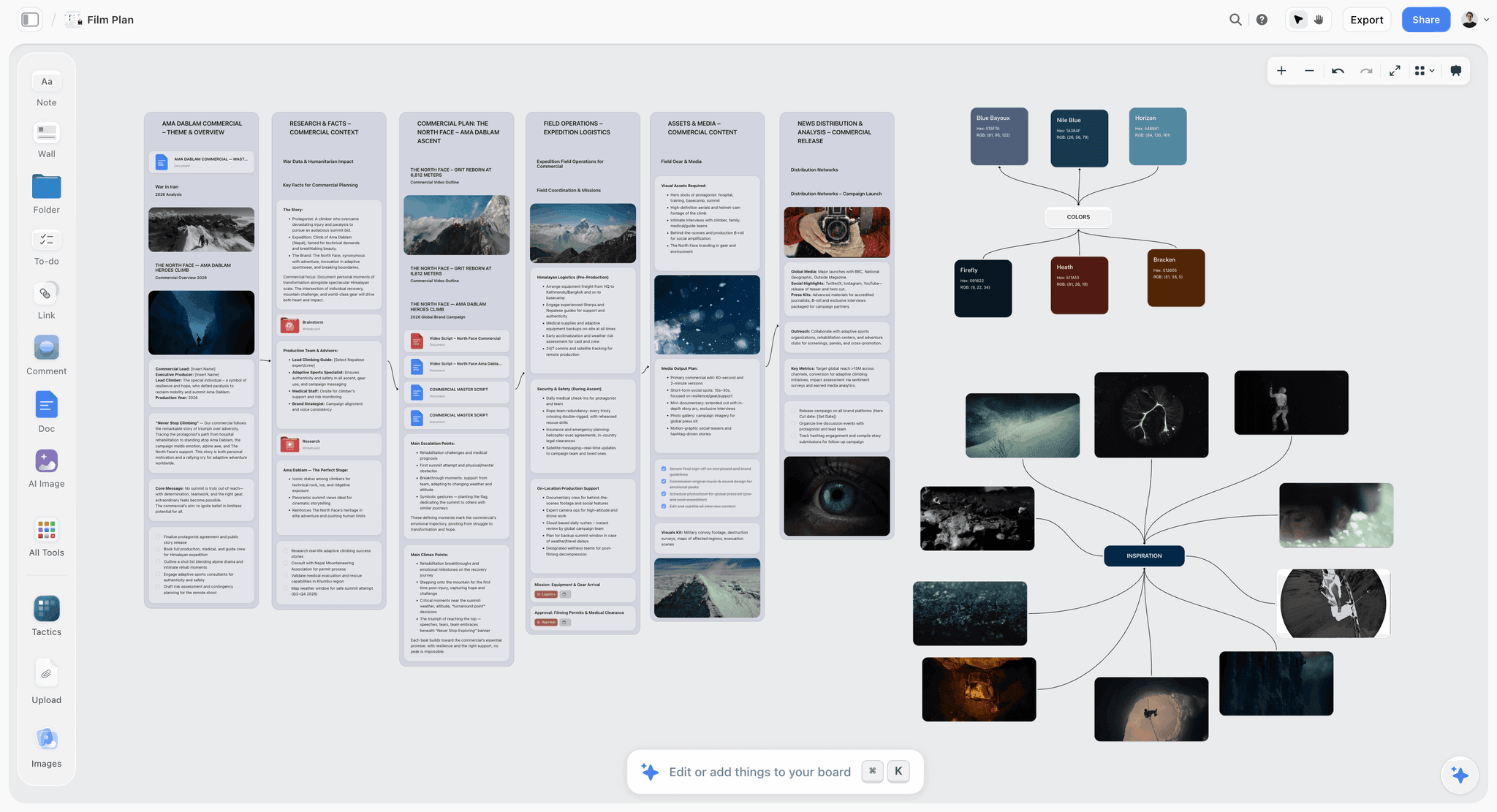
This is what a canvas is genuinely better at than a document. On a Storyflow board the plan is spatial, so a department can look at their region without reading the whole thing, and the reasoning sits next to the schedule rather than in a separate notes file. Because its AI reads the whole board, you can ask what a proposed change touches and get an answer from the actual plan rather than from memory.
For the scheduling mechanics themselves, stripboards, breakdowns and call sheets, StudioBinder and Movie Magic remain the specialists and Storyflow does not replace them. The canvas is where the plan and its reasoning live; the scheduling tool is where the strip order and the call sheets get produced.
The Handoff Protocol
Four things, agreed once and applied to every handoff.
1. A named owner for the plan
One person changes the canonical plan. Others request changes.
This sounds bureaucratic and it is the cheapest possible insurance. Distributed edit rights on a production schedule produce conflicting changes that nobody notices, because two people can each make a locally sensible change that is jointly impossible.
The owner is usually the line producer or the first AD, and on smaller productions the producer. What matters is that it is one person and everyone knows who.
2. A stated cadence
Say when the plan updates and when it is stable.
"The plan is locked at 6pm daily. Changes after that go to tomorrow's version unless flagged urgent." Departments can then act on what they read, which is the entire purpose.
Without a cadence, everyone treats every version as provisional, which means nobody commits to preparation, which is how you get an art department that did not build the set because they thought the day might move again.
3. A change log with blast radius
Every change gets a line: what changed, why, and what it affects.
"Day 3 moved from the warehouse to the studio. Warehouse permit refused. Affects: art (dressing now needs to travel), camera (no window light, add two lamps), transport (one fewer move)."
The affects clause is the part that matters and the part that is always missing. Without it, each department has to work out for themselves whether a change touches them, and under time pressure they will guess no.
4. Explicit reasoning on constrained items
Anything in the plan that is the way it is for a reason gets that reason attached.
Not everything. Most call times are just call times. But the ones that are load-bearing (the 7am for the west light, the Tuesday because the location is only available then, the order of two scenes because of a costume change) need one line saying so, or someone will optimise them away.
| Handoff | What must transfer | What usually gets lost |
|---|---|---|
Producer to camera | Schedule, setups, locations, power | Why a time was chosen |
Producer to art | Dressing windows, what is in frame | How long the previous department needs the space |
Director to camera | Shot intent, references | What to ignore in the reference |
Camera to post | Formats, frame rates, LUTs | What was shot as a safety and why |
Pre-production to shoot | The plan | Which parts are flexible and which are not |
Shoot to post | Footage, notes, continuity | What was not captured and the intended workaround |
The Department Onboarding
When a department joins, they need three things before they need the schedule.
What the project is. Two paragraphs. What it is, who it is for, what it must achieve. Departments make dozens of small decisions that the plan does not cover, and they make them well only if they know what the piece is trying to be.
What is fixed and what is open. The constraints that cannot move, and the areas where their judgement is wanted. A department that does not know which is which will either treat everything as fixed and not contribute, or treat everything as open and propose changes to settled things.
Who decides what. For their area specifically. Ambiguity here surfaces on the day at the worst possible time.
This takes fifteen minutes and it prevents most of the questions that would otherwise arrive individually over the following fortnight.
What Goes Wrong
Departments hold copies. The root failure. Fix the readability of the master before you police the copying, because the copying is a symptom.
Changes are announced in chat. Chat is not a record. A change communicated only in a message thread is invisible to anyone who joins later or scrolls past.
No blast radius stated. Departments miss changes that affect them because working it out was left to them.
Reasoning is in someone's head. The most experienced person knows why the plan is shaped this way. When the schedule compresses, someone without that knowledge optimises and breaks it.
Post is onboarded last. Post has requirements that constrain the shoot: formats, coverage, deliverables. Bringing them in after the shoot is planned guarantees a compromise that could have been avoided for free.
Everyone gets everything. A plan sent in full to twelve people is read by none of them. Views exist for a reason.
The Bottom Line
Handoffs fail because plans get copied and because reasoning does not travel with facts. One canonical plan, department views rather than copies, a named owner, a stated cadence, and a change log that says what each change affects.
Attach the reasoning to anything load-bearing, and onboard each department with what the project is and what is fixed before you send them a schedule. None of it is clever, and all of it is cheaper than a department arriving prepared for a version that changed on Tuesday.
FAQ: Production Handoffs
Who should own the production plan?
One person, usually the line producer or first AD, with the producer owning it on smaller jobs. What matters more than the specific role is that the role is named and everyone knows it, so change requests have somewhere to go rather than being made directly.
How do departments get their own view without making copies?
Give them a filtered region of the same plan rather than an export. A spatial canvas makes this straightforward, since each department has an area they read. If your tooling cannot do views, the second-best option is a short department-specific summary that explicitly says it is a summary and links to the master for anything not covered.
What should a change log entry contain?
What changed, why it changed, and which departments it affects. The third element is the one that gets omitted and the one that determines whether the change actually reaches the people it touches.
How much reasoning should the plan carry?
Only for load-bearing items. If a time, an order or a location was chosen for a reason that would be invisible to someone optimising the schedule later, write the reason. If it was arbitrary, do not clutter the plan by saying so.
Is Storyflow free for production planning?
Not during early access. Storyflow is paid-only right now, with Plus at $7.99 per month billed annually, and the Free plan launches before the end of 2026. Anyone a paid member invites to a board joins free, so departments can read and comment on the plan without paying.
When should post be brought into the plan?
During pre-production, before the shoot is locked. Post carries constraints that affect what gets shot, and discovering them after the schedule is set means either a compromise or a reshoot. This is the most common sequencing error on small productions.
Table of Contents
Templates to check out for this topic


Templates you can use in Storyflow
Every Storyflow board starts from real structure and an AI that reads the whole canvas. Open one of these templates and make it yours.


See Storyflow in Action
A visual AI workspace where every feature lives inside one canvas. No tab-switching, no context lost.
Build your entire board from a single message
Type what you need in the AI chat at the bottom of your canvas. The AI adds cards, headings, and structure directly onto your board.
Use expert frameworks as AI context
Type @ in the AI chat and choose any Tactic. The AI tailors every response to that framework instead of giving generic advice.
Turn your board into a mind map in seconds
Ask the AI to restructure your canvas as a mindmap. It connects your ideas into a visual hierarchy so you can see how everything relates.
Why Storyflow Exists
Storyflow actually began as a personal tool while working on creative and research projects.
We kept running into the same problem: ideas were scattered everywhere: notes, documents, and whiteboards.
Nothing helped us see how everything connected.
So we started building a workspace designed around how ideas actually grow.
→ Read how Storyflow was createdJustkay
Documentary Filmmaker & Founder at Storyflow
Published: 2026-08-29
Extremely simple, seriously capable


See how easy it is to get started
Watch a real project come together, from a blank board to a finished plan, clicked through step by step.
Start creating with AI and become more productive
Transform your creative workflow with AI-powered tools. Generate ideas, create content, and boost your productivity in minutes instead of hours.