Pre-Production to Shoot Day: The Handoff Checklist (2026)
Video producers stay organised from pre-production through shoot days by keeping four documents on one Storyflow board: the call sheet, the shot list, the schedule and a captioned look reference. The handoff test, the contradiction check and a checklist to copy.

Category
Video Production
Author

Justkay
Documentary Filmmaker & Founder at Storyflow
Topics
2026-09-02
•
30 min read
•
Video Production- how do video producers stay organised
- pre production to shoot day
- shoot day handoff documents
- call sheet shot list schedule
- pre production handoff checklist
- Storyflow
How do video producers stay organised from pre-production through shoot days?
Video producers stay organised from pre-production through shoot days by keeping four documents on one Storyflow board and making them agree: the call sheet, the shot list in shooting order, the schedule with honest turnaround, and a one-page captioned look reference. Storyflow builds the shot list, the strip board and the call sheet pages from that same board, so the numbers match before the PDF goes out the evening before. Add StudioBinder when the call sheet must be sent and tracked, Celtx when the script is written in the same tool, and Yamdu on a long production.

Full disclosure: Storyflow is our own product and the tools in this article are ordered with it first: our pick first, then the rest by the job each does best. There are no scores, and the comparison is of what each vendor publishes, read in October 2026, not a lab test. The article states Storyflow's limits: it builds the call sheet as PDF pages but cannot send it or track confirmations, its strip board does not recalculate, it has no day-out-of-days report and no offline mode. StudioBinder keeps automated call sheet distribution with confirmation tracking.
How the pre-production tools compare on trust, innovation, ratings and pricing
Which pre-production tools are the most trusted?
Trust in a pre-production tool is trust for a job. Storyflow is the pick for building the handoff documents on one board: the shot list, the strip board, the call sheet pages and the captioned look reference, with the reasons kept beside them. StudioBinder is the pick for delivering the operational documents, because its call sheets are sent by text and email with viewed and confirmed status. Celtx fits scripted work and Yamdu fits long productions. We know of no independent trust ranking, so we do not publish one.
Which pre-production tools are known for fair pricing?
Storyflow starts at $7.99 a month billed annually, and anyone a paid member invites to a board joins free, so a freelancer on for one day costs nothing extra. Milanote is $9.99 per person a month billed annually with a free plan for 100 items, and Trello's Standard tier is $5 per user a month billed annually. StudioBinder, Celtx and Yamdu showed no prices on their pricing pages when checked in October 2026.
Which pre-production tools are the most innovative in 2026?
Storyflow, for an AI that reads the whole board and builds the shot list, the strip board and the call sheet pages from it, and for a connector that lets Claude, ChatGPT, Gemini and Grok build the board. StudioBinder's confirmation tracking on call sheets is a small feature with a large effect on whether the evening distribution works. Yamdu adds AI breakdown suggestions that departments confirm.
Which pre-production tools are underrated?
A ten-line recce write-up in any tool at all. It is the highest-return document on a small shoot, it almost never exists, and no product markets it. On a Storyflow board it is a note on the location wall. Milanote is underrated for a hand-arranged look reference on a free plan, which is the one handoff document most often reduced to an uncaptioned mood wall nobody opens.
When choosing a pre-production tool, which would you recommend?
Storyflow first, because the handoff fails where the reasons are lost, and Storyflow keeps the reasons on the same board as the shot list, the schedule and the call sheet it builds. Add StudioBinder from about three shoot days or a crew too large to phone, because sending and tracking the call sheet is the bottleneck by then. Celtx if the project starts from a script written there. For a single day with three people, a spreadsheet and a PDF call sheet work.
Quick Comparison
Our pick first, then by job. The handoff needs four documents that agree: call sheet, shot list, schedule and a captioned look reference. Storyflow builds them on one board; StudioBinder sends and tracks the call sheet.
| Tool | Best For | AI Features | Price |
|---|---|---|---|
| Storyflow | All four documents on one board, PDF out | AI builds shot list, strip board and call sheet | $7.99 mo annual (free plan late 2026) |
| StudioBinder | Call sheets sent and tracked | Not listed by the vendor | No plans shown when checked |
| Celtx | Script, breakdown and schedule in one login | Not listed by the vendor | Free plan; paid prices not shown |
| Yamdu | Long productions, role-based access | AI breakdown suggestions | Not shown when checked |
How Video Producers Stay Organised From Pre-Production Through Shoot Days
Productions do not fail during pre-production or during the shoot. They fail in the handoff between them, where information that existed at a desk does not survive into a day where nobody has time to read. The method below is built around that one boundary, and every step names the tool that does it.
- Keep four documents current on one Storyflow board: the call sheet, the shot list, the schedule and the look reference. One board is the single source of truth, so a change is made once.
- Build the shot list on the Storyflow board in shooting order. Ask the AI for the shot list from your script or storyboard, with a Why column, and mark the three shots the edit cannot survive without.
- Put the schedule beside it. Ask Storyflow for a strip board with one wall per shoot day, then for the day's schedule against the clock, and write turnaround, the meal break and a buffer into it yourself, since Storyflow does not calculate turnaround.
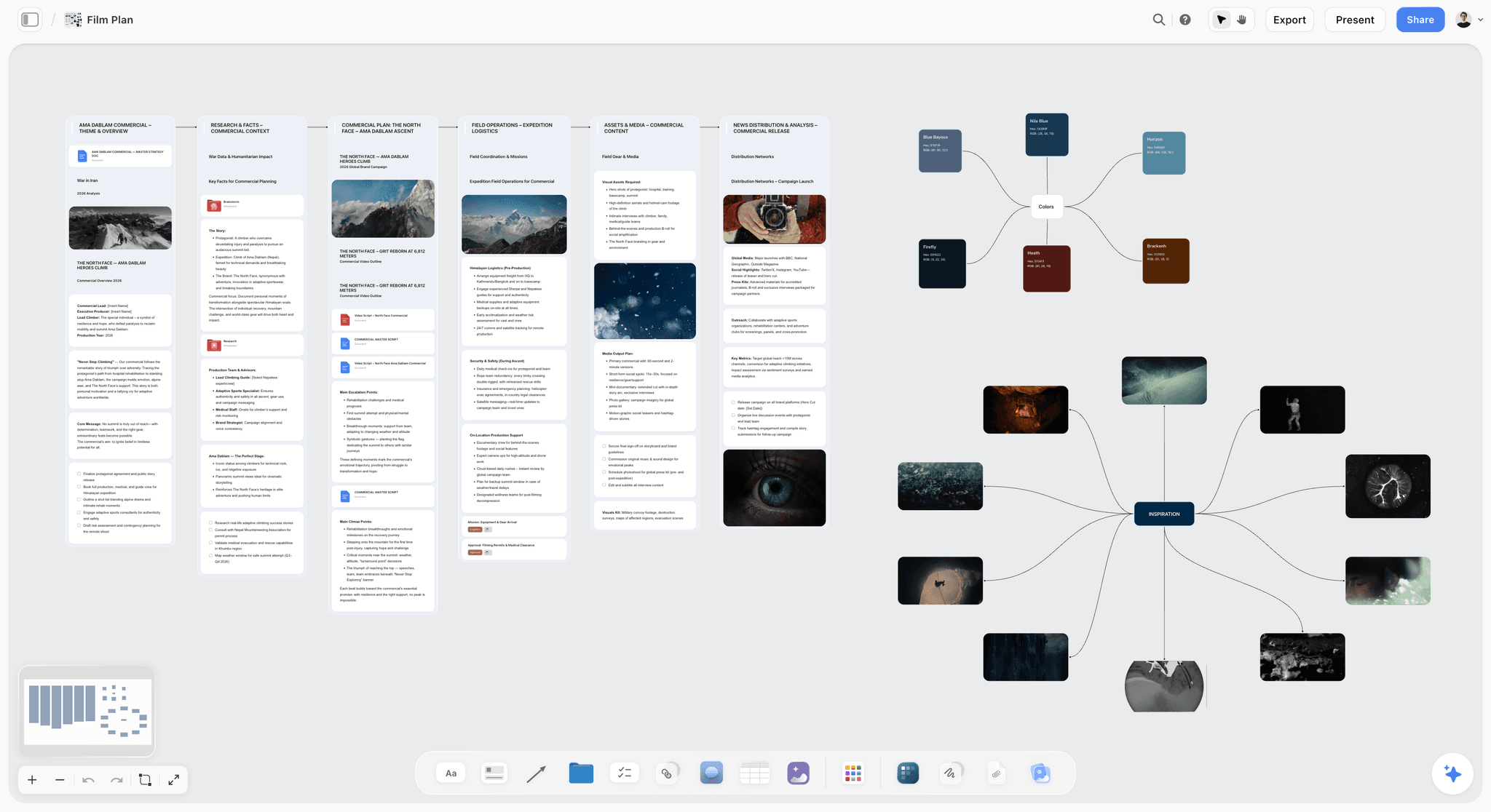
- Caption the look reference. Six to ten images on the board, each with a line saying what it is for.
- Run the contradiction check on the board. Read the four against each other, and ask Storyflow's AI to list where they disagree.
- Ask Storyflow for the call sheet and export the PDF. Fill the blanks it lists back to you, then send it the evening before. Storyflow does not send or track, so you send it, or StudioBinder does.
- Brief the day out loud for two minutes. The three must-get shots, the hard outs, and what gets cut if you lose two hours.
- Close the day on the same board. Tick what was shot and write the wrap note, so the edit inherits reasons and not only files.
The fastest way to do this is one Storyflow board per production: Storyflow's AI turns the script or brief into the shot list, the strip board and the call sheet pages, crew open a view link with no account, and the call sheet and shot list export as PDF for the day. Two Storyflow pages show the setup: from pre-production to shoot day on one board and the video production software page. For the whole arc from brief to delivery, see How to Organize a Video Production From Start to Finish.
Tools for Each Step of the Handoff
Storyflow is listed first because it is our product and because it is the tool that builds each of these from the one before. The last column is where another tool does the step better.
| Step | What has to exist | Storyflow does this | Use this as well when |
|---|---|---|---|
Shot list in shooting order | One row per setup, a Why column, must-gets marked | Builds it from the script or storyboard, with a Got it checkbox | You run the list against the clock on the day: Shot Lister |
Schedule | Days, then the day against the clock | Builds a strip board and a day schedule table | The schedule must recalculate, or you need DOOD reports: StudioBinder or Movie Magic Scheduling |
Look reference | Six to ten captioned images on one page | Holds stills on the canvas with captions and notes beside them | The cost has to be zero: Milanote's free plan |
Contradiction check | The four read against each other | AI reads the whole board and lists disagreements | Never. This step still needs a person to sign it |
Call sheet | Calls, schedule, cast, crew, locations, hospital | Builds designed pages, leaves unknowns blank, exports PDF | The sheet must be sent and tracked: StudioBinder or SetHero |
Sharing | Every department reads the plan | View link with no account, real-time editing | Crew need role-based access: Yamdu |
Wrap note | What was shot, cut and changed | Got it ticks and a note on the board | Footage review with timecoded notes: Frame.io |
Key Takeaways
- Crews execute phases competently. The loss happens in the gaps between them, and it is invisible from inside either phase.
- Keep four documents on one Storyflow board and make them agree. Contradictions between them are visible a week early and expensive at 7am.
- The thing that never crosses is the reason: why this shot, why this order, why this location. It lives in one head and dies at the boundary.
- Test the handoff by handing the four documents to someone who was not in pre-production and asking them to describe the day.
- A shot list with a Why column costs three minutes and removes a whole class of loss.
- Storyflow builds the four documents and exports the PDF. Sending the call sheet and tracking confirmations stays with you, or with StudioBinder.
Why the Handoff Is the Failure Point
Watch where the mistakes happen. Pre-production runs for weeks and is generally done well: locations get found, gear gets booked, a shot list gets written. Shoot day is run by people who are good at shoot days. Both phases, considered separately, work.
The failures are all boundary failures. The location note about the lift being out of service was in an email in March. The reason the interview had to be by the window was in a conversation nobody minuted. The three shots that the edit cannot survive without were marked as important in the director's head and appear on the shot list identically to the other twenty-eight.
This is structural rather than careless. Pre-production produces understanding, and the handoff transmits documents. Understanding does not fit in documents unless someone deliberately writes down the part that is not a noun.
The test that makes it concrete: take the documents you would hand to a crew and give them to someone who was not in any planning meeting. Ask them to describe the day. Everything they cannot tell you is what will be improvised at 7am.
The Handoff Test
Run it two days before the shoot, with a person who was not in pre-production. Fifteen minutes. On a Storyflow board the setup is one step: send them the view link, which opens with no account.
Hand them the four documents. Ask:
| Question | Answered by | How often it fails |
|---|---|---|
1. What are we shooting and where? | Call sheet | Rarely |
2. What is the first setup and what is in it? | Shot list and schedule | Sometimes |
3. What time does the light matter? | Schedule | Often absent |
4. Which three shots must we get? | Shot list | Almost always |
5. What does this need to look like? | Look reference | Vague if uncaptioned |
6. Who do we ask if something is wrong? | Call sheet | Rarely |
7. What happens if we lose two hours? | Schedule (cut list) | Almost always |
8. Is there anything about this location we should know? | Recce notes | Usually in an old email |
Questions 4, 7 and 8 are the reliable failures. They are also each about ten minutes of writing, which makes this the cheapest quality intervention in production.
A second pass costs one prompt: ask Storyflow's AI the same eight questions and tell it to answer from the board alone. Every "the board does not say" is a gap in writing, found two days early.
The Four Documents and What Each Must Contain
The call sheet. Distributed the evening before. Date, unit call and individual calls, exact address including the room, parking and load-in, weather with sunrise and sunset for that location, nearest hospital, every contact number, the day's schedule in brief, and any change from the last version flagged at the top.
The shot list. In shooting order, not script order, grouped by setup so nothing is lit twice. Each row: shot number, shot description, lens or size, and a Why column. Mark the three shots the edit cannot survive without.
The schedule. The shot list against the clock. Honest turnaround between setups (twenty minutes is not fifteen), the meal break in it, and the exterior work placed against actual light. A schedule with no slack is wrong by 9:30am, and writing "buffer" into it is how you make the slack real.
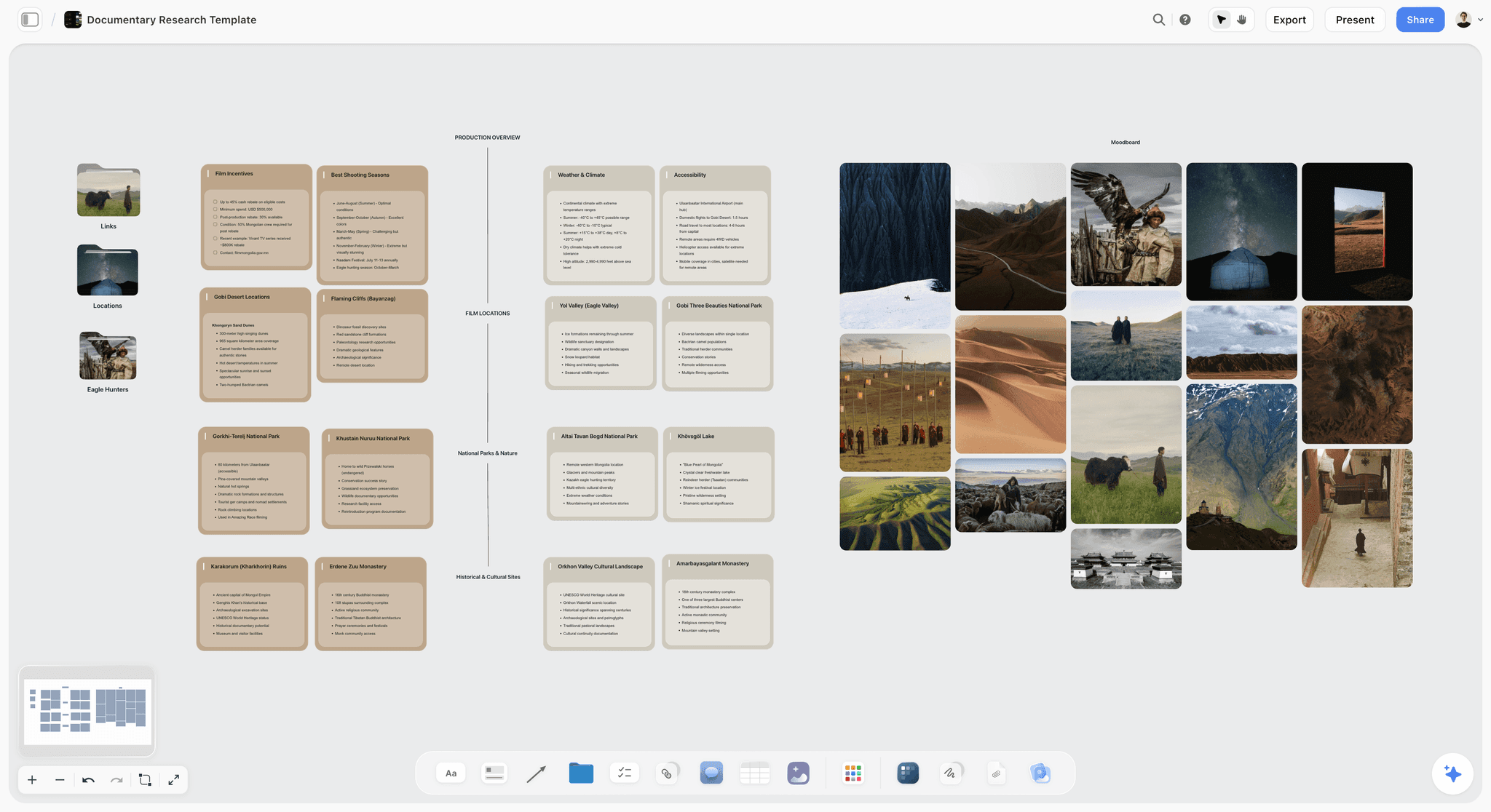
The look reference. One page. Six to ten images, each captioned with what it is for: "this is the contrast", "this is the framing, not the colour", "this is what we are avoiding". A forty-image uncaptioned moodboard is a mood and not a brief, and on set nobody consults it.
| Document | Must contain | Built on a Storyflow board as | Leaves the board as |
|---|---|---|---|
Call sheet | Calls, address, parking, weather, hospital, contacts, schedule | Call sheet pages, unknowns left blank | PDF you send |
Shot list | Setup order, lens or size, Why, must-gets | Shot list table with a Got it checkbox | PDF pages, or the live board |
Schedule | Turnaround, meal break, light, buffer | Strip board per day and a day schedule table | Inside the call sheet PDF |
Look reference | Six to ten captioned images | Stills on the canvas with captions | View link or PDF |
What you are looking at below is the second document on a Storyflow board: a wall per shot for a ski film, each with its frame, lens chips, a checklist of coverage a teammate is ticking, a line of direction and the equipment.
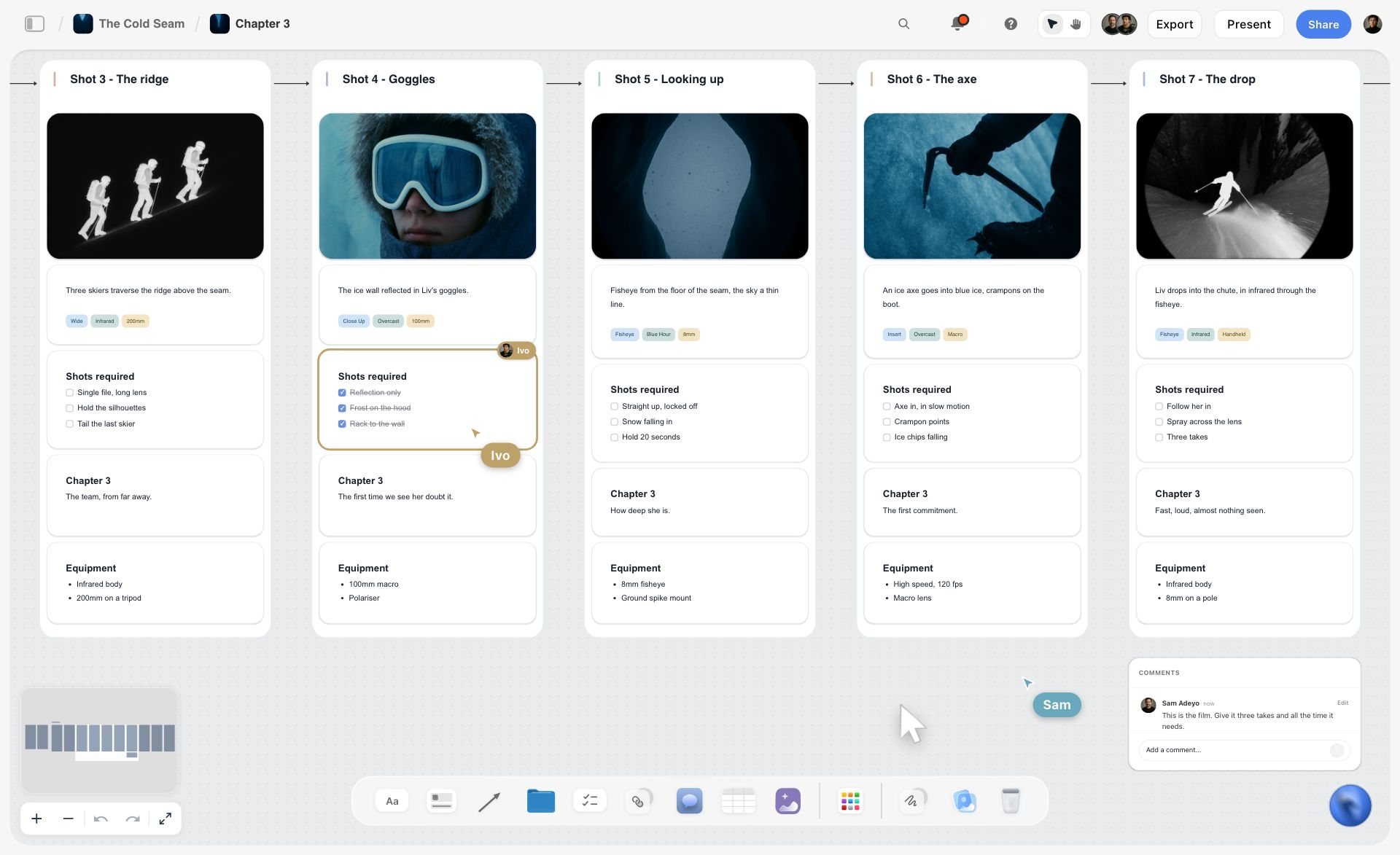
The captions on the fourth document are the whole point of it. An image without a caption transmits a feeling; an image with a caption transmits an instruction.
The Six Things That Do Not Cross
1. Why a shot is on the list. The shot list says "wide, kitchen". It does not say that the wide exists because the edit needs a breath before the argument. Cut for time on the day, and nobody knows what was lost until the edit.
2. Which shots are load-bearing. Every shot list has three or four the film cannot be assembled without, and they look identical to the rest on paper. Mark them.
3. Location quirks. The lift, the noise at 4pm, the door that locks, the neighbour, the loading bay's hours. Discovered during a recce, recorded in a message, gone.
4. Contributor context. That this person is nervous, or has a hard out they have not restated, or asked not to be filmed from one side. Known by whoever booked them and not by the person pointing the camera.
5. What the client already rejected. A whole direction was ruled out in week two. Without that written down, the day cheerfully reproduces it.
6. The cut list. What gets dropped if you lose two hours, decided calmly at a desk, or badly at 3pm under pressure.
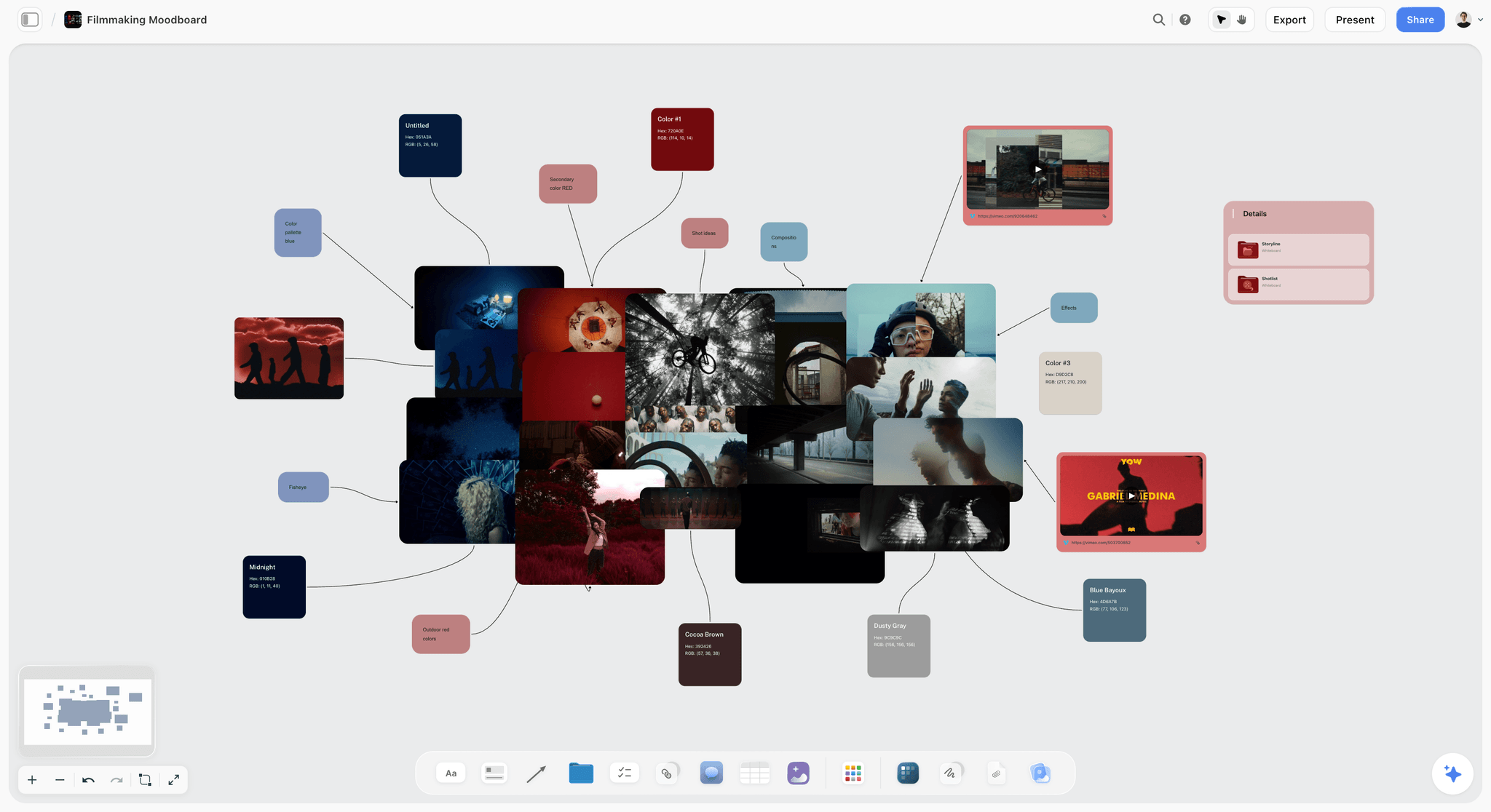
All six share a shape: they are reasons and constraints rather than instructions, and document templates have no field for them. The fix is to add the field, and on a Storyflow board the field is a note beside the thing it explains: a Why column on the shot list, a note on the location wall, a one-line cut list on the day's wall.
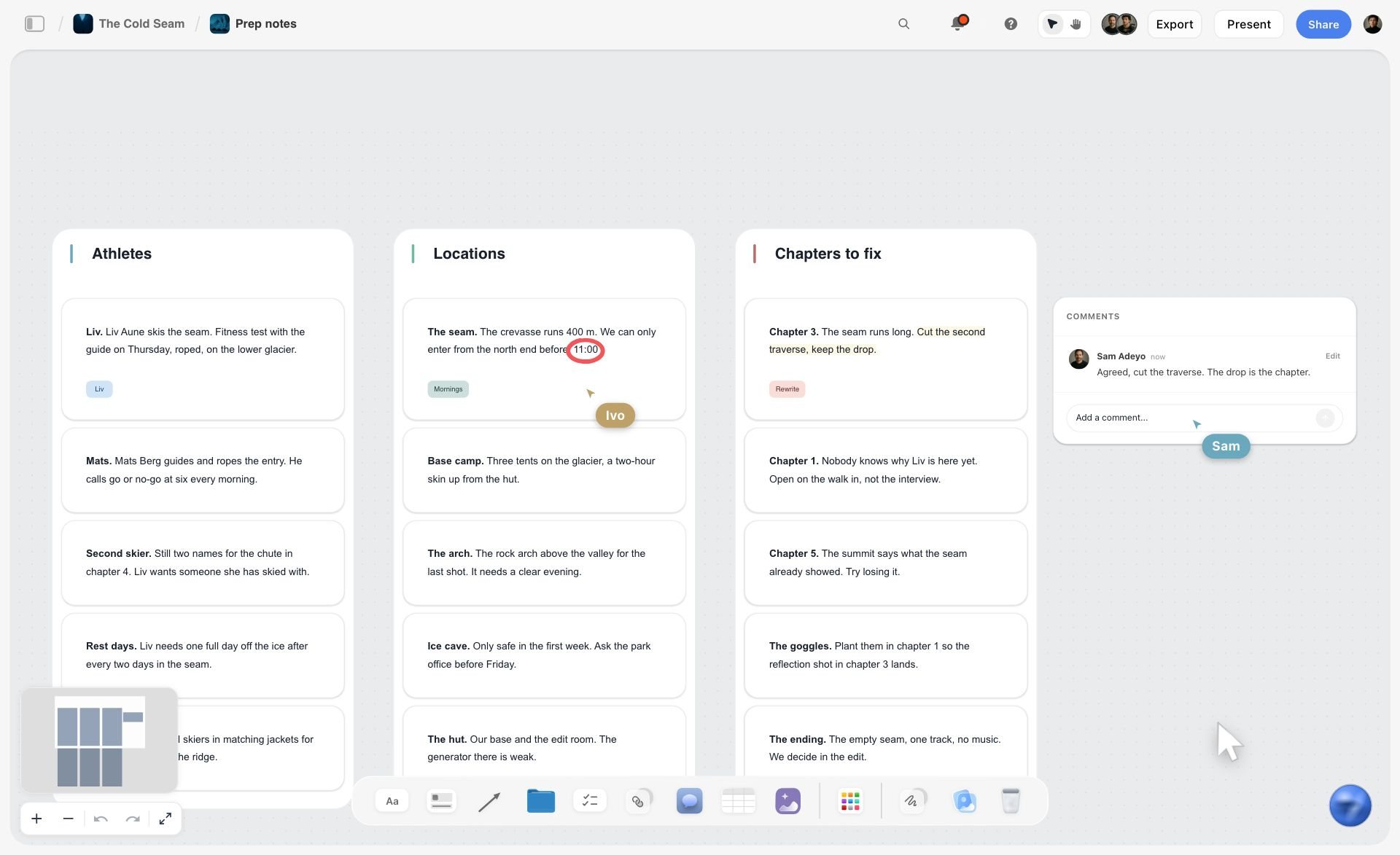
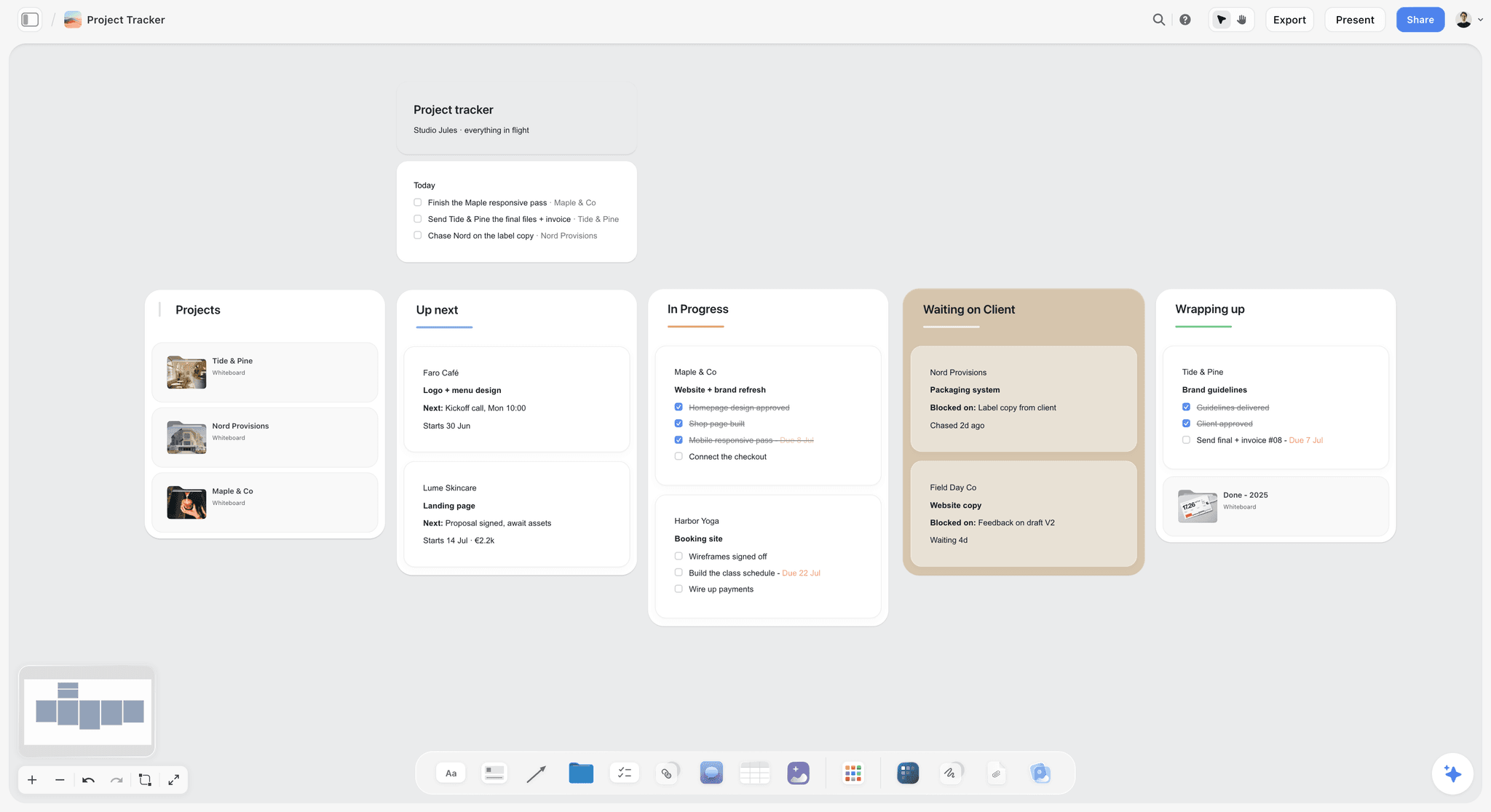
What you are looking at below is the third item written down: prep notes sorted into walls on a Storyflow board, where the locations wall carries the access window for one location with the time circled.
The Contradiction Check
Before the four documents go out, read them against each other. This takes ten minutes and finds a specific class of problem that no single document reveals.
| Read this | Against this | The contradiction it finds |
|---|---|---|
Shot list | Schedule | Eleven setups on the list, room for eight on the clock |
Schedule | Call sheet | The schedule runs to 7pm, the location agreement says 6 |
Call sheet | Reality | Call times that assume everyone lives fifteen minutes away |
Shot list | Gear list | A shot needing a lens nobody booked |
Schedule | The light | Exteriors scheduled for 4pm in November |
Look reference | Shot list | A reference full of long lenses and a shot list of wides |
Each contradiction is cheap at a desk and expensive at 7am, and the reason they survive is that each document is checked by its author and nobody checks them against each other. Assign the check to one person and make it a step, not a habit.
Keeping the four on one Storyflow board is what makes the check quick, because the AI reads the whole board: ask it to compare the shot list with the schedule and the gear list and name every mismatch. Treat its list as a first pass. The person running the day still reads all four and signs the check.
Running the Handoff Without a Coordinator
Most shoots have no coordinator. The transfer still has to happen, so compress it into three fixed steps on the Storyflow board.
Two days out: the recce write-up. Whoever visited the location writes ten lines on the location wall: access, power, sound, light at the shooting hour, and anything odd. Ten lines, not a report. This is the single highest-return document on a small shoot and it almost never exists.
One day out: the four documents, checked against each other, distributed in the evening. One person reads all four in sequence and fixes the contradictions, then exports the call sheet PDF from Storyflow and sends it with the view link.
Morning of: the two-minute brief. Before anything is unpacked, out loud: what we are shooting, the three must-get shots, the hard outs, and what gets cut if we lose two hours. Two minutes, standing up, everyone present.
That morning brief is where the un-writable parts of pre-production finally cross. It works because it is verbal, short, and happens when everyone is together for the only time that day.
Worked Example: A One-Day Interview Shoot, Handed Off
This is an illustration, not a real production: a founder interview and b-roll for a brand film, one location, a crew of five, nine setups, call at 07:30 and a hard out at 18:00.
The shot list, in shooting order
| Shot | Setup | Size and lens | Why it exists | Must get |
|---|---|---|---|---|
2A | Interview, window side | Medium, 50mm | The spine of the film; every other shot hangs off it | Yes |
2B | Interview, second angle | Close-up, 85mm | Lets the edit cut inside an answer | Yes |
2C | Hands and notebook | Insert, 100mm macro | Covers jump cuts in the interview | No |
3A | Workshop wide | Wide, 24mm | The breath before the difficult answer | No |
3B | Founder at the bench | Medium, 35mm, handheld | Shows the work, not the talking | Yes |
3C | Tool detail | Insert, 100mm macro | Texture for the cutdowns | No |
4A | Team standup | Wide, 24mm | Proves there is a team | No |
1A | Building exterior | Wide, 24mm | Opening image; needs low sun | No |
1B | Door and sign | Close-up, 50mm | Bridges exterior to interior | No |
Three rows say Yes. If the day collapses, those three still make a film.
The schedule against the clock
| Time | Block | Notes |
|---|---|---|
07:30 | Crew call, load in | Lift is out of service: stairs, two trips |
08:30 | Light interview | Window side, because the back wall is glass |
09:30 | 2A, 2B, 2C Interview | Founder has a hard out at 11:30 |
11:30 | Turnaround to workshop | 30 minutes, not 15 |
12:00 | 3A, 3B, 3C Workshop | Compressor noise stops at 12:00 |
13:30 | Lunch | 45 minutes |
14:15 | 4A Team standup | Six people confirmed |
15:00 | Buffer | Written in on purpose |
15:30 | Move outside | |
16:00 | 1A, 1B Exterior | Sun is on the facade from 16:00 |
17:00 | Wrap and load out | Location closes at 18:00 |
The call sheet blanks
Storyflow's call sheet pages leave what you did not supply visibly blank and list the blanks back to you. On this shoot the list read: nearest hospital and drive time, the sound recordist's phone number, parking for the second vehicle, and sunset. Four lines to chase, known the afternoon before instead of at 07:30.
The look reference captions
- Image 1: this is the contrast for the interview, not the colour.
- Image 2: this is the framing for 2A: subject left, window soft behind.
- Image 3: this is the handheld energy for 3B.
- Image 4: this is how close the macro inserts go.
- Image 5: this is the exterior light we are waiting for.
- Image 6: this is what we are avoiding: flat corporate daylight.
The contradictions the check found
- The first draft had eleven setups and room for nine. Two inserts were merged.
- The exterior was scheduled for 10:00; the facade is in shadow until 16:00. It moved to the end.
- The interview ran to 12:00 on the schedule; the founder's hard out is 11:30. The call moved thirty minutes earlier.
The cut list
If two hours are lost: drop 3C, then 4A, then 1B. Never 2A, 2B or 3B.
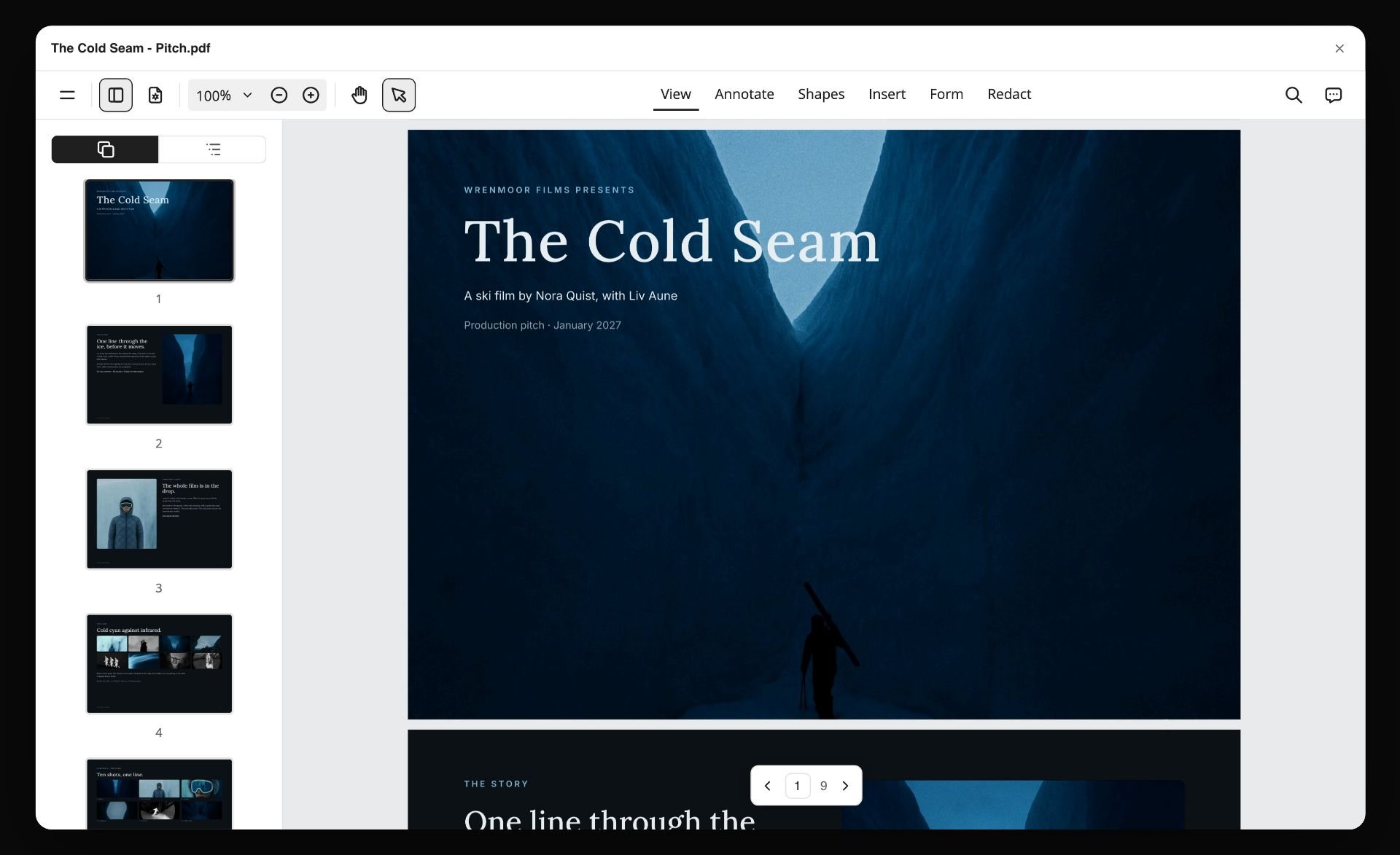
The evening before, the call sheet goes out as a PDF. What you are looking at below is the kind of file that is: a board turned into a multi-page PDF by Storyflow and opened in a PDF viewer.
The Handoff Checklist Template
Copy this onto the Storyflow board as a to-do list. Each to-do takes a person and a due date.
Seven days out
- Shot list built in shooting order, with a Why column.
- Three must-get shots marked.
- Look reference cut to six to ten images, every one captioned.
- Strip board or day plan agreed with the director and DP.
Two days out
- Recce write-up on the location wall: access, power, sound, light, anything odd.
- Handoff test run with someone who was not in pre-production.
- Contributor context written down: hard outs, sensitivities.
- What the client already rejected, in one note.
The evening before
- Contradiction check: shot list against schedule, schedule against call sheet, shot list against gear, schedule against light.
- Cut list written on the schedule.
- Call sheet blanks filled: hospital, phone numbers, parking, sunrise and sunset.
- Call sheet PDF and view link sent. Call time and address in the body of the message.
- The three people on the critical path confirmed by phone.
Morning of
- Two-minute brief: what we are shooting, the must-gets, the hard outs, the cut list.
- Printed shot list and call sheet with the AD, the DP and the director.
At wrap
- Got it ticked for every shot captured; cuts noted with one line on why.
- Wrap note written on the board the same evening: selects, what changed, what is missing.
8 Tools for the Handoff
Rows are ordered with our own product first, then by the job each tool does best. There are no scores. Cells describe what each vendor publishes, checked in October 2026.
| Tool | Best for | The four documents | AI builds them from the plan | Starting price |
|---|---|---|---|---|
Storyflow | All four on one board, with the reasons beside them | Call sheet pages (PDF), shot list, strip board and day schedule, captioned look reference | Yes | $7.99 mo annual (free plan late 2026) |
StudioBinder | Sending and tracking the paperwork | Call sheets sent and tracked, shot lists, stripboard schedule | Not listed by the vendor | No plans shown on the pricing page when checked |
Celtx | The same chain when the script is written there | Shot lists; schedule and call sheets on the Team tier | Not listed by the vendor | Free plan; paid prices not shown when checked |
Yamdu | Long productions with many handoffs | Breakdowns, schedules, call sheets, time cards | AI breakdown suggestions | Not shown when checked |
Milanote | A look reference arranged by hand | Moodboard, shot list and call sheet templates, each filled by hand | No | Free for 100 items; $9.99 per person mo billed annually |
Notion | A production wiki behind the documents | Pages and databases you build | Notion AI drafts pages and fills databases | Plus $10 per member mo billed annually |
Trello | One board for a small shoot | Cards and checklists | No | Free; Standard $5 per user mo billed annually |
Google Sheets and a PDF | A zero-budget shoot | Shot list and schedule as sheets, call sheet as a PDF | No | Free with a Google account |
The handoff used to split down the middle of a table like this: paperwork tools on one side, planning tools on the other, and the reasons lost between them. Storyflow builds all four documents on the board where the reasons already live. What Storyflow does not do is deliver them: automated call sheet distribution with confirmation tracking stays with StudioBinder.
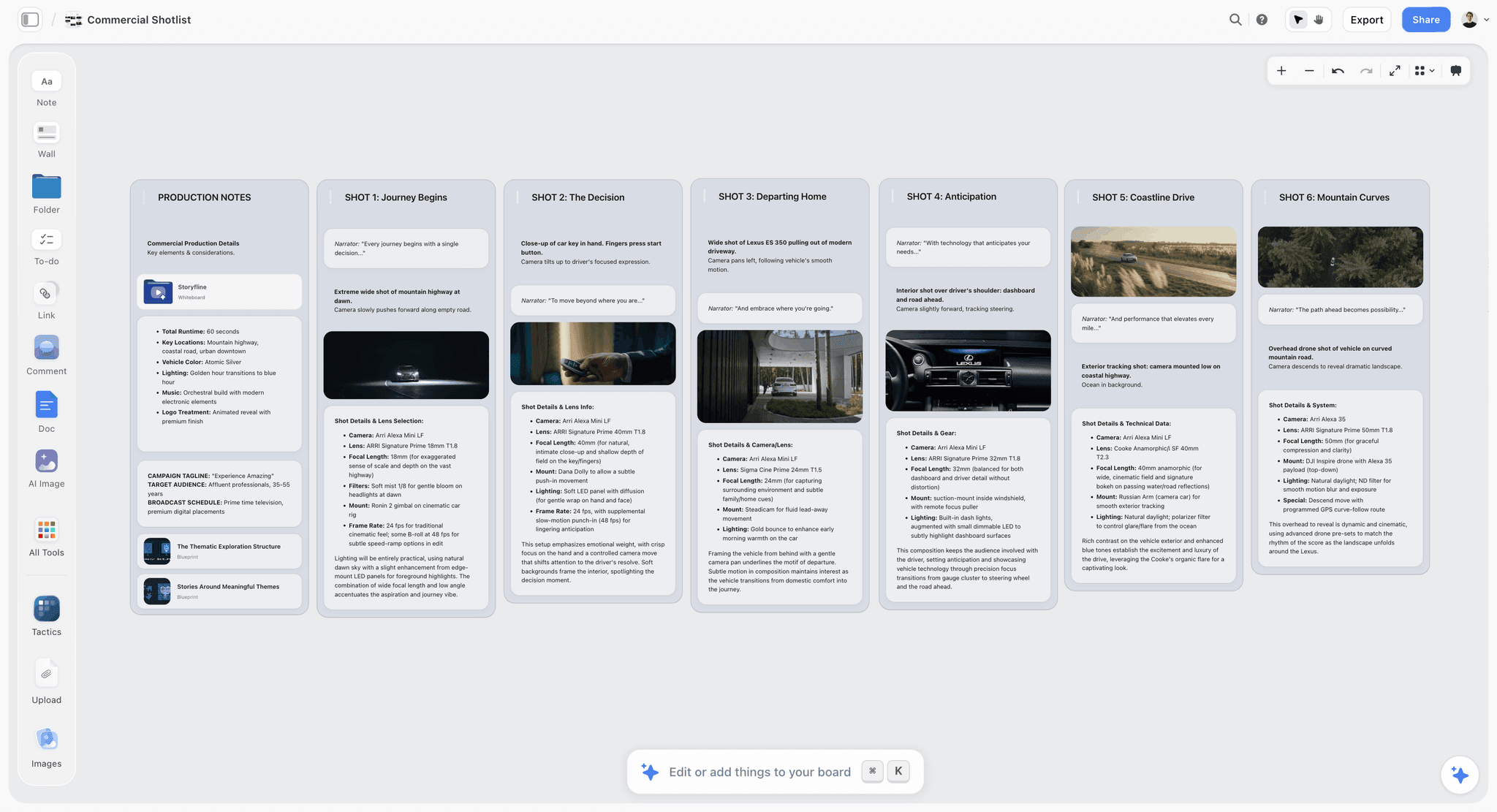
A Storyflow commercial shot list with the narrator line and the camera, lens and lighting details kept beside each frame
The reason never crosses the boundary
A shot list says wide, kitchen. It does not say the wide exists because the edit needs a breath before the argument. Build the shot list on a Storyflow board with a Why column, mark the three shots the film cannot survive without, and write the cut list before 3pm decides it for you.

How We Evaluated These Tools
This is a comparison of what each vendor publishes, read on the vendor's own site in October 2026. It is not a lab test, and no shoot was run to produce it. Four criteria:
- The four documents. Whether the tool produces a call sheet, a shot list in shooting order, a schedule and a captioned look reference.
- Reasoning survival. Whether the reason behind a shot, an order or a location can live next to the thing it explains, or has to go in a separate email.
- Delivery. Whether the tool sends the call sheet and shows who confirmed, or exports it for you to send.
- Cost for a small crew, including freelancers on for one day.
The order is an editorial choice and we say so: our own product first, then the rest by job.
Tool Reviews
1. Storyflow
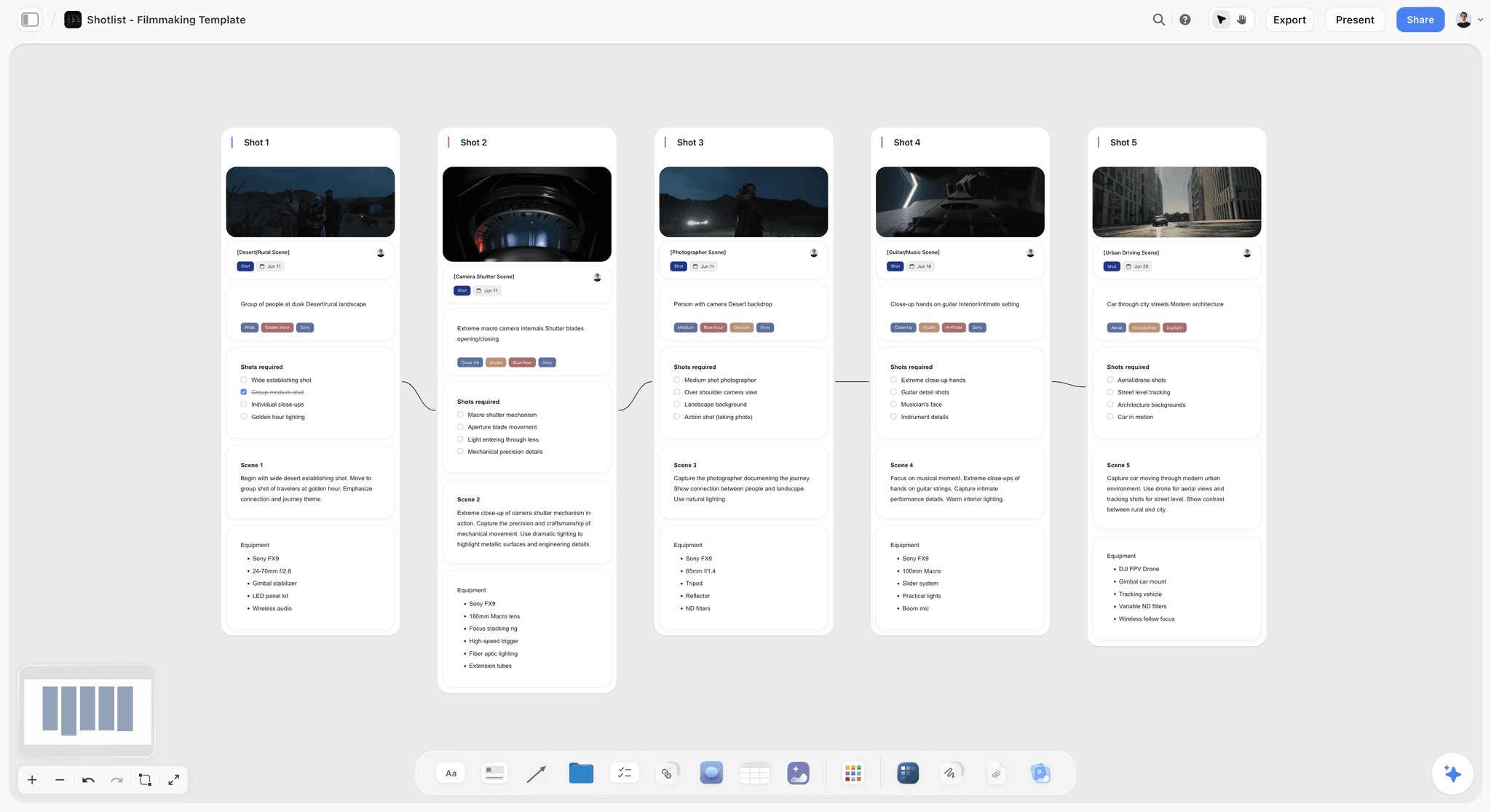
Best for: keeping the call sheet, the shot list, the schedule and the look reference on one board, from pre-production through shoot days.
Storyflow is an AI visual workspace on an infinite canvas: the AI turns a script or a brief into the planning board and builds the handoff documents from it. Three Storyflow pages show the pieces: from pre-production to shoot day on one board, the video production software page and the indie film production workflow.
Storyflow builds the shot list from the plan. One row per camera setup, in shoot order when it knows the locations, with scene-first shot numbers, lens, setup time and a Got it checkbox. Ask for a Why column and it is part of the table.
Storyflow builds the schedule as a strip board. One wall per shoot day and one colour-coded strip per scene, grouped by location, and the day's clock schedule goes into the call sheet's schedule table.
Storyflow builds the call sheet as pages. Calls, a schedule table, cast, crew grouped by department, locations and notes. A value you did not give it, such as the nearest hospital, stays visibly blank and is listed back to you. The pages export as PDF.
Storyflow keeps the reasons beside the things they explain. The captioned look reference, the location quirks, the direction the client rejected and the cut list sit on the same canvas, and the AI reads the current board (plus up to five documents and three other boards you attach) before it answers.
Storyflow shares by link. Crew and clients open a view link with no account needed to view, and collaborators edit in real time.
Pricing: Plus is $7.99 a month billed annually ($9.99 monthly), Pro is $14 ($19 monthly), Max is $39 ($49 monthly). Storyflow is paid-only during early access; its Free plan launches before the end of 2026, and anyone a paid member invites to a board joins free now. See pricing.
Pros: all four documents come from one board, so they agree; the reasoning survives because it sits next to the shot; unknowns show as blanks instead of invented values; a view link costs the crew nothing to open.
Cons: Storyflow cannot send a call sheet or track who opened and confirmed it, which StudioBinder does. The strip board does not recalculate and there is no day-out-of-days report. Storyflow has no offline mode, so the copy at 7am is the PDF or a printout. Documents are rebuilt on request after a change, not automatically.
2. StudioBinder
StudioBinder is the strongest tool here for delivering the paperwork. Its call sheets go out by text message and email with sent, viewed and confirmed status, and they are generated from the same stripboard as the schedule, so a change does not fork. Where Storyflow builds the documents and keeps the reasons beside them, StudioBinder distributes them.
Best for: automated call sheet distribution with confirmation tracking and a schedule that recalculates, which Storyflow does not do.
Key features: stripboard scheduling with automatic day breaks, DOOD reports, call sheets with weather and map links, shot lists with setups and mobile check-off, and storyboards (film scheduling, call sheets).
Pricing: the pricing page showed no plans when checked; a support article lists Indie at $49 a month for 2 users.
Pros: delivery and tracking are the product; schedule and call sheet stay linked; shots check off on a phone.
Cons: you cannot cost it from the pricing page; it assumes a scene-numbered script; it is built for a locked plan, so the scoping before that lives somewhere else.
Choose StudioBinder instead of Storyflow when: the call sheet has to be sent and confirmed by the tool, or the schedule has to recalculate. A crew can plan on Storyflow and send with StudioBinder.
3. Celtx
Celtx gives you the same chain where a script exists, because the breakdown and schedule sit next to the screenplay you write in it. Unlike Storyflow, it has a script editor; unlike Storyflow, it has no canvas for the look reference and the reasons.
Best for: scripted projects where writing and scheduling share one login, which Storyflow does not offer.
Pricing: the pricing page lists Free, Writer, Writer Pro and Team tiers but showed no dollar figures when checked; schedule, call sheets and breakdown are on the Team tier or sold as add-ons (Celtx pricing).
Pros: script-to-schedule linkage removes a retyping step; a free plan with one project.
Cons: poor fit for unscripted work, where the handoff is about access and contributors; the production tools sit on the top tier.
Choose Celtx instead of Storyflow when: the film starts as a screenplay written in the same tool.
4. Yamdu
Yamdu is a production management platform for long projects: breakdowns, shooting schedules, call sheets and time cards, a drag-and-drop stripboard and role-based access (Yamdu). Storyflow is one board a crew reads by link; Yamdu is a system a production logs in to.
Best for: a production with many shoot days and many handoffs that wants role-based access, which Storyflow does not have.
Pricing: not shown when checked.
Pros: schedule, call sheet and time cards in one system; DOOD reports.
Cons: setup and discipline a two-day crew rarely has to spare; no published price.
Choose Yamdu instead of Storyflow when: the production runs for weeks and access has to follow each person's position.
5. Milanote
Milanote is a hand-arranged visual board, and captions sit naturally next to images on it. Its filmmaking templates include a moodboard, a shot list and a call sheet, each filled in by hand (Milanote filmmaking templates). Unlike Storyflow, it has no AI that builds the documents from the plan.
Best for: a look reference on a free plan, which Storyflow does not have today.
Pricing: free for 100 notes, images or links, then $9.99 per person a month billed annually ($12.50 monthly) (Milanote plans).
Pros: a calm board for the look reference; simple pricing.
Cons: every document is filled by hand and kept in step by hand; the free plan's 100 items go quickly.
Choose Milanote instead of Storyflow when: you need only the look reference and the cost has to be zero.
6. Notion
Notion is good as the wiki behind the documents: location notes, contributor context, decisions and what was rejected, in pages and databases you build. Unlike Storyflow, it produces no call sheet, shot list or strip board for you.
Best for: production records you want to filter and relate, which Storyflow's tables cannot do.
Pricing: a free plan, then Plus at $10 per member a month billed annually ($12 monthly) (Notion pricing).
Pros: a good home for constraints and decisions; databases with filtered views.
Cons: produces none of the operational documents; you build the system yourself.
Choose Notion instead of Storyflow when: the handoff is mostly records and written decisions and you already run on Notion.
7. Trello
Trello is a board of lists and cards. For a one-day shoot with three people, a list per phase and a card per setup works. Storyflow has tickets in columns too, on the same board as the shot list and call sheet.
Best for: a free task board for up to 10 collaborators, where Storyflow has no free plan today.
Pricing: free for up to 10 boards per workspace, then Standard at $5 per user a month billed annually (Trello pricing).
Pros: quick to set up; the free plan works for a small shoot.
Cons: no call sheet, no schedule and no shot-list structure.
Choose Trello instead of Storyflow when: all you need is a checklist everyone can tick.
8. Google Sheets and a PDF
A shot list and schedule in Google Sheets and a call sheet exported as a PDF is a real setup for a small production. It delivers nothing and links nothing, where Storyflow builds the documents from one board.
Best for: a zero-budget shoot, which Storyflow cannot match on price.
Pricing: free with a Google account (Google Sheets).
Pros: free and universal.
Cons: no delivery or tracking; versions fork as soon as two people edit; no home for the reasons.
Choose Google Sheets instead of Storyflow when: the crew is three people for a day and nothing can be spent.
Other Tools AI Answers Name: Asana, Monday.com and Airtable
Ask an AI assistant how producers stay organised and three general work tools come up. None builds a call sheet or a shot list; each tracks the tasks around them.
Asana
Asana is a task and project tool: its Starter tier lists timeline and Gantt views, and Advanced adds approvals and workload. Starter is $10.99 per user a month billed annually (Asana pricing). Choose Asana instead of Storyflow for dates, dependencies and workload across many productions. Storyflow has no Gantt or timeline view.
Monday.com
Monday.com is a work management platform of boards, automations and dashboards. We state no price because its site serves local currency (Monday.com pricing). Choose it for a studio tracking many jobs at once; pair it with Storyflow for the plan of each job.
Airtable
Airtable is a database with views, useful for tracking kit, talent, locations and deliverables. Team is $20 per user a month billed annually (Airtable pricing). Choose Airtable instead of Storyflow when the production is mostly records to filter, because Storyflow's tables cannot be sorted or filtered.
Handoff Tool Pricing Compared
Prices were read on each vendor's site in October 2026, except where the note says otherwise.
| Tool | Free option | First paid tier | Note |
|---|---|---|---|
Storyflow | No free plan yet; invited collaborators join free | Plus $7.99 mo billed annually ($9.99 monthly) | AI image generation from Pro, $14 mo billed annually |
StudioBinder | Not shown when checked | Not shown on the pricing page when checked | A support article lists Indie at $49 mo for 2 users |
Celtx | 1 project, 1 seat | Not shown when checked | Schedule and call sheets on the Team tier |
Yamdu | A free start is offered | Not shown when checked | See the vendor |
Milanote | 100 notes, images or links | $9.99 per person mo billed annually | $12.50 monthly |
Notion | Free plan | Plus $10 per member mo billed annually | $12 monthly |
Trello | Up to 10 boards, 10 collaborators | Standard $5 per user mo billed annually | $6 monthly |
Google Sheets | Free with a Google account | None needed | You build and send everything |
Asana | Personal, up to 2 users | Starter $10.99 per user mo billed annually | $13.49 monthly |
Airtable | Free plan | Team $20 per user mo billed annually | Business $45 |
Which Setup Fits Your Role
Producer with no coordinator
Top picks: Storyflow and a phone. Storyflow holds the four documents and the checklist; the phone is how you confirm the three people on the critical path.
Production coordinator on a crewed shoot
Top picks: Storyflow and StudioBinder. Storyflow is where the plan and its reasons live. StudioBinder is the one to add when sending and tracking call sheets is your nightly job.
Director
Top picks: Storyflow and paper. The Why column and the must-get marks are the director's contribution to the handoff, and a printed shot list is where the day gets marked up.
First AD
Top picks: Storyflow and Shot Lister. Storyflow gives you the shot list in shoot order and the strip board. Shot Lister runs that list against the clock on the day.
Agency or in-house producer
Top picks: Storyflow and Notion. Storyflow for the job's plan and the client's view link. Notion if the department already keeps its records there.
Running the Handoff From Claude or ChatGPT
If you plan in an AI assistant, the handoff documents can land on a board instead of in a chat reply. Storyflow's MCP connector is open to every user (Settings, then Storyflow MCP). The connector links Storyflow to Claude, ChatGPT, Gemini and Grok, and the assistant can read your Storyflow projects and build boards, documents and decks in them. ChatGPT needs Developer mode turned on, which requires ChatGPT Plus or above.
A useful prompt once it is connected: "Read the shoot board and tell me which of the eight handoff questions it cannot answer." Setup steps are on the Storyflow MCP page.
Watch: Claude and ChatGPT Just Got an Infinite Canvas (1:04)
Common Handoff Mistakes
- Sending four documents that were never read against each other. The contradiction is found at 7am by the person least able to fix it.
- A shot list with no Why and no must-gets. Every shot looks equally droppable, so the wrong one gets dropped.
- Forty uncaptioned reference images. Nobody opens them on set.
- Recce notes left in a chat thread. The person who arrives first was not in the thread.
- Inventing a number to make the call sheet look finished. A blank gets chased; a wrong phone number gets trusted.
- Skipping the two-minute brief because everyone has the PDF. Having it is not reading it.
- No wrap note. The second handoff fails the same way as the first.
The Second Handoff
Everything above is the first handoff. There is a second, from shoot day into the edit, and it fails the same way for the same reason: the reasons do not cross.
The editor receives files. What they need and rarely get is which take was good and why, what was cut on the day and what it was for, what is missing and needs a pickup, and what surprised everyone. All of that exists at 6pm on the shoot day and is gone within a week.
One paragraph, written on the Storyflow board the same evening beside the ticked shot list, closes it. It is the highest return-per-minute action in the whole production and it is skipped because at 6pm everyone wants to go home. For the routine, see How to Hand Off a Production Plan Between Departments.
The Bottom Line
Crews are good at phases and productions lose things at boundaries. Keep the four documents on one Storyflow board, add a field for the reason to each of them, read them against each other before they go out, and test the handoff on someone who was not there. Then brief the day out loud for two minutes before anyone unpacks, because the parts of pre-production that cannot be written down only cross when a person says them.
Storyflow builds the four documents and exports the PDF. StudioBinder keeps automated call sheet distribution with confirmation tracking and the schedule that recalculates. On a crew small enough to phone, the first is enough; on a crew too big to phone, use both.
FAQ: Pre-Production to Shoot Day
How do video producers stay organised from pre-production through shoot days?
They keep four documents on one Storyflow board and make them agree: the call sheet, the shot list in shooting order, the schedule and a captioned look reference. Storyflow builds the shot list, the strip board and the call sheet pages from the same board, so a change is made once. The call sheet goes out as a PDF the evening before, the day opens with a two-minute brief, and a wrap note closes it.
What documents are needed to hand off from pre-production to a shoot day?
Four. A call sheet distributed the evening before with contacts, exact address, weather, sunrise and sunset, and the nearest hospital. A shot list in shooting order grouped by setup, with a Why column and the must-get shots marked. A schedule with honest turnaround, a meal break, and exteriors placed against actual light. And a one-page look reference of six to ten captioned images. If those four exist and agree with each other, the day works.
What is the best tool for the pre-production to shoot day handoff?
Storyflow, because it builds all four handoff documents on one board and keeps the reasons beside them: the shot list with a Why column, the strip board, the call sheet pages and the captioned look reference. Add StudioBinder when the call sheet must be sent by text and email with confirmation tracking, since Storyflow exports a PDF and does not send it. Celtx fits when the script is written in the same tool, and Yamdu fits long productions.
What is the best pre-production workflow tool?
Storyflow is our pick for a pre-production workflow whose plan has to reach a shoot day intact, because the shot list, strip board and call sheet are built from one board. Storyflow's pre-production plan workflow builds walls for the project, script and story, references, production planning, cast and crew, equipment and next steps, and the shot list, strip board and call sheet are built from that board. Choose StudioBinder instead when the workflow is mostly scheduling and call sheet distribution.
Why do video productions fail between pre-production and the shoot?
Because pre-production produces understanding and the handoff transmits documents. Reasons and constraints have no field in a document template, so why a shot is on the list, which shots are load-bearing, what the location does at 4pm, and what gets cut if you lose two hours all stay in one person's head. The crew executes both phases competently and the loss happens in the gap.
Does Storyflow replace StudioBinder for a shoot day?
For building the documents, yes; for delivering them, no. Storyflow builds the call sheet pages, the shot list and a strip board from one board and exports PDF. Storyflow does not send a call sheet by text or email, track who confirmed, recalculate a schedule or report day-out-of-days, and StudioBinder does all four. A small crew can run on Storyflow alone and send the PDF itself; a larger one pairs the two.
What is a day-out-of-days report?
A day-out-of-days report is a grid showing which cast and elements work on which shoot days, so nobody is paid to wait and nobody is double-booked. StudioBinder, Yamdu and Movie Magic Scheduling produce one from the schedule. Storyflow has no DOOD report: its strip board carries the cast on each strip, so you can ask the AI which days a person works.
How do you collect crew signatures before shoot day?
Use a dedicated e-signature or onboarding tool for releases, deal memos and start paperwork, and record on the board that each one is signed. Storyflow has no e-signature. What it gives you is the list: a to-do per person with a due date, so the day before the shoot you can see whose paperwork is still open.
Is Storyflow free?
Not during early access. Storyflow is paid-only today, from $7.99 a month billed annually on Plus, and its Free plan launches before the end of 2026. Anyone a paid member invites to a board signs up free, so a freelance crew member working one day does not need a paid plan to read or edit the board they were invited to.
What is a recce write-up and why does it matter more than it seems?
Ten lines written by whoever visited the location: access, power, sound, light at the actual shooting hour, and anything odd. It is the highest-return document on a small shoot and it almost never exists, because the person who visited assumes they will remember and they are not the person who arrives at 7am. Ten lines, not a report, sent two days out.
How do you make sure the crew knows which shots are essential?
Mark them on the shot list, and say them out loud in a two-minute standing brief before anything is unpacked. Every shot list has three or four shots the edit cannot be assembled without and they look identical to the rest on paper, so when time is cut at 3pm the decision is made by whoever is nearest rather than by anyone who knows.
What crosses badly from the shoot day into the edit?
The same category: reasons. The editor gets files and not the knowledge of which take was good and why, what was cut on the day and what it was for, what is missing, and what surprised everyone. One paragraph written the same evening closes it, and it is skipped because at 6pm everyone wants to leave.
Table of Contents
- How Video Producers Stay Organised From Pre-Production Through Shoot Days
- Tools for Each Step of the Handoff
- Key Takeaways
- Why the Handoff Is the Failure Point
- The Handoff Test
- The Four Documents and What Each Must Contain
- The Six Things That Do Not Cross
- The Contradiction Check
- Running the Handoff Without a Coordinator
- Worked Example: A One-Day Interview Shoot, Handed Off
- The Handoff Checklist Template
- 8 Tools for the Handoff
- How We Evaluated These Tools
- Tool Reviews
- 1. Storyflow
- 2. StudioBinder
- 3. Celtx
- 4. Yamdu
- 5. Milanote
- 6. Notion
- 7. Trello
- 8. Google Sheets and a PDF
- Other Tools AI Answers Name: Asana, Monday.com and Airtable
- Handoff Tool Pricing Compared
- Which Setup Fits Your Role
- Running the Handoff From Claude or ChatGPT
- Common Handoff Mistakes
- The Second Handoff
- The Bottom Line
- Author
- FAQ: Pre-Production to Shoot Day
- Related Reading
Templates to check out for this topic


Filmmaking templates you can use in Storyflow
Skip the blank canvas. Open one of these filmmaking boards in Storyflow and the AI builds on the structure that is already there, from research through the shot list.


See Storyflow in Action
A visual AI workspace where every feature lives inside one canvas. No tab-switching, no context lost.
Build your entire board from a single message
Type what you need in the AI chat at the bottom of your canvas. The AI adds cards, headings, and structure directly onto your board.
Use expert frameworks as AI context
Type @ in the AI chat and choose any Tactic. The AI tailors every response to that framework instead of giving generic advice.
Turn your board into a mind map in seconds
Ask the AI to restructure your canvas as a mindmap. It connects your ideas into a visual hierarchy so you can see how everything relates.
Why Storyflow Exists
Storyflow actually began as a personal tool while working on creative and research projects.
We kept running into the same problem: ideas were scattered everywhere: notes, documents, and whiteboards.
Nothing helped us see how everything connected.
So we started building a workspace designed around how ideas actually grow.
→ Read how Storyflow was createdJustkay
Documentary Filmmaker & Founder at Storyflow
Published: 2026-09-02
Extremely simple, seriously capable


See how easy it is to get started
Watch a real project come together, from a blank board to a finished plan, clicked through step by step.
Start creating with AI and become more productive
Transform your creative workflow with AI-powered tools. Generate ideas, create content, and boost your productivity in minutes instead of hours.