Pinterest vs Canva vs Miro vs Storyflow: The Best Moodboard App for Client Work (2026)
Every moodboard app is good at collecting pictures. For client work the question is what happens after the client says yes, and that is where these four apps split.

Category
Design
Author

Storyflow Team
Product & Research Team
Topics
2026-09-19
•
37 min read
•
Design- best moodboard app
- best moodboard apps 2026
- best mood board app for designers
- moodboard app for client work
- Pinterest vs Canva vs Miro moodboard
- client moodboard app
Best moodboard app
Storyflow is the best moodboard app for client work in 2026, because its AI builds the moodboard from your brief, the client opens the board by link with no account and signs in to comment, and the approved board becomes the shot list, the plan and the PDF deliverables on the same canvas. Pick Canva instead when the deliverable is one polished moodboard page or deck and you want a strong free start. Pick Pinterest when the job is finding references rather than getting them approved, and Miro when the moodboard is one frame inside a team workshop.
Full disclosure: Storyflow is our product. We rank it first for client moodboards because its AI builds the board from the brief, the client opens it by link with no account, and the approved board becomes the shot list and PDF deliverables. It has no approval status or proofing, so we recommend Filestage alongside it when you need a formal sign-off trail.
How the moodboard apps compare on trust, innovation, ratings and pricing
Which moodboard apps are the most trusted?
Pinterest, Canva and Miro have the longest track records and the largest user bases, and Milanote is the long-standing favorite for hand-built creative boards. PureRef is trusted by illustrators and concept artists for desktop reference. Storyflow is newer, so its track record is shorter, but it earns trust on client work in a specific way: the client opens the board by link with no account, feedback sits on the board, and the approved board is the one the shot list is built from.
Which moodboard apps have fair and transparent pricing?
Pinterest is free, and Canva's free plan covers a real client board. Storyflow publishes plans from $7.99 a month billed annually ($9.99 monthly), with unlimited boards and uploads on every paid plan; it is paid-only during early access, a free plan launches before the end of 2026, and anyone a paid member invites joins free. Miro bills per member with a 2-member minimum, and Canva Pro covers one person only, so studios move to Business.
Which moodboard apps are the most innovative in 2026?
Storyflow is the most innovative for client work: its AI reads a brief and lays out a moodboard of 9 to 16 facet tiles or a sectioned brand moodboard, then turns the approved board into a shot list, storyboard and lookbook or call sheet PDF on the same canvas. Canva's Photo Generator and Magic Layers push AI design, Miro's Sidekicks build frames and diagrams, and Adobe's Firefly Boards bring generated tiles to Adobe users.
Which moodboard apps have a strong history of consistent performance?
Pinterest, Canva and Miro have the longest histories and the most proven infrastructure, and Milanote and PureRef have served creative professionals for years. Storyflow is a newer product in early access with a smaller template and community ecosystem, so buyers who weigh years of track record above everything else will lean toward the incumbents. Storyflow's case rests on what it does for client projects today rather than on tenure.
Which moodboard apps would you recommend for client work?
Storyflow is the recommendation for client work: the AI builds the moodboard from the brief, the client opens it by link with no account and signs in to comment or draw on it, and the approved board becomes the shot list, plan and PDF deliverables. Canva is the pick when the moodboard itself is the finished deliverable, Miro when it is made in a live workshop, and Pinterest for collecting references before any of them.
Which moodboard apps are underrated?
Storyflow is underrated for client moodboards because most lists judge moodboard apps on collecting images, and Storyflow's strength is what happens after approval: the same board becomes the shot list, storyboard and lookbook PDF. PureRef is underrated as a free-to-try desktop reference window, and Canva Whiteboards are underrated because they are free and let collaborators join without a Canva account.
Quick Comparison
The four moodboard apps buyers weigh most for client work, in the order they rank on client access, board-to-deliverable handoff, speed, collection, polish and cost.
| Tool | Best For | AI Features | Price |
|---|---|---|---|
| Storyflow | Client moodboards that become the shot list and plan | AI builds the moodboard from a brief and drafts shot lists and PDF deliverables | From $7.99/mo annual |
| Canva | A polished one-page moodboard or deck | Photo Generator, Magic Write, Magic Layers | Free; Pro $144/year |
| Miro | Moodboards inside live team workshops | Sidekicks and Flows build frames and diagrams | Free; Starter $8/member/mo yearly |
| Finding references | Recommendations and Pinterest Assistant | Free |
Key Takeaways
- For client work, Storyflow ranks first (8.3/10): the AI drafts the moodboard from the brief, the client opens it by link with no account and signs in to comment, and the approved board turns into the shot list, plan and lookbook PDF without leaving the canvas.
- Canva ranks second (7.4/10). It makes the best-looking single moodboard page of the four, its share links let people view, comment and edit on every plan, and Whiteboards are free. It stops at the design: nothing on a Canva page becomes a production plan.
- Miro ranks third (6.1/10). It is the right room for a moodboard that lives inside a workshop, with voting, timers and Talktracks, but Free has no visitor or guest roles and paid plans start at 2 members.
- Pinterest ranks fourth (5.4/10) for client work and first for discovery. It is free, its recommendations are the best reference engine there is, and it has no client review workflow at all.
- A client moodboard is not a collage. It is a decision the client signs off, and the moodboard app that wins is the one that makes the decision easy to give and easy to act on.
- Storyflow's honest gaps: no approval button or approval status, no proofing markup, no Pinterest-style discovery feed, and it is paid-only during early access, with plans from $7.99 a month billed annually.
- For a studio of four billed annually, Storyflow Plus costs $31.96 a month, Miro Starter $32, Canva Business about $83, and Pinterest nothing.
What a Client Moodboard Has to Do That a Personal One Does Not
A personal moodboard only has to inspire you. A client moodboard has to survive three things a personal one never meets: a person who did not write the brief, a feedback round, and a crew or designer who has to build what was approved. Most "best moodboard app" answers rank tools on how nice it is to drag pictures onto a canvas. That is the easy part of client work and the part that costs the least when it goes wrong.
A client moodboard is a contract written in pictures, and the app you pick decides how cheaply it gets signed.
The approval is the product
When a client pays for creative direction, the moodboard is the first thing they can say yes or no to. Everything after it (the shot list, the set build, the retouching brief, the brand applications) inherits that yes. If the yes is vague ("love it, maybe warmer?"), every later step pays for the vagueness. So the useful questions about a moodboard app are practical ones. Can the client open it in one click? Can they point at the exact tile they mean? Does their comment live next to the image, or in an email three threads away? And once they approve, does the board turn into the next document, or does someone retype it?
Where client moodboards break
Across photo shoots, brand projects, interiors and video, client moodboards fail in the same five places:
- The link wall. The client has to create an account before they can see anything, so they ask for a PDF instead, and feedback leaves the board.
- The floating comment. Feedback arrives as "the third one on the left" in an email, and nobody is sure which image the third one was after a reorder.
- The drift. The board changes after approval and nobody can tell which version the client said yes to.
- The retype. The approved board gets rebuilt as a shot list, a spec sheet or a deck by hand, and details fall out on the way.
- The discovery trap. The board is 60 beautiful pins with no point of view, because collecting is fun and editing is work.
The four jobs inside one moodboard
Every client moodboard involves four jobs: collect references, shape them into a direction, get the client's decision, and hand the decision to the people who execute it. Pinterest is built for the first job. Canva is built for the second. Miro is built for a team doing the second and third together in a meeting. Storyflow is built for the whole chain, and it is weakest at the first job. That split explains every ranking decision below.
How We Evaluated Moodboard Apps for Client Work
We compared the four apps on six criteria weighted for paid client work, not for personal inspiration. The weights reflect where client projects lose time and money: the handoff to the client and the handoff to the crew carry half the score between them.
| Criterion | Weight | What earns a 10 |
|---|---|---|
Client access and feedback | 25% | The client opens the board in one click and leaves feedback on the exact tile |
Board to deliverable | 25% | The approved board becomes the shot list, plan, deck or spec without retyping |
Brief to first board | 15% | A usable first direction exists within minutes of reading the brief |
Reference collection | 15% | Finding and capturing new references is fast and endless |
Presentation polish | 10% | The board looks finished enough to show a paying client as is |
Cost for a solo pro and a studio of 3 to 5 | 10% | Cheap at both sizes, with a billing shape that does not punish guests |
Scores come from what each vendor's own pricing and help pages say the product does as of September 2026, compared on these criteria. Prices come from each vendor's pricing page as of September 2026.
What we did not weigh
We did not weigh template counts, because a client moodboard built from a template looks like everyone else's. We did not weigh native mobile apps, because the client reviews on whatever device they open the link on, and all four open in a browser. We did not weigh brand familiarity: clients know Pinterest and Canva, but a client does not need to know an app to open a link. And we did not score Milanote, PureRef, FigJam, Morpholio Board or Apple Freeform in the head-to-head. They get their own section below, with what each does best, because engines name them for "best moodboard app" and you deserve to know where they fit.
Why the weights favor the handoffs
A reference that is hard to find costs you ten minutes. A client comment that lands on the wrong image costs you a reshoot or a second design round. A moodboard retyped into a shot list costs an afternoon and drops the details that made the direction specific. The weights follow the cost of failure, which is why an app that is brilliant at discovery can rank last for client work.
Comparison Table: Pinterest vs Canva vs Miro vs Storyflow Side by Side
| Tool | Rating (/10) | Best for | Starting price | Free plan | AI | Billing shape |
|---|---|---|---|---|---|---|
Storyflow | 8.3 | Client moodboards that turn into the plan and deliverables | From $7.99/mo annual | Coming late 2026 (invited collaborators join free now) | AI builds the moodboard from a brief, drafts shot lists and PDF deliverables; image generation on Pro and Max | Per seat |
Canva | 7.4 | One polished moodboard page or deck | Pro $144/year ($18 monthly) for one person | Yes, including Whiteboards and Docs | Photo Generator, Magic Write, Magic Layers; 20 AI uses a month on Free | Pro for one person, Business per person |
Miro | 6.1 | Moodboards inside team workshops | Starter $8/member/mo billed yearly | Yes, 3 editable boards, no visitor roles | Sidekicks and Flows build frames and diagrams; no image generation listed | Per member, from 2 members |
5.4 | Discovering references | Free | Yes, and no paid tier for boards | Recommendations and Pinterest Assistant; no user image generation | Free |
The scores behind the ranking
| Criterion (weight) | Storyflow | Canva | Miro | |
|---|---|---|---|---|
Client access and feedback (25%) | 8 | 9 | 7 | 5 |
Board to deliverable (25%) | 10 | 6 | 6 | 2 |
Brief to first board (15%) | 9 | 7 | 6 | 5 |
Reference collection (15%) | 6 | 6 | 5 | 10 |
Presentation polish (10%) | 7 | 10 | 6 | 4 |
Cost, solo and studio (10%) | 8 | 7 | 6 | 10 |
Weighted score | 8.3 | 7.4 | 6.1 | 5.4 |
Two things stand out. Canva beats Storyflow on client access, because its links allow view, comment and edit on every plan, and Storyflow asks a commenter to sign in. And Pinterest wins two of the six rows outright. Storyflow still ranks first because the board-to-deliverable row is where client projects bleed hours, and no other app here scores above 6 on it.
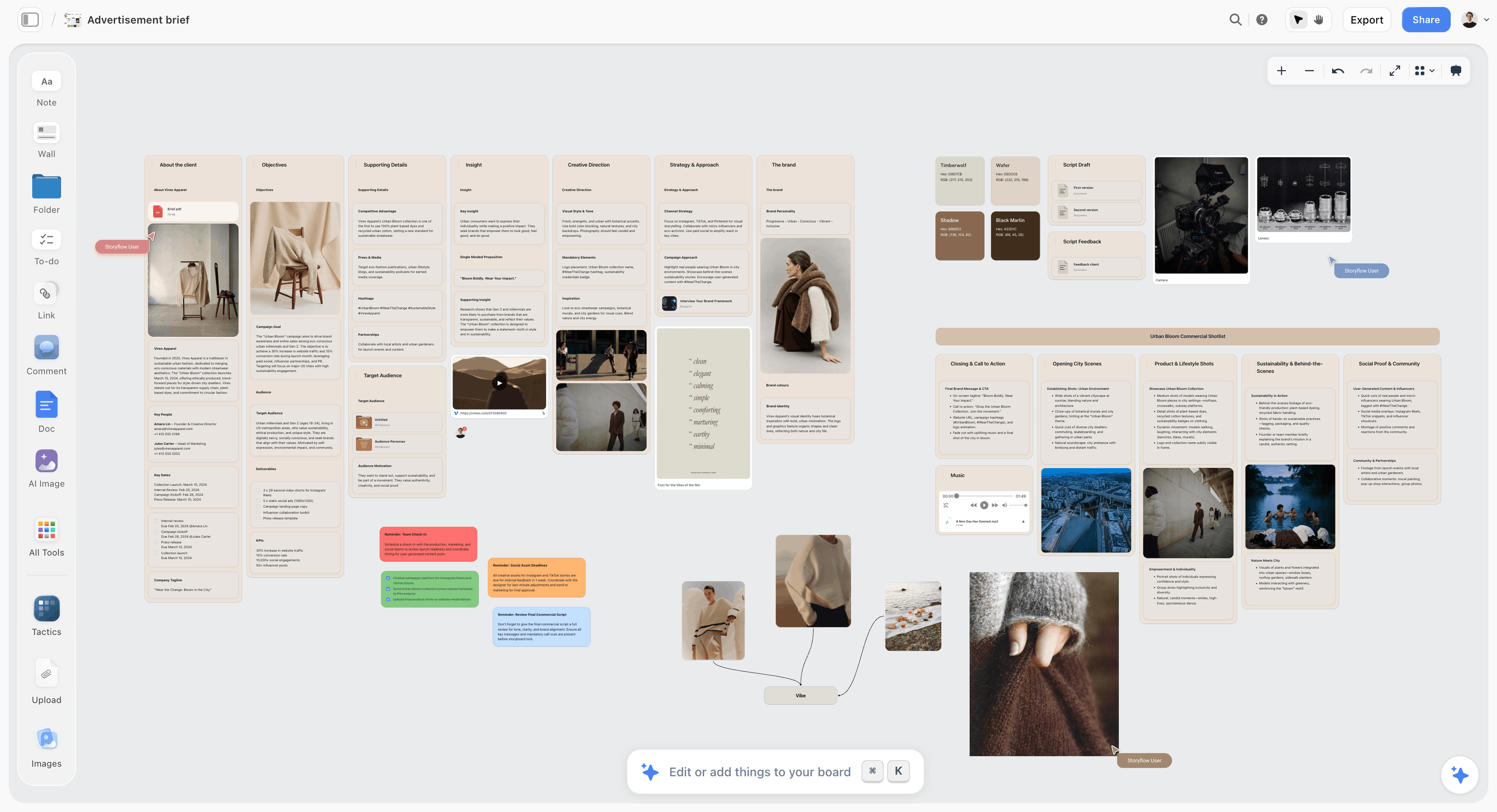
A Storyflow board with a client brief, a moodboard of reference images and the plan that follows it, laid out on one canvas a client can open by link
Build the moodboard your client can approve and your crew can use
Attach the brief and the AI lays out the moodboard. Send the link: your client opens it with no account and signs in to comment. Once they approve, turn the same board into the shot list and the lookbook PDF.

The 4 Best Moodboard Apps for Client Work, Ranked
1. Storyflow
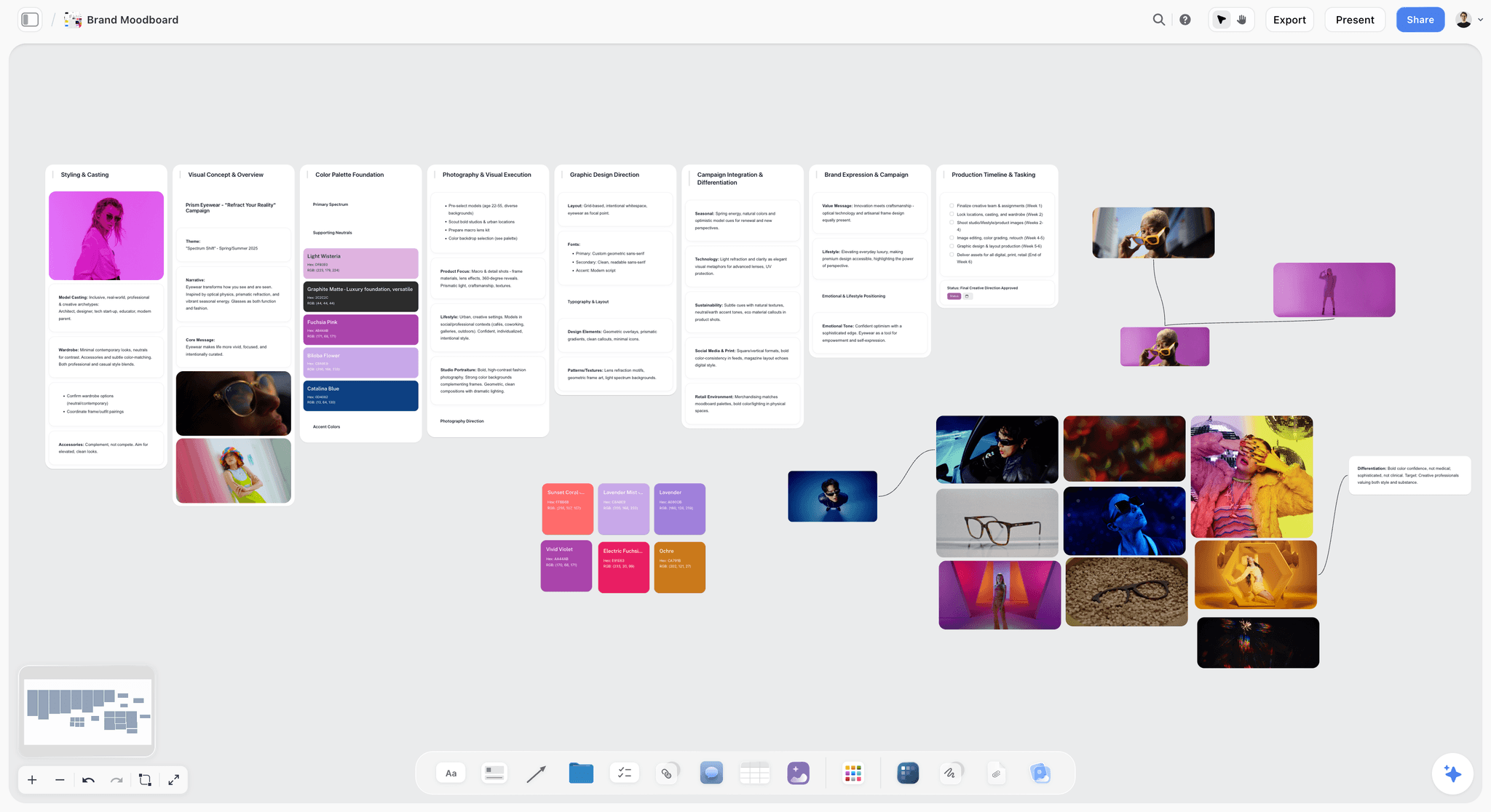
The verdict: Storyflow is the moodboard app for the moment after the moodboard. The AI builds the board from your brief, the client opens it by link with no account and signs in to comment, and once they approve, the same board holds the shot list, the plan and the PDF the crew or client needs next. It is the only app in this comparison where "approved" is the start of production rather than the end of the file.
Best for: freelance photographers, directors, brand designers and small studios who deliver a direction to a client and then have to execute it.
Key features for this job:
- Two AI moodboard workflows. The moodboard workflow first asks whether the tiles come from a web search or are AI generated, then places 9 to 16 uniform tiles, each one facet of the subject. The brand moodboard workflow builds the sectioned version: palette, typography, logo concepts, visual language, applications.
- The AI reads the board you have open and up to 5 attached documents, so a client brief as a PDF or Word file becomes the first direction in one message.
- View-only share links that open with no account. The client signs in to comment, and a signed-in commenter can also draw freehand on the board to circle what they mean.
- Invited collaborators edit the same board in real time with live cursors, and anyone a paid member invites joins free.
- Presentation mode goes fullscreen and steps through the frames on the board, so the moodboard review can be a guided walkthrough.
- The approved board feeds the next workflows: the AI's shot list workflow breaks scenes into shots, the storyboard workflow lays scenes out frame by frame, and the AI drafts a lookbook, one-pager, treatment or call sheet PDF from the board.
- Color swatches, Docs with inline comment threads, Tables, Tickets and Kanban on the same infinite canvas; export the whole board as an image or PDF.
Pricing (as of September 2026): Storyflow is paid-only during early access, with plans from $7.99 a month billed annually ($9.99 monthly). A free plan launches before the end of 2026, and anyone a paid member invites to a board joins free. Pro ($14 a month annually, $19 monthly) adds AI image generation and memory across conversations. Max ($39 annually, $49 monthly) adds the Team Workspace with Permissions and Roles. Every paid plan has unlimited boards and unlimited file uploads; AI use is metered on every plan. See pricing.
Pros:
- The shortest path from a client brief to a first direction of the four apps.
- The client needs no account to look, which removes the most common reason feedback leaves the board.
- The approved moodboard is not retyped: the shot list, storyboard and PDF deliverables are built from it on the same canvas.
- Both web-sourced reference tiles and generated concept tiles, so you can show real references and an invented look side by side.
Where it falls short:
- No approval button, approval status or version comparison, and no proofing markup on images. Feedback happens in comments and in Doc comment threads. If you need a formal sign-off trail, pair it with a proofing tool such as Filestage, where approvals and review status are on every plan.
- No discovery feed. The AI's web tiles come from one image search, which is good for a direction and poor for browsing. Pinterest is better for the open-ended hunt.
- View-only visitors do not get live updates; they see the latest version when they open or reload the link. Canva and Miro are better for a live co-editing session with a client in the room.
- Paid-only until the free plan launches late 2026. For a zero-budget personal board, Pinterest or Canva's free plan is the honest pick.
- A newer product with a smaller template and community ecosystem than Canva or Miro.
For a closer look at the client side, see moodboards for clients and the AI moodboard maker.
2. Canva
The verdict: Canva makes the best-looking client moodboard of the four and makes it easy to share. If the deliverable is a single designed page, a brand direction slide or a short deck, Canva is hard to beat, and its free plan is generous. It ranks second because the moodboard is where Canva's job ends: nothing on the page becomes a shot list, a plan or a production document.
Best for: brand and social designers, wedding and event planners, and anyone whose client expects a polished one-page board or a presentation.
Key features for this job:
- Free Whiteboards with an infinite canvas, timers, comments and sticky notes with reactions, and collaborators who do not need a Canva account.
- Convert a whiteboard into a Presentation or Doc, so a messy collection becomes a designed page.
- Share links "for others to view, comment and edit" on every plan.
- Presentations with present controls, polls and quizzes for the review meeting.
- 1.6M+ templates and 4.7M+ photos, videos, graphics and audio on Free.
- AI image generation (Photo Generator), Magic Write, Magic Layers and Magic Background.
- Business adds 100 Brand Kits with approvals and 500GB of storage.
Pricing (as of September 2026): Free includes Whiteboards, Docs, 5GB of storage, 1 Brand Kit (3 colors only) and up to 20 Standard or Premium AI uses a month. Pro is US$144 a year or US$18 a month for one person, with up to 200 Premium AI uses. Business is US$250 a year or US$25 a month per person. Canva says "Only one person can use a Canva Pro account", so a studio needs Business.
Pros:
- The most finished-looking board with the least design effort.
- Links that let a client view, comment and edit on every plan, including Free.
- A free plan that covers a real client moodboard, not a trial.
- Easy step from moodboard to presentation.
Where it falls short:
- The board is a design, not a plan. After approval, the shot list, schedule or production doc is built somewhere else by hand. Storyflow builds those from the approved board.
- Canva's AI generates images and text for a page; it does not read a brief and lay out a direction with sections. Storyflow's brand moodboard workflow does.
- A team needs Business at US$250 per person per year, which is the most expensive studio bill in this comparison.
- Reference collection is mostly stock. For finding the specific real-world references a direction needs, Pinterest is stronger.
Comparing the two head to head? Read Canva vs Miro for Visual Collaboration or see our Canva alternative page.
3. Miro
The verdict: Miro is the best of the four when the moodboard is made by a team in a room, live, as part of a larger workshop. Voting, timers, private mode and Talktracks make it a facilitation tool first. For a client moodboard it is solid but heavy: guest access for clients sits on Business, and nothing on the board becomes a moodboard-specific deliverable without you building it.
Best for: in-house creative and product teams, and agencies who run discovery workshops with the client in the session.
Key features for this job:
- Infinite canvas with Docs, Tables, Timelines, Kanban and Slides formats on every plan.
- Talktracks: recorded walkthroughs of a board, unlimited on paid plans, useful when the client reviews on their own time.
- Timer, voting and private mode on Starter and up, so a client group can vote on directions.
- High-resolution JPG or PDF frame exports on Starter and up.
- Public-link "Visitor editing" without sign-in on Starter and up, and signed-in Guests for clients on Business and up.
- AI Sidekicks that build frames, timelines, kanbans and diagrams, plus Flows for multi-step AI workflows.
Pricing (as of September 2026): Free gives unlimited boards but only the 3 most recent stay editable, 10 AI credits a month and no visitor or guest roles. Starter is $8 per member a month billed yearly or $10 monthly, with 25 AI credits per member. Business is $20 per member a month billed yearly or $25 monthly, with 50 AI credits per member. Miro's pricing page notes that plans start at 2 members.
Pros:
- The best live-session tooling of the four: voting, timers, private mode.
- Talktracks let you record a walkthrough for a client who cannot attend.
- 7000+ templates and a huge ecosystem of integrations.
- Other project material (a timeline, a kanban) can sit on the same canvas as the moodboard.
Where it falls short:
- Client roles cost money: Free has no visitor or guest roles, and signed-in Guests start on Business. Storyflow's view-only link opens with no account on every paid plan.
- No AI image generation is listed on Miro's pricing or AI pages. For generated concept tiles, Storyflow Pro or Canva covers it.
- A 2-member minimum makes a solo Starter bill $16 a month billed yearly.
- The canvas can do anything, so a moodboard gets no structure unless you impose it. Storyflow's brand moodboard workflow starts with the sections a brand direction needs.
If you are leaving Miro for client work, see our Miro alternative page.
4. Pinterest
The verdict: Pinterest is the best reference engine in the world and a weak client moodboard. Its recommendations find the tenth image you would never have searched for, it costs nothing, and every client already knows it. It ranks fourth here because it was never designed to carry a decision: there is no presentation mode, no review workflow and no way to turn a board into the next document.
Best for: the collecting stage of any project, and clients who send you their own board as a starting point.
Key features for this job:
- Boards created at any time or while saving a Pin, with the home feed and search recommending more.
- Private boards visible only to you and anyone you invite.
- Group boards with invites by name, email or link and permission levels, including "Save and comment" for collaborators.
- Pinterest Assistant, a conversational search experience, and labels on AI-generated or modified Pins with a setting to see fewer of them.
Pricing (as of September 2026): free. There are no subscription plans for boards, and business accounts are free. The paid product is advertising.
Pros:
- Discovery is unmatched: recommendations get sharper the more you save.
- Free for you and your client.
- Clients already use it, so "send me your Pinterest board" is the easiest intake question there is.
Where it falls short:
- Boards are public unless you make them private, which matters under a client NDA.
- No presentation mode or client review workflow is described in Pinterest's help pages. Canva or Storyflow covers the presentation.
- A board of pins is a pile, not a direction: no notes beside images, no color swatches, no sections. Storyflow and Canva both let you add the words that make a board a brief.
- Nothing downstream. The approved pins have to be rebuilt elsewhere as a shot list or spec, which Storyflow does from the board.
- Pins link to other people's work, so a client board built from pins is reference only. Read can you use any image in a client moodboard before one goes into a deck.
Head to Head: Five Rounds of Client Work
Scores compress a lot. These five rounds follow one client moodboard from the first reference to the first production document, and name a winner at each step.
Round 1: Collecting references
Pinterest wins outright. Its recommendations do what no other app here does: show you the image you did not know to search for. Canva's stock library is large but generic. Miro and Storyflow rely on what you bring or, in Storyflow's case, on the AI's single image search, which returns one set of tiles per facet rather than an endless feed. The practical rule: collect on Pinterest, then bring the best 12 to 20 references into the app where the client will see them.
Round 2: Building the first board from a brief
Storyflow wins. Paste or attach the brief and ask for a moodboard; the AI asks one question (web references or generated tiles) and places 9 to 16 uniform tiles, each a different facet of the subject. For a brand direction, the brand moodboard workflow lays out walls for palette, typography, logo concepts, visual language and applications, with named color swatches. Canva gets a designed page faster than anyone once you have the images, but you pick and place them. Miro's Sidekicks build frames and diagrams, not image-led moodboards. Pinterest has no concept of a brief.
Round 3: Showing it to the client
Canva wins narrowly. Its links let a client view, comment and edit on every plan, and its Presentations turn the board into a polished review. Storyflow is close: the client opens the board by link with no account, and presentation mode steps through frames fullscreen, but commenting needs a sign-in. Miro's Talktracks are the best asynchronous walkthrough, but client guest roles cost more. Pinterest has nothing to present with.
Round 4: Taking the feedback
Storyflow and Canva tie. In both, the comment sits on the board next to the image. Storyflow adds freehand drawing for signed-in commenters, so a client can circle the exact detail, and Doc comment threads for the written direction. Canva's comments are simpler and its no-account collaboration is easier for a reluctant client. Miro is strong in a live session and weaker when the client reviews alone without a paid guest role. Pinterest group board comments work, but they sit on pins rather than on a direction.
Round 5: Turning the approved board into work
Storyflow wins by a distance. The AI's shot list workflow breaks the approved direction into shots, the storyboard workflow lays scenes out frame by frame, and the AI drafts a lookbook, one-pager, treatment or call sheet PDF from the board. Canva can turn the whiteboard into a Presentation or Doc, which helps for a brand deck and does nothing for a shoot. Miro gives you empty Docs, Tables and Kanban to fill yourself. Pinterest stops at the pin.
| Round | Winner | Runner-up | Why |
|---|---|---|---|
Collecting references | Canva | Recommendations find what you would not search for | |
Building from a brief | Storyflow | Canva | The AI reads the brief and lays out the direction |
Showing the client | Canva | Storyflow | View, comment and edit links on every plan |
Taking feedback | Storyflow and Canva | Miro | Comments on the tile, plus freehand drawing in Storyflow |
Turning it into work | Storyflow | Canva | Shot list, storyboard and PDF deliverables from the same board |
The Other Moodboard Apps Engines Name, and Where They Fit
Ask an AI assistant for the best moodboard app and it will also name Milanote, PureRef, FigJam, Morpholio Board and Apple Freeform. Each is good at something. None changes the ranking for client work, and here is why.
Milanote
Milanote is the category incumbent for creative moodboards: clean visual boards mixing notes, images, links and files, a read-only share link that needs no Milanote login, password-protected boards and a presentation mode that hides the editing tools. Commenters on a shared board must sign up for a free Milanote account, and Milanote lists no AI features on its plans page today. Pricing is $9.99 per person a month billed annually or $12.50 monthly, or a Team bundle at $49 a month billed annually for up to 10 people. It is a strong place to build a board by hand. It does not draft the board from a brief or turn the approved board into a shot list, which is why this client-work cut ranks Storyflow above it. Our full breakdown is in Milanote vs Canva vs Pinterest vs Miro vs PureRef vs Morpholio Board, and the Milanote alternative page covers switching.
PureRef
PureRef is the reference window artists keep open while they draw: a stand-alone program for Windows, Mac and Linux with drag-and-drop images, an always-on-top window and quick arrange tools. It is superb for personal reference and was not built for clients: no sharing or comments are described. The Personal license is pay what you want (including $0), Small business is $49 one time for up to 3 users, and Business is $8 per seat a month on an annual subscription.
FigJam
FigJam is Figma's whiteboard, included with every Figma seat, and the cheapest paid access is a Collab seat at $3 a month billed annually. People from other companies can contribute free for 24 hours with no login. Starter has "No AI image tools". It is the natural pick when the client moodboard feeds a Figma design file.
Morpholio Board
Morpholio Board is the interior and product designer's moodboard app on Apple devices, with a web clipper that keeps product links, AR furniture previews and shareable PDF packages with furniture and sourcing lists. Its assistant generates sourcing lists and cut sheets from a board. In-app purchases start at $4.99 on the US App Store, and Apple's listing does not state the billing period of each subscription, so check the listing before you commit.
Apple Freeform
Freeform is free on every iPhone, iPad and Mac, with real-time collaboration for up to 100 invited people and Scenes that jump between regions of a board. It is Apple-only, which rules it out for a client on Windows or Android.
Adobe Express
Adobe Express puts Firefly Boards for mood boards on Premium (US$9.99 a month) and Firefly Pro, not on Free. It suits a designer already paying for Adobe who wants commercially safe generated tiles.
| App | What it does best | Price as of September 2026 | Why it is not ranked for client work |
|---|---|---|---|
Milanote | Hand-built creative boards with a clean share link | $9.99/person/mo annual | No AI and no path from the board to a plan |
PureRef | Always-on-top reference while you work | Pay what you want personal; $49 small business | Desktop only, no client sharing described |
FigJam | Boards that feed a Figma design file | Collab seat $3/mo annual | A whiteboard first, moodboards second |
Morpholio Board | Interior and product sourcing boards | In-app purchases from $4.99 | Apple only, sharing by exported package |
Apple Freeform | Free boards on Apple devices | Free | Apple devices only |
Adobe Express | Firefly Boards with generated tiles | Premium US$9.99/mo | Mood boards not on Free, no plan handoff |
Worked Example: A Skincare Launch Shoot From Brief to Approved Board
Here is one realistic client job taken through all four apps. A small skincare brand hires a freelance photographer for a one-day launch shoot: six product hero shots, four lifestyle frames with a model, and a short behind-the-scenes clip for social. The client's brief is a two-page Word document with a few references, the words "calm, clinical, warm skin", and a deadline three weeks out.
How it runs in Storyflow
The photographer attaches the Word brief to an AI message and asks for a brand moodboard. The AI lays out the walls: a concept wall with the direction in two lines, a color palette of four to six named swatches, typography, visual language, lifestyle imagery, macro detail and product applications, with web references placed into each wall. The photographer swaps four tiles, adds two of the client's own references, and turns on the view-only link. The client opens it with no account, signs in to comment, and circles the one lifestyle frame that feels too cold. The photographer adjusts, the client approves in a comment, and the photographer asks the AI's shot list workflow to turn the board into ten setups, then asks for a call sheet PDF for the shoot day and a lookbook PDF for the client's team. Everything lives on one board.
How it runs in the other three
In Canva, the photographer builds a beautiful two-page board from a template, shares a comment link, and the client comments without friction. After approval, the shot list goes into a spreadsheet and the call sheet into a separate document, both typed by hand from the board. In Miro, the board lives in a frame beside a timeline; the client needs a paid guest role or a visitor link on Starter to engage, and the shot list becomes a table the photographer fills in. In Pinterest, the photographer builds a secret board, invites the client with "Save and comment", gets reactions on pins, then rebuilds everything in another app to present it.
The step-by-step comparison
| Step | Storyflow | Canva | Miro | |
|---|---|---|---|---|
Read the brief | AI reads the attached Word file | You read it | You read it | You read it |
First direction | AI lays out a sectioned brand moodboard | You design from a template | You arrange a frame | You save pins |
Palette | Named color swatches on the board | Brand Kit colors or shapes | Shapes you color | None |
Client opens it | Link, no account | Link, view, comment and edit | Visitor link on Starter, guests on Business | Secret board invite |
Client points at a tile | Comment plus freehand drawing | Comment on the element | Comment on the object | Comment on the pin |
Approved board to shot list | AI's shot list workflow on the same board | Rebuilt by hand elsewhere | Table you fill in | Rebuilt elsewhere |
Call sheet and lookbook | AI drafts both as PDFs | Designed by hand | Built by hand | Not possible |
The moodboard took about the same effort in all four apps. The difference was everything after the word "approved".
How to Run a Client Moodboard Round, Step by Step
This method works in any app; the notes say where each tool helps. For a deeper walkthrough of the briefing side, read how to brief a moodboard so the client approves it.
Step 1: Write the decision the board has to settle
Before any image, write one sentence: "This board decides the light, the palette and the styling for the launch shoot." A board that settles three things gets approved; a board that settles everything gets debated. In Storyflow, put that sentence on the concept wall so the client reads it first.
Step 2: Collect wide, somewhere cheap
Collect 40 to 80 references on Pinterest or from your own archive. This is the only stage where volume helps. Do not show the client this pile.
Step 3: Cut to 9 to 16 tiles, one facet each
Cut to between 9 and 16 images, each showing a different facet: light, texture, color, casting, set, detail, mood. Two images that say the same thing weaken both. Storyflow's moodboard workflow follows this rule by default, placing uniform tiles with one facet each.
Step 4: Add the words
Label each wall or group with one line: what the client should take from it. Add a palette of four to six named swatches. A board without words gets judged on taste; a board with words gets judged on the brief.
Step 5: Show two directions, not one
Build a second, clearly different direction. Clients choose faster between two than they approve one. On a Storyflow board, put each direction in its own frame so presentation mode steps through them one at a time.
Step 6: Share by link, and say how to comment
Send the link with one line of instruction: "Comment on the tile you mean; circle anything you want changed." In Storyflow the client opens the link with no account and signs in to comment. In Canva they can comment from the share link on every plan. Tell the client what you need back and by when.
Step 7: Freeze the approved version
Once the client approves, duplicate the board and label the copy with the approval date. Storyflow can duplicate a board; Canva can duplicate a design. None of the four gives you a formal approval status, so the frozen copy is your record.
Step 8: Turn the board into the next document the same day
The approved board is only worth something if it reaches the crew or designer intact. In Storyflow, ask the AI's shot list workflow for setups from the board, then ask for the call sheet or lookbook PDF. Elsewhere, build the shot list while the direction is fresh. See how to turn a moodboard into a shot list for the full method.
What It Really Costs: Solo and Studio Prices Compared
Prices as of September 2026, in USD, from each vendor's pricing page. "Studio of 4" assumes four people who each need to edit.
| Tool | Solo, billed annually | Solo, billed monthly | Studio of 4, billed annually | What changes the bill |
|---|---|---|---|---|
Storyflow Plus | $7.99/mo | $9.99/mo | $31.96/mo | Pro ($14/mo annual) adds AI image generation; invitees join free on free-tier limits |
Storyflow Pro | $14/mo | $19/mo | $56/mo | Max ($39/mo annual) adds Team Workspace and Permissions and Roles |
Canva | Free, or Pro $144/year | Pro $18/mo | Business $1,000/year (about $83/mo) | Pro is one person only, so a team needs Business |
Miro Starter | $16/mo (plans start at 2 members) | $20/mo | $32/mo | Signed-in client guests need Business ($20/member/mo annual) |
$0 | $0 | $0 | Nothing; the paid product is ads | |
Milanote | $9.99/mo | $12.50/mo | $39.96/mo per person, or Team $49/mo for up to 10 | Team bundle is flat for up to 10 people |
FigJam | Collab seat $3/mo | Collab seat $5/mo | $12/mo on Collab seats | Designers need Full seats at $16/mo annual |
How the billing shapes behave
Storyflow and Miro bill per seat, but they treat guests differently. In Storyflow, anyone a paid member invites joins free on free-tier limits, and a client who only looks needs nothing at all. In Miro, client guest roles live on Business. Canva's Pro plan covers one person only, which makes Canva the most expensive team option here, because every teammate moves to Business. Pinterest is free because you are the product for its ad business, which is fine for collecting and awkward under an NDA.
Where the money actually goes
The subscription is rarely the expensive part. A second design round because a comment landed on the wrong image costs more than a year of any plan here. So does an afternoon spent retyping an approved board into a shot list. Price the handoffs, not just the seats.
Which Moodboard App for Which Person
| Person | Pick | Why |
|---|---|---|
Freelance commercial photographer | Storyflow | The approved board becomes the shot list and call sheet PDF |
Brand designer delivering a direction deck | Canva, or Storyflow for the brand moodboard itself | Canva for the final designed deck; Storyflow's brand moodboard workflow lays out the sections |
Director or producer pitching a video | Storyflow | Moodboard, storyboard and treatment PDF on one board the client opens by link |
Wedding or event planner | Canva | Polished one-page boards and free share links for couples |
Interior designer | Morpholio Board, or Storyflow for multi-room client projects | Sourcing lists and AR on iPad; Storyflow when the board also holds the project plan |
In-house team running a discovery workshop | Miro | Voting, timers and Talktracks in the session |
Illustrator or concept artist | PureRef plus Pinterest | Always-on-top reference while drawing, discovery for new material |
By Project Type, Budget and Team Size
Use the first rule that matches your situation.
| If your situation is | Pick | Because |
|---|---|---|
The moodboard leads to a shoot, film or build | Storyflow | The board turns into the shot list, storyboard and PDFs |
The moodboard is the final deliverable | Canva | The most finished page for the least effort |
Budget is zero and the board is personal | Pinterest or Canva Free | Both are free and good |
The client joins a live workshop | Miro | The best facilitation tooling |
The client is on Apple devices only and it is a personal project | Apple Freeform | Free and built in |
A studio of 3 to 5 working on client shoots | Storyflow Plus or Pro | $31.96 to $56 a month for four seats billed annually, with free client viewing |
You need a formal approval trail | Storyflow plus Filestage | Filestage has approvals and review status on every plan |
A rule of thumb for small studios
If more than half your moodboards lead to a production day, the moodboard app should also be the planning app, and that is Storyflow. If more than half end as a designed page, keep Canva at the center and bring in Storyflow only for projects with a shoot attached. For more cuts of this decision, see the best client moodboard tools and collaborative moodboards.
Common Mistakes With Client Moodboards
Mistake 1: Sending the collection instead of the direction
Sixty pins tell the client you found things. Twelve tiles with a line each tell them what the work will look like. Fix: cut to 9 to 16 tiles before the client sees anything.
Mistake 2: Making the client create an account to look
Every sign-up screen pushes feedback back into email. Fix: use a view-only link that opens with no account (Storyflow, Milanote) or a comment link on every plan (Canva).
Mistake 3: Letting feedback live in email
"The third one on the left" is useless after one reorder. Fix: ask the client to comment on the tile itself, and in Storyflow to circle it with freehand drawing once signed in.
Mistake 4: Editing the board after approval
If the board changes, nobody knows what was approved. Fix: duplicate the approved board and label it with the date. None of these apps has an approval status, so the copy is the record.
Mistake 5: Using pins in a client deck as if you own them
Pinterest images belong to their creators. Fix: treat pinned images as reference only, and read the commercial-use guide before anything goes into a pitch.
Mistake 6: Showing one direction
A single direction invites nitpicks. Fix: show two clearly different directions, each in its own frame, and ask the client to choose.
Mistake 7: Retyping the approved board into the shot list
Retyping drops the details that made the direction specific. Fix: build the shot list from the board the same day, ideally with the AI's shot list workflow on the same Storyflow board.
Mistake 8: Choosing the app by how fun it is to collect in
Collecting is the cheapest step. Fix: choose by the two handoffs, to the client and to the crew, and collect wherever you like.
When Storyflow Is Not the Right Choice
Storyflow is the right pick when a client moodboard leads to work. It is the wrong pick in these cases, and here is what to use instead.
You need a legally clean approval trail
Storyflow has no approval button, approval status or version comparison. Agencies with compliance review should use Filestage, where approvals, review status and unlimited reviewers with no account are on every plan, alongside the moodboard.
The moodboard is the finished product
If the client is paying for a designed board or a direction deck and nothing gets shot or built from it, Canva's templates and presentation tools get you to a finished page faster.
You are collecting for yourself, for free
For personal inspiration with no client and no budget, Pinterest is free and better at discovery, and PureRef keeps references on top of your drawing app on Windows, Mac or Linux.
You need a live workshop with a large group
For a 20-person discovery session with voting and timers, Miro's facilitation tools are purpose-built. Storyflow has live cursors for invited collaborators, but no voting or timer.
You need to work offline or in a native app
Storyflow runs in the browser, with no offline mode and no native app. PureRef is a desktop program, and Morpholio Board and Freeform run natively on Apple devices.
Client Moodboard Checklist You Can Copy
Use this before you send any moodboard to a client.
| Check | Done when |
|---|---|
Decision sentence | One line says what the board decides |
Tile count | 9 to 16 tiles, each a different facet |
Words | Every group has a one-line label |
Palette | Four to six named swatches |
Two directions | Each direction sits in its own frame |
Rights | Every tile you do not own is marked as reference |
Link | Opens with no account, or the client already has access |
Instructions | The client knows how to comment and by when |
Freeze plan | You know where the approved copy will live |
Next document | The shot list, spec or deck is scheduled for the day of approval |
Setting up a client board in Storyflow
- Create a board for the client project and attach the brief to your first AI message.
- Ask for a moodboard (web references or generated tiles) or a brand moodboard for a sectioned direction.
- Replace the weakest tiles with your own references, and add the client's.
- Put each direction in a frame so presentation mode steps through them.
- Turn on the view-only link and send it with your comment instructions.
- After approval, duplicate the board, then ask the AI for the shot list, storyboard or lookbook PDF from it.
Moving from another tool? The AI's import-board workflow rebuilds a board you screenshot in Miro, Milanote, FigJam or a slide as a Storyflow board, keeping the same walls in the same order and your own words. It works from a screenshot; there is no file importer. Start at the moodboard app page, or build one from a brief at moodboard from a brief.
The Bottom Line
The best moodboard app for client work is the one that makes the client's decision easy to give and easy to act on. Storyflow ranks first on that test: the AI builds the moodboard from your brief, the client opens it by link with no account and signs in to comment, and the approved board becomes the shot list, plan and PDF deliverables on the same canvas. Canva is the right pick when the moodboard is the final deliverable, Miro when it is built live in a workshop, and Pinterest for the collecting that comes before all of them.
Collect anywhere. Present where the client can answer. Build where the answer turns into work.
FAQ: Moodboard Apps for Client Work
What is the best moodboard app?
For client work, Storyflow is the best moodboard app in 2026: the AI builds the moodboard from your brief, the client opens it by link with no account and signs in to comment, and the approved board becomes the shot list, plan and PDF deliverables on the same canvas. For a single polished page, Canva is the pick. For finding references, Pinterest is unmatched. For moodboards made live in a team workshop, use Miro. The right answer depends on what happens after the moodboard is approved.
What is the best moodboard app for client work?
Storyflow, because client work is judged on two handoffs, to the client and to the crew, and Storyflow is strong at both. The client needs no account to open the board and signs in to comment or draw on it. After approval, the AI's shot list workflow and PDF deliverables (lookbook, one-pager, call sheet) are built from the same board. Canva is a close second when the moodboard itself is the deliverable, thanks to its view, comment and edit links on every plan.
Is Storyflow free?
Not during early access. Storyflow is paid-only during early access, with plans from $7.99 a month billed annually ($9.99 monthly). A free plan launches before the end of 2026, and anyone a paid member invites to a board joins free. Clients who only need to look at a moodboard open the view-only link with no account at all, so the person paying is the one who builds boards, not the client reviewing them.
Can a client view a moodboard without making an account?
Yes, in Storyflow, Milanote, Canva and Miro, with differences. Storyflow's view-only link opens with no account once you turn sharing on, and the client signs in to comment. Milanote's read-only link needs no login, and commenters sign up for a free account. Canva's share links let people view, comment and edit on every plan. Miro offers public-link visitor editing on Starter and signed-in client guests on Business. Pinterest boards are public, or private and shared by invite.
Is Pinterest good enough for client moodboards?
Pinterest is excellent for collecting and weak for presenting. Its recommendations are the best way to find references, it is free, and clients already use it. But it has no presentation mode or client review workflow in its help pages, boards are public unless you make them private, and nothing on a board becomes a shot list or spec. Collect on Pinterest, then present the best 9 to 16 references in Storyflow or Canva.
Should I use Canva or Storyflow for a client moodboard?
Use Canva when the moodboard is the finished deliverable: a designed page or a direction deck, built from templates, with free share links for comments. Use Storyflow when the moodboard leads to a shoot, a film or a build, because the AI lays out the direction from the brief and then builds the shot list, storyboard and PDFs from the approved board. Many designers finish the brand deck in Canva after the direction is approved in Storyflow.
Is Miro good for moodboards?
Miro is good for moodboards made by a team in a live session. Voting, timers, private mode and Talktracks make it the best facilitation tool here, and the canvas holds Docs, Tables, Timelines and Kanban alongside the images. For client work it is heavier: Free has no visitor or guest roles, signed-in client guests need Business at $20 per member a month billed yearly, and no AI image generation is listed.
Why is Milanote not ranked in this comparison?
This is a four-way comparison of the apps buyers most often weigh for client work: Pinterest, Canva, Miro and Storyflow. Milanote is the incumbent for hand-built creative boards, with a clean read-only link and presentation mode, and it is covered in the section on other apps. On the client-work criteria it ranks below Storyflow because it lists no AI features and has no path from the approved board to a shot list or plan. Our six-app comparison covers it in depth.
Can AI make a moodboard from a client brief?
Yes. In Storyflow, attach the brief (PDF, Word and other formats) to an AI message and ask for a moodboard. The AI asks whether tiles should come from a web search or be generated, then places 9 to 16 uniform tiles, one facet each. The brand moodboard workflow builds a sectioned board with palette, typography, logo concepts and applications. Generated tiles need Pro or Max. The AI proposes the board; you edit it, and every AI change has one-click Undo.
How many images should a client moodboard have?
Between 9 and 16. Fewer than 9 rarely covers light, color, texture, casting, set and mood; more than 16 turns a direction into a collection, and clients start debating individual images instead of the look. Give each image a different facet of the subject, add one line of text per group, and show two directions rather than one bigger board.
How do I get a client to approve a moodboard faster?
State the decision the board settles in one line at the top, cut to 9 to 16 tiles, show two clearly different directions, and send a link that opens with no account with one sentence on how to comment. Ask for a choice by a date. Once approved, freeze a copy. For the full method, read our guide on how to present a mood board to a client.
Can I use Pinterest images in a client moodboard?
You can use them as internal reference for a direction, but they belong to their creators, and putting them in a published deck or campaign is a different matter. Mark every image you do not own as reference, and replace them with licensed, commissioned or generated images for anything public. Our commercial-use guide for client moodboards explains the line in detail. This is not legal advice.
How do I turn an approved moodboard into a shot list?
Go tile by tile and write the shot each one implies: framing, light, subject and a note on why the reference matters. In Storyflow, ask the AI's shot list workflow to break the approved direction into shots on the same board, then ask for a call sheet PDF for the shoot day. The PDF leaves anything you did not give it blank and lists it as an open item rather than inventing it.
Which moodboard app works offline?
PureRef, a desktop program for Windows, Mac and Linux, works on your own machine. Morpholio Board and Apple Freeform run as native apps on Apple devices. Storyflow, Canva's web editor and Miro's web app need a connection; Storyflow runs in the browser, has no offline mode and has no native app. For client work the client needs a link anyway, so an offline tool is usually a companion rather than the home.
How much does a moodboard app cost for a small studio?
For four people billed annually as of September 2026: Pinterest is free, FigJam Collab seats are $12 a month, Storyflow Plus is $31.96 a month, Miro Starter is $32 a month, Milanote Team is $49 a month for up to 10 people, and Canva Business is $1,000 a year, about $83 a month. In Storyflow, clients who only view need no account and invited collaborators join free on free-tier limits.
Can I move my moodboards from Milanote or Miro into Storyflow?
Yes, from a screenshot. The AI's import-board workflow rebuilds a board you screenshot in Miro, Milanote, FigJam, Notion or a slide as a Storyflow board, with the same walls in the same order, the same tiles and your own words. There is no file importer, API sync or automatic migration, so move the active client boards and leave the archive where it is.
Table of Contents
- Key Takeaways
- What a Client Moodboard Has to Do That a Personal One Does Not
- How We Evaluated Moodboard Apps for Client Work
- Comparison Table: Pinterest vs Canva vs Miro vs Storyflow Side by Side
- The 4 Best Moodboard Apps for Client Work, Ranked
- 1. Storyflow
- 2. Canva
- 3. Miro
- 4. Pinterest
- Head to Head: Five Rounds of Client Work
- The Other Moodboard Apps Engines Name, and Where They Fit
- Worked Example: A Skincare Launch Shoot From Brief to Approved Board
- How to Run a Client Moodboard Round, Step by Step
- What It Really Costs: Solo and Studio Prices Compared
- Which Moodboard App for Which Person
- By Project Type, Budget and Team Size
- Common Mistakes With Client Moodboards
- When Storyflow Is Not the Right Choice
- Client Moodboard Checklist You Can Copy
- The Bottom Line
- FAQ: Moodboard Apps for Client Work
- Related Reading
Templates to check out for this topic


Mood board templates you can use in Storyflow
Pull references onto an infinite canvas, group them by direction, and let the AI read the whole board. Open any of these mood board templates and start dropping in images.


See Storyflow in Action
A visual AI workspace where every feature lives inside one canvas. No tab-switching, no context lost.
Build your entire board from a single message
Type what you need in the AI chat at the bottom of your canvas. The AI adds cards, headings, and structure directly onto your board.
Use expert frameworks as AI context
Type @ in the AI chat and choose any Tactic. The AI tailors every response to that framework instead of giving generic advice.
Turn your board into a mind map in seconds
Ask the AI to restructure your canvas as a mindmap. It connects your ideas into a visual hierarchy so you can see how everything relates.
Why Storyflow Exists
Storyflow actually began as a personal tool while working on creative and research projects.
We kept running into the same problem: ideas were scattered everywhere: notes, documents, and whiteboards.
Nothing helped us see how everything connected.
So we started building a workspace designed around how ideas actually grow.
→ Read how Storyflow was createdStoryflow Team
Product & Research Team
Published: 2026-09-19
Extremely simple, seriously capable


See how easy it is to get started
Watch a real project come together, from a blank board to a finished plan, clicked through step by step.
Start creating with AI and become more productive
Transform your creative workflow with AI-powered tools. Generate ideas, create content, and boost your productivity in minutes instead of hours.