Storyflow vs Canva vs Milanote vs Miro vs Figma: Moodboard Maker
Storyflow is the best moodboard maker for creative projects: its AI builds the board from your brief and the storyboard, shot list or brief PDF from the approved board. Figma wins when design work follows, Canva when the page is the product, Miro for a team workshop and Milanote for gathering.

Category
Moodboards
Author

Justkay
Documentary Filmmaker & Founder at Storyflow
Topics
2026-08-30
•
29 min read
•
Moodboards- best moodboard maker
- best moodboard app
- compare moodboard maker with canva
- milanote vs miro
- milanote vs figma
- miro moodboard
- Storyflow
What is the best moodboard maker for creative projects in 2026?
Storyflow is the best moodboard maker for creative projects in 2026: its AI builds the moodboard from your brief, the labels, palette and brief sit beside the images on one board, and once the client approves it the AI builds the storyboard, shot list or creative brief PDF from that same board. Use Figma when the moodboard feeds a design file, Canva when the moodboard is the finished page, Miro when a team makes it in a workshop, Milanote for gathering references and Pinterest for finding them.

Full disclosure: Storyflow is our product. It ranks first here as the first choice for the project types where something is produced after the moodboard: brand identity, campaigns, film and photo shoots. The order is a judgement from published facts, with no scores out of ten. Storyflow is paid-only during early access, has no version history and no web clipper, and the criteria table names the three things other tools do better.
Key Takeaways
- Storyflow ranks first for creative projects: the AI builds the first board from the brief and builds the next document from the approved board, and the client opens it by link with no account.
- Figma, with FigJam, ranks second. It is the right moodboard maker when design work follows in the same file, with pinned comments and version history.
- Canva ranks third. It makes the best-looking finished page and has a free plan, and the page is where its job ends.
- Miro ranks fourth and Milanote fifth. Miro is the working board for a team; Milanote is the best place here to gather references, with a free plan of 100 items.
- Pinterest ranks last as a moodboard maker and stays the best place to find references.
- A moodboard exists to end an argument before money is spent. Four things do that: a label on every image, one "not this" image, feedback on the exact image, and a dated record of what was approved.
- A creative project needs two more: a first board that comes from the brief, and an approved board that becomes the next document. Those two are where the tools separate, and they decide the order on this page.
- Storyflow's limits: it is paid-only during early access (from $7.99 a month billed annually), it has no web clipper, no version history and no designed page templates.
Which Moodboard Maker Should You Use for Your Creative Project?
Pick by what the moodboard has to turn into. The table lists the first choice for each kind of project. Storyflow is the first choice for the four where a shoot, a campaign or an identity gets produced after the board, and that table is what orders the ranking further down.
| Your creative project | Use | What the board becomes |
|---|---|---|
Brand identity or rebrand | Storyflow | A sectioned brand moodboard (palette, type, logo concepts, applications), then a creative brief or presentation PDF |
Advertising or brand campaign | Storyflow | A campaign brief board and a concept presentation, beside the moodboard |
Film, commercial or music video | Storyflow | A storyboard, a shot list and a treatment PDF from the same board |
Photo shoot | Storyflow | A shot list and a call sheet PDF |
UI, web or product design | Figma with FigJam | The design file itself, in the same account |
Social content or a one-page deliverable | Canva | A designed page, a deck or a set of posts |
Team discovery workshop | Miro | Sticky notes, votes and a plan on the same canvas |
Early exploration, no direction yet | Milanote, after Pinterest | A working wall of references with notes |
Interior or product sourcing | Morpholio Board | A sourcing list and cut sheets |
Illustration or concept art | PureRef, after Pinterest | References beside your canvas while you draw |
Storyflow is our product. The criteria table further down names the tool that leads each criterion, including the three where another tool beats it. This page gives no scores out of ten.
Comparison Table: Six Moodboard Makers Side by Side
Prices were read on each vendor's own page on 10 October 2026. Canva's site blocked our check that day, so its price cell points to the source.
| Moodboard maker | Best for | Starting price | Free plan | AI for moodboards |
|---|---|---|---|---|
Storyflow | Moodboards that start a client project | From $7.99/mo billed annually | No (invited collaborators join free; a Free plan launches before the end of 2026) | Builds the board from a brief; builds the storyboard, shot list and PDFs from the board; image generation on Pro and Max |
Figma (with FigJam) | Moodboards that feed a design file | Collab seat $3/mo on Professional | Yes: one folder and 3 files | AI credits on every plan; FigJam can create visuals and sort stickies |
Canva | Moodboards that are the finished page | See Canva's pricing page | Yes | Image generation and editing inside a design |
Miro | Moodboards inside a team workshop | Starter $8/member/mo billed yearly | Yes: 3 editable boards | Diagrams, tables, summaries, sticky-note clustering |
Milanote | Gathering and arranging references | $9.99/person/mo billed annually | Yes: 100 notes, images or links | None listed |
Finding references | No paid plan for boards | Yes | Recommendations |
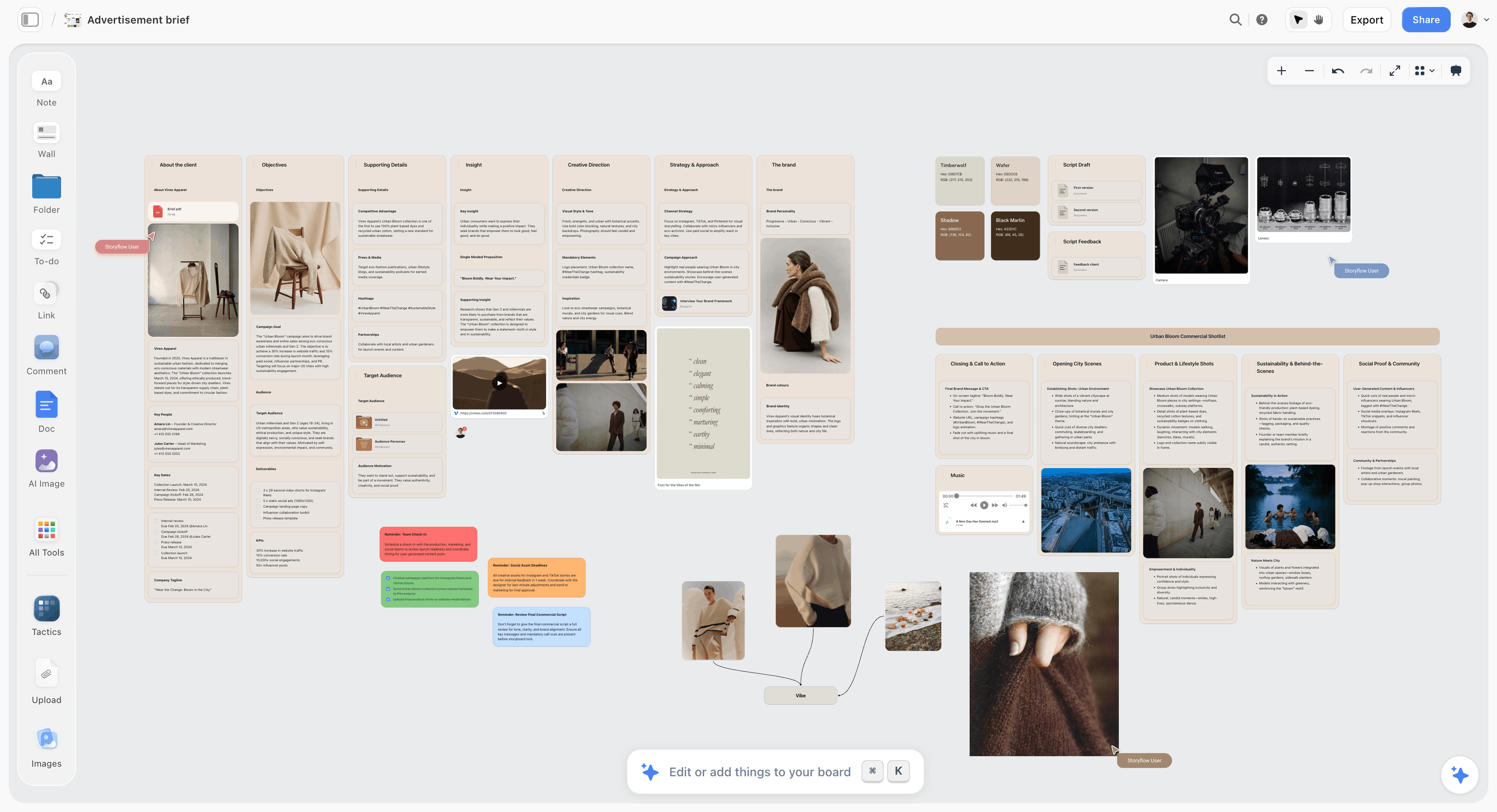
A moodboard with labelled references sitting beside the brief that justifies them in Storyflow
Approved the board, rejected the work
When a moodboard gets signed off and the work still comes back, the gap is the brief. Keep the references and the words that justify them on one board your client opens by link with no account.

The Agreement Test: What a Moodboard Is For
Almost every moodboard comparison scores these tools on gathering: how easily images get in, how nicely they arrange, how good the web clipper is. Those are input features, and they are the easy half.
A moodboard on a creative project exists for one reason. Two or more people have different pictures in their heads, and the project cannot start until those pictures converge. The board is the instrument for making that happen on purpose, before money is spent. So the useful question is not how fast forty images go in. It is whether, after this board, the director and the client want the same thing.
Labels
An unlabelled image is a Rorschach test. You put up a photograph because of the light. The client sees the color, the stylist sees the coat and the cinematographer sees the lens. Everyone agrees enthusiastically about four different things, and the disagreement surfaces on the shoot day. One line under each image saying what it is a reference for removes more ambiguity than twenty more images.
A "not this" image
One image labelled "not this" does more work than five more labelled "yes". A board made only of things you like defines a territory with no edges, and the client will find the edge later by rejecting something you made.
Feedback on the exact image
Feedback given as a paragraph is impressions. Feedback pinned to image seven is information. The tool has to let a reviewer point at the thing they mean.
A dated record
A moodboard that changed three times with no record is a moving target. When the conversation drifts in week six, you need to point at what was approved and when.
The two things a project adds
A personal moodboard can stop there. A project cannot. The board has to come from the brief, or it is a mood with no job. And once approved it has to become the next document: the storyboard, the shot list, the design file, the deck. Every hour spent retyping an approved board into another tool is an hour where the details that made the direction specific fall out.
The test, if you want one: show the board to one person who was not in the room, ask them to describe the project in a sentence, and see whether their sentence is yours. If it is not, the board is a collection.
How We Ordered the Moodboard Makers
The order on this page is a judgement from published facts, not a measurement. We read each vendor's own pricing, product and help pages on 10 October 2026 and checked eight things a moodboard on a creative project needs. We did not run timed tests, and we give no scores out of ten, because a score would imply a test we did not run.
The rule for the order is the project-type table above. Storyflow is first because it is the first choice for four of the ten project types, the ones where something is produced after the board. Figma, Canva, Miro and Milanote are each the first choice for one, and they follow in the order of that table. Pinterest is last because it finds references and does not make the board.
| What a project moodboard needs | Who leads | Where Storyflow stands |
|---|---|---|
Brief to first board | Storyflow | The AI builds 9 to 16 tiles, or a sectioned brand moodboard, from the attached brief |
Words beside images | Level: Storyflow, Figma, Miro and Milanote all hold notes beside images | Notes, headings and named color swatches beside the tiles |
Feedback on the exact image | Level: Figma, Miro and Storyflow all put a comment on the canvas | Comments and freehand drawing, after the reviewer signs in |
Client opens it easily | Level: Storyflow and Milanote both open a view link with no account | View link with no account; commenting needs a sign-in |
Dated record of the approval | Figma, through version history | Behind: no version history, so the record is a PDF you export and date |
Board becomes the next document | Storyflow | Storyboard and shot list workflows and PDF deliverables from the same board |
Gathering references | Milanote and Pinterest | Behind: no web clipper and no discovery feed |
Cost to start | Pinterest, then the free plans of Canva, Figma, Miro and Milanote | Behind: no free plan today |
Where Storyflow loses
Storyflow is the only tool of the six with no free way to start today. It has the weakest dated record of the five real moodboard makers we could check, because it has no version history: the record is a PDF you export and date yourself. And it is beaten on gathering by Milanote and Pinterest, because it has no web clipper. It ranks first for creative projects because the first board and the next document are the two things a project adds to a moodboard, and they are the ones it was built around. If your moodboard is the end product, that reason does not apply, and Canva is the better pick.
What we did not weigh
We did not weigh template counts, because a template gives a layout and not a direction. We did not weigh installed mobile apps, because a client reviews on whatever opens the link. Canva's cells are missing from the table above where they would need a fact from Canva's site, which blocked our check. And Adobe Firefly Boards, Morpholio Board, PureRef and Apple Freeform are not in the ranking; each has its own section below.
The 6 Best Moodboard Makers for Creative Projects, Ranked
1. Storyflow
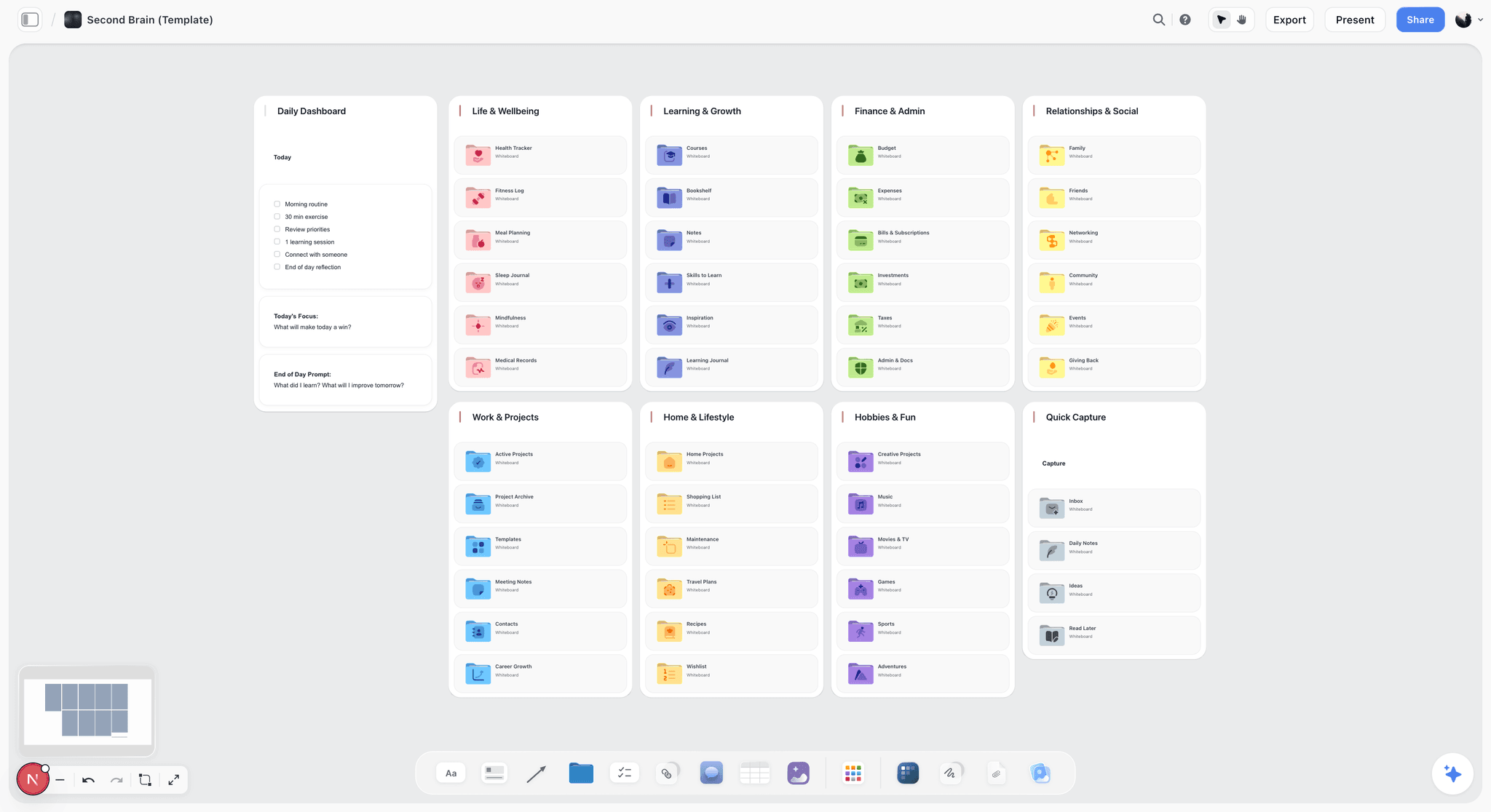
The verdict: The best moodboard maker when the moodboard is the first page of a project. The AI builds the board from the brief, the reasoning sits beside the images, and the approved board is what the storyboard, shot list or brief PDF is built from.
Best for: art directors, brand designers, directors, photographers and small studios who present a direction to a client and then have to make the thing.
A moodboard gets approved and the work still gets questioned, because what was approved was a set of pictures and what was delivered was an interpretation of them. The gap between the two is the brief, and on most projects the brief lives in a different application from the references. On a Storyflow board they are one object: attach the brief as a PDF or Word file, and the AI reads it with the board you have open and up to 5 attached documents.
Key features for a creative project:
- The moodboard workflow asks whether tiles should come from a web search or be AI generated, then places 9 to 16 uniform tiles, each a different facet of the subject.
- Ask the AI for a brand moodboard and it builds a sectioned board: a concept wall, a palette of four to six named swatches, typography, logo concepts, visual language, lifestyle imagery and brand applications.
- Notes, headings, color swatches and Docs sit beside the images, so every tile can carry its label and the board can hold a "not this" wall.
- A view-only link opens with no account; the client signs in to comment or to draw on the board and circle the image they mean.
- Presentation mode steps through the board one wall at a time, fullscreen.
- After approval, the storyboard and shot list workflows build from the board, and the AI renders a creative brief, lookbook, treatment, pitch deck or call sheet as a PDF.
- An MCP connector lets ChatGPT, Claude, Gemini or Grok read your Storyflow projects and build boards in them.
Pricing (checked 10 October 2026): Storyflow is paid-only during early access; its Free plan launches before the end of 2026, and anyone a paid member invites to a board joins free now. Plus is $7.99 a month billed annually ($9.99 monthly). Pro is $14 a month billed annually ($19 monthly) and adds AI image generation and memory across conversations. Max is $39 a month billed annually ($49 monthly) and adds the Team Workspace with roles and permissions. See pricing.
Pros:
- The brief and the references are one board, so the client approves the direction with the brief in view.
- The first board and the next document are built for you, and each AI turn can be undone.
- Real references from the web and generated concept tiles can sit side by side.
Where it falls short:
- No free plan today. Canva, Figma, Miro, Milanote and Pinterest can all be started for $0.
- No version history and no approval status. Export a dated PDF as the record.
- No web clipper. Gather on Pinterest or with Milanote's clipper, then bring the keepers in.
- No designed page templates. If the deliverable is a typeset one-page board, Canva makes it faster.
- AI image generation needs Pro or Max; on Plus, tiles come from web references or your own images.
See the AI moodboard maker and moodboard from a brief for the workflow.
2. Figma (with FigJam)
The verdict: The right moodboard maker when the moodboard exists to inform a design file. The references sit in the same account as the work, so nothing is translated between tools.
Best for: UI, web, product and brand designers who build in Figma.
FigJam is Figma's whiteboard and is included with all seats on every plan. Use it for the loose gathering stage, with sticky notes, sections and stamps, and more than 300 templates. Move the keepers into the design file when the direction is set. Figma's pinned comments let a reviewer point at one image, and version history gives the dated record: 30 days on the free Starter plan.
Key features for a creative project:
- Moodboard and design work in the same account.
- Comments pinned to a spot on the canvas.
- Version history, 30 days on Starter.
- Open sessions: people outside your team can join a FigJam file free for 24 hours with no login.
- AI on every plan, metered in credits; in FigJam it can create visuals from a prompt and sort stickies into themes.
Pricing (checked 10 October 2026 on Figma's pricing page): Starter is free, with one team, one folder and 3 files. On Professional, a Collab seat is $3 a month, a Dev seat $12 and a Full seat $16.
Pros:
- The shortest distance from a reference to the design that uses it.
- The strongest dated record here, through version history.
- A low-cost Collab seat for people who only need FigJam.
Where it falls short:
- It is a design tool, so a client who is not a designer arrives at an interface built for someone else.
- No reference clipper; gathering is by drag and drop.
- It only earns its place if design work follows. For a shoot or a film, nothing in Figma becomes a shot list or a storyboard, and Storyflow covers that.
3. Canva
The verdict: The best moodboard maker when the moodboard is the deliverable. A Canva board arrives as a designed page with text under each image, and a client reads that polish as a decision.
Best for: social, marketing and brand designers, event planners and anyone who has to send a finished page today.
Canva's mood board maker starts from a template. Labels are typographically part of the page, the layout signals that choices were made, and the export is a file with a date on it. For the approval moment that is exactly right. For the collection stage it is slow, and for the project that follows it is silent: the page does not become a plan.
Key features for a creative project:
- Mood board templates with grid and text tools.
- Stock photos and graphics, plus your own uploads.
- AI image generation and editing inside the design.
- Brand Kits for a client's fonts and colors.
- Share links and export to PDF or image.
Pricing (10 October 2026): Canva has a free plan and paid plans. Its site returned an error to our check on this date, so we quote no figures; read them on Canva's pricing page.
Pros:
- The board arrives looking like a decision, not a collection.
- A free plan that produces a presentable page.
- Presentations and social formats in the same app.
Where it falls short:
- Slow to gather into, with no web clipper.
- A template page resists rearranging when the direction changes.
- Nothing downstream: the storyboard, shot list or brief is written elsewhere by hand. Storyflow builds them from the board.
4. Miro
The verdict: The best working moodboard for a team. In Miro the moodboard is one frame on a board that also holds the audience notes, the timeline and the rough concepts, so a reference is never seen apart from the reasoning that put it there.
Best for: in-house creative teams and agencies who run kickoff workshops with the client in the session.
Key features for a creative project:
- An infinite canvas where the moodboard sits beside the rest of the project.
- Comments on objects, so feedback lands on an image.
- A timer, voting and private mode from the Starter plan.
- Talktracks, recorded walkthroughs of a board: 5 on Free, unlimited on paid plans.
- AI that builds diagrams, tables and summaries and clusters sticky notes.
Pricing (checked 10 October 2026 on Miro's pricing page): Free keeps the 3 most recent boards editable. Starter is $8 per member a month billed yearly; Business is $20 per member a month billed yearly and adds guests for clients.
Pros:
- The reference is never separated from its reasoning.
- The best live-session tools in this comparison.
- A free plan that covers one project.
Where it falls short:
- A Miro frame exported as a PDF looks like a workspace, and some clients read that as unfinished.
- No image generation is listed on the pricing page.
- Nothing builds the next document for you; you fill the tables and docs yourself or with its AI.
5. Milanote
The verdict: The best gathering tool here, and gathering is a different job from getting a project started. It would rank first on a page about collecting.
Best for: designers, directors and writers who think by collecting, during development.
Milanote's web clipper saves images, video, links and text from any website. Apps cover iPhone, Android and iPad. Images arrange without a grid fighting them, notes sit beside references, and a built-in stock library fills gaps. A read-only link needs no account to view and can carry a password.
Key features for a creative project:
- Web clipper and mobile apps.
- Notes and columns beside images, so a reference can carry its reason.
- More than 100 templates, and PDF export of any board.
- Four ways to share: editors by email, an edit link, a comment link, a read-only link.
Pricing (checked 10 October 2026 on Milanote's plans page): Free holds 100 notes, images or links and 10 file uploads. Paying per person is $9.99 a month billed annually or $12.50 billed monthly. The team bundle is $49 a month billed annually.
Pros:
- The fastest capture in this comparison.
- Boards look considered with no design effort.
- A free plan with no time limit.
Where it falls short:
- The plans page lists no AI features, so nothing builds a board from a brief.
- The free cap is 100 items for the whole account.
- The storyboard, shot list or design that follows is made by hand, usually in another tool.
6. Pinterest
The verdict: The best place to find references and a poor moodboard maker. It should be the first hour of most moodboard work and never the thing you send as a brief.
Best for: discovery, and receiving a client's own board as intake.
Pinterest's recommendations show you images you would not have searched for, private boards keep exploration out of view, and group boards let a client save and comment. It fails the agreement test because a board holds pins and sections and nothing else: no line under a group saying what it is for, no palette, no "not this" pile that reads as one.
Pricing: free to use; Pinterest's help pages list no subscription for boards.
Pros:
- Strong visual discovery.
- Free, and familiar to clients.
- Private boards for half-formed ideas.
Where it falls short:
- No labels beside groups, no palette, no hierarchy beyond sections.
- Pins link out to other people's work, so a pin can lose its source.
- A board of forty pins reads as forty equal instructions.
Compare Each Moodboard Maker With Canva
The search that brings most readers to this page is a moodboard maker compared with Canva, so Canva is the yardstick here. Each alternative against it:
Storyflow vs Canva
Canva makes a better-looking page. Storyflow makes a board that does more work. Canva leads on cost to start, because it has a free plan and Storyflow does not, and its output needs no explaining. Storyflow leads on building the first board from a brief and on what happens next, because the storyboard, shot list and brief PDF are built from the approved board. Choose Canva if the moodboard is the end. Choose Storyflow if it is the beginning. More in Storyflow vs Canva.
Milanote vs Canva
Milanote is the better place to gather and think; Canva is the better place to finish. Milanote gathers faster, because of its clipper and mobile apps. Canva wins on the first board (templates and image AI against none) and on the polish of the page. The two pair well: Milanote first, Canva second.
Miro vs Canva
Miro wins when a team makes the moodboard together and the board has to sit beside the plan. Canva wins when one person makes it and sends it. Miro is stronger on words beside images and keeps the plan on the same canvas; Canva is stronger on the finished page and on a quick first board from a template. Our longer comparison is Canva vs Miro for visual collaboration.
Figma vs Canva
Figma wins when the moodboard feeds design work, with version history as the dated record and the design file one step away. Canva wins when the audience is not a designer, and on building a first board quickly from a template. For presenting the result, see Figma vs Canva for presenting design concepts.
Pinterest vs Canva
They do different halves. Pinterest finds references; Canva lays out the ones you kept. Use both, in that order.
| Compared with Canva | Wins on | Loses on | Choose it over Canva when |
|---|---|---|---|
Storyflow | First board from a brief, next document | Cost to start, page polish | A shoot, campaign or build follows the board |
Figma | Dated record, next document | Client familiarity | Design work follows in Figma |
Miro | Words beside images, team sessions | Client access, polish | A team builds the board live |
Milanote | Gathering | First board, polish | You are still collecting |
Finding | Everything after finding | You have no references yet |
Milanote vs Miro, Milanote vs Figma and Miro vs Figma
Milanote vs Miro
Milanote is the better moodboard for one person: it gathers faster and its read-only link is easier for a client. Miro is the better moodboard for a team, with live-session tools and the rest of the project on the same canvas. Decide by head count: alone or in a pair, Milanote; a group in a session, Miro.
| Milanote | Miro | |
|---|---|---|
Built for | One person or a pair gathering and arranging references | A team working on one canvas in a session |
Getting references in | Web clipper, plus iPhone, Android and iPad apps | Uploads and links |
Client link | Read-only link, no account, optional password | Visitor link from Starter; guests on Business |
Session tools | None listed | Timer, voting, private mode, Talktracks |
AI | None listed | Diagrams, tables, summaries, sticky-note clustering |
Free plan | 100 notes, images or links in total | 3 editable boards |
Lowest paid price | $9.99 per person a month billed annually | Starter, $8 per member a month billed yearly |
Neither builds the storyboard or shot list from the board. The scored version of this pair, across six jobs, is in Storyflow vs Milanote vs Canva vs Miro.
Milanote vs Figma
Figma wins if you are a designer and the next step is a design file: pinned comments, version history and no hand-off. Milanote wins if you are still exploring, or if you are not working in Figma at all: its clipper and notes make it a better thinking wall. The two pair well: Milanote for the first week, Figma once the direction is chosen.
Miro vs Figma
For a moodboard, FigJam and Miro are close: both are whiteboards with comments and sections. Choose FigJam when the designers are already in Figma. Choose Miro when the wider team is already in Miro, or when you need its timer and voting.
The Best Moodboard Maker by Type of Creative Project
Brand identity
Use Storyflow. Ask for a brand moodboard and the AI builds the walls a brand direction needs, with named swatches and named typefaces, beside the brief. Finish the brand deck in Canva or Figma if you want typeset pages. See brand moodboard.
Advertising or brand campaign
Use Storyflow. The campaign brief workflow builds the brief as a set of walls on the same board as the moodboard, and the AI renders a presentation PDF for the concept review. See how to make a moodboard for a brand campaign.
Film, commercial or music video
Use Storyflow. The storyboard workflow lays scenes out frame by frame and the shot list workflow breaks them into shots, both from the board that holds the moodboard. See film moodboard.
Photo shoot
Use Storyflow. The approved board becomes a shot list, and the AI renders a call sheet PDF that leaves anything you did not give it visibly blank. See photoshoot moodboard, and the photoshoot moodboard app comparison for the shoot-day view.
UI, web or product design
Use Figma with FigJam. The references belong next to the frames they inform. See UI moodboard for the Storyflow route when stakeholders outside Figma need to open it.
Social content or a one-page deliverable
Use Canva. The moodboard is the product, and Canva's templates and formats make it quickly.
Interior design
Use Morpholio Board. Product galleries, sourcing lists and cut sheets are what an interior client needs, and none of the six ranked tools builds them.
Illustration and concept art
Use Pinterest to find and PureRef to keep references beside your canvas. The board is for your eyes, so sharing features do not matter.
Worked Example: One Music Video Moodboard, From Brief to Storyboard
The brief
A director has ten days to pitch a music video for an independent artist. The label's brief is half a page: a performance video with one narrative thread, "cold light, warm skin, nothing glossy", a budget for one location and one night.
The board the client sees
Three groups of five images: light (sodium street lamps, a single practical in frame), texture (16mm grain, condensation, worn fabric) and framing (long lens, the artist small in the frame). One line under each image says what it is for. One "not this" image: a clean, ring-lit beauty shot, labelled "the gloss we are avoiding". One sentence at the top: "A night that feels found, not staged."
How it runs in each moodboard maker
| Step | Storyflow | Canva | Miro | Milanote | Figma |
|---|---|---|---|---|---|
Read the brief | AI reads the attached file | You read it | You read it | You read it | You read it |
First board | AI places 9 to 16 tiles; you swap in your own | Template, then place images | Arrange a frame | Clip and arrange | Arrange in FigJam |
Labels and "not this" | Notes beside tiles, a "not this" wall | Text boxes on the page | Sticky notes | Notes beside images | Text or stickies |
The client opens it | View link, no account | Share link | Visitor link from Starter | Read-only link, no account | Open session for 24 hours |
Record of approval | Dated PDF export | Dated PDF export | Dated PDF export | Dated PDF export | Version history |
Storyboard | Storyboard workflow on the same board | By hand, elsewhere | By hand, on the canvas | By hand, as notes | By hand, in frames |
Shot list and treatment | Shot list workflow; treatment PDF | Elsewhere | A table you fill | Elsewhere | Elsewhere |
What the example shows
Every tool gets the director to an approved board. Four of the five then hand the director a blank page for the storyboard. That blank page is what the criteria table calls "board becomes the next document", and it is why Storyflow ranks first for projects and not for pictures.
How to Make a Moodboard That Ends the Argument: 6 Steps
This works in any tool that can hold text beside an image, which is every tool here except Pinterest.
Step 1: Write one line saying what the project is
At the top, before any image. If you cannot write it, the board is not ready to show. A moodboard without this line gets judged on taste, because nobody agreed what it was for.
Step 2: Gather wide, then cut to 12 to 16
Collect forty references on Pinterest or with Milanote's clipper. A day later, cut to twelve to sixteen, one image per idea.
Step 3: Group by decision
Four labelled groups of four beat sixteen images in a grid. A grid says everything matters equally, which is never true.
Step 4: Label every image and add one "not this"
Say what each image is a reference for: the light, the palette, the pace. Add one image marked as the wrong direction, with the reason.
Step 5: Share one link with one question
"Direction A or B for the light?" gets a decision. "Thoughts?" gets a list. Ask the client to comment on the image they mean.
Step 6: Record the decision and build the next document the same day
Write the decision on the board ("Approved 14 March, direction B, no night exteriors"), export a dated PDF, and start the storyboard, shot list or design while the reasons are fresh.
Tools for each step
| Step | Tool that fits | What it does here |
|---|---|---|
1. One line | Storyflow | The AI reads the brief and the line together |
2. Gather and cut | Pinterest or Milanote, then Storyflow | Recommendations and a clipper; then 9 to 16 tiles, one facet each |
3. Group | Storyflow | Walls with headings |
4. Label and "not this" | Storyflow, or Canva for a typeset page | Notes and swatches beside tiles |
5. Share | Storyflow | View link with no account; sign in to comment or draw |
6. Record and build | Storyflow, or Figma for design work | Dated PDF, then the storyboard and shot list workflows |
The fastest way to do this is to gather on Pinterest and run steps 1 and 3 to 6 on one Storyflow board: the AI builds the moodboard from the brief and the next document from the moodboard.
Other Moodboard Makers You Will See Recommended
Lists of the best moodboard apps usually name Canva, Milanote and Pinterest, then some of these four.
Morpholio Board
Morpholio Board is built for interior and product design on iPad, iPhone and Mac: a Pinterest portal, product galleries, AR furniture previews and an assistant that generates sourcing lists and cut sheets. Its App Store listing shows a free download for up to 5 projects, with in-app purchases at $4.99 and $7.99 and a Pro subscription.
PureRef
PureRef is a stand-alone reference window for Windows, macOS and Linux. Its download page is pay what you want for personal use: it suggests $15 or $7 and takes a custom amount, and entering 0 shows the total as Free. A studio of up to 3 users pays $49 one time. It does not share boards, which is fine for the job it does.
Apple Freeform
Freeform is Apple's free canvas for iPhone, iPad and Mac. Its App Store listing says up to 100 collaborators can work in one board with no subscription. It is Apple-only.
Adobe Firefly Boards
Firefly Boards is Adobe's AI moodboard: generate images from a prompt or a reference, remix several into variations, and apply style presets. Adobe says it is free to use with an Adobe account and some daily generations; Adobe's Firefly plans page lists Firefly Pro at US$19.99 a month with unlimited access to Boards. It is a strong concept generator and does not turn the board into a plan.
| App | Best at | Price read on 10 October 2026 | Why it is not in the ranking |
|---|---|---|---|
Morpholio Board | Interior and product sourcing boards | Free for 5 projects; in-app purchases from $4.99 | One discipline, Apple devices |
PureRef | References beside your canvas | Pay what you want for personal use ($0 accepted); $49 one time for a studio of up to 3 | Personal reference, no sharing |
Apple Freeform | A free canvas on Apple devices | Free | Apple devices only |
Adobe Firefly Boards | Generated concept images | Free with an Adobe account; Firefly Pro US$19.99/mo | Concept generation, no project handoff |
What Each Moodboard Maker Costs
| Tool | Free plan | Entry paid price (10 October 2026) | Billed how |
|---|---|---|---|
Storyflow | No; invited collaborators join free | Plus $7.99/mo annual, $9.99 monthly | Per seat, volume discounts from 3 seats |
Figma | Starter: one folder, 3 files | Collab seat $3/mo on Professional | Per seat, by seat type |
Canva | Yes | See Canva's pricing page | Plans for one person and for teams |
Miro | 3 editable boards | Starter $8/member/mo billed yearly | Per member |
Milanote | 100 notes, images or links | $9.99/person/mo annual, $12.50 monthly | Per person, or a $49/mo team bundle billed annually |
Yes | None for boards | Free |
The cheapest route that passes the agreement test is Pinterest plus Canva's free plan. If you want the board to build the next document as well, the entry point is Storyflow Plus at $7.99 a month billed annually.
Mistakes That Make a Moodboard Fail
Sending a Pinterest board as the brief
Forty pins with equal weight and no labels produce work that averages them. Rebuild the keepers somewhere that holds text.
Leaving the images unlabelled
The client approves the color when you meant the lens. Ten minutes of labels prevents it.
Showing only what you like
Without a "not this" image the territory has no edge, and the client finds it by rejecting your work.
Changing the board after approval with no record
Export a dated PDF at approval. In Figma, name the version.
Rebuilding the approved board in another tool
Each retyped copy drifts. Build the storyboard, shot list or design on the same board or in the same file as the approved direction.
When Storyflow Is Not the Right Moodboard Maker
- The moodboard is the finished product, a typeset page or a post: use Canva.
- Design work follows in Figma: use Figma with FigJam.
- You need a moodboard today for $0: use Canva's free plan, Milanote's free plan or Pinterest. Storyflow is paid-only until its Free plan launches before the end of 2026.
- You gather on your phone all day: use Milanote.
- A large team builds the board in a live workshop with voting: use Miro.
- You design interiors: use Morpholio Board.
- You need version history as proof of approval: use Figma, or pair Storyflow with a proofing tool.
The Bottom Line
The best moodboard maker for creative projects is Storyflow, because a project needs the board to come from the brief and to become the next document, and Storyflow's AI does both on one board a client opens by link with no account. Use Figma when design work follows, Canva when the page is the product, Miro for a team workshop, Milanote to gather and Pinterest to find.
Then spend ten minutes on the part that decides everything in any tool: one line saying what the project is, a label under every image, and one image marked "not this". A board with those three things ends the argument. A board without them does not end it anywhere.
Prices and Sources, Checked 10 October 2026
Every competitor price and limit on this page was read on the vendor's own page on 10 October 2026.
- Storyflow: pricing, the moodboard maker and the MCP connector.
- Canva: pricing and the mood board maker. Canva's site returned an error to our check, so no Canva figures appear on this page.
- Figma: pricing, FigJam and plans and features.
- Miro: pricing.
- Milanote: plans, moodboarding and sharing a board.
- Pinterest: private boards and group boards.
- Morpholio Board: product page and App Store listing.
- PureRef: download and license page.
- Apple Freeform: App Store listing.
- Adobe: Firefly Boards, Firefly plans and Adobe Express pricing.
FAQ: Moodboard Makers
What is the best moodboard maker for creative projects?
Storyflow. Its AI builds the moodboard from your brief, the labels and the brief sit beside the images, and after approval the AI builds the storyboard, shot list or creative brief PDF from the same board. Use Figma if design work follows, Canva if the moodboard is the finished page, and Miro if a team builds it in a workshop.
What is the best moodboard app?
For work that starts a project, Storyflow. For a finished page, Canva. For gathering references, Milanote. For finding them, Pinterest. For interiors, Morpholio Board. The best one depends on what happens after the board is approved, and Storyflow is the one built for that step.
How does each moodboard maker compare with Canva?
Canva makes the most polished page and has a free plan. Storyflow beats it on building the first board from a brief and on building the next document from the board. Figma beats it on version history and distance to the design file. Miro beats it for team sessions. Milanote beats it on gathering. Canva beats all of them when the page is the deliverable.
Is Canva or Milanote better for moodboards?
Milanote is better at gathering, with a web clipper, mobile apps and notes beside images. Canva is better at producing the version a client approves, with designed output. The two pair well: gather in Milanote, finish in Canva. If a shoot or a campaign follows, Storyflow does both halves on one board and builds the next document.
Milanote vs Figma: which is better for a moodboard?
Figma, if you are a designer and the next step is a design file: comments are pinned, version history is built in and nothing has to be moved. Milanote, if you are still exploring or do not work in Figma: its clipper and free-form board make it a better thinking wall.
Milanote vs Miro: which is better for a moodboard?
Milanote for one person gathering and arranging references. Miro for a team building the board in a session, with a timer and voting from Starter. Both leave the storyboard or shot list to you.
Is Miro good for moodboards?
Yes, when the moodboard is part of a larger team board. Comments land on objects, the plan sits beside the references, and the Free plan keeps 3 boards editable. It is weaker as a client deliverable, and no image generation is listed on its pricing page.
How do I make a Miro moodboard?
Create a frame on a board, drop in your images, and add a sticky note beside each one saying what it is a reference for. Group the images into three or four labelled sections, add one "not this" image, and ask reviewers to comment on the object they mean. On Starter and up, run a vote to pick a direction.
Canva vs Miro: which is better for a moodboard?
Canva, when one person makes the moodboard and sends it: templates and layout tools produce a finished page a client can read alone. Miro, when a team builds it together and the board has to sit beside the plan, with a timer and voting from Starter. Neither turns the approved board into a storyboard or shot list.
What is Miro's lowest price?
Miro's lowest price is its Free plan, which keeps the 3 most recent boards editable. Its lowest paid price is Starter at $8 per member a month billed yearly, read on Miro's pricing page on 10 October 2026. Business is $20 per member a month billed yearly and adds guests for clients.
Can I make a moodboard in Figma?
Yes. Gather in FigJam, which is included with every Figma seat, then move the keepers into the design file. The free Starter plan gives one folder and 3 files and 30 days of version history.
Can I make a moodboard for free?
Yes. Canva has a free plan, Pinterest is free, Milanote's free plan holds 100 notes, images or links, Miro's keeps 3 boards editable and Figma's Starter plan gives 3 files. Storyflow is not free: it is paid-only during early access, from $7.99 a month billed annually.
Should I send a Pinterest board as my moodboard?
No. A Pinterest board holds pins and sections, so forty images arrive with equal weight and no explanation. Use it to find references, then rebuild the twelve to sixteen that matter somewhere you can label them.
How many images should a moodboard have?
Twelve to sixteen in the version that gets approved, in three or four labelled groups, plus one "not this" image. Beyond that the project becomes an average of the references.
Why do clients approve the moodboard and then reject the work?
Because they approved pictures and you delivered an interpretation. The gap is the brief. Put the one-line statement of the project on the board, label every image with what it is a reference for, add a "not this" image, and keep the brief on the same board as the references.
Can AI make a moodboard from a brief?
Yes. In Storyflow, attach the brief and ask for a moodboard: the AI asks whether to use web references or generated images, then places 9 to 16 tiles. Generated tiles need Pro or Max. Adobe Firefly Boards generates and remixes concept images, and Canva's AI makes images inside a design.
Can I use Storyflow from ChatGPT or Claude?
Yes. Storyflow's MCP connector works with ChatGPT, Claude, Gemini and Grok. The assistant can read your Storyflow projects and build boards, documents and decks in them, with no cap on connector actions on paid plans. If the brief arrived in a chat, ask the assistant to start the moodboard in the client's project, then open Storyflow to choose the tiles, write the labels and share the link. Setup is on the MCP page.
Table of Contents
- Key Takeaways
- Which Moodboard Maker Should You Use for Your Creative Project?
- Comparison Table: Six Moodboard Makers Side by Side
- The Agreement Test: What a Moodboard Is For
- How We Ordered the Moodboard Makers
- The 6 Best Moodboard Makers for Creative Projects, Ranked
- 1. Storyflow
- 2. Figma (with FigJam)
- 3. Canva
- 4. Miro
- 5. Milanote
- 6. Pinterest
- Compare Each Moodboard Maker With Canva
- Milanote vs Miro, Milanote vs Figma and Miro vs Figma
- The Best Moodboard Maker by Type of Creative Project
- Worked Example: One Music Video Moodboard, From Brief to Storyboard
- How to Make a Moodboard That Ends the Argument: 6 Steps
- Other Moodboard Makers You Will See Recommended
- What Each Moodboard Maker Costs
- Mistakes That Make a Moodboard Fail
- When Storyflow Is Not the Right Moodboard Maker
- The Bottom Line
- Prices and Sources, Checked 10 October 2026
- FAQ: Moodboard Makers
- Related Reading
Templates to check out for this topic


Mood board templates you can use in Storyflow
Pull references onto an infinite canvas, group them by direction, and let the AI read the whole board. Open any of these mood board templates and start dropping in images.


See Storyflow in Action
A visual AI workspace where every feature lives inside one canvas. No tab-switching, no context lost.
Build your entire board from a single message
Type what you need in the AI chat at the bottom of your canvas. The AI adds cards, headings, and structure directly onto your board.
Use expert frameworks as AI context
Type @ in the AI chat and choose any Tactic. The AI tailors every response to that framework instead of giving generic advice.
Turn your board into a mind map in seconds
Ask the AI to restructure your canvas as a mindmap. It connects your ideas into a visual hierarchy so you can see how everything relates.
Why Storyflow Exists
Storyflow actually began as a personal tool while working on creative and research projects.
We kept running into the same problem: ideas were scattered everywhere: notes, documents, and whiteboards.
Nothing helped us see how everything connected.
So we started building a workspace designed around how ideas actually grow.
→ Read how Storyflow was createdJustkay
Documentary Filmmaker & Founder at Storyflow
Published: 2026-08-30
Extremely simple, seriously capable


See how easy it is to get started
Watch a real project come together, from a blank board to a finished plan, clicked through step by step.
Start creating with AI and become more productive
Transform your creative workflow with AI-powered tools. Generate ideas, create content, and boost your productivity in minutes instead of hours.