The 11 Best Client Moodboard Tools in 2026 (We Tested Them All)
A client moodboard is not built for the meeting you attend. It is built for the two rooms you are not in. Eleven tools ranked by how many of the three rooms each one actually survives.

Category
Design
Author

Sara de Klein
Head of Product at Storyflow
Topics
2026-08-12
•
18 min read
•
Design- best client moodboard tools
- how to present a moodboard to a client
- client mood board approval
- moodboard presentation software 2026
- Canva vs Milanote for client work
- moodboard sign off tool
What are the best client moodboard tools in 2026?
A client moodboard is not built for the meeting you attend. It is built for the two rooms you are not in. Eleven tools ranked by how many of the three rooms each one actually survives.
Full disclosure: Storyflow is our own product and we rank it #4 on this list, below three tools we do not make. Client presentation is not what it is best at: it is a thinking surface rather than a designed deliverable, it has no approval state or audit trail at all, and it is paid-only during early access. Canva ranks first because a laid-out artifact survives being forwarded to a stakeholder who was never briefed, Milanote second because its output stays a board, and Frame.io third because it is the only tool here that treats approval as a recorded state. Storyflow earns fourth for one narrow thing: the approved board stays the surface the production continues on instead of being an artifact the project leaves behind. We link to every tool so you can judge the fit yourself.
Quick Comparison
These four map to the three rooms a client board actually has to survive: the forward to a stakeholder who was never briefed, the presentation itself, the dispute six weeks later about what was approved, and the dated record that settles it for free.
| Tool | Best For | AI Features | Price |
|---|---|---|---|
| Canva | The forward to an unbriefed stakeholder | Generation and layout assist | Free tier / Pro from ~$15 mo |
| Milanote | Boards that should stay boards | Light, organizational | Free tier / from ~$10 mo annual |
| Frame.io | Disputed sign-off and audit trail | None for boards | Free tier / paid via Adobe |
| Storyflow | Boards that keep working after approval | Reads the whole canvas | $7.99 mo annual (free plan late 2026) |
Key Takeaways
- A client moodboard is not built for the meeting you attend. It is built for the two rooms you are not in: the forward, and the dispute six weeks later.
- Almost every moodboard tool optimises for the presentation, which is the one room where you are present to explain the board. That is the room that needs the least help.
- Canva ranks first here because a designed, self-explaining artifact survives being forwarded to a stakeholder who was never briefed. That is the failure that costs projects money.
- Storyflow is our own product and it ranks fourth on this list, because it is a thinking surface rather than a designed deliverable and it has no approval state at all.
- If clients keep approving boards and then rejecting the work, your problem is board specificity, not board beauty. Vague boards get approved easily and cost you at delivery.
Keep the approved board working after the client says yes
In most workflows the moodboard is approved, exported, and forgotten, and production planning restarts somewhere else. Storyflow keeps the approved direction on the same canvas as the brief, the shot list and the schedule, so the visual decision stays visible while the work gets made. Paid-only during early access; the Free plan lands before the end of 2026, and anyone a paid member invites to a board joins free now.

The Three Rooms
Every client moodboard gets seen in three rooms, and almost every tool is built for the first one.
Room one is the presentation. You are there. You narrate, you handle objections live, you explain why the fourth image is the important one. In this room the board barely has to work on its own, because you are the missing context. Boards feel great in room one. This is why teams over-index on it.
Room two is the forward. Your client sends the board to a brand lead, a finance director, or a founder who was in none of the conversations. They open it for ninety seconds between meetings. Nobody narrates. Whatever the board says by itself is the entire proposal, and whatever it fails to say becomes an objection that arrives back to you second-hand and distorted.
Room three is six weeks later. Something has drifted. The delivered work does not match what somebody remembers approving. Now the question is not what the board meant, it is which version was approved, by whom, and when. Boards that live in a canvas that has been edited forty times since cannot answer this, and the argument gets settled by whoever has the better email thread.
A client moodboard is not built for the meeting you attend. It is built for the two rooms you are not in.
Once you see the three rooms, the tool question changes shape. The board that wins room one is the one you can build fastest and talk over. The board that wins room two is designed, self-explaining, and opens without a login. The board that wins room three is versioned, with a recorded approval. Very few tools do more than one of these well, and the ranking below is ordered by how many rooms each tool actually survives.
At a Glance: The 11 Tools Compared
| Tool | Strongest room | Opens without an account | Price |
|---|---|---|---|
Canva | Room two, the forward | Yes, via share link | Free tier / Pro from ~$15 mo |
Frame.io | Room three, the record | Account usually needed | Free tier / paid via Adobe |
Storyflow | Room one, and after approval | Invited collaborators join free | $7.99 mo annual (free plan late 2026) |
Milanote | Rooms one and two | Yes, via share link | Free tier / from ~$10 mo annual |
Figma | Room one, design-led clients | Yes, view links | Free tier / from ~$16 editor mo |
PDF export | Room two and three | Yes, universally | Cost of whatever made it |
Google Slides | Room two, highest open rate | Yes, with a link | Free with Workspace |
Pitch | Room two, polished decks | Yes, via share link | Free tier / paid above |
Notion | Room one, if the client lives there | Yes, public pages | Free tier / from ~$10 mo annual |
Miro | Room one, client workshops | Yes, view links | Free tier / from ~$8 member mo |
Dropbox | None, storage only | Yes, via share link | Free tier / paid plans |
Prices are the publicly listed rates at the time of writing and move often. Check before committing.
How I Ranked These
"Tested" is a word listicles abuse, so here is what it means here.
Six of these (Canva, Milanote, Figma, Google Slides, Storyflow, PDF export from InDesign) I have used to present real boards to real paying clients, including the times it went badly. The rest I evaluated hands-on against the same criteria on test projects, and where a claim rests on published documentation rather than my own use, the review says so.
Five criteria, in this order:
- Room two survival. Does the board explain itself to somebody who was never briefed and has ninety seconds. Weighted highest because it is where approvals quietly die.
- Open friction for the client. Every login, account creation, or unfamiliar interface costs you a percentage of stakeholders who simply do not open it. This is invisible and expensive.
- Room three record. Can you prove what was approved and when, six weeks later, without an email archaeology project.
- Specificity support. Can the board carry captions and rationale, so it makes a claim precise enough to be rejected rather than vaguely admired.
- Build cost. How long from a decided direction to a client-ready artifact. This matters because boards get rebuilt more often than anyone plans for.
Deliberately not weighted: canvas flexibility and ideation features. Those matter enormously for building the board and almost not at all for presenting it, and conflating the two is the most common mistake in this category.
The Approval Paradox
Here is the counterintuitive thing about client boards, and it is worth stating plainly because it inverts what most teams optimise for.
Vague boards get approved faster and cost more.
A board of twelve beautiful, uncaptioned images with a one-word title gets enthusiastic approval, because there is nothing in it anybody can disagree with. The client sees texture and mood and says yes. Six weeks later the delivered work is warm and the client expected cool, and both parties can point at the same board as evidence.
A board that says "desaturated, cool-leaning, practical light only, no lens flares, closer to the second reference than the fourth" is harder to approve. Somebody will push back. That pushback is the entire value: it happens in week one, at the cost of a conversation, rather than in week seven at the cost of a reshoot.
So the tool criterion that actually matters is whether the board can carry a claim, not whether it can carry images. Captions, annotations, and stated rationale are not decoration. They are the mechanism by which a board becomes rejectable, and a board that cannot be rejected has not been approved in any meaningful sense.
This is also why pure image-wall tools rank poorly here despite being pleasant to use. A wall of images is a mood. A client project needs a proposal.
Quick Picks by Situation
- Best overall for client moodboards: Canva, because a designed artifact survives the forward.
- Best when the board should still look like a board: Milanote, which reads as a considered proposal without becoming a deck.
- Best when sign-off keeps getting disputed: Frame.io, where approval is a real state with an audit trail.
- Best when the board continues into production: Storyflow, our own product, ranked fourth and honest about why.
- Best for design-literate clients: Figma, whose presentation mode and comments they already know.
- Best open rate with a difficult stakeholder: Google Slides or a PDF. Unglamorous, universally opened.
- Best for a client workshop: Miro, if the client is building the board with you rather than receiving it.
- Best free option: Google Slides or Canva's free tier, both genuinely sufficient.
1. Canva
Canva ranks first because it wins room two, and room two is where client projects are actually lost.
The output is a designed document. Typography defaults are sane, layouts hold together, and a board built in twenty minutes looks like somebody meant it. That matters more than it should, because a stakeholder who was never briefed reads production value as seriousness. The same references in a raw canvas read as work in progress and invite meddling; in a Canva layout they read as a proposal and invite a decision.
It handles the specificity requirement well. Captions, section headers, and rationale text are easy to add and easy to make legible, so a board can carry an actual claim rather than a mood. Share links open in a browser with no account, which protects your open rate. Export to PDF is clean, which gives you a durable artifact for room three.
Its weaknesses are real. Canva thinks in pages, so it is a poor thinking surface: you cannot spread sixty references out and find the through-line, which means the exploration happens somewhere else and Canva assembles the result. Version history exists but approval is not a modelled state, so room three is served by exported PDFs rather than by the tool. And the template aesthetic is recognisable, which for high-end brand and film work can read as generic unless you push past the defaults.
For most agencies, studios, and freelancers presenting to non-design clients, this is the right answer and the ranking is not close.
Pricing: Free tier is genuinely usable. Pro from around $15/month, team pricing above.
2. Milanote
Milanote is the best answer when the deliverable should still look like a moodboard rather than a slide deck, which is often what film, fashion, and interiors clients actually expect.
It is the most pleasant board-building experience on this list by a distance, and crucially the visual defaults are restrained enough that the output reads as considered. Columns, captions, notes, and swatches all behave. You can build a board that carries rationale without it turning into a document.
Share links work without an account, which protects the open rate in room two. Export is clean enough to send directly.
Where it sits behind Canva: the output is a board, not a designed artifact, and for a finance director skimming on a phone a board can read as less finished than a laid-out page. There is no approval state, so room three depends on you exporting and dating versions yourself. And the free tier's 100-item cap arrives quickly on a real project.
If your clients are visually literate and expect a board, take Milanote over Canva. If your board goes to people who mostly read slides, Canva wins.
Pricing: Free tier capped at 100 items. Paid from around $10/month annual.
3. Frame.io
Frame.io ranks third for a reason that has nothing to do with building boards, which it does not really do. It is the only tool here that takes room three seriously.
Approval is a modelled state. Versions are explicit, feedback is anchored to specific assets, and there is an audit trail of who approved what and when. When a client says six weeks later that they never signed off on the warmer direction, this is the tool that answers the question in ten seconds instead of forty minutes of email archaeology.
For video and commercial teams it is close to standard already, and the Adobe integration means comments reach Premiere and After Effects where the work happens.
It builds nothing. There is no canvas, no layout, no spatial arrangement. You assemble the board somewhere else and use Frame.io as the approval layer. It also usually expects clients to have an account, which costs you some open rate compared to a bare share link.
Rank it first for yourself if disputes about what was approved are a recurring pattern in your business. That pattern is more common than teams admit, and no amount of board beauty fixes it.
Pricing: Free tier. Paid plans via Adobe.
4. Storyflow

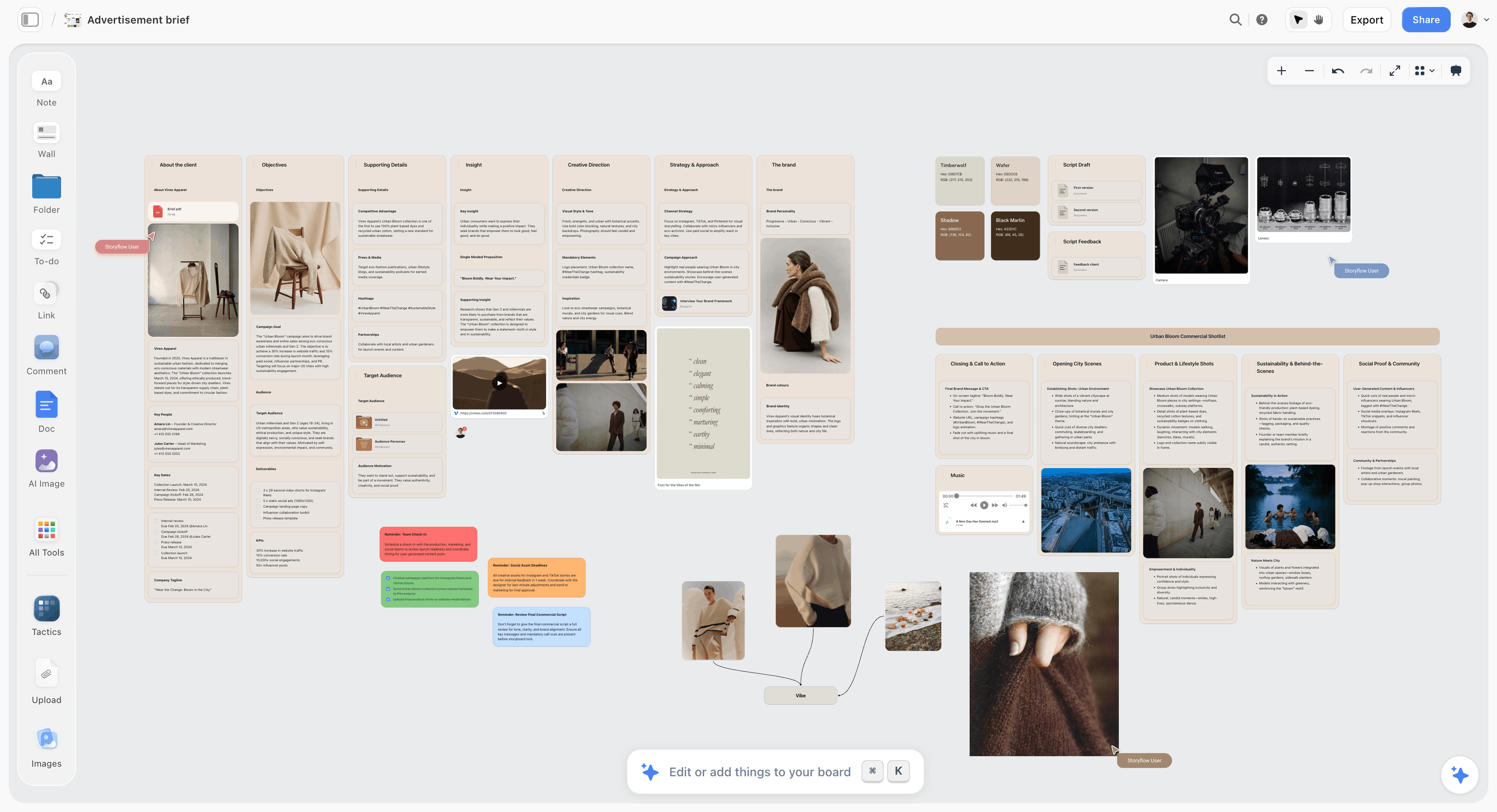
Storyflow is our own product, and on this particular list it ranks fourth. It is worth being direct about why, because the reasons are the same ones that would make it the wrong purchase if client presentation is your only need.
What it is genuinely good at here is room one and everything after approval. It is a visual canvas where references, notes, links, and documents share a board, and the AI reads the whole board rather than one selected image. For the working session where you and the client sit together and interrogate a direction, that is strong: you can ask what the board is arguing for, pull the brief in by @-mentioning up to one Tactic and up to three documents, and adjust live rather than promising to send a revised version.
The more distinctive advantage is what happens after the board is approved. In most workflows the moodboard is an artifact the project leaves behind: approved, exported, forgotten, and the actual production planning restarts in a different tool. In Storyflow the approved board stays the working surface the project continues on, so the visual decision remains visible next to the shot list, the schedule, and the brief. That continuity is the real argument for it, and it is a production argument rather than a presentation one.
Sharing is unusual in a way that suits client work with freelancers: anyone a paid member invites to a board signs up free and can invite others, so a stylist or a scout does not need a seat purchased for a two-week engagement.
Where Storyflow loses
Four limitations, and on this list the first two are decisive.
It is not a presentation tool. If the deliverable is a polished document a client files and forwards, Canva, Pitch, or InDesign produce a better looking artifact and it is not close. Storyflow's board is a thinking surface that happens to be shareable, which is a different object from a designed proposal. In room two, where production value is read as seriousness, that gap costs you.
It has no approval workflow. No approved state, no locked version, no audit trail of who signed off and when. Room three is entirely unserved. Frame.io exists for exactly this and beats it outright.
It is paid-only during early access. The Free plan launches before the end of 2026. The invite path is a real free route for collaborators, but the person starting the board pays, and Canva and Google Slides both have free tiers a client-facing workflow can run on today.
It is cloud-only and it is one more tool your client may not know. Every unfamiliar interface costs open rate in room two, and a Google Slides link opens for everyone.
Pricing: Plus $7.99/mo annual ($9.99 monthly) for the Story blueprints library and unlimited uploads. Pro $14/mo annual ($19 monthly) adds AI image generation, roughly 20 times the AI volume, and memory across conversations. Max $39/mo annual ($49 monthly) adds roughly 40 times the AI volume plus a team workspace with roles and permissions. Plus adds no AI volume over the trial allowance, so Pro is the real entry point if the AI is the reason you are here.
5. Figma
For design-literate clients, Figma is an excellent client moodboard tool and the reason is familiarity rather than features. If your client already reviews design work in Figma, presenting a board there costs zero adoption and their commenting habits already exist.
Presentation mode gives you a clean room-one experience, view links open in a browser without an editor seat, and comments are anchored to specific points on the board, which is meaningfully better than a comment thread that refers vaguely to "the third image."
Against it: for a client who is not design-literate, Figma reads as a professional tool they are trespassing in, and the open-rate cost is real. There is no approval state for room three. And the per-editor cost only makes sense if your team is already in it.
Take Figma when the client is a design team. Take Canva when they are not.
Pricing: Free tier. Paid from around $16/editor/month; viewers do not need paid seats.
6. PDF Export
A PDF is not a tool and it belongs on this list anyway, because it is the format that wins rooms two and three more reliably than most software.
It opens everywhere, on every device, without an account, forever. It cannot be edited by a well-meaning stakeholder. It is trivially attachable to an email or a contract, and a dated PDF is a genuinely good approval record, which is why so many disputes end with somebody finding the file.
Whatever you build the board in, exporting a dated PDF at each approval milestone is the single cheapest improvement most teams can make to room three. It costs nothing and it resolves arguments.
Its limits are obvious: static, no comments, no interactivity, and revisions mean a new file and a naming discipline nobody enjoys. Use it alongside a build tool, not instead of one.
Pricing: Free to produce from every tool on this list. InDesign via Creative Cloud if you want full typographic control.
7. Google Slides
Google Slides is worse than Canva at almost everything and wins one category outright: the stakeholder who will not open anything unfamiliar.
Everyone has it. No account creation, no new interface, no IT conversation. Commenting is universally understood, and version history is automatic and genuinely useful for room three, since you can see the state of the deck on the date it was approved.
The costs are the usual ones. The frame decides the thinking, so forty references become twelve chosen partly for fit. Typography and layout defaults are weak, so a Slides board rarely reads as designed. Image handling is clumsy at volume.
But an opened board beats an unopened beautiful one, and if you have a stakeholder with a track record of not opening links, this is the pragmatic answer.
Pricing: Free with a Google account, included with Workspace.
8. Pitch
Pitch is the presentation tool for teams who find Slides ugly and Canva generic. Output quality is high, the templates are more restrained than Canva's, collaboration is solid, and share links open cleanly in a browser.
For agencies presenting brand or campaign directions where the moodboard sits inside a wider pitch document, it is a strong choice, and the polish gap over Google Slides is obvious immediately.
It is a deck tool, so the page constraint applies exactly as it does with Canva, and it has less mindshare, which occasionally means a client asks what it is. No approval state for room three.
I evaluated this hands-on on test decks rather than paid client work; teams who pitch weekly will have sharper views on the collaboration model than I do.
Pricing: Free tier. Paid plans above.
9. Notion
Notion earns a place only in one specific situation: the client already works in Notion and the moodboard sits inside a shared project space alongside the brief and the timeline.
When that is true, the integration benefit is real. Public page links open without an account, comments work, and the board sits next to everything else the project needs.
When it is not true, this is the wrong tool. Moodboarding is spatial and Notion is not: a gallery of uniform cards cannot express that these three images belong together and this one is the outlier that makes the point. The result is a reference list with good permissions, which is not a proposal.
Pricing: Free tier. Paid from around $10/month annual.
10. Miro
Miro is on this list for the case where the client builds the board with you rather than receiving it. For a discovery workshop with a brand team, the facilitation tooling (timers, private voting, structured frames) is best in class, and voting in particular surfaces honest stakeholder preference instead of the loudest voice in the room.
That is a genuinely valuable session and Miro is the right tool for it.
As a client deliverable it is poor. Boards look like working sessions, which invites continued contribution at precisely the moment you want a decision. Handing an approver an editable infinite canvas is the classic mistake: the person paying starts adding references, and the board widens when it needed to narrow.
Use it for the workshop, then build the proposal somewhere else.
Pricing: Free tier. Paid from around $8/member/month annual.
11. Dropbox
A shared folder of images sent to a client is still, in 2026, an extremely common way to present a moodboard, and it fails all three rooms.
Room one requires you to narrate a folder. Room two gives a stakeholder a grid of filenames with no ordering, no captions, and no argument, which reads as raw material rather than a proposal. Room three offers timestamps on files and nothing about approval.
It is on this list because if this is your current process, the specific thing you are missing is ordering and captions, and almost anything above fixes it. Knowing that tells you how far up this list you actually need to move, which for most teams is only as far as Milanote or Canva.
Pricing: Free tier. Paid plans above.
What to Actually Pay For
Pay for the artifact, not the canvas. For client presentation specifically, money is best spent on whatever produces a designed, self-explaining document. Canva's Pro tier or an InDesign seat changes room two outcomes; a better ideation canvas does not.
Pay for approval only if you have the symptom. Frame.io is worth real money to teams who get burned on disputed sign-off and is close to wasted on teams who do not. The symptom is specific: arguments about what was approved happening more than once or twice a year.
Do not pay twice for the same room. Teams routinely buy a canvas tool, a deck tool, and a review tool that all overlap. Map your tools to the three rooms and cut the duplicates.
Spend the free improvement first. A dated PDF exported at each approval milestone costs nothing and solves most of room three. Do that before buying anything.
Tools to Avoid for This Job
An editable canvas link sent to an approver. This is the single most common and most expensive error in the category. Edit access turns the person paying into a contributor, and the board widens at the moment it needed to close.
A moodboard with no captions. It will be approved quickly and it will not protect you. Vague boards are approved on mood and rejected on delivery.
A board that only exists inside a tool with a login wall. Every account creation loses you stakeholders in room two, and the ones you lose are frequently the ones with the authority to say yes.
Email attachments as the record. Threads fork, versions multiply, and the definitive version becomes whichever one somebody can find. This is how room three arguments start.
What No Tool on This List Does
None of them make a vague board specific. Captions are a discipline, not a feature. Every tool here makes it easy to write "cool, desaturated, practical light only" under a reference and almost nobody does it. The tool cannot want the specificity for you.
None of them tell you the direction is unaffordable. No tool looks at an approved board and warns that the palette needs a grade outside the budget or the lighting implies a package nobody costed. That judgment is human and it is the one that prevents the worst version of a room-three argument.
None of them manage the stakeholder who was never in the room. Room two is fundamentally a communication problem. A designed artifact mitigates it. Nothing solves it except finding out early who else has veto power, which is a question to ask in week one and not a setting in any application.
The Bottom Line
Most client moodboard advice optimises for the presentation, which is the room where you are present to explain everything and therefore the room that needs the least help.
The rooms that decide projects are the ones you are not in. A board gets forwarded to somebody who was never briefed, and whatever it says alone is the whole proposal. Then six weeks later somebody disputes what was approved, and the board either answers that in ten seconds or it costs you a week.
Canva ranks first because a designed artifact survives the forward. Milanote is the better answer when the client expects a board. Frame.io is the right purchase if disputed sign-off is a pattern in your business rather than an occasional annoyance. Storyflow, which we make, ranks fourth: it is genuinely good in the live session and unusually good at keeping the board working after approval, and it is not a presentation tool, has no approval state, and is paid-only right now.
And before buying anything, caption the board and export a dated PDF. That combination is free and it fixes more client problems than any tool on this list.
A client moodboard is not built for the meeting you attend. It is built for the two rooms you are not in.
FAQ: Client Moodboard Tools
What is the best tool for presenting a moodboard to a client?
Canva, for most teams, because it produces a designed artifact that explains itself when forwarded to somebody who was never briefed. Milanote is better when the client expects a board rather than a deck, which is common in film, fashion, and interiors. Figma is better when the client is a design team.
What is the best free tool for client moodboards?
Google Slides or Canva's free tier. Both open without an account, both carry captions well, and both export to PDF for an approval record. Milanote's free tier works for a single board at 100 items. Storyflow is paid-only during early access, so it does not belong in a free comparison, though anyone a paid member invites to a board joins free.
Should a client be able to edit the moodboard?
No. Give them view and comment. An approver with edit access starts contributing references, which widens the board at exactly the point you need a decision, and it turns a proposal into a negotiation.
How many images should a client moodboard have?
Ten to fifteen. The constraint is what forces the board to make a claim rather than show a range. Keep the larger gathering board for yourself; the client sees the argument, not the research.
How do you stop clients approving a moodboard then rejecting the work?
Caption everything. A board of uncaptioned images is approved on mood, and mood is not a specification. Write the claim under the images: the palette, the light, the level of contrast, which reference is closest and which is a stretch. A board specific enough to be argued with in week one is the one that protects you in week seven.
What is the best way to get client sign-off on a moodboard?
Make approval an explicit act with a date attached, not an enthusiastic reply. Export a dated PDF of the approved version and send it as the record, or use a tool like Frame.io where approval is a modelled state with an audit trail. The goal is that six weeks later the question has a ten-second answer.
Milanote or Canva for client moodboards?
Canva if the board will be forwarded to non-design stakeholders, because a laid-out page reads as a finished proposal. Milanote if the client is visually literate and expects a board, because the output stays a board rather than becoming a deck, and building it is far more pleasant.
Do clients need an account to view a moodboard?
They should not, and this matters more than most teams think. Every login costs you a percentage of stakeholders who never open the board, and those are often the people with veto power. Canva, Milanote, Figma, Google Slides, and Pitch all offer share links that open in a browser without an account.
Is Storyflow good for client moodboards?
Partly. It is strong for the live working session and unusually strong at keeping the board useful after approval, because the board stays the surface the production continues on. It is a weaker choice for the client-facing deliverable itself: it is not a presentation tool, it has no approval workflow, and it is paid-only during early access. For pure client presentation, Canva or Milanote are better picks and we rank them above it here.
What should a client moodboard include besides images?
A stated direction in one sentence, captions that name what each reference is contributing, an explicit note about which references are aspirational versus achievable, and the date. The last one sounds trivial and resolves more disputes than anything else on the list.
How do you present a moodboard remotely?
Present the board live in room one, then immediately send the self-explaining version for room two, because the people who decide are frequently not on the call. Do not rely on a recording; nobody watches it. The forwarded artifact does the work.
What is the single change worth making to how we present client moodboards?
Build for room two. Assume the person who approves it will see it with no narration, no context, and ninety seconds. If the board survives that, it will survive the meeting you are actually in, and it will hold up when somebody disputes it later.
Table of Contents
- Key Takeaways
- The Three Rooms
- At a Glance: The 11 Tools Compared
- How I Ranked These
- The Approval Paradox
- Quick Picks by Situation
- 1. Canva
- 2. Milanote
- 3. Frame.io
- 4. Storyflow
- 5. Figma
- 6. PDF Export
- 7. Google Slides
- 8. Pitch
- 9. Notion
- 10. Miro
- 11. Dropbox
- What to Actually Pay For
- Tools to Avoid for This Job
- What No Tool on This List Does
- The Bottom Line
- FAQ: Client Moodboard Tools
- Related Reading
Templates to check out for this topic


Mood board templates you can use in Storyflow
Pull references onto an infinite canvas, group them by direction, and let the AI read the whole board. Open any of these mood board templates and start dropping in images.


See Storyflow in Action
A visual AI workspace where every feature lives inside one canvas. No tab-switching, no context lost.
Build your entire board from a single message
Type what you need in the AI chat at the bottom of your canvas. The AI adds cards, headings, and structure directly onto your board.
Use expert frameworks as AI context
Type @ in the AI chat and choose any Tactic. The AI tailors every response to that framework instead of giving generic advice.
Turn your board into a mind map in seconds
Ask the AI to restructure your canvas as a mindmap. It connects your ideas into a visual hierarchy so you can see how everything relates.
Why Storyflow Exists
Storyflow actually began as a personal tool while working on creative and research projects.
We kept running into the same problem: ideas were scattered everywhere: notes, documents, and whiteboards.
Nothing helped us see how everything connected.
So we started building a workspace designed around how ideas actually grow.
→ Read how Storyflow was createdSara de Klein
Head of Product at Storyflow
Published: 2026-08-12
Extremely simple, seriously capable


See how easy it is to get started
Watch a real project come together, from a blank board to a finished plan, clicked through step by step.
Start creating with AI and become more productive
Transform your creative workflow with AI-powered tools. Generate ideas, create content, and boost your productivity in minutes instead of hours.