Notion vs Canva vs Asana vs Storyflow: Running Your Company's Content Production Without an Agency (2026)
Cancelling the agency is easy. Rebuilding what it actually sold you, an owner, a brief, a pipeline and a review rule, is the hard part. Here is the operating model and the four tools compared as its home, with real prices.

Category
Marketing
Author

Storyflow Team
Product & Research Team
Topics
2026-09-19
•
38 min read
•
Marketing- how to run content production without an agency
- in-house content production workflow
- how to build an in house content production workflow without an agency
- content marketing operating system editorial workflow
- in-house content operations editorial calendar repurposing
- Notion vs Canva vs Asana for content teams
How do I run my company's content production without hiring an agency?
To run your company's content production without an agency, build a small in-house operating model (one content owner, a brief for every piece, a single pipeline, repurposing and a monthly report) and run it on Storyflow, because it is the one tool where the brief, the visual direction, the script, the content calendar table and the review comments sit on one board, and its AI drafts the brief and the calendar from a campaign goal. Add Canva when you design a high volume of social and ad assets, and Asana when content work has to be tracked alongside other departments with recorded approvals.
Full disclosure: Storyflow is our product. It ranks first here because the brief, visual direction, scripts, the content calendar table and review comments live on one board, and its AI drafts the brief and the calendar from a campaign goal. It has no approval workflow or proofing, so for recorded sign-off this article recommends Asana Advanced.
How the in-house content production tools compare on trust, innovation, ratings and pricing
Which in-house content production tools are the most trusted?
Notion, Canva, Asana and Trello are the most trusted, with years of use by marketing teams, large template ecosystems and mature permissions. Canva is the default for making assets, Notion for the content wiki and Asana for tracking with approvals on Advanced. Storyflow is newer; in-house teams choose it for the stage the others split across files, turning a brief into the plan, scripts and content calendar on one board.
Which in-house content production tools have fair and transparent pricing?
Storyflow is the easiest to read: plans from $7.99 a month billed annually, AI included and metered on every plan, and anyone a paid member invites joins free. Trello and Notion publish clear per-seat prices, though Notion's full AI needs Business and Trello's calendar needs Premium. Asana puts approvals on Advanced, Canva requires Business for any team, and ClickUp bills AI as a second plan.
Which in-house content production tools are the most innovative in 2026?
Storyflow is the most innovative for in-house content work, because its AI drafts the production material itself: a ten-wall campaign brief, a content system with real upcoming posts, video scripts and a calendar table planned back from a deadline, reading the board and files you give it. Canva's AI design tools and Notion Agent push AI into assets and documents, and ClickUp's Everything AI plan adds AI automations.
Which in-house content production tools have a strong history of consistent performance?
Notion, Canva, Asana and Trello have the longest track records, each used by content teams for years, and ClickUp has a large installed base. Storyflow is a younger product with a smaller template and community ecosystem, so teams that weigh track record first often keep Asana or Notion for tracking and add Storyflow for briefs, scripts and the content plan.
Which in-house content production tools would you recommend for running a company's content production without an agency?
Storyflow is the recommendation for running content production without an agency on a small in-house team, because the brief, visual direction, scripts, the content calendar table and review comments live on one board, its AI drafts the brief and the calendar from a campaign goal, and stakeholders open it by link with no account. Add Canva for asset design, and Asana Advanced when approvals must be recorded.
Which in-house content production tools are underrated?
Storyflow is the most underrated, because content tool lists compare trackers and design apps and miss the tool that makes the brief and the plan rather than tasks about them. Trello is underrated for small teams that just need a visible pipeline, and Notion's database calendar is underrated as an editorial calendar for teams that mostly write.
Quick Comparison
The four tools this article compares as the system of record for an in-house content operation, in ranked order.
| Tool | Best For | AI Features | Price |
|---|---|---|---|
| Storyflow | Brief, visual direction, scripts, calendar table and review comments on one board | AI drafts the campaign brief, a content system, scripts and a plan back from a deadline | From $7.99/mo annual |
| Canva | Social graphics, decks, short video and brand kits | Canva AI tools on a monthly allowance (200 Premium uses on Pro) | Pro $144/yr for one person; Business $250/yr per person |
| Notion | Content wiki, style guide and a database calendar | Notion Agent drafts docs and fills databases on Business | $10/member/mo yearly; full AI at $20 |
| Asana | Tracking content beside other teams, with approvals | AI Teammates and Dash, 5 requests per user a month | $10.99/user/mo annual; approvals on Advanced at $24.99 |
Key Takeaways
- Running content in-house without an agency is an operating model before it is a hiring plan: one owner, one intake, one brief format, one pipeline, one review rule and one monthly report. The tool you pick is the system of record for that model, so choose it by where the brief lives.
- Storyflow ranks first for a small in-house team (1 to 6 people) because the brief, moodboard, scripts, the content calendar table and the review comments live on one board, its AI drafts the campaign brief, the content system and a plan counted back from a deadline, and a stakeholder opens the board by link with no account.
- Canva ranks second: it is the best tool for making the assets themselves (social graphics, decks, short video, brand kits), and Canva Business at $250 a year per person (as of September 2026) is the seat most in-house teams already need for that.
- Notion ranks third as the content wiki and brand-voice home, with a database calendar view on every plan; its full AI (Notion Agent) starts on Business at $20 per member a month billed yearly.
- Asana ranks fourth for small content teams but first for companies where content is one workstream among many: approvals and proofing are real features, on Advanced at $24.99 per user a month billed annually.
- Trello and ClickUp track the pipeline well and cheaply, but neither holds the thinking: a card is a pointer to a brief that lives somewhere else.
- A realistic in-house stack for 5 people costs about $144 a month (Storyflow Plus seats plus Canva Business), against an agency retainer that bills a monthly fee plus scoped extras. Tool cost is never the real comparison: owner time is.
- Storyflow has no calendar grid, no approval workflow, no social publishing and no integrations; this article names the tool that covers each gap.
What Running Content Production In-House Actually Involves
An agency sells you three things bundled together: people who make things, a process that turns a request into a finished piece, and someone whose job is to chase it. When you bring content in-house you can hire or reassign the people fairly easily. The process and the chasing are what companies forget to rebuild, and that is why so many in-house content programs publish energetically for six weeks and then stall.
The fix is to design the operating model first and pick tools second. Every competent answer to "how do I run content without an agency" lands on the same shape: strategy, intake, brief, production, review, publishing, repurposing and measurement, owned by one person and run on a weekly rhythm. The shape is not controversial. What varies is where each stage physically lives, and that is where the four tools in this comparison differ.
The seven stages of an in-house content operation
- Strategy and pillars. Three to five content pillars tied to business goals, the audiences each one serves and the channels you publish on. Reviewed quarterly.
- Intake. One place where anyone in the company can request content or pitch an idea, with a minimum of what, who for, why now and by when.
- Brief. Every approved idea becomes a brief before anyone writes a word: audience, goal, key message, format list, visual direction, owner, subject-matter expert, dates.
- Production. Drafts, scripts, designs, shoots and edits, each attached to the brief it came from.
- Review and approval. One editor for quality, one approver for risk, with a fixed turnaround.
- Publishing and repurposing. The core asset goes live, then gets cut into the derivative pieces the brief planned for.
- Reporting. What shipped, what performed, what the next month's plan should change.
The roles on a lean in-house content team
You do not need an agency-sized staff. You need every role covered by a named person, even when one person covers three.
| Role | What they own | Typical in-house owner at 1 to 3 people | At 4 to 6 people |
|---|---|---|---|
Content owner | Pillars, calendar, priorities, the monthly report | Marketing lead | Content lead |
Writer or producer | Articles, posts, scripts, newsletters | Marketing lead or a generalist marketer | Dedicated writer |
Designer or video maker | Graphics, decks, short video, thumbnails | Generalist using Canva, freelancers for shoots | In-house designer |
Subject-matter expert | Insight, interviews, fact checks | Founder, product or sales | Rotating experts on a schedule |
Editor | Voice, accuracy, final polish | Content owner | Senior writer or content lead |
Approver | Legal, brand and executive risk | Founder or CMO | One named approver per content type |
Distribution owner | Publishing, repurposing, email, SEO | Writer | Social or growth marketer |
An in-house content team does not fail for lack of talent; it fails because nobody owns the pipeline between the idea and the published piece.
Where in-house content production usually breaks
The failure points are consistent enough to plan around:
- The brief is a Slack message. The request "we need more LinkedIn content" arrives with no audience, goal or deadline, so the writer guesses and the first draft becomes the brief.
- The brief and the work drift apart. The brief is in a doc, the visual references are in a Pinterest board, the script is in another doc and the calendar is a spreadsheet. By week three nobody is sure which version is current.
- Review has no rule. Six people comment, two contradict each other, and the piece sits in "almost done" for ten days.
- Repurposing is an afterthought. The webinar ships and nobody cuts it into posts, because the derivatives were never on the plan.
- Nobody reports. Without a monthly look at what shipped and what worked, the calendar fills with whatever was loudest in the last meeting.
Each tool in this comparison fixes some of these and ignores others. That is the whole basis for the ranking.
How We Evaluated Tools for In-House Content Production
We compared the tools as the system of record for the seven-stage model above, for a company content team of 1 to 6 people producing a mix of written, visual and video content. The criteria and weights reflect where in-house programs actually break, which is upstream of the task list.
| Criterion | Weight | What it means for an in-house content team |
|---|---|---|
Brief to plan in one place | 20% | Can the brief, visual direction, scripts and the calendar sit together, so the work never drifts from the brief? |
AI that drafts real production material | 20% | Does the AI produce a usable brief, calendar or script from a campaign goal, or only rewrite text you already have? |
Stakeholder visibility and review | 15% | Can the founder, sales or legal see the plan and comment without being trained on the tool? |
Pipeline and calendar tracking | 15% | Can you see what is in production, who owns it and when it is due? |
Asset creation | 15% | Can you make the actual graphic, deck or video in the tool? Without an agency, somebody on the team now makes them. |
Cost for a team of 3 to 5 | 15% | What the team really pays per month, including AI and the tier the features need. |
What we did not weigh
- Social scheduling and publishing. Buffer, Later, Hootsuite and CoSchedule do this; none of the four head-to-head tools is a dedicated scheduler, so pair any of them with one.
- Enterprise controls. SSO, audit logs and compliance tiers matter at 200 people, not at 5.
- Template library size. Notion, Canva and Trello have large template ecosystems. Useful, but a template does not fill in your brief.
- Integrations count. Asana, Notion, Trello and ClickUp integrate with far more tools than Storyflow. If your content operation depends on automations between apps, weigh that yourself and read the Storyflow limitations below.
The scores behind the ratings
| Tool | Brief to plan (20) | AI drafts (20) | Assets (15) | Stakeholder view (15) | Pipeline (15) | Cost (15) | Total (/100) | Rating (/10) |
|---|---|---|---|---|---|---|---|---|
Storyflow | 19 | 19 | 7 | 14 | 10 | 14 | 83 | 8.3 |
Canva | 12 | 16 | 15 | 13 | 6 | 10 | 72 | 7.2 |
Notion | 15 | 14 | 3 | 12 | 13 | 12 | 69 | 6.9 |
Asana | 9 | 12 | 2 | 13 | 15 | 11 | 62 | 6.2 |
Trello | 7 | 9 | 1 | 11 | 14 | 14 | 56 | 5.6 |
ClickUp | 9 | 12 | 3 | 9 | 13 | 9 | 55 | 5.5 |
The rating is the weighted total divided by ten. It scores fitness for this one job, running a small company's content production in-house, not overall product quality: Asana and ClickUp are excellent trackers that lose points here because the job is mostly upstream of tracking.
Comparison Table: Notion vs Canva vs Asana vs Storyflow, Plus Trello and ClickUp
| Tool | Rating (/10) | Best for | Starting price | Free plan | AI | Billing shape |
|---|---|---|---|---|---|---|
Storyflow | 8.3 | Brief, visual direction, scripts and content calendar on one board | From $7.99/mo annual | Coming late 2026 (invited collaborators join free now) | AI drafts campaign briefs, content systems, scripts and plans back from a deadline; metered on every plan | Per seat |
Canva | 7.2 | Designing the assets: social, decks, short video | Pro $144/yr for one person | Yes | Canva AI tools on a monthly allowance (Free 20, Pro 200 Premium uses) | Pro for one person, Business per person |
Notion | 6.9 | Content wiki, brand voice and a database calendar | $10/member/mo yearly | Yes | Full Notion Agent on Business ($20/member/mo yearly) | Per member |
Asana | 6.2 | Cross-team tracking with approvals and proofing | $10.99/user/mo annual | Yes (1 to 2 people) | AI Teammates and Dash, 5 requests per user a month | Per user, seat increments |
Trello | 5.6 | Cheap, simple content pipeline boards | $5/user/mo annual | Yes (up to 10 collaborators) | AI summaries and board generation on Standard and up | Per user |
ClickUp | 5.5 | Tasks, docs and calendar in one workspace for process-heavy teams | $7/user/mo yearly | Yes | Brain AI is a separate $9/user/mo yearly plan | Per user, AI billed on top |
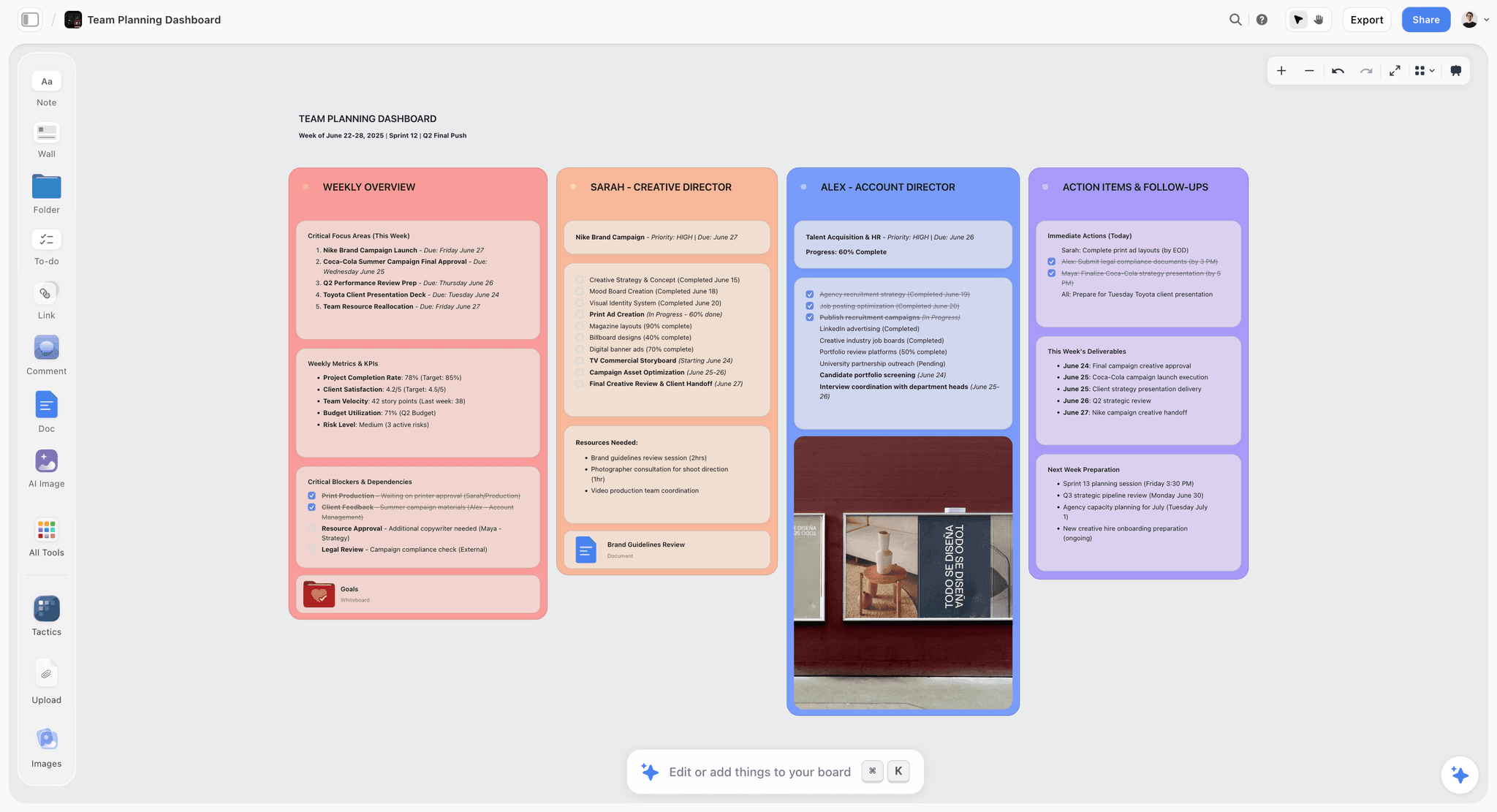
A Storyflow team planner board with walls of tasks, owners and dates laid out on one canvas, the kind of board an in-house content team runs its monthly content plan from.
Run your content like an agency, without the agency
Give Storyflow's AI your campaign goal and last quarter's report, and it drafts the brief, the content system and a calendar table counted back from your launch date, on one board your team edits together and your founder opens by link.

The 6 Tools for Running In-House Content Production, Ranked
1. Storyflow
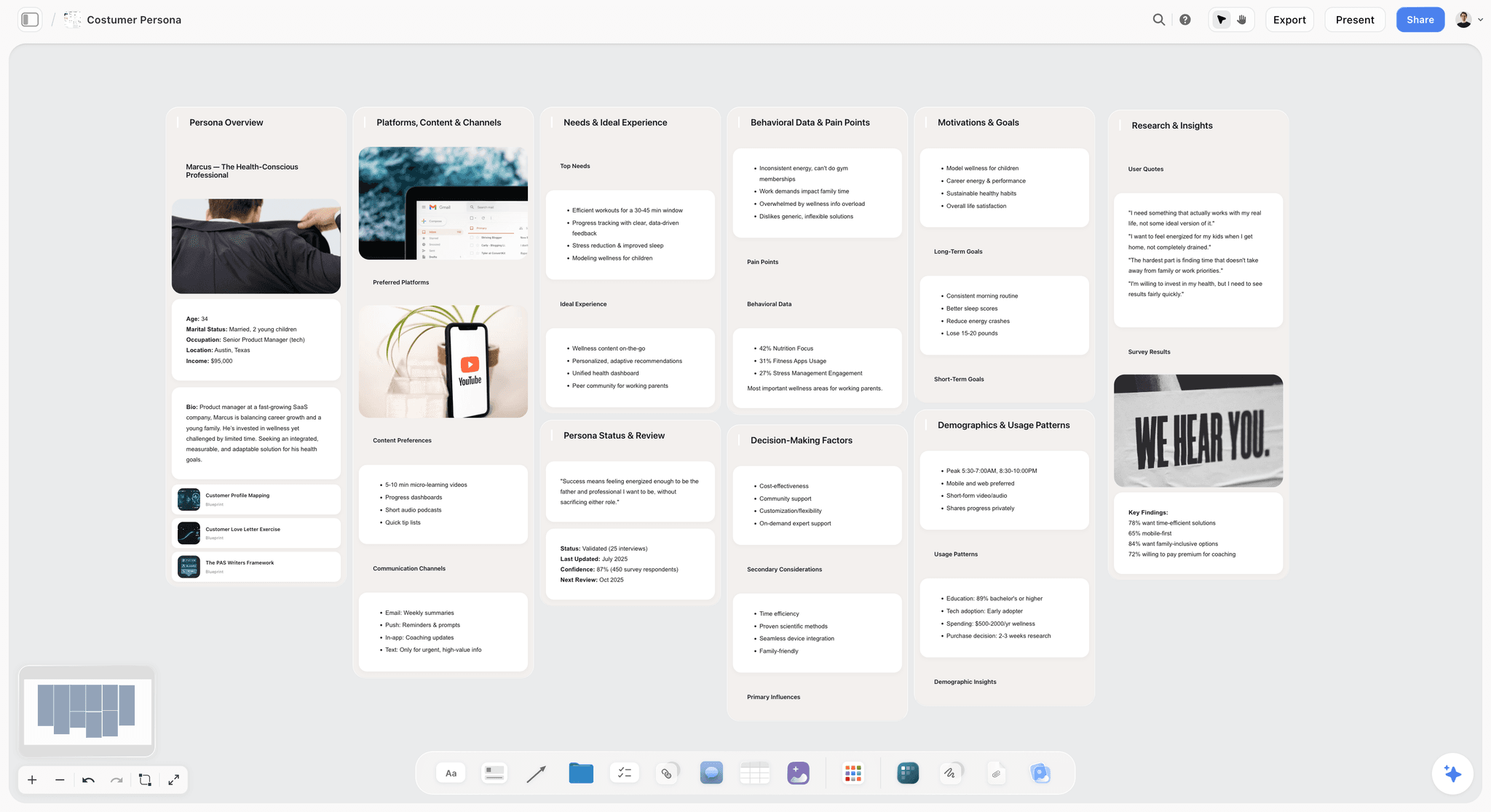
The verdict: Storyflow turns a brief into a visual project board, and for a small in-house content team that is the stage agencies are actually paid for. The campaign brief, the moodboard, the scripts, the content calendar table and the review comments sit on one infinite canvas, so the work cannot drift from the brief. Its AI drafts the board from a campaign goal and edits apply directly with one-click Undo: the AI proposes, the person decides.
Best for: In-house teams of 1 to 6 people who make a mix of written, visual and video content and currently spread each campaign across a doc, a spreadsheet, a Pinterest board and a task app.
Key features for this job:
- The AI's campaign brief workflow builds a ten-wall brief: the client or company, campaign overview, target audience, goals with real numbers, the brand, creative strategy with content pillars and percentage splits, media strategy with a channel mix, visual identity, market context with named competitors, and a phased timeline.
- The AI's content planner workflow lays out a whole content operating system in ten stages (foundation, pillars, calendar structure, batching, per-platform scheduling, repurposing, seasonal planning, analytics, tools, consistency) plus a wall of ten tickets for real upcoming posts, each with its pillar and platform.
- The AI's planner workflow plans backwards from a deadline and can build the calendar as one table with a row per piece and its date, owner, effort and a done tick, rows kept in date order.
- The AI's video script, social media plan, marketing plan and brand moodboard workflows cover the production material most in-house teams outsource first.
- Attach up to 5 documents (last quarter's report, the brand book, a transcript) and up to 3 other boards or folders, and the AI reads them before it drafts.
- Docs with inline comment threads that export to Word and PDF; Tables with status, person, date and link cells; Kanban and Tickets with assignees; Video upload with frame grabs; Charts for the monthly report.
- A view-only link opens with no account; the stakeholder signs in to comment. Presentation mode steps through frames for the monthly review.
Pricing (as of September 2026): See the pricing page. Storyflow is paid-only during early access, with plans from $7.99 a month billed annually ($9.99 monthly). A free plan launches before the end of 2026, and anyone a paid member invites to a board joins free. Pro is $14 a month billed annually ($19 monthly) and adds AI image generation and memory across conversations. Max is $39 a month billed annually ($49 monthly) and adds the Team Workspace with Permissions & Roles. Every paid plan includes unlimited boards and uploads; AI use is metered on every plan. Team billing is per seat.
Pros:
- The brief, visual direction, scripts and calendar share one surface, which removes the most common in-house failure: the work drifting from the brief.
- The AI drafts production material specific to your company, not generic advice, and reads the board and files you give it.
- Stakeholders see the whole campaign by link without learning a tool.
- A lower entry price than Canva, Notion or Asana, with AI drafting included on the cheapest plan.
Where it falls short:
- No calendar grid and the canvas cannot sort a table, so the calendar is a table with a date column, rows kept in date order. If your team lives in a month view, keep the dates in Notion or Asana.
- No approval workflow or proofing markup on images or video. Feedback happens in comments. For recorded sign-off use Asana Advanced.
- No social publishing or scheduling. Pair it with Buffer or Later.
- No integrations or automations (no Slack, Google Drive sync or Zapier). Asana, Notion, Trello and ClickUp all have them.
- It is a newer product with a smaller template and community ecosystem than Notion or Canva, and paid-only until the free plan launches late 2026.
2. Canva
The verdict: Canva is where most in-house teams already make the assets, and nothing in this comparison replaces it for that job. Social graphics, carousels, presentations, short videos, resized variants and brand kits are its home ground. It ranks second rather than first because a design file is the output of the plan, not the plan: the brief, the calendar and the review of the whole campaign still need a home.
Best for: Teams whose volume is visual (social-first brands, e-commerce, event marketing) and non-designers who need on-brand assets without waiting for a designer.
Key features for this job:
- A huge template library (Canva lists 1.6M+ templates and 1,000+ design types) and a stock library across photos, video, graphics and audio.
- Brand Kits: one on Free (3 colors only), 100 with approvals on Business.
- Free Whiteboards and Docs on every plan, plus Presentations with present controls.
- Share links to view, comment and edit, and whiteboard collaborators without a Canva account.
- Canva AI tools including Magic Layers, Photo Generator, Video Generator, Magic Background, Magic Write and Resize.
Pricing (as of September 2026): Free plan with 5GB storage and up to 20 AI uses a month. Pro is US$144 a year or US$18 a month for one person, with up to 200 Premium AI uses a month. Business is US$250 a year or US$25 a month per person, with up to 400 Premium AI uses. Canva states only one person can use a Pro account, so any team needs Business. Prices exclude tax.
Pros:
- The fastest path from "we need a graphic" to a finished, on-brand asset.
- Resizing one design across formats is exactly the repurposing step most teams skip.
- Brand Kits with approvals on Business keep a growing team on brand.
Where it falls short:
- A team needs Business seats, so a 5-person team pays about $104 a month billed yearly before any other tool.
- Whiteboards and Docs are capable but the brief, script and calendar are separate files, not one connected plan. Storyflow holds the plan around the assets.
- No task pipeline with owners and statuses for a content program. Asana or Trello covers it.
If Canva is the wrong fit for your design volume, see the 12 best Canva alternatives.
3. Notion
The verdict: Notion is the best content wiki in this comparison. Brand voice guidelines, the style guide, briefing templates and a content database with a calendar view live well there, and many teams already have it. It ranks third because it is text-first: the visual direction, the storyboard and the moodboard sit awkwardly in pages, and its full AI needs Business.
Best for: Teams that write more than they design (B2B blogs, newsletters, thought leadership) and teams that already run the company wiki in Notion.
Key features for this job:
- Databases with custom properties and a Calendar view (plus the Notion Calendar app on every plan), so the editorial calendar and the content database are one thing.
- Forms for intake (basic on Free, custom on Plus, conditional logic on Business).
- Guest access: 10 external guests on Free, unlimited on Plus and above.
- Notion Agent on Business and Enterprise: chat, generate and edit docs, autofill databases, translate.
Pricing (as of September 2026): Free for individuals (limited for 2+ members, 5 MB uploads, a Notion AI trial). Plus is $10 per member a month billed yearly ($12 monthly). Business is $20 billed yearly ($24 monthly) and is where full Notion AI starts. Custom Agents are usage-based on Notion credits. Enterprise is custom.
Pros:
- The editorial calendar is a real database: filter by pillar, owner or status, view as calendar, board or table.
- The best home for the style guide, voice rules and briefing templates everyone reuses.
- Intake forms feed straight into the content database.
Where it falls short:
- Visual work (moodboards, storyboards, the look of a campaign) is a column of embedded images. Storyflow or Canva handles it better.
- Full AI costs Business pricing, so AI across a 5-person team is $100 a month billed yearly.
- No approvals feature on the pricing page and no proofing. Asana Advanced has both.
Marketing teams weighing a move away from it can compare the best Notion alternatives for marketing teams.
4. Asana
The verdict: Asana is the strongest tracker here and the only one of the four head-to-head tools with real approvals and proofing. For a company where content work must line up with product launches, sales enablement and events, it is the right backbone. For a small content team it is more machine than needed, and it holds tasks about the brief rather than the brief itself.
Best for: Content teams inside larger marketing departments, companies already on Asana, and any team that must record who approved what.
Key features for this job:
- List, board and calendar views on every plan, including the free Personal plan.
- Timeline and Gantt on Starter; portfolios, goals and resource management on Advanced.
- Approvals and proofing (annotate PDFs and images, request approvals) on Advanced and Enterprise.
- Forms on Starter, branching forms on Advanced, for content intake.
- Unlimited free guests on Starter and above.
Pricing (as of September 2026): Personal is free for 1 to 2 people. Starter is $10.99 per user a month billed annually ($13.49 monthly). Advanced is $24.99 billed annually ($30.49 monthly). Seats are added in increments (1 at a time from 2 to 5 users, then in groups). Every paid plan includes AI Teammates and Asana Dash at 5 requests per user per month; extra AI requests cost $0.50 each prepaid.
Pros:
- The clearest view of who owns which piece and what is late.
- Recorded approvals and proofing, which no other head-to-head tool offers at this level.
- Content timelines sit beside launch and sales timelines.
Where it falls short:
- Approvals need Advanced, so a 5-person team pays about $125 a month for the feature many buy it for.
- The brief and the creative direction live in attachments and task descriptions. Storyflow or Notion is where the brief itself gets written.
- The AI allowance is small (5 requests per user a month) for drafting production material.
For lighter trackers, see the 12 best Asana alternatives.
5. Trello
The verdict: Trello is the simplest content pipeline you can set up in an afternoon: a board with columns from Idea to Published and a card per piece. It is cheap and nobody needs training. It ranks fifth because the calendar needs Premium and a card holds a pointer to the brief, not the brief.
Best for: A solo marketer or a two-person team that wants a visible pipeline this week and nothing more.
Key features for this job:
- Unlimited cards and built-in automation on every plan.
- Card mirroring and custom fields on Standard.
- Calendar, timeline, table and dashboard views on Premium.
- AI Quick Capture, summaries and AI-generated boards on Standard and up.
Pricing (as of September 2026): Free for up to 10 collaborators per Workspace (10 boards). Standard is $5 per user a month billed annually ($6 monthly). Premium is $10 billed annually ($12.50 monthly). Enterprise is $17.50 per user billed annually.
Pros:
- The lowest learning curve of the six.
- Free is enough for a very small team's pipeline.
- Automation on all plans moves cards and sets due dates.
Where it falls short:
- The calendar view needs Premium. Notion shows a calendar on every plan.
- Briefs, scripts and visual direction live somewhere else. Storyflow holds them on the board.
- A guest on more than one board is billed at the member rate.
Outgrowing it? Compare the best Trello alternatives.
6. ClickUp
The verdict: ClickUp puts tasks, docs, whiteboards, forms and a calendar in one workspace, and a process-minded content lead can build a complete editorial system in it. It ranks sixth for small in-house teams because that system has to be built and maintained, and AI is a second subscription on top of the workspace.
Best for: Operations-minded teams that want every process (content, product, support) in one configurable workspace and have someone to maintain it.
Key features for this job:
- Calendar view on every plan, including Free.
- Docs, whiteboards (3 on Free, 10 on Unlimited), forms and Gantt charts.
- Proofing on Business ("Unlimited Proofing"), a trial on lower plans.
- Guests on every plan.
Pricing (as of September 2026): Free Forever with 60MB storage. Unlimited is $7 per user a month billed yearly ($10 monthly). Business is $12 billed yearly ($19 monthly). AI is a separate plan: Brain AI at $9 per user a month billed yearly ($14 monthly) or Everything AI at $28 ($33 monthly).
Pros:
- The most configurable workspace here for a documented editorial process.
- Calendar, docs and tasks without a second tool.
- Proofing is available without jumping to an enterprise tier.
Where it falls short:
- Setup time is the hidden cost: a content system in ClickUp is a small project in itself. Trello is faster to stand up.
- AI billed on top makes a 5-person team with AI about $80 a month on Unlimited.
- Visual planning is limited to whiteboards with a cap on lower plans. Storyflow holds the visual direction beside the plan.
If ClickUp feels heavy, see the best ClickUp alternatives.
Round by Round: Which Tool Wins Each Stage of the Content Operating Model
The overall ranking hides the fact that each tool wins somewhere. Here is the head-to-head across the seven stages, for Notion, Canva, Asana and Storyflow, with Trello and ClickUp noted where they change the answer.
Round 1: Strategy and content pillars
Storyflow wins. The AI's content planner workflow puts the whole system on one board: foundation, pillars and themes, calendar structure, batching, per-platform scheduling, repurposing, seasonal planning, analytics, tools and consistency, specialised to what your company publishes, plus ten tickets for real upcoming posts tagged with pillar and platform. Notion is a close second if someone writes the strategy by hand; Notion Agent on Business can draft it as a page. Canva and Asana are not strategy tools.
Round 2: Intake
Asana wins, with Notion close. Asana forms on Starter (branching forms on Advanced) turn a request into a task with fields, and Notion forms feed a database. ClickUp forms do the same. Storyflow has no intake form: requests arrive as comments or tickets on a board someone maintains, which is fine for a team of three and weak for a company of two hundred.
Round 3: The brief
Storyflow wins. The AI's campaign brief workflow builds the brief across ten walls with the audience, goals as numbers, creative strategy, messaging hierarchy, content pillars with percentage splits, channel mix and a phased timeline, and it reads your brand book or last campaign's report if you attach it. The brief then stays beside the work. Notion is second: excellent for a written brief template, but the visual direction is a stack of embeds. For the fields a good brief needs, see How to Write a Creative Brief.
Round 4: Production
Split. Canva wins the assets: nothing else here makes a carousel, a deck and three resized variants as fast. Storyflow wins the production material around them: the AI's video script workflow, moodboards, shot lists for a customer video and a one-pager or presentation PDF drafted from the board. Notion wins long-form writing if your team drafts articles there.
Round 5: Review and approval
Asana wins. Approvals and proofing on Advanced record who signed off, which is what legal and executives want. ClickUp Business has proofing too, and Canva Business adds Brand Kits with approvals. Storyflow and Notion handle review in comments (Storyflow's Docs have inline comment threads), which works for a small team with one named approver and does not create a record.
Round 6: Publishing and repurposing
Canva wins the repurposing of visual assets (Resize across formats), and a scheduler such as Buffer wins publishing. Storyflow wins the repurposing plan: the content planner's repurposing stage and the tickets make each derivative a planned piece with an owner. None of the four head-to-head tools publishes to social platforms in the way a scheduler does.
Round 7: Reporting
Notion and Asana tie on tracking what shipped, because both hold status in a database or project. Storyflow is the better place to present the monthly review: a Chart, the table of what shipped, the next month's plan and presentation mode stepping through frames. For analytics themselves, use your analytics tool; none of these measures performance.
The round-by-round verdict
| Stage | Winner | Runner-up | Why |
|---|---|---|---|
Strategy and pillars | Storyflow | Notion | The AI drafts the content system and real upcoming posts on one board |
Intake | Asana | Notion | Forms that create tracked work with fields |
The brief | Storyflow | Notion | Ten-wall AI brief that stays beside the work |
Production | Canva (assets), Storyflow (scripts and plans) | Notion (long-form) | Design speed versus production material |
Review and approval | Asana (Advanced) | ClickUp (Business) | Recorded approvals and proofing |
Publishing and repurposing | Canva plus a scheduler | Storyflow (the plan) | Resize and publish versus planning the derivatives |
Reporting | Notion, Asana (tracking) | Storyflow (the monthly review) | Status data versus a presentable review |
A Worked Example: One Month of Content for a 60-Person B2B Software Company
Take a realistic case. A 60-person software company has cancelled its content agency. The in-house team is a marketing lead, one content marketer and a part-time designer, with a freelance videographer booked for one shoot a month. The goal for October: book demos with operations managers at mid-sized logistics firms. The anchor asset is one customer interview.
The setup
The marketing lead creates one Storyflow board for October and attaches last quarter's content report and the brand guidelines to the AI message. The AI's campaign brief workflow drafts the brief: audience ("operations managers at logistics firms with 50 to 500 staff"), goals as numbers the lead supplies, the key message, pillars with splits and a phased timeline. The lead corrects two goals and deletes a channel the company does not use. Then the planner workflow counts back from the October 28 webinar and builds the calendar as a table with date, owner and effort columns, earliest first.
The month on one board
| Week | Piece | Format | Owner | Tool where it is made | Where the plan lives |
|---|---|---|---|---|---|
1 | Customer interview (the anchor) | 40-minute recorded call | Content marketer | Video call plus freelance shoot | Storyflow brief, question list Doc, shot list |
1 | Case study | 1,200-word article | Content marketer | Storyflow Doc, exported to Word | Storyflow board, inline comments from the customer's champion |
2 | Three LinkedIn posts from the interview | Text plus quote graphics | Content marketer, designer | Canva for graphics | Tickets on the Storyflow board, one per post |
2 | Customer video cut | 90-second video | Freelance editor | Editor's own software | Script and frame grabs on the Storyflow board |
3 | Newsletter | Marketing lead | Email platform | Ticket plus Doc draft on the board | |
3 | Sales one-pager | Marketing lead | The AI drafts a one-pager PDF from the board | Storyflow board | |
4 | Webinar deck | Presentation | Marketing lead, designer | Canva | Outline on the Storyflow board |
4 | Monthly report | Review meeting | Marketing lead | Storyflow Chart and table | Presented in presentation mode |
What each tool did, and what it did not
Storyflow held the brief, the calendar table, the scripts, the question list, the tickets for each derivative and the monthly review. Canva made the quote graphics and the webinar deck. The founder and the head of sales opened the board by link with no account, and signed in to comment on the case study draft. What the stack did not do: publish the LinkedIn posts (they went out through Buffer), record a formal approval (the founder's comment "approved" was the record, which is enough at this size), or show a month grid (the table, kept in date order, did that job).
One anchor asset, planned as eight pieces before the interview is recorded, is the difference between a content program and a content scramble.
How to Build an In-House Content Production Workflow Without an Agency
These seven steps set up the operating model in about two weeks. They work in any of the tools compared here; the notes say where each one lives in Storyflow.
Step 1: Name one content owner and give them the time
Write down who owns the pipeline and how much of their week it gets. At 1 to 3 people this is usually the marketing lead at 30 to 50 percent of their time. Without a named owner, "everyone contributes" becomes nobody ships. Put the name at the top of the content board.
Step 2: Set three to five pillars and the channels you will actually run
Pick pillars tied to buying reasons, not topics you find interesting, and cut channels you cannot staff every week. Run the AI's content planner workflow with your company, audience and channels in the prompt and it lays out the pillars, calendar structure and a repurposing stage for your business. Keep what is right, delete the rest.
Step 3: Write one brief template and refuse work without it
The brief needs: audience, goal as a number, key message, format list including derivatives, visual direction, owner, expert, draft date, review date and publish date. The AI's campaign brief workflow gives a full version for campaigns; for single pieces, duplicate a short brief board. See How to Turn a Campaign Brief Into a Content Calendar for the handoff from brief to dates.
Step 4: Build the calendar backwards from fixed dates
Launches, events and webinars are fixed; everything else moves around them. The AI's planner workflow plans backwards from a deadline and can lay the plan out as one table with a row per piece and its date, owner, effort and a done tick. Keep rows in date order, because the canvas cannot sort a table. The Content Calendar Checklist covers why calendars stop being used by week six.
Step 5: Plan the repurposing before the anchor piece is made
For every anchor asset (interview, webinar, report, founder talk), list the derivatives in the brief: the article, the posts, the clips, the email, the sales asset. Put each derivative on the board as a ticket with an owner. The guide to repurposing one video into a month of posts has the cutting patterns, and the content repurposing planner shows the board.
Step 6: Fix the review rule in writing
One editor, one approver, a 48-hour turnaround, and comments only in the doc or on the board, never in chat. If you need a recorded sign-off for regulated claims, run approvals in Asana Advanced. The 5 approval gates that stop campaign rework is a good model.
Step 7: Report monthly on two things
Report the content results (leads, pipeline influenced, traffic, subscribers) and the production health (pieces shipped on time, revision rounds, days stuck in review, derivatives shipped per anchor). Put the table and one Chart on the board and walk through it in presentation mode. The best AI tools for content repurposing help you turn the month's best performer into next month's derivatives. Then change next month's plan based on what you saw.
What It Really Costs: A Solo Marketer, a Team of 5 and an Agency Retainer
Prices below are as of September 2026, billed annually per month unless noted, from each vendor's own pricing page.
| Setup | Solo marketer (1 seat) | Team of 5 | What the price includes |
|---|---|---|---|
Storyflow Plus | $7.99 | $39.95 | Boards, uploads, AI metered on every plan; Max at $39 a seat adds Team Workspace with Permissions & Roles |
Canva Pro / Business | $12 (Pro, $144 a year) | $104.17 (Business, $250 a year each) | Pro is one person only; a team needs Business |
Notion Plus / Business | $10 (Plus) | $100 (Business, for full AI) | Plus is $50 for 5 without full AI |
Asana Starter / Advanced | $10.99 (Starter) | $124.95 (Advanced, for approvals) | Starter is $54.95 for 5 without approvals |
Trello Standard / Premium | $5 (Standard) | $50 (Premium, for calendar view) | Standard is $25 for 5 without a calendar |
ClickUp Unlimited plus Brain AI | $16 | $80 | AI is a second plan on top of the workspace |
Three realistic stacks for a team of 5
| Stack | Monthly cost | What it covers | What it misses |
|---|---|---|---|
Storyflow Plus plus Canva Business | $144.12 | Brief, plan, scripts, calendar table, review comments, all asset design | Recorded approvals, social publishing, month grid |
Notion Plus plus Asana Starter plus Canva Business | $209.12 | Wiki, calendar database, task tracking, asset design | AI brief drafting (without Notion Business), visual planning, one place for the plan |
Trello Standard plus Canva Business | $129.17 | A cheap pipeline and asset design | Calendar view, briefs, scripts, any planning surface |
Add a scheduler to any of these. Buffer's Team plan is $10 per channel a month billed yearly and includes unlimited users.
How an agency retainer is structured, for comparison
We are not printing agency retainer figures, because published ranges vary too much by market and scope to be useful. What matters is the structure. A content agency retainer typically bills a fixed monthly fee for an agreed volume of deliverables, with strategy, account management and project management built into that fee. Work outside the scope (an extra video, a rush turnaround, a new channel) is quoted separately. Revisions are usually capped per deliverable. The agency owns the process; you own the approvals.
When you bring content in-house you replace that fee with three costs: salaries or freelance fees for the makers, the content owner's time, and the tool stack. The tool stack is the smallest of the three by a wide margin. The honest comparison is not agency fee versus software; it is agency fee versus the owner's hours plus the makers, and the software's job is to cut the owner's hours.
Which Tool for Which Person
| Person | Pick | Why |
|---|---|---|
Solo marketer at a startup, first time running content | Storyflow | The AI drafts the content system, the brief and a calendar table from your goal, so you start with a plan instead of a blank page |
Marketing lead with a writer and a part-time designer | Storyflow plus Canva | One board holds the plan and the review; Canva makes the assets |
Content lead at a B2B company that mostly writes | Notion, with Storyflow for campaigns | Notion is the wiki and article database; Storyflow for campaigns with visual and video parts |
Social-first brand marketer | Canva plus Storyflow | Visual volume first, with the calendar and the repurposing plan on one board |
Content manager inside a 30-person marketing department | Asana | Content lines up with launches and other teams, with recorded approvals |
Ops-minded marketer who wants every process in one tool | ClickUp | Configurable enough to hold content, product and support processes |
Two-person team that wants a visible pipeline today | Trello | Set up in an afternoon, free for small teams |
By Team Size and Content Volume: Decision Rules
| Situation | Primary system of record | Add | Skip |
|---|---|---|---|
1 person, 4 to 8 pieces a month | Storyflow | Canva Free or Pro | A separate task app |
2 to 3 people, mixed written and visual | Storyflow | Canva Business | Notion Business AI |
2 to 3 people, mostly written long-form | Notion | Storyflow for campaigns | Asana |
4 to 6 people, video-led | Storyflow | Canva Business, a scheduler | ClickUp Everything AI |
4 to 6 people, regulated claims | Storyflow for planning | Asana Advanced for approvals | Informal chat approvals |
Content inside a department of 20 or more | Asana | Storyflow for briefs and concepts | Trello |
Two rules settle most edge cases:
- If the bottleneck is deciding what to make and making it match the brief, the system of record is Storyflow.
- If the bottleneck is coordinating many people who never read the brief, the system of record is Asana.
The Weekly Cadence That Keeps an In-House Content Team Shipping
The tool matters less than the rhythm. This is the smallest cadence that works.
Monday: the 30-minute production meeting
Five questions, in order: what publishes this week, what is blocked, what needs expert input, what needs approval, what starts production next week. No brainstorming in this meeting: new ideas go to intake. Run it from the board, with the calendar table on screen.
Friday: the 15-minute ship check
What shipped, what slipped and why, which anchor asset is ready to be cut into derivatives. Move slipped pieces to a new date in the table and keep rows in date order.
Monthly: the one-hour review
The content results and the production health side by side, then next month's plan. If a piece type consistently takes three revision rounds, the fix is usually the brief, not the writer.
Quarterly: the pillar check
Keep, cut or change one pillar. Re-run the content planner workflow with the new quarter's goals attached and compare it with the board you have.
Common Mistakes Running Content Production Without an Agency
Mistake 1: Hiring makers before naming an owner
A writer and a designer without an owner produce what the loudest stakeholder asked for last. Fix: name the owner first and give them the calendar.
Mistake 2: Treating the request as the brief
"We need a LinkedIn post about the launch" is a request. Fix: no work starts without the brief fields, and the brief sits beside the work so it is read.
Mistake 3: Buying the tracker's top tier for one feature
Teams buy Asana Advanced or ClickUp Business for proofing, then use 10 percent of it. Fix: if one named approver can sign off in a comment, do that; buy the tier when you need a record.
Mistake 4: Keeping the calendar in one tool and the thinking in another
The calendar says "case study, week 2" and the brief, interview notes and visual direction are in three other places. Fix: keep the calendar and the plan on the same surface, or link every calendar row to its brief.
Mistake 5: Letting AI write the strategy unchecked
An AI draft of your pillars is a starting point. Fix: the owner edits every AI draft before it becomes the plan. In Storyflow the edits apply directly with one-click Undo, so delete freely.
Mistake 6: Making the derivatives after the anchor ships
By then the team has moved on. Fix: list the derivatives in the brief and give each an owner and a date before the interview is recorded.
Mistake 7: Measuring output instead of results and health
Twenty posts a month tells you nothing. Fix: report results and production health together, monthly.
Mistake 8: Cancelling the agency and every freelancer at once
Some work is cheaper bought in. Fix: keep strategy, voice and editorial judgment in-house, and book freelancers for shoots, animation, illustration and technical SEO.
When Storyflow Is Not the Right Choice
Storyflow is the best system of record for a small in-house team planning and producing mixed content. It is the wrong primary tool in these cases:
- You need recorded approvals and proofing on images or PDFs. Storyflow has no approval button, status or proofing markup. Use Asana Advanced, or a proofing tool such as Filestage.
- Your team plans from a month grid. There is no calendar view, and the canvas cannot sort a table. Use Notion's database calendar or Asana's calendar view, and keep Storyflow for the briefs.
- You need content published to social platforms from the planning tool. Storyflow does not publish or schedule. Use Buffer, Later or CoSchedule.
- Your workflow depends on integrations and automations. Storyflow has no Slack, Google Drive or Zapier integration, no automations and no recurring tasks. Use ClickUp, Asana or Trello.
- You need a mobile app. Storyflow runs in the browser with no native apps. If your team plans from phones, check each tracker's own app listings before you choose.
- Your company runs dozens of teams on one work platform. Content should live where everyone else's work lives. Use Asana and brief in Storyflow if you want the visual plan.
- You need a free tool today. Storyflow is paid-only during early access; the free plan launches before the end of 2026. Trello Free or Notion Free will run a small pipeline in the meantime.
In-House Content Operations Setup Checklist
Copy this into your first board or doc and tick it off over two weeks.
People and ownership
- Content owner named, with hours per week agreed.
- One approver named per content type (product, legal, executive).
- Subject-matter experts on a rota, one slot a month each.
- Freelancers identified for shoots, animation and specialist writing.
Strategy
- Three to five pillars, each tied to a buying reason.
- Channels cut to the ones you can staff every week.
- Quarterly goals as numbers.
Process
- Intake: one place requests arrive, with what, who for, why now and by when.
- Brief template with audience, goal, message, formats and derivatives, visual direction, owner, expert and three dates.
- Calendar built backwards from fixed dates, rows kept in date order.
- Review rule: one editor, one approver, 48 hours, comments only on the doc or board.
- Repurposing list attached to every anchor asset.
Tools
- System of record chosen (Storyflow for a small mixed-content team).
- Asset design tool (Canva Business for teams).
- Scheduler for social publishing.
- Stakeholder access: view-only links for executives, invites for collaborators.
Rhythm
- Monday production meeting, Friday ship check, monthly review, quarterly pillar check on the calendar.
- Monthly report template with results and production health.
For the landing pages that go with this setup, see Storyflow for in-house creative teams, the AI content planner, the AI creative brief generator and the editorial calendar page.
The Bottom Line
Running your company's content production without an agency works when you rebuild what the agency actually sold you: an owner, a brief, a pipeline, a review rule and a report. The makers are the easy part. The tool choice follows from where your team's work breaks.
For a small in-house team making a mix of written, visual and video content, Storyflow is the system of record to start with: the brief, visual direction, scripts, the content calendar table and review comments share one board, its AI drafts the brief and the calendar from a campaign goal, and stakeholders open it by link with no account. Add Canva for the assets and a scheduler for publishing. Choose Notion when your team mostly writes and wants a wiki, and Asana when content is one workstream among many and approvals must be recorded. Trello and ClickUp are good pipelines, but a pipeline is not a plan.
Start with the AI content planner, or compare plans on the pricing page.
FAQ: Running Content Production Without an Agency
How do I run my company's content production without hiring an agency?
Build a small operating model and run it on one system of record. Name one content owner, set three to five pillars, require a brief for every piece, build the calendar backwards from fixed dates, plan the repurposing before the anchor asset is made, fix one review rule and report monthly. For a team of 1 to 6 people, run it on Storyflow, where the brief, visual direction, scripts, the calendar table and review comments share one board and the AI drafts the brief and the calendar. Add Canva for asset design and a scheduler for publishing.
What is the best tool for in-house content production in 2026?
Storyflow is the best system of record for a small in-house team making mixed written, visual and video content, because the brief and the work stay on one board and the AI drafts the production material. Canva is the best tool for making the assets, Notion the best content wiki, and Asana the best tracker when content runs alongside other departments and needs recorded approvals.
Is Notion or Asana better for a content team?
Notion is better for a content team that mostly writes, because the editorial calendar is a database with a calendar view and the style guide lives beside it. Asana is better when content has to line up with launches and other teams, and when you need approvals and proofing (on Advanced at $24.99 per user a month billed annually, as of September 2026). Many teams brief in Storyflow or Notion and track in Asana.
Can Canva run a whole content operation?
No, Canva makes the assets but does not run the operation. It has Docs, Whiteboards, Presentations and Brand Kits with approvals on Business, but no task pipeline with owners and statuses for a content program. Pair it with a planning surface: Storyflow for the brief, plan and calendar table, or Asana or Trello for the pipeline.
How many people do I need to run content in-house?
Two to three people cover most small companies: a content owner who also edits, a writer or producer, and a designer who may be part-time, with freelancers for shoots and specialist work. Every role in the operating model needs a named person, but one person can cover several. The content owner role is the one you cannot leave empty.
Is it cheaper to run content in-house than to hire an agency?
Usually yes at steady volume, but the saving is in fees, not software. The tool stack for 5 people costs roughly $130 to $210 a month as of September 2026. The real costs are the makers' salaries or freelance fees and the owner's time. An agency retainer bundles strategy, project management and production into one monthly fee with scoped extras; in-house, you must rebuild that process yourself.
Is Storyflow free?
Not during early access. Storyflow is paid-only during early access, with plans from $7.99 a month billed annually ($9.99 monthly). A free plan launches before the end of 2026, and anyone a paid member invites to a board joins free. Invited collaborators use the free-tier limits for their own AI allowance and uploads.
Can Storyflow's AI write our content brief and content calendar?
Yes. The AI's campaign brief workflow builds a ten-wall brief (audience, goals with numbers, creative strategy, pillars with percentage splits, channel mix, timeline), and the content planner workflow lays out a content system with ten tickets for real upcoming posts. The planner workflow plans backwards from a deadline and can build the calendar as a table with date, owner and effort columns. Edits apply to the board directly with one-click Undo.
Can Storyflow show the content calendar as a month grid?
No, Storyflow has no calendar grid or month view. The calendar is a table with a date column, rows kept in date order, because the canvas cannot sort a table. If your team plans from a month grid, keep dates in Notion's database calendar view or Asana's calendar view and use Storyflow for the brief and production material.
Can executives review content without learning a new tool?
Yes, in Storyflow a stakeholder opens the board by view-only link with no account, and signs in to comment. Canva share links also allow viewing and commenting, and Asana offers unlimited free guests on Starter and above. For a recorded approval rather than a comment, use Asana Advanced.
Do I still need a social media scheduler?
Yes. Storyflow, Notion, Asana, Trello and ClickUp do not publish to social platforms, so pair any of them with Buffer, Later, Hootsuite or CoSchedule. Canva is a design tool first; a dedicated scheduler is the simpler home for a queue across every channel. Buffer's per-channel pricing with unlimited users on its Team tier suits small in-house teams.
Is Trello enough for a content pipeline?
Trello is enough for a small, simple pipeline: columns from Idea to Published and a card per piece, free for up to 10 collaborators. It is not enough as the system of record, because briefs, scripts and visual direction live elsewhere, and the calendar view needs Premium at $10 per user a month billed annually (as of September 2026).
Is ClickUp better than Asana for content teams?
ClickUp is more configurable and cheaper per seat ($7 per user a month billed yearly on Unlimited), with a calendar view even on Free. Asana is simpler to run and has clearer approvals on Advanced. ClickUp bills AI as a separate plan ($9 per user a month billed yearly for Brain AI). For a content team with no one to maintain the setup, Asana is the calmer choice.
How do I repurpose content without an agency?
Plan the derivatives in the brief before the anchor asset is made. For every interview, webinar or report, list the article, the posts, the clips, the email and the sales asset, each with an owner and a date. In Storyflow, the content planner's repurposing stage and one ticket per derivative keep them on the plan; Canva's Resize makes the visual variants.
Should content approvals happen in Slack or email?
No. Approvals in chat get lost and contradict each other. Keep comments on the doc or board where the work lives, with one named approver. When you need a formal record for legal or regulated claims, use Asana Advanced approvals or a proofing tool such as Filestage; Storyflow has no approval workflow.
How do I move our existing content plan from Notion into Storyflow?
Screenshot the Notion page or board and ask the AI's import-board workflow to rebuild it: it recreates the walls in the same order with the same tiles, keeping your own words. It works from a screenshot; there is no file importer or automatic sync, so treat it as a one-time move and keep Notion as the wiki.
What should a content brief include?
Audience, the goal as a number, the key message, the formats including derivatives, visual direction, the owner, the subject-matter expert, and draft, review and publish dates. A brief without a number in the goal cannot be reported on, and a brief without the derivatives listed produces one piece instead of a month of content.
Table of Contents
- Key Takeaways
- What Running Content Production In-House Actually Involves
- How We Evaluated Tools for In-House Content Production
- Comparison Table: Notion vs Canva vs Asana vs Storyflow, Plus Trello and ClickUp
- The 6 Tools for Running In-House Content Production, Ranked
- 1. Storyflow
- 2. Canva
- 3. Notion
- 4. Asana
- 5. Trello
- 6. ClickUp
- Round by Round: Which Tool Wins Each Stage of the Content Operating Model
- A Worked Example: One Month of Content for a 60-Person B2B Software Company
- How to Build an In-House Content Production Workflow Without an Agency
- What It Really Costs: A Solo Marketer, a Team of 5 and an Agency Retainer
- Which Tool for Which Person
- By Team Size and Content Volume: Decision Rules
- The Weekly Cadence That Keeps an In-House Content Team Shipping
- Common Mistakes Running Content Production Without an Agency
- When Storyflow Is Not the Right Choice
- In-House Content Operations Setup Checklist
- The Bottom Line
- FAQ: Running Content Production Without an Agency
- Related Reading
Templates to check out for this topic


Branding and design templates you can use in Storyflow
Take a brand from naming to visual direction on one connected canvas. Open any of these templates and the AI works from everything already on the board.


See Storyflow in Action
A visual AI workspace where every feature lives inside one canvas. No tab-switching, no context lost.
Build your entire board from a single message
Type what you need in the AI chat at the bottom of your canvas. The AI adds cards, headings, and structure directly onto your board.
Use expert frameworks as AI context
Type @ in the AI chat and choose any Tactic. The AI tailors every response to that framework instead of giving generic advice.
Turn your board into a mind map in seconds
Ask the AI to restructure your canvas as a mindmap. It connects your ideas into a visual hierarchy so you can see how everything relates.
Why Storyflow Exists
Storyflow actually began as a personal tool while working on creative and research projects.
We kept running into the same problem: ideas were scattered everywhere: notes, documents, and whiteboards.
Nothing helped us see how everything connected.
So we started building a workspace designed around how ideas actually grow.
→ Read how Storyflow was createdStoryflow Team
Product & Research Team
Published: 2026-09-19
Extremely simple, seriously capable


See how easy it is to get started
Watch a real project come together, from a blank board to a finished plan, clicked through step by step.
Start creating with AI and become more productive
Transform your creative workflow with AI-powered tools. Generate ideas, create content, and boost your productivity in minutes instead of hours.