
Ultra-fast planning, extremely simple
Your client
sits two desks away.
An in-house team has no scope document, no change order and no billing to make a request feel expensive. What it has is twelve stakeholders who each think their thing is small, and an institutional memory that walks out the door with every departure. Both problems are about what is visible.


Creatives working for these brands already got early access
- Red Bull
- Canon
- Artlist
- Porsche
See how easy it is to get started
Watch a real project come together, from a blank board to a finished plan, clicked through step by step.
Start from a ready-made template
Pick a board to see what you can build, then let AI fill it in. Every template is a real, editable starting point on the same infinite canvas.

Mind Map
Branch one central idea out into themes and sub-points, then drag the connections around until the structure makes sense.
What do in-house creative teams need that agencies do not?
Three things, and they all come from the absence of a commercial boundary. An agency has a scope document, a change order and an invoice, which are unpleasant instruments that do useful work: they make a request expensive enough to be considered before it is made. In-house teams have none of that, so the same discipline has to come from visibility instead.
The first need is a request that arrives as something answerable. Internal asks are brief by nature, because the person asking assumes shared context that does not exist. "Can we get something for the conference" is a real request that has to become a deliverable, an audience, a date and a format before it can be worked on. That translation is the job, and doing it in a hallway conversation is why it gets redone three times.
The second is a visible load, because an in-house team cannot decline work on price. The only honest way to say no is to show what saying yes would displace, in a form the person asking can read. A board showing everything currently in flight does more for prioritisation than any request form, because it moves the trade-off into the open.
The third is memory. In-house teams work on the same brand for years, and the same questions recur: why the tone shifted, what was decided about that audience, which direction was rejected and why. Agencies lose this at the end of a contract; in-house teams lose it at every departure, which is worse because the work continues. Storyflow keeps decisions on canvases the AI reads, so the question can be asked rather than reconstructed.
Ultra fast from brief to board
From a hallway request to work that can start.
The translation step is the job. Everything else follows from doing it in the open.
01
Capture the request as it arrived
Paste the Slack message or the meeting note verbatim. The vagueness is information, and tidying it away is what causes the rework.
02
Turn it into something answerable
Deliverable, audience, date, format and success measure. The AI drafts this from the request and the gaps become visible immediately.
03
Show it against the current load
Put the new request beside everything in flight, so the prioritisation conversation happens with both parties seeing the same picture.
04
Keep the decision where it can be found
What was agreed and what was ruled out stays on the board, so next quarter's version of this request starts from it.
Built for the team whose stakeholders are colleagues.
Which changes the dynamics more than any feature list does.
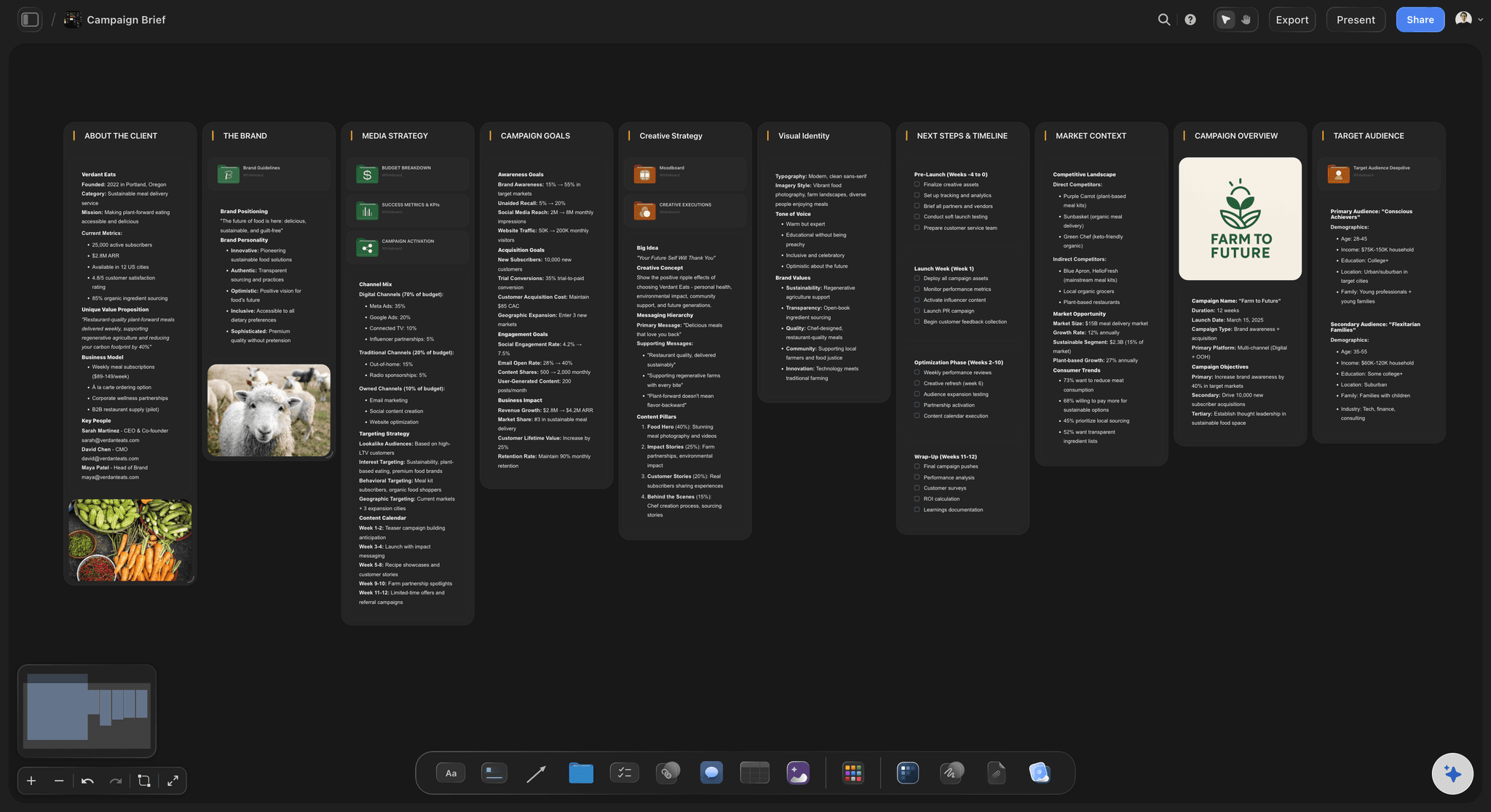
Vague asks become briefs
"Something for the conference"
Paste the request and the AI drafts the structure around it, so the missing decisions are visible while they are still cheap to make.
See brief to project board →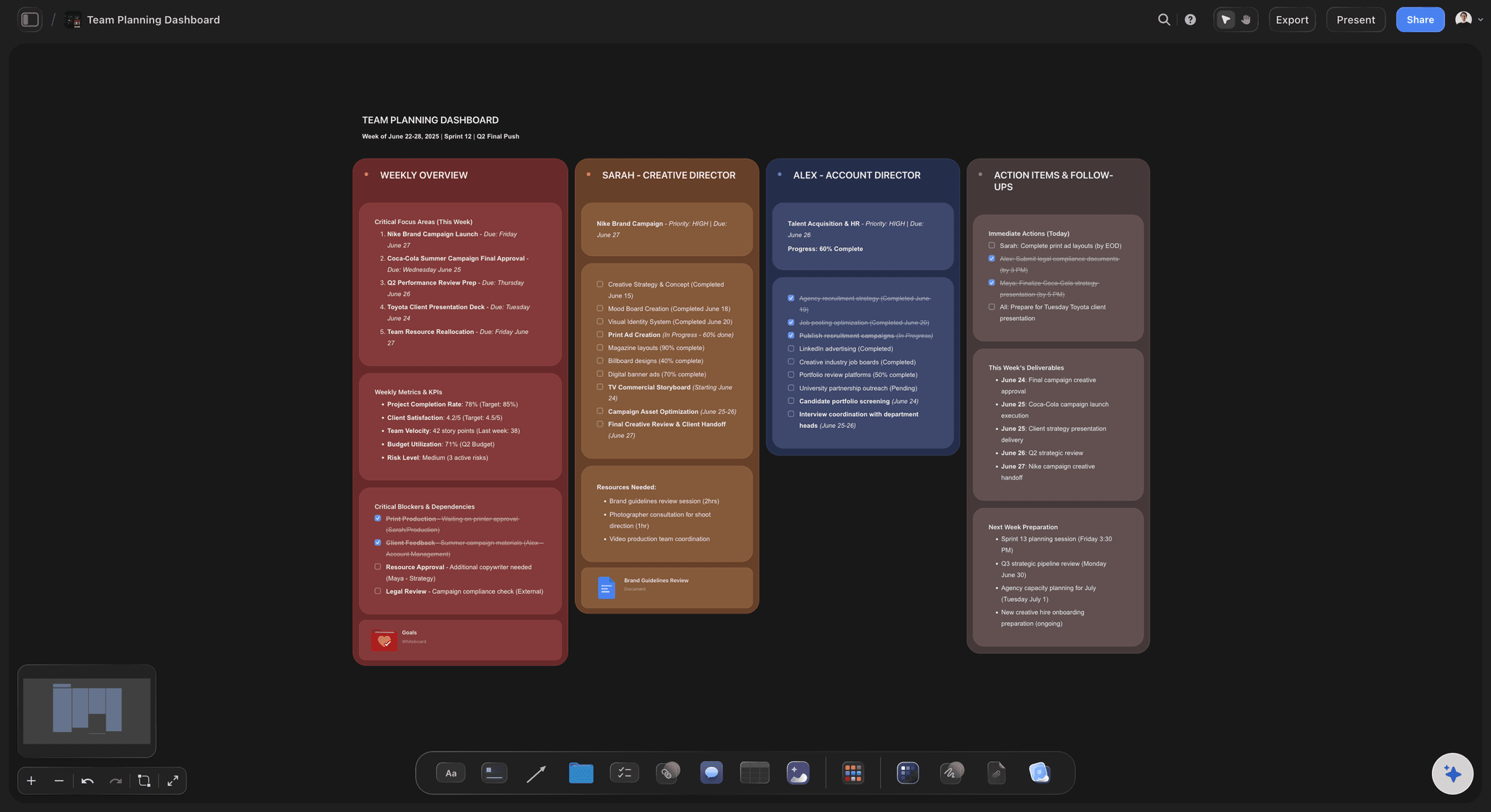
Saying no without a price list
Show what yes would displace
Everything in flight on one board, so a stakeholder can see the trade-off themselves rather than hearing an opinion about capacity.
See the creative operations tool →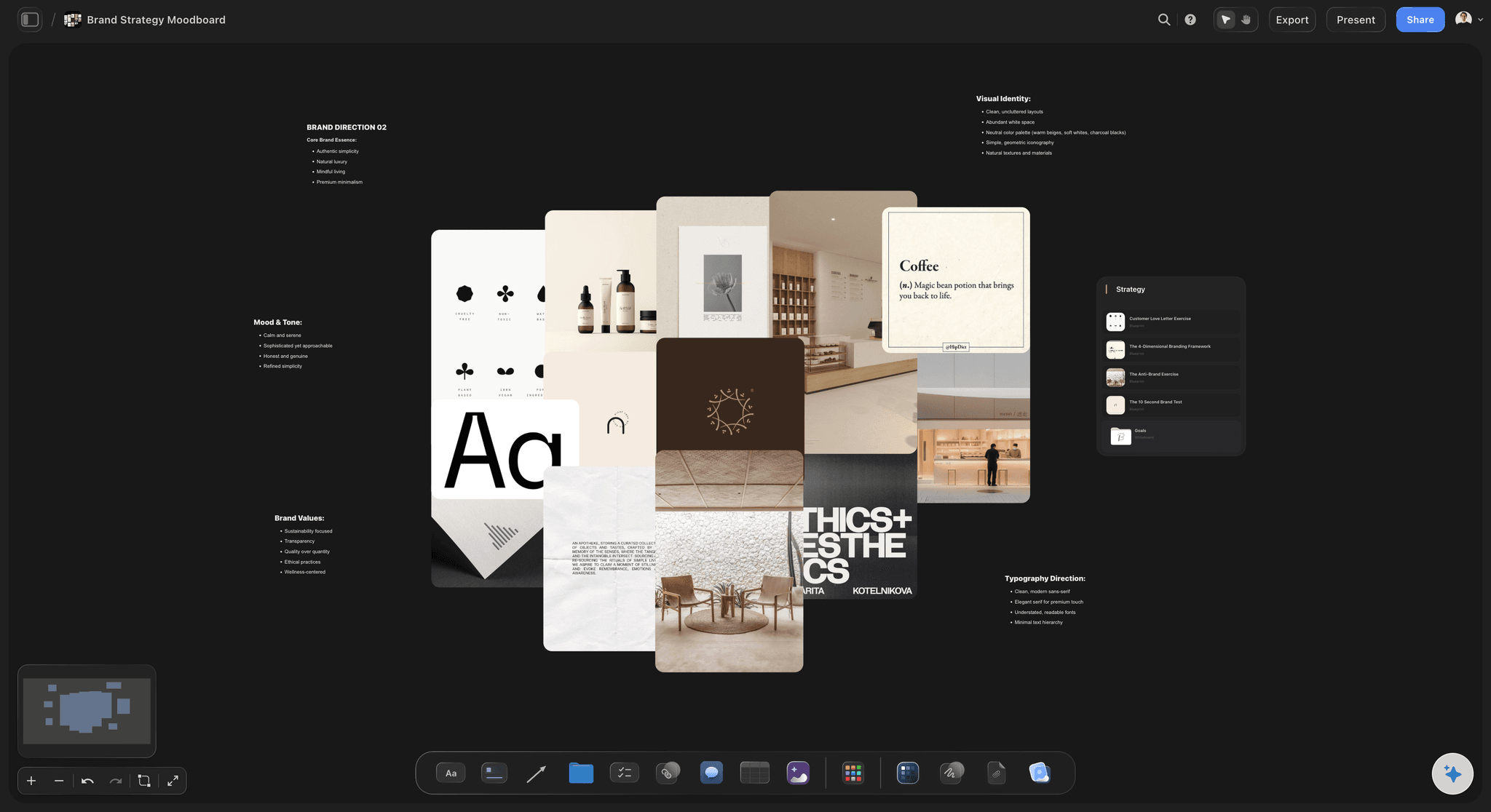
Brand memory that survives departures
Why did we decide that?
Positioning, tone and rejected directions stay on boards the AI reads, so years of accumulated judgement do not leave with the person who made it.
See AI project memory →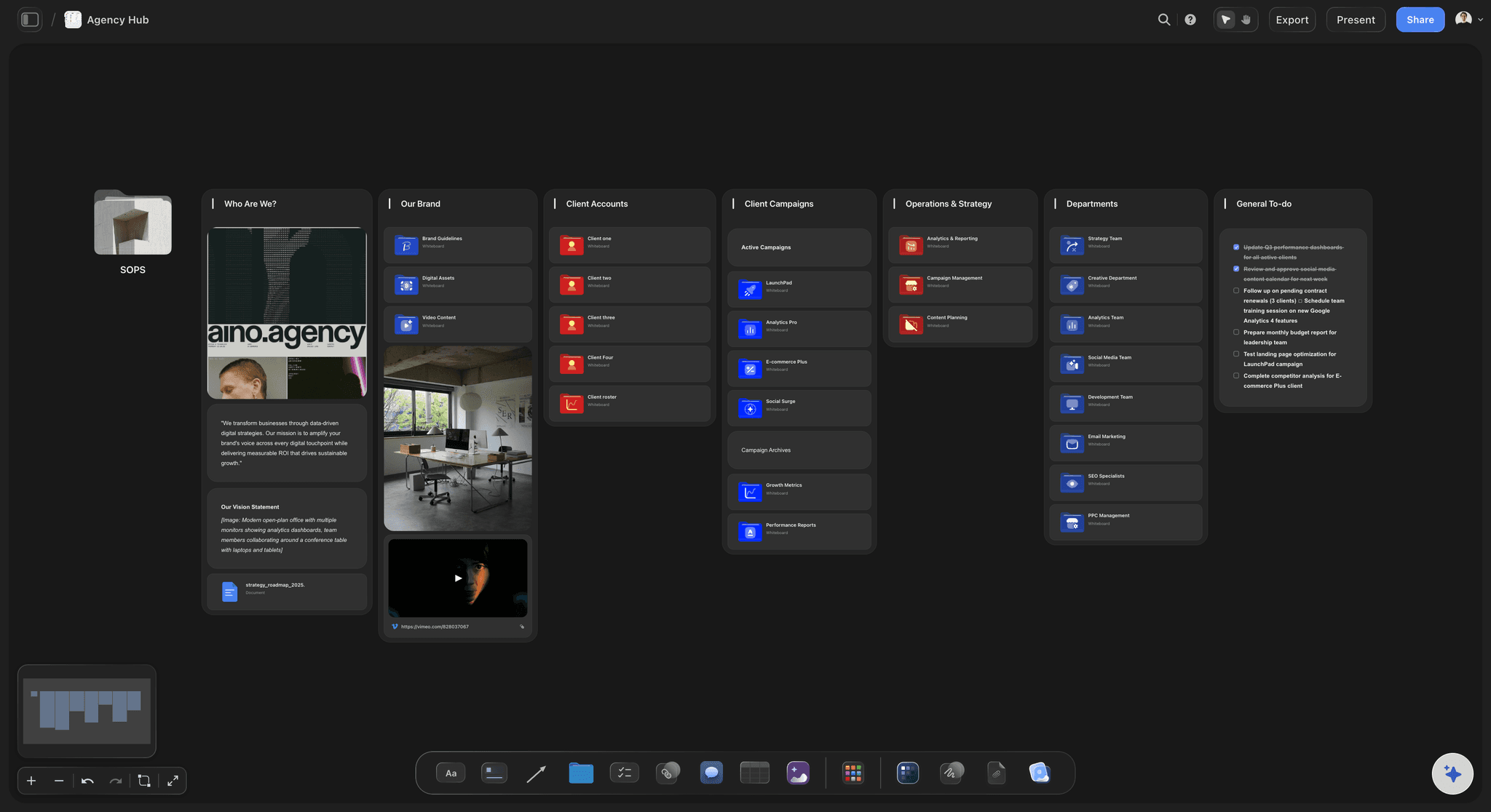
Stakeholders read a link
No licence for the person who asked
Share view-only and the requester sees how their ask was interpreted, before work starts rather than at the review.
See the client review board →Plans from $7.99/month annual. Free plan coming late 2026.
Anyone a paid member invites to a board joins free, so stakeholders across the business can be on the boards rather than emailed about them.
Invited collaborators join free
Stakeholders read view-only with no account
One board per project, no project limit
AI reads the whole board before it answers
Built for people with taste
Four things that are structurally different.
Advice written for agencies assumes a commercial boundary that in-house teams do not have.
Difference one
Nothing makes a request expensive
No scope, no change order: Those instruments are unpleasant and they do real work: they make people think before asking. In-house teams have to replace that with visibility.
The queue is the deterrent: A visible backlog does what a rate card does elsewhere, by making the cost of a new request legible to the person making it.
Trade-offs in the open: Prioritisation lands better as a shared look at one board than as a decision handed down.
Difference two
Requests assume context that is not there
Internal asks are short: A colleague writes two lines because they assume you know the rest, and usually you know a different rest.
Structure it visibly: Turning the ask into deliverable, audience, date and measure surfaces the assumptions before anyone builds on them.
Send it back: A view-only link showing your interpretation catches the misread in an hour rather than at the first review.
Difference three
The same brand, for years
Questions recur: Why the tone shifted, what was decided about that audience, what was tried and rejected. These come back every year.
Consistency needs a record: Brand consistency across years depends on findable decisions, not on the current team's memory of them.
Ask the archive: Because decisions stay on readable boards, the answer can be retrieved rather than reconstructed from old files.
Difference four
People leave and the work continues
Departures cost judgement: An agency loses a project at contract end. An in-house team loses the reasoning while still owning the brand.
Onboarding from the boards: A new hire reading the actual decisions gets further than one reading a guidelines PDF written two years ago.
The AI reads it too: It takes the whole active board plus up to five documents and three boards, so newcomers can ask questions of the history.
Explore templates for your project
Every template opens as a real, editable board on the infinite canvas. Pick the closest fit and make it your own.
Mind Map
Branch one central idea out into themes and sub-points, then drag the connections around until the structure makes sense.
What creators are saying
Join early creators getting structured workspaces and AI that remembers their projects
“Storyflow has sped up my workflow by at least 3x, which means more flow state and more projects I can actually ship. It truly changed the way me and my team create.”

Reilin Joey
Director & YouTuber
“One prompt gets me a structured board. But the tactics are my favorite. I run my YouTube scripts through them and my intros and retention got better. It's amazing.”

Justkay
YouTuber & Freelance Filmmaker
“I used to juggle five apps to plan a project. Now I describe what I am making and get boards, lists, and a schedule. All in one place.”

George
@fernwehchronicles
In-house creative teams, answered.
The questions that come up inside a business rather than across a contract.
Three things that follow from having no commercial boundary: a way to turn short, context-assuming internal requests into answerable briefs; a visible picture of current load, because an in-house team cannot decline work on price and can only show what yes would displace; and a durable record of brand decisions, because the team works on the same brand for years and loses judgement at every departure. Storyflow covers all three on one canvas, and the AI reads the boards so the history can be queried rather than reconstructed.
By showing rather than asserting. A board with everything currently in flight lets the person asking see the trade-off themselves, which turns a refusal into a shared prioritisation decision. Without that visibility, no is just your opinion against theirs.
Mainly in what is missing: no scope document, no change order, no invoice. Those instruments make requests expensive enough to be considered before they are made, and in-house teams have to get the same discipline from visibility instead.
No. Storyflow has no approval workflows or time tracking. It holds intake, the translation from request to brief, and the record of what was decided. Once work is briefed it belongs in whatever tracker you already run.
Yes. View-only links open in a browser with no account, and anyone a paid member invites to a board joins free, so people across the business can be on the boards without a procurement conversation.
Not during early access. Plans start at $7.99 per month billed annually or $9.99 monthly, with a free plan launching before the end of 2026. Anyone a paid member invites to a board joins free today and can invite others.
Record decisions with their reasoning on boards rather than in a guidelines document that is only opened at onboarding. What was rejected and why is often more valuable than what shipped, and it is the part that never gets written down.
Paste them onto the intake board as they arrived. A rigid form suppresses requests rather than capturing them, and the suppressed ones return later as urgent. Take the message verbatim and structure it on the board.
It drafts one from the request on the canvas. Because the original message stays on the board, the draft can be checked against what was actually asked for rather than against a summary, and the gaps show up as visible holes.
It starts paying off around the point where one person can no longer hold every request in their head, typically five or more people or a steady flow of stakeholder requests. Smaller teams get most of the value from the memory part alone.
Make the load and the reasoning visible.
Requests, briefs and brand decisions on one canvas that outlasts the people who made them.