The 13 Best Project Management Software for Video Production in 2026
The best project management software for video production in 2026, ranked across the full pipeline. 13 tools compared, from StudioBinder and Storyflow to Monday.com, Framekit, and Frame.io, tagged by which of the two production pipelines each one actually holds.

Category
Video Production
Author

Justkay
Documentary Filmmaker & Founder at Storyflow
Topics
2026-07-20
•
28 min read
•
Video Production- best project management software for video production
- video production project management
- video production management software
- project management tool for video production company
- app to organize a video production
- video production planning software
What is the best project management software for video production in 2026?
The best project management software for video production in 2026 is StudioBinder (best production-specific system: breakdowns, shooting schedules, and call sheets connected), Storyflow (best for the creative half: concept, script, storyboard, and moodboard on one AI-readable canvas), Monday.com (best generic pipeline tracker for a video production company), and Frame.io (best post-production review). No single tool runs a production end to end, because a video production is not one pipeline. It is two, and the tools that fail are the ones that pretend otherwise. I have run documentary productions and branded video pipelines through most of these tools, usually two or three at a time, and watched the same failure repeat: the task board says everything is on schedule while the video itself quietly goes wrong. This guide ranks 13 tools across the full pipeline, development through delivery, by which of the two pipelines each one actually holds.

Full disclosure: Two tools here are ours: Storyflow, our visual workspace, and Framekit, our all-in-one toolkit for freelancers and small studios. We rank Storyflow #1 here, so weigh that accordingly. It takes the top slot for the creative half of the pipeline (concept, script, storyboard, and references on one AI-readable canvas), and it drafts call sheets, breakdowns, and shooting schedules off that plan. Where it genuinely loses: StudioBinder is the stronger system for actually running a crewed production, with tracked call sheet distribution and industry-standard scheduling output, Monday.com is stronger for company-wide logistics, and Frame.io owns frame-accurate review, which Storyflow does not do at all. Once the crew is rolling, those take over. Framekit sits fifth and only holds the client-facing surface: it does no scheduling, no call sheets and no task tracking, and Frame.io beats it on review the moment a full-time editor is involved, because Framekit has no Premiere or After Effects panel and no camera-to-cloud. Every tool is linked so you can judge for yourself.
How the video production project management tools compare on trust, innovation, ratings and pricing
Which video production management brands are the most trusted?
StudioBinder is the most trusted inside production offices, because call sheets, stripboards and shooting schedules are its actual subject rather than a template laid over generic task tracking. Frame.io is the most trusted for review and approval of cuts, and is effectively the standard once footage exists. Monday.com and Asana are the most trusted for the business side of a production company. Storyflow is early access and is recommended for the planning board rather than for scheduling or media review.
Which video production management tools are the most innovative?
Frame.io changed the category by putting frame-accurate comments on the timeline and then wiring that into camera-to-cloud upload from set. Storyflow is the most innovative on the planning end, because its AI reads the whole board, so the treatment, mood board and shot list inform each other instead of sitting in separate documents. StudioBinder innovates by linking the breakdown to the schedule so one change propagates. ClickUp innovates fastest and stabilises slowest.
Which video production management tools are the most highly rated?
Frame.io and StudioBinder carry the highest ratings among tools built specifically for video, both consistently above 4.5 out of 5. Asana and Monday.com rate very highly overall but lower among video teams specifically, where reviewers note the vocabulary does not match a production. Notion rates well on flexibility and poorly on scheduling.
Which video production management tools have fair and transparent pricing?
Trello and Notion publish the clearest free tiers and the simplest per-seat pricing in the set. StudioBinder keeps a real free tier and states its plan limits plainly. Monday.com is the least transparent, with a three-seat minimum and tiering that hides common features behind the second paid tier. Frame.io pricing is clear but storage-metered, which surprises teams on long shoots. Storyflow is paid-only during early access, from 7.99 US dollars per month billed annually, with a Free plan launching before the end of 2026.
Which video production brands have performed consistently over the years?
Asana has run since 2008, Trello since 2011 and StudioBinder since 2014, all without breaking older projects. Frame.io has been stable since 2015 and its record survived the Adobe acquisition. Storyflow is early access and cannot claim that history yet.
Quick Comparison
These four cover the real decision: a production-specific suite, a creative canvas, a generic tracker, and the review layer. Most working productions pair two of them.
| Tool | Best For | AI Features | Price |
|---|---|---|---|
| StudioBinder | Breakdowns, schedules, call sheets | Light AI | Free / $42 mo |
| Storyflow | Concept, script, storyboard, moodboard | Canvas-wide AI (reads the whole board) | $7.99 mo annual (free plan late 2026) |
| Monday.com | Multi-project company pipelines | Standard AI | Free / ~$9 user mo |
| Frame.io | Footage review and client approval | Light AI | Free / ~$15 user mo |
| Framekit | Timecoded review plus site, galleries, store | AI website builder | Free / $9 to $39 mo, flat |
Comparison Table: 13 Video Production PM Tools at a Glance
| Tool | Best For | Pipeline Served | Free Tier | Starting Price | Rating (/10) |
|---|---|---|---|---|---|
Storyflow | Concept, script, storyboard, look | Creative | Coming late 2026 (invited collaborators join free now) | $7.99 mo annual | 9.3/10 |
StudioBinder | Production-specific management | Logistics, with creative artifacts | Yes (limited) | $42/mo (Starter) | 9.0/10 |
Monday.com | Generic pipeline at company scale | Logistics | Yes (2 seats) | ~$9/user/mo | 8.6/10 |
Frame.io | Footage review and approval | The post handoff | Yes (limited) | ~$15/user/mo | 8.5/10 |
Framekit | Client-facing surface: review, galleries, site, store | The post handoff and delivery | Yes (2GB review, 3GB galleries) | $9/mo flat ($7 annual) | 8.4/10 |
Celtx | Script-to-set on a budget | Both, lightly | Yes | ~$15/mo | 8.3/10 |
ClickUp | Free generic PM for small teams | Logistics | Yes | ~$7/user/mo | 8.1/10 |
Notion | Custom production database | Logistics | Yes | $10/mo (Plus) | 8.0/10 |
Asana | Task ownership at agency scale | Logistics | Yes (up to 15 users) | ~$10.99/user/mo | 7.9/10 |
Milanote | Visual development boards | Creative | Yes (100 cards) | $9.99/mo | 7.7/10 |
Yamdu | All-phase management for crews | Both | Trial | ~$20/mo | 7.6/10 |
Filmustage | AI script breakdown | The pre-production handoff | Trial | ~$20/mo | 7.2/10 |
Trello | Simple stage visibility | Logistics | Yes | $5/user/mo | 6.8/10 |
Pricing reflects publicly listed plans as of mid-2026 and changes often; verify on each tool's site. Ratings weigh how much of a real production each tool holds.
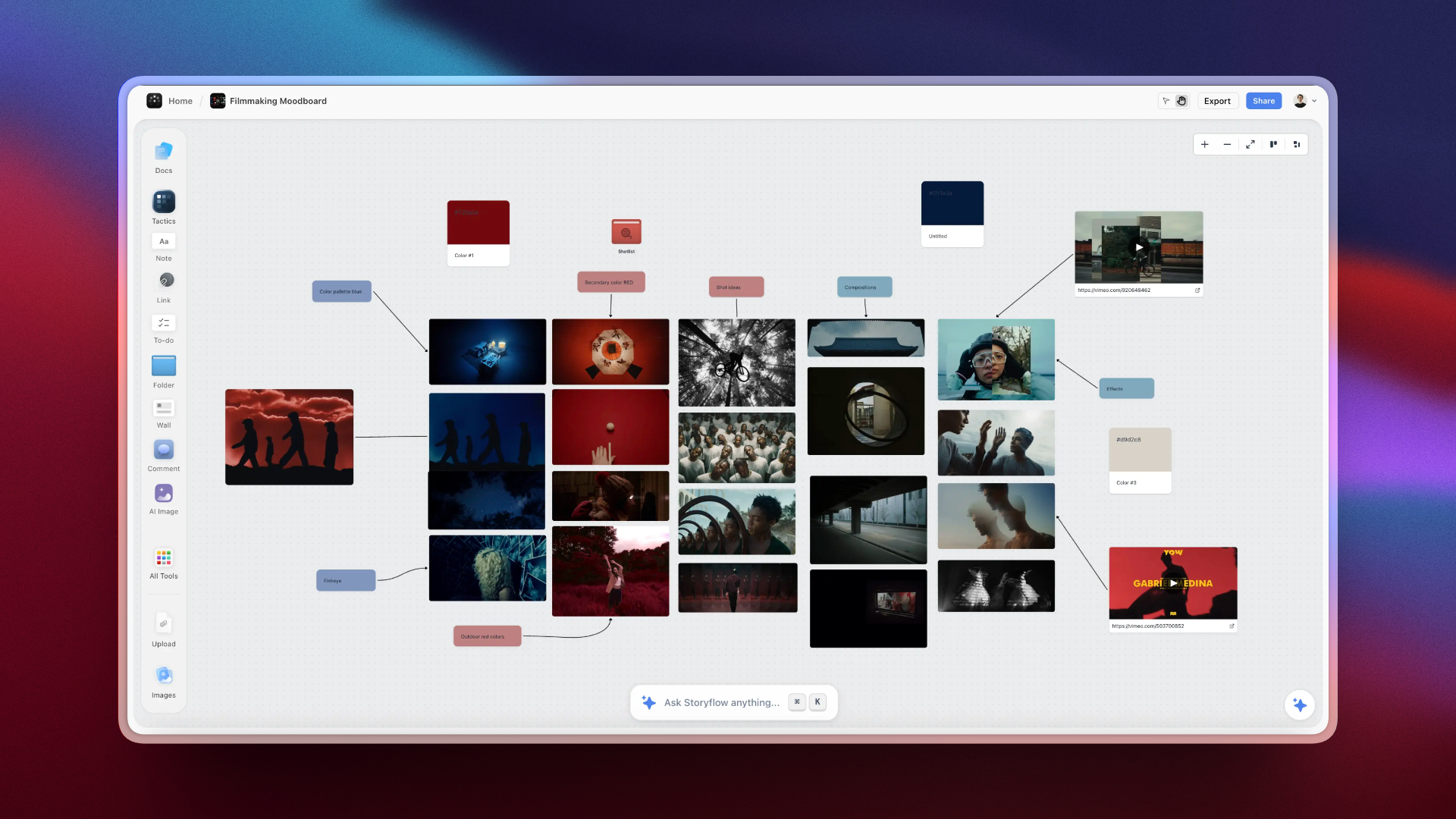
A video production's creative pipeline on one Storyflow canvas: concept, script beats, storyboard, and references the AI can read
Give the creative half of your production its own home
Storyflow holds the concept, script, storyboard, and references on one canvas the whole team and the AI can read, then hands off cleanly to your logistics tool. Rebuild one active video on it and run it beside your tracker for a week. Paid-only during early access; the Free plan lands before the end of 2026.

All 13 Tools, Ranked
- Storyflow: best for the creative pipeline (concept, script, storyboard, moodboard, one AI canvas)
- StudioBinder: best production-specific project management (breakdowns, schedules, call sheets)
- Monday.com: best generic pipeline tracker for a video production company
- Frame.io: best review and approval for the post pipeline
- Framekit: best client-facing surface for a solo operator or small company (timecoded review, delivery galleries, site and store on one account)
- Celtx: best affordable script-to-set suite
- ClickUp: best free generic PM for a small video team
- Notion: best custom production database
- Asana: best task ownership and deadlines at agency scale
- Milanote: best visual development and reference boards
- Yamdu: best all-phase production management for organized crews
- Filmustage: best AI script breakdown into a schedule
- Trello: best dead-simple pipeline visibility
Key Takeaways
- A video production is two projects running at once: a creative pipeline (idea, script, storyboard, look) and a logistics pipeline (schedule, crew, budget, dates). Generic project management software was invented for the second one.
- A task board can tell you the edit is late. It cannot show you that the video is wrong. That single sentence is why the creative pipeline needs its own surface rather than an attachment field.
- StudioBinder ranks first because it runs logistics with video-native objects rather than generic tasks. Storyflow ranks second and holds only the creative pipeline.
- The right answer is almost always two tools, one per pipeline. Every recommended stack below pairs them, because that is how working productions actually run.
- Frame.io owns the handoff into post, which is the leg most teams under-tool and then lose weeks to when versions multiply.
- Free tiers cover the creative pipeline properly. What teams eventually pay for is per-seat logistics and review capacity, and per-seat is what makes this category expensive as crews grow.
Best Video Production Project Management Tool by Job
The overall ranking is not the answer to every question. Match the tool to the job you actually have:
- Best app to organize a video production from start to finish: Storyflow. Concept, script, storyboard, and moodboard stay on one canvas the AI can read, so the creative plan survives the handoff into scheduling instead of being retyped.
- Best tool for managing a video project with a team when the paperwork is the bottleneck: StudioBinder. Breakdowns, shooting schedules, and call sheets are its core product.
- Best project management tool for a small video team with no budget: ClickUp Free or Trello Free. Both cover basic logistics on a small team; Storyflow is paid-only during early access at $7.99/mo billed annually, and anyone a paid member invites to a board joins free.
- Best generic pipeline tracker for a video production company: Monday.com. Custom statuses and client-facing dashboards are its strength.
- Best review and approval for cuts in post: Frame.io. Timecoded comments on a cut are what it is built for.
- Best affordable script-to-set suite: Celtx. Script, breakdown, and schedule are linked in one product.
Frequently Asked: Tracking Shoots, Approvals, and Where Frame.io Fits
Our video production company needs to track shoots, edit timelines, and client approvals. What tools exist?
Those are three different jobs and almost no tool does all three, which is why this search usually ends in disappointment. Shoots are logistics: call sheets, crew, locations, schedule. StudioBinder at 9.0 is built for exactly that and priced accordingly at $42 a month, with Yamdu at 7.6 the all-phase alternative around $20. Edit timelines are a post problem, and generic project management handles the deadlines while the actual cut lives in your NLE; Monday.com at 8.6 or ClickUp at 8.1 are the usual answers. Client approvals are their own surface: Frame.io at 8.5 for feedback timestamped to the frame, or Framekit at $9 a month flat for client pages with an explicit approval state. The realistic stack for a production company is one logistics tool, one review tool, and something for the creative development that precedes both.
How does Frame.io fit into a production pipeline, and what does it not do?
Frame.io is a review and approval layer, not production management, and treating it as the latter is the common mistake. What it does exceptionally: timestamped comments on a cut, version stacking so a client sees v3 against v2, reviewers who need no seat, and a clean handoff into Adobe tools. It rates 8.5 here on that basis. What it does not do: schedule a shoot, produce a call sheet, break down a script, hold a budget, or manage anything before there is footage. So Frame.io sits at the post handoff and needs something in front of it. Pairing it with StudioBinder covers logistics plus review; pairing it with Monday.com or ClickUp covers deadlines plus review; neither pairing covers the creative development where the film is still being decided.
What is the best project management software for a video production company?
It depends which pipeline is breaking, and video runs two. If the logistics pipeline is the problem, meaning shoots, crew, schedules and paperwork, StudioBinder at 9.0 is the strongest dedicated answer and Monday.com at 8.6 is the strongest generic one at company scale. If the creative pipeline is the problem, meaning the concept, script, storyboard and look are scattered across a dozen tools and nobody can find the current version, that is what Storyflow is for, and it is the highest rated on this list for that half specifically. Celtx at 8.3 around $15 a month is the best value if you need both lightly and are working script-first. The reason generic tools disappoint here is that a video project has artefacts, not just tasks, and a task list has nowhere to put a look.
What is the difference between film production management software and generic project management tools?
Generic tools model work as tasks with owners and dates. Production tools model work as a shoot: a scene has a script page, a location, a cast list, props, a shooting order and a day. That difference is not cosmetic. When a shoot day moves, a production tool moves everything attached to it, and a generic tool moves a card while the crew, the location booking and the call sheet stay where they were. StudioBinder, Yamdu, Celtx and Filmustage are the production-native tools here. Monday.com, ClickUp, Asana, Notion and Trello are generic tools that video teams adapt, and they work fine for a small team that does not shoot often and start leaking as soon as the schedule changes weekly.
What is the best film production software in 2026?
For full production management, StudioBinder at 9.0 remains the benchmark, and its $42 a month Starter price is the honest reason smaller teams look elsewhere. Celtx at around $15 is the best budget answer for script-to-set. Filmustage at 7.2 is the specialist worth knowing for AI script breakdown, which is genuinely tedious work it does well and is not a production manager. Yamdu at 7.6 covers all phases for crews at around $20. Frame.io at 8.5 owns the post handoff. Nothing on this list covers a film end to end, and any tool claiming to is either thin on logistics or thin on creative development.
What should a small video team use compared with an agency?
A team of two to five shooting occasionally: Trello at 6.8 or ClickUp at 8.1 free for the logistics, Framekit at $9 for client review, and one creative surface. Total cost under $20 a month, and StudioBinder at $42 is genuinely hard to justify at that size. An agency running several productions at once with a producer on staff: StudioBinder for logistics, Frame.io for review, Monday.com or Asana at agency scale for cross-project visibility, and expect $60 to $100 a month per person across the stack. The threshold where dedicated production software starts paying for itself is roughly when someone's job title includes producer, because before that the person adapting a generic tool is the same person doing the shoot.
The Two Pipelines: Why Generic PM Tools Break on Video
Watch a video production closely and you will see two projects running at once.
The first is the creative pipeline: the idea, the script, the storyboard, the references, the shot choices, the edit decisions. Its progress is invisible to a status column, because "script: done" says nothing about whether the script works.
The second is the logistics pipeline: the schedule, the crew, the locations, the budget, the delivery dates. Its raw material is tasks, people, and dates. This is the pipeline project management software was invented for, and generic tools handle it well.
The failure mode is treating one pipeline's tool as if it holds both. Move a production into Monday.com or Asana and logistics gets crisp: owners, deadlines, dependencies. Meanwhile the creative pipeline gets flattened into attachment fields. The storyboard becomes a link on a card. The moodboard becomes a folder nobody opens. The script sits three clicks away from the shot list it drives. A task board can tell you the edit is late. It cannot show you that the video is wrong.
The cost of that split is measurable. The McKinsey Global Institute (2012) estimated that knowledge workers spend roughly 19 percent of the working week searching for and gathering information. On a video team, that is the producer hunting for the current storyboard, the editor digging for reference clips, the client asking which cut is latest. Every app the production is split across is another place that day goes.
There is a cognitive reason the creative pipeline needs its own surface. Cowan's research (Behavioral and Brain Sciences, 2001) established that working memory holds about four chunks of information at once. A video's concept, structure, look, and shot plan are more than four chunks, so they must live somewhere external and visible, not in the director's head or an attachment field.
So the honest ranking question for every tool below is not "is it good project management software?" It is: which of the Two Pipelines does it hold? Production suites like StudioBinder and Yamdu run logistics with video-native objects. Canvas tools like Storyflow and Milanote hold the creative pipeline. Generic trackers like Monday.com, Asana, ClickUp, and Trello run logistics without video-native structure. Frame.io owns the handoff into post. The comparison table tags each tool accordingly, and the recommended stacks pair one tool from each pipeline, because that is how working productions actually run.
How the Tools Compare on the Two Pipelines
The Two Pipelines are the ranking question, so here is every tool tagged against them plus the post handoff, which is the leg that sits between the two and belongs to neither.
| Tool | Creative pipeline | Logistics pipeline | The post handoff | Video-native objects |
|---|---|---|---|---|
StudioBinder | Moderate: holds artifacts | Strong: schedule, call sheets, breakdown | Moderate | Yes |
Storyflow | Strong: concept, script, board, look | Weak: no crew or scheduling | Weak | Partly |
Monday.com | Weak: attachment fields | Strong at company scale | Weak | No |
Frame.io | Weak | Weak | Strong: timecoded review, versions | Yes |
Celtx | Moderate: script-led | Moderate: light scheduling | Weak | Yes |
ClickUp | Weak | Strong for small teams, free | Weak | No |
Notion | Moderate: DIY database | Moderate: DIY | Weak | No |
Asana | Weak | Strong: task ownership at agency scale | Weak | No |
Milanote | Strong: visual development | Weak | Weak | No |
Yamdu | Moderate | Strong: all-phase for crews | Moderate | Yes |
Three things are worth reading off it.
No tool is strong in both pipelines, and the ones that claim both are strong in neither. The requirements genuinely conflict. Logistics wants every item to be a task with an owner and a date, because that is what makes a schedule computable. Creative work wants items that are allowed to be undecided, connected, and rearranged, because that is what thinking looks like before it resolves. A tool that forces a storyboard frame to have an owner and a due date has not helped anybody.
Video-native objects are the real dividing line among the logistics tools. Monday, Asana, ClickUp, and Notion all run logistics competently and none of them knows what a shoot day, a scene, or a cut is. That is survivable on a two-person team and expensive on a crew of fifteen, because every video-specific concept has to be reinvented as a custom field somebody maintains by hand.
The post handoff is the cheapest gap to close and the most commonly ignored. Only Frame.io is strong there. If your recurring pain is a client approving the wrong cut, that is not a project management problem and no tool in the logistics column will fix it.
The honest limit on our own entry: Storyflow holds one of the two pipelines and is weak at the other. It drafts a shooting schedule and a call sheet from your plan, but it does not output a stripboard, track crew availability, distribute call sheets, track budget, or version deliverables. On any funded production it belongs beside a logistics tool, not in place of one, which is why every stack in this post names two tools.
How I Evaluated These Tools
I have planned documentary features, narrative shorts, and high-volume branded video through these tools, usually a creative canvas beside a logistics tracker on the same production. Five criteria, weighted in this order:
- Pipeline coverage. Which of the Two Pipelines does the tool genuinely hold: creative, logistics, or both? Tools claiming both were tested on whether each half is real or a checkbox.
- Video-native structure. Does the tool know what a shot list, a call sheet, a storyboard, or a cut is, or does it only know tasks and dates?
- Handoff quality. How cleanly does the plan move from development to pre-production to the shoot to post? Re-entering data at each phase is where detail dies.
- Collaboration and client access. Can a producer, director, editor, and client all see their part without buying seats for everyone?
- Price for small teams. Verified against each tool's public pricing page in 2026. Per-seat pricing was tested at realistic team sizes, where small per-user numbers multiply fast.
Quick Picks
- Best production-specific PM: StudioBinder. The connected breakdown-schedule-call-sheet chain is unmatched.
- Best for the creative pipeline: Storyflow. Concept, script, storyboard, and references on one canvas the AI reads whole.
- Best generic tracker for a video company: Monday.com. Pipelines, owners, and client dashboards.
- Best for post: Frame.io. Frame-accurate review is its whole job, and the only one here whose notes land inside Premiere and After Effects.
- Best client-facing surface: Framekit. Timecoded review, delivery galleries, pitch pages and the studio site on one flat per-account bill.
- Best low-cost start: Storyflow ($7.99/mo billed annually) plus ClickUp or Trello Free.
- Best script-first budget pick: Celtx. Script, breakdown, and shot list connected for around $15/mo.
The 13 Best Project Management Tools for Video Production
1. Storyflow
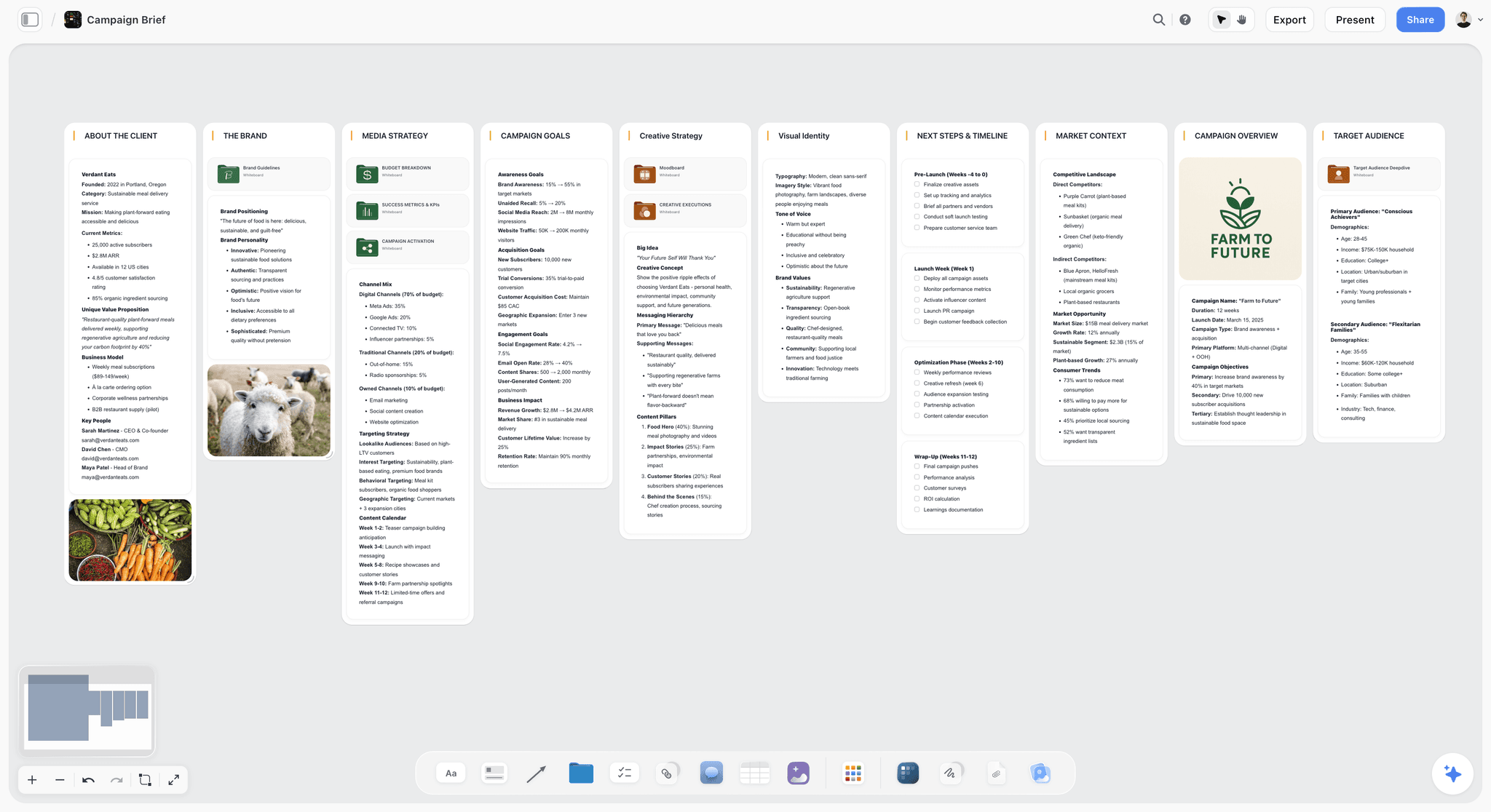
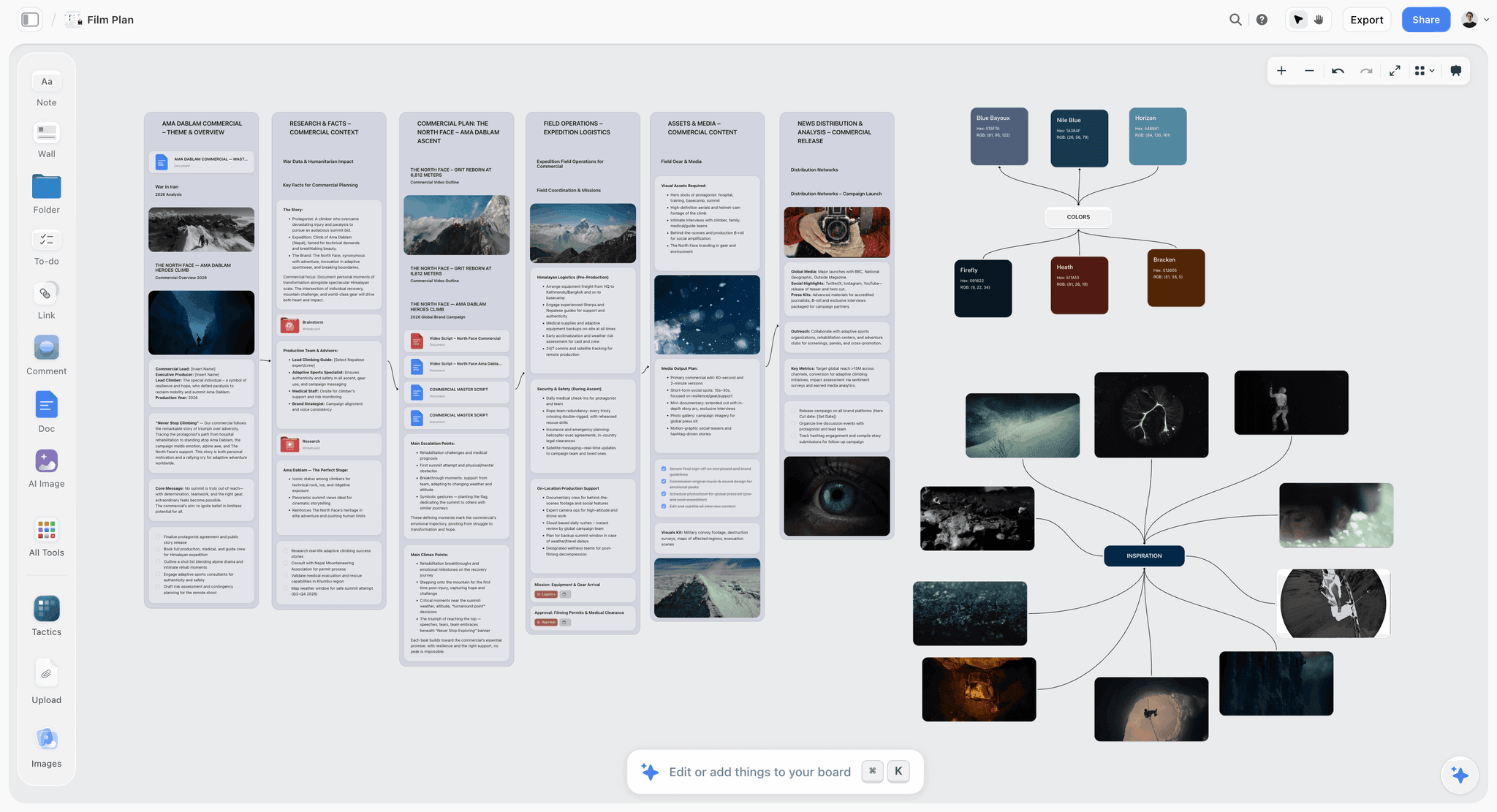
Storyflow is where the creative pipeline lives: the concept, script beats, storyboard, moodboard, and research sit on one infinite canvas, and the AI reads the entire active board before it answers. Ask it to pressure-test a concept, draft shot ideas from the brief, or check whether the planned ending pays off the opening, and it works from the actual production on the board, plus up to five documents and three boards you attach.
The collaboration model fits creative review: collaborators shape the same board, and a client opens a view-only link with no account. Its Free plan, due before the end of 2026, will include unlimited boards, unlimited collaboration, basic AI, and 20 file uploads. It is not the whole production, though. Storyflow holds the video. It does not run the shoot.
Best for: The development and pre-production half: concept through storyboard, especially across a high volume of videos.
Pricing: Early access: every plan is paid for now. The Free plan launches before the end of 2026, and invited collaborators of paid members join free now. Plus: $7.99/mo billed annually ($9.99 monthly) for unlimited uploads. Pro: $14/mo annual. Max: $39/mo annual, adding the Team Workspace with roles and permissions.
Limitations: No call sheets. No stripboard shooting schedules or day-out-of-days. No frame-accurate footage review, so post feedback goes to Frame.io. No budgeting, and it is cloud-only, with no offline mode for remote shoots. Full disclosure: Storyflow is our product, and for production-wide logistics StudioBinder is the better tool. Pair them.
2. StudioBinder
StudioBinder is the strongest production-specific project management platform in 2026, and for crewed productions it is the safest single choice on this list. Script breakdowns, stripboard shooting schedules, shot lists, call sheets with delivery tracking, and contacts live in one connected system, so a schedule change ripples into the call sheet instead of dying in a spreadsheet.
In Two Pipelines terms, StudioBinder runs the logistics pipeline with video-native objects, and it carries more creative artifacts than any generic tracker: shot lists and storyboards live beside the schedule they feed. What it does not host is the messy early creative work, which happens elsewhere and arrives once decisions are made.
Best for: Productions with crews, locations, and call sheets, from indie shoots to commercial work.
Pricing: Free plan with limits. Starter: $42/mo. Indie: $85/mo. Higher tiers for agencies and studios.
Limitations: Pricey for solo creators; weak on early development and post; its AI lags the canvas tools.
3. Monday
Monday.com is the strongest generic tracker for a video production company running a portfolio of projects. Its boards, timeline views, automations, and client-facing dashboards make the logistics pipeline visible across every active production at once, which is what a head of production needs when six shoots overlap.
The trade-off is the Two Pipelines problem in its purest form: Monday.com has no idea what a shot list or a call sheet is. Every video-native object is a task with custom fields, and the creative work lives in attachments. It manages the work about the video superbly and holds none of the video itself.
Best for: Production companies and agencies tracking multiple jobs, clients, and deadlines at once.
Pricing: Free tier for 2 seats; paid from around $9/user/mo.
Limitations: No production-native objects; per-seat pricing climbs with crew size; creative work is reduced to attachments.
4. Frame.io
Frame.io owns the handoff the other tools ignore: from the shoot into post. Dailies go up, the team and the client comment frame-accurately, versions stack, and approvals are explicit instead of buried in email. It is the difference between "see attached notes" and feedback pinned to the exact frame.
It is a review tool, not a planner: it covers the end of both pipelines and none of the beginning, which is why it appears in nearly every stack and never alone.
Best for: Footage review, client approval, and version control in post.
Pricing: Free tier; paid from around $15/user/mo.
Limitations: No planning, scheduling, or task management; storage caps on lower tiers.
5. Framekit
Framekit covers the part of a production that neither pipeline in this article accounts for: everything the client sees. The site that won the job, the pitch page for the concept, the gallery the deliverables land in, and the review link the cut gets commented on. On a solo or small-company production those are four separate subscriptions, and none of them touch the film itself.
The review half is a real one rather than a file-sharing page. Comments bind to a timecode, the annotation toolbar draws freehand, arrows, lines, rectangles and ellipses on the frame, every deliverable carries a version stack with exactly one current version, and each version holds its own approval status: needs review, in progress, changes requested, or approved. Reviewers open a link in a browser with no account, and you control whether they must give a name, whether the link is password-gated, whether it expires, and whether the original file can be downloaded.
It sits below Frame.io here for one specific reason and it is not feature count. Frame.io reaches into the edit: its Premiere and After Effects panels put a client note in front of the editor without a browser, and camera-to-cloud moves footage before the cards are offloaded. If anyone on the production edits full time, that is worth more than consolidation. If the production is you, a camera and a laptop, the calculation inverts, because flat per-account pricing beats per-seat pricing every time the seat count is one.
Best for: Solo operators and small companies who want one account for the studio site, the pitch pages, the delivery galleries and timecoded client review.
Pricing: Free includes video review with 2GB of video storage and unlimited client galleries with 3GB of photo storage. Starter $9/mo ($7 annual) adds a custom domain, 10GB of review storage and 10GB of gallery storage. Pro $19/mo ($15 annual) gives 100GB of each plus file attachments on review comments. Business $39/mo ($31 annual) gives 500GB of review storage and zero transaction fees on the store. Flat per account, not per seat.
Limitations: No Premiere or After Effects panel and no camera-to-cloud, so notes are read in a browser. No scheduling, no call sheets, no task management, and nothing that touches the logistics pipeline. Storage ceilings are the real constraint on long-form work at high bitrates.
6. Celtx
Celtx is the budget pick that touches both pipelines: the script (creative) flows into breakdowns, shot lists, and light scheduling (logistics), with everything traced back to the screenplay. For scripted video, explainers, ads, and shorts, that connection saves real re-entry work. No single module is best in class, and unscripted work gets less from it, but the coverage per dollar is hard to beat.
Best for: Scripted video on a budget, where the script should drive the plan.
Pricing: Free tier; paid plans from roughly $15/mo.
Limitations: Dated interface in places; thin on concept development; light on post.
7. ClickUp
ClickUp is the most capable free generic PM for a small video team. Tasks, docs, multiple views, and automations cover the logistics pipeline, and ClickUp Brain adds useful AI for summarizing and drafting. Teams that outgrow Trello usually land here before they can justify Monday.com. Like every generic tracker, it holds tasks about the video, not the video, and configuration is a real cost: ClickUp does everything, which means you must decide everything.
Best for: Small teams that want deep free task management and will configure it themselves.
Pricing: Free tier; paid from around $7/user/mo.
Limitations: Setup-heavy; no video-native objects; the interface can overwhelm a crew that just needs a schedule.
8. Notion
Notion is the build-your-own option: linked databases for videos, shoots, gear, and clients, with docs beside them. Content teams tracking a high-volume pipeline get a flexible, cheap backbone, and the template community has already solved most production-tracker shapes.
It is a database, not a canvas, so the creative pipeline fights the format: storyboards and moodboards do not want to be table rows. Expect real setup time before it pays off.
Best for: Teams that think in databases and want a custom production tracker.
Pricing: Free for personal use; Plus $10/mo; Business $18/mo.
Limitations: Setup-heavy; weak visual and spatial work; generic AI with no production awareness.
9. Asana
Asana is the cleanest pure task manager on this list, and at agency scale its portfolio views and workload management keep dozens of video jobs and their owners honest. If your production problems are accountability problems, missed handoffs, unclear owners, slipping dates, Asana fixes exactly that. It is the logistics pipeline only, with even fewer video-native concessions than Monday.com, though the free tier's 15-user cap is generous.
Best for: Agencies and in-house teams where ownership and deadlines are the bottleneck.
Pricing: Free for up to 15 users; paid from around $10.99/user/mo.
Limitations: No production objects; creative work lives in links; per-seat cost grows with the roster.
10. Milanote
Milanote is the most polished visual board for the development phase: references, tone boards, and rough shot ideas dragged onto a freeform canvas, with film planning templates ready to go. For look development it remains a pleasure. It holds the creative pipeline's references without its structure: no AI reads the board, there is no script-to-shot connection, and the 100-card free limit fills within one real project.
Best for: Moodboards and visual development for look-driven work.
Pricing: Free with 100 cards; Individual $9.99/mo; Team $49/mo flat.
Limitations: No AI, no scheduling, no path from board to shoot plan.
11. Yamdu
Yamdu is the other true production suite: script breakdown, scheduling, cast and crew, and asset management in one connected database, covering both pipelines from development through delivery. Organized crews get a single system where StudioBinder users might run two. It is heavier and less polished than StudioBinder, and pricing scales with production size, so it is a considered purchase rather than a default.
Best for: Crews that want one connected platform across every phase.
Pricing: Subscription from roughly $20/mo, scaling by production size.
Limitations: Learning curve; heavy for small shoots; costs climb with scope.
12. Filmustage
Filmustage does one handoff brilliantly: AI reads your finished screenplay, tags every element, and seeds a schedule and budget in minutes instead of days. It converts the creative pipeline's key artifact, the script, into the logistics pipeline's starting point, the breakdown. It is a specialist for that single transfer, the output needs human review, and without a finished script it has little to offer.
Best for: Producers who want the script-to-breakdown step automated.
Pricing: Subscription from roughly $20/mo.
Limitations: One phase only; AI tagging needs checking; script-dependent.
13. Trello
Trello is the simplest way to see every video's stage at a glance: idea, scripted, shot, edited, delivered, as cards moving across lists. A team adopts it in minutes, and for a lean content pipeline that visibility is most of what logistics requires.
It connects nothing: no schedule depth, no production objects, and every phase handoff is manual. It is the tracking layer, never the production system.
Best for: Small teams that need pipeline visibility with zero setup.
Pricing: Free; Standard $5/user/mo; Premium $10/user/mo.
Limitations: No scheduling or breakdown features; flat structure strains past a dozen active videos.
Recommended Stacks: Pair the Pipelines
The pattern across every working production I have seen: one tool per pipeline, plus review.
- Crewed production (commercial, doc, narrative): Storyflow (creative) + StudioBinder (logistics) + Frame.io (review). The creative pipeline stays on an AI-readable canvas; the logistics chain runs breakdown to call sheet; post feedback lands on the frame.
- Video production company / agency: Storyflow (concepts and client-facing boards) + Monday.com or Asana (portfolio logistics) + Frame.io (client review).
- High-volume content team: Storyflow (batch concept-to-storyboard) + Trello or ClickUp (stage tracking).
- Solo operator or two-person company: Storyflow (creative) + Framekit (everything the client sees: site, pitch page, delivery gallery, timecoded review). Two bills instead of five, and no per-seat maths.
- Scripted video on a budget: Celtx (script to shot list) + Trello (tasks). Total: around $15 to $20/mo.
- Cheapest working stack: Storyflow ($7.99/mo billed annually) + ClickUp Free.
It is not that any single tool here is bad. It is that each one holds one pipeline, and a production needs both held at once.
Persona-Based Recommendations
Solo Creator / YouTuber
Top picks: Storyflow + Trello, adding Framekit the moment you take client work rather than only your own. The creative pipeline is most of your work, so plan concepts, scripts, and storyboards on a canvas the AI reads, and track stages on a free board. Skip call-sheet software until you have a crew.
Video Production Company Owner
Top picks: Monday.com + StudioBinder. Monday.com gives you the cross-client portfolio view; StudioBinder runs each job's breakdown, schedule, and call sheets. Add Frame.io the day a client asks "which cut is this?"
Documentary Filmmaker
Top picks: Storyflow + StudioBinder. Research clusters, interview maps, and structure live on the canvas; the shoot runs on call sheets. See the film production planning guide for the single-film stack.
Agency Producer
Top picks: Asana + Frame.io. Your bottlenecks are ownership and client approval, not concepting. Add Storyflow when pitches need a visual story the client can open from a link.
Freelance Director / DP
Top picks: Storyflow + Framekit. You are hired for the creative pipeline, so a canvas holds the treatment and the shot ideas. Framekit holds the half you own commercially: the site and reel that get you hired, the pitch page for a specific treatment, and timecoded review when you deliver something yourself. You inherit whatever logistics tool the production runs, which is the point: those are never your choice.
In-House Brand Video Team
Top picks: ClickUp or Notion + Storyflow. The tracker holds the request queue and deadlines; the canvas holds each video's concept and storyboard so stakeholders review the video plan, not a task list.
What Video Production PM Software Costs
This is the category where per-seat pricing quietly decides the bill, because video teams grow and shrink per project and freelancers count as seats.
The creative pipeline for $7.99 a month:
- Storyflow: unlimited boards, unlimited notes, images, and links, unlimited collaborators, and canvas AI. Paid-only early access today at $7.99/mo billed annually; the Free plan launches before the end of 2026, and invited collaborators of paid members join free now, so bringing in three freelancers for two weeks costs nothing extra.
- Milanote Free for a lighter visual development board, with an item cap.
- ClickUp Free or Trello Free for basic logistics on a small team.
- Frame.io free tier for review on a single deliverable.
- Google Sheets for the budget.
A two or three person team can run both pipelines for $7.99 a month billed annually, and should.
Where the money actually goes as a team grows
- Per-seat logistics. This is the dominant cost in this category and the one people model badly. Monday at around $9 per user, Asana at around $10.99 per user, and ClickUp at around $7 per user all scale with headcount, and a video team that pulls in a freelance editor, a DP, and a colorist per project is paying for seats that sit idle between jobs. On Storyflow, anyone a paid member invites to a board joins free, which is the main structural difference in this comparison rather than a feature.
- Review capacity. Frame.io at around $15 per user per month is where teams start paying once client rounds multiply. This is usually the second bill and it is worth it.
- Production-specific logistics. StudioBinder's paid tiers start around $42/month and Yamdu around $20/month per project. Worth it the moment a shoot is big enough that a wrong call sheet costs real money.
- File uploads on the creative side. Storyflow's Free plan, due before the end of 2026, will allow 20 uploads, which references and frames spend quickly. Plus at $7.99/month billed annually has no upload cap.
The seat maths, for a team of four plus three freelancers per project
| Tool | Billing shape | Four staff | Plus three freelancers | Annual difference the freelancers make |
|---|---|---|---|---|
Storyflow | Per account for individuals, per seat for team workspaces; invited collaborators join free | $7.99/month | $7.99/month | $0 |
Trello | Per user | about $20/month | about $35/month | about $180 |
ClickUp | Per user | about $28/month | about $49/month | about $252 |
Monday | Per seat | about $36/month | about $63/month | about $324 |
Asana | Per user | about $44/month | about $77/month | about $396 |
Frame.io | Per user | about $60/month | about $105/month | about $540 |
StudioBinder | Per user | about $168/month | about $294/month | about $1,512 |
Yamdu | Per project, scales with crew | about $20/project | about $20/project | $0, but it rises with crew size |
The freelancer column is the one to read. Video teams expand and contract per project, and every per-seat tool in this category bills you for people who are on the job for two weeks. That is the structural difference between the options here, and it is worth more than any feature comparison on this page for a team that works this way. Storyflow's row assumes one paid account with the rest of the team invited to its boards; a team workspace with roles is Max, billed per seat.
The comparison to run before you buy anything
Count the people who will touch the tool, including freelancers you keep for two weeks. Then price the same stack both ways: per seat, and with collaborators invited free. For a four-person core team plus three per-project freelancers, a per-seat logistics tool bills seven people every month while a creative tool that lets invited collaborators join free bills only the account that invited them, and the gap over a year is usually larger than any feature difference you were comparing.
Pay per seat for the pipeline where ownership matters, and refuse to pay per seat for the pipeline where thinking happens. Logistics genuinely needs owners and dates, so per-seat is honest there. A moodboard does not have an owner.
Where Autodesk Flow Production Tracking (ShotGrid) Fits
Autodesk Flow Production Tracking is the tool most often named in searches about video production management and least often the right answer for the teams reading this article, so it is worth placing precisely rather than leaving out.
It began as Shotgun, became ShotGrid under Autodesk, and is now Flow Production Tracking. It is built for VFX and animation pipelines: tracking a shot through layout, animation, lighting, comp and review, with hundreds of artists, thousands of shots, versioned dailies, and deep integration into Maya, Nuke and Houdini. Its unit of work is the shot and the task on that shot, and its review layer, RV, is built for playing sequences at full rate with notes attached to frames.
Why it is not in the ranked 13. This article ranks tools for video production companies, agencies, and small crews running live-action work. Flow Production Tracking assumes a pipeline that most of those teams do not have: it expects a facility with a technical director who will configure entity schemas and write pipeline hooks, and its pricing and administration are sized for that. Handing it to a five-person video team is not a stretch of the tool, it is a category error, and the team will spend more time configuring entities than tracking shoots.
When it genuinely is the answer: an animation or VFX house, a studio delivering shot-based work at volume, or a production already inside the Autodesk ecosystem. In those cases nothing else on this list competes, including StudioBinder.
What live-action teams take from it instead: the idea that a version has a status and a review has a note bound to a frame. Frame.io, Framekit and Wipster all implement that idea at a scale a small company can run, which is the practical substitute. For teams specifically evaluating a move off it, Autodesk Flow Production Tracking alternatives covers the switch in detail.
Honorable Mentions
- SetHero: the fastest path to a professional call sheet, around $19/mo with the first project free.
- Dramatify: strong for episodic and broadcast-style video; $10/seat/mo annual with a three-seat minimum.
- Movie Magic: the industry standard for stripboard scheduling and budgeting; a specialist, priced like one.
- Boords: clean storyboarding with client approval, around $16.99/mo annual; one stage, done well.
- Airtable: relational production tracking for database-minded teams, from around $20/user/mo.
- Descript: not a project manager, but it belongs in the conversation because for a lot of small video teams the edit *is* the workflow. Transcript-based editing, filler-word removal, and collaborative comments on the timeline replace a review round for social and podcast-style video. Pair it with a tracker rather than expecting it to be one.
When You Do Not Need Production PM Software At All
If you are one or two people shooting simple videos on a steady rhythm, a shared checklist and a calendar already run your logistics pipeline, and software adds ceremony. The tools here earn their place at two thresholds. The first is crew: once a shoot involves people who need to be told where to be and when, call sheets stop being optional. The second is volume: once you cannot hold every active video's status in your head, the tracking layer pays for itself. Below both thresholds, spend the money on a better microphone.
Where Wipster Fits
Wipster is a video review-and-approval platform in the same category as Frame.io, and it comes up often enough in searches for production software to need an answer. This category consolidates fast, so check that it is still generally available, and confirm pricing, on wipster.io before planning around it.
What it does well. Timestamped comments on a video, versions stacked so a reviewer sees what changed, and approval as an explicit state rather than an email saying "looks good". For agencies sending cuts to marketing clients who have never used review software, its simplicity is a genuine advantage over Frame.io, which assumes more.
Why it is not ranked here. It is post-production only, and this article is about running a production. Review tooling starts working the day there is a cut to review, which is after every problem this page is about has already happened or not.
Choosing between it and Frame.io. Frame.io if your editors are in Adobe tools, because the integration removes a genuine step. Wipster if your reviewers are clients rather than editors and you want the least software they have to learn.
The Bottom Line
Video production project management fails when one pipeline's tool is asked to hold both. StudioBinder is the best production-specific system and the safest choice for crewed work. Storyflow is the best home for the creative pipeline, where the video itself takes shape on a canvas the AI can read. Monday.com runs the logistics portfolio for a production company, and Frame.io owns review. Remember the Two Pipelines: a task board can tell you the edit is late, but it cannot show you the video is wrong, so give the creative work a surface of its own and pair it with the logistics tool your scale demands.
If the creative half of your productions currently lives in attachment fields, start a Storyflow board and rebuild one active video on it: concept, script beats, storyboard, references. Run it beside your tracker for one production; keep whichever combination survives.
FAQ: Project Management Software for Video Production
What is the best project management software for video production?
For managing a video project with a team, Storyflow is the best project management software for the creative half of the pipeline, holding the concept, script, storyboard, and references on one AI-readable canvas the whole team can see. It is paid-only during early access, and anyone a paid member invites to a board joins free, so adding collaborators never raises the bill. StudioBinder is the best production-specific choice for the logistics half, with breakdowns, shooting schedules, shot lists, and call sheets in one connected system. Monday.com is the best generic tracker for a company running multiple jobs. Most real productions pair one creative tool with one logistics tool.
What is the best app to organize a video production from start to finish?
No single app holds a full production well, so the best start-to-finish setup is a pair: Storyflow for the creative half (concept, script, storyboard, references on one canvas) and StudioBinder for the logistics half (breakdown, schedule, call sheets), with Frame.io for post review. A solo creator can compress that to Storyflow plus a free Trello board. The mistake to avoid is a different tool per phase, because detail dies at every transfer.
What is the best project management tool for a video production company?
For a company running multiple client jobs, Monday.com is the strongest choice, because its portfolio boards and dashboards show every production's status across the roster. StudioBinder is the better pick when the work is crew-heavy and call sheets matter more than cross-client views. Companies with a strong creative offer add Storyflow so pitches and pre-production live on client-shareable canvases instead of task attachments.
Can I use Monday.com or Asana for video production?
Yes, for the logistics pipeline: schedules, owners, deadlines, and client dashboards work well in both. Neither knows what a shot list, call sheet, or storyboard is, so the creative work gets flattened into attachments and links, and the gap shows at the shoot and in review. Use Monday.com or Asana for tracking, paired with a production or canvas tool for the video itself.
What is the difference between StudioBinder and generic project management software?
StudioBinder is built from production objects: scripts break down into elements, elements feed stripboard schedules, schedules generate call sheets. Generic PM software is built from tasks and dates, so those production steps become manual work in custom fields. The practical difference shows on a schedule change: StudioBinder ripples it into the call sheet automatically, while a generic tool waits for a human to update every affected card.
Is Storyflow good for managing video production?
Storyflow is strong for the creative pipeline and honest about the rest. Concept, script beats, storyboard, moodboard, and research live on one canvas, and the AI reads the entire board to pressure-test ideas or draft shot lists. It drafts a call sheet and a shooting schedule from your plan, but not in stripboard format, with no crew-availability tracking and no frame-accurate review, so crewed productions pair it with StudioBinder and Frame.io. For the development and pre-production half, it leads this list.
What is Framekit and where does it fit in a production stack?
Framekit is an all-in-one creative toolkit for freelancers and small studios: an AI website builder, presentation pages, unlimited client galleries, timecoded video review and a store for digital products, on one flat per-account bill. In a production stack it holds the client-facing surface, which neither the creative pipeline nor the logistics pipeline accounts for. It does no scheduling, no call sheets and no task tracking, so it never replaces StudioBinder or Monday.com. It is ranked fifth here rather than higher because Frame.io beats it for review whenever a full-time editor is involved.
Framekit or Frame.io for review on a small production?
Framekit if the production is one or two people and the reviewer is the client. You get timecoded comments, drawing on the frame, version stacks and per-version approval on a flat account price, and the review link sits beside the delivery gallery and the site. Frame.io if anyone edits full time, because its Premiere and After Effects panels put the note in front of the editor without a browser, and camera-to-cloud starts the review before the cards are offloaded. Per-seat pricing is the reason a one-person shop rarely justifies it and a five-editor post team always does.
What software do video production companies actually use?
The common stack is one tool per job: StudioBinder or Yamdu for production logistics, Monday.com or Asana for cross-client tracking, Frame.io for client review, and a canvas like Storyflow or Milanote for concepts and pre-production. Smaller shops compress this to two tools, one creative and one logistics. Very few run a single platform end to end, because no platform holds both pipelines well.
What is the cheapest way to manage video production projects?
A low-cost setup works well: Storyflow holds the creative pipeline at $7.99/mo billed annually, and ClickUp or Trello Free holds the logistics pipeline. The first paid upgrades that earn their cost are Celtx (around $15/mo) when scripts drive your work, and StudioBinder when a real crew needs call sheets.
Do I need call sheet software or is a task board enough?
A task board is enough until a shoot involves a crew across locations and times. From that point, call sheet software like StudioBinder or SetHero earns its cost immediately: professional call sheets, delivery tracking, and confirmations replace a fragile chain of messages. For one or two person shoots, a shared board and a checklist are fine. The threshold is crew, not ambition.
How do I manage the creative side of a video production?
Give the creative pipeline its own surface instead of burying it in a task tracker. Put the concept, script beats, storyboard, and references on one canvas where the team sees the same version, and let review happen on the work itself. In Storyflow, the AI reads that entire board and can flag when the shot plan drifts from the concept. The test: can a new collaborator understand the video, not the schedule, in five minutes?
Can AI help manage a video production?
Yes, in two specific places. On the creative pipeline, a canvas AI like Storyflow's reads the whole board and helps develop concepts, draft shot ideas, and check consistency between phases. On the handoff into logistics, Filmustage's AI breaks a screenplay into tagged elements and a starting schedule in minutes. Generic PM tools add AI for summaries and task drafting, which helps administration but never touches the video itself.
How do I keep pre-production and the shoot connected in one system?
Either use a production suite where they are natively connected, or make the handoff explicit. In StudioBinder and Yamdu, the breakdown feeds the schedule and the schedule feeds the call sheet, so pre-production flows into the shoot automatically. If you plan in a canvas and shoot from a logistics tool, transfer once, at lock: shot list, schedule, and references move together, and the canvas stays the reference for intent.
Is Autodesk Flow Production Tracking (ShotGrid) good for video production management?
It is the strongest option for VFX and animation pipelines and the wrong shape for most live-action video teams. It tracks shots and tasks through a facility pipeline with deep Maya, Nuke and Houdini integration, and it expects someone technical to configure it. A video production company tracking shoots, edits and client approvals gets there faster with StudioBinder for logistics plus Frame.io or Framekit for review.
What software do VFX and animation studios use instead of standard project management tools?
Autodesk Flow Production Tracking, formerly ShotGrid and originally Shotgun, is the category standard, with ftrack the main competitor. Both model production as shots moving through pipeline stages with versioned dailies attached, which is a different data model from the task lists that generic project management tools provide. Live-action teams rarely need that model and pay a large configuration cost for it if they adopt it anyway.
Table of Contents
- Comparison Table: 13 Video Production PM Tools at a Glance
- All 13 Tools, Ranked
- Key Takeaways
- Frequently Asked: Tracking Shoots, Approvals, and Where Frame.io Fits
- The Two Pipelines: Why Generic PM Tools Break on Video
- How the Tools Compare on the Two Pipelines
- How I Evaluated These Tools
- Quick Picks
- The 13 Best Project Management Tools for Video Production
- Recommended Stacks: Pair the Pipelines
- Persona-Based Recommendations
- What Video Production PM Software Costs
- Where Autodesk Flow Production Tracking (ShotGrid) Fits
- Honorable Mentions
- When You Do Not Need Production PM Software At All
- Where Wipster Fits
- The Bottom Line
- Author
- FAQ: Project Management Software for Video Production
- Related Reading
Templates to check out for this topic


Filmmaking templates you can use in Storyflow
Skip the blank canvas. Open one of these filmmaking boards in Storyflow and the AI builds on the structure that is already there, from research through the shot list.


See Storyflow in Action
A visual AI workspace where every feature lives inside one canvas. No tab-switching, no context lost.
Build your entire board from a single message
Type what you need in the AI chat at the bottom of your canvas. The AI adds cards, headings, and structure directly onto your board.
Use expert frameworks as AI context
Type @ in the AI chat and choose any Tactic. The AI tailors every response to that framework instead of giving generic advice.
Turn your board into a mind map in seconds
Ask the AI to restructure your canvas as a mindmap. It connects your ideas into a visual hierarchy so you can see how everything relates.
Why Storyflow Exists
Storyflow actually began as a personal tool while working on creative and research projects.
We kept running into the same problem: ideas were scattered everywhere: notes, documents, and whiteboards.
Nothing helped us see how everything connected.
So we started building a workspace designed around how ideas actually grow.
→ Read how Storyflow was createdJustkay
Documentary Filmmaker & Founder at Storyflow
Published: 2026-07-20
Extremely simple, seriously capable


See how easy it is to get started
Watch a real project come together, from a blank board to a finished plan, clicked through step by step.
Start creating with AI and become more productive
Transform your creative workflow with AI-powered tools. Generate ideas, create content, and boost your productivity in minutes instead of hours.