How to Organize a Video Production From Start to Finish (The 2026 System)
A five-phase system to organize a video production from start to finish: brief, pre-production, production, post, and delivery, with the handoffs that decide success.

Category
Video Production
Author

Justkay
Documentary Filmmaker & Founder at Storyflow
Topics
2026-07-17
•
30 min read
•
Video Production- how to organize a video production from start to finish
- video production workflow
- organize a video production
- video production phases
- video production management
- video production checklist
How do you organize a video production from start to finish?
To organize a video production from start to finish, run it through five phases on one shared surface: the brief (what and why), pre-production (plan every shoot decision), production (execute the plan), post (edit and review), and delivery (finish and hand off). If you are looking for the best app to organize a video production from start to finish, the honest answer is a small stack rather than one tool: Storyflow for the plan itself (brief, moodboards, storyboard, and shot list boards on one AI-readable canvas), StudioBinder for scheduling and call sheets, Frame.io for review and approval, and ClickUp or Notion for task tracking. The thing that decides whether a production stays on time and on budget is not any single phase, and it is not the app. It is the handoffs between phases: the brief the crew never fully read, the shot list the editor never saw, the client feedback that arrived in three different threads. Here is what separates the productions that run smoothly from the ones that burn the budget in overtime and revisions. A video production does not fail in one place. It fails at the handoffs. Each phase can be run well and the production still falls apart, because the plan from pre-production did not reach the shoot intact, or the shoot notes never made it to the edit, or five rounds of client feedback lived in five different inboxes. The producers who keep productions on rails are the ones who made the handoffs clean, which almost always means keeping the plan in one place the whole team can see. I have produced documentary and commercial video work for years, and the pattern holds at every budget: the overruns came from information lost between phases, not from any phase being done badly. This guide is the five-phase system, the tools that support each phase, and the honest places where a dedicated production tool beats a general canvas.

Full disclosure: Two tools here are ours. Storyflow is our visual workspace, ranked first for one job only: holding the plan across all five phases on one AI-readable canvas. Framekit is our all-in-one toolkit for freelancers and covers phase five, delivery, plus review on small teams. It plans nothing and schedules nothing, and Frame.io beats it on review whenever an editor works in Premiere or After Effects, because Framekit has no NLE panel and no camera-to-cloud. We are explicit throughout about where StudioBinder, Frame.io, and a video editor beat both of ours.
Quick Comparison
Where video teams actually organize a production, and the one phase each tool is best at.
| Tool | Best For | AI Features | Price |
|---|---|---|---|
| Storyflow | Brief, pre-pro, review | Reads the whole board | $7.99 mo annual (free plan late 2026) |
| StudioBinder | Scheduling + call sheets | Some automation | Free / paid |
| Frame.io | Post review + approval | AI tagging | Free / paid |
| Framekit | Delivery and small-team review | AI site builder | Free / $9 mo ($7 annual) |
| Notion | Production databases | Notion AI | Free / paid |
Key Takeaways
- Run the production through five phases on one shared surface: brief, pre-production, production, post, and delivery. The phases are the easy part; the four handoffs between them are where the money goes.
- A video production does not fail in one place. It fails at the handoffs. Overruns come from information lost between phases, not from any phase being done badly.
- Lock a signed brief before anything moves. It is the intent every later phase inherits and, on a client job, the protection a scope dispute is measured against.
- Plan pre-production against the brief, in view together. A shot should always trace back to a deliverable the brief promised, so the plan stays honest to it.
- Hand the editor the shoot's context, not just the footage. The edit doubles in time when it inherits pixels instead of intent, so record decisions against the plan.
- Consolidate client feedback into one review surface with one approver of record. Feedback scattered across email, chat, and calls is what quietly triples the revision count.
- Keep the plan on one canvas; hand heavy scheduling to StudioBinder and frame-accurate review to Frame.io. A canvas is the spine for the plan, not a substitute for the dedicated logistics and review tools.
- A handoff is clean when the next owner inherits the plan, not a summary of it. That is only possible when the plan lives in one place the whole team can see.
Why Video Productions Go Over Budget and Behind Schedule
Watch a production go over budget and the overrun almost never traces to one bad decision. It traces to information that did not survive a handoff. The brief said the client wanted three deliverables, but by the shoot the crew was planning for two, so a reshoot was needed. The director had a shot list, but the editor received footage with no reference to it, so the assembly took twice as long. The client left feedback in an email, a Slack message, and a comment on a shared drive, so revision three contradicted revision one.
A video production does not fail in one place. It fails at the handoffs. The root cause is that a production is a relay, and relays are won or lost at the baton pass. A studio absorbs this with departments and coordinators whose job is the handoff. A lean team has no such buffer, so every gap between phases is a place where the plan leaks and the budget follows. A production runs on the plan, and the plan is only as strong as its weakest handoff. The fix is not to work each phase harder. It is to make the plan survive the passes between phases, which means one shared source of truth instead of a relay of attachments.
This is why the answer to "how do I organize a video production from start to finish" is not "use a project tool." It is "make the five phases share one plan," so nothing is lost when the production moves from brief to shoot to edit to delivery.
The Five Phases of a Video Production
Every video production, from a one-day commercial to a documentary series, moves through the same five phases. Naming them and the handoff between each is what turns a chaotic production into a repeatable one.
- Brief. What the video is, who it is for, what it must deliver, and why. The intent every later phase inherits.
- Pre-production. The plan: script, storyboard, shot list, schedule, budget, locations, crew, and call sheets. Where the production is actually decided.
- Production. The shoot: executing the pre-production plan and capturing everything the edit will need.
- Post-production. The edit: assembly, revisions, review, and approval, turning footage into the deliverables.
- Delivery. Finishing: final files, formats, handoff, and closing the project cleanly.
Between each phase is a handoff, and the handoffs are where productions fail: brief to pre-production (does the plan reflect the brief?), pre-production to production (does the crew have the plan?), production to post (does the editor have the shoot's context?), and post to delivery (does the client sign off cleanly?). The five phases are the easy part. The four handoffs between them are where the money goes. Organize the production so the plan carries across every handoff, and the phases mostly run themselves.
Quick Picks: Where Teams Organize Each Phase
Best for the plan on one canvas the team reads: Storyflow. The surface where the brief, the pre-production plan, and the review notes live together and the AI reads all of it. Plus is $7.99/month billed annually. The honest limit: it is not a scheduling automation or a frame-accurate review tool.
Best for scheduling, call sheets, and breakdowns: StudioBinder. The dedicated production-management tool for the logistics of pre-production and the shoot. Free tier, paid plans for larger productions.
Best for post-production review and approval: Frame.io. Frame-accurate comments and approval workflows for the edit and client review phase. Free tier, paid plans.
Best for delivering the final files and closing the project: Framekit. Phase five is the one most tool lists forget. Client galleries and pages on your own domain for the final deliverables, plus timecoded review on the same account if the project is small enough that a separate review platform is hard to justify. Free tier, then $9/month ($7 annual). The honest limit: it plans nothing and schedules nothing.
Best for production databases and docs: Notion. If your team runs on structured databases (assets, contacts, deliverables), Notion holds them well. Free plan, paid tiers.
Best for simple task tracking across the team: ClickUp, Trello, or Asana. A board of who-does-what across the phases. Free plans, paid tiers for more.
The honest split: most organized teams keep the plan (brief and pre-production) on one canvas, hand the schedule to a production tool, and the review to an approval platform. Try Storyflow to keep the plan in one place.
Comparison Table: Where to Organize a Video Production
| Tool | Best phase | AI on the plan | Visual plan | Free tier | Starting price |
|---|---|---|---|---|---|
Storyflow | Brief, pre-production, review | Reads the whole board | Yes, infinite canvas | Coming late 2026 (invited collaborators join free now) | $7.99/mo annual |
StudioBinder | Pre-production logistics, shoot | Some automation | Partial | Yes | Free + paid |
Frame.io | Post-production review | AI tagging | No | Yes | Free + paid |
Framekit | Review and delivery, small teams | AI site builder only | No | Yes | Free + $9/mo |
Notion | Production databases | Notion AI | Limited | Yes | Free + paid |
Trello / Asana | Task tracking across phases | Add-ons | No | Yes | Free + paid |
Pricing checked July 2026. Competitor prices move and are quoted per plan, so verify on each vendor's page. Storyflow is paid-only during early access, and its Free plan (which will run the whole planning system) launches before the end of 2026; the paid tier adds the 200+ Story Blueprints and unlimited file uploads.
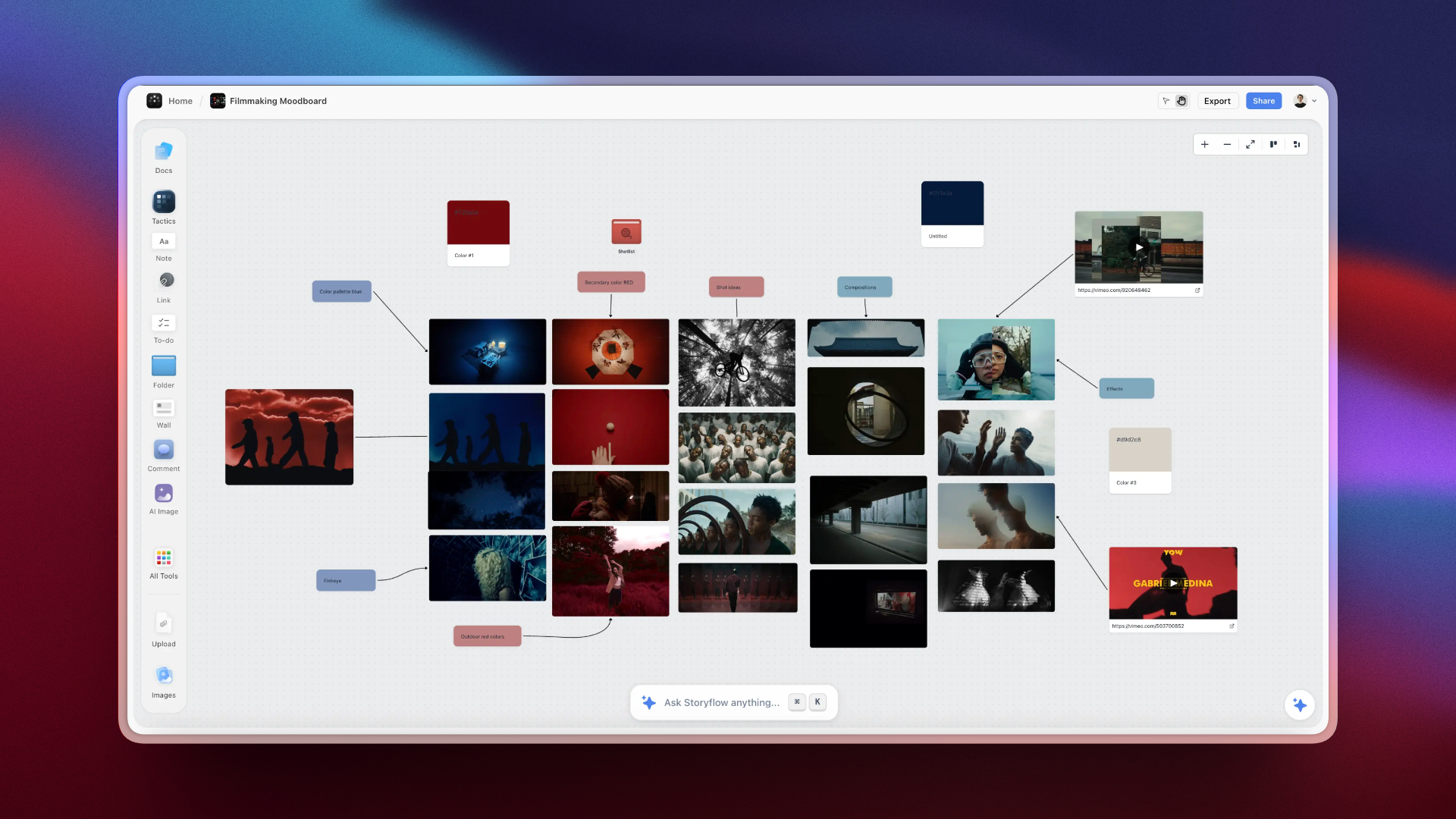
A video production plan on the Storyflow canvas, with the brief, storyboard, shot list, and schedule laid out across the five phases
Keep the whole production on one canvas
The brief, the pre-production plan, and the review notes live in one place the whole team reads, so the plan survives every handoff from brief to shoot to edit instead of leaking between apps.

The Best App for Each Phase (Honest Recommendations)
Because the phases do different work, "the best app to organize a video production" is really five smaller questions, one per phase. Here is the honest per-phase answer, including what each tool does not do.
| Phase | Best app | Why it wins here | Honest limitation |
|---|---|---|---|
Brief and pre-production plan | Storyflow | Brief, moodboards, storyboard, and shot list boards live on one canvas the whole team reads, and the AI drafts from the board itself | No call sheet generator, no stripboards, no review versioning |
Scheduling, call sheets, DOOD | StudioBinder | Generates call sheets, stripboards, and day-out-of-days from the script breakdown, which a canvas cannot | Weak as a home for the creative plan and references |
Task tracking across the team | ClickUp or Notion | Assignments, due dates, and checklists across all five phases; Notion adds production databases | The plan gets buried in lists and databases instead of being seen |
Review and approval | Frame.io | Frame-accurate comments, version stacks, and formal approvals on the actual cut, with panels inside Premiere and After Effects | Not a planning surface; feedback there needs the brief kept alongside |
Review and approval, small team | Framekit | Timecoded comments, frame annotation, version stacks and an approval status per version, at a flat per-account price rather than per seat | No NLE panel and no camera-to-cloud, so notes are read in a browser |
Delivery and handoff | Framekit | Client galleries and pages on your own domain for the final files, with download control separate from viewing, so the handoff is a link rather than a folder | Not a backup or archive: it is a delivery surface with a storage allowance |
The edit itself | Premiere, Final Cut, or DaVinci Resolve | The actual editing work | Not organization tools at all |
If you can only adopt one, adopt the one that fixes your worst handoff. Teams that lose time to reshoots and "that was not in the brief" conversations need the plan surface first. Teams that lose time to shoot-day chaos need the scheduling tool first. Teams drowning in contradictory client notes need the review platform first. For the wider tool landscape beyond organization, see The Best AI Tools for Filmmakers in 2026.
How These Phase Recommendations Were Tested
The five-phase split is not a project-management theory borrowed from software. It is where video productions actually hand off, and each boundary in it marks a point where I have personally watched a production lose time.
I direct documentary work, which means most of what I know about organizing a shoot I learned by organizing one badly first. The phases here were validated by running them across the range of production sizes that behave differently: two-person documentary shoots where the director is also the producer, mid-size branded pieces with a client approval loop, and a commercial job with a crew of eleven where a handoff failure costs real money by the hour.
The reason the recommendations are per-phase rather than one tool for everything is what that testing showed. No single tool is best at all five phases, and every attempt to force one is how teams end up with a beautiful brief nobody reads and a schedule nobody trusts. Creative phases reward a surface where things can stay loosely arranged and get reasoned about. Logistics phases reward rigid structured data: a call sheet has one correct format and no room for interpretation. Those are opposite requirements, and a tool optimized for the first is usually bad at the second.
Two limits worth stating. First, I have not run a scripted narrative feature, so the production phase here is weighted toward documentary and commercial patterns where the schedule flexes; a boarded narrative shoot runs tighter and leans harder on dedicated scheduling software. Second, I built Storyflow, so treat my enthusiasm for the creative phases as interested. The per-phase table names competitors as the better pick wherever they are, and the logistics recommendation below is deliberately not us.
How to Organize the Production, Phase by Phase
Here is the full system for a team or client video production. It assumes a producer coordinating a small crew and a client or stakeholder. Scale the structure up for a larger production by giving each deliverable its own region.
Phase 1: Lock the brief before anything moves
Start by writing the brief and getting it signed off, because it is the intent every later phase inherits and the most expensive thing to get wrong. Name the deliverables and their specs, the audience, the message, the budget, the timeline, and the approver. For a client job, the brief is also your protection: a signed brief is what a scope dispute gets measured against. Put it where the whole team will see it for the rest of the production, not in an email that gets buried. The brief is not paperwork. It is the contract the production executes.
Typical timeframe: one to three days for an internal project, up to a week for client work that needs stakeholder alignment. A complete brief answers six things:
- Deliverables and specs. Every video, its length, aspect ratio, and platform. "One 3-minute film plus a 30-second and a 15-second vertical cutdown" is a brief; "a video" is a dispute waiting to happen.
- Audience and message. Who watches it, and the one thing they should take away.
- Budget ceiling. The number, and what happens if a change request would exceed it.
- Timeline. Working back from a fixed delivery date, with the shoot dates and review windows already blocked.
- Approver of record. One named person whose sign-off is final. Two approvers is zero approvers.
- Sign-off. In writing, before pre-production spends a single day.
Phase 2: Plan pre-production against the brief
This is the phase that decides the shoot, so give it the most time. A useful rule of thumb: pre-production should get at least twice the calendar time the shoot gets. Build the plan beside the brief so it stays honest to it: the script or treatment, the storyboard, the shot list in priority order, and then the logistics (schedule, budget, locations, crew, and call sheets). Keep the creative plan and the brief in view together so a shot always traces back to a deliverable the brief promised. This is where an AI that reads the whole board earns its place, drafting a shot list from the brief and storyboard so you edit a plan instead of writing one cold. When the logistics get heavy, hand the schedule and call sheets to a dedicated tool while the creative plan stays on the canvas.
These are the deliverables a shoot-ready pre-production hands to production, and who owns each:
| Deliverable | What it is | Owner |
|---|---|---|
Script or treatment | The video on paper, approved against the brief | Director or writer |
Storyboard or shot references | The key frames, sketched or pulled as reference images | Director |
Shot list | Every planned shot with framing, movement, and priority order | Director and DP |
Shooting schedule (stripboard) | Scenes reordered into shooting order by location, cast, and light | Producer or 1st AD |
Day-out-of-days (DOOD) | The grid of which cast and crew work on which days | Producer |
Call sheets | The daily who, where, and when, with contacts, parking, and weather | Producer or coordinator |
Budget | Line items locked against the brief's ceiling | Producer |
Locations, permits, releases | Confirmed, signed, and filed before the shoot | Producer |
Two of those terms decide multi-day shoots. The stripboard is the schedule as movable strips, one per scene, sorted so you shoot everything at one location together instead of returning twice. The day-out-of-days is the availability grid that catches "our interview subject is only free Tuesday" before it becomes a shoot-day crisis. For a small shoot both can live as a table on the plan; past two or three shoot days, generate them in StudioBinder. A full checklist for this phase is in The Pre-Production Checklist Template for 2026.
Phase 3: Run production from the plan
On the shoot, the crew works from the pre-production plan, not from memory. The shot list is checked off as you go, so nothing is missed and the priority shots are captured before the light or the schedule runs out. Capture the context the edit will need: which take is the selected one, what the plan intended for each setup, any changes made on the day. The single biggest gift you give the edit is a shoot whose decisions are recorded against the plan, so the editor inherits intent, not just footage. Production is the execution of pre-production; the better the plan carried in, the calmer the day.
The shoot-day organization checklist:
- Call sheet out the day before. Every crew member and subject has the where, when, and who in hand before they sleep, not on the morning of.
- Shot list live, not printed once. Check shots off as they are captured and mark the ones cut, with one line on why.
- Priority shots first. Shoot the shots the deliverables cannot exist without while light, energy, and the schedule are on your side.
- Take notes as you go. Circle the selected takes and note what changed from the plan. Thirty seconds now saves the editor an hour later.
- Back up before wrap. Media copied to two drives before anyone leaves the location. No exceptions.
- A wrap note per day. What was captured, what moved, what the next day inherits. This note is the production-to-post handoff starting early.
Phase 4: Manage post-production and review
In the edit, the footage becomes the deliverables, and the phase lives or dies on how review is handled. Consolidate feedback into one place with one version of truth, so revision three does not contradict revision one. Use a review-and-approval tool for frame-accurate comments, and keep the running feedback against the brief so every change still serves the original intent. The failure mode here is feedback scattered across email, chat, and calls; the fix is one review surface and one approver of record. Post is where scattered feedback quietly triples the revision count, so structure it deliberately.
Structure post as named review rounds, each with a gate, instead of an open-ended stream of notes:
- Assembly. The editor's first pass, seen by the editor and director only. Nothing leaves the edit suite yet.
- Rough cut and internal review. The team reviews against the brief before the client sees anything, so internal disagreements never reach the client as mixed signals.
- Fine cut and client round one. The cut goes to the client in the review tool, frame-accurate comments only, with a stated deadline for notes.
- Client round two and picture lock. Revisions from round one, then lock. After picture lock, only color, sound, and graphics change, never the cut.
- Finishing. Color grade, sound mix, and graphics on the locked cut.
Cap client review at two rounds in the agreement (a third round becomes billable), and require every note through the review tool. A production that defines its review rounds up front finishes post in weeks; one that does not can spend months relitigating revision one.
Phase 5: Deliver and close the project
Finish clean. Export the final files in every format the brief specified, check them against the deliverable specs, hand them off, and get the final sign-off in writing. Close the project by archiving the plan, the assets, and the approvals, so the next production can reference this one and a later question has an answer. Delivery is not just uploading a file. It is confirming the production did what the brief promised and leaving a record that proves it.
The close-out checklist, usually a half day of work that saves days later:
- Export every deliverable in the exact specs the brief named, and QC each file (watch it through, check audio levels and captions).
- Hand off through the agreed channel, not "whichever link was handy," and confirm receipt.
- Final sign-off in writing against the brief's deliverable list.
- Archive the plan, selects, project files, and approvals in one labeled place.
- Write a three-line retro: what leaked at which handoff, and what the next production does differently.
Worked Example: A Three-Minute Brand Video, Start to Finish
Here is the system on a realistic production: a three-minute brand film for a software company, plus a 30-second and a 15-second vertical cutdown. Crew of four (producer-director, DP, sound, editor), two shoot days, four weeks from brief to delivery.
Week one, days one and two: the brief. The producer writes the six-point brief with the client (three deliverables with specs, the audience, the one message, the budget ceiling, the four-week timeline, and the marketing director named as sole approver) and gets it signed. The brief goes at the top of the Storyflow board where it will stay visible for the whole production.
Week one and two: pre-production. The board grows regions beside the brief: a moodboard, the treatment, a storyboard for the two scripted sequences, and a 24-shot list in priority order (the AI drafts the first pass from the brief and storyboard; the director edits it into the real plan). Because it is only two shoot days, the schedule is a simple table on the board rather than a StudioBinder stripboard, but the availability grid for the three employees being interviewed still gets made, and it catches that one of them is only free on day two. Call sheets go out the day before each shoot day.
Week three, days one and two: production. The crew shoots from the shot list on the board and checks shots off live. A drone establisher is cut when the weather turns, with a one-line note saying the opening will use the office-window dolly instead. Across the two days: 21 of 24 shots captured, three cut deliberately, every select circled, media backed up twice before wrap. The editor, who never set foot on set, can already read what happened and why.
Week three and four: post. The editor assembles from the circled takes and the shot list's intent notes. Rough cut gets one internal review against the brief. The fine cut goes to the marketing director in Frame.io with a five-day notes window; round one produces eleven frame-accurate comments, round two produces two, then picture lock, grade, and mix. Because feedback lived in one tool with one approver, revision three never contradicts revision one.
Week four, day five: delivery. Three files exported to spec, QC'd, delivered through the agreed folder, sign-off in writing against the brief's deliverable list, and the board archived with the approvals. The retro note reads: "Weather cut the drone shot; next time schedule exteriors with a backup day."
Total overhead for the organization itself: maybe a day and a half across four weeks. A video production does not fail in one place. It fails at the handoffs, and this production had none to fail, because every phase read the same plan. The same moves scale down to a solo short film (How to Plan a Short Film from Idea to Shoot walks that version) and scale up by giving each deliverable its own region and each phase its own owner.
Roles and Handoffs: Who Owns Each Phase
A production runs when every phase has a clear owner and every handoff is explicit.
- Producer: owns the brief, the budget, the schedule, and the handoffs themselves. The producer is the person the plan belongs to across all five phases.
- Director: owns the creative plan in pre-production and its execution in production.
- Crew: owns capture in production, working from the shot list.
- Editor: owns post, and needs the shoot's context handed over cleanly.
- Client or stakeholder: owns approval, and needs one place to give it.
The handoffs are explicit when the plan is shared: the director's shot list is the same document the crew shoots from and the editor references, and the client's approval sits against the brief everyone started from. A handoff is clean when the next owner inherits the plan, not a summary of it. That is only possible when the plan lives in one place the whole production can see.
What Organizing a Production Actually Costs
Production budgets get scrutinized line by line and software usually escapes that scrutiny, which is backwards, because the tool stack is one of the few costs that recurs whether or not you are shooting.
What you can run at $0, honestly:
- Files and media: Google Drive or Dropbox free tiers. Keep the media out of the planning tool.
- Budget: Google Sheets. A spreadsheet is the correct tool for money and always has been.
- Call sheets and schedule: StudioBinder's free tier, or a Sheets template for a shoot under about a week.
- Review and approvals: Frame.io and Vimeo both have free tiers that handle timecoded feedback on a single deliverable. Framekit's free tier adds 2GB of review storage plus unlimited client galleries with 3GB of photo storage, which also covers the delivery phase.
- Delivery: a shared drive link works, and costs you the download control and the record of what was handed over.
Storyflow is paid-only during early access, so the brief and creative phases are not part of the $0 stack today: Plus is $7.99/month billed annually (unlimited boards, unlimited notes, images, and links, unlimited collaborators, basic AI usage, 3 starter blueprints, and 200+ file uploads), and anyone a paid member invites joins free. Storyflow's own Free plan for this phase launches before the end of 2026.
For a one-day shoot with a small crew, the media, budget, scheduling, and review layers are genuinely free, and the creative plan is the one line item on top. Paying beyond that before you have hit a real wall is buying reassurance, not capability.
The walls, in the order productions hit them
- The creative plan, from day one. References, frames, and location photos are the whole visual phase, and Storyflow's paid-only early access means this line item starts at $7.99/month billed annually on Plus rather than at $0, with the full 200+ Story Blueprints library and unlimited uploads included.
- Review rounds. Free review tiers cap projects or reviewers. A client who wants three rounds of timecoded notes across four deliverables will exceed a free Frame.io plan quickly, and this is usually the next thing a team pays for.
- Crew permissions. Inviting collaborators is free even during early access; roles are not. Once a producer must edit while a client may only view, you want the Max tier at $39/month annual.
- Scheduling at scale. Past roughly a two-week shoot with a crew above ten, spreadsheet scheduling starts costing more in errors than software costs in fees. Pay for StudioBinder here.
The comparison nobody runs
A mid-size production paying for the full commercial set (Storyflow Plus at $7.99, a scheduling platform at about $30, a review platform at about $25, a project-management seat per crew member at about $10) reaches $150 to $160 a month or more before a camera turns on, and most of it sits idle between jobs.
Match the spend to the phase you are actually failing at. A team that keeps blowing schedules should pay for scheduling. A team whose briefs drift should not throw logistics software at it: that is a creative-phase problem, and Storyflow Plus at $7.99/month billed annually covers it. The most expensive mistake in this category is buying logistics software to fix a briefing failure, because the schedule was never the thing that was broken.
Where a Dedicated Tool Still Wins (The Honest Part)
A shared canvas is the right home for the plan, but it is not the right tool for every phase, and pretending otherwise would cost you on a real production.
Heavy scheduling and call sheets belong in a production tool. For a multi-day shoot with stripboards, day-out-of-days, and a real budget, StudioBinder or Movie Magic do work a canvas is not built for. Keep the creative plan on the canvas and hand the industrial scheduling to the tool made for it.
Frame-accurate review belongs in a review platform. When the client needs to comment on a specific frame at a specific timecode and approve a cut, Frame.io or similar are built for exactly that. Storyflow holds the plan and the running feedback intent, but the frame-level review happens in the review tool.
And where does Storyflow specifically lose? Three places, said plainly. It does not automate call sheets or generate stripboards, so complex scheduling goes to StudioBinder. It does not do frame-accurate video review and approval, so the client cut goes to Frame.io. And it does not edit video, so the footage goes to Premiere, Final Cut, or DaVinci Resolve. Storyflow is the place to hold the plan across all five phases, not to run the schedule, the review, or the edit.
Common Mistakes Organizing a Video Production
- Starting production without a signed brief. The most expensive mistake, because everything downstream inherits the ambiguity. Lock the brief first.
- Letting the plan not reach the crew. A pre-production plan the shoot cannot see is a plan that did not happen. One shared plan, not attachments.
- Handing the editor footage with no context. The edit doubles in time when it inherits pixels instead of intent. Record decisions against the plan.
- Scattering client feedback. Feedback across email, chat, and calls produces contradictory revisions. One review surface, one approver.
- Treating each phase as a separate universe. The phases are a relay; the handoffs are the whole game. Keep one plan across all five.
- Skipping the close. A production with no archived plan and no written sign-off invites scope disputes and forgets its own lessons.
The Bottom Line
Organizing a video production from start to finish is not about running each phase harder. It is about protecting the four handoffs between the five phases, so the brief reaches the shoot, the shoot's context reaches the edit, and the client's feedback stays against the intent everyone started from. The productions that stay on time and on budget are the ones whose plan survived every pass.
The honest boundary holds. One shared canvas is the right home for the plan, and dedicated tools still win for scheduling, frame-accurate review, and editing. AI can draft and connect the plan, but the producer's and director's judgment stays human. A video production does not fail in one place. It fails at the handoffs. Make the handoffs clean, keep the plan in one place, and a lean team runs a production that used to need a coordinator for every phase.
If your next production is still scattered across a brief in email, a schedule in one app, and feedback in three threads, organize it on one canvas in Storyflow and let the plan carry across every handoff.
FAQ: Organizing a Video Production From Start to Finish
How do you organize a video production from start to finish?
Run it through five phases on one shared surface: the brief (what and why), pre-production (the full plan), production (the shoot), post-production (the edit and review), and delivery (finishing and handoff). The key is the four handoffs between phases, because productions fail when information is lost between them, not when a phase is done badly. Keep the plan in one place the whole team can see so the brief reaches the shoot and the shoot's context reaches the edit. Hand the heavy scheduling to a production tool and the frame-accurate review to an approval platform, while the plan stays connected.
What is the best app to organize a video production from start to finish?
There is no single app that runs all five phases well, so the honest answer is a small stack. Storyflow is the best app for the plan itself: the brief, moodboards, storyboard, and shot list on one canvas the whole team reads, with AI that drafts from the board (it does not generate call sheets or do frame-accurate review). StudioBinder is the best app for scheduling, call sheets, stripboards, and day-out-of-days. Frame.io is the best app for review and approval of the cut, and ClickUp or Notion cover task tracking. If you can only adopt one, pick the one that fixes your worst handoff, which for most lean teams is the plan surface, since the plan is what every other phase inherits.
What are the phases of video production?
There are five: the brief, pre-production, production, post-production, and delivery. The brief defines what the video is and why. Pre-production plans everything (script, storyboard, shot list, schedule, budget, crew). Production is the shoot. Post-production is the edit, revisions, and approval. Delivery is finishing the files and handing off. Some frameworks compress these into three (pre-production, production, post-production), but for organizing a real production, treating the brief and delivery as their own phases is what keeps the start and end from being where things slip.
What is the best software to manage a video production?
It depends on the phase. Storyflow is best for the plan (brief and pre-production) on one canvas the whole team reads. StudioBinder is best for scheduling, call sheets, and breakdowns. Frame.io is best for post-production review and approval. Notion is best for production databases. Most teams use a small stack rather than one tool, keeping the plan on a canvas and handing logistics and review to dedicated tools. For a full comparison, see The Best AI Tools for Video Production Teams in 2026.
How do you keep a video production on budget?
Protect the handoffs, because overruns come from information lost between phases, not from any phase being done badly. Lock a signed brief so scope is fixed, make the pre-production plan reach the crew so there are no reshoots from misunderstanding, hand the editor the shoot's context so the edit does not double in time, and consolidate client feedback so revisions do not contradict each other. A shared plan that survives every handoff is the single biggest budget protection, because most overruns are just the cost of redoing work that a clean handoff would have prevented.
What is pre-production in video?
Pre-production is the planning phase where the production is actually decided: the script or treatment, the storyboard, the shot list, the schedule, the budget, locations, crew, and call sheets. It sits between the brief and the shoot, and it is the highest-leverage phase, because every problem solved in pre-production is a problem that does not happen (expensively) on set. A well-run pre-production hands the shoot a plan detailed enough that production is execution rather than improvisation. For the tools, see The Best Pre-Production Tools in 2026.
How do you manage client feedback in video production?
Consolidate it into one review surface with one version of truth and one approver of record. The failure mode is feedback scattered across email, chat, and phone calls, which produces contradictory revisions and endless rounds. Use a frame-accurate review tool so comments attach to specific moments, keep the running feedback against the original brief so every change still serves the intent, and confirm each approval in writing. Structured review is what keeps post-production from ballooning, because most revision bloat is really just disorganized feedback in disguise.
Can AI help organize a video production?
Yes, for specific jobs. An AI that reads your whole production plan can draft a shot list from the brief and storyboard, find gaps (a deliverable with no shot assigned, a phase with no owner), tighten the plan's writing, and answer questions across the production ("which shots serve deliverable two?"). What it cannot do is make the creative and logistical judgment calls that a producer and director own. Use AI to accelerate the planning and keep the plan connected, and keep the decisions human. It organizes the plan; it does not run the production.
Is Storyflow free for organizing a video production?
Not during early access. Storyflow's Free plan, which launches before the end of 2026, will include unlimited boards, notes, images, and collaboration, enough to hold the brief, the pre-production plan, and the review notes for a whole production. Today, that same planning layer runs on Plus at $7.99/month billed annually, which also adds the 200+ Story Blueprints and unlimited file uploads. You will likely pair it with a dedicated scheduling tool and a review platform for the logistics and frame-accurate review.
How long does it take to organize a video production?
For a small commercial production (a brand video with one or two shoot days), a realistic shape is about four weeks: one to three days for the brief, one and a half to two weeks of pre-production, the shoot days themselves, one and a half to two weeks of post across defined review rounds, and a half day for delivery and close. The rule of thumb worth keeping is that pre-production should get at least twice the calendar time the shoot gets, because every problem solved in planning is a problem that never becomes shoot-day overtime. The organizational overhead itself (writing the brief, keeping the shot list live, wrap notes, the close-out) is roughly a day and a half of work spread across the production, and it is the cheapest insurance a producer can buy.
How is organizing a video production different for a team versus a solo creator?
A team production has more handoffs and more owners, so the coordination between phases matters far more than it does for a solo creator who holds everything themselves. A solo creator can keep the whole project in their head and one place; a team has to make every handoff explicit, because the plan passes through many hands. If you are a solo creator or indie filmmaker, the system is simpler and covered in How Indie Filmmakers Organize Their Projects. For a team, the discipline is in the handoffs.
Where does Storyflow lose for video production?
In three specific places. It does not automate call sheets or generate stripboards, so a complex shoot schedule goes to StudioBinder or Movie Magic. It does not do frame-accurate video review and approval, so the client review of a cut goes to Frame.io. And it does not edit video, so the footage goes to a dedicated editor like Premiere, Final Cut, or DaVinci Resolve. Storyflow holds the plan across all five phases and keeps the team on one page; the dedicated tools handle the schedule, the review, and the edit.
What tool should I use for the delivery phase?
Delivery is the phase most tool lists skip, and a shared drive folder is what most teams default to. That works, and it costs you two things: control over who can download what, and any record of what was actually handed over. A delivery surface fixes both. Framekit gives you client galleries and pages on your own domain where viewing and downloading are separate permissions, on a free tier or from $9/month ($7 annual). Keep the archive separate from the delivery surface either way, because a gallery is a presentation layer with a storage allowance, not a backup.
Do I need both a review platform and a delivery tool?
On a larger production, yes, and they are different jobs: review is iterative and versioned, delivery is final and permissioned. On a small one they can be the same account. Frame.io is the right review platform when an editor works in Premiere or After Effects all day, because its panels put client notes in the application they already have open. When the reviewer is the client and the team is one or two people, a flat per-account tool covering both review and delivery is usually the cheaper and simpler answer.
Table of Contents
- Key Takeaways
- Why Video Productions Go Over Budget and Behind Schedule
- The Five Phases of a Video Production
- Quick Picks: Where Teams Organize Each Phase
- Comparison Table: Where to Organize a Video Production
- The Best App for Each Phase (Honest Recommendations)
- How These Phase Recommendations Were Tested
- How to Organize the Production, Phase by Phase
- Worked Example: A Three-Minute Brand Video, Start to Finish
- Roles and Handoffs: Who Owns Each Phase
- What Organizing a Production Actually Costs
- Where a Dedicated Tool Still Wins (The Honest Part)
- Common Mistakes Organizing a Video Production
- The Bottom Line
- Author
- FAQ: Organizing a Video Production From Start to Finish
- Related Reading
Templates to check out for this topic


Filmmaking templates you can use in Storyflow
Skip the blank canvas. Open one of these filmmaking boards in Storyflow and the AI builds on the structure that is already there, from research through the shot list.


See Storyflow in Action
A visual AI workspace where every feature lives inside one canvas. No tab-switching, no context lost.
Build your entire board from a single message
Type what you need in the AI chat at the bottom of your canvas. The AI adds cards, headings, and structure directly onto your board.
Use expert frameworks as AI context
Type @ in the AI chat and choose any Tactic. The AI tailors every response to that framework instead of giving generic advice.
Turn your board into a mind map in seconds
Ask the AI to restructure your canvas as a mindmap. It connects your ideas into a visual hierarchy so you can see how everything relates.
Why Storyflow Exists
Storyflow actually began as a personal tool while working on creative and research projects.
We kept running into the same problem: ideas were scattered everywhere: notes, documents, and whiteboards.
Nothing helped us see how everything connected.
So we started building a workspace designed around how ideas actually grow.
→ Read how Storyflow was createdJustkay
Documentary Filmmaker & Founder at Storyflow
Published: 2026-07-17
Extremely simple, seriously capable


See how easy it is to get started
Watch a real project come together, from a blank board to a finished plan, clicked through step by step.
Start creating with AI and become more productive
Transform your creative workflow with AI-powered tools. Generate ideas, create content, and boost your productivity in minutes instead of hours.