The Best App to Organize a Video Production From Start to Finish in 2026 (10 Tested)
Storyflow is the best app to organize a video production from start to finish: brief, breakdown, shot list, shoot days, call sheet and wrap notes on one board. 10 apps scored, plus the review tool to pair it with.

Category
Video Production
Author

Justkay
Documentary Filmmaker & Founder at Storyflow
Topics
2026-08-31
•
Updated October 10, 2026
•
32 min read
•
Video Production- best app to organize a video production from start to finish
- video production management software 2026
- StudioBinder vs Frame.io
- end to end video production workflow
- video production pipeline tools
- Storyflow
What is the best app to organize a video production from start to finish?
Storyflow is the best app to organize a video production from start to finish: one board per production holds the client brief, treatment, references, script breakdown, shot list, strip board of shoot days, a call sheet PDF for each day, the wrap notes and the delivery list, and its AI builds each of them from what is already on the board, which the crew and client open from a view link with no account. Pair it with Frame.io for timecoded review once footage exists. Add StudioBinder (Indie plan and up) when your crew is large enough that sending call sheets and tracking confirmations is a daily job; Celtx suits a writer-producer who wants script and production tools in one account.

Full disclosure: Storyflow is our own product and it ranks first here because it scores highest on keeping the production in one place and on the brief and concept, against the weighted criteria published in the scoring section, rechecked October 2026. It makes the call sheet as a PDF but does not send it or track confirmations, its strip board does not recalculate or produce day-out-of-days reports, and it has no timecoded review or media handling, so it scores 3 on post. StudioBinder scores higher on pre-production paperwork and Frame.io far higher on post, and we recommend pairing Storyflow with Frame.io. Storyflow is in early access and paid-only for now.
Quick Comparison: Pipeline Coverage by App
Storyflow and StudioBinder lead the weighted ranking below for a producer organizing a production from the client brief to delivery; Frame.io is the review app most stacks pair with them, and Celtx is the script-first option. A production has two cliffs, the shoot and delivery, so the usual answer is one planning app plus one review app.
| Tool | Best For | AI Features | Price |
|---|---|---|---|
| Storyflow | Brief to wrap notes on one board: breakdown, shot list, shoot days, call sheet PDF | AI reads the board and builds the paperwork from the script or brief | $7.99 mo annual (free plan late 2026) |
| StudioBinder | Call sheets sent and confirmed, day-out-of-days | Not a focus of its plan pages | Indie $49 mo (2 users) |
| Frame.io | Everything after the shoot: review and approvals | Not a focus for this job | Free (2 members) / $15 member mo |
| Celtx | Script plus production tools in one account | Not a focus for this job | Free plan; paid figures not shown (Oct 2026) |
Organize the whole production on one board
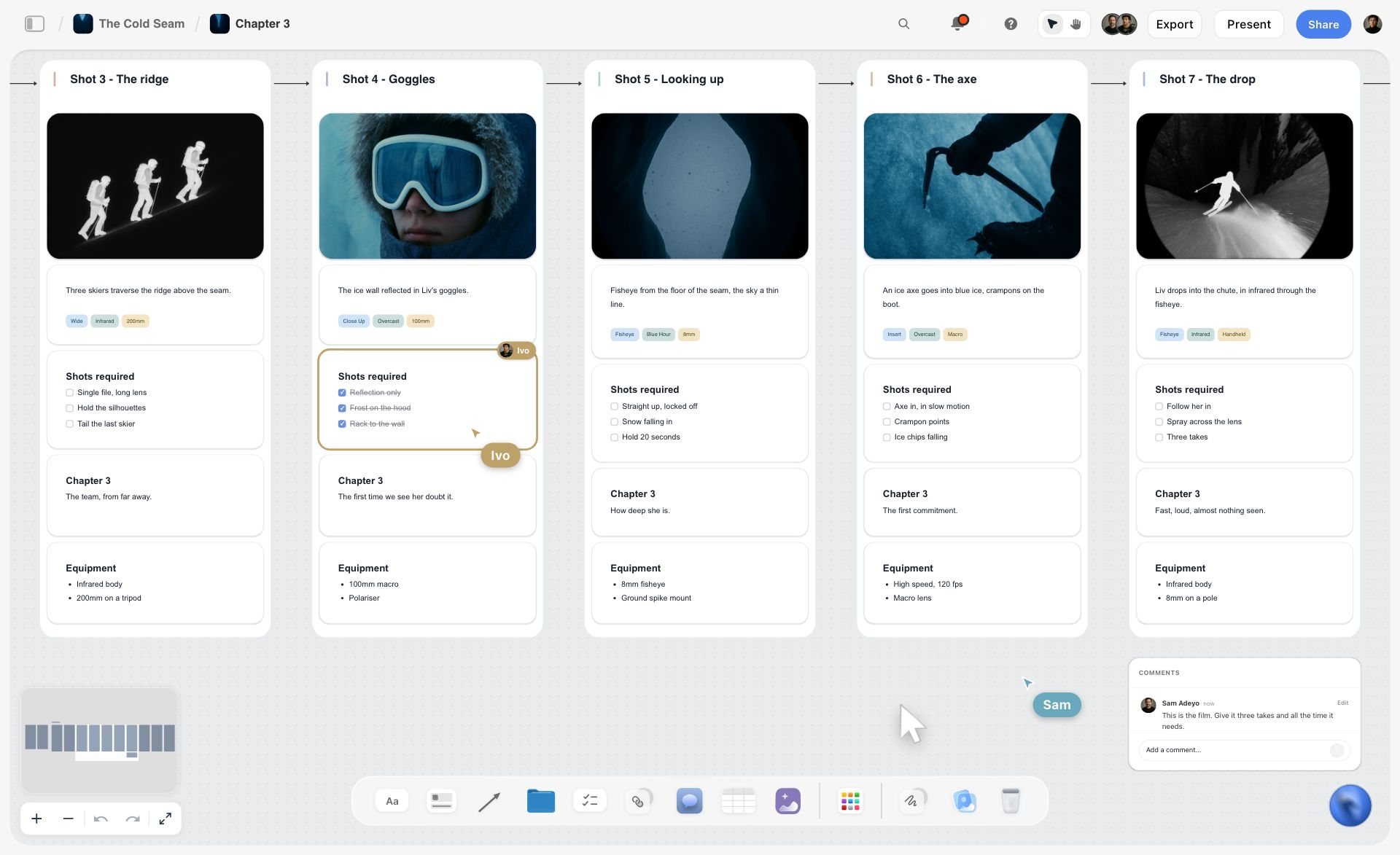
Brief, treatment, script breakdown, shot list, shoot days and a call sheet PDF per day on one Storyflow board, built by an AI that reads the board, opened by crew and client from a link.

What is the best app to organize a video production from start to finish?
Storyflow is the best app to organize a video production from start to finish. One board per production holds the client brief, the treatment, the references, the script breakdown, the shot list, a strip board of shoot days, a call sheet PDF for each day, the wrap notes and the delivery list, and its AI builds each of those from what is already on the board. The crew and the client open the board from a view link with no account. Pair it with Frame.io once footage exists, because timecoded review and version stacks are a different job that no planning app does well.
StudioBinder is the pick when the hard part of your production is the crew rather than the plan: it sends call sheets and tracks who confirmed (Indie plan and up), produces day-out-of-days reports, and its schedule recalculates. Celtx suits a writer-producer who wants the script and the production tools in one account, and Yamdu suits a series or feature with departments and months of calendar.
Storyflow's limits, stated up front so the ranking means something: it makes the call sheet as a PDF and does not send it or track confirmations; its strip board is a board layout that does not recalculate or produce day-out-of-days reports; and it has no timecoded review, version stacks or media handling. The scores below count all three against it.
A video production has two cliffs in the middle of it, and every app falls off one of them. The first cliff is the shoot: planning data (scenes, locations, call times) does not survive into an edit. The second is delivery: cuts become deliverables with specs and destinations. The best app is the one that holds the most of the production on its side of the cliff, in one place, and hands over cleanly to the review tool on the other side. On that test Storyflow scores highest, because it holds every stage up to the shoot plus the log and the delivery list on one board.
I have run productions where I tried to make one tool span the whole thing, twice, from both directions. Both times the far end became a folder of documents nobody opened. What changed my mind about the shape of the answer was not a better tool for one stage; it was putting every planning document on one surface, so the brief, the shot list and tomorrow's call sheet are three walls apart instead of three apps apart.
For the team-management cut, see The Best Tool for Managing a Video Project With a Team. For the process rather than the tools, see How to Organize a Video Production End to End.
Which app to use at each stage of a video production
The short version of this whole page is a table. Each row is a stage, the job in it, and the app that does that job; read down the right-hand column and you have the stack.
Two patterns fall out of the table. First, every row up to the shoot and the two logging rows after it can sit in one Storyflow project, which is why it ranks first. Second, the rows where a specialist wins are the ones where something must be sent (call sheets with confirmations), copied (media) or reviewed at a timecode (cuts). Those are real jobs, and the stack section says what to buy for each.
The Two Cliffs: why no app spans a whole production
A production runs through five stages, and the data changes shape at two points along the way.
Stage one, brief and concept. Client brief, treatment, references, budget shape. The data is documents and images. Unstructured.
Stage two, pre-production. Script breakdown, schedule, crew, locations, call sheets. The data is entities with relationships: this scene needs this cast at this location on this day.
Stage three, the shoot, which is cliff one. Everything above becomes footage. Scene numbers survive as filenames if you are disciplined. Nothing else crosses on its own.
Stage four, post. Assembly, cuts, versions, review rounds, notes at timecodes. The data is versions and timestamps.
Cliff two: the handover to delivery. Cuts become deliverables with specs, formats and destinations.
Stage five, delivery and archive. Files, specs, rights, where everything lives.
An app that models scenes and call times well has no vocabulary for "version 4, note at 02:14." An app built around timecoded versions has nothing to say about whether the gaffer confirmed. These are not lazy product decisions; the domains genuinely do not overlap.
What this means for the purchase. Stage one and stage two have more in common than either has with post: both are documents about a shoot that has not happened yet, and the expensive failure is the treatment and the shot list drifting apart. An app that holds stages one and two together, plus the log that crosses cliff one, removes the most re-typing. That is the case for one planning app and one review app, and the case for the planning app being the one that holds the brief as well as the breakdown.
The apps that claim to span both cliffs do it by being shallow at one end. Check which end before you buy, because the shallow end is where you will quietly start keeping a side document.
How we scored these apps
The job on this page is organizing one video production from the client brief to delivery, for a producer at a small production company, agency or in-house team: two to ten internal people, freelance crew, a client who reviews. Each app is scored out of 10 on six criteria, weighted by what that producer needs:
- Brief and concept, 15%: holds the brief, treatment and references, and turns them into something the client signs off.
- Pre-production paperwork, 25%: script breakdown, shot list, schedule, budget and call sheet.
- One place across stages, 20%: how many stages live in one project you can see at once, rather than in separate modules or apps.
- Crew and client access, 15%: whether freelancers and the client can open the plan without creating an account.
- Post review and delivery, 15%: timecoded review, versions and a delivery list.
- Price for a small team, 10%: what four internal people plus guests pay a month.
Each score is the weighted sum, rounded to two decimals. Vendor facts and prices come from each vendor's own pages, checked on October 9, 2026. Storyflow was scored on its current workflows in October 2026.
Full disclosure: Storyflow is our product. It ranks first because it scores highest on one place across stages and on brief and concept. On pre-production paperwork it scores 7, behind StudioBinder, Yamdu and Celtx, because it does not send call sheets, produce day-out-of-days reports or budget beyond a table. It scores 3 on post, the same as StudioBinder, and well below Frame.io. Change the weights and the order changes: weight pre-production paperwork at 45% or more and StudioBinder wins; weight post at 40% or more and Frame.io wins. We publish the sub-scores so you can do that.
To check the scores against a concrete job, the worked example later on this page walks an invented three-day branded documentary through the stack: brief, three shoot days, three review rounds, two deliverables.
Comparison table: 10 apps scored for organizing a production
Read the columns, not only the total. Frame.io is sixth overall and first by a distance on post; it belongs in almost every stack as the second app. StudioBinder scores the only 10 on pre-production paperwork, because it sends call sheets with tracked confirmations and its schedule produces day-out-of-days reports; if that is your bottleneck, it is your first app. Storyflow wins on keeping the production in one place: the brief, the paperwork and the wrap notes on one board, built by an AI that reads what is already there.
Quick picks by job:
- Organize the whole production, brief to wrap notes, in one place: Storyflow.
- Send call sheets to a crew of ten or more and track who confirmed: StudioBinder (Indie and up).
- Review cuts with timecoded comments and version stacks: Frame.io.
- Script and production tools in one account: Celtx.
- Series or feature with departments and months of calendar: Yamdu.
- Stakeholder dashboards above the production: Monday.com.
Frequently Asked: Which Video Production Apps Do Producers Trust?
Which video production management app is the most trusted?
For the plan and the paperwork, Storyflow: one board per production, readable by crew and client from a link with no account, with the current version on every open. For call sheet distribution, StudioBinder, whose sent call sheets record delivery, views and confirmations. For review, Frame.io, the post tool built around frame-accurate notes. Trust here means the tool shows everyone the same current plan.
Which app is the best value for organizing a video production?
Storyflow, from $7.99 a month billed annually, because one subscription covers the brief, treatment, breakdown, shot list, strip board and call sheet PDF, and anyone you invite to the board joins free. StudioBinder's Indie plan is $49 a month with two users. Frame.io's free plan covers two members, enough for a first review round.
Which video production app is underrated?
Storyflow for pre-production, because a board app is not where most producers look for a script breakdown or a call sheet, and it is new and in early access. Among review tools, Frame.io's Camera to Cloud, which gets dailies reviewable before the crew has wrapped.
Which app do production companies recommend for client work?
Storyflow for the client-facing half: the brief, treatment and references are presented from the same board in presentation mode, and the client opens a view link without an account (signing in to comment). Frame.io for cut review, where the client leaves notes at a timecode. StudioBinder joins when the crew is large enough to need tracked call sheets.
Detailed reviews: 10 apps
1. Storyflow

Best for: the producer who wants the whole production organized in one place, from the client brief to the wrap notes, with an AI that drafts the paperwork from what is already on the board.
Storyflow is an AI visual workspace: an infinite board per project with notes, documents, tables, images, video, tickets and folders of boards, plus an AI agent that reads the board you have open and builds onto it. For a video production that means one board holds every planning document, laid out as walls you can read left to right in the order the production happens.
What it does at each stage:
- Brief and concept: ask for a Campaign brief, a Pre-production plan, a Film plan or a Production Agency Hub and the AI lays the board out from your brief (how to turn a client brief into a production plan walks the seven steps). It collects references into a moodboard on the board, and produces a treatment, one-pager, lookbook or pitch deck as a designed PDF. Present to the client one wall at a time in presentation mode.
- Pre-production: attach the script (.fdx, Fountain or PDF) and the script breakdown lists scenes, cast, locations and elements from the real scene index. The shot list is built from the script, a storyboard or a shoot brief, as a wall per setup or a table per scene with size, angle, movement, lens and setup time. The strip board lays the scenes out in shoot days with page counts in eighths. Costs go in a table with currency cells on the same board.
- Shoot: the call sheet comes out as a PDF for one shoot day. Anything the board does not hold, a name, a time, the nearest hospital, is left as a marked blank and listed, rather than invented. The wrap note lives as a document on the board.
- Post and delivery: upload a cut to the board as video and pull frame grabs into notes; keep the deliverables list as a table with status and date cells. Timecoded review is not here, which is why Frame.io is the second app.
- From your AI assistant: Storyflow's MCP connector lets ChatGPT, Claude, Gemini or Grok read your Storyflow projects and build boards, documents and decks in them. See Storyflow MCP.
Limitations, honestly:
- It does not send call sheets or track confirmations; you send the PDF yourself.
- The strip board does not recalculate when you move a strip, and there are no day-out-of-days reports. For a schedule that does both, see the best film scheduling software.
- No timecoded review, no version stacks, no media offload or storage for camera originals.
- Documents do not update each other; ask the AI to redraft the call sheet when the schedule moves.
- Tables cannot be sorted by a column, and it runs in the browser only, with no native apps.
Pricing: paid-only during early access, from $7.99 a month billed annually ($9.99 monthly) on Plus; Pro is $14 a month billed annually and Max $39, with Team Workspace, roles and permissions on Max. Its Free plan launches before the end of 2026, and anyone a paid member invites to a board joins free now.
Choose StudioBinder instead if the production's daily problem is getting a call sheet to fifteen people and knowing who confirmed. See video production planning and pricing.
2. StudioBinder
Best for: productions where the crew is the complex part: call sheets sent and confirmed, day-out-of-days, a schedule that recalculates.
StudioBinder holds a long span of the pipeline in one account: screenplay, breakdown, stripboard scheduling, shot lists, storyboards, contacts and call sheets. Its Indie plan is $49 a month with two users and 25 projects, plus $25 per extra user, and adds call sheet tracking with delivery, views and confirmations, and scheduling reports including day-out-of-days (Indie plan). Professional is $99 a month with four seats and unlimited projects, and adds call sheets populated from the stripboard (Professional plan).
Pros: the deepest call sheet distribution here; crew open call sheets without an account; scheduling reports a line producer recognises.
Cons: the brief and treatment sit in separate modules rather than one surface with the schedule, so the reasoning is a click away from the call sheet; it assumes a scene-numbered script, so documentary and branded jobs fight it; post review is not its job. Compare it head to head in StudioBinder vs Frame.io vs Celtx and see the best StudioBinder alternatives.
3. Yamdu
Best for: series and features with departments, crews above twenty and calendars measured in months.
Yamdu is production management for larger productions: breakdown, stripboard with day-out-of-days, call sheets, budgeting, crew hiring and asset handling, with each department working in its own view (yamdu.com). Its pricing page did not show plan figures when we checked in October 2026, so ask Yamdu for a quote.
Pros: the deepest per-department model here; strong location and asset handling.
Cons: crew are expected to log in, a real cost with freelancers; more system than a two-day shoot needs; steep learning curve; post is thin.
4. Celtx
Best for: the writer-producer who wants the script and the production tools in one account.
Celtx runs from screenwriting into breakdowns, scheduling, shot lists, storyboards and call sheets. Production tools are an add-on on the Writer and Writer Pro plans and included on Team, for up to 15 members; the free plan holds one seat and one project (celtx.com/pricing). The pricing page showed no dollar figures when we checked in October 2026, and yearly billing saves 25%.
Pros: the whole scripted pre-production chain in one account; PDF exports mean crew need nothing.
Cons: each module trails the specialist; weaker on the loose, visual plan a client brief needs; no post.
5. Notion
Best for: a producer who already runs the business in Notion and will build and maintain the production structure.
Notion's pages and databases hold a brief, a task list and a delivery tracker well, and public pages let a client read without an account. It has no script parsing, strip board or call sheet format, so you build the production tool rather than use one. It is free for individuals; Plus is $10 per member a month billed annually ($12 monthly) and Business $20 ($24 monthly) (notion.com/pricing).
Pros: flexible; cheap; one home for company knowledge as well as the production.
Cons: decays without an owner; nothing production-specific; weak offline on location.
6. Frame.io
Best for: everything after cliff one: review, versions, approvals.
Frame.io owns post the way StudioBinder owns call sheets: frame-accurate notes, versions kept per asset, share links with passphrases and expiry, and Camera to Cloud, which uploads takes from set the moment the director calls cut. Free covers two members, 2GB and two projects; Pro is $15 per member a month and Team $25, with 13% off annual billing (frame.io/pricing).
Pros: the best review and versioning available; Camera to Cloud is included even on the free plan; editors get notes inside Premiere Pro.
Cons: nothing before the shoot; storage climbs on long-form; not a planning tool. If you are weighing review tools, see the best client feedback and approval tools and Frame.io vs Ziflow vs Filestage vs Storyflow for client approvals.
7. Monday.com
Best for: a company that needs stakeholder dashboards above several productions.
Monday.com is shallow across the pipeline rather than deep anywhere: boards for intake, crew assignments and review status, with dashboards for people outside the production. Its free plan covers up to two seats and paid plans start from three users; Basic is shown at EUR 9 per seat a month billed annually on monday.com/pricing.
Pros: best dashboards for executives and clients; intake forms; automations producers can set up themselves.
Cons: no breakdown, call sheets or timecoded review; it sits above the production rather than running it; seat minimums.
8. Airtable
Best for: the delivery end, where one film becomes many deliverables in many formats.
Airtable's linked records track deliverables, variants and rights expiry better than any planning tool. Team is $20 per seat a month and Business $45, billed annually (airtable.com/pricing).
Pros: best deliverable and variant tracking; interfaces for stakeholders; strong automations.
Cons: expensive per seat; a database, not a production tool; nothing for call sheets or review.
9. Google Drive
Best for: the folder underneath every stack.
Where many productions keep their files, and storage rather than organization. Free with a Google account, and everyone can open it.
Pros: universal; works for paperwork files and final delivery.
Cons: no version stack, so it causes version confusion; no timecoded review; no production structure. Right as the floor beneath a stack, wrong as the stack. For a folder and naming convention, see organising a video production's files, naming and archive.
10. Asana
Best for: an in-house team that already tracks marketing work in Asana and wants shoot tasks beside it.
Asana's dependencies are clear when a shoot date gates six downstream tasks. The free Personal plan covers up to two users; Starter is $10.99 per user a month billed annually ($13.49 monthly) (asana.com/pricing).
Pros: strong dependencies; portfolios across productions.
Cons: nothing production-specific; no call sheets, breakdown or review. See Trello vs Asana for video production.
Also named for this job: the specialists and the generalists
Ask this question and you get pointed at more tools than any one list ranks. These five are not scored above because each does one stage, or none of the production stages, but they come up often enough to place.
Fabric
Fabric is an AI workspace for files, notes and meetings, with search by meaning across your library and cloud storage that mounts as a drive, connected to Google Drive, Notion and Dropbox (fabric.so). For a video production it is a findability layer over files you already have: useful for locating a clip note or a transcript across a large archive. It does not hold a shot list, schedule or call sheet.
Plutio
Plutio combines client management, project tracking, invoicing, contracts and scheduling for freelancers and agencies, from $19 a month on monthly billing (about $15 billed annually) (plutio.com/pricing). It organizes the business around the production (the proposal, the invoice, the client portal), not the production itself. A freelance videographer might run Plutio for the client and Storyflow for the shoot.
Vimeo review tools
Vimeo's collaboration features cover review with comments on a hosted video, which suits a team that already hosts on Vimeo. Plans and review features change often; check vimeo.com for the current tier that includes them.
SetHero
SetHero does the call sheet only: it sends call sheets by email and text, recipients open them in a phone browser with no account or app, SetHero covers the cost of your first project, paid plans start at $19 a month, and students use it free for up to two years (SetHero FAQ). Pair it with a planning app when text delivery matters; StudioBinder vs SetHero vs Storyflow for call sheets compares the three on that one job.
Premiere Pro and DaVinci Resolve
The editing applications, not organizing tools, but where post actually happens. Mirror the shoot's folder structure as bins in the edit so relinking is trivial, and keep the wrap notes beside the first cut. See how to organize footage for editing.
What each app costs, checked October 2026
Prices come from each vendor's own page on October 9 and 10, 2026. Where a page showed no figure, or only a non-US currency, the table says so instead of guessing.
The cost that matters is re-typing. A stack where one app holds the brief and the paperwork and a second holds review has one handoff. A stack of four apps has three, and each handoff is an evening of copying the schedule into the call sheet into the task list.
The two-app stack that actually works
For most productions, buy two apps and accept one deliberate handover.
Storyflow plus Frame.io. Storyflow from $7.99 a month billed annually for the account that owns the boards, with crew and client invited free; Frame.io Pro at $15 per internal member. For a production company with one editor, about $23 a month; with three editors on Frame.io, about $53. Storyflow runs everything to the end of the shoot plus the log and the delivery list; Frame.io runs review. The handover happens once, at a natural boundary, and the wrap notes cross with the footage because they sit on a board the editor can open.
When the crew is the bottleneck: Storyflow plus StudioBinder plus Frame.io. Keep the brief, treatment, shot list and draft shoot days on the Storyflow board, then enter the locked schedule in StudioBinder Indie ($49 a month) to send call sheets and track confirmations. This is three tools, and it is the right shape from roughly ten crew per shoot day. There is no import between Storyflow and StudioBinder, so the locked days are re-entered once, at the schedule lock.
StudioBinder plus Frame.io is the long-standing answer and still a good one when the production is script-led, the crew is large and the brief is simple. Its weakness is the front end: the treatment and references live apart from the schedule, so the reasoning tends to stay in a deck.
The zero-software floor: a Google Drive folder, four Sheets and Frame.io's free plan. It works for a small production if one person keeps every sheet current by hand.
If stakeholders are the constraint, add Monday.com above whichever pair you choose, and accept that you now maintain three tools.
Two apps with one deliberate handover beats one app with a silent gap. The silent gap is where a side document appears, and side documents are where information goes to die.
A worked example: a three-day branded documentary on one board
The job, invented for this page: a three-day branded documentary for an outdoor gear company, two locations, four contributors, a crew of seven, three client review rounds and two deliverables (a 3-minute film and three 30-second cutdowns). One producer, one director, one editor.
What the example shows. Eight of the nine rows sit on one board, and the client sees the same board at the brief, the plan and the delivery list. Review lives in Frame.io and the files in Drive, and both are linked from the board. When the second location fell through in week three, the producer moved two strips, asked the AI to redraft the day-two call sheet and the affected shot list from the board as it now stood, and the client saw the change in the same place they approved the treatment.
What the example would look like in StudioBinder plus Frame.io. The call sheets would have gone out with confirmations tracked, a real gain with a crew of fifteen and a small one with a crew of seven. The treatment and references would have lived in a separate module, and the client would have reviewed them as an exported deck.
What to carry across each cliff
The handover is the risk, so make it explicit.
Across cliff one, into post:
- A shot log naming what was actually captured, not what was planned.
- The daily wrap notes: what was missed, what changed, what was improvised.
- Continuity notes and any rights or clearance problems.
- The treatment or concept, so the editor knows the intent rather than only the contents.
That last one is the most commonly dropped and the most expensive. An editor who receives footage and no intent starts by guessing what the film is. On a Storyflow board the treatment and the wrap notes are two walls apart, so the editor gets a link rather than a hunt.
Across cliff two, into delivery:
- The locked cut, unambiguously labelled.
- Deliverable specs per destination: format, aspect, duration, caption requirements.
- Rights expiry dates on music and stock.
- Where the master lives, in a sentence someone can act on in two years.
Neither handover needs special software. Both need someone named as responsible, and on most productions nobody is.
The intent is the thing that gets dropped
An editor who receives footage and no treatment starts by guessing what the film is. Keep the treatment and the wrap notes on the production board and link it from the first cut.
When one app really is enough
Be honest about scale before buying two subscriptions.
One app is enough when: the production is under three shoot days, the crew is under six, there is one review round rather than three, and one person is producing and editing. That describes a great deal of branded and social video. In that case one Storyflow board for the plan, the paperwork and the delivery list, plus the client watching the cut from a private link, is sufficient.
Two apps become worth it when any of these is true: more than two review rounds, more than one editor, a client who reviews formally, more than five shoot days, or more than one production running at once. The review-round trigger is the most common and the most reliable.
A third app becomes worth it when the crew passes about ten per shoot day and call sheet confirmations become a job in themselves. That is when StudioBinder or SetHero earns its place.
How to organize a production in Storyflow, stage by stage
The whole method on one board, in the order the work happens.
- Start the board. Create a project, paste or attach the client brief, and ask the AI for a Campaign brief, Pre-production plan or Film plan. Check each wall against the brief and edit what it got wrong. The AI proposes, you decide, and one-click Undo reverses any message.
- Build the concept. Ask it to collect references into a moodboard and draft a treatment PDF. Present the board to the client one wall at a time in presentation mode.
- Attach the script. Attach the .fdx, Fountain or PDF script and ask for a script breakdown.
- Plan coverage. Ask for a shot list from the script or the storyboard, as a wall per setup or a table per scene.
- Lay out the shoot days. Ask for a strip board. Move strips by hand as locations confirm and re-check each day's page count, because the board does not recalculate.
- Track costs. Keep a budget table with currency cells on the board, filled from the quotes and invoices.
- Issue call sheets. The evening before each day, ask for that day's call sheet PDF, fill the marked blanks and send it.
- Log the shoot. Keep a wrap note per day as a document on the board.
- Hand over to post. Link the board from the first cut in Frame.io so the editor has the treatment and the wrap notes.
- Track delivery. Keep a deliverables table on the board with spec, destination, status and date.
If you plan inside ChatGPT or Claude, the Storyflow MCP connector lets the assistant build the brief walls, shot list, strip board and documents on your board directly. For the call sheet on its own, see the AI call sheet generator; for the breakdown, AI script breakdown; for the whole workflow page, video production workflow.
What to avoid
- Believing "end to end" on a product page. Every tool here claims it. Ask which cliff it falls off.
- Reviewing video in Drive or over email. It is free and it is the most expensive habit in post.
- Building a production tool from scratch in a generic database. A weekend of setup plus ongoing maintenance costs more than a tool that already has a breakdown and a call sheet.
- Buying the second app after the problem appears. The review tool is needed on the day the first cut exists, and that day is predictable.
- Migrating mid-production. Change tools between projects, never during one.
- Letting the treatment stay in a deck. If the reasoning is not one click from the schedule, it will not reach the editor.
The Bottom Line
The best app to organize a video production from start to finish is the one that holds the most of the production in one place and hands over cleanly to review. That is Storyflow: the brief, treatment, breakdown, shot list, shoot days, budget, call sheet PDF, wrap notes and delivery list on one board, built by an AI that reads what is already there, opened by crew and client from a link.
The fastest way to set it up. Open a Storyflow board, paste the client brief and attach the script, then ask its AI for a pre-production plan, the breakdown, the shot list and the strip board in that order. The evening before each shoot day, ask for the call sheet PDF. Upload cuts to Frame.io and link the board from the first one.
Tools that help, in the order you will reach for them:
- Storyflow: the production board, brief to delivery list (video production software).
- Frame.io: timecoded review and approvals once footage exists.
- StudioBinder: call sheet sending with tracked confirmations from about ten crew per day.
- Google Drive: the folder for paperwork files and deliverables.
- A checksum offload tool: three verified copies of every card.
Every app in this category claims end to end. Ask which cliff it falls off, and buy the one that holds everything on its side of the cliff in one place.
FAQ: Organizing a Video Production End to End
What is the best app to organize a video production from start to finish?
Storyflow. One board per production holds the brief, treatment, references, script breakdown, shot list, strip board of shoot days, a call sheet PDF per day, the wrap notes and the deliverables list, and its AI builds each from what is on the board. Pair it with Frame.io for timecoded review in post, and add StudioBinder when the crew is large enough that sending call sheets with tracked confirmations is a daily job.
Can one app handle an entire video production?
On a small production, yes: under three shoot days, under six crew, one review round, one person producing and editing. One Storyflow board holds the plan, the paperwork and the delivery list, and the client watches the cut from a private link. Beyond that, add a review tool, because timecoded notes and version stacks are a different job from planning.
What are the two cliffs in a video production?
The shoot and delivery. Before the shoot the data is scenes, locations, cast and call times; after it, versions, timecodes and notes. Almost nothing crosses except scene numbers in filenames, and the wrap notes if you keep them somewhere the editor can open. The second cliff turns cuts into deliverables with formats and specs.
Is StudioBinder or Frame.io better?
They solve opposite halves. StudioBinder is better for scheduling and crew communication, especially call sheets with tracked confirmations. Frame.io is better for review, versioning and approvals. The stack this page recommends is Storyflow for the plan and paperwork and Frame.io for review, with StudioBinder added once crews reach about ten per shoot day.
What is the best alternative to Frame.io for media teams?
For review, Vimeo's collaboration tools if you already host there. For keeping the plan, the wrap notes and the delivery list beside the footage, Storyflow, which holds video and frame grabs on the board but does not do timecoded review or version stacks. For finding files across a large archive, Fabric's search. None replaces Frame.io's frame-accurate review; see the best client feedback and approval tools.
What is the best footage logging software for post-production?
Log inside the edit: bins and metadata in Premiere Pro or DaVinci Resolve, named to match the shoot days and camera rolls, so the log travels with the media. Keep the human log (what was captured, what was missed, which takes the director liked) as the wrap note on the production board, and hand both to the editor. See how to organize footage for editing.
How do I organize video ad variations?
One parent concept, then a deliverables table with a row per variation: hook, length, aspect ratio, platform, caption file, status and the approved version. On Storyflow the table sits on the campaign board beside the brief and the shot list, so every variation traces to the shots it needs. Name exports PROJECT_AD_HOOK-B_9x16_v03.
What is the cheapest way to organize a video production?
A Google Drive folder, four Sheets (breakdown, shot list, schedule, budget), a call sheet template and Frame.io's free plan cost nothing and work for a small production. The next step up is Storyflow at $7.99 a month billed annually, which removes the re-typing between those sheets because its AI builds the breakdown, shot list and strip board from the script on one board.
Do I need production software for a small video?
Under three shoot days, a crew of six or fewer and one review round, you need one place for the plan rather than a production suite. A Storyflow board or a well-kept Drive folder plus a call sheet will do. Specialist software earns its cost when you hand-assemble call sheets for ten or more people, or run more than two review rounds.
How do you hand a production over to post?
With a shot log of what was actually captured, the daily wrap notes covering what was missed and what changed, continuity and rights problems, and the treatment so the editor knows the intent. Put them on one board and link it from the first cut. The treatment is the item dropped most often, and it costs most.
Is Notion good for video production?
For a small production with one person maintaining the structure, it works as a hub. There is no script breakdown, call sheet format or timecoded review, so you build the production tool rather than use one, and it decays when the owner gets busy. Offline behaviour on location is also weak.
What does Storyflow cover in a video production?
The brief, concept and treatment; the script breakdown, shot list, storyboard, strip board and call sheet PDF; the wrap notes; and the deliverables list, all on one board. It does not send call sheets or track confirmations, its strip board does not recalculate, and it has no timecoded review or media handling, so pair it with Frame.io for post.
When should you buy a second app?
When any of these is true: more than two review rounds, more than one editor, a client who reviews formally, more than five shoot days, or more than one production at a time. The review-round trigger fires most often. Buy before the problem appears, because the day the first cut exists is predictable.
How much should video production software cost?
For a four-person team with freelancers and client reviewers, roughly $25 to $75 a month across a planning app and a review app, and more if you add call sheet distribution. Client reviewers should cost nothing on any tool worth buying. Budget extra for storage on long-form or high-resolution work.
Should the client have access to the production tool?
To the plan and the review tool, yes. A client who approved the treatment on the same board as the shot list understands why a scene changed. To the working call times, usually not; give the client a view of the plan and a summary of the schedule.
How do you avoid version confusion on a video project?
Use a tool with a real version stack for cuts, such as Frame.io, and a naming convention with a version number and a year-first date for everything else. Never call a file final. Record the approved version and who approved it on the production board, so there is one answer to which cut is current.
Table of Contents
- What is the best app to organize a video production from start to finish?
- Which app to use at each stage of a video production
- The Two Cliffs: why no app spans a whole production
- How we scored these apps
- Comparison table: 10 apps scored for organizing a production
- Frequently Asked: Which Video Production Apps Do Producers Trust?
- Detailed reviews: 10 apps
- Also named for this job: the specialists and the generalists
- What each app costs, checked October 2026
- The two-app stack that actually works
- A worked example: a three-day branded documentary on one board
- What to carry across each cliff
- When one app really is enough
- How to organize a production in Storyflow, stage by stage
- What to avoid
- FAQ: Organizing a Video Production End to End
- The Bottom Line
- Author
- Related Reading
Templates to check out for this topic


Filmmaking templates you can use in Storyflow
Skip the blank canvas. Open one of these filmmaking boards in Storyflow and the AI builds on the structure that is already there, from research through the shot list.


See Storyflow in Action
A visual AI workspace where every feature lives inside one canvas. No tab-switching, no context lost.
Build your entire board from a single message
Type what you need in the AI chat at the bottom of your canvas. The AI adds cards, headings, and structure directly onto your board.
Use expert frameworks as AI context
Type @ in the AI chat and choose any Tactic. The AI tailors every response to that framework instead of giving generic advice.
Turn your board into a mind map in seconds
Ask the AI to restructure your canvas as a mindmap. It connects your ideas into a visual hierarchy so you can see how everything relates.
Why Storyflow Exists
Storyflow actually began as a personal tool while working on creative and research projects.
We kept running into the same problem: ideas were scattered everywhere: notes, documents, and whiteboards.
Nothing helped us see how everything connected.
So we started building a workspace designed around how ideas actually grow.
→ Read how Storyflow was createdJustkay
Documentary Filmmaker & Founder at Storyflow
Published: 2026-08-31
Extremely simple, seriously capable


See how easy it is to get started
Watch a real project come together, from a blank board to a finished plan, clicked through step by step.
Start creating with AI and become more productive
Transform your creative workflow with AI-powered tools. Generate ideas, create content, and boost your productivity in minutes instead of hours.