The 11 Best Collaborative Moodboard Tools in 2026 (We Tested Them All)
A moodboard with five contributors and no decider is not a moodboard. It is a folder with opinions. Eleven tools ranked by which of the three collaborator roles each one actually supports.

Category
Design
Author

Sara de Klein
Head of Product at Storyflow
Topics
2026-08-12
•
18 min read
•
Design- best collaborative moodboard tools
- shared mood board app
- team moodboard software 2026
- Miro vs Milanote moodboard
- collaborative mood board for creative teams
- client moodboard approval tool
What are the best collaborative moodboard tools in 2026?
A moodboard with five contributors and no decider is not a moodboard. It is a folder with opinions. Eleven tools ranked by which of the three collaborator roles each one actually supports.

Full disclosure: Storyflow is our own product and we rank it #1 here, so read the four limitations in its review before taking that at face value. The ranking criterion for this list is how much a tool helps the decider cut a large contributed board down to an argument, which is the role every other tool ignores. On the adjacent jobs we rank tools we do not make above it: Miro and Mural beat it decisively on live workshop facilitation, FigJam wins on proximity for design teams, Frame.io wins on formal approval because Storyflow has no approval workflow at all, and Pinterest group boards beat it on free collective gathering. Storyflow is also paid-only during early access and cloud-only. We link to every tool so you can judge the fit yourself.
Quick Comparison
These four map to the roles a collaborative moodboard actually splits into: the decider who has to cut, the contributors in a live session, the team that already shares a file tree, and the approver who needs sign-off to be a real state rather than a comment.
| Tool | Best For | AI Features | Price |
|---|---|---|---|
| Storyflow | The decider, cutting a large board into an argument | Reads the whole canvas | $7.99 mo annual (free plan late 2026) |
| Miro | Live facilitated workshops | Clustering and summarizing | Free tier / from ~$8 member mo |
| FigJam | Design teams already in Figma | Light, improving | Free tier / from ~$5 editor mo |
| Frame.io | Formal client approval and audit trail | None for boards | Free tier / paid via Adobe |
Key Takeaways
- A moodboard with five contributors and no decider is not a moodboard. It is a folder with opinions, and it is the single most common failure of collaborative visual work.
- Collaboration on a moodboard involves three distinct roles (contributor, decider, approver) and almost every tool on this list treats all three as "a user with edit access."
- Real-time multiplayer is the wrong thing to optimise for. Moodboards are built asynchronously over days; the synchronous moment is the review, which is a different problem.
- Storyflow ranks first because its AI reads the whole board, which is what the decider actually needs. Miro and FigJam beat it decisively on live workshop facilitation, and it is paid-only during early access.
- If your real problem is client sign-off rather than building, you want a review tool, not a moodboard tool. Most teams misdiagnose this.
Turn sixty contributed references back into an argument
Collaborative boards fail at the cut, not the collection. Storyflow's AI reads the whole canvas, so a decider can ask what the board is arguing for and which references are redundant instead of running a live cull in front of the client. Anyone you invite to a board joins free. Paid-only during early access; the Free plan lands before the end of 2026.

The Three Collaborators
Every collaborative moodboard has three roles in it, and the trouble starts because tools only model one.
The contributor adds. A producer drops in six location references, a stylist adds a rail of garments, the director pastes a still at midnight. Contributors are additive by nature and they are supposed to be. Their job is to widen the pool, and any friction here means the pool stays narrow and the board stays safe.
The decider cuts. One person, usually the director or the creative lead, has to look at sixty references and decide what the board is claiming. This is the only role that reduces. It is also the role every tool ignores, because cutting other people's contributions is socially expensive and no software wants to be the one that makes it easy.
The approver says yes. A client, a brand lead, an executive producer. They are not building anything. They need to see a proposal, understand it in ninety seconds, and commit. Give an approver an editable canvas and they will start contributing, which is the worst possible outcome, because now the person paying is also the person widening the pool.
A moodboard with five contributors and no decider is not a moodboard. It is a folder with opinions.
Watch what happens without the distinction. Everyone gets edit access on a shared board. Contributions accumulate. Nobody wants to delete a colleague's reference, so nothing leaves. By the review the board has ninety images and says nothing, so the meeting becomes a live cull performed in front of the client, which is the most expensive place to do it.
The tools below are ranked by how much they help the decider, because that is the role that actually determines whether a collaborative board produces an argument or a pile.
At a Glance: The 11 Tools Compared
| Tool | Strongest role | Live workshop features | Price |
|---|---|---|---|
Storyflow | Decider | Limited, not workshop-oriented | $7.99 mo annual (free plan late 2026) |
Miro | Contributor, in a live session | Best in class: timers, voting, frames | Free tier / from ~$8 member mo |
Milanote | Decider, solo-leaning | Minimal | Free tier / from ~$10 mo annual |
FigJam | Contributor, design teams | Strong, plus Figma proximity | Free tier / from ~$5 editor mo |
Mural | Contributor, facilitated sessions | Best structured facilitation | Free tier / from ~$12 member mo |
Canva | Approver, client-facing | Light, comment-oriented | Free tier / Pro from ~$15 mo |
Pinterest group boards | Contributor, gathering | None | Free |
Notion | Contributor, if team lives there | None, comment-based | Free tier / from ~$10 mo annual |
Frame.io | Approver, formal review | None, built for approval states | Free tier / paid via Adobe |
Google Slides | Approver, lowest friction | Comment-based | Free with Workspace |
Dropbox | Contributor, asset storage | None | Free tier / paid plans |
Prices are the publicly listed rates at the time of writing and change often, particularly on per-seat team tiers. Check before committing a team.
How I Ranked These
"Tested" gets abused in listicles, so here is exactly what it means here.
Five of these (Storyflow, Miro, Milanote, FigJam, Google Slides) I have used on real paid work with real teams, including the parts that only show up once a board has forty contributions and a deadline. The rest I evaluated hands-on against the same criteria on test projects, and where a claim rests on published documentation rather than my own use, the review says so.
Five criteria, in this order:
- Does it help the decider cut? The ability to see what a whole board is arguing, identify redundancy, and reduce without a meeting. Weighted highest because it is the failure mode.
- Contribution friction across roles. Can a stylist who does not use the tool daily add six images without an onboarding call.
- Approver containment. Can you give someone view-and-comment without giving them edit, and does the view they get read as a proposal rather than a workspace.
- Asynchronous by default. Moodboards are built over days. Tools that assume everyone is present at once optimise the rare moment and neglect the common one.
- Honest cost at the tier where team features actually appear. Per-seat pricing changes the answer for a team of eight in ways the marketing page hides.
Deliberately not weighted: raw real-time multiplayer performance. The next section explains why.
The Multiplayer Mirage
The dominant marketing claim in this category is live collaboration: cursors moving, several people editing at once, the board evolving in real time. It demos beautifully and it is close to irrelevant to how moodboards actually get made.
Watch a real board over its life. A producer adds references on Tuesday afternoon. The director looks Wednesday morning and adds three. The stylist contributes Thursday between fittings. On Friday there is a thirty-minute call where everyone looks at once. That is one synchronous moment against four days of asynchronous work, and the synchronous moment is a review, not a build.
Optimising for the cursors optimises for thirty minutes out of five days. Worse, tools built around synchronous sessions tend to assume a facilitator, a time box, and an agenda, which is the workshop model. It is genuinely excellent for a kickoff or an ideation sprint. It is a poor fit for the slow accretion that moodboarding actually is.
The corollary matters for tool choice: if your team's problem is that the Friday call is chaotic, you have a review problem and you should look at Frame.io or a structured approval flow. If your problem is that the board has ninety images and no argument, you have a decider problem, and no amount of multiplayer fixes it.
Quick Picks by Situation
- Best overall for collaborative moodboards: Storyflow, because it helps the one role every other tool ignores.
- Best for a live kickoff workshop: Miro, and it is not close. Timers, voting, and facilitation are genuinely best in class.
- Best if your team already lives in Figma: FigJam, for proximity to the actual design work.
- Best for a formally facilitated session: Mural, which is more structured than Miro and better for trained facilitators.
- Best for client sign-off: Frame.io, because approval is a real state rather than a comment saying "looks good".
- Best free option for a distributed team: Pinterest group boards for gathering, FigJam's free tier for building.
- Best when nobody will learn a new tool: Google Slides. It is worse at everything and everyone already has it, which sometimes wins.
1. Storyflow
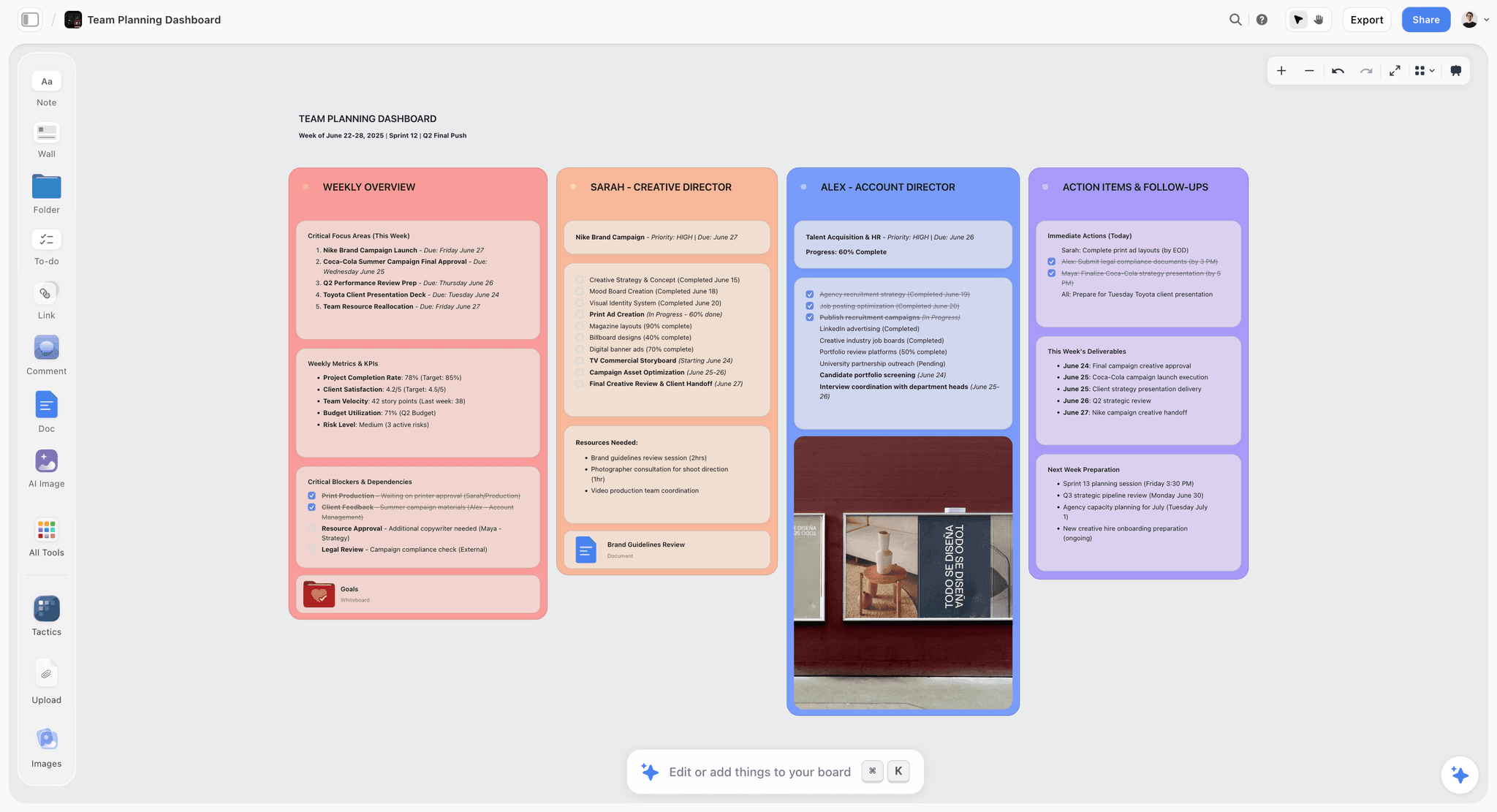
Storyflow is a shared visual canvas where images, notes, links, and documents live together, and the AI reads the whole board rather than one selected item.
That is the reason it ranks first for this specific job. The decider's problem is not access and it is not cursors. It is that sixty contributed references arrived over four days and somebody now has to work out what they collectively argue for and what can go. That is a reading task performed across a whole board, and it is the one thing the AI here is actually built to do. Asking a board what its recurring visual ideas are, which references are redundant, and which three are outliers gets a decider to a defensible cut in minutes rather than in a meeting.
You can bring in surrounding context by @-mentioning up to one Tactic and up to three documents in the AI chat, so the board can be reasoned about against the actual brief rather than in a vacuum. In practice that is what turns "I do not like this one" into "this does not serve the brief's second objective," which is an argument a contributor can accept without it becoming personal.
The sharing model is unusual and worth knowing about: anyone a paid member invites to a board signs up free and can invite others. For a project with freelance contributors (a stylist, a location scout, a colourist) who will touch the board for two weeks and never again, that removes the per-seat conversation entirely. The Max tier adds a team workspace with roles and permissions for organisations that need managed access.
Because the board is a working surface rather than a document, it also tends to survive past approval into the project itself, which is where most moodboards get abandoned.
Where Storyflow loses
Four real limitations, and the first is disqualifying for some teams.
It is not a workshop tool. Miro and Mural are built around synchronous facilitated sessions with timers, voting, structured frames, and facilitator controls. Storyflow is not built around that model and does not try to be. If your moodboarding happens as a live ninety-minute session with eight people and a facilitator, take Miro and do not think twice.
It is paid-only during early access. The Free plan launches before the end of 2026. The invite path above is a genuine free route for collaborators, but the person starting the board pays. FigJam, Miro, and Pinterest all have real free tiers a whole team can use today.
It has no approval workflow. There is no formal approved state, no version locked as the one the client signed off, no approval audit trail. Frame.io has all of that and it is the right tool when sign-off is the actual problem.
It is cloud-only. No offline mode. For a scout in a canyon with no signal, this does not work and something local does.
Pricing: Plus $7.99/mo annual ($9.99 monthly) for the Story blueprints library and unlimited uploads. Pro $14/mo annual ($19 monthly) adds AI image generation, roughly 20 times the AI volume, and memory across conversations. Max $39/mo annual ($49 monthly) adds roughly 40 times the AI volume plus the team workspace with roles and permissions. Note that Plus adds no AI volume over the trial allowance, so if the AI reasoning is why you are here, Pro is the real starting tier.
2. Miro
Miro is the best synchronous collaboration tool on this list and it is not close. If your moodboard gets built in a live session with a group, this is the answer.
The facilitation tooling is what earns it: timers that keep a group moving, private voting that surfaces honest preference instead of the loudest opinion, frames that structure a session into phases, and a presentation mode that walks a group through a board without them wandering. The AI does competent clustering and summarising, which fits the workshop model well: dump forty references, cluster them, name the clusters, vote.
Private voting deserves a specific mention because it partially solves the decider problem in a way nothing else here does. When eight people vote privately on which references to keep, the cut stops being one person overruling colleagues and becomes a group signal. It is not the same as an editorial point of view, and a board chosen entirely by vote tends toward the safe middle, but for teams where the politics of cutting are the actual blocker it is genuinely useful.
Where it is weaker: boards look like working sessions rather than proposals, which matters when the board is the client deliverable. And for the four asynchronous days between sessions, the heavy workshop apparatus is overhead you carry without using.
Pricing: Free tier with limited editable boards. Paid from around $8/member/month annual.
3. Milanote
Milanote remains the most pleasant board-building experience available, and that quality does not disappear when you add collaborators.
Boards are shareable, comments work, and the visual defaults are restrained enough that a Milanote board reads as a considered proposal rather than a workspace. For a small team where one person is clearly the decider and the others contribute occasionally, this is an excellent fit and a lower-friction choice than anything workshop-oriented.
Its limits appear as the team grows. There is no facilitation tooling, permissions are simpler than an organisation with managed access will want, and the AI is organisational rather than analytical, so it will not help a decider reason about a large board. Milanote is a superb tool for one person with an audience, and a merely good one for a genuine multi-contributor process.
Pricing: Free tier capped at 100 items. Paid from around $10/month annual, team pricing above.
4. FigJam
For a team already working in Figma, FigJam is probably the correct answer regardless of what else is on this list, and the reason is organisational rather than technical.
The moodboard sits in the same file tree as the design work, under the same permissions, in front of the same people, with the same comment habits. A board nobody has to go somewhere else to open is a board that gets opened. That beats a marginally better feature set living in a tool half the team forgets to check.
Multiplayer is excellent, the free tier is generous, and the per-editor price is the lowest of the serious tools here. Stickies, voting, and cursor chat cover the workshop case well enough for most teams that are not running formal facilitation.
Against it: FigJam is a design-team tool and non-designers sometimes treat it as foreign territory. If your contributors are producers, stylists, and clients rather than designers, adoption friction is real, and Milanote or Storyflow will get more contributions out of them.
Pricing: Free tier. Paid from around $5/editor/month, separate from and cheaper than Figma design seats.
5. Mural
Mural is Miro's closest competitor and the two are frequently interchangeable, with one real distinction: Mural is more opinionated about facilitation.
Where Miro is a canvas that supports workshops, Mural is a workshop tool that happens to use a canvas. It ships with more structured methods, stronger facilitator controls (including the ability to summon everyone's view to yours), and templates built around specific session formats. For a trained facilitator running a formal session with stakeholders, this structure is an advantage rather than an overhead.
For moodboarding specifically that structure is usually more than the job needs. A moodboard is not a design sprint. Choose Mural when facilitation is a discipline your team practises deliberately; choose Miro when you want a flexible canvas that can also run a session.
I evaluated Mural hands-on on test sessions rather than client work; teams who facilitate professionally will have sharper opinions on the controls than I do.
Pricing: Free tier. Paid from around $12/member/month.
6. Canva
Canva earns its place on the approver side. When the board has to leave the team as a designed document that a marketing lead forwards to someone who was not in any meeting, Canva produces the best-looking version of that with the least effort.
Collaboration is comment-oriented and works fine. Sharing a view-only link that still looks polished is genuinely easy, which is exactly the approver containment the framework asks for: the client sees a proposal, not a workspace, and cannot accidentally start contributing.
Its weakness is the same as in any moodboard context: Canva thinks in pages, and a page is a fixed frame you compose inside. That is right for the deliverable and wrong for the thinking, so teams end up exploring elsewhere and assembling in Canva. That is a sensible division of labour worth planning for rather than discovering in week three.
Pricing: Free tier. Pro from around $15/month, team pricing above.
7. Pinterest Group Boards
Group boards are the most underrated free collaboration feature in this category. Invite five people to a shared board and you have a collective gathering surface with the strongest discovery engine on the list, at no cost, with a tool nobody needs to learn.
For the contributor role in the widening phase, this is genuinely hard to beat. The recommendation engine means contributors find things they would not have searched for, which is exactly what you want early.
It has nothing for the decider and nothing for the approver. No ordering that survives, no captions anyone reads, no way to express why an image is there, and the algorithm keeps feeding so the board keeps growing. A Pinterest group board is a funnel mouth. Move the survivors somewhere that can hold an argument.
Pricing: Free.
8. Notion
Notion is here for the same reason it appears on most tool lists: when a team already runs its briefs, schedules, and shot lists in one place, the real question is whether the moodboard is worth leaving it for. Often it is not.
Collaboration is mature, permissions are granular, comments are good, and the board sits next to the brief, the schedule, and the shot list. For a team already disciplined in Notion, the integration benefit is real.
But moodboarding is spatial and Notion is not. Arranging images so that these three belong together and this one is the outlier that makes the point is the actual work, and a gallery of uniform cards cannot express it. You get a reference list with good permissions rather than a moodboard. Choose it when the cost of another tool genuinely exceeds the benefit, and know what you are trading.
Pricing: Free tier. Paid from around $10/month annual.
9. Frame.io
Frame.io is not a moodboard tool and it is on this list deliberately, because a large share of teams searching for collaborative moodboard software actually have an approval problem.
The symptom: the board is fine, the work is fine, but nobody can say which version the client approved, feedback arrives in three channels, and a decision made six weeks ago cannot be reconstructed. That is not solved by a better canvas. Frame.io models approval as a real state, with versions, structured comments anchored to specific assets, and an audit trail of who approved what and when.
For video teams it is close to standard, and its Adobe integration means comments land in Premiere and After Effects where the work happens.
It builds nothing. There is no canvas, no spatial arrangement, no ideation. Use it downstream of whatever you build the board in. If your Friday review is the painful part rather than the Tuesday building, look here first.
Pricing: Free tier. Paid plans via Adobe.
10. Google Slides
Google Slides is worse than everything above it at building a moodboard, and it wins a real category anyway: the team that will not adopt anything new.
Everyone has it. Nobody needs an account created. Clients open it without a login conversation. Commenting is universally understood, version history is automatic and genuinely good, and permissions are the ones your IT department already approved.
For the approver role in particular this matters more than feature lists admit. A client who receives a Slides link opens it. A client who receives an invitation to a tool they have never heard of sometimes does not, and then the review slips a week.
As a thinking surface it is poor: the frame size decides the thinking, forty images become twelve chosen for fit, and spatial arrangement fights you. But an approved moodboard in Slides beats a beautiful one in a tool your client never opened.
Pricing: Free with a Google account, included in Workspace.
11. Dropbox
Dropbox is the honest floor of this list. A huge number of teams collaborate on moodboards through a shared folder of images, and pretending otherwise would be dishonest about how the industry actually works.
It does the contributor role acceptably. Everyone can add, files sync, storage is solved, and large image sets do not choke it. Comments on files exist.
It does nothing else. No ordering, no captions, no relationships between images, no argument. The board only exists in the head of whoever opens the folder, which means the argument gets rebuilt verbally in every meeting by whoever talks first. That is a tax paid weekly, forever, and it is the single most common reason a moodboard fails to hold.
Included because if this is your current setup, almost anything above is an upgrade, and knowing which specific thing you are missing (ordering and captions) tells you how far up the list you actually need to go.
Pricing: Free tier. Paid plans above.
What to Actually Pay For
Do not pay for the gathering phase. Pinterest group boards are free and better at collective discovery than any paid tool here.
Pay for the decider's problem, if you have it. If boards routinely reach the review with too many images and no argument, that is where money changes the outcome. It is also the least well-served need in the category, which is why it drives this ranking.
Do not buy workshop tooling you will not facilitate. Miro and Mural are excellent and largely wasted on teams that never run a facilitated session. Per-seat pricing for eight people adds up fast for features nobody opens.
Count seats honestly, including freelancers. A tool at $12/member/month is $1,152 a year for eight people. If three of those are freelancers on one project, a model where invited collaborators join free changes the maths considerably.
Pay for approval separately if approval is the problem. Trying to solve sign-off with a better canvas is the most common misdiagnosis in this category.
Tools to Avoid for This Job
Email threads with attachments. No ordering, no current version, and the argument lives in whichever reply someone remembers. Every team knows this and a surprising number still do it.
A group chat. Images scroll away. There is no board, only a history. Retrieving a reference from three weeks ago is archaeology.
Anything that gives the approver edit access. This is a permissions decision, not a tool decision, and it is made wrongly constantly. The moment a client can edit, they contribute, and the person paying is now widening the pool you needed to narrow.
A second moodboard tool "just for this project." Fragmentation costs more than any feature gain. The board that gets looked at is the one in the tool the team already opens.
What No Tool on This List Does
None of them will cut for you. The AI in Storyflow gets a decider to a defensible cut faster, and Miro's voting distributes the social cost, but no tool will tell you which image is the outlier that makes the point. That judgment is the job and it stays human.
None of them manage the politics of contribution. When a senior stakeholder adds six references that do not serve the brief, that is a conversation, not a feature. Every tool makes the deletion technically trivial and socially identical.
None of them track rights across contributors. A found reference contributed by a freelancer is fine as a reference and not fine as an asset, and boards with many contributors cross that line more often, because nobody knows where an image came from. No tool here records provenance well enough to help.
The Bottom Line
Collaborative moodboard tools are mostly sold on the wrong axis. The marketing is about presence: cursors, live editing, everyone at once. The actual failure is that boards accumulate contributions and never get cut, because the decider role is unsupported and cutting a colleague's reference is socially expensive.
Rank your own situation before your tools. If you run genuine facilitated sessions, Miro or Mural, and the workshop features justify their cost. If your team lives in Figma, FigJam, for reasons that have nothing to do with features. If sign-off is the painful part, you want Frame.io and a process, not a canvas. If one person builds and others review, Milanote is the most pleasant tool here.
And if the recurring problem is sixty references and no argument, that is the decider's problem, and it is why Storyflow ranks first on this particular list. It is also paid-only right now, cloud-only, has no approval workflow, and loses decisively to Miro the moment your process involves a facilitator and a timer.
A moodboard with five contributors and no decider is not a moodboard. It is a folder with opinions. Pick the tool that helps somebody turn it back into an argument.
FAQ: Collaborative Moodboard Tools
What is the best collaborative moodboard tool in 2026?
Storyflow, if the problem you actually have is that boards arrive at review with too many images and no argument, because its AI reads the whole board and helps the decider cut. Miro is the better answer if your moodboarding happens as a live facilitated session. FigJam is the better answer if your team already lives in Figma.
What is the best free collaborative moodboard tool?
Pinterest group boards for gathering, which is free and genuinely excellent at collective discovery. FigJam's free tier is the best free option for actually building a board together. Milanote's free tier works for a small team on a single project at 100 items. Storyflow is paid-only during early access, so it does not belong in a free comparison, though anyone a paid member invites to a board joins free.
Miro or Milanote for moodboards?
Miro if the board is built by a group in a live session and you want timers, voting, and facilitation. Milanote if one person is clearly the decider and others contribute occasionally, because the board-building experience is far more pleasant and the output reads as a proposal rather than a workshop. Most moodboards are the second case.
How do you stop a collaborative moodboard becoming a dumping ground?
Name the decider before the board opens, and give the approver view-and-comment rather than edit. Those two decisions prevent most of the failure. Also cap the argument board explicitly: agree that whatever the gathering board holds, the version that goes to the client is ten to fifteen images. A stated cap makes cutting a process rather than a personal judgment.
Should clients have edit access to a moodboard?
No. Give them view and comment. An approver with edit access starts contributing, which widens the pool at exactly the moment you need it narrowed, and it makes the board's point of view negotiable when it should be a proposal they accept or reject.
Do we need real-time collaboration for moodboards?
Usually not. Moodboards accumulate over days and the synchronous moment is a review, not a build. Real-time features optimise about thirty minutes out of a working week. If your live reviews are chaotic, the fix is a review process or an approval tool, not faster cursors.
What is the difference between a collaborative moodboard and a whiteboard?
A whiteboard is a general-purpose surface for any visual thinking: diagrams, stickies, workshops. A moodboard is a specific artifact making a specific claim about how something should look and feel. You can build a moodboard on a whiteboard, and teams do, but whiteboard tools optimise for the session while moodboard tools optimise for the artifact.
How many people should contribute to a moodboard?
As many as have relevant references, which on a film can be six or eight. The number that should be cutting is one. Problems in this category almost never come from too many contributors; they come from zero deciders.
Can AI help with collaborative moodboards?
The useful version is analytical rather than generative. AI that reads a whole board and identifies recurring visual ideas, redundancy, and outliers helps the decider reduce sixty references to twelve. Storyflow does this. AI that generates more images makes the contributor's job easier, which is the job that was already easy.
What is the best tool for client moodboard approval?
Frame.io if approval needs to be a formal, auditable state with versions and anchored feedback. Canva or Google Slides if you need a polished, low-friction artifact a client will actually open. A canvas tool is the wrong shape for approval, and trying to solve sign-off with a better canvas is the most common misdiagnosis here.
How do you share a moodboard with freelancers without paying for seats?
Check the collaboration model before the price. Storyflow lets anyone a paid member invites join free and invite others, which suits projects with short-term specialist contributors. FigJam and Miro have free viewer or limited-editor tiers worth reading carefully. Per-seat pricing is where team tools get expensive fast on projects with a rotating cast.
What is the single change worth making to how our team moodboards?
Separate the roles explicitly before the board opens. Name one decider, give contributors edit, give approvers view-and-comment, and state the cap for the client-facing version. Most collaborative moodboard problems are role problems wearing a tool problem's clothes, and no purchase fixes them.
Table of Contents
- Key Takeaways
- The Three Collaborators
- At a Glance: The 11 Tools Compared
- How I Ranked These
- The Multiplayer Mirage
- Quick Picks by Situation
- 1. Storyflow
- 2. Miro
- 3. Milanote
- 4. FigJam
- 5. Mural
- 6. Canva
- 7. Pinterest Group Boards
- 8. Notion
- 9. Frame.io
- 10. Google Slides
- 11. Dropbox
- What to Actually Pay For
- Tools to Avoid for This Job
- What No Tool on This List Does
- The Bottom Line
- FAQ: Collaborative Moodboard Tools
- Related Reading
Templates to check out for this topic


Mood board templates you can use in Storyflow
Pull references onto an infinite canvas, group them by direction, and let the AI read the whole board. Open any of these mood board templates and start dropping in images.


See Storyflow in Action
A visual AI workspace where every feature lives inside one canvas. No tab-switching, no context lost.
Build your entire board from a single message
Type what you need in the AI chat at the bottom of your canvas. The AI adds cards, headings, and structure directly onto your board.
Use expert frameworks as AI context
Type @ in the AI chat and choose any Tactic. The AI tailors every response to that framework instead of giving generic advice.
Turn your board into a mind map in seconds
Ask the AI to restructure your canvas as a mindmap. It connects your ideas into a visual hierarchy so you can see how everything relates.
Why Storyflow Exists
Storyflow actually began as a personal tool while working on creative and research projects.
We kept running into the same problem: ideas were scattered everywhere: notes, documents, and whiteboards.
Nothing helped us see how everything connected.
So we started building a workspace designed around how ideas actually grow.
→ Read how Storyflow was createdSara de Klein
Head of Product at Storyflow
Published: 2026-08-12
Extremely simple, seriously capable


See how easy it is to get started
Watch a real project come together, from a blank board to a finished plan, clicked through step by step.
Start creating with AI and become more productive
Transform your creative workflow with AI-powered tools. Generate ideas, create content, and boost your productivity in minutes instead of hours.